

IEC 60848:2002
(Main)GRAFCET specification language for sequential function charts
General Information
- Abstract
Defines the GRAFCET specification language for the functional description of the behaviour of the sequential part of a control system. Specifies the symbols and the rules for the graphical representation of this language, as well as for its interpretation. Is primarily for automated production systems of industrial applications. It has the status of a horizontal standard in accordance with IEC Guide 108.
- Status
- Published
- Publication Date
- 25-Feb-2002
- Current Stage
- DELPUB - Deleted Publication
- Start Date
- 27-Feb-2013
- Completion Date
- 28-Aug-2026
Overview
IEC 60848:2002 defines the GRAFCET specification language for sequential function charts, providing a standardized method to describe the behavior of the sequential parts of control systems. As a horizontal international standard developed by the International Electrotechnical Commission (IEC), it primarily targets automated production systems in industrial applications. The document specifies the set of symbols and graphical rules required for representing GRAFCET diagrams and their proper interpretation throughout the control system lifecycle.
This standard facilitates consistent behavioral specifications and enhances communication between system designers, engineers, and stakeholders. IEC 60848:2002 represents a major revision of the original 1988 edition, introducing important concepts like input events, internal events, assignations, forcing, macro-steps, and enclosures for richer modeling capabilities.
Key Topics
Scope and Purpose
GRAFCET (Graphe Fonctionnel de Commande Etape-Transition) provides a formal language for describing the sequential functions in control systems, particularly in industrial automation.Graphical Elements and Syntax Rules
The standard defines graphical elements such as steps, transitions, actions, macro-steps, and their interrelations for depicting control sequences. Syntax rules guide the correct formation of charts to maintain clarity and avoid ambiguity.Behavioral Specification
By using input and internal events, and through event-driven evolution rules, the GRAFCET language precisely models how control systems behave under various scenarios.Structuring Mechanisms
IEC 60848 introduces structuring concepts including partitions, encapsulation, macro-steps, and forcing, allowing complex controls to be modularized and better managed.Output Modes and Evolution
Two output modes are described, detailing how outputs from sequential control behave and change in response to inputs and events over time.Integration with IEC 61131-3
Annex C of the standard offers guidance on the relationships between GRAFCET and the Sequential Function Charts (SFC) language defined in IEC 61131-3, facilitating interoperability between standards.
Applications
IEC 60848 is widely applied in designing automated production systems, including manufacturing lines, robotic controls, and complex machinery management. Its use provides:
- Clear functional representation of industrial sequential controls that improves design accuracy and maintainability.
- Standardized documentation that enhances international cooperation and communication among engineers, manufacturers, and system integrators.
- Improved reliability and verification by providing unambiguous diagrams enabling early detection of design flaws.
- Modular design capability through structuring rules, promoting reusable control components and system scalability.
Typical industries benefiting from this standard include automotive manufacturing, food processing, pharmaceutical production, and any sector requiring robust, sequential process automation.
Related Standards
- IEC 61131-3: Defines programming languages for industrial control systems including Sequential Function Charts (SFC), closely related to GRAFCET. IEC 60848 provides complementary graphical and specification details.
- IEC Guide 108: Establishes the status and role of horizontal standards like IEC 60848 which apply across multiple industries and sectors.
- ISO/IEC Directives: Guidelines followed in drafting IEC 60848 to ensure harmonized international standard development and publication processes.
By adhering to IEC 60848, organizations ensure compliance with international best practices for sequential function chart specification, facilitating interoperability and consistency across automation projects globally.
Keywords: IEC 60848, GRAFCET, sequential function charts, control systems, industrial automation, behavioral specification language, automated production systems, graphical representation, sequential control, IEC standards, IEC 61131-3, automation engineering, standardized control documentation
Relations
- Effective Date
- 09-Feb-2026
- Effective Date
- 05-Sep-2023
Get Certified
Connect with accredited certification bodies for this standard

IMQ S.p.A. (Certification)
Italian electrical product certification.

SLG Prüf- und Zertifizierungs GmbH
German testing and certification body.

UL Solutions
Global safety science company with testing, inspection and certification.
Sponsored listings
Frequently Asked Questions
IEC 60848:2002 is a standard published by the International Electrotechnical Commission (IEC). Its full title is "GRAFCET specification language for sequential function charts". This standard covers: Defines the GRAFCET specification language for the functional description of the behaviour of the sequential part of a control system. Specifies the symbols and the rules for the graphical representation of this language, as well as for its interpretation. Is primarily for automated production systems of industrial applications. It has the status of a horizontal standard in accordance with IEC Guide 108.
Defines the GRAFCET specification language for the functional description of the behaviour of the sequential part of a control system. Specifies the symbols and the rules for the graphical representation of this language, as well as for its interpretation. Is primarily for automated production systems of industrial applications. It has the status of a horizontal standard in accordance with IEC Guide 108.
IEC 60848:2002 is classified under the following ICS (International Classification for Standards) categories: 29.020 - Electrical engineering in general. The ICS classification helps identify the subject area and facilitates finding related standards.
IEC 60848:2002 has the following relationships with other standards: It is inter standard links to EN ISO 13631:2002, IEC 60848:2013. Understanding these relationships helps ensure you are using the most current and applicable version of the standard.
IEC 60848:2002 is available in PDF format for immediate download after purchase. The document can be added to your cart and obtained through the secure checkout process. Digital delivery ensures instant access to the complete standard document.
Standards Content (Sample)
NORME CEI
INTERNATIONALE IEC
INTERNATIONAL
Deuxième édition
STANDARD
Second edition
2002-02
Langage de spécification GRAFCET
pour diagrammes fonctionnels en séquence
GRAFCET specification language
for sequential function charts
Numéro de référence
Reference number
CEI/IEC 60848:2002
Numérotation des publications Publication numbering
Depuis le 1er janvier 1997, les publications de la CEI As from 1 January 1997 all IEC publications are
sont numérotées à partir de 60000. Ainsi, la CEI 34-1 issued with a designation in the 60000 series. For
devient la CEI 60034-1. example, IEC 34-1 is now referred to as IEC 60034-1.
Editions consolidées Consolidated editions
Les versions consolidées de certaines publications de la The IEC is now publishing consolidated versions of its
CEI incorporant les amendements sont disponibles. Par publications. For example, edition numbers 1.0, 1.1
exemple, les numéros d’édition 1.0, 1.1 et 1.2 indiquent and 1.2 refer, respectively, to the base publication,
respectivement la publication de base, la publication de the base publication incorporating amendment 1 and
base incorporant l’amendement 1, et la publication de the base publication incorporating amendments 1
base incorporant les amendements 1 et 2. and 2.
Informations supplémentaires Further information on IEC publications
sur les publications de la CEI
Le contenu technique des publications de la CEI est The technical content of IEC publications is kept
constamment revu par la CEI afin qu'il reflète l'état under constant review by the IEC, thus ensuring that
actuel de la technique. Des renseignements relatifs à the content reflects current technology. Information
cette publication, y compris sa validité, sont dispo- relating to this publication, including its validity, is
nibles dans le Catalogue des publications de la CEI available in the IEC Catalogue of publications
(voir ci-dessous) en plus des nouvelles éditions, (see below) in addition to new editions, amendments
amendements et corrigenda. Des informations sur les and corrigenda. Information on the subjects under
sujets à l’étude et l’avancement des travaux entrepris consideration and work in progress undertaken by the
par le comité d’études qui a élaboré cette publication, technical committee which has prepared this
ainsi que la liste des publications parues, sont publication, as well as the list of publications issued,
également disponibles par l’intermédiaire de: is also available from the following:
• Site web de la CEI (www.iec.ch) • IEC Web Site (www.iec.ch)
• Catalogue des publications de la CEI • Catalogue of IEC publications
Le catalogue en ligne sur le site web de la CEI The on-line catalogue on the IEC web site
(www.iec.ch/catlg-f.htm) vous permet de faire des (www.iec.ch/catlg-e.htm) enables you to search
recherches en utilisant de nombreux critères, by a variety of criteria including text searches,
comprenant des recherches textuelles, par comité technical committees and date of publication. On-
d’études ou date de publication. Des informations line information is also available on recently
en ligne sont également disponibles sur les issued publications, withdrawn and replaced
nouvelles publications, les publications rempla- publications, as well as corrigenda.
cées ou retirées, ainsi que sur les corrigenda.
• IEC Just Published
• IEC Just Published
Ce résumé des dernières publications parues
This summary of recently issued publications
(www.iec.ch/JP.htm) est aussi disponible par
(www.iec.ch/JP.htm) is also available by email.
courrier électronique. Veuillez prendre contact
Please contact the Customer Service Centre (see
avec le Service client (voir ci-dessous) pour plus
below) for further information.
d’informations.
• Service clients
• Customer Service Centre
Si vous avez des questions au sujet de cette
If you have any questions regarding this
publication ou avez besoin de renseignements
publication or need further assistance, please
supplémentaires, prenez contact avec le Service
contact the Customer Service Centre:
clients:
Email: custserv@iec.ch
Email: custserv@iec.ch
Tél: +41 22 919 02 11
Tel: +41 22 919 02 11
Fax: +41 22 919 03 00
Fax: +41 22 919 03 00
.
NORME CEI
INTERNATIONALE IEC
INTERNATIONAL
Deuxième édition
STANDARD
Second edition
2002-02
Langage de spécification GRAFCET
pour diagrammes fonctionnels en séquence
GRAFCET specification language
for sequential function charts
IEC 2002 Droits de reproduction réservés Copyright - all rights reserved
Aucune partie de cette publication ne peut être reproduite ni No part of this publication may be reproduced or utilized in any
utilisée sous quelque forme que ce soit et par aucun procédé, form or by any means, electronic or mechanical, including
électronique ou mécanique, y compris la photocopie et les photocopying and microfilm, without permission in writing from
microfilms, sans l'accord écrit de l'éditeur. the publisher.
International Electrotechnical Commission, 3, rue de Varembé, PO Box 131, CH-1211 Geneva 20, Switzerland
Telephone: +41 22 919 02 11 Telefax: +41 22 919 03 00 E-mail: inmail@iec.ch Web: www.iec.ch
CODE PRIX
XA
PRICE CODE
Commission Electrotechnique Internationale
International Electrotechnical Commission
Международная Электротехническая Комиссия
Pour prix, voir catalogue en vigueur
For price, see current catalogue
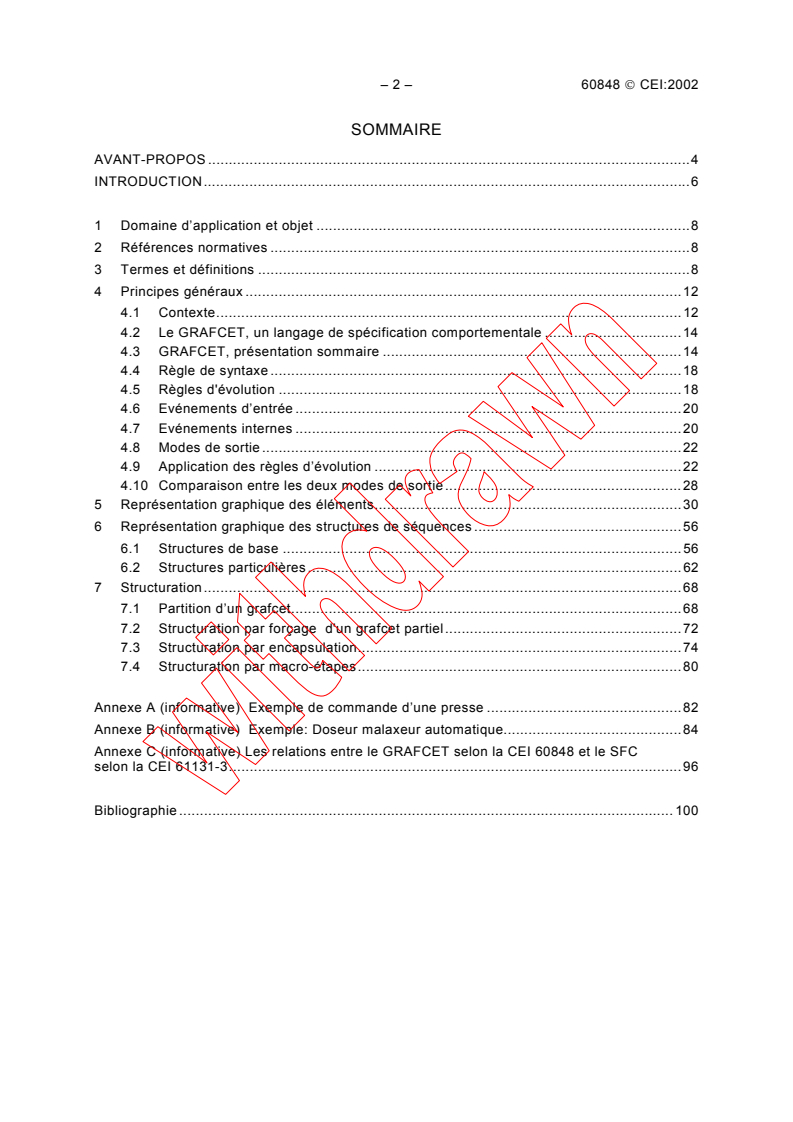
– 2 – 60848 CEI:2002
SOMMAIRE
AVANT-PROPOS .4
INTRODUCTION.6
1 Domaine d’application et objet .8
2 Références normatives .8
3 Termes et définitions .8
4 Principes généraux .12
4.1 Contexte.12
4.2 Le GRAFCET, un langage de spécification comportementale .14
4.3 GRAFCET, présentation sommaire .14
4.4 Règle de syntaxe .18
4.5 Règles d'évolution .18
4.6 Evénements d’entrée .20
4.7 Evénements internes .20
4.8 Modes de sortie.22
4.9 Application des règles d’évolution .22
4.10 Comparaison entre les deux modes de sortie.28
5 Représentation graphique des éléments.30
6 Représentation graphique des structures de séquences .56
6.1 Structures de base .56
6.2 Structures particulières .62
7 Structuration.68
7.1 Partition d’un grafcet.68
7.2 Structuration par forçage d'un grafcet partiel.72
7.3 Structuration par encapsulation.74
7.4 Structuration par macro-étapes.80
Annexe A (informative) Exemple de commande d’une presse .82
Annexe B (informative) Exemple: Doseur malaxeur automatique.84
Annexe C (informative) Les relations entre le GRAFCET selon la CEI 60848 et le SFC
selon la CEI 61131-3.96
Bibliographie . 100
60848 IEC:2002 – 3 –
CONTENTS
FOREWORD.5
INTRODUCTION.7
1 Scope and object .9
2 Normative references.9
3 Terms and definitions .9
4 General principles.13
4.1 Context.13
4.2 GRAFCET, a behaviour specification language .15
4.3 GRAFCET, short presentation.15
4.4 Syntax rule .19
4.5 Evolution rules.19
4.6 Input events.21
4.7 Internal events.21
4.8 Output modes.23
4.9 Application of the evolution rules.23
4.10 Comparison between the two output modes .29
5 Graphical representation of the elements .31
6 Graphical representation of sequential structures .57
6.1 Basic structures.57
6.2 Particular structures .63
7 Structuring.69
7.1 Partition of a grafcet .69
7.2 Structuring using the forcing of a partial grafcet .73
7.3 Structuring using the enclosure.75
7.4 Structuring using the macro-steps.81
Annex A (informative) Example of control of a press.83
Annex B (informative) Example: Automatic weighing-mixing.85
Annex C (informative) Relations between the GRAFCET of IEC 60848
and the SFC of IEC 61131-3.97
Bibliography . 101
– 4 – 60848 CEI:2002
COMMISSION ÉLECTROTECHNIQUE INTERNATIONALE
____________
LANGAGE DE SPÉCIFICATION GRAFCET
POUR DIAGRAMMES FONCTIONNELS EN SÉQUENCE
AVANT-PROPOS
1) La CEI (Commission Électrotechnique Internationale) est une organisation mondiale de normalisation composée
de l'ensemble des comités électrotechniques nationaux (Comités nationaux de la CEI). La CEI a pour objet de
favoriser la coopération internationale pour toutes les questions de normalisation dans les domaines de
l'électricité et de l'électronique. A cet effet, la CEI, entre autres activités, publie des Normes internationales.
Leur élaboration est confiée à des comités d'études, aux travaux desquels tout Comité national intéressé par le
sujet traité peut participer. Les organisations internationales, gouvernementales et non gouvernementales, en
liaison avec la CEI, participent également aux travaux. La CEI collabore étroitement avec l'Organisation
Internationale de Normalisation (ISO), selon des conditions fixées par accord entre les deux organisations.
2) Les décisions ou accords officiels de la CEI concernant les questions techniques représentent, dans la mesure
du possible un accord international sur les sujets étudiés, étant donné que les Comités nationaux intéressés
sont représentés dans chaque comité d’études.
3) Les documents produits se présentent sous la forme de recommandations internationales. Ils sont publiés
comme normes, spécifications techniques, rapports techniques ou guides et agréés comme tels par les Comités
nationaux.
4) Dans le but d'encourager l'unification internationale, les Comités nationaux de la CEI s'engagent à appliquer de
façon transparente, dans toute la mesure possible, les Normes internationales de la CEI dans leurs normes
nationales et régionales. Toute divergence entre la norme de la CEI et la norme nationale ou régionale
correspondante doit être indiquée en termes clairs dans cette dernière.
5) La CEI n’a fixé aucune procédure concernant le marquage comme indication d’approbation et sa responsabilité
n’est pas engagée quand un matériel est déclaré conforme à l’une de ses normes.
6) L’attention est attirée sur le fait que certains des éléments de la présente Norme internationale peuvent faire
l’objet de droits de propriété intellectuelle ou de droits analogues. La CEI ne saurait être tenue pour
responsable de ne pas avoir identifié de tels droits de propriété et de ne pas avoir signalé leur existence.
La Norme internationale CEI 60848 a été établie par le sous-comité 3B: Documentation, du
comité d'études 3 de la CEI: Structures d'informations, documentation et symboles graphiques.
Cette deuxième édition annule et remplace la première édition parue en 1988, dont elle
constitue une révision technique générale comprenant l’ajout des principaux concepts suivants:
événement d’entrée, événement interne, assignation, affectation, forçage, macro-étape et
encapsulation.
Le texte de cette norme est issu des documents suivants:
FDIS Rapport de vote
3B/344/FDIS 3B/346/RVD
Le rapport de vote indiqué dans le tableau ci-dessus donne toute information sur le vote ayant
abouti à l'approbation de cette norme.
Cette publication a été rédigée selon les Directives ISO/CEI, Partie 3.
Les annexes A, B et C sont données uniquement à titre d’information.
Le comité a décidé que le contenu de cette publication ne sera pas modifié avant 2006. A cette
date, la publication sera
• reconduite;
• supprimée;
• remplacée par une édition révisée, ou
• amendée.
60848 IEC:2002 – 5 –
INTERNATIONAL ELECTROTECHNICAL COMMISSION
____________
GRAFCET SPECIFICATION LANGUAGE
FOR SEQUENTIAL FUNCTION CHARTS
FOREWORD
1) The IEC (International Electrotechnical Commission) is a worldwide organization for standardization comprising
all national electrotechnical committees (IEC National Committees). The object of the IEC is to promote
international co-operation on all questions concerning standardization in the electrical and electronic fields. To
this end and in addition to other activities, the IEC publishes International Standards. Their preparation is
entrusted to technical committees; any IEC National Committee interested in the subject dealt with may
participate in this preparatory work. International, governmental and non-governmental organizations liaising
with the IEC also participate in this preparation. The IEC collaborates closely with the International Organization
for Standardization (ISO) in accordance with conditions determined by agreement between the two
organizations.
2) The formal decisions or agreements of the IEC on technical matters express, as nearly as possible, an
international consensus of opinion on the relevant subjects since each technical committee has representation
from all interested National Committees.
3) The documents produced have the form of recommendations for international use and are published in the form
of standards, technical specifications, technical reports or guides and they are accepted by the National
Committees in that sense.
4) In order to promote international unification, IEC National Committees undertake to apply IEC International
Standards transparently to the maximum extent possible in their national and regional standards. Any
divergence between the IEC Standard and the corresponding national or regional standard shall be clearly
indicated in the latter.
5) The IEC provides no marking procedure to indicate its approval and can not be rendered responsible for any
equipment declared to be in conformity with one of its standards.
6) Attention is drawn to the possibility that some of the elements of this International Standard may be the subject
of patent rights. The IEC shall not be held responsible for identifying any or all such patent rights.
International Standard IEC 60848 has been prepared by subcommittee 3B: Documentation, of
IEC technical committee 3: Information structures, documentation and graphical symbols.
This second edition cancels and replaces the first edition published in 1988 and constitutes a
global technical revision with the addition of the following main concepts: input event, internal
event, assignation, allocation, forcing, macro-step and enclosure.
The text of this standard is based on the following documents:
FDIS Report on voting
3B/344/FDIS 3B/346/RVD
Full information on the voting for the approval of this standard can be found in the report on
voting indicated in the above table.
This publication has been drafted in accordance with the ISO/IEC Directives, Part 3.
Annexes A, B and C are for information only.
The committee has decided that the contents of this publication will remain unchanged until
2006. At this date, the publication will be
• reconfirmed;
• withdrawn;
• replaced by a revised edition, or
• amended.
– 6 – 60848 CEI:2002
INTRODUCTION
La principale raison de la révision de la première édition de cette norme est la volonté des
utilisateurs d'enrichir l'outil de spécification normalisé par de nouveaux concepts, permettant
une description structurée et hiérarchisée.
Par ailleurs, il apparaît maintenant nécessaire d’ajouter aux aspects descriptifs et fonctionnels
de la première édition les aspects formels et comportementaux essentiels à la définition d’un
véritable langage de spécification.
Toutes ces raisons ont rendu nécessaire une révision générale de la norme.
Cette norme est destinée principalement aux utilisateurs (concepteurs, réalisateurs, agents de
maintenance, etc.) qui ont besoin de spécifier le comportement d’un système (commande
d’une machine automatique, composant de sûreté, etc.). Ce langage de spécification peut
également servir de moyen de communication entre les concepteurs et les utilisateurs de
systèmes automatisés.
60848 IEC:2002 – 7 –
INTRODUCTION
The main reason for the revision of this standard is the desire of the users to increase the
standardised specification language with new concepts, allowing a structured and hierarchical
description.
Otherwise, in addition to the descriptive and functional aspects of the first edition, it now seems
necessary to add the formal and behavioural aspects, which are essential for the definition of a
real specification language.
For all these reasons, an overall review of the document is required.
This standard is mainly for people (design engineers, realisation engineers, maintenance
engineers, etc.) who need to specify the behaviour of a system (control-command of an
automatic machine, safety component, etc.). This specification language should also serve as
a communication means between designers and users of automated systems.
– 8 – 60848 CEI:2002
LANGAGE DE SPÉCIFICATION GRAFCET
POUR DIAGRAMMES FONCTIONNELS EN SÉQUENCE
1 Domaine d’application et objet
1)
La présente Norme internationale définit le langage de spécification GRAFCET pour la des-
cription fonctionnelle du comportement de la partie séquentielle des systèmes de commande.
Cette norme définit les symboles et les règles nécessaires à la représentation graphique de ce
langage, ainsi que l'interprétation qui en est faite.
Cette norme a été établie pour les systèmes automatisés de production des applications
industrielles, cependant aucun champ d'application n'est exclu.
Les méthodes de réalisation d’une spécification utilisant le GRAFCET ne font pas partie du
domaine d’application de cette norme. Une méthode possible est l’utilisation du langage «SFC»
décrit dans la CEI 61131-3, qui définit un ensemble de langages de programmation destinés
aux automates programmables.
NOTE Voir l'annexe C pour de plus amples informations sur les relations entre la CEI 60848 et les langages de
réalisation comme le SFC de la CEI 61131-3.
2 Références normatives
Les documents normatifs suivants contiennent des dispositions qui, par suite de la référence
qui y est faite, constituent des dispositions valables pour la présente Norme internationale.
Pour les références datées, les amendements ultérieurs ou les révisions de ces publications ne
s’appliquent pas. Toutefois, les parties prenantes aux accords fondés sur la présente Norme
internationale sont invitées à rechercher la possibilité d'appliquer les éditions les plus récentes
des documents normatifs indiqués ci-après. Pour les références non datées, la dernière édition
du document normatif en référence s’applique. Les membres de la CEI et de l'ISO possèdent
le registre des Normes internationales en vigueur.
CEI 60050-351:1998, Vocabulaire Electrotechnique International (VEI) – Partie 351:
Commande et régulation automatiques
CEI 60617-12:1997, Symboles graphiques pour schémas – Partie 12: Opérateurs logiques
binaires
3 Termes et définitions
Pour les besoins de la présente Norme internationale, les termes et définitions suivants
s’appliquent. Les définitions des termes précédés d’un astérisque ne s’appliquent que dans le
contexte du langage de spécification GRAFCET.
3.1
* action
élément du langage GRAFCET associé à une étape, l’action indique le comportement d’une
variable de sortie
———————
1)
GRAFCET, GRAphe Fonctionnel de Commande Etape Transition.
60848 IEC:2002 – 9 –
GRAFCET SPECIFICATION LANGUAGE
FOR SEQUENTIAL FUNCTION CHARTS
1 Scope and object
1)
This International Standard defines the GRAFCET specification language for the functional
description of the behaviour of the sequential part of a control system.
This standard specifies the symbols and the rules for the graphical representation of this
language, as well as for its interpretation.
This standard has been prepared for automated production systems of industrial applications.
However no particular area of application is excluded.
Methods of development of a specification that makes use of GRAFCET are beyond the scope
of this standard. One method is for example the "SFC language" specified in IEC 61131-3,
which defines a set of programming languages for programmable controllers.
NOTE See annex C for further information on the relations between IEC 60848 and implementation languages
such as the SFC of IEC 61131-3.
2 Normative references
The following normative documents contain provisions, which, through reference in this text,
constitute provisions of this International Standard. For dated references, subsequent
amendments to, or revisions of, any of these publications do not apply. However, parties to
agreements based on this International Standard are encouraged to investigate the possibility
of applying the most recent editions of the normative documents indicated below. For undated
references, the latest edition of the normative document referred to applies. Members of IEC
and ISO maintain registers of currently valid International Standards.
IEC 60050-351:1998, International Electrotechnical Vocabulary (VEI – Part 351: Automatic
control
IEC 60617-12:1997, Graphical symbols for diagrams – Part 12: Binary logical elements
3 Terms and definitions
For the purposes of this International Standard, the following definitions apply. The definitions
of the terms preceded by an asterisk apply only in the context of the GRAFCET specification
language. The chosen order is the alphabetic one.
3.1
* action
GRAFCET language element associated with a step, indicating an activity to be performed on
output variables
———————
1)
GRAFCET , GRAphe Fonctionnel de Commande Etape Transition.
– 10 – 60848 CEI:2002
3.2
diagramme
représentation graphique décrivant le comportement d’un système, par exemple les relations
entre deux ou plus de deux grandeurs variables, actions ou états
3.3
* liaison orientée
élément du langage GRAFCET, les liaisons orientées indiquent les voies d'évolution en reliant
les étapes aux transitions et les transitions aux étapes
3.4
* diagramme grafcet
diagramme fonctionnel utilisant le langage GRAFCET
NOTE Le terme «diagramme grafcet» est, en raccourci, remplacé par «grafcet».
3.5
* événement d’entrée
événement caractérisé par le changement de valeur d’une ou plusieurs variables d’entrée de la
partie séquentielle du système
3.6
* événement interne
événement caractérisé par un événement d’entrée associé à la situation de la partie
séquentielle du système
3.7
* interprétation
partie du GRAFCET permettant de faire la relation entre:
– les variables d'entrées et la structure, par les réceptivités;
– les variables de sorties et la structure, par les actions
3.8
* situation
désignation de l'état du système spécifié par un grafcet et caractérisé par les étapes actives à
l’instant considéré
3.9
* étape
élément du langage GRAFCET utilisé pour définir la situation de la partie séquentielle d’un
système
NOTE 1 Une étape est soit active soit inactive.
NOTE 2 L’ensemble des étapes actives représente la situation du système.
3.10
* structure
partie du GRAFCET permettant de décrire l'évolution possible entre les situations
3.11
système
ensemble d'éléments reliés entre eux, considérés dans un contexte défini comme un tout et
séparés de leur environnement
[VEI 351-11-01]
NOTE 1 Les éléments du système peuvent être à la fois des objets matériels ou des concepts aussi bien
que les résultats de ceux-ci (par exemple formes d'organisation, méthodes mathématiques, langages de
programmation).
60848 IEC:2002 – 11 –
3.2
chart, graph
graphical presentation describing the behaviour of a system, for example the relations between
two or more variable quantities, operations or states
3.3
* directed link
GRAFCET language element indicating the evolution paths between steps by connecting steps
to transitions and transitions to steps
3.4
* grafcet chart
function chart using GRAFCET
NOTE The “grafcet chart” can, in short form, be called “grafcet”.
3.5
* input event
event characterized by the change of at least one value of all input variables of the sequential
part of the system
3.6
* internal event
event characterized by an input event associated with the situation of the sequential part of the
system
3.7
* interpretation
part of the GRAFCET enabling the linkage of:
– the input variables and the structure, by the means of the transition-condition;
– the output variables and the structure, by the means of the actions
3.8
* situation
name of the state of the system described by grafcet and characterised by the active steps at a
given instant
3.9
* step
GRAFCET language element used for the definition of the state of the sequential part of the
system
NOTE 1 A step can be active or inactive.
NOTE 2 The set of active steps represents the situation of the system.
3.10
* structure
part of the GRAFCET enabling the description of the possible evolution between situations
3.11
system
a set of interrelated elements considered in a defined context as a whole and separated from
their environment
[IEV 351-11-01]
NOTE 1 Such elements may be material objects and concepts as well as their results (e.g. forms of organisation,
mathematical methods, programming languages).
– 12 – 60848 CEI:2002
NOTE 2 Le système est considéré comme séparé de l’environnement et des autres systèmes extérieurs par une
surface imaginaire qui coupe les liaisons entre eux et le système.
NOTE 3 Le langage GRAFCET peut être utilisé pour décrire le comportement logique de n’importe quel type de
système.
3.12
* évolution fugace
évolution caractérisée par le franchissement de plusieurs transitions successives à
l’occurrence d’un unique événement d’entrée
3.13
* transition
élément du langage GRAFCET, une transition indique la possibilité d'évolution d'activité entre
deux ou plusieurs étapes
NOTE Cette évolution possible s'accomplit par le franchissement de la transition.
3.14
* réceptivité
élément du langage GRAFCET associé à une transition, la réceptivité exprime le résultat d’une
expression booléenne
NOTE Une réceptivité est soit vraie soit fausse.
4 Principes généraux
4.1 Contexte
La réalisation d'un système automatisé requiert, notamment, une description liant les effets
aux causes. Pour cela, on décrira l'aspect logique du comportement souhaité du système.
La partie séquentielle du système désigne l'aspect logique d'un système physique auquel on
accède par des variables d'entrée et des variables de sortie booléennes. Le comportement
indique la manière dont les variables de sortie dépendent des variables d'entrée (voir note de
la figure 1). Le GRAFCET a pour objet de spécifier le comportement de la partie séquentielle
des systèmes.
SYSTEME
PARTIE SEQUENTIELLE DU SYSTEME
fi
fr
auto
Entrées Sorties
P/P
hg
booléennes
booléennes
fi
Dcy
hg fr
Pv
(auto Pv ) + (P/P Dcy)
⋅ ⋅
mr fr
Sorties non
[C > 6]
[C > 6]
C
booléennes
Test
mr
Entrées non
booléennes
PID
NOTE La partie séquentielle du système est caractérisée par ses variables d'entrée, ses variables de sortie et son
comportement. Cette partie séquentielle ne comporte que des variables d'entrées et de sorties booléennes,
toutefois le langage de spécification GRAFCET permet par extension (exemple: évaluation d'un prédicat ou
affectation d'une valeur numérique à une variable) de décrire le comportement de variables non booléennes.
Figure 1 – Représentation graphique de la partie séquentielle d’un système
60848 IEC:2002 – 13 –
NOTE 2 The system is considered to be separated from the environment and from the other external systems by
an imaginary surface, which cuts the links between them and the system.
NOTE 3 The language GRAFCET can be use to describe the logical behaviour of any kind of system.
3.12
* transient evolution
evolution characterized by the clearing of several successive transitions on the occurrence of a
single input event
3.13
* transition
GRAFCET language element indicating a possible evolution of the activity between two or more
steps
NOTE The possible evolution is realised by clearing the transition.
3.14
* transition-condition
GRAFCET language element associated with a transition indicating the result of a boolean
expression
NOTE The transition-condition can be either true or false.
4 General principles
4.1 Context
The implementation of an automated system requires, in particular, a description relating cause
and effect. To do this, the logical aspect of the desired behaviour of the system will be described.
The sequential part of the system, which is accessed via Boolean input and output variables, is
the logical aspect of this physical system. The behaviour indicates the way in which the output
variables depend on the input variables (see note to figure 1). The object of the GRAFCET is to
specify the behaviour of the sequential part of the systems.
SYSTEM
SEQUENTIAL PART OF THE SYSTEM
fi
fr
auto
Boolean Boolean
P/P
hg
outputs
inputs
fi
Dcy
hg fr
Pv
(auto Pv ) + (P/P Dcy)
⋅ ⋅
mr fr
Non boolean
[C > 6]
[C > 6]
C
outputs
Test
Non boolean
mr
inputs
PID
NOTE The sequential part of the system is characterised by its input variables, its output variables, and its
behaviour. This sequential part comprises only input and output boolean variables. However the GRAFCET
specification language by extension allows the description of the behaviour of the non Boolean variables (for
example: evaluation of an assertion or allocation of a numeric value for a variable).
Figure 1 – Graphical representation of the sequential part of a system
– 14 – 60848 CEI:2002
4.2 Le GRAFCET, un langage de spécification comportementale
Le langage de spécification GRAFCET permet d'établir un grafcet exprimant le comportement
attendu de la partie séquentielle d’un système déterminé. Ce langage se caractérise
principalement par ses éléments graphiques qui, associés à une expression alphanumérique
des variables, offre une représentation synthétique du comportement reposant sur une
description indirecte de la situation du système.
La description du comportement sous forme d’états est la suivante: les états, «monomarqués»,
correspondent aux situations du GRAFCET, ce qui implique l’unicité de la situation à un instant
donné. Les états sont reliés les uns aux autres par des arcs assortis d'une condition
d'évolution, ce qui permet de décrire le passage d'une situation à une autre.
Pour des raisons de commodité, la description du comportement sous forme d'états est
avantageusement remplacée par une description sous forme d'étapes appelée GRAFCET.
Dans le GRAFCET plusieurs étapes peuvent être actives simultanément, la situation étant
alors caractérisée par l'ensemble des étapes actives à l'instant considéré. Les conditions
d'évolution d'un ensemble d'étapes vers un autre sont alors portées par une ou plusieurs
transitions, caractérisées chacune par:
• ses étapes amont,
• ses étapes aval,
• sa réceptivité associée.
NOTE La règle de syntaxe imposant l'alternance étape-transition résulte de ce qui précède.
4.3 GRAFCET, présentation sommaire
Le GRAFCET est utile pour concevoir des grafcets donnant une représentation graphique et
synthétique du comportement des systèmes. La représentation (voir figure 2) distingue:
• la structure, qui permet de décrire les évolutions possibles entre les situations,
• l'interprétation, qui fait la relation entre les variables d'entrées, la structure, et les variables
de sorties (des règles d'évolution, d'assignation et d'affectation sont nécessaires pour
réaliser cette interprétation).
4.3.1 La structure est constituée des éléments de base suivants
• Etape (définition: 3.9, symbole 1). Une étape est soit active, soit inactive, l'ensemble des
étapes actives d'un grafcet à un instant donné représente la situation de ce grafcet à
l'instant considéré.
• Transition (définition: 3.13, symbole 7). Une transition indique la possibilité d'évolution
d'activité entre deux ou plusieurs étapes. Cette évolution s'accomplit par le franchissement
de la transition.
• Liaison orientée (définition: 3.3, symbole 10). Une liaison orientée relie soit une ou
plusieurs étapes à une transition, soit une transition à une ou plusieurs étapes.
4.3.2 L'interprétation se fait grâce aux éléments suivants
• Réceptivité (définition: 3.14, symbole 13). Associée à chaque transition, la réceptivité est
une condition logique qui est soit vraie, soit fausse, et qui est composée de variables
d'entrées et/ou de variables internes.
• Action (définition: 3.1). L'action indique, dans un rectangle, comment agir sur la variable de
sortie, soit par assignation (action continue, symbole 20), soit par affectation (action
mémorisée, symbole 26).
60848 IEC:2002 – 15 –
4.2 GRAFCET, a behaviour specification language
The GRAFCET specification language enables a grafcet to be created showing the expected
behaviour of a given sequential system. This language is characterized mainly by its graphic
elements, which, associated with an alphanumerical expression of variables, provides a
synthetic representation of the behaviour, based on an indirect description of the situation of
the system.
The behaviour description on states is the following: the "monomarked" states correspond to
the GRAFCET situations, which implies the uniqueness of the situation at a given instant. The
states are connected to each other by means of an evolution condition, which allows the
passage from one situation to another one to be described.
For reasons of convenience, the behaviour description based on states is better replaced by a
description based on steps called GRAFCET. In the GRAFCET, several steps may be active
simultaneously, the situation being then characterized by the set of active steps at the
considered moment. The evolution of one set of steps to another are translated by one or
several transitions, each characterized by:
• its preceding steps,
• its succeeding steps,
• its associated transition-condition.
NOTE These reasons lead to the syntax rule enforcing the alternation step-transition.
4.3 GRAFCET, short presentation
The GRAFCET is used for the design of grafcet charts to provide a graphical and synthetic
representation of the sequential systems behaviour. The representation (figure 2) distinguishes:
• the structure, which allows possible evolutions between the situations to be described,
• the interpretation, which enables the relationship between input, output variables and the
structure (evolution, assignation and allocation rules are necessary to achieve this
interpretation).
4.3.1 The structure comprises the following basic items
• Step (definition: 3.9, symbol 1). A step is either active or inactive, the set of the active
steps of a grafcet chart at any given instant represents the situation of this grafcet at this
instant.
• Transition (definition: 3.13, symbol 7). A transition indicates that an evolution of the activity
between two or more steps may evolve. This evolution is realized by the clearing of the
transition.
• Directed link (definition: 3.3, symbol 10). A directed link connects one or several steps to a
transition, or a transition to one or several steps.
4.3.2 The following elements are used for the interpretation
• Transition-condition (definition: 3.14, symbol 13). Associated with each transition, the
transition-condition is a logical expression which is true or false and which is composed of
input variables and/or internal variables.
• Action (definition: 3.1). The action indicates, in a rectangle, what shall be done to the
output variable, either by assignation (continuous action, symbol 20), or allocation (stored
action, symbol 26).
– 16 – 60848 CEI:2002
DescenteRapide
Marche
PARTIE
PositionHaute RotationBroche
Variables de
Variables
sortie
SÉQUENTIELLE
d’entrée
DescenteLente
PositionBasse
booléennes
booléennes
DU SYSTÈME
FinApproche Montée
Variables d’entrée formant
la réceptivité avec
l’opérateur logique « ET »
Etapes 1 et 2
(1)
Marche ET PositionHaute
DescenteRapide RotationBroche
Liaisons
Variables de sortie
orientées
(2)
FinApproche
assignées dans les actions
associées à l’étape 2
3 DescenteLente RotationBroche
(3)
PositionBasse Actions continues
associées aux étapes
3 et 4
Montée
Transitions 3 et 4
Réceptivité associée à la
(4)
PositionHaute transition 4
STRUCTURE
INTERPRÉTATION
Figure 2 – Eléments de structure et d'interprétation utilisés dans un grafcet
pour décrire le comportement de la partie séquentielle d’un système
défini par ses variables d'entrée et de sortie
60848 IEC:2002 – 17 –
QuickDescent
On
SEQUENTIAL Boolean
HighPosition DriftRotation
Boolean
ouput
PART OF A
input
SlowDescent variables
LowPosition
variables
SYSTEM
Ascent
EndApproch
Input variables forming the
transition condition with the
logic operator : « AND »
Steps 1 and 2
(1) On AND HighPosition
QuickDescent DriftRotation
Ouput variables assigned in
Directed links
(2)
EndApproch
the associated actions to
the step 2
SlowDescent DriftRotation
(3) Continuous actions
LowPosition
associated to the steps
3 and 4
4 Ascent
Transitions 3 and 4
Transition condition
(4)
HighPosition
associated to transition 4
STRUCTURE
INTERPRETATION
Figure 2 – Structure and interpretation elements used in a grafcet chart to describe
the behaviour of a sequential part of the system defined by its input and output variables
– 18 – 60848 CEI:2002
4.4 Règle de syntaxe
L'alternance étape-transition et transition-étape doit toujours être respectée, quelle que soit la
séquence parcourue.
Conséquences:
• Deux étapes ou deux transitions ne doivent jamais être reliées par une liaison orientée.
• La liaison orientée relie obligatoirement une étape à une transition ou une transition à une
étape.
4.5 Règles d'évolution
Sachant que toute situation est caractérisée par l'ensemble des étapes actives à l'instant
considéré, les règles d'évolution du GRAFCET ne sont que l'application, sur les étapes, du
principe d'évolution entre les situations de la partie séquentielle du système.
4.5.1 Situation initiale
La situation initiale est la situation à l'instant initial, elle est donc décrite par l'ensemble des
étapes actives à cet instant. Le choix de la situation à l'instant initial repose sur des consi-
dérations méthodologiques et relatives à la nature de la partie séquentielle du système visé.
Règle 1: La situation initiale, choisie par le concepteur, est la situation à l'instant initial.
4.5.2 Franchissement d'une transition
Règle 2: Une transition est dite validée lorsque toutes les étapes immédiatement précédentes
reliées à cette transition sont actives. Le franchissement d'une transition se produit:
• lorsque la transition est VALIDÉE,
• ET QUE la réceptivité associée à cette transition est VRAIE.
4.5.3 Evolution des étapes actives
Règle 3: Le franchissement d'une transition entraîne simultanément l'activation de toutes les
étapes immédiatement suivantes et la désactivation de toutes les étapes immédiatement
précédentes.
4.5.4 Evolutions simultanées
L'évolution entre deux situations actives implique qu'aucune situation intermédiaire ne soit
possible, on passe donc instantanément d'une représentation de la situation par un ensemble
d'étapes à une autre représentation.
Règle 4: Plusieurs transitions simultanément franchissables sont simultanément franchies.
4.5.5 Activation et désactivation simultanées d'une étape
Si une même étape participe à la description de la situation précédente et à celle de la
situation suivante, elle ne peut, en conséquence, que rester active.
Règle 5: Si, au cours du fonctionnement, une étape active est simultanément activée et
désactivée, alors elle reste active.
60848 IEC:2002 – 19 –
4.4
...