

IEC 62613-1:2019
(Main)Plugs, socket-outlets and ship couplers for high-voltage shore connection (HVSC) systems - Part 1: General requirements
General Information
- Abstract
IEC 62613-1:2019 applies to accessories with
- three phases and earth with pilot contacts,
- one pole for neutral.
These accessories have rated currents not exceeding 500 A and rated operating voltages not exceeding 12 kV 50/60 Hz.
This second edition cancels and replaces the first edition published in 2011. This edition constitutes a technical revision.
This edition includes the following significant technical changes with respect to the previous edition:
a) extension of the scope to an unlimited number of pilot contacts (previously limited to 3);
b) update of the Figures and deletion of their embedded texts;
c) insertion of tables of keys whenever required by the Figures.
- Status
- Published
- Publication Date
- 23-May-2019
- Technical Committee
- SC 23H - Plugs, Socket-outlets and Couplers for industrial and similar applications, and for Electric Vehicles
- Drafting Committee
- MT 9 - TC 23/SC 23H/MT 9
- Current Stage
- PPUB - Publication issued
- Start Date
- 24-May-2019
- Completion Date
- 02-Jul-2019
Buy Documents
IEC 62613-1:2019 - Plugs, socket-outlets and ship couplers for high-voltage shore connection (HVSC) systems - Part 1: General requirements Released:5/24/2019
IEC 62613-1:2019 - Plugs, socket-outlets and ship couplers for high-voltage shore connection (HVSC) systems - Part 1: General requirements Released:8/22/2019
Overview
IEC 62613-1:2019 - "Plugs, socket‑outlets and ship couplers for high‑voltage shore connection (HVSC) systems - Part 1: General requirements" is the IEC international standard that defines general requirements for accessories used to deliver high‑voltage shore power to ships. It applies to three‑phase plus earth arrangements with pilot contacts and a separate neutral pole, for accessories with rated currents up to 500 A and rated operating voltages up to 12 kV, 50/60 Hz. Edition 2.0 (2019) replaces the 2011 edition and expands the scope (notably allowing an unlimited number of pilot contacts).
Keywords: IEC 62613-1:2019, high-voltage shore connection, HVSC, ship couplers, plugs, socket-outlets.
Key Topics
This Part 1 standard covers the essential technical and safety topics manufacturers, designers and test labs need to address:
- General requirements and classifications for HVSC accessories.
- Marking and dimensional requirements to support compatibility and interchangeability.
- Protection against electric shock and provisions for protective earthing.
- Terminal and termination requirements (conductor sizes, screw/clamp types, mechanical tests).
- Pilot contacts design and dielectric testing requirements.
- Insulation, dielectric withstand, partial discharge and AC tests for HV power contacts.
- Temperature‑rise limits and surface temperature control under defined load conditions.
- Mechanical strength tests including impact and drop tests, and cable anchorage verification.
- Conditional short‑circuit current withstand testing and acceptance criteria.
- Resistance to heat, fire and tracking; corrosion; EMC requirements.
- Requirements for flexible cable connection and cable anchorage. These topics are reflected in the standard’s test‑oriented structure (insulation, mechanical, thermal, EMC and short‑circuit tests).
Applications
IEC 62613-1:2019 is intended for:
- Shipbuilders and marine electrical designers specifying HV shore‑power interfaces.
- Manufacturers of plugs, socket‑outlets, ship couplers and ship inlets for HVSC systems.
- Port authorities and operators implementing compliant shore power infrastructure.
- Test laboratories and certification bodies performing conformity and type testing.
- Regulators and class societies referencing safe design and testing criteria for onshore‑to‑ship connections.
Practical benefits include ensuring electrical safety, mechanical robustness, compatibility with IEC/IEEE 80005‑1 shore power system requirements, and providing a basis for certification and procurement specifications.
Related Standards
- IEC/IEEE 80005‑1 (shore power system requirements) - IEC 62613-1 is intended to support compliant accessories for that standard.
- Other parts of the IEC 62613 series (for specific accessory types and detailed requirements) - consult the IEC webstore for the complete series.
Relations
- Effective Date
- 05-Sep-2023
Buy Documents
IEC 62613-1:2019 - Plugs, socket-outlets and ship couplers for high-voltage shore connection (HVSC) systems - Part 1: General requirements Released:5/24/2019
IEC 62613-1:2019 - Plugs, socket-outlets and ship couplers for high-voltage shore connection (HVSC) systems - Part 1: General requirements Released:8/22/2019
Get Certified
Connect with accredited certification bodies for this standard

IMQ S.p.A. (Certification)
Italian electrical product certification.

SLG Prüf- und Zertifizierungs GmbH
German testing and certification body.

UL Solutions
Global safety science company with testing, inspection and certification.
Sponsored listings
Frequently Asked Questions
IEC 62613-1:2019 is a standard published by the International Electrotechnical Commission (IEC). Its full title is "Plugs, socket-outlets and ship couplers for high-voltage shore connection (HVSC) systems - Part 1: General requirements". This standard covers: IEC 62613-1:2019 applies to accessories with - three phases and earth with pilot contacts, - one pole for neutral. These accessories have rated currents not exceeding 500 A and rated operating voltages not exceeding 12 kV 50/60 Hz. This second edition cancels and replaces the first edition published in 2011. This edition constitutes a technical revision. This edition includes the following significant technical changes with respect to the previous edition: a) extension of the scope to an unlimited number of pilot contacts (previously limited to 3); b) update of the Figures and deletion of their embedded texts; c) insertion of tables of keys whenever required by the Figures.
IEC 62613-1:2019 applies to accessories with - three phases and earth with pilot contacts, - one pole for neutral. These accessories have rated currents not exceeding 500 A and rated operating voltages not exceeding 12 kV 50/60 Hz. This second edition cancels and replaces the first edition published in 2011. This edition constitutes a technical revision. This edition includes the following significant technical changes with respect to the previous edition: a) extension of the scope to an unlimited number of pilot contacts (previously limited to 3); b) update of the Figures and deletion of their embedded texts; c) insertion of tables of keys whenever required by the Figures.
IEC 62613-1:2019 is classified under the following ICS (International Classification for Standards) categories: 29.120.30 - Plugs, socket-outlets, couplers. The ICS classification helps identify the subject area and facilitates finding related standards.
IEC 62613-1:2019 has the following relationships with other standards: It is inter standard links to IEC 62613-1:2011. Understanding these relationships helps ensure you are using the most current and applicable version of the standard.
IEC 62613-1:2019 is available in PDF format for immediate download after purchase. The document can be added to your cart and obtained through the secure checkout process. Digital delivery ensures instant access to the complete standard document.
Standards Content (Sample)
IEC 62613-1 ®
Edition 2.0 2019-05
INTERNATIONAL
STANDARD
Plugs, socket-outlets and ship couplers for high-voltage shore connection
(HVSC) systems –
Part 1: General requirements
All rights reserved. Unless otherw ise specified, no part of this publication may be reproduced or utilized in any form
or by any means, electronic or mechanical, including photocopying and microfilm, w ithout permission in w riting from
either IEC or IEC's member National Committee in the country of the requester. If you have any questions about IEC
copyright or have an enquiry about obtaining additional rights to this publication, please contact the address below or
your local IEC member National Committee for further information.
IEC Central Office Tel.: +41 22 919 02 11
3, rue de Varembé info@iec.ch
CH-1211 Geneva 20 w ww.iec.ch
Sw itzerland
About the IEC
The International Electrotechnical Commission (IEC) is the leading global organization that prepares and publishes
International Standards for all electrical, electronic and related technologies.
About IEC publications
The technical content of IEC publications is kept under constant review by the IEC. Please make sure that you have the
latest edition, a corrigendum or an amendment might have been published.
IEC publications search - webstore.iec.ch/advsearchform Electropedia - www.electropedia.org
The advanced search enables to find IEC publications by a The world's leading online dictionary on electrotechnology,
variety of criteria (reference number, text, technical containing more than 22 000 terminological entries in English
committee,…). It also gives information on projects, replaced and French, w ith equivalent terms in 16 additional languages.
and w ithdraw n publications. Also known as the International Electrotechnical Vocabulary
(IEV) online.
IEC Just Published - webstore.iec.ch/justpublished
Stay up to date on all new IEC publications. Just Published IEC Glossary - std.iec.ch/glossary
details all new publications released. Available online and 67 000 electrotechnical terminology entries in English and
once a month by email. French extracted from the Terms and Definitions clause of
IEC publications issued since 2002. Some entries have been
IEC Customer Service Centre - webstore.iec.ch/csc collected from earlier publications of IEC TC 37, 77, 86 and
If you wish to give us your feedback on this publication or CISPR.
need further assistance, please contact the Customer Service
Centre: sales@iec.ch.
IEC 62613-1 ®
Edition 2.0 2019-05
INTERNATIONAL
STANDARD
Plugs, socket-outlets and ship couplers for high-voltage shore connection
(HVSC) systems –
Part 1: General requirements
INTERNATIONAL
ELECTROTECHNICAL
COMMISSION
ICS 29.120.30 ISBN 978-2-8322-7005-9
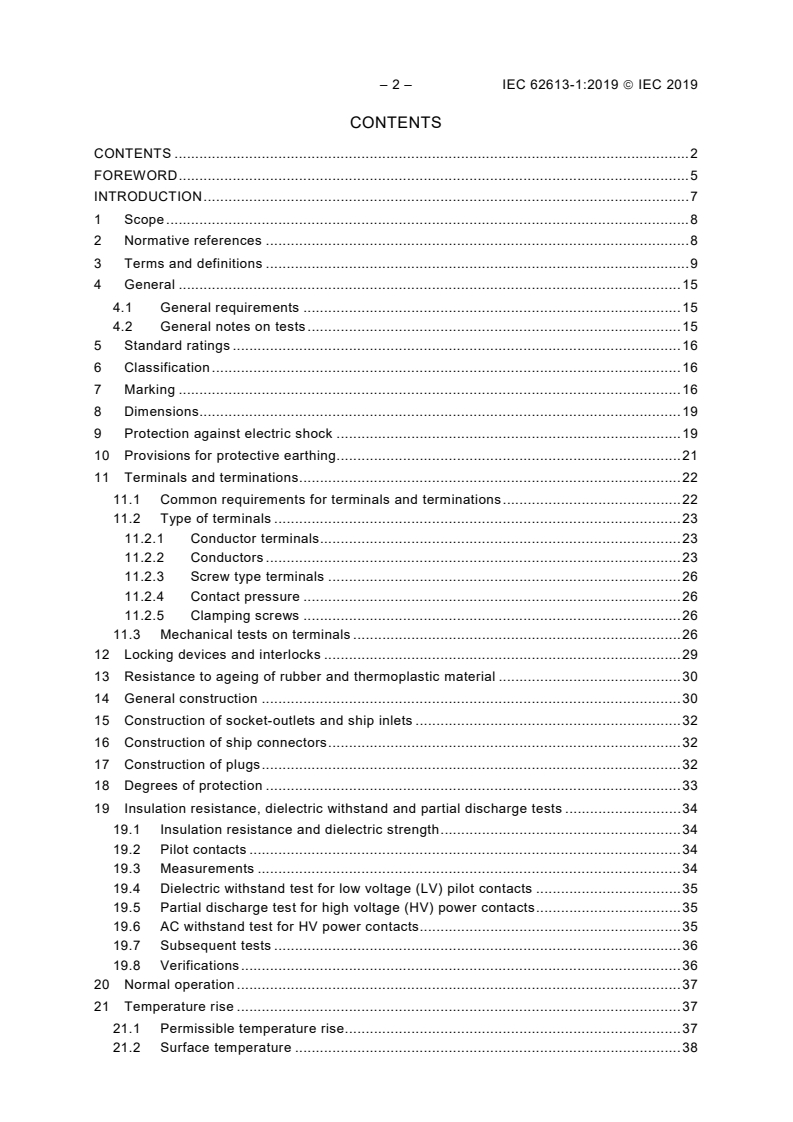
– 2 – IEC 62613-1:2019 IEC 2019
CONTENTS
FOREWORD . 5
INTRODUCTION . 7
1 Scope . 8
2 Normative references . 8
3 Terms and definitions . 9
4 General. 15
4.1 General requirements. 15
4.2 General notes on tests . 15
5 Standard ratings. 16
6 Classification. 16
7 Marking. 16
8 Dimensions . 19
9 Protection against electric shock . 19
10 Provisions for protective earthing . 21
11 Terminals and terminations . 22
11.1 Common requirements for terminals and terminations . 22
11.2 Type of terminals . 23
11.2.1 Conductor terminals. 23
11.2.2 Conductors . 23
11.2.3 Screw type terminals . 26
11.2.4 Contact pressure. 26
11.2.5 Clamping screws. 26
11.3 Mechanical tests on terminals . 26
12 Locking devices and interlocks . 29
13 Resistance to ageing of rubber and thermoplastic material . 30
14 General construction . 30
15 Construction of socket-outlets and ship inlets . 32
16 Construction of ship connectors . 32
17 Construction of plugs . 32
18 Degrees of protection . 33
19 Insulation resistance, dielectric withstand and partial discharge tests . 34
19.1 Insulation resistance and dielectric strength. 34
19.2 Pilot contacts . 34
19.3 Measurements. 34
19.4 Dielectric withstand test for low voltage (LV) pilot contacts . 35
19.5 Partial discharge test for high voltage (HV) power contacts . 35
19.6 AC withstand test for HV power contacts. 35
19.7 Subsequent tests . 36
19.8 Verifications. 36
20 Normal operation. 37
21 Temperature rise . 37
21.1 Permissible temperature rise. 37
21.2 Surface temperature . 38
22 Flexible cables and their connection. 39
22.1 Means for cable clamping. 39
22.2 Requirements for plugs and ship connectors . 39
23 Mechanical strength . 42
23.1 Impact resistance . 42
23.2 Drop test . 42
24 Screws, current-carrying parts and connections . 43
25 Resistance to heat, to fire and to tracking . 46
26 Corrosion and resistance to rusting. 47
27 Conditional short-circuit current withstand test . 48
27.1 General . 48
27.2 Ratings and test conditions. 48
27.3 Test circuit . 48
27.4 Calibration. 49
27.5 Test procedure . 49
27.6 Behaviour of the accessory under test . 49
27.7 Acceptance conditions. 49
28 Electromagnetic compatibility . 51
28.1 Immunity . 51
28.2 Emission . 51
Bibliography . 52
Figure 1 – Diagram showing the use of the accessories . 10
Figure 2 – Pillar terminals. 12
Figure 3 – Screw terminals . 12
Figure 4 – Stud terminals . 12
Figure 5 – Saddle terminals . 13
Figure 6 – Lug terminals . 13
Figure 7 – Mantle terminals. 14
Figure 8 – Standard test finger . 21
Figure 9 – Gauges for testing insertability of round unprepared conductors having the
maximum specified cross-section . 25
Figure 10 – Test apparatus for checking damage to conductors . 27
Figure 11 – Apparatus for testing the cable anchorage . 40
Figure 12 – Arrangement for mechanical strength test for plugs and ship connectors . 43
Figure 13 – Diagram of the test circuit for the verification of short-circuit current
withstand of a three-phase accessory . 50
Figure 14 – Diagram of the test circuit for the verification of short-circuit current
withstand of a three-phase and separate neutral accessory . 51
Table 1 – Size for connectable conductors. 24
Table 2 – Test values for flexing tests for copper conductors. 28
Table 3 – Test values for pull-out tests for copper conductors . 29
Table 4 – Test voltage for dielectric strength test of pilot contacts . 35
Table 5 – Dielectric withstand test voltage . 36
– 4 – IEC 62613-1:2019 IEC 2019
Table 6 – Test current and conductor cross-section for temperature rise . 38
Table 7 – Maximum surface temperatures . 38
Table 8 – Flexible cable types and dimensions, including conductor sizes and wire
type 41
Table 9 – Cable secureness test values . 41
Table 10 – Screw sizes and torque test values . 44
INTERNATIONAL ELECTROTECHNICAL COMMISSION
____________
PLUGS, SOCKET-OUTLETS AND SHIP COUPLERS FOR
HIGH-VOLTAGE SHORE CONNECTION (HVSC) SYSTEMS –
Part 1: General requirements
FOREWORD
1) The International Electrotechnical Commission (IEC) is a worldwide organization for standardization comprising
all national electrotechnical committees (IEC National Committees). The object of IEC is to promote
international co-operation on all questions c oncerning standardization in the electrical and electronic fields. To
this end and in addition to other activities, IEC publishes International Standards, Techni ca l S pe cif i cat i ons,
Technical Reports, Publicly Available Specifications (PAS) and Guides (hereafter referred to as "IEC
Publication(s)"). Their preparation is entrusted to technical committees; any IEC National Committee intereste d
in the subject dealt with may participate in this preparat ory w ork. In t ern at i on al , go vern me nt al a n d n on -
governmental organizations liaising with the IEC also participate in this preparation. IEC collabo rat es cl o sel y
w ith the International Organization for Standardization (ISO) in accordance w i t h co nd i ti o ns d et ermi n e d b y
agreement between the tw o organizations.
2) The f ormal decisions or agreements of IEC on technical matters express, as nearly as possible, an international
consensus of opinion on the relevant subjects since each technical committ ee h as r ep resen ta ti o n f ro m a l l
interested IEC National Committees.
3) IEC Publications have the form of recommendations for international use and are accep te d b y IEC Na t i o n a l
Committees in that sense. While all reasonable efforts are made to ensure that the tech ni cal c on te nt of IEC
Publications is accurate, IEC cannot be held responsible for the w ay in w hich they are used or for any
misinterpretation by any end user.
4) In order to promote international uniformity, IEC National Committees undertake t o a pp l y IEC Pu b l i c a ti o ns
transparently to the maximum extent possible in their national and r egional publications. Any divergence
betw een any IEC Publication and the corresponding national or regional publication shall be clearly indicated in
the latter.
5) IEC itself does not provide any attestation of conformity. Independent certification bodies pro vid e c onf o rmi ty
assessment services and, in some areas, access to IEC marks of conformity. IEC is not r esp onsi b l e f o r a ny
services carried out by independent certification bodies.
6) A ll users should ensure that they have the latest edition of this publication.
7) No liability shall attach to IEC or its directors, employees, servants or agents including individual e xpe rts a n d
members of its technical committees and IEC National Committees for any personal injury, property damage o r
other damage of any nature whatsoever, whether direct or indirect, or for c osts ( i ncl ud i ng l e ga l f ees) a n d
expenses arising out of the publication, use of, or rel i a nce u p on , t h is IEC Pu b l i c a t i on o r a ny o t he r IEC
Publications.
8) A ttention is drawn to the Normative references cited in this publication. Use of the referenced p ub l i cat i ons i s
indispensable for the correct application of this publication.
9) A ttention is drawn to the possibility that some of the elements of this IEC Publicatio n ma y be t he su bj ect of
patent rights. IEC shall not be held responsible for identifying any or all such patent rights.
International Standard IEC 62613-1 has been prepared by subcommittee 23H: Plugs, so c ke t-
outlets and couplers for industrial and similar applications, and for elec t ric vehi c l es, of IE C
technical committee 23: Electrical accessories.
This second edition cancels and replaces the first edition published in 2011. This edition
constitutes a technical revision.
This edition includes the following significant technical changes with respect t o t he pr evi ous
edition:
a) extension of the scope to an unlimited number of pilot contacts (previously limited to 3);
b) update of the Figures and deletion of their embedded texts;
c) insertion of tables of keys whenever required by the Figures.
– 6 – IEC 62613-1:2019 IEC 2019
The text of this International Standard is based on the following documents:
CDV Report on voting
23H/411/CDV 23H/442A/RVC
Full information on the voting for the approval of this International Standard c a n b e fo u n d i n
the report on voting indicated in the above table.
This document has been drafted in accordance with the ISO/IEC Directives, Part 2.
In this standard, the following print types are used:
• requirements proper: in roman type;
• test specifications: in italic type;
• notes: in smaller roman type.
A list of all the parts in the IEC 62613 series , under the general title Plugs, socket-outlets a n d
ship couplers for high-voltage shore connection (HVSC) systems, c an be found on t he IE C
website.
Future standards in this series will carry the new general title as cited above. Titles of existing
standards in this series will be updated at the time of the next edition.
The committee has decided that the contents of this document will remain unchanged until the
stability date indicated on the IEC website under "http://webstore.iec.ch" in the data related t o
the specific document. At this date, the document will be
• reconfirmed,
• withdrawn,
• replaced by a revised edition, or
• amended.
A bilingual version of this publication may be issued at a later date.
INTRODUCTION
This part of IEC 62613 has been primarily written to address the needs of IEC/IEEE 80005-1
in terms of plugs, socket-outlets, ship connectors and ship inlets (hereafter referred to as
"accessories"), to deliver electrical power to ships in ports. The purpose of IEC/IEEE 80005-1
is to define requirements that allow compliant ships to connect to compliant high-voltage
shore power supplies through a compatible shore-to-ship connection.
These ships are described in IEC/IEEE 80005-1.
Ships that do not require connecting with standardized high-voltage shore power sup p l i e s a s
above may use accessories that are not covered by the standard sheets of IEC 62613-2, but
they may find it impossible to connect to these shore supplies.
Low-voltage plugs, socket-outlets, ship connectors and ship inlets used for the conn e c t i o n o f
certain ship types to low-voltage shore power supplies can be found in IEC 60309 (all parts).
– 8 – IEC 62613-1:2019 IEC 2019
PLUGS, SOCKET-OUTLETS AND SHIP COUPLERS FOR
HIGH-VOLTAGE SHORE CONNECTION (HVSC) SYSTEMS –
Part 1: General requirements
1 Scope
This part of IEC 62613 applies to accessories with
• three phases and earth with pilot contacts,
• one pole for neutral.
These accessories have rated currents not exceeding 500 A and rated operating voltage s n o t
exceeding 12 kV 50/60 Hz.
NOTE 1 In some countries, the term "ground" is used instead of "earth".
These accessories are primarily intended for use outdoors, in a seawater environment, for th e
shore supply of ships (ship-to-shore connection), in an ambient temperature within t h e r a n g e
of −25 °C to +45 °C.
NOTE 2 In some countries, other ambient temperatures prevail and are considered.
These accessories are not intended for use in hazardous areas. In such locations where
special conditions prevail, additional requirements can be necessary.
These accessories are intended to be connected to cables of copper or copper alloy only.
Socket-outlets or ship inlets incorporated in or fixed to elect r i c al e q u i p m e n t a r e w i t h i n t h e
scope of this document.
2 Normative references
The following documents are referred to in the text in such a way that some or all of their
content constitutes requirements of this document. For dated references, only the edition
cited applies. For undated references, the latest edition of the referenced document (including
any amendments) applies.
IEC 60068-2-75, Environmental testing – Part 2-75: Tests – Test Eh: Hammer tests
IEC 60092 (all parts), Electrical installations in ships
IEC 60092-354, Electrical installations in ships – Part 354: Single- and three-core power
cables with extruded solid insulation for rated voltages 6 kV (U = 7,2 kV) up to 30 kV
m
(U = 36 kV)
m
IEC 60112, Method for the determination of the proof and the comparative tracking indic e s o f
solid insulating materials
IEC 60228, Conductors of insulated cables
IEC 60269-1, Low-voltage fuses – Part 1: General requirements
IEC 60269-2, Low-voltage fuses – Part 2: Supplementary requirements f or f us es f or us e b y
authorized persons (fuses mainly for industrial application) – Examples of standardized
systems of fuses A to K
IEC 60502-4:2010, Power cables with extruded insulation and their accessories for rated
= 1,2 kV) up to 30 kV (U = 36 kV) – Part 4: T es t requi rem ent s on
voltages from 1 kV (U
m m
= 7,2 kV) up to 30 kV (U = 36 kV)
accessories for cab les with rated voltages from 6 kV (U
m m
IEC 60529, Degrees of protection provided b y enclosures (IP Code)
IEC 60664-1, Insulation coordination for equipment within low-voltage systems – Part 1:
Principles, requirements and tests
IEC 60695-2-11, Fire hazard testing – Part 2-11: Glowing/hot-wire based test methods –
Glow-wire flammab ility test method for end-products (GWEPT)
IEC 60695-10-2, Fire hazard testing – Part 10-2: Ab normal heat – Ball pressure test method
IEC 62262, Degrees of protection provided by enclosures for electrical equipment against
external mechanical impacts (IK code)
IEC 62271-1, High-voltage switchgear and controlgear – Part 1: Common s pec i f i cati ons f or
alternating current switchgear and controlgear
ASTM B117-1985, Standard practice for operating salt spray (fog) apparatus
IEEE 1580, IEEE Recommended Practice for Marine Cab le for Use on Shipb oard and Fixed or
Floating Facilities
3 T e rms and definitions
For the purposes of this document, the following terms and definitions apply.
ISO and IEC maintain terminological databases for use in standardization at the following
addresses:
• IEC Electropedia: available at http://www.electropedia.org/
• ISO Online browsing platform: available at http://www.iso.org/obp
NOTE Where the terms "voltage" and "current" are used, they imply the alternating current (AC) root mean square
(RMS) values.
3.1
accessory
plugs, socket-outlets, ship connectors and ship inlets
Note 1 to entry: The application of accessories is shown in Figure 1.
3.1.1
socket-outlet
part intended to be installed with the fixed wiring or incorporated in equipment
Note 1 to entry: A socket-outlet may also be incorporated in the output circuit of an isolating transformer.
3.1.2
plug
part intended to be attached directly to one flexible cable
– 10 – IEC 62613-1:2019 IEC 2019
3.2
ship coupler
means enabling the connection at will of a flexible cable to the ship, and consisting of a s hi p
connector and ship inlet
3.2.1
ship connector
part intended to be attached to one flexible cable connected to the supply
3.2.2
ship inlet
part incorporated in, or fixed to, the ship
Key
A Plug and socket-outlet
B Socket-outlet
C Plug
D Ship coupler
E Ship connector
F Ship inlet
Figure 1 – Dia gram show ing the use of the a cce ssorie s
3.3
interlock
device, either electrical and/or mechanical, which prevents the contacts of a plug from
becoming live before it is in proper engagement with a socket-outlet, and which either
prevents the plug or the ship connector from being withdrawn while its contacts are live or
makes the contacts dead and earthed before separation
3.4
re ta ining de vice
mechanical arrangement which holds a plug or ship connector in position when it is i n p r o p e r
engagement, and prevents its unintentional withdrawal
3.5
cap
part separated or attached, which can be used to provide the degree of protection of a plug o r
ship inlet when it is not engaged with a socket-outlet or ship connector
3.6
lid
means to ensure the degree of protection on a socket-outlet or a ship connector
3.7
insula tion voltage
voltage assigned to the accessory by the manufacturer and to which dielectric tests,
clearances and creepage distances refer
3.8
ra te d curre nt
current assigned to the accessory by the manufacturer
3.9
ra te d ope rating voltage
nominal voltage of the supply for which the accessory is intended to be used
3.10
conditional short-circuit current
prospective current that an accessory, protected by a specified short-circuit protective device ,
can satisfactorily withstand for the total operating time of that device under specified
conditions of use and behaviour
Note 1 to entry: This definition differs from definition 441-17-20 of IEC 6 0050 -44 1: 198 4 by broadening the
concept of current-limiting device to a short-circuit protective device, the function of which is not onl y t o l i mi t t h e
current.
3.11
live
a conductor or circuit is live when a difference of potential exists between it and earth
[SOURCE: IEC 60092-101:1994, 1.3.14]
3.12
cla mping unit
part of a terminal necessary for the clamping and the electrical connection of the conductor
3.13
terminal
conductive part provided for the connection of a conductor to an accessory
3.14
pillar te rminal
terminal in which the conductor is inserted into a hole or cavity, w h e r e i t i s
clamped under the shank of the screw or screws
Note 1 to entry: The clamping pressure can be applied directly by the s hank of the scr ew or through an
intermediate clamping member to which pressure is applied by the shank of the screw (see Figure 2).
– 12 – IEC 62613-1:2019 IEC 2019
Figure 2 – Pillar te rminals
3.15
scre w te rminal
terminal in which the conductor is clamped under the head of the screw
Note 1 to entry: The clamping pressure can be applied directly by the head of the screw or through an
intermediate part, such as a washer, clamping plate or anti-spread device (see Figure 3).
Figure 3 – Scre w te rminals
3.16
stud terminal
terminal in which the conductor is clamped under a nut
Note 1 to entry: The clamping pressure can be applied directly by a suitably shaped nut or through an
intermediate part, such as a washer, clamping plate or anti-spread device (see Figure 4).
Figure 4 – Stud te rminals
3.17
sa ddle te rminal
terminal in which the conductor is clamped under a saddle by means o f t w o
or more screws or nuts
SEE: Figure 5.
Figure 5 – Sa ddle te rminals
3.18
lug te rminal
screw terminal or stud terminal, designed for clamping a cable lug or bar by means of a scre w
or nut
SEE: Figure 6.
Figure 6 – Lug te rminals
3.19
crimping te rminal
terminal in which the conductor is crimped by means of an adequate tool
3.20
soldering terminal
terminal in which the conductor is soldered
3.21
mantle terminal
terminal in which the conductor is clamped against the base o f a s l o t i n a
threaded stud by means of a nut
Note 1 to entry: The conductor is clamped against the base of the slot by a suitably shaped washer under the nut,
by a central peg if the nut is a cap nut, or by equally effective means for transmitting the pressure from t h e n u t t o
the conductor within the slot (see Figure 7).
– 14 – IEC 62613-1:2019 IEC 2019
Figure 7 – Ma ntle te rminals
3.22
non-re w ireable a ccessory
accessory so constructed that the cable or wiring cannot be sepa r a t e d fr o m t h e a c c e s s o r y
without making it permanently useless
3.23
field-rewireable a ccessory
accessory so constructed that it can be rewired by skilled personnel as qualified by the
manufacturer
3.24
non-field-rewireable a ccessory
accessory so constructed that it can only be rewired by the manufacturer's authorised
personnel
3.25
user-se rvice able a ccessory
accessory so constructed that parts can be replaced using commonly available tools
3.26
non-user-se rviceable a ccessory
accessory so constructed that parts can only be replaced by the manufa c t u r e r's aut hori sed
personnel
3.27
(e le ctrically) skilled pe rson
person with relevant education and experience to enable him or her to percei ve r i s k s a n d t o
avoid hazards which electricity can create
[SOURCE: IEC 60050-826:2004, 826-18-01]
3.28
(e le ctrically) instructe d pe rson
person adequately advised or supervised by electrically skilled persons to ena b l e h i m o r h e r
to perceive risks and to avoid hazards which electricity can create
[SOURCE: IEC 60050-826:2004, 826-18-02]
4 General
4.1 Ge ne ral re quirements
Accessories shall be supplied with all the necessary instructions from the m a n u fa c t u r e r , for
example on installation, assembling, wiring, commissioning, inspection, preventive
maintenance, replacement of consumable parts, etc., including the levels of ability of the
personnel to perform such operations.
Accessories shall be so designed and constructed that in nor m a l u s e t h e i r p e r fo r m a n c e i s
reliable and without danger to the user or the surroundings.
Accessories constructed in accordance with this document shall be suitable for the
environment conditions in the space(s) where they are intended to operate. Accessories
located on ships shall comply with the applicable part(s) of IEC 60092.
Unless otherwise stated, the normal use environment in which the accessories complying with
this document are normally used is pollution degree 3 according to IEC 60664-1.
Accessories shall comply with the applicable requirements of IEC 60502-4.
Accessories shall be wired, installed, commissioned, maintained and used by electrically
instructed or skilled personnel.
HVSC systems do not allow in-line connections unless a specific piece of e q u i p e m e n t m a d e
for that purpose is used. It shall not be possible to connect a plug into a ship connector
(see 8.4).
4.2 Ge ne ral note s on te sts
4.2.1 Tests according to this document are type tests. If a part of an accessory has
previously passed tests for a given degree of severity, the relevant type tests shall not be
repeated if the severity is not greater.
4.2.2 Unless otherwise specified, the samples are tested as deliver e d a n d u n d e r n o r m a l
conditions of use, at an ambient temperature of (20 ± 5) °C; the tests are made at rated
frequency.
4.2.3 Unless otherwise specified, the tests are carried out in the or der of t he c l aus es or
subclauses of this document.
4.2.4 Three samples are subjected to all the tests . For the tests of 11.1.4, for t h e t e s t s o f
19.6 and 19.7, and for the tests of Clause 27, a new set of three samples can be used, if
necessary.
4.2.5 Accessories are deemed to comply with this document if no sample fails in the
complete series of appropriate tests. If one sample fails in a test, that test and those
preceding which can have influenced the test result are repeated on another set of three
samples, all of which shall then pass the repeated tests.
NOTE In general, only the test that caused the failure will be repeated, unless the sample fails in one of the tests
of Clause 21 in which case the tests are repeated from that of Clause 20 onwards.
The applicant can submit, together with the first set of samples, the additional set, which could be necessary if one
sample f ails. The testing station will then, without further request, test the additional samples and will reject only if
a f urther failure occurs. If the additional set of samples is not submitted at the same time, the failure of one sample
w ill entail a rejection.
– 16 – IEC 62613-1:2019 IEC 2019
4.2.6 W hen the tests are carried out with conductors, unless otherwise specified, they shall
be copper and comply with IEC 60228, that is, flexible (class 5). Accessories according to this
document are intended to be connected to cables with plain or metal coated copper
conductors.
5 Standard ratings
Maximum voltages and currents for accessories' standard ratings are
− 7,2 kV, 350 A,
− 12 kV, 350 A,
− 12 kV, 500 A,
− single-pole, 7,2 kV, 250 A,
− pilot contacts: 10 A 250 V AC / 1 A 300 V DC or
10 A 50 V AC / 1 A 120 V DC.
6 Classification
6.1 Accessories are classified according to their purpose:
• plugs,
• socket-outlets,
• ship connectors,
• ship inlets.
6.2 Accessories are classified according to their rewirability:
• non-rewirable accessories,
• field-rewirable accessories,
• non-field-rewirable accessories.
6.3 Accessories are classified according to their serviceability:
• user-serviceable accessories,
• non-user-serviceable accessories.
6.4 Accessories are classified according to their conditional short-circuit current wi t h st an d
capacity:
• accessories with a short-circuit withstand current of 16 kA RMS/1 s,
• accessories with a short-circuit withstand current of 25 kA RMS/1 s.
7 Marking
7.1 Accessories shall be marked with
• rated current, in amperes;
• rated operating voltage, in kilovolts;
• rated short-time withstand current (I );
k/s
• rated short-circuit current peak withstand capacity;
• range of conductor sizes accepted by terminals;
• the IP rating according to IEC 60529 (IP66H or IP66/IP67H);
• either the name or trademark of the manufacturer or of the responsible vendor;
• type reference, which may be a catalogue number;
• DO NOT DISCONNECT WHILE ENERGIZED.
NOTE Optionally, the insulation voltage can be marked.
The nameplates shall be legible during normal service.
Compliance is checked b y inspection.
7.2 When symbols are used, they shall be as follows:
A . ampere
kV . kilovolt
Hz . hertz
............................................ alternat ing current IEC 60417-5032 (2002-10)
............................................ protect ive earth IEC 60417-5019 (2006-08)
IP66H or IP66/IP67H IPXX degree of protection according to IEC 60529
NOTE The marked degree of protection on accessories is only valid when in engagement with a comp l eme n ta ry
accessory or with an attached cap, if any.
Compliance is checked b y inspection.
7.3 For socket-outlets and ship inlets, the marking for rated current, n a t u r e o f s u p p l y , i f
necessary, and either the name or trademark of the manufacturer or the re s p o n s i b l e ve n d o r
shall be on the main part, on the outside of the enclosure, or on t h e l i d , i f a n y , i f t he l at t er
cannot be removed without the aid of a tool.
Except for flush-type socket-outlets and ship inlets, these markings shall be easily discernible
when the accessory is mounted and wired as in normal use, if nec es s ary aft er i t has been
removed from the enclosure. The marking, if any, for the insulation voltage shall be on the
main part; it shall not be visible when the accessory is mounted and wired as in normal use.
The marking for rated operating voltage, the type reference, and the symbol for degree of
protection shall be on a place which is visible after installation of the accessory, on the
outside of the enclosure or on the lid, if any, if the latter cannot be removed without the a i d o f
a tool.
W ith the exception of the type reference, these markings shall be easily discernible w h e n t h e
accessory is mounted and wired as in normal use.
Compliance is checked b y inspection.
NOTE The term "main part" of a socket-outlet or a ship inlet means the part c arryi n g t h e co nt act s. The type
ref erence can be marked on the main part.
The marking for rated current, nature of supply, rated operating voltage and the name or
trademark of the manufacturer or the responsible vendor, may be repeated on the lid, if any.
– 18 – IEC 62613-1:2019 IEC 2019
7.4 For plugs and ship connectors, the marking specified in 7.1, except for the marking fo r
insulation voltage, if any, shall be easily discernible when the ac c e s s o r y i s w i r e d r e a d y fo r
use.
The marking for insulation voltage, if any, shall be on the main part; it shall not be visible
when the accessory is mounted and wired as in normal use.
NOTE 1 The term "ready for use" does not imply that the plug o r sh ip co nn ect or i s i n e n ga ge men t w i t h i t s
complementary accessory.
NOTE 2 The term "main part" of a plug or a ship connector means the part carrying the contacts.
Compliance is checked b y inspection.
7.5 For rewirable accessories, the contacts shall be indicated by the symbols
• L1, L2, L3, or 1, 2, 3 for the three-phase accessories,
• N for neutral (for single-pole neutral accessories),
• for protective earth,
• P1, P2, P3, etc. for the pilot contacts, if any.
These symbols shall be placed close to the relevant terminals; t h e y s h a l l n o t b e p l a c e d o n
screws, removable washers or other removable parts.
NOTE The f igures used with the letters can be written as an index.
Compliance is checked b y inspection.
7.6 Marking shall be indelible and easily legible.
Compliance is checked b y inspection and b y the following test:
After the humidity treatment of 18.4, the marking is rub bed b y hand fo r 1 5 s wi t h a pi ec e of
cloth soaked in water and again for 15 s with a piece of cloth soaked in petroleum spirit.
NOTE 1 The petroleum spirit used can consist of a solvent hexane with an aroma ti c co nt en t o f ma xi mu m 0 ,1
volume percentage, a kauributanol value of approximately 29, an initial boiling point of approximately 65 °C, a d ry
point of approximately 69 °C and a density of approximately 0,68 g/cm .
Special attention is paid to the mark ing of the name or trademark of the manuf a c turer or t he
responsib le vendor and to that of the nature of supply, if any.
NOTE 2 A special test for checking the indelibility of these markings and the combination of pressu re s ensi t i ve
label and the surface on which it is applied is under consideration.
7.7 For terminals, the connection and disconnection procedures shall be in d i c a t e d o n t h e
product, on the smallest package unit or on the manufacturer's documentation.
8 Dimensions
8.1 Accessories shall comply with the appropriate standard sheets, if any. W hen stand a rd
sheets do not exist, accessories shall comply with the manufacturer's specifications.
8.2 It shall not be possible to engage plugs or ship connectors with socket-outlets or s hi p
inlets having different voltages, or different current ratings, or having c ont ac t c om binati ons
allowing improper connection.
In addition, the design shall be such that improper connections shall not be possible bet w e e n
the protective earth and/or pilot plug contact and a live socket-outlet c ontact , or a l i ve pl ug
contact and the protective earth and/or pilot socket-outlet contact.
Compliance is checked b y inspection.
8.3 It shall not be possible to make single-pole connections between multi-pole plug s a n d
socket-outlets or ship connectors, or between ship inlets and ship connectors. It s hal l not be
possible to make single-pole connections between single-pole and multi-pole accessories.
Improper connections include single-pole connections and other c onnec t i ons whi c h do not
comply with the requirements for protection against electric shock.
Compliance is checked b y inspection.
8.4 It shall not be possible to engage plugs into ship connectors, as in-line cable
connections (cable couplers) are not allowed by the application.
Compliance is checked b y inspection and test.
9 Protection against e lectric shock
9.1 Accessories shall be so designed that live parts of socket-outlets and ship connectors,
when they are wired as in normal use, and live parts of plugs and ship inlets, when they are in
partial or complete engagement with the complementary accessories, are not accessible
(IP2X according to IEC 60529).
Pilot contacts can be accessible if used at an extra low voltage.
NOTE The neutral contact and pilot contacts of socket-outlets and ship connectors are deemed to be l i ve p art s.
Pilot contacts are deemed not to be live parts if used at extra low voltage.
In addition, it shall not be possible to make contact between a contact of a plug o r s h i p i n l e t
and a contact of a socket-outlet or ship connector while any contact is accessible.
Compliance is checked b y inspection and, if necessary, b y a test on the s a m p l e wi r e d a s i n
normal use.
The standard test finger shown in Figure 8 is applied in every possible position, an e l e c t r ic al
indicator, with a voltage not less than 40 V, b eing used to show contact with the relevant part.
9.2 Accessories shall be so designed that
a) when inserting the three-phase plug or ship connector
– 20 – IEC 62613-1:2019 IEC 2019
− the protective earth contact shall be made before the phase contacts,
− the pilot contact shall be made after the phase contacts.
b) when withdrawing the three-phase plug or ship connector
− the pilot contact shall break before the phase contacts,
− the phase contacts shall break before the protective earth contact.
dimensions in millimetres
Key
E Handle
F Stop plate
G Insulating material
H Cylindrical
J Spherical
K Chamf er all edges
L V iew on back side
1 Part 1
2 Part 2
3 Part 3
Tolerances on dimensions without specific tolerance:
On linear dimensions
On angles
up to 25 mm over 25 mm
0°
±0,2
−0,05
−10
Material of finger: for example, heat-treated steel.
+10
Both joints of this finger may be bent through an angle of 90° but in one and the same direction only.
Using the pin and groove solution is only one of the possible approaches in order to limit the bending angle to 90° .
For this reason, dimensions and tolerances of these details are not given in the drawing.
...
IEC 62613-1 ®
Edition 2.0 2019-05
INTERNATIONAL
STANDARD
NORME
INTERNATIONALE
Plugs, socket-outlets and ship couplers for high-voltage shore connection
(HVSC) systems –
Part 1: General requirements
Prises de courant et connecteurs de navire pour les systèmes haute tension de
raccordement des navires à quai –
Partie 1: Exigences générales
All rights reserved. Unless otherwise specified, no part of this publication may be reproduced or utilized in any form
or by any means, electronic or mechanical, including photocopying and microfilm, without permission in writing from
either IEC or IEC's member National Committee in the country of the requester. If you have any questions about IEC
copyright or have an enquiry about obtaining additional rights to this publication, please contact the address below or
your local IEC member National Committee for further information.
Droits de reproduction réservés. Sauf indication contraire, aucune partie de cette publication ne peut être reproduite
ni utilisée sous quelque forme que ce soit et par aucun procédé, électronique ou mécanique, y compris la photocopie
et les microfilms, sans l'accord écrit de l'IEC ou du Comité national de l'IEC du pays du demandeur. Si vous avez des
questions sur le copyright de l'IEC ou si vous désirez obtenir des droits supplémentaires sur cette publication, utilisez
les coordonnées ci-après ou contactez le Comité national de l'IEC de votre pays de résidence.
IEC Central Office Tel.: +41 22 919 02 11
3, rue de Varembé info@iec.ch
CH-1211 Geneva 20 www.iec.ch
Switzerland
About the IEC
The International Electrotechnical Commission (IEC) is the leading global organization that prepares and publishes
International Standards for all electrical, electronic and related technologies.
About IEC publications
The technical content of IEC publications is kept under constant review by the IEC. Please make sure that you have the
latest edition, a corrigendum or an amendment might have been published.
IEC publications search - webstore.iec.ch/advsearchform Electropedia - www.electropedia.org
The advanced search enables to find IEC publications by a The world's leading online dictionary on electrotechnology,
variety of criteria (reference number, text, technical containing more than 22 000 terminological entries in English
committee,…). It also gives information on projects, replaced and French, with equivalent terms in 16 additional languages.
and withdrawn publications. Also known as the International Electrotechnical Vocabulary
(IEV) online.
IEC Just Published - webstore.iec.ch/justpublished
Stay up to date on all new IEC publications. Just Published IEC Glossary - std.iec.ch/glossary
details all new publications released. Available online and 67 000 electrotechnical terminology entries in English and
once a month by email. French extracted from the Terms and Definitions clause of
IEC publications issued since 2002. Some entries have been
IEC Customer Service Centre - webstore.iec.ch/csc collected from earlier publications of IEC TC 37, 77, 86 and
If you wish to give us your feedback on this publication or CISPR.
need further assistance, please contact the Customer Service
Centre: sales@iec.ch.
A propos de l'IEC
La Commission Electrotechnique Internationale (IEC) est la première organisation mondiale qui élabore et publie des
Normes internationales pour tout ce qui a trait à l'électricité, à l'électronique et aux technologies apparentées.
A propos des publications IEC
Le contenu technique des publications IEC est constamment revu. Veuillez vous assurer que vous possédez l’édition la
plus récente, un corrigendum ou amendement peut avoir été publié.
Recherche de publications IEC - Electropedia - www.electropedia.org
webstore.iec.ch/advsearchform Le premier dictionnaire d'électrotechnologie en ligne au
La recherche avancée permet de trouver des publications IEC monde, avec plus de 22 000 articles terminologiques en
en utilisant différents critères (numéro de référence, texte, anglais et en français, ainsi que les termes équivalents dans
comité d’études,…). Elle donne aussi des informations sur les 16 langues additionnelles. Egalement appelé Vocabulaire
projets et les publications remplacées ou retirées. Electrotechnique International (IEV) en ligne.
IEC Just Published - webstore.iec.ch/justpublished Glossaire IEC - std.iec.ch/glossary
Restez informé sur les nouvelles publications IEC. Just 67 000 entrées terminologiques électrotechniques, en anglais
Published détaille les nouvelles publications parues. et en français, extraites des articles Termes et Définitions des
Disponible en ligne et une fois par mois par email. publications IEC parues depuis 2002. Plus certaines entrées
antérieures extraites des publications des CE 37, 77, 86 et
Service Clients - webstore.iec.ch/csc CISPR de l'IEC.
Si vous désirez nous donner des commentaires sur cette
publication ou si vous avez des questions contactez-nous:
sales@iec.ch.
IEC 62613-1 ®
Edition 2.0 2019-05
INTERNATIONAL
STANDARD
NORME
INTERNATIONALE
Plugs, socket-outlets and ship couplers for high-voltage shore connection
(HVSC) systems –
Part 1: General requirements
Prises de courant et connecteurs de navire pour les systèmes haute tension de
raccordement des navires à quai –
Partie 1: Exigences générales
INTERNATIONAL
ELECTROTECHNICAL
COMMISSION
COMMISSION
ELECTROTECHNIQUE
INTERNATIONALE
ICS 29.120.30 ISBN 978-2-8322-7302-9
– 2 – IEC 62613-1:2019 IEC 2019
CONTENTS
CONTENTS . 2
FOREWORD . 5
INTRODUCTION . 7
1 Scope . 8
2 Normative references . 8
3 Terms and definitions . 9
4 General . 15
4.1 General requirements . 15
4.2 General notes on tests . 15
5 Standard ratings . 16
6 Classification . 16
7 Marking . 16
8 Dimensions. 19
9 Protection against electric shock . 19
10 Provisions for protective earthing. 21
11 Terminals and terminations . 22
11.1 Common requirements for terminals and terminations . 22
11.2 Type of terminals . 23
11.2.1 Conductor terminals. 23
11.2.2 Conductors . 23
11.2.3 Screw type terminals . 26
11.2.4 Contact pressure . 26
11.2.5 Clamping screws . 26
11.3 Mechanical tests on terminals . 26
12 Locking devices and interlocks . 29
13 Resistance to ageing of rubber and thermoplastic material . 30
14 General construction . 30
15 Construction of socket-outlets and ship inlets . 32
16 Construction of ship connectors . 32
17 Construction of plugs . 32
18 Degrees of protection . 33
19 Insulation resistance, dielectric withstand and partial discharge tests . 34
19.1 Insulation resistance and dielectric strength . 34
19.2 Pilot contacts . 34
19.3 Measurements . 34
19.4 Dielectric withstand test for low voltage (LV) pilot contacts . 35
19.5 Partial discharge test for high voltage (HV) power contacts . 35
19.6 AC withstand test for HV power contacts . 35
19.7 Subsequent tests . 36
19.8 Verifications . 36
20 Normal operation . 37
21 Temperature rise . 37
21.1 Permissible temperature rise. 37
21.2 Surface temperature . 38
22 Flexible cables and their connection . 39
22.1 Means for cable clamping . 39
22.2 Requirements for plugs and ship connectors . 39
23 Mechanical strength . 42
23.1 Impact resistance . 42
23.2 Drop test . 42
24 Screws, current-carrying parts and connections . 43
25 Resistance to heat, to fire and to tracking . 46
26 Corrosion and resistance to rusting . 47
27 Conditional short-circuit current withstand test . 48
27.1 General . 48
27.2 Ratings and test conditions . 48
27.3 Test circuit . 48
27.4 Calibration . 49
27.5 Test procedure . 49
27.6 Behaviour of the accessory under test . 49
27.7 Acceptance conditions . 49
28 Electromagnetic compatibility . 51
28.1 Immunity . 51
28.2 Emission . 51
Bibliography . 52
Figure 1 – Diagram showing the use of the accessories . 10
Figure 2 – Pillar terminals . 12
Figure 3 – Screw terminals . 12
Figure 4 – Stud terminals . 12
Figure 5 – Saddle terminals . 13
Figure 6 – Lug terminals . 13
Figure 7 – Mantle terminals. 14
Figure 8 – Standard test finger . 21
Figure 9 – Gauges for testing insertability of round unprepared conductors having the
maximum specified cross-section . 25
Figure 10 – Test apparatus for checking damage to conductors . 27
Figure 11 – Apparatus for testing the cable anchorage . 40
Figure 12 – Arrangement for mechanical strength test for plugs and ship connectors . 43
Figure 13 – Diagram of the test circuit for the verification of short-circuit current
withstand of a three-phase accessory . 50
Figure 14 – Diagram of the test circuit for the verification of short-circuit current
withstand of a three-phase and separate neutral accessory . 51
Table 1 – Size for connectable conductors . 24
Table 2 – Test values for flexing tests for copper conductors . 28
Table 3 – Test values for pull-out tests for copper conductors . 29
Table 4 – Test voltage for dielectric strength test of pilot contacts . 35
Table 5 – Dielectric withstand test voltage . 36
– 4 – IEC 62613-1:2019 IEC 2019
Table 6 – Test current and conductor cross-section for temperature rise . 38
Table 7 – Maximum surface temperatures . 38
Table 8 – Flexible cable types and dimensions, including conductor sizes and wire type. 41
Table 9 – Cable secureness test values . 41
Table 10 – Screw sizes and torque test values . 44
INTERNATIONAL ELECTROTECHNICAL COMMISSION
____________
PLUGS, SOCKET-OUTLETS AND SHIP COUPLERS FOR
HIGH-VOLTAGE SHORE CONNECTION (HVSC) SYSTEMS –
Part 1: General requirements
FOREWORD
1) The International Electrotechnical Commission (IEC) is a worldwide organization for standardization comprising
all national electrotechnical committees (IEC National Committees). The object of IEC is to promote
international co-operation on all questions concerning standardization in the electrical and electronic fields. To
this end and in addition to other activities, IEC publishes International Standards, Technical Specifications,
Technical Reports, Publicly Available Specifications (PAS) and Guides (hereafter referred to as "IEC
Publication(s)"). Their preparation is entrusted to technical committees; any IEC National Committee interested
in the subject dealt with may participate in this preparatory work. International, governmental and non-
governmental organizations liaising with the IEC also participate in this preparation. IEC collaborates closely
with the International Organization for Standardization (ISO) in accordance with conditions determined by
agreement between the two organizations.
2) The formal decisions or agreements of IEC on technical matters express, as nearly as possible, an international
consensus of opinion on the relevant subjects since each technical committee has representation from all
interested IEC National Committees.
3) IEC Publications have the form of recommendations for international use and are accepted by IEC National
Committees in that sense. While all reasonable efforts are made to ensure that the technical content of IEC
Publications is accurate, IEC cannot be held responsible for the way in which they are used or for any
misinterpretation by any end user.
4) In order to promote international uniformity, IEC National Committees undertake to apply IEC Publications
transparently to the maximum extent possible in their national and regional publications. Any divergence
between any IEC Publication and the corresponding national or regional publication shall be clearly indicated in
the latter.
5) IEC itself does not provide any attestation of conformity. Independent certification bodies provide conformity
assessment services and, in some areas, access to IEC marks of conformity. IEC is not responsible for any
services carried out by independent certification bodies.
6) All users should ensure that they have the latest edition of this publication.
7) No liability shall attach to IEC or its directors, employees, servants or agents including individual experts and
members of its technical committees and IEC National Committees for any personal injury, property damage or
other damage of any nature whatsoever, whether direct or indirect, or for costs (including legal fees) and
expenses arising out of the publication, use of, or reliance upon, this IEC Publication or any other IEC
Publications.
8) Attention is drawn to the Normative references cited in this publication. Use of the referenced publications is
indispensable for the correct application of this publication.
9) Attention is drawn to the possibility that some of the elements of this IEC Publication may be the subject of
patent rights. IEC shall not be held responsible for identifying any or all such patent rights.
International Standard IEC 62613-1 has been prepared by subcommittee 23H: Plugs, socket-
outlets and couplers for industrial and similar applications, and for electric vehicles, of IEC
technical committee 23: Electrical accessories.
This bilingual version (2019-08) corresponds to the monolingual English version, published in
2019-05.
This second edition cancels and replaces the first edition published in 2011. This edition
constitutes a technical revision.
This edition includes the following significant technical changes with respect to the previous
edition:
a) extension of the scope to an unlimited number of pilot contacts (previously limited to 3);
b) update of the Figures and deletion of their embedded texts;
– 6 – IEC 62613-1:2019 IEC 2019
c) insertion of tables of keys whenever required by the Figures.
The text of this International Standard is based on the following documents:
CDV Report on voting
23H/411/CDV 23H/442A/RVC
Full information on the voting for the approval of this International Standard can be found in
the report on voting indicated in the above table.
The French version of this standard has not been voted upon.
This document has been drafted in accordance with the ISO/IEC Directives, Part 2.
In this standard, the following print types are used:
• requirements proper: in roman type;
• test specifications: in italic type;
• notes: in smaller roman type.
A list of all the parts in the IEC 62613 series, under the general title Plugs, socket-outlets and
ship couplers for high-voltage shore connection (HVSC) systems, can be found on the IEC
website.
Future standards in this series will carry the new general title as cited above. Titles of existing
standards in this series will be updated at the time of the next edition.
The committee has decided that the contents of this document will remain unchanged until the
stability date indicated on the IEC website under "http://webstore.iec.ch" in the data related to
the specific document. At this date, the document will be
• reconfirmed,
• withdrawn,
• replaced by a revised edition, or
• amended.
INTRODUCTION
This part of IEC 62613 has been primarily written to address the needs of IEC/IEEE 80005-1
in terms of plugs, socket-outlets, ship connectors and ship inlets (hereafter referred to as
"accessories"), to deliver electrical power to ships in ports. The purpose of IEC/IEEE 80005-1
is to define requirements that allow compliant ships to connect to compliant high-voltage
shore power supplies through a compatible shore-to-ship connection.
These ships are described in IEC/IEEE 80005-1.
Ships that do not require connecting with standardized high-voltage shore power supplies as
above may use accessories that are not covered by the standard sheets of IEC 62613-2, but
they may find it impossible to connect to these shore supplies.
Low-voltage plugs, socket-outlets, ship connectors and ship inlets used for the connection of
certain ship types to low-voltage shore power supplies can be found in IEC 60309 (all parts).
– 8 – IEC 62613-1:2019 IEC 2019
PLUGS, SOCKET-OUTLETS AND SHIP COUPLERS FOR
HIGH-VOLTAGE SHORE CONNECTION (HVSC) SYSTEMS –
Part 1: General requirements
1 Scope
This part of IEC 62613 applies to accessories with
• three phases and earth with pilot contacts,
• one pole for neutral.
These accessories have rated currents not exceeding 500 A and rated operating voltages not
exceeding 12 kV 50/60 Hz.
NOTE 1 In some countries, the term "ground" is used instead of "earth".
These accessories are primarily intended for use outdoors, in a seawater environment, for the
shore supply of ships (ship-to-shore connection), in an ambient temperature within the range
of −25 °C to +45 °C.
NOTE 2 In some countries, other ambient temperatures prevail and are considered.
These accessories are not intended for use in hazardous areas. In such locations where
special conditions prevail, additional requirements can be necessary.
These accessories are intended to be connected to cables of copper or copper alloy only.
Socket-outlets or ship inlets incorporated in or fixed to electrical equipment are within the
scope of this document.
2 Normative references
The following documents are referred to in the text in such a way that some or all of their
content constitutes requirements of this document. For dated references, only the edition
cited applies. For undated references, the latest edition of the referenced document (including
any amendments) applies.
IEC 60068-2-75, Environmental testing – Part 2-75: Tests – Test Eh: Hammer tests
IEC 60092 (all parts), Electrical installations in ships
IEC 60092-354, Electrical installations in ships – Part 354: Single- and three-core power
cables with extruded solid insulation for rated voltages 6 kV (U = 7,2 kV) up to 30 kV
m
(U = 36 kV)
m
IEC 60112, Method for the determination of the proof and the comparative tracking indices of
solid insulating materials
IEC 60228, Conductors of insulated cables
IEC 60269-1, Low-voltage fuses – Part 1: General requirements
IEC 60269-2, Low-voltage fuses – Part 2: Supplementary requirements for fuses for use by
authorized persons (fuses mainly for industrial application) – Examples of standardized
systems of fuses A to K
IEC 60502-4:2010, Power cables with extruded insulation and their accessories for rated
voltages from 1 kV (U = 1,2 kV) up to 30 kV (U = 36 kV) – Part 4: Test requirements on
m m
= 7,2 kV) up to 30 kV (U = 36 kV)
accessories for cables with rated voltages from 6 kV (U
m m
IEC 60529, Degrees of protection provided by enclosures (IP Code)
IEC 60664-1, Insulation coordination for equipment within low-voltage systems – Part 1:
Principles, requirements and tests
IEC 60695-2-11, Fire hazard testing – Part 2-11: Glowing/hot-wire based test methods –
Glow-wire flammability test method for end-products (GWEPT)
IEC 60695-10-2, Fire hazard testing – Part 10-2: Abnormal heat – Ball pressure test method
IEC 62262, Degrees of protection provided by enclosures for electrical equipment against
external mechanical impacts (IK code)
IEC 62271-1, High-voltage switchgear and controlgear – Part 1: Common specifications for
alternating current switchgear and controlgear
ASTM B117-1985, Standard practice for operating salt spray (fog) apparatus
IEEE 1580, IEEE Recommended Practice for Marine Cable for Use on Shipboard and Fixed or
Floating Facilities
3 Terms and definitions
For the purposes of this document, the following terms and definitions apply.
ISO and IEC maintain terminological databases for use in standardization at the following
addresses:
• IEC Electropedia: available at http://www.electropedia.org/
• ISO Online browsing platform: available at http://www.iso.org/obp
NOTE Where the terms "voltage" and "current" are used, they imply the alternating current (AC) root mean square
(RMS) values.
3.1
accessory
plugs, socket-outlets, ship connectors and ship inlets
Note 1 to entry: The application of accessories is shown in Figure 1.
3.1.1
socket-outlet
part intended to be installed with the fixed wiring or incorporated in equipment
Note 1 to entry: A socket-outlet may also be incorporated in the output circuit of an isolating transformer.
3.1.2
plug
part intended to be attached directly to one flexible cable
– 10 – IEC 62613-1:2019 IEC 2019
3.2
ship coupler
means enabling the connection at will of a flexible cable to the ship, and consisting of a ship
connector and ship inlet
3.2.1
ship connector
part intended to be attached to one flexible cable connected to the supply
3.2.2
ship inlet
part incorporated in, or fixed to, the ship
Key
A Plug and socket-outlet
B Socket-outlet
C Plug
D Ship coupler
E Ship connector
F Ship inlet
Figure 1 – Diagram showing the use of the accessories
3.3
interlock
device, either electrical and/or mechanical, which prevents the contacts of a plug from
becoming live before it is in proper engagement with a socket-outlet, and which either
prevents the plug or the ship connector from being withdrawn while its contacts are live or
makes the contacts dead and earthed before separation
3.4
retaining device
mechanical arrangement which holds a plug or ship connector in position when it is in proper
engagement, and prevents its unintentional withdrawal
3.5
cap
part separated or attached, which can be used to provide the degree of protection of a plug or
ship inlet when it is not engaged with a socket-outlet or ship connector
3.6
lid
means to ensure the degree of protection on a socket-outlet or a ship connector
3.7
insulation voltage
voltage assigned to the accessory by the manufacturer and to which dielectric tests,
clearances and creepage distances refer
3.8
rated current
current assigned to the accessory by the manufacturer
3.9
rated operating voltage
nominal voltage of the supply for which the accessory is intended to be used
3.10
conditional short-circuit current
prospective current that an accessory, protected by a specified short-circuit protective device,
can satisfactorily withstand for the total operating time of that device under specified
conditions of use and behaviour
Note 1 to entry: This definition differs from definition 441-17-20 of IEC 60050-441:1984 by broadening the
concept of current-limiting device to a short-circuit protective device, the function of which is not only to limit the
current.
3.11
live
a conductor or circuit is live when a difference of potential exists between it and earth
[SOURCE: IEC 60092-101:1994, 1.3.14]
3.12
clamping unit
part of a terminal necessary for the clamping and the electrical connection of the conductor
3.13
terminal
conductive part provided for the connection of a conductor to an accessory
3.14
pillar terminal
terminal in which the conductor is inserted into a hole or cavity, where it is
clamped under the shank of the screw or screws
Note 1 to entry: The clamping pressure can be applied directly by the shank of the screw or through an
intermediate clamping member to which pressure is applied by the shank of the screw (see Figure 2).
– 12 – IEC 62613-1:2019 IEC 2019
Figure 2 – Pillar terminals
3.15
screw terminal
terminal in which the conductor is clamped under the head of the screw
Note 1 to entry: The clamping pressure can be applied directly by the head of the screw or through an
intermediate part, such as a washer, clamping plate or anti-spread device (see Figure 3).
Figure 3 – Screw terminals
3.16
stud terminal
terminal in which the conductor is clamped under a nut
Note 1 to entry: The clamping pressure can be applied directly by a suitably shaped nut or through an
intermediate part, such as a washer, clamping plate or anti-spread device (see Figure 4).
Figure 4 – Stud terminals
3.17
saddle terminal
terminal in which the conductor is clamped under a saddle by means of two
or more screws or nuts
SEE: Figure 5.
Figure 5 – Saddle terminals
3.18
lug terminal
screw terminal or stud terminal, designed for clamping a cable lug or bar by means of a screw
or nut
SEE: Figure 6.
Figure 6 – Lug terminals
3.19
crimping terminal
terminal in which the conductor is crimped by means of an adequate tool
3.20
soldering terminal
terminal in which the conductor is soldered
3.21
mantle terminal
terminal in which the conductor is clamped against the base of a slot in a
threaded stud by means of a nut
Note 1 to entry: The conductor is clamped against the base of the slot by a suitably shaped washer under the nut,
by a central peg if the nut is a cap nut, or by equally effective means for transmitting the pressure from the nut to
the conductor within the slot (see Figure 7).
– 14 – IEC 62613-1:2019 IEC 2019
Figure 7 – Mantle terminals
3.22
non-rewireable accessory
accessory so constructed that the cable or wiring cannot be separated from the accessory
without making it permanently useless
3.23
field-rewireable accessory
accessory so constructed that it can be rewired by skilled personnel as qualified by the
manufacturer
3.24
non-field-rewireable accessory
accessory so constructed that it can only be rewired by the manufacturer's authorised
personnel
3.25
user-serviceable accessory
accessory so constructed that parts can be replaced using commonly available tools
3.26
non-user-serviceable accessory
accessory so constructed that parts can only be replaced by the manufacturer's authorised
personnel
3.27
(electrically) skilled person
person with relevant education and experience to enable him or her to perceive risks and to
avoid hazards which electricity can create
[SOURCE: IEC 60050-826:2004, 826-18-01]
3.28
(electrically) instructed person
person adequately advised or supervised by electrically skilled persons to enable him or her
to perceive risks and to avoid hazards which electricity can create
[SOURCE: IEC 60050-826:2004, 826-18-02]
4 General
4.1 General requirements
Accessories shall be supplied with all the necessary instructions from the manufacturer, for
example on installation, assembling, wiring, commissioning, inspection, preventive
maintenance, replacement of consumable parts, etc., including the levels of ability of the
personnel to perform such operations.
Accessories shall be so designed and constructed that in normal use their performance is
reliable and without danger to the user or the surroundings.
Accessories constructed in accordance with this document shall be suitable for the
environment conditions in the space(s) where they are intended to operate. Accessories
located on ships shall comply with the applicable part(s) of IEC 60092.
Unless otherwise stated, the normal use environment in which the accessories complying with
this document are normally used is pollution degree 3 according to IEC 60664-1.
Accessories shall comply with the applicable requirements of IEC 60502-4.
Accessories shall be wired, installed, commissioned, maintained and used by electrically
instructed or skilled personnel.
HVSC systems do not allow in-line connections unless a specific piece of equipement made
for that purpose is used. It shall not be possible to connect a plug into a ship connector
(see 8.4).
4.2 General notes on tests
4.2.1 Tests according to this document are type tests. If a part of an accessory has
previously passed tests for a given degree of severity, the relevant type tests shall not be
repeated if the severity is not greater.
4.2.2 Unless otherwise specified, the samples are tested as delivered and under normal
conditions of use, at an ambient temperature of (20 ± 5) °C; the tests are made at rated
frequency.
4.2.3 Unless otherwise specified, the tests are carried out in the order of the clauses or
subclauses of this document.
4.2.4 Three samples are subjected to all the tests. For the tests of 11.1.4, for the tests of
19.6 and 19.7, and for the tests of Clause 27, a new set of three samples can be used, if
necessary.
4.2.5 Accessories are deemed to comply with this document if no sample fails in the
complete series of appropriate tests. If one sample fails in a test, that test and those
preceding which can have influenced the test result are repeated on another set of three
samples, all of which shall then pass the repeated tests.
NOTE In general, only the test that caused the failure will be repeated, unless the sample fails in one of the tests
of Clause 21 in which case the tests are repeated from that of Clause 20 onwards.
The applicant can submit, together with the first set of samples, the additional set, which could be necessary if one
sample fails. The testing station will then, without further request, test the additional samples and will reject only if
a further failure occurs. If the additional set of samples is not submitted at the same time, the failure of one sample
will entail a rejection.
– 16 – IEC 62613-1:2019 IEC 2019
4.2.6 When the tests are carried out with conductors, unless otherwise specified, they shall
be copper and comply with IEC 60228, that is, flexible (class 5). Accessories according to this
document are intended to be connected to cables with plain or metal coated copper
conductors.
5 Standard ratings
Maximum voltages and currents for accessories' standard ratings are
− 7,2 kV, 350 A,
− 12 kV, 350 A,
− 12 kV, 500 A,
− single-pole, 7,2 kV, 250 A,
− pilot contacts: 10 A 250 V AC / 1 A 300 V DC or
10 A 50 V AC / 1 A 120 V DC.
6 Classification
6.1 Accessories are classified according to their purpose:
• plugs,
• socket-outlets,
• ship connectors,
• ship inlets.
6.2 Accessories are classified according to their rewirability:
• non-rewirable accessories,
• field-rewirable accessories,
• non-field-rewirable accessories.
6.3 Accessories are classified according to their serviceability:
• user-serviceable accessories,
• non-user-serviceable accessories.
6.4 Accessories are classified according to their conditional short-circuit current withstand
capacity:
• accessories with a short-circuit withstand current of 16 kA RMS/1 s,
• accessories with a short-circuit withstand current of 25 kA RMS/1 s.
7 Marking
7.1 Accessories shall be marked with
• rated current, in amperes;
• rated operating voltage, in kilovolts;
• rated short-time withstand current (I );
k/s
• rated short-circuit current peak withstand capacity;
• range of conductor sizes accepted by terminals;
• the IP rating according to IEC 60529 (IP66H or IP66/IP67H);
• either the name or trademark of the manufacturer or of the responsible vendor;
• type reference, which may be a catalogue number;
• DO NOT DISCONNECT WHILE ENERGIZED.
NOTE Optionally, the insulation voltage can be marked.
The nameplates shall be legible during normal service.
Compliance is checked by inspection.
7.2 When symbols are used, they shall be as follows:
A . ampere
kV . kilovolt
Hz . hertz
............................................. alternat ing current IEC 60417-5032 (2002-10)
............................................. protect i ve earth IEC 60417-5019 (2006-08)
IP66H or IP66/IP67H IPXX degree of protection according to IEC 60529
NOTE The marked degree of protection on accessories is only valid when in engagement with a complementary
accessory or with an attached cap, if any.
Compliance is checked by inspection.
7.3 For socket-outlets and ship inlets, the marking for rated current, nature of supply, if
necessary, and either the name or trademark of the manufacturer or the responsible vendor
shall be on the main part, on the outside of the enclosure, or on the lid, if any, if the latter
cannot be removed without the aid of a tool.
Except for flush-type socket-outlets and ship inlets, these markings shall be easily discernible
when the accessory is mounted and wired as in normal use, if necessary after it has been
removed from the enclosure. The marking, if any, for the insulation voltage shall be on the
main part; it shall not be visible when the accessory is mounted and wired as in normal use.
The marking for rated operating voltage, the type reference, and the symbol for degree of
protection shall be on a place which is visible after installation of the accessory, on the
outside of the enclosure or on the lid, if any, if the latter cannot be removed without the aid of
a tool.
With the exception of the type reference, these markings shall be easily discernible when the
accessory is mounted and wired as in normal use.
Compliance is checked by inspection.
NOTE The term "main part" of a socket-outlet or a ship inlet means the part carrying the contacts. The type
reference can be marked on the main part.
The marking for rated current, nature of supply, rated operating voltage and the name or
trademark of the manufacturer or the responsible vendor, may be repeated on the lid, if any.
– 18 – IEC 62613-1:2019 IEC 2019
7.4 For plugs and ship connectors, the marking specified in 7.1, except for the marking for
insulation voltage, if any, shall be easily discernible when the accessory is wired ready for
use.
The marking for insulation voltage, if any, shall be on the main part; it shall not be visible
when the accessory is mounted and wired as in normal use.
NOTE 1 The term "ready for use" does not imply that the plug or ship connector is in engagement with its
complementary accessory.
NOTE 2 The term "main part" of a plug or a ship connector means the part carrying the contacts.
Compliance is checked by inspection.
7.5 For rewirable accessories, the contacts shall be indicated by the symbols
• L1, L2, L3, or 1, 2, 3 for the three-phase accessories,
• N for neutral (for single-pole neutral accessories),
• for protective earth,
• P1, P2, P3, etc. for the pilot contacts, if any.
These symbols shall be placed close to the relevant terminals; they shall not be placed on
screws, removable washers or other removable parts.
NOTE The figures used with the letters can be written as an index.
Compliance is checked by inspection.
7.6 Marking shall be indelible and easily legible.
Compliance is checked by inspection and by the following test:
After the humidity treatment of 18.4, the marking is rubbed by hand for 15 s with a piece of
cloth soaked in water and again for 15 s with a piece of cloth soaked in petroleum spirit.
NOTE 1 The petroleum spirit used can consist of a solvent hexane with an aromatic content of maximum 0,1
volume percentage, a kauributanol value of approximately 29, an initial boiling point of approximately 65 °C, a dry
point of approximately 69 °C and a density of approximately 0,68 g/cm .
Special attention is paid to the marking of the name or trademark of the manufacturer or the
responsible vendor and to that of the nature of supply, if any.
NOTE 2 A special test for checking the indelibility of these markings and the combination of pressure sensitive
label and the surface on which it is applied is under consideration.
7.7 For terminals, the connection and disconnection procedures shall be indicated on the
product, on the smallest package unit or on the manufacturer's documentation.
8 Dimensions
8.1 Accessories shall comply with the appropri
...