

IEC 60695-7-1:2010
(Main)Fire hazard testing - Part 7-1: Toxicity of fire effluent - General guidance
General Information
- Abstract
IEC 60695-7-1:2010 provides guidance on the factors which affect the toxic hazard from fires involving electrotechnical products, and provides information on the methodologies recommended by ISO TC 92 (SC 3) for estimating and reducing the toxic hazard from fires, as expressed in ISO 19706, ISO 13344 and ISO 13571. There is no single test to realistically assess toxic hazard in fires. Small-scale toxic potency tests are not capable on their own of assessing the toxic hazard in fires. Current toxicity tests attempt to measure the toxic potency of a laboratory generated fire effluent. Toxic potency should not be confused with toxic hazard. The main changes with respect to the previous edition are as follows:
- minor editorial and technical changes throughout;
- references to the ISO 9122 series have been deleted and the text throughout has been updated;
- definitions have been updated in accordance with ISO/IEC 13943:2008;
- dispersal volume is stated to be an important parameter in the assessment of toxic hazard;
- table 2 has been updated;
- figures 1 and 2 have both been updated.
This publication is to be read in conjunction with IEC 60695-7-2:2002.
- Status
- Published
- Publication Date
- 27-Jun-2010
- Technical Committee
- TC 89 - Fire hazard testing
- Drafting Committee
- WG 11 - TC 89/WG 11
- Current Stage
- PPUB - Publication issued
- Start Date
- 28-Jun-2010
- Completion Date
- 15-Jul-2010
Overview
IEC 60695-7-1:2010 is an international standard developed by the International Electrotechnical Commission (IEC) that provides general guidance on the toxicity of fire effluents, specifically in the context of fires involving electrotechnical products. This foundational safety document outlines critical factors that influence fire toxicity hazards and examines recommended methodologies for estimating and mitigating toxic risks, aligning with protocols developed by ISO Technical Committee 92 (SC 3). Its primary aim is to guide technical committees and professionals in assessing toxic hazards from fire effluents, referencing key ISO standards such as ISO 19706, ISO 13344, and ISO 13571.
It is important to note that no single test can realistically assess toxic hazards in fires. Small-scale toxic potency tests measure the toxic potency of fire effluent in a controlled setting, but they cannot, by themselves, provide a full assessment of toxic risk or hazard in real fire scenarios.
Key Topics
- Toxic Hazard from Fire Effluent: The standard defines critical terms such as toxic hazard, toxic potency, and fire effluent, clarifying the distinction between toxic potency (the intrinsic effect of a substance) and toxic hazard (the potential for harm in a real-world scenario).
- Factors Determining Toxic Hazard: Key parameters include:
- Rate and quantity of product burned or pyrolyzed
- Toxicity of the emitted fire effluent
- Volume into which the toxic effluent disperses
- Impediments to escape, affecting exposure duration
- Types of Fire Toxicants: Focuses on primary hazardous gases generated in fire scenarios, including:
- Asphyxiants (such as carbon monoxide and hydrogen cyanide)
- Sensory irritants (affecting eyes, nose, and respiratory tract)
- Other factors such as heat, oxygen depletion, and smoke
- Assessment Methodologies: Emphasizes the use of methodologies recommended by ISO/IEC, recognizing that:
- Small-scale fire tests are insufficient for comprehensive hazard assessment
- Laboratory measurements are useful for evaluating toxic potency, but full hazard assessment requires consideration of real fire growth dynamics
Applications
IEC 60695-7-1:2010 serves as a reference for technical committees, product designers, safety assessors, and regulatory bodies when evaluating or specifying materials and products in terms of fire safety. Its applications include:
- Product Standard Development: Used in the creation of safety requirements for electrotechnical products, ensuring products minimize toxic emissions in case of fire.
- Risk Assessment: Assists fire safety engineers and risk assessors in incorporating toxicity assessment into broader fire risk analysis, especially for critical infrastructure such as power plants or public transportation systems.
- Testing Laboratories: Provides guidance for selecting and interpreting toxicity tests, avoiding over-reliance on small-scale test results by considering broader hazard factors.
- Regulatory Compliance: Supports authorities and manufacturers in aligning their fire safety protocols with international best practices, ensuring harmonization across jurisdictions.
Related Standards
In interpreting and applying IEC 60695-7-1:2010, it is essential to reference several related standards, including:
- IEC 60695-7-2: Toxicity of fire effluent - Summary and relevance of test methods
- IEC 60695-7-3: Toxicity of fire effluent - Use and interpretation of test results
- ISO 19706: Guidelines for assessing the fire threat to people
- ISO 13344: Estimation of the lethal toxic potency of fire effluents
- ISO 13571: Estimation of time available for escape using fire data
- ISO/IEC 13943: Fire safety – Vocabulary
To ensure a comprehensive fire hazard assessment and effective risk mitigation, users should consult these documents alongside IEC 60695-7-1:2010.
By addressing the toxicity of fire effluent for electrotechnical products, IEC 60695-7-1:2010 enhances fire safety standards worldwide and supports the reliable evaluation of toxic fire hazards, thus enabling the protection of human life and infrastructure. For the latest information, refer to the IEC website and consult updated editions or amendments to related standards.
Relations
- Revises
IEC 60695-7-1:2004 - Fire hazard testing - Part 7-1: Toxicity of fire effluent - General guidance - Effective Date
- 05-Sep-2023
Get Certified
Connect with accredited certification bodies for this standard

IMQ S.p.A. (Certification)
Italian electrical product certification.

SLG Prüf- und Zertifizierungs GmbH
German testing and certification body.

UL Solutions
Global safety science company with testing, inspection and certification.
Sponsored listings
Frequently Asked Questions
IEC 60695-7-1:2010 is a standard published by the International Electrotechnical Commission (IEC). Its full title is "Fire hazard testing - Part 7-1: Toxicity of fire effluent - General guidance". This standard covers: IEC 60695-7-1:2010 provides guidance on the factors which affect the toxic hazard from fires involving electrotechnical products, and provides information on the methodologies recommended by ISO TC 92 (SC 3) for estimating and reducing the toxic hazard from fires, as expressed in ISO 19706, ISO 13344 and ISO 13571. There is no single test to realistically assess toxic hazard in fires. Small-scale toxic potency tests are not capable on their own of assessing the toxic hazard in fires. Current toxicity tests attempt to measure the toxic potency of a laboratory generated fire effluent. Toxic potency should not be confused with toxic hazard. The main changes with respect to the previous edition are as follows: - minor editorial and technical changes throughout; - references to the ISO 9122 series have been deleted and the text throughout has been updated; - definitions have been updated in accordance with ISO/IEC 13943:2008; - dispersal volume is stated to be an important parameter in the assessment of toxic hazard; - table 2 has been updated; - figures 1 and 2 have both been updated. This publication is to be read in conjunction with IEC 60695-7-2:2002.
IEC 60695-7-1:2010 provides guidance on the factors which affect the toxic hazard from fires involving electrotechnical products, and provides information on the methodologies recommended by ISO TC 92 (SC 3) for estimating and reducing the toxic hazard from fires, as expressed in ISO 19706, ISO 13344 and ISO 13571. There is no single test to realistically assess toxic hazard in fires. Small-scale toxic potency tests are not capable on their own of assessing the toxic hazard in fires. Current toxicity tests attempt to measure the toxic potency of a laboratory generated fire effluent. Toxic potency should not be confused with toxic hazard. The main changes with respect to the previous edition are as follows: - minor editorial and technical changes throughout; - references to the ISO 9122 series have been deleted and the text throughout has been updated; - definitions have been updated in accordance with ISO/IEC 13943:2008; - dispersal volume is stated to be an important parameter in the assessment of toxic hazard; - table 2 has been updated; - figures 1 and 2 have both been updated. This publication is to be read in conjunction with IEC 60695-7-2:2002.
IEC 60695-7-1:2010 is classified under the following ICS (International Classification for Standards) categories: 13.220.40 - Ignitability and burning behaviour of materials and products; 29.020 - Electrical engineering in general; 29.060.20 - Cables. The ICS classification helps identify the subject area and facilitates finding related standards.
IEC 60695-7-1:2010 has the following relationships with other standards: It is inter standard links to IEC 60695-7-1:2004. Understanding these relationships helps ensure you are using the most current and applicable version of the standard.
IEC 60695-7-1:2010 is available in PDF format for immediate download after purchase. The document can be added to your cart and obtained through the secure checkout process. Digital delivery ensures instant access to the complete standard document.
Standards Content (Sample)
IEC 60695-7-1 ®
Edition 3.0 2010-06
INTERNATIONAL
STANDARD
NORME
INTERNATIONALE
BASIC SAFETY PUBLICATION
PUBLICATION FONDAMENTALE DE SÉCURITÉ
Fire hazard testing –
Part 7-1: Toxicity of fire effluent – General guidance
Essais relatifs aux risques du feu –
Partie 7-1: Toxicité des effluents du feu – Lignes directrices générales
All rights reserved. Unless otherwise specified, no part of this publication may be reproduced or utilized in any form or by
any means, electronic or mechanical, including photocopying and microfilm, without permission in writing from either IEC or
IEC's member National Committee in the country of the requester.
If you have any questions about IEC copyright or have an enquiry about obtaining additional rights to this publication,
please contact the address below or your local IEC member National Committee for further information.
Droits de reproduction réservés. Sauf indication contraire, aucune partie de cette publication ne peut être reproduite
ni utilisée sous quelque forme que ce soit et par aucun procédé, électronique ou mécanique, y compris la photocopie
et les microfilms, sans l'accord écrit de la CEI ou du Comité national de la CEI du pays du demandeur.
Si vous avez des questions sur le copyright de la CEI ou si vous désirez obtenir des droits supplémentaires sur cette
publication, utilisez les coordonnées ci-après ou contactez le Comité national de la CEI de votre pays de résidence.
IEC Central Office
3, rue de Varembé
CH-1211 Geneva 20
Switzerland
Email: inmail@iec.ch
Web: www.iec.ch
About the IEC
The International Electrotechnical Commission (IEC) is the leading global organization that prepares and publishes
International Standards for all electrical, electronic and related technologies.
About IEC publications
The technical content of IEC publications is kept under constant review by the IEC. Please make sure that you have the
latest edition, a corrigenda or an amendment might have been published.
ƒ Catalogue of IEC publications: www.iec.ch/searchpub
The IEC on-line Catalogue enables you to search by a variety of criteria (reference number, text, technical committee,…).
It also gives information on projects, withdrawn and replaced publications.
ƒ IEC Just Published: www.iec.ch/online_news/justpub
Stay up to date on all new IEC publications. Just Published details twice a month all new publications released. Available
on-line and also by email.
ƒ Electropedia: www.electropedia.org
The world's leading online dictionary of electronic and electrical terms containing more than 20 000 terms and definitions
in English and French, with equivalent terms in additional languages. Also known as the International Electrotechnical
Vocabulary online.
ƒ Customer Service Centre: www.iec.ch/webstore/custserv
If you wish to give us your feedback on this publication or need further assistance, please visit the Customer Service
Centre FAQ or contact us:
Email: csc@iec.ch
Tel.: +41 22 919 02 11
Fax: +41 22 919 03 00
A propos de la CEI
La Commission Electrotechnique Internationale (CEI) est la première organisation mondiale qui élabore et publie des
normes internationales pour tout ce qui a trait à l'électricité, à l'électronique et aux technologies apparentées.
A propos des publications CEI
Le contenu technique des publications de la CEI est constamment revu. Veuillez vous assurer que vous possédez
l’édition la plus récente, un corrigendum ou amendement peut avoir été publié.
ƒ Catalogue des publications de la CEI: www.iec.ch/searchpub/cur_fut-f.htm
Le Catalogue en-ligne de la CEI vous permet d’effectuer des recherches en utilisant différents critères (numéro de référence,
texte, comité d’études,…). Il donne aussi des informations sur les projets et les publications retirées ou remplacées.
ƒ Just Published CEI: www.iec.ch/online_news/justpub
Restez informé sur les nouvelles publications de la CEI. Just Published détaille deux fois par mois les nouvelles
publications parues. Disponible en-ligne et aussi par email.
ƒ Electropedia: www.electropedia.org
Le premier dictionnaire en ligne au monde de termes électroniques et électriques. Il contient plus de 20 000 termes et
définitions en anglais et en français, ainsi que les termes équivalents dans les langues additionnelles. Egalement appelé
Vocabulaire Electrotechnique International en ligne.
ƒ Service Clients: www.iec.ch/webstore/custserv/custserv_entry-f.htm
Si vous désirez nous donner des commentaires sur cette publication ou si vous avez des questions, visitez le FAQ du
Service clients ou contactez-nous:
Email: csc@iec.ch
Tél.: +41 22 919 02 11
Fax: +41 22 919 03 00
IEC 60695-7-1 ®
Edition 3.0 2010-06
INTERNATIONAL
STANDARD
NORME
INTERNATIONALE
BASIC SAFETY PUBLICATION
PUBLICATION FONDAMENTALE DE SÉCURITÉ
Fire hazard testing –
Part 7-1: Toxicity of fire effluent – General guidance
Essais relatifs aux risques du feu –
Partie 7-1: Toxicité des effluents du feu – Lignes directrices générales
INTERNATIONAL
ELECTROTECHNICAL
COMMISSION
COMMISSION
ELECTROTECHNIQUE
PRICE CODE
INTERNATIONALE
T
CODE PRIX
ICS 13.220.40; 29.020 ISBN 978-2-88912-013-0
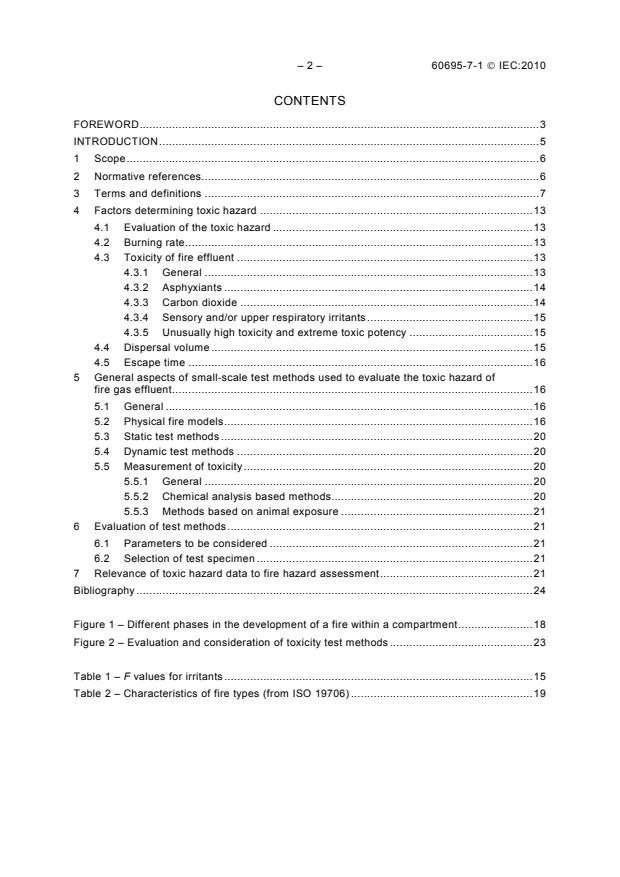
– 2 – 60695-7-1 © IEC:2010
CONTENTS
FOREWORD.3
INTRODUCTION.5
1 Scope.6
2 Normative references.6
3 Terms and definitions .7
4 Factors determining toxic hazard .13
4.1 Evaluation of the toxic hazard .13
4.2 Burning rate.13
4.3 Toxicity of fire effluent .13
4.3.1 General .13
4.3.2 Asphyxiants .14
4.3.3 Carbon dioxide .14
4.3.4 Sensory and/or upper respiratory irritants.15
4.3.5 Unusually high toxicity and extreme toxic potency .15
4.4 Dispersal volume .15
4.5 Escape time .16
5 General aspects of small-scale test methods used to evaluate the toxic hazard of
fire gas effluent.16
5.1 General .16
5.2 Physical fire models.16
5.3 Static test methods .20
5.4 Dynamic test methods .20
5.5 Measurement of toxicity.20
5.5.1 General .20
5.5.2 Chemical analysis based methods.20
5.5.3 Methods based on animal exposure .21
6 Evaluation of test methods.21
6.1 Parameters to be considered .21
6.2 Selection of test specimen .21
7 Relevance of toxic hazard data to fire hazard assessment.21
Bibliography .24
Figure 1 – Different phases in the development of a fire within a compartment.18
Figure 2 – Evaluation and consideration of toxicity test methods .23
Table 1 – F values for irritants.15
Table 2 – Characteristics of fire types (from ISO 19706) .19
60695-7-1 © IEC:2010 – 3 –
INTERNATIONAL ELECTROTECHNICAL COMMISSION
____________
FIRE HAZARD TESTING –
Part 7-1: Toxicity of fire effluent –
General guidance
FOREWORD
1) The International Electrotechnical Commission (IEC) is a worldwide organization for standardization comprising
all national electrotechnical committees (IEC National Committees). The object of IEC is to promote
international co-operation on all questions concerning standardization in the electrical and electronic fields. To
this end and in addition to other activities, IEC publishes International Standards, Technical Specifications,
Technical Reports, Publicly Available Specifications (PAS) and Guides (hereafter referred to as “IEC
Publication(s)”). Their preparation is entrusted to technical committees; any IEC National Committee interested
in the subject dealt with may participate in this preparatory work. International, governmental and non-
governmental organizations liaising with the IEC also participate in this preparation. IEC collaborates closely
with the International Organization for Standardization (ISO) in accordance with conditions determined by
agreement between the two organizations.
2) The formal decisions or agreements of IEC on technical matters express, as nearly as possible, an international
consensus of opinion on the relevant subjects since each technical committee has representation from all
interested IEC National Committees.
3) IEC Publications have the form of recommendations for international use and are accepted by IEC National
Committees in that sense. While all reasonable efforts are made to ensure that the technical content of IEC
Publications is accurate, IEC cannot be held responsible for the way in which they are used or for any
misinterpretation by any end user.
4) In order to promote international uniformity, IEC National Committees undertake to apply IEC Publications
transparently to the maximum extent possible in their national and regional publications. Any divergence
between any IEC Publication and the corresponding national or regional publication shall be clearly indicated in
the latter.
5) IEC itself does not provide any attestation of conformity. Independent certification bodies provide conformity
assessment services and, in some areas, access to IEC marks of conformity. IEC is not responsible for any
services carried out by independent certification bodies.
6) All users should ensure that they have the latest edition of this publication.
7) No liability shall attach to IEC or its directors, employees, servants or agents including individual experts and
members of its technical committees and IEC National Committees for any personal injury, property damage or
other damage of any nature whatsoever, whether direct or indirect, or for costs (including legal fees) and
expenses arising out of the publication, use of, or reliance upon, this IEC Publication or any other IEC
Publications.
8) Attention is drawn to the Normative references cited in this publication. Use of the referenced publications is
indispensable for the correct application of this publication.
9) Attention is drawn to the possibility that some of the elements of this IEC Publication may be the subject of
patent rights. IEC shall not be held responsible for identifying any or all such patent rights.
International Standard IEC 60695-7-1 has been prepared by IEC technical committee 89: Fire
hazard testing.
This third edition cancels and replaces the second edition published in 2004. It constitutes a
technical revision.
The main changes with respect to the previous edition are listed below:
– minor editorial and technical changes throughout;
– Introduction – text referring to IEC 60695-7-50 and ISO/TS 19700 has been updated;
– references to the ISO 9122 series have been deleted (other than an historical reference
to ISO 9122-1 in the Introduction) and the text throughout has been updated;
– definitions have been updated in accordance with ISO/IEC 13943:2008;
– 4 – 60695-7-1 © IEC:2010
– dispersal volume is stated to be an important parameter in the assessment of toxic
hazard;
– Table 2 has been updated;
– Figures 1 and 2 have both been updated.
It has the status of a basic safety publication in accordance with IEC Guide 104 and ISO/IEC
Guide 51.
The text of this standard is based on the following documents:
FDIS Report on voting
89/990/FDIS 89/1003/RVD
Full information on the voting for the approval of this standard can be found in the report on
voting indicated in the above table.
This publication has been drafted in accordance with the ISO/IEC Directives, Part 2.
This standard is to be used in conjunction with IEC 60695-7-2.
A list of all the parts of IEC 60695 series, under the general title of Fire hazard testing, can be
found on the IEC website.
Part 7 consists of the following parts:
Part 7-1: Toxicity of fire effluent – General guidance
Part 7-2: Toxicity of fire effluent – Summary and relevance of test methods
Part 7-3: Toxicity of fire effluent – Use and interpretation of test results
Part 7-50: Toxicity of fire effluent – Estimation of toxic potency – Apparatus and test method
Part 7-51: Toxicity of fire effluent – Estimation of toxic potency – Calculation and
interpretation of test results
The committee has decided that the contents of this publication will remain unchanged until the
stability date indicated on the IEC web site under "http://webstore.iec.ch" in the data related to
the specific publication. At this date, the publication will be
• reconfirmed;
• withdrawn;
• replaced by a revised edition, or
• amended.
60695-7-1 © IEC:2010 – 5 –
INTRODUCTION
Electrotechnical products sometimes become involved in fires. However, except for certain
specific cases (for example, power generating stations, mass transit tunnels, computer suites),
electrotechnical products are not normally present in sufficient quantities to form the major
source of toxic hazard. For example, in domestic dwellings and places of public assembly,
electrotechnical products are usually a very minor source of fire effluent compared with, for
example, furnishings.
The IEC 60695-7 series of publications is subject to the ongoing evolution of fire safety
philosophy within ISO TC 92.
The guidance in this International Standard is consistent with the principles of fire safety
developed by ISO TC 92 (SC 3) on toxic hazards in fire as described in ISO 19706. General
guidance for the fire hazard assessment of electrotechnical products is provided in
IEC 60695-1-10 and IEC 60695-1-11. Guidance on the estimation of escape times from fires is
provided in ISO 13571. The determination of the lethal toxic potency of fire effluents is
described in ISO 13344.
In 1989, the following views were expressed in ISO/TR 9122-1.
"Small-scale toxic potency tests as we know them today are inappropriate for regulatory
purposes. They cannot provide rank orderings of materials with respect to their propensity to
produce toxic atmospheres in fires. All currently available tests are limited because of their
inability to replicate the dynamics of fire growth which determine the time/concentration profiles
of the effluent in full-scale fires, and the response of electrotechnical products, not just
materials. This is a crucial limitation because the toxic effects of combustion effluent are now
known to depend much more on the rates and conditions of combustion than on the chemical
constitution of the burning materials."
Because of these limitations IEC TC 89 developed IEC 60695-7-50 and ISO subsequently
. Both these standards use the same apparatus. It is a practical
developed ISO/TS 19700 [1]
small-scale apparatus which is used to measure toxic potency and which, by virtue of its ability
to model defined stages of a fire, yields toxic potency data suitable for use in a full hazard
assessment. Both methods use variations in air flow and temperature to give different physical
fire models, but the ISO test method additionally uses the equivalence ratio as a key
parameter.
The evidence from fires and fire casualties, when taken with data from experimental fire and
combustion toxicity studies, suggests that chemical species with unusually high toxicity are not
important (see 4.3.4). Carbon monoxide is by far the most significant agent contributing to toxic
hazard. Other agents of major significance are hydrogen cyanide, carbon dioxide and irritants.
There are also other important non-toxic threats to life such as the effects of heat, radiant
energy, depletion of oxygen and smoke obscuration, all of which are discussed in ISO 13571.
General guidance on of smoke obscuration is provided in IEC 60695-6-1 [2].
IEC TC 89 recognizes that the effective mitigation of toxic hazard from electrotechnical
products is best accomplished by tests and regulations leading to improved resistance to
ignition and to reduced rates of fire growth, thus limiting the level of exposure to fire effluent.
___________
Figures in square brackets refer to the bibliography.
– 6 – 60695-7-1 © IEC:2010
FIRE HAZARD TESTING –
Part 7-1: Toxicity of fire effluent –
General guidance
1 Scope
This part of IEC 60695 provides guidance on the factors which affect the toxic hazard from
fires involving electrotechnical products, and provides information on the methodologies
recommended by ISO TC 92 (SC 3) for estimating and reducing the toxic hazard from fires, as
expressed in ISO 19706, ISO 13344 and ISO 13571.
There is no single test to realistically assess toxic hazard in fires. Small-scale toxic potency
tests are not capable on their own of assessing the toxic hazard in fires. Current toxicity tests
attempt to measure the toxic potency of a laboratory generated fire effluent. Toxic potency
should not be confused with toxic hazard.
This basic safety publication is intended for use by technical committees in the preparation of
standards in accordance with the principles laid down in IEC Guide 104 and ISO/IEC Guide 51.
One of the responsibilities of a technical committee is, wherever applicable, to make use of
basic safety publications in the preparation of its publications. The requirements, test methods
or test conditions of this basic safety publication will not apply unless specifically referred to or
included in the relevant publications.
2 Normative references
The following referenced documents are indispensable for the application of this document. For
dated references, only the edition cited applies. For undated references, the latest edition of
the referenced document (including any amendments) applies.
IEC 60695-7-2, Fire hazard testing – Part 7-2: Toxicity of fire effluent – Summary and
relevance of test methods
IEC 60695-7-3, Fire hazard testing – Part 7-3: Toxicity of fire effluent – Use and interpretation
of test results
IEC Guide 104:1997, The preparation of safety publications and the use of basic safety
publications and group safety publications
ISO/IEC Guide 51:1999, Safety aspects – Guidelines for their inclusion in standards
ISO 13344:2004, Estimation of the lethal toxic potency of fire effluents
ISO/IEC 13943:2008, Fire safety – Vocabulary
ISO 13571:2007, Life-threatening components of fire – Guidelines for the estimation of time
available for escape using fire data
ISO 16312-1, Guidance for assessing the validity of physical fire models for obtaining fire
effluent toxicity data for fire hazard and risk assessment – Part 1: Criteria
60695-7-1 © IEC:2010 – 7 –
ISO/TR 16312-2, Guidance for assessing the validity of physical fire models for obtaining fire
effluent toxicity data for fire hazard and risk assessment – Part 2: Evaluation of individual
physical fire models
ISO 19701, Methods for sampling and analysis of fire effluents
ISO 19702, Toxicity testing of fire effluents – Guidance for analysis of gases and vapours in
fire effluents using FTIR gas analysis
ISO 19703:2005, Generation and analysis of toxic gases in fire – Calculation of species yields,
equivalence ratios and combustion efficiency in experimental fires
ISO 19706:2007, Guidelines for assessing the fire threat to people
NOTE ISO 9122-1:1989, Toxicity testing of fire effluents – Part: General, has been withdrawn and replaced by
ISO 19706:2007.
3 Terms and definitions
For the purposes of this document, the terms and definitions given in ISO/IEC 13943, some of
which are reproduced below for the use’ convenience, as well as the followings apply.
3.1
acute toxicity
toxicity that causes rapidly occurring toxic effects
cf. toxic potency
[ISO/IEC 13943, definition 4.5]
3.2
asphyxiant
toxicant that causes hypoxia, which can result in central nervous system depression or
cardiovascular effects
NOTE Loss of consciousness and ultimately death can occur.
[ISO/IEC 13943, definition 4.17]
3.3
burn, intransitive verb
undergo combustion
[ISO/IEC 13943, definition 4.28]
3.4
burn, transitive verb
cause combustion
[ISO/IEC 13943, definition 4.29]
3.5
combustible, adj.
capable of being ignited and burned
[ISO/IEC 13943, definition 4.43]
3.6
combustible, noun
item capable of combustion
– 8 – 60695-7-1 © IEC:2010
[ISO/IEC 13943, definition 4.44]
3.7
combustion
exothermic reaction of a substance with an oxidizing agent
NOTE Combustion generally emits fire effluent accompanied by flames and/or glowing.
[ISO/IEC 13943, definition 4.46]
3.8
concentration
mass per unit volume
–3
NOTE 1 For a fire effluent the typical units are grams per cubic metre (g⋅m ).
NOTE 2 For a toxic gas, concentration is usually expressed as a volume fraction at T = 298 K and P = 1 atm, with
3 3 –6
typical units of microlitres per litre (μL/L), which is equivalent to cm /m or 10 .
NOTE 3 The concentration of a gas at a temperature, T, and a pressure, P, can be calculated from its volume
fraction (assuming ideal gas behaviour) by multiplying the volume fraction by the density of the gas at that
temperature and pressure.
[ISO/IEC 13943, definition 4.52]
3.9
equivalence ratio
fuel/air ratio divided by the fuel/air ratio required for a stoichiometric mixture
NOTE 1 Standard, dry air contains 20,95 % oxygen by volume. In practice, the oxygen concentration in entrained
air may vary and calculation of the equivalence ratio to a standard, dry air basis is required.
NOTE 2 The equivalence ratio is dimensionless.
[ISO/IEC 13943, definition 4.81]
3.10
exposure dose
measure of the maximum amount of a toxic gas or fire effluent which is available for inhalation,
calculated by integration of the area under a concentration-time curve
–3
NOTE 1 For fire effluent, typical units are grams times minutes per cubic metre (g⋅min⋅m ).
–1
NOTE 2 For a toxic gas, typical units are microlitres times minutes per litre (μL⋅min⋅L ) (at T = 298 K and P =
1 atm); see volume fraction.
[ISO/IEC 13943, definition 4.89]
3.11
fire
〈general〉 process of combustion characterized by the emission of heat and fire effluent and
usually accompanied by smoke, flame, glowing or a combination thereof
NOTE In the English language the term “fire” is used to designate three concepts, two of which, fire (3.11) and fire
(3.12), relate to specific types of self-supporting combustion with different meanings and two of them are
designated using two different terms in both French and German.
[ISO/IEC 13943, definition 4.96]
3.12
fire
(controlled) self-supporting combustion that has been deliberately arranged to provide useful
effects and is limited in its extent in time and space
60695-7-1 © IEC:2010 – 9 –
[ISO/IEC 13943, definition 4.97]
3.13
fire
(uncontrolled) self-supporting combustion that has not been deliberately arranged to provide
useful effects and is not limited in its extent in time and space
[ISO/IEC 13943, definition 4.98]
3.14
fire effluent
totality of gases and aerosols, including suspended particles, created by combustion or
pyrolysis in a fire
[ISO/IEC 13943, definition 4.105]
3.15
fire hazard
physical object or condition with a potential for an undesirable consequence from fire
[ISO/IEC 13943, definition 4.112]
3.16
fire risk
probability of a fire combined with a quantified measure of its consequence
[ISO/IEC 13943, definition 4.124]
3.17
fire scenario
qualitative description of the course of a fire with respect to time, identifying key events that
characterise the studied fire and differentiate it from other possible fires
NOTE It typically defines the ignition and fire growth processes, the fully developed fire stage, the fire decay
stage, and the environment and systems that impact on the course of the fire.
[ISO/IEC 13943, definition 4.129]
3.18
flame spread
propagation of a flame front
[ISO/IEC 13943, definition 4.142]
3.19
flashover
〈stage of fire〉 transition to a state of total surface involvement in a fire of combustible materials
within an enclosure
[ISO/IEC 13943, definition 4.156]
3.20
fractional effective concentration
FEC
ratio of the concentration of an irritant to that concentration expected to produce a specified
effect on an exposed subject of average susceptibility
NOTE 1 As a concept, FEC may refer to any effect, including incapacitation, lethality or other endpoints.
– 10 – 60695-7-1 © IEC:2010
NOTE 2 When not used with reference to a specific irritant, the term “FEC” represents the summation of FEC
values for all irritants in a fire-generated atmosphere.
NOTE 3 The fractional effective concentration is dimensionless.
[ISO/IEC 13943, definition 4.159]
3.21
fractional effective dose
FED
ratio of the exposure dose for an asphyxiant to that exposure dose of the asphyxiant expected
to produce a specified effect on an exposed subject of average susceptibility
NOTE 1 As a concept, fractional effective dose may refer to any effect, including incapacitation, lethality or other
endpoints.
NOTE 2 When not used with reference to a specific asphyxiant, the term FED represents the summation of FED
values for all asphyxiants in a combustion atmosphere.
NOTE 3 The FED is dimensionless.
[ISO/IEC 13943, definition 4.160]
3.22
fully developed fire
state of total involvement of combustible materials in a fire
[ISO/IEC 13943, definition 4.164]
3.23
hyperventilation
rate and/or depth of breathing which is greater than normal
[ISO/IEC 13943, definition 4.180]
3.24
ignition
sustained ignition (deprecated)
〈general〉 initiation of combustion
[ISO/IEC 13943, definition 4.187]
3.25
incapacitation
state of physical inability to accomplish a specific task
NOTE An example of a specific task is to accomplish escape from a fire.
[ISO/IEC 13943, definition 4.194]
3.26
irritant, noun
〈sensory/upper respiratory〉 gas or aerosol that stimulates nerve receptors in the eyes, nose,
mouth, throat and respiratory tract, causing varying degrees of discomfort and pain with the
initiation of numerous physiological defence responses
NOTE Physiological defence responses include reflex eye closure, tear production, coughing, and
bronchoconstriction.
[ISO/IEC 13943, definition 4.203]
60695-7-1 © IEC:2010 – 11 –
3.27
irritant, noun
〈pulmonary〉 gas or aerosol that stimulates nerve receptors in the lower respiratory tract, which
may result in breathing discomfort
NOTE Examples of breathing discomfort are dyspnoea and an increase in respiratory rate. In severe cases,
pneumonitis or pulmonary oedema (which can be fatal) can occur some hours after exposure.
[ISO/IEC 13943, definition 4.204]
3.28
lethal exposure dose 50
LCt
product of LC and the exposure time over which it is determined
NOTE 1 LCt is a measure of lethal toxic potency.
–3
NOTE 2 For fire effluent, the typical units are grams times minutes per cubic metre (g⋅min⋅m ).
–1
NOTE 3 For a toxic gas, typical units are microlitres times minutes per litre (μL⋅min⋅L ) at T = 298 K and P =
1 atm; see volume fraction.
[ISO/IEC 13943, definition 4.208]
3.29
physical fire model
laboratory process, including the apparatus, the environment and the fire test procedure
intended to represent a certain phase of a fire
[ISO/IEC 13943, definition 4.251]
3.30
pyrolysis
chemical decomposition of a substance by the action of heat
NOTE 1 Pyrolysis is often used to refer to a stage of fire before flaming combustion has begun.
NOTE 2 In fire science, no assumption is made about the presence or absence of oxygen.
[ISO/IEC 13943, definition 4.266]
3.31
small-scale fire test
fire test performed on a test specimen of small dimensions
NOTE A fire test performed on a test specimen of which the maximum dimension is less than 1 m is usually called
a small-scale fire test.
[ISO/IEC 13943, definition 4.292]
3.32
smoke
visible part of fire effluent
[ISO/IEC 13943, definition 4.293]
3.33
toxic
poisonous
NOTE A poisonous substance produces adverse effects upon a living organism, e.g. irritation, narcosis or death.
[ISO/IEC 13943, definition 4.335]
– 12 – 60695-7-1 © IEC:2010
3.34
toxic gas
toxic vapour
NOTE In the context of fire effluent, the term is usually applied to a single chemical element or compound.
[ISO/IEC 13943, definition 4.336]
3.35
toxic hazard
potential for harm resulting from exposure to toxic combustion products
[ISO/IEC 13943, definition 4.337]
3.36
toxic potency
measure of the amount of toxicant required to elicit a specific toxic effect
NOTE A small value of toxic potency corresponds to a high toxicity, and vice versa.
[ISO/IEC 13943, definition 4.338]
3.37
toxic risk
result of the multiplication of
− the probability of occurrence of a toxic hazard expected in a given technical operation or
state, and
− the consequence or extent of injury to be expected on the occurrence of the toxic hazard
NOTE The toxic risk is part of the fire risk.
[ISO/IEC 13943, definition 4.339]
3.38
toxicant
toxin
toxic substance
[ISO/IEC 13943, definition 4.340]
3.39
toxicity
toxic quality
[ISO/IEC 13943, definition 4.341]
3.40
volume fraction
〈gas in a gas mixture〉 ratio of
- the volume that the gas alone would occupy at a defined temperature and pressure, to:
- the volume occupied by the gas mixture at the same temperature and pressure
NOTE 1 The concentration of a gas at a temperature, T, and at a pressure, P, can be calculated from its volume
fraction (assuming ideal gas behaviour) by multiplying the volume fraction by the density of the gas at that
temperature and pressure.
NOTE 2 Unless stated otherwise, a temperature of 298 K and a pressure of 1 atm are assumed.
NOTE 3 The volume fraction is dimensionless and is usually expressed in terms of microlitres per litre (μL/L),
3 3 –6
which is equivalent to cm /m or 10 ), or as a percentage.
60695-7-1 © IEC:2010 – 13 –
[ISO/IEC 13943, definition 4.351]
3.41
yield
mass of a combustion product generated during combustion divided by the mass loss of the
test specimen
NOTE The yield is dimensionless.
[ISO/IEC 13943, definition 4.354]
4 Factors determining toxic hazard
4.1 Evaluation of the toxic hazard
The main questions concerning the evaluation of the toxic hazard from fire are:
a) How much product is burned or pyrolyzed, and at what rate ?
b) How toxic is the fire effluent ?
c) Into what volume is the toxic effluent being dispersed ?
d) How is escape impeded ?
4.2 Burning rate
The quantity of effluent generated is proportional to the quantity of product burned or
pyrolyzed. The rate of effluent generation is determined by the rate of burning or pyrolysis.
Therefore in order to minimize the toxic hazard, it is necessary to decrease ignitability and to
decrease the burning rate, i.e. decrease the rates of fire growth and flame spread.
4.3 Toxicity of fire effluent
4.3.1 General
Fire effluent consists of a complex mixture of solid particulates, liquid aerosols, and gases.
Although fires may generate effluent of widely differing compositions, toxicity tests have shown
that gases are a major factor in the causes of acute toxicity. The predominant acute toxic
effects may be separated into two classes:
a) asphyxiant effects,
b) sensory and/or upper respiratory irritation.
Asphyxiants are discussed in 4.3.2. Sensory and/or upper respiratory irritants are discussed in
4.3.3.
NOTE In ISO 13344 several equations are given for the calculation of 30 min lethality FED values. These
equations treat both asphyxiants and irritants in a similar way and they use 30 min LC values for rats. ISO 13571
recommends that if such equations are used then one half of the LCt is an approximate exposure dose when
relating incapacitation to lethality.
There are also other important, non-toxic, threats to life. These include the effects of heat and
radiant energy, the effects of depletion of oxygen, and the effects of smoke obscuration.
It has been widely recognized by many technical studies that most products and materials give
fire atmospheres of generally similar toxic potency. No study has found evidence that
substances of unusually high toxicity are important in fires.
Combustible fuel in a fire often consists of a mixture of materials and products that are
unidentified as to their nature and relative quantity. In these cases, for the purpose of
– 14 – 60695-7-1 © IEC:2010
–3
estimating toxic hazard, a "generic" LCt value may be employed, i.e. 900 g⋅min⋅m ⋅for well-
–3
ventilated, pre-flashover fires and 450 g⋅min⋅m for vitiated post-flashover fires [3], [4] and [5].
–3 –3
For evaluation of occupants' escape, values of 450 g⋅min⋅m and 220 g⋅min⋅m , respectively,
are recommended in ISO 13571.
Test data indicate that fire effluent from electrotechnical products offers no greater toxicity than
that from other materials or products (for example, furnishings and building materials). A
bibliography is provided in ISO 19706 and additional data are found in references [5], [6], and
[7].
4.3.2 Asphyxiants
Asphyxiation is a major cause of death in fires. An asphyxiant is a toxicant causing hypoxia (a
decrease in oxygen supplied to or utilized by body tissue), resulting in central nervous system
depression with loss of consciousness and, ultimately, death. Effects of these toxicants depend
upon accumulated doses, i.e. a function of both concentration and the time or duration of
exposure. The severity of the effects increases with increasing dose. Among the fire gas
toxicants, carbon monoxide and hydrogen cyanide have received the most study and are best
understood with respect to their capacity to cause incapacitation and death of those exposed
[8] and [9].
The basic principle for assessing the asphyxiant component of toxic hazard analysis involves
the exposure dose of each toxicant, i.e. the integrated area under each concentration-time
curve (see ISO 13571). Fractional effective doses (FEDs) are determined for each asphyxiant
at each discrete increment of time. The time at which their accumulated sum exceeds a
specified threshold value represents the time available for escape relative to chosen safety
criteria.
For carbon monoxide, the incapacitating dose (volume fraction × time) is 0,035 min [10].
For hydrogen cyanide, the incapacitating dose is not a constant, but varies depending on the
volume fraction [8]. Empirical analysis of data obtained for volume fractions in the range
–6 –6
30 × 10 to 400 × 10 indicate that the FED may be calculated using an exponential
expression
t
−5
exp(x /4,3 ×10 )
HCN
FED = ×Δt
∑
220min
t
where X is the average volume fraction of HCN over the time increment Δt (see
HCN
ISO 13571).
–6
For volume fractions below 30 × 10 the following formula should be used
t
−1
FED = (304,4min ×x ) × Δt
∑ HCN
t
4.3.3 Carbon dioxide
If the volume fraction of carbon dioxide exceeds 0,02 the effective exposure doses of
asphyxiants can be considered to be increased because of hyperventilation by a factor of
exp(X / 0,05) where X equals the volume fraction of carbon dioxide (see ISO 13571).
CO2 CO2
60695-7-1 © IEC:2010 – 15 –
4.3.4 Sensory and/or upper respiratory irritants
Sensory and/or upper respiratory irritation stimulates nerve receptors in the eyes, nose, throat
and upper respiratory tract. Appearing to be related only to concentration, the effects lie on a
continuum going from mild eye and upper respiratory discomfort all the way to severe pain.
These acute effects can present a threat to safe escape.
At sufficiently high concentrations, most sensory and/or upper respiratory irritants can
penetrate deeply into the lungs, causing pulmonary irritation effects that are normally related
both to concentration and to the duration of exposure (i.e. dose). Generally these effects are
not acute and are therefore not regarded as presenting a threat to safe escape. However,
pulmonary irritation may cause post-exposure respiratory distress and even death from a few
hours up to several days after exposure due to pulmonary oedema.
The basic principle for assessing the irritant gas component of toxic hazard analysis involves
only the concentration of each irritant. Fractional effective concentrations (FECs) are
determined for each irritant at each discrete increment of time. The time at which their sum
exceeds a specified threshold value represents the time available for escape relative to chosen
safety criteria.
The volume fractions of irritant gases that are expected to seriously compromise occupants'
ability to take effective action to accomplish escape (F values) for some of the more important
irritants are listed in Table 1 (see ISO 13571).
Table 1 – F values for irritants
(from ISO 13571)
Irritant
F value × 10
Acrolein 30
Sulphur dioxide 150
Formaldehyde 250
Nitrogen dioxide 250
Hydrogen fluoride 500
Hydrogen bromide 1 000
Hydrogen chloride 1 000
Guidance on analytical methods for these gases is given in ISO 19701.
4.3.5 Unusually high toxicity and extreme toxic potency
Unusually high toxicity refers to products exerting types of toxic effect not normally
encountered in fires (i.e. other than asphyxiation or irritancy). As stated in the introduction,
products of unusually high toxicity have not been reported to be important in fires. Extreme
toxic potency suggests that the toxicity of the products is much greater on a mass basis than
the toxicity of usual fire effluent.
There is at present no recorded instance of a fire in which the hazard resulted from extreme
toxic potency.
4.4 Dispersal volume
As effluent is diluted, its toxicity is lowered, and therefore In order to assess toxic hazard, the
volume into which effluent is dispersed must be known or assumed.
– 16 – 60695-7-1 © IEC:2010
4.5 Escape time
The time available for escape from a fire is that time after which occupants can no longer take
effective action to accomplish their own escape. It is the shortest of four distinct times
estimated from consideration of; 1) asphyxiant fire gases, 2) irritant fire gases, 3) heat, and 4)
visual obscuration due to smoke.
Guidance on the estimation of the time available for escape using fire data is provided in
ISO 13571.
5 General aspects of small-scale test methods used to evaluate the toxic
hazard of fire gas effluent
5.1 General
Small-scale toxicity tests are comprised, essentially, of two parts:
a) decomposition conditions (the physical fire model – see 5.2), which should be such that
they generate fire effluent which has the same relative composition as that which would be
produced in a specific stage of a fire, and
b) evaluation methods for the fire effluent to assess or calculate toxic potency, which can be
carried out by either exposing animals to the fire effluent, in a controlled manner, and
monitoring their response, or by carrying out chemical analyses of the fire effluent and
estimating toxic potency from their concentrations.
IEC 60695-7-2 summarizes the test methods that are in common use in the assessment of
lethal and sub-lethal acute toxic potency and other toxicity tests. It includes special
observations on their relevance to fire scenarios and gives recommendations on their use.
ISO 16312-1 gives guidance for assessing the validity of physical fire models for obtaining fire
effluent toxicity data, and ISO/TR 16312-2 evaluates twelve test methods using the criteria
given in ISO 16312-1.
A critical part of any method is to be able to relate the toxic effect or concentrations observed
to the mass loss of the material under test. Without this information the data that are obtained
cannot be used to evaluate the toxic hazard of a given fire scenario. This is because small-
scale toxic potency tests are not capable on their own of assessing toxic hazard. Toxic
potency data must be combined with independently determined combustion data and other
relevant data (for example the assumed dispersal volume) to estimate toxic hazard. Toxic
potency should not be confused with toxic hazard.
ISO 19706 states in 4.3 that “Because the effect of the fire effluent on people depends on
factors beyond the combustible(s) as a source of the effluent, the fire effluent composition data
must be combined with the additional information about the facility, the fire and the people into
a fire hazard or risk assessment, rather than being used alone as an indicator of fire hazard or
risk.”
Reduction of the likelihood of ignition and the reduction of the rate of subsequent flame spread
are the prime considerations in the reduction of toxic hazard.
5.2 Physical fire models
The composition of the fire effluent from a given material is not an inherent property of that
material, but is critically dependent on the conditions under which that material is burnt.
Therefore, toxic product yields and the toxic potency of fire effluent are dependent on burning
conditions. The chemical composition of the fuel, the decomposition temperature and the
amount of ventilation are the main variables which affect the composition of fire effluent, and
hence the toxic potency.
60695-7-1 © I
...