

IEC 60331-2:2018
(Main)Tests for electric cables under fire conditions - Circuit integrity - Part 2: Test method for fire with shock at a temperature of at least 830 °C for cables of rated voltage up to and including 0,6/1,0 kV and with an overall diameter not exceeding 20 mm
General Information
- Abstract
IEC 60331-2:2018 specifies the test method for cables which are required to maintain circuit integrity when subject to fire and mechanical shock under specified conditions.
This document is applicable to cables of rated voltage not exceeding 600 V/1 000 V, including those of rated voltage below 80 V, metallic data and telecom cables and optical fibre cables.
It is intended for use when testing cables of not greater than 20 mm overall diameter.
Cables of larger diameter are intended to be tested using the apparatus, procedure and requirements of IEC 60331-1.
This document includes details for the specific point of failure, continuity checking arrangement, test sample, test procedure and test report relevant to electric power and control cables with rated voltage up to and including 600 V/1000 V. Details for the specific point of failure, continuity checking arrangement, test sample, test procedure and test report relevant to metallic data and telecom cables and optical fibre cables are not given by IEC 60331-2.
Although the scope is restricted to cables with rated voltage up to and including 0,6/1,0 kV, the procedure can be used, with the agreement of the manufacturer and the purchaser, for cables with rated voltage up to and including 1,8/3 (3,3) kV, provided that suitable fuses are used.
Annex A provides the method of verification of the burner and control system used for the test.
Requirements are stated for an identification that may optionally be marked on the cable to signify compliance with this standard.
This second edition cancels and replaces the first edition published in 2009. It constitutes a technical revision.
The significant technical changes with respect to the previous edition are as follows:
– extension of the scope with metallic data and telecom cables and optical fibre cables, although details for the specific point of failure, continuity checking arrangement, test sample, test procedure and test report relevant to metallicdata and telecom cables and optical fibre cables are not given by IEC 60331-2;
– improved description of the test environment;
– mandatory use of mass flow meters/controllers as the means of controlling accurately the input flow rates of fuel and air to the burner;
– improved figure illustrating method of mounting of the sample regarding bending radius;
– improved description of the information to be included in the test report.
- Status
- Published
- Publication Date
- 27-Mar-2018
- Technical Committee
- TC 20 - Electric cables
- Drafting Committee
- WG 18 - TC 20/WG 18
- Current Stage
- PPUB - Publication issued
- Start Date
- 28-Mar-2018
- Completion Date
- 20-Apr-2018
Buy Documents
IEC 60331-2:2018 - Tests for electric cables under fire conditions - Circuit integrity - Part 2: Test method for fire with shock at a temperature of at least 830 °C for cables of rated voltage up to and including 0,6/1,0 kV and with an overall diameter not exceeding 20 mm Released:3/28/2018
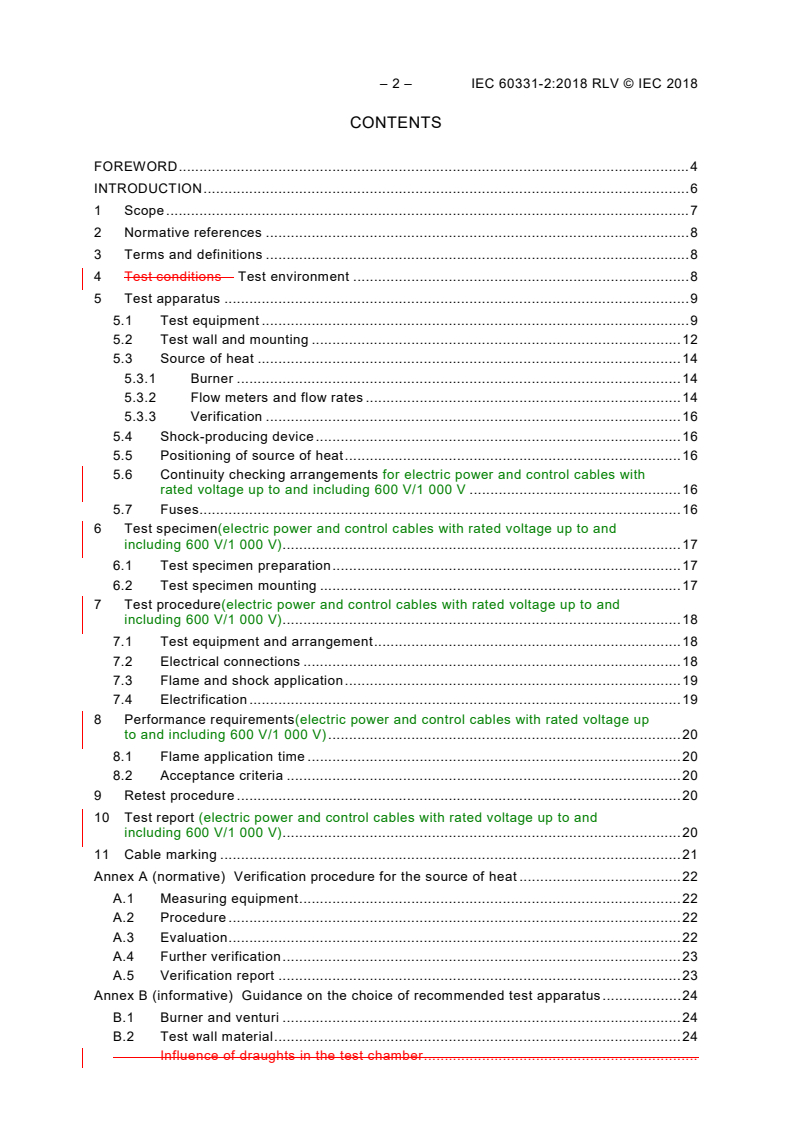
IEC 60331-2:2018 RLV - Tests for electric cables under fire conditions - Circuit integrity - Part 2: Test method for fire with shock at a temperature of at least 830°C for cables of rated voltage up to and including 0,6/1,0 kV and with an overall diameter not exceeding 20mm Released:3/28/2018
IEC 60331-2:2018 - Tests for electric cables under fire conditions - Circuit integrity - Part 2: Test method for fire with shock at a temperature of at least 830 °C for cables of rated voltage up to and including 0,6/1,0 kV and with an overall diameter not exceeding 20 mm Released:11/8/2018
Overview
IEC 60331-2:2018 is an International Electrotechnical Commission standard that defines a test method for circuit integrity of electric cables under fire with mechanical shock. The method applies to cables with an overall diameter not exceeding 20 mm and rated voltage up to and including 0,6/1,0 kV (600 V/1 000 V). The test simulates a fire environment at a temperature of at least 830 °C combined with a shock event to verify that cables can maintain electrical continuity under extreme fire conditions.
Keywords: IEC 60331-2, circuit integrity, fire with shock, electric cables, 830 °C, 0.6/1.0 kV
Key Topics and Requirements
- Scope and applicability
- Intended for electric power and control cables (≤ 600 V/1 000 V) and can be used, by agreement, for higher voltages up to 1,8/3 (3,3) kV with suitable fusing.
- Extended to include metallic data/telecom and optical fibre cables; however, specific continuity-checking and reporting details for those cable types are not provided in this part.
- Test environment and apparatus
- Fire source producing at least 830 °C, mounted relative to a standard test wall and specimen mounting arrangement.
- Mandatory use of mass flow meters/controllers for accurate control of fuel and air delivery to the burner.
- Annex A specifies verification procedures for the burner and control system.
- Specimen preparation and mounting
- Limits on overall diameter (≤ 20 mm) and defined methods for mounting and bending radius of samples to ensure repeatable results.
- Continuity checking and failure criteria
- Detailed continuity checking arrangements, specific point of failure definition and electrical connections are given for power/control cables up to 600 V/1 000 V.
- Test procedure, reporting & marking
- Requirements for the test sequence, shock application, test report content and optional cable identification marking to indicate compliance.
Keywords: burner verification, mass flow controllers, continuity checking, test report, cable marking
Practical Applications and Who Uses This Standard
- Cable manufacturers use IEC 60331-2 to design and validate fire-resistant cables and to support product claims of circuit integrity under fire with shock.
- Independent test laboratories adopt the method to perform standardized cable fire/shock tests and issue test reports for certification and procurement.
- Specifiers, procurement and safety engineers (buildings, tunnels, transport systems, industrial plants) reference the standard to select cables for emergency circuits, fire detection, alarm and safety-critical power/control systems.
- Certification bodies and compliance teams use the documented procedure and reporting requirements to assess conformity and to allow optional marking on compliant cable products.
Keywords: cable testing, fire-resistant cables, emergency circuits, safety-critical cables
Related Standards
- IEC 60331 series (other parts): Part 1 (larger diameter cables), Part 3 (metal enclosure tests), and associated parts (11, 21, 23, 25) that address alternative apparatus and procedures for different cable types and test conditions.
Relations
- Effective Date
- 05-Sep-2023
Buy Documents
IEC 60331-2:2018 - Tests for electric cables under fire conditions - Circuit integrity - Part 2: Test method for fire with shock at a temperature of at least 830 °C for cables of rated voltage up to and including 0,6/1,0 kV and with an overall diameter not exceeding 20 mm Released:3/28/2018
IEC 60331-2:2018 RLV - Tests for electric cables under fire conditions - Circuit integrity - Part 2: Test method for fire with shock at a temperature of at least 830°C for cables of rated voltage up to and including 0,6/1,0 kV and with an overall diameter not exceeding 20mm Released:3/28/2018
IEC 60331-2:2018 - Tests for electric cables under fire conditions - Circuit integrity - Part 2: Test method for fire with shock at a temperature of at least 830 °C for cables of rated voltage up to and including 0,6/1,0 kV and with an overall diameter not exceeding 20 mm Released:11/8/2018
Get Certified
Connect with accredited certification bodies for this standard

IMQ S.p.A. (Certification)
Italian electrical product certification.

SLG Prüf- und Zertifizierungs GmbH
German testing and certification body.

UL Solutions
Global safety science company with testing, inspection and certification.
Sponsored listings
Frequently Asked Questions
IEC 60331-2:2018 is a standard published by the International Electrotechnical Commission (IEC). Its full title is "Tests for electric cables under fire conditions - Circuit integrity - Part 2: Test method for fire with shock at a temperature of at least 830 °C for cables of rated voltage up to and including 0,6/1,0 kV and with an overall diameter not exceeding 20 mm". This standard covers: IEC 60331-2:2018 specifies the test method for cables which are required to maintain circuit integrity when subject to fire and mechanical shock under specified conditions. This document is applicable to cables of rated voltage not exceeding 600 V/1 000 V, including those of rated voltage below 80 V, metallic data and telecom cables and optical fibre cables. It is intended for use when testing cables of not greater than 20 mm overall diameter. Cables of larger diameter are intended to be tested using the apparatus, procedure and requirements of IEC 60331-1. This document includes details for the specific point of failure, continuity checking arrangement, test sample, test procedure and test report relevant to electric power and control cables with rated voltage up to and including 600 V/1000 V. Details for the specific point of failure, continuity checking arrangement, test sample, test procedure and test report relevant to metallic data and telecom cables and optical fibre cables are not given by IEC 60331-2. Although the scope is restricted to cables with rated voltage up to and including 0,6/1,0 kV, the procedure can be used, with the agreement of the manufacturer and the purchaser, for cables with rated voltage up to and including 1,8/3 (3,3) kV, provided that suitable fuses are used. Annex A provides the method of verification of the burner and control system used for the test. Requirements are stated for an identification that may optionally be marked on the cable to signify compliance with this standard. This second edition cancels and replaces the first edition published in 2009. It constitutes a technical revision. The significant technical changes with respect to the previous edition are as follows: – extension of the scope with metallic data and telecom cables and optical fibre cables, although details for the specific point of failure, continuity checking arrangement, test sample, test procedure and test report relevant to metallicdata and telecom cables and optical fibre cables are not given by IEC 60331-2; – improved description of the test environment; – mandatory use of mass flow meters/controllers as the means of controlling accurately the input flow rates of fuel and air to the burner; – improved figure illustrating method of mounting of the sample regarding bending radius; – improved description of the information to be included in the test report.
IEC 60331-2:2018 specifies the test method for cables which are required to maintain circuit integrity when subject to fire and mechanical shock under specified conditions. This document is applicable to cables of rated voltage not exceeding 600 V/1 000 V, including those of rated voltage below 80 V, metallic data and telecom cables and optical fibre cables. It is intended for use when testing cables of not greater than 20 mm overall diameter. Cables of larger diameter are intended to be tested using the apparatus, procedure and requirements of IEC 60331-1. This document includes details for the specific point of failure, continuity checking arrangement, test sample, test procedure and test report relevant to electric power and control cables with rated voltage up to and including 600 V/1000 V. Details for the specific point of failure, continuity checking arrangement, test sample, test procedure and test report relevant to metallic data and telecom cables and optical fibre cables are not given by IEC 60331-2. Although the scope is restricted to cables with rated voltage up to and including 0,6/1,0 kV, the procedure can be used, with the agreement of the manufacturer and the purchaser, for cables with rated voltage up to and including 1,8/3 (3,3) kV, provided that suitable fuses are used. Annex A provides the method of verification of the burner and control system used for the test. Requirements are stated for an identification that may optionally be marked on the cable to signify compliance with this standard. This second edition cancels and replaces the first edition published in 2009. It constitutes a technical revision. The significant technical changes with respect to the previous edition are as follows: – extension of the scope with metallic data and telecom cables and optical fibre cables, although details for the specific point of failure, continuity checking arrangement, test sample, test procedure and test report relevant to metallicdata and telecom cables and optical fibre cables are not given by IEC 60331-2; – improved description of the test environment; – mandatory use of mass flow meters/controllers as the means of controlling accurately the input flow rates of fuel and air to the burner; – improved figure illustrating method of mounting of the sample regarding bending radius; – improved description of the information to be included in the test report.
IEC 60331-2:2018 is classified under the following ICS (International Classification for Standards) categories: 13.220.40 - Ignitability and burning behaviour of materials and products; 29.020 - Electrical engineering in general; 29.060.20 - Cables. The ICS classification helps identify the subject area and facilitates finding related standards.
IEC 60331-2:2018 has the following relationships with other standards: It is inter standard links to IEC 60331-2:2009. Understanding these relationships helps ensure you are using the most current and applicable version of the standard.
IEC 60331-2:2018 is available in PDF format for immediate download after purchase. The document can be added to your cart and obtained through the secure checkout process. Digital delivery ensures instant access to the complete standard document.
Standards Content (Sample)
IEC 60331-2 ®
Edition 2.0 2018-03
INTERNATIONAL
STANDARD
GROUP SAFETY PUBLICATION
Tests for electric cables under fire conditions – Circuit integrity –
Part 2: Test method for fire with shock at a temperature of at least 830 °C for
cables of rated voltage up to and including 0,6/1,0 kV and with an overall
diameter not exceeding 20 mm
All rights reserved. Unless otherwise specified, no part of this publication may be reproduced or utilized in any form
or by any means, electronic or mechanical, including photocopying and microfilm, without permission in writing from
either IEC or IEC's member National Committee in the country of the requester. If you have any questions about IEC
copyright or have an enquiry about obtaining additional rights to this publication, please contact the address below or
your local IEC member National Committee for further information.
IEC Central Office Tel.: +41 22 919 02 11
3, rue de Varembé info@iec.ch
CH-1211 Geneva 20 www.iec.ch
Switzerland
About the IEC
The International Electrotechnical Commission (IEC) is the leading global organization that prepares and publishes
International Standards for all electrical, electronic and related technologies.
About IEC publications
The technical content of IEC publications is kept under constant review by the IEC. Please make sure that you have the
latest edition, a corrigenda or an amendment might have been published.
IEC Catalogue - webstore.iec.ch/catalogue Electropedia - www.electropedia.org
The stand-alone application for consulting the entire The world's leading online dictionary of electronic and
bibliographical information on IEC International Standards, electrical terms containing 21 000 terms and definitions in
Technical Specifications, Technical Reports and other English and French, with equivalent terms in 16 additional
documents. Available for PC, Mac OS, Android Tablets and languages. Also known as the International Electrotechnical
iPad. Vocabulary (IEV) online.
IEC publications search - webstore.iec.ch/advsearchform IEC Glossary - std.iec.ch/glossary
The advanced search enables to find IEC publications by a 67 000 electrotechnical terminology entries in English and
variety of criteria (reference number, text, technical French extracted from the Terms and Definitions clause of
committee,…). It also gives information on projects, replaced IEC publications issued since 2002. Some entries have been
and withdrawn publications. collected from earlier publications of IEC TC 37, 77, 86 and
CISPR.
IEC Just Published - webstore.iec.ch/justpublished
Stay up to date on all new IEC publications. Just Published IEC Customer Service Centre - webstore.iec.ch/csc
details all new publications released. Available online and If you wish to give us your feedback on this publication or
also once a month by email. need further assistance, please contact the Customer Service
Centre: sales@iec.ch.
IEC 60331-2 ®
Edition 2.0 2018-03
INTERNATIONAL
STANDARD
GROUP SAFETY PUBLICATION
Tests for electric cables under fire conditions – Circuit integrity –
Part 2: Test method for fire with shock at a temperature of at least 830 °C for
cables of rated voltage up to and including 0,6/1,0 kV and with an overall
diameter not exceeding 20 mm
INTERNATIONAL
ELECTROTECHNICAL
COMMISSION
ICS 13.220.40; 29.020; 29.060.20 ISBN 978-2-8322-5490-5
– 2 – IEC 60331-2:2018 © IEC 2018
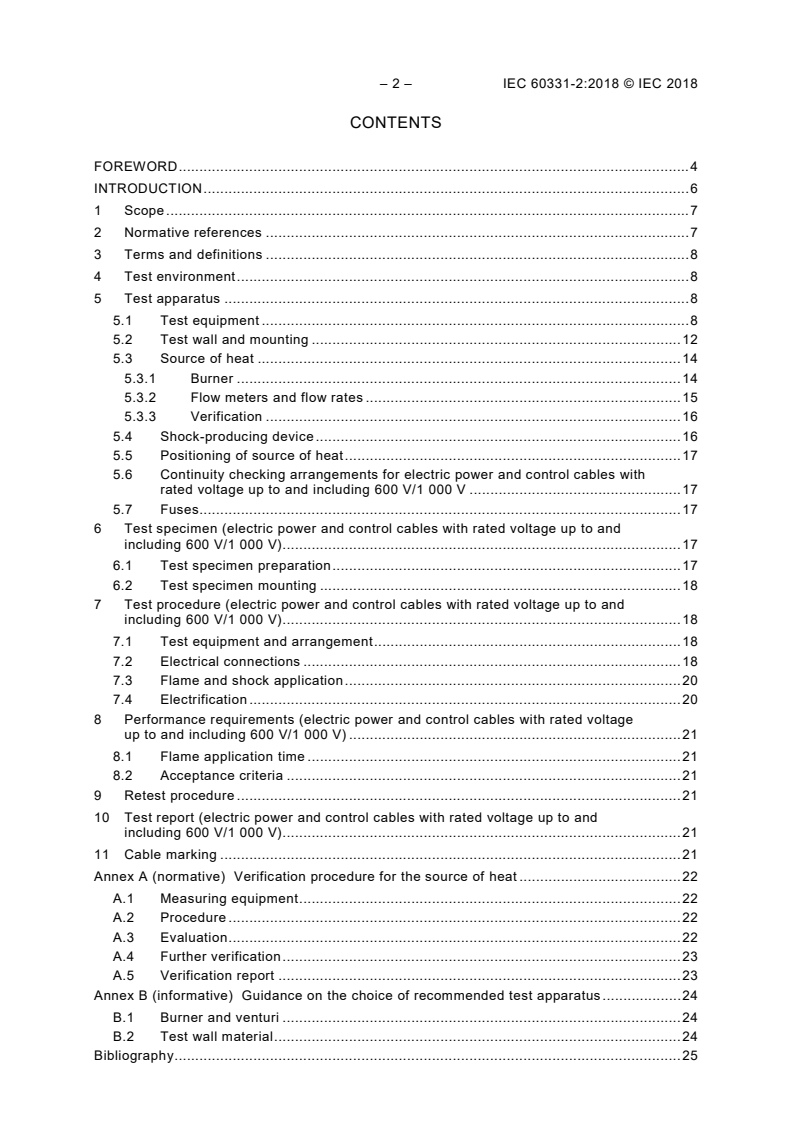
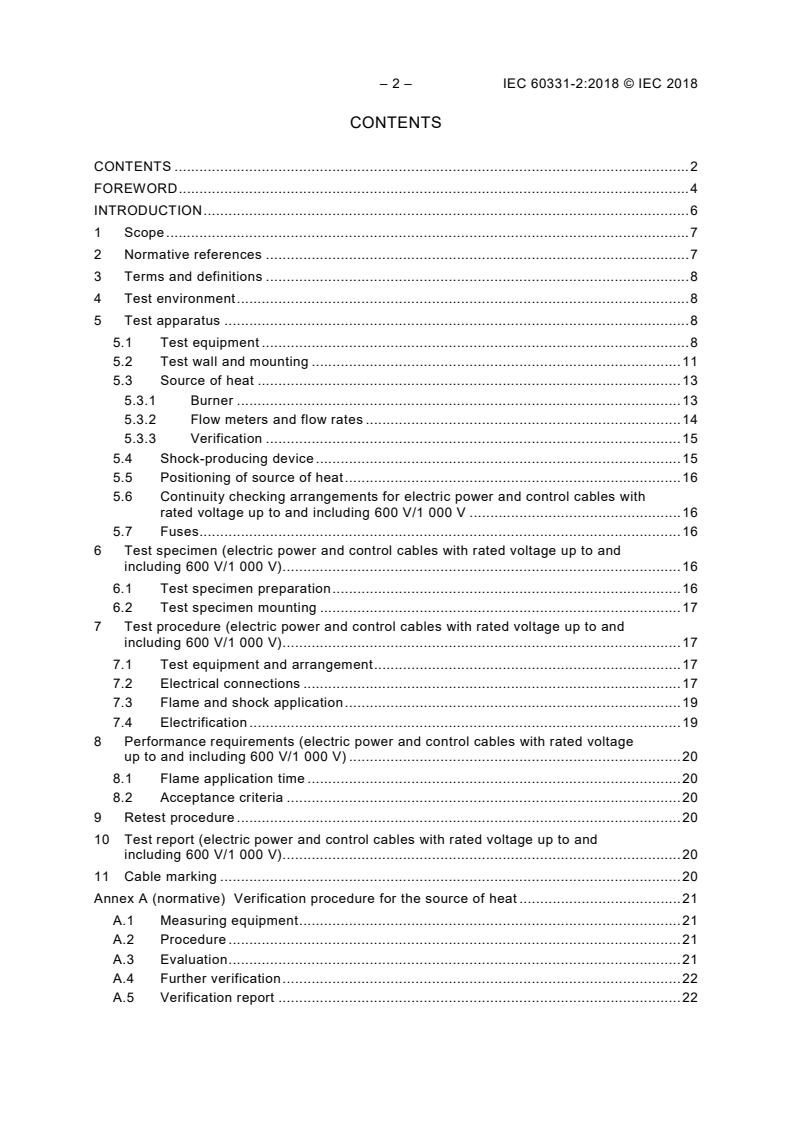
CONTENTS
FOREWORD . 4
INTRODUCTION . 6
1 Scope . 7
2 Normative references . 7
3 Terms and definitions . 8
4 Test environment . 8
5 Test apparatus . 8
5.1 Test equipment . 8
5.2 Test wall and mounting . 12
5.3 Source of heat . 14
5.3.1 Burner . 14
5.3.2 Flow meters and flow rates . 15
5.3.3 Verification . 16
5.4 Shock-producing device . 16
5.5 Positioning of source of heat . 17
5.6 Continuity checking arrangements for electric power and control cables with
rated voltage up to and including 600 V/1 000 V . 17
5.7 Fuses. 17
6 Test specimen (electric power and control cables with rated voltage up to and
including 600 V/1 000 V) . 17
6.1 Test specimen preparation . 17
6.2 Test specimen mounting . 18
7 Test procedure (electric power and control cables with rated voltage up to and
including 600 V/1 000 V) . 18
7.1 Test equipment and arrangement . 18
7.2 Electrical connections . 18
7.3 Flame and shock application . 20
7.4 Electrification . 20
8 Performance requirements (electric power and control cables with rated voltage
up to and including 600 V/1 000 V) . 21
8.1 Flame application time . 21
8.2 Acceptance criteria . 21
9 Retest procedure . 21
10 Test report (electric power and control cables with rated voltage up to and
including 600 V/1 000 V) . 21
11 Cable marking . 21
Annex A (normative) Verification procedure for the source of heat . 22
A.1 Measuring equipment . 22
A.2 Procedure . 22
A.3 Evaluation . 22
A.4 Further verification . 23
A.5 Verification report . 23
Annex B (informative) Guidance on the choice of recommended test apparatus . 24
B.1 Burner and venturi . 24
B.2 Test wall material . 24
Bibliography . 25
Figure 1 – Schematic diagram of test configuration . 10
Figure 2 – Plan view of fire test equipment . 11
Figure 3 – End elevation of fire test equipment (not to scale) . 12
Figure 4 – Typical rubber bush (hardness: 50-60 shore A) for fastening wall . 14
Figure 5 – Burner face . 15
Figure 6 – Schematic diagram of an example of a burner control system . 16
Figure 7 – Example of method of mounting a sample for test . 18
Figure 8 – Basic circuit diagram – Electric power and control cables with rated voltage
up to 600 V/1 000 V . 20
Figure A.1 – Temperature measuring arrangement . 22
– 4 – IEC 60331-2:2018 © IEC 2018
INTERNATIONAL ELECTROTECHNICAL COMMISSION
____________
TESTS FOR ELECTRIC CABLES UNDER FIRE CONDITIONS –
CIRCUIT INTEGRITY –
Part 2: Test method for fire with shock at a temperature of at least 830 °C
for cables of rated voltage up to and including 0,6/1,0 kV and with
an overall diameter not exceeding 20 mm
FOREWORD
1) The International Electrotechnical Commission (IEC) is a worldwide organization for standardization comprising
all national electrotechnical committees (IEC National Committees). The object of IEC is to promote
international co-operation on all questions concerning standardization in the electrical and electronic fields. To
this end and in addition to other activities, IEC publishes International Standards, Technical Specifications,
Technical Reports, Publicly Available Specifications (PAS) and Guides (hereafter referred to as “IEC
Publication(s)”). Their preparation is entrusted to technical committees; any IEC National Committee interested
in the subject dealt with may participate in this preparatory work. International, governmental and non-
governmental organizations liaising with the IEC also participate in this preparation. IEC collaborates closely
with the International Organization for Standardization (ISO) in accordance with conditions determined by
agreement between the two organizations.
2) The formal decisions or agreements of IEC on technical matters express, as nearly as possible, an international
consensus of opinion on the relevant subjects since each technical committee has representation from all
interested IEC National Committees.
3) IEC Publications have the form of recommendations for international use and are accepted by IEC National
Committees in that sense. While all reasonable efforts are made to ensure that the technical content of IEC
Publications is accurate, IEC cannot be held responsible for the way in which they are used or for any
misinterpretation by any end user.
4) In order to promote international uniformity, IEC National Committees undertake to apply IEC Publications
transparently to the maximum extent possible in their national and regional publications. Any divergence
between any IEC Publication and the corresponding national or regional publication shall be clearly indicated in
the latter.
5) IEC itself does not provide any attestation of conformity. Independent certification bodies provide conformity
assessment services and, in some areas, access to IEC marks of conformity. IEC is not responsible for any
services carried out by independent certification bodies.
6) All users should ensure that they have the latest edition of this publication.
7) No liability shall attach to IEC or its directors, employees, servants or agents including individual experts and
members of its technical committees and IEC National Committees for any personal injury, property damage or
other damage of any nature whatsoever, whether direct or indirect, or for costs (including legal fees) and
expenses arising out of the publication, use of, or reliance upon, this IEC Publication or any other IEC
Publications.
8) Attention is drawn to the Normative references cited in this publication. Use of the referenced publications is
indispensable for the correct application of this publication.
9) Attention is drawn to the possibility that some of the elements of this IEC Publication may be the subject of
patent rights. IEC shall not be held responsible for identifying any or all such patent rights.
International Standard IEC 60331-2 has been prepared by IEC technical committee 20:
Electric cables.
This second edition cancels and replaces the first edition published in 2009. It constitutes a
technical revision.
The significant technical changes with respect to the previous edition are as follows:
– extension of the scope with metallic data and telecom cables and optical fibre cables,
although details for the specific point of failure, continuity checking arrangement, test
sample, test procedure and test report relevant to metallicdata and telecom cables and
optical fibre cables are not given by IEC 60331-2;
– improved description of the test environment;
– mandatory use of mass flow meters/controllers as the means of controlling accurately the
input flow rates of fuel and air to the burner;
– improved figure illustrating method of mounting of the sample regarding bending radius;
– improved description of the information to be included in the test report.
The text of this International Standard is based on the following documents:
FDIS Report on voting
20/1783A/FDIS 20/1793/RVD
Full information on the voting for the approval of this International Standard can be found in
the report on voting indicated in the above table.
This document has been drafted in accordance with the ISO/IEC Directives, Part 2.
It has the status of a group safety publication in accordance with IEC Guide 104.
A list of all parts of the IEC 60331 series, published under the title: Tests for electric cables
under fire conditions – Circuit integrity, can be found on the IEC website.
The committee has decided that the contents of this publication will remain unchanged until
the maintenance result date indicated on the IEC web site under "http://webstore.iec.ch" in
the data related to the specific publication. At this date, the publication will be
• reconfirmed,
• withdrawn,
• replaced by a revised edition, or
• amended.
A bilingual version of this publication may be issued at a later date.
– 6 – IEC 60331-2:2018 © IEC 2018
INTRODUCTION
IEC 60331 consists of the following parts under the general title: Tests for Electric cables
under fire conditions – Circuit integrity:
Part 1: Test method for fire with shock at a temperature of at least 830 °C for cables of rated
voltage up to and including 0,6/1,0 kV and with an overall diameter exceeding 20 mm
Part 2: Test method for fire with shock at a temperature of at least 830 °C for cables of rated
voltage up to and including 0,6/1,0 kV and with an overall diameter not exceeding 20 mm
Part 3: Test method for fire with shock at a temperature of at least 830 °C for cables of rated
voltage up to and including 0,6/1,0 kV tested in a metal enclosure
Part 11: Apparatus – Fire alone at a flame temperature of at least 750 °C
Part 21: Procedures and requirements – Cables of rated voltage up to and including 0,6/1,0 kV
Part 23: Procedures and requirements – Electric data cables
Part 25: Procedures and requirements – Optical fibre cables
NOTE 1 Parts 21, 23 and 25 relate to fire-only conditions at a flame temperature of at least 750 °C.
NOTE 2 Parts 11, 21, 23 and 25 are no longer subject to maintenance. IEC 60331 Parts 1 and 2 are the
recommended test procedures
Since its first edition (1970), IEC 60331 has been extended and has introduced a range of test
apparatus in order that a test may be carried out on large and small power, control, data and
optical fibre cables.
Successful tests carried out in accordance with this standard will enable an identification to be
marked on the product.
TESTS FOR ELECTRIC CABLES UNDER FIRE CONDITIONS –
CIRCUIT INTEGRITY –
Part 2: Test method for fire with shock at a temperature of at least 830 °C
for cables of rated voltage up to and including 0,6/1,0 kV and with
an overall diameter not exceeding 20 mm
1 Scope
This part of IEC 60331 specifies the test method for cables which are required to maintain
circuit integrity when subject to fire and mechanical shock under specified conditions.
This document is applicable to cables of rated voltage not exceeding 600 V/1 000 V, including
those of rated voltage below 80 V, metallic data and telecom cables and optical fibre cables.
It is intended for use when testing cables of not greater than 20 mm overall diameter.
Cables of larger diameter are intended to be tested using the apparatus, procedure and
requirements of IEC 60331-1.
This document includes details for the specific point of failure, continuity checking
arrangement, test sample, test procedure and test report relevant to electric power and
control cables with rated voltage up to and including 600 V/1000 V. Details for the specific
point of failure, continuity checking arrangement, test sample, test procedure and test report
relevant to metallic data and telecom cables and optical fibre cables are not given by
IEC 60331-2.
Although the scope is restricted to cables with rated voltage up to and including 0,6/1,0 kV,
the procedure can be used, with the agreement of the manufacturer and the purchaser, for
cables with rated voltage up to and including 1,8/3 (3,3) kV, provided that suitable fuses are
used.
Annex A provides the method of verification of the burner and control system used for the
test.
Requirements are stated for an identification that may optionally be marked on the cable to
signify compliance with this standard.
CAUTION – The test given in this standard may involve the use of dangerous voltages
and temperatures. Suitable precautions should be taken against the risk of shock,
burning, fire and explosion that may be involved, and against any noxious fumes that
may be produced.
2 Normative references
The following documents are referred to in the text in such a way that some or all of their
content constitutes requirements of this document. For dated references, only the edition
cited applies. For undated references, the latest edition of the referenced document (including
any amendments) applies.
IEC 60584-1, Thermocouples – Part 1: EMF specifications and tolerances
– 8 – IEC 60331-2:2018 © IEC 2018
IEC 60269-3, Low-voltage fuses – Part 3: Supplementary requirements for fuses for use by
unskilled persons (fuses mainly for household and similar applications) – Examples of
standardized systems of fuses A to F
3 Terms and definitions
For the purposes of this document, the following terms and definitions apply.
ISO and IEC maintain terminological databases for use in standardization at the following
addresses:
• IEC Electropedia: available at http://www.electropedia.org/
• ISO Online browsing platform: available at http://www.iso.org/obp
3.1
circuit integrity
ability of an electric cable to continue to operate in the designated manner whilst subjected to
a specified flame source for a specified period of time under specified conditions
3.2
draught-free environment
space in which the results of tests are not significantly affected by the local air speed
4 Test environment
The test shall be carried out in a draught-free environment within a suitable chamber, of
minimum volume 20 m , with facilities for disposing of any noxious gases resulting from the
burning. Sufficient ventilation shall be available to sustain the flame for the duration of the
test. Air inlets and the exhaust chimney should be located in such a way that the burner flame
remains stable during the verification procedure and test. If necessary, the burner shall be
shielded from any draughts by the use of draught shields. Windows may be installed in the
walls of the chamber in order to observe the behaviour of the cable during the test. Fume
exhaust should be achieved by means of natural draught through a chimney located at least
1 m from the burner. A damper may be used for adjustment of ventilation conditions.
NOTE Experience has shown a chamber similar to the "3 m cube" specified in IEC 61034-1 to be suitable.
The chamber and test apparatus shall be at a temperature of between 10 °C and 40 °C at the
start of each test.
The same ventilation and shielding conditions shall be used in the chamber during both the
verification and cable test procedures.
5 Test apparatus
5.1 Test equipment
The test equipment shall consist of the following:
a) a test wall onto which the cable is mounted, comprising a board manufactured from
heat-resistant, non-combustible material suitable for the temperatures involved fastened to
steel supports and mounted on a rigid support as described in 5.2;
b) a source of heat comprising a horizontally mounted ribbon burner as described in 5.3;
c) a shock-producing device as described in 5.4;
d) a test wall equipped with thermocouples for verification of the source of heat as described
in Annex A;
...
IEC 60331-2 ®
Edition 2.0 2018-03
REDLINE VERSION
INTERNATIONAL
STANDARD
colour
inside
GROUP SAFETY PUBLICATION
Tests for electric cables under fire conditions – Circuit integrity –
Part 2: Test method for fire with shock at a temperature of at least 830 °C for
cables of rated voltage up to and including 0,6/1,0 kV and with an overall
diameter not exceeding 20 mm
All rights reserved. Unless otherwise specified, no part of this publication may be reproduced or utilized in any form
or by any means, electronic or mechanical, including photocopying and microfilm, without permission in writing from
either IEC or IEC's member National Committee in the country of the requester. If you have any questions about IEC
copyright or have an enquiry about obtaining additional rights to this publication, please contact the address below or
your local IEC member National Committee for further information.
IEC Central Office Tel.: +41 22 919 02 11
3, rue de Varembé info@iec.ch
CH-1211 Geneva 20 www.iec.ch
Switzerland
About the IEC
The International Electrotechnical Commission (IEC) is the leading global organization that prepares and publishes
International Standards for all electrical, electronic and related technologies.
About IEC publications
The technical content of IEC publications is kept under constant review by the IEC. Please make sure that you have the
latest edition, a corrigenda or an amendment might have been published.
IEC Catalogue - webstore.iec.ch/catalogue Electropedia - www.electropedia.org
The stand-alone application for consulting the entire The world's leading online dictionary of electronic and
bibliographical information on IEC International Standards, electrical terms containing 21 000 terms and definitions in
Technical Specifications, Technical Reports and other English and French, with equivalent terms in 16 additional
documents. Available for PC, Mac OS, Android Tablets and languages. Also known as the International Electrotechnical
iPad. Vocabulary (IEV) online.
IEC publications search - webstore.iec.ch/advsearchform IEC Glossary - std.iec.ch/glossary
The advanced search enables to find IEC publications by a 67 000 electrotechnical terminology entries in English and
variety of criteria (reference number, text, technical French extracted from the Terms and Definitions clause of
committee,…). It also gives information on projects, replaced IEC publications issued since 2002. Some entries have been
and withdrawn publications. collected from earlier publications of IEC TC 37, 77, 86 and
CISPR.
IEC Just Published - webstore.iec.ch/justpublished
Stay up to date on all new IEC publications. Just Published IEC Customer Service Centre - webstore.iec.ch/csc
details all new publications released. Available online and If you wish to give us your feedback on this publication or
also once a month by email. need further assistance, please contact the Customer Service
Centre: sales@iec.ch.
IEC 60331-2 ®
Edition 2.0 2018-03
REDLINE VERSION
INTERNATIONAL
STANDARD
colour
inside
GROUP SAFETY PUBLICATION
Tests for electric cables under fire conditions – Circuit integrity –
Part 2: Test method for fire with shock at a temperature of at least 830 °C for
cables of rated voltage up to and including 0,6/1,0 kV and with an overall
diameter not exceeding 20 mm
INTERNATIONAL
ELECTROTECHNICAL
COMMISSION
ICS 13.220.40; 29.020; 29.060.20 ISBN 978-2-8322-5550-6
– 2 – IEC 60331-2:2018 RLV © IEC 2018
CONTENTS
FOREWORD . 4
INTRODUCTION . 6
1 Scope . 7
2 Normative references . 8
3 Terms and definitions . 8
4 Test conditions – Test environment . 8
5 Test apparatus . 9
5.1 Test equipment . 9
5.2 Test wall and mounting . 12
5.3 Source of heat . 14
5.3.1 Burner . 14
5.3.2 Flow meters and flow rates . 14
5.3.3 Verification . 16
5.4 Shock-producing device . 16
5.5 Positioning of source of heat . 16
5.6 Continuity checking arrangements for electric power and control cables with
rated voltage up to and including 600 V/1 000 V . 16
5.7 Fuses. 16
6 Test specimen(electric power and control cables with rated voltage up to and
including 600 V/1 000 V) . 17
6.1 Test specimen preparation . 17
6.2 Test specimen mounting . 17
7 Test procedure(electric power and control cables with rated voltage up to and
including 600 V/1 000 V) . 18
7.1 Test equipment and arrangement . 18
7.2 Electrical connections . 18
7.3 Flame and shock application . 19
7.4 Electrification . 19
8 Performance requirements(electric power and control cables with rated voltage up
to and including 600 V/1 000 V) . 20
8.1 Flame application time . 20
8.2 Acceptance criteria . 20
9 Retest procedure . 20
10 Test report (electric power and control cables with rated voltage up to and
including 600 V/1 000 V) . 20
11 Cable marking . 21
Annex A (normative) Verification procedure for the source of heat . 22
A.1 Measuring equipment . 22
A.2 Procedure . 22
A.3 Evaluation . 22
A.4 Further verification . 23
A.5 Verification report . 23
Annex B (informative) Guidance on the choice of recommended test apparatus . 24
B.1 Burner and venturi . 24
B.2 Test wall material . 24
Influence of draughts in the test chamber .
Guidance on provision of a suitable test chamber .
Bibliography . 26
Figure 1 – Schematic diagram of test configuration . 10
Figure 2 – Plan view of fire test equipment . 11
Figure 3 – End elevation of fire test equipment (not to scale) . 12
Figure 4 – Typical rubber bush (hardness: 50-60 shore A) for fastening wall . 13
Figure 5 – Burner face . 14
Figure 6 – Schematic diagram of an example of a burner control system using
rotameters . 15
Figure 7 – Example of method of mounting a sample for test . 17
Figure 8 – Basic circuit diagram – Electric power and control cables with rated voltage
up to 600 V/1 000 V . 19
Figure A.1 – Temperature measuring arrangement . 22
– 4 – IEC 60331-2:2018 RLV © IEC 2018
INTERNATIONAL ELECTROTECHNICAL COMMISSION
____________
TESTS FOR ELECTRIC CABLES UNDER FIRE CONDITIONS –
CIRCUIT INTEGRITY –
Part 2: Test method for fire with shock at a temperature of at least 830 °C
for cables of rated voltage up to and including 0,6/1,0 kV and with
an overall diameter not exceeding 20 mm
FOREWORD
1) The International Electrotechnical Commission (IEC) is a worldwide organization for standardization comprising
all national electrotechnical committees (IEC National Committees). The object of IEC is to promote
international co-operation on all questions concerning standardization in the electrical and electronic fields. To
this end and in addition to other activities, IEC publishes International Standards, Technical Specifications,
Technical Reports, Publicly Available Specifications (PAS) and Guides (hereafter referred to as “IEC
Publication(s)”). Their preparation is entrusted to technical committees; any IEC National Committee interested
in the subject dealt with may participate in this preparatory work. International, governmental and non-
governmental organizations liaising with the IEC also participate in this preparation. IEC collaborates closely
with the International Organization for Standardization (ISO) in accordance with conditions determined by
agreement between the two organizations.
2) The formal decisions or agreements of IEC on technical matters express, as nearly as possible, an international
consensus of opinion on the relevant subjects since each technical committee has representation from all
interested IEC National Committees.
3) IEC Publications have the form of recommendations for international use and are accepted by IEC National
Committees in that sense. While all reasonable efforts are made to ensure that the technical content of IEC
Publications is accurate, IEC cannot be held responsible for the way in which they are used or for any
misinterpretation by any end user.
4) In order to promote international uniformity, IEC National Committees undertake to apply IEC Publications
transparently to the maximum extent possible in their national and regional publications. Any divergence
between any IEC Publication and the corresponding national or regional publication shall be clearly indicated in
the latter.
5) IEC itself does not provide any attestation of conformity. Independent certification bodies provide conformity
assessment services and, in some areas, access to IEC marks of conformity. IEC is not responsible for any
services carried out by independent certification bodies.
6) All users should ensure that they have the latest edition of this publication.
7) No liability shall attach to IEC or its directors, employees, servants or agents including individual experts and
members of its technical committees and IEC National Committees for any personal injury, property damage or
other damage of any nature whatsoever, whether direct or indirect, or for costs (including legal fees) and
expenses arising out of the publication, use of, or reliance upon, this IEC Publication or any other IEC
Publications.
8) Attention is drawn to the Normative references cited in this publication. Use of the referenced publications is
indispensable for the correct application of this publication.
9) Attention is drawn to the possibility that some of the elements of this IEC Publication may be the subject of
patent rights. IEC shall not be held responsible for identifying any or all such patent rights.
This redline version of the official IEC Standard allows the user to identify the changes
made to the previous edition. A vertical bar appears in the margin wherever a change
has been made. Additions are in green text, deletions are in strikethrough red text.
International Standard IEC 60331-2 has been prepared by IEC technical committee 20:
Electric cables.
This second edition cancels and replaces the first edition published in 2009. It constitutes a
technical revision.
The significant technical changes with respect to the previous edition are as follows:
– extension of the scope with metallic data and telecom cables and optical fibre cables,
although details for the specific point of failure, continuity checking arrangement, test
sample, test procedure and test report relevant to metallicdata and telecom cables and
optical fibre cables are not given by IEC 60331-2;
– improved description of the test environment;
– mandatory use of mass flow meters/controllers as the means of controlling accurately the
input flow rates of fuel and air to the burner;
– improved figure illustrating method of mounting of the sample regarding bending radius;
– improved description of the information to be included in the test report.
The text of this International Standard is based on the following documents:
FDIS Report on voting
20/1783A/FDIS 20/1793/RVD
Full information on the voting for the approval of this International Standard can be found in
the report on voting indicated in the above table.
This document has been drafted in accordance with the ISO/IEC Directives, Part 2.
It has the status of a group safety publication in accordance with IEC Guide 104.
A list of all parts of the IEC 60331 series, published under the title: Tests for electric cables
under fire conditions – Circuit integrity, can be found on the IEC website.
The committee has decided that the contents of this publication will remain unchanged until
the maintenance result date indicated on the IEC web site under "http://webstore.iec.ch" in
the data related to the specific publication. At this date, the publication will be
• reconfirmed,
• withdrawn,
• replaced by a revised edition, or
• amended.
IMPORTANT – The “colour inside” logo on the cover page of this publication indicates
that it contains colours which are considered to be useful for the correct understanding
of its contents. Users should therefore print this publication using a colour printer.
– 6 – IEC 60331-2:2018 RLV © IEC 2018
INTRODUCTION
IEC 60331 consists of the following parts under the general title: Tests for Electric cables
under fire conditions – Circuit integrity:
Part 1: Test method for fire with shock at a temperature of at least 830 °C for cables of rated
voltage up to and including 0,6/1,0 kV and with an overall diameter exceeding 20 mm
Part 2: Test method for fire with shock at a temperature of at least 830 °C for cables of rated
voltage up to and including 0,6/1,0 kV and with an overall diameter not exceeding 20 mm
Part 3: Test method for fire with shock at a temperature of at least 830 °C for cables of rated
voltage up to and including 0,6/1,0 kV tested in a metal enclosure
Part 11: Apparatus – Fire alone at a flame temperature of at least 750 °C
Part 21: Procedures and requirements – Cables of rated voltage up to and including 0,6/1,0 kV
Part 23: Procedures and requirements – Electric data cables
Part 25: Procedures and requirements – Optical fibre cables
NOTE 1 Parts 21, 23 and 25 relate to fire-only conditions at a flame temperature of at least 750 °C.
NOTE 2 Parts 11, 21, 23 and 25 are no longer subject to maintenance. IEC 60331 Parts 1 and 2 are the
recommended test procedures
Since its first edition (1970), IEC 60331 has been extended and has introduced a range of test
apparatus in order that a test may be carried out on large and small power, control, data and
optical fibre cables.
Successful tests carried out in accordance with this standard will enable an identification to be
marked on the product.
TESTS FOR ELECTRIC CABLES UNDER FIRE CONDITIONS –
CIRCUIT INTEGRITY –
Part 2: Test method for fire with shock at a temperature of at least 830 °C
for cables of rated voltage up to and including 0,6/1,0 kV and with
an overall diameter not exceeding 20 mm
1 Scope
This part of IEC 60331 specifies the test apparatus and procedure and gives the performance
requirements, including recommended flame application times, for low-voltage power cables
of rated voltage up to and including 0,6/1,0 kV and control cables with a rated voltage which
are required to maintain circuit integrity when subject to fire and mechanical shock under
specified conditions. It is intended for use when testing cables not greater than 20 mm overall
diameter.
This part of IEC 60331 specifies the test method for cables which are required to maintain
circuit integrity when subject to fire and mechanical shock under specified conditions.
This document is applicable to cables of rated voltage not exceeding 600 V/1 000 V, including
those of rated voltage below 80 V, metallic data and telecom cables and optical fibre cables.
It is intended for use when testing cables of not greater than 20 mm overall diameter.
NOTE Cables of larger diameter should are intended to be tested using the apparatus,
procedure and requirements of IEC 60331-1.
This standard describes the means of test specimen preparation, the continuity checking
arrangements, the electrical testing procedure, the method of burning the cables and the
method of shock production, and gives requirements for evaluating test results
This document includes details for the specific point of failure, continuity checking
arrangement, test sample, test procedure and test report relevant to electric power and
control cables with rated voltage up to and including 600 V/1000 V. Details for the specific
point of failure, continuity checking arrangement, test sample, test procedure and test report
relevant to metallic data and telecom cables and optical fibre cables are not given by
IEC 60331-2.
Although the scope is restricted to cables with rated voltage up to and including 0,6/1,0 kV,
the procedure can be used, with the agreement of the manufacturer and the purchaser, for
cables with rated voltage up to and including 1,8/3 (3,3) kV, provided that suitable fuses are
used.
Annex A provides the method of verification of the burner and control system used for the
test.
Requirements are stated for an identification that may optionally be marked on the cable to
signify compliance with this standard.
CAUTION – The test given in this standard may involve the use of dangerous voltages
and temperatures. Suitable precautions should be taken against the risk of shock,
burning, fire and explosion that may be involved, and against any noxious fumes that
may be produced.
– 8 – IEC 60331-2:2018 RLV © IEC 2018
2 Normative references
The following documents are referred to in the text in such a way that some or all of their
content constitutes requirements of this document. For dated references, only the edition
cited applies. For undated references, the latest edition of the referenced document (including
any amendments) applies.
IEC 60584-1, Thermocouples – Part 1: Reference tables EMF specifications and tolerances
IEC 60269-3, Low-voltage fuses – Part 3: Supplementary requirements for fuses for use by
unskilled persons (fuses mainly for household and similar applications) – Examples of
standardized systems of fuses A to F
IEC Guide 104, The preparation of safety publications and the use of basic safety publications
and group safety publications
3 Terms and definitions
For the purposes of this document, the following terms and definitions apply.
ISO and IEC maintain terminological databases for use in standardization at the following
addresses:
• IEC Electropedia: available at http://www.electropedia.org/
• ISO Online browsing platform: available at http://www.iso.org/obp
3.1
circuit integrity
ability of an electric cable to continue to operate in the designated manner whilst subjected to
a specified flame source for a specified period of time under specified conditions
3.2
draught-free environment
space in which the results of tests are not significantly affected by the local air speed
4 Test conditions – Test environment
The test shall be carried out in a draught-free environment within a suitable chamber, of
minimum volume 10 20 m , with facilities for disposing of any noxious gases resulting from
the burning. Sufficient ventilation shall be available to sustain the flame for the duration of the
test. Air inlets and the exhaust chimney should be located in such a way that the burner flame
remains stable during the verification procedure and test. If necessary, the burner shall be
shielded from any draughts by the use of draught shields. Windows may be installed in the
walls of the chamber in order to observe the behaviour of the cable during the test. Fume
exhaust should be achieved by means of natural draught through a chimney located at least
1 m from the burner. A damper may be used for adjustment of ventilation conditions.
NOTE Guidance on the choice of suitable chambers is given in Annex B.
NOTE Experience has shown a chamber similar to the "3 m cube" specified in IEC 61034-1 to be suitable.
The chamber and test apparatus shall be at a temperature of between 10 °C and 40 °C at the
start of each test.
The same ventilation and shielding conditions shall be used in the chamber during both the
verification and cable test procedures.
NOTE The test given in this standard may involve the use of dangerous voltages and temperatures. Suitable
precautions should be taken against the risk of shock, burning, fire and explosion that may be involved, and
against any noxious fumes that may be produced.
5 Test apparatus
5.1 Test equipment
The test equipment shall consist of the following:
a) a test wall onto which the cable is mounted, comprising a board manufactured from
heat-resistant, non-combustible material with suitable for the temperatures involved
fastened to steel supports and mounted on a rigid support as described in 5.2;
b) a source of heat comprising a horizontally mounted ribbon burner as described in 5.3;
c) a shock-producing device as described in 5.4;
d) a test wall equipped with thermocouples for verification of the source of heat as described
in Annex A;
e) a continuity checking arrangement as described in 5.6;
f) fuses as described in 5.7.
A general arrangement of the test equipment is shown in Figure 1, Figure 2 and Figure 3.
– 10 – IEC 60331-2:2018 RLV © IEC 2018
Dimensions in millimetres
10 ±2
900 ±100
EC
Key
1 shock-producing device 4 ribbon gas burner
2 steel support 5 air inlet pipe
3 rubber bush 6 propane inlet pipe
Figure 1 – Schematic diagram of test configuration
300 ±50
Dimensions in millimetres
IEC
Key
1 entry for air 4 support framework
2 board 5 horizontal steel support for board
3 rubber bush 6 entry for propane gas
Figure 2 – Plan view of fire test equipment
900 ±100
– 12 – IEC 60331-2:2018 RLV © IEC 2018
Dimensions in millimetres
+5
60° 0
2 200 ±5
400 ±5
600 ±5
40 ±2
IEC
Key
1 shock-producing device 4 centre line of burner face
2 board 5 support framework
3 gas burner 6 test sample
V Vertical distance from centre line of burner to
the centre of the test specimen
Figure 3 – End elevation of fire test equipment
(not to scale)
5.2 Test wall and mounting
The test wall shall consist of a board of heat-resistant, non-combustible and non-metallic
material fastened rigidly to two horizontal steel supports, one at the top of the board and the
other at the bottom, as shown in Figure 1. Vertical supports may also be used. The board
shall be (900 ± 100) mm long, (300 ± 50) mm high and (10 ± 2) mm thick and the total mass of
the test wall (i.e. board and steel supports) shall be (10,0 ± 0,5) kg. Ballast, if required, shall
be placed on the steel supports.
25,0 ±0,1
V ±2
300 ±50
In case of dispute, a new board should be used for each test.
NOTE 1 Supports made from square section steel tube approximately 25 mm x 25 mm and approximately 1 m
long have been found to be suitable.
NOTE The top support should be fastened to the board so that its upper face is slightly above
the upper edge of the board, so that the shock-producing device impacts on the support and
not the board.
Each horizontal support shall have a mounting hole at each end, not more than 100 mm from
the edge of the board, the exact position and diameter being determined by the particular
supporting bush and supporting framework used. The test wall shall be fastened to a rigid
support by four bonded rubber bushes of hardness 50–60 Shore A fitted between the
horizontal steel supports of the wall and the support framework, as shown in Figure 1 and
Figure 2 so as to allow movement under impact.
NOTE 2 A typical rubber bush, which has been found to be suitable, is shown in Figure 4.
In order to check the mounting of the wall, the static deflection following application of a mass
to the centre of the upper support of the wall shall periodically be measured.
The values of mass and deflection shall comply with the following:
Mass Deflection
kg mm
25,0 ± 0,2 1,5 ± 0,3
Dimensions in millimetres
30-40
IEC
Figure 4 – Typical rubber bush (hardness: 50-60 shore A) for fastening wall
20-30
– 14 – IEC 60331-2:2018 RLV © IEC 2018
5.3 Source of heat
5.3.1 Burner
The source of heat shall be a ribbon type propane gas burner with a nominal burner face
length of 500 mm (outer distance between outer holes) with a venturi mixer. The nominal
burner face width shall be 10 mm. The face of the burner shall have three staggered rows of
drilled holes, nominally 1,32 mm in diameter and drilled at centres 3,2 mm from one another,
as shown in Figure 5.
A centre-feed burner is recommended.
Additionally, A row of small holes milled on each side of the burner plate, to serve as pilot
holes for keeping the flame burning, is permitted.
Guidance on the choice of a recommended burner system is given in Annex B.
Dimensions in millimetres
(Dimensions are approximate)
3,2
IEC
NOTE Round holes, 1,32 mm in diameter, on centres 3,2 mm from one another, staggered in three rows and
centred on the face of the burner. Nominal burner face length 500 mm.
Figure 5 – Burner face
5.3.2 Flow meters and flow rates
Mass flow meters/controllers should shall be used as the means of controlling accurately the
input flow rates of fuel and air to the burner.
NOTE Rotameter type flow meters may be used as an alternative, but are not recommended. Guidance on their
use, and the application of appropriate correction factors is given in IEC 60331-11:1999, Annex C.
NOTE Figure 6 shows an example of a rotameter type system.
For the purpose of this test, the air shall have a dew point not higher than 0 °C.
The mass flow rates used for the test shall be as follows:
– air: (80 ± 4) l/min at reference conditions (1 bar and 20 °C) or (1600 ± 80) mg/s;
– propane: (5,0 ± 0,2) l/min at reference conditions (1 bar and 20 °C) or (160 ± 6) mg/s.
Propane: (160 ± 6) mg/s
NOTE 1 This is approximately equivalent to a volume flow rate of (5,0 ± 0,2) litres/min at reference conditions
(1 bar and 20 °C).
3,2
4,5
NOTE The purity of the propane is not defined. Industrial grades that contain impurities are
allowed provided that the calibration requirements are achieved.
Air: (1 600 ± 80) mg/s
NOTE 2 This is approximately equivalent to a volume flow rate of (80 ± 4) litres/min at reference conditions
(1 bar and 20 °C).
A schematic diagram of an example of a burner control system is given in Figure 6.
6A
IEC
Key
1 regulator 9 mass flow meters
2 piezoelectric igniter 10 venturi mixer
3 flame failure device 11 burner
4 control thermocouples 12 ball valve
5 propane cylinder 13 air flow
6 screw valve (6A = alternative position) 14 compressed air cylinder
7 pilot feed 15 screw valve on pilot feed
8 gas flow
Figure 6 – Schematic diagram of an example of a burner control
system using rotameters
– 16 – IEC 60331-2:2018 RLV © IEC 2018
5.3.3 Verification
The burner and control system shall be subject to verification following the procedure given in
Annex A.
5.4 Shock-producing device
The shock producing device shall be a mild steel round bar (25,0 ± 0,1) mm in diameter and
(600 ± 5) mm long. The bar shall be freely pivoted about an axis parallel to the test wall,
which shall be in the same horizontal plane as, and (200 ± 5) mm away from, the upper edge
of the wall. The axis shall divide the bar into two unequal lengths, the longer length being
(400 ± 5) mm which shall impact the wall. The bar shall drop under its own weight from an
+5
angle of (60 ) ° to the horizontal to strike the upper steel support of the wall at its midpoint
as shown in Figure 1 and Figure 3.
5.5 Positioning of source of heat
The burner face shall be positioned in the test chamber so that it is at least 200 mm above the
floor of the chamber, or any solid mounting block, and at least 500 mm from any chamber
wall.
By reference to the centre point of the cable to be tested, the burner shall be positioned
centrally at a horizontal distance of (40 ± 2) mm from the burner face to the test wall and at a
vertical distance of (V ± 2) mm from the burner horizontal central plane to the central
horizontal plane of the test specimen, as shown in Figure 3 and Figure A.1.
The exact burner location to be used during cable testing shall be determined using the
verification procedure given in Annex A, where the value of V to be used shall be determined.
NOTE The burner should be rigidly fixed to the framework during testing so as to prevent
movement relative to the test sample specimen.
5.6 Continuity checking arrangements for electric power and control cables with rated
voltage up to and including 600 V/1 000 V
During the test, a current for continuity checking shall be passed through all conductors of the
test specimen. This shall be provided by a three-phase star-connected or single-phase
transformer(s) of sufficient capacity to maintain the test voltage up to the maximum leakage
current allowable.
NOTE 1 Due Note should be taken of the fuse characteristics when determining the power rating of the
transformer.
This current shall be achieved by connecting, at the other end of the test specimen, a suitable
load and an indicating device (e.g. lamp) to each conductor, or group of conductors.
NOTE 2 A current of 0,25 A at the test voltage, through each conductor or group of conductors, has been found to
be suitable.
5.7 Fuses
Fuses used in the test procedure in Clause 7 shall be of type DII, complying with IEC 60269-3
Fuse System A-D Type DII, 2A. Alternatively, a circuit-breaker with equivalent characteristics
may be used.
Where a circuit-breaker is used, its equivalent characteristics shall be demonstrated by
reference to the characteristic curve shown in IEC 60269-3.
The test method using fuses shall be the reference method in the case of dispute.
6 Test specimen (electric power and control cables with rated voltage up to
and including 600 V/1 000 V)
6.1 Test specimen preparation
A cable sample at least 4,5 3,6 m long shall be available from the cable length for test. Each
individual test specimen to be tested shall be a piece of cable, taken from the cable sample,
not less than 1 200 mm long with approximately 100 mm of sheath or outer covering removed
at each end.
At each end of the test specimen, each conductor shall be suitably prepared for electrical
connections, and, if there is more than one conductor, the exposed conductors shall be
spread apart to avoid contact with each other.
6.2 Test specimen mounting
The test specimen shall be bent to form an approximate “U” shape. The internal radius of
each bend shall be the manufacturer’s declared minimum bending radius in normal use and
the overall distance between the vertical portions of the cable shall be (475 ± 10) mm as
shown in Figure 7.
The test specimen shall be mounted centrally on the wall using metal clips which shall be
earthed. The lower edge of the cable shall be (200 ± 10) mm below the top of the test wall.
P-clips made of metal strip (10 ± 1) mm wide shall support the test specimen at either both
ends of the radiused section and in the centre as shown in Figure 7. The P-clips shall be
formed so as to have approximately the same diameter as the cable under test.
Dimensions in millimetres
900 ±100
R
475 ±10
IEC
Key
1 metal clips
R minimum bending radius of cables in normal use
Figure 7 – Example of method of mounting a sample for test
300 ±50
200 ±10
– 18 – IEC 60331-2:2018 RLV © IEC 2018
7 Test procedure (electric power and control cables with rated voltage up to
and including 600 V/1 000 V)
7.1 Test equipment and arrangement
The test procedure defined in this clause shall be carried out using the apparatus detailed in
Clause 5.
Mount the test specimen on the test wall and adjust the burner to the correct position relative
to the specimen in accordance with 5.5.
7.2 Electrical connections
At the transformer end of the test specimen, earth the neutral conductor, if present, and any
protective conductors. Any metal screens, drain wire or metallic layer shall be interconnected
and earthed. Connect the transformer(s) to the conductors, excluding any conductor which is
specifically identified as intended for use as a neutral or a protective conductor, as shown in
the circuit diagram in Figure 8. Where a metallic sheath, armour or screen acts as a neutral or
protective conductor, it shall be connected, as shown in the circuit diagram in Figure 8, as for
a neutral or protective conductor.
For single-, twin- or three-phase conductor cables, connect each phase conductor to a
separate phase of the transformer(s) output with a 2 A fuse or circuit-breaker with equivalent
characteristics in each phase.
For multicore cables that have four or more conductors (excluding any neutral or protective
conductors), the conductors shall be divided into three roughly equal groups, ensuring that
adjacent conductors are, as far as possible, in different groups.
For multipair cables, the conductors shall be divided into two equal groups, ensuring that the
a-core of each pair is connected to one phase and the b-core of each pair is connected to
another phase (L1 and L2 in Figure 8). Quads shall be treated as two pairs.
For multi-triple cables, the conductors shall be divided into three equal groups, ensuring that
the a-core of each triple is connected to one phase, the b-core of each triple to another phase
and the c-core of each triple to the third phase of the transformer (L1, L2 and L3 in Figure 8).
Connect the conductors of each group in series and connect each group to a separate phase
of the transformer output with a 2 A fuse or circuit-breaker with equivalent characteristics in
each phase.
NOTE The above test procedure connects the neutral conductor to earth. This may not be
appropriate if the cable is designed for use on a system where neutral is not earthed. If
required by the cable standard it is permissible for the neutral conductor to be tested as if it
were a phase conductor. Where a metallic sheath, armour or screen acts as a neutral
conductor, it shall always be connected to earth. Any such variations in methodology should
be included in the test report.
NOTE For cable constructions not specifically identified above, the test voltage should be
applied, as far as is practicable, to ensure that adjacent conductors are connected to different
phases.
NOTE In certain cases, for example when testing a control cable using a three-phase
transformer, it may not be possible to apply a test voltage between conductors and from
conductor to earth equal to the rated voltage simultaneously. In such cases, either the test
voltage between conductors, or the test voltage from conductor to earth shall be equal to the
rated voltage, such that both the test voltage between conductors and the test voltage from
conductor to earth is equal to or higher than the rated voltage.
At the end of the test specimen remote from the transformer:
– connect each phase conductor, or group of conductors, to one terminal of the load and
indicating device (as described in 5.6), the other terminal being earthed;
– connect the neutral conductor and any protective conductor to one terminal of the load
and indicating device (as described in 5.6), the other terminal being connected to L1 (or
L2 or L3) at the transformer end (see Figure 8).
3 6
2 5
L3 L3
L2 L2
L1
L1
N
PE
N
IECI
Key
L1, L2, L3 phase conductors (L2, L3 if present)
N neutral conductor (if present)
PE protective earth (if present)
1 Transformer 5 test conductor or group
2 fuse (2 A) 6 load and indicating device (e.g. lamp)
3 connection to phase L1 (or L2 or L3) 7 test specimen
4 metal clips 8 metal screen (if present)
Figure 8 – Basic circuit diagram – Electric power and control cables
with rated voltage up to 600 V/1 000 V
7.3 Flame and shock application
Ignite the burner and adjust the propane and air flow rates to those obtained during the
verification procedure (see Annex A).
Immediately after igniting the burner, activate the shock-producing device and start the test
duration timer. The shock-producing device shall impact the wall after 5 min ± 10 s from
activation and subsequently at 5 min ± 10 s intervals. After each impact, the impacting bar
shall be raised from the test wall no more than 20 s after the impact.
7.4 Electrification
Immediately after starting the test duration timer, switch on the electricity supply and adjust
the voltage to the rated voltage of the cable (subject to a minimum voltage of 100 V AC),
i.e. the test voltage between conductors shall equal the rated voltage between conductors,
and the test voltage from conductor to earth shall equal the rated voltage from conductor to
earth.
– 20 – IEC 60331-2:2018 RLV © IEC 2018
The test shall continue for the flame application time given in 8.1, after which the flame shall
be extinguished.
8 Performance requirements (electric power and control cables with rated
voltage up to and including 600 V/1 000 V)
8.1 Flame application time
The flame application time shall be as specified in the relevant cable standard. In the absence
of such a standard, a flame and impact application of 30 min, 60 min, 90 min or 120 min shall
be chosen.
8.2 Acceptance criteria
With reference to the test procedure given in Clause 7, the cable possesses the
characteristics for providing circuit integrity so long as during the course of the test
– the voltage is maintained, i.e. no fuse fails or circuit-breaker is interrupted,
– a conductor does not rupture, i.e. the lamp is not extinguished.
Failure by either one of the criteria listed shall be sufficient to show a failure for that cable.
9 Retest procedure
In the event of a failure, as judged by the requirements of the relevant standard, two further
test specimens, taken from the same cable sample, shall be tested. If both comply, the test
shall be deemed successful.
10 Test report (electric power and control cables with rated voltage up to and
including 600 V/1 000 V)
The test report shall include the following information:
a) the number of this standard;
b) a full description of the cable tested;
c) the manufacturer of the cable tested;
d) the test voltage and actual applied electrical connections, in accordance with Paragraphs
7 to 9 of 7.2;
e) any option used in the test procedure (i.e. type of test wall, failure detection method);
f) the type and disposition of clips supporting cable sample;
g) the actual cable bending radius used for the test;
h) the method used for temperature monitoring during the verification procedure;
i) the point of failure mechanism (i.e. voltage not maintained or conductor rupture);
j) the actual performance requirement applied (by reference to Clause 8);
k) the flame application time;
l) the chamber volume and temperature at the start of the test.
11 Cable marking
If a cable is required to be marked to signify compliance with this standard, it shall be marked
with the number of this standard and the duration of flame a
...
IEC 60331-2 ®
Edition 2.0 2018-03
INTERNATIONAL
STANDARD
NORME
INTERNATIONALE
Tests for electric cables under fire conditions – circuit integrity –
Part 2: Test method for fire with shock at a temperature of at least 830 °C for
cables of rated voltage up to and including 0,6/1,0 kV and with an overall
diameter not exceeding 20 mm
Essais pour câbles électriques soumis au feu – intégrité des circuits –
Partie 2: Méthode d'essai au feu avec chocs pour les câbles de tension assignée
au plus égale à 0,6/1,0 kV et de diamètre externe inférieur ou égal à 20 mm, à une
température d'au moins 830 °C
All rights reserved. Unless otherwise specified, no part of this publication may be reproduced or utilized in any form
or by any means, electronic or mechanical, including photocopying and microfilm, without permission in writing from
either IEC or IEC's member National Committee in the country of the requester. If you have any questions about IEC
copyright or have an enquiry about obtaining additional rights to this publication, please contact the address below or
your local IEC member National Committee for further information.
Droits de reproduction réservés. Sauf indication contraire, aucune partie de cette publication ne peut être reproduite
ni utilisée sous quelque forme que ce soit et par aucun procédé, électronique ou mécanique, y compris la photocopie
et les microfilms, sans l'accord écrit de l'IEC ou du Comité national de l'IEC du pays du demandeur. Si vous avez des
questions sur le copyright de l'IEC ou si vous désirez obtenir des droits supplémentaires sur cette publication, utilisez
les coordonnées ci-après ou contactez le Comité national de l'IEC de votre pays de résidence.
IEC Central Office Tel.: +41 22 919 02 11
3, rue de Varembé info@iec.ch
CH-1211 Geneva 20 www.iec.ch
Switzerland
About the IEC
The International Electrotechnical Commission (IEC) is the leading global organization that prepares and publishes
International Standards for all electrical, electronic and related technologies.
About IEC publications
The technical content of IEC publications is kept under constant review by the IEC. Please make sure that you have the
latest edition, a corrigenda or an amendment might have been published.
IEC Catalogue - webstore.iec.ch/catalogue Electropedia - www.electropedia.org
The stand-alone application for consulting the entire The world's leading online dictionary of electronic and
bibliographical information on IEC International Standards, electrical terms containing 21 000 terms and definitions in
Technical Specifications, Technical Reports and other English and French, with equivalent terms in 16 additional
documents. Available for PC, Mac OS, Android Tablets and languages. Also known as the International Electrotechnical
iPad. Vocabulary (IEV) online.
IEC publications search - webstore.iec.ch/advsearchform IEC Glossary - std.iec.ch/glossary
The advanced search enables to find IEC publications by a 67 000 electrotechnical terminology entries in English and
variety of criteria (reference number, text, technical French extracted from the Terms and Definitions clause of
committee,…). It also gives information on projects, replaced IEC publications issued since 2002. Some entries have been
and withdrawn publications. collected from earlier publications of IEC TC 37, 77, 86 and
CISPR.
IEC Just Published - webstore.iec.ch/justpublished
Stay up to date on all new IEC publications. Just Published IEC Customer Service Centre - webstore.iec.ch/csc
details all new publications released. Available online and If you wish to give us your feedback on this publication or
also once a month by email. need further assistance, please contact the Customer Service
Centre: sales@iec.ch.
A propos de l'IEC
La Commission Electrotechnique Internationale (IEC) est la première organisation mondiale qui élabore et publie des
Normes internationales pour tout ce qui a trait à l'électricité, à l'électronique et aux technologies apparentées.
A propos des publications IEC
Le contenu technique des publications IEC est constamment revu. Veuillez vous assurer que vous possédez l’édition la
plus récente, un corrigendum ou amendement peut avoir été publié.
Catalogue IEC - webstore.iec.ch/catalogue Electropedia - www.electropedia.org
Application autonome pour consulter tous les renseignements
Le premier dictionnaire en ligne de termes électroniques et
bibliographiques sur les Normes internationales,
électriques. Il contient 21 000 termes et définitions en anglais
Spécifications techniques, Rapports techniques et autres
et en français, ainsi que les termes équivalents dans 16
documents de l'IEC. Disponible pour PC, Mac OS, tablettes
langues additionnelles. Egalement appelé Vocabulaire
Android et iPad.
Electrotechnique International (IEV) en ligne.
Recherche de publications IEC -
Glossaire IEC - std.iec.ch/glossary
webstore.iec.ch/advsearchform
67 000 entrées terminologiques électrotechniques, en anglais
La recherche avancée permet de trouver des publications IEC et en français, extraites des articles Termes et Définitions des
en utilisant différents critères (numéro de référence, texte, publications IEC parues depuis 2002. Plus certaines entrées
comité d’études,…). Elle donne aussi des informations sur les antérieures extraites des publications des CE 37, 77, 86 et
projets et les publications remplacées ou retirées. CISPR de l'IEC.
IEC Just Published - webstore.iec.ch/justpublished Service Clients - webstore.iec.ch/csc
Restez informé sur les nouvelles publications IEC. Just Si vous désirez nous donner des commentaires sur cette
Published détaille les nouvelles publications parues. publication ou si vous avez des questions contactez-nous:
Disponible en ligne et aussi une fois par mois par email. sales@iec.ch.
IEC 60331-2 ®
Edition 2.0 2018-03
INTERNATIONAL
STANDARD
NORME
INTERNATIONALE
Tests for electric cables under fire conditions – circuit integrity –
Part 2: Test method for fire with shock at a temperature of at least 830 °C for
cables of rated voltage up to and including 0,6/1,0 kV and with an overall
diameter not exceeding 20 mm
Essais pour câbles électriques soumis au feu – intégrité des circuits –
Partie 2: Méthode d'essai au feu avec chocs pour les câbles de tension assignée
au plus égale à 0,6/1,0 kV et de diamètre externe inférieur ou égal à 20 mm, à
une température d'au moins 830 °C
INTERNATIONAL
ELECTROTECHNICAL
COMMISSION
COMMISSION
ELECTROTECHNIQUE
INTERNATIONALE
ICS 29.060.20 ISBN 978-2-8322-6151-4
– 2 – IEC 60331-2:2018 © IEC 2018
CONTENTS
CONTENTS . 2
FOREWORD . 4
INTRODUCTION . 6
1 Scope . 7
2 Normative references . 7
3 Terms and definitions . 8
4 Test environment . 8
5 Test apparatus . 8
5.1 Test equipment . 8
5.2 Test wall and mounting . 11
5.3 Source of heat . 13
5.3.1 Burner . 13
5.3.2 Flow meters and flow rates . 14
5.3.3 Verification . 15
5.4 Shock-producing device . 15
5.5 Positioning of source of heat . 16
5.6 Continuity checking arrangements for electric power and control cables with
rated voltage up to and including 600 V/1 000 V . 16
5.7 Fuses. 16
6 Test specimen (electric power and control cables with rated voltage up to and
including 600 V/1 000 V) . 16
6.1 Test specimen preparation . 16
6.2 Test specimen mounting . 17
7 Test procedure (electric power and control cables with rated voltage up to and
including 600 V/1 000 V) . 17
7.1 Test equipment and arrangement . 17
7.2 Electrical connections . 17
7.3 Flame and shock application . 19
7.4 Electrification . 19
8 Performance requirements (electric power and control cables with rated voltage
up to and including 600 V/1 000 V) . 20
8.1 Flame application time . 20
8.2 Acceptance criteria . 20
9 Retest procedure . 20
10 Test report (electric power and control cables with rated voltage up to and
including 600 V/1 000 V) . 20
11 Cable marking . 20
Annex A (normative) Verification procedure for the source of heat . 21
A.1 Measuring equipment . 21
A.2 Procedure . 21
A.3 Evaluation . 21
A.4 Further verification . 22
A.5 Verification report . 22
Annex B (informative) Guidance on the choice of recommended test apparatus . 23
B.1 Burner and venturi . 23
B.2 Test wall material . 23
Bibliography . 24
Figure 1 – Schematic diagram of test configuration . 9
Figure 2 – Plan view of fire test equipment . 10
Figure 3 – End elevation of fire test equipment (not to scale) . 11
Figure 4 – Typical rubber bush (hardness: 50-60 shore A) for fastening wall . 13
Figure 5 – Burner face . 14
Figure 6 – Schematic diagram of an example of a burner control system . 15
Figure 7 – Example of method of mounting a sample for test . 17
Figure 8 – Basic circuit diagram – Electric power and control cables with rated voltage
up to 600 V/1 000 V . 19
Figure A.1 – Temperature measuring arrangement . 21
– 4 – IEC 60331-2:2018 © IEC 2018
INTERNATIONAL ELECTROTECHNICAL COMMISSION
____________
TESTS FOR ELECTRIC CABLES UNDER FIRE CONDITIONS –
CIRCUIT INTEGRITY –
Part 2: Test method for fire with shock at a temperature of at least 830 °C
for cables of rated voltage up to and including 0,6/1,0 kV and with
an overall diameter not exceeding 20 mm
FOREWORD
1) The International Electrotechnical Commission (IEC) is a worldwide organization for standardization comprising
all national electrotechnical committees (IEC National Committees). The object of IEC is to promote
international co-operation on all questions concerning standardization in the electrical and electronic fields. To
this end and in addition to other activities, IEC publishes International Standards, Technical Specifications,
Technical Reports, Publicly Available Specifications (PAS) and Guides (hereafter referred to as “IEC
Publication(s)”). Their preparation is entrusted to technical committees; any IEC National Committee interested
in the subject dealt with may participate in this preparatory work. International, governmental and non-
governmental organizations liaising with the IEC also participate in this preparation. IEC collaborates closely
with the International Organization for Standardization (ISO) in accordance with conditions determined by
agreement between the two organizations.
2) The formal decisions or agreements of IEC on technical matters express, as nearly as possible, an international
consensus of opinion on the relevant subjects since each technical committee has representation from all
interested IEC National Committees.
3) IEC Publications have the form of recommendations for international use and are accepted by IEC National
Committees in that sense. While all reasonable efforts are made to ensure that the technical content of IEC
Publications is accurate, IEC cannot be held responsible for the way in which they are used or for any
misinterpretation by any end user.
4) In order to promote international uniformity, IEC National Committees undertake to apply IEC Publications
transparently to the maximum extent possible in their national and regional publications. Any divergence
between any IEC Publication and the corresponding national or regional publication shall be clearly indicated in
the latter.
5) IEC itself does not provide any attestation of conformity. Independent certification bodies provide conformity
assessment services and, in some areas, access to IEC marks of conformity. IEC is not responsible for any
services carried out by independent certification bodies.
6) All users should ensure that they have the latest edition of this publication.
7) No liability shall attach to IEC or its directors, employees, servants or agents including individual experts and
members of its technical committees and IEC National Committees for any personal injury, property damage or
other damage of any nature whatsoever, whether direct or indirect, or for costs (including legal fees) and
expenses arising out of the publication, use of, or reliance upon, this IEC Publication or any other IEC
Publications.
8) Attention is drawn to the Normative references cited in this publication. Use of the referenced publications is
indispensable for the correct application of this publication.
9) Attention is drawn to the possibility that some of the elements of this IEC Publication may be the subject of
patent rights. IEC shall not be held responsible for identifying any or all such patent rights.
International Standard IEC 60331-2 has been prepared by IEC technical committee 20:
Electric cables.
This bilingual version (2018-11) corresponds to the monolingual English version, published in
2018-03.
This second edition cancels and replaces the first edition published in 2009. It constitutes a
technical revision.
The significant technical changes with respect to the previous edition are as follows:
– extension of the scope with metallic data and telecom cables and optical fibre cables,
although details for the specific point of failure, continuity checking arrangement, test
sample, test procedure and test report relevant to metallicdata and telecom cables and
optical fibre cables are not given by IEC 60331-2;
– improved description of the test environment;
– mandatory use of mass flow meters/controllers as the means of controlling accurately the
input flow rates of fuel and air to the burner;
– improved figure illustrating method of mounting of the sample regarding bending radius;
– improved description of the information to be included in the test report.
The text of this International Standard is based on the following documents:
FDIS Report on voting
20/1783A/FDIS 20/1793/RVD
Full information on the voting for the approval of this International Standard can be found in
the report on voting indicated in the above table.
The French version of this document has not been voted upon.
This document has been drafted in accordance with the ISO/IEC Directives, Part 2.
It has the status of a group safety publication in accordance with IEC Guide 104.
A list of all parts of the IEC 60331 series, published under the title: Tests for electric cables
under fire conditions – Circuit integrity, can be found on the IEC website.
The committee has decided that the contents of this publication will remain unchanged until
the stability date indicated on the IEC website under "http://webstore.iec.ch" in the data
related to the specific publication. At this date, the publication will be
• reconfirmed,
• withdrawn,
• replaced by a revised edition, or
• amended.
– 6 – IEC 60331-2:2018 © IEC 2018
INTRODUCTION
IEC 60331 consists of the following parts under the general title: Tests for Electric cables
under fire conditions – Circuit integrity:
Part 1: Test method for fire with shock at a temperature of at least 830 °C for cables of rated
voltage up to and including 0,6/1,0 kV and with an overall diameter exceeding 20 mm
Part 2: Test method for fire with shock at a temperature of at least 830 °C for cables of rated
voltage up to and including 0,6/1,0 kV and with an overall diameter not exceeding 20 mm
Part 3: Test method for fire with shock at a temperature of at least 830 °C for cables of rated
voltage up to and including 0,6/1,0 kV tested in a metal enclosure
Part 11: Apparatus – Fire alone at a flame temperature of at least 750 °C
Part 21: Procedures and requirements – Cables of rated voltage up to and including 0,6/1,0 kV
Part 23: Procedures and requirements – Electric data cables
Part 25: Procedures and requirements – Optical fibre cables
NOTE 1 Parts 21, 23 and 25 relate to fire-only conditions at a flame temperature of at least 750 °C.
NOTE 2 Parts 11, 21, 23 and 25 are no longer subject to maintenance. IEC 60331 Parts 1 and 2 are the
recommended test procedures
Since its first edition (1970), IEC 60331 has been extended and has introduced a range of test
apparatus in order that a test may be carried out on large and small power, control, data and
optical fibre cables.
Successful tests carried out in accordance with this standard will enable an identification to be
marked on the product.
TESTS FOR ELECTRIC CABLES UNDER FIRE CONDITIONS –
CIRCUIT INTEGRITY –
Part 2: Test method for fire with shock at a temperature of at least 830 °C
for cables of rated voltage up to and including 0,6/1,0 kV and with
an overall diameter not exceeding 20 mm
1 Scope
This part of IEC 60331 specifies the test method for cables which are required to maintain
circuit integrity when subject to fire and mechanical shock under specified conditions.
This document is applicable to cables of rated voltage not exceeding 600 V/1 000 V, including
those of rated voltage below 80 V, metallic data and telecom cables and optical fibre cables.
It is intended for use when testing cables of not greater than 20 mm overall diameter.
Cables of larger diameter are intended to be tested using the apparatus, procedure and
requirements of IEC 60331-1.
This document includes details for the specific point of failure, continuity checking
arrangement, test sample, test procedure and test report relevant to electric power and
control cables with rated voltage up to and including 600 V/1000 V. Details for the specific
point of failure, continuity checking arrangement, test sample, test procedure and test report
relevant to metallic data and telecom cables and optical fibre cables are not given by
IEC 60331-2.
Although the scope is restricted to cables with rated voltage up to and including 0,6/1,0 kV,
the procedure can be used, with the agreement of the manufacturer and the purchaser, for
cables with rated voltage up to and including 1,8/3 (3,3) kV, provided that suitable fuses are
used.
Annex A provides the method of verification of the burner and control system used for the
test.
Requirements are stated for an identification that may optionally be marked on the cable to
signify compliance with this standard.
CAUTION – The test given in this standard may involve the use of dangerous voltages
and temperatures. Suitable precautions should be taken against the risk of shock,
burning, fire and explosion that may be involved, and against any noxious fumes that
may be produced.
2 Normative references
The following documents are referred to in the text in such a way that some or all of their
content constitutes requirements of this document. For dated references, only the edition
cited applies. For undated references, the latest edition of the referenced document (including
any amendments) applies.
IEC 60584-1, Thermocouples – Part 1: EMF specifications and tolerances
IEC 60269-3, Low-voltage fuses – Part 3: Supplementary requirements for fuses for use by
unskilled persons (fuses mainly for household and similar applications) – Examples of
standardized systems of fuses A to F
– 8 – IEC 60331-2:2018 © IEC 2018
3 Terms and definitions
For the purposes of this document, the following terms and definitions apply.
ISO and IEC maintain terminological databases for use in standardization at the following
addresses:
• IEC Electropedia: available at http://www.electropedia.org/
• ISO Online browsing platform: available at http://www.iso.org/obp
3.1
circuit integrity
ability of an electric cable to continue to operate in the designated manner whilst subjected to
a specified flame source for a specified period of time under specified conditions
3.2
draught-free environment
space in which the results of tests are not significantly affected by the local air speed
4 Test environment
The test shall be carried out in a draught-free environment within a suitable chamber, of
minimum volume 20 m , with facilities for disposing of any noxious gases resulting from the
burning. Sufficient ventilation shall be available to sustain the flame for the duration of the
test. Air inlets and the exhaust chimney should be located in such a way that the burner flame
remains stable during the verification procedure and test. If necessary, the burner shall be
shielded from any draughts by the use of draught shields. Windows may be installed in the
walls of the chamber in order to observe the behaviour of the cable during the test. Fume
exhaust should be achieved by means of natural draught through a chimney located at least
1 m from the burner. A damper may be used for adjustment of ventilation conditions.
NOTE Experience has shown a chamber similar to the "3 m cube" specified in IEC 61034-1 to be suitable.
The chamber and test apparatus shall be at a temperature of between 10 °C and 40 °C at the
start of each test.
The same ventilation and shielding conditions shall be used in the chamber during both the
verification and cable test procedures.
5 Test apparatus
5.1 Test equipment
The test equipment shall consist of the following:
a) a test wall onto which the cable is mounted, comprising a board manufactured from
heat-resistant, non-combustible material suitable for the temperatures involved fastened to
steel supports and mounted on a rigid support as described in 5.2;
b) a source of heat comprising a horizontally mounted ribbon burner as described in 5.3;
c) a shock-producing device as described in 5.4;
d) a test wall equipped with thermocouples for verification of the source of heat as described
in Annex A;
e) a continuity checking arrangement as described in 5.6;
f) fuses as described in 5.7.
A general arrangement of the test equipment is shown in Figure 1, Figure 2 and Figure 3.
Dimensions in millimetres
10 ±2
900 ±100
IEC
Key
1 shock-producing device 4 ribbon gas burner
2 steel support 5 air inlet pipe
3 rubber bush 6 propane inlet pipe
Figure 1 – Schematic diagram of test configuration
300 ±50
– 10 – IEC 60331-2:2018 © IEC 2018
Dimensions in millimetres
IEC
Key
1 entry for air 4 support framework
2 board 5 horizontal steel support for board
3 rubber bush 6 entry for propane gas
Figure 2 – Plan view of fire test equipment
900 ±100
Dimensions in millimetres
+5
60° 0
200 ±5
400 ±5
600 ±5
40 ±2
IEC
Key
1 shock-producing device 4 centre line of burner face
2 board 5 support framework
3 gas burner 6 test sample
V Vertical distance from centre line of burner to
the centre of the test specimen
Figure 3 – End elevation of fire test equipment
(not to scale)
5.2 Test wall and mounting
The test wall shall consist of a board of heat-resistant, non-combustible and non-metallic
material fastened rigidly to two horizontal steel supports, one at the top of the board and the
other at the bottom, as shown in Figure 1. Vertical supports may also be used. The board
shall be (900 ± 100) mm long, (300 ± 50) mm high and (10 ± 2) mm thick and the total mass of
the test wall (i.e. board and steel supports) shall be (10,0 ± 0,5) kg. Ballast, if required, shall
be placed on the steel supports.
25,0 ±0,1
V ±2
300 ±50
– 12 – IEC 60331-2:2018 © IEC 2018
In case of dispute, a new board should be used for each test.
NOTE 1 Supports made from square section steel tube approximately 25 mm x 25 mm and approximately 1 m
long have been found to be suitable.
The top support should be fastened to the board so that its upper face is slightly above the
upper edge of the board, so that the shock-producing device impacts on the support and not
the board.
Each horizontal support shall have a mounting hole at each end, not more than 100 mm from
the edge of the board, the exact position and diameter being determined by the particular
supporting bush and supporting framework used. The test wall shall be fastened to a rigid
support by four bonded rubber bushes of hardness 50–60 Shore A fitted between the
horizontal steel supports of the wall and the support framework, as shown in Figure 1 and
Figure 2 so as to allow movement under impact.
NOTE 2 A typical rubber bush, which has been found to be suitable, is shown in Figure 4.
In order to check the mounting of the wall, the static deflection following application of a mass
to the centre of the upper support of the wall shall periodically be measured.
The values of mass and deflection shall comply with the following:
Mass Deflection
kg mm
25,0 ± 0,2 1,5 ± 0,3
Dimensions in millimetres
30-40
IEC
Figure 4 – Typical rubber bush (hardness: 50-60 shore A) for fastening wall
5.3 Source of heat
5.3.1 Burner
The source of heat shall be a ribbon type propane gas burner with a nominal burner face
length of 500 mm (outer distance between outer holes) with a venturi mixer. The nominal
burner face width shall be 10 mm. The face of the burner shall have three staggered rows of
drilled holes, nominally 1,32 mm in diameter and drilled at centres 3,2 mm from one another,
as shown in Figure 5.
A centre-feed burner is recommended.
A row of small holes milled on each side of the burner plate, to serve as pilot holes for
keeping the flame burning, is permitted.
Guidance on the choice of a recommended burner system is given in Annex B.
20-30
– 14 – IEC 60331-2:2018 © IEC 2018
Dimensions in millimetres
(Dimensions are approximate)
3,2
IEC
NOTE Round holes, 1,32 mm in diameter, on centres 3,2 mm from one another, staggered in three rows and
centred on the face of the burner. Nominal burner face length 500 mm.
Figure 5 – Burner face
5.3.2 Flow meters and flow rates
Mass flow meters/controllers shall be used as the means of controlling accurately the input
flow rates of fuel and air to the burner.
For the purpose of this test, the air shall have a dew point not higher than 0 °C.
The mass flow rates used for the test shall be as follows:
Propane: (160 ± 6) mg/s
NOTE 1 This is approximately equivalent to a volume flow rate of (5,0 ± 0,2) litres/min at reference conditions
(1 bar and 20 °C).
The purity of the propane is not defined. Industrial grades that contain impurities are allowed
provided that the calibration requirements are achieved.
Air: (1 600 ± 80) mg/s
NOTE 2 This is approximately equivalent to a volume flow rate of (80 ± 4) litres/min at reference conditions
(1 bar and 20 °C).
A schematic diagram of an example of a burner control system is given in Figure 6.
3,2
4,5
6A
1 12
IEC
Key
1 regulator 9 mass flow meters
2 piezoelectric igniter 10 venturi mixer
3 flame failure device 11 burner
4 control thermocouples 12 ball valve
5 propane cylinder 13 air flow
6 screw valve (6A = alternative position) 14 compressed air cylinder
7 pilot feed 15 screw valve on pilot feed
8 gas flow
Figure 6 – Schematic diagram of an example of a burner control system
5.3.3 Verification
The burner and control system shall be subject to verification following the procedure given in
Annex A.
5.4 Shock-producing device
The shock producing device shall be a mild steel round bar (25,0 ± 0,1) mm in diameter and
(600 ± 5) mm long. The bar shall be freely pivoted about an axis parallel to the test wall,
which shall be in the same horizontal plane as, and (200 ± 5) mm away from, the upper edge
of the wall. The axis shall divide the bar into two unequal lengths, the longer length being
(400 ± 5) mm which shall impact the wall. The bar shall drop under its own weight from an
+5
angle of (60 ) ° to the horizontal to strike the upper steel support of the wall at its midpoint
as shown in Figure 1 and Figure 3.
– 16 – IEC 60331-2:2018 © IEC 2018
5.5 Positioning of source of heat
The burner face shall be positioned in the test chamber so that it is at least 200 mm above the
floor of the chamber, or any solid mounting block, and at least 500 mm from any chamber
wall.
By reference to the centre point of the cable to be tested, the burner shall be positioned
centrally at a horizontal distance of (40 ± 2) mm from the burner face to the test wall and at a
vertical distance of (V ± 2) mm from the burner horizontal central plane to the central
horizontal plane of the test specimen, as shown in Figure 3 and Figure A.1.
The exact burner location to be used during cable testing shall be determined using the
verification procedure given in Annex A, where the value of V to be used shall be determined.
The burner should be rigidly fixed to the framework during testing so as to prevent movement
relative to the test specimen.
5.6 Continuity checking arrangements for electric power and control cables with
rated voltage up to and including 600 V/1 000 V
During the test, a current for continuity checking shall be passed through all conductors of the
test specimen. This shall be provided by a three-phase star-connected or single-phase
transformer(s) of sufficient capacity to maintain the test voltage up to the maximum leakage
current allowable.
NOTE 1 Note the fuse characteristics when determining the power rating of the transformer.
This current shall be achieved by connecting, at the other end of the test specimen, a suitable
load and an indicating device (e.g. lamp) to each conductor, or group of conductors.
NOTE 2 A current of 0,25 A at the test voltage, through each conductor or group of conductors, has been found to
be suitable.
5.7 Fuses
Fuses used in the test procedure in Clause 7 shall comply with IEC 60269-3 Fuse System A-D
Type DII, 2A. Alternatively, a circuit-breaker with equivalent characteristics may be used.
Where a circuit-breaker is used, its equivalent characteristics shall be demonstrated by
reference to the characteristic curve shown in IEC 60269-3.
The test method using fuses shall be the reference method in the case of dispute.
6 Test specimen (electric power and control cables with rated voltage up to
and including 600 V/1 000 V)
6.1 Test specimen preparation
A cable sample at least 3,6 m long shall be available from the cable length for test. Each
individual test specimen to be tested shall be a piece of cable, taken from the cable sample,
not less than 1 200 mm long with approximately 100 mm of sheath or outer covering removed
at each end.
At each end of the test specimen, each conductor shall be suitably prepared for electrical
connections, and, if there is more than one conductor, the exposed conductors shall be
spread apart to avoid contact with each other.
6.2 Test specimen mounting
The test specimen shall be bent to form an approximate “U” shape. The internal radius of
each bend shall be the manufacturer’s declared minimum bending radius in normal use and
the overall distance between the vertical portions of the cable shall be (475 ± 10) mm as
shown in Figure 7.
The test specimen shall be mounted centrally on the wall using metal clips which shall be
earthed. The lower edge of the cable shall be (200 ± 10) mm below the top of the test wall.
P-clips made of metal strip (10 ± 1) mm wide shall support the test specimen at both ends of
the radiused section and in the centre as shown in Figure 7. The P-clips shall be formed so as
to have approximately the same diameter as the cable under test.
Dimensions in millimetres
900 ±100
R
475 ±10
IEC
Key
1 metal clips
R minimum bending radius of cables in normal use
Figure 7 – Example of method of mounting a sample for test
7 Test procedure (electric power and control cables with rated voltage up to
and including 600 V/1 000 V)
7.1 Test equipment and arrangement
The test procedure defined in this clause shall be carried out using the apparatus detailed in
Clause 5.
Mount the test specimen on the test wall and adjust the burner to the correct position relative
to the specimen in accordance with 5.5.
7.2 Electrical connections
At the transformer end of the test specimen, earth the neutral conductor, if present, and any
protective conductors. Any metal screens, drain wire or metal layer shall be interconnected
and earthed. Connect the transformer(s) to the conductors, excluding any conductor which is
specifically identified as intended for use as a neutral or a protective conductor, as shown in
the circuit diagram in Figure 8. Where a metal sheath, armour or screen acts as a neutral or
protective conductor, it shall be connected, as shown in the circuit diagram in Figure 8, as for
a neutral or protective conductor.
300 ±50
200 ±10
– 18 – IEC 60331-2:2018 © IEC 2018
For single-, twin- or three-phase conductor cables, connect each phase conductor to a
separate phase of the transformer(s) output with a 2 A fuse or circuit-breaker with equivalent
characteristics in each phase.
For multicore cables that have four or more conductors (excluding any neutral or protective
conductors), the conductors shall be divided into three roughly equal groups, ensuring that
adjacent conductors are, as far as possible, in different groups.
For multipair cables, the conductors shall be divided into two equal groups, ensuring that the
a-core of each pair is connected to one phase and the b-core of each pair is connected to
another phase (L1 and L2 in Figure 8). Quads shall be treated as two pairs.
For multi-triple cables, the conductors shall be divided into three equal groups, ensuring that
the a-core of each triple is connected to one phase, the b-core of each triple to another phase
and the c-core of each triple to the third phase of the transformer (L1, L2 and L3 in Figure 8).
Connect the conductors of each group in series and connect each group to a separate phase
of the transformer output with a 2 A fuse or circuit-breaker with equivalent characteristics in
each phase.
The above test procedure connects the neutral conductor to earth. This may not be
appropriate if the cable is designed for use on a system where neutral is not earthed. If
required by the cable standard it is permissible for the neutral conductor to be tested as if it
were a phase conductor. Where a metal sheath, armour or screen acts as a neutral
conductor, it shall always be connected to earth. Any such variations in methodology should
be included in the test report.
For cable constructions not specifically identified above, the test voltage should be applied, as
far as is practicable, to ensure that adjacent conductors are connected to different phases.
In certain cases, for example when testing a control cable using a three-phase transformer, it
may not be possible to apply a test voltage between conductors and from conductor to earth
equal to the rated voltage simultaneously. In such cases, either the test voltage between
conductors, or the test voltage from conductor to earth shall be equal to the rated voltage,
such that both the test voltage between conductors and the test voltage from conductor to
earth is equal to or higher than the rated voltage.
At the end of the test specimen remote from the transformer:
– connect each phase conductor, or group of conductors, to one terminal of the load and
indicating device (as described in 5.6), the other terminal being earthed;
– connect the neutral conductor and any protective conductor to one terminal of the load
and indicating device (as described in 5.6), the other terminal being connected to L1 (or
L2 or L3) at the transformer end (see Figure 8).
3 6
2 5
L3 L3
L2
L2
L1
L1
N
PE
N
IEC
Key
L1, L2, L3 phase conductors (L2, L3 if present)
N neutral conductor (if present)
PE protective earth (if present)
1 Transformer 5 test conductor or group
2 fuse (2 A) 6 load and indicating device (e.g. lamp)
3 connection to phase L1 (or L2 or L3) 7 test specimen
4 metal clips 8 metal screen (if present)
Figure 8 – Basic circuit diagram – Electric power and control cables
with rated voltage up to 600 V/1 000 V
7.3 Flame and shock application
Ignite the burner and adjust the propane and air flow rates to those obtained during the
verification procedure (see Annex A).
Immediately after igniting the burner, activate the shock-producing device and start the test
duration timer. The shock-producing device shall impact the wall after 5 min ± 10 s from
activation and subsequently at 5 min ± 10 s intervals. After each impact, the impacting bar
shall be raised from the test wall no more than 20 s after the impact.
7.4 Electrification
Immediately after starting the test duration timer, switch on the electricity supply and adjust
the voltage to the rated voltage of the cable (subject to a minimum voltage of 100 V AC),
i.e. the test voltage between conductors shall equal the rated voltage between conductors,
and the test voltage from conductor to earth shall equal the rated voltage from conductor to
earth.
The test shall continue for the flame application time given in 8.1, after which the flame shall
be extinguished.
– 20 – IEC 60331-2:2018 © IEC 2018
8 Performance requirements (electric power and control cables with rated
voltage up to and including 600 V/1 000 V)
8.1 Flame application time
The flame application time shall be as specified in the relevant cable standard. In the absence
of such a standard, a flame and impact application of 30 min, 60 min, 90 min or 120 min shall
be chosen.
8.2 Acceptance criteria
With reference to the test procedure given in Clause 7, the cable possesses the
characteristics for providing circuit integrity so long as during the course of the test
– the voltage is maintained, i.e. no fuse fails or circuit-breaker is interrupted,
– a conductor does not rupture, i.e. the lamp is not extinguished.
Failure by either one of the criteria listed shall be sufficient to show a failure for that cable.
9 Retest procedure
In the event of a failure, as judged by the requirements of the relevant standard, two further
test specimens, taken from the same cable sample, shall be tested. If both comply, the test
shall be deemed successful.
10 Test report (electric power and control cables with rated voltage up to and
including 600 V/1 000 V)
The test report shall include the following information:
a) the number of this standard;
b) a full description of the cable tested;
c) the manufacturer of the cable tested;
d) the test voltage and actual applied electrical connections, in accordance with Paragraphs
7 to 9
...