


IEC 62885-2:2026
(Main)Surface cleaning appliances - Part 2: Dry vacuum cleaners for household or similar use - Methods for measuring the performance
General Information
- Abstract
IEC 62885-2:2026 is applicable for measurements of the performance of mains-operated and cordless dry vacuum cleaners, including water filter vacuum cleaners for household or similar use. Table D.1 of Annex D is applicable to measurements of the performance of cordless dry vacuum cleaners for household use or under conditions similar to those in households. The results obtained under this annex are intended to be comparable to the results obtained for mains-operated vacuum cleaners. The purpose of Annex D is to specify additional requirements for measurements of cordless dry vacuum cleaners. Cleaning robots are evaluated to IEC/ASTM 62885-7. Handheld dry vacuum cleaners are excluded, except for 5.10.2 and 5.11. Measurements of the performance of mains-operated commercial dry vacuum cleaners are found in IEC 62885-8. The purpose of this document is to specify essential performance characteristics of dry vacuum cleaners which are of interest to users and to describe methods for measuring these characteristics. Due to the influence of environmental conditions, variations in time, origin of test materials and proficiency of the operator, some of the described test methods will give more reliable results when applied for comparative testing of a number of appliances at the same time, in the same laboratory and by the same operator. The methods here can be applied with modifications for surface-cleaning product types or technologies not currently covered within the scope. For safety requirements, reference is made to IEC 60335-1:2020 and IEC 60335-2-2. A recommendation on information for the consumer at the point of sale is given in Annex B. This third edition of IEC 62885-2 cancels and replaces the second edition published in 2021. This edition constitutes a technical revision.
This edition includes the following significant technical changes with respect to the previous edition:
a) relocation of RSB annexes to IEC TS 62885-1;
b) relocation of remaining test materials, test dust, and equipment to IEC TS 62885-1;
c) reduced number of test strokes from 5 double strokes to 3 double strokes except as specifically required;
d) relocated requirements for cordless products, except for battery-related items, from IEC 62885-4 to a new Annex D;
e) added definition and instructions for a universal dry nozzle;
f) relocated air data equipment to IEC TS 62885-1, relocated formulae to 5.11, and made revisions to air data requirements;
g) relocated dust re-emission equipment to IEC TS 62885-1.
- Status
- Published
- Publication Date
- 12-Jul-2026
- Technical Committee
- SC 59F - Surface cleaning appliances
- Drafting Committee
- WG 3 - TC 59/SC 59F/WG 3
- Current Stage
- PPUB - Publication issued
- Start Date
- 13-Jul-2026
- Completion Date
- 31-Jul-2026
Buy Documents
IEC 62885-2:2026 - Surface cleaning appliances - Part 2: Dry vacuum cleaners for household or similar use - Methods for measuring the performance
REDLINE IEC 62885-2:2026 CMV - Surface cleaning appliances - Part 2: Dry vacuum cleaners for household or similar use - Methods for measuring the performance
Overview
IEC 62885-2:2026 sets out standardized methods for measuring the performance of dry vacuum cleaners designed for household or similar uses. Developed by the International Electrotechnical Commission (IEC), this standard applies to both mains-operated and cordless vacuum cleaners, including those using water filters. It ensures that manufacturers, laboratories, and regulatory bodies have a common framework for evaluating key performance characteristics such as dust removal, energy consumption, and filtration efficiency.
This third edition introduces significant updates, including revised test protocols for cordless vacuums, reduced test stroke counts, new universal nozzle definitions, and streamlined documentation by relocating specific test materials and methodologies to other related IEC documents. The standard is essential for product testing, market comparison, and supporting consumer choice with reliable data.
Key Topics
- Scope of application: Covers performance measurement for mains-operated and cordless dry vacuum cleaners, including water filter models; excludes handheld types except for certain tests.
- Standardized performance tests:
- Dust and debris removal from various surfaces (hard floors, carpets, crevices, along walls).
- Airborne dust re-emission and filtration efficiency.
- Motion resistance and usability under furniture.
- Maximum usable volume of dust receptacles.
- Energy consumption and noise emissions.
- Operational durability, hose flexibility, and impact resistance.
- Comparative testing: Results are most useful when appliances are tested simultaneously under controlled laboratory conditions.
- Cordless vacuum cleaner requirements: Annex D provides specific guidance for comparative testing of cordless vacuum cleaners to ensure results are in line with mains-operated products.
- Consumer information at point of sale: Annex B includes recommendations for providing consumers with transparent performance information.
Applications
The practical value of IEC 62885-2:2026 lies in its ability to:
- Standardize product testing: Laboratories and manufacturers use this standard to test vacuum cleaners in a consistent way, ensuring reliable results across the industry.
- Support regulatory compliance: The methods prescribed help manufacturers certify performance claims and meet the requirements set by market surveillance authorities.
- Guide product development: Engineering teams use the test methods to develop new models and enhance cleaning performance, filtration, and design durability.
- Enable consumer comparison: Reliable performance data empowers consumers to independently compare vacuum cleaners based on standardized tests for dust pick-up, energy use, and filtration.
- Facilitate international trade: Harmonized methods reduce trade barriers by aligning testing standards across global markets.
Related Standards
- IEC 62885-1: General test methods for surface cleaning appliances, housing many relocated annexes, test materials, and formulas referenced by IEC 62885-2.
- IEC 62885-4: Previously addressed cordless product requirements; now referenced in part through Annex D.
- IEC/ASTM 62885-7: Specifics on testing cleaning robots, not covered in this part.
- IEC 62885-8: Methods for measuring the performance of commercial dry vacuum cleaners.
- IEC 60335-1:2020 & IEC 60335-2-2: Safety standards to which vacuum cleaners must still conform.
- ISO/IEC guidelines: Procedures referenced in drafting and revising the standard to ensure international applicability.
Keywords: IEC 62885-2, vacuum cleaner performance standard, dry vacuum cleaners, household vacuum testing, comparative vacuum cleaner testing, performance measurement vacuum, vacuum cleaner filtration efficiency, IEC vacuum standards.
Relations
- Effective Date
- 05-Sep-2023
Buy Documents
IEC 62885-2:2026 - Surface cleaning appliances - Part 2: Dry vacuum cleaners for household or similar use - Methods for measuring the performance
REDLINE IEC 62885-2:2026 CMV - Surface cleaning appliances - Part 2: Dry vacuum cleaners for household or similar use - Methods for measuring the performance
Frequently Asked Questions
IEC 62885-2:2026 is a standard published by the International Electrotechnical Commission (IEC). Its full title is "Surface cleaning appliances - Part 2: Dry vacuum cleaners for household or similar use - Methods for measuring the performance". This standard covers: IEC 62885-2:2026 is applicable for measurements of the performance of mains-operated and cordless dry vacuum cleaners, including water filter vacuum cleaners for household or similar use. Table D.1 of Annex D is applicable to measurements of the performance of cordless dry vacuum cleaners for household use or under conditions similar to those in households. The results obtained under this annex are intended to be comparable to the results obtained for mains-operated vacuum cleaners. The purpose of Annex D is to specify additional requirements for measurements of cordless dry vacuum cleaners. Cleaning robots are evaluated to IEC/ASTM 62885-7. Handheld dry vacuum cleaners are excluded, except for 5.10.2 and 5.11. Measurements of the performance of mains-operated commercial dry vacuum cleaners are found in IEC 62885-8. The purpose of this document is to specify essential performance characteristics of dry vacuum cleaners which are of interest to users and to describe methods for measuring these characteristics. Due to the influence of environmental conditions, variations in time, origin of test materials and proficiency of the operator, some of the described test methods will give more reliable results when applied for comparative testing of a number of appliances at the same time, in the same laboratory and by the same operator. The methods here can be applied with modifications for surface-cleaning product types or technologies not currently covered within the scope. For safety requirements, reference is made to IEC 60335-1:2020 and IEC 60335-2-2. A recommendation on information for the consumer at the point of sale is given in Annex B. This third edition of IEC 62885-2 cancels and replaces the second edition published in 2021. This edition constitutes a technical revision. This edition includes the following significant technical changes with respect to the previous edition: a) relocation of RSB annexes to IEC TS 62885-1; b) relocation of remaining test materials, test dust, and equipment to IEC TS 62885-1; c) reduced number of test strokes from 5 double strokes to 3 double strokes except as specifically required; d) relocated requirements for cordless products, except for battery-related items, from IEC 62885-4 to a new Annex D; e) added definition and instructions for a universal dry nozzle; f) relocated air data equipment to IEC TS 62885-1, relocated formulae to 5.11, and made revisions to air data requirements; g) relocated dust re-emission equipment to IEC TS 62885-1.
IEC 62885-2:2026 is applicable for measurements of the performance of mains-operated and cordless dry vacuum cleaners, including water filter vacuum cleaners for household or similar use. Table D.1 of Annex D is applicable to measurements of the performance of cordless dry vacuum cleaners for household use or under conditions similar to those in households. The results obtained under this annex are intended to be comparable to the results obtained for mains-operated vacuum cleaners. The purpose of Annex D is to specify additional requirements for measurements of cordless dry vacuum cleaners. Cleaning robots are evaluated to IEC/ASTM 62885-7. Handheld dry vacuum cleaners are excluded, except for 5.10.2 and 5.11. Measurements of the performance of mains-operated commercial dry vacuum cleaners are found in IEC 62885-8. The purpose of this document is to specify essential performance characteristics of dry vacuum cleaners which are of interest to users and to describe methods for measuring these characteristics. Due to the influence of environmental conditions, variations in time, origin of test materials and proficiency of the operator, some of the described test methods will give more reliable results when applied for comparative testing of a number of appliances at the same time, in the same laboratory and by the same operator. The methods here can be applied with modifications for surface-cleaning product types or technologies not currently covered within the scope. For safety requirements, reference is made to IEC 60335-1:2020 and IEC 60335-2-2. A recommendation on information for the consumer at the point of sale is given in Annex B. This third edition of IEC 62885-2 cancels and replaces the second edition published in 2021. This edition constitutes a technical revision. This edition includes the following significant technical changes with respect to the previous edition: a) relocation of RSB annexes to IEC TS 62885-1; b) relocation of remaining test materials, test dust, and equipment to IEC TS 62885-1; c) reduced number of test strokes from 5 double strokes to 3 double strokes except as specifically required; d) relocated requirements for cordless products, except for battery-related items, from IEC 62885-4 to a new Annex D; e) added definition and instructions for a universal dry nozzle; f) relocated air data equipment to IEC TS 62885-1, relocated formulae to 5.11, and made revisions to air data requirements; g) relocated dust re-emission equipment to IEC TS 62885-1.
IEC 62885-2:2026 is classified under the following ICS (International Classification for Standards) categories: 97.080 - Cleaning appliances. The ICS classification helps identify the subject area and facilitates finding related standards.
IEC 62885-2:2026 has the following relationships with other standards: It is inter standard links to IEC 62885-2:2021. Understanding these relationships helps ensure you are using the most current and applicable version of the standard.
IEC 62885-2:2026 is available in PDF format for immediate download after purchase. The document can be added to your cart and obtained through the secure checkout process. Digital delivery ensures instant access to the complete standard document.
Standards Content (Sample)
IEC 62885-2 ®
Edition 3.0 2026-07
INTERNATIONAL
STANDARD
Surface cleaning appliances -
Part 2: Dry vacuum cleaners for household or similar use - Methods for
measuring the performance
ICS 97.080 ISBN 978-2-8327-1351-8
All rights reserved. Unless otherwise specified, no part of this publication may be reproduced or utilized in any form or
by any means, electronic or mechanical, including photocopying and microfilm, without permission in writing from either
IEC or IEC's member National Committee in the country of the requester. If you have any questions about IEC copyright
or have an enquiry about obtaining additional rights to this publication, please contact the address below or your local
IEC member National Committee for further information.
IEC Secretariat Tel.: +41 22 919 02 11
3, rue de Varembé info@iec.ch
CH-1211 Geneva 20 www.iec.ch
Switzerland
About the IEC
The International Electrotechnical Commission (IEC) is the leading global organization that prepares and publishes
International Standards for all electrical, electronic and related technologies.
About IEC publications
The technical content of IEC publications is kept under constant review by the IEC. Please make sure that you have the
latest edition, a corrigendum or an amendment might have been published.
IEC publications search - IEC Products & Services Portal - products.iec.ch
webstore.iec.ch/advsearchform Discover our powerful search engine and read freely all the
The advanced search enables to find IEC publications by a publications previews, graphical symbols and the glossary.
variety of criteria (reference number, text, technical With a subscription you will always have access to up to date
committee, …). It also gives information on projects, content tailored to your needs.
replaced and withdrawn publications.
Electropedia - www.electropedia.org
The world's leading online dictionary on electrotechnology,
IEC Just Published - webstore.iec.ch/justpublished
Stay up to date on all new IEC publications. Just Published containing more than 22 500 terminological entries in English
details all new publications released. Available online and and French, with equivalent terms in 25 additional languages.
once a month by email. Also known as the International Electrotechnical Vocabulary
(IEV) online.
IEC Customer Service Centre - webstore.iec.ch/csc
If you wish to give us your feedback on this publication or
need further assistance, please contact the Customer
Service Centre: sales@iec.ch.
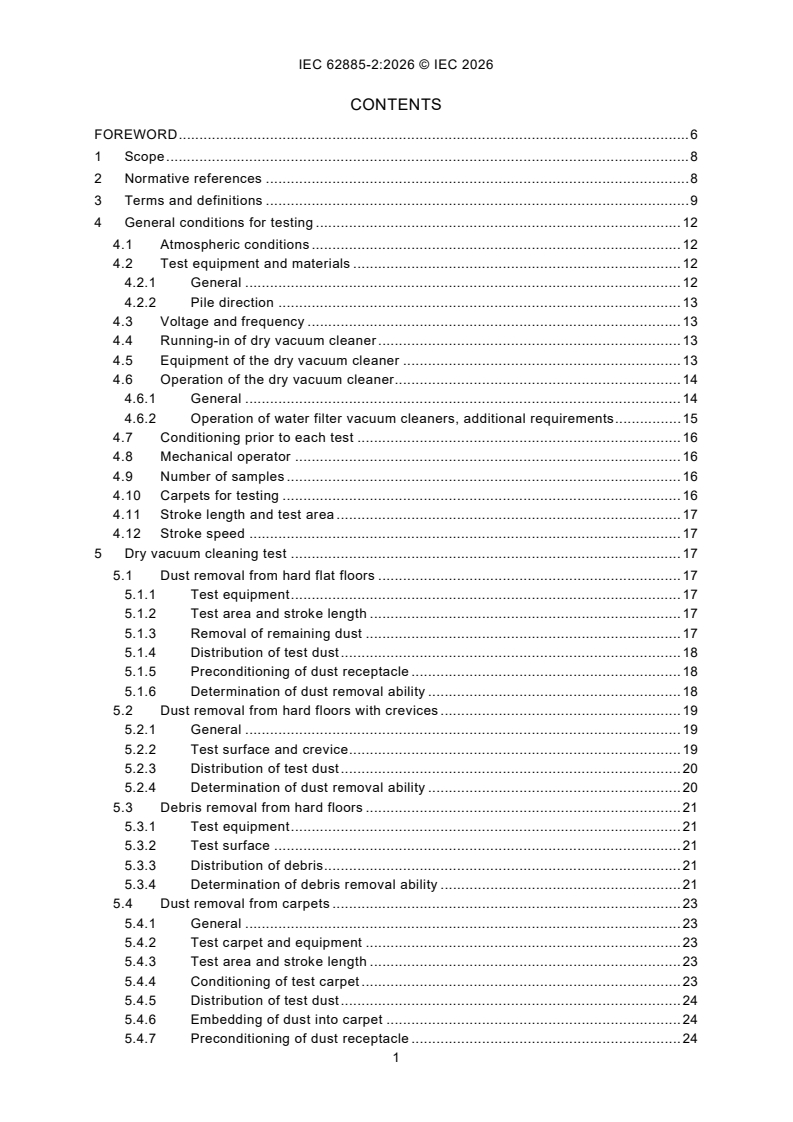
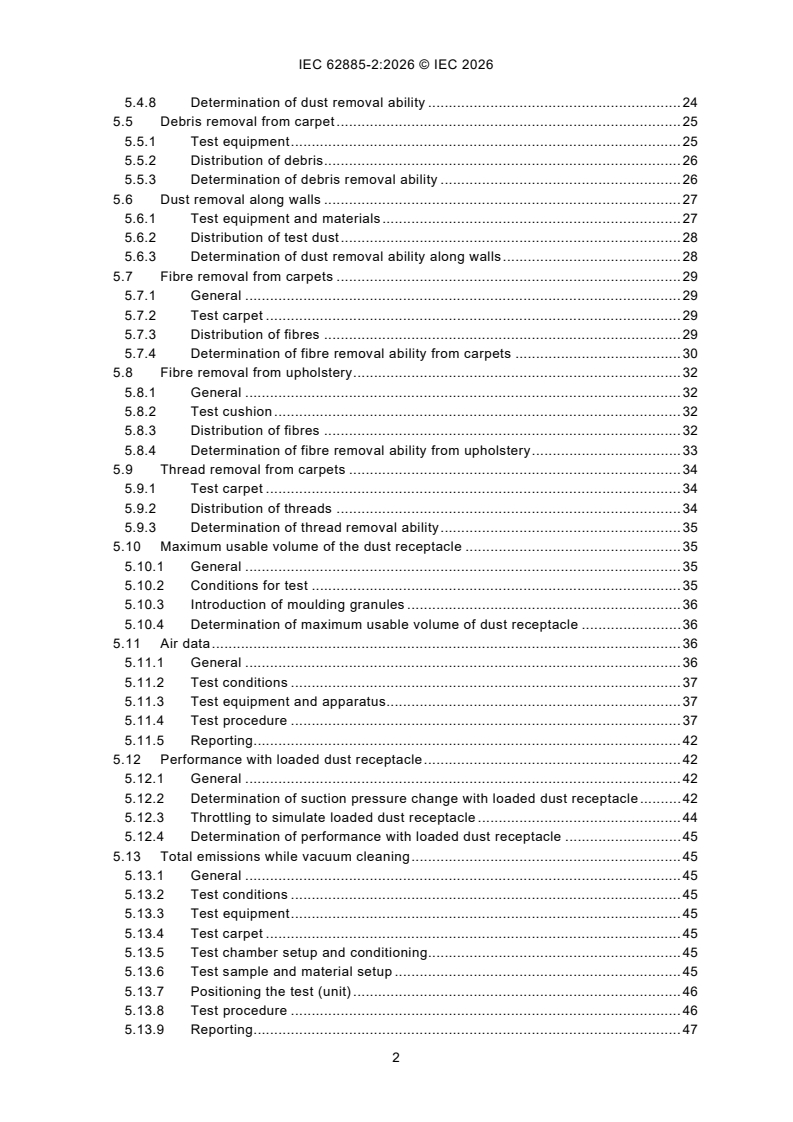
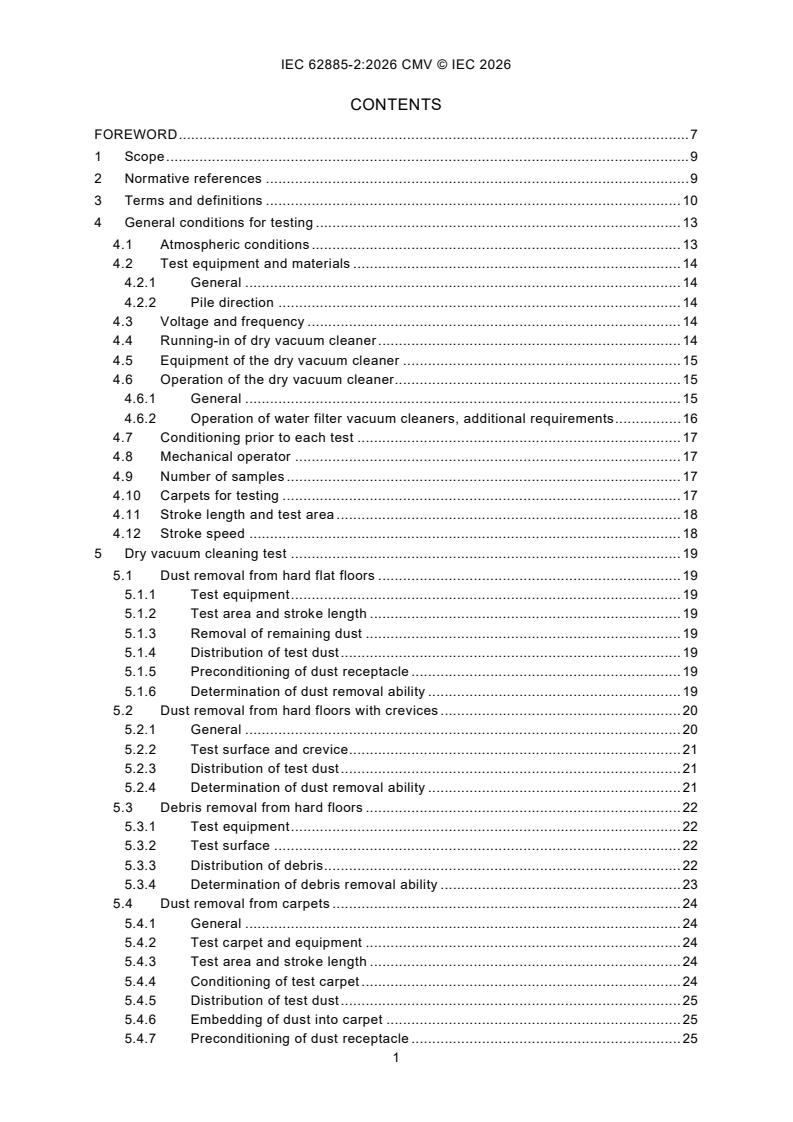
CONTENTS
FOREWORD . 6
1 Scope . 8
2 Normative references . 8
3 Terms and definitions . 9
4 General conditions for testing . 12
4.1 Atmospheric conditions . 12
4.2 Test equipment and materials . 12
4.2.1 General . 12
4.2.2 Pile direction . 13
4.3 Voltage and frequency . 13
4.4 Running-in of dry vacuum cleaner . 13
4.5 Equipment of the dry vacuum cleaner . 13
4.6 Operation of the dry vacuum cleaner. 14
4.6.1 General . 14
4.6.2 Operation of water filter vacuum cleaners, additional requirements . 15
4.7 Conditioning prior to each test . 16
4.8 Mechanical operator . 16
4.9 Number of samples . 16
4.10 Carpets for testing . 16
4.11 Stroke length and test area . 17
4.12 Stroke speed . 17
5 Dry vacuum cleaning test . 17
5.1 Dust removal from hard flat floors . 17
5.1.1 Test equipment . 17
5.1.2 Test area and stroke length . 17
5.1.3 Removal of remaining dust . 17
5.1.4 Distribution of test dust . 18
5.1.5 Preconditioning of dust receptacle . 18
5.1.6 Determination of dust removal ability . 18
5.2 Dust removal from hard floors with crevices . 19
5.2.1 General . 19
5.2.2 Test surface and crevice . 19
5.2.3 Distribution of test dust . 20
5.2.4 Determination of dust removal ability . 20
5.3 Debris removal from hard floors . 21
5.3.1 Test equipment . 21
5.3.2 Test surface . 21
5.3.3 Distribution of debris . 21
5.3.4 Determination of debris removal ability . 21
5.4 Dust removal from carpets . 23
5.4.1 General . 23
5.4.2 Test carpet and equipment . 23
5.4.3 Test area and stroke length . 23
5.4.4 Conditioning of test carpet . 23
5.4.5 Distribution of test dust . 24
5.4.6 Embedding of dust into carpet . 24
5.4.7 Preconditioning of dust receptacle . 24
5.4.8 Determination of dust removal ability . 24
5.5 Debris removal from carpet . 25
5.5.1 Test equipment . 25
5.5.2 Distribution of debris . 26
5.5.3 Determination of debris removal ability . 26
5.6 Dust removal along walls . 27
5.6.1 Test equipment and materials . 27
5.6.2 Distribution of test dust . 28
5.6.3 Determination of dust removal ability along walls . 28
5.7 Fibre removal from carpets . 29
5.7.1 General . 29
5.7.2 Test carpet . 29
5.7.3 Distribution of fibres . 29
5.7.4 Determination of fibre removal ability from carpets . 30
5.8 Fibre removal from upholstery . 32
5.8.1 General . 32
5.8.2 Test cushion . 32
5.8.3 Distribution of fibres . 32
5.8.4 Determination of fibre removal ability from upholstery . 33
5.9 Thread removal from carpets . 34
5.9.1 Test carpet . 34
5.9.2 Distribution of threads . 34
5.9.3 Determination of thread removal ability . 35
5.10 Maximum usable volume of the dust receptacle . 35
5.10.1 General . 35
5.10.2 Conditions for test . 35
5.10.3 Introduction of moulding granules . 36
5.10.4 Determination of maximum usable volume of dust receptacle . 36
5.11 Air data . 36
5.11.1 General . 36
5.11.2 Test conditions . 37
5.11.3 Test equipment and apparatus. 37
5.11.4 Test procedure . 37
5.11.5 Reporting . 42
5.12 Performance with loaded dust receptacle . 42
5.12.1 General . 42
5.12.2 Determination of suction pressure change with loaded dust receptacle . 42
5.12.3 Throttling to simulate loaded dust receptacle . 44
5.12.4 Determination of performance with loaded dust receptacle . 45
5.13 Total emissions while vacuum cleaning . 45
5.13.1 General . 45
5.13.2 Test conditions . 45
5.13.3 Test equipment . 45
5.13.4 Test carpet . 45
5.13.5 Test chamber setup and conditioning. 45
5.13.6 Test sample and material setup . 45
5.13.7 Positioning the test (unit) . 46
5.13.8 Test procedure . 46
5.13.9 Reporting . 47
5.14 Dust re-emission and fractional filtration efficiency of the dry vacuum cleaner . 47
5.14.1 General . 47
5.14.2 Test conditions . 47
5.14.3 Determining the test dust quantity . 47
5.14.4 Dust re-emission for the entire range of particle size . 48
5.14.5 Fractional filtration efficiency . 53
6 Miscellaneous tests . 56
6.1 General . 56
6.2 Motion resistance . 56
6.2.1 Purpose . 56
6.2.2 Test carpet, hard floor surface, and test equipment . 56
6.2.3 Determination of motion resistance . 56
6.3 Cleaning under furniture . 57
6.3.1 Purpose . 57
6.3.2 Distribution of test dust . 57
6.3.3 Determination of free furniture height. 57
6.4 Radius of operation . 57
6.4.1 Purpose . 57
6.4.2 Conditions for measurement . 58
6.4.3 Determination of radius of operation . 58
6.5 Impact resistance for detachable cleaning heads . 58
6.5.1 Purpose . 58
6.5.2 Test equipment . 58
6.5.3 Determination of impact resistance . 58
6.6 Deformation of hose and connecting tubes. 58
6.6.1 Purpose . 58
6.6.2 Test equipment . 58
6.6.3 Determination of permanent deformation . 58
6.7 Bump test . 59
6.7.1 Purpose . 59
6.7.2 Test equipment . 59
6.7.3 Test cycle . 60
6.7.4 Test procedure . 61
6.8 Flexibility of the hose . 61
6.8.1 Purpose . 61
6.8.2 Preparation of test object . 61
6.8.3 Determination of the flexibility of the hose . 61
6.9 Durability of suction hoses . 62
6.9.1 Primary hose testing . 62
6.9.2 Secondary hose testing . 64
6.10 Ability to maintain air flow performance . 65
6.10.1 Purpose . 65
6.10.2 Test dust . 65
6.10.3 Procedure . 65
6.11 Mass . 65
6.12 Weight in hand . 66
6.13 Specific cleaning time . 66
6.14 Dimensions . 66
6.15 Airborne acoustical noise . 66
6.16 Energy consumption . 67
6.16.1 General . 67
6.16.2 Energy consumption when vacuuming carpets . 67
6.16.3 Energy consumption with vacuuming of hard floors and hard floors with
crevices . 69
6.16.4 Energy consumption of cordless active dry nozzles for use with mains-
powered dry vacuum cleaners . 69
6.17 Operational motor lifetime test . 71
6.17.1 General . 71
6.17.2 Procedure . 71
7 Test material and equipment . 72
7.1 General . 72
7.2 Test carpets . 72
7.2.1 General . 72
7.2.2 Quantity and size of carpets . 72
7.3 Equipment for tests . 73
7.3.1 Floor test plate . 73
7.3.2 Weighing machine . 73
7.3.3 Total emissions test . 73
7.3.4 Dust collection box . 74
8 Instructions for use . 75
Annex A (informative) Information on materials . 76
Annex B (informative) Information at the point of sale . 77
Annex C (informative) Maximum operational power (Not applicable to cordless dry
vacuum cleaners) . 78
Annex D (normative) Cordless dry vacuum cleaners for household or similar use -
Additional requirements . 79
Bibliography . 83
Figure 1 – Right-angled T . 28
Figure 2 – Determination of cleaning area . 29
Figure 3 – Stencil for distribution of fibres on test carpets . 30
Figure 4 – Zigzag stroke pattern . 31
Figure 5 – Frame for test cushion . 32
Figure 6 – Stencil for distribution of fibres on upholstery . 33
Figure 7 – Arrangement of threads in the thread removal test . 34
Figure 8 – Stroke length in tests . 35
Figure 9 – Air data curves . 38
Figure 10 – Connecting tube opening . 43
Figure 11 – Test dust for loading dust receptacle . 43
Figure 12 – Insertion depth . 57
Figure 13 – Position of test object and cross-section for measurement of deformation . 59
Figure 14 – Profile of threshold . 60
Figure 15 – Arrangements for bump test . 60
Figure 16 – Configurations of vacuum cleaners with primary or secondary hoses . 63
Figure 17 – Interconnecting hose . 63
Figure 18 – Dust collection box . 75
Figure D.1 – Air data curves . 82
Table 1 – Confidence limits of a Poisson distribution for 95 % confidence range . 52
Table D.1 – Modifications to the text of this document . 79
INTERNATIONAL ELECTROTECHNICAL COMMISSION
____________
Surface cleaning appliances -
Part 2: Dry vacuum cleaners for household or similar use - Methods for
measuring the performance
FOREWORD
1) The International Electrotechnical Commission (IEC) is a worldwide organization for standardization comprising
all national electrotechnical committees (IEC National Committees). The object of IEC is to promote international
co-operation on all questions concerning standardization in the electrical and electronic fields. To this end and
in addition to other activities, IEC publishes International Standards, Technical Specifications, Technical Reports,
Publicly Available Specifications (PAS) and Guides (hereafter referred to as "IEC Publication(s)"). Their
preparation is entrusted to technical committees; any IEC National Committee interested in the subject dealt with
may participate in this preparatory work. International, governmental and non-governmental organizations liaising
with the IEC also participate in this preparation. IEC collaborates closely with the International Organization for
Standardization (ISO) in accordance with conditions determined by agreement between the two organizations.
2) The formal decisions or agreements of IEC on technical matters express, as nearly as possible, an international
consensus of opinion on the relevant subjects since each technical committee has representation from all
interested IEC National Committees.
3) IEC Publications have the form of recommendations for international use and are accepted by IEC National
Committees in that sense. While all reasonable efforts are made to ensure that the technical content of IEC
Publications is accurate, IEC cannot be held responsible for the way in which they are used or for any
misinterpretation by any end user.
4) In order to promote international uniformity, IEC National Committees undertake to apply IEC Publications
transparently to the maximum extent possible in their national and regional publications. Any divergence between
any IEC Publication and the corresponding national or regional publication shall be clearly indicated in the latter.
5) IEC itself does not provide any attestation of conformity. Independent certification bodies provide conformity
assessment services and, in some areas, access to IEC marks of conformity. IEC is not responsible for any
services carried out by independent certification bodies.
6) All users should ensure that they have the latest edition of this publication.
7) No liability shall attach to IEC or its directors, employees, servants or agents including individual experts and
members of its technical committees and IEC National Committees for any personal injury, property damage or
other damage of any nature whatsoever, whether direct or indirect, or for costs (including legal fees) and
expenses arising out of the publication, use of, or reliance upon, this IEC Publication or any other IEC
Publications.
8) Attention is drawn to the Normative references cited in this publication. Use of the referenced publications is
indispensable for the correct application of this publication.
9) IEC draws attention to the possibility that the implementation of this document may involve the use of (a)
patent(s). IEC takes no position concerning the evidence, validity or applicability of any claimed patent rights in
respect thereof. As of the date of publication of this document, IEC had not received notice of (a) patent(s), which
may be required to implement this document. However, implementers are cautioned that this may not represent
the latest information, which may be obtained from the patent database available at https://patents.iec.ch. IEC
shall not be held responsible for identifying any or all such patent rights.
IEC 62885-2 has been prepared by subcommittee 59F: Surface cleaning appliances, of IEC
technical committee 59: Performance of household and similar electrical appliances. It is an
International Standard.
This third edition of IEC 62885-2 cancels and replaces the second edition published in 2021.
This edition constitutes a technical revision.
This edition includes the following significant technical changes with respect to the previous
edition:
a) relocation of RSB annexes to IEC TS 62885-1 [1];
b) relocation of remaining test materials, test dust, and equipment to IEC TS 62885-1 [1];
c) reduced number of test strokes from 5 double strokes to 3 double strokes except as
specifically required;
d) relocated requirements for cordless products, except for battery-related items, from IEC
62885-4 [2] to a new Annex D;
e) added definition and instructions for a universal dry nozzle;
f) relocated air data equipment to IEC TS 62885-1 [1], relocated formulae to 5.11, and made
revisions to air data requirements;
g) relocated dust re-emission equipment to IEC TS 62885-1 [1].
The text of this International Standard is based on the following documents:
Draft Report on voting
59F/569/FDIS 59F/576/RVD
Full information on the voting for its approval can be found in the report on voting indicated in
the above table.
The language used for the development of this International Standard is English.
This document was drafted in accordance with ISO/IEC Directives, Part 2, and developed in
accordance with ISO/IEC Directives, Part 1 and ISO/IEC Directives, IEC Supplement, available
at www.iec.ch/members_experts/refdocs. The main document types developed by IEC are
described in greater detail at www.iec.ch/publications.
A list of all the parts in the IEC 62885 series, under the general title Surface cleaning
appliances, can be found on the IEC website.
The committee has decided that the contents of this document will remain unchanged until the
stability date indicated on the IEC website under webstore.iec.ch in the data related to the
specific document. At this date, the document will be
– reconfirmed,
– withdrawn, or
– revised.
1 Scope
This part of IEC 62885 is applicable for measurements of the performance of mains-operated
and cordless dry vacuum cleaners, including water filter vacuum cleaners for household or
similar use.
Table D.1 of Annex D is applicable to measurements of the performance of cordless dry vacuum
cleaners for household use or under conditions similar to those in households. The results
obtained under this annex are intended to be comparable to the results obtained for mains-
operated vacuum cleaners. The purpose of Annex D is to specify additional requirements for
measurements of cordless dry vacuum cleaners.
NOTE 1 Annex D is not intended for mains-operated vacuum cleaners or cleaning robots.
NOTE 2 Cleaning robots are evaluated to IEC/ASTM 62885-7 [3].
NOTE 3 Handheld dry vacuum cleaners are excluded, except for 5.10.2 and 5.11.
NOTE 4 Measurements of the performance of mains-operated commercial dry vacuum cleaners are found in
IEC 62885-8 [4].
The purpose of this document is to specify essential performance characteristics of dry vacuum
cleaners which are of interest to users and to describe methods for measuring these
characteristics.
NOTE 5 Due to the influence of environmental conditions, variations in time, origin of test materials and proficiency
of the operator, some of the described test methods will give more reliable results when applied for comparative
testing of a number of appliances at the same time, in the same laboratory and by the same operator.
NOTE 6 The methods here can be applied with modifications for surface-cleaning product types or technologies not
currently covered within the scope.
For safety requirements, reference is made to IEC 60335-1:2020 [5] and IEC 60335-2-2 [6].
A recommendation on information for the consumer at the point of sale is given in Annex B.
2 Normative references
The following documents are referred to in the text in such a way that some or all of their content
constitutes requirements of this document. For dated references, only the edition cited applies.
For undated references, the latest edition of the referenced document (including any
amendments) applies.
IEC 60704-2-1, Household and similar electrical appliances - Test code for the determination
of airborne acoustical noise - Part 2-1: Particular requirements for dry vacuum cleaners
IEC 62301:2011, Household electrical appliances - Measurement of standby power
IEC TS 62885-1:2026, Surface cleaning appliances - Part 1: General requirements on test
material and test equipment
ISO 29463-1, High efficiency filters and filter media for removing particles in air — Part 1:
Classification, performance, testing and marking
EN 1822-1, High efficiency air filters (EPA, HEPA, and ULPA) - Part 1: Classification,
performance testing, marking.
IEC 60335-2-2:2019, Household and similar electrical appliances - Safety - Part 2-2: Particular
requirements for vacuum cleaners and water-suction cleaning appliances
IEST-RP-CC001, HEPA and ULPA Filters
ISO 29643-1, High efficiency filters and filter media for removing particles in air — Part 1:
Classification, performance, testing and marking
3 Terms and definitions
For the purposes of this document, the following terms and definitions apply.
ISO and IEC maintain terminological databases for use in standardization at the following
addresses:
– IEC Electropedia: available at https://www.electropedia.org/
– ISO Online browsing platform: available at https://www.iso.org/obp
3.1
active depth of the dry cleaning head
distance from the front edge of the dry cleaning head (3.3) to its rear edge or a line 10 mm
behind the rear edge of the suction opening on the underside of the dry cleaning head (3.3),
whichever is the shortest
3.2
active dry nozzle
dry cleaning head (3.3) provided with a driven agitation device to assist dirt removal
Note 1 to entry: The agitation device can be driven by an incorporated electric motor (motorized nozzle), an
incorporated turbine powered by the air flow (air-turbine nozzle), or an incorporated friction or gear mechanism
actuated by moving the dry cleaning head (3.3) over the surface to be cleaned (mechanical nozzle).
3.3
dry cleaning head
plain nozzle or brush attached to a connecting tube (3.23), or a power nozzle, separate or part
of the cleaner housing, and that part of a dry vacuum cleaner (3.8) which is applied to a surface
to be cleaned
3.4
dry cleaning head width
B
external maximum width of the dry cleaning head (3.3), in metres
3.5
cordless active dry nozzle
dry cleaning head (3.3) provided on a mains-operated machine with an agitation device to assist
dirt removal driven by a battery-operated motor
3.6
cylinder dry vacuum cleaner
portable dry vacuum cleaner (3.8) having a nozzle separated from the cleaner housing by a
hose
Note 1 to entry: In use, only the nozzle is guided over the surface area to be cleaned.
Note 2 to entry: These dry vacuum cleaners are generally floor-supported.
Note 3 to entry: The dry vacuum cleaner (3.8) can have detachable passive or active dry nozzles (3.2), attachments,
and tubes (3.23) for both floor and above the floor cleaning.
3.7
double stroke
one forward and one backward movement of the dry cleaning head (3.3) performed according
to the appropriate stroke pattern (3.19)
3.8
dry vacuum cleaner
electrically operated appliance that removes dry material (for example, dust, fibre, threads, and
debris) from the surface to be cleaned by an air flow created by a vacuum developed within the
unit, the removed material being separated in the appliance and the cleaned suction air being
returned to the ambient air
3.9
forward stroke
forward movement of a stroke pattern (3.19)
Note 1 to entry: On test (3.21) carpets, forward strokes are carried out in the direction of the carpet pile.
3.10
in-house reference dry vacuum cleaner
electrically operated laboratory equipment designated for internal comparison within a
laboratory
3.11
maximum operational power
power level that the machine is not capable of exceeding in any operating condition set either
by the user or automatically by the appliance
3.12
maximum continuous airflow
airflow that occurs when the highest permanently adjustable power level of the dry vacuum
cleaner (3.8) is selected
Note 1 to entry: A temporary power mode that does not exceed 5 min is not considered as continuous airflow.
3.13
parallel pattern
stroke pattern (3.19) where the forward strokes and the return strokes are congruent and are
carried out in the direction of the carpet pile (direction of manufacture) unless otherwise
specified
3.14
passive dry nozzle
dry cleaning head (3.3) without any driven agitation device
3.15
return stroke
backward movement of a stroke pattern (3.19)
3.16
self-propelled dry cleaning head
dry cleaning head (3.3) provided with a propulsion mechanism
3.17
stroke
single traverse of the dry cleaning head (3.3) over the test area
3.18
stroke length
distance between the two parallel lines defining the limits of a stroke pattern (3.19)
3.19
stroke pattern
arrangement of the forward strokes and return strokes on the surface to be cleaned
3.20
stroke speed
speed of the dry cleaning head (3.3), moved as uniformly as possible, during a forward stroke
(3.9) or a return stroke (3.15)
3.21
test
entirety or superset of all trials and trial (3.22) batches of all samples to be measured for a
single vacuum cleaner model
3.22
trial
single instance of a performance measurement carried out under identical conditions that can
be repeated multiple times
3.23
tube
rigid length or lengths of hollow pipe that connect the end of the hose to various vacuum cleaner
accessories
Note 1 to entry: The tube can be of fixed length, in multiple parts or telescopic, passive or energized.
3.24
upright vacuum cleaner
self-standing and floor-supported dry vacuum cleaner (3.8) with the dry cleaning head (3.3)
forming an integral part of, or permanently connected to, the cleaner housing, the dry cleaning
head (3.3) normally being provided with an agitation device to assist dirt removal and the
complete cleaner housing being moved over the surface to be cleaned by means of an attached
handle
3.25
water filter vacuum cleaner
dry vacuum cleaner (3.8) that uses water as the main filter medium, whereby the suction air is
forced through the water entrapping the removed dry material as it passes through
3.26
water filter system
removable water filter components that are in contact with the water
3.27
side brush
peripheral brush whose main function is to relocate the dust and debris along the floor and
extend the cleaning reach beyond the dry cleaning head width (3.4)
3.28
universal dry nozzle
active dry nozzle (3.2) or passive dry nozzle (3.14) that is used for cleaning hard floor and
carpet, where any adaptation for the floor surface can be made automatically or by means of a
mechanical adjusting mechanism
3.29
cordless dry vacuum cleaner
dry vacuum cleaner (3.8) that is not mains-operated
Note 1 to entry: The term "cordless" is equivalent to "battery-operated" throughout the document.
3.30
reference vacuum cleaner system RSB
electrically operated laboratory equipment intended to provide different laboratories with a
similarly constructed vacuum cleaner to measure the reference dust removal ability on carpets
for passive and active dry nozzles (3.2) to improve the reproducibility of results
Note 1 to entry: The reference vacuum cleaner system RSB may be used with active or passive dry nozzles (3.14).
Note 2 to entry: The reference vacuum cleaner system RSB is not intended for tests other than dust pick-up from
Wilton test carpets.
Note 3 to entry: The reference vacuum cleaner system RSB is described in IEC TS 62885-1:2026 [7], Annex B.
Maintenance of the RSB is described in IEC TS 62885-1:2026 [7], Annex C.
Note 4 to entry: The reference vacuum cleaner system RSB is required for measurements in accordance with
legislation in the European Union.
4 General conditions for testing
4.1 Atmospheric conditions
Unless otherwise specified, the test procedures and measurements shall be carried out under
the following conditions:
Standard atmosphere 23/50
Temperature: (23 ± 2) °C
Relative humidity: (50 ± 5) %
Absolute air pressure: 91,3 kPa to 106,3 kPa
Temperature and humidity conditions shall be maintained within the specified ranges to ensure
good repeatability and reproducibility during testing.
For test procedures and measurements carried out at other than standard atmospheric
conditions, the ambient temperature shall be maintained at (23 ± 5) °C.
4.2 Test equipment and materials
4.2.1 General
To minimize the influence of electrostatic phenomena, measurements on carpets shall be
carried out on a flat floor consisting of a smooth untreated pine plywood or equivalent panel, at
least 15 mm thick and of a size equal to or larger than the test carpet.
Equipment and materials for measurements (devices, test carpets, test dust, etc.) to be used
in a test shall, prior to the test, be stored for at least 16 h at standard atmospheric conditions
in accordance with 4.1.
Carpets that have already been used shall be stored unbeaten at standard atmospheric
conditions in accordance with 4.1.
When not in use, carpets shall be hanging free, or lying flat, pile upwards and uncovered.
Carpets shall not be rolled when stored between test. Carpets that have been rolled shall be
laid flat for a minimum of 16 h before use.
4.2.2 Pile direction
Machine or manufacturing direction is an indication of the projected pile direction for carpet
production. Pile direction is what is important for dust pick-up (DPU) testing.
If the pile direction is clearly parallel to the test bed, as is required by the applicable test
procedures, the carpet is acceptable for use for that test. If the pile
...
IEC 62885-2 ®
Edition 3.0 2026-07
INTERNATIONAL
STANDARD
COMMENTED VERSION
Surface cleaning appliances -
Part 2: Dry vacuum cleaners for household or similar use - Methods for
measuring the performance
ICS 97.080 ISBN 978-2-8327-1389-1
All rights reserved. Unless otherwise specified, no part of this publication may be reproduced or utilized in any form or
by any means, electronic or mechanical, including photocopying and microfilm, without permission in writing from either
IEC or IEC's member National Committee in the country of the requester. If you have any questions about IEC copyright
or have an enquiry about obtaining additional rights to this publication, please contact the address below or your local
IEC member National Committee for further information.
IEC Secretariat Tel.: +41 22 919 02 11
3, rue de Varembé info@iec.ch
CH-1211 Geneva 20 www.iec.ch
Switzerland
About the IEC
The International Electrotechnical Commission (IEC) is the leading global organization that prepares and publishes
International Standards for all electrical, electronic and related technologies.
About IEC publications
The technical content of IEC publications is kept under constant review by the IEC. Please make sure that you have the
latest edition, a corrigendum or an amendment might have been published.
IEC publications search - IEC Products & Services Portal - products.iec.ch
webstore.iec.ch/advsearchform Discover our powerful search engine and read freely all the
The advanced search enables to find IEC publications by a publications previews, graphical symbols and the glossary.
variety of criteria (reference number, text, technical With a subscription you will always have access to up to date
committee, …). It also gives information on projects, content tailored to your needs.
replaced and withdrawn publications.
Electropedia - www.electropedia.org
The world's leading online dictionary on electrotechnology,
IEC Just Published - webstore.iec.ch/justpublished
Stay up to date on all new IEC publications. Just Published containing more than 22 500 terminological entries in English
details all new publications released. Available online and and French, with equivalent terms in 25 additional languages.
once a month by email. Also known as the International Electrotechnical Vocabulary
(IEV) online.
IEC Customer Service Centre - webstore.iec.ch/csc
If you wish to give us your feedback on this publication or
need further assistance, please contact the Customer
Service Centre: sales@iec.ch.
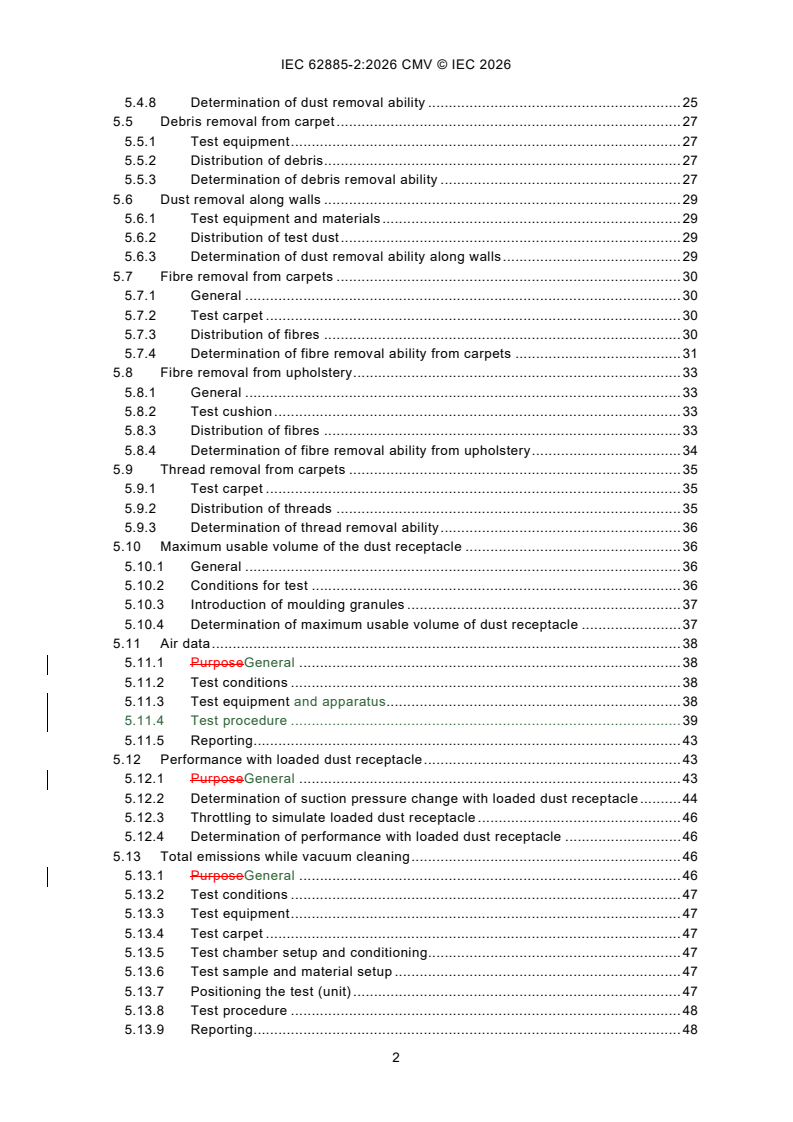
CONTENTS
FOREWORD . 7
1 Scope . 9
2 Normative references . 9
3 Terms and definitions . 10
4 General conditions for testing . 13
4.1 Atmospheric conditions . 13
4.2 Test equipment and materials . 14
4.2.1 General . 14
4.2.2 Pile direction . 14
4.3 Voltage and frequency . 14
4.4 Running-in of dry vacuum cleaner . 14
4.5 Equipment of the dry vacuum cleaner . 15
4.6 Operation of the dry vacuum cleaner. 15
4.6.1 General . 15
4.6.2 Operation of water filter vacuum cleaners, additional requirements . 16
4.7 Conditioning prior to each test . 17
4.8 Mechanical operator . 17
4.9 Number of samples . 17
4.10 Carpets for testing . 17
4.11 Stroke length and test area . 18
4.12 Stroke speed . 18
5 Dry vacuum cleaning test . 19
5.1 Dust removal from hard flat floors . 19
5.1.1 Test equipment . 19
5.1.2 Test area and stroke length . 19
5.1.3 Removal of remaining dust . 19
5.1.4 Distribution of test dust . 19
5.1.5 Preconditioning of dust receptacle . 19
5.1.6 Determination of dust removal ability . 19
5.2 Dust removal from hard floors with crevices . 20
5.2.1 General . 20
5.2.2 Test surface and crevice . 21
5.2.3 Distribution of test dust . 21
5.2.4 Determination of dust removal ability . 21
5.3 Debris removal from hard floors . 22
5.3.1 Test equipment . 22
5.3.2 Test surface . 22
5.3.3 Distribution of debris . 22
5.3.4 Determination of debris removal ability . 23
5.4 Dust removal from carpets . 24
5.4.1 General . 24
5.4.2 Test carpet and equipment . 24
5.4.3 Test area and stroke length . 24
5.4.4 Conditioning of test carpet . 24
5.4.5 Distribution of test dust . 25
5.4.6 Embedding of dust into carpet . 25
5.4.7 Preconditioning of dust receptacle . 25
5.4.8 Determination of dust removal ability . 25
5.5 Debris removal from carpet . 27
5.5.1 Test equipment . 27
5.5.2 Distribution of debris . 27
5.5.3 Determination of debris removal ability . 27
5.6 Dust removal along walls . 29
5.6.1 Test equipment and materials . 29
5.6.2 Distribution of test dust . 29
5.6.3 Determination of dust removal ability along walls . 29
5.7 Fibre removal from carpets . 30
5.7.1 General . 30
5.7.2 Test carpet . 30
5.7.3 Distribution of fibres . 30
5.7.4 Determination of fibre removal ability from carpets . 31
5.8 Fibre removal from upholstery . 33
5.8.1 General . 33
5.8.2 Test cushion . 33
5.8.3 Distribution of fibres . 33
5.8.4 Determination of fibre removal ability from upholstery . 34
5.9 Thread removal from carpets . 35
5.9.1 Test carpet . 35
5.9.2 Distribution of threads . 35
5.9.3 Determination of thread removal ability . 36
5.10 Maximum usable volume of the dust receptacle . 36
5.10.1 General . 36
5.10.2 Conditions for test . 36
5.10.3 Introduction of moulding granules . 37
5.10.4 Determination of maximum usable volume of dust receptacle . 37
5.11 Air data . 38
5.11.1 PurposeGeneral . 38
5.11.2 Test conditions . 38
5.11.3 Test equipment and apparatus. 38
5.11.4 Test procedure . 39
5.11.5 Reporting . 43
5.12 Performance with loaded dust receptacle . 43
5.12.1 PurposeGeneral . 43
5.12.2 Determination of suction pressure change with loaded dust receptacle . 44
5.12.3 Throttling to simulate loaded dust receptacle . 46
5.12.4 Determination of performance with loaded dust receptacle . 46
5.13 Total emissions while vacuum cleaning . 46
5.13.1 PurposeGeneral . 46
5.13.2 Test conditions . 47
5.13.3 Test equipment . 47
5.13.4 Test carpet . 47
5.13.5 Test chamber setup and conditioning. 47
5.13.6 Test sample and material setup . 47
5.13.7 Positioning the test (unit) . 47
5.13.8 Test procedure . 48
5.13.9 Reporting . 48
5.14 Dust re-emission and fractional filtration efficiency of the dry vacuum cleaner . 48
5.14.1 General . 48
5.14.2 Test conditions . 49
5.14.3 Determining the test dust quantity . 49
5.14.4 Dust re-emission for the entire range of particle size . 49
5.14.5 Fractional filtration efficiency . 55
6 Miscellaneous tests . 58
6.1 General . 58
6.2 Motion resistance . 58
6.2.1 Purpose . 58
6.2.2 Test carpet, hard floor surface, and test equipment . 58
6.2.3 Determination of motion resistance . 58
6.3 Cleaning under furniture . 59
6.3.1 Purpose . 59
6.3.2 Distribution of test dust . 59
6.3.3 Determination of free furniture height. 59
6.4 Radius of operation . 59
6.4.1 Purpose . 59
6.4.2 Conditions for measurement . 60
6.4.3 Determination of radius of operation . 60
6.5 Impact resistance for detachable cleaning heads . 60
6.5.1 Purpose . 60
6.5.2 Test equipment . 60
6.5.3 Determination of impact resistance . 60
6.6 Deformation of hose and connecting tubes. 60
6.6.1 Purpose . 60
6.6.2 Test equipment . 60
6.6.3 Determination of permanent deformation . 61
6.7 Bump test . 61
6.7.1 Purpose . 61
6.7.2 Test equipment . 61
6.7.3 Test cycle . 63
6.7.4 Test procedure . 63
6.8 Flexibility of the hose . 63
6.8.1 Purpose . 63
6.8.2 Preparation of test object . 63
6.8.3 Determination of the flexibility of the hose . 64
6.9 Durability of suction hoses . 64
6.9.1 Primary hose testing . 64
6.9.2 Secondary hose testing . 67
6.10 Ability to maintain air flow performance . 67
6.10.1 Purpose . 67
6.10.2 Test dust . 68
6.10.3 Procedure . 68
6.11 Mass . 68
6.12 Weight in hand . 68
6.13 Specific cleaning time . 69
6.14 Dimensions . 69
6.15 Airborne acoustical noise . 69
6.16 Energy consumption . 69
6.16.1 General . 69
6.16.2 Energy consumption when vacuuming carpets . 70
6.16.3 Energy consumption with vacuuming of hard floors and hard floors with
crevices . 72
6.16.4 Energy consumption of cordless active dry nozzles for use with mains-
powered dry vacuum cleaners . 73
6.17 Operational motor lifetime test . 74
6.17.1 PurposeGeneral . 74
6.17.2 Procedure . 75
7 Test material and equipment . 75
7.1 General . 75
7.2 Material for tests .
7.2 Test carpets . 76
7.2.1 General . 76
7.2.2 Quantity and size of carpets . 76
7.2.2 Mineral dust – Type 4 .
7.2.3 Fibre material .
7.2.4 Thread material .
7.2.5 Moulding granules .
7.2.6 Test cushion .
7.2.7 Debris .
7.3 Equipment for tests . 77
7.3.1 Floor test plate . 77
7.3.2 Test plate with crevice .
7.3.3 Carpet-beating machine .
7.3.4 Hold-downs and guides .
7.3.5 Mechanical dust spreader (optional) .
7.3.6 Rollers for embedding .
7.3.7 Equipment for air data test .
7.3.8 Test equipment for determining the fractional filtration efficiency and
dust re-emission of the dry vacuum cleaner .
7.3.9 Device for motion resistance test .
7.3.10 Device for impact test .
7.3.11 Device for determination of deformation of hoses and connecting tubes .
7.3.12 Mechanical operator .
7.3.2 Weighing machine . 95
7.3.3 Total emissions test . 95
7.3.4 Dust collection box . 96
7.3.16 Secondary hose test equipment .
8 Instructions for use . 98
Annex A (informative) Information on materials . 99
Annex B (informative) Information at the point of sale . 100
Annex C (informative) Reference vacuum cleaner system RSB .
Annex D (informative) Maintenance of the RSB .
Annex E (normative) Hard floorboard realization, floor support and floor pattern .
Annex F (informative) Maximum operational power .
Annex C (informative) Maximum operational power (Not applicable to cordless dry
vacuum cleaners) . 111
Annex D (normative) Cordless dry vacuum cleaners for household or similar use -
Additional requirements . 112
Bibliography . 116
List of comments. 119
Figure 1 – Right-angled T . 29
Figure 2 – Determination of cleaning area . 30
Figure 3 – Stencil for distribution of fibres on test carpets . 31
Figure 4 – Zigzag stroke pattern . 32
Figure 5 – Frame for test cushion . 33
Figure 6 – Stencil for distribution of fibres on upholstery . 34
Figure 7 – Arrangement of threads in the thread removal test . 35
Figure 8 – Stroke length in tests . 36
Figure 9 – Air data curves . 40
Figure 10 – Connecting tube opening . 44
Figure 11 – Test dust for loading dust receptacle . 45
Figure 12 – Insertion depth . 59
Figure 13 – Position of test object and cross-section for measurement of deformation . 61
Figure 14 – Profile of threshold . 62
Figure 15 – Arrangements for bump test . 62
Figure 16 – Preparation of hoses for testing flexibility .
Figure 16 – Configurations of vacuum cleaners with primary or secondary hoses . 65
Figure 17 – Interconnecting hose . 66
Figure 19 – Equipment for repeated bending of hoses .
Figure 18 – Dust collection box . 97
Figure 20 – Test plate with crevice.
Figure 21 – Carpet-beating machine .
Figure 22 – Carpet hold-downs and guides .
Figure 23 – Dust spreader and roller for embedding dust into carpets .
Figure 24 – Alternative A equipment for air data tests .
Figure 25 – Measuring box for alternative A .
Figure 26 – Alternative B equipment for air data tests .
Figure 27 – Test hood .
Figure 28 – Intake aerosol channel with sampling probe .
Figure 29 – Exhaust channel with sampling probe .
Figure 30 – Equipment diagram for filtration / dust re-emission testing.
Figure 31 – Modified test hood .
Figure 32 – Drum for impact test .
Figure 33 – Device for testing deformation of hoses and connecting tubes.
Figure 34 – Mechanical operator for the measurement of dust removal from carpets
and of motion resistance .
Figure 36 – Equipment for durability testing of secondary hoses .
Figure C.1 – RSB with passive and active nozzle and vacuum measuring box .
Figure E.1 – Dimensions of the floorboard and mounting on a test rig .
Figure E.2 – Pattern of hard floor planks .
Figure D.1 – Air data curves . 115
Table 1 – Confidence limits of a Poisson distribution for 95 % confidence range . 54
Table 2 – Nominal diameters of orifices .
Table 3 – Graduation of eight size classes for particle sizes 0,3 µm to 10 µm .
Table D.1 – Modifications to the text of this document . 112
INTERNATIONAL ELECTROTECHNICAL COMMISSION
____________
Surface cleaning appliances -
Part 2: Dry vacuum cleaners for household or similar use - Methods for
measuring the performance
FOREWORD
1) The International Electrotechnical Commission (IEC) is a worldwide organization for standardization comprising
all national electrotechnical committees (IEC National Committees). The object of IEC is to promote international
co-operation on all questions concerning standardization in the electrical and electronic fields. To this end and
in addition to other activities, IEC publishes International Standards, Technical Specifications, Technical Reports,
Publicly Available Specifications (PAS) and Guides (hereafter referred to as "IEC Publication(s)"). Their
preparation is entrusted to technical committees; any IEC National Committee interested in the subject dealt with
may participate in this preparatory work. International, governmental and non-governmental organizations liaising
with the IEC also participate in this preparation. IEC collaborates closely with the International Organization for
Standardization (ISO) in accordance with conditions determined by agreement between the two organizations.
2) The formal decisions or agreements of IEC on technical matters express, as nearly as possible, an international
consensus of opinion on the relevant subjects since each technical committee has representation from all
interested IEC National Committees.
3) IEC Publications have the form of recommendations for international use and are accepted by IEC National
Committees in that sense. While all reasonable efforts are made to ensure that the technical content of IEC
Publications is accurate, IEC cannot be held responsible for the way in which they are used or for any
misinterpretation by any end user.
4) In order to promote international uniformity, IEC National Committees undertake to apply IEC Publications
transparently to the maximum extent possible in their national and regional publications. Any divergence between
any IEC Publication and the corresponding national or regional publication shall be clearly indicated in the latter.
5) IEC itself does not provide any attestation of conformity. Independent certification bodies provide conformity
assessment services and, in some areas, access to IEC marks of conformity. IEC is not responsible for any
services carried out by independent certification bodies.
6) All users should ensure that they have the latest edition of this publication.
7) No liability shall attach to IEC or its directors, employees, servants or agents including individual experts and
members of its technical committees and IEC National Committees for any personal injury, property damage or
other damage of any nature whatsoever, whether direct or indirect, or for costs (including legal fees) and
expenses arising out of the publication, use of, or reliance upon, this IEC Publication or any other IEC
Publications.
8) Attention is drawn to the Normative references cited in this publication. Use of the referenced publications is
indispensable for the correct application of this publication.
9) IEC draws attention to the possibility that the implementation of this document may involve the use of (a)
patent(s). IEC takes no position concerning the evidence, validity or applicability of any claimed patent rights in
respect thereof. As of the date of publication of this document, IEC had not received notice of (a) patent(s), which
may be required to implement this document. However, implementers are cautioned that this may not represent
the latest information, which may be obtained from the patent database available at https://patents.iec.ch. IEC
shall not be held responsible for identifying any or all such patent rights.
This commented version (CMV) of the official standard IEC 62885-2:2026 edition 3.0 allows the
user to identify the changes made to the previous IEC 62885-2:2021 edition 2.0. Furthermore,
comments from IEC SC 59F experts are provided to explain the reasons of the most relevant
changes, or to clarify any part of the content.
A vertical bar appears in the margin wherever a change has been made. Additions are in green
text, deletions are in strikethrough red text. Experts' comments are identified by a blue-
background number. Mouse over a number to display a pop-up note with the comment.
This publication contains the CMV and the official standard. The full list of comments is available
at the end of the CMV.
IEC 62885-2 has been prepared by subcommittee 59F: Surface cleaning appliances, of IEC
technical committee 59: Performance of household and similar electrical appliances. It is an
International Standard.
This third edition of IEC 62885-2 cancels and replaces the second edition published in 2021.
This edition constitutes a technical revision.
This edition includes the following significant technical changes with respect to the previous
edition:
a) relocation of RSB annexes to IEC TS 62885-1 [1];
b) relocation of remaining test materials, test dust, and equipment to IEC TS 62885-1 [1];
c) reduced number of test strokes from 5 double strokes to 3 double strokes except as
specifically required;
d) relocated requirements for cordless products, except for battery-related items, from IEC
62885-4 [2] to a new Annex D;
e) added definition and instructions for a universal dry nozzle;
f) relocated air data equipment to IEC TS 62885-1 [1], relocated formulae to 5.11, and made
revisions to air data requirements;
g) relocated dust re-emission equipment to IEC TS 62885-1 [1].
The text of this International Standard is based on the following documents:
Draft Report on voting
59F/569/FDIS 59F/576/RVD
Full information on the voting for its approval can be found in the report on voting indicated in
the above table.
The language used for the development of this International Standard is English.
This document was drafted in accordance with ISO/IEC Directives, Part 2, and developed in
accordance with ISO/IEC Directives, Part 1 and ISO/IEC Directives, IEC Supplement, available
at www.iec.ch/members_experts/refdocs. The main document types developed by IEC are
described in greater detail at www.iec.ch/publications.
A list of all the parts in the IEC 62885 series, under the general title Surface cleaning
appliances, can be found on the IEC website.
The committee has decided that the contents of this document will remain unchanged until the
stability date indicated on the IEC website under webstore.iec.ch in the data related to the
specific document. At this date, the document will be
– reconfirmed,
– withdrawn, or
– revised.
1 Scope
This part of IEC 62885 is applicable for measurements of the performance of mains-operated
and cordless dry vacuum cleaners, including water filter vacuum cleaners for household or
similar use.
Table D.1 of Annex D is applicable to measurements of the performance of cordless dry vacuum
cleaners for household use or under conditions similar to those in households. The results
obtained under this annex are intended to be comparable to the results obtained for mains-
operated vacuum cleaners. The purpose of Annex D is to specify additional requirements for
measurements of cordless dry vacuum cleaners. 1
NOTE 1 Annex D is not intended for mains-operated vacuum cleaners or cleaning robots.
NOTE 2 Cleaning robots are evaluated to IEC/ASTM 62885-7 [3].
NOTE 3 Handheld dry vacuum cleaners are excluded, except for 5.10.2 and 5.11.
NOTE 4 Measurements of the performance of mains-operated commercial dry vacuum cleaners are found in IEC
62885-8 [4].
The purpose of this document is to specify essential performance characteristics of dry vacuum
cleaners which are of interest to users and to describe methods for measuring these
characteristics.
NOTE 5 Due to the influence of environmental conditions, variations in time, origin of test materials and proficiency
of the operator, some of the described test methods will give more reliable results when applied for comparative
testing of a number of appliances at the same time, in the same laboratory and by the same operator.
NOTE 6 The methods here can be applied with modifications for surface-cleaning product types or technologies not
currently covered within the scope.
For safety requirements, reference is made to IEC 60335-1:2020 [5] and IEC 60335-2-2 [6].
A recommendation on information for the consumer at the point of sale is given in Annex B.
2 Normative references
The following documents are referred to in the text in such a way that some or all of their content
constitutes requirements of this document. For dated references, only the edition cited applies.
For undated references, the latest edition of the referenced document (including any
amendments) applies.
IEC 60688, Electrical measuring transducers for converting A.C. and D.C. electrical quantities
to analogue or digital signals
IEC 60704-2-1, Household and similar electrical appliances - Test code for the determination
of airborne acoustical noise - Part 2-1: Particular requirements for dry vacuum cleaners
IEC 62301:2011, Household electrical appliances - Measurement of standby power
IEC TS 62885-1:20202026, Surface cleaning appliances - Part 1: General requirements on test
material and test equipment
ISO 5167-1, Measurement of fluid flow by means of pressure differential devices inserted in
circular cross-section conduits running full – Part 1: General principles and requirements
ISO 12103-1, Road vehicles – Test dust for filter evaluation – Part 1: Arizona test dust
ISO 29463-1, High efficiency filters and filter media for removing particles in air — Part 1:
Classification, performance, testing and marking
EN 1822-1, High efficiency air filters (EPA, HEPA, and ULPA) - Part 1: Classification,
performance testing, marking.
IEC 60335-2-2:2019, Household and similar electrical appliances - Safety - Part 2-2: Particular
requirements for vacuum cleaners and water-suction cleaning appliances
IEST-RP-CC001, HEPA and ULPA Filters
ISO 29643-1, High efficiency filters and filter media for removing particles in air — Part 1:
Classification, performance, testing and marking
3 Terms and definitions
For the purposes of this document, the following terms and definitions apply.
ISO and IEC maintain terminological databases for use in standardization at the following
addresses:
– IEC Electropedia: available at https://www.electropedia.org/
– ISO Online browsing platform: available at https://www.iso.org/obp
3.1
active depth of the dry 2 cleaning head
distance from the front edge of the dry cleaning head (3.3) to its rear edge or a line 10 mm
behind the rear edge of the suction opening on the underside of the dry cleaning head (3.3),
whichever is the shortest
3.2
active dry nozzle
dry cleaning head (3.3) provided with a driven agitation device to assist dirt removal
Note 1 to entry: The agitation device can be driven by an incorporated electric motor (motorized nozzle), an
incorporated turbine powered by the air flow (air-turbine nozzle), or an incorporated friction or gear mechanism
actuated by moving the dry cleaning head (3.3) over the surface to be cleaned (mechanical nozzle).
3.3
dry cleaning head
plain nozzle or brush attached to a connecting tube (3.23), or a power nozzle, separate or part
of the cleaner housing, and that part of a dry vacuum cleaner (3.8) which is applied to a surface
to be cleaned
3.4
dry cleaning head width
B
external maximum width of the dry cleaning head (3.3), in metres
3.5
cordless active dry nozzle
dry cleaning head (3.3) provided on a mains-operated machine with an agitation device to assist
dirt removal driven by a battery-operated motor
3.6
cylinder dry vacuum cleaner
portable dry vacuum cleaner (3.8) having a nozzle separated from the cleaner housing by a
hose
Note 1 to entry: In use, only the nozzle is guided over the surface area to be cleaned. 3
Note 2 to entry: These dry vacuum cleaners are generally floor-supported.
Note 3 to entry: The dry vacuum cleaner (3.8) can have detachable passive or active dry nozzles (3.2), attachments,
and tubes (3.23) for both floor and above the floor cleaning.
3.7
double stroke
one forward and one backward movement of the
...