

IEC 60704-2-1:2026
(Main)Household and similar electrical appliances - Test code for the determination of airborne acoustical noise - Part 2-1: Particular requirements for dry vacuum cleaners
- Abstract
IEC 60704-2-1:2026 specifies the determination of airborne acoustical noise of mains operated and cordless dry vacuum cleaners including their accessories and docking stations for household use or under conditions similar to those in households. For wet and dry vacuum cleaners, the dry cleaning function applies. The wet cleaning function is measured in accordance with IEC 60704-2-20. Particular requirements for floor cleaning robots are specified in IEC 60704-2-17 . This document describes the determination of the noise emission of dry vacuum cleaners under normal operating conditions on carpet and hard floor in accordance with IEC 62885-2. This fifth edition cancels and replaces the fourth edition published in 2020. This edition constitutes a technical revision.
This edition includes the following significant technical changes with respect to the previous edition:
a) alignment with IEC 60704 1:2021;
b) addressing consumer relevant testing aspects;
c) robustness of standards and closing potential loopholes
d) enlarged scope to include noise measurement on docking stations.
This document is intended to be used in conjunction with IEC 60704-1:2021, Household and similar electrical appliances - Test code for the determination of airborne acoustical noise - Part 1: General requirements.
- Status
- Published
- Publication Date
- 10-Jun-2026
- Technical Committee
- SC 59F - Surface cleaning appliances
- Drafting Committee
- JWG 2 - Acoustical noise of household and similar electrical appliances
- Current Stage
- PPUB - Publication issued - 60 Publication
- Start Date
- 11-Jun-2026
- Due Date
- 03-Jul-2026
- Completion Date
- 03-Jul-2026
Buy Documents
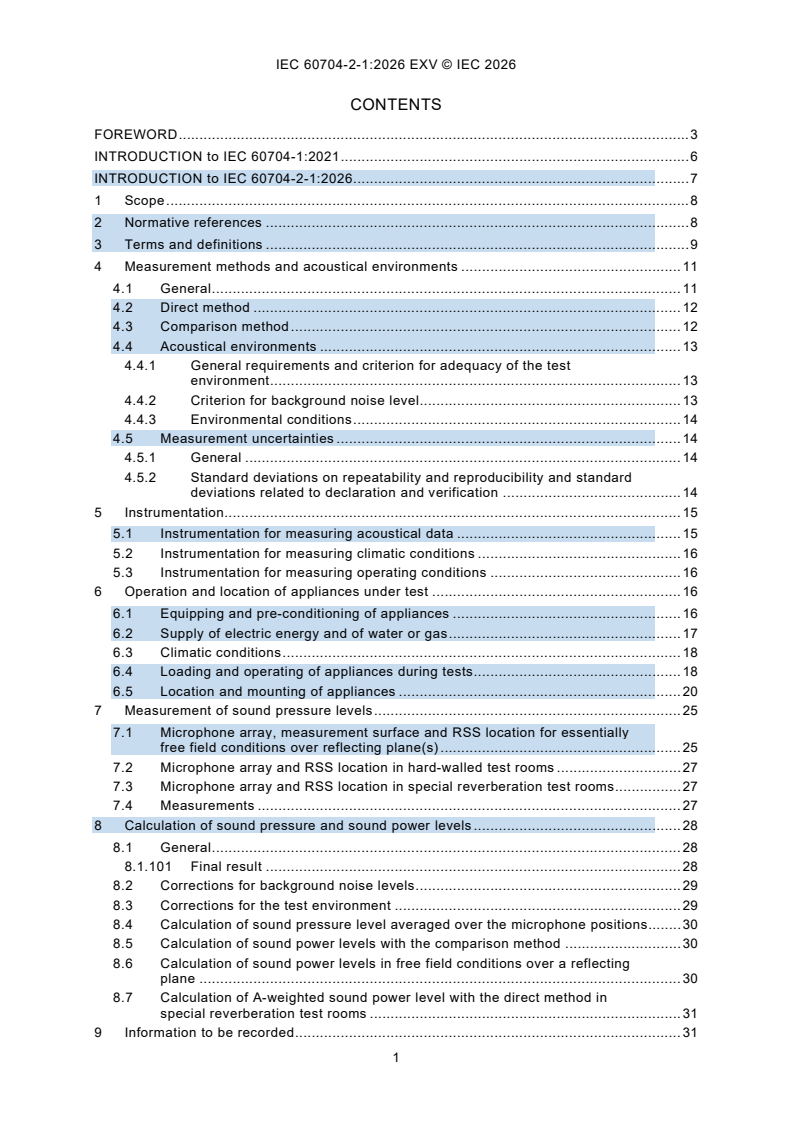
IEC 60704-2-1:2026 EXV - Household and similar electrical appliances - Test code for the determination of airborne acoustical noise - Part 2-1: Particular requirements for dry vacuum cleaners
iec60704-2-1{ed5.0}en - Household and similar electrical appliances - Test code for the determination of airborne acoustical noise - Part 2-1: Particular requirements for dry vacuum cleaners
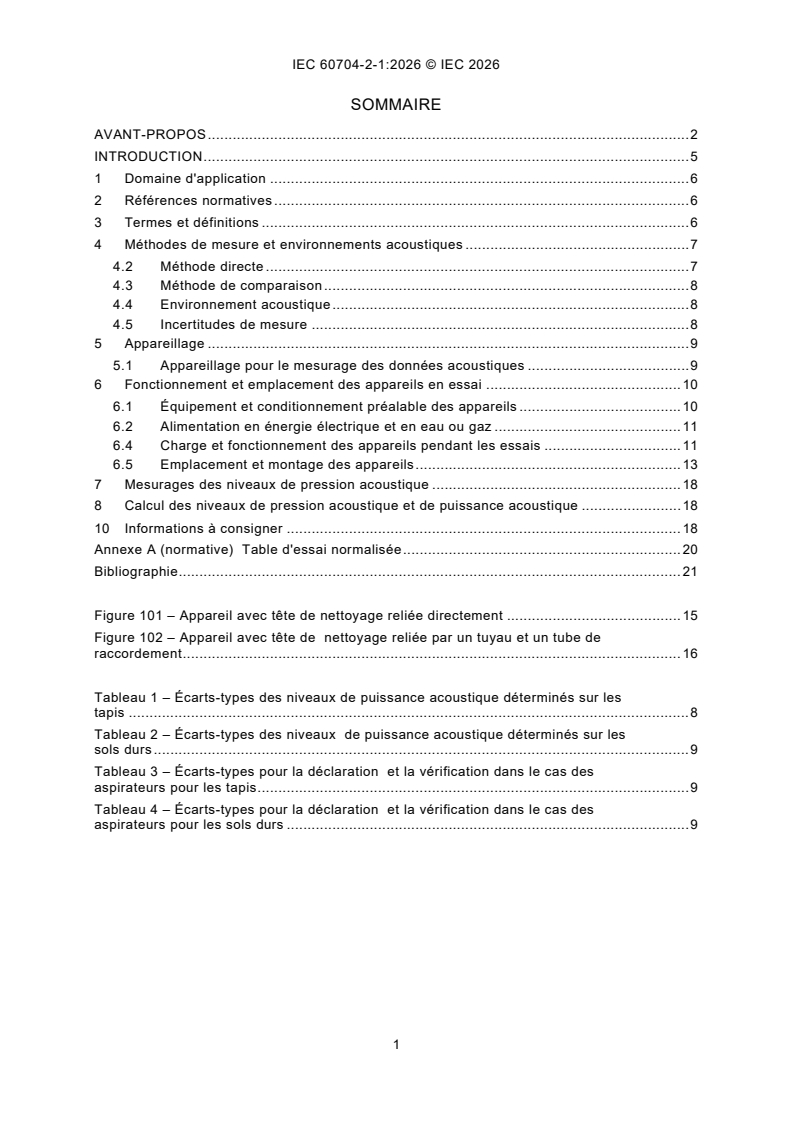
iec60704-2-1{ed5.0}fr - Appareils électrodomestiques et analogues - Code d'essai pour la détermination du bruit aérien - Partie 2-1: Exigences particulieres pour les aspirateurs a sec
IEC 60704-2-1:2026 is an International Standard from the IEC for measuring airborne acoustical noise from dry vacuum cleaners. It covers mains-operated and cordless dry vacuum cleaners for household use or similar use, including accessories and docking stations. The document specifies how to determine and report the noise emission of these appliances under normal operating conditions, and it is intended to be used with IEC 60704-1:2021.
What does IEC 60704-2-1:2026 specify?
IEC 60704-2-1:2026 specifies the test code for airborne acoustical noise from dry vacuum cleaners, including their accessories and docking stations. For wet and dry vacuum cleaners, it applies only to the dry-cleaning function, while the wet-cleaning function is covered by IEC 60704-2-20.
The standard is organized as a part of the IEC 60704 series and follows the usual test-code structure:
- Clause 1 - scope
- Clause 2 - normative references
- Clause 3 - terms and definitions
- Clause 4 - measurement methods and acoustic environments
- Clause 5 - apparatus
- Clause 6 - operation and positioning of the appliances under test
- Clause 7 - sound pressure level measurements
- Clause 8 - calculation of sound pressure and sound power levels
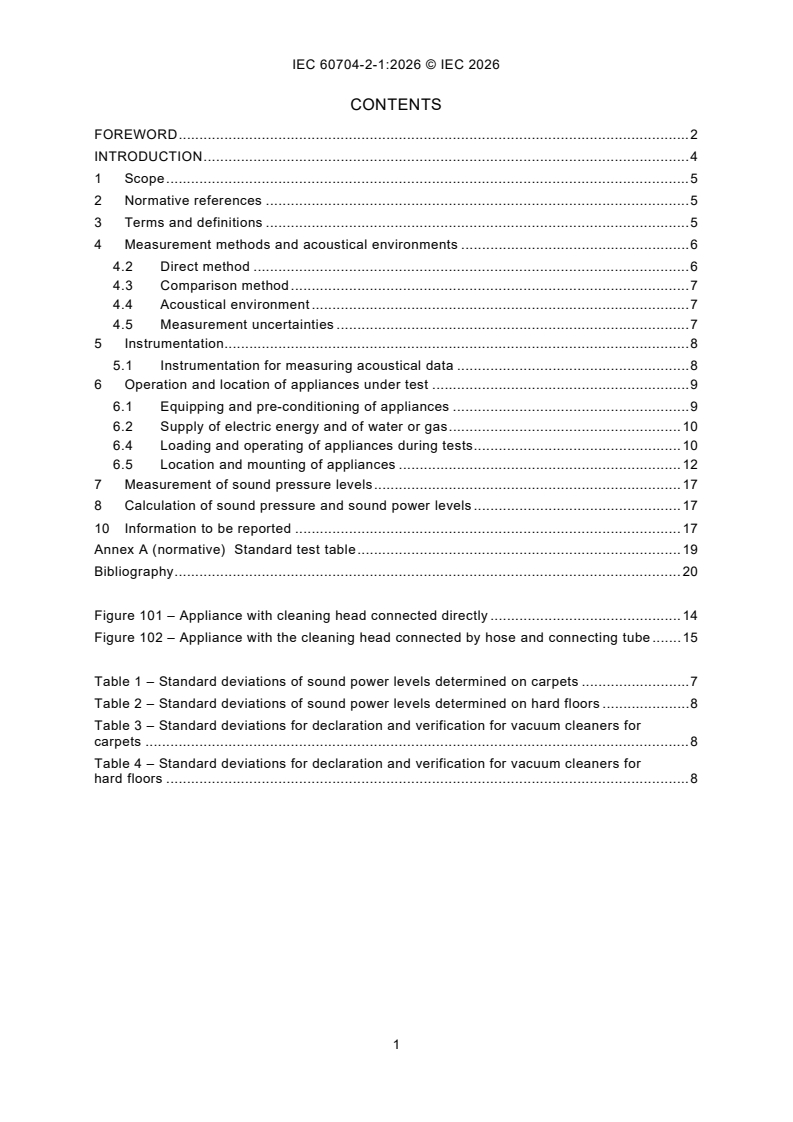
- Clause 10 - information to record
- Annex A - normative, titled standardized test table
- Bibliography
In practice, this means the document tells a laboratory not only what to measure, but also how to prepare the appliance, where to place it, what operating mode to use, and what to record so results can be compared between tests and laboratories.
What are the key requirements of IEC 60704-2-1:2026?
Measurement method and acoustic environment
Clause 4 allows direct and comparison methods for measuring emitted noise, with ISO 3743-1, ISO 3743-2 and ISO 3744 used as the reference acoustical environments. If the appliance produces audible pure tones, the setup may need additional microphone or source positions.
Clause 4 also treats the operator as part of the test environment when human operation is needed. In practice, the operator must be positioned consistently because the operator can affect the sound field and therefore the result.
Clause 4.5 provides estimated standard deviations for carpet tests, hard-floor tests, and for declaration and verification. These figures matter when comparing results, judging repeatability, or checking whether a declared sound emission value is realistic.
Preparation and conditioning of the appliance
Clause 6 requires the appliance to be used with the cleaning configuration intended for the surface under test. Disposable dust containers are replaced before each measurement, and reusable dust containers and removable filters are cleaned according to the manufacturer’s instructions.
For new appliances, Clause 6 requires conditioning before the first test. Corded appliances are run in, cordless appliances are fully charged and discharged in a defined way, and docking stations are prepared through repeated operating cycles. In practice, this reduces the effect of early-life behavior and battery state on the noise result.
Clause 6 also requires stabilization after storage or interruption. This is important because a vacuum cleaner that has just been switched on after a long pause may not behave the same as one already at steady operating temperature.
Operating mode and test surface
Clauses 6.4.2.101 to 6.4.2.104 define how the appliance is operated on carpet, hard floor, and at the docking station. The same configuration must be kept for all tests on a given surface, and the selected settings must be the ones intended by the manufacturer for that surface.
If the appliance has multiple settings and the correct one is not clear, the standard directs the tester to use the product markings and then, if needed, the manufacturer’s guidance. If the setup is still ambiguous, the setting that provides maximum continuous airflow is used. In practice, the standard tries to avoid arbitrary lab choices.
For appliances with dust-detection control, the highest power in the dusty range is used. For docking stations, all operating modes are considered, and the loudest mode must at least be measured.
Positioning on carpet and hard floor
Clause 6.5.2.101 and 6.5.2.102 define how the appliance, hose, tubes, handle and cleaning head are arranged on the test surface. Figures 101 and 102 illustrate the two common geometries: a cleaning head directly attached to the appliance, and a cleaning head connected by hose and tube.
On carpet, the test uses the standardized Wilton carpet specified in IEC TS 62885-1. For active cleaning heads, the carpet is fixed down to avoid vibration noise from the carpet itself.
On hard floor, the reference surface must have low acoustic absorption and sufficient surface density. If the surface does not meet the reference conditions, a polished marble or similar natural-stone plate can be used. The purpose is to make the measured noise come from the vacuum cleaner, not from an unsuitable floor surface.
Measuring, calculating and reporting
Clause 7 requires time-averaged A-weighted sound pressure measurements for the appliance, and it sets a separate measurement approach for docking stations. If sound prompts or voice messages are present, they should be disabled if possible; otherwise, they are included only when they occur during a measured operating mode.
Clause 8 states that the final results for dry vacuum cleaners are sound power levels reported separately for the standardized carpet and the reference hard floor. For docking stations, the final result comes from the measurement defined for the operating mode.
Clause 10 requires the report to identify the cleaning head, the carpet model, batch and sample, the floor type, the cleaning-head setting, and the state of the suction openings. It also requires each measured value to be clearly linked to the surface type used.
What terms does IEC 60704-2-1:2026 define?
- Dry vacuum cleaner - An electrically powered appliance that removes dry material from a surface by airflow and separates the collected material inside the appliance.
- Wet and dry vacuum cleaner - An appliance designed to remove liquid as well as perform dry vacuum cleaning.
- Cleaning head - The nozzle or brush, including a powered nozzle, that is applied to the surface being cleaned.
- Active nozzle - A cleaning head with a driven agitation device that helps remove dust.
- Standardized Wilton test carpet - The Wilton carpet used as the carpet test surface for measurements.
- Reference hard floor - The hard-floor test surface used for measurements and positioning.
- Docking station - The base unit that may charge the battery, empty dust, process data, or provide other support functions.
Who uses IEC 60704-2-1:2026?
IEC 60704-2-1:2026 is used by vacuum cleaner manufacturers, acoustic test laboratories, certification bodies, and quality teams. It supports product development, type testing, conformity assessment, and the verification of declared sound emission values.
It is also useful to buyers and technical assessors who need to compare models on the same basis. Because the standard separates carpet and hard-floor testing, it helps people check whether a vacuum cleaner noise claim matches the intended use surface.
What changed in IEC 60704-2-1:2026 from the previous edition?
This fifth edition cancels and replaces the fourth edition published in 2020. It is described as a technical revision.
The changes stated for this edition are:
- alignment with IEC 60704-1:2021
- attention to consumer-relevant testing aspects
- improved robustness of the standard and closure of possible loopholes
- extended scope to include noise measurement on docking stations
Which standards are used with IEC 60704-2-1:2026?
| Standard | Contribution in IEC 60704-2-1:2026 |
|---|---|
| IEC 60704-1:2021 | General requirements for the airborne acoustical noise test code used with this part |
| IEC 60704-2-20 | Noise measurement for the wet-cleaning function of wet and dry vacuum cleaners |
| IEC TS 62885-1 | Test material and test equipment, including the specification for the Wilton test carpet |
| IEC 62885-2 | Cleaning performance methods and the normal operating conditions referenced for carpet and hard-floor testing |
| IEC 60704-2-17 | Particular requirements for floor cleaning robots, noted as a separate document |
| IEC 60704-3 | Declaration and verification of declared sound emission values |
| ISO 3743-1 | Comparison method and related acoustical environment |
| ISO 3743-2 | Direct method and related acoustical environment |
| ISO 3744 | Additional acoustical environment referenced for emitted-noise measurements |
What does the IEC 60704-2-1:2026 document contain?
IEC 60704-2-1:2026 contains the operating rules, positioning rules, measurement methods, and reporting items needed to measure airborne acoustical noise from dry vacuum cleaners. It includes separate treatment of carpet and hard-floor testing, plus dedicated measurement provisions for docking stations.
The document also contains two explanatory figures showing appliance placement, four tables for uncertainty and declaration support, and clause-by-clause instructions for preparation, measurement, calculation, and reporting. Annex A is identified as a normative standardized test table, and the bibliography points to the related floor-cleaning-robot standard.
Relations
- Effective Date
- 14-Jun-2024
Buy Documents
IEC 60704-2-1:2026 EXV - Household and similar electrical appliances - Test code for the determination of airborne acoustical noise - Part 2-1: Particular requirements for dry vacuum cleaners
iec60704-2-1{ed5.0}en - Household and similar electrical appliances - Test code for the determination of airborne acoustical noise - Part 2-1: Particular requirements for dry vacuum cleaners
iec60704-2-1{ed5.0}fr - Appareils électrodomestiques et analogues - Code d'essai pour la détermination du bruit aérien - Partie 2-1: Exigences particulieres pour les aspirateurs a sec
Get Certified
Connect with accredited certification bodies for this standard

BSMI (Bureau of Standards, Metrology and Inspection)
Taiwan's standards and inspection authority.
Sponsored listings
Frequently Asked Questions
IEC 60704-2-1:2026 is a standard published by the International Electrotechnical Commission (IEC). Its full title is "Household and similar electrical appliances - Test code for the determination of airborne acoustical noise - Part 2-1: Particular requirements for dry vacuum cleaners". This standard covers: IEC 60704-2-1:2026 specifies the determination of airborne acoustical noise of mains operated and cordless dry vacuum cleaners including their accessories and docking stations for household use or under conditions similar to those in households. For wet and dry vacuum cleaners, the dry cleaning function applies. The wet cleaning function is measured in accordance with IEC 60704-2-20. Particular requirements for floor cleaning robots are specified in IEC 60704-2-17 . This document describes the determination of the noise emission of dry vacuum cleaners under normal operating conditions on carpet and hard floor in accordance with IEC 62885-2. This fifth edition cancels and replaces the fourth edition published in 2020. This edition constitutes a technical revision. This edition includes the following significant technical changes with respect to the previous edition: a) alignment with IEC 60704 1:2021; b) addressing consumer relevant testing aspects; c) robustness of standards and closing potential loopholes d) enlarged scope to include noise measurement on docking stations. This document is intended to be used in conjunction with IEC 60704-1:2021, Household and similar electrical appliances - Test code for the determination of airborne acoustical noise - Part 1: General requirements.
IEC 60704-2-1:2026 specifies the determination of airborne acoustical noise of mains operated and cordless dry vacuum cleaners including their accessories and docking stations for household use or under conditions similar to those in households. For wet and dry vacuum cleaners, the dry cleaning function applies. The wet cleaning function is measured in accordance with IEC 60704-2-20. Particular requirements for floor cleaning robots are specified in IEC 60704-2-17 . This document describes the determination of the noise emission of dry vacuum cleaners under normal operating conditions on carpet and hard floor in accordance with IEC 62885-2. This fifth edition cancels and replaces the fourth edition published in 2020. This edition constitutes a technical revision. This edition includes the following significant technical changes with respect to the previous edition: a) alignment with IEC 60704 1:2021; b) addressing consumer relevant testing aspects; c) robustness of standards and closing potential loopholes d) enlarged scope to include noise measurement on docking stations. This document is intended to be used in conjunction with IEC 60704-1:2021, Household and similar electrical appliances - Test code for the determination of airborne acoustical noise - Part 1: General requirements.
IEC 60704-2-1:2026 is classified under the following ICS (International Classification for Standards) categories: 17.140.20 - Noise emitted by machines and equipment; 97.080 - Cleaning appliances. The ICS classification helps identify the subject area and facilitates finding related standards.
IEC 60704-2-1:2026 has the following relationships with other standards: It is inter standard links to IEC 60704-2-1:2020. Understanding these relationships helps ensure you are using the most current and applicable version of the standard.
IEC 60704-2-1:2026 is available in PDF format for immediate download after purchase. The document can be added to your cart and obtained through the secure checkout process. Digital delivery ensures instant access to the complete standard document.
Standards Content (Sample)
Contents
- 1 Scope
- 2 Normative references
- 3 Terms and definitions
- 3.1 measurement time interval
- 3.2 operational period
- 3.3 operational cycle
- 3.4 time history
- 3.5 reference box
- 3.6 test enclosure
- 4 Measurement methods and acoustical environments
- 4.1 General
- 4.2 Direct method
- 4.3 Comparison method
- 4.4 Acoustical environments
- 4.5 Measurement uncertainties
- 5 Instrumentation
- 5.1 Instrumentation for measuring acoustical data
- 5.2 Instrumentation for measuring climatic conditions
- 5.3 Instrumentation for measuring operating conditions
- 6 Operation and location of appliances under test
- 6.1 Equipping and pre-conditioning of appliances
- 6.2 Supply of electric energy and of water or gas
- 6.3 Climatic conditions
- 6.4 Loading and operating of appliances during tests
- 6.4.2 6.4.2.101
- 6.5 Location and mounting of appliances
- 6.5.2 6.5.2.101
- 7 Measurement of sound pressure levels
- 7.1 Microphone array, measurement surface and RSS location for essentially free
- 7.2 Microphone array and RSS location in hard-walled test rooms
- 7.3 Microphone array and RSS location in special reverberation test rooms
- 7.4 Measurements
- 8 Calculation of sound pressure and sound power levels
- 8.1 General
- 8.2 Corrections for background noise levels
- 8.3 Corrections for the test environment
- 8.4 Calculation of sound pressure level averaged over the microphone positions
- 8.5 Calculation of sound power levels with the comparison method
- 8.6 Calculation of sound power levels in free field conditions over a reflecting plane
- 8.7 Calculation of A-weighted sound power level with the direct method in special
- 9 Information to be recorded
- 9.1 General data
- 9.2 Description of appliance under test
- 9.3 Measurement method
- 9.4 Acoustical test environment
- 9.5 Instrumentation
- 9.6 Equipment and pre-conditioning of appliance under test
- 9.8 Climatic conditions
- 9.9 Operation of the appliance under test
- 9.10 Location and mounting of the appliance under test
- 9.11 Microphone array
- 9.12 Measurement data
- 9.13 Calculated sound pressure and sound power levels
- 9.14 Reporting
- 10 Information to be reported
- 10.3 Test conditions for the appliance
- 10.4 Acoustical data
- Annex A
- Annex B
- Annex C
- Bibliography
- FOREWORD
- 1 Scope
- 2 Normative references
- 3 Terms and definitions
- 4 Measurement methods and acoustical environments
- 4.2 Direct method
- 4.3 Comparison method
- 4.4 Acoustical environment
- 4.5 Measurement uncertainties
- 5 Instrumentation
- 5.1 Instrumentation for measuring acoustical data
- 6 Operation and location of appliances under test
- 6.1 Equipping and pre-conditioning of appliances
- 6.2 Supply of electric energy and of water or gas
- 6.4 Loading and operating of appliances during tests
- 6.5 Location and mounting of appliances
- 7 Measurement of sound pressure levels
- 7.4 Measurements
- 8 Calculation of sound pressure and sound power levels
1 Scope
This part of IEC 60704 applies to electric appliances (including their accessories or components) for household and similar use, supplied from mains or from batteries. By "similar use" is understood the use in conditions similar to those found in households, for example in inns, coffee houses, tea rooms, hotels, barber or hairdresser shops, launderettes, etc., if not otherwise specified in the IEC 60704-2 series.
This document does not apply to - appliances, equipment, or machines designed exclusively for industrial or professional purposes; - appliances that are integrated parts of a building or its installations, such as equipment for air conditioning, heating and ventilating (except household fans, cooker hoods, freestanding heating appliances, dehumidifiers, air cleaners, and stand-alone water heaters), oil burners for central heating, pumps for water supply and for sewage systems; - separate motors or generators and - appliances exclusively for outdoor use.
For determining and verifying noise emission values declared in product specifications, see IEC 60704-3:2019.
This document specifies the determination of airborne acoustical noise of mains operated and cordless dry vacuum cleaners including their accessories and docking stations for household use or under conditions similar to those in households. For wet and dry vacuum cleaners, the dry cleaning function applies. The wet cleaning function is measured in accordance with IEC 60704-2-20.
NOTE 101 Particular requirements for floor cleaning robots are specified in IEC 60704-2-17 . This document describes the determination of the noise emission of dry vacuum cleaners under normal operating conditions on carpet and hard floor in accordance with
IEC 62885-2:—, 4.6 .
2 Normative references
The following documents are referred to in the text in such a way that some or all of their content constitutes requirements of this document. For dated references, only the edition cited applies. For undated references, the latest edition of the referenced document (including any amendments) applies.
IEC 60704-2 (all parts), Household and similar electrical appliances – Test code for the determination of airborne acoustical noise IEC 60704-2-20, Household and similar electrical appliances - Test code for the determination of airborne acoustical noise - Part 2-20: Particular requirements for wet hard floor cleaning appliances
Under preparation. Stage at the date of publication: IEC/CDV 60704-2-17:2026.
Under preparation. Stage at the date of publication: IEC/FDIS 62885-2:2026.
IEC 60704-3:2019, Household and similar electrical appliances – Test code for the determination of airborne acoustical noise – Part 3: Procedure for determining and verifying declared noise emission values IEC 61260-1:2014, Electroacoustics – Octave-band and fractional-octave-band filters – Part 1: Specifications IEC 61672-1:2013, Electroacoustics – Sound level meters – Part 1: Specifications IEC TS 62885-1, Surface cleaning appliances - Part 1: General requirements on test material and test equipment
IEC 62885-2:—, Surface cleaning appliances - Part 2: Dry vacuum cleaners for household and similar use - Methods for measuring the performance ISO 3743-1:2010, Acoustics – Determination of sound power levels of noise sources – Engineering methods for small, movable sources in reverberant fields – Part 1: Comparison method for hard-walled test rooms ISO 3743-2:2018, Acoustics – Determination of sound power levels of noise sources using sound pressure – Engineering methods for small, movable sources in reverberant fields – Part 2: Methods for special reverberation test rooms ISO 3744:2010, Acoustics – Determination of sound power levels of noise sources using sound pressure – Engineering method in an essentially free field over a reflecting plane ISO 9614-1:1993, Acoustics – Determination of sound power levels of noise sources using sound intensity – Part 1: Measurement at discrete points ISO 9614-2:1996, Acoustics – Determination of sound power levels of noise sources using sound intensity – Part 2: Measurement by scanning ISO 9614-3:2002, Acoustics – Determination of sound power levels of noise sources using sound intensity – Part 3: Precision method for measurement by scanning ISO 6926:2016, Acoustics – Requirements for the performance and calibration of reference sound sources used for the determination of sound power levels ISO 12001:1996, Acoustics – Noise emitted by machinery and equipment – Rules for the drafting and presentation of a noise test code
3 Terms and definitions
For the purposes of this document, the following terms and definitions apply. Terms and definitions pertinent to the determination of sound power levels can be found in ISO 3743- 1:2010, ISO 3743-2:2018 and ISO 3744:2010.
ISO and IEC maintain terminological databases for use in standardization at the following addresses:
- IEC Electropedia: available at http://www.electropedia.org/
- ISO Online browsing platform: available at http://www.iso.org/obp
3.1 measurement time interval
portion or a multiple of an operational period or operational cycle for which the sound power levels are determined
3.2 operational period
interval of time during which a specified process is accomplished by the appliance under test (for example, washing or rinsing or drying for a dishwasher)
3.3 operational cycle
specific sequence of operational periods occurring while the appliance under test performs a complete work cycle Note 1 to entry: During the operational cycle, each operational period is associated with a specific process that can occur only once, or can be repeated (for example, washing and rinsing and drying for a dishwasher).
3.4 time history
continuous recording of the sound pressure level (for a distinct microphone position) as a function of time, which is obtained during one or more operational periods of an operational cycle
3.5 reference box
hypothetical right parallelepiped terminating on the reflecting plane(s) on which the noise source under test is located, that just encloses the source including all the significant sound radiating components and any test table on which the source is mounted [SOURCE: ISO 3744:2010, 3.10, modified – The note has been omitted.]
3.6 test enclosure
enclosure used for simulating the typical acoustic built-in or/and mounting conditions 3.101 dry vacuum cleaner electrically operated appliance that removes dry material (for example, dust, fibre, threads, and debris) from the surface to be cleaned by an air flow created by a vacuum developed within the unit, the removed material being separated in the appliance and the cleaned suction air being returned to the ambient air [SOURCE: IEC 62885-2: —, 3.8] 3.102 wet and dry vacuum cleaner appliance designed to remove liquid in combination with the functionality of a dry vacuum cleaner 3.103 cleaning head plain nozzle or brush attached to a connecting tube, or a power nozzle, separate or part of the cleaner housing, and that part of a dry vacuum cleaner which is applied to a surface to be cleaned [SOURCE: IEC 62885-2: —, 3.3]
3.104 active nozzle cleaning head provided with a driven agitation device to assist dirt removal Note 1 to entry: The agitation device can be driven by an incorporated electric motor (motorized nozzle), an incorporated turbine powered by the air flow (air-turbine nozzle) or an incorporated friction or gear mechanism actuated by moving the cleaning head over the surface to be cleaned (mechanical nozzle). [SOURCE: IEC 62885-2: —, 3.2] 3.105 standard Wilton test carpet Wilton carpet on which the dry vacuum cleaner and its cleaning head is placed for the measurement Note 1 to entry: The specification of the standard Wilton test carpet can be found in IEC TS 62885-1. 3.106 standard hard floor hard floor on which the dry vacuum cleaner and its cleaning head is placed for the measurement 3.107 docking station base unit unit that can provide manual or automatic battery charging facilities, dust removal from the dry vacuum cleaner, data processing facility or other support functions
4 Measurement methods and acoustical environments
4.1 General
This document is concerned with objective methods of engineering accuracy grade 2 in accordance with ISO 12001:1996 for determining sound power levels L , expressed in W decibels (dB), with reference to a sound power of one picowatt (1 pW), of airborne acoustical noise within the specified frequency range of interest (generally including the octave-bands with centre frequencies from 125 Hz to 8 000 Hz), and for prescribed operating conditions of the appliance to be measured.
Methods for determining sound power levels with precision accuracy grade 1 in accordance with ISO 12001:1996, as specified for example in ISO 3741 and ISO 3745, are not included in this document. They may, however, be applied if the appropriate test environment and instrumentation are available.
NOTE 1 The noise values obtained under the described conditions of this document will not necessarily correspond to the noise experienced under the operational conditions of practical use. NOTE 2 For quality control during production etc., simplified methods can be appropriate. For noise reduction purposes, other measurement methods employing, for example, narrow-band analysis or intensity techniques usually have to be applied. These methods are not covered by this document. The total noise emitted by machinery or equipment and radiated in all directions to the space surrounding the machine can be characterized by the sound power of the machine. Within the accuracy range of this document, the sound power of a machine is basically independent of the environment in which the machine is installed Therefore, the concept of sound power level has been chosen for expressing the noise emission of appliances for household and similar purposes.
The preferred noise emission quantity is the A-weighted sound power level, L , in dB WA (re 1 pW).
According to this document, two principal methods exist, the direct method and the comparison method, as described in 4.2 and 4.3. These two methods can be used alternatively.
Different types of environments, as described in 4.4, may be used. A part of the IEC 60704-2 series may, if necessary, exclude one or several combinations among those available.
4.2 Direct method
The direct method can be used only for measurements in qualified test environments in accordance with ISO 3744:2010 for free field conditions over reflecting plane(s), and in accordance with ISO 3743-2:2018 for special reverberation test rooms. With this method, the sound power level is determined - in free field conditions over reflecting plane(s), from time-averaged sound pressure levels (on a mean-square basis) over the measurement surface and from the area of the measurement surface, S, or - in reverberation and special reverberation test rooms, from averaged sound pressure levels, and from the reverberation time and the volume of the test room. If for a measurement in a free field, reverberation or special reverberation room is not possible because the appliance cannot be placed or operated in such an environment, the intensity method in accordance with ISO 9614-1:1993, ISO 9614-2:1996, and ISO 9614- 3:2002 shall be applied. For the intensity method, the standard deviations given in the parts of the IEC 60704-2 series and IEC 60704-3:2019 are not applicable unless stated explicitly. These methods yield results expressed in A-weighted sound power levels (and in octave- or 1/3 octave-band sound power levels, if required) that are calculated directly from measured sound pressure levels.
NOTE This method can also be used in conjunction with more precise methods, such as those given in ISO 3741 and ISO 3745.
If audible discrete tones are present in the noise emitted by the source, the estimated standard deviation of the measured sound pressure levels in the special reverberation room can increase. In such cases, additional microphone positions or source positions can be necessary, as specified in ISO 3743-2.
If an operator is necessary, it is considered as part of the test environment. Therefore, the operator shall be present also during the reverberation time measurement with the RSS. The position of the operator shall be approximately at the same position as in the measurement with the test sample.
4.3 Comparison method
The comparison method for measurement is explicitly described in ISO 3743-1:2010 and in ISO 3743-2:2018.
NOTE The term "comparison method" is not explicitly given in ISO 3744:2010, but when applying the "absolute comparison test" for the determination of the environmental correction given in A.3 of ISO 3744:2010, by using a reference sound source, the procedure is, in fact, a comparison method. With this method, the sound power level is determined by comparing the averaged values (on a mean-square basis) of the sound pressure levels produced by the source in the test room to the averaged values of the sound pressure levels produced in the same room by a calibrated reference sound source (RSS) of known sound power output, complying with the requirements
of ISO 6926:2016. The difference in sound pressure levels is equal to the difference in sound power levels when conditions are the same for both sets of measurements. This method yields results expressed in octave- or 1/3 octave-band sound power levels, and the A-weighted sound power level is calculated from the octave- or 1/3 octave-band sound power levels.
To check whether there is a systematic difference between results obtained in different environments, the use of the comparison method is recommended. If audible discrete tones are present in the noise emitted by the source, the estimated standard deviation of the measured sound pressure levels in the hard-walled test room or in the special reverberation room can increase. In such cases, additional microphone positions or source positions can be necessary, as specified in ISO 3743-1 or ISO 3743-2. If an operator is necessary, it is considered as part of the test environment. Therefore, the operator shall be present also during the comparison measurement with the RSS. The position of the operator shall be approximately at the same position as in the measurement with the test sample.
4.4 Acoustical environments
4.4.1 General requirements and criterion for adequacy of the test environment
They are given in the following clauses:
- Clause 4 of ISO 3743-1:2010 for hard-walled test rooms;
- Clause 5 of ISO 3743-2:2018 for special reverberation test rooms and
- Clause 4 of ISO 3744:2010 for free-field conditions over a reflecting plane. A classification of different types of noise is given in ISO 12001:1996. The method specified in ISO 3744:2010 is suitable for measurements of all types of noise emitted by household appliances. The methods specified in ISO 3743-1:2010 and ISO 3743-2:2018 are suitable for all types of noise, except for sources of impulsive noise consisting of short-duration noise bursts. This will be taken into account in the preparation of parts of the IEC 60704-2 series. The method specified in ISO 3744:2010 is applicable to noise sources of any size. Limitations for the size of the source are given in 4.2 of ISO 3743-1:2010 and in Clause 5 of ISO 3743-2:2018. This will be taken into account in the preparation of parts of the IEC 60704-2 series.
NOTE For free-field conditions over a reflecting plane, the absolute comparison test for the qualification of the environment, described in Clause A.2 of ISO 3744:2010, is preferred. Guidelines for the design of simple test rooms with free-field conditions are given in Annex C. Guidelines for the design of a suitable special reverberation test room are given in ISO 3743-2:2018, Annex A.
The methods specified in ISO 3743-1, ISO 3743-2 and ISO 3744 can be used for measuring noise emitted by electric vacuum cleaners.
4.4.2 Criterion for background noise level
Requirements for the background noise level are given in 4.5 of ISO 3743-1:2010, in 6.5 of ISO 3743-2:2018 and in 4.2 of ISO 3744:2010. Averaged over the microphone positions, the background noise level shall be at least 6 dB below, and preferably more than 15 dB below, the sound pressure level to be measured.
NOTE If the difference between the sound pressure levels of the background noise and the appliance noise is less than 6 dB, see 8.2.
4.4.3 Environmental conditions
Environmental conditions having an adverse effect on the microphone used for the measurements (for example, strong electric or magnetic fields, wind, impingement of air discharge from the equipment being tested, high or low temperatures) shall be avoided by proper selection or positioning of the microphone.
The instructions of the manufacturers of the measurement instruments regarding adverse environmental conditions shall be followed. The microphone shall always be oriented in such a way that the angle of incidence of the sound waves is that for which the microphone is calibrated.
4.5 Measurement uncertainties
4.5.1 General
The estimated values of the standard deviations of reproducibility of sound power levels determined in accordance with this document are given in 9.1 of ISO 3743-1:2010, in 11.1 of ISO 3743‑2:2018 and in 9.1 of ISO 3744:2010. But for a particular family of appliances of similar size with similar operating conditions, the standard deviations of reproducibility can be smaller than these values. Hence, in the IEC 60704-2 series, standard deviations smaller than those listed in ISO standards can be stated if substantiation is available from the results of suitable interlaboratory tests.
In the case of discrepancies between the measurements where the results normally remain inside the foreseen standard deviation, it can be helpful to perform measurements according to the upper grade of accuracy: grade 1, laboratory or precision, as described in ISO 3741 or ISO 3745.
4.5.2 Standard deviations on repeatability and reproducibility and standard
deviations related to declaration and verification For dry vacuum cleaners designed for cleaning carpets, the estimated values of standard deviations of sound power levels determined in accordance with this document are provided in Table 1.
Table 1 – Standard deviations of sound power levels determined on carpets Standard deviation (dB) σ (repeatability) σ (reproducibility) r R 0,3 0,8
For dry vacuum cleaners designed for cleaning hard floors, the estimated values of standard deviations of sound power levels determined in accordance with this document are provided in Table 2.
Table 2 – Standard deviations of sound power levels determined on hard floors Standard deviation (dB) σ (repeatability) σ (reproducibility) r R 0,2 0,6
NOTE 101 The values in Table 1 and Table 2 are derived from the results of a round robin test (RRT) conducted in 2010/2011 with 4 different vacuum cleaners (passive and active) in 8 participating laboratories. NOTE 102 For docking stations, the standard deviations are under consideration. For the purpose of determining and verifying declared noise emission values for dry vacuum cleaners designed for cleaning carpets, in accordance with IEC 60704-3, the following values provided in Table 3 apply.
Table 3 – Standard deviations for declaration and verification for vacuum cleaners for carpets Standard deviation (dB) σ (production) σ (total) σ (reference) P t M 0,5 to 1,0 0,9 to 1,3 1,5
For the purpose of determining and verifying declared noise emission values for dry vacuum cleaners designed for cleaning hard floors, in accordance with IEC 60704-3, the following values provided in Table 4 apply.
...
Contents
- 1 Scope
- 2 Normative references
- 3 Terms and definitions
- 4 Measurement methods and acoustical environments
- 4.2 Direct method
- 4.3 Comparison method
- 4.4 Acoustical environment
- 4.5 Measurement uncertainties
- 5 Instrumentation
- 5.1 Instrumentation for measuring acoustical data
- 6 Operation and location of appliances under test
- 6.1 Equipping and pre-conditioning of appliances
- 6.2 Supply of electric energy and of water or gas
- 6.4 Loading and operating of appliances during tests
- 6.5 Location and mounting of appliances
- 7 Measurement of sound pressure levels
- 7.4 Measurements
- 8 Calculation of sound pressure and sound power levels
- 10 Information to be reported
- 10.3 Test conditions for the appliance
- Annex A
- Bibliography
INTRODUCTION The measuring conditions specified in this document provide for sufficient accuracy in determining the noise emitted and comparing the results of measurements taken by different laboratories, whilst simulating as far as possible the practical use of dry vacuum cleaners. It is recommended to consider the determination of noise levels as part of a comprehensive testing procedure covering many aspects of properties and performance of household vacuum cleaners.
NOTE As stated in the introduction to IEC 60704-1, this test code is concerned with airborne noise only.
1 Scope
Addition:
This document specifies the determination of airborne acoustical noise of mains operated and cordless dry vacuum cleaners including their accessories and docking stations for household use or under conditions similar to those in households.
For wet and dry vacuum cleaners, the dry cleaning function applies. The wet cleaning function is measured in accordance with IEC 60704-2-20.
NOTE 101 Particular requirements for floor cleaning robots are specified in IEC 60704-2-17 . This document describes the determination of the noise emission of dry vacuum cleaners under normal operating conditions on carpet and hard floor in accordance with IEC 62885-2:—,
4.6 .
2 Normative references
Addition:
IEC 60704-2-20, Household and similar electrical appliances - Test code for the determination of airborne acoustical noise - Part 2-20: Particular requirements for wet hard floor cleaning appliances IEC TS 62885-1, Surface cleaning appliances - Part 1: General requirements on test material and test equipment
IEC 62885-2:—, Surface cleaning appliances - Part 2: Dry vacuum cleaners for household and similar use - Methods for measuring the performance
3 Terms and definitions
Addition:
3.101 dry vacuum cleaner electrically operated appliance that removes dry material (for example, dust, fibre, threads, and debris) from the surface to be cleaned by an air flow created by a vacuum developed within the unit, the removed material being separated in the appliance and the cleaned suction air being returned to the ambient air [SOURCE: IEC 62885-2: —, 3.8] 3.102 wet and dry vacuum cleaner appliance designed to remove liquid in combination with the functionality of a dry vacuum cleaner
Under preparation. Stage at the date of publication: IEC/CDV 60704-2-17:2026.
Under preparation. Stage at the date of publication: IEC/FDIS 62885-2:2026.
3.103 cleaning head plain nozzle or brush attached to a connecting tube, or a power nozzle, separate or part of the cleaner housing, and that part of a dry vacuum cleaner which is applied to a surface to be cleaned [SOURCE: IEC 62885-2: —, 3.3] 3.104 active nozzle cleaning head provided with a driven agitation device to assist dirt removal Note 1 to entry: The agitation device can be driven by an incorporated electric motor (motorized nozzle), an incorporated turbine powered by the air flow (air-turbine nozzle) or an incorporated friction or gear mechanism actuated by moving the cleaning head over the surface to be cleaned (mechanical nozzle). [SOURCE: IEC 62885-2: —, 3.2] 3.105 standard Wilton test carpet Wilton carpet on which the dry vacuum cleaner and its cleaning head is placed for the measurement Note 1 to entry: The specification of the standard Wilton test carpet can be found in IEC TS 62885-1. 3.106 standard hard floor hard floor on which the dry vacuum cleaner and its cleaning head is placed for the measurement 3.107 docking station base unit unit that can provide manual or automatic battery charging facilities, dust removal from the dry vacuum cleaner, data processing facility or other support functions
4 Measurement methods and acoustical environments
4.2 Direct method
Addition:
If audible discrete tones are present in the noise emitted by the source, the estimated standard deviation of the measured sound pressure levels in the special reverberation room can increase. In such cases, additional microphone positions or source positions can be necessary, as specified in ISO 3743-2.
If an operator is necessary, it is considered as part of the test environment. Therefore, the operator shall be present also during the reverberation time measurement with the RSS. The position of the operator shall be approximately at the same position as in the measurement with the test sample.
4.3 Comparison method
Addition:
If audible discrete tones are present in the noise emitted by the source, the estimated standard deviation of the measured sound pressure levels in the hard-walled test room or in the special reverberation room can increase. In such cases, additional microphone positions or source positions can be necessary, as specified in ISO 3743-1 or ISO 3743-2. If an operator is necessary, it is considered as part of the test environment. Therefore, the operator shall be present also during the comparison measurement with the RSS. The position of the operator shall be approximately at the same position as in the measurement with the test sample.
4.4 Acoustical environment
4.4.1 General requirements and criterion for adequacy of the test environment
Addition:
The methods specified in ISO 3743-1, ISO 3743-2 and ISO 3744 can be used for measuring noise emitted by electric vacuum cleaners.
4.5 Measurement uncertainties
4.5.2 Standard deviations on repeatability and reproducibility and standard
deviations related to declaration and verification Replacement:
For dry vacuum cleaners designed for cleaning carpets, the estimated values of standard deviations of sound power levels determined in accordance with this document are provided in Table 1.
Table 1 – Standard deviations of sound power levels determined on carpets Standard deviation (dB) σ (repeatability) σ (reproducibility) r R 0,3 0,8
For dry vacuum cleaners designed for cleaning hard floors, the estimated values of standard deviations of sound power levels determined in accordance with this document are provided in Table 2.
Table 2 – Standard deviations of sound power levels determined on hard floors Standard deviation (dB) σ (repeatability) σ (reproducibility) r R 0,2 0,6
NOTE 101 The values in Table 1 and Table 2 are derived from the results of a round robin test (RRT) conducted in 2010/2011 with 4 different vacuum cleaners (passive and active) in 8 participating laboratories. NOTE 102 For docking stations, the standard deviations are under consideration. For the purpose of determining and verifying declared noise emission values for dry vacuum cleaners designed for cleaning carpets, in accordance with IEC 60704-3, the following values provided in Table 3 apply.
Table 3 – Standard deviations for declaration and verification for vacuum cleaners for carpets Standard deviation (dB) σ (production) σ (total) σ (reference) P t M 0,5 to 1,0 0,9 to 1,3 1,5
For the purpose of determining and verifying declared noise emission values for dry vacuum cleaners designed for cleaning hard floors, in accordance with IEC 60704-3, the following values provided in Table 4 apply.
Table 4 – Standard deviations for declaration and verification for vacuum cleaners for hard floors Standard deviation (dB) σ (production) σ (total) σ (reference) P t M 0,5 to 1,0 0,8 to 1,2 1,5
5 Instrumentation
5.1 Instrumentation for measuring acoustical data
Addition:
The use of windscreens is recommended. If necessary, the observed sound pressure level shall be corrected for changes in the microphone sensitivity, in accordance with the instructions accompanying the instrumentation.
6 Operation and location of appliances under test
6.1 Equipping and pre-conditioning of appliances
6.1.1 Replacement:
The dry vacuum cleaner setting configurations, such as cleaning head and cleaning head setting, shall be used and adjusted in accordance with 6.4.2.
If the dry vacuum cleaner or docking station is designed to be used with disposable dust receptacles, it shall, prior to each measurement, be equipped with a new dust receptacle of the type recommended or supplied by the manufacturer of the dry vacuum cleaner. If the dry vacuum cleaner or docking station is provided with a reusable dust receptacle (as the sole original dust receptacle or as an enclosure for disposable dust receptacles), the dust receptacle and any additional filters removable without the aid of tools shall, prior to each measurement, be cleaned in accordance with the manufacturer's instructions until its mass is within 1 % or 2 g of its original mass, whichever is the lower. Docking stations shall be fitted for normal use in accordance with manufacturer's instructions. Audible signals (e.g. voice notification) shall be switched off if possible. 6.1.3 Replacement:
...
Contents
- 1 Domaine d'application
- 2 Références normatives
- 3 Termes et définitions
- 4 Méthodes de mesure et environnements acoustiques
- 4.2 Méthode directe
- 4.3 Méthode de comparaison
- 4.4 Environnement acoustique
- 4.5 Incertitudes de mesure
- 5 Appareillage
- 5.1 Appareillage pour le mesurage des données acoustiques
- 6 Fonctionnement et emplacement des appareils en essai
- 6.1 Équipement et conditionnement préalable des appareils
- 6.2 Alimentation en énergie électrique et en eau ou gaz
- 6.4 Charge et fonctionnement des appareils pendant les essais
- 6.5 Emplacement et montage des appareils
- 7 Mesurages des niveaux de pression acoustique
- 7.4 Mesurages
- 8 Calcul des niveaux de pression acoustique et de puissance acoustique
- 10 Informations à consigner
- 10.3 Conditions d'essai de l'appareil
- Annexe A
- Bibliographie
INTRODUCTION Les conditions de mesure spécifiées dans le présent document sont prévues pour assurer une exactitude suffisante pour la détermination du bruit émis et la comparaison des résultats de mesures obtenus par différents laboratoires tout en simulant, dans la mesure du possible, l'utilisation pratique des aspirateurs à sec.
Il est recommandé de prendre en considération la détermination des niveaux de bruit comme faisant partie d'une procédure d'essai complète qui couvre de nombreux aspects des caractéristiques et des performances des aspirateurs à usage domestique. NOTE Comme cela est indiqué dans l'introduction de l'IEC 60704-1, ce code d'essai concerne uniquement le bruit aérien.
1 Domaine d'application
Addition:
Le présent document spécifie la détermination du bruit aérien des aspirateurs à sec qui fonctionnent sur secteur et des aspirateurs à sec sans cordon, y compris leurs accessoires et les stations d'accueil, destinés à un usage domestique ou dans des conditions analogues à celles des foyers domestiques.
Pour les aspirateurs humides et à sec, la fonction de nettoyage à sec s'applique. La fonction de nettoyage avec de l'eau est mesurée conformément à l'IEC 60704-2-20. NOTE 101 Les exigences particulières pour les robots de nettoyage humide sont spécifiées dans
l'IEC 60704-2-17 .
Le présent document décrit la méthode utilisée pour déterminer le bruit émis par les aspirateurs à sec qui fonctionnent dans les conditions normales d'utilisation sur tapis et sur
sol dur conformément à l'IEC 62885-2:—, 4.6 .
2 Références normatives
Addition:
IEC 60704-2-20, Appareils électrodomestiques et analogues - Code d'essai pour la détermination du bruit aérien - Partie 2-20: Exigences particulières pour les appareils de nettoyage des sols durs et mouillés IEC TS 62885-1, Surface cleaning appliances - Part 1: General requirements on test material and test equipment (disponible en anglais seulement)
IEC 62885-2:—, Appareils de nettoyage des sols - Partie 2: Aspirateurs à sec à usage domestique ou analogue - Méthodes de mesure de l'aptitude à la fonction
3 Termes et définitions
Addition:
3.101 aspirateur à sec appareil électrique permettant d'éliminer des matériaux à sec (par exemple de la poussière, des fibres, des fils et des débris) de la surface à nettoyer à l'aide d'un débit d'air créé par un vide développé à l'intérieur de l'unité, les matériaux éliminés étant séparés dans l'appareil et l'air aspiré nettoyé étant renvoyé dans l'air ambiant [SOURCE: IEC 62885-2: —, 3.8] 3.102 aspirateur humide et à sec appareil conçu pour éliminer le liquide en combinaison avec la fonctionnalité d'un aspirateur à sec
En cours d'élaboration. Stade à la date de publication: IEC/CDV 60704-2-17:2026.
En cours d'élaboration. Stade à la date de publication: IEC/FDIS 62885-2:2026.
3.103 tête de nettoyage suceur simple ou brosse fixé(e) à un tube de raccordement, ou suceur motorisé, individuel ou faisant partie du corps de l'aspirateur, et partie d'un aspirateur à sec qui est appliquée sur la surface à nettoyer [SOURCE: IEC 62885-2: —, 3.3] 3.104 suceur actif tête de nettoyage équipée d'un dispositif d'agitation entraîné et destiné à faciliter le dépoussiérage Note 1 à l'article: Le dispositif d'agitation peut être entraîné par un moteur électrique intégré (suceur motorisé), une turbine intégrée alimentée par le débit d'air (suceur à turbine à air) ou un mécanisme d'engrenage ou de friction intégré actionné en déplaçant la tête de nettoyage sur la surface à nettoyer (suceur mécanique). [SOURCE: IEC 62885-2: —, 3.2] 3.105 tapis d'essai normalisé Wilton tapis Wilton sur lequel l'aspirateur à sec et sa tête de nettoyage sont placés pour le mesurage Note 1 à l'article: La spécification du tapis d'essai normalisé Wilton peut être consultée dans l'IEC TS 62885-1. 3.106 sol dur de référence sol dur sur lequel l'aspirateur à sec et sa tête de nettoyage sont placés pour le mesurage 3.107 station d'accueil unité de base unité qui peut proposer des fonctions de charge manuelle ou automatique de la batterie, le dépoussiérage de l'aspirateur à sec, une fonctionnalité de traitement de données ou d'autres fonctions d'appui
4 Méthodes de mesure et environnements acoustiques
4.2 Méthode directe
Addition:
Si le bruit émis par la source comporte des sons purs audibles, l'écart-type estimé des niveaux de pression acoustique mesurés dans la salle réverbérante spéciale peut augmenter. Dans de tels cas, des positions de microphones ou des positions de sources supplémentaires peuvent être nécessaires, comme cela est spécifié dans l'ISO 3743-2.
Si un opérateur est nécessaire, il est considéré comme faisant partie de l'environnement d'essai. Par conséquent, l'opérateur doit également être présent pendant le mesurage du temps de réverbération avec la RSS. La position de l'opérateur doit être située approximativement à la même position utilisée pour le mesurage avec l'échantillon d'essai.
4.3 Méthode de comparaison
Addition:
Si le bruit émis par la source comporte des sons purs audibles, l'écart-type estimé des niveaux de pression acoustique mesurés dans la salle d'essai à parois dures ou dans la salle réverbérante spéciale peut augmenter. Dans de tels cas, des positions de microphones ou des positions de sources supplémentaires peuvent être nécessaires, comme cela est spécifié dans l'ISO 3743-1 ou l'ISO 3743-2.
Si un opérateur est nécessaire, il est considéré comme faisant partie de l'environnement d'essai. Par conséquent, l'opérateur doit être présent pendant le mesurage comparatif avec la RSS. La position de l'opérateur doit être située approximativement à la même position utilisée pour le mesurage avec l'échantillon d'essai.
4.4 Environnement acoustique
4.4.1 Exigences générales et critère d'adéquation avec l'environnement d'essai
Addition:
Les méthodes spécifiées dans l'ISO 3743-1, l'ISO 3743-2 et l'ISO 3744 peuvent être utilisées pour mesurer le bruit émis par les aspirateurs électriques.
4.5 Incertitudes de mesure
4.5.2 Écarts-types sur la répétabilité et la reproductibilité et écarts-types liés à la
déclaration et à la vérification Remplacement:
Pour les aspirateurs à sec conçus pour le nettoyage des tapis, les valeurs estimées des écarts-types des niveaux de puissance acoustique, déterminées conformément au présent document, sont fournies dans le Tableau 1.
Tableau 1 – Écarts-types des niveaux de puissance acoustique déterminés sur les tapis Écart-type (dB) σ (répétabilité) σ (reproductibilité) r R 0,3 0,8
Pour les aspirateurs à sec conçus pour le nettoyage des sols durs, les valeurs estimées des écarts-types des niveaux de puissance acoustique, déterminées conformément au présent document, sont fournies dans le Tableau 2.
Tableau 2 – Écarts-types des niveaux de puissance acoustique déterminés sur les sols durs Écart-type (dB) σ (répétabilité) σ (reproductibilité) r R 0,2 0,6
NOTE 101 Les valeurs du Tableau 1 et du Tableau 2 sont issues des résultats d'essais interlaboratoires réalisés en 2010/2011 à l'aide de quatre aspirateurs différents (passifs et actifs) dans huit laboratoires participants. NOTE 102 Pour les stations d'accueil, les écarts-types sont à l'étude. Dans le but de déterminer et de vérifier les valeurs déclarées d'émission sonore pour les aspirateurs à sec conçus pour le nettoyage des tapis, conformément à l'IEC 60704-3, les valeurs suivantes fournies dans le Tableau 3 s'appliquent:
Tableau 3 – Écarts-types pour la déclaration et la vérification dans le cas des aspirateurs pour les tapis Écart-type (dB) σ (production) σ (total) σ (référence) P t M 0,5 à 1,0 0,9 à 1,3 1,5
Dans le but de déterminer et de vérifier les valeurs déclarées d'émission sonore pour les aspirateurs à sec conçus pour le nettoyage des sols durs, conformément à l'IEC 60704-3, les valeurs suivantes fournies dans le Tableau 4 s'appliquent:
Tableau 4 – Écarts-types pour la déclaration et la vérification dans le cas des aspirateurs pour les sols durs Écart-type (dB) σ (production) σ (total) σ (référence) P t M 0,5 à 1,0 0,8 à 1,2 1,5
5 Appareillage
5.1 Appareillage pour le mesurage des données acoustiques
Addition:
L'utilisation d'un écran de protection est recommandée. Le cas échéant, le niveau de pression acoustique mesuré doit être corrigé pour prendre en compte les variations de sensibilité du microphone, conformément aux instructions qui accompagnent l'appareillage.
6 Fonctionnement et emplacement des appareils en essai
6.1 Équipement et conditionnement préalable des appareils
6.1.1 Remplacement:
Les configurations de réglage de l'aspirateur à sec, telles que la tête de nettoyage et le réglage de celle-ci, doivent être utilisées et ajustées conformément au 6.4.2. Si l'aspirateur à sec ou la station d'accueil est conçu pour être utilisé avec des conteneurs à poussière jetables, il doit être équipé, avant chaque mesurage, d'un conteneur à poussière neuf du type recommandé ou fourni par le fabricant de l'aspirateur à sec. Si l'aspirateur à sec ou la station d'accueil est équipé d'un conteneur à poussière réutilisable (comme conteneur à poussière unique d'origine ou comme enveloppe pour des conteneurs à poussière jetables), ce conteneur et tous les éventuels filtres supplémentaires qu'il est possible de retirer sans l'aide d'un outil doivent être nettoyés avant chaque mesurage, conformément aux instructions du fabricant, jusqu'à ce que sa masse se situe dans les limites de 1 % ou 2 g par rapport à sa masse d'origine, si cette valeur est plus faible. Les stations d'accueil doivent être équipées pour une utilisation normale, conformément aux instructions du fabricant. Les signaux sonores (par exemple, avertissement vocal) doivent être désactivés si possible.
6.1.3 Remplacement:
Avant le premier essai sur un aspirateur à sec sur secteur neuf, celui-ci doit avoir fonctionné sans réduction de débit d'air pendant au moins 2 h pour assurer un rodage approprié. L'appareil doit être utilisé et réglé conformément au 6.4.2. Pour les suceurs actifs, le dispositif d'agitation doit fonctionner sans être en contact avec le sol.
...