

IEC TR 62036:2007
(Main)Mineral insulating oils - Oxidation stability test method based on differential scanning calorimetry (DSC)
General Information
- Abstract
To develop a rapid oxidation stability test method based on differential scanning calorimetry (DSC) to assess the oxidation stability of mineral insulating oils
- Status
- Published
- Publication Date
- 10-Apr-2007
- Technical Committee
- TC 10 - Fluids for electrotechnical applications
- Drafting Committee
- WG 18 - TC 10/WG 18
- Current Stage
- PPUB - Publication issued
- Start Date
- 11-Apr-2007
- Completion Date
- 15-May-2007


Overview
IEC TR 62036:2007 details an advanced method for evaluating the oxidation stability of mineral insulating oils using differential scanning calorimetry (DSC). Prepared by the International Electrotechnical Commission (IEC), this technical report addresses the industry need for a rapid, reliable, and sensitive test to monitor the quality and performance of mineral insulating oils, which are used as both insulating and cooling agents in electrical equipment such as transformers. Traditional methods for assessing oxidation stability are often time-consuming and not ideal for quick quality control, whereas DSC offers a faster alternative for routine analysis.
Key terms: mineral insulating oils, oxidation stability, differential scanning calorimetry, DSC, IEC standards, transformer oil testing.
Key Topics
Purpose of the Standard
- To provide a rapid method based on DSC for assessing the oxidation stability of mineral insulating oils.
- To support quality control and compliance with international specifications for transformer oils.
Importance of Oxidation Stability
- Oxidation decreases oil performance, potentially leading to the formation of acids and sludge, which degrade dielectric properties and equipment reliability.
- Testing oxidation stability helps estimate the service life and maintenance needs of transformers and related equipment.
DSC Technique Advantages
- Accelerates oxidation stability testing compared to conventional methods such as IEC 61125.
- Sensitive to changes in sample composition and external variables, supporting thorough analysis.
- Capable of distinguishing between inhibited (stabilized) and uninhibited insulating oils.
Influencing Factors in Testing
- Temperature programs and heating rates: Different ramp rates affect the oxidation induction time (OIT) determination.
- Sample size: Smaller samples provide sharper peaks and improved accuracy.
- Instrument type and operational parameters: DSC models and setup (e.g., oxygen pressure, gas flow) can influence results and reproducibility.
Quality and Repeatability
- The DSC method demonstrates good repeatability under controlled conditions.
- While some instrument and operator variability exists, careful standardization yields reliable comparative data.
Applications
Transformer Oil Quality Control
- IEC TR 62036 enables faster evaluation of new or in-service transformer oils, providing timely information for decision-making in maintenance and procurement.
- Routine DSC analysis helps flag oils with reduced oxidation stability, guiding replacement or remedial action.
Support to Equipment Manufacturers
- Electrical equipment manufacturers can employ DSC-based testing to validate oil batches against client and regulatory requirements.
- Useful in R&D for developing improved or more oxidation-resistant insulating oil formulations.
Testing Laboratories
- Adoption of the DSC test method enhances laboratory throughput and efficiency, allowing for high-volume screening of insulating oil samples.
Related Standards
- IEC 61125: Specifies conventional test methods for determining oxidation stability of unused hydrocarbon-based insulating liquids, often referenced for comparison.
- IEC 61165: Provides supplementary methods for evaluating the oxidation stability of hydrocarbon-based insulating liquids.
For more information and access to the full text, visit IEC's Webstore.
By providing a fast, sensitive, and reliable test for oxidation stability, IEC TR 62036:2007 supports proactive maintenance, extends the operational life of electrical assets, and ensures compliance with industry best practices. Integrating DSC-based methods into oil testing protocols is a practical advancement in managing the quality and longevity of critical insulating fluids.
Get Certified
Connect with accredited certification bodies for this standard

IMQ S.p.A. (Certification)
Italian electrical product certification.

SLG Prüf- und Zertifizierungs GmbH
German testing and certification body.

UL Solutions
Global safety science company with testing, inspection and certification.
Sponsored listings
Frequently Asked Questions
IEC TR 62036:2007 is a technical report published by the International Electrotechnical Commission (IEC). Its full title is "Mineral insulating oils - Oxidation stability test method based on differential scanning calorimetry (DSC)". This standard covers: To develop a rapid oxidation stability test method based on differential scanning calorimetry (DSC) to assess the oxidation stability of mineral insulating oils
To develop a rapid oxidation stability test method based on differential scanning calorimetry (DSC) to assess the oxidation stability of mineral insulating oils
IEC TR 62036:2007 is classified under the following ICS (International Classification for Standards) categories: 29.040.10 - Insulating oils. The ICS classification helps identify the subject area and facilitates finding related standards.
IEC TR 62036:2007 is available in PDF format for immediate download after purchase. The document can be added to your cart and obtained through the secure checkout process. Digital delivery ensures instant access to the complete standard document.
Standards Content (Sample)
TECHNICAL IEC
REPORT
CEI
TR 62036
RAPPORT
First edition
TECHNIQUE
Première édition
2007-04
Mineral insulating oils –
Oxidation stability test method based on
differential scanning calorimetry (DSC)
Huiles minérales isolantes –
Méthode d’essai pour évaluer la stabilité
d’oxydation fondée sur l’analyse calorimétrique
différentielle par balayage
Reference number
Numéro de référence
IEC/CEI/TR 62036:2007
All rights reserved. Unless otherwise specified, no part of this publication may be reproduced or utilized in any form
or by any means, electronic or mechanical, including photocopying and microfilm, without permission in writing from
either IEC or IEC's member National Committee in the country of the requester.
If you have any questions about IEC copyright or have an enquiry about obtaining additional rights to this publication,
please contact the address below or your local IEC member National Committee for further information.
Droits de reproduction réservés. Sauf indication contraire, aucune partie de cette publication ne peut être reproduite
ni utilisée sous quelque forme que ce soit et par aucun procédé, électronique ou mécanique, y compris la photocopie
et les microfilms, sans l'accord écrit de la CEI ou du Comité national de la CEI du pays du demandeur.
Si vous avez des questions sur le copyright de la CEI ou si vous désirez obtenir des droits supplémentaires sur cette
publication, utilisez les coordonnées ci-après ou contactez le Comité national de la CEI de votre pays de résidence.
IEC Central Office
3, rue de Varembé
CH-1211 Geneva 20
Switzerland
Email: inmail@iec.ch
Web: www.iec.ch
About the IEC
The International Electrotechnical Commission (IEC) is the leading global organization that prepares and publishes
International Standards for all electrical, electronic and related technologies.
About IEC publications
The technical content of IEC publications is kept under constant review by the IEC. Please make sure that you have the
latest edition, a corrigenda or an amendment might have been published.
ƒ Catalogue of IEC publications: www.iec.ch/searchpub
The IEC on-line Catalogue enables you to search by a variety of criteria (reference number, text, technical committee,…).
It also gives information on projects, withdrawn and replaced publications.
ƒ IEC Just Published: www.iec.ch/online_news/justpub
Stay up to date on all new IEC publications. Just Published details twice a month all new publications released. Available
on-line and also by email.
ƒ Customer Service Centre: www.iec.ch/webstore/custserv
If you wish to give us your feedback on this publication or need further assistance, please visit the Customer Service
Centre FAQ or contact us:
Email: csc@iec.ch
Tel.: +41 22 919 02 11
Fax: +41 22 919 03 00
A propos de la CEI
La Commission Electrotechnique Internationale (CEI) est la première organisation mondiale qui élabore et publie des
normes internationales pour tout ce qui a trait à l'électricité, à l'électronique et aux technologies apparentées.
A propos des publications CEI
Le contenu technique des publications de la CEI est constamment revu. Veuillez vous assurer que vous possédez
l’édition la plus récente, un corrigendum ou amendement peut avoir été publié.
ƒ Catalogue des publications de la CEI: www.iec.ch/searchpub/cur_fut-f.htm
Le Catalogue en-ligne de la CEI vous permet d’effectuer des recherches en utilisant différents critères (numéro de
référence, texte, comité d’études,…). Il donne aussi des informations sur les projets et les publications retirées ou
remplacées.
ƒ Just Published CEI: www.iec.ch/online_news/justpub
Restez informé sur les nouvelles publications de la CEI. Just Published détaille deux fois par mois les nouvelles
publications parues. Disponible en-ligne et aussi par email.
ƒ Service Clients: www.iec.ch/webstore/custserv/custserv_entry-f.htm
Si vous désirez nous donner des commentaires sur cette publication ou si vous avez des questions, visitez le FAQ du
Service clients ou contactez-nous:
Email: csc@iec.ch
Tél.: +41 22 919 02 11
Fax: +41 22 919 03 00
TECHNICAL IEC
REPORT
CEI
TR 62036
RAPPORT
First edition
TECHNIQUE
Première édition
2007-04
Mineral insulating oils –
Oxidation stability test method based on
differential scanning calorimetry (DSC)
Huiles minérales isolantes –
Méthode d’essai pour évaluer la stabilité
d’oxydation fondée sur l’analyse calorimétrique
différentielle par balayage
PRICE CODE
M
Commission Electrotechnique Internationale CODE PRIX
International Electrotechnical Commission
МеждународнаяЭлектротехническаяКомиссия
For price, see current catalogue
Pour prix, voir catalogue en vigueur
– 2 – TR 62036 © IEC:2007
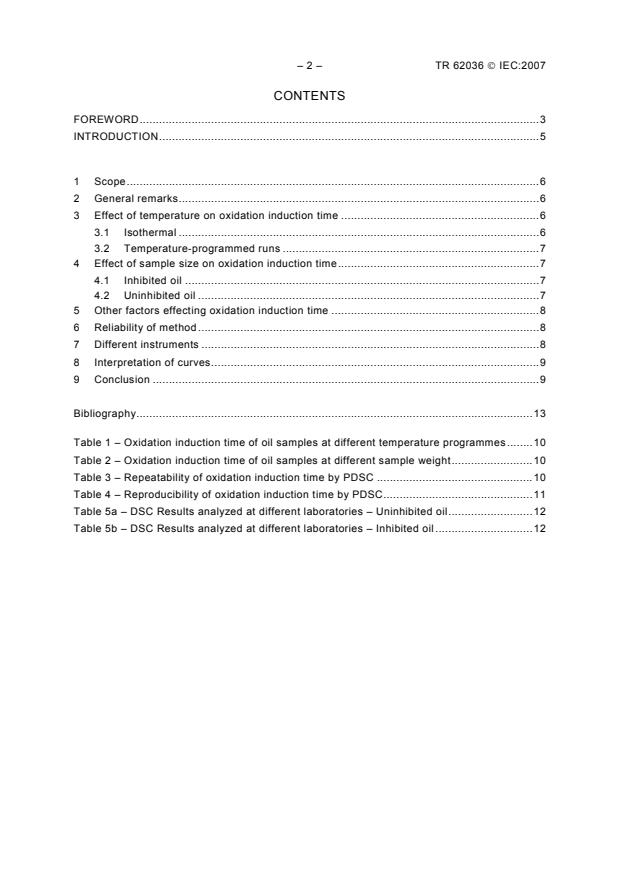
CONTENTS
FOREWORD.3
INTRODUCTION.5
1 Scope.6
2 General remarks.6
3 Effect of temperature on oxidation induction time .6
3.1 Isothermal .6
3.2 Temperature-programmed runs .7
4 Effect of sample size on oxidation induction time.7
4.1 Inhibited oil .7
4.2 Uninhibited oil .7
5 Other factors effecting oxidation induction time .8
6 Reliability of method .8
7 Different instruments .8
8 Interpretation of curves.9
9 Conclusion .9
Bibliography.13
Table 1 – Oxidation induction time of oil samples at different temperature programmes.10
Table 2 – Oxidation induction time of oil samples at different sample weight.10
Table 3 – Repeatability of oxidation induction time by PDSC .10
Table 4 – Reproducibility of oxidation induction time by PDSC.11
Table 5a – DSC Results analyzed at different laboratories – Uninhibited oil.12
Table 5b – DSC Results analyzed at different laboratories – Inhibited oil.12
TR 62036 © IEC:2007 – 3 –
INTERNATIONAL ELECTROTECHNICAL COMMISSION
____________
MINERAL INSULATING OILS –
OXIDATION STABILITY TEST METHOD BASED ON DIFFERENTIAL
SCANNING CALORIMETRY (DSC)
FOREWORD
1) The International Electrotechnical Commission (IEC) is a worldwide organization for standardization comprising
all national electrotechnical committees (IEC National Committees). The object of IEC is to promote
international co-operation on all questions concerning standardization in the electrical and electronic fields. To
this end and in addition to other activities, IEC publishes International Standards, Technical Specifications,
Technical Reports, Publicly Available Specifications (PAS) and Guides (hereafter referred to as “IEC
Publication(s)”). Their preparation is entrusted to technical committees; any IEC National Committee interested
in the subject dealt with may participate in this preparatory work. International, governmental and non-
governmental organizations liaising with the IEC also participate in this preparation. IEC collaborates closely
with the International Organization for Standardization (ISO) in accordance with conditions determined by
agreement between the two organizations.
2) The formal decisions or agreements of IEC on technical matters express, as nearly as possible, an international
consensus of opinion on the relevant subjects since each technical committee has representation from all
interested IEC National Committees.
3) IEC Publications have the form of recommendations for international use and are accepted by IEC National
Committees in that sense. While all reasonable efforts are made to ensure that the technical content of IEC
Publications is accurate, IEC cannot be held responsible for the way in which they are used or for any
misinterpretation by any end user.
4) In order to promote international uniformity, IEC National Committees undertake to apply IEC Publications
transparently to the maximum extent possible in their national and regional publications. Any divergence
between any IEC Publication and the corresponding national or regional publication shall be clearly indicated in
the latter.
5) IEC provides no marking procedure to indicate its approval and cannot be rendered responsible for any
equipment declared to be in conformity with an IEC Publication.
6) All users should ensure that they have the latest edition of this publication.
7) No liability shall attach to IEC or its directors, employees, servants or agents including individual experts and
members of its technical committees and IEC National Committees for any personal injury, property damage or
other damage of any nature whatsoever, whether direct or indirect, or for costs (including legal fees) and
expenses arising out of the publication, use of, or reliance upon, this IEC Publication or any other IEC
Publications.
8) Attention is drawn to the Normative references cited in this publication. Use of the referenced publications is
indispensable for the correct application of this publication.
9) Attention is drawn to the possibility that some of the elements of this IEC Publication may be the subject of
patent rights. IEC shall not be held responsible for identifying any or all such patent rights.
The main task of IEC technical committees is to prepare International Standards. However, a
technical committee may propose the publication of a technical report when it has collected
data of a different kind from that which is normally published as an International Standard, for
example "state of the art".
IEC 62036, which is a technical report, has been prepared by IEC technical committee 10:
Fluids for electrotechnical applications.
– 4 – TR 62036 © IEC:2007
The text of this technical report is based on the following documents:
Enquiry draft Report on voting
10/676/DTR 10/690/RVC
Full information on the voting for the approval of this technical report can be found in the
report on voting indicated in the above table.
This publication has been drafted in accordance with the ISO/IEC Directives, Part 2.
The committee has decided that the contents of this publication will remain unchanged until
the maintenance result date indicated on the IEC web site under "http://webstore.iec.ch" in
the data related to the specific publication. At this date, the publication will be
• reconfirmed,
• withdrawn,
• replaced by a revised edition, or
• amended.
TR 62036 © IEC:2007 – 5 –
INTRODUCTION
The existing methods to assess oxidation stability of mineral insulating oil are very time
consuming. A faster method is necessary for effective quality control and status monitoring.
Differential scanning calorimetry (DSC) as a technique has been used for monitoring grease
and lubricants oxidation stability. The use of DSC for evaluation of oil oxidation stability was
originally suggested to IEC, TC 10 following publication of a literature review of DSC oxidation
tests performed on petroleum products (10/367/INF April 1996). During IEC’s TC 10 meeting
in Geneva, 1998, it was decided to set up a working group for development of a standard
based on DSC for rapid evaluation of mineral insulating oil oxidation stability.
– 6 – TR 62036 © IEC:2007
MINERAL INSULATING OILS –
OXIDATION STABILITY TEST METHOD BASED ON DIFFERENTIAL
SCANNING CALORIMETRY (DSC)
1 Scope
The purpose of IEC 62036, which is a technical report, is to develop a rapid oxidation stability
test method based on differential scanning calorimetry (DSC) to assess the oxidation stability
of mineral insulating oils.
2 General remarks
The main function of insulating oil is insulation and cooling. The expected life span of
transformer oil is 25 to 40 years, largely depending on operating temperature and electrical
load. Specifications are prepared and used to fulfil all criteria required for proper functioning
of the oil in service. Life expectancy from insulating oil has a large economic impact on the
cost of operation of a unit.
The oxidation stability test is an important test as this will evaluate, to some extent, the life of
the oil in service. Resistance of an oil oxidation is very much dependant on the refining
process and type of crude oil. Both under-refined and over-refined oils may exhibit poor
oxidation stability. The complex process of oxidation of in-service oils occurs slowly at the
normal operating temperature of the transformer and is dependant on temperature, oxygen
and catalyst. In the first stage of oil oxidation, radicals and peroxides are produced. These
compounds are unstable and rapidly convert to volatile and soluble acids and finally
producing insoluble material or sludge. All of these products have an adverse effect on
electrical and physical properties of oil. The oil may reach a stage where it is not fit for its
intended purpose.
To establish a long service life for the oil, an oxidation stability test is performed on the
unused oil. There are several standard test methods for evaluation of the oxidation stability of
transformer oil. The recommended international test method is IEC 61125. This test involves
oxidizing the oil at 120 °C for 164 h and then measuring the acidity, sludge and dielectric
dissipation factor (DDF). Other national test methods are based on the same principal and are
time consuming. On delivery, it is required to test the oil for compliance with the specification.
As this test is very time consuming, results are usually retrospective. Clearly, existing methods
are time consuming and not very sensitive. Although there is no direct relation between the oil
oxidation stability test and service life of the oil, oils that are very stable and resist oxidation
are clearly preferred. Therefore, a fast method of determining the oxidation stability is needed
for rapid evaluation of the oil and compliance to the specification.
In order to evaluate high pressure differential scanning calorimetry (PDSC) as a technique for
testing oxidation stability of transformer oil and to establish a suitable method, transformer oil
samples were analysed under varying conditions.
3 Effect of temperature on oxidation induction time
3.1 Isothermal
Six samples of transformer oil (A-F) were analysed using PDSC at different temperature
programmes. Samples B and D were inhibited transformer oil, the remainder were uninhibited
and sample F was a used oil. Oxygen at 300 psi was applied in each case and the sample
weight was kept constant at 4 mg. The results are shown in Table 1. It was found that below
165 °C, no phase transition occurred in any of the six samples. Temperatures higher than
expected, of up to 260 °C were required to give peaks in a reasonable time. At the lower
TR 62036 © IEC:2007 – 7 –
temperature, only sample D gave a peak at around 45 min. When this sample was run at
170 °C, the peak become sharper and clear and occurred at an onset of around 40 min. At
175 °C, the peak occurred at around 30 min and was sharper still. The same trend was
observed in sample B, showing decreasing induction time with increasing temperature, but
oxidation occurred after a slightly longer time. Sample B and D were inhibited oils, which
showed a clear and sharp peak following the rapid oxidation and depletion of the inhibitor.
3.2 Temperature-programmed runs
The uninhibited oils, A, C, E and F showed no clearly defined peak in the thermograms of
isothermal runs. Oxidation did not occur when the samples were run at a heating rate of
50 °C/min or 25 °C/min, or the curves were poorly defined. The samples were then run at a
heating rate of 10 °C/min (TP 2) and more clearly defined exotherms were obtained. As with
the inhibited oil samples, the uninhibited oils showed a broader, shallower peak with
increasing heating rate, but the area under the peak remained the same. As the heating rate
was increased from 2 °C to 5 °C, the oxidation induction time (OIT) decreased, but there was
little change in the OIT between the heating rates of 5 °C and 10 °C. At a heating rate of
10 °C/min, all of the samples showed oxidation induction times between 16 min and 19 min
and therefore could not be distinguished from one another. When the samples were run using
a heating rate of 5 °C/min up to 180 °C, then 2 °C/min up to 210 °C (TP 3), there was a wider
spread in the OITs obtained. This temperature programme was used because it was found
that a slow heating rate was required to give clearly defined peaks for uninhibited oils, and
oxidation usually occurred in the 180 °C – 210 °C range.
Oxidation of the inhibited oils B and D occurred at approximately the same time as it had done
at 10 °C/min, but the uninhibited oils oxidized more rapidly. Samples E and C could not be
distinguished, as they both had 0ITs of around 11 min and samples B and D were also very
similar. The samples overall showed approximately the same ranking with the different
temperature programmes. However, when the samples were run at 2 °C/min up to 180 °C,
then 1 °C/min up to 210 °C (TP 4), the samples could be distinguished by their oxidation
induction times. Again, the ranking was similar as with the other temperature programmes.
This very slow rate of heating also clarified the peak obtained in the thermogram of sample F,
which was a used oil and showed the most broad peak due to the complicated oxidation
process in used oil. The used oil did not, however show the poorest oxidation stability.
4 Effect of sample size on oxidation induction time
Sample B (inhibited oil) and sample A (uninhibited oil) were analyzed by PDSC under 300 psi
of oxygen, as above, using a temperature programme of 130 °C – 180 °C at 2 °C/min, 180 °C
– 210 °C at 1 °C/min. Each sample was analyzed at weights of 1 mg, 4 mg and 10 mg. The
oxidation induction time at the various sample sizes is given in Table 2.
4.1 Inhibited oil
The results showed that oxidation induction time increases with increasing sample size, in
inhibited oil. This may be due to limited oxygen diffusion through the larger samples. The
repeatability between triplicate determinations is good and is unaffected by sample weight.
4.2 Uninhibited oil
With uninhibited oil, however, there is little difference in oxidation induction time with sample
size. The 10 mg sample showed slightly longer oxidation induction time, but this was within
the margin of error for repeatability. Repeatability is also slightly poorer with the larger sample
size and the peak is larger and more spread out, giving poorer resolution. If the sample size is
very large, the accuracy is reduced, because the heat flow may be variable within the sample.
Smaller sample sizes produce smaller peaks, better resolution and better accuracy.
Therefore, the sample size should be as small as possible. A suitable sample size is normally
10 mg to 15 mg, however, much smaller sample sizes should be used with volatile products to
minimize any decontamination of the DSC cell. A sensible sample size of 4 mg was chosen in
this case, so as not to introduce sample handling difficulties.
– 8 – TR 62036 © IEC:2007
5 Other factors effecting oxidation induction time
As well as heating rate and sample size, there are many other factors which may effect the
results, such as purge gas, sample pan type, sample homogenity, particle size (if applicable)
and computational effects. Sample pans used were aluminium, which were found to give
repeatable results. The purge gas used was nitrogen, in a pure, dry form. This is suitable for
temperature ranges between -100 °C and 400 °C. The rate of flow of 30 ml/min was found to
be a little slow, since decomposition products would condense on the DSC cell, so this was
increased to 60 ml/min; however, a flow rate above 60 ml/min produced turbulence and a
noisy baseline. It was also found necessary to use a flow-through cover to allow the removal
of decomposition products from the DSC cell; in addition, it was decided that local exhaust
ventilation was required to remove the vaporized oil from the atmosphere.
6 Reliability of method
The high pressure DSC method for analyzing oxidation stability of transformer oils was found
to show good repeatability between triplicate runs, however, some difficulty was encountered
with the reproducibility of the technique. Results are shown in Table 3.
As can be seen from the results, the repeatability between triplicate determinations is good.
When samples were run on the same day by the same operator, the standard deviation
between OIT determinations was less than 0,5 min for the unused oils and only slightly higher
for the used oil sample.
The results in Table 4 show that repeatability is generally good between samples run on the
same instrument by the same operator but on different days. At TP3 (5 °C/min) this was true
for all the samples except sample F, the used oil, which showed a larger discrepancy. At the
slower temperature programme, this variation was slightly higher, up to 2 min, and 2,5 mins
for the used oil. Isothermal runs of the inhibited samples, B and D showed variation of 0,6 min
and 1,1 min, respectively, between runs on different days, ignoring the results on Day 1. On
this particular day, the results of oxidation induction time were markedly different from the
results on the other two days, and this was counted as an anomaly, which may have been due
to deterioration of the samples themselves, which were left in laboratory light for some time.
There were thought to be numerous reasons for the remaining variation. The main reason
may have been the calculation of oxidation induction time, which was found to account for
variation of up to 2 min. In the Pyris software, tangents to the onset curve and baseline are
drawn with the mouse and extrapolated to the point at which the lines intersect. This depends
on where the tangent to the curve is taken from and any changes in baseline heat flow or in
the shape of the curve may result in a relatively large difference in calculated onset time. This
is exacerbated by noisy baselines, which were common with the technique and may be due to
changes in gas flow rate or pressure, the volatility of the samples, or interference from the
glass woof plugs in the DSC cell cover. Generally, differential scanning calorimetry is a
sensitive technique and variables such as gas flow rate and pressure, equilibration time and
temperature and humidity of the room, should be kept constant.
7 Different instruments
Thirty-one samples of unused insulating oil consisting of 13 inhibited oils and 18 uninhibited
oils were analyzed by PDSC by three different laboratories. Laboratory 1 used Perkin-Elmer
DSC 7. Samples were analyzed at a heating rate of 130 °C to 260 °C at 5 °C/min, under
300 psi of oxygen. The second laboratory used TA Instruments heat flux type. Air was applied
at 300 psi at a flow rate of 60 ml/min and the samples were analyzed from 100 °C to 350 °C at
20 °C/min. The samples were run in duplicate and the mean oxidation onset temperature
calculated. At the third laboratory, samples were analyzed on a TA instrument, at a heating
rate of 2 °C/min from 130 °C to 210 °C for the uninhibited oils and isothermally at 180 °C for
the inhibited oils, under oxygen at 300 psi. Results are shown in Tables 5a and 5b.
TR 62036 © IEC:2007 – 9 –
Results from both Table 5a and 5b clearly indicate that the DSC results obtained at the three
different laboratories show basically the same trend when the samples were analyzed under
different conditions and using different instruments. Better correlation was obtained for
laboratory 1 and 3. This correlation is better for uninhibited oils than for inhibited oils.
8 Interpretation of curves
Characterization of thermal events in the DSC trace is not easy. In many cases it was found
that the particular shape of curves obtained was not reproducible. This may be due to
changes in the sample itself, or operating variables such as heating rate, pan type or
instrument used. For example, all of the thermograms obtained with the TA Instrument
showed multiple peaks, compared to single peaks obtained with the Perkin Elmer instrument,
for the same set of samples. This may have been due to impurities or reaction of different
parts of molecules, but was more likely due to instrumental factors such as degree of thermal
contact. It has so far been assumed that the exothermic peak obtained in the thermograms of
the oils is representative of oxidation. This may not be the case and it may be due to some
other exothermic reaction when the oil is subject to extreme conditions of heat and oxygen.
Generally, melting, crystal transitions, vaporization and sublimation are observed as
endothermic reactions, whereas curing, crystallization and decomposition are exothermic
reactions.
9 Conclusion
High temperature differential scanning calorimetry (PDSC) provides an alternative method
which is fast, simple and reliable. It was found that PDSC could be applied to the oxidation
stability of uninhibited mineral insulating oil by measuring the onset time of the oxidation
exotherm under high pressure and temperature when applying a slow thermal ramp. The
sample size and heating rate effect the onset time and the technique was found to be
sensitive to any change in cooling rate, gas flow rate or calibration variables. The method is
capable of distinguishing inhibited oils from uninhibited oils. Repeatability of method is
acceptable and if care is taken, reproducible results may be obtained and the onset time
found to correlate to the induction period measured in the existing IEC 61125. However, the
relationship between thermal onset time and other physical characteristics of the oil was poor.
The type and manufacture of the DSC equipment has an influence on the results.
– 10 – TR 62036 © IEC:2007
Table 1 – Oxidation induction time of oil samples at different temperature programmes
Temperature Oxidation induction time (OIT) in minutes
program
Sample A Sample B Sample C Sample D Sample E Sample F
TP1 165 °C ND ND ND 46,88 ND ND
TP1 170 °C ND ND ND 41,76 ND ND
TP1 175 °C ND 33,96 ND 30,52 ND ND
TP1 180 °C ND 22,37 ND 21,12 ND ND
TP2 17,78 19,35 16,73 19,03 17,95 17,20
TP3 12,21 19,36 10,78 18,18 14,55 11,17
TP4 23,13 37,06 19,82 33,22 30,15 26,81
TP1 = isothermal at 165 °C, 170 °C, 175 °C and 180 °C
TP2 = 25 °C – 260 °C at 10 °C/min, hold for 10 min at 260 °C
TP3 = 130 °C – 180 °C at 5 °C/min, 180 °C -210 °C at 2 °C/min
TP4 = 130 °C – 180 °C at 2 °C/min, 180 °C -210 °C at 1 °C/min
ND = onset of peak is not clearly detectable in thermogram
OIT is given as an average of triplicate runs.
Table 2 – Oxidation induction time of oil samples at different sample weight
Sample Oxidation induction time (OIT) in minutes
weight
Sample A Sample B
mg
1 24,32 24,11 24,16 30,95 31,58 30,63
4 24,21 24,11 24,12 35,00 35,74 35,07
10 24,18 25,77 26,93 40,61 40,31 40.44
Table 3 – Repeatability of oxidation induction time by PDSC
Oxidation induction time (OIT) in minutes
Sample A Sample B Sample C Sample D Sample E Sample F
Run 1 12,51 19,45 10,76 18,16 14,43 10,72
Run 2 12,44 19,34 10,68 18,24 14,74 11,92
Run 3 11,67 19,29 10,89 18,14 14,49 10,86
Average 12,21 19,36 10,78 18,18 14,55 11,17
Standard deviation 0,5 0,1 0,1 <0,1 0,2 0,7
TR 62036 © IEC:2007 – 11 –
Table 4 – Reproducibility of oxidation induction time by PDSC
Temperature Oxidation induction time (OIT) in minutes
programme
Sample A Sample B Sample C Sample D Sample E SampleF
Day 1 / TP3 12,21 19,36 10,78 18,18 14,55 11,17
Day 2 / TP3 12,10 19,66 9,89 18,31 14,26 14,82
Average 12,16 19,51 10,34 18,25 14,41 13,00
Standard deviation <0,1 0,2 0,6 0,1 0,2 2,6
Day 1 / TP4 23,13 37,06 19,82 33,22 30,15 26,81
Day 2 / TP4 24,15 35,27 20,67 32,88 27,63 23,21
Average 23,64 36,17 20,25 33,05 28,89 25,01
Standard deviation 0,7 1,3 0,6 0,2 1,8 2,5
Day 1 / TP1 (175 °C) ND 14,82 ND 6,66 ND ND
Day 2 / TP1 (175 °C) ND 33,15 ND 30,52 ND ND
Day 3 / TP1 (175 °C) __ 33,96 __ 28,99 __ __
Average __ 33.56 __ 29.76 __ __
Standard deviation __ 0.6 __ 1.1 __ __
– 12 – TR 62036 © IEC:2007
Table 5a – DSC Results analyzed at different laboratories – Uninhibited oil
Sample reference OIT, min. Lab 1 OIT, min. Lab 2 OIT, min. Lab3
9503.023U 12,53 219,3 31,92
9503.476U 12,55 210,7 33,65
9503.479U 14,53 218,3 37,39
9503.484U 11,02 203,5 29,13
9503.491U 12,28 205,4 33,29
9504.121U 11,34 204,7 29,80
9504.123U 13,88 229,6 36,06
9504.133U 10,25 204,5 28,09
9505.081U 12,84 212,0 35,87
9505.082U 15,44 233,4 38,55
9505.170U 14,50 284,7 41,60
9505.182U 12,70 210,5 33,97
9505.304U 13,66 216,2 36,98
9505.305U 11,01 202,7 29,50
9505.306U 11,98 208,9 32,05
9506.115U 11,46 208,3 30,30
9511.122U 10,13 205,3 26,85
9511.125U 10,68 213,1 26,40
Table 5b – DSC Results analyzed at different laboratories – Inhibited oil
Sample reference OIT, min. Lab1 OIT, min. Lab2 OIT, min. Lab3
9503.4891 15,10 231,8 21,27
9504.1201 15,39 229,7 25,86
9504.1241 14,82 230,3 20,03
9505.0801 15,92 225,8 40,99
9505.0841 15,49 236,8 22,22
9505.3071 14,75 232,5 20,56
9505.3091 14,85 232,5 16,63
9507.1811 14,27 229,9 17,80
9510.2031 15,61 228,6 37,36
9511.1241 14,83 232,5 22,32
TR 62036 © IEC:2007 – 13 –
Bibliography
IEC 61165:1992, Unused hydrocarbon-based insulating liquids – Test methods for evaluating
the oxidation stability
___________
– 14 – TR 62036 © CEI:2007
SOMMAIRE
AVANT-PROPOS.15
INTRODUCTION.17
1 Domaine d’application .18
2 Remarques générales .18
3 Effet de la température sur le temps d’induction de l’oxydation.19
3.1 Isothermique .
...