

IEC 60107-3:1988/AMD1:1999
(Amendment)Amendment 1 - Recommended methods of measurement on receivers for television broadcast transmissions. Part 3: Electrical measurements on multichannel sound television receivers using subcarrier systems
General Information
- Abstract
- Status
- Published
- Publication Date
- 04-Feb-1999
- Technical Committee
- TC 100 - Audio, video and multimedia systems and equipment
- Current Stage
- PPUB - Publication issued
- Start Date
- 05-Feb-1999
- Completion Date
- 31-Mar-1999
Buy Documents
IEC 60107-3:1988/AMD1:1999 - Amendment 1 - Recommended methods of measurement on receivers for television broadcast transmissions. Part 3: Electrical measurements on multichannel sound television receivers using subcarrier systems
Overview
IEC 60107-3:1988/AMD1:1999 is an important international amendment to the IEC 60107 series, focusing on recommended methods of measurement on receivers for television broadcast transmissions. This amendment specifically addresses electrical measurements on multichannel sound television receivers that employ subcarrier systems. Developed by IEC Technical Committee 100 subcommittee 100A, which specializes in multimedia end-user equipment, this standard update reflects modernized measurement practices to support the evolving landscape of television broadcasting technologies.
The amendment revises various parts of the original 1988 standard, aligning terminology, references, and technical procedures with recent editions and related ITU-R recommendations. It offers clear guidance to ensure consistency, accuracy, and interoperability in testing multichannel TV sound receivers worldwide.
Key Topics
Standardized Measurement Methods
Provides refined measurement procedures for evaluating electrical parameters of multichannel sound TV receivers using subcarrier sound systems, essential for ensuring performance reliability.Reference Output Levels
Introduces a revised approach to standard output power and standard line output voltage:- Output power for loudspeakers set 10 dB below rated output power or at preferred nominal values (500 mW, 50 mW, 5 mW).
- Standard line output voltage fixed at 500 mV RMS at 1 kHz for typical impedance loads.
Updated Terminology and References
Modernizes language by replacing outdated IEC publication numbers with current ones (e.g., IEC 60107-1:1997, IEC 60107-2:1997, IEC 60315-4:1997) and updates references from CCIR to ITU-R reports and recommendations, such as:- CCIR Report 795 → ITU-R Report BS.795-3
- CCIR Recommendations 468, 559 → ITU-R Recommendations BS.468-4, BS.559-2
Measurement of Audio Noise and Distortion
Details refined procedures for assessing audio noise, interference, and distortion under weighted and unweighted conditions to ensure accurate characterization of receiver sound quality.Receiver Tuning and Signal Handling
Aligns tuning methods and radio-frequency signal measurement processes with contemporary IEC and ITU-R standards for consistency across testing platforms.
Applications
Broadcast Engineering and Compliance Testing
Enables manufacturers and testing laboratories to reliably measure and verify the electrical performance of multichannel sound television receivers according to international best practices.Quality Assurance for TV Receivers
Assists product development teams in benchmarking audio output power, noise levels, and signal fidelity to meet regulatory and consumer safety standards.Standardization of Multimedia Equipment
Supports global harmonization in testing methodologies for multimedia and broadcast consumer electronics, facilitating seamless compatibility across regions.Regulatory Certification
Provides a framework referenced by certification bodies for approval of new television receiver models using subcarrier sound systems.
Related Standards
- IEC 60107-1:1997 – Methods of measurement on receivers for television broadcast transmissions – General considerations, including radiofrequency and video frequency measurements.
- IEC 60107-2:1997 – Methods of measurement on receivers for television broadcast transmissions – Audio channel methods, including monophonic channel measurements.
- IEC 60315-4:1997 – Methods for measuring radio receivers for FM sound broadcasting emissions.
- ITU-R Reports and Recommendations – Such as BS.795-3 (receiver performance), BS.468-4 (audio noise measurement), BS.559-2 (coloured noise), and BT.470-5 (television signal parameters).
This amendment is critical for stakeholders involved in the design, testing, and certification of modern multichannel sound television receivers. Adhering to IEC 60107-3 Amendment 1 ensures measurement accuracy and interoperability in the evolving broadcast environment, supporting high-quality audio-visual experiences for end users worldwide.
Relations
- Effective Date
- 05-Sep-2023
Buy Documents
IEC 60107-3:1988/AMD1:1999 - Amendment 1 - Recommended methods of measurement on receivers for television broadcast transmissions. Part 3: Electrical measurements on multichannel sound television receivers using subcarrier systems
Get Certified
Connect with accredited certification bodies for this standard

ANCE
Mexican certification and testing association.

Intertek Slovenia
Intertek testing, inspection, and certification services in Slovenia.

LNE (Laboratoire National de Métrologie et d'Essais)
French national laboratory for metrology and testing.
Sponsored listings
Frequently Asked Questions
IEC 60107-3:1988/AMD1:1999 is a standard published by the International Electrotechnical Commission (IEC). Its full title is "Amendment 1 - Recommended methods of measurement on receivers for television broadcast transmissions. Part 3: Electrical measurements on multichannel sound television receivers using subcarrier systems". This standard covers: Amendment 1 - Recommended methods of measurement on receivers for television broadcast transmissions. Part 3: Electrical measurements on multichannel sound television receivers using subcarrier systems
Amendment 1 - Recommended methods of measurement on receivers for television broadcast transmissions. Part 3: Electrical measurements on multichannel sound television receivers using subcarrier systems
IEC 60107-3:1988/AMD1:1999 is classified under the following ICS (International Classification for Standards) categories: 33.160.20 - Radio receivers. The ICS classification helps identify the subject area and facilitates finding related standards.
IEC 60107-3:1988/AMD1:1999 has the following relationships with other standards: It is inter standard links to IEC 60107-3:1988. Understanding these relationships helps ensure you are using the most current and applicable version of the standard.
IEC 60107-3:1988/AMD1:1999 is available in PDF format for immediate download after purchase. The document can be added to your cart and obtained through the secure checkout process. Digital delivery ensures instant access to the complete standard document.
Standards Content (Sample)
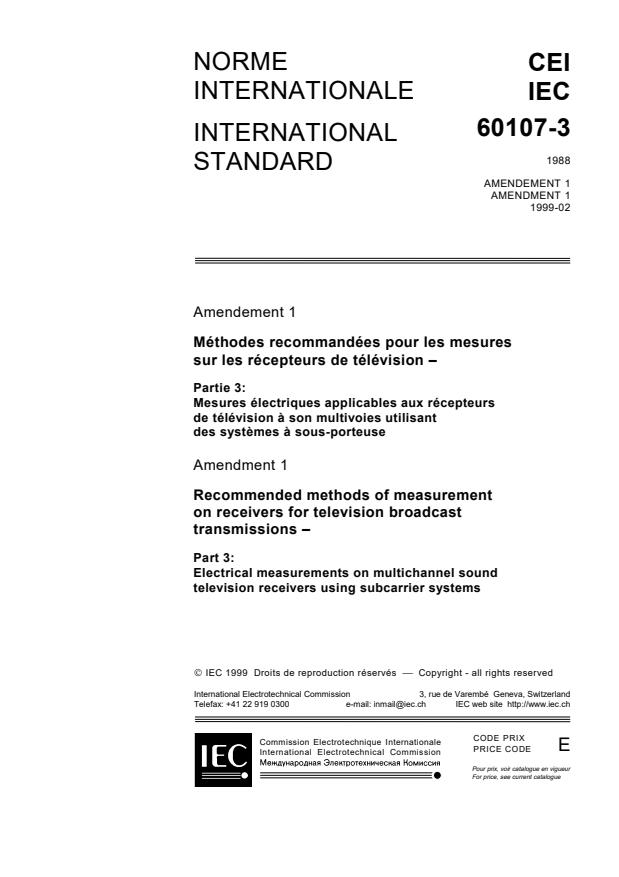
NORME
CEI
INTERNATIONALE
IEC
60107-3
INTERNATIONAL
STANDARD
AMENDEMENT 1
AMENDMENT 1
1999-02
Amendement 1
Méthodes recommandées pour les mesures
sur les récepteurs de télévision –
Partie 3:
Mesures électriques applicables aux récepteurs
de télévision à son multivoies utilisant
des systèmes à sous-porteuse
Amendment 1
Recommended methods of measurement
on receivers for television broadcast
transmissions –
Part 3:
Electrical measurements on multichannel sound
television receivers using subcarrier systems
IEC 1999 Droits de reproduction réservés Copyright - all rights reserved
International Electrotechnical Commission 3, rue de Varembé Geneva, Switzerland
Telefax: +41 22 919 0300 e-mail: inmail@iec.ch IEC web site http://www.iec.ch
CODE PRIX
Commission Electrotechnique Internationale
E
PRICE CODE
International Electrotechnical Commission
Pour prix, voir catalogue en vigueur
For price, see current catalogue
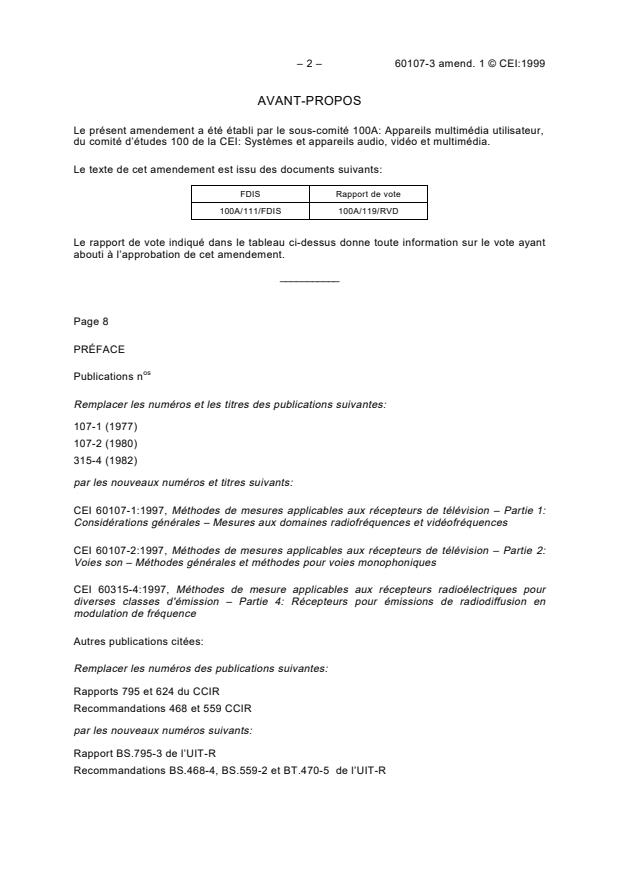
– 2 – 60107-3 amend. 1 © CEI:1999
AVANT-PROPOS
Le présent amendement a été établi par le sous-comité 100A: Appareils multimédia utilisateur,
du comité d’études 100 de la CEI: Systèmes et appareils audio, vidéo et multimédia.
Le texte de cet amendement est issu des documents suivants:
FDIS Rapport de vote
100A/111/FDIS 100A/119/RVD
Le rapport de vote indiqué dans le tableau ci-dessus donne toute information sur le vote ayant
abouti à l’approbation de cet amendement.
___________
Page 8
PRÉFACE
os
Publications n
Remplacer les numéros et les titres des publications suivantes:
107-1 (1977)
107-2 (1980)
315-4 (1982)
par les nouveaux numéros et titres suivants:
CEI 60107-1:1997, Méthodes de mesures applicables aux récepteurs de télévision – Partie 1:
Considérations générales – Mesures aux domaines radiofréquences et vidéofréquences
CEI 60107-2:1997, Méthodes de mesures applicables aux récepteurs de télévision – Partie 2:
Voies son – Méthodes générales et méthodes pour voies monophoniques
CEI 60315-4:1997, Méthodes de mesure applicables aux récepteurs radioélectriques pour
diverses classes d'émission – Partie 4: Récepteurs pour émissions de radiodiffusion en
modulation de fréquence
Autres publications citées:
Remplacer les numéros des publications suivantes:
Rapports 795 et 624 du CCIR
Recommandations 468 et 559 CCIR
par les nouveaux numéros suivants:
Rapport BS.795-3 de l’UIT-R
Recommandations BS.468-4, BS.559-2 et BT.470-5 de l’UIT-R
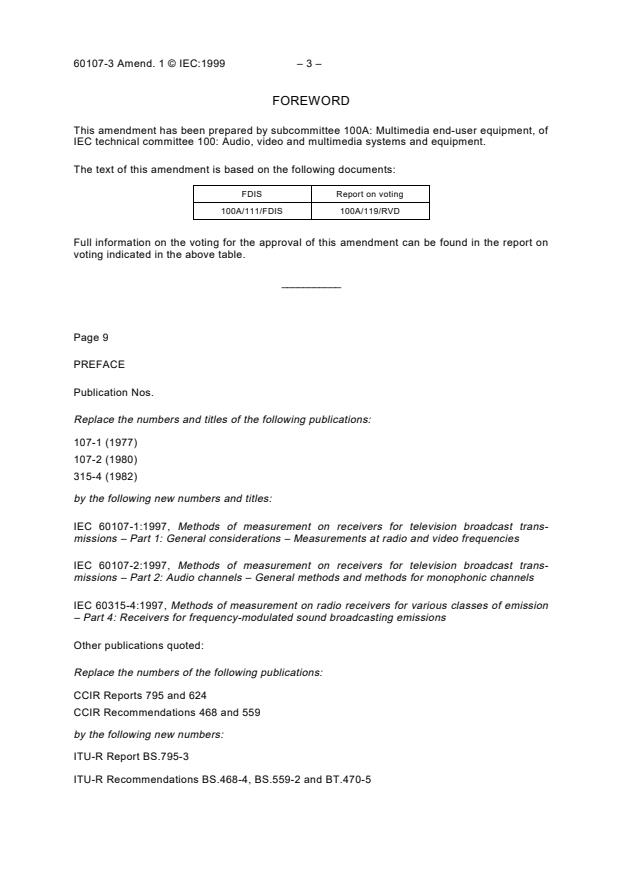
60107-3 Amend. 1 © IEC:1999 – 3 –
FOREWORD
This amendment has been prepared by subcommittee 100A: Multimedia end-user equipment, of
IEC technical committee 100: Audio, video and multimedia systems and equipment.
The text of this amendment is based on the following documents:
FDIS Report on voting
100A/111/FDIS 100A/119/RVD
Full information on the voting for the approval of this amendment can be found in the report on
voting indicated in the above table.
___________
Page 9
PREFACE
Publication Nos.
Replace the numbers and titles of the following publications:
107-1 (1977)
107-2 (1980)
315-4 (1982)
by the following new numbers and titles:
IEC 60107-1:1997, Methods of measurement on receivers for television broadcast trans-
missions – Part 1: General considerations – Measurements at radio and video frequencies
IEC 60107-2:1997, Methods of measurement on receivers for television broadcast trans-
missions – Part 2: Audio channels – General methods and methods for monophonic channels
IEC 60315-4:1997, Methods of measurement on radio receivers for various classes of emission
– Part 4: Receivers for frequency-modulated sound broadcasting emissions
Other publications quoted:
Replace the numbers of the following publications:
CCIR Reports 795 and 624
CCIR Recommendations 468 and 559
by the following new numbers:
ITU-R Report BS.795-3
ITU-R Recommendations BS.468-4, BS.559-2 and BT.470-5
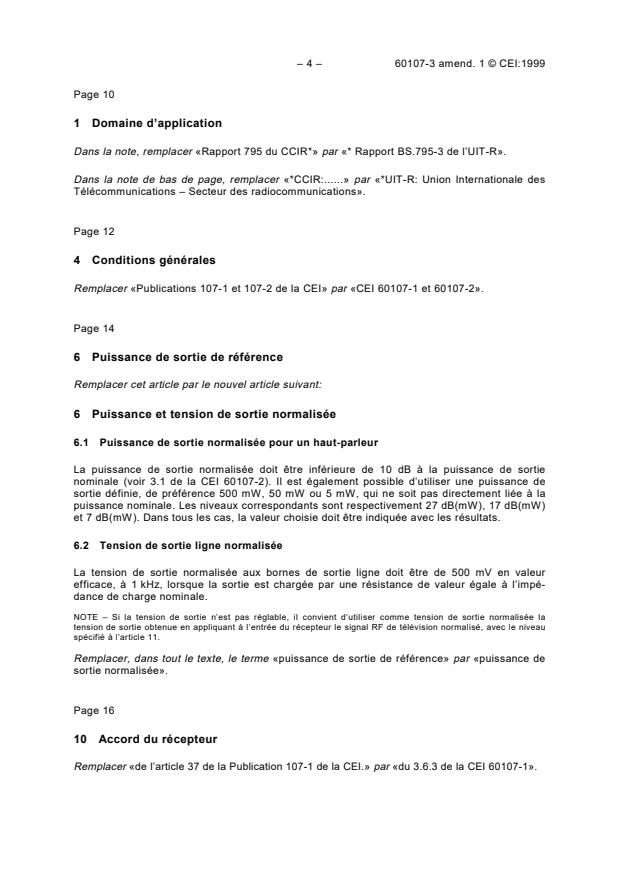
– 4 – 60107-3 amend. 1 © CEI:1999
Page 10
1 Domaine d’application
Dans la note, remplacer «Rapport 795 du CCIR*» par «* Rapport BS.795-3 de l’UIT-R».
Dans la note de bas de page, remplacer «*CCIR:.» par «*UIT-R: Union Internationale des
Télécommunications – Secteur des radiocommunications».
Page 12
4 Conditions générales
Remplacer «Publications 107-1 et 107-2 de la CEI» par «CEI 60107-1 et 60107-2».
Page 14
6 Puissance de sortie de référence
Remplacer cet article par le nouvel article suivant:
6 Puissance et tension de sortie normalisée
6.1 Puissance de sortie normalisée pour un haut-parleur
La puissance de sortie normalisée doit être inférieure de 10 dB à la puissance de sortie
nominale (voir 3.1 de la CEI 60107-2). Il est également possible d’utiliser une puissance de
sortie définie, de préférence 500 mW, 50 mW ou 5 mW, qui ne soit pas directement liée à la
puissance nominale. Les niveaux correspondants sont respectivement 27 dB(mW), 17 dB(mW)
et 7 dB(mW). Dans tous les cas, la valeur choisie doit être indiquée avec les résultats.
6.2 Tension de sortie ligne normalisée
La tension de sortie normalisée aux bornes de sortie ligne doit être de 500 mV en valeur
efficace, à 1 kHz, lorsque la sortie est chargée par une résistance de valeur égale à l’impé-
dance de charge nominale.
NOTE – Si la tension de sortie n’est pas réglable, il convient d’utiliser comme tension de sortie normalisée la
tension de sortie obtenue en appliquant à l’entrée du récepteur le signal RF de télévision normalisé, avec le niveau
spécifié à l’article 11.
Remplacer, dans tout le texte, le terme «puissance de sortie de référence» par «puissance de
sortie normalisée».
Page 16
10 Accord du récepteur
Remplacer «de l’article 37 de la Publication 107-1 de la CEI.» par «du 3.6.3 de la CEI 60107-1».
60107-3 Amend. 1 © IEC:1
...