

IEC 61285:2004
(Main)Industrial-process control - Safety of analyser houses
General Information
- Abstract
describes the physical requirements for the safe operation of the process analyser measuring system installed in an AH in order to ensure its protection against fire, explosion and health hazards. This standard extends beyond IEC 60079-16 to include houses with Zone 2 interiors and to apply to toxic hazards. (Appropriate national guidelines on toxic hazards are to be followed.)
- Status
- Published
- Publication Date
- 11-Oct-2004
- Technical Committee
- SC 65B - Measurement and control devices
- Current Stage
- DELPUB - Deleted Publication
- Start Date
- 24-Feb-2015
- Completion Date
- 28-Aug-2026
Overview
IEC 61285:2004 - Industrial-process control: Safety of analyser houses sets minimum physical safety requirements for buildings, rooms, cabinets or shelters that house process analysers (referred to as analyser houses, AHs). The standard aims to protect analysers and personnel from fire, explosion and health hazards, and it explicitly extends beyond IEC 60079-16 by addressing Zone 2 interiors and toxic inhalation hazards (while noting that appropriate national toxic-hazard guidelines must be followed).
Key topics and requirements
- Scope and definitions: Covers AHs, analyser cabinets/shelters, sample conditioning rooms (SCR), toxic materials, LEL (lower explosive limit), hazardous areas (Zones 0, 1, 2).
- Location and connections (Clause 4): Guidance on siting AHs within a plant, utilities, response time, safety and access considerations.
- Design, construction and layout (Clause 5): Structural requirements, dimensions, equipment arrangement, labelling, documentation and modular arrangements to support maintenance and safety.
- Explosion protection (Clause 6): Measures to reduce explosion risk while permitting maintenance with power on, including both artificial (mechanical) ventilation and natural ventilation strategies.
- Health hazard controls (Clause 7): Measures to prevent personnel exposure to toxic atmospheres inside AHs, including safety procedures, additional measures for abnormal conditions, and external hazard mitigation.
- Supporting material: Annex A (normative) evaluates leakage risk of modules; Annex B (informative) provides ventilation calculation guidance (assumes STP conditions).
Practical applications
IEC 61285 is used to design, operate and maintain analyser houses that support continuous process measurement and control. Typical practical uses include:
- Ensuring safe installation of analyser systems used for environmental monitoring, personnel protection, equipment protection, quality control, process optimization, and energy conservation.
- Selecting AH location and ventilation strategy to prevent hazardous atmospheres (below LEL and toxic exposure limits).
- Defining labelling, documentation and maintenance access rules so technicians can safely service analysers (including risk mitigation when working with Zone 2 interiors).
- Performing leakage risk assessments for modular analyser components and sizing ventilation per Annex B guidance.
Who should use this standard
- Process safety and instrumentation engineers
- Plant designers and facility managers
- Health, safety & environmental (HSE) professionals
- Maintenance teams and operations personnel
- Certification bodies and compliance auditors
Related standards
- IEC 60079-16 - Electrical apparatus for explosive gas atmospheres (artificial ventilation for analyser houses). IEC 61285 extends and complements this standard, particularly for Zone 2 interiors and toxic hazards.
Keywords: IEC 61285, analyser houses safety, explosion protection, toxic hazards, Zone 2, analyser ventilation, hazardous area, LEL, industrial-process control.
Relations
- Effective Date
- 05-Sep-2023
- Effective Date
- 05-Sep-2023
Get Certified
Connect with accredited certification bodies for this standard

DVS-ZERT GmbH
German welding certification society.
CARES (UK Certification Authority for Reinforcing Steels)
UK certification for reinforcing steels and construction.
CIS Institut d.o.o.
Personal Protective Equipment (PPE) certification body. Notified Body NB-2890 for EU Regulation 2016/425 PPE.
Sponsored listings
Frequently Asked Questions
IEC 61285:2004 is a standard published by the International Electrotechnical Commission (IEC). Its full title is "Industrial-process control - Safety of analyser houses". This standard covers: describes the physical requirements for the safe operation of the process analyser measuring system installed in an AH in order to ensure its protection against fire, explosion and health hazards. This standard extends beyond IEC 60079-16 to include houses with Zone 2 interiors and to apply to toxic hazards. (Appropriate national guidelines on toxic hazards are to be followed.)
describes the physical requirements for the safe operation of the process analyser measuring system installed in an AH in order to ensure its protection against fire, explosion and health hazards. This standard extends beyond IEC 60079-16 to include houses with Zone 2 interiors and to apply to toxic hazards. (Appropriate national guidelines on toxic hazards are to be followed.)
IEC 61285:2004 is classified under the following ICS (International Classification for Standards) categories: 13.110 - Safety of machinery; 25.040.40 - Industrial process measurement and control. The ICS classification helps identify the subject area and facilitates finding related standards.
IEC 61285:2004 has the following relationships with other standards: It is inter standard links to IEC 61285:2015, IEC 61285:1994. Understanding these relationships helps ensure you are using the most current and applicable version of the standard.
IEC 61285:2004 is available in PDF format for immediate download after purchase. The document can be added to your cart and obtained through the secure checkout process. Digital delivery ensures instant access to the complete standard document.
Standards Content (Sample)
INTERNATIONAL IEC
STANDARD 61285
Second edition
2004-10
Industrial-process control –
Safety of analyser houses
Reference number
Publication numbering
As from 1 January 1997 all IEC publications are issued with a designation in the
60000 series. For example, IEC 34-1 is now referred to as IEC 60034-1.
Consolidated editions
The IEC is now publishing consolidated versions of its publications. For example,
edition numbers 1.0, 1.1 and 1.2 refer, respectively, to the base publication, the
base publication incorporating amendment 1 and the base publication incorporating
amendments 1 and 2.
Further information on IEC publications
The technical content of IEC publications is kept under constant review by the IEC,
thus ensuring that the content reflects current technology. Information relating to
this publication, including its validity, is available in the IEC Catalogue of
publications (see below) in addition to new editions, amendments and corrigenda.
Information on the subjects under consideration and work in progress undertaken
by the technical committee which has prepared this publication, as well as the list
of publications issued, is also available from the following:
• IEC Web Site (www.iec.ch)
• Catalogue of IEC publications
The on-line catalogue on the IEC web site (www.iec.ch/searchpub) enables you to
search by a variety of criteria including text searches, technical committees
and date of publication. On-line information is also available on recently issued
publications, withdrawn and replaced publications, as well as corrigenda.
• IEC Just Published
This summary of recently issued publications (www.iec.ch/online_news/ justpub)
is also available by email. Please contact the Customer Service Centre (see
below) for further information.
• Customer Service Centre
If you have any questions regarding this publication or need further assistance,
please contact the Customer Service Centre:
Email: custserv@iec.ch
Tel: +41 22 919 02 11
Fax: +41 22 919 03 00
INTERNATIONAL IEC
STANDARD 61285
Second edition
2004-10
Industrial-process control –
Safety of analyser houses
IEC 2004 Copyright - all rights reserved
No part of this publication may be reproduced or utilized in any form or by any means, electronic or
mechanical, including photocopying and microfilm, without permission in writing from the publisher.
International Electrotechnical Commission, 3, rue de Varembé, PO Box 131, CH-1211 Geneva 20, Switzerland
Telephone: +41 22 919 02 11 Telefax: +41 22 919 03 00 E-mail: inmail@iec.ch Web: www.iec.ch
PRICE CODE
Commission Electrotechnique Internationale U
International Electrotechnical Commission
МеждународнаяЭлектротехническаяКомиссия
For price, see current catalogue
– 2 – 61285 © IEC:2004(E)
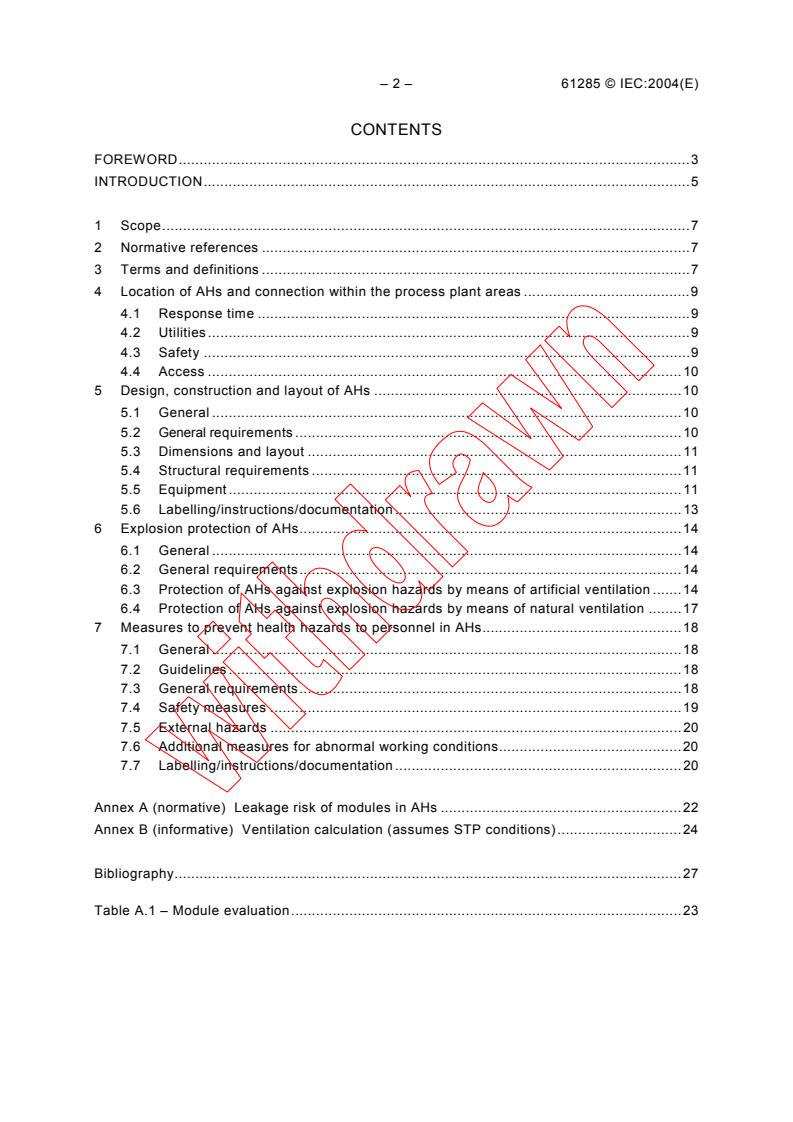
CONTENTS
FOREWORD.3
INTRODUCTION.5
1 Scope.7
2 Normative references .7
3 Terms and definitions .7
4 Location of AHs and connection within the process plant areas .9
4.1 Response time .9
4.2 Utilities.9
4.3 Safety .9
4.4 Access .10
5 Design, construction and layout of AHs .10
5.1 General .10
5.2 General requirements .10
5.3 Dimensions and layout .11
5.4 Structural requirements .11
5.5 Equipment.11
5.6 Labelling/instructions/documentation.13
6 Explosion protection of AHs.14
6.1 General .14
6.2 General requirements.14
6.3 Protection of AHs against explosion hazards by means of artificial ventilation .14
6.4 Protection of AHs against explosion hazards by means of natural ventilation .17
7 Measures to prevent health hazards to personnel in AHs.18
7.1 General .18
7.2 Guidelines .18
7.3 General requirements.18
7.4 Safety measures .19
7.5 External hazards .20
7.6 Additional measures for abnormal working conditions.20
7.7 Labelling/instructions/documentation.20
Annex A (normative) Leakage risk of modules in AHs .22
Annex B (informative) Ventilation calculation (assumes STP conditions).24
Bibliography.27
Table A.1 – Module evaluation.23
61285 © IEC:2004(E) – 3 –
INTERNATIONAL ELECTROTECHNICAL COMMISSION
____________
INDUSTRIAL-PROCESS CONTROL –
SAFETY OF ANALYSER HOUSES
FOREWORD
1) The International Electrotechnical Commission (IEC) is a worldwide organization for standardization comprising
all national electrotechnical committees (IEC National Committees). The object of IEC is to promote
international co-operation on all questions concerning standardization in the electrical and electronic fields. To
this end and in addition to other activities, IEC publishes International Standards, Technical Specifications,
Technical Reports, Publicly Available Specifications (PAS) and Guides (hereafter referred to as “IEC
Publication(s)”). Their preparation is entrusted to technical committees; any IEC National Committee interested
in the subject dealt with may participate in this preparatory work. International, governmental and non-
governmental organizations liaising with the IEC also participate in this preparation. IEC collaborates closely
with the International Organization for Standardization (ISO) in accordance with conditions determined by
agreement between the two organizations.
2) The formal decisions or agreements of IEC on technical matters express, as nearly as possible, an international
consensus of opinion on the relevant subjects since each technical committee has representation from all
interested IEC National Committees.
3) IEC Publications have the form of recommendations for international use and are accepted by IEC National
Committees in that sense. While all reasonable efforts are made to ensure that the technical content of IEC
Publications is accurate, IEC cannot be held responsible for the way in which they are used or for any
misinterpretation by any end user.
4) In order to promote international uniformity, IEC National Committees undertake to apply IEC Publications
transparently to the maximum extent possible in their national and regional publications. Any divergence
between any IEC Publication and the corresponding national or regional publication shall be clearly indicated in
the latter.
5) IEC provides no marking procedure to indicate its approval and cannot be rendered responsible for any
equipment declared to be in conformity with an IEC Publication.
6) All users should ensure that they have the latest edition of this publication.
7) No liability shall attach to IEC or its directors, employees, servants or agents including individual experts and
members of its technical committees and IEC National Committees for any personal injury, property damage or
other damage of any nature whatsoever, whether direct or indirect, or for costs (including legal fees) and
expenses arising out of the publication, use of, or reliance upon, this IEC Publication or any other IEC
Publications.
8) Attention is drawn to the Normative references cited in this publication. Use of the referenced publications is
indispensable for the correct application of this publication.
9) Attention is drawn to the possibility that some of the elements of this IEC Publication may be the subject of
patent rights. IEC shall not be held responsible for identifying any or all such patent rights.
International Standard IEC 61285 has been prepared by subcommittee 65D: Analysing
equipment, of IEC technical committee 65: Industrial-process measurement and control.
This second edition cancels and replaces the first edition published in 1994. This edition
constitutes a technical revision.
The main changes with respect to the previous edition are listed below:
a) incorporation of previously issued corrigendum;
b) minor updates to several sections and references
The text of this standard is based on the following documents:
FDIS Report on voting
65D/107/FDIS 65D/110/RVD
Full information on the voting for the approval of this standard can be found in the report on
voting indicated in the above table.
– 4 – 61285 © IEC:2004(E)
This publication has been drafted in accordance with the ISO/IEC Directives, Part 2.
The committee has decided that the contents of this publication will remain unchanged until
the maintenance result date indicated on the IEC web site under "http://webstore.iec.ch" in
the data related to the specific publication. At this date, the publication will be
• reconfirmed;
• withdrawn;
• replaced by a revised edition, or
• amended.
61285 © IEC:2004(E) – 5 –
INTRODUCTION
Process analysers measure the characteristics of a process stream continuously and
automatically. The process sample is introduced automatically and the system is designed for
unattended operation and minimal maintenance.
This document is designed to set forth minimum safety requirements for typical analyser
houses (AHs). It shall be superseded in all cases by national, local, or corporate
requirements, which may be more stringent.
The measured output is transmitted continuously for process control, operator action or
documentation. Process analysers are used for
– environmental analysis;
– personnel protection;
– equipment protection;
– quality measurement/control;
– process control (plant optimization);
– energy conservation.
In the simplest case, the analyser sensor is mounted directly in the material to be measured,
and there is no need to extract a sample. In other cases, a sample is extracted from the main
stream and transported to the analyser. The system may include many functional elements
such as
– sample extraction;
– sample transport;
– sample conditioning;
– sample stream disposal and/or return to process;
– utilities and auxiliary materials supply;
– stream switching;
– automatic or manual calibration and validation system;
– signal processing;
– performance monitoring and control.
(See IEC 61115.)
Analyser elements can be arranged modularly and located separately. There are advantages
in grouping analysers and systems and further advantages in enclosing them. Advantages
include
– lower cost of installation of utilities and signals;
protection of personnel and complex modules and equipment from adverse ambient
conditions;
ease of maintenance;
safety.
Analysers are constructed to various standards: some are ex-proof, some intrinsically safe,
some suitable for Zone 2 and some suitable only for a non-hazardous area. Not all analysers
are available in all variants.
Process plants usually include all zones 0, 1, 2 and non-hazardous.
– 6 – 61285 © IEC:2004(E)
The selection of the AH location, the source of ventilation air, and the classification of the
house interior and its analysers is an economic exercise.
Factors include the distance from the sample point to the AH , classification of the area
around the AH, distance from the AH to the source of non-hazardous air, and the cost of
analysers of classification appropriate to the house interior.
61285 © IEC:2004(E) – 7 –
INDUSTRIAL-PROCESS CONTROL –
SAFETY OF ANALYSER HOUSES
1 Scope
This International Standard describes the physical requirements for the safe operation of the
process analyser measuring system installed in an AH in order to ensure its protection against
fire, explosion and health hazards. This standard extends beyond IEC 60079-16 to include
houses with Zone 2 interiors and to apply to toxic hazards. (Appropriate national guidelines on
toxic hazards are to be followed.)
This standard does not address facilities where dust is the hazard.
Clause 4 addresses the location of the AH and connection within the process plant areas.
Clause 5 addresses the design, construction and layout of the AH. It does not address parts
of the analyser measuring system installed in other locations such as sample conditioning
rooms (SCR) or switchgear rooms.
Clause 6 addresses measures for reducing the danger of explosion for AHs while permitting
maintenance of equipment with the power on and the case open.
NOTE For most fluids, the major constraint is that the concentration of vapours, which are hazardous for
personnel, is lower than the lower explosive (flammable) limit (LEL) (see Clause 7).
–6
Using n-Pentane as an example, the LEL is 1,4 % or 14 000 × 10 . The level immediately
dangerous to life or health (which is the maximum level from which a worker could escape
within 30 min without any escape-impairing symptoms or any irreversible health effects) is
–
only 0,5 % or 5 000 × 10 .
Classification of a house interior as Zone 1 may imply that no technician can enter without
protective equipment such as breathing gear. Placing an AH in a Zone 1 area would usually
imply that no technician could approach the house without wearing protective equipment.
Clause 7 addresses those measures for protecting personnel from materials in the
atmosphere of AHs that are hazardous to health.
2 Normative references
The following referenced documents are indispensable for the application of this document.
For dated references, only the edition cited applies. For undated references, the latest edition
of the referenced document (including any amendments) applies.
IEC 60079-16:1990, Electrical apparatus for explosive gas atmospheres – Part 16: Artificial
ventilation for the protection of analyser(s) houses
3 Terms and definitions
For the purposes of this document, the following terms and definitions apply.
– 8 – 61285 © IEC:2004(E)
3.1
analyser cabinet
small housing in which analysers are installed individually or grouped together. Maintenance
is performed from outside the cabinet with the door(s) open
3.2
analyser shelter
structure with one or more sides open and free from obstruction to the natural passage of air,
in which one or more analysers are installed. The maintenance of the analysers is normally
performed in the protection of the shelter
3.3
analyser house (AH)
enclosed building or part of a building containing process analysers and associated
equipment where streams for analysis are brought in and which is regularly entered by
authorized personnel
NOTE Within the scope of this standard, the term AH is used regardless of the structure configuration as either a
room, cabinet or building and whether or not it is an integral part of, or attached to, another structure.
3.4
sample conditioning room
SCR
room that is separated from the AH and has modules for sample conditioning, auxiliary
material, or sample disposal equipment.
3.5
toxic material
material that is a health hazard by inhalation from the surrounding atmosphere. Atmospheric
routes such as skin absorption or ingestion are not addressed
3.6
safety back-up
additional personnel, in constant contact with a person or persons in dangerous working
conditions, who could assist or get additional help
3.7
external and internal hazards
distinction is made between "external" and "internal" explosion hazards. An external explosion
hazard exists when the AH is erected at a location where flammable material can be
introduced from the outside resulting in dangerous concentrations of flammable gases and
vapours inside the AH. An internal explosion hazard exists when a flammable mixture can
result from the leakage of samples or auxiliary supplies inside the AH
3.8
lower explosive limit
LEL
lower flammable limit
LFL
volume ratio of the flammable gas or vapour in air below which an explosive gas atmosphere
will not be formed
3.9
explosive gas atmosphere
mixture with air, under atmospheric conditions, of a flammable material in the form of gas or
vapour in which, after ignition, combustion spreads through the unconsumed mixture
61285 © IEC:2004(E) – 9 –
3.10
hazardous area
area in which an explosive gas atmosphere is present, or may be expected to be present, in
quantities such as to require special precautions for the construction, installation and use of
the analysers (includes Zones 0, 1, and 2 – Division 1 and 2 are also utilized as hazardous
area definitions in many regions – refer to appropriate authorities and standards for detail
definitions)
3.11
non-hazardous area
area in which an explosive gas atmosphere is not expected to be present in quantities such as
to require special precautions for the construction, installation and use of the analysers
3.12
Zone 0
area in which an explosive gas atmosphere is present continuously or for long periods
3.13
Zone 1
area in which an explosive gas atmosphere is likely to occur in normal operation
3.14
Zone 2
area in which an explosive gas atmosphere is not likely to occur in normal operation and, if it
does occur, is likely to do so only infrequently and will exist for a short period only
3.15
flashpoint
lowest liquid temperature at which, under certain standardized conditions, a liquid gives off
vapours in a quantity such as to be capable of forming an ignitable vapour/air mixture
3.16
ignition temperature (T-rating)
lowest temperature of a heated surface at which, under specified conditions, the ignition of a
flammable substance in the form of a gas or vapour mixture with air will occur
4 Location of AHs and connection within the process plant areas
When determining the location of the AH, the following factors should be considered.
4.1 Response time
Line lengths from sample points to the analysers shall be estimated and the necessary flow
rates calculated to determine whether resultant dead times, sample deterioration and flow
rates are acceptable.
4.2 Utilities
Connection lengths to all utilities such as air, steam, electricity, sample return, signals, etc.
shall be estimated.
4.3 Safety
4.3.1 Location
The AH should be located a safe distance from sources of toxic or flammable release, and in
a place where accumulation of these materials is not likely to occur.
– 10 – 61285 © IEC:2004(E)
4.3.2 Escape
Escape routes shall be determined and remain unobstructed and where possible be oriented
away from hazardous areas.
4.3.3 Area classification
Area classification for the AH interior and for the ventilation air source shall be determined by
the process plant safety authority or user.
4.3.4 Peripheral hazards
Consideration shall be given to the possibility of analysers or their sample lines creating a
hazard in the AH or any adjacent room.
4.4 Access
Access is needed both for maintenance personnel and for supplies. AHs should be located at
ground level or with access to an elevator. Consideration should be given to the requirements
of heavy supplies such as gas cylinders and safe removal/installation of analysers.
Maintenance access to process equipment such as a heat exchanger shall also be
considered.
5 Design, construction and layout of AHs
5.1 General
Analysers and analyser sampling systems require varying degrees of protection depending on
the sample and the type of analyser, the importance of the application and the environment in
which it has to operate. Where the construction and maintenance requirements are not
suitable for the working environment, additional protection such as AHs should be provided.
This additional protection is to ensure satisfactory performance of the instrument and to
facilitate maintenance.
The selection of the housing depends on a number of factors such as
– classification of the area in which the analyser and/or sample system is to be located;
– range of ambient conditions at the site, including temperature, rain, humidity, snow, wind,
dust, sand, direct sunlight, and corrosive atmosphere;
– environment specified by the analyser vendor for reliable, accurate, and safe operation;
– protection required for equipment and personnel during maintenance;
– maintenance and accessibility requirements of the system components;
– process conditions/environment of the area in which the AH is to be located (for example,
loading, unloading or transferring of chemicals or equipment, noise, vibration, chemical
releases, etc.).
This clause primarily describes AH located in hazardous (classified environments) and/or into
which flammable or toxic samples are introduced. Those AH located in an unclassified area
and into which no flammable or toxic samples, services, calibration mixtures or air from a
hazardous location are introduced need only provide the environment necessary for accurate
and reliable operation.
5.2 General requirements
This clause addresses the general requirements for safe operation of an AH regardless of
leakage or flammable material (see Clause 6) or material hazardous to health (see Clause 7).
61285 © IEC:2004(E) – 11 –
5.3 Dimensions and layout
The size of the AH depends on the number, size and access requirements of the analysers
and auxiliary equipment. Allowance shall be made for any ventilation, drainage, spare parts
storage, electrical distribution, local recording, etc. Recommended minimum dimensions are
2,5 m length and width and 2,3 m headroom. The absolute minimum unobstructed headroom
should be 2,0 m. Spare space of 30 % is recommended to facilitate later equipment addition.
Suspended ceilings, cable trenches and other dead air spaces should be avoided.
5.4 Structural requirements
5.4.1 Construction materials
Construction materials should be fire-retardant and resistant to attack from substances with
which they could come into contact.
5.4.2 Walls
Local requirements such as for anti-static properties, corrosion, fire and weather resistance
shall be determined and appropriate material selected. Where equipment is supported from
the walls, appropriate reinforcement may be required. Wall penetrations should be minimized
and sealed where appropriate with materials meeting the relevant structural and safety
requirements (for example, watertight, fire-retardant, flame-resistant, mechanical strength,
etc.).
5.4.3 Floors and foundation
Floors should be non-porous, non-slip and resistant to materials likely to be spilled on them.
Requirements for floor cleaning, such as a slight slope and drain, should be considered. If a
floor drain is installed, it should be free draining to the outside of the AH, where the liquid can
be properly disposed of. Measures should be taken to prevent the entry of extraneous liquids.
Such measures can include raising the floor above the exterior grade level or providing a step
or ramp at the entrance or by appropriately sealing the house at the base.
5.4.4 Doors
Doors shall open outwards and be self-closing. Doors shall be fitted with a "panic bar" so that
they may be opened from the inside even if locked. The doors shall contain windows with
shatter-resistant safety glass. A second door or emergency exit such as a kick-out panel,
remote from the first, should be considered, if access to the main door can be impeded either
internally or externally.
NOTE Where the AH is part of a building, other safety considerations may override this.
5.4.5 Windows
Unless the AH is classified non-hazardous and is located in a non-hazardous area, any
windows should be fixed closed and vapour-tight.
5.4.6 Roof
The roof shall be designed for appropriate loads (for example, snow, equipment, people, etc.)
5.5 Equipment
5.5.1 Lighting
Lighting or emergency lights shall be operational at all times. Minimum light level should be
that required for maintenance work or the level specified by authorities having jurisdiction.
– 12 – 61285 © IEC:2004(E)
5.5.2 Communications
Where safety alarm(s) from the surrounding plant cannot be detected inside the AH, they shall
be repeated inside the AH. Consideration should be given to the installation of a verbal
communications link to a permanently manned location.
5.5.3 Piping and valves
Under normal operation, piping, containers and apparatus in the AH shall not have any
openings that would permit hazardous material to escape into the AH. The functions and
content of piping and valves shall be clearly marked. Isolation valves shall be external to the
AH. Streams for disposal should be collected in closed systems or transported to facilities
outside the AH. Any lines capable of delivering unacceptable high quantities of hazardous
material under fault conditions into the AH shall have automatic shut-off valves, flow
restrictors or excess flow preventers outside and before the point of entry into the AH.
5.5.4 Utilities
5.5.4.1 Hazardous quantities
The quantity of hazardous auxiliary materials should be restricted to the minimum necessary
to operate the analyser systems.
5.5.4.2 Hazard identification
Any fire, explosion or health hazard should be clearly identified.
5.5.4.3 Asphyxiants (for example nitrogen, carbon dioxide)
5.5.4.3.1 Any asphyxiant line connected into the AH shall have a flow restrictor or excess
flow preventer in the line outside the AH, to limit the flow to assist in meeting the
requirements of the ventilation system.
5.5.4.3.2 When a potential low oxygen hazard exists (for example, instrument air backed up
with nitrogen) in the AH, the air inside the AH has to be monitored by low oxygen detectors.
They shall be installed with fail-safe alarms, both locally and in a remote permanently manned
location.
5.5.4.4 Hazardous auxiliary supplies should be stored outside the AH.
5.5.4.5 If the storage of auxiliary gases or calibration gases in pressurized cylinders inside
the AH is unavoidable, they shall be protected against rise in pressure when heated by fire.
This can be accomplished by storage in insulated and continuously ventilated cabinets or
through rupture disks and relief valves, which are installed at the cylinders immediately ahead
of the pressure-reducing stations. Gases escaping from the rupture discs shall be safely
carried to the outside of the AH. Exceptions to these measures may be made in agreement
with local authorities.
5.5.5 Fire extinguishers
An appropriate fire extinguisher should be located at the door(s)
5.5.6 Ventilation
Ventilation may be installed for climate control, corrosion protection, protection from
asphyxiation, explosion protection (see Clause 6) and/or personnel safety (see Clause 7).
61285 © IEC:2004(E) – 13 –
5.5.6.1 General
All ventilation shall provide a minimum of five air changes per hour. The ventilation air source
should be preferably in a non-hazardous area. If this is not available, Zone 2 air may be used
if the equipment installed in the AH is suitable for a Zone 2 or worse location, or it is
monitored at the intake point by means of one or more gas detectors, which discontinue
ventilation airflow when a value of 20 % or less of LEL is exceeded.
Dust filtration should be installed in the ventilation inlet.
5.5.6.2 Temperature
For safe performance of the monitoring instruments and alarm systems temperature shall be
kept in their recommended operating range
5.6 Labelling/instructions/documentation
5.6.1 Entrance
An indelible marked sign indicating the type of hazard is to be posted on the entrance to the
AH stating that entering the AH is allowed only for authorized personnel. Information as to the
organization responsible for the AH is to be included on the sign (name, department,
telephone number, etc.).
5.6.2 Alarms
If required, the following AH safety-related local alarms/indicators shall be generated and dis-
played as applicable:
a) ventilation failure (purge and/or overpressure);
b) flammable gas (concentration shall not exceed 20 % LEL);
c) toxic gas (concentration exceeds allowable levels);
d) oxygen deficiency
NOTE Oxygen concentration needs to be above 18 % or statutory requirements;
e) fire or smoke;
f) automatic extinguisher released;
g) gas/fire detection instrument fault.
NOTE The relative densities of the hazard(s) and the air flow dictate the placement of flammable or toxic gas
detectors. It may be necessary to detect light gases near the roof level and heavy gases near the floor level.
NOTE The records from the gas detectors provide assurance that the house interior requirements have been met.
Alarms shall be reported at the following locations:
a) inside the AH a common audible alarm or a highly noticeable visual light (for example,
strobe lamp);
b) at a continuously manned process location;
c) discrete alarm lamps shall be provided outside near the entrance of the AH for toxic,
asphyxiant, and LEL and should be considered for other alarms.
NOTE A positive indication of a non-hazardous condition is recommended.
5.6.3 Safety procedures
The AH safety procedures shall be documented and be kept in a readily accessible location
inside the AH. Any person working in the AH shall have adequate training for this location.
– 14 – 61285 © IEC:2004(E)
5.6.4 Additional data
The following items, as appropriate, should be included in th
...