


IEC 60749-41:2020
(Main)Semiconductor devices - Mechanical and climatic test methods - Part 41: Standard reliability testing methods of non-volatile memory devices
General Information
- Abstract
IEC 60749-41:2020 specifies the procedural requirements for performing valid endurance, retention and cross-temperature tests based on a qualification specification. Endurance and retention qualification specifications (for cycle counts, durations, temperatures, and sample sizes) are specified in JESD47 or are developed using knowledge-based methods such as in JESD94.
- Status
- Published
- Publication Date
- 21-Jul-2020
- Technical Committee
- TC 47 - Semiconductor devices
- Drafting Committee
- WG 2 - TC 47/WG 2
- Current Stage
- PPUB - Publication issued
- Start Date
- 22-Jul-2020
- Completion Date
- 14-Aug-2020
Overview
IEC 60749-41:2020 is an international standard that defines standard reliability testing methods for non-volatile memory devices, specifically focusing on semiconductor devices. Published by the International Electrotechnical Commission (IEC), this standard outlines procedural requirements for conducting endurance, retention, and cross-temperature tests on non-volatile memories such as EEPROMs and flash memory. It provides a framework for validating the reliability of memory devices under various mechanical and climatic stresses.
This standard is crucial for manufacturers, test engineers, and quality assurance professionals in the semiconductor industry to ensure that non-volatile memory components meet stringent reliability criteria during their operational life.
Key Topics
Endurance Testing: IEC 60749-41 specifies the methodology for assessing a memory device’s ability to sustain repeated program/erase cycles without failure, verifying its long-term durability.
Data Retention Testing: Guidelines for verifying that memory devices can reliably retain stored data for the expected lifespan under specified environmental conditions are covered, including accelerated aging tests such as temperature baking.
Cross-Temperature Testing: The standard details methods for program/verify cycles across the operational temperature range - programming at low temperature and verifying at high temperature, and vice versa - to uncover temperature sensitivity issues in data retention or read performance.
Qualification Specifications: It refers to JESD47 and JESD94 for endurance and retention parameters, including cycle counts, durations, temperatures, and sampling sizes, promoting knowledge-based and stress-driven qualification processes.
Failure Criteria: Clear failure definitions and calculation methods for Uncorrectable Bit Error Rate (UBER) are provided to quantify device reliability accurately.
Test Apparatus and Procedures: Standardized test setups, cycling procedures, electrical verification techniques, and required measurement conditions ensure repeatable and consistent testing results.
Applications
IEC 60749-41:2020 serves multiple practical applications in the semiconductor and electronics industries:
Semiconductor Device Qualification: Ensures non-volatile memory devices meet international reliability benchmarks before market release.
Quality Assurance and Production Testing: Enables manufacturers to screen memory components throughout the production cycle, ensuring early detection of potential reliability issues.
Product Development: Assists R&D teams in stress-testing new EEPROM and flash memory designs for endurance and data retention capabilities.
Supplier and Vendor Compliance: Acts as a reference standard for sourcing components that comply with recognized international reliability criteria.
Lifetime Prediction and Warranty Determination: Provides methodologies to predict data retention lifetimes and endurance limits, informing warranty conditions and reliability claims.
Related Standards
IEC 60749-41:2020 is part of the broader IEC 60749 series on mechanical and climatic test methods for semiconductor devices. Key related standards include:
IEC 60749-6: Mechanical and climatic test methods - Storage at high temperature, relevant for high temperature stress testing.
IEC 60749-23: Mechanical and climatic test methods - High temperature operating life, which covers life testing under thermal stress.
JESD47: Stress-Test-Driven Qualification of Integrated Circuits, which specifies detailed endurance and retention qualification specifications referenced within IEC 60749-41.
JESD94: Application Specific Qualification Using Knowledge Based Test Methodology, supporting knowledge-based development of qualification tests.
By leveraging IEC 60749-41:2020 in conjunction with these complementary standards, semiconductor manufacturers and testers can establish comprehensive reliability evaluation programs tailored for non-volatile memory devices.
Keywords: IEC 60749-41, non-volatile memory, EEPROM, flash memory, semiconductor devices, reliability testing, endurance testing, data retention, cross-temperature testing, qualification specification, JESD47, JESD94, semiconductor standards, mechanical and climatic test methods, UBER, semiconductor quality assurance.
Frequently Asked Questions
IEC 60749-41:2020 is a standard published by the International Electrotechnical Commission (IEC). Its full title is "Semiconductor devices - Mechanical and climatic test methods - Part 41: Standard reliability testing methods of non-volatile memory devices". This standard covers: IEC 60749-41:2020 specifies the procedural requirements for performing valid endurance, retention and cross-temperature tests based on a qualification specification. Endurance and retention qualification specifications (for cycle counts, durations, temperatures, and sample sizes) are specified in JESD47 or are developed using knowledge-based methods such as in JESD94.
IEC 60749-41:2020 specifies the procedural requirements for performing valid endurance, retention and cross-temperature tests based on a qualification specification. Endurance and retention qualification specifications (for cycle counts, durations, temperatures, and sample sizes) are specified in JESD47 or are developed using knowledge-based methods such as in JESD94.
IEC 60749-41:2020 is classified under the following ICS (International Classification for Standards) categories: 31.080.01 - Semiconductor devices in general. The ICS classification helps identify the subject area and facilitates finding related standards.
IEC 60749-41:2020 is available in PDF format for immediate download after purchase. The document can be added to your cart and obtained through the secure checkout process. Digital delivery ensures instant access to the complete standard document.
Standards Content (Sample)
IEC 60749-41 ®
Edition 1.0 2020-07
INTERNATIONAL
STANDARD
NORME
INTERNATIONALE
Semiconductor devices – Mechanical and climatic test methods –
Part 41: Standard reliability testing methods of non-volatile memory devices
Dispositifs à semiconducteurs – Méthodes d’essais mécaniques
et climatiques –
Partie 41: Méthodes d’essai normalisées pour la fiabilité des dispositifs
à mémoire non volatile
All rights reserved. Unless otherwise specified, no part of this publication may be reproduced or utilized in any form
or by any means, electronic or mechanical, including photocopying and microfilm, without permission in writing from
either IEC or IEC's member National Committee in the country of the requester. If you have any questions about IEC
copyright or have an enquiry about obtaining additional rights to this publication, please contact the address below or
your local IEC member National Committee for further information.
Droits de reproduction réservés. Sauf indication contraire, aucune partie de cette publication ne peut être reproduite
ni utilisée sous quelque forme que ce soit et par aucun procédé, électronique ou mécanique, y compris la photocopie
et les microfilms, sans l'accord écrit de l'IEC ou du Comité national de l'IEC du pays du demandeur. Si vous avez des
questions sur le copyright de l'IEC ou si vous désirez obtenir des droits supplémentaires sur cette publication, utilisez
les coordonnées ci-après ou contactez le Comité national de l'IEC de votre pays de résidence.
IEC Central Office Tel.: +41 22 919 02 11
3, rue de Varembé info@iec.ch
CH-1211 Geneva 20 www.iec.ch
Switzerland
About the IEC
The International Electrotechnical Commission (IEC) is the leading global organization that prepares and publishes
International Standards for all electrical, electronic and related technologies.
About IEC publications
The technical content of IEC publications is kept under constant review by the IEC. Please make sure that you have the
latest edition, a corrigendum or an amendment might have been published.
IEC publications search - webstore.iec.ch/advsearchform Electropedia - www.electropedia.org
The advanced search enables to find IEC publications by a The world's leading online dictionary on electrotechnology,
variety of criteria (reference number, text, technical containing more than 22 000 terminological entries in English
committee,…). It also gives information on projects, replaced and French, with equivalent terms in 16 additional languages.
and withdrawn publications. Also known as the International Electrotechnical Vocabulary
(IEV) online.
IEC Just Published - webstore.iec.ch/justpublished
Stay up to date on all new IEC publications. Just Published IEC Glossary - std.iec.ch/glossary
details all new publications released. Available online and 67 000 electrotechnical terminology entries in English and
once a month by email. French extracted from the Terms and Definitions clause of
IEC publications issued since 2002. Some entries have been
IEC Customer Service Centre - webstore.iec.ch/csc collected from earlier publications of IEC TC 37, 77, 86 and
If you wish to give us your feedback on this publication or CISPR.
need further assistance, please contact the Customer Service
Centre: sales@iec.ch.
A propos de l'IEC
La Commission Electrotechnique Internationale (IEC) est la première organisation mondiale qui élabore et publie des
Normes internationales pour tout ce qui a trait à l'électricité, à l'électronique et aux technologies apparentées.
A propos des publications IEC
Le contenu technique des publications IEC est constamment revu. Veuillez vous assurer que vous possédez l’édition la
plus récente, un corrigendum ou amendement peut avoir été publié.
Recherche de publications IEC - Electropedia - www.electropedia.org
webstore.iec.ch/advsearchform Le premier dictionnaire d'électrotechnologie en ligne au
La recherche avancée permet de trouver des publications IEC monde, avec plus de 22 000 articles terminologiques en
en utilisant différents critères (numéro de référence, texte, anglais et en français, ainsi que les termes équivalents dans
comité d’études,…). Elle donne aussi des informations sur les 16 langues additionnelles. Egalement appelé Vocabulaire
projets et les publications remplacées ou retirées. Electrotechnique International (IEV) en ligne.
IEC Just Published - webstore.iec.ch/justpublished Glossaire IEC - std.iec.ch/glossary
Restez informé sur les nouvelles publications IEC. Just 67 000 entrées terminologiques électrotechniques, en anglais
Published détaille les nouvelles publications parues. et en français, extraites des articles Termes et Définitions des
Disponible en ligne et une fois par mois par email. publications IEC parues depuis 2002. Plus certaines entrées
antérieures extraites des publications des CE 37, 77, 86 et
Service Clients - webstore.iec.ch/csc CISPR de l'IEC.
Si vous désirez nous donner des commentaires sur cette
publication ou si vous avez des questions contactez-nous:
sales@iec.ch.
IEC 60749-41 ®
Edition 1.0 2020-07
INTERNATIONAL
STANDARD
NORME
INTERNATIONALE
Semiconductor devices – Mechanical and climatic test methods –
Part 41: Standard reliability testing methods of non-volatile memory devices
Dispositifs à semiconducteurs – Méthodes d’essais mécaniques
et climatiques –
Partie 41: Méthodes d’essai normalisées pour la fiabilité des dispositifs
à mémoire non volatile
INTERNATIONAL
ELECTROTECHNICAL
COMMISSION
COMMISSION
ELECTROTECHNIQUE
INTERNATIONALE
ICS 31.080.01 ISBN 978-2-8322-8640-1
– 2 – IEC 60749-41:2020 © IEC 2020
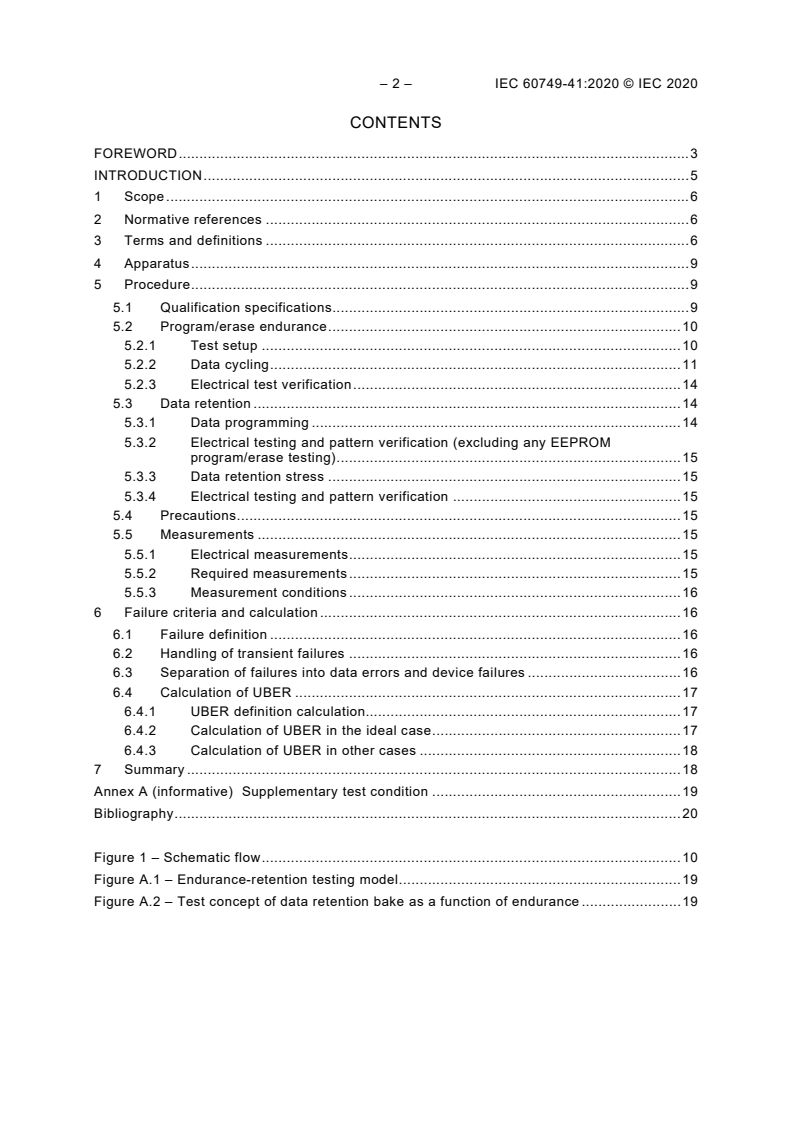
CONTENTS
FOREWORD . 3
INTRODUCTION . 5
1 Scope . 6
2 Normative references . 6
3 Terms and definitions . 6
4 Apparatus . 9
5 Procedure . 9
5.1 Qualification specifications. 9
5.2 Program/erase endurance . 10
5.2.1 Test setup . 10
5.2.2 Data cycling . 11
5.2.3 Electrical test verification . 14
5.3 Data retention . 14
5.3.1 Data programming . 14
5.3.2 Electrical testing and pattern verification (excluding any EEPROM
program/erase testing) . 15
5.3.3 Data retention stress . 15
5.3.4 Electrical testing and pattern verification . 15
5.4 Precautions . 15
5.5 Measurements . 15
5.5.1 Electrical measurements . 15
5.5.2 Required measurements . 15
5.5.3 Measurement conditions . 16
6 Failure criteria and calculation . 16
6.1 Failure definition . 16
6.2 Handling of transient failures . 16
6.3 Separation of failures into data errors and device failures . 16
6.4 Calculation of UBER . 17
6.4.1 UBER definition calculation. 17
6.4.2 Calculation of UBER in the ideal case . 17
6.4.3 Calculation of UBER in other cases . 18
7 Summary . 18
Annex A (informative) Supplementary test condition . 19
Bibliography . 20
Figure 1 – Schematic flow . 10
Figure A.1 – Endurance-retention testing model . 19
Figure A.2 – Test concept of data retention bake as a function of endurance . 19
INTERNATIONAL ELECTROTECHNICAL COMMISSION
____________
SEMICONDUCTOR DEVICES –
MECHANICAL AND CLIMATIC TEST METHODS –
Part 41: Standard reliability testing methods
of non-volatile memory devices
FOREWORD
1) The International Electrotechnical Commission (IEC) is a worldwide organization for standardization comprising
all national electrotechnical committees (IEC National Committees). The object of IEC is to promote
international co-operation on all questions concerning standardization in the electrical and electronic fields. To
this end and in addition to other activities, IEC publishes International Standards, Technical Specifications,
Technical Reports, Publicly Available Specifications (PAS) and Guides (hereafter referred to as “IEC
Publication(s)”). Their preparation is entrusted to technical committees; any IEC National Committee interested
in the subject dealt with may participate in this preparatory work. International, governmental and non-
governmental organizations liaising with the IEC also participate in this preparation. IEC collaborates closely
with the International Organization for Standardization (ISO) in accordance with conditions determined by
agreement between the two organizations.
2) The formal decisions or agreements of IEC on technical matters express, as nearly as possible, an international
consensus of opinion on the relevant subjects since each technical committee has representation from all
interested IEC National Committees.
3) IEC Publications have the form of recommendations for international use and are accepted by IEC National
Committees in that sense. While all reasonable efforts are made to ensure that the technical content of IEC
Publications is accurate, IEC cannot be held responsible for the way in which they are used or for any
misinterpretation by any end user.
4) In order to promote international uniformity, IEC National Committees undertake to apply IEC Publications
transparently to the maximum extent possible in their national and regional publications. Any divergence
between any IEC Publication and the corresponding national or regional publication shall be clearly indicated in
the latter.
5) IEC itself does not provide any attestation of conformity. Independent certification bodies provide conformity
assessment services and, in some areas, access to IEC marks of conformity. IEC is not responsible for any
services carried out by independent certification bodies.
6) All users should ensure that they have the latest edition of this publication.
7) No liability shall attach to IEC or its directors, employees, servants or agents including individual experts and
members of its technical committees and IEC National Committees for any personal injury, property damage or
other damage of any nature whatsoever, whether direct or indirect, or for costs (including legal fees) and
expenses arising out of the publication, use of, or reliance upon, this IEC Publication or any other IEC
Publications.
8) Attention is drawn to the Normative references cited in this publication. Use of the referenced publications is
indispensable for the correct application of this publication.
9) Attention is drawn to the possibility that some of the elements of this IEC Publication may be the subject of
patent rights. IEC shall not be held responsible for identifying any or all such patent rights.
International Standard IEC 60749-41 has been prepared by IEC technical committee 47:
Semiconductor devices. This standard is based on JEDEC Standard 22-A117. It is used with
permission of the copyright holder, JEDEC Solid State Technology Association.
The text of this International Standard is based on the following documents:
FDIS Report on voting
47/2631/FDIS 47/2643/RVD
Full information on the voting for the approval of this International Standard can be found in
the report on voting indicated in the above table.
This publication has been drafted in accordance with the ISO/IEC Directives, Part 2.
– 4 – IEC 60749-41:2020 © IEC 2020
A list of all parts in the IEC 60749 series, published under the general title Semiconductor
devices – Mechanical and climatic test methods, can be found on the IEC website.
The committee has decided that the contents of this publication will remain unchanged until
the stability date indicated on the IEC website under "http://webstore.iec.ch" in the data
related to the specific publication. At this date, the publication will be
• reconfirmed,
• withdrawn,
• replaced by a revised edition, or
• amended.
IMPORTANT – The 'colour inside' logo on the cover page of this publication indicates
that it contains colours which are considered to be useful for the correct
understanding of its contents. Users should therefore print this document using a
colour printer.
INTRODUCTION
The stress tests described in this part of IEC 60749 are intended to determine the ability of an
EEPROM integrated circuit or an integrated circuit with an EEPROM module (such as a
microprocessor) to sustain repeated data changes without failure (program/erase endurance)
and to retain data for the expected life of the EEPROM (data retention).
The program/erase endurance and data retention test for qualification and monitoring, using
the parameter levels specified in JESD47, is considered destructive. The data retention stress
can be used as a proxy to replace the high temperature storage life test when the temperature
and time meet or exceed qualification requirements. Cross-temperature testing for writing and
reading across the data sheet temperature range can be considered when there are
demonstrated sensitivities for programming at low and reading at high temperatures or vice
versa. Lesser test parameter levels (e.g., of temperature, number of cycles, retention bake
duration) can be used for screening as long as these parameter levels have been verified by
the device manufacturer to be nondestructive; this can be performed anywhere from wafer
level to finished device.
– 6 – IEC 60749-41:2020 © IEC 2020
SEMICONDUCTOR DEVICES –
MECHANICAL AND CLIMATIC TEST METHODS –
Part 41: Standard reliability testing methods
of non-volatile memory devices
1 Scope
This part of IEC 60749 specifies the procedural requirements for performing valid endurance,
retention and cross-temperature tests based on a qualification specification. Endurance and
retention qualification specifications (for cycle counts, durations, temperatures, and sample
sizes) are specified in JESD47 or are developed using knowledge-based methods such as in
JESD94.
2 Normative references
The following documents are referred to in the text in such a way that some or all of their
content constitutes requirements of this document. For dated references, only the edition
cited applies. For undated references, the latest edition of the referenced document (including
any amendments) applies.
IEC 60749-6, Semiconductor devices – Mechanical and climatic test methods – Part 6:
Storage at high temperature
IEC 60749-23, Semiconductor devices – Mechanical and climatic test methods – Part 23: High
temperature operating life
JESD47, Stress-Test-Driven Qualification of Integrated Circuits
JESD94, Application Specific Qualification Using Knowledge Based Test Methodology
3 Terms and definitions
For the purposes of this document, the following terms and definitions apply.
ISO and IEC maintain terminological databases for use in standardization at the following
addresses:
• IEC Electropedia: available at http://www.electropedia.org/
• ISO Online browsing platform: available at http://www.iso.org/obp
3.1
cross-temperature test
CTT
data read verification across the opposite end of the operating temperature range such that
when programming occurs at low temperature it is properly read at hot temperature or vice
versa
Note 1 to entry: This note applies to the French language only.
3.2
cross-temperature test failure
CTTF
data read verification failure across the opposite end of the operating temperature range
where it was programmed
Note 1 to entry: This note applies to the French language only.
3.3
electrically erasable programmable read-only memory
EEPROM
reprogrammable read-only memory in which the cells at each address can be erased
electrically and reprogrammed electrically
Note 1 to entry: The term EEPROM in this document includes all such memories, including flash EEPROM
integrated circuits and embedded memory in integrated circuits such as Erasable Programmable Logic Devices
(EPLDs) and microcontrollers. Destructive-read memories such as ferroelectric memories, in which the read
operation re-writes the data in the memory cells, are beyond the scope of this document.
Note 2 to entry: This note applies to the French language only.
3.4
data pattern
mix of several 1s and 0s in the memory and their physical or logical positions
Note 1 to entry: A device can be single-bit-per-cell (SBC), meaning that one physical memory cell stores a "0" or
a "1", or multiple-bits-per-cell (MBC), meaning that one cell stores typically two bits of data: "00", "01", "10", or "11".
In some MBC memories, the two bits represent logically-adjacent bit-pairs in each byte of data. For example, for
2 bits per cell, a byte containing binary data 10110001 would correspond to four physical cells with data 2301 in
base-four logic. In other MBC memories, the two bits can represent bits in entirely different address locations. For
an SBC memory a physical checkerboard pattern consists of alternating 0s and 1s, with each 0 surrounded by 1s
on either side and above and below; a logical checkerboard pattern consists of data bytes AAH or 55H in which
each 0 is logically adjacent to 1s. In some qualifications only logical positions are known.
3.5
endurance
ability of a reprogrammable read-only memory to withstand data rewrites and still comply with
applicable specifications
Note 1 to entry: EEPROM device specifications often require an erase step before reprogramming data; in this
case a data rewrite includes both erase and programming steps, which together are called a program/erase cycle.
Direct-write memories allow data to be written directly over old, without an erase; in this case the use of the
generic term "program/erase cycle" will refer to a single rewrite with no erase. For single-bit-per-cell (SBC)
memories that require an erase step, one program/erase cycle consists of programming cells (typically to "0") and
then erasing ("1"). For the comparable multiple-bits-per-cell (MBC) case, a cycle would consist of programming
cells (to "0", "1", or "2" for two bits per cell) and then erasing ("3" for two bits per cell).
Note 2 to entry: Endurance cycling consists of performing multiple rewrites in succession, and the data pattern or
patterns for these rewrites must be chosen. There is no one data pattern or set of patterns that is worst-case for all
failure mechanisms. For example, for floating-gate memories a fully programmed pattern is worst-case for charge
transfer, but a physical checkerboard pattern is worst-case for spurious programming of adjacent cells, and a
mostly erased pattern can be worst-case for mechanisms related to erase-preconditioning algorithms. For MBC
memories, programming to the highest state is worst-case for charge transfer, but intermediate-state cells can
experience more programming time and also have less sensing margin. Finally, in some memories, the margin of a
cell is influenced by the data states of the physically adjacent cells.
3.6
endurance failure
failure caused by endurance cycling
Note 1 to entry: An endurance failure occurs if, as a result of program/erase cycling, an EEPROM fails to
complete the program or erase operations within the datasheet-specified times or if it fails to meet any of its other
datasheet requirements. A program operation that results in incorrect data being stored in the device counts as an
endurance failure. However, if an error-management method such as an error-correction code is built into the
device or specified to be applied by the system, then failure is taken to occur only if the error is not properly
managed by the specified method.
– 8 – IEC 60749-41:2020 © IEC 2020
Note 2 to entry: Certain EEPROMS are specified to operate with either internal or external bad-block
management system (BBM). When the BBM system detects an endurance failure it directs the data to another
(spare) block and removes the address of the failing block from an appropriate address table. An endurance failure
of such product is taken to occur when a pre-set number of spare blocks of the product had been consumed within
that product datasheet specified cycle count.
Note 3 to entry: A number of distinct failure mechanisms are responsible for endurance failures, and in general
these are accelerated in different ways by temperature and other adjustable qualification parameters such as
cycling delay between cycles. For example, in floating-gate memories, failure may be caused by charge trapping
(normally accelerated by lower temperatures and/or shorter cycling delay) in the charge transfer dielectric or by
oxide rupturing (normally accelerated by higher temperatures) in the transfer dielectric or in peripheral dielectrics.
3.7
failure
loss of the ability of a component to meet the electrical or physical performance specifications
that (by design or testing) it was intended to meet
Note 1 to entry: The term "failure" is often qualified by an adjective describing the type of failure. For example, a
component is a functional failure if it fails to function and a parametric failure if it functions but does not meet a
datasheet specification for a parameter such as power consumption. Endurance and retention failures are defined
in 3.6 and 3.9.
Note 2 to entry: Failures can be firm or transient. For the purpose of this standard, a firm failure is a component
that fails sometime during a reliability stress and continues to fail at the final test at the end of that same stress. A
transient failure is a component that fails during a reliability stress but passes in the final test at the end of that
stress.
3.8
data retention
retention
ability of EEPROM cell to retain data over time
Note 1 to entry: The one-word term "retention" is usually used when context ensures that no confusion is likely;
otherwise, the full term "data retention" is used.
Note 2 to entry: The term data retention can refer to the ability of a device to retain data in the unbiased state,
but the term will sometimes be used to include the ability to retain data under bias. The term "disturb" refers
unambiguously to the ability of an EEPROM cell to retain data over time under bias. For example, read disturb
refers to the ability of an EEPROM cell to retain data after being read a given number of times. A detailed
discussion of disturbs is beyond the scope of this document.
Note 3 to entry: Retention stressing consists of writing a data pattern into a device and then verifying that the
pattern is intact after a specified time at a specified temperature. There is no single data pattern that is worst-case
for all retention mechanisms, cell designs, or process architectures. There are generally some failure mechanisms
which primarily affect programmed cells and some which primarily affect erased cells, and there are also failure
mechanisms which depend on the data in adjacent cells.
3.9
data retention failure
retention failure
change of stored data by one bit or more detected when the device is read according to
applicable specifications after an extended period of time following the previous write
Note 1 to entry: The short-term "retention failure" is usually used when context ensures that no confusion is likely,
otherwise the full term "data retention failure" is used.
Note 2 to entry: It is necessary to distinguish whether or not retention failure was caused by charge loss or some
other mechanism. Endurance cycling with shorter cycling delay between cycles might induce apparent bit change
or pseudo-bit-flip.
Note 3 to entry: If an error-management method such as an error-correction-code is built into the device or
specified to be applied by the system, then failure is taken to occur only if the error is not properly managed by the
specified method.
Note 4 to entry: A number of distinct failure mechanisms are responsible for retention failures, and in general
these are accelerated in different ways by temperature and other adjustable qualification parameters. For example,
in floating-gate memories, failure can occur due to defects that allow charge to leak through the transfer dielectric
or by the detrapping of charge in the transfer dielectric; the former can be weakly accelerated or even decelerated
by high temperature, and the latter can be highly temperature-accelerated.
3.10
uncorrectable bit-error rate
UBER
metric for the rate of occurrence of data errors, equal to the bit error rate (BER) after applying
any specified error-correction method
Note 1 to entry: The uncorrectable bit error rate is calculated from the following equation:
e
k (1)
b
r
where k is UBER,
e is the cumulative number of data errors and
b is the cumulative number of bits read
r
For non-error-corrected devices, any data bit in error counts as a data error. For error-corrected devices, any
codeword or sector (as defined in the product data sheet) returning incorrect data after applying the specified error
correction scheme counts as a data error. Transient data errors, such as data errors that occur at a given
program/erase cycle but not at later ones, are counted as data errors. Standard statistical confidence levels can be
applied to the numerator.
The cumulative number of bits read is the sum of all bits of data read back from the device, with multiple reads of
the same memory bit counting as multiple bits read. For example, if a 1-Gb device is read 10 times, then there
would be 10 Gb bits read.
Note 2 to entry: Some devices can be specified to have a certain UBER value, and in this case the qualification
must determine that the device meets the UBER specification. Clause 5 discusses details regarding calculation of
the UBER value.
4 Apparatus
The apparatus required for this test shall consist of a controlled temperature chamber capable
of maintaining the specified temperature conditions to within ±5 °C. Sockets or other mounting
means shall be provided within the chamber so that reliable electrical contact can be made to
the device terminals in the specified circuit configuration. Power supplies and biasing
networks shall be capable of maintaining the specified operating conditions throughout the
test. Also, the test circuitry should be designed so that the existence of abnormal or failed
devices will not alter the specified conditions for other units on test. Care should be taken to
avoid possible damage from transient voltage spikes or other conditions that might result in
electrical, thermal or mechanical overstress.
5 Procedure
5.1 Qualification specifications
Qualification specifications, including those in JESD47, commonly require that some devices
undergo endurance cycling followed by retention stressing. There may also be retention
requirements for uncycled devices and for the optional cross-temperature testing across the
temperatures specified in the data sheet. Qualification specifications commonly call for
endurance cycling to be performed at multiple temperatures within the datasheet range, and
retention stress to be performed both at elevated temperatures, such as 125 °C, and room
temperature. Figure 1 schematically illustrates the flow, with references to the paragraphs
describing the procedure.
A supplementary test condition is given in Annex A.
– 10 – IEC 60749-41:2020 © IEC 2020
Figure 1 – Schematic flow
5.2 Program/erase endurance
5.2.1 Test setup
Devices shall be placed in the chamber so there is no substantial obstruction to the flow of air
across and around each unit. The power shall be applied and suitable checks made to assure
that all devices are properly energized. When special mounting or heat sinking is required, the
details shall be specified in the applicable device specification and/or test specification.
5.2.2 Data cycling
5.2.2.1 Program and erase verification
Program and erase operations during the endurance test shall be verified to have been
properly executed in accordance with the device specification or the supplier's internal stress
test specification (see Clause 7).
5.2.2.2 Data patterns during cycling
The data pattern used for endurance cycling shall be agreed upon between supplier and user,
and the rationale documented. It is important to cycle enough sectors of blocks during the
cycling period taking into account for the target application models. See Note 1 to Entry 3.4
for a discussion of the trade-offs involved in the selection of data pattern for cycling.
The purpose of many qualifications is to test the device for the broadest possible range of
failure mechanisms. The broadest possible range of failure mechanisms can be detected
when the data pattern includes the full range of logic levels and adjacency conditions that
would occur in actual use. For example, this full range can be achieved if the following three
conditions are met. First, the data in the memory cells is cycled between all available logic
states in equal measure. For example, in an SBC memory half the cells would be programmed
and half left erased in any one cycle, whereas in a 4-level cell memory one-quarter of the
cells would be written to each of the four available levels in any given cycle. Second, the
positions of 1s and 0s are non-uniform, ideally quasi-random, so that all possible adjacency
configurations are represented. For example, a data pattern consisting of a mix of bytes with
data patterns 00H (zero zero hexadecimal), 55H, AAH, 33H, CCH, and FFH would create a
wide range of adjacency patterns. Third, the data pattern in successive cycles is not the same,
but rather follows a sequence. Best practice is to ensure, in this sequence, that some cells
are written to all available logic states while other cells are re-written to the same logic state
in every cycle. For example, in an SBC memory, a byte that was cycled to AAH in even-
numbered cycles and 5AH in odd-numbered cycles would have four cells that would be written
to 0s and 1s in alternating cycles, two cells that are re-written to 0 in every cycle, and two
cells that are re-written to 1 in every cycle.
In some knowledge-based qualifications, endurance tests can be defined for specific failure
mechanisms. Such tests can use different data patterns from that described above, optimized
to increase the sensitivity to the targeted mechanisms. Examples of acceptable data patterns
for such purposes include a solid programmed pattern, checkerboard/inverse-checkerboard
sequence, and checkerboard with subsequent filling-in of the pattern.
Some flash EEPROM devices employ a built-in scrambling mechanism. When testing
endurance of such devices, the scrambling mechanism should be enabled; disabling the
scrambler for endurance cycling can stress the product beyond the stress a user can
experience. A quasi-random pattern is best for testing endurance when employing scrambling.
5.2.2.3 Fraction of cells to be cycled
Qualification specifications, whether from JESD47 or developed using knowledge-based
methods (JESD94) will generally require that some fraction of the memory to be cycled to the
maximum number of program/erase cycles specified in the device specification and other
fractions to be cycled to lesser amounts. In large memories, it can take a prohibitively long
time to cycle all cells to the maximum specification, and in knowledge-based qualifications it
is possible that application use conditions do not require all cells to be so cycled. The actual
fraction of cells cycled to 100 % of the maximum specification, and the fraction cycled to other
percentages of the specification, shall be agreed upon between supplier and user and
documented, along with the rationale for the chosen fractions.
– 12 – IEC 60749-41:2020 © IEC 2020
5.2.2.4 Cycling conditions
The mode, voltages, temperature, and frequency of cycling should be agreed to between the
supplier and user, and documented along with the rationale. Mode refers to different
operational modes for program and/or erase, such as address, page, and block (or sector)
program and erase modes. Voltages refer to all relevant supply voltages, including the logic-
level supply and, if applicable, any high-voltage supply required for program or erase.
Temperature refers to the temperature of the chamber in which the devices are cycled.
Qualification specifications will often specify that some devices be cycled at low temperature
and other devices be cycled at higher temperature. Frequency of cycling refers to the number
of cycles performed per unit time.
5.2.2.5 Intentional delays between cycles
The degradation rate of EEPROM products can depend strongly on the cycling frequency.
That is because some cycling-induced damage mechanisms exhibit partial recovery in
between cycles; increasing the cycling rate can prevent that recovery and lead to early
failures. Typical recoverable degradation mechanisms are the detrapping of charge trapped
during cycling in the transfer-dielectric layer of floating gate devices, or detrapping of excess
trapped charge in trapping-based non-volatile memories. Under user-mode application the
product cycle count is spread over few years and the excess trapped charge can detrap
between cycles, but if the product is run to maximum cycle count in few hours or days under
qualification test mode, excess trapped charge will accumulate, leading to early product
failure during the endurance cycling itself or in the following data retention test.
To avoid unrealistic cycling during qualification testing the qualification flow can specify
intentional delays to be added between cycles. This 5.2.2.5 describes methods for inserting
relaxation delays during cycling and the rules and limitations that apply. The methods
comprise:
i) Cycling at elevated temperature (relaxation delays distributed evenly between cycles);
ii) Cycling at elevated temperature at reduced cycle frequency (delays entered between each
two cycles and / or between groups of cycles);
iii) Ambient temperature cycling with high-temperature bake intervals inserted between
groups of cycles.
The rule governing the insertion of cycling delays is that the resultant relaxation due to
insertion of bake delays should not exceed the matching relaxation under user mode
conditions. The total duration of inserted delays should be calculated from the difference
between the intended use temperature and the delay temperatures, using the activation
energy of the recovery mechanism. Combination of the above methods is allowed as long as
the combination obeys this rule.
For cycling at elevated temperature according to method (ii), the supplier can specify that
cycling shall not exceed certain number of cycles per day. During the rest of the day the
devices can stay idle at the cycling temperature. The devices can be kept idle also at a
different temperature, provided the total time at cycling temperature and the time at the idle
temperature do not exceed together the matching cycling duration of the product at the
intended use temperature (see Example 1 below).
To avoid exaggerated recovery effect towards end of cycling, cycling delays and/or bake
intervals calculated for given group of cycles shall be inserted at the beginning of each group
of cycles. For example, if the supplier elects 4 even groups of cycles with even idling intervals
,
between groups, and if the total allowed idle time at the idle temperature is calculated to be t
T
then fraction t /4 of the total idle time may be inserted at the beginning of the second, third
T
and fourth cycling groups. No relaxation delay is allowed at the end of the fourth group
besides unavoidable logistical delay subject to the maximum specified in 5.2.2.6.
If the supplier elects to segment the cycling delays using non-even groups of cycles, the bake
intervals shall be proportional to the fraction of cycles in the consecutive cycling group. The
rationale for selecting non-even cycling groups is that bake delays at the early portion of the
cycling flow are generally less effective for relaxing the device than delays towards the end of
cycling, so the supplier may elect to skip early bake intervals and save in total stress test time.
Since the recovery effect may also depend on cell level, the supplier should specify the cell
level used during delays between cycles. A cell level rotation among delays should also be
used to simulate the usage conditions.
The supplier shall document the method elected for inserting bake delays, report the data
pattern used during delays, specify the recovery mechanism and provide the source for its
activation energy. The supplier shall also document the rationale for selecting the specific
delays / bake intervals / temperatures during cycling.
The cycling and data retention capability are calculated using the target cycling condition. The
supplier shall calculate data retention under various target cycling delays and temperatures.
Data retention failure estimates are calculated by applying the appropriate device junction
) during cycling as determined by the supplier. Use cycling and retention may
temperature (T
J
be calculated at different temperatures corresponding to the target conditions such that the
endurance T is greater than the read cycling T .
J J
Two examples illustrating how to select bake intervals are shown below:
– Example 1 [method (ii)]:
Product cycle count = 10 k-cycle
Time for 10 k-cycle at intended application of 2 y = 17 520 h
User mode cycling temperature = 55 °C
Desired endurance qualification time = 10 days
Cycle time per day = 1 k-cycle over a period of 14 h
Qualification cycling temperature = 85 °C
Detrapping (relaxation) activation energy = 1,1 eV
What is the maximum allowed temperature during the idle period of 10 h per day?
a) 10 d × 14 h of cycling per day at 85 °C are equivalent to 140 h × 26,1 = 3 652 h at
use temperature (Acceleration factor is 26,1 from 55 °C to 85 °C for Eaa = 1,1 eV)
b) Remaining equivalent user-mode cycling life is 17 520 h – 3 652 h = 13 868 h
c) The total idling time is 100 h
d) The thermal acceleration factor (AT) from 100 h to 13 868 h is 138,68
e) To reach A = 138,6 with Eaa = 1,1 eV and T = 55 °C, T = 102,6 °C
T use relax
Answer: The maximum allowed temperature during the idle time is 102,6 °C. No delay is
allowed on the last day after cycling besides the allowance for up to 12 h at cycling
temperature in accordance with 5.2.2.6.
– Example 2 [method (iii)]:
Product cycle count = 10 k-cycle
Time for 10 k-cycle at intended application = 2 years = 17 520 h
User mode cycling temperature = 35 °C
Qualification cycling temperature = 25 °C
Detrapping (relaxation) activation energy = 0,9 eV
Supplier wishes to insert bake intervals after 5 k-cycle and after 9 k-cycle. Bake
temperature is 125 °C.
– 14 – IEC 60749-41:2020 © IEC 2020
What is the maximum allowed duration of each bake interval?
a) fraction of cycles of the second group is (9 k-cycle – 5 k-cycle)/10 k-cycle = 0,4
b) fraction of cycles of the third group is (10 k-cycle – 9 k-cycle)/10 k-cycle = 0,1
c) Thermal acceleration factor from 35 °C to 125 °C at Eaa = 0,9 eV = X 2 139
d) Total allowed relaxation time = 17 520 h / 2 139 = 8,19 h
e) Maximum cycling delay before the second group = 8,19 × 0,4 = 3,28 h
f) Maximum cycling delay before the third group = 8,19 × 0,1 = 0,82 h
Answer: The maximum allowed bake interval at 125 °C after 5 k-cycle is 3,28 h, and after 9 k-
cycle it is 0,82 h.
NOTE Activation energies of in-cycling recovery mechanisms can vary between 0,8 eV and 1,2 eV according to
technology and materials. See, for example, JEP122H, 5.5 – 5.6.
5.2.2.6 Delay at the end of endurance cycling
For cycling performed at elevated temperature, devices shall not remain in the cycling
chamber for more than 12 h after completion of elevated-temperature cycling. For cycling at
room temperature or below, any delay in the cycling chamber prior to removal of the devices
shall be counted in the overall 96 h allowance discussed in 5.5.1. For devices with multiple
regions that are independently cycled, these limits shall be calculated starting from the time at
which the first region finishes cycling. It may be necessary to stagger the cycling of the
regions in order to meet these requirements. For example, if two regions ar
...