

IEC 61140:2001
(Main)Protection against electric shock - Common aspects for installation and equipment
General Information
- Abstract
Applies to the protection of persons and animals against electric shock. It is intended to give fundamental principles and requirements which are common to electrical installations, systems and equipment or necessary for their co-ordination. Prepared for installations, systems and equipment without a voltage limit. NOTE - There are some clauses in this standard which refer to low-voltage and high-voltage systems, installations and equipment. For the purpose of this standard, low -voltage is any rated voltage up to and including 1 000 V a.c. or 1 500 V d.c. High voltage is any rated voltage exceeding 1 000 V a.c. or 1 500 V d.c. The requirements of this standard apply only if they are incorporated, or are referred to, in the relevant standards. It is not intended to be used as a stand-alone standard. Has the status of a basic safety publication in accordance with IEC Guide 104.
- Status
- Published
- Publication Date
- 22-Sep-2009
- Technical Committee
- TC 64 - Electrical installations and protection against electric shock
- Current Stage
- DELPUB - Deleted Publication
- Start Date
- 07-Jan-2016
- Completion Date
- 28-Aug-2026
Buy Documents
IEC 61140:2001 - Protection against electric shock - Common aspects for installation and equipment Released:10/10/2001
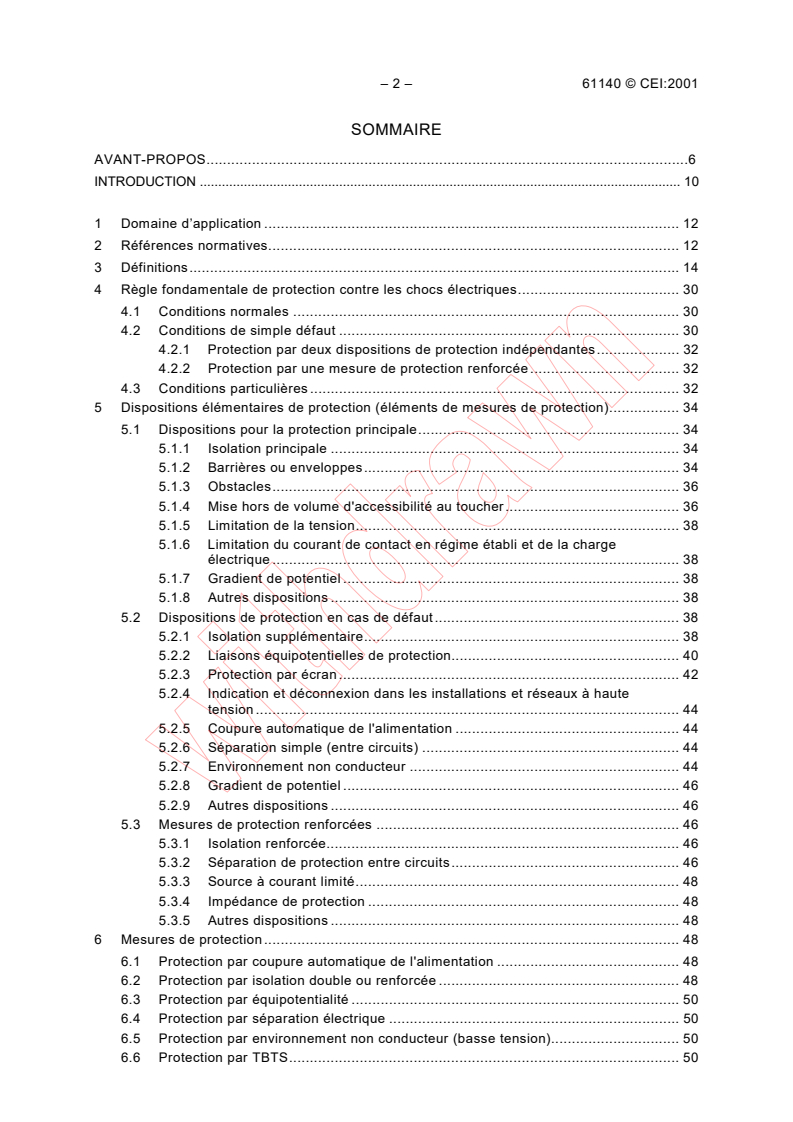
IEC 61140:2001 - Protection contre les chocs électriques - Aspects communs aux installations et aux matériels Released:10/10/2001
IEC 61140:2001 - Protection against electric shock - Common aspects for installation and equipment Released:10/10/2001
IEC 61140:2001+AMD1:2004 CSV - Protection against electric shock - Common aspects for installation and equipment Released:9/23/2009
Overview
IEC 61140:2001 – Protection against electric shock – Common aspects for installation and equipment is an international basic safety publication developed by the International Electrotechnical Commission (IEC). This standard provides the fundamental principles and requirements for protecting persons and animals from electric shock. It establishes common safety aspects relevant to electrical installations, systems, and equipment, facilitating their coordination. IEC 61140 applies to installations and equipment at all voltage levels, with references to both low-voltage and high-voltage systems, making it essential for standardization in electrical safety.
Key Topics
- Scope of Protection: The standard addresses protection against electric shock without setting a voltage limit, covering both low-voltage (up to and including 1,000 V a.c. or 1,500 V d.c.) and high-voltage systems (exceeding above limits).
- Fundamental Safety Rules: Defines the core requirement that hazardous-live-parts must not be accessible and accessible conductive parts must not present a hazard under either normal or single-fault conditions.
- Types of Protection:
- Basic protection: Safeguarding under normal, fault-free conditions.
- Fault protection: Safeguarding in the event of single faults, typically corresponding to indirect contact scenarios.
- Enhanced protective provisions: Measures that offer reliability equal to two independent protective provisions.
- Protective Measures and Provisions:
- Basic insulation, barriers, and enclosures
- Supplementary and reinforced insulation
- Equipotential bonding and earthing arrangements
- Protective screening and safe separation techniques
- Limitation of touch currents and voltages
- Coordination Requirements: Ensures the coordinated design of installations, equipment, and protective measures for comprehensive safety.
Applications
IEC 61140:2001 is applicable to a wide range of electrical engineering fields and technologies where protection against electric shock is critical, including:
- Building Electrical Installations: Used as a reference for the safety design of residential, commercial, and industrial electrical systems.
- Electrical Equipment Manufacturing: Forms the basis for safety requirements incorporated into standards for electrical devices, apparatus, and appliances.
- System Coordination: Assists technical committees and safety engineers in specifying detailed protective measures for installations, systems, and equipment as part of harmonized safety standards.
- High and Low-Voltage Systems: Relevant for environments ranging from standard consumer applications to complex industrial facilities and power systems, covering both low and high-voltage applications.
- Sector-Specific Safety Standards: Serves as a basic safety reference for the development of further IEC and ISO standards that address sector-specific or equipment-specific electric shock protection.
Related Standards
IEC 61140:2001 is a core reference for numerous international standards and is not intended for stand-alone use. Some important related standards include:
- IEC 60364 Series: Electrical installations of buildings, especially IEC 60364-4-41 (Protection against electric shock) and IEC 60364-5-54 (Earthing arrangements and protective conductors).
- IEC 60529: Degrees of protection provided by enclosures (IP Code).
- IEC 60479 Series: Effects of current on human beings and livestock.
- IEC 60050 (IEV): International Electrotechnical Vocabulary for terminology.
- IEC 60601-1: Safety of medical electrical equipment.
- ISO/IEC Guide 51: Safety aspects for inclusion in standards.
Practical Value
IEC 61140:2001 is essential for ensuring electrical safety and protecting users, operators, and animals from electric shock risks. By harmonizing fundamental principles and definitions across related standards, it supports the safe and coordinated development of globally recognized electrical installations and equipment. Its guidance is critical for compliance, risk management, and the design of effective protective measures in both new and existing electrical systems.
Relations
- Effective Date
- 25-Aug-2026
- Effective Date
- 25-Aug-2026
- Effective Date
- 25-Aug-2026
- Effective Date
- 05-Sep-2023
- Revised
IEC 61140:2016 - Protection against electric shock - Common aspects for installation and equipment - Effective Date
- 05-Sep-2023
- Revises
IEC 61140:1997 - Protection against electric shock - Common aspects for installation and equipment - Effective Date
- 05-Sep-2023
Buy Documents
IEC 61140:2001 - Protection against electric shock - Common aspects for installation and equipment Released:10/10/2001
IEC 61140:2001 - Protection contre les chocs électriques - Aspects communs aux installations et aux matériels Released:10/10/2001
IEC 61140:2001 - Protection against electric shock - Common aspects for installation and equipment Released:10/10/2001
IEC 61140:2001+AMD1:2004 CSV - Protection against electric shock - Common aspects for installation and equipment Released:9/23/2009
Get Certified
Connect with accredited certification bodies for this standard

DIBt (Deutsches Institut für Bautechnik)
German Institute for Building Technology.
DIN CERTCO
DIN Group product certification.

IMQ S.p.A. (Certification)
Italian electrical product certification.
Sponsored listings
Frequently Asked Questions
IEC 61140:2001 is a standard published by the International Electrotechnical Commission (IEC). Its full title is "Protection against electric shock - Common aspects for installation and equipment". This standard covers: Applies to the protection of persons and animals against electric shock. It is intended to give fundamental principles and requirements which are common to electrical installations, systems and equipment or necessary for their co-ordination. Prepared for installations, systems and equipment without a voltage limit. NOTE - There are some clauses in this standard which refer to low-voltage and high-voltage systems, installations and equipment. For the purpose of this standard, low -voltage is any rated voltage up to and including 1 000 V a.c. or 1 500 V d.c. High voltage is any rated voltage exceeding 1 000 V a.c. or 1 500 V d.c. The requirements of this standard apply only if they are incorporated, or are referred to, in the relevant standards. It is not intended to be used as a stand-alone standard. Has the status of a basic safety publication in accordance with IEC Guide 104.
Applies to the protection of persons and animals against electric shock. It is intended to give fundamental principles and requirements which are common to electrical installations, systems and equipment or necessary for their co-ordination. Prepared for installations, systems and equipment without a voltage limit. NOTE - There are some clauses in this standard which refer to low-voltage and high-voltage systems, installations and equipment. For the purpose of this standard, low -voltage is any rated voltage up to and including 1 000 V a.c. or 1 500 V d.c. High voltage is any rated voltage exceeding 1 000 V a.c. or 1 500 V d.c. The requirements of this standard apply only if they are incorporated, or are referred to, in the relevant standards. It is not intended to be used as a stand-alone standard. Has the status of a basic safety publication in accordance with IEC Guide 104.
IEC 61140:2001 is classified under the following ICS (International Classification for Standards) categories: 13.260 - Protection against electric shock. Live working; 29.020 - Electrical engineering in general; 91.140.50 - Electricity supply systems. The ICS classification helps identify the subject area and facilitates finding related standards.
IEC 61140:2001 has the following relationships with other standards: It is inter standard links to EN ISO 13482:2014, EN ISO 12696:2012, EN ISO 5826:2014, IEC 61140:2001/AMD1:2004, IEC 61140:2016, IEC 61140:1997. Understanding these relationships helps ensure you are using the most current and applicable version of the standard.
IEC 61140:2001 is available in PDF format for immediate download after purchase. The document can be added to your cart and obtained through the secure checkout process. Digital delivery ensures instant access to the complete standard document.
Standards Content (Sample)
INTERNATIONAL IEC
STANDARD 61140
Third edition
2001-10
BASIC SAFETY PUBLICATION
Protection against electric shock –
Common aspects for installation
and equipment
This English-language version is derived from the original
bilingual publication by leaving out all French-language
pages. Missing page numbers correspond to the French-
language pages.
Reference number
Publication numbering
As from 1 January 1997 all IEC publications are issued with a designation in the
60000 series. For example, IEC 34-1 is now referred to as IEC 60034-1.
Consolidated editions
The IEC is now publishing consolidated versions of its publications. For example,
edition numbers 1.0, 1.1 and 1.2 refer, respectively, to the base publication, the
base publication incorporating amendment 1 and the base publication incorporating
amendments 1 and 2.
Further information on IEC publications
The technical content of IEC publications is kept under constant review by the IEC,
thus ensuring that the content reflects current technology. Information relating to
this publication, including its validity, is available in the IEC Catalogue of
publications (see below) in addition to new editions, amendments and corrigenda.
Information on the subjects under consideration and work in progress undertaken
by the technical committee which has prepared this publication, as well as the list
of publications issued, is also available from the following:
• IEC Web Site (www.iec.ch)
• Catalogue of IEC publications
The on-line catalogue on the IEC web site (www.iec.ch/searchpub) enables you to
search by a variety of criteria including text searches, technical committees
and date of publication. On-line information is also available on recently issued
publications, withdrawn and replaced publications, as well as corrigenda.
• IEC Just Published
This summary of recently issued publications (www.iec.ch/online_news/ justpub)
is also available by email. Please contact the Customer Service Centre (see
below) for further information.
• Customer Service Centre
If you have any questions regarding this publication or need further assistance,
please contact the Customer Service Centre:
Email: custserv@iec.ch
Tel: +41 22 919 02 11
Fax: +41 22 919 03 00
INTERNATIONAL IEC
STANDARD 61140
Third edition
2001-10
BASIC SAFETY PUBLICATION
Protection against electric shock –
Common aspects for installation
and equipment
IEC 2001 Copyright - all rights reserved
No part of this publication may be reproduced or utilized in any form or by any means, electronic or mechanical,
including photocopying and microfilm, without permission in writing from the publisher.
International Electrotechnical Commission, 3, rue de Varembé, PO Box 131, CH-1211 Geneva 20, Switzerland
Telephone: +41 22 919 02 11 Telefax: +41 22 919 03 00 E-mail: inmail@iec.ch Web: www.iec.ch
PRICE CODE
X
Commission Electrotechnique Internationale
International Electrotechnical Commission
МеждународнаяЭлектротехническаяКомиссия
For price, see current catalogue
61140 © IEC:2001 – 3 –
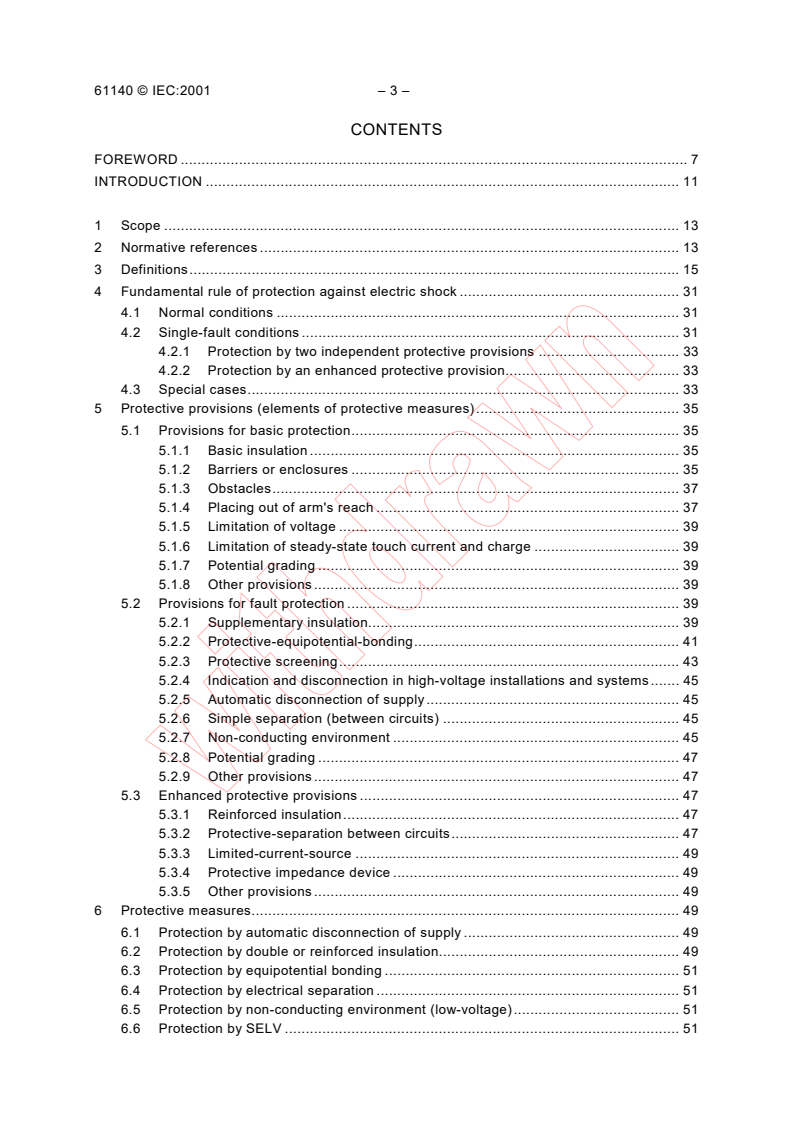
CONTENTS
FOREWORD . 7
INTRODUCTION . 11
1 Scope . 13
2 Normative references . 13
3 Definitions. 15
4 Fundamental rule of protection against electric shock . 31
4.1 Normal conditions . 31
4.2 Single-fault conditions . 31
4.2.1 Protection by two independent protective provisions . 33
4.2.2 Protection by an enhanced protective provision. 33
4.3 Special cases. 33
5 Protective provisions (elements of protective measures). 35
5.1 Provisions for basic protection. 35
5.1.1 Basic insulation . 35
5.1.2 Barriers or enclosures . 35
5.1.3 Obstacles. 37
5.1.4 Placing out of arm's reach . 37
5.1.5 Limitation of voltage . 39
5.1.6 Limitation of steady-state touch current and charge . 39
5.1.7 Potential grading . 39
5.1.8 Other provisions . 39
5.2 Provisions for fault protection . 39
5.2.1 Supplementary insulation. 39
5.2.2 Protective-equipotential-bonding. 41
5.2.3 Protective screening. 43
5.2.4 Indication and disconnection in high-voltage installations and systems. 45
5.2.5 Automatic disconnection of supply. 45
5.2.6 Simple separation (between circuits) . 45
5.2.7 Non-conducting environment . 45
5.2.8 Potential grading . 47
5.2.9 Other provisions . 47
5.3 Enhanced protective provisions . 47
5.3.1 Reinforced insulation. 47
5.3.2 Protective-separation between circuits. 47
5.3.3 Limited-current-source . 49
5.3.4 Protective impedance device . 49
5.3.5 Other provisions . 49
6 Protective measures. 49
6.1 Protection by automatic disconnection of supply . 49
6.2 Protection by double or reinforced insulation. 49
6.3 Protection by equipotential bonding . 51
6.4 Protection by electrical separation . 51
6.5 Protection by non-conducting environment (low-voltage). 51
6.6 Protection by SELV . 51
61140 © IEC:2001 – 5 –
6.7 Protection by PELV . 53
6.8 Protection by limitation of steady-state touch current and charge . 53
6.9 Protection by other measures . 53
7 Co-ordination of electrical equipment and of protective provisions within an
electrical installation. 53
7.1 Class 0 equipment . 55
7.1.1 Insulation . 55
7.2 Class I equipment . 55
7.2.1 Insulation . 55
7.2.2 Protective-equipotential-bonding. 55
7.2.3 Accessible surfaces of parts of insulating material . 55
7.2.4 Connection of a protective conductor. 57
7.3 Class II equipment . 57
7.3.1 Insulation . 57
7.3.2 Protective bonding. 59
7.3.3 Marking. 59
7.4 Class III equipment . 59
7.4.1 Voltages. 59
7.4.2 Protective bonding. 61
7.4.3 Marking. 61
7.5 Touch currents, protective conductor currents, leakage currents. 61
7.5.1 Touch currents . 61
7.5.2 Protective conductor currents . 63
7.5.3 Other requirements . 65
7.6 Safety and boundary clearances and warning labels for high-voltage
installations. 65
8 Special operating and servicing conditions. 67
8.1 Devices to be operated manually and components intended to be replaced
manually . 67
8.1.1 Devices to be operated or components intended to be replaced by
ordinary persons in low-voltage installations, systems and equipment . 67
8.1.2 Devices to be operated or components intended to be replaced by
skilled or instructed persons . 67
8.2 Electrical values after isolation . 69
Annex A (informative) Survey of protective measures as implemented by protective
provisions. 71
Annex B (informative) Values of maximum a.c. limits of protective conductor currents
for cases 7.5.2.2 a) and 7.5.2.2 b) . 75
Annex C (informative) Index of definitions . 77
61140 © IEC:2001 – 7 –
INTERNATIONAL ELECTROTECHNICAL COMMISSION
___________
PROTECTION AGAINST ELECTRIC SHOCK –
COMMON ASPECTS FOR INSTALLATION AND EQUIPMENT
FOREWORD
1) The IEC (International Electrotechnical Commission) is a worldwide organization for standardization comprising
all national electrotechnical committees (IEC National Committees). The object of the IEC is to promote
international co-operation on all questions concerning standardization in the electrical and electronic fields. To
this end and in addition to other activities, the IEC publishes International Standards. Their preparation is
entrusted to technical committees; any IEC National Committee interested in the subject dealt with may
participate in this preparatory work. International, governmental and non-governmental organizations liaising
with the IEC also participate in this preparation. The IEC collaborates closely with the International Organization
for Standardization (ISO) in accordance with conditions determined by agreement between the two
organizations.
2) The formal decisions or agreements of the IEC on technical matters express, as nearly as possible, an
international consensus of opinion on the relevant subjects since each technical committee has representation
from all interested National Committees.
3) The documents produced have the form of recommendations for international use and are published in the form
of standards, technical specifications, technical reports or guides and they are accepted by the National
Committees in that sense.
4) In order to promote international unification, IEC National Committees undertake to apply IEC International
Standards transparently to the maximum extent possible in their national and regional standards. Any
divergence between the IEC Standard and the corresponding national or regional standard shall be clearly
indicated in the latter.
5) The IEC provides no marking procedure to indicate its approval and cannot be rendered responsible for any
equipment declared to be in conformity with one of its standards.
6) Attention is drawn to the possibility that some of the elements of this International Standard may be the subject
of patent rights. The IEC shall not be held responsible for identifying any or all such patent rights.
International Standard IEC 61140 has been prepared by IEC technical committee 64: Electrical
installations and protection against electric shock.
This third edition cancels and replaces the second edition, published in 1997, and constitutes a
technical revision.
The text of this standard is based on the following documents:
FDIS Report on voting
64/1191/FDIS 64/1202/RVD
Full information on the voting for the approval of this standard can be found in the report on
voting indicated in the above table.
This publication has been drafted in accordance with the ISO/IEC Directives, Part 3.
It has the status of a basic safety publication in accordance with IEC Guide 104.
Annexes A, B and C are for information only.
61140 © IEC:2001 – 9 –
The committee has decided that the contents of this publication will remain unchanged until
2006. At this date, the publication will be
reconfirmed;
withdrawn;
replaced by a revised edition, or
amended.
61140 © IEC:2001 – 11 –
INTRODUCTION
This International Standard is a Basic Safety Publication intended for use by technical
committees in the preparation of standards in accordance with the principles of IEC Guide 104
and ISO/IEC Guide 51.
61140 © IEC:2001 – 13 –
PROTECTION AGAINST ELECTRIC SHOCK –
COMMON ASPECTS FOR INSTALLATION AND EQUIPMENT
1 Scope
This International Standard applies to the protection of persons and animals against electric
shock. It is intended to give fundamental principles and requirements which are common to
electrical installations, systems and equipment or necessary for their co-ordination.
This standard has been prepared for installations, systems and equipment without a voltage
limit.
NOTE There are some clauses in this standard which refer to low-voltage and high-voltage systems, installations
and equipment. For the purpose of this standard, low -voltage is any rated voltage up to and including 1 000 V a.c.
or 1 500 V d.c. High voltage is any rated voltage exceeding 1 000 V a.c. or 1 500 V d.c.
The requirements of this standard apply only if they are incorporated, or are referred to, in the
relevant standards. It is not intended to be used as a stand-alone standard.
2 Normative references
The following normative documents contain provisions which, through reference in this text,
constitute provisions of this International Standard. For dated references, subsequent
amendments to, or revisions of, any of these publications do not apply. However, parties to
agreements based on this International Standard are encouraged to investigate the possibility
of applying the most recent editions of the normative documents indicated below. For undated
references, the latest edition of the normative document referred to applies. Members of IEC
and ISO maintain registers of currently valid International Standards.
IEC 60050(131): International Electrotechnical Vocabulary (IEV) – Chapter 131: Electric and
magnetic circuits
IEC 60050(195): 1998, International Electrotechnical Vocabulary (IEV) – Part 195: Earthing and
protection against electric shock
Amendment 1 (2001)
IEC 60050(351):1998, International Electrotechnical Vocabulary – Part 351: Automatic control
IEC 60050(826):1982, International Electrotechnical Vocabulary – Chapter 826: Electrical
installations of buildings
Amendment 2 (1995)
IEC 60071-1:1993, Insulation co-ordination – Part 1: Definitions, principles and rules
IEC 60071-2:1996, Insulation co-ordination – Part 2: Application guide
IEC 60364-4-41, Electrical installations of buildings – Part 4: Protection for safety – Chapter
41: Protection against electric shock
IEC 60364-4-443:1995, Electrical installations of buildings – Part 4: Protection for safety –
Chapter 44: Protection against overvoltages − Section 443: Protection against overvoltages of
atmospheric origin or due to switching
61140 © IEC:2001 – 15 –
IEC 60364-5-54:1980, Electrical installations of buildings – Part 5: Selection and erection of
electrical equipment – Chapter 54: Earthing arrangements and protective conductors
IEC 60364-6-61:1986, Electrical installations of buildings – Part 6: Verification – Chapter 61:
Initial verification
IEC 60417-2, Graphical symbols for use on equipment – Part 2: Symbol originals
IEC 60446:1999, Basic and safety principles for man-machine interface, marking and
identification – Identification of conductors by colours or numerals
IEC 60479-1:1994, Effects of current on human beings and livestock – Part 1: General aspects
IEC 60529:1989, Degrees of protection provided by enclosures (IP Code)
IEC 60601 (all parts), Medical electrical equipment
IEC 60601-1:1988, Medical electrical equipment − Part 1: General requirements for safety
IEC 60664-1:1992, Insulation co-ordination for equipment within low-voltage systems – Part 1:
Principles, requirements and tests
IEC 60721 (all parts), Classification of environmental conditions
IEC 60990:1999, Methods of measurement of touch current and protective conductor current
IEC 61201:1992, Extra-low-voltage (ELV) – Limit values
ISO/IEC Guide 51:1999, Safety aspects – Guidelines for their inclusion in standards
IEC Guide 104:1997, The preparation of safety publications and the use of basic safety
publications and group safety publications
3 Definitions
NOTE An index of definitions is given in annex C.
For the purpose of this International Standard the following definitions apply:
3.1
electric shock
physiological effect resulting from an electric current through a human or animal body
[IEV 195-01-04]
3.1.1
basic protection
protection against electric shock under fault-free conditions
[IEV 195-06-01]
NOTE For low-voltage installations, systems and equipment, basic protection generally corresponds to protection
against direct contact as used in IEC 60364-4-41.
61140 © IEC:2001 – 17 –
3.1.2
fault protection
protection against electric shock under single-fault conditions
[IEV 195-06-02]
NOTE For low-voltage installations, systems and equipment, fault protection generally corresponds to protection
against indirect contact as used in IEC 60364-4-41, mainly with regard to failure of basic insulation.
3.2
(electric) circuit
an arrangement of devices or media through which electric current can flow
[IEV 131-01-01]
NOTE See also IEV 826-05-01 for electrical installations of buildings.
3.3
(electrical) equipment
any item used for such purposes as generation, conversion, transmission, storage, distribution
or utilization of electrical energy, such as machines, transformers, apparatus, measuring
instruments, protective devices, accessories for wiring systems, appliances
[IEV 826-07-01, modified]
3.4
live part
conductor or conductive part intended to be energized in normal operation, including a neutral
conductor, but by convention not a PEN conductor or PEM conductor or PEL conductor
[IEV 195-02-19]
NOTE 1 This concept does not necessarily imply a risk of electric shock.
NOTE 2 For definitions of PEM and PEL see IEV 195-02-13 and 195-02-14.
3.5
hazardous-live-part
live part which, under certain conditions, can give a harmful electric shock
[IEV 195-06-05]
NOTE In case of high voltage, a hazardous voltage may be present on the surface of solid insulation. In such a
case the surface is considered to be a hazardous-live-part.
3.6
exposed-conductive-part
conductive part of equipment, which can be touched and which is not normally live, but which
can become live when basic insulation fails
[IEV 195-06-10]
NOTE A conductive part of electrical equipment which can only become live through contact with an exposed-
conductive-part which has become live, is not considered to be an exposed-conductive-part itself.
3.7
extraneous-conductive-part
conductive part not forming part of the electrical installation and liable to introduce an electric
potential, generally the electric potential of a local earth
[IEV 195-06-11]
61140 © IEC:2001 – 19 –
3.8
touch voltage
3.8.1
(effective) touch voltage
voltage between conductive parts when touched simultaneously by a person or an animal
NOTE The value of the effective touch voltage may be appreciably influenced by the impedance of the person or
the animal in electric contact with these conductive parts.
[IEV 195-05-11]
3.8.2
prospective touch voltage
voltage between simultaneously accessible conductive parts when those conductive parts are
not being touched, by a person or an animal
[IEV 195-05-09]
3.9
touch current
electric current passing through a human body or through an animal body when it touches one
or more accessible parts of an installation or of equipment
[IEV 195-05-21]
3.10
insulation
NOTE Insulation can be a solid, a liquid or a gas (e.g. air), or any combination.
3.10.1
basic insulation
insulation of hazardous-live-parts which provides basic protection
NOTE This concept does not apply to insulation used exclusively for functional purposes.
[IEV 195-06-06]
3.10.2
supplementary insulation
independent insulation applied in addition to basic insulation, for fault protection
[IEV 195-06-07]
3.10.3
double insulation
insulation comprising both basic insulation and supplementary insulation
[IEV 195-06-08]
3.10.4
reinforced insulation
insulation of hazardous-live-parts which provides a degree of protection against electric shock
equivalent to double insulation
NOTE Reinforced insulation may comprise several layers which cannot be tested singly as basic insulation or
supplementary insulation.
[IEV 195-06-09]
61140 © IEC:2001 – 21 –
3.11
non-conducting environment
provision whereby a person or an animal touching an exposed-conductive-part that has
become hazardous-live is protected by the high impedance of his environment (e.g. insulating
walls and floors) and by the absence of earthed conductive parts
[IEV 195-06-21]
3.12
(electrically) protective obstacle
part preventing unintentional direct contact, but not preventing direct contact by deliberate
action
[IEV 195-06-16]
NOTE Direct contact is defined in IEV 195-06-03.
3.13
(electrically) protective barrier
part providing protection against direct contact from any usual direction of access
[IEV 195-06-15]
NOTE Direct contact is defined in IEV 195-06-03.
3.14
(electrically) protective enclosure
electrical enclosure surrounding internal parts of equipment to prevent access to hazardous-
live-part from any direction
[IEV 195-06-14]
NOTE In addition, an enclosure generally provides protection against internal or external influences, e.g. ingress
of dust or water or prevention of mechanical damage.
3.15
arm's reach
zone of accessibility to touch extending from any point on a surface where persons usually
stand or move about to the limits which a person can reach with the hand, in any direction,
without assistance
[IEV 195-06-12]
3.16
equipotential bonding
provision of electric connections between conductive parts, intended to achieve equipotentiality
[IEV 195-01-10 ]
NOTE The effectiveness of the equipotential bonding may depend on the frequency of the current in the bonding.
3.16.1
protective equipotential bonding
equipotential bonding for purposes of safety (e.g. protection against electric shock)
[IEV 195-01-15, modified]
NOTE Functional equipotential bonding is defined in IEV 195-01-16.
3.16.2
equipotential bonding terminal
terminal provided on equipment or on a device and intended for the electric connection with the
equipotential bonding system
[IEV 195-02-32]
61140 © IEC:2001 – 23 –
3.16.3
protective bonding terminal
terminal intended for protective-equipotential-bonding purposes
3.16.4
protective conductor, PE
conductor provided for purposes of safety, for example protection against electric shock
[IEV 195-02-09]
3.16.5
PEN conductor
conductor combining the functions of both protective conductor and neutral conductor
[IEV 195-02-12, modified]
3.17
earth
NOTE The concept "Earth" means the planet and all its physical matter
3.17.1
reference earth
reference ground (US)
part of the earth considered as conductive, the electric potential of which is conventionally
taken as zero, being outside the zone of influence of any earthing arrangement
[IEV 195-01-01]
3.17.2
(local) earth
(local) ground (US)
part of the earth which is in electric contact with an earth electrode and the electric potential of
which is not necessarily equal to zero
[IEV 195-01-03]
3.17.3
earth electrode
ground electrode (US)
conductive part, which may be embedded in a specific conductive medium, e.g. concrete or
coke, in electric contact with the earth
[IEV 195-02-01]
3.17.4
earthing conductor
grounding conductor (US)
conductor which provides a conductive path, or part of the conductive path, between a given
point in a system or in an installation or in equipment and an earth electrode
[IEV 195-02-03]
3.17.5
earthing arrangement
grounding arrangement (US)
all the electric connections and devices involved in the earthing of a system, an installation and
equipment
[IEV 195-02-20]
NOTE This could be a locally limited arrangement of interconnected earth electrodes on the high-voltage side.
61140 © IEC:2001 – 25 –
3.17.6
protective earthing
protective grounding (US)
earthing a point or points in a system or in an installation or in equipment for purposes of
electrical safety
[IEV 195-01-11]
3.17.7
functional earthing
functional grounding (US)
earthing a point or points in a system or in an installation or in equipment, for purposes other
than electrical safety
[IEV 195-01-13]
3.18
automatic disconnection of supply
interruption of one or more of the line conductors, effected by the automatic operation of a
protective device in case of a fault
[IEV 195-04-10]
NOTE This does not necessarily mean an interruption in all conductors of the supply system.
3.19
enhanced protective provision
protective provision having a reliability of protection not less than that provided by two
independent protective provisions
3.20
(conductive) screen
(conductive) shield (US)
conductive part that encloses or separates electric circuits and/or conductors
[IEV 195-02-38]
3.21
(electrically)protective screen
(electrically) protective shield (US)
conductive screen (shield) used to separate an electric circuit and/or conductors from
hazardous-live-parts
[IEV 195-06-17]
3.22
(electrically) protective screening
(electrically) protective shielding (US)
separation of electric circuits or conductors from hazardous-live-parts by an electrically
protective screen (shield) connected to the protective-equipotential-bonding system and
intended to provide protection against electric shock
[IEV 195-06-18]
3.23
simple separation
separation between circuits or between a circuit and earth by means of basic insulation
61140 © IEC:2001 – 27 –
3.24
(electrically) protective separation
separation of one electric circuit from another by means of:
– double insulation; or
– basic insulation and electrically protective screening (shielding); or
– reinforced insulation
[IEV 195-06-19]
3.25
electrical separation
protective measure in which a circuit that is hazardous-live is insulated from all other circuits
and parts, from earth and from touch
3.26
extra-low-voltage (ELV)
any voltage not exceeding the relevant voltage limit specified in IEC 61201
3.26.1
SELV system
an electrical system in which the voltage cannot exceed ELV:
– under normal conditions; and
– under single-fault conditions, including earth faults in other circuits
3.26.2
PELV system
an electrical system in which the voltage cannot exceed ELV:
– under normal conditions, and
– under single-fault conditions, except earth faults in other circuits
3.27
limitation of steady-state touch current and charge
protection against electric shock by circuit or equipment design such that under normal and
fault conditions the steady-state touch current and charge are limited to non-hazardous levels
[IEV 826-03-16, modified]
3.28
limited-current-source
device supplying electrical energy in an electric circuit
– with protective-separation from hazardous-live-parts, and
– which ensures that the steady-state touch current and charge are limited to non-hazardous
levels, under normal and fault conditions
3.29
protective impedance device
component or assembly of components the impedance and construction of which are such as
to ensure that steady-state touch current and charge are limited to non-hazardous levels
61140 © IEC:2001 – 29 –
3.30
(electrically) skilled person
person with relevant education and experience to enable him or her to perceive risks and to
avoid hazards which electricity can create
[IEV 195-04-01]
3.31
(electrically) instructed person
person adequately advised or supervised by electrically skilled persons to enable him or her to
perceive risks and to avoid hazards which electricity can create
[IEV 195-04-02]
3.32
ordinary person
person who is neither a skilled person nor an instructed person
[IEV 195-04-03]
3.33
step voltage
voltage between two points on the earth's surface that are 1 m distant from each other, which
is considered to be the stride length of a person
[IEV 195-05-12]
3.34
potential grading
control of the earth potential, especially the earth surface potential, by means of earth electrodes
3.35
danger zone
in the case of high voltage, area limited by the minimum clearance around hazardous-live-parts
without complete protection against direct contact
NOTE Entering the danger zone is considered the same as touching hazardous-live-parts.
3.36
leakage current
electric current in an unwanted conductive path under normal operating conditions
[IEV 195-05-15]
3.37
stationary equipment
– fixed equipment, or
– permanently connected equipment, or
– equipment that, due to its physical characteristics, is normally not moved and is normally
plugged into the same socket-outlet
61140 © IEC:2001 – 31 –
3.38
protective conductor current
current which flows in a protective conductor
(see 3.2 of IEC 60990)
3.39
system
a set of interrelated elements considered in a defined context as a whole and separated from
their environment
NOTE 1 Such elements may be both material objects and concepts as well as the results thereof (e.g. forms of
organization, mathematical methods, programming languages).
NOTE 2 The system is considered to be separated from the environment and from the other external SYSTEMS by
an imaginary surface, which cuts the links between them and the system.
[IEV 351-11-01]
3.40
(electrical) installation
an assembly of associated electrical equipment to fulfil a specific purpose or purposes and
having co-ordinated characteristics
[IEV 826-01-01]
4 Fundamental rule of protection against electric shock
Hazardous-live-parts shall not be accessible and accessible conductive parts shall not be
hazardous live
– either under normal conditions (operation in intended use, see 3.13 of ISO/IEC Guide 51,
and absence of a fault), or
– under single-fault conditions (see also 2.8 of IEC Guide 104).
NOTE 1 The accessibility rules for ordinary persons may differ from those for skilled or instructed persons, and
may also vary for different products and locations.
NOTE 2 For high-voltage installations, system and equipment, entering the danger zone is considered the same
as touching hazardous-live-part.
Protection under normal conditions (see 4.1) is provided by basic protection, and protection
under single-fault conditions (see 4.2) is provided by fault protection.
Enhanced protective provisions (see 4.2.2) provide protection under both conditions.
4.1 Normal conditions
To meet the fundamental rule for protection against electric shock under normal conditions,
what is referred to in this standard as basic protection is necessary. The requirements for
provisions for basic protection are given in 5.1.
NOTE For low-voltage installations, systems and equipment, basic protection generally corresponds to protection
against direct contact as used in IEC 60364-4-41.
4.2 Single-fault conditions
Single faults shall be considered, if they would
– cause an accessible, non-hazardous-live-part to become a hazardous-live-part (e.g. due to
failure of limitation of steady-state touch current and charge), or
61140 © IEC:2001 – 33 –
– cause an accessible conductive part which is not live under normal conditions to become
hazardously live (e.g. due to failure of basic insulation to exposed-conductive-parts), or
– cause a hazardous-live-part to become accessible (e.g. by mechanical failure of an
enclosure) .
To meet the fundamental rule under single-fault conditions, what is referred to in this standard
as fault protection is necessary. This protection can be achieved by
– a further protective provision, independent of that for basic protection (see 4.2.1), or
– an enhanced protective provision (see 4.2.2) which provides both basic and fault protection
taking account of all relevant influences.
The requirements for provisions for fault protection are given in 5.2.
NOTE For low-voltage installations, systems and equipment, fault protection generally corresponds to protection
against indirect contact as used in IEC 60364-4-41, in particular the failure of basic insulation.
4.2.1 Protection by two independent protective provisions
Each of the two independent protective provisions shall be designed so that a failure is unlikely
under conditions specified by the relevant technical committee.
The two independent protective provisions shall have no influence on each other such that a
failure of one of the protective provisions could impair the other.
Simultaneous failure of the two independent protective provisions is unlikely and need not
normally be taken into consideration. Reliance is placed on one of the protective provisions
remaining effective.
4.2.2 Protection by an enhanced protective provision
The properties of an enhanced protective provision shall be such that the same continued
effectiveness of protection as provided by two independent protective provisions is achieved.
Requirements for enhanced protective provisions are given in 5.3.
4.3 Special cases
If the intended use implies an increased inherent risk, e.g. for areas with a low-impedance
contact of persons with earth potential, technical committees shall consider the possible need
to specify additional protection. Such additional protection may be provided in the installation,
in the system or in the equipment.
NOTE In the case of low-voltage installations and equipment, the use of residual current devices, with a rated
residual operating current not exceeding 30 mA, is recognized as additional protection against electric shock where
basic and/or fault protection is not effective or by careless use of equipment .
The consequences of double or even multiple faults may have to be considered, in special
cases, subject to judgement by technical committees.
___________
It is recognized that this aspect has not been dealt with up till now. Appropriate mechanical requirements and
tests will be needed. They cannot be replaced by the specification of electrical parameters.
61140 © IEC:2001 – 35 –
5 Protective provisions (elements of protective measures)
All protective provisions shall be designed and constructed to be effective during the
anticipated life of the installation, of the system or of the equipment when used as intended and
properly maintained.
The environment should be taken into account by use of the classification of external
influences as described in IEC 60721. Attention is particularly drawn to the ambient
temperature, climatic conditions, presence of water, mechanical stresses, capability of persons
and area of contact of persons or animals with earth potential.
Technical committees shall take account of the requirements for insulation co-ordination. For
low-voltage installations, systems and equipment these requirements are found in IEC 60664-1
which also gives dimensioning rules for clearances (in air) and creepage distances as well as
dimensioning guidance for solid insulation. For high-voltage installations, systems and
equipment, the requirements are found in IEC 60071-1 and IEC 60071-2.
5.1 Provisions for basic protection
Basic protection shall consist of one or more provisions that under normal conditions prevent
contact with hazardous-live-parts.
NOTE Paints, varnishes, lacquers and similar products alone are generally not considered to provide adequate
insulation for protection against electric shock in normal service.
Subclauses 5.1.1 to 5.1.8 specify some individual provisions for basic protection.
5.1.1 Basic insulation
5.1.1.1 Where solid basic insulation is used, it shall prevent contact with hazardous-live-parts.
NOTE In case of high-voltage installations and equipment, a voltage may be present on the surface of solid
insulation and further precautions may be necessary.
5.1.1.2 Where basic insulation is provided by air, access to hazardous-live-parts or entering
the danger zone shall be prevented by obstacles, barriers or enclosures as specified in 5.1.2
and 5.1.3 or by placing out of arm's reach as specified in 5.1.4.
5.1.2 Barriers or enclosures
5.1.2.1 Barriers or enclosures shall prevent
- in the case of low-voltage installations and equipment, access to hazardous-live-parts by
providing a degree of protection against electric shock of at least IPXXB (also complied
with by IP2X) of IEC 60529,
- in the case of high-voltage installations and equipment, entering the danger zone by
providing a degree of protection of at least IPXXB (also complied with by IP2X) of IEC
60529.
5.1.2.2 Barriers or enclosures shall have sufficient mechanical strength, stability and
durability to maintain the specified degree of protection, taking account of all relevant
influences from the environment and from inside the enclosure. They shall be firmly secured in
place.
61140 © IEC:2001 – 37 –
5.1.2.3 Where the design or construction allows for the removal of barriers, the opening of
enclosures or the removal of parts of enclosures, access to hazardous-live-parts or entering
the danger zone shall only be possible
– by the use of a key or tool, or
– after isolation of hazardous-live-parts from the supply circuit where the enclosure would no
longer provide protection, restoration of the supply shall become possible only after
replacement of barriers or parts of enclosures or after the closing of doors, or
– where an intermediate barrier still maintains the required degree of protection, such barrier
being removable only by the use of a key or tool.
NOTE See also clause 8.
5.1.3 Obstacles
5.1.3.1 Obstacles are intended to protect skilled or instructed persons but are not intended to
protect ordinary persons.
5.1.3.2 During the operation of the installation, system or equipment under special operating
and servicing conditions (see clause 8), obstacles shall prevent
– in the case of low-voltage installations and equipment, unintentional contact with
hazardous-live-parts or
– in the case of high-voltage installations and equipment, unintentional entering the danger
zone.
5.1.3.3 Obstacles may be removable without using a key or tool but shall be so secured as to
make unintentional removal unlikely.
5.1.3.4 Where a conductive obstacle is separated from hazardous-live-parts by basic
insulation only, it is an exposed-conductive-part, and measures for fault protection (see
clause 6) shall also be applied.
5.1.4 Placing out of arm's reach
5.1.4.1 Where provisions specified in 5.1.1.1, 5.1.2, 5.1.3, 5.1.5 and 5.1.6 are found to be not
applicable, placing out of arm's reach may be appropriate to prevent
– in the case of low-voltage installations and equipment, unintentional simultaneous access
to conductive parts between which a hazardous voltage can exist,
– in the case of high-voltage installations and equipment, unintentional entering the danger
zone.
Details shall be specified by technical committees.
NOTE For low-voltage installations, parts that are separated by a distance of more than 2,5 m are normally
considered not to be simultaneously accessible. Where access is restricted to skilled or instructed persons,
reduced distances may be specified.
5.1.4.2 Where a distance is expected to be reduced by objects which a person uses or holds
in the hand, such as a tool or a ladder, technical committees shall specify relevant restrictions,
or an appropriate distance between parts between which a hazardous voltage can exist.
61140 © IEC:2001 – 39 –
5.1.5 Limitation of voltage
Limitation of voltage shall provide that the voltage between simultaneously accessible parts
does not exceed relevant ELV limits as specified in IEC 61201.
NOTE This provision for basic protection does not refe
...
NORME CEI
INTERNATIONALE 61140
Troisième édition
2001-10
PUBLICATION FONDAMENTALE DE SÉCURITÉ
Protection contre les chocs électriques –
Aspects communs aux installations
et aux matériels
Cette version française découle de la publication d’origine
bilingue dont les pages anglaises ont été supprimées.
Les numéros de page manquants sont ceux des pages
supprimées.
Numéro de référence
CEI 61140:2001(F)
Numérotation des publications
Depuis le 1er janvier 1997, les publications de la CEI sont numérotées à partir de
60000. Ainsi, la CEI 34-1 devient la CEI 60034-1.
Editions consolidées
Les versions consolidées de certaines publications de la CEI incorporant les
amendements sont disponibles. Par exemple, les numéros d’édition 1.0, 1.1 et 1.2
indiquent respectivement la publication de base, la publication de base incorporant
l’amendement 1, et la publication de base incorporant les amendements 1 et 2
Informations supplémentaires sur les publications de la CEI
Le contenu technique des publications de la CEI est constamment revu par la CEI
afin qu'il reflète l'état actuel de la technique. Des renseignements relatifs à cette
publication, y compris sa validité, sont disponibles dans le Catalogue des
publications de la CEI (voir ci-dessous) en plus des nouvelles éditions, amende-
ments et corrigenda. Des informations sur les sujets à l’étude et l’avancement des
travaux entrepris par le comité d’études qui a élaboré cette publication, ainsi que la
liste des publications parues, sont également disponibles par l’intermédiaire de:
• Site web de la CEI (www.iec.ch)
• Catalogue des publications de la CEI
Le catalogue en ligne sur le site web de la CEI (www.iec.ch/searchpub) vous permet
de faire des recherches en utilisant de nombreux critères, comprenant des
recherches textuelles, par comité d’études ou date de publication. Des informations
en ligne sont également disponibles sur les nouvelles publications, les publications
remplacées ou retirées, ainsi que sur les corrigenda.
• IEC Just Published
Ce résumé des dernières publications parues (www.iec.ch/online_news/justpub)
est aussi disponible par courrier électronique. Veuillez prendre contact avec le
Service client (voir ci-dessous) pour plus d’informations.
• Service clients
Si vous avez des questions au sujet de cette publication ou avez besoin de
renseignements supplémentaires, prenez contact avec le Service clients:
Email: custserv@iec.ch
Tél: +41 22 919 02 11
Fax: +41 22 919 03 00
NORME CEI
INTERNATIONALE 61140
Troisième édition
2001-10
PUBLICATION FONDAMENTALE DE SÉCURITÉ
Protection contre les chocs électriques –
Aspects communs aux installations
et aux matériels
© IEC 2001 Droits de reproduction réservés
Aucune partie de cette publication ne peut être reproduite ni utilisée sous quelque forme que ce soit et par aucun
procédé, électronique ou mécanique, y compris la photocopie et les microfilms, sans l'accord écrit de l'éditeur.
International Electrotechnical Commission, 3, rue de Varembé, PO Box 131, CH-1211 Geneva 20, Switzerland
Telephone: +41 22 919 02 11 Telefax: +41 22 919 03 00 E-mail: inmail@iec.ch Web: www.iec.ch
CODE PRIX
X
Commission Electrotechnique Internationale
International Electrotechnical Commission
МеждународнаяЭлектротехническаяКомиссия
Pour prix, voir catalogue en vigueur
– 2 – 61140 © CEI:2001
SOMMAIRE
AVANT-PROPOS.6
INTRODUCTION . 10
1 Domaine d’application . 12
2 Références normatives. 12
3 Définitions. 14
4 Règle fondamentale de protection contre les chocs électriques. 30
4.1 Conditions normales . 30
4.2 Conditions de simple défaut . 30
4.2.1 Protection par deux dispositions de protection indépendantes. 32
4.2.2 Protection par une mesure de protection renforcée . 32
4.3 Conditions particulières . 32
5 Dispositions élémentaires de protection (éléments de mesures de protection). 34
5.1 Dispositions pour la protection principale. 34
5.1.1 Isolation principale . 34
5.1.2 Barrières ou enveloppes. 34
5.1.3 Obstacles. 36
5.1.4 Mise hors de volume d'accessibilité au toucher. 36
5.1.5 Limitation de la tension. 38
5.1.6 Limitation du courant de contact en régime établi et de la charge
électrique . 38
5.1.7 Gradient de potentiel . 38
5.1.8 Autres dispositions . 38
5.2 Dispositions de protection en cas de défaut. 38
5.2.1 Isolation supplémentaire. 38
5.2.2 Liaisons équipotentielles de protection. 40
5.2.3 Protection par écran . 42
5.2.4 Indication et déconnexion dans les installations et réseaux à haute
tension. 44
5.2.5 Coupure automatique de l'alimentation . 44
5.2.6 Séparation simple (entre circuits) . 44
5.2.7 Environnement non conducteur . 44
5.2.8 Gradient de potentiel . 46
5.2.9 Autres dispositions . 46
5.3 Mesures de protection renforcées . 46
5.3.1 Isolation renforcée. 46
5.3.2 Séparation de protection entre circuits. 46
5.3.3 Source à courant limité. 48
5.3.4 Impédance de protection . 48
5.3.5 Autres dispositions . 48
6 Mesures de protection. 48
6.1 Protection par coupure automatique de l'alimentation . 48
6.2 Protection par isolation double ou renforcée . 48
6.3 Protection par équipotentialité . 50
6.4 Protection par séparation électrique . 50
6.5 Protection par environnement non conducteur (basse tension). 50
6.6 Protection par TBTS. 50
– 4 – 61140 © CEI:2001
6.7 Protection par TBTP. 52
6.8 Protection par limitation du courant de contact en régime établi et de la
charge électrique . 52
6.9 Protection par d'autres mesures . 52
7 Coordination des matériels électriques et des mesures de protection avec
l'installation électrique . 52
7.1 Matériel de classe 0 . 54
7.1.1 Isolation . 54
7.2 Matériel de classe I . 54
7.2.1 Isolation . 54
7.2.2 Liaisons équipotentielles de protection. 54
7.2.3 Surfaces accessibles de parties en matériau isolant . 54
7.2.4 Connexion d'un conducteur de protection . 56
7.3 Matériel de classe II . 56
7.3.1 Isolation . 56
7.3.2 Equipotentialité de protection. 58
7.3.3 Marquage. 58
7.4 Matériel de classe III . 58
7.4.1 Tensions . 58
7.4.2 Équipotentialité de protection. 60
7.4.3 Marquage. 60
7.5 Courants de contact, courants dans le conducteur de protection, courants de
fuite . 60
7.5.1 Courants de contact . 60
7.5.2 Courants dans le conducteur de protection . 62
7.5.3 Autres prescriptions . 64
7.6 Distances de sécurité et distances de limite et signaux d'avertissement pour
installations à haute tension . 64
8 Conditions particulières de fonctionnement. 66
8.1 Dispositifs à manoeuvre manuelle et composants prévus pour être remplacés
manuellement . 66
8.1.1 Dispositifs à manoeuvre manuelle ou composants destinés à être
remplacés par des personnes ordinaires dans des installations,
réseaux et matériels à basse tension. 66
8.1.2 Dispositifs destinés à être manœuvrés manuellement ou composants
destinés à être remplacés par des personnes qualifiées ou averties. 66
8.2 Valeurs électriques après sectionnement. 68
Annexe A (informative) Synthèse des mesures de protection apportées par des
dispositions de protection . 70
Annexe B (informative) Valeurs maximales des courants alternatifs dans le conducteur
de protection dans les cas 7.5.2.2 a) et 7.5.2.2 b) . 74
Annexe C (informative) Index des définitions. 76
– 6 – 61140 © CEI:2001
COMMISSION ÉLECTROTECHNIQUE INTERNATIONALE
___________
PROTECTION CONTRE LES CHOCS ÉLECTRIQUES –
ASPECTS COMMUNS AUX INSTALLATIONS ET AUX MATÉRIELS
AVANT-PROPOS
1) La CEI (Commission Electrotechnique Internationale) est une organisation mondiale de normalisation composée
de l'ensemble des comités électrotechniques nationaux (Comités nationaux de la CEI). La CEI a pour objet de
favoriser la coopération internationale pour toutes les questions de normalisation dans les domaines de
l'électricité et de l'électronique. A cet effet, la CEI, entre autres activités, publie des Normes Internationales.
Leur élaboration est confiée à des comités d'études, aux travaux desquels tout Comité national intéressé par le
sujet traité peut participer. Les organisations internationales, gouvernementales et non gouvernementales, en
liaison avec la CEI, participent également aux travaux. La CEI collabore étroitement avec l'Organisation
Internationale de Normalisation (ISO), selon des conditions fixées par accord entre les deux organisations.
2) Les décisions ou accords officiels de la CEI concernant les questions techniques, représentent, dans la mesure
du possible un accord international sur les sujets étudiés, étant donné que les Comités nationaux intéressés
sont représentés dans chaque comité d’études.
3) Les documents produits se présentent sous la forme de recommandations internationales. Ils sont publiés
comme normes, spécifications techniques, rapports techniques ou guides et agréés comme tels par les Comités
nationaux.
4) Dans le but d'encourager l'unification internationale, les Comités nationaux de la CEI s'engagent à appliquer de
façon transparente, dans toute la mesure possible, les Normes internationales de la CEI dans leurs normes
nationales et régionales. Toute divergence entre la norme de la CEI et la norme nationale ou régionale
correspondante doit être indiquée en termes clairs dans cette dernière.
5) La CEI n’a fixé aucune procédure concernant le marquage comme indication d’approbation et sa responsabilité
n’est pas engagée quand un matériel est déclaré conforme à l’une de ses normes.
6) L’attention est attirée sur le fait que certains des éléments de la présente Norme internationale peuvent faire
l’objet de droits de propriété intellectuelle ou de droits analogues. La CEI ne saurait être tenue pour
responsable de ne pas avoir identifié de tels droits de propriété et de ne pas avoir signalé leur existence.
La Norme internationale CEI 61140 a été établie par le comité d’études 64 de la CEI:
Installations électriques et protection contre les chocs électriques.
Cette troisième édition annule et remplace la deuxième édition parue en 1997 dont elle
constitue une révision technique.
Le texte de cette norme est issu des documents suivants:
FDIS Rapport de vote
64/1191/FDIS 64/1202/RVD
Le rapport de vote indiqué dans le tableau ci-dessus donne toute information sur le vote ayant
abouti à l'approbation de cette norme.
Cette publication a été rédigée selon les Directives ISO/CEI, Partie 3.
Elle a le statut d'une publication fondamentale de sécurité conformément au Guide CEI 104.
Les annexes A, B et C sont données uniquement à titre d'information.
– 8 – 61140 © CEI:2001
Le comité a décidé que le contenu de cette publication ne sera pas modifié avant 2006. A cette
date, la publication sera
• reconduite;
• supprimée;
• remplacée par une édition révisée, ou
• amendée.
– 10 – 61140 © CEI:2001
INTRODUCTION
La présente Norme internationale est une Norme Fondamentale de Sécurité destinée à être
utilisée par les comités techniques lors de l’élaboration de normes en conformité avec les
principes du Guide CEI 104 et du Guide ISO/CEI 51.
– 12 – 61140 © CEI:2001
PROTECTION CONTRE LES CHOCS ÉLECTRIQUES –
ASPECTS COMMUNS AUX INSTALLATIONS ET AUX MATÉRIELS
1 Domaine d’application
La présente Norme internationale est applicable à la protection des personnes et des animaux
contre les chocs électriques. Elle est destinée à donner des principes fondamentaux et des
prescriptions communes aux installations électriques, aux systèmes et aux matériels, ou
nécessaires à leur coordination.
Cette norme a été élaborée pour les installations, les systèmes et les matériels sans limite de
tension.
NOTE Il y a des articles dans cette norme qui se réfèrent à des systèmes, installations et matériels de basse
tension et de haute tension. Pour les besoins de cette norme, la basse tension est n’importe quelle tension
nominale jusqu’à et y compris 1 000 V en courant alternatif ou 1 500 V en courant continu. La haute tension est
n’importe quelle tension nominale dépassant 1 000 V en courant alternatif ou 1 500 V en courant continu.
Les prescriptions de cette norme ne sont applicables que si elles sont incluses ou sont
référencées dans les normes concernées. Elle n’est pas destinée à être utilisée seule.
2 Références normatives
Les documents normatifs suivants contiennent des dispositions qui, par suite de la référence
qui y est faite, constituent des dispositions valables pour la présente Norme internationale.
Pour les références datées, les amendements ultérieurs ou les révisions de ces publications ne
s’appliquent pas. Toutefois, les parties prenantes aux accords fondés sur la présente Norme
internationale sont invitées à rechercher la possibilité d'appliquer les éditions les plus récentes
des documents normatifs indiqués ci-après. Pour les références non datées, la dernière édition
du document normatif en référence s’applique. Les membres de la CEI et de l'ISO possèdent
le registre des Normes internationales en vigueur.
CEI 60050(131): Vocabulaire Electrotechnique International (VEI) – Chapitre 131: Circuits
électriques et magnétiques
CEI 60050(195):1998, Vocabulaire Electrotechnique International (VEI) – Partie 195: Mise à la
terre et protection contre les chocs électriques
Amendement 1 (2001)
CEI 60050(351):1998, Vocabulaire Electrotechnique International (VEI) – Partie 351:
Commande et régulation automatiques
CEI 60050(826):1982, Vocabulaire Electrotechnique International (VEI) – Chapitre 826:
Installations électriques des bâtiments
Amendement 2 (1995)
CEI 60071-1:1993, Coordination de l'isolement − Partie 1: Définitions, principes et règles
CEI 60071-2:1996, Coordination de l'isolement − Partie 2: Guide d'application
CEI 60364-4-41: Installations électriques des bâtiments – Quatrième partie: Protection pour
assurer la sécurité – Chapitre 41: Protection contre les chocs électriques
CEI 60364-4-443:1995, Installations électriques des bâtiments − Partie 4: Protection pour
assurer la sécurité − Chapitre 44: Protection contre les surtensions − Section 443: Protection
contre les surtensions d’origine atmosphérique ou dues à des manoeuvres
– 14 – 61140 © CEI:2001
CEI 60364-5-54:1980, Installations électriques des bâtiments − Cinquième partie: Choix et
mise en œuvre des matériels électriques − Chapitre 54: Mises à la terre et conducteurs de
protection
CEI 60364-6-61:1986, Installations électriques des bâtiments – Sixième partie: Vérification –
Chapitre 61: Vérification à la mise en service
CEI 60417-2, Symboles graphiques utilisables sur le matériel – Partie 2: Dessins originaux
CEI 60446:1999, Principes fondamentaux et de sécurité pour les interfaces homme-machines,
le marquage et l’identification − Identification des conducteurs par des couleurs ou par des
repères numériques
CEI 60479-1:1994, Effets du courant sur l'homme et les animaux domestiques – Partie 1:
Aspects généraux
CEI 60529:1989, Degrés de protection procurés par les enveloppes (Code IP)
CEI 60601 (toutes les parties), Appareils électromédicaux
CEI 60601-1:1988, Appareils électromédicaux − Partie 1: Règles générales de sécurité
CEI 60664-1:1992, Coordination de l'isolement des matériels dans les systèmes (réseaux) à
basse tension – Partie 1: Principes, prescriptions et essais
CEI 60721( toutes les parties), Classification des conditions d'environnement
CEI 60990:1999, Méthodes de mesure du courant de contact et du courant dans le conducteur
de protection
CEI 61201:1992, Très basse tension (TBT) – Valeurs limites
Guide ISO/CEI 51:1999, Aspects liés à la sécurité − Principes directeurs pour les inclure dans
les normes
Guide CEI 104:1997, Elaboration des publications de sécurité et utilisation des publications
fondamentales de sécurité et publications groupées de sécurité
3 Définitions
NOTE Un index des définitions est donné à l’annexe C.
Pour les besoins de la présente Norme internationale, les définitions suivantes sont
applicables.
3.1
choc électrique
effet physiologique résultant du passage d'un courant électrique à travers le corps humain ou
celui d'un animal
[VEI 195-01-04]
3.1.1
protection principale
protection contre les chocs électriques en l'absence de défaut
[VEI 195-06-01]
NOTE Pour les installations, réseaux et matériels à basse tension, la protection principale correspond
généralement à la protection contre les contacts directs définie dans la CEI 60364-4-41.
– 16 – 61140 © CEI:2001
3.1.2
protection en cas de défaut
protection contre les chocs électriques dans des conditions de défaut simple
[VEI 195-06-02]
NOTE Pour les installations, réseaux et matériels à basse tension, la protection en cas de défaut correspond
généralement dans la CEI 60364-4-41 à la protection contre les contacts indirects, principalement en ce qui
concerne un défaut de l'isolation principale.
3.2
circuit (électrique)
ensemble de dispositifs ou de milieux dans lesquels peuvent circuler des courants électriques
[VEI 131-01-01]
NOTE Voir aussi le VEI 826-05-01 pour les installations électriques des bâtiments.
3.3
matériel (électrique)
tout matériel utilisé pour la production, la transformation, le transport, le stockage, la
distribution ou l'utilisation de l'énergie électrique, tel que machines, transformateurs,
appareillages, appareils de mesure, dispositifs de protection, matériel de canalisation, appareil
d'utilisation
[VEI 826-07-01, modifiée]
3.4
partie active
conducteur ou partie conductrice destinée à être sous tension en service normal, y compris le
conducteur de neutre, mais par convention, excepté le conducteur PEN, le conducteur PEM ou
le conducteur PEL
[VEI 195-02-19]
NOTE 1 Ce concept n'implique pas nécessairement un risque de choc électrique.
NOTE 2 Pour les définitions de conducteurs PEM et PEL, voir VEI 195-02-13 et VEI 195-02-14.
3.5
partie active dangereuse
partie active qui peut provoquer, dans certaines conditions, un choc électrique nuisible
[VEI 195-06-05]
NOTE En haute tension, une tension dangereuse peut être présente à la surface d’une isolation solide. Dans ce
cas, la surface est considérée comme une partie active dangereuse.
3.6
partie conductrice accessible
masse (dans une installation)
partie conductrice d'un matériel susceptible d'être touchée et qui n'est pas normalement sous
tension mais peut le devenir lorsque l'isolation principale est défaillante
[VEI 195-06-10]
NOTE Une partie conductrice d'un matériel électrique qui ne peut être mise sous tension que par l'intermédiaire
d'une masse qui est devenue sous tension n'est pas considérée comme une masse.
3.7
élément conducteur étranger
partie conductrice ne faisant pas partie de l'installation électrique et susceptible d'introduire un
potentiel électrique, généralement celui d'une terre locale
[VEI 195-06-11]
– 18 – 61140 © CEI:2001
3.8
tension de contact
3.8.1
tension de contact (effective)
tension entre des parties conductrices touchées simultanément par une personne ou un animal
NOTE La valeur de la tension de contact effective peut être sensiblement influencée par l'impédance de la
personne ou de l'animal en contact électrique avec ces parties conductrices.
[VEI 195-05-11]
3.8.2
tension de contact présumée
tension apparaissant entre les parties conductrices simultanément accessibles quand ces
parties conductrices ne sont pas touchées par une personne ou un animal
[VEI 195-05-09]
3.9
courant de contact
courant électrique passant dans le corps humain ou dans le corps d'un animal lorsque ce corps
est en contact avec une ou plusieurs parties accessibles d’une installation ou de matériels
[VEI 195-05-21]
3.10
isolation
NOTE L'isolation peut être solide, liquide ou gazeuse (par exemple l'air), ou une combinaison de celles-ci.
3.10.1
isolation principale
isolation des parties actives dangereuses qui assure la protection principale
NOTE Ce concept n'est pas applicable à l'isolation utilisée exclusivement à des fins fonctionnelles.
[VEI 195-06-06]
3.10.2
isolation supplémentaire
isolation indépendante prévue, en plus de l'isolation principale, en tant que protection en cas
de défaut
[VEI 195-06-07]
3.10.3
double isolation
isolation comprenant à la fois une isolation principale et une isolation supplémentaire
[VEI 195-06-08]
3.10.4
isolation renforcée
isolation des parties actives dangereuses assurant un degré de protection contre les chocs
électriques équivalent à celui d'une double isolation
NOTE L’isolation renforcée peut comporter plusieurs couches qui ne peuvent pas être essayées séparément en
tant qu’isolation principale ou isolation supplémentaire.
[VEI 195-06-09]
– 20 – 61140 © CEI:2001
3.11
environnement non conducteur
disposition par laquelle une personne ou un animal touchant une partie conductrice accessible
qui est devenue une partie active dangereuse est protégée par l'impédance élevée de son
environnement (par exemple murs et sols isolants) et par l'absence de parties conductrices
mises à la terre
[VEI 195-06-21]
3.12
obstacle de protection (électrique)
élément empêchant un contact direct fortuit mais ne s'opposant pas à un contact direct par une
action délibérée
[VEI 195-06-16]
NOTE Un contact direct est défini dans le VEI 195-06-03.
3.13
barrière de protection (électrique)
partie assurant la protection contre les contacts directs dans toute direction habituelle d'accès
[VEI 195-06-15]
NOTE Un contact direct est défini dans le VEI 195-06-03.
3.14
enveloppe de protection (électrique)
enveloppe électrique entourant les parties internes des matériels et empêchant, dans toutes
les directions, l'accès aux parties actives dangereuses
[VEI 195-06-14]
NOTE De plus, une enveloppe procure généralement une protection contre les influences internes et externes, par
exemple entrée de poussière, d'eau, ou une protection contre les chocs mécaniques.
3.15
volume d'accessibilité au toucher
zone s'étendant entre tout point de la surface où les personnes se tiennent et circulent
habituellement, et la limite qu'une personne peut atteindre avec la main, dans toutes les
directions, sans moyen auxiliaire
[VEI 195-06-12]
3.16
liaison équipotentielle
mise en œuvre de liaisons électriques entre parties conductrices pour réaliser l'équipotentialité
[VEI 195-01-10]
NOTE L'efficacité d'une liaison équipotentielle peut dépendre de la fréquence du courant qui y circule.
3.16.1
liaison équipotentielle de protection
liaison équipotentielle prévue pour des raisons de sécurité (par exemple protection contre les
chocs électriques)
[VEI 195-01-15 modifiée]
NOTE Une liaison équipotentielle fonctionnelle est définie dans le VEI 195-01-16.
3.16.2
borne d'équipotentialité
borne dont un matériel ou un dispositif est muni, et destinée à être connectée électriquement
au réseau de liaison équipotentielle
[VEI 195-02-32]
– 22 – 61140 © CEI:2001
3.16.3
borne d'équipotentialité de protection
borne destinée à des fins d'équipotentialité de protection
3.16.4
conducteur de protection, PE
conducteur prévu à des fins de sécurité, par exemple pour la protection contre les chocs
électriques
[VEI 195-02-09]
3.16.5
conducteur PEN
conducteur assurant à la fois les fonctions de conducteur de protection et de conducteur
neutre
[VEI 195-02-12, modifiée]
3.17
terre
NOTE La notion de terre se réfère à la planète et à toute la matière dont elle est composée.
3.17.1
terre de référence
partie de la terre considérée comme conductrice, dont le potentiel électrique est pris, par
convention, égal à zéro, étant hors de la zone d'influence de toute installation mise à la terre
[VEI 195-01-01]
3.17.2
terre (locale)
partie de la terre en contact électrique avec une électrode de terre, et dont le potentiel
électrique n'est pas nécessairement égal à zéro
[VEI 195-01-03 modifiée]
3.17.3
prise de terre
électrode de terre
partie conductrice pouvant être incorporée dans un milieu conducteur particulier, par exemple
béton ou coke, en contact électrique avec la terre
[VEI 195-02-01]
3.17.4
conducteur de (mise à la) terre
conducteur assurant un chemin conducteur, ou une partie du chemin conducteur, entre un
point donné d’un réseau, d’une installation ou d’un matériel et une prise de terre
[VEI 195-02-03]
3.17.5
installation de mise à la terre
ensemble des liaisons électriques et dispositifs mis en œuvre dans la mise à la terre d’un
réseau, d’une installation ou d’un matériel
[VEI 195-02-20]
NOTE Cela peut être une disposition locale limitée de prises de terre conductrices interconnectées en haute
tension.
– 24 – 61140 © CEI:2001
3.17.6
mise à la terre de protection
action de mettre à la terre un ou plusieurs points d'un réseau, d'une installation ou d'un
matériel à des fins de sécurité électrique
[VEI 195-01-11]
3.17.7
mise à la terre pour des raisons fonctionnelles
mise à la terre d'un ou de plusieurs points d'un schéma, d'une installation ou d'un matériel pour
des raisons autres que la sécurité électrique
[VEI 195-01-13]
3.18
coupure automatique de l'alimentation
interruption d'un ou de plusieurs conducteurs de ligne provoquée par le fonctionnement
automatique d'un dispositif de protection en cas de défaut
[VEI 195-04-10]
NOTE Cela ne signifie pas nécessairement la coupure de tous les conducteurs du réseau d'alimentation.
3.19
mesure de protection renforcée
mesure de protection dont la fiabilité n'est pas moindre que celle fournie par deux dispositions
de protection indépendantes
3.20
écran (conducteur)
partie conductrice qui enveloppe ou sépare des circuits électriques et/ou des conducteurs
[VEI 195-02-38]
3.21
écran de protection (électrique)
écran conducteur utilisé pour séparer un circuit électrique et/ou des conducteurs des parties
actives dangereuses
[VEI 195-06-17]
3.22
protection (électrique) par écran
séparation de circuits électriques et/ou de conducteurs par rapport aux parties actives
dangereuses par un écran de protection électrique relié au réseau de liaisons équipotentielles
de protection et destiné à fournir une protection contre les chocs électriques
[VEI 195-06-18]
3.23
séparation simple
séparation entre circuits ou entre un circuit et la terre par une isolation principale
– 26 – 61140 © CEI:2001
3.24
séparation (électrique) de protection
séparation entre un circuit électrique et les autres circuits au moyen:
– d'une double isolation; ou
– d'une isolation principale et d'une protection par écran; ou
– d'une isolation renforcée
[VEI 195-06-19 modifiée]
3.25
séparation électrique
mesure de protection dans laquelle un circuit actif est isolé de la terre et de tout contact vis-à-
vis de tous les autres circuits et parties
3.26
très basse tension (TBT)
toute tension ne dépassant pas les limites spécifiées dans la CEI 61201
3.26.1
réseau TBTS
réseau électrique dont la tension ne peut pas dépasser la valeur de la TBT
– dans des conditions normales, et
– dans des conditions de défaut, y compris les défauts à la terre dans les autres circuits
3.26.2
réseau TBTP
réseau électrique dont la tension ne peut pas dépasser la valeur TBT
– dans des conditions normales, et
– dans des conditions de défaut, à l'exception des défauts à la terre dans les autres circuits
3.27
limitation du courant de contact en régime établi et de la charge électrique
protection contre les chocs électriques par la conception de circuits ou de matériels de
manière que, en fonctionnement normal ou dans des conditions de défaut, le courant de
contact en régime établi et la charge soient limités à un niveau non dangereux
[VEI 826-03-16, modifiée]
3.28
source à courant limité
dispositif fournissant de l'énergie électrique alimentant un circuit électrique
– présentant une séparation de protection vis-à-vis des parties actives dangereuses, et
– assurant que le courant de contact en régime établi et la charge sont limités à des niveaux
non dangereux en fonctionnement normal ou dans des conditions de défaut
3.29
dispositif d'impédance de protection
composant ou ensemble de composants dont l'impédance et la construction sont telles qu'elles
assurent la limitation du courant de contact en régime établi et la charge à des niveaux non
dangereux
– 28 – 61140 © CEI:2001
3.30
personne qualifiée (en électricité)
personne ayant la formation et l'expérience appropriées pour lui permettre de percevoir les
risques et d’éviter les dangers que peut présenter l'électricité
[VEI 195-04-01]
3.31
personne avertie (en électricité)
personne suffisamment informée ou surveillée par des personnes qualifiées (en électricité)
pour lui permettre de percevoir les risques et d’éviter les dangers que peut présenter
l'électricité
[VEI 195-04-02]
3.32
personne ordinaire
personne qui n'est ni une personne qualifiée ni une personne avertie
[VEI 195-04-03]
3.33
tension de pas
tension entre deux points de la surface de la terre distants de 1 m, ce qui est considéré comme
la longueur de l'enjambée d’une personne
[VEI 195-05-12]
3.34
gradient de potentiel
contrôle du potentiel de la terre, plus particulièrement celui de la surface de la terre, au moyen
de prise de terre
3.35
zone dangereuse
dans le cas de la haute tension, zone limitée par une distance minimale autour des parties
actives dangereuses ne présentant pas une protection complète contre les contacts directs
NOTE L’entrée dans la zone dangereuse est considérée comme équivalente au contact avec des parties actives
dangereuses.
3.36
courant de fuite
courant électrique qui, dans des conditions normales de fonctionnement, s'écoule à travers un
chemin électrique non désiré
[VEI 195-05-15]
3.37
matériel installé à poste fixe
– matériel fixe; ou
– matériel connecté de manière permanente; ou
– matériel qui, en raison de ses caractéristiques physiques, n’est pas normalement déplacé et
est normalement connecté au même socle de prise de courant
– 30 – 61140 © CEI:2001
3.38
courant dans le conducteur de protection
courant circulant dans le conducteur de protection
(voir 3.2 de la CEI 60990)
3.39
système
ensemble d’éléments liés entre eux considérés dans un contexte défini comme un tout et
séparé de leur environnement
NOTE 1 Les éléments du système peuvent être à la fois des objets matériels ou des concepts aussi bien que les
résultats de ceux-ci (par exemple formes d’organisation, méthodes mathématiques, langages de programmation).
NOTE 2 Le système est considéré comme séparé de l'environnement et des autres systèmes extérieurs par une
surface imaginaire qui coupe les liaisons entre eux et le système.
[VEI 351-11-01]
3.40
installation électrique
ensemble de matériels électriques associés en vue d'une application donnée et ayant des
caractéristiques coordonnées
[VEI 826-01-01]
4 Règle fondamentale de protection contre les chocs électriques
Les parties actives dangereuses ne doivent pas devenir accessibles et les parties conductrices
accessibles ne doivent pas devenir dangereuses
– ni dans les conditions normales (fonctionnement en usage prévu, voir 3.13 du guide
ISO/CEI 51, et absence de défaut),
– ni dans des conditions de simple défaut (voir aussi 2.8 du Guide CEI 104).
NOTE 1 Les règles d'accessibilité pour les personnes ordinaires peuvent être différentes de celles pour les
personnes qualifiées ou averties et peuvent aussi changer selon les produits et les emplacements.
NOTE 2 Pour les installations à haute tension, les réseaux et les matériels, l’entrée dans la zone dangereuse est
considérée comme équivalente au contact avec des parties actives dangereuses.
La protection dans des conditions normales (voir 4.1) est assurée par une protection
principale, et la protection dans des conditions de simple défaut (voir 4.2) est assurée par une
protection en cas de défaut.
Les mesures de protection renforcée (voir 4.2.2) assurent la protection dans les deux cas.
4.1 Conditions normales
Afin de satisfaire à la règle fondamentale de protection contre les chocs électriques dans des
conditions normales, une protection principale est nécessaire. Les prescriptions pour les
dispositions de protection principale sont données en 5.1.
NOTE Pour les installations, systèmes et matériels à basse tension, le terme « protection principale » correspond
généralement dans la CEI 60364-4-41 à la protection contre les contacts directs.
4.2 Conditions de simple défaut
Les défauts simples doivent être considérés si
– une partie active accessible non dangereuse est devenue une partie active dangereuse
(par exemple en raison d'une défaillance de la limitation du courant de contact en régime
établi et de la charge électrique), ou si
– 32 – 61140 © CEI:2001
– une partie conductrice accessible qui n'est pas sous tension dans des conditions normales
est devenue active (par exemple en raison d'une défaillance entre l'isolation principale et
les masses), ou si
– une partie active dangereuse est rendue accessible (par exemple par défaillance
mécanique d'une enveloppe) .
Pour satisfaire à la règle fondamentale dans des conditions de simple défaut, une protection
en cas de défaut est nécessaire. Cette protection peut être réalisée par
– une mesure de protection complémentaire, indépendante de la mesure de protection
principale (voir 4.2.1), ou
– une mesure de protection renforcée (voir 4.2.2) qui assure à la fois une protection
principale et une protection en cas de défaut
en prenant en compte toutes les influences appropriées.
Des prescriptions pour des dispositions de protection en cas de défaut sont données en 5.2.
NOTE Pour les installations, systèmes et matériels à basse tension, le terme « protection en cas de défaut »
correspond généralement dans la CEI 60364-4-41 à la protection contre les contacts indirects, essentiellement
lorsqu'il s'agit d'une défaillance de l'isolation principale.
4.2.1 Protection par deux dispositions de protection indépendantes
Chacune des deux dispositions de protection indépendantes doit être conçue de manière
qu'une défaillance ne soit pas susceptible de se produire dans les conditions spécifiées par le
comité d'études approprié.
Les deux dispositions de protection indépendantes ne doivent pas avoir une influence l’une sur
l’autre de manière que la défaillance de l’une puisse rendre l’autre inopérante.
La défaillance simultanée des deux dispositions de protection indépendantes est improbable
et n’est normalement pas à prendre en compte. La confiance repose sur le fait que l’une des
deux dispositions de protection demeure effective.
4.2.2 Protection par une mesure de protection renforcée
Les propriétés d'une mesure de protection renforcée doivent être telles que la fiabilité de cette
protection soit la même que celle réalisée par deux dispositions de protection indépendantes.
Les prescriptions pour des mesures de protection renforcée sont données en 5.3.
4.3 Conditions particulières
Si l'utilisation prévue implique un risque inhérent accru, par exemple pour des emplacements
présentant un contact à faible impédance des personnes avec le potentiel de terre, les comités
d'études doivent considérer la nécessité éventuelle de spécifier des prescriptions
complémentaires de protection. Une telle protection complémentaire peut être prévue dans
l'installation, le système ou le matériel.
NOTE Dans le cas d’installations et matériels à basse tension, l'utilisation de dispositifs à courant résiduel, avec
un courant résiduel assigné de fonctionnement ne dépassant pas 30 mA, est reconnue comme une protection
complémentaire contre les chocs électriques si la protection principale et/ou de défaut n’est pas efficace ou si les
utilisateurs ne sont pas attentifs.
Les conséquences de doubles ou même de multiples défauts peuvent devoir être considérées
dans des cas particuliers, par les comités d'études.
___________
Il est reconnu que cet aspect n'a pas été traité jusqu'ici. Des prescriptions mécaniques appropriées et des
essais seront nécessaires. Ils ne peuvent pas être remplacés par la spécification de paramètres électriques.
– 34 – 61140 © CEI:2001
5 Dispositions élémentaires de protection (éléments de mesures de protection)
Toutes les dispositions élémentaires de protection doivent être conçues et construites pour
être effectives pour l'espérance de vie de l'installation, du système ou des matériels lorsqu'ils
sont utilisés de manière prévue et maintenus de manière appropriée.
Il convient de prendre en compte l'environnement en utilisant la classification des influences
externes décrites dans la CEI 60721. L'attention est particulièrement attirée sur la température
ambiante, les conditions climatiques, la présence d'eau, les chocs mécaniques, la compétence
des personnes et la surface de contact des personnes ou des animaux avec le potentiel de
terre.
Les comités d'études doivent prendre en compte les règles de la coordination de l'isolement.
Pour les installations à basse tension, les réseaux et les matériels, ces règles sont données
dans la CEI 60664-1 qui donne aussi des règles pour le dimensionnement des distances dans
l'air et des lignes de fuite, ainsi que des indications de dimensionnement de l'isolation solide.
Pour les installations, réseaux et matériels à haute tension, les prescriptions sont données
dans la CEI 60071-1 et la CEI 60071-2.
5.1 Dispositions pour la protection principale
La protection principale doit comprendre une ou plusieurs dispositions qui, dans des conditions
normales, doivent empêcher tout contact avec les parties actives dangereuses.
NOTE Les peintures, vernis, laques et produits analogues ne sont en général pas considérés comme constituant
une isolation suffisante pour la protection contre les chocs électriques en utilisation normale.
Les paragraphes 5.1.1 à 5.1.8 donnent les dispositions pour la protection principale.
5.1.1 Isolation principale
5.1.1.1 Si une isolation principale solide est utilisée, elle doit empêcher tout contact avec des
parties actives dangereuses.
NOTE En cas d’installations et de matériels à haute tension, une tension peut être présente à la surface de
l'isolation solide et des précautions supplémentaires pe
...
NORME CEI
INTERNATIONALE IEC
INTERNATIONAL
Troisième édition
STANDARD
Third edition
2001-10
PUBLICATION FONDAMENTALE DE SÉCURITÉ
BASIC SAFETY PUBLICATION
Protection contre les chocs électriques –
Aspects communs aux installations
et aux matériels
Protection against electric shock –
Common aspects for installation
and equipment
Numéro de référence
Reference number
CEI/IEC 61140:2001
Numérotation des publications Publication numbering
Depuis le 1er janvier 1997, les publications de la CEI As from 1 January 1997 all IEC publications are
sont numérotées à partir de 60000. Ainsi, la CEI 34-1 issued with a designation in the 60000 series. For
devient la CEI 60034-1. example, IEC 34-1 is now referred to as IEC 60034-1.
Editions consolidées Consolidated editions
Les versions consolidées de certaines publications de la The IEC is now publishing consolidated versions of its
CEI incorporant les amendements sont disponibles. Par publications. For example, edition numbers 1.0, 1.1
exemple, les numéros d’édition 1.0, 1.1 et 1.2 indiquent and 1.2 refer, respectively, to the base publication,
respectivement la publication de base, la publication de the base publication incorporating amendment 1 and
base incorporant l’amendement 1, et la publication de the base publication incorporating amendments 1
base incorporant les amendements 1 et 2. and 2.
Informations supplémentaires Further information on IEC publications
sur les publications de la CEI
Le contenu technique des publications de la CEI est The technical content of IEC publications is kept
constamment revu par la CEI afin qu'il reflète l'état under constant review by the IEC, thus ensuring that
actuel de la technique. Des renseignements relatifs à the content reflects current technology. Information
cette publication, y compris sa validité, sont dispo- relating to this publication, including its validity, is
nibles dans le Catalogue des publications de la CEI available in the IEC Catalogue of publications
(voir ci-dessous) en plus des nouvelles éditions, (see below) in addition to new editions, amendments
amendements et corrigenda. Des informations sur les and corrigenda. Information on the subjects under
sujets à l’étude et l’avancement des travaux entrepris consideration and work in progress undertaken by the
par le comité d’études qui a élaboré cette publication, technical committee which has prepared this
ainsi que la liste des publications parues, sont publication, as well as the list of publications issued,
également disponibles par l’intermédiaire de: is also available from the following:
• Site web de la CEI (www.iec.ch) • IEC Web Site (www.iec.ch)
• Catalogue des publications de la CEI • Catalogue of IEC publications
Le catalogue en ligne sur le site web de la CEI The on-line catalogue on the IEC web site
(www.iec.ch/catlg-f.htm) vous permet de faire des (www.iec.ch/catlg-e.htm) enables you to search
recherches en utilisant de nombreux critères, by a variety of criteria including text searches,
comprenant des recherches textuelles, par comité technical committees and date of publication. On-
d’études ou date de publication. Des informations line information is also available on recently
en ligne sont également disponibles sur les issued publications, withdrawn and replaced
nouvelles publications, les publications rempla- publications, as well as corrigenda.
cées ou retirées, ainsi que sur les corrigenda.
• IEC Just Published
• IEC Just Published
Ce résumé des dernières publications parues
This summary of recently issued publications
(www.iec.ch/JP.htm) est aussi disponible par
(www.iec.ch/JP.htm) is also available by email.
courrier électronique. Veuillez prendre contact
Please contact the Customer Service Centre (see
avec le Service client (voir ci-dessous) pour plus
below) for further information.
d’informations.
• Service clients
• Customer Service Centre
Si vous avez des questions au sujet de cette
If you have any questions regarding this
publication ou avez besoin de renseignements
publication or need further assistance, please
supplémentaires, prenez contact avec le Service
contact the Customer Service Centre:
clients:
Email: custserv@iec.ch
Email: custserv@iec.ch
Tél: +41 22 919 02 11
Tel: +41 22 919 02 11
Fax: +41 22 919 03 00
Fax: +41 22 919 03 00
.
NORME CEI
INTERNATIONALE IEC
INTERNATIONAL
Troisième édition
STANDARD
Third edition
2001-10
PUBLICATION FONDAMENTALE DE SÉCURITÉ
BASIC SAFETY PUBLICATION
Protection contre les chocs électriques –
Aspects communs aux installations
et aux matériels
Protection against electric shock –
Common aspects for installation
and equipment
IEC 2001 Droits de reproduction réservés Copyright - all rights reserved
Aucune partie de cette publication ne peut être reproduite ni No part of this publication may be reproduced or utilized in
utilisée sous quelque forme que ce soit et par aucun procédé, any form or by any means, electronic or mechanical,
électronique ou mécanique, y compris la photocopie et les including photocopying and microfilm, without permission in
microfilms, sans l'accord écrit de l'éditeur. writing from the publisher.
International Electrotechnical Commission 3, rue de Varembé Geneva, Switzerland
Telefax: +41 22 919 0300 e-mail: inmail@iec.ch IEC web site http://www.iec.ch
CODE PRIX
Commission Electrotechnique Internationale
X
PRICE CODE
International Electrotechnical Commission
Pour prix, voir catalogue en vigueur
For price, see current catalogue
– 2 – 61140 © CEI:2001
SOMMAIRE
AVANT-PROPOS.6
INTRODUCTION . 10
1 Domaine d’application . 12
2 Références normatives. 12
3 Définitions. 14
4 Règle fondamentale de protection contre les chocs électriques. 30
4.1 Conditions normales . 30
4.2 Conditions de simple défaut . 30
4.2.1 Protection par deux dispositions de protection indépendantes. 32
4.2.2 Protection par une mesure de protection renforcée . 32
4.3 Conditions particulières . 32
5 Dispositions élémentaires de protection (éléments de mesures de protection). 34
5.1 Dispositions pour la protection principale. 34
5.1.1 Isolation principale . 34
5.1.2 Barrières ou enveloppes. 34
5.1.3 Obstacles. 36
5.1.4 Mise hors de volume d'accessibilité au toucher. 36
5.1.5 Limitation de la tension. 38
5.1.6 Limitation du courant de contact en régime établi et de la charge
électrique . 38
5.1.7 Gradient de potentiel . 38
5.1.8 Autres dispositions . 38
5.2 Dispositions de protection en cas de défaut. 38
5.2.1 Isolation supplémentaire. 38
5.2.2 Liaisons équipotentielles de protection. 40
5.2.3 Protection par écran . 42
5.2.4 Indication et déconnexion dans les installations et réseaux à haute
tension. 44
5.2.5 Coupure automatique de l'alimentation . 44
5.2.6 Séparation simple (entre circuits) . 44
5.2.7 Environnement non conducteur . 44
5.2.8 Gradient de potentiel . 46
5.2.9 Autres dispositions . 46
5.3 Mesures de protection renforcées . 46
5.3.1 Isolation renforcée. 46
5.3.2 Séparation de protection entre circuits. 46
5.3.3 Source à courant limité. 48
5.3.4 Impédance de protection . 48
5.3.5 Autres dispositions . 48
6 Mesures de protection. 48
6.1 Protection par coupure automatique de l'alimentation . 48
6.2 Protection par isolation double ou renforcée . 48
6.3 Protection par équipotentialité . 50
6.4 Protection par séparation électrique . 50
6.5 Protection par environnement non conducteur (basse tension). 50
6.6 Protection par TBTS. 50
61140 © IEC:2001 – 3 –
CONTENTS
FOREWORD . 7
INTRODUCTION . 11
1 Scope . 13
2 Normative references . 13
3 Definitions. 15
4 Fundamental rule of protection against electric shock . 31
4.1 Normal conditions . 31
4.2 Single-fault conditions . 31
4.2.1 Protection by two independent protective provisions . 33
4.2.2 Protection by an enhanced protective provision. 33
4.3 Special cases. 33
5 Protective provisions (elements of protective measures). 35
5.1 Provisions for basic protection. 35
5.1.1 Basic insulation . 35
5.1.2 Barriers or enclosures . 35
5.1.3 Obstacles. 37
5.1.4 Placing out of arm's reach . 37
5.1.5 Limitation of voltage . 39
5.1.6 Limitation of steady-state touch current and charge . 39
5.1.7 Potential grading . 39
5.1.8 Other provisions . 39
5.2 Provisions for fault protection . 39
5.2.1 Supplementary insulation. 39
5.2.2 Protective-equipotential-bonding. 41
5.2.3 Protective screening. 43
5.2.4 Indication and disconnection in high-voltage installations and systems. 45
5.2.5 Automatic disconnection of supply. 45
5.2.6 Simple separation (between circuits) . 45
5.2.7 Non-conducting environment . 45
5.2.8 Potential grading . 47
5.2.9 Other provisions . 47
5.3 Enhanced protective provisions . 47
5.3.1 Reinforced insulation. 47
5.3.2 Protective-separation between circuits. 47
5.3.3 Limited-current-source . 49
5.3.4 Protective impedance device . 49
5.3.5 Other provisions . 49
6 Protective measures. 49
6.1 Protection by automatic disconnection of supply . 49
6.2 Protection by double or reinforced insulation. 49
6.3 Protection by equipotential bonding . 51
6.4 Protection by electrical separation . 51
6.5 Protection by non-conducting environment (low-voltage). 51
6.6 Protection by SELV . 51
– 4 – 61140 © CEI:2001
6.7 Protection par TBTP. 52
6.8 Protection par limitation du courant de contact en régime établi et de la
charge électrique . 52
6.9 Protection par d'autres mesures . 52
7 Coordination des matériels électriques et des mesures de protection avec
l'installation électrique . 52
7.1 Matériel de classe 0 . 54
7.1.1 Isolation . 54
7.2 Matériel de classe I . 54
7.2.1 Isolation . 54
7.2.2 Liaisons équipotentielles de protection. 54
7.2.3 Surfaces accessibles de parties en matériau isolant . 54
7.2.4 Connexion d'un conducteur de protection . 56
7.3 Matériel de classe II . 56
7.3.1 Isolation . 56
7.3.2 Equipotentialité de protection. 58
7.3.3 Marquage. 58
7.4 Matériel de classe III . 58
7.4.1 Tensions . 58
7.4.2 Équipotentialité de protection. 60
7.4.3 Marquage. 60
7.5 Courants de contact, courants dans le conducteur de protection, courants de
fuite . 60
7.5.1 Courants de contact . 60
7.5.2 Courants dans le conducteur de protection . 62
7.5.3 Autres prescriptions . 64
7.6 Distances de sécurité et distances de limite et signaux d'avertissement pour
installations à haute tension . 64
8 Conditions particulières de fonctionnement. 66
8.1 Dispositifs à manoeuvre manuelle et composants prévus pour être remplacés
manuellement . 66
8.1.1 Dispositifs à manoeuvre manuelle ou composants destinés à être
remplacés par des personnes ordinaires dans des installations,
réseaux et matériels à basse tension. 66
8.1.2 Dispositifs destinés à être manœuvrés manuellement ou composants
destinés à être remplacés par des personnes qualifiées ou averties. 66
8.2 Valeurs électriques après sectionnement. 68
Annexe A (informative) Synthèse des mesures de protection apportées par des
dispositions de protection . 70
Annexe B (informative) Valeurs maximales des courants alternatifs dans le conducteur
de protection dans les cas 7.5.2.2 a) et 7.5.2.2 b) . 74
Annexe C (informative) Index des définitions. 76
61140 © IEC:2001 – 5 –
6.7 Protection by PELV . 53
6.8 Protection by limitation of steady-state touch current and charge . 53
6.9 Protection by other measures . 53
7 Co-ordination of electrical equipment and of protective provisions within an
electrical installation. 53
7.1 Class 0 equipment . 55
7.1.1 Insulation . 55
7.2 Class I equipment . 55
7.2.1 Insulation . 55
7.2.2 Protective-equipotential-bonding. 55
7.2.3 Accessible surfaces of parts of insulating material . 55
7.2.4 Connection of a protective conductor. 57
7.3 Class II equipment . 57
7.3.1 Insulation . 57
7.3.2 Protective bonding. 59
7.3.3 Marking. 59
7.4 Class III equipment . 59
7.4.1 Voltages. 59
7.4.2 Protective bonding. 61
7.4.3 Marking. 61
7.5 Touch currents, protective conductor currents, leakage currents. 61
7.5.1 Touch currents . 61
7.5.2 Protective conductor currents . 63
7.5.3 Other requirements . 65
7.6 Safety and boundary clearances and warning labels for high-voltage
installations. 65
8 Special operating and servicing conditions. 67
8.1 Devices to be operated manually and components intended to be replaced
manually . 67
8.1.1 Devices to be operated or components intended to be replaced by
ordinary persons in low-voltage installations, systems and equipment . 67
8.1.2 Devices to be operated or components intended to be replaced by
skilled or instructed persons . 67
8.2 Electrical values after isolation . 69
Annex A (informative) Survey of protective measures as implemented by protective
provisions. 71
Annex B (informative) Values of maximum a.c. limits of protective conductor currents
for cases 7.5.2.2 a) and 7.5.2.2 b) . 75
Annex C (informative) Index of definitions . 77
– 6 – 61140 © CEI:2001
COMMISSION ÉLECTROTECHNIQUE INTERNATIONALE
___________
PROTECTION CONTRE LES CHOCS ÉLECTRIQUES –
ASPECTS COMMUNS AUX INSTALLATIONS ET AUX MATÉRIELS
AVANT-PROPOS
1) La CEI (Commission Electrotechnique Internationale) est une organisation mondiale de normalisation composée
de l'ensemble des comités électrotechniques nationaux (Comités nationaux de la CEI). La CEI a pour objet de
favoriser la coopération internationale pour toutes les questions de normalisation dans les domaines de
l'électricité et de l'électronique. A cet effet, la CEI, entre autres activités, publie des Normes Internationales.
Leur élaboration est confiée à des comités d'études, aux travaux desquels tout Comité national intéressé par le
sujet traité peut participer. Les organisations internationales, gouvernementales et non gouvernementales, en
liaison avec la CEI, participent également aux travaux. La CEI collabore étroitement avec l'Organisation
Internationale de Normalisation (ISO), selon des conditions fixées par accord entre les deux organisations.
2) Les décisions ou accords officiels de la CEI concernant les questions techniques, représentent, dans la mesure
du possible un accord international sur les sujets étudiés, étant donné que les Comités nationaux intéressés
sont représentés dans chaque comité d’études.
3) Les documents produits se présentent sous la forme de recommandations internationales. Ils sont publiés
comme normes, spécifications techniques, rapports techniques ou guides et agréés comme tels par les Comités
nationaux.
4) Dans le but d'encourager l'unification internationale, les Comités nationaux de la CEI s'engagent à appliquer de
façon transparente, dans toute la mesure possible, les Normes internationales de la CEI dans leurs normes
nationales et régionales. Toute divergence entre la norme de la CEI et la norme nationale ou régionale
correspondante doit être indiquée en termes clairs dans cette dernière.
5) La CEI n’a fixé aucune procédure concernant le marquage comme indication d’approbation et sa responsabilité
n’est pas engagée quand un matériel est déclaré conforme à l’une de ses normes.
6) L’attention est attirée sur le fait que certains des éléments de la présente Norme internationale peuvent faire
l’objet de droits de propriété intellectuelle ou de droits analogues. La CEI ne saurait être tenue pour
responsable de ne pas avoir identifié de tels droits de propriété et de ne pas avoir signalé leur existence.
La Norme internationale CEI 61140 a été établie par le comité d’études 64 de la CEI:
Installations électriques et protection contre les chocs électriques.
Cette troisième édition annule et remplace la deuxième édition parue en 1997 dont elle
constitue une révision technique.
Le texte de cette norme est issu des documents suivants:
FDIS Rapport de vote
64/1191/FDIS 64/1202/RVD
Le rapport de vote indiqué dans le tableau ci-dessus donne toute information sur le vote ayant
abouti à l'approbation de cette norme.
Cette publication a été rédigée selon les Directives ISO/CEI, Partie 3.
Elle a le statut d'une publication fondamentale de sécurité conformément au Guide CEI 104.
Les annexes A, B et C sont données uniquement à titre d'information.
61140 © IEC:2001 – 7 –
INTERNATIONAL ELECTROTECHNICAL COMMISSION
___________
PROTECTION AGAINST ELECTRIC SHOCK –
COMMON ASPECTS FOR INSTALLATION AND EQUIPMENT
FOREWORD
1) The IEC (International Electrotechnical Commission) is a worldwide organization for standardization comprising
all national electrotechnical committees (IEC National Committees). The object of the IEC is to promote
international co-operation on all questions concerning standardization in the electrical and electronic fields. To
this end and in addition to other activities, the IEC publishes International Standards. Their preparation is
entrusted to technical committees; any IEC National Committee interested in the subject dealt with may
participate in this preparatory work. International, governmental and non-governmental organizations liaising
with the IEC also participate in this preparation. The IEC collaborates closely with the International Organization
for Standardization (ISO) in accordance with conditions determined by agreement between the two
organizations.
2) The formal decisions or agreements of the IEC on technical matters express, as nearly as possible, an
international consensus of opinion on the relevant subjects since each technical committee has representation
from all interested National Committees.
3) The documents produced have the form of recommendations for international use and are published in the form
of standards, technical specifications, technical reports or guides and they are accepted by the National
Committees in that sense.
4) In order to promote international unification, IEC National Committees undertake to apply IEC International
Standards transparently to the maximum extent possible in their national and regional standards. Any
divergence between the IEC Standard and the corresponding national or regional standard shall be clearly
indicated in the latter.
5) The IEC provides no marking procedure to indicate its approval and cannot be rendered responsible for any
equipment declared to be in conformity with one of its standards.
6) Attention is drawn to the possibility that some of the elements of this International Standard may be the subject
of patent rights. The IEC shall not be held responsible for identifying any or all such patent rights.
International Standard IEC 61140 has been prepared by IEC technical committee 64: Electrical
installations and protection against electric shock.
This third edition cancels and replaces the second edition, published in 1997, and constitutes a
technical revision.
The text of this standard is based on the following documents:
FDIS Report on voting
64/1191/FDIS 64/1202/RVD
Full information on the voting for the approval of this standard can be found in the report on
voting indicated in the above table.
This publication has been drafted in accordance with the ISO/IEC Directives, Part 3.
It has the status of a basic safety publication in accordance with IEC Guide 104.
Annexes A, B and C are for information only.
– 8 – 61140 © CEI:2001
Le comité a décidé que le contenu de cette publication ne sera pas modifié avant 2006. A cette
date, la publication sera
• reconduite;
• supprimée;
• remplacée par une édition révisée, ou
• amendée.
61140 © IEC:2001 – 9 –
The committee has decided that the contents of this publication will remain unchanged until
2006. At this date, the publication will be
reconfirmed;
withdrawn;
replaced by a revised edition, or
amended.
– 10 – 61140 © CEI:2001
INTRODUCTION
La présente Norme internationale est une Norme Fondamentale de Sécurité destinée à être
utilisée par les comités techniques lors de l’élaboration de normes en conformité avec les
principes du Guide CEI 104 et du Guide ISO/CEI 51.
61140 © IEC:2001 – 11 –
INTRODUCTION
This International Standard is a Basic Safety Publication intended for use by technical
committees in the preparation of standards in accordance with the principles of IEC Guide 104
and ISO/IEC Guide 51.
– 12 – 61140 © CEI:2001
PROTECTION CONTRE LES CHOCS ÉLECTRIQUES –
ASPECTS COMMUNS AUX INSTALLATIONS ET AUX MATÉRIELS
1 Domaine d’application
La présente Norme internationale est applicable à la protection des personnes et des animaux
contre les chocs électriques. Elle est destinée à donner des principes fondamentaux et des
prescriptions communes aux installations électriques, aux systèmes et aux matériels, ou
nécessaires à leur coordination.
Cette norme a été élaborée pour les installations, les systèmes et les matériels sans limite de
tension.
NOTE Il y a des articles dans cette norme qui se réfèrent à des systèmes, installations et matériels de basse
tension et de haute tension. Pour les besoins de cette norme, la basse tension est n’importe quelle tension
nominale jusqu’à et y compris 1 000 V en courant alternatif ou 1 500 V en courant continu. La haute tension est
n’importe quelle tension nominale dépassant 1 000 V en courant alternatif ou 1 500 V en courant continu.
Les prescriptions de cette norme ne sont applicables que si elles sont incluses ou sont
référencées dans les normes concernées. Elle n’est pas destinée à être utilisée seule.
2 Références normatives
Les documents normatifs suivants contiennent des dispositions qui, par suite de la référence
qui y est faite, constituent des dispositions valables pour la présente Norme internationale.
Pour les références datées, les amendements ultérieurs ou les révisions de ces publications ne
s’appliquent pas. Toutefois, les parties prenantes aux accords fondés sur la présente Norme
internationale sont invitées à rechercher la possibilité d'appliquer les éditions les plus récentes
des documents normatifs indiqués ci-après. Pour les références non datées, la dernière édition
du document normatif en référence s’applique. Les membres de la CEI et de l'ISO possèdent
le registre des Normes internationales en vigueur.
CEI 60050(131): Vocabulaire Electrotechnique International (VEI) – Chapitre 131: Circuits
électriques et magnétiques
CEI 60050(195):1998, Vocabulaire Electrotechnique International (VEI) – Partie 195: Mise à la
terre et protection contre les chocs électriques
Amendement 1 (2001)
CEI 60050(351):1998, Vocabulaire Electrotechnique International (VEI) – Partie 351:
Commande et régulation automatiques
CEI 60050(826):1982, Vocabulaire Electrotechnique International (VEI) – Chapitre 826:
Installations électriques des bâtiments
Amendement 2 (1995)
CEI 60071-1:1993, Coordination de l'isolement − Partie 1: Définitions, principes et règles
CEI 60071-2:1996, Coordination de l'isolement − Partie 2: Guide d'application
CEI 60364-4-41: Installations électriques des bâtiments – Quatrième partie: Protection pour
assurer la sécurité – Chapitre 41: Protection contre les chocs électriques
CEI 60364-4-443:1995, Installations électriques des bâtiments − Partie 4: Protection pour
assurer la sécurité − Chapitre 44: Protection contre les surtensions − Section 443: Protection
contre les surtensions d’origine atmosphérique ou dues à des manoeuvres
61140 © IEC:2001 – 13 –
PROTECTION AGAINST ELECTRIC SHOCK –
COMMON ASPECTS FOR INSTALLATION AND EQUIPMENT
1 Scope
This International Standard applies to the protection of persons and animals against electric
shock. It is intended to give fundamental principles and requirements which are common to
electrical installations, systems and equipment or necessary for their co-ordination.
This standard has been prepared for installations, systems and equipment without a voltage
limit.
NOTE There are some clauses in this standard which refer to low-voltage and high-voltage systems, installations
and equipment. For the purpose of this standard, low -voltage is any rated voltage up to and including 1 000 V a.c.
or 1 500 V d.c. High voltage is any rated voltage exceeding 1 000 V a.c. or 1 500 V d.c.
The requirements of this standard apply only if they are incorporated, or are referred to, in the
relevant standards. It is not intended to be used as a stand-alone standard.
2 Normative references
The following normative documents contain provisions which, through reference in this text,
constitute provisions of this International Standard. For dated references, subsequent
amendments to, or revisions of, any of these publications do not apply. However, parties to
agreements based on this International Standard are encouraged to investigate the possibility
of applying the most recent editions of the normative documents indicated below. For undated
references, the latest edition of the normative document referred to applies. Members of IEC
and ISO maintain registers of currently valid International Standards.
IEC 60050(131): International Electrotechnical Vocabulary (IEV) – Chapter 131: Electric and
magnetic circuits
IEC 60050(195): 1998, International Electrotechnical Vocabulary (IEV) – Part 195: Earthing and
protection against electric shock
Amendment 1 (2001)
IEC 60050(351):1998, International Electrotechnical Vocabulary – Part 351: Automatic control
IEC 60050(826):1982, International Electrotechnical Vocabulary – Chapter 826: Electrical
installations of buildings
Amendment 2 (1995)
IEC 60071-1:1993, Insulation co-ordination – Part 1: Definitions, principles and rules
IEC 60071-2:1996, Insulation co-ordination – Part 2: Application guide
IEC 60364-4-41, Electrical installations of buildings – Part 4: Protection for safety – Chapter
41: Protection against electric shock
IEC 60364-4-443:1995, Electrical installations of buildings – Part 4: Protection for safety –
Chapter 44: Protection against overvoltages − Section 443: Protection against overvoltages of
atmospheric origin or due to switching
– 14 – 61140 © CEI:2001
CEI 60364-5-54:1980, Installations électriques des bâtiments − Cinquième partie: Choix et
mise en œuvre des matériels électriques − Chapitre 54: Mises à la terre et conducteurs de
protection
CEI 60364-6-61:1986, Installations électriques des bâtiments – Sixième partie: Vérification –
Chapitre 61: Vérification à la mise en service
CEI 60417-2, Symboles graphiques utilisables sur le matériel – Partie 2: Dessins originaux
CEI 60446:1999, Principes fondamentaux et de sécurité pour les interfaces homme-machines,
le marquage et l’identification − Identification des conducteurs par des couleurs ou par des
repères numériques
CEI 60479-1:1994, Effets du courant sur l'homme et les animaux domestiques – Partie 1:
Aspects généraux
CEI 60529:1989, Degrés de protection procurés par les enveloppes (Code IP)
CEI 60601 (toutes les parties), Appareils électromédicaux
CEI 60601-1:1988, Appareils électromédicaux − Partie 1: Règles générales de sécurité
CEI 60664-1:1992, Coordination de l'isolement des matériels dans les systèmes (réseaux) à
basse tension – Partie 1: Principes, prescriptions et essais
CEI 60721( toutes les parties), Classification des conditions d'environnement
CEI 60990:1999, Méthodes de mesure du courant de contact et du courant dans le conducteur
de protection
CEI 61201:1992, Très basse tension (TBT) – Valeurs limites
Guide ISO/CEI 51:1999, Aspects liés à la sécurité − Principes directeurs pour les inclure dans
les normes
Guide CEI 104:1997, Elaboration des publications de sécurité et utilisation des publications
fondamentales de sécurité et publications groupées de sécurité
3 Définitions
NOTE Un index des définitions est donné à l’annexe C.
Pour les besoins de la présente Norme internationale, les définitions suivantes sont
applicables.
3.1
choc électrique
effet physiologique résultant du passage d'un courant électrique à travers le corps humain ou
celui d'un animal
[VEI 195-01-04]
3.1.1
protection principale
protection contre les chocs électriques en l'absence de défaut
[VEI 195-06-01]
NOTE Pour les installations, réseaux et matériels à basse tension, la protection principale correspond
généralement à la protection contre les contacts directs définie dans la CEI 60364-4-41.
61140 © IEC:2001 – 15 –
IEC 60364-5-54:1980, Electrical installations of buildings – Part 5: Selection and erection of
electrical equipment – Chapter 54: Earthing arrangements and protective conductors
IEC 60364-6-61:1986, Electrical installations of buildings – Part 6: Verification – Chapter 61:
Initial verification
IEC 60417-2, Graphical symbols for use on equipment – Part 2: Symbol originals
IEC 60446:1999, Basic and safety principles for man-machine interface, marking and
identification – Identification of conductors by colours or numerals
IEC 60479-1:1994, Effects of current on human beings and livestock – Part 1: General aspects
IEC 60529:1989, Degrees of protection provided by enclosures (IP Code)
IEC 60601 (all parts), Medical electrical equipment
IEC 60601-1:1988, Medical electrical equipment − Part 1: General requirements for safety
IEC 60664-1:1992, Insulation co-ordination for equipment within low-voltage systems – Part 1:
Principles, requirements and tests
IEC 60721 (all parts), Classification of environmental conditions
IEC 60990:1999, Methods of measurement of touch current and protective conductor current
IEC 61201:1992, Extra-low-voltage (ELV) – Limit values
ISO/IEC Guide 51:1999, Safety aspects – Guidelines for their inclusion in standards
IEC Guide 104:1997, The preparation of safety publications and the use of basic safety
publications and group safety publications
3 Definitions
NOTE An index of definitions is given in annex C.
For the purpose of this International Standard the following definitions apply:
3.1
electric shock
physiological effect resulting from an electric current through a human or animal body
[IEV 195-01-04]
3.1.1
basic protection
protection against electric shock under fault-free conditions
[IEV 195-06-01]
NOTE For low-voltage installations, systems and equipment, basic protection generally corresponds to protection
against direct contact as used in IEC 60364-4-41.
– 16 – 61140 © CEI:2001
3.1.2
protection en cas de défaut
protection contre les chocs électriques dans des conditions de défaut simple
[VEI 195-06-02]
NOTE Pour les installations, réseaux et matériels à basse tension, la protection en cas de défaut correspond
généralement dans la CEI 60364-4-41 à la protection contre les contacts indirects, principalement en ce qui
concerne un défaut de l'isolation principale.
3.2
circuit (électrique)
ensemble de dispositifs ou de milieux dans lesquels peuvent circuler des courants électriques
[VEI 131-01-01]
NOTE Voir aussi le VEI 826-05-01 pour les installations électriques des bâtiments.
3.3
matériel (électrique)
tout matériel utilisé pour la production, la transformation, le transport, le stockage, la
distribution ou l'utilisation de l'énergie électrique, tel que machines, transformateurs,
appareillages, appareils de mesure, dispositifs de protection, matériel de canalisation, appareil
d'utilisation
[VEI 826-07-01, modifiée]
3.4
partie active
conducteur ou partie conductrice destinée à être sous tension en service normal, y compris le
conducteur de neutre, mais par convention, excepté le conducteur PEN, le conducteur PEM ou
le conducteur PEL
[VEI 195-02-19]
NOTE 1 Ce concept n'implique pas nécessairement un risque de choc électrique.
NOTE 2 Pour les définitions de conducteurs PEM et PEL, voir VEI 195-02-13 et VEI 195-02-14.
3.5
partie active dangereuse
partie active qui peut provoquer, dans certaines conditions, un choc électrique nuisible
[VEI 195-06-05]
NOTE En haute tension, une tension dangereuse peut être présente à la surface d’une isolation solide. Dans ce
cas, la surface est considérée comme une partie active dangereuse.
3.6
partie conductrice accessible
masse (dans une installation)
partie conductrice d'un matériel susceptible d'être touchée et qui n'est pas normalement sous
tension mais peut le devenir lorsque l'isolation principale est défaillante
[VEI 195-06-10]
NOTE Une partie conductrice d'un matériel électrique qui ne peut être mise sous tension que par l'intermédiaire
d'une masse qui est devenue sous tension n'est pas considérée comme une masse.
3.7
élément conduct
...
IEC 61140 ®
Edition 3.1 2009-09
INTERNATIONAL
STANDARD
NORME
INTERNATIONALE
BASIC SAFETY PUBLICATION
PUBLICATION FONDAMENTALE DE SÉCURITÉ
Protection against electric shock – Common aspects for installation and
equipment
Protection contre les chocs électriques – Aspects communs aux installations et
aux matériels
All rights reserved. Unless otherwise specified, no part of this publication may be reproduced or utilized in any form or by
any means, electronic or mechanical, including photocopying and microfilm, without permission in writing from either IEC or
IEC's member National Committee in the country of the requester.
If you have any questions about IEC copyright or have an enquiry about obtaining additional rights to this publication,
please contact the address below or your local IEC member National Committee for further information.
Droits de reproduction réservés. Sauf indication contraire, aucune partie de cette publication ne peut être reproduite
ni utilisée sous quelque forme que ce soit et par aucun procédé, électronique ou mécanique, y compris la photocopie
et les microfilms, sans l'accord écrit de la CEI ou du Comité national de la CEI du pays du demandeur.
Si vous avez des questions sur le copyright de la CEI ou si vous désirez obtenir des droits supplémentaires sur cette
publication, utilisez les coordonnées ci-après ou contactez le Comité national de la CEI de votre pays de résidence.
IEC Central Office
3, rue de Varembé
CH-1211 Geneva 20
Switzerland
Email: inmail@iec.ch
Web: www.iec.ch
About the IEC
The International Electrotechnical Commission (IEC) is the leading global organization that prepares and publishes
International Standards for all electrical, electronic and related technologies.
About IEC publications
The technical content of IEC publications is kept under constant review by the IEC. Please make sure that you have the
latest edition, a corrigenda or an amendment might have been published.
ƒ Catalogue of IEC publications: www.iec.ch/searchpub
The IEC on-line Catalogue enables you to search by a variety of criteria (reference number, text, technical committee,…).
It also gives information on projects, withdrawn and replaced publications.
ƒ IEC Just Published: www.iec.ch/online_news/justpub
Stay up to date on all new IEC publications. Just Published details twice a month all new publications released. Available
on-line and also by email.
ƒ Electropedia: www.electropedia.org
The world's leading online dictionary of electronic and electrical terms containing more than 20 000 terms and definitions
in English and French, with equivalent terms in additional languages. Also known as the International Electrotechnical
Vocabulary online.
ƒ Customer Service Centre: www.iec.ch/webstore/custserv
If you wish to give us your feedback on this publication or need further assistance, please visit the Customer Service
Centre FAQ or contact us:
Email: csc@iec.ch
Tel.: +41 22 919 02 11
Fax: +41 22 919 03 00
A propos de la CEI
La Commission Electrotechnique Internationale (CEI) est la première organisation mondiale qui élabore et publie des
normes internationales pour tout ce qui a trait à l'électricité, à l'électronique et aux technologies apparentées.
A propos des publications CEI
Le contenu technique des publications de la CEI est constamment revu. Veuillez vous assurer que vous possédez
l’édition la plus récente, un corrigendum ou amendement peut avoir été publié.
ƒ Catalogue des publications de la CEI: www.iec.ch/searchpub/cur_fut-f.htm
Le Catalogue en-ligne de la CEI vous permet d’effectuer des recherches en utilisant différents critères (numéro de référence,
texte, comité d’études,…). Il donne aussi des informations sur les projets et les publications retirées ou remplacées.
ƒ Just Published CEI: www.iec.ch/online_news/justpub
Restez informé sur les nouvelles publications de la CEI. Just Published détaille deux fois par mois les nouvelles
publications parues. Disponible en-ligne et aussi par email.
ƒ Electropedia: www.electropedia.org
Le premier dictionnaire en ligne au monde de termes électroniques et électriques. Il contient plus de 20 000 termes et
définitions en anglais et en français, ainsi que les termes équivalents dans les langues additionnelles. Egalement appelé
Vocabulaire Electrotechnique International en ligne.
ƒ Service Clients: www.iec.ch/webstore/custserv/custserv_entry-f.htm
Si vous désirez nous donner des commentaires sur cette publication ou si vous avez des questions, visitez le FAQ du
Service clients ou contactez-nous:
Email: csc@iec.ch
Tél.: +41 22 919 02 11
Fax: +41 22 919 03 00
IEC 61140 ®
Edition 3.1 2009-09
INTERNATIONAL
STANDARD
NORME
INTERNATIONALE
BASIC SAFETY PUBLICATION
PUBLICATION FONDAMENTALE DE SÉCURITÉ
Protection against electric shock – Common aspects for installation and
equipment
Protection contre les chocs électriques – Aspects communs aux installations et
aux matériels
INTERNATIONAL
ELECTROTECHNICAL
COMMISSION
COMMISSION
ELECTROTECHNIQUE
PRICE CODE
INTERNATIONALE
CN
CODE PRIX
ICS 13.260; 29.020; 91.140.50 ISBN 978-2-88910-415-4
– 2 – 61140 © IEC:2001+A1:2004
CONTENTS
FOREWORD.4
INTRODUCTION.6
1 Scope.7
2 Normative references.7
3 Definitions.8
4 Fundamental rule of protection against electric shock.16
4.1 Normal conditions.16
4.2 Single-fault conditions.16
4.2.1 Protection by two independent protective provisions .16
4.2.2 Protection by an enhanced protective provision .17
4.3 Special cases .17
5 Protective provisions (elements of protective measures) .17
5.1 Provisions for basic protection .17
5.1.1 Basic insulation.17
5.1.2 Barriers or enclosures.18
5.1.3 Obstacles.18
5.1.4 Placing out of arm's reach.19
5.1.5 Limitation of voltage.19
5.1.6 Limitation of steady-state touch current and charge.19
5.1.7 Potential grading.19
5.1.8 Other provisions .19
5.2 Provisions for fault protection.20
5.2.1 Supplementary insulation .20
5.2.2 Protective-equipotential-bonding .20
5.2.3 Protective screening .22
5.2.4 Indication and disconnection in high-voltage installations and systems .22
5.2.5 Automatic disconnection of supply.22
5.2.6 Simple separation (between circuits) .22
5.2.7 Non-conducting environment.22
5.2.8 Potential grading.23
5.2.9 Other provisions .23
5.3 Enhanced protective provisions.23
5.3.1 Reinforced insulation .23
5.3.2 Protective-separation between circuits .23
5.3.3 Limited-current-source.24
5.3.4 Protective impedance device.24
5.3.5 Other provisions .24
6 Protective measures .24
6.1 Protection by automatic disconnection of supply.24
6.2 Protection by double or reinforced insulation .24
6.3 Protection by equipotential bonding.25
6.4 Protection by electrical separation.25
6.5 Protection by non-conducting environment (low-voltage) .25
6.6 Protection by SELV.25
61140 © IEC:2001+A1:2004 – 3 –
6.7 Protection by PELV.26
6.8 Protection by limitation of steady-state touch current and charge.26
6.9 Protection by other measures .26
7 Co-ordination of electrical equipment and of protective provisions
within an electrical installation.26
7.1 Class 0 equipment.26
7.1.1 Insulation.27
7.2 Class I equipment.27
7.2.1 Insulation.27
7.2.2 Protective-equipotential-bonding .27
7.2.3 Accessible surfaces of parts of insulating material.27
7.2.4 Connection of a protective conductor .28
7.3 Class II equipment.28
7.3.1 Insulation.28
7.3.2 Protective bonding .28
7.3.3 Marking.29
7.4 Class III equipment.29
7.4.1 Voltages.29
7.4.2 Protective bonding .29
7.4.3 Marking.29
7.5 Touch currents, protective conductor currents, leakage currents .30
7.5.1 Touch currents.30
7.5.2 Protective conductor currents.30
7.5.3 Other requirements.31
7.6 Safety and boundary clearances and warning labels for high-voltage
installations .32
8 Special operating and servicing conditions .32
8.1 Devices to be operated manually and components intended to be replaced
manually.32
8.1.1 Devices to be operated or components intended to be replaced by
ordinary persons in low-voltage installations, systems and equipment.32
8.1.2 Devices to be operated or components intended to be replaced by
skilled or instructed persons.33
8.2 Electrical values after isolation.33
Devices for isolation .34
8.3
8.3.1 General .34
8.3.2 Devices for isolation for low voltage .34
8.3.3 Devices for isolation for high voltage .35
Annex A (informative) Survey of protective measures as implemented by protective
provisions .36
Annex B (informative) Values of maximum a.c. limits of protective conductor currents
for cases 7.5.2.2 a) and 7.5.2.2 b).38
Annex C (informative) Index of definitions .39
– 4 – 61140 © IEC:2001+A1:2004
INTERNATIONAL ELECTROTECHNICAL COMMISSION
___________
PROTECTION AGAINST ELECTRIC SHOCK –
COMMON ASPECTS FOR INSTALLATION AND EQUIPMENT
FOREWORD
1) The International Electrotechnical Commission (IEC) is a worldwide organization for standardization comprising
all national electrotechnical committees (IEC National Committees). The object of IEC is to promote
international co-operation on all questions concerning standardization in the electrical and electronic fields. To
this end and in addition to other activities, IEC publishes International Standards, Technical Specifications,
Technical Reports, Publicly Available Specifications (PAS) and Guides (hereafter referred to as “IEC
Publication(s)”). Their preparation is entrusted to technical committees; any IEC National Committee interested
in the subject dealt with may participate in this preparatory work. International, governmental and non-
governmental organizations liaising with the IEC also participate in this preparation. IEC collaborates closely
with the International Organization for Standardization (ISO) in accordance with conditions determined by
agreement between the two organizations.
2) The formal decisions or agreements of IEC on technical matters express, as nearly as possible, an international
consensus of opinion on the relevant subjects since each technical committee has representation from all
interested IEC National Committees.
3) IEC Publications have the form of recommendations for international use and are accepted by IEC National
Committees in that sense. While all reasonable efforts are made to ensure that the technical content of IEC
Publications is accurate, IEC cannot be held responsible for the way in which they are used or for any
misinterpretation by any end user.
4) In order to promote international uniformity, IEC National Committees undertake to apply IEC Publications
transparently to the maximum extent possible in their national and regional publications. Any divergence
between any IEC Publication and the corresponding national or regional publication shall be clearly indicated in
the latter.
5) IEC provides no marking procedure to indicate its approval and cannot be rendered responsible for any
equipment declared to be in conformity with an IEC Publication.
6) All users should ensure that they have the latest edition of this publication.
7) No liability shall attach to IEC or its directors, employees, servants or agents including individual experts and
members of its technical committees and IEC National Committees for any personal injury, property damage or
other damage of any nature whatsoever, whether direct or indirect, or for costs (including legal fees) and
expenses arising out of the publication, use of, or reliance upon, this IEC Publication or any other IEC
Publications.
8) Attention is drawn to the Normative references cited in this publication. Use of the referenced publications is
indispensable for the correct application of this publication.
9) Attention is drawn to the possibility that some of the elements of this IEC Publication may be the subject of
patent rights. IEC shall not be held responsible for identifying any or all such patent rights.
International Standard IEC 61140 has been prepared by IEC technical committee 64: Electrical
installations and protection against electric shock.
This consolidated version of IEC 61140 consists of the third edition (2001) [documents
64/1191/FDIS and 64/1202/RVD] and its amendment 1 (2004) [documents 64/1402/FDIS and
64/1412/RVD].
The technical content is therefore identical to the base edition and its amendment and has
been prepared for user convenience.
It bears the edition number 3.1.
A vertical line in the margin shows where the base publication has been modified by
amendment 1.
It has the status of a basic safety publication in accordance with IEC Guide 104.
Annexes A, B and C are for information only.
61140 © IEC:2001+A1:2004 – 5 –
The committee has decided that the contents of the base publication and its amendments will
remain unchanged until the maintenance result date indicated on the IEC web site under
"http://webstore.iec.ch" in the data related to the specific publication. At this date,
the publication will be
• reconfirmed,
• withdrawn,
• replaced by a revised edition, or
• amended.
– 6 – 61140 © IEC:2001+A1:2004
INTRODUCTION
This International Standard is a Basic Safety Publication intended for use by technical
committees in the preparation of standards in accordance with the principles of IEC Guide 104
and ISO/IEC Guide 51.
61140 © IEC:2001+A1:2004 – 7 –
PROTECTION AGAINST ELECTRIC SHOCK –
COMMON ASPECTS FOR INSTALLATION AND EQUIPMENT
1 Scope
This International Standard applies to the protection of persons and animals against electric
shock. It is intended to give fundamental principles and requirements which are common to
electrical installations, systems and equipment or necessary for their co-ordination.
This standard has been prepared for installations, systems and equipment without a voltage
limit.
NOTE There are some clauses in this standard which refer to low-voltage and high-voltage systems, installations
and equipment. For the purpose of this standard, low -voltage is any rated voltage up to and including 1 000 V a.c.
or 1 500 V d.c. High voltage is any rated voltage exceeding 1 000 V a.c. or 1 500 V d.c.
The requirements of this standard apply only if they are incorporated, or are referred to, in the
relevant standards. It is not intended to be used as a stand-alone standard.
2 Normative references
The following referenced documents are indispensable for the application of this document. For
dated references, only the edition cited applies. For undated references, the latest edition of
the referenced document (including any amendments) applies.
IEC 60038:1983, IEC standard voltages
IEC 60050(131): International Electrotechnical Vocabulary (IEV) – Chapter 131: Electric and
magnetic circuits
IEC 60050(195): 1998, International Electrotechnical Vocabulary (IEV) – Part 195: Earthing and
protection against electric shock
Amendment 1 (2001)
IEC 60050(351):1998, International Electrotechnical Vocabulary – Part 351: Automatic control
IEC 60050(826):1982, International Electrotechnical Vocabulary – Chapter 826: Electrical
installations of buildings
Amendment 2 (1995)
IEC 60071-1:1993, Insulation co-ordination – Part 1: Definitions, principles and rules
IEC 60071-2:1996, Insulation co-ordination – Part 2: Application guide
IEC 60364-4-41, Electrical installations of buildings – Part 4: Protection for safety – Chapter 41:
Protection against electric shock
IEC 60364-4-443:1995, Electrical installations of buildings – Part 4: Protection for safety –
Chapter 44: Protection against overvoltages − Section 443: Protection against overvoltages of
atmospheric origin or due to switching
IEC 60364-5-54:1980, Electrical installations of buildings – Part 5: Selection and erection of
electrical equipment – Chapter 54: Earthing arrangements and protective conductors
IEC 60364-6-61:1986, Electrical installations of buildings – Part 6: Verification – Chapter 61:
Initial verification
– 8 – 61140 © IEC:2001+A1:2004
IEC 60417-2, Graphical symbols for use on equipment – Part 2: Symbol originals
IEC 60446:1999, Basic and safety principles for man-machine interface, marking and
identification – Identification of conductors by colours or numerals
IEC 60479-1:1994, Effects of current on human beings and livestock – Part 1: General aspects
IEC 60529:1989, Degrees of protection provided by enclosures (IP Code)
IEC 60601 (all parts), Medical electrical equipment
IEC 60601-1:1988, Medical electrical equipment − Part 1: General requirements for safety
IEC 60664-1:1992, Insulation co-ordination for equipment within low-voltage systems – Part 1:
Principles, requirements and tests
IEC 60721 (all parts), Classification of environmental conditions
IEC 60990:1999, Methods of measurement of touch current and protective conductor current
IEC 61201:1992, Extra-low-voltage (ELV) – Limit values
IEC 62271-102:2001, High-voltage switchgear and controlgear – Part 102 : Alternating current
disconnectors and earthing switches
ISO/IEC Guide 51:1999, Safety aspects – Guidelines for their inclusion in standards
IEC Guide 104:1997, The preparation of safety publications and the use of basic safety
publications and group safety publications
3 Definitions
NOTE An index of definitions is given in annex C.
For the purpose of this International Standard the following definitions apply:
3.1
electric shock
physiological effect resulting from an electric current through a human or animal body
[IEV 195-01-04]
3.1.1
basic protection
protection against electric shock under fault-free conditions
[IEV 195-06-01]
NOTE For low-voltage installations, systems and equipment, basic protection generally corresponds to protection
against direct contact as used in IEC 60364-4-41.
3.1.2
fault protection
protection against electric shock under single-fault conditions
[IEV 195-06-02]
NOTE For low-voltage installations, systems and equipment, fault protection generally corresponds to protection
against indirect contact as used in IEC 60364-4-41, mainly with regard to failure of basic insulation.
61140 © IEC:2001+A1:2004 – 9 –
3.2
(electric) circuit
an arrangement of devices or media through which electric current can flow
[IEV 131-01-01]
NOTE See also IEV 826-05-01 for electrical installations of buildings.
3.3
(electrical) equipment
any item used for such purposes as generation, conversion, transmission, storage, distribution
or utilization of electrical energy, such as machines, transformers, apparatus, measuring
instruments, protective devices, accessories for wiring systems, appliances
[IEV 826-07-01, modified]
3.4
live part
conductor or conductive part intended to be energized in normal operation, including a neutral
conductor, but by convention not a PEN conductor or PEM conductor or PEL conductor
[IEV 195-02-19]
NOTE 1 This concept does not necessarily imply a risk of electric shock.
NOTE 2 For definitions of PEM and PEL see IEV 195-02-13 and 195-02-14.
3.5
hazardous-live-part
live part which, under certain conditions, can give a harmful electric shock
[IEV 195-06-05]
NOTE In case of high voltage, a hazardous voltage may be present on the surface of solid insulation. In such a
case the surface is considered to be a hazardous-live-part.
3.6
exposed-conductive-part
conductive part of equipment, which can be touched and which is not normally live, but which
can become live when basic insulation fails
[IEV 195-06-10]
NOTE A conductive part of electrical equipment which can only become live through contact with an exposed-
conductive-part which has become live, is not considered to be an exposed-conductive-part itself.
3.7
extraneous-conductive-part
conductive part not forming part of the electrical installation and liable to introduce an electric
potential, generally the electric potential of a local earth
[IEV 195-06-11]
3.8
touch voltage
3.8.1
(effective) touch voltage
voltage between conductive parts when touched simultaneously by a person or an animal
NOTE The value of the effective touch voltage may be appreciably influenced by the impedance of the person or
the animal in electric contact with these conductive parts.
[IEV 195-05-11]
– 10 – 61140 © IEC:2001+A1:2004
3.8.2
prospective touch voltage
voltage between simultaneously accessible conductive parts when those conductive parts are
not being touched, by a person or an animal
[IEV 195-05-09]
3.9
touch current
electric current passing through a human body or through an animal body when it touches one
or more accessible parts of an installation or of equipment
[IEV 195-05-21]
3.10
insulation
NOTE Insulation can be a solid, a liquid or a gas (e.g. air), or any combination.
3.10.1
basic insulation
insulation of hazardous-live-parts which provides basic protection
NOTE This concept does not apply to insulation used exclusively for functional purposes.
[IEV 195-06-06]
3.10.2
supplementary insulation
independent insulation applied in addition to basic insulation, for fault protection
[IEV 195-06-07]
3.10.3
double insulation
insulation comprising both basic insulation and supplementary insulation
[IEV 195-06-08]
3.10.4
reinforced insulation
insulation of hazardous-live-parts which provides a degree of protection against electric shock
equivalent to double insulation
NOTE Reinforced insulation may comprise several layers which cannot be tested singly as basic insulation or
supplementary insulation.
[IEV 195-06-09]
3.11
non-conducting environment
provision whereby a person or an animal touching an exposed-conductive-part that has
become hazardous-live is protected by the high impedance of his environment (e.g. insulating
walls and floors) and by the absence of earthed conductive parts
[IEV 195-06-21]
3.12
(electrically) protective obstacle
part preventing unintentional direct contact, but not preventing direct contact by deliberate
action
[IEV 195-06-16]
NOTE Direct contact is defined in IEV 195-06-03.
61140 © IEC:2001+A1:2004 – 11 –
3.13
(electrically) protective barrier
part providing protection against direct contact from any usual direction of access
[IEV 195-06-15]
NOTE Direct contact is defined in IEV 195-06-03.
3.14
(electrically) protective enclosure
electrical enclosure surrounding internal parts of equipment to prevent access to hazardous-
live-part from any direction
[IEV 195-06-14]
NOTE In addition, an enclosure generally provides protection against internal or external influences, e.g. ingress
of dust or water or prevention of mechanical damage.
3.15
arm's reach
zone of accessibility to touch extending from any point on a surface where persons usually
stand or move about to the limits which a person can reach with the hand, in any direction,
without assistance
[IEV 195-06-12]
3.16
equipotential bonding
provision of electric connections between conductive parts, intended to achieve equipotentiality
[IEV 195-01-10 ]
NOTE The effectiveness of the equipotential bonding may depend on the frequency of the current in the bonding.
3.16.1
protective equipotential bonding
equipotential bonding for purposes of safety (e.g. protection against electric shock)
[IEV 195-01-15, modified]
NOTE Functional equipotential bonding is defined in IEV 195-01-16.
3.16.2
equipotential bonding terminal
terminal provided on equipment or on a device and intended for the electric connection with the
equipotential bonding system
[IEV 195-02-32]
3.16.3
protective bonding terminal
terminal intended for protective-equipotential-bonding purposes
3.16.4
protective conductor, PE
conductor provided for purposes of safety, for example protection against electric shock
[IEV 195-02-09]
3.16.5
PEN conductor
conductor combining the functions of both protective conductor and neutral conductor
[IEV 195-02-12, modified]
– 12 – 61140 © IEC:2001+A1:2004
3.17
earth
NOTE The concept "Earth" means the planet and all its physical matter
3.17.1
reference earth
reference ground (US)
part of the earth considered as conductive, the electric potential of which is conventionally
taken as zero, being outside the zone of influence of any earthing arrangement
[IEV 195-01-01]
3.17.2
(local) earth
(local) ground (US)
part of the earth which is in electric contact with an earth electrode and the electric potential of
which is not necessarily equal to zero
[IEV 195-01-03]
3.17.3
earth electrode
ground electrode (US)
conductive part, which may be embedded in a specific conductive medium, e.g. concrete or
coke, in electric contact with the earth
[IEV 195-02-01]
3.17.4
earthing conductor
grounding conductor (US)
conductor which provides a conductive path, or part of the conductive path, between a given
point in a system or in an installation or in equipment and an earth electrode
[IEV 195-02-03]
3.17.5
earthing arrangement
grounding arrangement (US)
all the electric connections and devices involved in the earthing of a system, an installation and
equipment
[IEV 195-02-20]
NOTE This could be a locally limited arrangement of interconnected earth electrodes on the high-voltage side.
3.17.6
protective earthing
protective grounding (US)
earthing a point or points in a system or in an installation or in equipment for purposes of
electrical safety
[IEV 195-01-11]
3.17.7
functional earthing
functional grounding (US)
earthing a point or points in a system or in an installation or in equipment, for purposes other
than electrical safety
[IEV 195-01-13]
61140 © IEC:2001+A1:2004 – 13 –
3.18
automatic disconnection of supply
interruption of one or more of the line conductors, effected by the automatic operation of a
protective device in case of a fault
[IEV 195-04-10]
NOTE This does not necessarily mean an interruption in all conductors of the supply system.
3.19
enhanced protective provision
protective provision having a reliability of protection not less than that provided by two
independent protective provisions
3.20
(conductive) screen
(conductive) shield (US)
conductive part that encloses or separates electric circuits and/or conductors
[IEV 195-02-38]
3.21
(electrically)protective screen
(electrically) protective shield (US)
conductive screen (shield) used to separate an electric circuit and/or conductors from
hazardous-live-parts
[IEV 195-06-17]
3.22
(electrically) protective screening
(electrically) protective shielding (US)
separation of electric circuits or conductors from hazardous-live-parts by an electrically
protective screen (shield) connected to the protective-equipotential-bonding system and
intended to provide protection against electric shock
[IEV 195-06-18]
3.23
simple separation
separation between circuits or between a circuit and earth by means of basic insulation
3.24
(electrically) protective separation
separation of one electric circuit from another by means of:
– double insulation; or
– basic insulation and electrically protective screening (shielding); or
– reinforced insulation
[IEV 195-06-19]
3.25
electrical separation
protective measure in which a circuit that is hazardous-live is insulated from all other circuits
and parts, from earth and from touch
3.26
extra-low-voltage (ELV)
any voltage not exceeding the relevant voltage limit specified in IEC 61201
– 14 – 61140 © IEC:2001+A1:2004
3.26.1
SELV system
an electrical system in which the voltage cannot exceed ELV:
– under normal conditions; and
– under single-fault conditions, including earth faults in other circuits
3.26.2
PELV system
an electrical system in which the voltage cannot exceed ELV:
– under normal conditions, and
– under single-fault conditions, except earth faults in other circuits
3.27
limitation of steady-state touch current and charge
protection against electric shock by circuit or equipment design such that under normal and
fault conditions the steady-state touch current and charge are limited to non-hazardous levels
[IEV 826-03-16, modified]
3.28
limited-current-source
device supplying electrical energy in an electric circuit
– with protective-separation from hazardous-live-parts, and
– which ensures that the steady-state touch current and charge are limited to non-hazardous
levels, under normal and fault conditions
3.29
protective impedance device
component or assembly of components the impedance and construction of which are such as
to ensure that steady-state touch current and charge are limited to non-hazardous levels
3.30
(electrically) skilled person
person with relevant education and experience to enable him or her to perceive risks and to
avoid hazards which electricity can create
[IEV 195-04-01]
3.31
(electrically) instructed person
person adequately advised or supervised by electrically skilled persons to enable him or her to
perceive risks and to avoid hazards which electricity can create
[IEV 195-04-02]
3.32
ordinary person
person who is neither a skilled person nor an instructed person
[IEV 195-04-03]
3.33
step voltage
voltage between two points on the earth's surface that are 1 m distant from each other, which
is considered to be the stride length of a person
[IEV 195-05-12]
61140 © IEC:2001+A1:2004 – 15 –
3.34
potential grading
control of the earth potential, especially the earth surface potential, by means of earth electrodes
3.35
danger zone
in the case of high voltage, area limited by the minimum clearance around hazardous-live-parts
without complete protection against direct contact
NOTE Entering the danger zone is considered the same as touching hazardous-live-parts.
3.36
leakage current
electric current in an unwanted conductive path under normal operating conditions
[IEV 195-05-15]
3.37
stationary equipment
– fixed equipment, or
– permanently connected equipment, or
– equipment that, due to its physical characteristics, is normally not moved and is normally
plugged into the same socket-outlet
3.38
protective conductor current
current which flows in a protective conductor
(see 3.2 of IEC 60990)
3.39
system
a set of interrelated elements considered in a defined context as a whole and separated from
their environment
NOTE 1 Such elements may be both material objects and concepts as well as the results thereof (e.g. forms of
organization, mathematical methods, programming languages).
NOTE 2 The system is considered to be separated from the environment and from the other external SYSTEMS by
an imaginary surface, which cuts the links between them and the system.
[IEV 351-11-01]
3.40
(electrical) installation
an assembly of associated electrical equipment to fulfil a specific purpose or purposes and
having co-ordinated characteristics
[IEV 826-01-01]
3.41
isolation
function intended to make dead for reasons of safety all or a discrete section of the electrical
installation by separating the electrical installation or section from every source of electric energy
[IEV 826-08-01]
3.42
impulse withstand voltage
highest peak value of impulse voltage of prescribed form and polarity which does not cause
breakdown of insulation under specified conditions
– 16 – 61140 © IEC:2001+A1:2004
4 Fundamental rule of protection against electric shock
Hazardous-live-parts shall not be accessible and accessible conductive parts shall not be
hazardous live
– either under normal conditions (operation in intended use, see 3.13 of ISO/IEC Guide 51,
and absence of a fault), or
– under single-fault conditions (see also 2.8 of IEC Guide 104).
NOTE 1 The accessibility rules for ordinary persons may differ from those for skilled or instructed persons, and
may also vary for different products and locations.
NOTE 2 For high-voltage installations, system and equipment, entering the danger zone is considered the same
as touching hazardous-live-part.
Protection under normal conditions (see 4.1) is provided by basic protection, and protection
under single-fault conditions (see 4.2) is provided by fault protection.
Enhanced protective provisions (see 4.2.2) provide protection under both conditions.
4.1 Normal conditions
To meet the fundamental rule for protection against electric shock under normal conditions,
what is referred to in this standard as basic protection is necessary. The requirements for
provisions for basic protection are given in 5.1.
NOTE For low-voltage installations, systems and equipment, basic protection generally corresponds to protection
against direct contact as used in IEC 60364-4-41.
4.2 Single-fault conditions
Single faults shall be considered, if they would
– cause an accessible, non-hazardous-live-part to become a hazardous-live-part (e.g. due to
failure of limitation of steady-state touch current and charge), or
– cause an accessible conductive part which is not live under normal conditions to become
hazardously live (e.g. due to failure of basic insulation to exposed-conductive-parts), or
– cause a hazardous-live-part to become accessible (e.g. by mechanical failure of an
enclosure) .
To meet the fundamental rule under single-fault conditions, what is referred to in this standard
as fault protection is necessary. This protection can be achieved by
– a further protective provision, independent of that for basic protection (see 4.2.1), or
– an enhanced protective provision (see 4.2.2) which provides both basic and fault protection
taking account of all relevant influences.
The requirements for provisions for fault protection are given in 5.2.
NOTE For low-voltage installations, systems and equipment, fault protection generally corresponds to protection
against indirect contact as used in IEC 60364-4-41, in particular the failure of basic insulation.
4.2.1 Protection by two independent protective provisions
Each of the two independent protective provisions shall be designed so that a failure is unlikely
under conditions specified by the relevant technical committee.
___________
It is recognized that this aspect has not been dealt with up till now. Appropriate mechanical requirements and
tests will be needed. They cannot be replaced by the specification of electrical parameters.
61140 © IEC:2001+A1:2004 – 17 –
The two independent protective provisions shall have no influence on each other such that a
failure of one of the protective provisions could impair the other.
Simultaneous failure of the two independent protective provisions is unlikely and need not
normally be taken into consideration. Reliance is placed on one of the protective provisions
remaining effective.
4.2.2 Protection by an enhanced protective provision
The properties of an enhanced protective provision shall be such that the same continued
effectiveness of protection as provided by two independent protective provisions is achieved.
Requirements for enhanced protective provisions are given in 5.3.
4.3 Special cases
If the intended use implies an increased inherent risk, e.g. for areas with a low-impedance
contact of persons with earth potential, technical committees shall consider the possible need
to specify additional protection. Such additional protection may be provided in the installation,
in the system or in the equipment.
NOTE In the case of low-voltage installations and equipment, the use of residual current devices, with a rated
residual operating current not exceeding 30 mA, is recognized as additional protection against electric shock where
basic and/or fault protection is not effective or by careless use of equipment .
The consequences of double or even multiple faults may have to be considered, in special
cases, subject to judgement by technical committees.
5 Protective provisions (elements of protective measures)
All protective provisions shall be designed and constructed to be effective during the
anticipated life of the installation, of the system or of the equipment when used as intended and
properly maintained.
The environment should be taken into account by use of the classification of external
influences as described in IEC 60721. Attention is particularly drawn to the ambient
temperature, climatic conditions, presence of water, mechanical stresses, capability of persons
and area of contact of persons or animals with earth potential.
Technical committees shall take account of the requirements for insulation co-ordination. For
low-voltage installations, systems and equipment these requirements are found in IEC 60664-1
which also gives dimensioning rules for clearances (in air) and creepage distances as well as
dimensioning guidance for solid insulation. For high-voltage installations, systems and
equipment, the requirements are found in IEC 60071-1 and IEC 60071-2.
5.1 Provisions for basic protection
Basic protection shall consist of one or more pro
...