

IEC 60092-504:2001
(Main)Electrical installations in ships - Part 504: Special features - Control and instrumentation
General Information
- Abstract
The contents of the corrigendum of January 2011 have been included in this copy.
- Status
- Published
- Publication Date
- 21-Mar-2001
- Current Stage
- DELPUB - Deleted Publication
- Start Date
- 22-Sep-2016
- Completion Date
- 28-Aug-2026
Overview
IEC 60092-504:2001 - "Electrical installations in ships - Part 504: Special features - Control and instrumentation" is an IEC marine standard that specifies requirements for electrical, electronic and programmable equipment used for control, monitoring, alarm and protection systems on ships. This third edition (2001) consolidates guidance relevant to design, type testing, construction, installation, commissioning and documentation for shipboard control and instrumentation equipment. The copy includes the corrigendum of January 2011.
Key topics and technical requirements
The standard focuses on practical and safety-driven aspects of shipboard control and instrumentation, including:
- General requirements: dependability, safety, segregation, performance, usability and system integration.
- Environmental and type testing: references to environmental test standards (cold, dry heat, vibration, damp heat, salt mist) to ensure equipment robustness at sea.
- Design considerations: circuit design, signal levels, power supply, mutual effects and electrical subdivision for reliable operation.
- Construction and materials: accessibility, replacement, non‑interchangeability, cooling, internal wiring and mechanical features of cabinets and connectors.
- Installation and ergonomics: sensor siting, presentation of information, human‑machine interface and alarm systems.
- Specific installations: fire‑protection control, machinery alarm systems, automatic power‑supply control, motor starting, machinery protection, watertight/power‑operated doors and public address on passenger ships.
- Computer‑based systems: system safety, configuration, integration, power supply, data communications, user interfaces, alarm/control/safety functions, software requirements, tests and documentation.
- Unattended machinery spaces and reduced attendance: additional alarm, fire and flooding precautions.
- Commissioning, testing and documentation: operational tests, circuit diagrams and apparatus descriptions.
Practical applications and users
IEC 60092-504 is used by professionals involved in marine electrical and automation systems, including:
- shipbuilders and shipyards designing and installing control systems
- marine electrical and automation engineers specifying equipment and layouts
- equipment manufacturers and system integrators developing marine control hardware/software
- classification societies, flag state authorities and regulatory bodies assessing compliance
- shipowners and operators seeking reliable alarm, protection and automation systems
Applying this standard helps ensure safety, interoperability, maintainability and regulatory alignment of shipboard control and instrumentation.
Related standards (selected)
- IEC 60092 series (general ship electrical design)
- IEC 60068 series (environmental testing)
- IEC 60529 (IP codes)
- IEC 60533 (EMC for ships)
- IEC 60447 (man–machine interface)
- IEC 60945 (maritime navigation and radiocommunication equipment)
Keywords: IEC 60092-504, electrical installations in ships, control and instrumentation, marine automation, shipboard control systems, ship instrumentation standards.
Relations
- Effective Date
- 10-Feb-2026
- Effective Date
- 10-Feb-2026
- Referred By
EN 1864:2008 - Inland navigation vessels - Wheelhouse - Ergonomic and safety requirements - Effective Date
- 09-Feb-2026
- Effective Date
- 05-Sep-2023
- Effective Date
- 05-Sep-2023
Get Certified
Connect with accredited certification bodies for this standard

DNV
DNV is an independent assurance and risk management provider.

Lloyd's Register
Lloyd's Register is a global professional services organisation specialising in engineering and technology.

FSC International
Forest Stewardship Council certification.
Sponsored listings
Frequently Asked Questions
IEC 60092-504:2001 is a standard published by the International Electrotechnical Commission (IEC). Its full title is "Electrical installations in ships - Part 504: Special features - Control and instrumentation". This standard covers: The contents of the corrigendum of January 2011 have been included in this copy.
The contents of the corrigendum of January 2011 have been included in this copy.
IEC 60092-504:2001 is classified under the following ICS (International Classification for Standards) categories: 47.020.60 - Electrical equipment of ships and of marine structures. The ICS classification helps identify the subject area and facilitates finding related standards.
IEC 60092-504:2001 has the following relationships with other standards: It is inter standard links to EN 60947-1:2007/A2:2014, EN 61162-402:2005, EN 1864:2008, IEC 60092-504:2001/COR1:2011, IEC 60092-504:2016. Understanding these relationships helps ensure you are using the most current and applicable version of the standard.
IEC 60092-504:2001 is available in PDF format for immediate download after purchase. The document can be added to your cart and obtained through the secure checkout process. Digital delivery ensures instant access to the complete standard document.
Standards Content (Sample)
INTERNATIONAL IEC
STANDARD
60092-504
Third edition
2001-03
Electrical installations in ships –
Part 504:
Special features – Control and instrumentation
Installations électriques à bord des navires –
Partie 504:
Caractéristiques spéciales – Conduite et instrumentation
Reference number
Publication numbering
As from 1 January 1997 all IEC publications are issued with a designation in the
60000 series. For example, IEC 34-1 is now referred to as IEC 60034-1.
Consolidated editions
The IEC is now publishing consolidated versions of its publications. For example,
edition numbers 1.0, 1.1 and 1.2 refer, respectively, to the base publication, the
base publication incorporating amendment 1 and the base publication incorporating
amendments 1 and 2.
Further information on IEC publications
The technical content of IEC publications is kept under constant review by the IEC,
thus ensuring that the content reflects current technology. Information relating to
this publication, including its validity, is available in the IEC Catalogue of
publications (see below) in addition to new editions, amendments and corrigenda.
Information on the subjects under consideration and work in progress undertaken
by the technical committee which has prepared this publication, as well as the list
of publications issued, is also available from the following:
• IEC Web Site (www.iec.ch)
• Catalogue of IEC publications
The on-line catalogue on the IEC web site (www.iec.ch/catlg-e.htm) enables
you to search by a variety of criteria including text searches, technical
committees and date of publication. On-line information is also available on
recently issued publications, withdrawn and replaced publications, as well as
corrigenda.
• IEC Just Published
This summary of recently issued publications (www.iec.ch/JP.htm) is also
available by email. Please contact the Customer Service Centre (see below) for
further information.
• Customer Service Centre
If you have any questions regarding this publication or need further assistance,
please contact the Customer Service Centre:
Email: custserv@iec.ch
Tel: +41 22 919 02 11
Fax: +41 22 919 03 00
INTERNATIONAL IEC
STANDARD
60092-504
Third edition
2001-03
Electrical installations in ships –
Part 504:
Special features – Control and instrumentation
Installations électriques à bord des navires –
Partie 504:
Caractéristiques spéciales – Conduite et instrumentation
© IEC 2001 ⎯ Copyright - all rights reserved
No part of this publication may be reproduced or utilized in any form or by any means, electronic or
mechanical, including photocopying and microfilm, without permission in writing from the publisher.
International Electrotechnical Commission 3, rue de Varembé Geneva, Switzerland
Telefax: +41 22 919 0300 e-mail: inmail@iec.ch IEC web site http://www.iec.ch
Commission Electrotechnique Internationale
PRICE CODE
XA
International Electrotechnical Commission
For price, see current catalogue
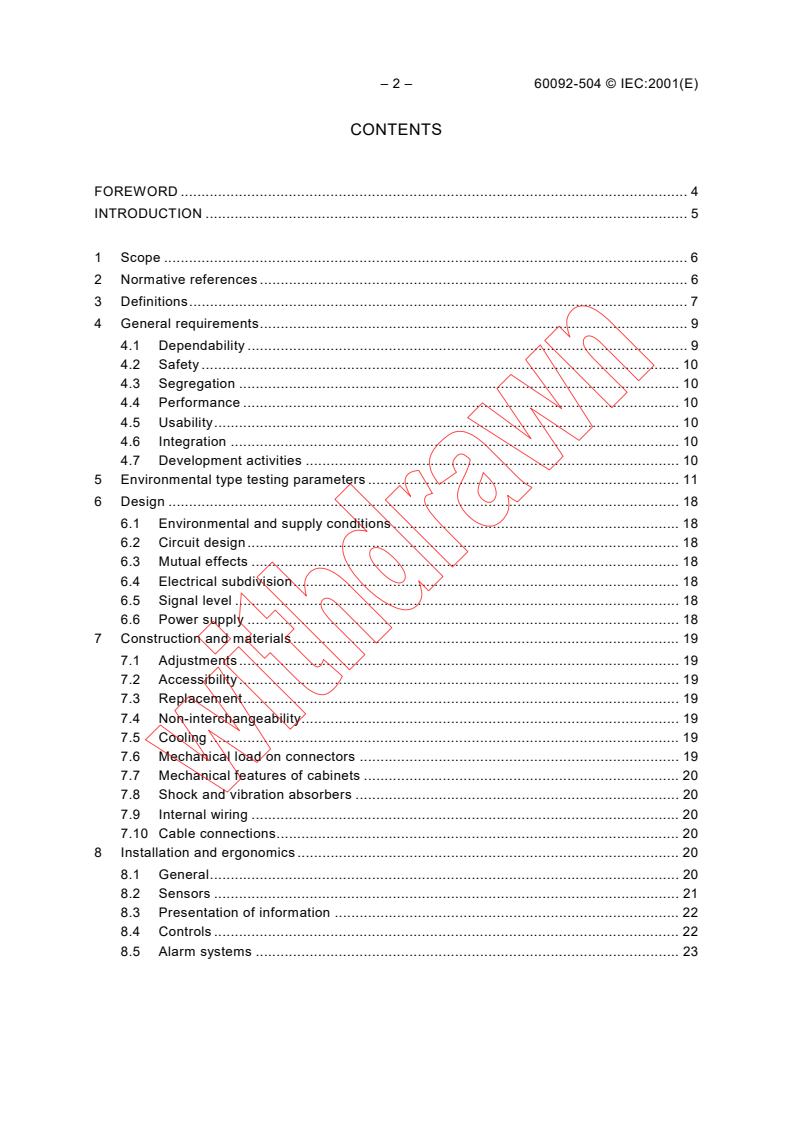
– 2 – 60092-504 © IEC:2001(E)
CONTENTS
FOREWORD . 4
INTRODUCTION .5
1 Scope . 6
2 Normative references . 6
3 Definitions. 7
4 General requirements. 9
4.1 Dependability . 9
4.2 Safety . 10
4.3 Segregation . 10
4.4 Performance . 10
4.5 Usability. 10
4.6 Integration . 10
4.7 Development activities . 10
5 Environmental type testing parameters . 11
6 Design . 18
6.1 Environmental and supply conditions . 18
6.2 Circuit design. 18
6.3 Mutual effects . 18
6.4 Electrical subdivision. 18
6.5 Signal level . 18
6.6 Power supply . 18
7 Construction and materials . 19
7.1 Adjustments. 19
7.2 Accessibility . 19
7.3 Replacement. 19
7.4 Non-interchangeability. 19
7.5 Cooling . 19
7.6 Mechanical load on connectors . 19
7.7 Mechanical features of cabinets . 20
7.8 Shock and vibration absorbers . 20
7.9 Internal wiring . 20
7.10 Cable connections. 20
8 Installation and ergonomics . 20
8.1 General. 20
8.2 Sensors . 21
8.3 Presentation of information . 22
8.4 Controls . 22
8.5 Alarm systems . 23
60092-504 © IEC:2001(E) – 3 –
9 Specific installations. 23
9.1 Fire protection control installations . 23
9.2 Machinery alarm installations . 28
9.3 Automatic control installations for electrical power supply . 30
9.4 Automatic starting installations for electrical motor-driven auxiliaries . 33
9.5 Machinery control installations. 35
9.6 Machinery protection (safety) systems . 37
9.7 Bow, inner, side shell and stern doors . 38
9.8 Power-operated watertight doors . 40
9.9 Public address systems on passenger ships . 42
10 Computer-based systems . 43
10.1 General. 43
10.2 System safety . 44
10.3 System configuration. 44
10.4 System integration . 45
10.5 Power supply . 45
10.6 Data communications links. 45
10.7 User interface . 46
10.8 Alarm, control and safety functions. 48
10.9 Software . 49
10.10 Tests . 50
10.11 Documentation. 51
11 Additional requirements for periodically unattended machinery spaces or for
reduced attendance. 53
11.1 Introduction. 53
11.2 General requirements. 53
11.3 Fire precautions . 53
11.4 Protection against flooding . 54
11.5 Control of propulsion machinery . 54
11.6 Alarm system . 54
11.7 Protection (safety) systems . 55
11.8 Special requirements for machinery, boiler and electrical installations. 55
12 Commissioning and testing. 56
12.1 Tests of completed installation . 56
12.2 Operational tests. 56
13 Documentation. 57
13.1 Apparatus description. 57
13.2 Circuit diagrams. 57
– 4 – 60092-504 © IEC:2001(E)
INTERNATIONAL ELECTROTECHNICAL COMMISSION
___________
ELECTRICAL INSTALLATIONS IN SHIPS –
Part 504: Special features –
Control and instrumentation
FOREWORD
1) The IEC (International Electrotechnical Commission) is a worldwide organization for standardization comprising
all national electrotechnical committees (IEC National Committees). The object of the IEC is to promote
international co-operation on all questions concerning standardization in the electrical and electronic fields. To
this end and in addition to other activities, the IEC publishes International Standards. Their preparation is
entrusted to technical committees; any IEC National Committee interested in the subject dealt with may
participate in this preparatory work. International, governmental and non-governmental organizations liaising
with the IEC also participate in this preparation. The IEC collaborates closely with the International Organization
for Standardization (ISO) in accordance with conditions determined by agreement between the two
organizations.
2) The formal decisions or agreements of the IEC on technical matters express, as nearly as possible, an
international consensus of opinion on the relevant subjects since each technical committee has representation
from all interested National Committees.
3) The documents produced have the form of recommendations for international use and are published in the form
of standards, technical specifications, technical reports or guides and they are accepted by the National
Committees in that sense.
4) In order to promote international unification, IEC National Committees undertake to apply IEC International
Standards transparently to the maximum extent possible in their national and regional standards. Any
divergence between the IEC Standard and the corresponding national or regional standard shall be clearly
indicated in the latter.
5) The IEC provides no marking procedure to indicate its approval and cannot be rendered responsible for any
equipment declared to be in conformity with one of its standards.
6) Attention is drawn to the possibility that some of the elements of this International Standard may be the subject
of patent rights. The IEC shall not be held responsible for identifying any or all such patent rights.
International Standard IEC 60092-504 has been prepared by IEC technical committee 18:
Electrical installations of ships and of mobile and fixed offshore units.
This third edition cancels and replaces the second edition, published in 1994, and constitutes a
technical revision.
The text of this standard is based on the following documents:
FDIS Report on voting
18/889/FDIS 18/890/RVD
Full information on the voting for the approval of this standard can be found in the report on
voting indicated in the above table.
This publication has been drafted in accordance with the ISO/IEC Directives, Part 3.
The committee has decided that the contents of this publication will remain unchanged until
2005. At this date, the publication will be
• reconfirmed;
• withdrawn;
• replaced by a revised edition, or
• amended.
A bilingual version of this standard may be issued at a later date.
The contents of the corrigendum of January 2011 have been included in this copy.
60092-504 © IEC:2001(E) – 5 –
INTRODUCTION
IEC 60092 forms a series of International Standards intended to ensure safety in the design,
selection, installation, maintenance and use of electrical equipment for the generation, storage,
distribution and utilization of electrical energy for all purposes in seagoing ships.
This part of IEC 60092 also incorporates and co-ordinates, as far as possible, existing rules
and forms a code of interpretation, where applicable, of the requirements of the International
Maritime Organization, and serves as a guide for future regulations which may be prepared and
as a statement of practice for use by shipowners, shipbuilders and appropriate organizations,
and by constructors and appropriate organizations.
This standard is based on equipment and practices which are in current use, but it is not
intended in any way to impede development of new or improved techniques.
– 6 – 60092-504 © IEC:2001(E)
ELECTRICAL INSTALLATIONS IN SHIPS –
Part 504: Special features –
Control and instrumentation
1 Scope
This part of IEC 60092 deals with electrical, electronic and programmable equipment intended
for control, monitoring, alarm and protection systems for use in ships.
2 Normative references
The following normative documents contain provisions which, through reference in this text,
constitute provisions of this part of IEC 60092. For dated references, subsequent amendments
to, or revisions of, any of these publications do not apply. However, parties to agreements
based on this part of IEC 60092 are encouraged to investigate the possibility of applying the
most recent editions of the normative documents indicated below. For undated references, the
latest edition of the normative document referred to applies. Members of IEC and ISO maintain
registers of currently valid International Standards.
IEC 60050 (all parts), International Electrotechnical Vocabulary (IEV)
IEC 60068-2-1, Environmental testing – Part 2: Tests – Tests A: Cold
IEC 60068-2-2, Environmental testing – Part 2: Tests – Tests B: Dry heat
IEC 60068-2-6, Environmental testing – Part 2: Tests – Tests Fc: Vibration (sinusoidal)
IEC 60068-2-30, Environmental testing – Part 2: Tests – Tests Db and guidance: Damp heat,
cyclic (12 + 12-hour cycle)
IEC 60068-2-52, Environmental testing – Part 2: Tests – Tests Kb: Salt mist, cyclic (sodium
chloride solution)
IEC 60092 (all parts), Electrical installations in ships
IEC 60092-101, Electrical installations in ships – Part 101: Definitions and general
requirements
IEC 60092-201, Electrical installations in ships – Part 201: System design – General
IEC 60092-202, Electrical installations in ships – Part 202: System design – Protection
IEC 60092-204, Electrical installations in ships – Part 204: System design – Electric and
electrohydraulic steering gear
IEC 60092-302, Electrical installations in ships – Part 302: Low voltage switchgear and
controlgear assemblies
IEC 60092-375, Electrical installations in ships. Shipboard telecommunication cables and radio-
frequency cables. General instrumentation, control and communication cables
IEC 60092-376, Electrical installations in ships – Part 376: Shipboard multicore cables for
control circuits
IEC 60092-401, Electrical installations in ships – Part 401: Installation and test of completed
installation
60092-504 © IEC:2001(E) – 7 –
IEC 60092-501, Electrical installations in ships – Part 501: Special features – Electric
propulsion plant
IEC 60092-502, Electrical installations in ships – Part 502: Tankers – Special features
IEC 60447, Man-machine interface (MMI) – Actuating principles
IEC 60529, Degrees of protection provided by enclosures (IP Code)
IEC 60533, Electrical and electronic installations in ships – Electromagnetic compatibility
IEC 60945, Maritime navigation and radiocommunication equipment and systems – General
requirements – Methods of testing and required test results
IEC 61000-4-2, Electromagnetic compatibility (EMC) – Part 4: Testing and measurement
techniques – Section 2: Electrostatic discharge immunity test. Basic EMC Publication
IEC 61000-4-3, Electromagnetic compatibility (EMC) – Part 4: Testing and measurement
techniques – Section 3: Radiated, radio-frequency, electromagnetic field immunity test
IEC 61000-4-4, Electromagnetic compatibility (EMC) – Part 4: Testing and measurement
techniques – Section 4: Electrical fast transient/burst immunity test. Basic EMC Publication
IEC 61000-4-5, Electromagnetic compatibility (EMC) – Part 4: Testing and measurement
techniques – Section 5: Surge immunity test
IEC 61000-4-6, Electromagnetic compatibility (EMC) – Part 4: Testing and measurement
techniques – Section 6: Immunity to conducted disturbances, induced by radio-frequency fields
IEC 61000-4-11, Electromagnetic compatibility (EMC) – Part 4: Testing and measuring
techniques – Section 11: Voltage dips, short interruptions and voltage variations immunity tests
CISPR 16-1, Specification for radio disturbance and immunity measuring apparatus and
methods – Part 1: Radio disturbance and immunity measuring apparatus
CISPR 16-2, Specification for radio disturbance and immunity measuring apparatus and
methods – Part 2: Methods of measurement of disturbances and immunity
IMO Assembly Resolution A.830 (19)1995, Code on Alarms and Indicators
NOTE Other informative IMO documents are referenced within the text of this standard.
3 Definitions
For the purposes of this part of IEC 60092, the following definitions, having special application
to the control, monitoring, alarm and protection equipment, apply. For definitions of general and
more particular terms, reference is made to IEC 60050 (IEV) and other normative documents.
3.1
accuracy
quality which characterizes the closeness of a measured value to the corresponding true value
3.2
alarm functions
functions intended to alert relevant personnel, by visual and audible means, in the event of any
condition requiring their attention
___________
See IMO 867E:1996, Code on Alarms and Indicators, 1995
– 8 – 60092-504 © IEC:2001(E)
3.3
availability
ability of an item to be in a state to perform a required function under given conditions at a
given time interval, assuming that the required external resources are provided
3.4
centralized control
control of all operations of a controlled system from one central control position
3.5
computer-based system
system that consists of one or more programmable electronic devices with their connections,
peripherals and software necessary to carry out automatically specified functions
NOTE The following types of programmable devices could form part of a computer system: main-frame, mini-
computer, micro-processor-based computer, programmable logic controller.
3.6
control functions
functions intended to regulate the behavior of equipment or systems
3.7
control position (control station)
group of control devices by which an operator can control the performance of a machine,
apparatus, process or assembly of machines and apparatus.
NOTE A control position will generally enable an operator to verify the achievement of the desired conditions by
means of an appropriate monitoring system
3.8
dependability
extent to which a system can be relied upon to perform its intended functions under defined
operational and environmental conditions
3.9
essential services
functions necessary for the propulsion, steering and safety of the ship and its personnel
3.10
fail-to-safe
principle by which a failure or malfunction of a component of the system causes its output to
automatically adjust to a predetermined safe state
NOTE The safe state, according to the application, will be predetermined in terms of priority for the safety of the
ship and may generally be taken as the least critical one for the main components and auxiliaries of, for example,
the propulsion/manoeuvring plant.
3.11
function
elementary operation performed by the system which, in conjunction with other elementary
operations (system functions), enables the system to perform a task
3.12
indication functions
functions intended to inform relevant personnel, by visual and/or audible means, of any
equipment or system status
60092-504 © IEC:2001(E) – 9 –
3.13
integrity
capability of a system to satisfactorily perform the required functions under all the stated
conditions within a stated period of time
3.14
machinery control room
room or spaces where centralized controls and measuring and monitoring equipment for main
equipment and essential auxiliary machinery are located together with the appropriate means
of communication
3.15
maintainability
ability of an item under given conditions of use, to be retained in, or restored to, a state in
which it can perform a required function, when maintenance is performed under given
conditions and using stated procedures and resources
3.16
monitoring functions
functions intended to collect data from equipment and systems for the purpose of display and
recording
3.17
protection functions
functions intended to prevent damage to equipment or systems in the event of a fault
3.18
reliability
ability of an item to perform a required function under given conditions for a given time interval
3.19
safety functions
functions intended to prevent harm or danger to personnel
3.20
software
program, procedures and associated documentation pertaining to the operation of a computer
system and including application (user) program, middleware and operating system (firmware)
program
3.21
system
collection of components organised to accomplish a specific function or set of functions
3.22
usability
extent to which a system can be used by specified users to achieve specified goals with
effectiveness, efficiency and satisfaction in a specified context of use
4 General requirements
4.1 Dependability
Systems shall be suitable for the user, the task and the application.
– 10 – 60092-504 © IEC:2001(E)
System integrity shall be appropriate for the functions supported, with due regard to factors
such as availability, reliability and maintainability.
4.2 Safety
Systems shall be designed such that risk of harm to persons or the environment is reduced to
a level acceptable to the appropriate authority, both in normal operation and under failure
conditions. Functions shall be designed on the fail-to-safe principle.
4.3 Segregation
Systems shall be designed such that failure of one component part or sub-system will not
unduly affect any other system, sub-system or component and, as far as is practicable, shall be
detectable.
Protection (safety) functions shall be independent of control and monitoring (alarm) functions.
As far as is practicable, control and monitoring (alarm) functions shall also be independent.
Standby systems, or other redundancy arrangements, are to be functionally independent.
4.4 Performance
Systems shall maintain specified levels of performance in operation, and where necessary,
under fault conditions.
Repeatability and accuracy shall be adequate for the proposed use and shall be maintained at
their specified value during their expected lifetime and normal use.
Systems shall be stable throughout their operational range.
4.5 Usability
Systems shall be readily usable under all intended operating conditions and shall support
effective and efficient operation.
Adequate safeguards against incorrect operation shall be provided.
4.6 Integration
Where safety of personnel may directly depend on correct system operation or failure, such
systems shall not be integrated with, or be mutually dependent upon, any other system, except
those providing complementary functions.
Where safety may indirectly depend on system operation or failure, the integrity of the
integrated system shall be to the satisfaction of the appropriate authority.
4.7 Development activities
Activities undertaken in the development process, from initial design through to eventual
realisation, and any modifications in use thereafter, shall be planned and structured in a
systematic manner, and are to be properly managed. Persons responsible for carrying out
these activities shall be competent to do so.
Activities, scopes, responsibilities and competencies shall be documented.
60092-504 © IEC:2001(E) – 11 –
5 Environmental type testing parameters
Where equipment or systems are subject to type testing, the test procedures and severities
specified in table 1 shall apply.
NOTE Compliance with IMO Res. A.813(19) will require all ship’s electrical and electronic equipment to be tested
to the relevant electromagnetic compatibility standard.
Table 1 – Type tests, test procedures and severities
a
Test Procedure
Severity Other information
according to
1 Visual Examination of the equipment for:
inspection
– conformity to drawings and design
data;
– compliance with applicable
IEC standards;
– quality of workmanship and
construction.
2 Functional Standard atmospheric conditions:
test to
– temperature: 25 °C ± 10 °C
equipment
specification
– relative humidity: 60 % ± 30 %
– air pressure: 96 kPa ± 10 kPa
3 High voltage Rated insulation Test voltage AC Frequency of test voltage: 50 Hz or
test voltage U 60 Hz.
n
V
V Separate circuits to be tested
against each other.
All circuits connected with each
other are to be tested against earth.
Contact pieces are to be tested
across their open points of contact.
Printed circuits with electronic
components which could be subject
to damage may be removed during
the test.
Un ≤ 65 2 × Un + 500
1 500
66 < U ≤ 250
n
2 000
251 < U ≤ 500
n
501 < U ≤ 690 2 500
n
Period of application of test voltage:
1 min
___________
IMO A.813 (19):1995, General requirements for electromagnetic compatibility (EMC) for all electrical and
electronic ships equipment
– 12 – 60092-504 © IEC:2001(E)
Table 1 (continued)
a
Test Procedure
Severity Other information
according to
4a Power IEC 61000-4-11 AC supply
supply
variations
Combination Voltage Frequency Each combination shall be tested.
No. variation variation
(permanent) (permanent)
% %
1+6 +5
2+6 –5
3 –10 –5
4 –10 +5
Voltage Frequency
transient transient
(duration 1,5 s) (duration 5 s)
5+20 +10
6 –20 –10
DC supply
Voltage tolerance ±10 %
continuous
Voltage cyclic variation 5 %
Voltage ripple 10 %
Electrical battery supply:
+30 % to –25 % for equipment connected to
charging battery or as determined by the
charging/discharging characteristics, including
ripple voltage from the charging device;
+20 % to –25 % for equipment not connected
to the battery during charging.
4b Power IEC 61000-4-11 Three interruptions during 5 minutes Verification of the following:
supply
30 s break time – specified action of the equipment
failure
on loss and restoration of supply;
– there is no corruption of program
or data held in programmable
electronic systems, where
applicable.
60092-504 © IEC:2001(E) – 13 –
Table 1 (continued)
a
Test Procedure
according to Severity Other information
5 Insulation Rated Test voltage Minimum insulation Between all circuits and earth; on
b
resistance supply resistance the supply terminals where
V
voltage appropriate.
Resistance shall be measured
V
before and after high voltage test,
damp heat test, cold test and salt
mist test.
Before After test
test
MΩ
MΩ
U ≤ 65 2 × U 10 1
n n
min. 24
500 100 10
U > 65
n
6 Cold with IEC 60068-2-1 +5 °C ± 3 °C –25 °C ± 3 °C Initial measurement of insulation
gradual resistance (see test 6)
Test Ab for 2 h 2 h
change of
non-heat Equipment not operating during
temperature
c
dissipating conditioning except for operational
equipment tests
IEC 60068-2-1 Operational test during last hour at
test temperature
Test Ad for
heat Insulation resistance measurement
dissipating and operational test after recovery
equipment
7 Dry heat IEC 60068-2-2 55 °C ± 2 °C 70 °C ± 2 °C Equipment operating during
with gradual conditioning
16 h 2 h
change of
Operational test during last hour at
temperature
Test Bb for
d
test temperature
non-heat
dissipating Operational test after recovery
equipment
IEC 60068-2-2 55 °C ± 2 °C 70 °C ± 2 °C Equipment operating during
conditioning with cooling system
Test Bd for 16 h 2 h
on if provided
heat
dissipating Operational test during last hour at
equipment test temperature
Operational test after recovery
– 14 – 60092-504 © IEC:2001(E)
Table 1 (continued)
a
Test Procedure Severity Other information
according to
Damp IEC 60068-2-30 Temperature: 55 °C Measurement of insulation
heat, resistance before test
Test Db Humidity: 95 %
cyclic
Equipment operating during
(12 h+12 h
Duration: two cycles
the complete first cycle and
j
cycle)
(12 h + 12 h)
switched off during second
cycle except for functional
test
Functional test during the
first 2 h of the first cycle at
the test temperature and
during the last 2 h of the
second cycle at the test
temperature
Recovery at standard
atmosphere conditions
Insulation resistance
measurements and
performance test
e
9Salt mist IEC 60068-2-52 Four spraying periods with a storage of 7 days Initial measurement of
after each insulation resistance and
Test Kb
initial functional test
Equipment in its normal
position during test
Equipment not operating
during conditioning
Operational test on day 7 of
each spraying period
Insulation resistance
measurement and
performance test 4 h to 6 h
after the recovery period
10 Vibration IEC 60068-2-6 For general For equipment mounted on During the vibration test,
(sinu- applications reciprocating machines, operational conditions are to
Test Fc
soidal) installed in steering gear be demonstrated.
+3
2 Hz to 13,2 Hz compartment or similar
−0
Tests to be carried out in
locations
three mutually perpendicular
amplitude ±1 mm
+3 planes.
13,2 Hz to 100 Hz 2 Hz to 25 Hz
−
acceleration ±0,7 g
It is recommended as
Amplitude ±1,6 mm
guidance that Q does not
Endurance at:
exceed 5.
25 Hz to 100 Hz
– each resonance
If sweep test is chosen,
frequency at which Acceleration ±4 g
where several resonance
an amplification
frequencies are detected
Endurance at:
factor Q ≥ 2 is
close to each other, duration
recorded;
– each resonance frequency
of test shall be 120 min.
at which an amplification
– 30 Hz if no
factor Q ≥ 2 is recorded;
resonance
frequency is
–30 Hz if no resonance
recorded.
frequency is recorded.
90 min
40 Hz to 2 000 Hz acceleration ±10 g Only for extreme conditions
e.g. on exhaust manifolds of
90 min
diesel engines
60092-504 © IEC:2001(E) – 15 –
Table 1 (continued)
a
Test Procedure Severity Other information
according to
11a Inclination 22,5° Each direction
a, i
steady
Equipment operating
11b Inclination 22,5° Each direction
dynamic
0,1 Hz Equipment operating
Duration of test not less than 15 min
12 Enclosure IEC 60529 Dependent on location See table 5 of IEC 60092-201 for
protection minimum requirements.
13 Electrostatic IEC 61000-4-2 Contact discharge: 6 kV Electrostatic discharge as may
discharge occur when persons touch the
Air discharge: 8 kV
appliance
Interval between single discharges: 1 s
The test is to be confined to the
points and surfaces that can
No. of pulses: 10 per polarity
normally be reached by the
According to level 3 severity standard operator.
f
.
Performance criterion B: see note
14 Electro- IEC 61000-4-3 Frequency range: 80 MHz – 2 GHz Electromagnetic fields radiated by
magnetic field different transmitters
Modulation: 80 % AM at 1 000 Hz
If for tests of equipment an input
Field strength: 10 V/m
signal with a modulation frequency
–3 of 1 000 Hz is necessary, a
Frequency sweep rate: ≤1,5 × 10
modulation frequency of 400 Hz may
decades/s (or 1 %/3 sec) be chosen.
g
Performance criterion A: see note .
According to level 3 severity standard.
15 Conducted low IEC 60533 AC: Distortions in the power supply
frequency system generated for instance by
Frequency range: rated frequency to
electronic consumers and coupled in
th
200 harmonic;
as harmonics
Test voltage (r.m.s.): 10 % of supply to
Method of the test in accordance
th th
15 harmonic reducing to 1 % at 100
with IEC 60945
harmonic and maintain this level to the
th
g
200 harmonic, max 2 W Performance criterion A: see note .
DC:
Frequency range: 50 Hz – 10 kHz;
Test voltage (r.m.s.): 10 % of supply,
max. 2 W
16 Conducted IEC 61000-4-6 Frequency range: 150 kHz – 80 MHz Electromagnetic fields coupled as
radio high frequency into the test
h
Amplitude: 3 V r.m.s.
frequency specimen via the connecting lines
Modulation: 80 % AM at 1 000 Hz
If for tests of equipment an input
signal with a modulation frequency
Frequency sweep range
–3 of 1 000 Hz is necessary, a
≤ 1,5 × 10 decades/s (or 1 %/3 sec.)
modulation frequency of 400 Hz may
According to level 2 severity standard be chosen.
g
Performance criterion A: see note .
– 16 – 60092-504 © IEC:2001(E)
table 1 (continued)
Test Procedure Severity Other information
(note 1) according to
17 Burst/fast IEC 61000-4-4 Single pulse time: 5 ns (between 10 % Arcs generated when actuating
transients and 90 % value) electrical contacts
Pulse width: 50 ns (50 % value) Interference effect occurring on the
power supply, as well as the
Amplitude (peak): 2 kV line/line on power
external wiring of the test specimen
supply port;
f
Performance criterion B: see note .
1 kV lines/earth on I/O data control and
signal lines;
Pulse period: 300 ms;
Burst duration: 15 ms;
Duration/polarity: 5 min
According to level 3 severity standard
18 Surge/show IEC 61000-4-5 Interference generated for instance,
Pulse rise time: 1,2 μs, (between 10 %
transient by switching "ON" or "OFF" high
and 90 % value)
power inductive consumers
Pulse width: 50 μs (50 % value)
Test procedure in accordance with
Amplitude (peak): 1 kV line/earth;
figure 10 of the standard for
equipment where power and signal
0,5 kV line/line
lines are identical
Repetition rate >1 pulse/min
f
Performance criterion B: see note .
No. of pulses: five per polarity
Application: continuous
According to level 2 severity standard
19 Radiated CISPR 16-1 For equipment installed in the bridge and Procedure in accordance with the
emission deck zone standard but distance 3 m between
CISPR 16-2
equipment and antenna
Frequency range: Limits:
0,15 – 0,3 MHz 80 – 52 dBμV/m
0,3 – 30 MHz 52 – 34 dBμV/m
30 – 2 000 MHz 54 dBμV/m
except for:
156 – 165 MHz 24 dBμV/m
For equipment installed in the general
power distribution zone
Frequency range: Limits:
0,15 – 30 MHz 80 – 50 dB V/m
μ
30 – 100 MHz 60 – 54 dBμV/m
100 – 2 000 MHz 54 dBμV/m
except for:
156 – 165 MHz 24 dBμV/m
60092-504 © IEC:2001(E) – 17 –
Table 1 (continued)
a
Test Procedure Severity Other information
according to
20 Conducted CISPR 16-1 For equipment installed in the bridge and
emission deck zone
CISPR 16-2
Frequency range: Limits:
10 – 150 kHz 96 – 50 dBμV
150 – 350 kHz 60 – 50 dBμV
350 kHz – 30 MHz 50 dBμV
For equipment installed in the general
power distribution zone
Frequency range: Limits:
10 – 150 kHz 120 – 69 dBμV
0,15 – 0.5 MHz 79 dBμV
0,5 – 30 MHz 73 dBμV
21 Flame IEC 60092-101 Flame application: The burnt-out or damaged part of
retardancy the specimen is not to exceed
– 5 times, 15 s each
60 mm in length
(cables)
Interval between each application:
– 15 s
a
The static inclination test is not required on equipment with no moving parts.
b
Insulation resistance test to be carried out before and after damp heat test, cold test and salt mist test.
c
For equipment installed in non-weather-protected locations or cold locations, test is to be carried out at
–25 °C.
d
Dry heat at 70 °C is to be carried out to withstand a high degree of heat, e.g. for equipment to be mounted in
consoles, housings.
e
Salt mist test to be carried out for equipment to be installed in non-weatherprotected areas, for example on open
deck.
f
Performance criterion B: the equipment under test (EUT) shall continue to operate as intended after the tests. No
degradation of performance or loss of function is allowed as defined in the technical specification published by
the manufacturer. During the test, degradation or loss of function or performance which is self-recoverable is,
however, allowed but no change of actual operating state or stored data is allowed.
Recovery times shall be consistent with continued safe operation, taking due account of the need to preserve
essential services.
g
Performance criterion A: the equipment under test (EUT) shall continue to operate as intended during and after
the test. No degradation of performance or loss of function is allowed, as defined in the technical specification
published by the manufacturer.
h
For equipment installed on the bridge and deck zone the test levels shall be increased to 10 V r.m.s. for spot
frequencies in accordance with IEC 60945 at 2 ; 3 ; 4 ; 6,2 ; 8,2 ; 12,6 ; 16,5 ; 18,8 ; 22 ; 25 MHz.
i
On ships for the carriage of liquid gases and chemicals, the emergency power supply must also remain
operational with the ship flooded up to maximum athwarthship inclination of 30°.
j
This test shall be carried out for equipment located in non-air-conditioned spaces.
– 18 – 60092-504 © IEC:2001(E)
6 Design
6.1 Environmental and supply conditions
Equipment shall be designed to operate satisfactorily within the expected environmental and
supply conditions, with due regard to the limits specified in Annex B of IEC 60092-101.
6.2 Circuit design
Circuits shall be designed to enable efficient test, calibration, maintenance and repair.
Preferably, they shall be suitable for repair by unit or card replacement. In some cases, it may
be desirable to provide simulation circuits or similar means to check correct operation of the
equipment.
6.3 Mutual effects
Systems shall be arranged such that faults will not affect any function provided by any other
system.
6.4 Electrical subdivision
Design of circuits shall be such that there is no direct connection to any point of the ship's main
power supply system, e.g. isolating transformers shall be used for power supplies. The chassis
may not form part of any circuit, except earthing for functional reasons.
It is recommended that extensive systems be subdivided and the supplies to the sections be
electrically separated or individually protected.
Control circuits shall be separated from signal and indicating circuits in such a way that faults
in the indicating circuits will not impair the operation of the equipment or apparatus, and vice
versa.
6.5 Signal level
Signal levels shall be kept high enough to overcome the effects of contact corrosion and noise
pick-up.
Transducers and amplifiers shall be situated as close to each other as it is practicable.
Particular attention shall be paid to the earthing (grounding) of screens and signal reference
systems.
To avoid possible interference on control and instrumentation cables, suitable installation
features shall be provided, such as:
– screening and/or twisted pairs;
– use of balanced input amplifiers;
– separation between signal and other cables.
6.6 Power supply
6.6.1 Independent supplies
Where required, redundant power supplies shall be independent and the system selectively fed.
60092-504 © IEC:2001(E) – 19 –
6.6.2 Capacity
The capacity of any back-up source shall be sufficient to ensure the normal operation of the
system until safety conditions are reached.
6.6.3 Protection
Each circuit shall be separately protected against short-circuit and overloads.
7 Construction and materials
7.1 Adjustments
Where necessary, equipment shall be arranged for simple adjustment. The set points shall be
readily identifiable and suitable means shall be provided to protect against changes, e.g. due to
environmental effect.
7.2 Accessibility
Ease of access to interchangeable parts for repairs and maintenance shall be ensured.
As far as is practicable, equipment shall be free of voltage, temperature, or other such factors
which may present unsafe working conditions.
7.3 Replacement
Each replaceable assembly shall be simple to replace and shall be constructed for easy and
safe handling.
7.4 Non-interchangeability
Preferably, all replaceable parts shall be so arranged that it is not possible to connect them
incorrectly or to use incorrect replacements. Where this is not practicable, the replaceabl
...