


IEC PAS 60936-5:2003
(Main)Maritime navigation and radiocommunication equipment and systems - Radar - Part 5: Guidelines for the use and display of AIS information on radar
General Information
- Abstract
Specifies the minimum operational and performance requirements, methods of testing and required test results and the effect on extant standards, that are recommended to be complied with for optional equipment conforming to Interim Operational Guidelines not inferior to those adopted by the IMO in SN/Circ.217. Is limited to requirements for superimposition of selected parts of AIS information on radar systems.
- Status
- Replaced
- Publication Date
- 09-Sep-2003
- Technical Committee
- TC 80 - Maritime navigation and radiocommunication equipment and systems
- Drafting Committee
- WG 1 - TC 80/WG 1
- Current Stage
- DELPUB - Deleted Publication
- Start Date
- 13-Dec-2007
- Completion Date
- 28-Aug-2026
Buy Documents



IEC PAS 60936-5:2003 - Maritime navigation and radiocommunication equipment and systems - Radar - Part 5: Guidelines for the use and display of AIS information on radar Released:9/10/2003
Relations
- Effective Date
- 05-Sep-2023
Buy Documents
IEC PAS 60936-5:2003 - Maritime navigation and radiocommunication equipment and systems - Radar - Part 5: Guidelines for the use and display of AIS information on radar Released:9/10/2003
Get Certified
Connect with accredited certification bodies for this standard

DNV
DNV is an independent assurance and risk management provider.

Lloyd's Register
Lloyd's Register is a global professional services organisation specialising in engineering and technology.

FSC International
Forest Stewardship Council certification.
Sponsored listings
Frequently Asked Questions
IEC PAS 60936-5:2003 is a technical specification published by the International Electrotechnical Commission (IEC). Its full title is "Maritime navigation and radiocommunication equipment and systems - Radar - Part 5: Guidelines for the use and display of AIS information on radar". This standard covers: Specifies the minimum operational and performance requirements, methods of testing and required test results and the effect on extant standards, that are recommended to be complied with for optional equipment conforming to Interim Operational Guidelines not inferior to those adopted by the IMO in SN/Circ.217. Is limited to requirements for superimposition of selected parts of AIS information on radar systems.
Specifies the minimum operational and performance requirements, methods of testing and required test results and the effect on extant standards, that are recommended to be complied with for optional equipment conforming to Interim Operational Guidelines not inferior to those adopted by the IMO in SN/Circ.217. Is limited to requirements for superimposition of selected parts of AIS information on radar systems.
IEC PAS 60936-5:2003 is classified under the following ICS (International Classification for Standards) categories: 47.020.70 - Navigation and control equipment. The ICS classification helps identify the subject area and facilitates finding related standards.
IEC PAS 60936-5:2003 has the following relationships with other standards: It is inter standard links to IEC 62388:2007. Understanding these relationships helps ensure you are using the most current and applicable version of the standard.
IEC PAS 60936-5:2003 is available in PDF format for immediate download after purchase. The document can be added to your cart and obtained through the secure checkout process. Digital delivery ensures instant access to the complete standard document.
Standards Content (Sample)
IEC/PAS 60936-5
Edition 1.0
2003-09
Maritime navigation and
radiocommunication equipment
and systems –
Radar –
Part 5:
Guidelines for the use and display
of AIS information on radar
PUB LI C LY AV AI LAB L E SPECI F IC ATI ON
I N TE RNA T I O N A L
ELEC T R OT EC H N I C AL
Reference number
CO MMI S S I O N
IEC/PAS 60936-5
IEC/PAS 60936-5
Edition 1.0
2003-09
Maritime navigation and
radiocommunication equipment
and systems –
Radar –
Part 5:
Guidelines for the use and display
of AIS information on radar
PUB LI C LY AV AI LAB L E SPECI F IC ATI ON
I N TE RNA T I O N A L
ELEC T R OT EC H N I C AL
Reference number
CO MMI S S I O N
IEC/PAS 60936-5
– 2 – Copyright © 2003, IEC
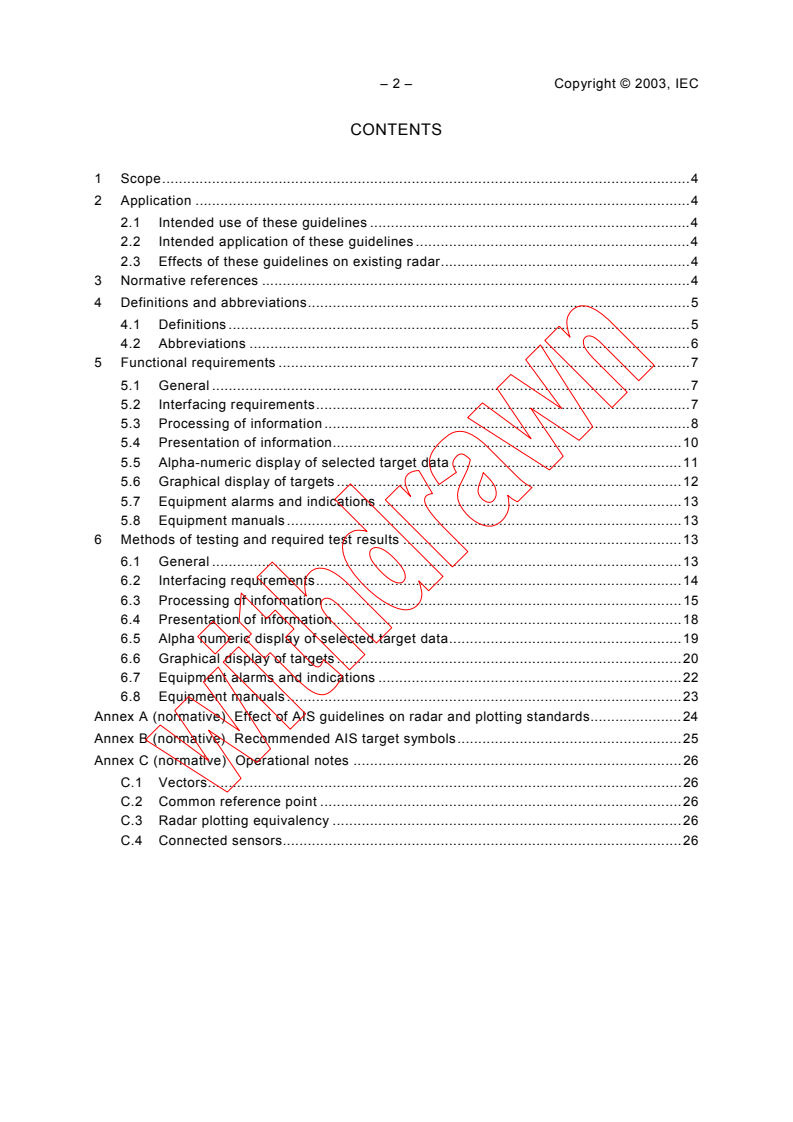
CONTENTS
1 Scope.4
2 Application.4
2.1 Intended use of these guidelines .4
2.2 Intended application of these guidelines .4
2.3 Effects of these guidelines on existing radar.4
3 Normative references.4
4 Definitions and abbreviations.5
4.1 Definitions.5
4.2 Abbreviations.6
5 Functional requirements.7
5.1 General.7
5.2 Interfacing requirements.7
5.3 Processing of information .8
5.4 Presentation of information.10
5.5 Alpha-numeric display of selected target data .11
5.6 Graphical display of targets .12
5.7 Equipment alarms and indications .13
5.8 Equipment manuals.13
6 Methods of testing and required test results .13
6.1 General.13
6.2 Interfacing requirements.14
6.3 Processing of information .15
6.4 Presentation of information.18
6.5 Alpha numeric display of selected target data.19
6.6 Graphical display of targets .20
6.7 Equipment alarms and indications .22
6.8 Equipment manuals.23
Annex A (normative) Effect of AIS guidelines on radar and plotting standards.24
Annex B (normative) Recommended AIS target symbols.25
Annex C (normative) Operational notes .26
C.1 Vectors.26
C.2 Common reference point.26
C.3 Radar plotting equivalency .26
C.4 Connected sensors.26
INTERNATIONAL ELECTROTECHNICAL COMMISSION
____________
MARITIME NAVIGATION AND RADIOCOMMUNICATION
EQUIPMENT AND SYSTEMS – RADAR –
Part 5: Guidelines for the use and display of AIS information on radar
FOREWORD
1) The International Electrotechnical Commission (IEC) is a worldwide organization for standardization comprising
all national electrotechnical committees (IEC National Committees). The object of IEC is to promote
international co-operation on all questions concerning standardization in the electrical and electronic fields. To
this end and in addition to other activities, IEC publishes International Standards, Technical Specifications,
Technical Reports, Publicly Available Specifications (PAS) and Guides (hereafter referred to as “IEC
Publication(s)”). Their preparation is entrusted to technical committees; any IEC National Committee interested
in the subject dealt with may participate in this preparatory work. International, governmental and non-
governmental organizations liaising with the IEC also participate in this preparation. IEC collaborates closely
with the International Organization for Standardization (ISO) in accordance with conditions determined by
agreement between the two organizations.
2) The formal decisions or agreements of IEC on technical matters express, as nearly as possible, an international
consensus of opinion on the relevant subjects since each technical committee has representation from all
interested IEC National Committees.
3) IEC Publications have the form of recommendations for international use and are accepted by IEC National
Committees in that sense. While all reasonable efforts are made to ensure that the technical content of IEC
Publications is accurate, IEC cannot be held responsible for the way in which they are used or for any
misinterpretation by any end user.
4) In order to promote international uniformity, IEC National Committees undertake to apply IEC Publications
transparently to the maximum extent possible in their national and regional publications. Any divergence
between any IEC Publication and the corresponding national or regional publication shall be clearly indicated in
the latter.
5) IEC provides no marking procedure to indicate its approval and cannot be rendered responsible for any
equipment declared to be in conformity with an IEC Publication.
6) All users should ensure that they have the latest edition of this publication.
7) No liability shall attach to IEC or its directors, employees, servants or agents including individual experts and
members of its technical committees and IEC National Committees for any personal injury, property damage or
other damage of any nature whatsoever, whether direct or indirect, or for costs (including legal fees) and
expenses arising out of the publication, use of, or reliance upon, this IEC Publication or any other IEC
Publications.
8) Attention is drawn to the Normative references cited in this publication. Use of the referenced publications is
indispensable for the correct application of this publication.
9) Attention is drawn to the possibility that some of the elements of this IEC Publication may be the subject of
patent rights. IEC shall not be held responsible for identifying any or all such patent rights.
A PAS is a technical specification not fulfilling the requirements for a standard, but made available to
the public.
IEC-PAS 60936-5 has been processed by IEC technical committee 80: Maritime navigation and
radiocommunication equipment and systems.
The text of this PAS is based on the This PAS was approved for
following document: publication by the P-members of the
committee concerned as indicated in
the following document
Draft PAS Report on voting
80/357/PAS 80/375/RVD
Following publication of this PAS, the technical committee or subcommittee concerned will investigate
the possibility of transforming the PAS into an International Standard.
This PAS shall remain valid for no longer than 3 years starting from 2003-09. The validity may be
extended for a single 3-year period, following which it shall be revised to become another type of
normative document or shall be withdrawn.
This PAS document relates to International Standards of the IEC 60936 series and IEC 61993-2. The
document has been co-ordinated with IMO Safety of Navigation circular No.217.
– 4 – Copyright © 2003, IEC
MARITIME NAVIGATION AND RADIOCOMMUNICATION
EQUIPMENT AND SYSTEMS – RADAR –
Part 5: Guidelines for the use and display of AIS information on radar
1 Scope
This document specifies the minimum operational and performance requirements, methods of
testing and required test results and the effect on extant standards, that are recommended to
be complied with for optional equipment conforming to Interim Operational Guidelines not
inferior to those adopted by the IMO in SN/Circ.217 (11 July 2001) – Interim guidelines for the
presentation and display of AIS target information. The scope is further restricted to
requirements for superimposition of selected parts of AIS information on radar systems. All
text of this standard, which is identical to that in IMO SN/Circ.217 is printed in italics and the
Circular and paragraph numbers are indicated in brackets, for example – (C.217/3.3).
The interim guidelines deal with the graphical presentation, alphanumeric information and the
display of AIS target data in standalone or integrated navigational aids or systems and are
considered as an interim performance guideline. They should be replaced by the appropriate
performance standards after experience has been gained. (C.217/2)
The fusion of AIS and radar plotting (RP) data and information is not detailed in this guideline
as it is only permitted when the functionality meets the requirements of an ‘Integrated
Navigation System’, as specified in the relevant IMO Performance Standards.
2 Application
2.1 Intended use of these guidelines
These guidelines are intended to apply to all SOLAS ship’s radar and radar plotting displays
1 1 1
) ) )
complying to IMO MSC.64(67) Annex 4 , IMO A.820(19) and IMO A.823(19) .
2.2 Intended application of these guidelines
The application of these Guidelines is intended to reduce OoW workload, provide common
training and enhance situation awareness for safety.
2.3 Effects of these guidelines on existing radar
The effect of these guidelines on the extant radar and radar plotting standards is given in
A n nex A.
3 Normative references
The following referenced documents are indispensable for the application of this document.
For dated references, only the edition cited applies. For undated references, the latest edition
of the referenced document (including any amendments) applies.
IEC 60872-1:1998, Maritime navigation and radiocommunication equipment and systems –
Radar plotting aids – Part 1: Automatic radar plotting aids (ARPA) – Methods of testing and
required test results
———————
)
As implemented in the IEC 60936 and IEC 60872 series of standards.
IEC 60872-2:1999, Maritime navigation and radiocommunication equipment and systems –
Radar plotting aids – Part 2: Automatic tracking aids (ATA) – Methods of testing and required
test results
IEC 60872-3:2000, Maritime navigation and radiocommunication equipment and systems –
Radar plotting aids – Part 3: Electronic plotting aids (EPA) – Methods of testing and required
test results
IEC 60936-1:2002, Maritime navigation and radiocommunication equipment and systems –
Radar – Part 1: Shipborne radar – Performance requirements – Methods of testing and
required test results
IEC 60936-2:1998, Maritime navigation and radiocommunication equipment and systems –
Radar – Part 2: Shipborne radar for high-speed craft (HSC) – Methods of testing and
required test results
IEC 60936-3:2002, Maritime navigation and radiocommunication equipment and systems –
Radar – Part 3: Radar with chart facilities – Performance requirements – Methods of testing
and required test results
IEC 60945:2002, Maritime navigation and radiocommunication equipment and systems –
General requirements – Methods of testing and required test results
IEC 61162: Maritime navigation and radiocommunication equipment and systems – Digital
interfaces
IEC 61993-2:2001, Maritime navigation and radiocommunication equipment and systems –
Universal shipborne automatic identification system (AIS) installation using VHF TDMA
techniques
)
IEC 62287 AIS class B
IMO MSC.982(73) Guidelines on ergonomic criteria for bridge equipment and layout
IMO SN/Circ.217 (11 July 2001) Interim guidelines for the presentation and display of AIS
target information
4 Definitions and abbreviations
4.1 Definitions
4.1.1
AIS Symbol 1 – Sleeping target
target symbol indicating the presence and orientation of a vessel equipped with AIS in a
certain location. No additional information is presented until AIS targets are activated, thus
avoiding information overload. (C.217/1)
4.1.2
AIS Symbol 2a, b, c – Activated target
symbol representing the automatic or manual activation of a sleeping target for the display of
additional graphically presented information, including:
– a vector (speed and course over ground or water) (2a);
– the heading (2a); and
———————
)
To be published
– 6 – Copyright © 2003, IEC
– ROT or direction of turn indication (if available) to display the actually initiated course
changes (2b) and/or path predictor (if available) (2c). (C.217/1)
4.1.3
AIS Symbol 3 – Selected target
symbol representing the manual or automatic selection of any AIS target for the display of
detailed information in a separate data display area. In this area, received target data as well
as the calculated CPA and TCPA values will be shown.(C.217/1)
4.1.4
AIS Symbol 4 – Dangerous target
symbol representing an AIS target (activated or not) which has data that contravenes pre-set
CPA and TCPA limits. (C.217/1)
4.1.5
AIS Symbol 5 – Lost target
symbol representing the last valid predicted position of an AIS target before the reception of
its data was lost. (C.217/1)
4.1.6
association
is a process by which data from AIS and radar plotting are assessed to represent the same
physical target
4.2 Abbreviations
ACK Acknowledge
AIS Universal shipborne automatic identification system
ALR Alarm
ARPA Automatic Radar Plotting Aid
ATA Automatic Tracking Aid
COG Course over ground
CPA Closest point of approach
CSE Course
DR Dead reckoning
EPA Electronic Plotting Aid
EPFS Electronic Position-Fixing System
EUT Equipment Under Test
HSC High Speed Craft
IEC International Electrotechnical Committee
IMO International Maritime Organization
MMSI Maritime Mobile Service Identity
MSC Maritime Safety Committee of the IMO
ROT Rate Of Turn
RP Radar Plotting
SENC System electronic navigation chart
SOG Speed over ground
SOLAS Safety Of Life At Sea (IMO Convention for the Safety Of Life At Sea)
STW Speed through water
TCPA Time to closest point of approach
TDMA Time division multiple access (system in the VHF maritime mobile band)
TTM Serial output containing the TTM message (IEC 61162)
VDL VHF data link
VDM Serial output message containing VDL message (IEC 61162)
VDO Serial output message containing VDO message (IEC 61162)
5 Functional requirements
5.1 General
5.1.1 Presentation and display of AIS information
In addition to the relevant performance standards, AIS information may be presented and
displayed according to the following interim guidelines. (C.217/2)
5.1.2 Display and indication of AIS functions equivalency
As far as practical, the user interface for operating, displaying and indicating AIS functions
shall be equivalent to the other relevant functions of the navigational aid. (C.217/2.3)
The AIS functionality, controls and display shall be similar to that provided for radar plotting
as far as is practical.
5.1.3 Minimum required AIS information for collision avoidance
The equipment shall provide a facility to enable the user to select at least the minimum AIS
information required for aiding collision avoidance and target identification.
The functionality shall aid collision avoidance by employing those selected parts of the AIS
information necessary and sufficient for the task. (See Table 1)
5.1.4 Graphical display of AIS capability
The equipment shall have the capability to graphically display AIS targets as symbols.
5.1.5 Indication of AIS functionality
Clear and continuous indications shall be given of the status for AIS functionality and
presentation.
5.2 Interfacing requirements
5.2.1 Minimum AIS information input
The minimum recommended selected parts of the AIS information – parts of messages 1, 2,
(AIS class A) and optionally 18 and 19 (AIS class B) – that may be input to the own ship’s
radar for alpha-numeric or graphic display are given in table 1.
– 8 – Copyright © 2003, IEC
Table 1 – Relevant information content input from AIS
Relevant Information for ‘Situation Awareness’ ( Collision Avoidance )
Information provided AIS-VDL AIS Minimum to be
by the AIS message presentation displayed if available
(data from IMO-AIS Spec.) interface by
IEC 61162 RADAR /RP
sentences
Static information
MMSI All VDM a
Dynamic information
Target’s position 1/2, 18/19 VDM g
COG 1/2, 18/19 VDM g, a
SOG 1/2, 18/19 VDM g, a
Heading 1/2, 18/19 VDM g
Turn Indicator or ROT 1/2 VDM g
Where - g = graphic representation, and a = alphanumeric data.
NOTE 1 Messages 18 and 19 are transmitted by Class B (SOLAS carriage exempt ships)
transponders.
NOTE 2 Incomplete AIS information shall be marked accordingly.
5.2.2 Output of AIS information
The output from the AIS is specified by IEC 61162 messages (VDM/VDO). If AIS targets are
transmitted from the radar using the TTM message, then the type of acquisition field shall be
identified with the letter R.
5.3 Processing of information
5.3.1 Zones and limits
If zones or limits for automatic target acquisition are set, these shall be the same for
automatically activating and presenting any targets regardless of their source. (C.217/2.2.1)
Details shall be included in the manufacture’s documentation.
5.3.2 Vector consistency
The vector time set shall be adjustable and valid for presentation of any target regardless of
its source. (C.217/2.2.2) Vectors from radar plotting and AIS shall be of the same "time"
length and shall all be consistent in presentation.
5.3.3 Equivalency of radar plotting and AIS plotting functions
If radar-plotting aids are used for the display of AIS information, these shall be capable of
calculating and displaying collision parameters for AIS equivalent to the available radar
plotting functions. (C.217/2.2.3)
5.3.4 (CPA/TCPA) Alarm
In all cases when the AIS functionality is enabled and if the calculated CPA and TCPA values
of an AIS target are less than the set limits,
• an alarm shall be given; and
• a dangerous target symbol shall be displayed when the system is set to the appropriate
range scale.
The pre-set CPA/TCPA limits applied to target data derived from different sensors shall be
identical. (C.217/2.2.4)
It may be possible to enable/disable the AIS functionality. When disabled, the AIS CPA and
TCPA activity shall also be disabled.
When calculating the CPA/TCPA value of an AIS target the system shall use the last
COG/SOG and/or position values as received from AIS. There shall be no filtering or
prediction based on the rate of turn.
If a failure of own ship or AIS target COG/SOG or other parameters causes the calculated
CPA/TCPA value to be uncertain, a clear indication shall be given (for example AIS symbol
triangle outline to be dashed.) Details of the clear indication method shall be provided in the
manual.
The use of manual speed, set and drift and echo references shall be disabled when AIS
functionality is enabled.
5.3.5 Processing or display overload
An indication shall be provided, when the maximum number of AIS targets that can be
displayed has been reached.
The system shall continue to function normally when the maximum anticipated number (for
example 500) AIS targets possible to be processed has been reached.
5.3.6 Lost target
If the signal of a dangerous AIS target is not received for a set time dependent on the
reporting rates of the AIS target (see Table 2), then:
• a lost target symbol shall appear at the latest predicted position and an alarm be given;
• the lost target symbol shall disappear after the alarm has been acknowledged or after a
pre-set time; and
Means to recover the data for a number of last acknowledged lost targets may be provided.
Preferably this function may also be applied to any AIS target within a certain range/distance.
(C.217/2.2.5)
Table 2 – AIS Reporting Rates
Nominal Lost target Nominal Lost
reporting maximum reporting target
Category of ship
interval interval interval maximum
Class A Class A Class B interval
Class B
Ship at anchor or moored and not moving faster 3 min 18 min 3 min 18 min
than 3 knots (class B not moving faster than 2 knots)
Ship at anchor or moored and moving 10 s 60 s N/A N/A
at more than 3 knots
Ship 0 – 14 knots (class B 2 – 14 knots) 10 s 60 s 30 s 180 s
Ship 0 – 14 knots and changing course 3 1/3 s 60 s
Ship 14 – 23 knots 6 s 36 s 15 s 90 s
Ship 14 – 23 knots and changing course 2 s 36 s
Ship > 23 knots 2 s 12 s 5 s 30 s
Ship > 23 knots and changing course 2 s 12 s
– 10 – Copyright © 2003, IEC
5.3.7 Ownship position – lost
If ownship EPFS position is lost, AIS functionality shall be disabled unless a DR position is
used. If used for CPA/TCPA calculations a clear indication shall be given. A DR position may
only be used for up to 10 minutes after which AIS functionality shall be disabled.
5.3.8 Automatic display function
An automatic display selection function (target association) may be provided to avoid the
presentation of two target symbols for the same physical target. If target data from AIS and
from radar plotting functions are available and if the automatic display selection criteria is
fulfilled then the activated AIS target symbol shall be presented. Otherwise the respective
radar plotting and AIS symbols shall be displayed separately. The operator shall have the
option to make reasonable changes to the default parameters of automatic display selection
(association) criteria. (C.217/2.2.6).
5.4 Presentation of information
5.4.1 Minimum AIS information to be displayed
If AIS information is made available for a graphical display, at least the following information
shall be displayed when the equipment is ground stabilised: (see Resolution MSC.74(69)
Annex 3 (AIS) Paragraph 6):
1) position
2) course over ground
3) speed over ground
4) heading
5) rate of turn, or direction of turn, as available (C.217/2.1.1).
Equivalent information shall be displayed if the presentation is sea stabilised:
1) position
2) course through the water
3) speed through the water
4) heading
5) rate of turn or direction of turn, as available
5.4.2 Heading lost
If heading is lost from an AIS target, then the orientation of the triangle shall be displayed
oriented in the COG or CSE direction as appropriate.
NOTE The lack of the heading indicator on the symbol will alert the user of the lack of heading from the AIS target
message.
5.4.3 Symbol presentation
If information provided by AIS is graphically presented, the symbols described in annex B
shall be applied. Symbols may be positioned on the screen using prediction between AIS
reports. In the case of a radar display, where practical, radar signals shall not be masked,
obscured or degraded. (C.217/2.1.2)
5.4.4 Equivalency of AIS and radar plotting target presentation
Whenever the graphical display of AIS targets is enabled or available, the graphical properties
of other (for example radar plotting) target vectors shall be equivalent to those of the AIS
target symbols. The type of vector presentation mode (for example ground / sea, true /
relative), may be selectable by the operator and the active display mode shall be indicated.
(C.217/2.1.3)
5.4.5 Prioritisation of display symbology
The presentation of AIS target symbols, except for sleeping or lost targets, shall have priority
over other target presentations within the display area, including targets from EPA, ATA or
ARPA. If such a target is marked/selected for data display, the existence of the other source
of target data may be indicated, and the related data may be available for display upon
operator command. (C.217/2.1.4)
AIS target symbology may be deactivated allowing radar plotting target symbology to take
precedence.
5.5 Alpha-numeric display of selected target data
A target may be selected for the display of its AIS data and collision parameters in
alphanumeric form on request. The target shall be indicated with the target symbol for
selected target.
The mariner shall be able to select additional parts of the information from AIS targets
including the ship’s identification, at least the MMSI, which, when selected, shall be presented
in the data area of the display (i.e. outside the radar effective area). If the received AIS
information is not complete, this shall be indicated, (for example by a blank data field).
(C.217/2.1.5). Additionally, when the target is selected, its CPA/TCPA information shall be co-
located with the identity and presented in the data area of the display.
Other associated information may also be presented in the same data area of the display.
5.5.1 Display of current data
The data shall be displayed and continually updated, until another AIS or radar-plotted target
is selected for data display or until the window is closed.
5.5.2 Selected alphanumeric data
When an AIS target is ‘selected’, alphanumeric data detailed in clause 5.5 shall be displayed
in the data area. Temporary overwriting of this information is permitted.
5.5.3 Common reference point
A common reference point shall be used for the superimposition of AIS symbols with other
information on the same display, and for the calculation of target properties (for example
TCPA, CPA.). (C.217/2.1.6)
The values displayed for target properties shall be the same regardless of the source of the
data.
5.5.4 Target data identification
Target data derived from radar/radar plotting and AIS shall be clearly distinguishable as such.
(C.217/2.1.8) The method of differentiation shall be noted in the manufacturer's
documentation. For example the letters ‘AIS’ may be used for this purpose on the
alphanumeric display.
– 12 – Copyright © 2003, IEC
5.6 Graphical display of targets
5.6.1 Display activation
It shall be possible to switch on and off the graphical display of AIS information. If the display
of AIS information is off, the collision risk (CPA and TCPA) alarm function shall still be active.
5.6.2 Independent display of AIS data with respect to radar
AIS targets shall be displayed whether or not radar targets are present.
5.6.3 Display of AIS targets
Within the capacity of the equipment, the operator may choose to display all or any AIS
targets for graphical presentation. The mode of presentation shall be indicated. (C.217/2.1.9)
All AIS targets shall be displayed when they are within the limitations and capacity of the
equipment, as defined in the manufacturer’s documentation and when the user-selected
display criteria are met. (E.g. range, CPA/TCPA and area of risk).
The AIS targets shall be displayed at least as sleeping targets, unless the display of AIS is
switched off.
A clear indication for the mode of presentation, status and source (e.g. RP or AIS etc.) of
information presented on the AIS display, shall be provided.
It shall not be possible for the user to remove individual AIS targets from the display.
5.6.4 Enabled AIS symbol removal
If the display of AIS symbols is enabled, removing a dangerous target shall only be possible
temporarily as long as the operator activates the corresponding control. (C.217/2.1.10)
5.6.5 Activation of targets
One or several individual targets
...