

IEC 62590-2-2:2026
(Main)Railway applications - Electronic power converters for fixed installations - Part 2-2: DC Traction applications - Controlled converters
- Abstract
IEC 62590-2-2:2026 describes functions and working principles, specifies requirements, interfaces, and test methods for controlled converters for DC electric traction power supply systems:
– AC/DC converters:
• rectifiers,
• inverters,
• combinations.
– DC converters.
The purpose of the converters can be a power connection to other power networks or energy storages.
The common characteristic of this equipment is the possibility to influence the power flow in the DC electric traction power supply system. The converters can be:
– line-commutated;
– self-commutated.
This document applies to fixed installations of the following electric traction systems:
– railway networks,
– metropolitan transport networks including metros, tramways, trolleybuses and fully automated transport systems, magnetic levitated transport systems, and electric road systems.
- Status
- Published
- Publication Date
- 16-Jun-2026
- Technical Committee
- TC 9 - Electrical equipment and systems for railways
- Drafting Committee
- WG 50 - TC 9/WG 50
- Current Stage
- PPUB - Publication issued
- Start Date
- 17-Jun-2026
- Completion Date
- 27-Mar-2026
IEC 62590-2-2:2026 is an IEC International Standard for controlled converters used in fixed DC electric traction power supply systems. It specifies the functions, working principles, interfaces, requirements, and test methods for AC/DC converters and DC converters in railway and metropolitan transport installations. It is meant for designers, manufacturers, suppliers, users, and test teams that need to specify or verify converter equipment for controlled power flow.
What does IEC 62590-2-2:2026 specify?
IEC 62590-2-2:2026 covers controlled converters that can influence power flow in DC electric traction power supply systems. It applies to fixed installations in railway networks and metropolitan transport networks, including metros, tramways, trolleybuses, fully automated transport systems, magnetic levitated transport systems, and electric road systems.
The document is organized into:
- Clause 1 Scope
- Clause 2 Normative references
- Clause 3 Terms, definitions, symbols, and abbreviated terms
- Clause 4 System configurations
- Clause 5 Design and integration
- Clause 6 Performance requirements
- Clause 7 Tests
- Annexes A to C, all informative
| Annex | What it covers |
|---|---|
| Annex A | Power flow control strategies and examples of DC-side coordination |
| Annex B | Calculation factors for voltage relationships |
| Annex C | Test circuits for load tests |
The scope includes AC/DC converters such as rectifiers, inverters, and combinations, as well as DC converters. The converters may be line-commutated or self-commutated, and their purpose may include connection to other power networks or to energy storage. In practice, this tells a buyer or engineer whether the document fits a traction converter that controls energy flow rather than an uncontrolled rectifier.
What are the key requirements of IEC 62590-2-2:2026?
IEC 62590-2-2:2026 sets the main engineering obligations for design data, protection, withstand performance, marking, losses, and verification testing. The most important requirements are concentrated in Clauses 5, 6, and 7.
Design and integration data
Clause 5 requires the user’s specification to define the electrical and operating context of the converter, including nominal DC voltage, network conditions on both the DC and 3AC sides, rated current, duty class or load cycle, voltage-versus-current characteristic, short-circuit capability, cooling method, efficiency, audible sound, and the short-circuit power or impedance of the feeding 3AC network. This matters because the converter cannot be selected or designed correctly without the traction network data and the intended operating range.
Clause 5 also requires the user to define mechanical and installation-related data such as the IP code, connection arrangement, cables or busbars, earthing and bonding, maximum dimensions, transport, and site installation details. In practice, these items drive enclosure design, interfaces, and site preparation.
The manufacturer must then state corresponding performance data, including harmonic emissions, measuring device data, safety-related interlocks, losses, weight, dimensions, and a functional diagram of the control structure. This gives the purchaser a basis for acceptance, integration, and comparison of offers.
Protection and short-circuit behavior
Clause 6 requires internal faults to be detected and to trigger an automatic reaction, and external faults to be handled by the equipment as specified. The manufacturer must indicate the required external protection equipment and its characteristics, including any effect from capacitors on short-circuit current.
Clause 6.3 is particularly important for traction use: the converter shall withstand a full DC short-circuit after continuous operation at rated current for 150 ms without loss of function. If protection acts faster than that, the time may be reduced. For a thyristor inverter, commutation failure is specifically addressed, and the converter must withstand the resulting current without damage while the protective device interrupts the fault. This is the core practical safety and availability requirement for traction substations.
Ratings, marking, and losses
Clause 6.4 requires each assembled converter, and each separately delivered assembly, to carry a rating plate with identification and electrical ratings such as nominal DC voltage, rated insulation voltage, rated input and output data, rated direct current, duty class or load cycle, short-time withstand current, and cooling method. For users, this supports site identification, inspection, and traceability.
Clause 6.5 requires the main circuit terminal markings to show phase sequence where relevant and DC polarity. Clause 6.6 requires losses to include the valve device assemblies, smoothing equipment, filter equipment, and auxiliary equipment, and to be stated at 0 %, 50 %, and 100 % of rated direct current, plus any overload points defined by the duty class or load cycle. This helps with thermal design, energy studies, and operating cost estimates.
Verification tests
Clause 7 defines a mix of mandatory and optional type tests and routine tests. The main tests include visual inspection, accessory and auxiliary component checks, insulation test, operational sequence test, protective function checks, control function test, light load functional test, load test, temperature rise test, short-time withstand current test, power loss determination, EMC tests, harmonic measurements, power factor measurement, and mechanical tests.
For a buyer or quality manager, the key point is that the standard requires both factory verification and site-related checks where relevant. It also allows some performance demonstrations by calculation or simulation, especially where full-power testing is impractical.
What terms does IEC 62590-2-2:2026 define?
- Rated current - the DC current value for which a controlled converter is designed; other component ratings are derived from it.
- Rated DC power - the rated current multiplied by the nominal DC voltage on the traction side.
- Reversible converter - a converter in which power flow can move in either direction.
- Trigger delay angle - the delay angle used in phase control to fire a converter valve after the reference instant.
- Commutation failure - failure to transfer current from one conducting arm to the next.
- Switched valve device - a controllable valve device that can be turned on and off by a control signal.
- Free-wheeling diode - a diode placed in reverse parallel with a switched valve device to provide free-wheeling current.
- Buck converter - a direct DC converter that produces a lower output voltage than its input voltage.
Who uses IEC 62590-2-2:2026?
IEC 62590-2-2:2026 is used by railway and metro traction system designers, converter manufacturers, and integrators of fixed traction substations. It is also relevant to operators, buyers, and quality teams that write technical specifications or check delivered equipment.
In practice, they use it for:
- defining the operating range and interface of traction converters
- selecting rectifier, inverter, reversible, or DC converter arrangements
- coordinating converter behavior with the traction network and braking loads
- specifying tests for type approval, routine inspection, and commissioning
- checking protection, losses, markings, EMC, harmonics, and thermal behavior
What changed in IEC 62590-2-2:2026 from the previous edition?
This first edition partially cancels and replaces IEC 62589 and IEC 62590. It constitutes a technical revision.
Which standards are used with IEC 62590-2-2:2026?
The normative references that form part of the document’s requirements are:
- IEC 60071-1 - insulation coordination principles and rules
- IEC 60529 - IP code for degrees of protection provided by enclosures
- IEC 62590-1:2025 - general requirements for electronic power converters for fixed installations
- IEC 62695 - traction transformers for fixed installations
- IEC 62236-5 - EMC emission and immunity for fixed power supply installations and apparatus
Other named standards provide important companion context:
- IEC 62590-2-1:2025 - uncontrolled rectifiers and the uncontrolled part of reversible converters
- IEC 62924 - reversible converters for stationary energy storage systems in DC traction
- IEC 60146-1-1, IEC/TR 60146-1-2, IEC 60146-2 - semiconductor converter principles for line-commutated and self-commutated converters
- IEC 60076 - power transformers
- IEC 60850 - traction supply voltages
- IEC 60050-551 and IEC 60050-811 - terminology used for power electronics and electric traction
- IEC 60617 - graphical symbols used in the diagrams
What does the IEC 62590-2-2:2026 document contain?
IEC 62590-2-2:2026 includes operating principles for rectifiers, inverters, reversible converters, and DC converters, with system configuration figures for separate and combined transformer arrangements. It also includes graphical symbols, abbreviated terms, and examples of power flow coordination on the DC side.
The annexes add practical material without changing the core requirements:
- Annex A shows example control strategies and characteristic curves for different converter combinations
- Annex B gives calculation factors for voltage relationships between transformer and DC values
- Annex C shows test circuits that can be used for load tests, temperature-rise work, and loss determination
The document also contains a summary table of tests and detailed test methods for inspection, control functions, insulation, EMC, harmonics, power factor, mechanical checks, and short-circuit behavior. In practice, these sections support specification writing, factory testing, commissioning, and verification of traction converter performance.
Relations
- Effective Date
- 26-Oct-2025
- Effective Date
- 26-Oct-2025
Get Certified
Connect with accredited certification bodies for this standard

IMQ S.p.A. (Certification)
Italian electrical product certification.

SLG Prüf- und Zertifizierungs GmbH
German testing and certification body.

UL Solutions
Global safety science company with testing, inspection and certification.
Sponsored listings
Frequently Asked Questions
IEC 62590-2-2:2026 is a standard published by the International Electrotechnical Commission (IEC). Its full title is "Railway applications - Electronic power converters for fixed installations - Part 2-2: DC Traction applications - Controlled converters". This standard covers: IEC 62590-2-2:2026 describes functions and working principles, specifies requirements, interfaces, and test methods for controlled converters for DC electric traction power supply systems: – AC/DC converters: • rectifiers, • inverters, • combinations. – DC converters. The purpose of the converters can be a power connection to other power networks or energy storages. The common characteristic of this equipment is the possibility to influence the power flow in the DC electric traction power supply system. The converters can be: – line-commutated; – self-commutated. This document applies to fixed installations of the following electric traction systems: – railway networks, – metropolitan transport networks including metros, tramways, trolleybuses and fully automated transport systems, magnetic levitated transport systems, and electric road systems.
IEC 62590-2-2:2026 describes functions and working principles, specifies requirements, interfaces, and test methods for controlled converters for DC electric traction power supply systems: – AC/DC converters: • rectifiers, • inverters, • combinations. – DC converters. The purpose of the converters can be a power connection to other power networks or energy storages. The common characteristic of this equipment is the possibility to influence the power flow in the DC electric traction power supply system. The converters can be: – line-commutated; – self-commutated. This document applies to fixed installations of the following electric traction systems: – railway networks, – metropolitan transport networks including metros, tramways, trolleybuses and fully automated transport systems, magnetic levitated transport systems, and electric road systems.
IEC 62590-2-2:2026 is classified under the following ICS (International Classification for Standards) categories: 29.280 - Electric traction equipment. The ICS classification helps identify the subject area and facilitates finding related standards.
IEC 62590-2-2:2026 has the following relationships with other standards: It is inter standard links to IEC 62590:2019, IEC 62589:2010. Understanding these relationships helps ensure you are using the most current and applicable version of the standard.
IEC 62590-2-2:2026 is available in PDF format for immediate download after purchase. The document can be added to your cart and obtained through the secure checkout process. Digital delivery ensures instant access to the complete standard document.
Standards Content (Sample)
IEC 62590-2-2 ®
Edition 1.0 2026-06
INTERNATIONAL
STANDARD
Railway applications - Electronic power converters for fixed installations -
Part 2-2: DC Traction applications - Controlled converters
ICS 29.280 ISBN 978-2-8327-1346-4
All rights reserved. Unless otherwise specified, no part of this publication may be reproduced or utilized in any form or
by any means, electronic or mechanical, including photocopying and microfilm, without permission in writing from either
IEC or IEC's member National Committee in the country of the requester. If you have any questions about IEC copyright
or have an enquiry about obtaining additional rights to this publication, please contact the address below or your local
IEC member National Committee for further information.
IEC Secretariat Tel.: +41 22 919 02 11
3, rue de Varembé info@iec.ch
CH-1211 Geneva 20 www.iec.ch
Switzerland
About the IEC
The International Electrotechnical Commission (IEC) is the leading global organization that prepares and publishes
International Standards for all electrical, electronic and related technologies.
About IEC publications
The technical content of IEC publications is kept under constant review by the IEC. Please make sure that you have the
latest edition, a corrigendum or an amendment might have been published.
IEC publications search - IEC Products & Services Portal - products.iec.ch
webstore.iec.ch/advsearchform Discover our powerful search engine and read freely all the
The advanced search enables to find IEC publications by a
publications previews, graphical symbols and the glossary.
variety of criteria (reference number, text, technical With a subscription you will always have access to up to date
committee, …). It also gives information on projects, content tailored to your needs.
replaced and withdrawn publications.
Electropedia - www.electropedia.org
IEC Just Published - webstore.iec.ch/justpublished The world's leading online dictionary on electrotechnology,
Stay up to date on all new IEC publications. Just Published containing more than 22 500 terminological entries in English
details all new publications released. Available online and and French, with equivalent terms in 25 additional languages.
once a month by email. Also known as the International Electrotechnical Vocabulary
(IEV) online.
IEC Customer Service Centre - webstore.iec.ch/csc
If you wish to give us your feedback on this publication or
need further assistance, please contact the Customer
Service Centre: sales@iec.ch.
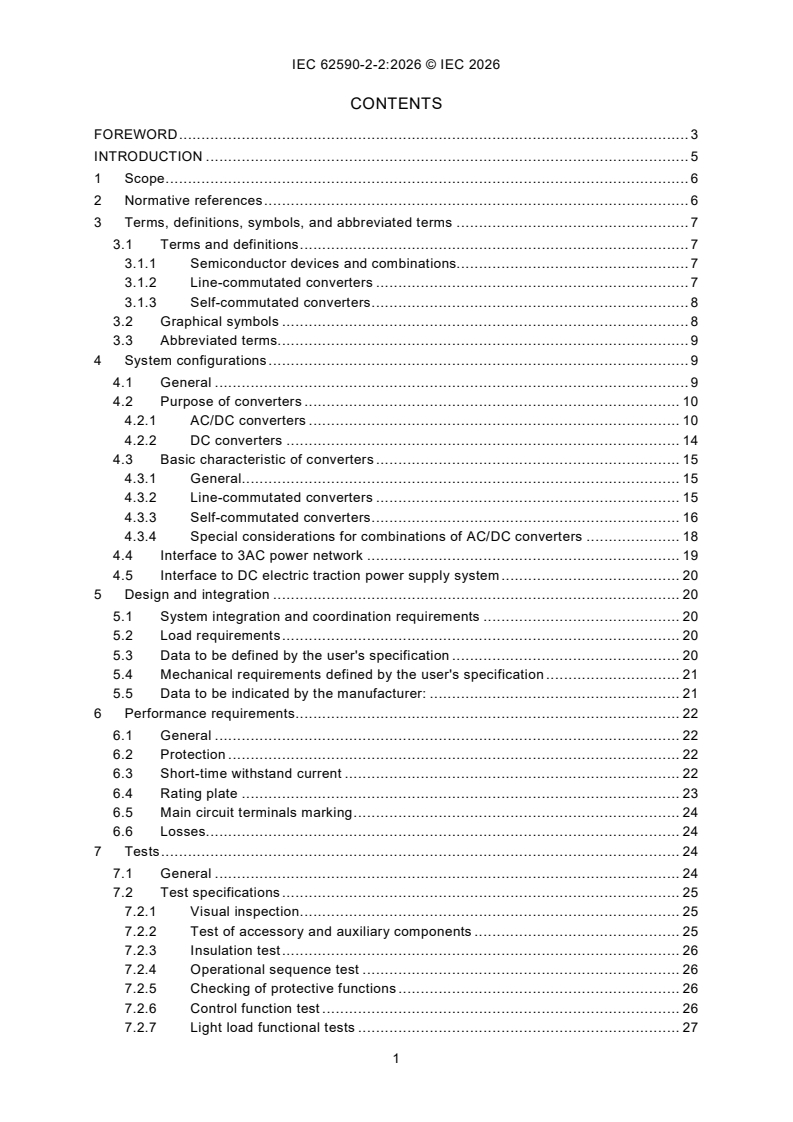
CONTENTS
FOREWORD . 3
INTRODUCTION . 5
1 Scope . 6
2 Normative references . 6
3 Terms, definitions, symbols, and abbreviated terms . 7
3.1 Terms and definitions . 7
3.1.1 Semiconductor devices and combinations. 7
3.1.2 Line-commutated converters . 7
3.1.3 Self-commutated converters . 8
3.2 Graphical symbols . 8
3.3 Abbreviated terms. 9
4 System configurations . 9
4.1 General . 9
4.2 Purpose of converters . 10
4.2.1 AC/DC converters . 10
4.2.2 DC converters . 14
4.3 Basic characteristic of converters . 15
4.3.1 General. 15
4.3.2 Line-commutated converters . 15
4.3.3 Self-commutated converters . 16
4.3.4 Special considerations for combinations of AC/DC converters . 18
4.4 Interface to 3AC power network . 19
4.5 Interface to DC electric traction power supply system . 20
5 Design and integration . 20
5.1 System integration and coordination requirements . 20
5.2 Load requirements . 20
5.3 Data to be defined by the user's specification . 20
5.4 Mechanical requirements defined by the user's specification . 21
5.5 Data to be indicated by the manufacturer: . 21
6 Performance requirements . 22
6.1 General . 22
6.2 Protection . 22
6.3 Short-time withstand current . 22
6.4 Rating plate . 23
6.5 Main circuit terminals marking . 24
6.6 Losses. 24
7 Tests . 24
7.1 General . 24
7.2 Test specifications . 25
7.2.1 Visual inspection . 25
7.2.2 Test of accessory and auxiliary components . 25
7.2.3 Insulation test . 26
7.2.4 Operational sequence test . 26
7.2.5 Checking of protective functions . 26
7.2.6 Control function test . 26
7.2.7 Light load functional tests . 27
7.2.8 Load test . 27
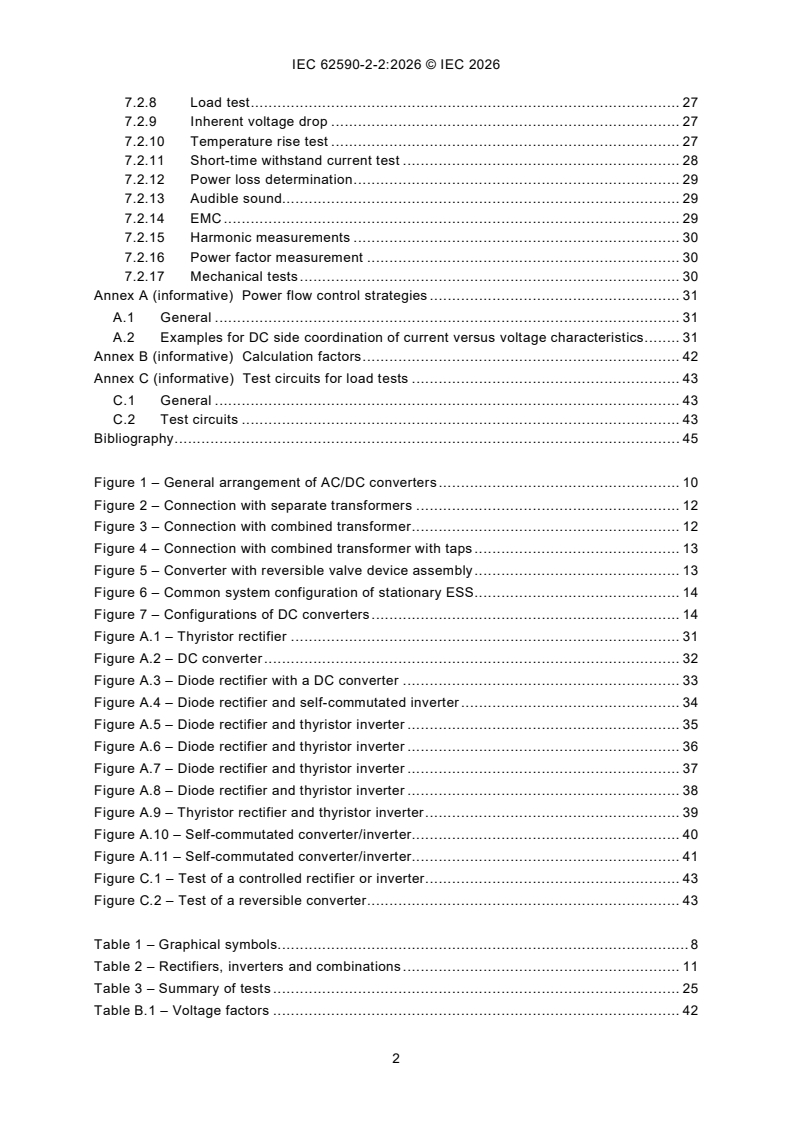
7.2.9 Inherent voltage drop . 27
7.2.10 Temperature rise test . 27
7.2.11 Short-time withstand current test . 28
7.2.12 Power loss determination . 29
7.2.13 Audible sound. 29
7.2.14 EMC . 29
7.2.15 Harmonic measurements . 30
7.2.16 Power factor measurement . 30
7.2.17 Mechanical tests . 30
Annex A (informative) Power flow control strategies . 31
A.1 General . 31
A.2 Examples for DC side coordination of current versus voltage characteristics . 31
Annex B (informative) Calculation factors . 42
Annex C (informative) Test circuits for load tests . 43
C.1 General . 43
C.2 Test circuits . 43
Bibliography . 45
Figure 1 – General arrangement of AC/DC converters . 10
Figure 2 – Connection with separate transformers . 12
Figure 3 – Connection with combined transformer . 12
Figure 4 – Connection with combined transformer with taps . 13
Figure 5 – Converter with reversible valve device assembly . 13
Figure 6 – Common system configuration of stationary ESS . 14
Figure 7 – Configurations of DC converters . 14
Figure A.1 – Thyristor rectifier . 31
Figure A.2 – DC converter . 32
Figure A.3 – Diode rectifier with a DC converter . 33
Figure A.4 – Diode rectifier and self-commutated inverter . 34
Figure A.5 – Diode rectifier and thyristor inverter . 35
Figure A.6 – Diode rectifier and thyristor inverter . 36
Figure A.7 – Diode rectifier and thyristor inverter . 37
Figure A.8 – Diode rectifier and thyristor inverter . 38
Figure A.9 – Thyristor rectifier and thyristor inverter . 39
Figure A.10 – Self-commutated converter/inverter . 40
Figure A.11 – Self-commutated converter/inverter . 41
Figure C.1 – Test of a controlled rectifier or inverter . 43
Figure C.2 – Test of a reversible converter . 43
Table 1 – Graphical symbols. 8
Table 2 – Rectifiers, inverters and combinations . 11
Table 3 – Summary of tests . 25
Table B.1 – Voltage factors . 42
INTERNATIONAL ELECTROTECHNICAL COMMISSION
____________
Railway applications -
Electronic power converters for fixed installations -
Part 2-2: DC Traction applications - Controlled converters
FOREWORD
1) The International Electrotechnical Commission (IEC) is a worldwide organization for standardization comprising
all national electrotechnical committees (IEC National Committees). The object of IEC is to promote international
co-operation on all questions concerning standardization in the electrical and electronic fields. To this end and
in addition to other activities, IEC publishes International Standards, Technical Specifications, Technical Reports,
Publicly Available Specifications (PAS) and Guides (hereafter referred to as “IEC Publication(s)”). Their
preparation is entrusted to technical committees; any IEC National Committee interested in the subject dealt with
may participate in this preparatory work. International, governmental and non-governmental organizations liaising
with the IEC also participate in this preparation. IEC collaborates closely with the International Organization for
Standardization (ISO) in accordance with conditions determined by agreement between the two organizations.
2) The formal decisions or agreements of IEC on technical matters express, as nearly as possible, an international
consensus of opinion on the relevant subjects since each technical committee has representation from all
interested IEC National Committees.
3) IEC Publications have the form of recommendations for international use and are accepted by IEC National
Committees in that sense. While all reasonable efforts are made to ensure that the technical content of IEC
Publications is accurate, IEC cannot be held responsible for the way in which they are used or for any
misinterpretation by any end user.
4) In order to promote international uniformity, IEC National Committees undertake to apply IEC Publications
transparently to the maximum extent possible in their national and regional publications. Any divergence between
any IEC Publication and the corresponding national or regional publication shall be clearly indicated in the latter.
5) IEC itself does not provide any attestation of conformity. Independent certification bodies provide conformity
assessment services and, in some areas, access to IEC marks of conformity. IEC is not responsible for any
services carried out by independent certification bodies.
6) All users should ensure that they have the latest edition of this publication.
7) No liability shall attach to IEC or its directors, employees, servants or agents including individual experts and
members of its technical committees and IEC National Committees for any personal injury, property damage or
other damage of any nature whatsoever, whether direct or indirect, or for costs (including legal fees) and
expenses arising out of the publication, use of, or reliance upon, this IEC Publication or any other IEC
Publications.
8) Attention is drawn to the Normative references cited in this publication. Use of the referenced publications is
indispensable for the correct application of this publication.
9) IEC draws attention to the possibility that the implementation of this document may involve the use of (a)
patent(s). IEC takes no position concerning the evidence, validity or applicability of any claimed patent rights in
respect thereof. As of the date of publication of this document, IEC had not received notice of (a) patent(s), which
may be required to implement this document. However, implementers are cautioned that this may not represent
the latest information, which may be obtained from the patent database available at https://patents.iec.ch. IEC
shall not be held responsible for identifying any or all such patent rights.
IEC 62590-2-2 has been prepared by IEC technical committee 9: Electrical equipment and
systems for railways. It is an International Standard.
This first edition partially cancels and replaces IEC 62589 and IEC 62590. This edition
constitutes a technical revision.
The text of this International Standard is based on the following documents:
Draft Report on voting
9/3312/FDIS 9/3328/RVD
Full information on the voting for its approval can be found in the report on voting indicated in
the above table.
The language used for the development of this International Standard is English.
This document was drafted in accordance with ISO/IEC Directives, Part 2, and developed in
accordance with ISO/IEC Directives, Part 1 and ISO/IEC Directives, IEC Supplement, available
at www.iec.ch/members_experts/refdocs. The main document types developed by IEC are
described in greater detail at www.iec.ch/publications.
A list of all parts in the IEC 62590 series, published under the general title Railway applications -
Electronic power converters for fixed installations, can be found on the IEC website.
The committee has decided that the contents of this document will remain unchanged until the
stability date indicated on the IEC website under webstore.iec.ch in the data related to the
specific document. At this date, the document will be
– reconfirmed,
– withdrawn, or
– revised.
INTRODUCTION
Semiconductor converters for traction power supply differ from other electronic power
converters for industrial use due to special electrical service conditions and due to the large
range of load variation and the particular characteristics of the load.
Controlled rectifiers supply a DC traction network from a three-phase power network using
controllable semiconductor valves. Inverters allow the recuperation of power from a DC traction
network into a three-phase power network. Reversible converters combine the functions of a
rectifier and an inverter.
DC converters are self-commutated converters for connecting the DC traction network to other
DC networks or storage devices.
1 Scope
This part of IEC 62590 describes functions and working principles, specifies requirements,
interfaces, and test methods for controlled converters for DC electric traction power supply
systems:
– AC/DC converters:
• rectifiers,
• inverters,
• combinations.
– DC converters.
The purpose of the converters can be a power connection to other power networks or energy
storages.
The common characteristic of this equipment is the possibility to influence the power flow in the
DC electric traction power supply system. The converters can be:
– line-commutated;
– self-commutated.
This document applies to fixed installations of the following electric traction systems:
– railway networks,
– metropolitan transport networks including metros, tramways, trolleybuses and fully
automated transport systems, magnetic levitated transport systems, and electric road
systems.
2 Normative references
The following documents are referred to in the text in such a way that some or all of their content
constitutes requirements of this document. For dated references, only the edition cited applies.
For undated references, the latest edition of the referenced document (including any
amendments) applies.
IEC 60071-1, Insulation co-ordination - Part 1: Definitions, principles and rules
IEC 60529, Degrees of protection provided by enclosures (IP code)
IEC 62590-1:2025, Railway applications - Electronic power converters for fixed installations -
Part 1: General requirements
IEC 62695, Railway applications - Fixed installations - Traction transformers
IEC 62236-5, Railway applications - Electromagnetic compatibility - Part 5: Emission and
immunity of fixed power supply installations and apparatus
3 Terms, definitions, symbols, and abbreviated terms
For the purposes of this document, the terms and definitions given in IEC 62590-1 and the
following apply.
ISO and IEC maintain terminology databases for use in standardization at the following
addresses:
– IEC Electropedia: available at https://www.electropedia.org/
– ISO Online browsing platform: available at https://www.iso.org/obp
3.1 Terms and definitions
3.1.1 Semiconductor devices and combinations
3.1.1.1
rated current
I
Nd
value of a DC current a controlled converter is designed for, referring
to the DC electric traction power supply system
Note 1 to entry: All rated values of the components are derived from this value.
Note 2 to entry: A converter can have a rated continuous current and rated currents in conjunction with a duty class.
3.1.1.2
rated DC power
rated current multiplied with nominal DC voltage
Note 1 to entry: This value refers to DC electric traction power supply system side.
3.1.1.3
reversible converter
converter in which the direction of the power flow is reversible
[SOURCE IEC 60050-551:1998, 551-12-37, modified – Figure 1 has been omitted.]
3.1.2 Line-commutated converters
3.1.2.1
trigger delay angle
time expressed in angular measure by which the trigger pulse is delayed with respect to the
reference instant in the case of phase control
Note 1 to entry: With line, machine or load commutated converters the reference instant is the zero crossing instant
of the commutating voltage. With AC controllers it is the zero crossing instant of the supply voltage. For AC controllers
with inductive loads the trigger delay angle is the sum of the phase shift and the current delay angle.
[SOURCE: IEC 60050-551:1998, 551-16-33, modified – In the definition, “the” has been
deleted.]
3.1.2.2
commutation failure
failure to commutate the current from a conducting arm to the succeeding arm
[SOURCE: IEC 60050-551:1998, 551-16-59, modified – In the definition, “a” has been deleted]
3.1.3 Self-commutated converters
3.1.3.1
switched valve device
controllable valve device which can be turned on and off by a control signal
[SOURCE: IEC 60050-551:1998, 551-14-08, modified – In the definition, “a” has been deleted,
"may" has been replaced with "can".]
3.1.3.2
free-wheeling diode
diode parallel to a switched valve device in reverse direction fulfilling the purpose of a free-
wheeling arm
3.1.3.3
buck converter
direct DC converter providing an output voltage which is lower than the input voltage
[SOURCE: IEC 60050-551:1998, 551-12-33]
3.2 Graphical symbols
Table 1 lists all symbols used in this document. These symbols are based on symbols registered
in IEC 60617.
Table 1 – Graphical symbols
Symbol Explanation
AC/DC converter with optional indication of power
flow direction
SOURCE: IEC 60617-S00213:2001-07;
3~ 3~ 3~
IEC 60617-S01402:2001-09;
IEC 60617-S01403:2001-09
DC DC DC
IEC 60617-S00099:2001-07;
IEC 60617-S00100:2001-07;
IEC 60617-S01407:2001-10.
DC converter
DC
SOURCE: IEC 60617-S00213:2001-07;
DC
IEC 60617-S01402:2001-09.
DC converter with isolation between 2 electrical
circuits
DC
SOURCE: IEC 60617-S00213:2001-07;
DC
IEC 60617-S01402:2001-09;
IEC 60617-S01407:2001-10
diode rectifier (valve device) assembly
SOURCE: IEC 60617-S00641:2001-07;
Rec
Symbol Explanation
IGBT converter (valve device) assembly
SOURCE: IEC 60617-S00616:2001-07;
IEC 60617 S00621:2001-07;
IEC 60617-S00624:2001-07;
IEC 60617-S00641:2001-07.
thyristor converter (valve device) assembly
SOURCE: IEC 60617-S00654:2001-07.
Rec
Transformer with two windings
SOURCE: IEC 60617-S00841:2001-07.
Transformer with three windings
SOURCE: IEC 60617-S00844:2001-07.
Group of connections
SOURCE: IEC 60617-S00002:2001-07.
3.3 Abbreviated terms
3AC three phase alternating current
AC alternating current
ACTB apparatus for connecting the ESU to the DC bus
DC direct current
ESS energy storage system
ESU energy storage unit
IGBT insulated gate bipolar transistor
U power frequency test voltage for power frequency withstand voltage test
a
U nominal DC voltage
dN
U no load transformer voltage, valve side
v0
4 System configurations
4.1 General
The main purpose of controlled electronic power converters for DC electric traction power
supply systems is to establish an intended power flow. The power can flow from a 3AC power
network to the DC electric traction system or vice versa. This can also be a bidirectional power
flow to energy storages or other equipment using regenerated power.
4.2 Purpose of converters
4.2.1 AC/DC converters
4.2.1.1 General
The AC/DC converters connect a 3AC power network with a DC electric traction power supply
system as shown in Figure 1. Requirements from both networks shall be applied, see 5.3.
Figure 1 – General arrangement of AC/DC converters
4.2.1.2 Rectifiers
The purpose of rectifiers is to have a power flow from the 3AC power network to the DC electric
traction power supply system.
Controlled rectifiers operate on an adjustable characteristic curve in the current versus voltage
plane. This characteristic can be adjustable. Examples are given in Annex A. Limits can be
included.
Controlled rectifiers can be line-commutated or self-commutated.
A suitable duty class should be chosen from IEC 62590-1:2025, 5.7.2.
4.2.1.3 Inverters
The purpose of inverters is to enable a power flow from the DC electric traction power supply
system to the 3AC power network to improve the energy efficiency of the railway system.
Inverters operate on an adjustable characteristic curve in the current versus voltage plane. This
characteristic can be adjustable. Examples are given in Annex A. Limits can be included.
Inverters can be line-commutated or self-commutated.
The definition of a load cycle is appropriate in most cases, see IEC 62590-1:2025, 5.7.3.
4.2.1.4 Reversible converters
The purpose of the combination of a rectifier and an inverter is to enable a bidirectional power
exchange between a 3AC power network and the DC electric traction power supply system.
Reversible converters operate on an adjustable characteristic curve in the current versus
voltage plane. This characteristic can be adjustable. Examples are given in Annex A. Limits can
be included.
There is a broad variety of combinations using line-commutated and self-commutated
converters, see Table 2.
Figure 2 to Figure 5 show various possible combinations of rectifiers and inverters that can be
installed in a reversible substation. They can share the same transformer, the same control, or
the same filter.
Commonly used parts of the reversible converter are subject to a combined load requirement.
For the rectifier part a suitable duty class should be chosen. For the inverter part a suitable
load cycle or a suitable duty class should be chosen according to the application, see Figure 2
to Figure 5. This can result in an asymmetric load for 3 winding transformers in special cases
shown in Figure 3 and Figure 4.
IEC 62590-2-1 applies to the uncontrolled part of the reversible converter, if any, and this
document applies to the inverter part.
Table 2 – Rectifiers, inverters and combinations
Rectifier Inverter Reversible converter
3~ 3~ 3~
General symbol
DC DC DC
Inv
Rec
Rec Inv
Examples of associated
Rec
Inv
transformer and valve device
assembly
Rec Inv
Rec Inv
Rec
Inv
Rec/Inv
NOTE 1 The symbols represent typical valve devices used in the respective application.
NOTE 2 "Rec" indicates the use of a rectifier and "Inv" the use of an inverter.
Figure 2 – Connection with separate transformers
A reversible converter configuration can consist of a separated rectifier and inverter. Figure 2
shows such a configuration. Both can be connected to the same 3AC power network or to
different 3AC power networks. The function and design are as independent as possible.
NOTE Dashed symbols represent optional components to achieve symmetry.
Figure 3 – Connection with combined transformer
A reversible converter configuration can share the same main transformer. Such a configuration
is shown in Figure 3. In this case an additional transformer is used to adapt the inverter 3AC
voltage to the rectifier 3AC voltage. If a three-winding transformer with two traction side
windings is used, a single inverter or multiple inverters can be connected to one or both
windings equally. The main transformer shall be designed for both power flow directions.
NOTE Dashed symbols represent optional components to achieve symmetry.
Figure 4 – Connection with combined transformer with taps
Figure 4 shows a configuration with a combined transformer with taps. No additional
transformer is used for the adaptation of the inverter and rectifier voltage.
Figure 5 – Converter with reversible valve device assembly
Figure 5 shows the configuration of a reversible converter using a unique all-in-one reversible
valve device assembly associated with a unique transformer. In this case, the control for both
flow directions is integrated.
More than one traction side transformer winding can be used.
4.2.1.5 Reversible AC/DC converters for energy storages
The purpose of a reversible converter for an energy storage is to connect the DC electric traction
power supply system to an energy storage unit. In this case the ESU is a rotating machine.
IEC 62924 covers reversible converters for energy storage. The converter fulfils the function of
the ACTB.
The configuration is shown in Figure 6.
Load requirements are defined in IEC 62924.
NOTE DC bus means the DC traction power supply system in the addressed use case.
Figure 6 – Common system configuration of stationary ESS
4.2.2 DC converters
A DC converter connects the DC electric traction power supply system to another DC system.
This can be for example a capacitor or battery for energy storage purposes or a DC distribution
system. DC converters can also be used for controlling a wayside braking resistor for consuming
power of braking rolling stock.
NOTE A controlled wayside braking resistor is often called an automatic assured receptivity unit, or a braking
resistor unit.
Figure 7 shows the basic configuration of DC converters.
Figure 7 – Configurations of DC converters
Both sides of a non-isolating DC converter are part of the DC electric traction power supply
system.
An isolating DC converter separates the DC electric traction power supply system from another
system with different insulation coordination.
IEC 62924 covers energy storage. The converter is fulfilling the function of an ACTB.
See Figure 6.
For energy storage purpose load requirements are defined in IEC 62924.
For any other purpose a load class should be selected.
4.3 Basic characteristic of converters
4.3.1 General
Controlled converters have different basic working principles. A coordination between the
transformer and the valve device assembly is required. In most cases the transformer is part of
a filter circuit. The choice of the transformer main values has a major influence on the power
quality of the connected networks.
All controlled converters use voltage and current sensors. Their signals are processed and used
to create firing signals for the semiconductors. For all converters connected to a 3AC power
network, a synchronization with this network is necessary.
The user shall specify the complete operating range, together with the tolerance of the 3AC
network voltage. This information shall be used by the manufacturer to design the transformer
and the valve device assembly.
4.3.2 Line-commutated converters
4.3.2.1 General
The basic behaviour of line-commutated converters is broadly described in IEC 60146-1-1.
An application guide is IEC/TR 60146-1-2.
For basic connections, 6-pulse bridges or combinations thereof are used. The most common
types of line-commutated converters are those with 12-pulse connections. The basic
connections and calculation factors for uncontrolled operation can be taken from
IEC 62590-2-1:2025, Table 1.
NOTE The ratio between the direct voltage drop and the impedance voltage specified in IEC 60146-1-1:2024,
Table 10 have a slightly different meaning.
The DC voltage can be controlled by varying the trigger delay angle. A voltage versus current
characteristic can be established.
4.3.2.2 Line-commutated rectifiers
The transformer’s no-load voltage shall be chosen according to the required range of operation.
The transformer’s no-load voltage for a controlled rectifier is higher than for an uncontrolled
diode rectifier. The trigger delay angle reduces the DC voltage as described in
IEC TR 60146-1-2.
NOTE For the purposes of the rectifier, the trigger delay angle is in the range clearly below 90°. The trigger delay
angle depends on the point of operation and is usually between 60° and 5°. For practical reasons, a trigger delay
angle of 0° is not achievable as thyristors can only be switched on with a forward voltage.
The no-load transformer voltage is higher than the one for a comparable diode rectifier. With a
higher no-load voltage:
– the control range increases;
– the reactive power at the 3AC side increases;
– the DC harmonic content increases;
– the transformer power for the same traction load is higher;
– the 3AC harmonic content is higher at low current.
4.3.2.3 Line-commutated inverters
The transformer’s no-load voltage shall be chosen according to the required range of operation.
NOTE For inverters the trigger delay angle is higher than 90° and the cathodes are connected to the negative
polarity of the supply voltage. A practical range is between 130° and 165° including some reserve.
The expected worst-case operational situation should not lead to a commutation failure. This
worst case consists of the maximum operational DC voltage at the maximum DC current in
combination with the minimum expected operational 3AC power network voltage.
A commutation failure is a short-circuit and leads to an interruption of the inverter operation.
Only intended protection devices shall operate.
A commutation failure shall not lead to any damage of the inverter by design. Only the foreseen
protection devices should be reset. Neighbouring rectifiers should not be affected to guarantee
the availability of the power supply function.
The maximum allowable trigger delay angle depends on:
– the recovery time of the thyristor;
– the overlap angle as a function of the current;
– the commutation inductance provided by the transformer and the short-circuit impedance;
– the 3AC power network voltage;
– the transformer's rated no-load voltage;
– the DC operating voltage.
The choice of a proper traction side no-load voltage for the transformer is important for the
overall behaviour of the inverter. With a higher no-load voltage:
– the probability of a commutation failure decreases;
– the DC harmonic content is higher;
– the reactive power increases;
– the transformer power for the same current is higher.
In most cases a DC side inductor should be used to improve the operational behaviour in case
of a commutation failure and to reduce the DC harmonic current.
4.3.3 Self-commutated converters
4.3.3.1 General
Self-commutated converters are described in IEC 60146-2.
Self-commutated converters are characterized using switched valve devices that can be
switched on and off. The most commonly used valves are transistors and turn-off thyristors,
both with an antiparallel free-wheeling diode.
Self-commutated converters contain a major capacitor smoothing the DC side voltage. Together
with other components, they form a filter. Converters can be pre-charged in order to avoid
current surges.
4.3.3.2 AC/DC converters
A broad variety of connections are used in AC/DC converters.
The common main characteristics of self-commutated AC/DC converters are as follows.
– Use of free-wheeling diodes. The free-wheeling diodes are forming an uncontrolled rectifier.
The DC voltage is higher than the amplitude of the 3AC transformer traction side voltage.
– There is no fixed ratio between the 3AC transformer traction side voltage and the DC
voltage. The ratio is determined by pulse patterns and modulation methods. Safety margins
are used for the adaption to all points of operation.
– The converters can be operated in both directions even if not intended in some applications.
– The transformer is used for voltage adaption and electric isolation of the two networks
– The impedance of the transformer is used for power flow control and is part of a filter.
– Harmonic orders are specific for every converter type, on the DC side as well as on the
AC side.
– A major capacitance on the DC side is required for operation.
Pulse frequency, modulation method and number of parallel units define the harmonic orders
on the 3AC power network side as well as on the DC side. Coordination is recommended to
avoid frequencies used by the signalling system as well as resonance frequencies as far as
they are identified.
A self-commutated AC/DC converter can have additional control functions such as providing
reactive power for the 3AC power network side or active filtering. These optional functions shall
be specified if requested by the user.
4.3.3.3 DC converters
DC converters are mostly self-commutated.
DC converters are mostly reversible.
DC converters use a filter on the DC traction side.
Applications for energy storages shall be bidirectional. The free-wheeling diodes may carry a
current in the case of a DC electric traction power supply system short-circuit. A disconnection
device can be used for this case.
The power flow is controlled in both directions or in one direction only for wayside resistors.
For non-isolated DC converters boost or buck converters can be used.
Isolating DC converters consist of an inverter, a transformer, and a rectifier. They can be used
to connect the DC electric traction power supply system to other DC power systems. Both DC
circuits can have a different insulation level. In the terminology of power electronics, this type
is an indirect DC converter with an AC intermediate circuit.
Both sides of a non-isolating DC converter are part of the DC electric traction power supply
system.
4.3.4 Special considerations for combinations of AC/DC converters
4.3.4.1 General
The rectifier and inverter functions can be combined in different ways. Both functions can share
components.
Two separate converter units do not share any component. They can be individually designed,
delivered, and operated. They can be connected to different 3AC power networks.
A reversible converter is associated with a unique transformer. Power flow requirements for
both directions shall be considered.
All combinations of converters shall be coordinated for proper operation. The current versus
voltage characteristic shall be coordinated in such a way that only intended circulating current
is flowing. Coordination can mean the exchange of information between combined units.
Examples are shown in Annex A and for the circulating current specifically Figure A.6 to
Figure A.8.
Different types of converters require different 3AC transformer traction side voltages at the
valve device assembly for the same DC voltage, see Annex B. This leads to adapting the
voltage either by transformers or DC converters.
4.3.4.2 Diode rectifier combined with thyristor inverter
The voltage versus current characteristic of the rectifier is fixed. The characteristic of the
inverter can be adjusted.
Even if the average inverter voltage is higher than the average rectifier voltage, a circulating
current will occur due to the instantaneous voltages. The circulating current is limited by the
inverter inductor and the transformer impedances.
Both valve device assemblies require different transformer's no-load voltages.
4.3.4.3 Diode rectifier combined with self-commutated inverter
The voltage versus current characteristic of the rectifier is fixed. The characteristic of the
inverter can be adjusted.
The smoothed DC voltage allows for avoiding circulating current.
Both valve device assemblies need different no-load voltages.
4.3.4.4 Thyristor rectifier combined with thyristor inverter
The voltage versus current characteristic for both directions is adjustable.
Circulating current can be avoided if only one converter is active. If both current directions are
active at the same time, high overcurrent can be expected. Changing the current flow direction
is operated after load current has reached zero.
Both directions can use the same transformer traction side voltage without any adaption. In this
case compromises concerning the reactive power are made.
In order to keep the inductive reactive power for the rectifier low, it can be useful to have
different transformer no-load voltages for the rectifier and inverter.
4.3.4.5 Thyristor rectifier combined with self-commutated inverter
The voltage versus current characteristic for both directions is adjustable.
Circulating current can be avoided if only one direction is active.
Both valve device assemblies need different transformer no-load voltages.
4.3.4.6 Self-commutated reversible converter
The voltage versus current characteristic for both directions is adjustable.
Circulating currents are avoided by the working principle.
Additional functions for the power flow on the 3AC power network like reactive power
compensation and active harmonic filtering are possible.
4.4 Interface to 3AC power network
The harmonic behaviour of line-commutated converters is well known and described in
IEC/TR 60146-1-2. Asymmetric and non-sinusoidal conditions of the feeding 3AC power
network are not described.
Self-commutated converters have a less determined harmonic behaviour. The harmonic
behaviour depends on the used connection, modulation method, pulse frequency, filter
equipment and load point.
Every 3AC power network has specific resonance frequencies. If they are excited by the
harmonics of a converter, major disturbances can appear. Specific resonance frequencies to
be avoided shall be made available to the manufacturer to determine countermeasures like
modification of the pulse patterns or use of a filter.
Calculations and simulations can support a more comprehensive description of the harmonic
interface.
The power factor of line-commutated converters i
...