

IEC 62589:2010
(Main)Railway applications - Fixed installations - Harmonisation of the rated values for converter groups and tests on converter groups
General Information
- Abstract
IEC 62589:2010 provides requirements for some type tests which are significant only when made on the entire converter group. Provides also a basic relationship between compatible ratings of traction transformer and converter(s), in order to provide minimum requirements for the choice of their ratings. Moreover gives the minimum values to be considered in order to choose switching devices with characteristics suitable for the converter group(s) involved.
- Status
- Published
- Publication Date
- 21-Jul-2010
- Technical Committee
- TC 9 - Electrical equipment and systems for railways
- Current Stage
- PPUB - Publication issued
- Start Date
- 22-Jul-2010
- Completion Date
- 15-Aug-2010


Overview
IEC 62589:2010 is an international standard developed by the International Electrotechnical Commission (IEC) that addresses fixed installations in railway applications, specifically focusing on converter groups. The standard establishes harmonized rated values for converter groups and provides essential testing requirements applicable to the entire group.
A converter group typically includes components such as converters, traction transformers, interbridge reactors, and switching devices. IEC 62589:2010 ensures compatibility between these components by defining minimum requirements for their ratings and performance tests. This harmonization helps optimize the design, safety, and operational reliability of electrical traction installations in railways.
Key Topics
Rated Values Harmonization: IEC 62589 provides a basic relationship between compatible ratings of traction transformers and converters. This helps in selecting appropriately rated equipment to avoid mismatches and performance issues.
Testing of Converter Groups: The standard specifies type tests that must be conducted on the entire converter group rather than on individual components only. These tests include voltage requirements, current demand, short-circuit performance, insulation levels, power factor measurements, and inherent voltage drop assessments.
Switching Devices Selection: Minimum characteristic values for switching devices are described to ensure suitability within the converter groups, enhancing overall system safety and reliability.
Components and Applicable Standards: The document references related standards for individual components, including:
- Converters: IEC 62590
- Traction Transformers: EN 50329
- Interbridge Reactors and Reactors: IEC 60076-6
- Transducers: IEC 61992 series
- Instrument Transformers: IEC 62505-3 and IEC 60044 series
Service Conditions and Performance: It covers service conditions along with short circuit and insulation requirements that are critical for robust railway fixed installations.
Informative Annexes: Annexes provide supplementary guidance on voltage drop, short-circuit current determination, power factor examples, and interbridge reactor design to assist engineers in practical converter group design.
Applications
IEC 62589:2010 is vital for engineers, designers, and manufacturers engaged in:
Railway Fixed Electrical Installations: Ensuring converter groups meet harmonized rated values and performance standards for fixed traction substations.
Traction System Design: Guiding the compatibility and integration of key electrical components such as converters and traction transformers in railway power supply systems.
Safety and Reliability Assurance: Enabling verification tests on complete converter groups to assess their combined performance under service and fault conditions.
Component Selection: Providing minimum requirement criteria to select appropriate switching devices and transformers tailored to specific railway applications.
Standard Compliance: Aligning with international best practices to meet regulatory requirements in electrified railway infrastructure.
Related Standards
To fully implement IEC 62589:2010 and maintain system interoperability, familiarity with the following standards is recommended:
IEC 62590 (Electronic Power Converters for Substations): Covers converters’ design and operational requirements.
EN 50329 (Traction Transformers): Specific to transformers used in railway traction systems.
IEC 60076 (Power Transformers): General power transformer standards including aspects relevant to reactors.
IEC 61992 Series (Transducers): Standards covering instrumentation needed for control and monitoring.
IEC 60850 (Supply Voltages of Traction Systems): Defines voltage supply parameters in railway systems.
IEC 61000-2-12 (Electromagnetic Compatibility): Addresses EMC requirements critical in traction power environments.
By conforming to IEC 62589:2010, railway fixed installations achieve a higher level of operational synergy between converters and transformers, resulting in enhanced electrical performance, improved safety, and global standard harmonization. This standard is an essential reference for stakeholders involved in the design, testing, and certification of electrical equipment for railway traction power systems.
Relations
- Effective Date
- 26-Oct-2025
- Effective Date
- 26-Oct-2025
- Effective Date
- 26-Oct-2025
- Effective Date
- 26-Oct-2025
Get Certified
Connect with accredited certification bodies for this standard

IRIS Certification (UNIFE)
International Railway Industry Standard certification.

TÜV SÜD Rail GmbH
TÜV SÜD railway certification services.

Bureau Veritas Railway Certification
Railway and transportation certification.
Sponsored listings
Frequently Asked Questions
IEC 62589:2010 is a standard published by the International Electrotechnical Commission (IEC). Its full title is "Railway applications - Fixed installations - Harmonisation of the rated values for converter groups and tests on converter groups". This standard covers: IEC 62589:2010 provides requirements for some type tests which are significant only when made on the entire converter group. Provides also a basic relationship between compatible ratings of traction transformer and converter(s), in order to provide minimum requirements for the choice of their ratings. Moreover gives the minimum values to be considered in order to choose switching devices with characteristics suitable for the converter group(s) involved.
IEC 62589:2010 provides requirements for some type tests which are significant only when made on the entire converter group. Provides also a basic relationship between compatible ratings of traction transformer and converter(s), in order to provide minimum requirements for the choice of their ratings. Moreover gives the minimum values to be considered in order to choose switching devices with characteristics suitable for the converter group(s) involved.
IEC 62589:2010 is classified under the following ICS (International Classification for Standards) categories: 45.060.01 - Railway rolling stock in general. The ICS classification helps identify the subject area and facilitates finding related standards.
IEC 62589:2010 has the following relationships with other standards: It is inter standard links to IEC 62590-2-2:2026, IEC 62590-1:2025, IEC 62590-3-1:2022, IEC 62590-2-1:2025. Understanding these relationships helps ensure you are using the most current and applicable version of the standard.
IEC 62589:2010 is available in PDF format for immediate download after purchase. The document can be added to your cart and obtained through the secure checkout process. Digital delivery ensures instant access to the complete standard document.
Standards Content (Sample)
IEC 62589 ®
Edition 1.0 2010-07
INTERNATIONAL
STANDARD
NORME
INTERNATIONALE
Railway applications – Fixed installations – Harmonisation of the rated values
for converter groups and tests on converter groups
Applications ferroviaires – Installations fixes – Harmonisation des valeurs
assignées pour les groupes convertisseurs et essais sur les groupes
convertisseurs
All rights reserved. Unless otherwise specified, no part of this publication may be reproduced or utilized in any form or by
any means, electronic or mechanical, including photocopying and microfilm, without permission in writing from either IEC or
IEC's member National Committee in the country of the requester.
If you have any questions about IEC copyright or have an enquiry about obtaining additional rights to this publication,
please contact the address below or your local IEC member National Committee for further information.
Droits de reproduction réservés. Sauf indication contraire, aucune partie de cette publication ne peut être reproduite
ni utilisée sous quelque forme que ce soit et par aucun procédé, électronique ou mécanique, y compris la photocopie
et les microfilms, sans l'accord écrit de la CEI ou du Comité national de la CEI du pays du demandeur.
Si vous avez des questions sur le copyright de la CEI ou si vous désirez obtenir des droits supplémentaires sur cette
publication, utilisez les coordonnées ci-après ou contactez le Comité national de la CEI de votre pays de résidence.
IEC Central Office
3, rue de Varembé
CH-1211 Geneva 20
Switzerland
Email: inmail@iec.ch
Web: www.iec.ch
About the IEC
The International Electrotechnical Commission (IEC) is the leading global organization that prepares and publishes
International Standards for all electrical, electronic and related technologies.
About IEC publications
The technical content of IEC publications is kept under constant review by the IEC. Please make sure that you have the
latest edition, a corrigenda or an amendment might have been published.
ƒ Catalogue of IEC publications: www.iec.ch/searchpub
The IEC on-line Catalogue enables you to search by a variety of criteria (reference number, text, technical committee,…).
It also gives information on projects, withdrawn and replaced publications.
ƒ IEC Just Published: www.iec.ch/online_news/justpub
Stay up to date on all new IEC publications. Just Published details twice a month all new publications released. Available
on-line and also by email.
ƒ Electropedia: www.electropedia.org
The world's leading online dictionary of electronic and electrical terms containing more than 20 000 terms and definitions
in English and French, with equivalent terms in additional languages. Also known as the International Electrotechnical
Vocabulary online.
ƒ Customer Service Centre: www.iec.ch/webstore/custserv
If you wish to give us your feedback on this publication or need further assistance, please visit the Customer Service
Centre FAQ or contact us:
Email: csc@iec.ch
Tel.: +41 22 919 02 11
Fax: +41 22 919 03 00
A propos de la CEI
La Commission Electrotechnique Internationale (CEI) est la première organisation mondiale qui élabore et publie des
normes internationales pour tout ce qui a trait à l'électricité, à l'électronique et aux technologies apparentées.
A propos des publications CEI
Le contenu technique des publications de la CEI est constamment revu. Veuillez vous assurer que vous possédez
l’édition la plus récente, un corrigendum ou amendement peut avoir été publié.
ƒ Catalogue des publications de la CEI: www.iec.ch/searchpub/cur_fut-f.htm
Le Catalogue en-ligne de la CEI vous permet d’effectuer des recherches en utilisant différents critères (numéro de référence,
texte, comité d’études,…). Il donne aussi des informations sur les projets et les publications retirées ou remplacées.
ƒ Just Published CEI: www.iec.ch/online_news/justpub
Restez informé sur les nouvelles publications de la CEI. Just Published détaille deux fois par mois les nouvelles
publications parues. Disponible en-ligne et aussi par email.
ƒ Electropedia: www.electropedia.org
Le premier dictionnaire en ligne au monde de termes électroniques et électriques. Il contient plus de 20 000 termes et
définitions en anglais et en français, ainsi que les termes équivalents dans les langues additionnelles. Egalement appelé
Vocabulaire Electrotechnique International en ligne.
ƒ Service Clients: www.iec.ch/webstore/custserv/custserv_entry-f.htm
Si vous désirez nous donner des commentaires sur cette publication ou si vous avez des questions, visitez le FAQ du
Service clients ou contactez-nous:
Email: csc@iec.ch
Tél.: +41 22 919 02 11
Fax: +41 22 919 03 00
IEC 62589 ®
Edition 1.0 2010-07
INTERNATIONAL
STANDARD
NORME
INTERNATIONALE
Railway applications – Fixed installations – Harmonisation of the rated values
for converter groups and tests on converter groups
Applications ferroviaires – Installations fixes – Harmonisation des valeurs
assignées pour les groupes convertisseurs et essais sur les groupes
convertisseurs
INTERNATIONAL
ELECTROTECHNICAL
COMMISSION
COMMISSION
ELECTROTECHNIQUE
PRICE CODE
INTERNATIONALE
W
CODE PRIX
ICS 45.060 ISBN 978-2-88912-043-7
– 2 – 62589 © IEC:2010
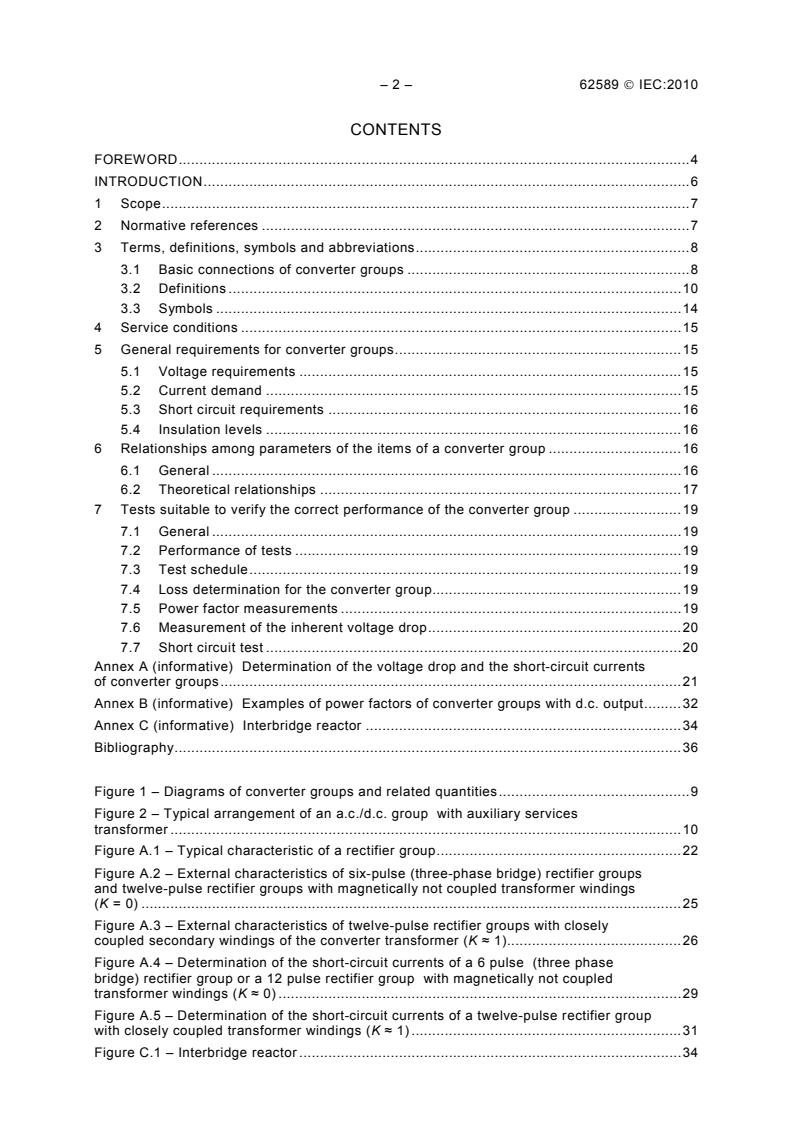
CONTENTS
FOREWORD.4
INTRODUCTION.6
1 Scope.7
2 Normative references .7
3 Terms, definitions, symbols and abbreviations.8
3.1 Basic connections of converter groups .8
3.2 Definitions .10
3.3 Symbols .14
4 Service conditions .15
5 General requirements for converter groups.15
5.1 Voltage requirements .15
5.2 Current demand .15
5.3 Short circuit requirements .16
5.4 Insulation levels .16
6 Relationships among parameters of the items of a converter group .16
6.1 General .16
6.2 Theoretical relationships .17
7 Tests suitable to verify the correct performance of the converter group .19
7.1 General .19
7.2 Performance of tests .19
7.3 Test schedule.19
7.4 Loss determination for the converter group.19
7.5 Power factor measurements .19
7.6 Measurement of the inherent voltage drop.20
7.7 Short circuit test .20
Annex A (informative) Determination of the voltage drop and the short-circuit currents
of converter groups.21
Annex B (informative) Examples of power factors of converter groups with d.c. output.32
Annex C (informative) Interbridge reactor .34
Bibliography.36
Figure 1 – Diagrams of converter groups and related quantities.9
Figure 2 – Typical arrangement of an a.c./d.c. group with auxiliary services
transformer .10
Figure A.1 – Typical characteristic of a rectifier group.22
Figure A.2 – External characteristics of six-pulse (three-phase bridge) rectifier groups
and twelve-pulse rectifier groups with magnetically not coupled transformer windings
(K = 0) .25
Figure A.3 – External characteristics of twelve-pulse rectifier groups with closely
coupled secondary windings of the converter transformer (K ≈ 1).26
Figure A.4 – Determination of the short-circuit currents of a 6 pulse (three phase
bridge) rectifier group or a 12 pulse rectifier group with magnetically not coupled
transformer windings (K ≈ 0) .29
Figure A.5 – Determination of the short-circuit currents of a twelve-pulse rectifier group
with closely coupled transformer windings (K ≈ 1) .31
Figure C.1 – Interbridge reactor .34
62589 © IEC:2010 – 3 –
Table 1 – Components of a converter group.7
Table 2 – Theoretical relationships for line commutated converters .18
Table 3 – Relationship valid in most cases between basic and rated current.18
Table 4 – Summary of tests .19
Table A.1 – Method of use of the charts in Figure A.2 and Figure A.3 .23
Table A.2 – Example of the application of Table A.1 for a six-pulse (three phase
bridge) rectifier group or a twelve-pulse rectifier group with magnetically not coupled
transformer windings (K ≈ 0) .27
Table A.3 – Example of the application of Table A.1 for a twelve-pulse rectifier group
with closely coupled secondary windings of the converter transformer (K ≈ 1).30
– 4 – 62589 © IEC:2010
INTERNATIONAL ELECTROTECHNICAL COMMISSION
____________
RAILWAY APPLICATIONS –
FIXED INSTALLATIONS –
HARMONISATION OF THE RATED VALUES FOR CONVERTER
GROUPS AND TESTS ON CONVERTER GROUPS
FOREWORD
1) The International Electrotechnical Commission (IEC) is a worldwide organization for standardization comprising
all national electrotechnical committees (IEC National Committees). The object of IEC is to promote
international co-operation on all questions concerning standardization in the electrical and electronic fields. To
this end and in addition to other activities, IEC publishes International Standards, Technical Specifications,
Technical Reports, Publicly Available Specifications (PAS) and Guides (hereafter referred to as “IEC
Publication(s)”). Their preparation is entrusted to technical committees; any IEC National Committee interested
in the subject dealt with may participate in this preparatory work. International, governmental and non-
governmental organizations liaising with the IEC also participate in this preparation. IEC collaborates closely
with the International Organization for Standardization (ISO) in accordance with conditions determined by
agreement between the two organizations.
2) The formal decisions or agreements of IEC on technical matters express, as nearly as possible, an international
consensus of opinion on the relevant subjects since each technical committee has representation from all
interested IEC National Committees.
3) IEC Publications have the form of recommendations for international use and are accepted by IEC National
Committees in that sense. While all reasonable efforts are made to ensure that the technical content of IEC
Publications is accurate, IEC cannot be held responsible for the way in which they are used or for any
misinterpretation by any end user.
4) In order to promote international uniformity, IEC National Committees undertake to apply IEC Publications
transparently to the maximum extent possible in their national and regional publications. Any divergence
between any IEC Publication and the corresponding national or regional publication shall be clearly indicated in
the latter.
5) IEC itself does not provide any attestation of conformity. Independent certification bodies provide conformity
assessment services and, in some areas, access to IEC marks of conformity. IEC is not responsible for any
services carried out by independent certification bodies.
6) All users should ensure that they have the latest edition of this publication.
7) No liability shall attach to IEC or its directors, employees, servants or agents including individual experts and
members of its technical committees and IEC National Committees for any personal injury, property damage or
other damage of any nature whatsoever, whether direct or indirect, or for costs (including legal fees) and
expenses arising out of the publication, use of, or reliance upon, this IEC Publication or any other IEC
Publications.
8) Attention is drawn to the Normative references cited in this publication. Use of the referenced publications is
indispensable for the correct application of this publication.
9) Attention is drawn to the possibility that some of the elements of this IEC Publication may be the subject of
patent rights. IEC shall not be held responsible for identifying any or all such patent rights.
International Standard IEC 62589 has been prepared by IEC technical committee 9: Electrical
equipment and systems for railways.
This standard is based on EN 50327.
The text of this standard is based on the following documents:
FDIS Report on voting
9/1389/FDIS 9/1414/RVD
Full information on the voting for the approval of this standard can be found in the report on
voting indicated in the above table.
This publication has been drafted in accordance with the ISO/IEC Directives, Part 2.
62589 © IEC:2010 – 5 –
The committee has decided that the contents of this publication will remain unchanged until
the stability date indicated on the IEC web site under "http://webstore.iec.ch" in the data
related to the specific publication. At this date, the publication will be
• reconfirmed,
• withdrawn,
• replaced by a revised edition, or
• amended.
– 6 – 62589 © IEC:2010
INTRODUCTION
Converters, traction transformers and switchgear are ordered in most cases as individual
items and are tested in manufacturer’s premises as such.
It is evident that tuning is necessary to choose compatible ratings and that certain
performances cannot be verified (through additional or investigation type tests) unless at least
the traction transformer and the converter are coupled together.
That is the reason for this document.
62589 © IEC:2010 – 7 –
RAILWAY APPLICATIONS –
FIXED INSTALLATIONS –
HARMONISATION OF THE RATED VALUES FOR CONVERTER
GROUPS AND TESTS ON CONVERTER GROUPS
1 Scope
This International Standard provides requirements for some type tests which are significant
only when made on the entire group.
It provides also a basic relationship between compatible ratings of traction transformer and
converter(s), in order to provide minimum requirements for the choice of their ratings.
Moreover it gives the minimum values to be considered in order to choose switching devices
with characteristics suitable for the converter group(s) involved.
Annexes provide useful information as a guide for the group designer.
Table 1 indicates the components of a converter group and the relevant applicable standards.
Table 1 – Components of a converter group
Component Standard
Converter IEC 62590
Traction transformer EN 50329
Interbridge reactor IEC 60076-6
and informative Annex C
Reactors IEC 60076-6
Transducers IEC 61992-7-1
IEC 61992-7-2
Instrument transformers (as applicable) IEC 62505-3-2 /
IEC 62505-3-3
IEC 60044 series
Control devices as applicable
Busbars and connections as applicable
2 Normative references
The following referenced documents are indispensable for the application of this document.
For dated references, only the edition cited applies. For undated references, the latest edition
of the referenced document (including any amendments) applies.
IEC 60050-811:1991, International Electrotechnical Vocabulary (IEV) – Chapter 811: Electric
traction
IEC 60076 (all parts), Power transformers
– 8 – 62589 © IEC:2010
IEC/TR 60146-1-2:1991, Semiconductor convertors – General requirements and line
commutated convertors – Part 1-2: Application guide
IEC 60850:2007, Railway applications – Supply voltages of traction systems
IEC 61000-2-12:2003, Electromagnetic compatibility (EMC) – Part 2-12: Environment –
Compatibility levels for low-frequency conducted disturbances and signalling in public
medium-voltage power supply systems
IEC 62498-2, Railway applications – Environmental conditions for equipment – Part 2: Fixed
electrical installations
IEC 62590:2010, Railway applications – Fixed installations – Electronic power converters for
substations
EN 50329:2010, Railway applications – Fixed installations – Traction transformers
3 Terms, definitions, symbols and abbreviations
For the purposes of this document, the following terms and definitions apply.
3.1 Basic connections of converter groups
For the purposes of this standard, a schematic overview of the various types of converter
groups is given as far as the main components are concerned. The various types of converter
groups are schemed in Figure 1 and Figure 2.
62589 © IEC:2010 – 9 –
Supply side Supply side
U
L
U 1
L
Traction converter
Traction transformer(s)
transformer(s)
U
S
U
v
U
S
AC
U
v
Converter
AC
AC
Converter
U 4
P
DC
Traction inverter
transformer(s)
U 5
d
U
V
Traction side
Traction side
IEC 1629/10 IEC 1630/10
AC/DC group AC/AC group
Point Rated voltage(s) Rated current Basic current Rated service Basic service
current current
1: Supply-side U I I I I
NL NL BL NGL BGL
2: Transformer output U I I I I
NS NS BS NGS BGS
2: Converter input U I I I I
Nv Nv Bv NGv BGv
3: a.c/d.c. converter
U (U U ) I I n.a. n.a.
Nd di diα Nd Bd
output
4: a.c./a.c. or d.c./a.c.
U I I n.a. n.a.
NP NP BP
converter output
U I I
5: a.c. traction-side n.a. n.a.
NV NV BV
5: d.c. traction-side U (U U ) I I
n.a. n.a.
Nd di diα Nd Bd
NOTE 1 “input” – “output” are referred to the normal flow of the current.
NOTE 2 n.a. means not applicable (not significant).
Figure 1 – Diagrams of converter groups and related quantities
– 10 – 62589 © IEC:2010
Supply side
U 1
L
I
L
Traction transformer(s)
Auxiliary services
I
S
U
S
Uv
I
v
AC
Converter
DC
Id
U
d
Traction side
IEC 1631/10
NOTE Connection point 2 is indicated separately as transformer output and as converter input. In effect, it is
possible that a connection is present for auxiliary supplies or that other circuit components are interposed.
Figure 2 – Typical arrangement of an a.c./d.c. group
with auxiliary services transformer
3.2 Definitions
3.2.1
converter group
the chain consisting of the traction transformer and the associated converter
3.2.2
traction transformer
transformer connected to an a.c. or d.c. contact line, directly or through a converter, used in
fixed installations of railway applications
3.2.2.1
traction converter transformer
traction transformer on the supply side of a converter group and supplying contact line(s)
through static converter(s)
3.2.2.2
traction inverter transformer
traction transformer on the traction (contact line) side of a converter group and supplied by a
static converter(s) (inverter)
3.2.3
electronic power converter
operative unit for power conversion comprising one or more assemblies of semiconductor
devices
62589 © IEC:2010 – 11 –
3.2.4
rated value
numerical value for the electrical, thermal, mechanical and environmental rating assigned to
the quantities which define the operation of a converter group in the conditions specified in
accordance with this Standard and on which the supplier’s guarantees and tests are based
3.2.5
rated frequency (f )
N
frequency on either side of the converter group for the conversion of which the converter
group is designed to operate
3.2.6
rated voltage on the supply-side of a converter group (U )
NL
r.m.s. value of the sinusoidal no-load voltage assigned to be applied to the supply-side
terminals of a converter group
3.2.7
rated voltage on the converter side(s) of a traction converter transformer (U )
NS
r.m.s. value of the no-load voltage at the line-to-line terminals of the converter side(s) of a
traction converter transformer, at the rated voltage on the supply side of the traction
transformer
3.2.8
rated a.c. voltage on the supply side of a converter (U )
Nv
r.m.s. value of the no-load voltage between vectorially consecutive commutating phase
terminals of a commutating group, at the rated voltage on the supply side of the traction
converter transformer
3.2.9
rated voltage on the inverter side of a traction inverter transformer (U )
NP
r.m.s. value of the sinusoidal no-load voltage resulting at the inverter side terminals of a
traction transformer
3.2.10
rated voltage on the traction side(s) of an inverter transformer (U )
NV
r.m.s. value of the no-load voltage at the line-to-line terminals of the traction side(s) of an
inverter transformer at the rated voltage on its inverter side
3.2.11
ideal no-load direct voltage (U )
di
theoretical no-load mean direct voltage of a converter, assuming no reduction by phase
control, no voltage drop in the assemblies and no voltage rise at small loads (see 3.8.1 of
IEC 62590)
3.2.12
controlled ideal no-load direct voltage (U )
diα
theoretical no-load mean direct voltage of a converter, when the direct voltage is reduced by
phase control, assuming no voltage drop in the assemblies and no voltage rise at small loads
(see 3.8.2 of IEC 62590)
3.2.12.1
real no-load direct voltage (U )
d00
actual mean direct voltage at zero direct current
3.2.13
rated direct voltage (U )
Nd
specified value of the direct voltage between the d.c. terminals of the converter assembly at
basic direct current. This value is the mean value of the direct voltage (see also 3.6.7 of
IEC 62590)
– 12 – 62589 © IEC:2010
NOTE The term “rated direct voltage” is kept for traditional reasons because, considering the use of the basic
current, the exact notation should be “basic direct voltage”. U has more the characteristics of a rated voltage.
di
3.2.14
rated a.c. voltage on the traction-side of the converter group (U )
NV
r.m.s. value of the sinusoidal no-load voltage at the traction-side of a converter group fed at
U
NL
3.2.15
nominal voltage (U , U )
nd nV
suitable approximate d.c. or a.c. voltage used to designate or identify a converter group
NOTE The standard values of nominal voltages are given in IEC 60850.
3.2.16
, S , S , S )
rated power of a winding in a traction transformer (S
NL NP NSn NV
conventional value of apparent power assigned to a winding which, together with the rated
voltage of the winding, determines its rated current. It is based on the fundamental
components of voltage and current
NOTE 1 ”primary” and “secondary” are referred to the normal flow of energy from the supply side to the traction
side.
NOTE 2 In the suffix “S ” for secondary windings “n” is the assigned order number of the secondary winding. In
n
formulae where any winding is separately considered S indicates the rated power of the winding considered.
N
n
NOTE 3 S or S may differ from the S because the sum should be vectorial taking into account the
∑
NL NP NSn
cos ϕ of the secondary currents involved.
n
3.2.17
rated current on the supply-side of the converter group (I )
NL
r.m.s. value of the fundamental component of the current flowing through a line terminal of a
primary winding of the converter transformer which is derived from its rated power S and
NL
rated voltage U for the winding
NL
3.2.18
basic current on the supply-side of the converter group (I )
BL
r.m.s. value of the fundamental component of the current flowing through a line terminal of a
primary winding of the traction converter transformer which is assumed to last for longer
periods and represents the load carried out continuously by the converter group and on which
the overloads are imposed
3.2.19
rated service current on the supply-side of the converter group (I )
NGL
r.m.s. value of the current flowing through a supply side terminal of a primary winding of the
traction converter transformer which contains all harmonic components and whose
fundamental component is the rated current (I )
NL
NOTE 1 In case of traction inverter transformers it is assumed that the service current is not sensibly different
from sinusoidal current in all windings.
NOTE 2 The generic r.m.s. value of the service current is indicated as I
G.
The generic r.m.s. value of the harmonic of order h of an a.c. current is indicated as I .
h
In formulas where any winding is separately considered I indicates the rated current of the winding considered
N
and I
its rated service current.
NG
3.2.20
basic service current on the supply-side of the converter group (I )
BGL
r.m.s. value of the service current through a line terminal of a primary winding of the step-
down traction transformer which contains all harmonic components and which is assumed to
62589 © IEC:2010 – 13 –
last for longer periods and represents the load carried out continuously by the converter group
and on which the overloads are imposed
3.2.21
rated d.c. current on the output or intermediate side of a converter group (I )
Nd
mean value of the current at the output terminals of the converter group, representing the
quadratic mean of the currents delivered according to the loading profile (duty class or load
cycle). It applies also to the input to an inverter
3.2.22
basic d.c. current on the output or intermediate side of a converter group (I )
Bd
mean value of the current at the output terminals of the converter group, according to the load
cycle. For the standardised duty classes, which have no quadratic mean, the factors
according to Table 3 apply (see 3.3.27)
3.2.23
rated a.c. current on the traction-side of a converter group (I )
NV
the r.m.s. value of the fundamental component of the current at the traction-side terminals of
the converter group, which causes I on the supply-side
NP
3.2.24
power factor ratio (ψ)
ratio between the power factor resulting on the line side of the converter group and that of the
a.c. output of the same (inverter)
NOTE This ratio is influenced by the magnetising current in the transformer and by the reactances of the devices
added to the converter, unless the power factor is controlled by thyristors. Some complementary information may
be found in Annex B.
3.2.25
current demand
actual or expected load variation of the current absorbed by a traction line, whose root mean
square value is the rated current. It is expressed by a load diagram
3.2.25.1
load diagram
true demand of current by the traction circuit in the worse expected condition
3.2.26
load cycle
conventional representation of the current demand to a converter group expressed in per unit
of the rated currents. It shows the repetitive variation of the loads with the time and, hence,
the overloads and underloads the converter group is expected to carry, as well as, for the
transformers, the duration and intervals assumed
3.2.27
duty class
conventional classification of the current capability of a converter group expressed in per unit
of the basic currents. The duty classes, associated with other rated values, define the
characteristics of a converter group
NOTE IEC 62590 and EN 50329 indicate preferred duty classes.
3.2.28
nominal power of a converter group
suitable approximate quantity value used to designate the output power of a converter group
S = U × I [kW]
– for converter groups with d.c. output:
n nd Bd
– 14 – 62589 © IEC:2010
– for converter groups with a.c. output: S = U × I [kVA]
n NV NV
3.3 Symbols
d resistive direct voltage drop of the converter group in percent of U
di
rB
d inductive direct voltage drop of the converter group in percent of U
di
xB
e resistive component of the relative short-circuit voltage of the converter transformer
rB
e inductive component of the relative short-circuit voltage of the converter transformer
xB
e inductive component of the relative impedance of the feeding grid
xL
f rated frequency
N
I basic d.c. current on the output or intermediate side of a converter group
Bd
I basic service current on the supply-side of the converter group
BGL
I basic service current on the converter side of a traction converter transformer
BGS
I basic service current on the supply side of a traction converter
BGv
I basic current on the supply-side of a converter group
BL
I basic current on the inverter-side of a traction inverter transformer
BP
I basic current on the converter side of a traction converter transformer
BS
I basic current on the transformer side of a traction converter
Bv
I basic a.c. current on the traction side of a traction converter group
BV
I maximum current value of the range of linear voltage drop
dlinmax
I rated d.c. current on the traction side of a converter group
Nd
I rated service current on the supply-side of a converter group
NGL
I rated service current on the converter side of a traction converter transformer
NGS
I rated service current on the supply side of a traction converter
NGv
I rated current on the supply-side of a converter group
NL
I rated current on the inverter-side of a traction inverter transformer
NP
I rated a.c. current on the traction side of a converter group
NV
I rated current on the transformer side of a traction converter
Nv
I rated current on the converter side of a traction converter transformer
NS
sustained d.c. short-circuit current
I
SS
I theoretical maximum value of the steady state d.c. short-circuit current at L = ∞
SSmax d
Î transient peak value of the d.c. short-circuit current
SS
K coupling factor
k conventional load ratio
dx
L inductance on the load side (i.e.traction side)
d
L inductance of the secondary windings of the converter transformer
s
R resistance on the load side (i.e.traction side)
d
S rated power of the supply side winding of a traction transformer
NL
S rated power of the inverter side winding of an inverter transformer
NP
S rated power of a winding in a traction transformer
NSn
S rated power of the traction side winding(s) of an inverter transformer
NV
T circuit time constant of the load circuit
c
T time constant of the grid on the supply side of the converter group
s
U ideal no-load direct voltage
di
62589 © IEC:2010 – 15 –
U controlled ideal no-load direct voltage
diα
U conventional no-load direct voltage
d0
U real no-load direct voltage
d00
U highest permanent voltage
max1
U rated direct voltage
Nd
U nominal voltage
nd
U rated voltage on the supply-side of a converter group
NL
U rated voltage on the inverter side of a traction inverter transformer
NP
U rated voltage on the converter side(s) of a traction converter transformer
NS
U rated a.c. voltage on the traction side(s) of an inverter transformer
NV
U rated a.c. voltage on the supply side of a converter
Nv
resistive direct voltage drop on the load side (i.e.traction side) in percent of U
V
D di
V total relative resistive direct voltage drop in percent of U
Dt di
Ψ power factor ratio
4 Service conditions
The service conditions applicable for the individual pieces of equipment of the group apply.
Complementary requirements, if needed, are available in IEC 62498-2.
5 General requirements for converter groups
5.1 Voltage requirements
The output voltage range on the traction side of traction converter groups shall be chosen to
supply the contact line, taking into account the voltage limits of IEC 60850.
NOTE For diode rectifier groups it is in most cases acceptable that the voltage at currents below the transition
current (see Figure 2 of IEC 62590) exceeds U but the conventional no-load voltage U should be lower or
max1 d0
equal U . In those cases where the real no-load voltage of a rectifier group U shall not exceed U additional
max1 d00 d0
provisions in the rectifier against the voltage rise at small currents are recommended.
The maximum admissible distortion in the supply voltage shall be as indicated in 5.3.2.1.3 of
IEC 62590.
In case of paralleled groups feeding the same busbars, voltage and impedance characteristics
shall be identical, within IEC 60076 tolerances, on any like tap position.
For converter groups, the r.m.s. value of the voltage shall be based on the rectified mean
value of the d.c. system voltage (see Figure 1).
When the secondary windings of a supply-side traction transformer are more than one, even if
the secondaries are intended to feed a single conversion bridge, the rated secondary voltage
of each winding is differing from that of other secondary winding by small quantities. The
tolerances in any case shall be observed.
The tap-changer of the traction transformers shall be normally considered effective only for
compensating long-period variations on the supply-side voltage.
5.2 Current demand
The converter group is subject to a load with important variations in amplitude and duration.
Therefore, the expected load diagram shall be determined by the purchaser before issuing a
– 16 – 62589 © IEC:2010
tender invitation for the converter group. Based on this load diagram a duty class or load
cycle shall be determined.
In traction converter transformers with connection 9 of the converter, the rated power of the
converter side windings is increased, taking into account the current sharing between the two
secondaries (see 6.7.3 of IEC 62590).
NOTE 1 Depending on the variations during a daily cycle of the load, the quadratic mean value of the most severe
load demand during a reasonable period should be calculated. The load may be represented by the apparent
power or by the current at a fixed voltage.
High loads over this quadratic mean values (overloads) are then compensated by low loads under this value
(underloads).
For testing purposes the use of a load diagram is not practicable. Therefore a conventional load cycle, equivalent
to the load diagram, is determined considering the load profile at short (say 600 s) intervals.
The quadratic mean value of the load diagram and the load cycle are conceived to be the same as well as the
effects of the overloads and underloads are concerned.
When this conventional representation of the loading basically corresponds to a standardised duty class, this is
preferable.
NOTE 2 Load cycles and duty classes are intended to allow testing of the converter group components.
NOTE 3 Filters can be necessary to limit the influence of the harmonics imposed to the supply and/or traction
voltages (see IEC/TR 60146-1-2). Filters can increase the transformer loading due to the reactive power and
harmonic currents. The additional load should be evaluated.
5.3 Short circuit requirements
The a.c. circuit breaking system at the supply-side is intended to break any short circuit inside
the converter group and its connections and the maximum fault current depends on the supply
circuit impedance only. The converter group shall be capable of withstanding d.c. short circuit
currents for the breaking time of the supply side circuit breaker. If not otherwise specified, a
breaking time of 0,15 s shall be taken into account.
The transformer and the converter shall be able to sustain a short circuit on the traction side
of the group, which shall be cleared normally by the breaking systems at the traction side.
This system shall be dimensioned taking into account that in any case the fault shall be
cleared within 0,15 s. The auto-reclosing cycle of the circuit breaker (when applicable) shall
be considered.
The purchaser shall inform on peak and duration of a short circuit or shall supply relevant
elements for its calculation.
NOTE Annex A gives guidance for calculation of d.c. short circuit currents. The rectifier circuit breaker (if any) is
intended to protect from reverse flow of the short circuit power in case of internal faults.
For a.c. traction systems both duties are carried out by the a.c. circuit breaker at the traction-side of the converter
group.
5.4 Insulation levels
The insulation levels given in the product standards IEC 62590 and EN 50329 apply.
6 Relationships among parameters of the items of a converter group
6.1 General
Care shall be taken in considering that a traction transformer and a converter are rated in a
different way. In effect the rated current on the output side determines the rated service
current in the converter transformer. Similarly the rated a.c. voltages are at no load and may
62589 © IEC:2010 – 17 –
be compared with the ideal no-load d.c. voltage in a rectifier, while the rated d.c. voltage is at
rated load.
6.2 Theoretical relationships
Table 2 gives the theoretical relationships based on an ideal configuration of harmonics on
the a.c. converter input side according to a rectangular current waveform (180° for
connection 7 and 120° for other connections). The connections for the rectifiers are those
used in IEC 62590 and EN 50329. The parameters for an inverter are those applicable with an
inverter having the peak a.c. voltage equal to direct voltage; when other type of inverters are
adopted, new parameters have to be calculated by the supplier.
The relationships indicated for currents are valid for any situation described in the duty class
or in the load cycle, being expressed in per unit. The designation of current capability of a
converter group according to a duty class is only applicable for the converter itself, but not for
devices with longer time constants as e.g. transformers, cables, busbars and switching
devices. Table 3 gives ratios between basic current of the converter and rated current of the
other devices for the standardised duty classes. Basis is the basic (output) current of the
converter.
For connection 12 the secondary windings of the transformer shall be rated for one half of the
voltage suitable for connection 8. In connection 9 the current input to the converter
(downstream the transformer) is one half of that for connection 8. The above statements shall
be considered taking into consideration the tolerances.
– 18 – 62589 © IEC:2010
Table 2 – Theoretical relationships for line commutated converters
Transformer
Conn.
connection Valve connection All groups a.c./a.c. groups
valve side
I /I I /I I /I U /U I /I U /U
NGL Nd NL Nd NS Nd di NL NL NV NV NL
8 8.1 9 10 8.2 10.1
1 3 4
1 1 0,637 0,637
1 0,9 0,9
1 2 K Ψ × K K
K K
1 1 1 12 12
0,551
0,816 0,78 0,816 1,35 0,955
1 or 1
3 K K K Ψ × K K
1 2 3
1 1 1 12
3 2 2
0,551
0,789 0,78 0,408 1,35 0,955
1 2
Ψ × K
6 K K K K
1 3 5 2 4 6
1 1 1 12
5 3 4
1,103 1,91
1,577 1,56 0,816 2,7
1 2
6 Ψ × K K
1 3 5 2 4 6 K K K
12 12
1 1 1
5 3 4
0,816 0,551
0,816 0,78 1,35 0,955
11 21 or 11 21
Ψ × K
K K K K
13 23 11 12 13 21 22 23 12
1 1 1 12
1312 23 22 12 22
0,551
0,816 0,78 0,816 1,35 0,955
1 or 1
Ψ × K
K K K K
1 2 3 1 2 3 1 1 1 12
3 2 2
NOTE 1 Connections are numbered according to IEC 60146 series.
NOTE 2 K is the turns ratio on the traction transformer.
NOTE 3 K is the combined turns ratio of both transformers at the supply-side and the traction-side.
NOTE 4 For power factor ratio Ψ see 3.2.24.
NOTE 5 Columns 8.2 and 10.1 refer to groups having a.c. current both on the supply side and on the traction side;
they are based on the simplest case only of an inverter having the peak a.c. voltage equal to d.c. voltage.
Table 3 – Relationship valid in most cases between basic and rated current
Duty class I V VI VII VIII IX
I /I 1 0,81 0,80 0,81 0,81 0,78
B N
62589 © IEC:2010 – 19 –
7 Tests suitable to verify the correct performance of the converter group
7.1 General
The following tests are intended to check the general design of the group and are applicable
only if explicitly required in the tender enquiry and agreed between purchaser and supplier as
investigation tests (see IEV 811-10). The characteristics checked for the group with these
tests may also be derived by means of calculations basing on tests carried out on the
individual items of the group.
NOTE In case of different suppliers for each item, the distribution of responsibilities should be contractually ruled.
7.2 Performance of tests
The tests may be performed in the manufacturer’s testing station or in an independent testing
laboratory or at site, depending on the contractual agreement. The electrical conditions shall
be equivalent to those in real service.
The converter group shall be internally connected as in normal operation with all accessories
(e.g. interbridge reactors, reactors, etc.) connected.
Unless otherwise agreed at the time of the contract, the a.c. supply and test voltages shall be
at rated frequency.
7.3 Test schedule
The tests (supplementary or investigation tests) admitted for checking the design of a
converter group are given in Table 4.
Table 4 – Summary of tests
o
N Test Reference
1 Loss determination for the converter group 7.4
2 Power factor measurements 7.5
3 Measurement of the inherent voltage drop 7.6
4 Short circuit test 7.7
7.4 Loss determination for the converter group
Losses
...