


IEC TR 60728-6-1:2006
(Main)Cable networks for television signals, sound signals and interactive services - Part 6-1: System guidelines for analogue optical transmission systems
General Information
- Abstract
provides guidelines and procedures for determining the overall performance of optical transmissions systems used in cable networks for television signals, sound signals and interactive services. It is based on the requirements for optical equipment defined in IEC 60728-6 and should be used together with this standard. The information provided is meant to help field engineers and network planners (system designers) in planning and designing optical systems. Though this content is less dense than in a standard, basic knowledge about system parameters of cable networks is needed.
- Status
- Published
- Publication Date
- 07-Dec-2006
- Technical Committee
- TC 100 - Audio, video and multimedia systems and equipment
- Drafting Committee
- WG 1 - TC 100/TA 5/WG 1
- Current Stage
- PPUB - Publication issued
- Start Date
- 08-Dec-2006
- Completion Date
- 31-Dec-2006
Buy Documents


IEC TR 60728-6-1:2006 - Cable networks for television signals, sound signals and interactive services - Part 6-1: System guidelines for analogue optical transmission systems Released:12/8/2006
Overview
IEC TR 60728-6-1:2006 is a Technical Report that provides practical system guidelines for analogue optical transmission systems used in cable networks carrying television signals, sound signals and interactive services. It explains procedures for determining the overall performance of optical links and is intended to be used together with IEC 60728-6 (optical equipment requirements). The report targets field engineers and network planners who need guidance when planning and designing optical segments in CATV / HFC / MATV / SMATV networks.
Key topics and technical requirements
The report organizes guidance around network topology and system performance. Major technical topics include:
- Network topologies: point-to-point (PTP), point-to-multi-point (PMP), multi-point-to-point, true WDM arrangements and combined architectures - and how topology influences design choices.
- Equipment and fibre parameter influences: interdependencies between transmitters, receivers, optical fibre characteristics and system-level performance.
- Optical Modulation Index (OMI): defining OMI for single-wavelength and WDM systems and guidelines for choosing transmitter input levels.
- Carrier-to-noise ratio (C/N): methods to evaluate C/N for short-haul, long-haul, multi-transmitter and amplifier-based links.
- Linearity metrics: assessment and limits for Composite Second Order (CSO) and Composite Triple Beat (CTB) distortion in analogue optical distribution.
- Flatness and output level: recommendations for spectral flatness and achievable output levels across systems.
- Noise and non-linear effects: informative annexes covering Brillouin scattering, optical noise sources and non-linear distortion mechanisms (e.g., laser chirp, self-phase modulation, polarization mode dispersion).
Practical applications
IEC TR 60728-6-1 is practical for:
- Designing optical feeder and trunk links in cable TV (CATV) and hybrid fibre-coax (HFC) networks.
- Specifying transmitter/receiver operating points and optical budgets.
- Assessing the impact of WDM and multiple-transmitter systems on analogue signal quality.
- Troubleshooting distortion, noise and dispersion-related impairments in analogue optical links.
Who should use this standard
- Field engineers responsible for installation and commissioning of optical segments.
- Network planners / system designers preparing optical architectures for broadcast and interactive service distribution.
- Equipment vendors and integrators who must align component behavior with system-level performance objectives.
Related standards
Use this TR together with:
- IEC 60728-6 (optical equipment requirements)
- IEC 60728-1 (measurement methods and system performance)
- IEC 60728-3 (active wideband equipment for coaxial networks)
- Relevant fibre standards such as IEC 60793-2 and IEC fibre terminology.
Keywords: IEC TR 60728-6-1, analogue optical transmission systems, cable networks, CATV, OMI, CSO, CTB, WDM, network planners, field engineers.
Relations
- Effective Date
- 10-Feb-2026
- Effective Date
- 10-Feb-2026
- Effective Date
- 10-Feb-2026
Buy Documents
IEC TR 60728-6-1:2006 - Cable networks for television signals, sound signals and interactive services - Part 6-1: System guidelines for analogue optical transmission systems Released:12/8/2006
Get Certified
Connect with accredited certification bodies for this standard

ANCE
Mexican certification and testing association.

Intertek Slovenia
Intertek testing, inspection, and certification services in Slovenia.

LNE (Laboratoire National de Métrologie et d'Essais)
French national laboratory for metrology and testing.
Sponsored listings
Frequently Asked Questions
IEC TR 60728-6-1:2006 is a technical report published by the International Electrotechnical Commission (IEC). Its full title is "Cable networks for television signals, sound signals and interactive services - Part 6-1: System guidelines for analogue optical transmission systems". This standard covers: provides guidelines and procedures for determining the overall performance of optical transmissions systems used in cable networks for television signals, sound signals and interactive services. It is based on the requirements for optical equipment defined in IEC 60728-6 and should be used together with this standard. The information provided is meant to help field engineers and network planners (system designers) in planning and designing optical systems. Though this content is less dense than in a standard, basic knowledge about system parameters of cable networks is needed.
provides guidelines and procedures for determining the overall performance of optical transmissions systems used in cable networks for television signals, sound signals and interactive services. It is based on the requirements for optical equipment defined in IEC 60728-6 and should be used together with this standard. The information provided is meant to help field engineers and network planners (system designers) in planning and designing optical systems. Though this content is less dense than in a standard, basic knowledge about system parameters of cable networks is needed.
IEC TR 60728-6-1:2006 is classified under the following ICS (International Classification for Standards) categories: 33.160.01 - Audio, video and audiovisual systems in general; 33.180.20 - Fibre optic interconnecting devices. The ICS classification helps identify the subject area and facilitates finding related standards.
IEC TR 60728-6-1:2006 has the following relationships with other standards: It is inter standard links to EN 60728-13:2010, EN IEC 60728-113:2023, EN IEC 60728-113:2018. Understanding these relationships helps ensure you are using the most current and applicable version of the standard.
IEC TR 60728-6-1:2006 is available in PDF format for immediate download after purchase. The document can be added to your cart and obtained through the secure checkout process. Digital delivery ensures instant access to the complete standard document.
Standards Content (Sample)
TECHNICAL IEC
REPORT TR 60728-6-1
First edition
2006-12
Cable networks for television signals, sound
signals and interactive services –
Part 6-1:
System guidelines for analogue optical
transmission systems
Reference number
IEC/TR 60728-6-1:2006(E)
Publication numbering
As from 1 January 1997 all IEC publications are issued with a designation in the
60000 series. For example, IEC 34-1 is now referred to as IEC 60034-1.
Consolidated editions
The IEC is now publishing consolidated versions of its publications. For example,
edition numbers 1.0, 1.1 and 1.2 refer, respectively, to the base publication, the
base publication incorporating amendment 1 and the base publication incorporating
amendments 1 and 2.
Further information on IEC publications
The technical content of IEC publications is kept under constant review by the IEC,
thus ensuring that the content reflects current technology. Information relating to
this publication, including its validity, is available in the IEC Catalogue of
publications (see below) in addition to new editions, amendments and corrigenda.
Information on the subjects under consideration and work in progress undertaken
by the technical committee which has prepared this publication, as well as the list
of publications issued, is also available from the following:
• IEC Web Site (www.iec.ch)
• Catalogue of IEC publications
The on-line catalogue on the IEC web site (www.iec.ch/searchpub) enables you to
search by a variety of criteria including text searches, technical committees
and date of publication. On-line information is also available on recently issued
publications, withdrawn and replaced publications, as well as corrigenda.
• IEC Just Published
This summary of recently issued publications (www.iec.ch/online_news/ justpub)
is also available by email. Please contact the Customer Service Centre (see
below) for further information.
• Customer Service Centre
If you have any questions regarding this publication or need further assistance,
please contact the Customer Service Centre:
Email: custserv@iec.ch
Tel: +41 22 919 02 11
Fax: +41 22 919 03 00
TECHNICAL IEC
REPORT TR 60728-6-1
First edition
2006-12
Cable networks for television signals, sound
signals and interactive services –
Part 6-1:
System guidelines for analogue optical
transmission systems
© IEC 2006 ⎯ Copyright - all rights reserved
No part of this publication may be reproduced or utilized in any form or by any means, electronic or
mechanical, including photocopying and microfilm, without permission in writing from the publisher.
International Electrotechnical Commission, 3, rue de Varembé, PO Box 131, CH-1211 Geneva 20, Switzerland
Telephone: +41 22 919 02 11 Telefax: +41 22 919 03 00 E-mail: inmail@iec.ch Web: www.iec.ch
PRICE CODE
Commission Electrotechnique Internationale X
International Electrotechnical Commission
МеждународнаяЭлектротехническаяКомиссия
For price, see current catalogue
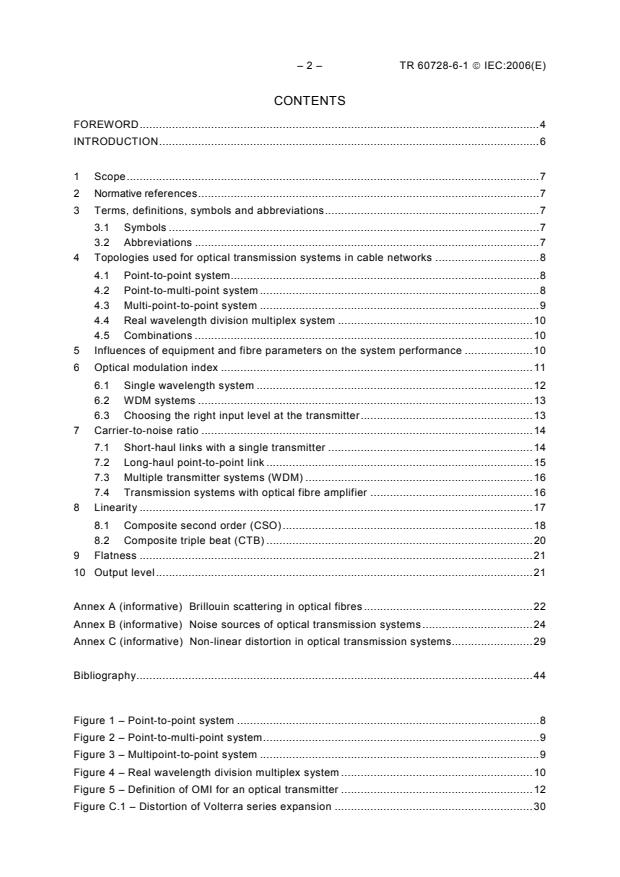
– 2 – TR 60728-6-1 © IEC:2006(E)
CONTENTS
FOREWORD.4
INTRODUCTION.6
1 Scope.7
2 Normative references.7
3 Terms, definitions, symbols and abbreviations.7
3.1 Symbols .7
3.2 Abbreviations .7
4 Topologies used for optical transmission systems in cable networks .8
4.1 Point-to-point system.8
4.2 Point-to-multi-point system .8
4.3 Multi-point-to-point system .9
4.4 Real wavelength division multiplex system .10
4.5 Combinations .10
5 Influences of equipment and fibre parameters on the system performance .10
6 Optical modulation index .11
6.1 Single wavelength system .12
6.2 WDM systems .13
6.3 Choosing the right input level at the transmitter.13
7 Carrier-to-noise ratio .14
7.1 Short-haul links with a single transmitter .14
7.2 Long-haul point-to-point link .15
7.3 Multiple transmitter systems (WDM) .16
7.4 Transmission systems with optical fibre amplifier .16
8 Linearity .17
8.1 Composite second order (CSO).18
8.2 Composite triple beat (CTB) .20
9 Flatness .21
10 Output level.21
Annex A (informative) Brillouin scattering in optical fibres .22
Annex B (informative) Noise sources of optical transmission systems .24
Annex C (informative) Non-linear distortion in optical transmission systems.29
Bibliography.44
Figure 1 – Point-to-point system .8
Figure 2 – Point-to-multi-point system.9
Figure 3 – Multipoint-to-point system .9
Figure 4 – Real wavelength division multiplex system .10
Figure 5 – Definition of OMI for an optical transmitter .12
Figure C.1 – Distortion of Volterra series expansion .30
TR 60728-6-1 © IEC:2006(E) – 3 –
Figure C.2 – Weighted second- and third-order distortion repartition for the 42 carriers
frequency allocation map defined in Table C.1 of IEC 60728-3 (software window
capture) .31
Figure C.3 – Polarization-mode dispersion in single-mode fibre .33
Figure C.4 – Static curve of a laser showing the clipping effect.34
Figure C.5 – Transmitted and back-scattered power in the range of the Brillouin
threshold .35
Figure C.6 – Cause of self-phase modulation.35
Figure C.7 – CSO caused by laser chirping and chromatic dispersion.37
Figure C.8 – CSO degradation without PDL .38
Figure C.9 – CSO degradation with PDL = 0,5 dB [12] .38
Figure C.10 – Simulated and measured intermodulation due to laser clipping .39
Figure C.11 – Zoom on a CTB .43
Table 1 – Interdependencies between equipment and system properties and
performance parameters .11
Table C.1 – Weightings of HD2, HD3, IMD2 and IMD3 .30
– 4 – TR 60728-6-1 © IEC:2006(E)
INTERNATIONAL ELECTROTECHNICAL COMMISSION
____________
CABLE NETWORKS FOR TELEVISION SIGNALS,
SOUND SIGNALS AND INTERACTIVE SERVICES –
Part 6-1: System guidelines for analogue optical transmission systems
FOREWORD
1) The International Electrotechnical Commission (IEC) is a worldwide organization for standardization comprising
all national electrotechnical committees (IEC National Committees). The object of IEC is to promote
international co-operation on all questions concerning standardization in the electrical and electronic fields. To
this end and in addition to other activities, IEC publishes International Standards, Technical Specifications,
Technical Reports, Publicly Available Specifications (PAS) and Guides (hereafter referred to as “IEC
Publication(s)”). Their preparation is entrusted to technical committees; any IEC National Committee interested
in the subject dealt with may participate in this preparatory work. International, governmental and non-
governmental organizations liaising with the IEC also participate in this preparation. IEC collaborates closely
with the International Organization for Standardization (ISO) in accordance with conditions determined by
agreement between the two organizations.
2) The formal decisions or agreements of IEC on technical matters express, as nearly as possible, an international
consensus of opinion on the relevant subjects since each technical committee has representation from all
interested IEC National Committees.
3) IEC Publications have the form of recommendations for international use and are accepted by IEC National
Committees in that sense. While all reasonable efforts are made to ensure that the technical content of IEC
Publications is accurate, IEC cannot be held responsible for the way in which they are used or for any
misinterpretation by any end user.
4) In order to promote international uniformity, IEC National Committees undertake to apply IEC Publications
transparently to the maximum extent possible in their national and regional publications. Any divergence
between any IEC Publication and the corresponding national or regional publication shall be clearly indicated in
the latter.
5) IEC provides no marking procedure to indicate its approval and cannot be rendered responsible for any
equipment declared to be in conformity with an IEC Publication.
6) All users should ensure that they have the latest edition of this publication.
7) No liability shall attach to IEC or its directors, employees, servants or agents including individual experts and
members of its technical committees and IEC National Committees for any personal injury, property damage or
other damage of any nature whatsoever, whether direct or indirect, or for costs (including legal fees) and
expenses arising out of the publication, use of, or reliance upon, this IEC Publication or any other IEC
Publications.
8) Attention is drawn to the Normative references cited in this publication. Use of the referenced publications is
indispensable for the correct application of this publication.
9) Attention is drawn to the possibility that some of the elements of this IEC Publication may be the subject of
patent rights. IEC shall not be held responsible for identifying any or all such patent rights.
The main task of IEC technical committees is to prepare International Standards. However, a
technical committee may propose the publication of a technical report when it has collected
data of a different kind from that which is normally published as an International Standard, for
example "state of the art".
IEC 60728-6-1, which is a technical report, has been prepared by technical area 5: Cable
networks for television signals, sound signals and interactive services, of IEC technical
committee 100: Audio, video and multimedia systems and equipment.
TR 60728-6-1 © IEC:2006(E) – 5 –
The text of this technical report is based on the following documents:
Enquiry draft Report on voting
100/1078/DTR 100/1142A/RVC
Full information on the voting for the approval of this technical report can be found in the
report on voting indicated in the above table.
This publication has been drafted in accordance with the ISO/IEC Directives, Part 2.
A list of all the parts of the IEC 60728 series, under the general title Cable networks for
television signals, sound signals and interactive services, can be found on the IEC website.
The committee has decided that the contents of this publication will remain unchanged until
the maintenance result date indicated on the IEC web site under "http://webstore.iec.ch" in
the data related to the specific publication. At this date, the publication will be
• reconfirmed,
• withdrawn,
• replaced by a revised edition, or
• amended.
A bilingual version of this publication may be issued at a later date.
– 6 – TR 60728-6-1 © IEC:2006(E)
INTRODUCTION
Standards of the IEC 60728 series deal with cable networks for television signals, sound
signals and interactive services including equipment, systems and installations for
• head-end reception, processing and distribution of sound and television signals and their
associated data signals;
• processing, interfacing and transmitting all kinds of signals for interactive services using
all applicable transmission media.
All kinds of networks like
• CATV-networks
• MATV-networks and SMATV-networks
• individual receiving networks
and all kinds of equipment, systems and installations installed in such networks, are within
this scope.
The extent of this standardization work is from the antennas, special signal source inputs to
the head-end or other interface points to the network up to the terminal input.
The standardization of any user terminals (i.e. tuners, receivers, decoders, multimedia
terminals etc.) as well as of any coaxial and optical cables and accessories thereof is
excluded.
TR 60728-6-1 © IEC:2006(E) – 7 –
CABLE NETWORKS FOR TELEVISION SIGNALS,
SOUND SIGNALS AND INTERACTIVE SERVICES –
Part 6-1: System guidelines for analogue optical transmission systems
1 Scope
This part of IEC 60728 provides guidelines and procedures for determining the overall
performance of optical transmissions systems used in cable networks for television signals,
sound signals and interactive services. It is based on the requirements for optical equipment
defined in IEC 60728-6 and should be used together with this standard. The information
provided is meant to help field engineers and network planners (system designers) in planning
and designing optical systems. Though this content is less dense than in a standard, basic
knowledge about system parameters of cable networks is needed.
2 Normative references
The following referenced documents are indispensable for the application of this document.
For dated references, only the edition cited applies. For undated references, the latest edition
of the referenced document (including any amendments) applies.
IEC 60728-1, Cable networks for television signals, sound signals and interactive services –
Part 1: Methods of measurement and system performance
IEC 60728-3, Cable networks for television signals, sound signals and interactive services –
Part 3: Active wideband equipment for coaxial cable networks
IEC 60728-6, Cable networks for television signals, sound signals and interactive services –
Part 6: Optical equipment
IEC 60793-2, Optical fibres – Part 2: Product specifications – General
IEC 61931, Fibre optics – Terminology
3 Terms, definitions, symbols and abbreviations
For the purposes of this document, the terms, definitions, symbols and abbreviations given in
IEC 60728-1, IEC 60728-6 and IEC/TR 61931 apply.
3.1 Symbols
In addition to the symbols given in the above-mentioned references, the following graphical
symbol is used in the figures of this technical report.
wavelength division multiplexer
WDM
3.2 Abbreviations
In addition to the abbreviations given in the above-mentioned references, the following
abbreviations are used in this technical report.
2HD second harmonic distortion
– 8 – TR 60728-6-1 © IEC:2006(E)
3HD third harmonic distortion
DFB distributed feedback
DWDM dense wavelength division multiplex
IIN induced intensity noise
IMD2 second-order intermodulation
IMD3 third-order intermodulation
IM-DD intensity modulation – direct detection
I equivalent input noise current density of an optical receiver
r
OMI optical modulation index
MPI multi-path interference
PMD polarization mode dispersion
PMP point-to-multi-point
PTP point-to-point
RMS root-mean-square
SBS stimulated Brillouin scattering
WDM wavelength division multiplexer
4 Topologies used for optical transmission systems in cable networks
The overall performance of optical transmission systems depends on many parameters and
conditions. Separating the applications into different categories simplifies the step-by-step
analysis and leads to a better overview. A logical way to build up these categories is to
distinguish different network topologies because it can be assumed that the network
architecture is always known in advance. Starting from this point of view the following five
topologies can be identified as relevant for the user.
4.1 Point-to-point system
Point-to-point (PTP) systems consist of a single optical transmitter and a single optical
receiver connected by a single line of fibre (Figure 1).
E O
O E
IEC 2154/06
Figure 1 – Point-to-point system
This configuration can typically be found in trunk-line feeding areas cabled with coax (HFC
networks). Both wavelengths, 1 310 nm and 1 550 nm, are used for these systems. Most of
the optical budget is consumed by the fibre attenuation (long-distance system). At 1 550 nm,
optical amplifiers can be used to extend the range of this kind of system.
4.2 Point-to-multi-point system
In point-to-multi-point (PMP) systems, a single optical transmitter feeds more than one optical
receiver. The receivers are connected to a main fibre via optical couplers and tap fibres as
shown in Figure 2.
TR 60728-6-1 © IEC:2006(E) – 9 –
O
E
E O
O E
O
E
IEC 2155/06
Figure 2 – Point-to-multi-point system
An alternative configuration for feeding more than one receiver from a single transmitter is to
use an optical splitter at the transmitter node and individual fibres from the transmitter node to
each receiver. This leads to a star topology, which should be treated as multiple PTP systems
with a single transmitter.
PMP systems are typically used when different coaxial parts of a network shall be supplied
with the same signal saving as much fibre as possible (optical distribution systems).
Depending on the fibre lengths, both wavelengths are used. At 1 550 nm, optical amplifiers
can be used to compensate for the fibre and splitting losses.
4.3 Multi-point-to-point system
Multi-point-to-point systems consist of at least two transmitters with different wavelengths
sending their signals to a common receiver. The transmitter signals may be combined by an
optical coupler or, if the link loss is critical, by a wavelength multiplexer (Figure 3).
E
O
O
WDM
E
E
O
IEC 215 6/06
Figure 3 – Multipoint-to-point system
Since optical receivers usually have a very broad input wavelength range, the central
wavelengths of the transmitters may be extremely different (for example, 1 310 nm and
1 550 nm). In order to avoid signal mixing in the receiver, the optical spectrums of the
transmitters shall differ at least by the upper limit of the receiver’s electrical frequency range.
If only signals in the 1 550 nm wavelength range are used, optical amplifiers can be employed
for extending the fibre length. Since all input signals of the system are provided at the same
system output, different frequency ranges have to be used for modulating the transmitters.
This kind of topology is typically chosen if part of a network shall be provided with signals
from different locations.
– 10 – TR 60728-6-1 © IEC:2006(E)
4.4 Real wavelength division multiplex system
Real wavelength division multiplex systems consist of at least two PTP systems operating on
the same fibre. The transmitter signals are combined at the transmitter node with a
wavelength multiplexer or, if the link loss is not critical, by an optical coupler. At the receiver
node, the different signals are separated by another wavelength multiplexer and led to
individual receivers (Figure 4).
E
O
O
E
WDM WDM
E O
O E
IEC 2157/06
Figure 4 – Real wavelength division multiplex system
For only two different wavelengths, this configuration can be built up easily combining a
1 310 nm system and a 1 550 nm system. If wavelength dependent fibre losses cannot be
tolerated, or more than two PTP systems have to be combined, closer spacing of the
wavelengths shall be chosen (DWDM = dense WDM). This is usually done in the 1 550 nm
wavelength range. Optical amplifiers can be used to achieve longer link lengths in this case.
Care has to be taken to avoid overlapping of the transmitters spectrums. Narrow wavelength
spacing means high efforts to control the transmitter wavelengths and high costs for the
wavelength division multiplexers.
The main reason for using this configuration is to save fibres. This approach allows for the
transmission of digital and analogue modulated signals over the same fibre.
4.5 Combinations
The basic configurations described above can be combined to more complex architectures.
The best way of dealing with such complex structures is to split them up into their basic parts
which could be treated separately.
5 Influences of equipment and fibre parameters on the system performance
The performance of analogue optical transmission systems depends not only on various
equipment parameters but also on the properties of the fibre installation. Some of these
parameters and properties interact in a way making it necessary to look at the transmission
system at a whole. The interdependencies between the equipment and system properties and
the performance parameters are shown in Table 1. The numbers in the table refer to the
clauses of this technical report containing the relevant information.
TR 60728-6-1 © IEC:2006(E) – 11 –
Table 1 – Interdependencies between equipment and system properties
and performance parameters
System performance parameters
Equipment properties C/N CSO CTB Flatness Output
and effects level
TX OMI Clauses Clause 6, Clause 6, (Clause 9) Clauses 6
6 and 7 8.2 8.1 and 10
CSO 8.1
CTB 8.2
Line width B.1.2
Chirping 7.2 C.3.7.1, C.4.1
C.3.7.2
RIN Clause 7
Power Clause 7 Clause 10
λ (7.3)
Flatness Clause 9
RX I Clause 7
r
CSO 8.1
CTB 8.2
Flatness Clause 9
AGC range Clause 9 Clause 10
OFA F 7.4
Power 7.4 Clause 10
Gain 7.4 (8.1.2) (8.2)
λ 7.4
Fibre Dispersion C.3.7.1, (8.2)
C.3.7.2
SBS (7.2) (8.1.2) (C.4.3)
SPM C.3.10
PMD (8.1.1)
Loss Clause 7 Clause 10
Passive Return loss (B.1.3)
PDL (C.3.7.2)
Loss Clause 7 Clause 10
X: relevant (X): can be relevant
This table can be used as an entry point and quick reference to the contents of this technical
report.
6 Optical modulation index
The optical modulation index (OMI) is one of the most important parameters of analogue
optical links. It shall be chosen very carefully in order to obtain the best carrier-to-noise ratio
without getting too much distortion due to clipping effects (see C.3.3).
– 12 – TR 60728-6-1 © IEC:2006(E)
Working with OMIs two cases shall be considered: single wavelength systems and wavelength
division multiplex (WDM) systems.
6.1 Single wavelength system
The definition of the OMI is very similar to the definition of the modulation index in ordinary
AM modulation. An illustrative explanation of this definition is shown in Figure 5.
P/mW
P
max
P
avg
P
min
P P
max – min
m =
2P
avg
I/mA
I I
th bias
IEC 2158/06
Figure 5 – Definition of OMI for an optical transmitter
The OMI is defined as
P − P P − P
max min max min
m = =
(1)
P + P 2 ⋅ P
max min avg
where
m is the optical modulation index;
P is the peak optical output power;
max
P is the minimum optical output power;
min
P is the mean optical output power.
avg
Laser currents below I lead to clipping, and the waveform of the optical output power
th
becomes distorted. The OMI is more than 1 then.
This definition relates to a single channel and a sinusoidal signal. The same definition can
also be used with QAM signals if the equivalent power is used to calculate a new peak value
of the modulating current. However, the signals transmitted in cable networks are a mixture of
a whole bunch of channels containing carriers with various modulation schemes. For each
channel an individual OMI can be determined.
TR 60728-6-1 © IEC:2006(E) – 13 –
Since the peak-to-average ratio of combined signals decreases with the number of channels,
the individual OMIs do not add up linearly to the total OMI. The total OMI for several channels
is, instead, calculated by summing the powers of individual carriers
2 2 2
(2)
m = m + m +K + m
T N
1 2
Provided that all channels have equal OMI the formula simplifies to
(3)
m = m N
T
The total OMI is a practical value for making estimations of the maximum channel counts or
for C/N calculations with a certain number of channels [6] , but the peak-to-average ratio for
relatively small numbers of channels can be surprisingly high, and clipping may occur at
smaller total OMI values than in the case of more than 10 channels. For analogue carriers,
m = 0,3 is a typical value for 1 310 nm directly modulated transmitter and m = 0,25 to 0,28
T T
for externally modulated 1 550 nm transmitter.
6.2 WDM systems
In WDM systems outputs of optical transmitters are combined using wavelength division
multiplexers or optical couplers. Thereby the average optical output powers add up resulting
in a reduced OMI for the individual channels. For the combination of signals from two
transmitters the resulting OMI of a channel can be calculated by
m ⋅ P
1 1
m =
(4)
P + P
1 2
where
m is the OMI of the channel to be considered, transmitted by the first transmitter;
P is the optical power of the first transmitter at the output of the combining device (optical
coupler or WDM);
P is the optical power of the second transmitter at the output of the combining device
(optical coupler or WDM).
For more than two transmitters, the denominator shall be replaced by the sum of all powers at
the output of the combining device. If the combined signal is fed to an optical receiver, the
carrier-to-noise ratio at its output is lower than with a single optical signal due to the reduced
OMIs. Therefore, multi-point-to-point systems are not very popular and true WDM systems
with separate receivers for each wavelength are preferred in cable networks. Nevertheless,
this configuration can be useful for adding narrowcast signals to broadcast signals in existing
networks. As equation (4) shows, great care has to be taken by adjusting the power levels of
the input signals.
6.3 Choosing the right input level at the transmitter
The OMI is directly related to the driving current of the laser hence to the input level of the
transmitter. Therefore, choosing the right transmitter input level is crucial for any optical
transmission link. Some manufacturers solved this problem by developing special driving
amplifier with an automatic gain control (AGC) for their transmitters. This results in a broader
input level range for achieving the optimum OMI. Nevertheless, even with this kind of solution,
the input level should be chosen carefully in order to save the AGC range for unwanted
changes in the level or the channel load.
———————
Figures in square brackets refer to the Bibliography.
– 14 – TR 60728-6-1 © IEC:2006(E)
IEC 60728-6 requires manufacturers to publish the required input level at which the required
performance can be met (see 6.1.1 of IEC 60728-6). Starting from this level the optimum input
level for a given channel load can be calculated, using the following procedure.
1) Check the count of channels related to the given reference input level stated in the data
sheet of the optical transmitter. Since according to IEC 60728-6, all transmitters shall be
designed for the frequency range 47 MHz to 862 MHz and all measurements shall be
carried through using the channel allocation specified in IEC 60728-3, this count will
usually be n = 42.
2) Determine the effective channel load for the considered system. For the effective channel
load the different levels of the channels to be transmitted shall be taken into account:
ΔU
n
n =10 (5)
e ∑
n
where ΔU is the deviation from the level of an analogue channel in dB.
n
With this effective channel load the target deviation ΔU from the reference input level can be
calculated easily with
⎛ n ⎞
e
⎜ ⎟
ΔU = 10 ⋅lg in dB (6)
⎜ ⎟
n
⎝ 0⎠
3) If the OMI is given for the reference input level (m ), the OMI for the new channel load
ref
can be calculated with
n
m = m (7)
e ref
n
e
This procedure should be used only when the number of channels (n and n ) is higher than
e 0
10 (see 6.1). For lesser channel loads, significant deviations from the optimum OMI can
occur.
7 Carrier-to-noise ratio
Noise in optical links can be divided into three different components: intensity noise, shot
noise and thermal noise (Annex B). Intensity noise is noise associated with the generation of
light in transmitters and optical amplifiers, shot noise appears in the receiver and thermal
noise is a noise mechanism of the electrical amplifiers. The parameters needed for calculating
the carrier-to-noise ratio of an optical link are either well known or shall be given in the data
sheets of the equipment as required by IEC 60728-6.
7.1 Short-haul links with a single transmitter
The carrier-to-noise ratio for a single channel of an optical point-to-point link up to lengths of
about L = 30 km can be calculated using equation (25) in 4.19 of IEC 60728-6:
⎛ ⎛ ⎞⎞
2e
⎜ I ⎟
⎜ r ⎟
− RIN
C/N = 20lg m − 10lg(2B) − 10lg + +
(8)
⎜ ⎜ ⎟⎟
2 2
⎜ ⎟
rP
opt,RX r P
opt,RX
⎝ ⎝ ⎠⎠
where
–1
RIN is the relative intensity noise in dB/(Hz) . This value shall be published in the
data sheet of the optical transmitter;
m is the OMI of the channel to be considered. For the choice of the right OMI, see
Clause 6;
TR 60728-6-1 © IEC:2006(E) – 15 –
P is the optical power incident on the photodiode in W;
opt,RX
r is the responsivity of the photodiode in A/W;
B is the bandwidth in Hz;
–19
e is 1,6 × 10 C (charge of an electron);
I is the effective spectral noise current density in A/√Hz.
r
In point-to-multi-point systems this equation has to be used for each receiver, as different
optical input powers shall be taken into account.
7.2 Long-haul point-to-point link
Long fibres can degrade the carrier-to-noise ratio of an analogue optical link. Using direct
modulation, for example, with DFB lasers, multi-path interference is the main source for
additional link noise. With externally modulated transmitters, care has to be taken to avoid
signal degradation due to stimulated Brillouin scattering (SBS).
7.2.1 Long-haul links with DFB lasers
At fibre lengths above L = 20 km, multi-path interference should be taken into account for
calculating the carrier-to-noise ratio. With equation (B.9) (see B.1.3), the carrier-to-noise ratio
equation from equation (8) extends to
⎛ ⎛ ⎞⎞
2e
⎜ I ⎟
⎜ r ⎟
−()RIN +RIN
IIN
C/N = 20lg m − 10lg(2B) − 10lg + +
(9)
⎜ ⎜ ⎟⎟
2 2
⎜ rP ⎟
opt,RX
r P
opt,RX
⎝ ⎝ ⎠⎠
The main difficulty in applying this equation is to find the values needed for calculating RIN
IIN
according to equation (B.9). The following hints may help to get reasonable results.
α The fibre’s attenuation-per-unit length is usually known in dB/km (for example,
0,38 dB/km at λ = 1 310 nm or 0,18 dB/km at λ = 1 550 nm). For α the according
–0,38/10
(linear) attenuation coefficient shall be used (for example, α = ln(10 )/km
=0,0875/km at λ = 1 310 nm).
α The proportion of signal scattered per unit length is a parameter of the fibre and can
S
be found in the fibre’s data sheet. For standard single-mode fibre α ≈ α can be
S
assumed.
S The fraction of scattering that is captured by the fibre is also a parameter of the fibre
which can be found in data sheets. For standard single-mode fibre S = 0,001 5 is a
common value.
η The light source’s chirping efficiency is usually not specified by the manufacturer of
FM
lasers and transmitters because it varies in a very large range from sample to sample.
The measurement of this parameter is costly and the benefit is low. As a rule of
thumb, η = 250 MHz/mA to 500 MHz/mA can be used for standard DFB lasers at
FM
1 310 nm.
I , I The bias current and the threshold current of the laser are set by the manufacturer of
b th
the transmitter and are usually not published in the data sheet. Common values are in
the range I – I = 40 mA to 60 mA for high-power DFB lasers used in long-haul
b th
systems.
– 16 – TR 60728-6-1 © IEC:2006(E)
7.2.2 Long-haul links with externally modulated transmitters
For long distances high optical power is needed in order to achieve sufficient input power at
the receivers. With modern high-power DFB lasers up to L ≈ 40 km can be achieved. For even
longer distances the wavelength range at 1 550 nm shall be used where the fibre attenuation
is significantly lower. Unless dispersion-shifted fibres or dispersion-flattened fibres are
employed, directly modulated DFB lasers cannot be used anymore at these wavelengths
because the laser’s chirping and the dispersion of the fibre would cause too much distortion.
Externally modulated transmitters are used instead.
Another advantage of using the wavelength range at 1 550 nm is that optical amplifiers are
available. Using optical amplifiers as booster amplifiers, very high output powers up to several
100 mW could be achieved. Unfortunately, the small cross-section of single-mode fibre cores
is not able to handle such powers. Non-linear effects of the fibre lead to distorted signals
(Annex A). Several techniques have been developed for broadening the optical spectrum of
externally modulated transmitters in order to increase the maximum power level. As a
drawback, a certain loss in carrier-to-noise ratio at long fibre lengths due to increased multi-
path interference shall be accepted. Unfortunately, without detailed knowledge about these
techniques, there is no reliable method for predicting the C/N degradation to be expected.
Therefore, IEC 60728-6 requires that the degradation shall not exceed 2,5 dB at a fibre length
of L = 65 km. For different fibre lengths, the manufacturer shall be consulted or measure-
ments shall be made.
7.3 Multiple transmitter systems (WDM)
If signals from optical transmitters working at different wavelengths are combined and fed to a
single receiver, the optical modulation index decreases according to equation (4). With this
resulting modulation index, equation (8) can be used for calculating the carrier-to-noise ratio.
This works satisfactorily as long as the wavelengths of the transmitters are close together in
the same range (1 310 nm or 1 550 nm). If different wavelength ranges are used (1 310 nm
and 1 550 nm), the wavelength dependency of the responsivity of the photodiode shall be
taken into account. This can easily be done by using an adapted equation for the optical
modulation index of the combined signal:
m ⋅ P ⋅ r
1 1 1
m =
(10)
P ⋅r + P ⋅ r
1 1 2 2
where
m is the optical modulation index (OMI) of the channel to be considered, transmitted by
the first transmitter;
P is the optical power at λ of the first transmitter at the output of the combining device
1 1
(optical coupler or WDM);
P is the optical power at λ of the second transmitter at the output of the combining
2 2
device (optical coupler or WDM);
r is the responsivity of the receiving photodiode at λ
1 1;
r is the responsivity of the receiving photodiode at λ
2 2.
7.4 Transmission systems with optical fibre amplifier
With optical fibre amplifiers the range of optical transmission systems can be increased
significantly. The major drawback of optical amplifiers is that they add noise to the amplified
signal. Therefore, only a very limited number of optical amplifiers can be cascaded in optical
cable networks.
TR 60728-6-1 © IEC:2006(E) – 17 –
The amount of added optical noise is expressed as a noise figure, which has a similar
definition to the noise figure of electrical amplifiers. With a known noise figure, the carrier-to-
noise ratio of an optical transmission system including an optical amplifier can be calculated
according to equation (11).
F
⎛ ⎛ ⎞ ⎞
⎛ 2 ⎞
⎜ 2hν 1 2e ⎟
⎜ ⎟ I
⎜ r ⎟
− ()RIN
C/N = 20lg m − 10lg(2B) − 10lg + 10 − + +
10 (11)
⎜ ⎜ ⎟ ⎟
⎜ ⎟
2 2
P G
⎜ ⎟
⎜ rP ⎟
in opt,RX r P
opt,RX
⎝ ⎠
⎝ ⎝ ⎠ ⎠
where
–1
RIN is the relative intensity noise of the optical transmitter in dB(Hz) . This value
shall be published in the data sheet of the optical transmitter;
m is the OMI of the channel to be considered. For choice of the right OMI, see
Clause 6;
P is the optical power incident on the photodiode in W;
opt,RX
r is the responsivity of the photodiode;
B is the bandwidth of the considered transmission channel in Hz;
–19
e is 1,6⋅10 C (charge of an electron);
I is the effective spectral noise current density in A/√Hz;
r
F is the noise figure of the optical amplifier in dB. This value depends on the
optical input power. Therefore, manufacturers shall publish the noise figure as
a function of the optical input power;
G = P /P is the power gain of the optical amplifier;
out in
–34
h is 6,62⋅10 Js (Planck's Constant);
is the frequency of the light signal in Hz. Because of the high frequency of light
signals, the wavelength in the vacuum is commonly used instead: ν = c /λ.
If optical amplifiers are cascaded, equation (11) is not useful. A better approach is to consider
the added noise as an increase of the RIN.
F
⎛ ⎛ ⎞⎞
⎜ 2hν 1 ⎟
⎜ ⎟
− ()RIN 10
in
RIN = 10lg + 10 −
(12)
out 10
⎜ ⎜ ⎟⎟
P G
⎜ ⎟
⎜ ⎟
in
⎝ ⎝ ⎠⎠
where
–1
RIN is the relative intensity noise of the output signal in dB(Hz) ;
out
–1
RIN is the relative intensity noise of the input signal in dB(Hz) .
in
With this equation the increase of the RIN can be calculated step by step for each optical
amplifier passed. For the last part of the system the resulting RIN can be inserted in
out
equation (8) for determining the carrier-to-noise ratio from end to end.
8 Linearity
Non-linear distortion in cable networks leads to intermodulation of the transferred signals.
Due to the regular spacing of channels, intermodulation products add up at certain
frequencies (Annex C). The ratio of the carriers to the cumulated distortion products is called
CSO for second-order distortion and CTB for third-order distortion. Both parameters are
expressed in dB. In some documents negative values and the unit dBc are used in order to
point out that the cumulated distortion products are below the carrier. Throughout this report
and in IEC 60728-6, only positive values are used.
– 18 – TR 60728-6-1 © IEC:2006(E)
Unlike C/N the calculation of CSO and CTB values is difficult because several aspects shall
be considered.
• The amount of non-linear distortion depends on the channel allocation used.
• The linearity of active devices depends on the frequency.
• Laser clipping is a very strong source of distortion. Precise calculations can only be made
if all signals are well known as a function of time or if statistical methods can be applied.
• CSO and CTB depend on the load of the active devices (number and level of channels).
• Strictly speaking CSO and CTB are defined for un-modulated carriers only.
• It is hardly possible to predict how intermodulation products from different sources add up
on a certain frequency. Sometimes even compensation can be observed. The results
depend on the phase of the different intermodulation products, which in turn depend on
the phase of the input signals and the phase behaviour of the active device’s internal
distortion sources which both are usually unknown.
For most relations only assumptions can be made. Their accuracy largely depends on the
applicability of statistical methods. Therefore, calculated CSO and CTB values can deviate
significantly from measured results.
8.1 Composite second order (CSO)
The symmetrical characteristic line of externally modulated transmitters leads to very low
second-order distortion. So, CSO is mainly a problem of transmitters containing directly
modulated lasers. Deviations between samples of the same laser charge are significant.
Therefore, additional pre-distortion circuits are often employed to achieve CSOs good enough
for cable networks. As stated above, the CSO of an optical system cannot reliably be
calculated from the CSOs of the TX and the RX due to the fact that the laws of statistics
cannot be applied. Therefore, the following procedures may only be understood as guidance
for rough estimations.
8.1.1 CSO of 1 310 nm systems
In the 1 310 nm wavelength range, fibre dispersion can be neglected on short hauls up to
approximately L = 25 km. For this kind of system, only the distortion of the transmitter and the
receiver and the influence of the channel allocation shall be considered.
a) Make sure that the CSO values of both the transmitter (CSO ) and the receiver
CLC,TX
(CSO ) are given for the IEC frequency map as required in 4.12 of IEC 60728-6.
CLC,RX
b) The CSO for the whole link can be estimated out of the single CSO values with
1 1
⎛ ⎞
CSO CSO
CLC,TX CLC,RX
⎜ ⎟
k k
CSO = k ⋅ lg 10 + 10
(13)
CLC
⎜ ⎟
⎜ ⎟
⎝ ⎠
where k = 15 for unlocked carriers and k = 20 for locked carriers.
NOTE Sometimes the CSO value is already given in the data sheets of the manufacturers for the whole link.
c) Calculate the maximum number of beats n for the actual frequency map. The maximum
act
number of se
...