

IEC 60092-504:2026
(Main)Electrical installations in ships - Part 504: Automation, control and instrumentation
General Information
- Abstract
IEC 60092-504:2026 specifies requirements for electrical, electronic and programmable equipment supporting essential services intended for automation, control, monitoring, alert, safety and protection systems. This fifth edition cancels and replaces the fourth edition published in 2016. This edition constitutes a technical revision.
This edition includes the following significant technical changes with respect to the previous edition:
a) aligned bridge and machinery alert references throughout the document;
b) transfer of EMC items to IEC 60533 throughout the document;
c) update of power management and energy management (9.5 and 9.6).
- Status
- Published
- Publication Date
- 16-Apr-2026
- Drafting Committee
- MT 2 - TC 18/MT 2
- Current Stage
- PPUB - Publication issued
- Start Date
- 17-Apr-2026
- Completion Date
- 08-May-2026
Buy Documents
IEC 60092-504:2026 - Electrical installations in ships - Part 504: Automation, control and instrumentation
REDLINE IEC 60092-504:2026 RLV - Electrical installations in ships - Part 504: Automation, control and instrumentation
Overview
IEC 60092-504:2026 is an international standard developed by the International Electrotechnical Commission (IEC) that outlines requirements for electrical installations in ships, focusing specifically on automation, control, and instrumentation systems. As Part 504 in the IEC 60092 series, this standard addresses the design, installation, and testing of electrical and electronic equipment that supports critical shipboard functions such as monitoring, safety, alert generation, and protection. The 2026 fifth edition incorporates technical revisions to ensure ongoing alignment with maritime safety and operational efficiency, including updates on alert systems, the handling of electromagnetic compatibility (EMC), and enhanced power and energy management.
Key Topics
IEC 60092-504:2026 covers a comprehensive range of topics essential for safe, reliable shipboard automation and control systems:
- Essential Services: Electrical, electronic, and programmable systems supporting automation, monitoring, safety, and protection.
- Alert and Alarm Management: Requirements for bridge and machinery alerts, centralized alert management, and the integration of emergency alarm systems.
- Cyber Security: Inclusion of security measures and guidelines for automation and control equipment, including considerations for IoT-enabled systems.
- Power and Energy Management: Specifications for power management and energy management systems, addressing automatic operation, load sharing, blackout recovery, and energy optimization.
- Design and Installation: Guidance on the environmental, supply, and layout conditions; segregation; and performance of electrical circuits and components.
- Control and Monitoring: Requirements for control installations, remote operation, machinery interfaces, and display of operational data.
- Safety and Protection: Provisions for fire safety, bilge and flood detection, watertight doors, and machinery protection systems.
- Public Address (PA) and General Alarm (GA): Design and installation criteria, with special requirements for passenger ships and vessels operating in polar waters.
- Testing and Commissioning: Checklists and procedures for on-board testing and validation of completed installations.
- Documentation: Requirements for technical documentation, functional descriptions, and maintenance information for installed systems.
Applications
IEC 60092-504:2026 is critical for the maritime industry, ensuring shipboard automation and control systems adhere to international standards for performance, safety, and reliability. Key practical applications include:
- Shipbuilding and Retrofitting: Supporting naval architects, marine engineers, and shipbuilders in the design and upgrade of automated systems for new builds and existing vessels.
- Essential Services Automation: Implementation of power management, emergency alarm, fire detection, and machinery control systems to enhance operational safety and efficiency.
- Inspection and Compliance: Assisting flag states, classification societies, and inspectors in verifying that ships comply with international safety and operational requirements.
- Operational Maintenance: Providing operators and maintenance teams with clear requirements for ongoing system integrity, fault alerting, and system recovery processes.
- Support for Regulatory Compliance: Facilitating adherence to international maritime conventions such as SOLAS by providing detailed guidance aligned with recognized safety and reliability practices.
Related Standards
For a holistic approach to maritime electrical installations, several related standards complement IEC 60092-504:2026:
- IEC 60092 Series: General electrical installations in ships, including system design, protection, cabling, switchgear, and propulsion plant requirements.
- IEC 60533: Electromagnetic compatibility (EMC) for shipboard equipment.
- IEC 60945: Maritime navigation and radiocommunication equipment requirements.
- EN 54: Fire detection and alarm systems.
- SOLAS: International Convention for the Safety of Life at Sea, underpinning much of the safety and alert requirements.
Adoption of IEC 60092-504:2026 is vital for ensuring shipboard automation, instrumentation, and control systems are robust, interoperable, and meet the evolving demands of modern maritime operations.
Relations
- Effective Date
- 05-Sep-2023
Buy Documents
IEC 60092-504:2026 - Electrical installations in ships - Part 504: Automation, control and instrumentation
REDLINE IEC 60092-504:2026 RLV - Electrical installations in ships - Part 504: Automation, control and instrumentation
Get Certified
Connect with accredited certification bodies for this standard

DNV
DNV is an independent assurance and risk management provider.

Lloyd's Register
Lloyd's Register is a global professional services organisation specialising in engineering and technology.

FSC International
Forest Stewardship Council certification.
Sponsored listings
Frequently Asked Questions
IEC 60092-504:2026 is a standard published by the International Electrotechnical Commission (IEC). Its full title is "Electrical installations in ships - Part 504: Automation, control and instrumentation". This standard covers: IEC 60092-504:2026 specifies requirements for electrical, electronic and programmable equipment supporting essential services intended for automation, control, monitoring, alert, safety and protection systems. This fifth edition cancels and replaces the fourth edition published in 2016. This edition constitutes a technical revision. This edition includes the following significant technical changes with respect to the previous edition: a) aligned bridge and machinery alert references throughout the document; b) transfer of EMC items to IEC 60533 throughout the document; c) update of power management and energy management (9.5 and 9.6).
IEC 60092-504:2026 specifies requirements for electrical, electronic and programmable equipment supporting essential services intended for automation, control, monitoring, alert, safety and protection systems. This fifth edition cancels and replaces the fourth edition published in 2016. This edition constitutes a technical revision. This edition includes the following significant technical changes with respect to the previous edition: a) aligned bridge and machinery alert references throughout the document; b) transfer of EMC items to IEC 60533 throughout the document; c) update of power management and energy management (9.5 and 9.6).
IEC 60092-504:2026 is classified under the following ICS (International Classification for Standards) categories: 47.020.60 - Electrical equipment of ships and of marine structures. The ICS classification helps identify the subject area and facilitates finding related standards.
IEC 60092-504:2026 has the following relationships with other standards: It is inter standard links to IEC 60092-504:2016. Understanding these relationships helps ensure you are using the most current and applicable version of the standard.
IEC 60092-504:2026 is available in PDF format for immediate download after purchase. The document can be added to your cart and obtained through the secure checkout process. Digital delivery ensures instant access to the complete standard document.
Standards Content (Sample)
IEC 60092-504 ®
Edition 5.0 2026-04
INTERNATIONAL
STANDARD
Electrical installations in ships -
Part 504: Automation, control and instrumentation
ICS 47.020.60 ISBN 978-2-8327-1200-9
All rights reserved. Unless otherwise specified, no part of this publication may be reproduced or utilized in any form or
by any means, electronic or mechanical, including photocopying and microfilm, without permission in writing from either
IEC or IEC's member National Committee in the country of the requester. If you have any questions about IEC copyright
or have an enquiry about obtaining additional rights to this publication, please contact the address below or your local
IEC member National Committee for further information.
IEC Secretariat Tel.: +41 22 919 02 11
3, rue de Varembé info@iec.ch
CH-1211 Geneva 20 www.iec.ch
Switzerland
About the IEC
The International Electrotechnical Commission (IEC) is the leading global organization that prepares and publishes
International Standards for all electrical, electronic and related technologies.
About IEC publications
The technical content of IEC publications is kept under constant review by the IEC. Please make sure that you have the
latest edition, a corrigendum or an amendment might have been published.
IEC publications search - IEC Products & Services Portal - products.iec.ch
webstore.iec.ch/advsearchform Discover our powerful search engine and read freely all the
The advanced search enables to find IEC publications by a publications previews, graphical symbols and the glossary.
variety of criteria (reference number, text, technical With a subscription you will always have access to up to date
committee, …). It also gives information on projects, content tailored to your needs.
replaced and withdrawn publications.
Electropedia - www.electropedia.org
The world's leading online dictionary on electrotechnology,
IEC Just Published - webstore.iec.ch/justpublished
Stay up to date on all new IEC publications. Just Published containing more than 22 500 terminological entries in English
details all new publications released. Available online and and French, with equivalent terms in 25 additional languages.
once a month by email. Also known as the International Electrotechnical Vocabulary
(IEV) online.
IEC Customer Service Centre - webstore.iec.ch/csc
If you wish to give us your feedback on this publication or
need further assistance, please contact the Customer
Service Centre: sales@iec.ch.
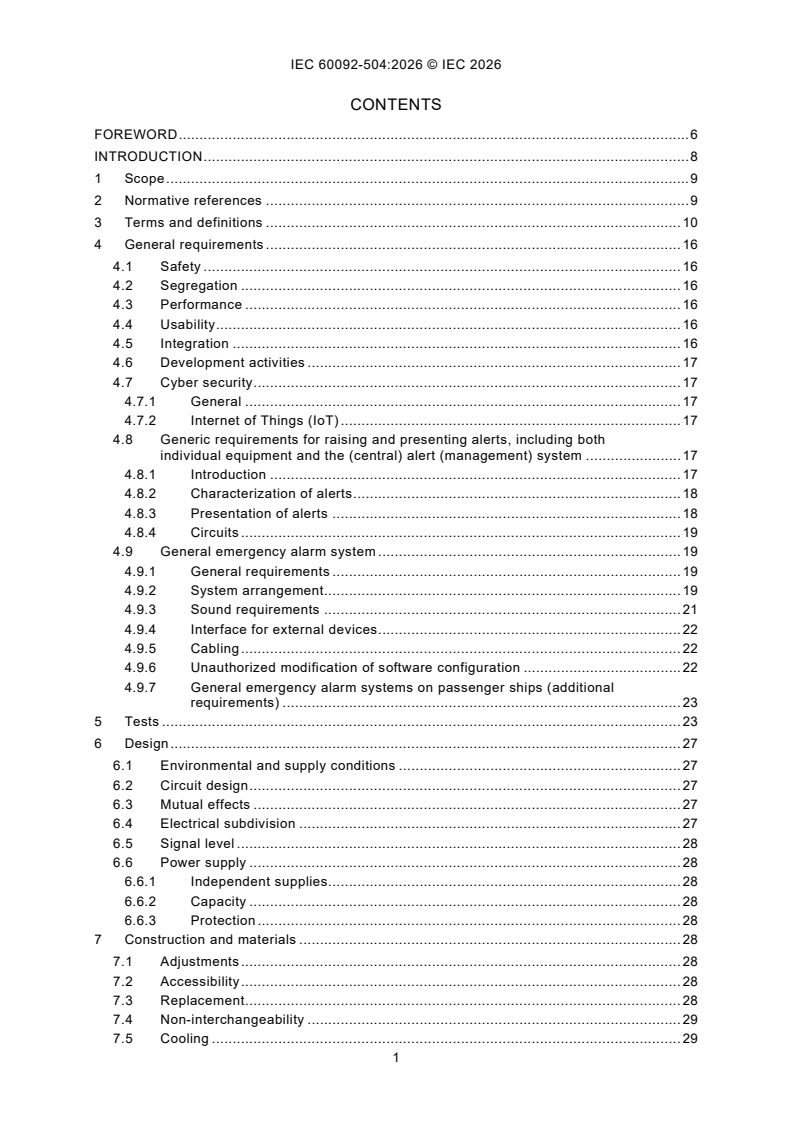
CONTENTS
FOREWORD . 6
INTRODUCTION . 8
1 Scope . 9
2 Normative references . 9
3 Terms and definitions . 10
4 General requirements . 16
4.1 Safety . 16
4.2 Segregation . 16
4.3 Performance . 16
4.4 Usability . 16
4.5 Integration . 16
4.6 Development activities . 17
4.7 Cyber security . 17
4.7.1 General . 17
4.7.2 Internet of Things (IoT) . 17
4.8 Generic requirements for raising and presenting alerts, including both
individual equipment and the (central) alert (management) system . 17
4.8.1 Introduction . 17
4.8.2 Characterization of alerts . 18
4.8.3 Presentation of alerts . 18
4.8.4 Circuits . 19
4.9 General emergency alarm system . 19
4.9.1 General requirements . 19
4.9.2 System arrangement. 19
4.9.3 Sound requirements . 21
4.9.4 Interface for external devices . 22
4.9.5 Cabling . 22
4.9.6 Unauthorized modification of software configuration . 22
4.9.7 General emergency alarm systems on passenger ships (additional
requirements) . 23
5 Tests . 23
6 Design . 27
6.1 Environmental and supply conditions . 27
6.2 Circuit design . 27
6.3 Mutual effects . 27
6.4 Electrical subdivision . 27
6.5 Signal level . 28
6.6 Power supply . 28
6.6.1 Independent supplies . 28
6.6.2 Capacity . 28
6.6.3 Protection . 28
7 Construction and materials . 28
7.1 Adjustments . 28
7.2 Accessibility . 28
7.3 Replacement . 28
7.4 Non-interchangeability . 29
7.5 Cooling . 29
7.6 Mechanical load on connectors . 29
7.7 Mechanical features of cabinets . 29
7.8 Shock and vibration absorbers . 29
7.9 Internal wiring . 29
7.10 Cable connections . 30
8 Installation and ergonomics . 30
8.1 General . 30
8.1.1 Layout . 30
8.1.2 Compatibility . 30
8.1.3 Labelling . 30
8.1.4 Labels . 30
8.1.5 Display colours . 30
8.1.6 Illumination . 30
8.1.7 Protection against fluid leakage . 31
8.1.8 Protection from condensation . 31
8.1.9 External cables and wiring . 31
8.2 Sensors . 31
8.2.1 Location of sensors . 31
8.2.2 Temperature sensors . 31
8.2.3 Pressure sensors . 31
8.2.4 Water level detectors . 31
8.2.5 Enclosure . 32
8.2.6 Testing and calibration . 32
8.2.7 Presentation of information . 32
8.3 Controls . 32
8.3.1 Remote controls . 32
8.3.2 Man-machine interface . 33
9 Specific installations . 33
9.1 General . 33
9.2 Fire safety systems . 33
9.3 Bilge systems . 33
9.4 Alert system . 33
9.4.1 Alert requirements . 33
9.4.2 Display of information . 34
9.4.3 Supply arrangements . 35
9.4.4 Design . 35
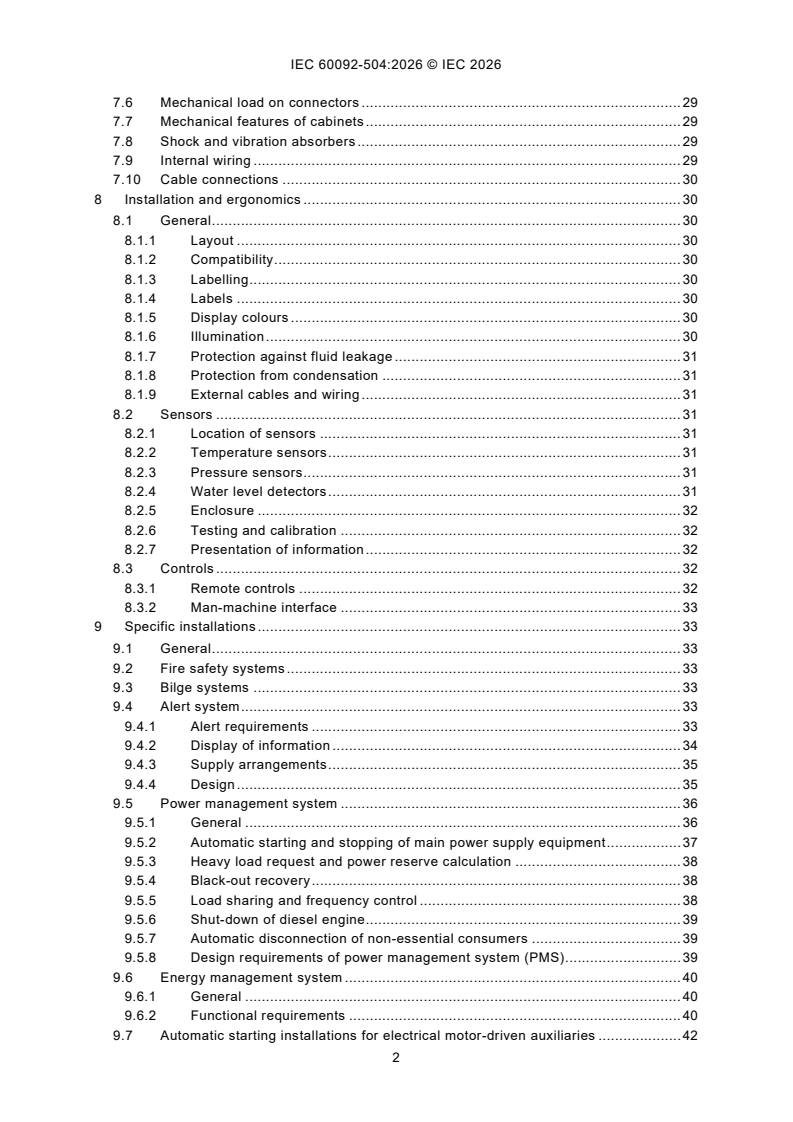
9.5 Power management system . 36
9.5.1 General . 36
9.5.2 Automatic starting and stopping of main power supply equipment . 37
9.5.3 Heavy load request and power reserve calculation . 38
9.5.4 Black-out recovery . 38
9.5.5 Load sharing and frequency control . 38
9.5.6 Shut-down of diesel engine . 39
9.5.7 Automatic disconnection of non-essential consumers . 39
9.5.8 Design requirements of power management system (PMS) . 39
9.6 Energy management system . 40
9.6.1 General . 40
9.6.2 Functional requirements . 40
9.7 Automatic starting installations for electrical motor-driven auxiliaries . 42
9.7.1 General . 42
9.7.2 Automatic sequence starting . 43
9.7.3 Starting installations for stand-by auxiliaries . 43
9.7.4 Control voltages . 43
9.7.5 Manual control . 43
9.7.6 Mechanically driven auxiliaries in low-speed range . 43
9.7.7 Mechanically driven auxiliaries . 43
9.7.8 Sensors . 44
9.8 Machinery control installations . 44
9.8.1 General . 44
9.8.2 General requirements . 44
9.8.3 Transfer of control . 44
9.8.4 Remote control of propulsion machinery from the bridge . 44
9.8.5 Indicators for remote control of machinery . 45
9.8.6 Manual override . 46
9.9 Machinery protection and safety systems . 46
9.9.1 General . 46
9.9.2 General requirements . 46
9.10 Bow, inner, side shell and stern doors. 47
9.10.1 Application. 47
9.10.2 Remote control . 47
9.10.3 Indicator system . 47
9.10.4 Mode selection . 47
9.10.5 Failsafe . 47
9.10.6 Testing . 47
9.10.7 Independence . 48
9.10.8 Display . 48
9.10.9 Sensors . 48
9.10.10 Television surveillance . 48
9.10.11 Water leakage detection . 48
9.10.12 Drainage alert . 48
9.10.13 Control location . 49
9.11 Power-operated watertight doors . 49
9.11.1 General . 49
9.11.2 Indications . 49
9.11.3 Emergency alarm . 49
9.11.4 Closure rate . 49
9.11.5 Power supply . 49
9.11.6 Dedicated circuits . 50
9.11.7 Location of equipment . 50
9.11.8 Enclosures . 50
9.11.9 Leakage . 50
9.11.10 Independent circuits . 50
9.11.11 Failure of alert circuits . 50
9.11.12 Failure of control circuits . 50
9.11.13 Power supply monitoring . 51
9.11.14 Mode selection . 51
9.11.15 Indication on navigation bridge . 51
9.11.16 Remote opening . 51
9.12 Public address systems (PA) . 51
9.12.1 General . 51
9.12.2 System arrangement. 52
9.12.3 Emergency broadcast . 53
9.12.4 Sound requirements . 53
9.12.5 Interference . 54
9.12.6 Fault tolerance . 54
9.12.7 Protection . 54
9.12.8 Fire zones . 54
9.12.9 Segregation . 54
9.12.10 Power supplies . 55
9.12.11 Cabling . 55
9.12.12 Ships operating in polar waters . 55
9.12.13 Public address system (PA) on passenger ships (additional
requirements) . 55
9.13 Use of public address system (PA) for general emergency alarm (GA) and
fire alarm . 56
9.13.1 General . 56
9.13.2 Power supply . 57
10 Computer-based systems . 57
10.1 General . 57
10.2 General requirements . 57
10.3 System categories . 58
10.4 System configuration . 59
10.4.1 General . 59
10.4.2 Power supply . 59
10.4.3 Hardware . 59
10.4.4 Software . 60
10.4.5 Data communication links . 60
10.4.6 Wireless data communication . 60
10.4.7 Network integration of systems . 61
10.4.8 User interface . 61
10.4.9 Input devices . 61
10.4.10 Output devices . 62
10.4.11 Graphical user interface . 62
10.5 Protection against modification and loss of data. 62
10.6 Software maintenance . 63
10.7 Remote access . 63
10.7.1 General . 63
10.7.2 Remote software maintenance . 63
10.8 Documentation . 63
10.8.1 General . 63
10.8.2 Hardware . 64
10.8.3 System functional description . 64
10.8.4 Software . 64
10.8.5 User interface . 65
10.8.6 Test and evidence . 65
11 Additional requirements for periodically unattended machinery spaces or for
reduced attendance . 66
11.1 General . 66
11.2 Fire precautions . 67
11.3 Protection against flooding . 67
11.4 Control of propulsion machinery . 67
11.5 Alert system and engineers’ alert . 67
11.6 Protection (safety) systems . 67
11.7 Machinery, boiler and electrical installations . 67
12 Commissioning and testing . 67
12.1 Tests of completed installation on board . 67
12.2 Operational tests . 67
13 Documentation . 68
Annex A (informative) Characterization of alerts . 69
Bibliography . 70
Figure 1 – Relationship between different alarm processing and handling concepts . 18
Figure 2 – Block diagram showing general emergency alarm system interfaces . 22
Figure 3 – Typical designs of power management systems . 36
Figure A.1 – Characterization of alerts . 69
Table 1 – Operating conditions of equipment in respect to power demand . 14
Table 2 – Type tests, test procedures and severities . 23
Table 3 – Electrical grid control overview . 42
Table 4 – Minimum water ingress protection . 50
Table 5 – System categories . 58
Table 6 – Examples of assignment to system categories . 58
Table 7 – Tests and evidence according to the system category . 65
INTERNATIONAL ELECTROTECHNICAL COMMISSION
____________
Electrical installations in ships -
Part 504: Automation, control and instrumentation
FOREWORD
1) The International Electrotechnical Commission (IEC) is a worldwide organization for standardization comprising
all national electrotechnical committees (IEC National Committees). The object of IEC is to promote international
co-operation on all questions concerning standardization in the electrical and electronic fields. To this end and
in addition to other activities, IEC publishes International Standards, Technical Specifications, Technical Reports,
Publicly Available Specifications (PAS) and Guides (hereafter referred to as “IEC Publication(s)”). Their
preparation is entrusted to technical committees; any IEC National Committee interested in the subject dealt with
may participate in this preparatory work. International, governmental and non-governmental organizations liaising
with the IEC also participate in this preparation. IEC collaborates closely with the International Organization for
Standardization (ISO) in accordance with conditions determined by agreement between the two organizations.
2) The formal decisions or agreements of IEC on technical matters express, as nearly as possible, an international
consensus of opinion on the relevant subjects since each technical committee has representation from all
interested IEC National Committees.
3) IEC Publications have the form of recommendations for international use and are accepted by IEC National
Committees in that sense. While all reasonable efforts are made to ensure that the technical content of IEC
Publications is accurate, IEC cannot be held responsible for the way in which they are used or for any
misinterpretation by any end user.
4) In order to promote international uniformity, IEC National Committees undertake to apply IEC Publications
transparently to the maximum extent possible in their national and regional publications. Any divergence between
any IEC Publication and the corresponding national or regional publication shall be clearly indicated in the latter.
5) IEC itself does not provide any attestation of conformity. Independent certification bodies provide conformity
assessment services and, in some areas, access to IEC marks of conformity. IEC is not responsible for any
services carried out by independent certification bodies.
6) All users should ensure that they have the latest edition of this publication.
7) No liability shall attach to IEC or its directors, employees, servants or agents including individual experts and
members of its technical committees and IEC National Committees for any personal injury, property damage or
other damage of any nature whatsoever, whether direct or indirect, or for costs (including legal fees) and
expenses arising out of the publication, use of, or reliance upon, this IEC Publication or any other IEC
Publications.
8) Attention is drawn to the Normative references cited in this publication. Use of the referenced publications is
indispensable for the correct application of this publication.
9) IEC draws attention to the possibility that the implementation of this document may involve the use of (a)
patent(s). IEC takes no position concerning the evidence, validity or applicability of any claimed patent rights in
respect thereof. As of the date of publication of this document, IEC had not received notice of (a) patent(s), which
may be required to implement this document. However, implementers are cautioned that this may not represent
the latest information, which may be obtained from the patent database available at https://patents.iec.ch. IEC
shall not be held responsible for identifying any or all such patent rights.
IEC 60092-504 has been prepared by IEC technical committee 18: Electrical installations of
ships and of mobile and fixed offshore units. It is an International Standard.
This fifth edition cancels and replaces the fourth edition published in 2016. This edition
constitutes a technical revision.
This edition includes the following significant technical changes with respect to the previous
edition:
a) aligned bridge and machinery alert references throughout the document;
b) transfer of EMC items to IEC 60533 throughout the document;
c) update of power management and energy management (9.5 and 9.6).
The text of this International Standard is based on the following documents:
Draft Report on voting
18/2024/FDIS 18/2034/RVD
Full information on the voting for its approval can be found in the report on voting indicated in
the above table.
The language used for the development of this International Standard is English.
This document was drafted in accordance with ISO/IEC Directives, Part 2, and developed in
accordance with ISO/IEC Directives, Part 1 and ISO/IEC Directives, IEC Supplement, available
at www.iec.ch/members_experts/refdocs. The main document types developed by IEC are
described in greater detail at www.iec.ch/publications.
A list of all parts in the IEC 60092 series, published under the general title Electrical installations
in ships, can be found on the IEC website.
The committee has decided that the contents of this document will remain unchanged until the
stability date indicated on the IEC website under webstore.iec.ch in the data related to the
specific document. At this date, the document will be
– reconfirmed,
– withdrawn, or
– revised.
INTRODUCTION
IEC 60092 forms a series of International Standards for electrical installations in sea-going
ships, incorporating good practice and coordinating, as far as possible, existing rules.
These standards form a code of practical interpretation and amplification of the requirements
of the International Convention for the Safety of Life at Sea (SOLAS), a guide for future
regulations which can be prepared and a statement of practice for use by ship owners,
shipbuilders and appropriate organizations.
1 Scope
This part of IEC 60092 specifies requirements for electrical, electronic and programmable
equipment supporting essential services intended for automation, control, monitoring, alert,
safety and protection systems
This document is not applicable for:
– maritime navigation and radiocommunication equipment and systems making use of
electrotechnical, electronic, electroacoustic, electro-optical and data processing
techniques.
NOTE It is important that equipment in the scope of IEC TC 80 (Maritime navigation and radiocommunication
equipment and systems) complies with IEC 60945 which already covers the requirements stated in this
document.
– internal communication systems, except PA/GA (Public Adress/General Alarm).
2 Normative references
The following documents are referred to in the text in such a way that some or all of their content
constitutes requirements of this document. For dated references, only the edition cited applies.
For undated references, the latest edition of the referenced document (including any
amendments) applies.
IEC 60068-2-1, Environmental testing - Part 2: Tests - Test A: Cold
IEC 60068-2-2, Environmental testing - Part 2: Tests - Test B: Dry heat
IEC 60068-2-6, Environmental testing - Part 2: Tests - Test Fc: Vibration (sinusoidal)
IEC 60068-2-30, Environmental testing - Part 2: Tests - Test Db: Damp heat, cyclic (12 h + 12 h
cycle)
IEC 60068-2-52, Environmental testing - Part 2: Tests - Test Kb: Salt mist, cyclic (sodium
chloride solution)
IEC 60079-14:2024, Explosive atmospheres - Part 14: Electrical installation design, selection
and installation of equipment, including initial inspection
IEC 60092-101:2018, Electrical installations in ships - Part 101: Definitions and general
requirements
IEC 60092-201:1994, Electrical installations in ships - Part 201: System design - General
IEC 60092-202, Electrical installations in ships - Part 202: System design - Protection
IEC 60092-302-2, Electrical installations in ships - Part 302-2: Low voltage switchgear and
controlgear assemblies - Marine power
IEC 60092-353, Electrical installations in ships - Part 353: Power cables for rated voltages 1 kV
and 3 kV
IEC 60092-376, Electrical installations in ships - Part 376: Cables for control and
instrumentation circuits 150/250 V (300 V)
IEC 60092-501, Electrical installations in ships - Part 501: Special features - Electric propulsion
plant
IEC 60331 (all parts), Tests for electric cables under fire conditions
IEC 60332-1-2, Tests on electric and optical fibre cables under fire conditions - Part 1-2: Test
for vertical flame propagation for a single insulated wire or cable - Procedure for 1 kW pre-
mixed flame
IEC 60447, Basic and safety principles for man-machine interface, marking and identification -
Actuating principles
IEC 60529, Degrees of protection provided by enclosures (IP Code)
IEC 60533, Electrical and electronic installations in ships - Electromagnetic compatibility
(EMC) - Ships with a metallic hull
IEC 61000-4-11, Electromagnetic compatibility (EMC) - Part 4-11: Testing and measurement
techniques - Voltage dips, short interruptions and voltage variations immunity tests for
equipment with input current up to 16 A per phase
IEC 61000-4-17, Electromagnetic compatibility (EMC) - Part 4-17: Testing and measurement
techniques - Ripple on d.c. input power port immunity test
IEC 61000-4-29, Electromagnetic compatibility (EMC) - Part 4-29: Testing and measurement
techniques - Voltage dips, short interruptions and voltage variations on d.c. input power port
immunity tests
IEC 62923-1:2018, Maritime navigation and radiocommunication equipment and systems -
Bridge alert management - Part 1: Operational and performance requirements, methods of
testing and required test results
IEC 81355-1, Industrial systems, installations and equipment and industrial products -
Classification and designation of information - Part 1: Basic rules and classification of
information
ISO 3740, Acoustics - Determination of sound power levels of noise sources - Guidelines for
the use of basic standards
EN 54 (all parts), Fire detection and fire alarm systems
SOLAS, International Convention for the Safety of Life at Sea:1974, consolidated edition, 2024
MSC-FAL.1/Circ.3/Rev.2, Guidelines on maritime cyber risk management, 2022
IMO Resolution MSC.302(87) Adoption of Performance Standards for Bridge Alert Management
3 Terms and definitions
For the purposes of this document, the following terms and definitions apply.
ISO and IEC maintain terminology databases for use in standardization at the following
addresses:
– IEC Electropedia: available at https://www.electropedia.org/
– ISO Online browsing platform: available at https://www.iso.org/obp
3.1
accuracy
quality which characterizes the closeness of a measured value to the corresponding true value
3.2
administration
Government of the State whose flag the ship is entitled to fly
[SOURCE: SOLAS, Chapter I, Regulation 2, Definition (b)]
3.3
alarm
condition requiring immediate attention and action by the crew, to maintain the safe navigation
and safe operation of the ship
[SOURCE: IEC 62923-1:2018, 3.1.7, modified – ‘bridge team’ is replaced by ‘crew’]
3.4
alert
announcement of abnormal situations and conditions requiring attention
Note 1 to entry: Alerts are divided in four priorities: emergency alarms, alarms, warnings and cautions. An alert
provides information about a defined state change in connection with information about how to announce this event
in a defined way to the system and the operator.
[SOURCE: IEC 62923-1:2018, 3.1.8]
3.5
alert system
automation cluster system for the centralized processing and presentation of the alerts from a
group of equipment
Note 1 to entry: Refer to SOLAS II-1 Part E, where this is called an alarm system.
Note 2 to entry: An alert system encompassing all alerts in the engineering domain of a ship can be regarded as a
Central Alert Management (CAM) system for the automation cluster, see MSC.302(87), IEC 62923-1 and
IEC 62923-2.
Note 3 to entry: This was formerly called “machinery alarm systems”.
3.6
automation system
system to monitor and control a process
3.7
availability
ability of an item to be in a state to perform a required function under given conditions at a
given time interval, assuming that the required external resources are provided
3.8
bridge and deck zone
area from which the ship is steered and navigated and where the antennas are located
3.9
caution
awareness of a condition which does not warrant an alarm or warning condition, but still requires
attention out of the ordinary consideration of the situation or of given information
[SOURCE: IEC 62923-1:2018, 3.1.22]
3.10
centralized control
control of all operations of a controlled system from one central control position
3.11
computer-based system
system that consists of one or more programmable electronic devices with their connections,
peripherals and software necessary to carry out automatically specified functions
Note 1 to entry: The following types of programmable devices could form part of a computer system: main-frame,
mini-computer, micro-processor-based computer, programmable logic controller.
3.12
control functions
functions intended to regulate the behaviour of equipment or systems
3.13
control position
control station
group of control devices by which an operator can control the performance of a machine,
apparatus, process or assembly of machines and apparatus
Note 1 to entry: A control position will generally enable an operator to verify the achievement of the desired
conditions by means of an appropriate monitoring system
3.14
emergency alarm
alarm which indicates immediate danger to human life or to the ship and its machinery exists
and requires immediate action
[SOURCE: IEC 62923-1:2018, 3.1.25]
3.15
EMS
energy management system
automatic control system for the generation, distribution, storage and loads of electrical energy,
including system demand control and management forecast of the electrical energy system, in
order to continuously search for an optimum with respect to an operational goal
Note 1 to entry: The energy management system definition is derived from “microgrid energy management system”
(IEC 60050-617:2018, 617-04-25) defined as a “system operating and controlling energy resources and loads of the
microgrid”.
Note 2 to entry: Examples for such goals can be fuel consumption, emissions, wear and tear, performance and/or
reliability.
Note 3 to entry: The EMS is considered to be a tertiary loop. The power management of the power source is the
first control loop and the PMS the secondary control loop.
3.16
essential services
services essential for the navigation, propulsion, steering or manoeuvring of the ship, or for the
safety of human life, or for special characteristics of the ship (for example special services)
[SOURCE: IEC 60
...
IEC 60092-504 ®
Edition 5.0 2026-04
INTERNATIONAL
STANDARD
REDLINE VERSION
Electrical installations in ships -
Part 504: Automation, control and instrumentation
ICS 47.020.60 ISBN 978-2-8327-1222-1
All rights reserved. Unless otherwise specified, no part of this publication may be reproduced or utilized in any form or
by any means, electronic or mechanical, including photocopying and microfilm, without permission in writing from either
IEC or IEC's member National Committee in the country of the requester. If you have any questions about IEC copyright
or have an enquiry about obtaining additional rights to this publication, please contact the address below or your local
IEC member National Committee for further information.
IEC Secretariat Tel.: +41 22 919 02 11
3, rue de Varembé info@iec.ch
CH-1211 Geneva 20 www.iec.ch
Switzerland
About the IEC
The International Electrotechnical Commission (IEC) is the leading global organization that prepares and publishes
International Standards for all electrical, electronic and related technologies.
About IEC publications
The technical content of IEC publications is kept under constant review by the IEC. Please make sure that you have the
latest edition, a corrigendum or an amendment might have been published.
IEC publications search - IEC Products & Services Portal - products.iec.ch
webstore.iec.ch/advsearchform Discover our powerful search engine and read freely all the
The advanced search enables to find IEC publications by a publications previews, graphical symbols and the glossary.
variety of criteria (reference number, text, technical With a subscription you will always have access to up to date
committee, …). It also gives information on projects, content tailored to your needs.
replaced and withdrawn publications.
Electropedia - www.electropedia.org
The world's leading online dictionary on electrotechnology,
IEC Just Published - webstore.iec.ch/justpublished
Stay up to date on all new IEC publications. Just Published containing more than 22 500 terminological entries in English
details all new publications released. Available online and and French, with equivalent terms in 25 additional languages.
once a month by email. Also known as the International Electrotechnical Vocabulary
(IEV) online.
IEC Customer Service Centre - webstore.iec.ch/csc
If you wish to give us your feedback on this publication or
need further assistance, please contact the Customer
Service Centre: sales@iec.ch.
CONTENTS
FOREWORD . 6
INTRODUCTION . 8
1 Scope . 9
2 Normative references . 9
3 Terms and definitions . 11
4 General requirements . 18
4.1 Dependability .
4.1 Safety . 18
4.2 Segregation . 18
4.3 Performance . 18
4.4 Usability . 19
4.5 Integration . 19
4.6 Development activities . 19
4.7 Cyber security . 19
4.7.1 General . 19
4.7.2 Internet of Things (IoT) . 19
4.8 Generic requirements for raising and presenting alerts, including both
individual equipment and the (central) alert (management) system . 19
4.8.1 Introduction . 19
4.8.2 Characterization of alerts . 20
4.8.3 Presentation of alerts . 20
4.8.4 Circuits . 21
4.9 General emergency alarm system . 21
4.9.1 General requirements . 21
4.9.2 System arrangement. 21
4.9.3 Sound requirements . 23
4.9.4 Interface for external devices . 24
4.9.5 Cabling . 24
4.9.6 Unauthorized modification of software configuration . 25
4.9.7 General emergency alarm systems on passenger ships (additional
requirements) . 25
5 Environmental type testing parameters Tests . 25
5.1 General .
5.2 Performance .
6 Design . 32
6.1 Environmental and supply conditions . 32
6.2 Circuit design . 32
6.3 Mutual effects . 32
6.4 Electrical subdivision . 32
6.5 Signal level . 33
6.6 Power supply . 33
6.6.1 Independent supplies . 33
6.6.2 Capacity . 33
6.6.3 Protection . 33
7 Construction and materials . 33
7.1 Adjustments . 33
7.2 Accessibility . 33
7.3 Replacement . 33
7.4 Non-interchangeability . 34
7.5 Cooling . 34
7.6 Mechanical load on connectors . 34
7.7 Mechanical features of cabinets . 34
7.8 Shock and vibration absorbers . 34
7.9 Internal wiring . 34
7.10 Cable connections . 35
8 Installation and ergonomics . 35
8.1 General . 35
8.1.1 Layout . 35
8.1.2 Compatibility . 35
8.1.3 Labelling . 35
8.1.4 Labels . 35
8.1.5 Display colours . 35
8.1.6 Illumination . 35
8.1.7 Protection against fluid leakage . 36
8.1.8 Protection from condensation . 36
8.1.9 External cables and wiring . 36
8.2 Sensors . 36
8.2.1 Location of sensors . 36
8.2.2 Temperature sensors . 36
8.2.3 Pressure sensors . 36
8.2.4 Water level detectors on bulk carriers . 36
8.2.5 Enclosure . 37
8.2.6 Testing and calibration . 37
8.2.7 Presentation of information . 37
8.3 Controls . 37
8.3.1 Remote controls . 37
8.3.2 Man-machine interface . 38
8.4 Alert systems .
9 Specific installations . 38
9.1 General . 38
9.2 Fire safety systems . 38
9.3 Bilge systems . 39
9.4 Machinery alert installations Alert system . 39
9.3.1 General .
9.4.1 Alert requirements . 39
9.4.2 Display of information . 40
9.4.3 Supply arrangements . 41
9.4.4 Design . 42
9.5 Power management system . 42
9.5.1 General . 42
9.5.2 Automatic starting and stopping of main power supply equipment . 44
9.5.3 Heavy load request and power reserve calculation . 45
9.5.4 Black-out recovery . 45
9.5.5 Load sharing and frequency control . 45
9.5.6 Shut-down of diesel engine . 45
9.5.7 Automatic disconnection of non-essential consumers . 46
9.5.8 Design requirements of power management system (PMS) . 46
9.6 Energy management system . 47
9.6.1 General . 47
9.6.2 Functional requirements . 47
9.7 Automatic starting installations for electrical motor-driven auxiliaries . 49
9.7.1 General . 49
9.7.2 Automatic sequence starting . 50
9.7.3 Starting installations for stand-by auxiliaries . 50
9.7.4 Control voltages . 50
9.7.5 Manual control . 50
9.7.6 Mechanically driven auxiliaries in low-speed range . 50
9.7.7 Mechanically driven auxiliaries . 50
9.7.8 Sensors . 51
9.8 Machinery control installations . 51
9.8.1 General . 51
9.8.2 General requirements . 51
9.8.3 Transfer of control . 51
9.8.4 Remote control of propulsion machinery from the bridge . 51
9.8.5 Indicators for remote control of machinery . 52
9.8.6 Manual override . 53
9.9 Machinery protection and safety systems . 53
9.9.1 General . 53
9.9.2 General requirements . 53
9.10 Bow, inner, side shell and stern doors. 54
9.10.1 Application. 54
9.10.2 Remote control . 54
9.10.3 Indicator system . 54
9.10.4 Mode selection . 54
9.10.5 Failsafe . 54
9.10.6 Testing . 55
9.10.7 Independence . 55
9.10.8 Display . 55
9.10.9 Sensors . 55
9.10.10 Television surveillance . 55
9.10.11 Water leakage detection . 55
9.10.12 Drainage alarm alert . 56
9.10.13 Control location . 56
9.11 Power-operated watertight doors . 56
9.11.1 General . 56
9.11.2 Indications . 56
9.11.3 Emergency alarm . 56
9.11.4 Closure rate . 56
9.11.5 Power supply . 56
9.11.6 Dedicated circuits . 57
9.11.7 Location of equipment . 57
9.11.8 Enclosures . 57
9.11.9 Leakage . 57
9.11.10 Independent circuits . 58
9.11.11 Failure of alarm alert circuits . 58
9.11.12 Failure of control circuits . 58
9.11.13 Power supply monitoring . 58
9.11.14 Mode selection . 58
9.11.15 Indication on navigation bridge . 58
9.11.16 Remote opening . 58
9.12 Public address systems (PA) on passenger ships . 58
9.12.1 General . 58
9.12.2 System arrangement. 59
9.12.3 Emergency broadcast . 60
9.12.4 Sound requirements . 61
9.12.5 Interference . 61
9.12.6 Fault tolerance . 61
9.12.7 Protection . 62
9.12.8 Fire zones . 62
9.12.9 Segregation . 62
9.12.10 Power supplies . 62
9.12.11 Cabling . 62
9.12.12 Ships operating in polar waters . 62
9.12.13 Public address system (PA) on passenger ships (additional
requirements) . 63
9.13 Use of public address system (PA) for general emergency alarm (GA) and
fire alarm . 63
9.13.1 General . 63
9.13.2 Power supply . 64
10 Computer-based systems . 64
10.1 General . 64
10.2 General requirements . 64
10.3 System categories . 65
10.4 System configuration . 66
10.4.1 General . 66
10.4.2 Power supply . 66
10.4.3 Hardware . 66
10.4.4 Software . 67
10.4.5 Data communication links . 67
10.4.6 Wireless data communication . 67
10.4.7 Network integration of systems . 68
10.4.8 User interface . 68
10.4.9 Input devices . 68
10.4.10 Output devices . 69
10.4.11 Graphical user interface . 69
10.5 Protection against modification and loss of data. 69
10.6 Software maintenance . 70
10.7 Remote access . 70
10.7.1 General . 70
10.7.2 Remote software maintenance . 70
10.8 Documentation . 70
10.8.1 General . 70
10.8.2 Hardware . 71
10.8.3 System functional description . 71
10.8.4 Software . 71
10.8.5 User interface . 72
10.8.6 Test and evidence . 72
11 Additional requirements for periodically unattended machinery spaces or for
reduced attendance . 73
11.1 General . 73
11.2 Fire precautions . 74
11.3 Protection against flooding . 74
11.4 Control of propulsion machinery . 74
11.5 AlarmAlert system and engineers’ alarmalert . 74
11.6 Protection (safety) systems . 74
11.7 Machinery, boiler and electrical installations . 74
12 Commissioning and testing . 74
12.1 Tests of completed installation on board . 74
12.2 Operational tests . 74
13 Documentation . 75
Annex A (informative) Characterization of alerts . 76
Bibliography . 77
Figure 1 – Relationship between different alarm processing and handling concepts . 20
Figure 2 – Block diagram showing general emergency alarm system interfaces . 24
Figure 3 – Typical designs of power management systems . 43
Figure A.1 – Characterization of alerts . 76
Table 1 – Operating conditions of equipment in respect to power demand . 15
Table 2 – Type tests, test procedures and severities . 26
Table 3 – Electrical grid control overview . 49
Table 4 – Minimum water ingress protection . 57
Table 5 – System categories . 65
Table 6 – Examples of assignment to system categories . 65
Table 7 – Tests and evidence according to the system category . 72
INTERNATIONAL ELECTROTECHNICAL COMMISSION
____________
Electrical installations in ships -
Part 504: Automation, control and instrumentation
FOREWORD
1) The International Electrotechnical Commission (IEC) is a worldwide organization for standardization comprising
all national electrotechnical committees (IEC National Committees). The object of IEC is to promote international
co-operation on all questions concerning standardization in the electrical and electronic fields. To this end and
in addition to other activities, IEC publishes International Standards, Technical Specifications, Technical Reports,
Publicly Available Specifications (PAS) and Guides (hereafter referred to as “IEC Publication(s)”). Their
preparation is entrusted to technical committees; any IEC National Committee interested in the subject dealt with
may participate in this preparatory work. International, governmental and non-governmental organizations liaising
with the IEC also participate in this preparation. IEC collaborates closely with the International Organization for
Standardization (ISO) in accordance with conditions determined by agreement between the two organizations.
2) The formal decisions or agreements of IEC on technical matters express, as nearly as possible, an international
consensus of opinion on the relevant subjects since each technical committee has representation from all
interested IEC National Committees.
3) IEC Publications have the form of recommendations for international use and are accepted by IEC National
Committees in that sense. While all reasonable efforts are made to ensure that the technical content of IEC
Publications is accurate, IEC cannot be held responsible for the way in which they are used or for any
misinterpretation by any end user.
4) In order to promote international uniformity, IEC National Committees undertake to apply IEC Publications
transparently to the maximum extent possible in their national and regional publications. Any divergence between
any IEC Publication and the corresponding national or regional publication shall be clearly indicated in the latter.
5) IEC itself does not provide any attestation of conformity. Independent certification bodies provide conformity
assessment services and, in some areas, access to IEC marks of conformity. IEC is not responsible for any
services carried out by independent certification bodies.
6) All users should ensure that they have the latest edition of this publication.
7) No liability shall attach to IEC or its directors, employees, servants or agents including individual experts and
members of its technical committees and IEC National Committees for any personal injury, property damage or
other damage of any nature whatsoever, whether direct or indirect, or for costs (including legal fees) and
expenses arising out of the publication, use of, or reliance upon, this IEC Publication or any other IEC
Publications.
8) Attention is drawn to the Normative references cited in this publication. Use of the referenced publications is
indispensable for the correct application of this publication.
9) IEC draws attention to the possibility that the implementation of this document may involve the use of (a)
patent(s). IEC takes no position concerning the evidence, validity or applicability of any claimed patent rights in
respect thereof. As of the date of publication of this document, IEC had not received notice of (a) patent(s), which
may be required to implement this document. However, implementers are cautioned that this may not represent
the latest information, which may be obtained from the patent database available at https://patents.iec.ch. IEC
shall not be held responsible for identifying any or all such patent rights.
This redline version of the official IEC Standard allows the user to identify the changes made
to the previous edition IEC 60092-504:2016. A vertical bar appears in the margin wherever a
change has been made. Additions are in green text, deletions are in strikethrough red text.
IEC 60092-504 has been prepared by IEC technical committee 18: Electrical installations of
ships and of mobile and fixed offshore units. It is an International Standard.
This fifth edition cancels and replaces the fourth edition published in 2016. This edition
constitutes a technical revision.
This edition includes the following significant technical changes with respect to the previous
edition:
a) aligned bridge and machinery alert references throughout the document;
b) transfer of EMC items to IEC 60533 throughout the document;
c) update of power management and energy management (9.5 and 9.6).
The text of this International Standard is based on the following documents:
Draft Report on voting
18/2024/FDIS 18/2034/RVD
Full information on the voting for its approval can be found in the report on voting indicated in
the above table.
The language used for the development of this International Standard is English.
This document was drafted in accordance with ISO/IEC Directives, Part 2, and developed in
accordance with ISO/IEC Directives, Part 1 and ISO/IEC Directives, IEC Supplement, available
at www.iec.ch/members_experts/refdocs. The main document types developed by IEC are
described in greater detail at www.iec.ch/publications.
A list of all parts in the IEC 60092 series, published under the general title Electrical installations
in ships, can be found on the IEC website.
The committee has decided that the contents of this document will remain unchanged until the
stability date indicated on the IEC website under webstore.iec.ch in the data related to the
specific document. At this date, the document will be
– reconfirmed,
– withdrawn, or
– revised.
INTRODUCTION
IEC 60092 forms a series of International Standards for electrical installations in sea-going
ships, incorporating good practice and coordinating, as far as possible, existing rules.
These standards form a code of practical interpretation and amplification of the requirements
of the International Convention for the Safety of Life at Sea (SOLAS), a guide for future
regulations which may can be prepared and a statement of practice for use by ship owners,
shipbuilders and appropriate organizations.
1 Scope
This part of IEC 60092 specifies requirements for electrical, electronic and programmable
equipment supporting essential services intended for automation, control, monitoring, alert, and
safety and protection systems for in ships
This document is not applicable for:
– maritime navigation and radiocommunication equipment and systems making use of
electrotechnical, electronic, electroacoustic, electro-optical and data processing
techniques.
NOTE It is important that equipment in the scope of IEC TC 80 (Maritime navigation and radiocommunication
equipment and systems) complies with IEC 60945 which already covers the requirements stated in this
document.
– internal communication systems, except PA/GA (Public Adress/General Alarm).
2 Normative references
The following documents are referred to in the text in such a way that some or all of their content
constitutes requirements of this document. For dated references, only the edition cited applies.
For undated references, the latest edition of the referenced document (including any
amendments) applies.
IEC 60050 (all parts), International Electrotechnical Vocabulary (IEV) (available at
www.electropedia.org)
IEC 60068-2-1, Environmental testing - Part 2: Tests - Test A: Cold
IEC 60068-2-2, Environmental testing - Part 2: Tests - Test B: Dry heat
IEC 60068-2-6, Environmental testing - Part 2: Tests - Test Fc: Vibration (sinusoidal)
IEC 60068-2-30, Environmental testing - Part 2: Tests - Test Db: Damp heat, cyclic (12 h + 12 h
cycle)
IEC 60068-2-52, Environmental testing - Part 2: Tests - Test Kb: Salt mist, cyclic (sodium
chloride solution)
IEC 60079-14:2024, Explosive atmospheres - Part 14: Electrical installation design, selection
and installation of equipment, including initial inspection
IEC 60092-101:19942018, Electrical installations in ships - Part 101: Definitions and general
requirements
IEC 60092-101:1994/AMD1:1995
IEC 60092-201:1994, Electrical installations in ships - Part 201: System design - General
IEC 60092-202, Electrical installations in ships - Part 202: System design - Protection
IEC 60092-302, Electrical installations in ships – Part 302: Low -voltage switchgear and
controlgear assemblies
IEC 60092-302-2, Electrical installations in ships - Part 302-2: Low voltage switchgear and
controlgear assemblies - Marine power
IEC 60092-353, Electrical installations in ships - Part 353: Power cables for rated voltages 1 kV
and 3 kV
IEC 60092-376, Electrical installations in ships - Part 376: Cables for control and
instrumentation circuits 150/250 V (300 V)
IEC 60092-501, Electrical installations in ships - Part 501: Special features - Electric propulsion
plant
IEC 60092-502, Electrical installations in ships – Part 502: Tankers – Special features
IEC 60331 (all parts), Tests for electric cables under fire conditions
IEC 60332-1-2, Tests on electric and optical fibre cables under fire conditions - Part 1-2: Test
for vertical flame propagation for a single insulated wire or cable - Procedure for 1 kW pre-
mixed flame
IEC 60447, Basic and safety principles for man-machine interface, marking and identification -
Actuating principles
IEC 60529, Degrees of protection provided by enclosures (IP Code)
IEC 60533, Electrical and electronic installations in ships - Electromagnetic compatibility
(EMC) - Ships with a metallic hull
IEC 60945, Maritime navigation and radiocommunication equipment and systems – General
requirements – Methods of testing and required test results
IEC 61000-4-2, Electromagnetic compatibility (EMC) – Part 4-2: Testing and measuring
techniques – Electrostatic discharge immunity test
IEC 61000-4-3, Electromagnetic compatibility (EMC) – Part 4-3: Testing and measurement
techniques – Radiated, radio-frequency, electromagnetic field immunity test
IEC 61000-4-4, Electromagnetic compatibility (EMC) – Part 4-4: Testing and measurement
techniques – Electrical fast transient/burst immunity test
IEC 61000-4-5:2014, Electromagnetic compatibility (EMC) – Part 4-5: Testing and
measurement techniques – Surge immunity test
IEC 61000-4-6, Electromagnetic compatibility (EMC) – Part 4-6: Testing and measurement
techniques – Immunity to conducted disturbances, induced by radio-frequency fields
IEC 61000-4-11, Electromagnetic compatibility (EMC) - Part 4-11: Testing and measurement
techniques - Voltage dips, short interruptions and voltage variations immunity tests for
equipment with input current up to 16 A per phase
IEC 61000-4-17, Electromagnetic compatibility (EMC) - Part 4-17: Testing and measurement
techniques - Ripple on d.c. input power port immunity test
IEC 61000-4-29, Electromagnetic compatibility (EMC) - Part 4-29: Testing and measurement
techniques - Voltage dips, short interruptions and voltage variations on d.c. input power port
immunity tests
IEC 61355-1, Classification and designation of documents for plants, systems and
equipment − Part 1: rules and classification tables
IEC 62443 (all parts), Industrial communication networks − Network and system security
IEC 62923-1:2018, Maritime navigation and radiocommunication equipment and systems -
Bridge alert management - Part 1: Operational and performance requirements, methods of
testing and required test results
IEC 81355-1, Industrial systems, installations and equipment and industrial products -
Classification and designation of information - Part 1: Basic rules and classification of
information
ABS publication, Guidance notes on the application of ergonomics to marine systems (2014-02)
CISPR 16-1-1, Specification for radio disturbance and immunity measuring apparatus and
methods – Part 1-1: Radio disturbance and immunity measuring apparatus – Measuring
apparatus
CISPR 16-2-1, Specification for radio disturbance and immunity measuring apparatus and
methods – Part 2-1: Methods of measurement of disturbances and immunity – Conducted
disturbance measurements
ISO 3740, Acoustics - Determination of sound power levels of noise sources - Guidelines for
the use of basic standards
EN 54 (all parts), Fire detection and fire alarm systems
IMO Resolution A.1021(26):2009, Code on alerts and Indicators
SOLAS, International Convention for the Safety of Life at Sea:1974, consolidated edition, 2024
MSC-FAL.1/Circ.3/Rev.2, Guidelines on maritime cyber risk management, 2022
IMO Resolution MSC.302(87):2010, Adoption of Performance Standards for Bridge Alert
Management (BAM)
IMO Resolution A.813(19):1995, General Requirements for Electromagnetic Compatibility
(EMC) for all Electrical and Electronic Ship's Equipment
IMO Resolution MSC.98(73):2000, Adoption of the international code for fire safety systems
(FSS Code)
SOLAS, International Convention for the Safety of Life at Sea (SOLAS):1974, consolidated
edition, 2009
3 Terms and definitions
For the purposes of this document, the following terms and definitions apply.
ISO and IEC maintain terminology databases for use in standardization at the following
addresses:
– IEC Electropedia: available at https://www.electropedia.org/
– ISO Online browsing platform: available at https://www.iso.org/obp
3.1
accuracy
quality which characterizes the closeness of a measured value to the corresponding true value
3.2
administration
Government of the State whose flag the ship is entitled to fly
[SOURCE: SOLAS, Chapter I, Regulation 2, Definition (b)]
3.3
alarm
condition requiring immediate attention and action by the crew, to maintain the safe navigation
and safe operation of the ship
[SOURCE: IEC 62923-1:2018, 3.1.7, modified – ‘bridge team’ is replaced by ‘crew’]
3.4
alert
announcement of abnormal situations and conditions requiring attention
Note 1 to entry: Alerts are divided in four priorities: emergency alarms, alarms, warnings and cautions. An alert
provides information about a defined state change in connection with information about how to announce this event
in a defined way to the system and the operator.
[SOURCE: IEC 62923-1:2018, 3.1.8]
3.5
alert system
automation cluster system for the central
...