

IEC 60494-2:2002
(Main)Railway applications - Rolling stock - Pantographs - Characteristics and tests - Part 2: Pantographs for metros and light rail vehicles
- Abstract
Defines the general assembly characteristics which are to be applied to pantographs for metros and light rail vehicles, to enable current collection from the overhead line system. Also defines the tests the pantographs have to perform, excluding insulators. Does not apply to pantograph dielectric tests, which are to be performed on the pantograph installed on the vehicle roof. These rules in so far as they are applicable are also valid for trolley buses. Does not apply to pantographs used on main line vehicles: these pantographs are considered in IEC 60494-1. Relates to conventional suspended overhead line systems and accessories. The systems (or part of them) which are rigidly suspended will require special consideration between the customer and the supplier.
- Status
- Published
- Publication Date
- 15-Aug-2002
- Technical Committee
- TC 9 - Electrical equipment and systems for railways
- Drafting Committee
- WG 3 - TA 5/WG 3
- Current Stage
- DELPUB - Deleted publication - 99 Deleted
- Start Date
- 13-Sep-2013


Overview
IEC 60494-2:2002 is an international standard published by the International Electrotechnical Commission (IEC) that specifies the characteristics and testing requirements for pantographs used on metros and light rail vehicles. Pantographs are critical components of railway rolling stock, enabling safe and reliable current collection from overhead line systems. This part of the IEC 60494 series focuses specifically on pantographs designed for urban rail transit systems-such as metros and light rail-excluding main line railway pantographs, which are covered under IEC 60494-1.
The standard establishes essential assembly characteristics and mechanical, electrical, and functional performance criteria for pantographs in these applications. It also outlines rigorous testing methods to verify compliance and operational reliability, excluding dielectric tests for pantograph insulators which must be conducted with the pantograph installed on the vehicle roof. The scope extends, where applicable, to trolley buses equipped with pantographs.
Key Topics
Technical Requirements
The document defines the mechanical dimensions, gauge, electrical characteristics, static and dynamic forces, transverse rigidity, and mass constraints of pantographs. It emphasizes the importance of collector head design, operating systems, and automatic dropping devices to optimize performance during current collection.Testing Procedures
Multiple categories of tests are prescribed to ensure durability, safety, and functionality:- General tests covering mechanical integrity and electrical properties
- Operating tests simulating real-world functional conditions
- Endurance tests for long-term reliability
- Specialized tests including resistance to shocks, transverse rigidity, and air tightness
- Routine tests measuring freedom of movement in collector heads and current collection efficiency
Maintenance and Reliability
The standard discusses maintenance design considerations to facilitate easy serviceability and inspections. It also addresses in-service reliability demonstrations and customer-supplier agreements regarding rigidly suspended overhead systems.Marking and Documentation
Proper marking for traceability and conformity is mandated to assist in operational safety and maintenance records.Electromagnetic Compatibility (EMC)
Requirements ensure that pantographs operate without contributing to or being affected by electromagnetic disturbances, preserving system integrity.
Applications
IEC 60494-2:2002 is tailored for use in the following contexts:
Metro Systems
Urban rapid transit systems where pantographs must operate reliably under frequent stops and starts, tight clearances, and varying electrical demands.Light Rail Vehicles
Vehicles operating in urban or suburban environments with overhead line power collection, requiring robust pantograph designs optimized for these operational profiles.Trolley Buses
Electric buses that collect current via pantographs may also apply these rules where relevant to ensure safe and consistent power pickup.
Adhering to this standard helps manufacturers and operators achieve higher safety levels, interoperability, and performance optimization, supporting efficient public transportation.
Related Standards
IEC 60494-1: Covers pantographs for main line railway vehicles and is complementary to IEC 60494-2 by addressing different operating environments and design considerations.
IEC 60034 Series: While not directly linked, this general IEC numbering series may contain relevant electromechanical standards impacting rolling stock component design.
National and Regional Metro Standards: Many countries adopt IEC standards as a benchmark, supplementing them with local regulations for pantographs and overhead line systems.
Keywords: IEC 60494-2, pantographs, metro pantographs, light rail vehicles, railway applications, rolling stock, overhead line system, current collection, pantograph testing, electromechanical standards, IEC standards, urban rail transport, trolley bus pantographs, pantograph maintenance, electromagnetic compatibility.
Relations
- Effective Date
- 05-Sep-2023
Get Certified
Connect with accredited certification bodies for this standard

IRIS Certification (UNIFE)
International Railway Industry Standard certification.

TÜV SÜD Rail GmbH
TÜV SÜD railway certification services.

Bureau Veritas Railway Certification
Railway and transportation certification.
Sponsored listings
Frequently Asked Questions
IEC 60494-2:2002 is a standard published by the International Electrotechnical Commission (IEC). Its full title is "Railway applications - Rolling stock - Pantographs - Characteristics and tests - Part 2: Pantographs for metros and light rail vehicles". This standard covers: Defines the general assembly characteristics which are to be applied to pantographs for metros and light rail vehicles, to enable current collection from the overhead line system. Also defines the tests the pantographs have to perform, excluding insulators. Does not apply to pantograph dielectric tests, which are to be performed on the pantograph installed on the vehicle roof. These rules in so far as they are applicable are also valid for trolley buses. Does not apply to pantographs used on main line vehicles: these pantographs are considered in IEC 60494-1. Relates to conventional suspended overhead line systems and accessories. The systems (or part of them) which are rigidly suspended will require special consideration between the customer and the supplier.
Defines the general assembly characteristics which are to be applied to pantographs for metros and light rail vehicles, to enable current collection from the overhead line system. Also defines the tests the pantographs have to perform, excluding insulators. Does not apply to pantograph dielectric tests, which are to be performed on the pantograph installed on the vehicle roof. These rules in so far as they are applicable are also valid for trolley buses. Does not apply to pantographs used on main line vehicles: these pantographs are considered in IEC 60494-1. Relates to conventional suspended overhead line systems and accessories. The systems (or part of them) which are rigidly suspended will require special consideration between the customer and the supplier.
IEC 60494-2:2002 is classified under the following ICS (International Classification for Standards) categories: 45.060.01 - Railway rolling stock in general. The ICS classification helps identify the subject area and facilitates finding related standards.
IEC 60494-2:2002 has the following relationships with other standards: It is inter standard links to IEC 60494-2:2013. Understanding these relationships helps ensure you are using the most current and applicable version of the standard.
IEC 60494-2:2002 is available in PDF format for immediate download after purchase. The document can be added to your cart and obtained through the secure checkout process. Digital delivery ensures instant access to the complete standard document.
Standards Content (Sample)
NORME CEI
INTERNATIONALE IEC
60494-2
INTERNATIONAL
Première édition
STANDARD
First edition
2002-08
Applications ferroviaires – Matériel roulant –
Pantographes – Caractéristiques et essais –
Partie 2:
Pantographes pour métros et véhicules légers
Railway applications – Rolling stock –
Pantographs – Characteristics and tests –
Part 2:
Pantographs for metros and light rail vehicles
Numéro de référence
Reference number
CEI/IEC 60494-2:2002
Numérotation des publications Publication numbering
Depuis le 1er janvier 1997, les publications de la CEI As from 1 January 1997 all IEC publications are
sont numérotées à partir de 60000. Ainsi, la CEI 34-1 issued with a designation in the 60000 series. For
devient la CEI 60034-1. example, IEC 34-1 is now referred to as IEC 60034-1.
Editions consolidées Consolidated editions
Les versions consolidées de certaines publications de la The IEC is now publishing consolidated versions of its
CEI incorporant les amendements sont disponibles. Par publications. For example, edition numbers 1.0, 1.1
exemple, les numéros d’édition 1.0, 1.1 et 1.2 indiquent and 1.2 refer, respectively, to the base publication,
respectivement la publication de base, la publication de the base publication incorporating amendment 1 and
base incorporant l’amendement 1, et la publication de the base publication incorporating amendments 1
base incorporant les amendements 1 et 2. and 2.
Informations supplémentaires Further information on IEC publications
sur les publications de la CEI
Le contenu technique des publications de la CEI est The technical content of IEC publications is kept
constamment revu par la CEI afin qu'il reflète l'état under constant review by the IEC, thus ensuring that
actuel de la technique. Des renseignements relatifs à the content reflects current technology. Information
cette publication, y compris sa validité, sont dispo- relating to this publication, including its validity, is
nibles dans le Catalogue des publications de la CEI available in the IEC Catalogue of publications
(voir ci-dessous) en plus des nouvelles éditions, (see below) in addition to new editions, amendments
amendements et corrigenda. Des informations sur les and corrigenda. Information on the subjects under
sujets à l’étude et l’avancement des travaux entrepris consideration and work in progress undertaken by the
par le comité d’études qui a élaboré cette publication, technical committee which has prepared this
ainsi que la liste des publications parues, sont publication, as well as the list of publications issued,
également disponibles par l’intermédiaire de: is also available from the following:
• Site web de la CEI (www.iec.ch) • IEC Web Site (www.iec.ch)
• Catalogue des publications de la CEI • Catalogue of IEC publications
Le catalogue en ligne sur le site web de la CEI The on-line catalogue on the IEC web site
(http://www.iec.ch/searchpub/cur_fut.htm) vous permet (http://www.iec.ch/searchpub/cur_fut.htm) enables
de faire des recherches en utilisant de nombreux you to search by a variety of criteria including text
critères, comprenant des recherches textuelles, par searches, technical committees and date of
comité d’études ou date de publication. Des publication. On-line information is also available
informations en ligne sont également disponibles sur on recently issued publications, withdrawn and
les nouvelles publications, les publications rempla- replaced publications, as well as corrigenda.
cées ou retirées, ainsi que sur les corrigenda.
• IEC Just Published • IEC Just Published
Ce résumé des dernières publications parues This summary of recently issued publications
(http://www.iec.ch/online_news/justpub/jp_entry.htm) (http://www.iec.ch/online_news/justpub/jp_entry.htm)
est aussi disponible par courrier électronique. is also available by email. Please contact the
Veuillez prendre contact avec le Service client Customer Service Centre (see below) for further
(voir ci-dessous) pour plus d’informations. information.
• Service clients • Customer Service Centre
Si vous avez des questions au sujet de cette If you have any questions regarding this
publication ou avez besoin de renseignements publication or need further assistance, please
supplémentaires, prenez contact avec le Service contact the Customer Service Centre:
clients:
Email: custserv@iec.ch Email: custserv@iec.ch
Tél: +41 22 919 02 11 Tel: +41 22 919 02 11
Fax: +41 22 919 03 00 Fax: +41 22 919 03 00
.
NORME CEI
INTERNATIONALE IEC
60494-2
INTERNATIONAL
Première édition
STANDARD
First edition
2002-08
Applications ferroviaires – Matériel roulant –
Pantographes – Caractéristiques et essais –
Partie 2:
Pantographes pour métros et véhicules légers
Railway applications – Rolling stock –
Pantographs – Characteristics and tests –
Part 2:
Pantographs for metros and light rail vehicles
IEC 2002 Droits de reproduction réservés Copyright - all rights reserved
Aucune partie de cette publication ne peut être reproduite ni No part of this publication may be reproduced or utilized in any
utilisée sous quelque forme que ce soit et par aucun procédé, form or by any means, electronic or mechanical, including
électronique ou mécanique, y compris la photocopie et les photocopying and microfilm, without permission in writing from
microfilms, sans l'accord écrit de l'éditeur. the publisher.
International Electrotechnical Commission, 3, rue de Varembé, PO Box 131, CH-1211 Geneva 20, Switzerland
Telephone: +41 22 919 02 11 Telefax: +41 22 919 03 00 E-mail: inmail@iec.ch Web: www.iec.ch
CODE PRIX
T
Commission Electrotechnique Internationale PRICE CODE
International Electrotechnical Commission
Международная Электротехническая Комиссия
Pour prix, voir catalogue en vigueur
For price, see current catalogue
− 2 − 60494-2 CEI:2002
SOMMAIRE
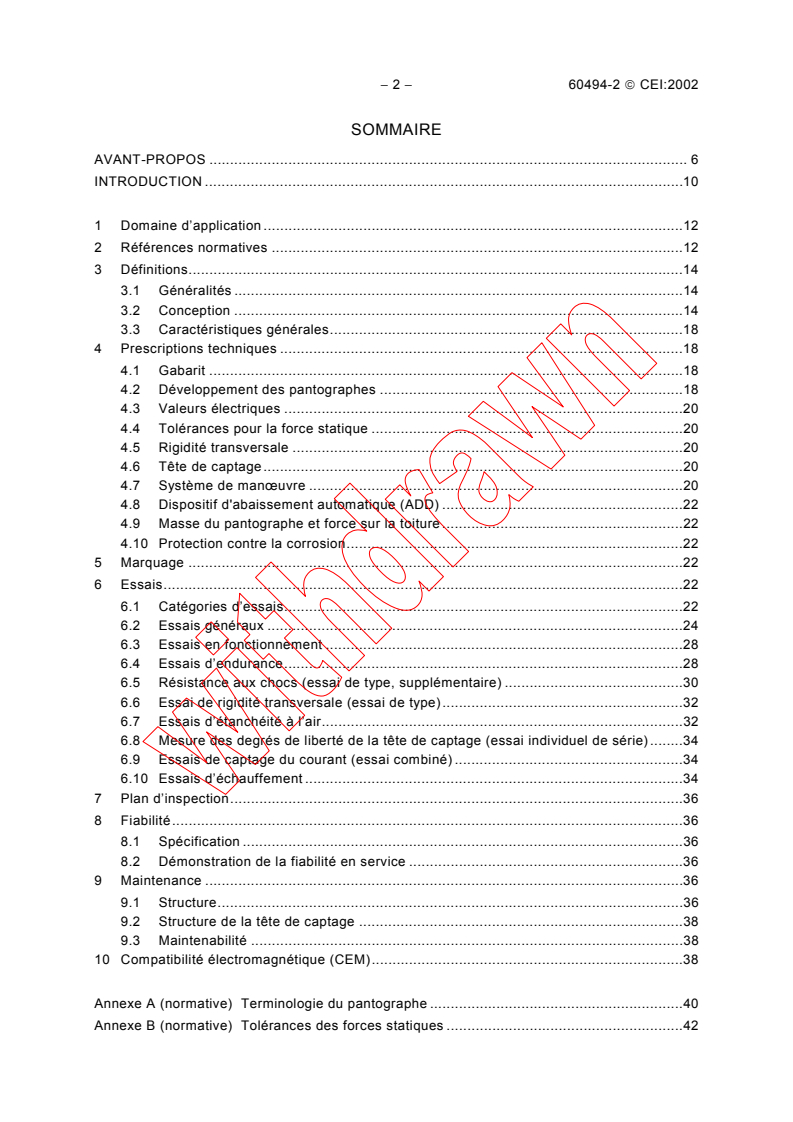
AVANT-PROPOS . 6
INTRODUCTION .10
1 Domaine d’application .12
2 Références normatives .12
3 Définitions.14
3.1 Généralités .14
3.2 Conception .14
3.3 Caractéristiques générales.18
4 Prescriptions techniques .18
4.1 Gabarit .18
4.2 Développement des pantographes .18
4.3 Valeurs électriques .20
4.4 Tolérances pour la force statique .20
4.5 Rigidité transversale .20
4.6 Tête de captage.20
4.7 Système de manœuvre .20
4.8 Dispositif d'abaissement automatique (ADD) .22
4.9 Masse du pantographe et force sur la toiture .22
4.10 Protection contre la corrosion.22
5 Marquage .22
6 Essais.22
6.1 Catégories d’essais.22
6.2 Essais généraux .24
6.3 Essais en fonctionnement .28
6.4 Essais d’endurance.28
6.5 Résistance aux chocs (essai de type, supplémentaire) .30
6.6 Essai de rigidité transversale (essai de type).32
6.7 Essais d’étanchéité à l’air.32
6.8 Mesure des degrés de liberté de la tête de captage (essai individuel de série) .34
6.9 Essais de captage du courant (essai combiné) .34
6.10 Essais d’échauffement .34
7 Plan d’inspection.36
8 Fiabilité.36
8.1 Spécification .36
8.2 Démonstration de la fiabilité en service .36
9 Maintenance .36
9.1 Structure.36
9.2 Structure de la tête de captage .38
9.3 Maintenabilité .38
10 Compatibilité électromagnétique (CEM).38
Annexe A (normative) Terminologie du pantographe .40
Annexe B (normative) Tolérances des forces statiques .42
60494-2 IEC:2002 − 3 −
CONTENTS
FOREWORD . 7
INTRODUCTION .11
1 Scope .13
2 Normative references.13
3 Definitions.15
3.1 General .15
3.2 Design .15
3.3 General characteristics .19
4 Technical requirements .19
4.1 Gauge .19
4.2 Extension of the pantographs .19
4.3 Electric values .21
4.4 Static force tolerances .21
4.5 Transverse rigidity .21
4.6 Collector head .21
4.7 Operating system.21
4.8 Automatic dropping device (ADD).23
4.9 Pantograph mass and force on the roof .23
4.10 Protection against corrosion.23
5 Marking.23
6 Tests .23
6.1 Categories of tests.23
6.2 General tests .25
6.3 Operating tests .29
6.4 Endurance tests.29
6.5 Resistance to shocks (supplementary type test) .31
6.6 Transverse rigidity test (type test) .33
6.7 Air tightness tests .33
6.8 Measurement of degrees of freedom of collector head (routine test) .35
6.9 Current collection tests (combined test).35
6.10 Heating tests.35
7 Inspection plan.37
8 Reliability .37
8.1 Specification .37
8.2 In-service reliability demonstration .37
9 Maintenance .37
9.1 Structure.37
9.2 Collector head structure .39
9.3 Maintainability.39
10 Electromagnetic compatibility (EMC) .39
Annex A (normative) Pantograph terminology .41
Annex B (normative) Static force tolerances.43
− 4 − 60494-2 CEI:2002
Annexe C (normative) Liste des essais .44
Annexe D (informative) Eléments à préciser dans les spécifications du client.46
Bibliographie .48
Figure 1 – Principe d’essai .32
Figure A.1 – Terminologie du pantographe.40
Figure B.1 – Tolérances des forces statiques.42
Tableau 1 – Déviation latérale de la tête de captage .20
Tableau 2 – Rigidité transversale.32
Tableau C.1 – Catalogue des essais.44
60494-2 IEC:2002 − 5 −
Annex C (normative) List of tests .45
Annex D (informative) Items to be specified in the customer specifications.47
Bibliography .49
Figure 1 – Test principle .33
Figure A.1 – Pantograph terminology .41
Figure B.1 – Static force tolerances .43
Table 1 – Lateral deviation of the collector head .21
Table 2 – Transverse rigidity.33
Table C.1 – Catalogue of tests.45
− 6 − 60494-2 CEI:2002
COMMISSION ÉLECTROTECHNIQUE INTERNATIONALE
____________
APPLICATIONS FERROVIAIRES – MATÉRIEL ROULANT –
PANTOGRAPHES – CARACTÉRISTIQUES ET ESSAIS –
Partie 2: Pantographes pour métros et véhicules légers
AVANT-PROPOS
1) La CEI (Commission Électrotechnique Internationale) est une organisation mondiale de normalisation composée
de l'ensemble des comités électrotechniques nationaux (Comités nationaux de la CEI). La CEI a pour objet de
favoriser la coopération internationale pour toutes les questions de normalisation dans les domaines de
l'électricité et de l'électronique. A cet effet, la CEI, entre autres activités, publie des Normes internationales.
Leur élaboration est confiée à des comités d'études, aux travaux desquels tout Comité national intéressé par le
sujet traité peut participer. Les organisations internationales, gouvernementales et non gouvernementales, en
liaison avec la CEI, participent également aux travaux. La CEI collabore étroitement avec l'Organisation
Internationale de Normalisation (ISO), selon des conditions fixées par accord entre les deux organisations.
2) Les décisions ou accords officiels de la CEI concernant les questions techniques représentent, dans la mesure
du possible, un accord international sur les sujets étudiés, étant donné que les Comités nationaux intéressés
sont représentés dans chaque comité d’études.
3) Les documents produits se présentent sous la forme de recommandations internationales. Ils sont publiés
comme normes, spécifications techniques, rapports techniques ou guides et agréés comme tels par les Comités
nationaux.
4) Dans le but d'encourager l'unification internationale, les Comités nationaux de la CEI s'engagent à appliquer de
façon transparente, dans toute la mesure possible, les Normes internationales de la CEI dans leurs normes
nationales et régionales. Toute divergence entre la norme de la CEI et la norme nationale ou régionale
correspondante doit être indiquée en termes clairs dans cette dernière.
5) La CEI n’a fixé aucune procédure concernant le marquage comme indication d’approbation et sa responsabilité
n’est pas engagée quand un matériel est déclaré conforme à l’une de ses normes.
6) L’attention est attirée sur le fait que certains des éléments de la présente Norme internationale peuvent faire
l’objet de droits de propriété intellectuelle ou de droits analogues. La CEI ne saurait être tenue pour
responsable de ne pas avoir identifié de tels droits de propriété et de ne pas avoir signalé leur existence.
La Norme internationale CEI 60494-2 a été établie par le comité d'études 9 de la CEI: Matériel
électrique ferroviaire.
Avec la CEI 60494-1, cette norme annule et remplace la CEI 60494 (1974). Cette première
édition de la CEI 60494-2 constitue une révision technique.
Le texte de cette norme est issu des documents suivants:
FDIS Rapport de vote
9/680/FDIS 9/699/RVD
Le rapport de vote indiqué dans le tableau ci-dessus donne toute information sur le vote ayant
abouti à l'approbation de cette norme.
Cette publication a été rédigée selon les Directives ISO/CEI, Partie 2.
60494-2 IEC:2002 − 7 −
INTERNATIONAL ELECTROTECHNICAL COMMISSION
___________
RAILWAY APPLICATIONS – ROLLING STOCK –
PANTOGRAPHS – CHARACTERISTICS AND TESTS –
Part 2: Pantographs for metros and light rail vehicles
FOREWORD
1) The IEC (International Electrotechnical Commission) is a worldwide organization for standardization comprising
all national electrotechnical committees (IEC National Committees). The object of the IEC is to promote
international co-operation on all questions concerning standardization in the electrical and electronic fields. To
this end and in addition to other activities, the IEC publishes International Standards. Their preparation is
entrusted to technical committees; any IEC National Committee interested in the subject dealt with may
participate in this preparatory work. International, governmental and non-governmental organizations liaising
with the IEC also participate in this preparation. The IEC collaborates closely with the International Organization
for Standardization (ISO) in accordance with conditions determined by agreement between the two
organizations.
2) The formal decisions or agreements of the IEC on technical matters express, as nearly as possible, an
international consensus of opinion on the relevant subjects since each technical committee has representation
from all interested National Committees.
3) The documents produced have the form of recommendations for international use and are published in the form
of standards, technical specifications, technical reports or guides and they are accepted by the National
Committees in that sense.
4) In order to promote international unification, IEC National Committees undertake to apply IEC International
Standards transparently to the maximum extent possible in their national and regional standards. Any
divergence between the IEC Standard and the corresponding national or regional standard shall be clearly
indicated in the latter.
5) The IEC provides no marking procedure to indicate its approval and cannot be rendered responsible for any
equipment declared to be in conformity with one of its standards.
6) Attention is drawn to the possibility that some of the elements of this International Standard may be the subject
of patent rights. The IEC shall not be held responsible for identifying any or all such patent rights.
International Standard IEC 60494-2 has been prepared by IEC technical committee 9: Electric
railway equipment.
Together with IEC 60494-1, this standard cancels and replaces IEC 60494 (1974). This first
edition of IEC 60494-2 constitutes a technical revision.
The text of this standard is based on the following documents:
FDIS Report on voting
9/680/FDIS 9/699/RVD
Full information on the voting for the approval of this standard can be found in the report on
voting indicated in the above table.
This publication has been drafted in accordance with the ISO/IEC Directives, Part 2.
− 8 − 60494-2 CEI:2002
Le comité a décidé que cette publication reste valable jusqu’en 2009. A cette date, selon
décision préalable du comité, la publication sera
• reconduite;
• supprimée;
• remplacée par une édition révisée, ou
• amendée.
La CEI 60494-2 fait partie d’une série de publications qui porte le titre général: Applications
ferroviaires – Matériel roulant – Pantographes – Caractéristiques et essais.
60494-2 IEC:2002 − 9 −
The committee has decided that the contents of this publication will remain unchanged until 2009.
At this date, the publication will be
• reconfirmed;
• withdrawn;
• replaced by a revised edition, or
• amended.
IEC 60494-2 forms part of a series of publications under the general title: Railway applications –
Rolling stock – Pantographs – Characteristics and tests.
− 10 − 60494-2 CEI:2002
INTRODUCTION
L'alimentation électrique d'un engin de traction s'effectue par le captage du courant sur le fil de
contact au moyen d'un ou plusieurs pantographes, installés sur l'engin de traction ou sur le
véhicule.
La bande de frottement du pantographe, glissant sur le fil de contact, permet la transmission
de l'énergie.
Le pantographe et la caténaire forment deux sous-systèmes oscillants qui peuvent se déplacer
l'un par rapport à l'autre. Il existe, entre eux, une liaison glissante unilatérale, qui assure un
contact continu. Leur conception minimise l'usure des deux sous-systèmes.
60494-2 IEC:2002 − 11 −
INTRODUCTION
The electrical power supply of a tractive unit is achieved by the collection of current from the
contact wire by means of one or more pantograph(s), installed on the traction unit or on the
vehicle.
The contact strip of the pantograph which slides along the contact wire facilitates the
transmission of power.
The pantograph and the catenary form two oscillating sub-systems which can be displaced.
There exists a unilateral sliding linkage between them, which will ensure continuous contact.
Their design will allow for minimum wear of both sub-systems when used.
− 12 − 60494-2 CEI:2002
APPLICATIONS FERROVIAIRES – MATÉRIEL ROULANT –
PANTOGRAPHES – CARACTÉRISTIQUES ET ESSAIS –
Partie 2: Pantographes pour métros et véhicules légers
1 Domaine d’application
La présente partie de la CEI 60494 définit les caractéristiques générales de montage qui sont à
appliquer aux pantographes pour métros et véhicules légers, afin de permettre le captage du
courant sur la ligne aérienne de contact. Elle définit aussi les essais auxquels doivent être
soumis les pantographes, à l'exclusion des isolateurs.
La présente norme ne s'applique pas aux essais de tenue en tension du pantographe, qui sont
à effectuer lorsque celui-ci est monté sur le toit du véhicule.
Ces règles sont également valables pour les trolleybus, dans la mesure où elles sont
applicables en pratique.
Cette norme ne s'applique pas aux pantographes utilisés sur les véhicules grandes lignes: ces
pantographes sont traités dans la CEI 60494-1.
Cette norme concerne les systèmes à suspension conventionnelle pour lignes aériennes de
contact et les accessoires. Les systèmes (ou parties de systèmes) à suspension rigide
exigeront un traitement spécifique de la part du client et du fournisseur.
2 Références normatives
Les documents de référence suivants sont indispensables pour l'application du présent
document. Pour les références datées, seule l'édition citée s'applique. Pour les références non
datées, la dernière édition du document de référence s'applique (y compris les éventuels
amendements).
CEI 60050(811), Vocabulaire Electrotechnique International (VEI) – Chapitre 811: Traction
électrique
CEI 60077-1, Applications ferroviaires – Equipements électriques du matériel roulant – Partie 1:
Conditions générales de service et règles générales
CEI 60077-2, Applications ferroviaires – Equipements électriques du matériel roulant – Partie 2:
Composants électrotechniques – Règles générales
CEI 60494-1, Applications ferroviaires – Matériel roulant – Pantographes – Caractéristiques
et essais – Partie 2: Pantographes pour véhicules grandes lignes
CEI 60529:2001, Degrés de protection procurés par les enveloppes (code IP)
CEI 60850, Applications ferroviaires – Tensions d’alimentation des systèmes de traction
CEI 61373, Applications ferroviaires – Matériel roulant – Essais de chocs et de vibrations
ISO 9001:2000, Systèmes de management de la qualité – Exigences
60494-2 IEC:2002 − 13 −
RAILWAY APPLICATIONS – ROLLING STOCK –
PANTOGRAPHS – CHARACTERISTICS AND TESTS –
Part 2: Pantographs for metros and light rail vehicles
1 Scope
This part of IEC 60494 defines the general assembly characteristics which are to be applied to
pantographs for metros and light rail vehicles, to enable current collection from the overhead
line system. It also defines the tests the pantographs have to perform, excluding insulators.
This standard does not apply to pantograph dielectric tests, which are to be performed on the
pantograph installed on the vehicle roof.
These rules in so far as they are applicable are also valid for trolley buses.
This standard does not apply to pantographs used on main line vehicles: these pantographs
are considered in IEC 60494-1.
This standard relates to conventional suspended overhead line systems and accessories. The
systems (or part of them) which are rigidly suspended will require special consideration
between the customer and the supplier.
2 Normative references
The following referenced documents are indispensable for the application of this document. For
dated references, only the edition cited applies. For undated references, the latest edition of
the referenced document (including any amendments) applies.
IEC 60050(811), International Electrotechnical Vocabulary (IEV) – Chapter 811: Electric
traction
IEC 60077-1, Railway applications – Electric equipment for rolling stock – Part 1: General
service conditions and general rules
IEC 60077-2, Railway applications – Electric equipment for rolling stock – Part 2:
Electrotechnical components – General rules
IEC 60494-1, Railway applications – Rolling stock – Pantographs – Characteristics and tests –
Part 1: Pantographs for main line vehicles
IEC 60529:2001, Degrees of protection provided by enclosures (IP code)
IEC 60850, Railway applications – Supply voltages of traction systems
IEC 61373, Railway applications – Rolling stock equipment – Shock and vibration tests
ISO 9001:2000, Quality management systems – Requirements
− 14 − 60494-2 CEI:2002
3 Définitions
Pour les besoins de la présente partie de la CEI 60494, les définitions suivantes s’appliquent;
pour les définitions des termes généraux utilisés, il convient de se référer à la CEI 60050-811.
3.1 Généralités
3.1.1
fournisseur
constructeur du pantographe
3.1.2
client
soit l’exploitant soit le constructeur du véhicule
3.1.3
pantographe (voir annexe A)
appareil qui capte le courant sur une ou plusieurs lignes de contact. Il est constitué d'un bâti,
d'un système de manœuvre, d'un cadre et d'une tête de captage. Sa géométrie est variable. En
position de «fonctionnement», l'appareil est entièrement ou partiellement sous tension. Il est
uniquement isolé à ses interfaces, sur le toit du véhicule. Il est capable de transmettre le
courant de la ligne de contact à l'appareillage électrique du véhicule.
3.2 Conception
Les définitions suivantes sont explicitées dans la figure de l’annexe A, à l’exception des
repères 9, 15, 16, 17.
3.2.1
cadre (repère 1)
structure articulée qui est capable de déplacer verticalement la tête de captage par rapport
au bâti du pantographe
3.2.2
bâti (repère 2)
partie fixe du pantographe qui supporte le cadre et qui est montée grâce à des isolateurs
sur le toit du véhicule
3.2.3
tête de captage (repère 3)
partie du pantographe supportée par le cadre qui inclut les bandes de frottement, les cornes et
peut inclure une suspension
3.2.4
bande de frottement (repère 4)
partie remplaçable de la tête de captage qui est l’interface avec la ligne aérienne de contact
3.2.5
cornes (repère 5)
extrémités de la tête de captage qui permettent un engagement doux avec le fil de contact
3.2.6
longueur de la tête de captage (repère 6)
dimension de la tête de captage mesurée horizontalement, transversalement par rapport
au véhicule
60494-2 IEC:2002 − 15 −
3 Definitions
For the purposes of this part of IEC 60494, the following definitions apply; for the definitions of
general terms used, reference should be made to IEC 60050-811.
3.1 General
3.1.1
supplier
manufacturer of the pantograph
3.1.2
customer
either the operating authority or the vehicle manufacturer
3.1.3
pantograph (see annex A)
apparatus that collects current on one or more contact lines. It consists of a base frame, an
operating system, a frame and a collector head. It is of variable geometry. In the “operating”
position, the apparatus is entirely or partly under voltage. It is electrically insulated only
generally at its interfaces, on the vehicle roof. It enables current to be transmitted from the
overhead line to the vehicle electrical system
3.2 Design
The following definitions are related to the sketch in Annex A, except items 9, 15, 16, 17.
3.2.1
frame (item 1)
an articulated structure which enables the collector head to move in a vertical direction with
respect to the base frame of the pantograph
3.2.2
base frame (item 2)
fixed part of the pantograph which supports the frame and is mounted on insulators fixed to the
vehicle roof
3.2.3
collector head (item 3)
part of the pantograph supported by the frame which includes contact strips, horns and may
include a suspension
3.2.4
contact strip (item 4)
replaceable wearing part of the collector head which interfaces with the overhead line
3.2.5
horns (item 5)
ends of the collector head which ensure smooth engagement with the contact wire
3.2.6
collector head length (item 6)
dimension of collector head measured horizontally transversely in relation to the vehicle
− 16 − 60494-2 CEI:2002
3.2.7
largeur de la tête de captage (repère 7)
dimension de la tête de captage mesurée longitudinalement par rapport au véhicule
3.2.8
hauteur de la tête de captage (repère 8)
distance verticale entre le point le plus bas des cornes et le point le plus haut des bandes
de frottement
3.2.9
pivot de la tête de captage (repère 9)
axe de l'arbre anti-balançant de la tête de captage, s’il existe un pivot
3.2.10
longueur des bandes de frottement (repère 10)
longueur totale mesurée transversalement par rapport au véhicule
3.2.11
hauteur de la «position basse de travail» (repère 11)
distance verticale entre le plan de montage du pantographe au-dessus des isolateurs et le plan
supérieur des bandes de frottement, le pantographe étant au niveau le plus bas lui permettant
de capter le courant de par sa conception
3.2.12
hauteur de la «position haute de travail» (repère 12)
distance verticale entre le plan de montage du pantographe au-dessus des isolateurs et le plan
supérieur des bandes de frottement, le pantographe étant au niveau le plus haut lui permettant
de capter le courant de par sa conception
3.2.13
plage de développement (repère 13)
différence entre la hauteur de la «position haute de travail» et la hauteur de la «position basse
de travail»
3.2.14
hauteur de la position de repos (repère 14)
distance verticale entre le plan de montage du pantographe au-dessus des isolateurs et le plan
supérieur des bandes de frottement ou une autre partie de la structure du pantographe si celle-
ci est plus haute (le pantographe étant en position de repos)
3.2.15
«épaisseur électrique» du pantographe (repère 15)
distance verticale entre la partie la plus haute et la partie la plus basse sous tension du
pantographe en position de repos
3.2.16
système de manœuvre (repère 16)
dispositif qui fournit une force pour lever ou pour abaisser le pantographe
3.2.17
développement maximal (repère 17)
hauteur de développement maximal jusqu’aux butées mécaniques
3.2.18
plage de développement (E)
différence entre la hauteur de la position haute de travail (3.2.12) et la hauteur de la position
de repos (3.2.14)
60494-2 IEC:2002 − 17 −
3.2.7
collector head width (item 7)
dimension of collector head measured longitudinally in relation to the vehicle
3.2.8
collector head height (item 8)
the vertical distance between the lowest point of the horns and the upper most point of the
contact strips
3.2.9
collector head pivot (item 9)
it is the pitching axis of the collector head, if any pivot is applied
3.2.10
length of contact strips (item 10)
the total length measured transversely in relation to the vehicle
3.2.11
height at “lower operating position” (item 11)
vertical distance between the pantograph mounting plane on the top of insulators and the upper
surface of the contact strips, the pantograph being raised to the lowest level at which it is
designed to collect current
3.2.12
height at “upper operating position” (item 12)
vertical distance between the pantograph mounting plane on the top of insulators and the upper
surface of the contact strips, the pantograph being raised to the highest level at which it is
designed to collect current
3.2.13
working range (item 13)
difference between the “upper operating position” height and the “lower operating position”
height
3.2.14
housed height (item 14)
vertical distance between the pantograph mounting plane on the top of insulators and the upper
surface of the contact strips or any other part of the pantograph structure if higher (pantograph
being in the housed position)
3.2.15
pantograph “electrical thickness” (item 15)
vertical distance between the highest live part and the lowest live part of the pantograph at
housed position
3.2.16
operating system (item 16)
device which provides a force to raise or to lower the pantograph
3.2.17
maximum extension (item 17)
maximum extended height to mechanical stops
3.2.18
extension range (E)
difference between height at upper operating position (3.2.12) and housed height (3.2.14)
− 18 − 60494-2 CEI:2002
3.3 Caractéristiques générales
Toutes les caractéristiques générales sont définies dans les spécifications du client. Sauf
spécifications contraires, les conditions d'environnement sont définies par la CEI 60077-1.
3.3.1
tension assignée, véhicule à l’arrêt
tension pour laquelle le pantographe est conçu
NOTE Les valeurs assignées sont des grandeurs généralement fixées par le constructeur.
3.3.2
courant assigné, véhicule à l’arrêt
valeur moyenne du courant supporté pendant 30 min par le pantographe à l'arrêt
3.3.3
courant maximal, véhicule à l’arrêt
valeur maximale du courant supporté par le pantographe à l'arrêt pour un temps donné dans la
spécification du client
3.3.4
courant assigné, véhicule en circulation
courant capté via le pantographe de l'arrêt à la vitesse maximale du véhicule
3.3.5
force statique
force verticale exercée par la tête de captage sur la caténaire et fournie par le dispositif de
levée du pantographe, lorsque celui-ci est levé et que le véhicule est à l'arrêt
3.3.6
force statique nominale
moyenne des valeurs réelles des forces statiques évaluée comme suit: les forces statiques
sont mesurées d'une manière continue dans la plage de développement durant la montée (F )
r
et la descente (F) du pantographe. Par convention, la force statique nominale en un point
l
quelconque est égale à
F +F
r l
4 Prescriptions techniques
4.1 Gabarit
Le pantographe, en position de repos et de travail, doit respecter le gabarit stipulé par les
spécifications du client.
4.2 Développement des pantographes
Les spécifications du client doivent donner les valeurs relatives aux définitions 3.2.10 à 3.2.13.
En l'absence de spécifications dans l'appel d'offre, lorsque le pantographe est levé ou abaissé,
la trajectoire de la tête de captage au-delà de la plage de développement doit être conforme au
tableau 1.
60494-2 IEC:2002 − 19 −
3.3 General characteristics
All general characteristics are defined in the customer specifications. Unless otherwise
specified, environmental conditions are defined in IEC 60077-1.
3.3.1
rated voltage, vehicle at standstill
the voltage at which the pantograph is designed to function
NOTE Rated values are quantity values generally assigned by the manufacturer.
3.3.2
rated current, vehicle at standstill
average value of that current withstood for 30 min by the pantograph at standstill
3.3.3
maximum current, vehicle at standstill
maximum value of that current withstood by the pantograph at standstill for a time given in the
customer specification
3.3.4
rated current, vehicle running
current collected via the pantograph from standstill to maximum speed of the vehicle
3.3.5
static force
the vertical force exerted upward by the collector head on the catenary, and caused by the
pantograph raising device, whilst the pantograph is raised and the vehicle is at standstill
3.3.6
nominal static force
an average of the actual values of static forces evaluated as follows: the static forces are
measured continually within the working range during raising (F ) and lowering (F ) operation.
r l
By convention, the nominal static force at any point is equal to
F +F
r l
.
4 Technical requirements
4.1 Gauge
The pantograph, at housed position and operating position, shall comply with the gauge
specified in the customer specifications.
4.2 Extension of the pantographs
The customer specifications shall give the values in relationship with 3.2.10 to 3.2.13. In the
absence of specifications in the tender documents, when the pantograph is raising or lowering,
the collector head trajectory over the working range shall be in accordance with table 1:
− 20 − 60494-2 CEI:2002
Tableau 1 – Déviation latérale de la tête de captage
Déviation latérale maximale
Plage de développement
par rapport à la ligne verticale
E
mm
E < 1m 10
1m
E > 2m 30
4.3 Valeurs électriques
Les tensions d'alimentation des systèmes de traction sont spécifiées par la CEI 60850.
Les spécifications du client doivent aussi fixer la durée et les valeurs des tensions prévisibles
pour les pantographes en fonctionnement ou au repos.
Les valeurs définies de 3.3.2 à 3.3.4 doivent être indiquées dans les spécifications du client.
4.4 Tolérances pour la force statique
Les forces statiques mesurées lors de la montée et la descente du pantographe doivent rester
dans les limites définies à l’annexe B.
4.5 Rigidité transversale
Quand une force transversale est exercée sur une partie du cadre qui supporte la tête de
captage en position haute de travail, la déflexion ne doit pas dépasser la valeur définie en 6.6
et aucune déformation permanente ne doit apparaître.
4.6 Tête de captage
4.6.1 Profils de tête
La spécification du client doit indiquer des valeurs en relation avec les définitions 3.2.6 à 3.2.8
et les profils de la tête de captage.
4.6.2 Bandes de frottement
Le matériau de la bande de frottement et/ou la conception de la bande de frottement doivent
être stipulés dans les spécifications du client.
NOTE En l’absence de spécifications du client, la DIN 43267 peut être utilisée.
4.7 Système de manœuvre
Le système de manœuvre doit être conçu pour assurer, du repos jusqu'à la vitesse
maximale de l'unité motrice, qu’un décollement du fil de contact ne soit pas à l’origine de
dommages permanents du fil de contact ou des bandes de frottement dans les conditions
normales de fonctionnement.
Le systèm
...