

IEC TS 63060:2019
(Main)Electric energy supply networks - General aspects and methods for the maintenance of installations and equipment
General Information
- Abstract
IEC TS 63060:2019(E) provides guidance to develop maintenance requirements of installations and equipment in electric power networks. It is primarily meant for the operators of electric power networks, particularly those of public power supplies, including High-Voltage DC transmission (HVDC). This scope does not include:
– railway networks,
– installations of end consumer networks,
– installations for electric power generation.
Crises handling, e.g. in emergency situations, is not within the scope of this document.
- Status
- Published
- Publication Date
- 14-Feb-2019
- Technical Committee
- TC 8 - System aspects of electrical energy supply
- Drafting Committee
- MT 8 - TC 8/MT 8
- Current Stage
- PPUB - Publication issued
- Start Date
- 15-Feb-2019
- Completion Date
- 13-Mar-2019
Overview
IEC TS 63060:2019 - Electric energy supply networks: general aspects and methods for the maintenance of installations and equipment - is a Technical Specification published by the IEC (TC 8). It provides guidance to develop maintenance requirements for installations and equipment in public electric power networks, including High-Voltage DC transmission (HVDC). The document focuses on management methods, processes and techniques necessary to achieve safe, reliable operation and acceptable asset availability across the lifecycle of network equipment. It explicitly excludes railway networks, end-consumer installations and power-generation facilities, and does not cover crisis or emergency handling.
Key Topics
- Maintenance management and structure – organization of maintenance roles, responsibilities and the maintenance management framework.
- Maintenance concept and planning – defining maintenance objectives, maintenance levels, indenture levels and development of a maintenance plan.
- Types of maintenance – corrective maintenance, preventive maintenance (periodic/time‑based and condition‑based), reliability‑centred maintenance (RCM) and risk‑based maintenance. (Annex A provides notes on types.)
- Conducting maintenance tasks – planning and issuing work instructions, task execution considerations and safety aspects.
- Documentation and analysis – required records, statistics, and performance indicators to support decision making and continual improvement.
- Assessment and improvement – methods for reviewing and improving maintenance concepts and adapting them to operational experience.
- Condition assessment of equipment – selection catalogues and guidance for determining asset condition across asset classes: substations, low-voltage installations, fuses, power transformers and reactors, surge arresters, overhead lines, cable systems, protection and measuring relays, telecontrol and network technology (Annex B).
Applications
- Utility asset managers and network operators developing or updating maintenance policies, maintenance plans and supportability requirements for public power networks and HVDC systems.
- Maintenance planners, reliability engineers and operations managers who select maintenance strategies (preventive, condition‑based, RCM, risk‑based) to improve availability and manage lifecycle costs.
- Consultants and service providers creating maintenance programs, documentation systems and condition-assessment procedures for electrical distribution and transmission assets.
- Regulators and auditors seeking a recognized framework for maintenance governance and performance monitoring.
Practical value
- Helps align maintenance strategy with required availability and safety targets.
- Guides selection of condition-monitoring and inspection activities tailored to asset type.
- Supports structured documentation and analysis for continuous improvement of maintenance concepts.
Related references
- Terms and definitions referenced in IEC TS 63060 are aligned with IEC Electropedia / IEC 60050. Users should consult IEC webstore and electropedia for further IEC publications and terminology.
Get Certified
Connect with accredited certification bodies for this standard

IMQ S.p.A. (Certification)
Italian electrical product certification.

SLG Prüf- und Zertifizierungs GmbH
German testing and certification body.

UL Solutions
Global safety science company with testing, inspection and certification.
Sponsored listings
Frequently Asked Questions
IEC TS 63060:2019 is a technical specification published by the International Electrotechnical Commission (IEC). Its full title is "Electric energy supply networks - General aspects and methods for the maintenance of installations and equipment". This standard covers: IEC TS 63060:2019(E) provides guidance to develop maintenance requirements of installations and equipment in electric power networks. It is primarily meant for the operators of electric power networks, particularly those of public power supplies, including High-Voltage DC transmission (HVDC). This scope does not include: – railway networks, – installations of end consumer networks, – installations for electric power generation. Crises handling, e.g. in emergency situations, is not within the scope of this document.
IEC TS 63060:2019(E) provides guidance to develop maintenance requirements of installations and equipment in electric power networks. It is primarily meant for the operators of electric power networks, particularly those of public power supplies, including High-Voltage DC transmission (HVDC). This scope does not include: – railway networks, – installations of end consumer networks, – installations for electric power generation. Crises handling, e.g. in emergency situations, is not within the scope of this document.
IEC TS 63060:2019 is classified under the following ICS (International Classification for Standards) categories: 29.240.01 - Power transmission and distribution networks in general. The ICS classification helps identify the subject area and facilitates finding related standards.
IEC TS 63060:2019 is available in PDF format for immediate download after purchase. The document can be added to your cart and obtained through the secure checkout process. Digital delivery ensures instant access to the complete standard document.
Standards Content (Sample)
IEC TS 63060 ®
Edition 1.0 2019-02
TECHNICAL
SPECIFICATION
Electric energy supply networks – General aspects and methods for the
maintenance of installations and equipment
All rights reserved. Unless otherwise specified, no part of this publication may be reproduced or utilized in any form
or by any means, electronic or mechanical, including photocopying and microfilm, without permission in writing from
either IEC or IEC's member National Committee in the country of the requester. If you have any questions about IEC
copyright or have an enquiry about obtaining additional rights to this publication, please contact the address below or
your local IEC member National Committee for further information.
IEC Central Office Tel.: +41 22 919 02 11
3, rue de Varembé info@iec.ch
CH-1211 Geneva 20 www.iec.ch
Switzerland
About the IEC
The International Electrotechnical Commission (IEC) is the leading global organization that prepares and publishes
International Standards for all electrical, electronic and related technologies.
About IEC publications
The technical content of IEC publications is kept under constant review by the IEC. Please make sure that you have the
latest edition, a corrigendum or an amendment might have been published.
IEC publications search - webstore.iec.ch/advsearchform Electropedia - www.electropedia.org
The advanced search enables to find IEC publications by a The world's leading online dictionary on electrotechnology,
variety of criteria (reference number, text, technical containing more than 22 000 terminological entries in English
committee,…). It also gives information on projects, replaced and French, with equivalent terms in 16 additional languages.
and withdrawn publications. Also known as the International Electrotechnical Vocabulary
(IEV) online.
IEC Just Published - webstore.iec.ch/justpublished
Stay up to date on all new IEC publications. Just Published IEC Glossary - std.iec.ch/glossary
details all new publications released. Available online and 67 000 electrotechnical terminology entries in English and
once a month by email. French extracted from the Terms and Definitions clause of
IEC publications issued since 2002. Some entries have been
IEC Customer Service Centre - webstore.iec.ch/csc collected from earlier publications of IEC TC 37, 77, 86 and
If you wish to give us your feedback on this publication or CISPR.
need further assistance, please contact the Customer Service
Centre: sales@iec.ch.
IEC TS 63060 ®
Edition 1.0 2019-02
TECHNICAL
SPECIFICATION
Electric energy supply networks – General aspects and methods for the
maintenance of installations and equipment
INTERNATIONAL
ELECTROTECHNICAL
COMMISSION
ICS 29.240.01 ISBN 978-2-8322-6562-8
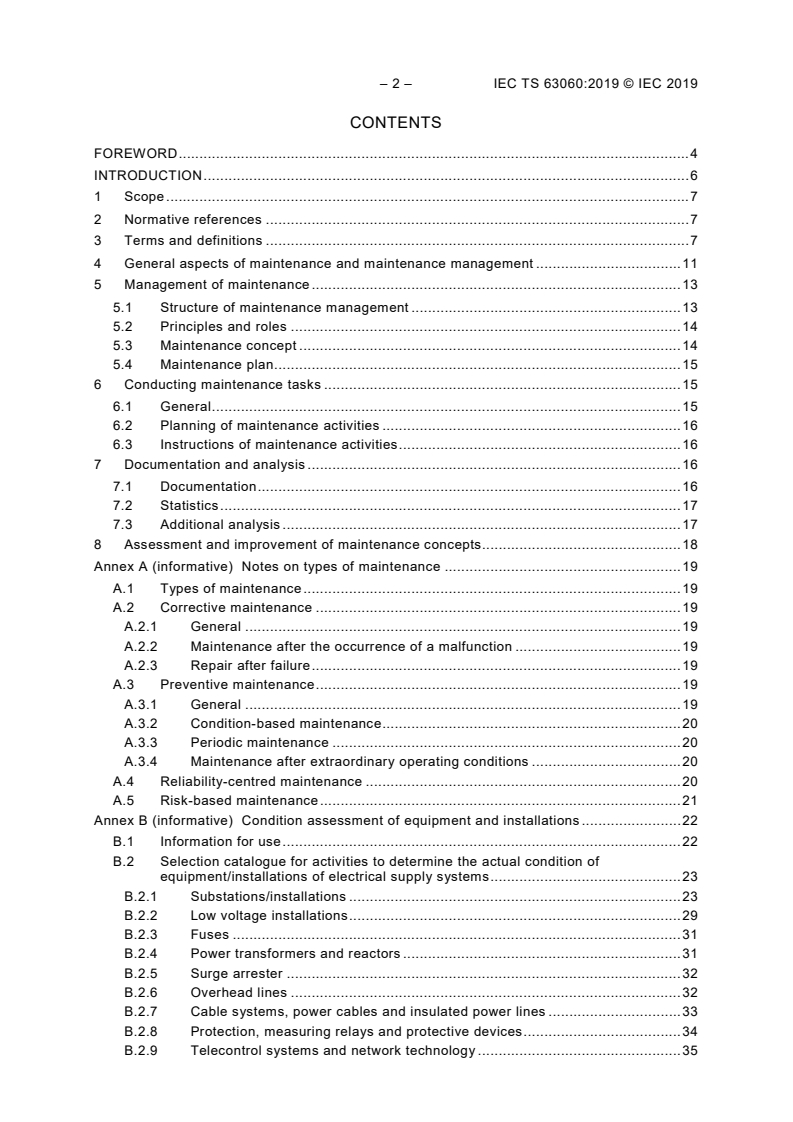
– 2 – IEC TS 63060:2019 © IEC 2019
CONTENTS
FOREWORD . 4
INTRODUCTION . 6
1 Scope . 7
2 Normative references . 7
3 Terms and definitions . 7
4 General aspects of maintenance and maintenance management . 11
5 Management of maintenance . 13
5.1 Structure of maintenance management . 13
5.2 Principles and roles . 14
5.3 Maintenance concept . 14
5.4 Maintenance plan . 15
6 Conducting maintenance tasks . 15
6.1 General . 15
6.2 Planning of maintenance activities . 16
6.3 Instructions of maintenance activities . 16
7 Documentation and analysis . 16
7.1 Documentation . 16
7.2 Statistics . 17
7.3 Additional analysis . 17
8 Assessment and improvement of maintenance concepts. 18
Annex A (informative) Notes on types of maintenance . 19
A.1 Types of maintenance . 19
A.2 Corrective maintenance . 19
A.2.1 General . 19
A.2.2 Maintenance after the occurrence of a malfunction . 19
A.2.3 Repair after failure . 19
A.3 Preventive maintenance . 19
A.3.1 General . 19
A.3.2 Condition-based maintenance . 20
A.3.3 Periodic maintenance . 20
A.3.4 Maintenance after extraordinary operating conditions . 20
A.4 Reliability-centred maintenance . 20
A.5 Risk-based maintenance . 21
Annex B (informative) Condition assessment of equipment and installations . 22
B.1 Information for use . 22
B.2 Selection catalogue for activities to determine the actual condition of
equipment/installations of electrical supply systems . 23
B.2.1 Substations/installations . 23
B.2.2 Low voltage installations . 29
B.2.3 Fuses . 31
B.2.4 Power transformers and reactors . 31
B.2.5 Surge arrester . 32
B.2.6 Overhead lines . 32
B.2.7 Cable systems, power cables and insulated power lines . 33
B.2.8 Protection, measuring relays and protective devices . 34
B.2.9 Telecontrol systems and network technology . 35
Bibliography . 36
Figure 1 – Influence of maintenance actions with different strategies on the availability
of equipment . 12
Table 1 – Structure of maintenance management . 13
– 4 – IEC TS 63060:2019 © IEC 2019
INTERNATIONAL ELECTROTECHNICAL COMMISSION
____________
ELECTRIC ENERGY SUPPLY NETWORKS – GENERAL ASPECTS
AND METHODS FOR THE MAINTENANCE OF INSTALLATIONS
AND EQUIPMENT
FOREWORD
1) The International Electrotechnical Commission (IEC) is a worldwide organization for standardization comprising
all national electrotechnical committees (IEC National Committees). The object of IEC is to promote interna-
tional co-operation on all questions concerning standardization in the electrical and electronic fields. To this
end and in addition to other activities, IEC publishes International Standards, Technical Specifications, Tech-
nical Reports, Publicly Available Specifications (PAS) and Guides (hereafter referred to as “IEC Publica-
tion(s)”). Their preparation is entrusted to technical committees; any IEC National Committee interested in the
subject dealt with may participate in this preparatory work. International, governmental and non-governmental
organizations liaising with the IEC also participate in this preparation. IEC collaborates closely with the Interna-
tional Organization for Standardization (ISO) in accordance with conditions determined by agreement between
the two organizations.
2) The formal decisions or agreements of IEC on technical matters express, as nearly as possible, an international
consensus of opinion on the relevant subjects since each technical committee has representation from all inter-
ested IEC National Committees.
3) IEC Publications have the form of recommendations for international use and are accepted by IEC National
Committees in that sense. While all reasonable efforts are made to ensure that the technical content of IEC
Publications is accurate, IEC cannot be held responsible for the way in which they are used or for any misinter-
pretation by any end user.
4) In order to promote international uniformity, IEC National Committees undertake to apply IEC Publications
transparently to the maximum extent possible in their national and regional publications. Any divergence be-
tween any IEC Publication and the corresponding national or regional publication shall be clearly indicated in
the latter.
5) IEC itself does not provide any attestation of conformity. Independent certification bodies provide conformity
assessment services and, in some areas, access to IEC marks of conformity. IEC is not responsible for any
services carried out by independent certification bodies.
6) All users should ensure that they have the latest edition of this publication.
7) No liability shall attach to IEC or its directors, employees, servants or agents including individual experts and
members of its technical committees and IEC National Committees for any personal injury, property damage or
other damage of any nature whatsoever, whether direct or indirect, or for costs (including legal fees) and ex-
penses arising out of the publication, use of, or reliance upon, this IEC Publication or any other IEC Publica-
tions.
8) Attention is drawn to the Normative references cited in this publication. Use of the referenced publications is
indispensable for the correct application of this publication.
9) Attention is drawn to the possibility that some of the elements of this IEC Publication may be the subject of
patent rights. IEC shall not be held responsible for identifying any or all such patent rights.
The main task of IEC technical committees is to prepare International Standards. In excep-
tional circumstances, a technical committee may propose the publication of a Technical
Specification when
• the required support cannot be obtained for the publication of an International Standard,
despite repeated efforts, or
• the subject is still under technical development or where, for any other reason, there is the
future but no immediate possibility of an agreement on an International Standard.
Technical Specifications are subject to review within three years of publication to decide
whether they can be transformed into International Standards.
IEC TS 63060, which is a Technical Specification, has been prepared by IEC technical com-
mittee 8: System aspects of electrical energy supply.
The text of this Technical Specification is based on the following documents:
Enquiry draft Report on voting
8/1470/DTS 8/1488/RVDTS
Full information on the voting for the approval of this Technical Specification can be found in
the report on voting indicated in the above table.
This document has been drafted in accordance with the ISO/IEC Directives, Part 2.
The committee has decided that the contents of this document will remain unchanged until the
stability date indicated on the IEC website under "http://webstore.iec.ch" in the data related to
the specific document. At this date, the document will be
• transformed into an International Standard,
• reconfirmed,
• withdrawn,
• replaced by a revised edition, or
• amended.
A bilingual version of this publication may be issued at a later date.
– 6 – IEC TS 63060:2019 © IEC 2019
INTRODUCTION
Maintenance (MA) and maintenance support provide an important contribution to ensure the
reliability of components and electric installations throughout their operating life cycle. The
correct functionality, performance, and reliability will be achieved by providing the necessary
maintenance in conjunction with adequate design, construction, maintainability and installa-
tion quality, and by their proper usage. Other parameters besides maintenance affect the
safe, secure, and reliable operation of electricity networks. For example: network topology,
spare parts, new investment, technology, network conditions, know-how, staff, etc. The op-
tion(s) used is/are the responsibility of the company.
The extent and type of maintenance and maintenance support correspond to the type of
equipment and installations, their constitution and required availability, as well as other fac-
tors such as operational and environmental condition, and operating experience.
Inappropriate, irregular or missing maintenance could lead to premature functional failures
which reduce the availability of equipment and installations, could lead to consequential dam-
age, and shorter asset life cycles. Functional failures can lead to operational consequences
and need to be assessed accordingly. Safety aspects have to be considered at all times.
The purpose of this document is to describe, in general terms, the management methods,
processes, and techniques with regard to the maintenance of installations and equipment,
which are necessary to achieve public safety, reliable operation, and acceptable reliability for
installations and equipment.
In this document, the term “network operator” and “system operator” are used for the network
owner, asset manager, and maintenance provider.
ELECTRIC ENERGY SUPPLY NETWORKS – GENERAL ASPECTS
AND METHODS FOR THE MAINTENANCE OF INSTALLATIONS
AND EQUIPMENT
1 Scope
This document provides guidance to develop maintenance requirements of installations and
equipment in electric power networks. It is primarily meant for the operators of electric power
networks, particularly those of public power supplies, including High-Voltage DC transmission
(HVDC). This scope does not include:
– railway networks,
– installations of end consumer networks,
– installations for electric power generation.
Crises handling, e.g. in emergency situations, is not within the scope of this document.
NOTE Consumer networks (e.g. networks of chemical companies, traffic lights and street lighting) are installations
which are not used to distribute electric energy to further consumers. The main scope covers public networks, but
the general recommendations can be applied to other networks.
2 Normative references
There are no normative references in this document.
3 Terms and definitions
For the purposes of this document the following terms and definitions apply.
ISO and IEC maintain terminological databases for use in standardization at the following ad-
dresses:
• IEC Electropedia: available at http://www.electropedia.org/
• ISO Online browsing platform: available at http://www.iso.org/obp
3.1
maintenance
combination of all technical and managerial actions intended to retain an object in, or restore
it to, a state in which it can perform as required
[SOURCE: IEC 60050-192:2015, 192-06-01, modified – In the definition, "item" has been re-
placed with "object".] [1]
3.2
maintenance concept
maintenance policy
definition of the maintenance objectives, line of maintenance, indenture levels, maintenance
levels, maintenance support, and their interrelationships
—————————
Numbers in square brackets refer to the Bibliography.
– 8 – IEC TS 63060:2019 © IEC 2019
Note 1 to entry: The maintenance concept provides the basis for maintenance planning, determining supportabil-
ity requirements, and developing logistic support.
[SOURCE: IEC 60050-192:2015, 192-06-02] [1]
3.3
corrective maintenance
maintenance carried out after fault detection to effect restoration
[SOURCE: IEC 60050-192:2015, 192-06-06, modified – Note 1 to entry has been deleted.] [1]
3.4
preventive maintenance
maintenance carried out to mitigate degradation and reduce the probability of failure
[SOURCE: IEC 60050-192:2015, 192-06-05, modified – The second term and Note 1 to entry
have been deleted.] [1]
3.4.1
condition-based maintenance
preventive maintenance based on the assessment of physical condition
Note 1 to entry: Condition-based maintenance is derived from the analysis and determination of parameters which
characterize the deterioration of the object
[SOURCE: IEC 60050-192:2015, 192-06-07, modified – Note 1 to entry has been
changed.] [1]
3.4.2
periodic maintenance
time-based maintenance
maintenance carried out in accordance with a specified time schedule
Note 1 to entry: Periodic maintenance may identify the need for some corrective maintenance action.
[SOURCE: IEC 60050-192:2015,192-06-12, modified – The terms defined have been
changed.] [1]
3.5
reliability-centred maintenance
RCM
systematic method for determining the respective maintenance actions and associated fre-
quencies, based on the probability and consequences of failure
Note 1 to entry: RCM studies may be conducted at any indenture level of a system.
Note 2 to entry: Data used may be derived from analysis (e.g. FMECA) and experience (e.g. FRACAS).
Note 3 to entry: RCM studies may provide feedback to initiate modifications of design or procedures to effect im-
provements.
[SOURCE: IEC 60050-192:2015, 192-06-08] [1]
3.6
maintenance task
maintenance action
sequence of elementary maintenance activities
EXAMPLE Fault localization, fault diagnosis, repair, and function checkout.
Note 1 to entry: Maintenance can be completely divided into the following tasks:
– inspection;
– routine maintenance;
– overhaul;
– repair;
– improvement.
[SOURCE: IEC 60050-192:2015,192-06-11, modified – Note 1 to entry has been added.] [1]
3.6.1
inspection
activities to determine and assess the actual condition of an object, including the determina-
tion of the causes of wear and deriving the necessary conclusions for future use
Note 1 to entry: The term "condition determination" is described in detail in Clause B.1.
3.6.1.1
operational inspection
on-site inspection
activities carried out by pure visual observation with the aim of checking the recognizable
condition of the object from outside
Note 1 to entry: Operational inspections are to be understood as checks to fulfil the legal duty to maintain safety.
The inspection may be made by car or from the air (surveying flying).
Note 2 to entry: Operational inspection is the simplest form of inspection.
3.6.1.2
visual inspection
activities carried out by observation with the human senses and by recording simple condition
variables
Note 1 to entry: Obvious function defects are recorded.
Note 2 to entry: Observation with the human senses can include simple tools like cameras and drones.
3.6.1.3
online monitoring
continuous or periodic detection, under energized condition, to verify that the parameters of
an object lie within formulation limits
3.6.1.4
function check
action to confirm that an object is able to perform the required function
3.6.1.5
condition investigation
activities carried out by defined measurements, which can be a routine measurement or spe-
cific test, to make an assessment of the actual condition of the considered equipment
Note 1 to entry: Diagnostic indicators that may be used for the condition investigation can be derived from the
operational experience that is the analysis of fault situations and causes of faults.
Note 2 to entry: Condition investigation within the scheduled inspection ensures that occurring defects can be
detected and corrected at components.
3.6.2
routine maintenance
regular or repeated simple preventive maintenance activities
Note 1 to entry: Routine maintenance may include for example cleaning, tightening of connections, replacement
of connectors, checking liquid levels, lubrication, etc.
– 10 – IEC TS 63060:2019 © IEC 2019
Note 2 to entry: Activity to delay the degradation of the existing degree of wear. The degree of wear is the re-
serve of the possible functional compliances under specified conditions which an object does possess due to the
construction as well as service activities.
[SOURCE: EN 13306:2010, 8.5] [2]
3.6.3
overhaul
comprehensive set of preventive actions carried out, in order to maintain the required level of
performance of an object
Note 1 to entry: Overhaul may be performed at prescribed intervals of time or number of operations.
Note 2 to entry: Overhaul may require a complete or partial dismantling of the object.
[SOURCE: EN 13306:2010, 8.6] [2]
3.6.4
repair
direct action taken to effect restoration
Note 1 to entry: Repair includes fault localization (IEV 192-06-19), fault diagnosis (IEV 192-06-20), fault correc-
tion (IEV 192-06-21), and function checkout (IEV 192-06-22).
[SOURCE: IEC 60050-192:2015, 192-06-14] [1]
3.6.5
improvement
combination of all technical, administrative and managerial actions, intended to ameliorate the
reliability and/or the maintainability and/or the safety of an object, without changing the origi-
nal function
Note 1 to entry: Improvements can be useful if, for example, operating experience and inspection results identify
systematic problems that demonstrate that the previous function security is not sufficient.
[SOURCE: EN 13306:2010, 8.12] [2]
3.7
failure
termination of the ability of an object to perform a required function
Note 1 to entry: After failure the object has a fault, which may be complete or partial.
Note 2 to entry: "Failure" is an event, as distinguished from "fault", which is a state.
[SOURCE: EN 13306:2010, 5.1] [2]
3.8
reliability
ability to perform as required, without failure, for a given time interval, under given conditions
Note 1 to entry: Reliability is used only for general descriptions in non-quantitative terms.
[SOURCE: IEC 60050-192:2015, 192-01-24, modified – The notes to entry have been deleted
and a new note to entry has been added.] [1]
3.9
functional security
defined degree of reliability and reserve of wear of an object
3.10
maintenance object
object
particular equipment, particular installation or a group of equipment or installations which in
general are considered jointly with respect to the maintenance plan
EXAMPLE The equipment of a switching bay at a specific location.
3.11
maintenance object type
particular equipment, particular installation or a group of equipment or installations which in
general are considered jointly with respect to the maintenance concept or inspections
EXAMPLE Power transformers with certain properties, such as, size, design, manufacturer, and age.
3.12
maintainability
ability to be retained in, or restored to a state to perform as required, under given conditions
of use and maintenance
[SOURCE: IEC 60050-192:2015, 192-01-27, modified – The notes to entry have been delet-
ed.] [1]
3.13
maintenance support
provision of resources to maintain an object
[SOURCE: IEC 60050-192:2015, 192-01-28, modified – In the definition, "item" has been re-
placed with "object".] [1]
3.14
testability
degree to which an object can be tested
[SOURCE: IEC 60050-192:2015, 192-09-20, modified – In the definition, "item" has been re-
placed with "object".] [1]
3.15
reserve of wear
ability to withstand a cumulative deterioration caused by the stresses imposed
without losing its function while in use
Note 1 to entry: Stresses can be mechanical, electrical, etc.
4 General aspects of maintenance and maintenance management
The availability and power quality of a network is influenced by several criteria, e.g. topology
of the network, specification of components, maintenance, availability of spare parts, service
know-how, environmental condition, application, etc. In consequence, the network operator
has to consider which criterion (or criteria) is most influential to the performance of the net-
work. During installations’ design, the maintenance and the maintenance support should be
considered in connection with the functionality and maintainability of power networks.
The network operator has to decide whether all required tasks for maintenance and mainte-
nance support can be self-performed, or partly or fully commissioned to external contractors.
A clear definition of aims and responsibilities for maintenance and maintenance support is
important and has to be documented.
– 12 – IEC TS 63060:2019 © IEC 2019
In a conception of a network, a required reliability is assigned to each component. The objec-
tive of maintenance is to ensure the required reliability over the entire life cycle of compo-
nents. Maintenance and maintenance support have to be taken into account over the entire
life cycle. Already, when planning installations and procuring equipment, decisions are taken
that influence the effectiveness of maintenance activities in subsequent life cycle periods.
Figure 1 shows an example of the availability of a component depending on the life time. Dif-
ferent maintenance cycles (marked as strategy 1, 2 and 3) will influence the availability of the
components towards the end of the expected life time.
1,2
Strategy 1
0,8
Strategy 2
0,6
Strategy 3
0,4
No service
0,2
Age
IEC
SOURCE: BALZER, G.; SCHORN, C. [3]
Figure 1 – Influence of maintenance actions with different strategies on the availability
of equipment
The optimal use of a maintenance strategy is occasionally obtained via the optimization of
conflicting parameters. These parameters consist of: Investment costs (CAPEX), operating
costs (OPEX), and energy not supplied or not transmitted, etc. The last parameter can be as-
sessed, for example, by an appropriate indicator (for example, System Average Interruption
Duration Index, SAIDI, refer to IEC 60050-692:2017, 692-08-03).
If condition-based maintenance is to be applied, it should be noted that additional investment
costs for monitoring or diagnostics occur and the corresponding know-how shall be available.
On the other hand, repair costs are avoided during the total operating period. In each case,
the financial efficiency should be considered [3][4].
The maintenance targets are derived from business objectives, consumer needs, and legal
requirements. The principles include:
– the realization of operational safety, particularly personal and third parties safety (includ-
ing occupational safety),
– property protection, including fire protection and protection of goods of other parties,
– environmental protection,
as well as:
– functional security,
Availability
– value retention.
5 Management of maintenance
5.1 Structure of maintenance management
Maintenance management, in accordance with this specification, includes at least the follow-
ing steps (see Table 1). These steps can be handled separately or combined.
Table 1 – Structure of maintenance management
System step Result Content Clause
1 Definition of responsibility Principles, e.g. in the form
• What are the objectives? 5.2
and principles of a guideline
• Assignment of responsibilities
2 Development of mainte- Maintenance concept and Specification of maintenance object types 5.3
nance concept basic structure of the
• Assignment of maintenance types to the
documentation
object types
• Description of maintenance tasks regard-
ing the object types
• Identification of basic dates for inspections
3 Elaboration of mainte- Maintenance plan 5.4
• Readout of the maintenance documenta-
nance plan tion
• Arrangement of maintenance tasks to ob-
jects taking into account the available
maintenance budget
• Determine time frames for maintenance
tasks
4 Planning of mainte- Plan of action (date, loca- • Allocate resources for maintenance activi- 6.2
nance activities tion, resource)
ties taking into account availability of
spare parts, human resources, subcon-
tractors, etc.
• Define schedule
• Instruction of maintenance
• Consideration of current operating and
network states
5 Performing of Object is maintained 6.3
maintenance activi-
ties
6 Documentation of Documentation for each 7
• What was done when?
results object
• What conditions were found?
• Which additional maintenance action will
be provided?
• What will be the condition after the activi-
ty?
7 Analysis of results Maintenance plan updated
• Were all tasks performed?
• Was a maintenance task assigned?
• Was an improvement assigned?
• Was the maintenance plan updated?
8 Assessment and improve- Maintenance concept im- • Techno-economic analysis of the mainte- 8
ment proved nance
NOTE Arrows indicate possible recursion.
– 14 – IEC TS 63060:2019 © IEC 2019
5.2 Principles and roles
The network operator is responsible for planning and developing maintenance and mainte-
nance support. The network operator has to ensure the proper implementation of maintenance
activities. The organizational responsibilities have to be defined, assigned, and documented
for all maintenance activities.
During the concept, design and definition stages of an installation, maintenance principles
shall be defined that consider:
– general aims of maintenance and maintenance support,
– applicable laws and government regulations,
– required reliability, availability, maintainability (including testability), safety and health, en-
vironment, and costs,
– general specifications for maintenance and maintenance support.
The network operator is responsible for:
– defining maintenance principles,
– assuring that implementation and planning of maintenance is achieved,
– reviewing and adapting maintenance concepts with respect to operating experiences.
For this purpose, the network operator has to provide adequate resources (e.g. budget, staff,
and spare parts). The general procedure for performing maintenance is defined by mainte-
nance principles that serve as a guideline for planning, implementation, benchmarking, analy-
sis, and improvement of maintenance. The principles have to be documented.
The principles for planning maintenance activities are defined by the network operator. With
regard to grid development and grid planning, the planning of maintenance is oriented on
long, medium, and short term operational objectives, as well as regularly occurring condition
changes of equipment and installations.
The specifications of maintenance and maintenance support have to be verified on a regular
basis to consider changes in legal frameworks, operational requirements, and the develop-
ment of maintenance procedures. Corresponding changes may be necessary due to the age
of the object or based on the results of diagnostic tests, if available. If new equipment or in-
stallations are added or modifications are implemented, required adjustments in maintenance
and maintenance support should be considered.
If training is required, training documents, tools, and equipment have to be identified and pro-
vided, before entering the operational and planning phase. The training also has to be per-
formed during the phase of operation and maintenance.
Technical manuals and technical documentation should contain the information and proce-
dures that are necessary for the correct, safe, effective and economic implementation of
maintenance tasks.
5.3 Maintenance concept
The maintenance concept defines the precise procedure for maintenance types based on
maintenance principles.
The maintenance activities derived from a condition assessment (e.g. replacement, repair,
service, and overhaul) are not defined in this document but are the responsibility of the net-
work operator. Test cycles are not the subject of this document, but are to be defined by the
system operators in self-responsibility.
The maintenance concept of an electric supply network includes the following:
– structuring of equipment and installations regarding maintenance object types;
– assignment of the types of maintenance to the maintenance object types and description
of associated maintenance tasks, possibly dependent on operating conditions, environ-
mental conditions, or other circumstances – see Annex A;
– defining of parameters dealing with criticality of equipment, e.g. impact on global quality
and reliability of the network;
– defining of parameters for the specification of the maintenance types, e.g. as appropriate
deadlines/frequencies for the execution of maintenance activities, depending in particular
on the useful life, fault rate, and operational experience.
NOTE Details are described in Annex B
The following aspects have to be taken into account in the maintenance concept:
– operating experiences with installations and equipment (degradation mode, efficiency of
maintenance tasks, etc.);
– recommendations of the manufacturer as appropriate, taking into account factors such as
official regulations, safety considerations, environmental conditions and economic conse-
quences of a failure;
– analysis of installations and equipment using a structured procedure to ensure functionali-
ty (possible criteria are condition, reliability, etc.);
– analysis of criticality of equipment on quality and reliability of the network.
5.4 Maintenance plan
Based on the maintenance concept, the characteristic of the respective types of maintenance
for each equipment and installation are defined in terms of the content of the activities, the
time frame, and the available budget.
The maintenance plan contains the following maintenance tasks:
– inspection (operational inspection, visual inspection, online monitoring, functional check
and condition investigation);
– routine maintenance;
– overhaul;
– repair;
– improvement.
The result of this planning process is to create a maintenance plan that contains all common
maintenance tasks to be performed for a sufficiently long time period.
The maintenance plan has to be issued in a way that guarantees the implementation of the
maintenance concept in terms of both time and content. Statistically foreseeable events,
whose respective time of occurrence is unknown, are also to be taken into account. The man-
agement of such events requires provision of dedicated maintenance resources to be kept on
call. As appropriate, planning with a priority system may improve efficiency.
The maintenance plan is the basis for commission and implementation of the particular
maintenance activities. It defines location, time frame, form and extent of tasks for each ob-
ject and the associated maintenance support.
6 Conducting maintenance tasks
6.1 General
It shall be ensured that the planned maintenance tasks are performed completely and in ac-
cordance with the concept. To ensure the implementation of the planned maintenance tasks,
– 16 – IEC TS 63060:2019 © IEC 2019
documents have to be provided – such as work orders, work instructions, checklists, report
forms, inspection lists, etc., as applicable – which take the requirements of this document into
account. It is the responsibility of the network operator to decide which level of qualification is
required.
Maintenance activities shall only be executed by qualified personnel according to the re-
quirements of the maintenance plan. Different qualifications of the instructed persons are re-
quired depending on the scope and difficulty of the assigned maintenance tasks.
6.2 Planning of maintenance activities
The implementation of specific maintenance activities has to be planned with adequate lead
time to ensure that necessary resources are available. These include:
– organization of operational availability (including, for example, coordination of switching
operations, consumer information, getting necessary permits, etc.),
– determining and allocating staff,
– acquisition of material and spare parts from external sources or stocks,
– ensuring that tools, transportation, lifting and support facilities are available,
– preparation of necessary procedures for operation, maintenance, safety, and environment
and work plans,
– identification and advance booking of external resources,
– specification of means of communication,
– provision of necessary training.
Before starting the maintenance activities, personal protection equipment and tools have to be
provided.
Dates, locations and resources for the maintenance activities are documented in the plan of
action. The operational plan has to be adjusted accordingly, if its implementation conflicts with
current operating or network conditions.
6.3 Instructions of maintenance activities
In order to instruct, supervise, and document individual maintenance activities, suitable as-
signments have to be implemented. An instruction is triggered either by IT-support
or manually.
NOTE The IT-supported inducement is triggered by the maintenance IT-system using predetermined triggers,
e.g. calendar time, time since the last activity, operating hours of objects, or by combining with other orders in ac-
cordance with the maintenance schedule.
7 Documentation and analysis
7.1 Documentation
The maintenance documentation should cover the following data.
– One-time documentation in the sense of a guideline:
• principles of maintenance,
• catalogue of maintenance support,
• maintenance concept (mandatory),
• catalogue of maintenance plans,
• benchmark criteria for the condition of installations and equipment (mandatory),
• description of maintenance tasks for each maintenance object type,
• skill requirements,
• confirmation of course attendance.
– Annual documentation in the sense of an object-inventory:
• portfolio of installations and equipment.
– Current documentation of the maintenance performed:
• catalogue of implemented maintenance activities (mandatory),
• inspection documents, detected defects and damage (mandatory).
The implementation of maintenance and the detected defects and damage on installations
and equipment have to be documented. The maintenance plan has to be updated.
7.2 Statistics
If appropriate, the network operator has to use a standardized, repeatable procedure for col-
lecting and analysing data for the assessment of results. It should be based on corporate and
sector-related factors, if applicable. The results should be used to support and to justify im-
provements. Possibly, a computer based maintenance information system for data manage-
ment and analysis is needed.
NOTE The exchange of information between different system operators regarding the results of maintenance is
not covered by this document.
Statistics of failure and, if appropriate, damage are to be kept in order to draw conclusions
about the behaviour of equipment or components. Thus, the volume and timing of mainte-
nance work can be oriented on statistical quantities. The maintenance plan is adjusted, if
necessary.
The effectiveness of maintenance and maintenance support has to be monitored. For this
purpose, selected properties have to be detected at certain objects, such as:
– availability, functionality, and maintainability,
– mean time between failures,
– mean time to repair.
7.3 Additional analysis
In addition to scheduled inspections, it may be necessary to perform additional testing and
complementary analysis in particular cases, e.g. for improvement purposes, such as:
– Extraordinary incidents (e.g. caused by flood or terror attack)
After extraordinary incidents, inspection of equipment may be required due to potential
damage or overload. The testing is event-oriented.
– Damaging events (e.g. due to aging)
After damaging events, failure analysis and additional investigations may be necessary.
The testing is event-oriented.
– Justified information from third parties
If, for example, during inspections or by information from third parties (suppliers, other
system operators, etc.) indications are known that indicate possible defects, tests have to
be conducted, if required. The inspections are event-oriented.
Appropriate material oriented analysis may be conducted to obtain information on condition
and aging behaviour of equipment and components.
– 18 – IEC TS 63060:2019 © IEC 2019
8 Assessment and improvement of maintenance concepts
It is to ensure that maintenance concepts are regularly reviewed and improved where neces-
sary to facilitate the analysis of the effectiveness and possible improvement of the activities
for servicing and maintenance support.
If, for example, appropriate experience has been gained, other operating situations arise and
equipment ages unexpectedly or new techniques become available, the requirements during
the operation and maintenance phase should be checked. The maintenance concept has to
be adapted and evolved optionally.
The observation of maintenance contains, if appropriate, the following assessments:
– the rate of planned activities versus unplanned activities,
– work that has not been completed in time,
– deviation of actual used resources from budgeted amount,
– availability of
...