

IEC TS 63042-103:2025
(Main)UHV AC transmission systems - Part 103: Security and stability requirements for system planning and design
General Information
- Abstract
IEC TS 63042-103:2025, which is a Technical Specification, specifies the basic security and stability requirements for UHV AC transmission systems in planning and design, the security and stability criteria, and security and stability analysis method for the UHV AC transmission systems.
This document is applicable to power grids of UHV AC systems and their associated equipment and connected systems.
- Status
- Published
- Publication Date
- 03-Sep-2025
- Technical Committee
- TC 122 - UHV AC transmission systems
- Drafting Committee
- WG 1 - TC 122/WG 1
- Current Stage
- PPUB - Publication issued
- Start Date
- 04-Sep-2025
- Completion Date
- 03-Oct-2025
Overview
IEC TS 63042-103:2025 - UHV AC transmission systems - Part 103: Security and stability requirements for system planning and design - is a Technical Specification published by IEC TC 122 (Edition 1.0, 2025-09). It defines the basic security and stability requirements and analysis methods for ultra-high-voltage AC (UHV AC) transmission systems used in power grid planning and design. The document applies to UHV AC power grids, associated equipment and connected systems and sets out criteria and methods to assess secure, stable operation.
Key topics and technical requirements
- Power system security and stability: Definitions and overall approach to secure operation and risk assessment for UHV AC transmission systems.
- Stability types covered: rotor angle (transient) stability, voltage stability, and frequency stability, including steady-state and dynamic considerations.
- Security criteria: Steady-state stability margin and multi-level security/stability criteria (Level 1, Level 2, Level 3) for large disturbances and contingencies.
- Contingency principles: Application of the N-1 principle for component loss scenarios and dynamic security analysis.
- Grid structure and connections: Requirements for receiving-end systems, power supply and load access, interconnection principles between power systems, and design principles for UHV grid topology.
- Grid support functions: Reactive power balance and compensation, coordination between generating units and grids, and grid-related protection requirements.
- Analytical methods: Procedures for steady-state security analysis, transient and dynamic stability simulation, voltage and frequency stability studies, short-circuit calculations, and assessment of sub-synchronous and hypersynchronous oscillations.
- System resilience: Prevention of system collapse and procedures for restoration after wide-area blackout.
- Planning, design and management: Guidance on planning stages, project design, construction and operational management focused on security and stability.
Applications
This Technical Specification is intended for practical use in:
- Transmission system planning and grid design for UHV AC projects
- Stability and security assessment during project feasibility and design studies
- Protection and control strategy development, including reactive power compensation and oscillation mitigation
- Interconnection studies for integrating large renewable or DC links (multi-infeed DC considerations)
- Post-event analysis and blackout restoration planning
Keywords: UHV AC transmission systems, security and stability, system planning and design, power system stability, N-1 principle, transient stability, voltage stability, frequency stability, reactive power, short-circuit ratio.
Who should use this standard
- Transmission system operators (TSOs) and planners
- Power system planners and consultants
- Grid design and protection engineers
- Manufacturers of transmission equipment and control systems
- Regulatory bodies and technical reviewers involved in UHV project approval
Related standards
- Other parts of the IEC 63042 series on UHV AC transmission systems (see IEC webstore for the full list).
- Consult IEC resources (Electropedia, IEC publications portal) for related terminology and supporting guidance.
Get Certified
Connect with accredited certification bodies for this standard

IMQ S.p.A. (Certification)
Italian electrical product certification.

SLG Prüf- und Zertifizierungs GmbH
German testing and certification body.

UL Solutions
Global safety science company with testing, inspection and certification.
Sponsored listings
Frequently Asked Questions
IEC TS 63042-103:2025 is a technical specification published by the International Electrotechnical Commission (IEC). Its full title is "UHV AC transmission systems - Part 103: Security and stability requirements for system planning and design". This standard covers: IEC TS 63042-103:2025, which is a Technical Specification, specifies the basic security and stability requirements for UHV AC transmission systems in planning and design, the security and stability criteria, and security and stability analysis method for the UHV AC transmission systems. This document is applicable to power grids of UHV AC systems and their associated equipment and connected systems.
IEC TS 63042-103:2025, which is a Technical Specification, specifies the basic security and stability requirements for UHV AC transmission systems in planning and design, the security and stability criteria, and security and stability analysis method for the UHV AC transmission systems. This document is applicable to power grids of UHV AC systems and their associated equipment and connected systems.
IEC TS 63042-103:2025 is classified under the following ICS (International Classification for Standards) categories: 29.240.01 - Power transmission and distribution networks in general. The ICS classification helps identify the subject area and facilitates finding related standards.
IEC TS 63042-103:2025 is available in PDF format for immediate download after purchase. The document can be added to your cart and obtained through the secure checkout process. Digital delivery ensures instant access to the complete standard document.
Standards Content (Sample)
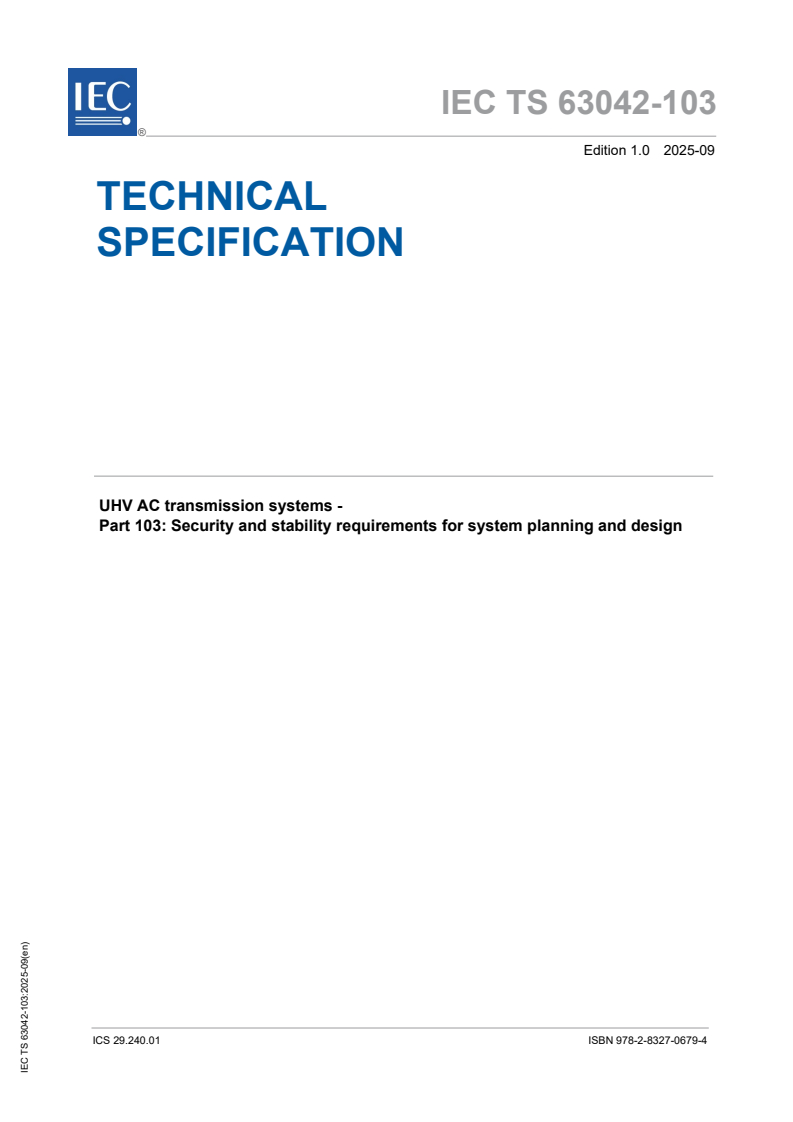
IEC TS 63042-103 ®
Edition 1.0 2025-09
TECHNICAL
SPECIFICATION
UHV AC transmission systems -
Part 103: Security and stability requirements for system planning and design
ICS 29.240.01 ISBN 978-2-8327-0679-4
All rights reserved. Unless otherwise specified, no part of this publication may be reproduced or utilized in any form or
by any means, electronic or mechanical, including photocopying and microfilm, without permission in writing from either
IEC or IEC's member National Committee in the country of the requester. If you have any questions about IEC copyright
or have an enquiry about obtaining additional rights to this publication, please contact the address below or your local
IEC member National Committee for further information.
IEC Secretariat Tel.: +41 22 919 02 11
3, rue de Varembé info@iec.ch
CH-1211 Geneva 20 www.iec.ch
Switzerland
About the IEC
The International Electrotechnical Commission (IEC) is the leading global organization that prepares and publishes
International Standards for all electrical, electronic and related technologies.
About IEC publications
The technical content of IEC publications is kept under constant review by the IEC. Please make sure that you have the
latest edition, a corrigendum or an amendment might have been published.
IEC publications search - IEC Products & Services Portal - products.iec.ch
webstore.iec.ch/advsearchform Discover our powerful search engine and read freely all the
publications previews, graphical symbols and the glossary.
The advanced search enables to find IEC publications by a
variety of criteria (reference number, text, technical With a subscription you will always have access to up to date
committee, …). It also gives information on projects, content tailored to your needs.
replaced and withdrawn publications.
Electropedia - www.electropedia.org
The world's leading online dictionary on electrotechnology,
IEC Just Published - webstore.iec.ch/justpublished
Stay up to date on all new IEC publications. Just Published containing more than 22 500 terminological entries in English
details all new publications released. Available online and and French, with equivalent terms in 25 additional languages.
once a month by email. Also known as the International Electrotechnical Vocabulary
(IEV) online.
IEC Customer Service Centre - webstore.iec.ch/csc
If you wish to give us your feedback on this publication or
need further assistance, please contact the Customer
Service Centre: sales@iec.ch.
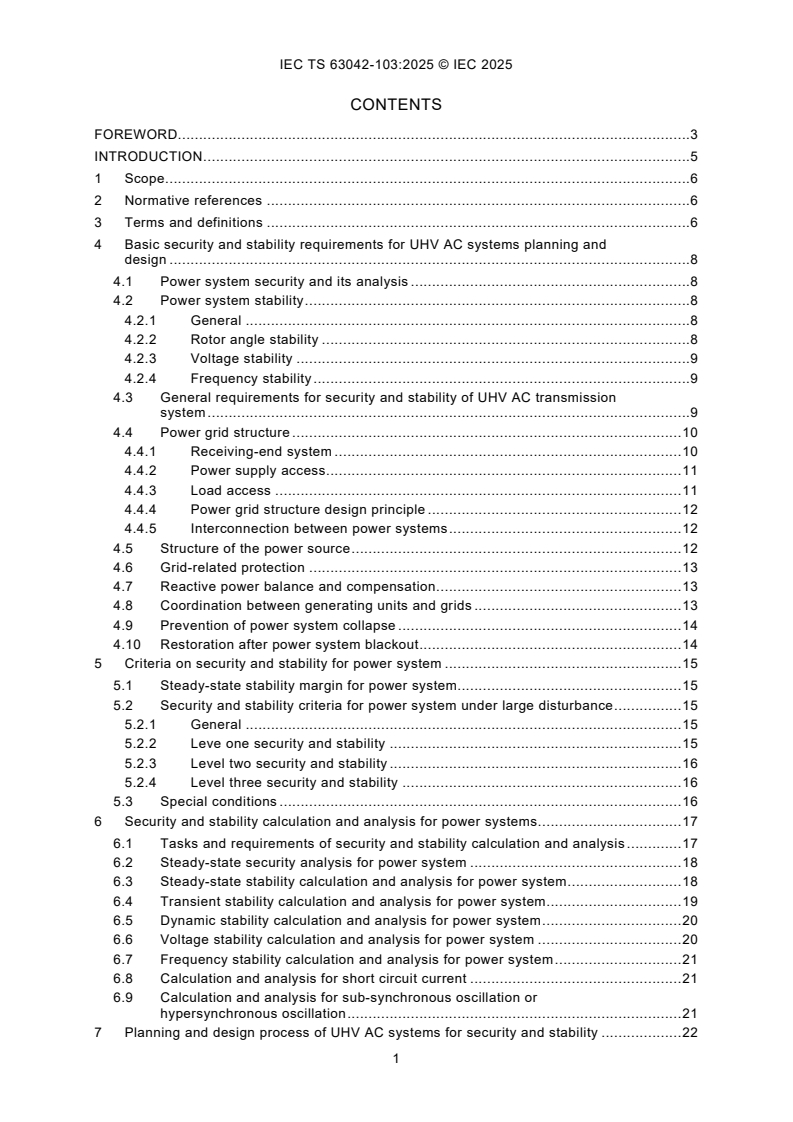
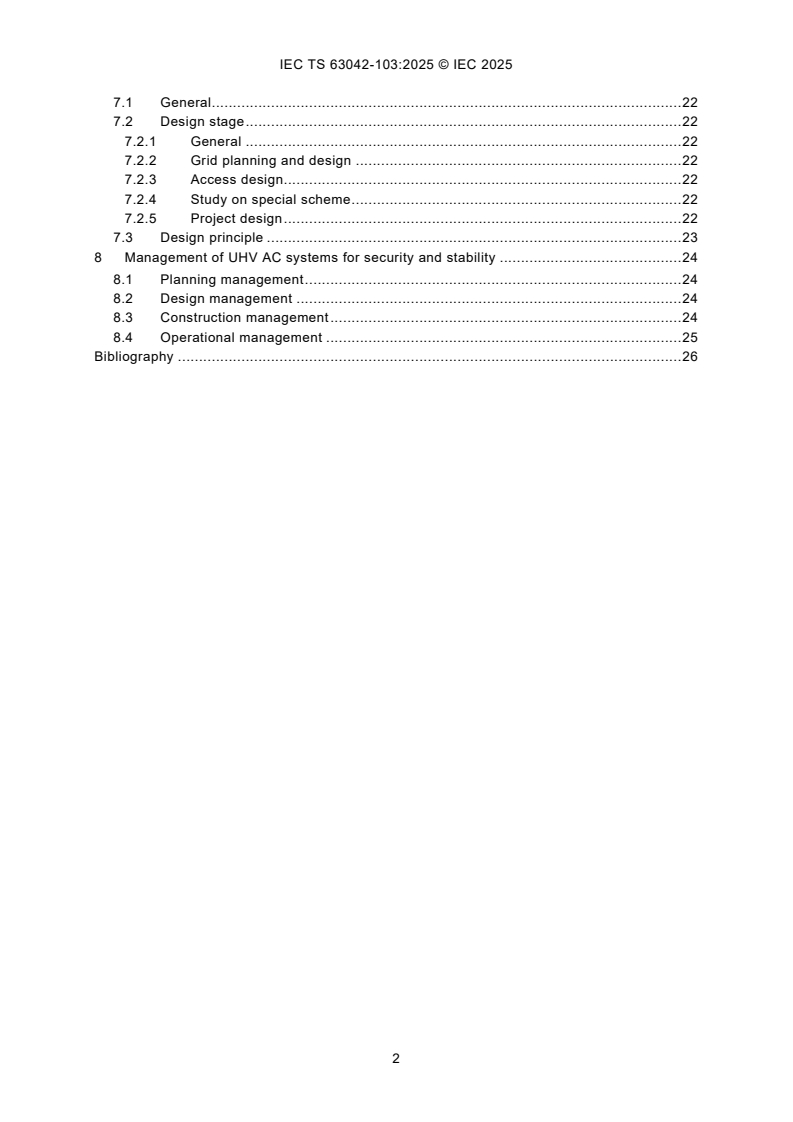
CONTENTS
FOREWORD. 3
INTRODUCTION . 5
1 Scope . 6
2 Normative references . 6
3 Terms and definitions . 6
4 Basic security and stability requirements for UHV AC systems planning and
design . 8
4.1 Power system security and its analysis . 8
4.2 Power system stability . 8
4.2.1 General . 8
4.2.2 Rotor angle stability . 8
4.2.3 Voltage stability . 9
4.2.4 Frequency stability . 9
4.3 General requirements for security and stability of UHV AC transmission
system . 9
4.4 Power grid structure . 10
4.4.1 Receiving-end system . 10
4.4.2 Power supply access . 11
4.4.3 Load access . 11
4.4.4 Power grid structure design principle . 12
4.4.5 Interconnection between power systems . 12
4.5 Structure of the power source . 12
4.6 Grid-related protection . 13
4.7 Reactive power balance and compensation . 13
4.8 Coordination between generating units and grids . 13
4.9 Prevention of power system collapse . 14
4.10 Restoration after power system blackout . 14
5 Criteria on security and stability for power system . 15
5.1 Steady-state stability margin for power system. 15
5.2 Security and stability criteria for power system under large disturbance . 15
5.2.1 General . 15
5.2.2 Leve one security and stability . 15
5.2.3 Level two security and stability . 16
5.2.4 Level three security and stability . 16
5.3 Special conditions . 16
6 Security and stability calculation and analysis for power systems . 17
6.1 Tasks and requirements of security and stability calculation and analysis . 17
6.2 Steady-state security analysis for power system . 18
6.3 Steady-state stability calculation and analysis for power system . 18
6.4 Transient stability calculation and analysis for power system . 19
6.5 Dynamic stability calculation and analysis for power system . 20
6.6 Voltage stability calculation and analysis for power system . 20
6.7 Frequency stability calculation and analysis for power system . 21
6.8 Calculation and analysis for short circuit current . 21
6.9 Calculation and analysis for sub-synchronous oscillation or
hypersynchronous oscillation . 21
7 Planning and design process of UHV AC systems for security and stability . 22
7.1 General . 22
7.2 Design stage . 22
7.2.1 General . 22
7.2.2 Grid planning and design . 22
7.2.3 Access design . 22
7.2.4 Study on special scheme . 22
7.2.5 Project design . 22
7.3 Design principle . 23
8 Management of UHV AC systems for security and stability . 24
8.1 Planning management . 24
8.2 Design management . 24
8.3 Construction management . 24
8.4 Operational management . 25
Bibliography . 26
INTERNATIONAL ELECTROTECHNICAL COMMISSION
____________
UHV AC transmission systems -
Part 103: Security and stability requirements
for system planning and design
FOREWORD
1) The International Electrotechnical Commission (IEC) is a worldwide organization for standardization comprising
all national electrotechnical committees (IEC National Committees). The object of IEC is to promote international
co-operation on all questions concerning standardization in the electrical and electronic fields. To this end and
in addition to other activities, IEC publishes International Standards, Technical Specifications, Technical Reports,
Publicly Available Specifications (PAS) and Guides (hereafter referred to as “IEC Publication(s)”). Their
preparation is entrusted to technical committees; any IEC National Committee interested in the subject dealt with
may participate in this preparatory work. International, governmental and non-governmental organizations liaising
with the IEC also participate in this preparation. IEC collaborates closely with the International Organization for
Standardization (ISO) in accordance with conditions determined by agreement between the two organizations.
2) The formal decisions or agreements of IEC on technical matters express, as nearly as possible, an international
consensus of opinion on the relevant subjects since each technical committee has representation from all
interested IEC National Committees.
3) IEC Publications have the form of recommendations for international use and are accepted by IEC National
Committees in that sense. While all reasonable efforts are made to ensure that the technical content of IEC
Publications is accurate, IEC cannot be held responsible for the way in which they are used or for any
misinterpretation by any end user.
4) In order to promote international uniformity, IEC National Committees undertake to apply IEC Publications
transparently to the maximum extent possible in their national and regional publications. Any divergence between
any IEC Publication and the corresponding national or regional publication shall be clearly indicated in the latter.
5) IEC itself does not provide any attestation of conformity. Independent certification bodies provide conformity
assessment services and, in some areas, access to IEC marks of conformity. IEC is not responsible for any
services carried out by independent certification bodies.
6) All users should ensure that they have the latest edition of this publication.
7) No liability shall attach to IEC or its directors, employees, servants or agents including individual experts and
members of its technical committees and IEC National Committees for any personal injury, property damage or
other damage of any nature whatsoever, whether direct or indirect, or for costs (including legal fees) and
expenses arising out of the publication, use of, or reliance upon, this IEC Publication or any other IEC
Publications.
8) Attention is drawn to the Normative references cited in this publication. Use of the referenced publications is
indispensable for the correct application of this publication.
9) IEC draws attention to the possibility that the implementation of this document may involve the use of (a)
patent(s). IEC takes no position concerning the evidence, validity or applicability of any claimed patent rights in
respect thereof. As of the date of publication of this document, IEC had not received notice of (a) patent(s), which
may be required to implement this document. However, implementers are cautioned that this may not represent
the latest information, which may be obtained from the patent database available at https://patents.iec.ch. IEC
shall not be held responsible for identifying any or all such patent rights.
IEC TS 63042-103 has been prepared by IEC technical committee 122: UHV AC transmission
systems. It is a Technical Specification.
The text of this Technical Specification is based on the following documents:
Draft Report on voting
122/198/DTS 122/203/RVDTS
Full information on the voting for its approval can be found in the report on voting indicated in
the above table.
The language used for the development of this Technical Specification is English.
This document was drafted in accordance with ISO/IEC Directives, Part 2, and developed in
accordance with ISO/IEC Directives, Part 1 and ISO/IEC Directives, IEC Supplement, available
at www.iec.ch/members_experts/refdocs. The main document types developed by IEC are
described in greater detail at www.iec.ch/publications.
A list of all parts in the IEC 63042 series, published under the general title UHV AC transmission
systems, can be found on the IEC website.
The committee has decided that the contents of this document will remain unchanged until the
stability date indicated on the IEC website under webstore.iec.ch in the data related to the
specific document. At this date, the document will be
– reconfirmed,
– withdrawn, or
– revised.
INTRODUCTION
The size and mass of the UHV AC systems are larger than those of other voltage levels, and
their large power fluctuation strongly impacts the security operation of the power systems. On
the other hand, there are few power sources directly connected to the UHV AC systems,
resulting in insufficient system support and regulation capability. The operation of the UHV AC
systems operates with other voltage levels co-ordinately. Furthermore, the aggravation of the
load and the access of large renewable energy has led to higher requirements for the secure
and stable operation of the power grid with UHV AC systems. More attention should be paid to
coordinated control between the units and grids, AC systems and DC systems. All of the above
are different from other voltage levels of AC systems. Therefore, safety and stability
specifications are becoming a priority for UHV AC transmission systems.
This document provides the basic requirements for the secure and stable operation of the UHV
AC transmission systems, the criteria and the assessment of security and stability for UHV AC
transmission systems.
This document is applicable to power grids of UHV AC systems and their associated equipment
and connected systems.
1 Scope
This part of IEC 63042 specifies the basic security and stability requirements for UHV AC
transmission systems in planning and design, the security and stability criteria, and the security
and stability analysis method for the UHV AC transmission systems.
2 Normative references
There are no normative references in this document.
3 Terms and definitions
For the purposes of this document, the following terms and definitions apply.
ISO and IEC maintain terminology databases for use in standardization at the following
addresses:
– IEC Electropedia: available at https://www.electropedia.org/
– ISO Online browsing platform: available at https://www.iso.org/obp
3.1
N-1 principle
power system design and operational criterion that requires the system to maintain stable
operation and continuity of power supply under normal operating conditions, when subjected to
the loss of a single component (e.g., generator, AC line, transformer, or DC monopole) resulting
from fault or non-fault events, without causing overloads or malfunctions in the remaining
equipment while maintaining system frequency and voltage within specified operational limits
Note 1 to entry: The N-1 principle applies to both steady-state safety analysis (component loss scenarios) and
dynamic security analysis (stability assessment post-component loss from faults).
Note 2 to entry: For power plants with only one outgoing transmission line, a fault on this line effectively results in
loss of the power plant. In such cases, the loss scenarios shall be evaluated in accordance with N-1 principle.
3.2
DC short-circuit ratio
ratio of the short-circuit capacity of the AC bus to the rated capacity of the DC converter
connected to it
Note 1 to entry: The short-circuit ratio serves as an indicator of the strength of the AC system at the DC transmission
interconnection point.
3.3
renewable power station short-circuit ratio
ratio of the short-circuit capacity of the AC system at the point of common coupling (PCC) to
the equivalent power of the renewable energy power station, considering influences from
neighbouring stations
3.4
multi-infeed DC short-circuit ratio
ratio of the short-circuit capacity of the AC bus at a converter station to the equivalent DC
capacity, accounting for influences from neighbouring DC circuits
3.5
rotor angle
phase difference between the terminal voltage of an alternator and its electromotive force
Note 1 to entry: The relative angle between these two sinusoidally varying quantities has a direct relation to the
power output of the generator.
[Source: IEC 60050-603:1986, 603-03-06, modified – "internal angle of an alternator" has been
replaced by "rotor angle", a Note to entry has been added.]
3.6
steady-state stability margin
difference between the steady-state stability limit and actual transfer power under normal
operation conditions
3.7
sub-synchronous oscillation
variation in power exchange between a power grid and a generator unit or a new energy station
that is occurring at a frequency lower than the power frequency
3.8
hypersynchronous oscillation
variation in power exchange between a power grid and a generator unit or a new energy station
that is occurring at a frequency higher than the power frequency
3.9
primary equipment
high-voltage electrical equipment that is directly involved in generation, transmission and
distribution of power
Note 1 to entry: It includes generators, transformers, switching devices, busbars, transmission lines, power cables,
reactors, etc.
3.10
secondary equipment
equipment of auxiliary system for monitoring, measuring, controlling, regulating and protecting
the primary equipment of the power system
3.11
auxiliary system
equipment designed to control, adjust, protect and monitor primary equipment, enabling safe
and economic operation of primary equipment
3.12
system small disturbance
disturbances causing minor changes in power system operating conditions
Note 1 to entry: Typical small disturbances include random events that cause small changes in power system state,
such as load fluctuations or disconnection of small generating units, etc.
Note 2 to entry: Mathematically, small disturbances may be represented using linearized equations of the system
dynamic state without compromising analysis accuracy.
3.13
system large disturbance
disturbances that cause significant changes in power system operating conditions
Note 1 to entry: System large disturbances are generally caused by a fault on overhead lines, cables, disconnection
of a large generation unit, loss of a large load, or any combination thereof.
Note 2 to entry: System large disturbance can lead to violation of frequency or voltage limits, loss of power system
stability, cascading outages, or widespread customer load interruption.
Note 3 to entry: Mathematically, system large disturbances are represented by nonlinear equations.
4 Basic security and stability requirements for UHV AC systems planning and
design
4.1 Power system security and its analysis
Power system security is defined as the capability of a power system to withstand disturbances
during operation (e.g., sudden loss of a power system component or short-circuit fault). This
characteristic is characterized by two key attributes:
a) The power system shall be capable of withstanding disturbances and transitioning to an
acceptable stable operating condition.
b) All of the constraint conditions shall be satisfied under the new operating condition.
Security analysis is categorized into steady-state security analysis and dynamic security
analysis. Steady-state security analysis assumes the power system transitions directly from a
pre-disturbance steady-state to a post-disturbance steady-state condition without considering
the intermediate process. It is used to verify whether various constraint conditions are satisfied
after the disturbance.
4.2 Power system stability
4.2.1 General
Stability refers to a power system's capability of maintaining stable operation after being
disturbed.
Power system stability is categorized into three types: rotor angle stability, voltage stability, and
frequency stability.
4.2.2 Rotor angle stability
4.2.2.1 General
A synchronous generator in an interconnected power system shall have the ability to withstand
disturbances and maintain synchronous operation.
Rotor angle stability can be divided into steady-state rotor angle stability, transient rotor angle
stability and dynamic rotor angle stability.
NOTE Rotor angle instability is caused by many factors, such as insufficient synchronous torque which results in
non-periodic instability, insufficient damping torque which results in oscillatory instability, etc.
4.2.2.2 Steady-state rotor angle stability
Steady-state rotor angle stability refers to the capability of the power system to withstand
system small disturbances, recover to its initial operating state and maintain rotor angle
synchronization.
4.2.2.3 Transient rotor angle stability
Transient rotor angle stability refers to the capability of a synchronous generator to withstand
system large disturbances, remain synchronization and transit to a new steady-state operating
condition or return to the original state.
NOTE 1 Transient rotor angle stability typically involves rotor angle oscillations during the first and second swing
cycles.
a) Dynamic rotor angle stability
Dynamic rotor angle stability is the ability of a power system to withstand small or large
system disturbances and maintain rotor angle stability during a long process, supported by
the action of automatic regulation and control devices.
b) Small-disturbance dynamic rotor angle stability
Small-disturbance dynamic rotor angle stability is the ability of a power system to withstand
a system small disturbance and maintain the rotor angle stability during a long process with
the help of automatic control and regulating devices, and without experiencing divergent or
sustained oscillations.
c) Large-disturbance dynamic rotor angle stability
Large-disturbance dynamic rotor angle stability is the ability of a power system to withstand
a system large disturbance and maintain the rotor angle stability during a long process under
the action of automatic regulation and control devices.
NOTE 2 This usually refers to the ability of the power system to maintain stability without experiencing divergent or
sustained oscillations following a system large disturbance.
4.2.3 Voltage stability
4.2.3.1 General
After system small or large disturbances, the power system has the ability to maintain or restore
the voltage to within permissible limits and prevent voltage collapse.
4.2.3.2 Steady-state voltage stability
Steady-state voltage stability is the ability of the power system to withstand a system small
disturbance and maintain the voltage at all buses within its permissible range.
4.2.3.3 Transient voltage stability
Transient voltage stability is the ability of the power system to withstand a system large
disturbance and maintain bus voltages within stable limits.
4.2.4 Frequency stability
The power system shall have the ability to withstand system small or large disturbances and
maintain or restore the system frequency within the allowable range, and prevent frequency
oscillations or collapse.
4.3 General requirements for security and stability of UHV AC transmission system
The planning and design of UHV AC transmission systems shall follow the principle of "detailed
near-term and rough long term, combining short and long term" (rough planning in the long term,
detailed planning in the short term, and coordination between short-, medium- and long-term
planning).
To ensure the stability of power system operation and maintain the system frequency and
voltage, the power system shall have an adequate steady-state stability margin, and active and
reactive power reserve capacity. Active and reactive power reserve capacity with necessary
regulation measures should be distributed. Self-excited oscillations shall not occur under
normal load and generation fluctuations and adjustments to active and reactive power flow.
The steady-state stability margin can be calculated by 6.3. An adequate margin shall satisfy the
stability criteria defined in 5.1.
A reasonable power grid structure and generation mix are the foundation for secure and stable
operation of a power system, and therefore, shall be fully taken into consideration at the
planning and design stage. A reasonable power grid structure shall meet the following basic
requirements:
a) It shall be able to meet the requirements of power flow under various operating modes, have
a certain degree of flexibility, and be able to adapt to the requirements of system
development.
b) If any component disconnects without fault, it will be able to maintain the stable operation
of the power system, and does not cause other components to exceed their overload
capacity, nor cause system voltage and frequency to exceed the permissible range.
c) It has a high level of disturbance immunity and meets the various security and stability
standards.
d) Grid structure design principle as defined in 4.4.4 shall be complied with.
e) Short-circuit current shall be controlled.
f) The mutual influence of UHV AC and UHV DC transmission systems shall be considered
and coordinated.
g) The selection of type, size and site of power generation should consider the system
requirement and have flexible regulation capability.
Under a normal operation mode (including scheduled maintenance mode), the system shall be
capable of maintaining a safe and stable operation in the event of failure of any single
component of the system.
After adjustment of the operating mode following a fault, a power system shall have a specified
steady-state stability margin and be able to withstand subsequent failure of a single component
without causing the remaining components to exceed the specified limit.
When power system instability occurs, predetermined measures shall be activated to isolate
the event, limit the scope of the accident from expanding and minimize the losses.
Loss of any single component in the lower voltage level power grid will not affect the stable
operation of the UHV AC power grid.
The DC short-circuit ratio, multi-infeed DC short-circuit ratio, and renewable power station
short-circuit ratio shall be at a permissible level.
NOTE The permissible level of DC short-circuit ratio varies from one country to another due to differing power
system conditions.
4.4 Power grid structure
4.4.1 Receiving-end system
The receiving-end system is a power system that imports active power and reactive power from
external and distant power sources.
The receiving-end system is an important part of the entire power system and should be
strengthened as a key part of a reasonable power grid structure. The security and stability for
a receiving-end-system shall be strengthened from the following key points:
a) The network connection at the highest voltage level in a receiving-end-system shall be
strengthened.
b) To enhance the voltage support and operational flexibility of the receiving-end system,
power plants have sufficient regulating capacity and capability to control the system.
c) A receiving-end system shall have adequate reactive power compensation capacity, DC
connection points, and load concentrated areas shall be equipped with dynamic reactive
power regulation devices.
d) The capacity of a pivotal substation and converter station shall be compatible with that of a
receiving-end system.
e) Any change in the operation mode of a power plant in a receiving-end system shall not affect
the power-receiving capability.
For receiving-end systems containing DC infeed, DC connection points should be optimized,
the near-area grid should be improved, and the system's support capacity for DC transmission
should be enhanced; the overall scale of multiple DC connections (two or more DC transmission
lines) shall be compatible with the receiving-end system. Receiving-end systems shall maintain
sufficient dynamic reactive power reserve capacity to ensure voltage stability during
contingencies affecting HVDC/UHVDC transmission in-feeding operations.
4.4.2 Power supply access
Power supplies of different scales shall be connected to the appropriate voltage levels. Under
the premise of economic rationality and feasible construction conditions, main power sources
with regulation capability shall be constructed in the receiving-end system. The UHV AC grid
shall be directly connected to the necessary main power supply.
External power supplies shall be connected to a receiving-end system through relatively
independent power transmission lines. Direct connection from power supplies or sending-end
systems to excessively centralized access of power transmission lines shall be avoided. The
proportion of the maximum transmission power of each group of power supply circuit to the total
load of the receiving-end system shall not exceed the permissible level.
NOTE The value of permissible level of the proportion of the maximum transmission power of each group of power
supply circuit varies from one country to another due to the difference in power system conditions.
4.4.3 Load access
The impact of harmonics, shocks and other characteristics on power quality and system safety
and stability shall not exceed the voltage and frequency operating range of the system.
The load shall have a defined level of fault disturbance tolerance. A load protection scheme
shall be provided to avoid unnecessary load loss and limit the fault impact.
NOTE The certain fault disturbance tolerance for load varies from one country to another due to the differences in
power system conditions.
Interruptible loads or those capable of providing frequency response shall be integrated into
the load side technical measures to ensure power system security and stability. Important loads
shall be given priority to ensure the reliability of their power supply.
4.4.4 Power grid structure design principle
A power grid shall be layered and zoned according to voltage levels and power supply areas.
Layering refers to connection of loads and power plants of different scales to the power system
at appropriate voltage levels; zoning refers to dividing the receiving-end system into areas with
a basic balance between supply and demand. Each area connects with adjacent areas through
tie lines.
With the construction of UHV AC systems, lower-voltage power grids shall gradually adopt
zoned operation, and adjacent zones shall provide mutual support. Electromagnetic looped
network system at different voltage levels which will affect security and stability of the UHV AC
systems shall be avoided and eliminated. A power plant shall not be equipped with
interconnecting transformers constituting an electromagnetic looped network.
Zoned power grids should be as simplified as possible, to limit short-circuit current and simplify
the configurations of relay protection.
4.4.5 Interconnection between power systems
UHV AC or DC interconnection shall be chosen based on technical and economic comparisons.
The voltage levels of AC tie lines shall be consistent with the highest voltage level of the main
grid.
Tie lines shall be designed to withstand simultaneous loss of the largest single power source
or any critical network component on either interconnected system, while maintaining stable
operation without exceeding their overload limits.
In the event of tie line disconnection due to faults, the power system at either side of the tie line
shall maintain a safe and stable operation.
UHV AC tie lines shall not constitute part of an interconnected loop. If a tie line is disconnected,
the other tie lines remain in stable operation and can transmit the specified electric power.
For interconnection schemes of a weakly connected UHV AC system, their impact on the
security and stability of the power system shall be studied in detail. Only after a technical and
economic demonstration can the scheme be adopted.
For connection scheme of the DC system, the capacity of the DC power transmission shall
match the connection capacity of the receiving-end system, and the DC short-circuit ratio
(including the multi-feed DC short-circuit ratio) shall meet the requirements. The AC tie lines
that are in parallel with the DC system shall be able to bear the increased power transfer in the
event of a DC block.
4.5 Structure of the power source
According to the functions of power sources, the scale and layout of different types of power
sources shall be configured to meet the requirements of power balance and safe and stable
operation of the power system, and to provide the necessary inertia, short-circuit capacity,
active and reactive power support for the system. The UHV AC systems shall contain a certain
size of power supply to provide the necessary support.
The power system shall have the required regulation capacity. Conventional power plants
(thermal, hydro, nuclear, etc.) shall be equipped with the necessary capacity of peak shaving,
frequency and voltage regulation. Renewable power stations shall have the capacity of
regulation. When necessary, renewable power stations shall be complemented with flexible
power resources such as gas power station, pumped storage, energy storage, etc. and dynamic
reactive power regulation equipment such as synchronous compensator, static reactive power
compensator, etc.
NOTE The required power system regulation capacity varies from one country to another due to the differences in
power system conditions.
4.6 Grid-related protection
Protection and control devices of generators (including renewable ones) and reactive power
regulation equipment shall be coordinated with the grid side safety automatic devices as their
behaviours and settings are related to the power grid operation.
Protection and control devices shall include, but not be limited to, synchronous generator stator
overvoltage protection, rotor overload protection, loss of magnetism protection, out-of-step
protection, frequency anomaly protection, overspeed protection, top value and overexcited
limits, fan overvoltage protection.
4.7 Reactive power balance and compensation
The UHV AC transmission system shall have a reasonable margin of the reactive power supply
to ensure that system voltages comply with specified requirements under normal and abnormal
conditions.
The reactive power compensation for UHV AC transmission system shall comply with the
principles of layering, zoning and local balance of reactive power. Transmission of reactive
power through long-distance lines or transformers shall be avoided. The charging power of
cable lines in UHV AC transmission systems shall be compensated.
Generators or synchronous condensers shall operate in automatic regulating excitation mode
(including forced excitation) and have sufficient leading or lagging capability.
The renewable power station shall have the capability of automatic voltage control and adjusting
reactive power output.
To ensure voltage stability in cases where the receiving-end system suffers from accidents such
as a sudden loss of a heavy-loaded line or large unit (including loss of excitation of generators),
the receiving-end system shall have adequate dynamic reactive power reserves.
NOTE Adequate dynamic reactive power reserves vary from one country to another due to differences in power
system conditions.
4.8 Coordination between generating units and grids
The parameters of the power supply and reactive power compensation devices shall be
coordinated to ensure that their performance meets the requirements of stable operation of the
power system.
The configuration and settings of protection and automatic devices (e.g., automatic excitation
regulators, power system stabilizers, governors, stability control devices, automatic generation
control devices) for power supplies and reactive power compensation devices shall be
coordinated with those of the power system to ensure compliance with stable operation
requirements.
Power supplies shall be capable of primary frequency modulation, rapid voltage regulation and
peak shaving capability, and shall comply with the relevant standards.
Power supplies and reactive power compensation equipment shall have a certain tolerance for
system voltage and frequency fluctuations. The voltage and frequency tolerance of renewable
power stations and distributed power supplies are in principle consistent with those of
synchronous generators.
For conventional power plants with the risk of sub-synchronous oscillation, measures of
suppression, protection and monitoring shall be taken. The renewable power stations with the
risk of sub-synchronous oscillation or hypersynchronous oscillation shall be restrained and
monitored.
UHV AC transmission system shall have inertia and short circuit capacity. In high renewable
energy penetration areas, renewable power stations shall provide necessary inertia and short
circuit capacity.
4.9 Prevention of power system collapse
The structural planning of power grids containing UHV AC transmission systems shall follow
the principles of layering and zoning. Splitting points shall be identified at appropriate positions
where automatic disconnection devices shall be installed. In case of system instability, the
system can be quickly split into two or more sections to prevent incidents from propagating
rapidly and causing system frequency and voltage collapse.
For the UHV AC transmission system, the most severe fault scenarios shall be considered. At
the same time, in coordination with the setting of the system splitting point, the order and values
of automatic low-frequency load shedding schemes shall be arranged. In case of a power
shortage occurring in the whole system or a portion of it after system split, pre-planned load
shedding can be automatically executed based on the frequency decline to ensure uninterrupted
power supply for important users. Power plants shall take measures to ensure reliable supply
of station power to avoid total plant outages due to the loss of station power.
In load concentration areas, automatic or manual load shedding and system splitting schemes
shall be considered to avoid voltage collapse.
4.10 Restoration after power system blackout
During restoration after power system blackout, affected areas, range and conditions of system
outage shall be determined first, and the possibility of restoration assisted by the power supply
in the area or external system shall be determined. In the case where this is impossible, a
system black start scheme shall be implemented quickly.
The black start plan shall be developed based on the characteristics of the power grid structure
and zoning. In power supply planning, at least one to two units capable of black start should be
available in each region.
A restoration scheme (including black start plan) should be suitable for the actual situation of
the system, to achieve a quick and orderly restoration of the system and users. The restoration
plan shall include the restoration steps and key considerations during the restoration process.
The protection, communication, remote control, switching, and automatic safety devices shall
meet the special requirements of self-starting or restoring power supply to other lines and loads.
During restoration, active and reactive power balance shall be monitored, to avoid self-
excitation, uncontrollable voltage and large frequency fluctuation. Stability during system
restoration shall be taken into account, and relay protection and automatic safety devices shall
be activated, to avoid unexpected protection operations resulting in interruption or delay of
system restoration.
5 Criteria on security and stability for power system
5.1 Steady-state stability margin for power system
Under normal operation mode of an AC power system, the steady-state stability reserve
coefficient based on rotor angle criteria (K ) is calculated as 15 % to 20 %, and that based on
p
reactive power voltage criteria (K ) is specified as 10 % to 15 % in some countries.
v
Under post-fault operation mode and some special operation modes, K shall be greater than
p
10 %, and K shall be greater than 8 % in some countries.
v
Hydroelectric power plants are allowed to generate power only according to steady-state
stability reserves in the following cases, but there shall be corresponding measures to prevent
the expansion of accidents.
a) If stability damage occurs but does not affect the stable operation of the main system, it is
allowed to send power only according to the normal steady-state stability reserve.
b) In the post-fault operation mode, it is allowed to send power only according to the post-fault
steady-state stability reserve.
5.2 Security and stability criteria for power system under large disturbance
5.2.1 General
The security and stability standards for power systems under system large disturbances are
classified into three levels:
a) Level one: maintaining stable operation and normal power supply of power grid.
b) Level tw
...