

IEC TS 63042-102:2021
(Main)UHV AC transmission systems - Part 102: General system design
General Information
- Abstract
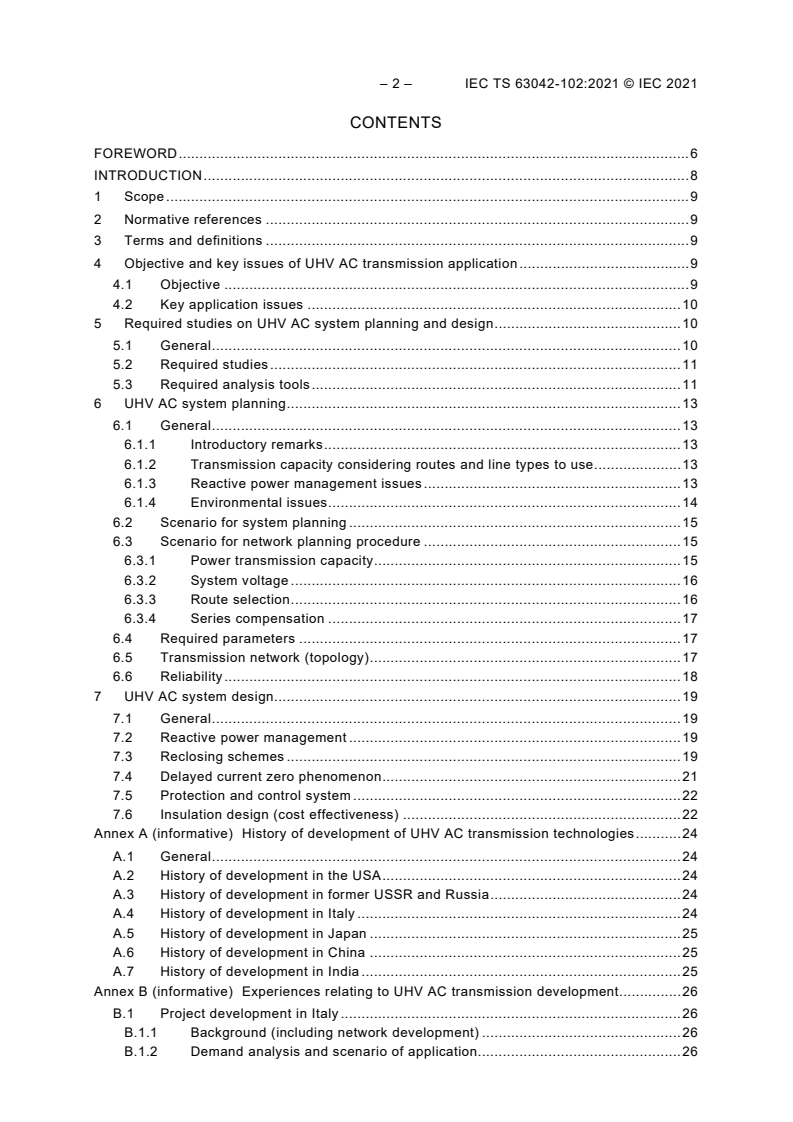
IEC TS 63042-102:2021(E) specifies the procedure to plan and design UHV transmission projects and the items to be considered.
The objective of UHV AC power system planning and design is to achieve both economic efficiency and high reliability, considering its impact on EHV systems.
- Status
- Published
- Publication Date
- 23-Aug-2021
- Technical Committee
- TC 122 - UHV AC transmission systems
- Drafting Committee
- WG 1 - TC 122/WG 1
- Current Stage
- PPUB - Publication issued
- Start Date
- 24-Aug-2021
- Completion Date
- 15-Sep-2021
Overview
IEC TS 63042-102:2021 - "UHV AC transmission systems - Part 102: General system design" provides a procedural framework for planning and designing ultra‑high voltage AC (UHV AC) transmission projects. The Technical Specification defines the items to be considered and the studies required to achieve both economic efficiency and high reliability, while accounting for impacts on existing EHV systems. It is aimed at guiding system planners and designers through route selection, capacity assessment, reactive power management and insulation coordination for UHV transmission lines and substations.
Key Topics
- Scope and objectives: Planning and design steps for UHV AC transmission to meet reliability and cost targets; interfaces with EHV networks.
- Required studies: Power-flow, stability, short‑circuit, electromagnetic transient and insulation coordination studies; scenario‑based network planning.
- Analysis tools: Time-domain and steady‑state simulation tools for dynamic, transient and insulation checks.
- Transmission planning issues: Transmission capacity, line routes and types, voltage selection, environmental considerations and topology options.
- Reactive power management: Shunt reactors, series compensation strategies, tertiary compensation at transformer tertiary windings and reactive compensation flowcharts.
- System design details: Reclosing schemes, handling of delayed current‑zero phenomena, protection and control systems, and reliability allocation.
- Insulation design: Cost‑effective insulation coordination procedures, surge arrester energy considerations and air‑gap/clearance design.
- Annex material: Case histories, field and laboratory testing experiences, and technology summaries (UHV transformers, shunt reactors, switchgear, series capacitors, gas‑insulated lines).
Applications
This IEC TS is practical for:
- Transmission planners and system engineers evaluating new UHV AC corridors or upgrades.
- Grid operators and utilities responsible for integrating large bulk power transfers into EHV/UHV networks.
- Consultants and design houses preparing technical specifications, feasibility studies and procurement documentation.
- Manufacturers and testing labs developing UHV equipment and planning laboratory/field validation programs.
- Regulators and project developers assessing environmental, reliability and cost trade‑offs for UHV projects.
Keywords naturally relevant for search: IEC TS 63042-102:2021, UHV AC transmission, UHV AC system planning, ultra‑high voltage, reactive power management, insulation coordination, protection and control, series compensation.
Related standards
Refer to the normative references listed in IEC TS 63042-102:2021 and to other IEC standards covering insulation coordination, surge arresters, high‑voltage switchgear and protection schemes for complementary technical requirements.
Get Certified
Connect with accredited certification bodies for this standard

IMQ S.p.A. (Certification)
Italian electrical product certification.

SLG Prüf- und Zertifizierungs GmbH
German testing and certification body.

UL Solutions
Global safety science company with testing, inspection and certification.
Sponsored listings
Frequently Asked Questions
IEC TS 63042-102:2021 is a technical specification published by the International Electrotechnical Commission (IEC). Its full title is "UHV AC transmission systems - Part 102: General system design". This standard covers: IEC TS 63042-102:2021(E) specifies the procedure to plan and design UHV transmission projects and the items to be considered. The objective of UHV AC power system planning and design is to achieve both economic efficiency and high reliability, considering its impact on EHV systems.
IEC TS 63042-102:2021(E) specifies the procedure to plan and design UHV transmission projects and the items to be considered. The objective of UHV AC power system planning and design is to achieve both economic efficiency and high reliability, considering its impact on EHV systems.
IEC TS 63042-102:2021 is classified under the following ICS (International Classification for Standards) categories: 29.240.01 - Power transmission and distribution networks in general; 29.240.10 - Substations. Surge arresters. The ICS classification helps identify the subject area and facilitates finding related standards.
IEC TS 63042-102:2021 is available in PDF format for immediate download after purchase. The document can be added to your cart and obtained through the secure checkout process. Digital delivery ensures instant access to the complete standard document.
Standards Content (Sample)
IEC TS 63042-102 ®
Edition 1.0 2021-08
TECHNICAL
SPECIFICATION
colour
inside
UHV AC transmission systems –
Part 102: General system design
All rights reserved. Unless otherwise specified, no part of this publication may be reproduced or utilized in any form
or by any means, electronic or mechanical, including photocopying and microfilm, without permission in writing from
either IEC or IEC's member National Committee in the country of the requester. If you have any questions about IEC
copyright or have an enquiry about obtaining additional rights to this publication, please contact the address below or
your local IEC member National Committee for further information.
IEC Central Office Tel.: +41 22 919 02 11
3, rue de Varembé info@iec.ch
CH-1211 Geneva 20 www.iec.ch
Switzerland
About the IEC
The International Electrotechnical Commission (IEC) is the leading global organization that prepares and publishes
International Standards for all electrical, electronic and related technologies.
About IEC publications
The technical content of IEC publications is kept under constant review by the IEC. Please make sure that you have the
latest edition, a corrigendum or an amendment might have been published.
IEC publications search - webstore.iec.ch/advsearchform IEC online collection - oc.iec.ch
The advanced search enables to find IEC publications by a Discover our powerful search engine and read freely all the
variety of criteria (reference number, text, technical publications previews. With a subscription you will always
committee, …). It also gives information on projects, replaced have access to up to date content tailored to your needs.
and withdrawn publications.
Electropedia - www.electropedia.org
IEC Just Published - webstore.iec.ch/justpublished
The world's leading online dictionary on electrotechnology,
Stay up to date on all new IEC publications. Just Published
containing more than 22 000 terminological entries in English
details all new publications released. Available online and
and French, with equivalent terms in 18 additional languages.
once a month by email.
Also known as the International Electrotechnical Vocabulary
(IEV) online.
IEC Customer Service Centre - webstore.iec.ch/csc
If you wish to give us your feedback on this publication or
need further assistance, please contact the Customer Service
Centre: sales@iec.ch.
IEC TS 63042-102 ®
Edition 1.0 2021-08
TECHNICAL
SPECIFICATION
colour
inside
UHV AC transmission systems –
Part 102: General system design
INTERNATIONAL
ELECTROTECHNICAL
COMMISSION
ICS 29.240.01; 29.240.10 ISBN 978-2-8322-1012-7
– 2 – IEC TS 63042-102:2021 © IEC 2021
CONTENTS
FOREWORD . 6
INTRODUCTION . 8
1 Scope . 9
2 Normative references . 9
3 Terms and definitions . 9
4 Objective and key issues of UHV AC transmission application . 9
4.1 Objective . 9
4.2 Key application issues . 10
5 Required studies on UHV AC system planning and design . 10
5.1 General . 10
5.2 Required studies . 11
5.3 Required analysis tools . 11
6 UHV AC system planning . 13
6.1 General . 13
6.1.1 Introductory remarks . 13
6.1.2 Transmission capacity considering routes and line types to use . 13
6.1.3 Reactive power management issues . 13
6.1.4 Environmental issues . 14
6.2 Scenario for system planning . 15
6.3 Scenario for network planning procedure . 15
6.3.1 Power transmission capacity . 15
6.3.2 System voltage . 16
6.3.3 Route selection . 16
6.3.4 Series compensation . 17
6.4 Required parameters . 17
6.5 Transmission network (topology) . 17
6.6 Reliability . 18
7 UHV AC system design. 19
7.1 General . 19
7.2 Reactive power management . 19
7.3 Reclosing schemes . 19
7.4 Delayed current zero phenomenon . 21
7.5 Protection and control system . 22
7.6 Insulation design (cost effectiveness) . 22
Annex A (informative) History of development of UHV AC transmission technologies . 24
A.1 General . 24
A.2 History of development in the USA . 24
A.3 History of development in former USSR and Russia . 24
A.4 History of development in Italy . 24
A.5 History of development in Japan . 25
A.6 History of development in China . 25
A.7 History of development in India . 25
Annex B (informative) Experiences relating to UHV AC transmission development. 26
B.1 Project development in Italy . 26
B.1.1 Background (including network development) . 26
B.1.2 Demand analysis and scenario of application. 26
B.1.3 Project overview . 26
B.1.4 UHV system planning . 27
B.1.5 UHV system design . 28
B.1.6 Laboratory and field tests . 29
B.2 Project development in China . 32
B.2.1 Background . 32
B.2.2 Project overview . 32
B.2.3 Changzhi-Nanyang-Jingmen UHV AC extension project . 33
B.2.4 Overvoltage mitigation and insulation coordination . 35
B.2.5 Insulation coordination . 36
B.2.6 Laboratory and field tests . 38
B.3 Project development in India . 40
B.3.1 Background (including network development) . 40
B.3.2 Demand analysis and scenario of application. 40
B.3.3 Project overview . 40
B.3.4 Development of 1 200 kV national test station in India . 41
B.3.5 POWERGRID's 1 200 kV transmission system . 42
B.3.6 UHV AC technology design – Insulation coordination . 43
B.3.7 Insulation design for substation . 44
B.4 Project development in Japan . 45
B.4.1 Background (including network development) . 45
B.4.2 Demand analysis and scenario of application. 46
B.4.3 Project overview . 46
B.4.4 UHV system planning . 47
B.4.5 UHV system design . 47
B.4.6 Laboratory and field tests . 50
Annex C (informative) Summary of system technologies specific to UHV AC
transmission systems . 53
C.1 Technologies used in China . 53
C.1.1 Transformer . 53
C.1.2 UHV shunt reactor and reactive compensation at tertiary side of
transformer . 54
C.1.3 Switchgear . 55
C.1.4 Series capacitor (SC) . 57
C.1.5 Gas-insulated transmission line (GIL) . 59
C.2 Technologies used in India . 60
C.2.1 UHV AC transformer . 60
C.2.2 Surge arrester . 61
C.2.3 Circuit-breakers . 62
C.2.4 Instrument transformers . 63
C.3 Technologies used in Japan . 64
C.3.1 Switch gear . 64
C.3.2 Surge arrester . 65
Bibliography . 67
Figure 1 – Analysis tool by time domain . 12
Figure 2 – Flowchart of reactive power compensation configuration . 14
Figure 3 – π equivalent circuit . 15
Figure 4 – Four-legged reactor . 20
– 4 – IEC TS 63042-102:2021 © IEC 2021
Figure 5 – One typical reclosing sequence of high speed earthing switches (HSESs) . 21
Figure 6 – Procedure for insulation design . 23
Figure B.1 – Demand situation in Italy. 26
Figure B.2 – UHV transmission lines in Italy as originally planned in '70 . 27
Figure B.3 – SPIRA system and SICRE system . 28
Figure B.4 – Preliminary system design . 29
Figure B.5 – Field testing of UHV equipment . 30
Figure B.6 – UHV AC transmission projects implemented in China. 32
Figure B.7 – Single-line diagram of Changzhi-Nanyang-Jingmen UHV AC pilot project . 33
Figure B.8 – Artificial grounding test of UHV series capacitors in China . 34
Figure B.9 – Single-line diagram of Huainan-Zhebei-Shanghai double-circuit UHV AC
project . 34
Figure B.10 – Generator integrated into a UHV system through a UHV step-up
transformer . 35
Figure B.11 –Hubei Wuhan UHV AC test base . 38
Figure B.12 –Hebei Bazhou UHV tower test base . 38
Figure B.13 – 1 200 kV national test station (India) . 41
Figure B.14 – Power flow from Satna to Bina diverted via a 1 200 kV test station (India) . 42
Figure B.15 – Schematic of 1 200 kV UHV AC line . 43
Figure B.16 – Typical V-I characteristic of 1 200 kV MOSA . 44
Figure B.17 – Sequence of events for calculation of surge arrester energy
accumulation . 45
Figure B.18 – Trend of peak demand in Japan . 46
Figure B.19 – UHV transmission line for each construction year in Japan . 47
Figure B.20 – Concept for transmission capacity enhancement with short-circuit
current restriction . 47
Figure B.21 – Insulation design sequence of 1 100 kV transmission lines' air gap
clearances . 48
Figure B.22 – UHV designed transmission line in TEPCO . 49
Figure B.23 – Field testing of UHV substation equipment since 1996 . 50
Figure C.1 – UHV AC transformer . 53
Figure C.2 – UHV AC shunt reactor . 54
Figure C.3 – Reactor and capacitor at tertiary side of UHV transformer . 55
Figure C.4 – UHV GIS . 56
Figure C.5 – UHV MTS . 56
Figure C.6 – UHV air insulated disconnectors . 57
Figure C.7 – Single-line diagram of UHV series capacitor . 58
Figure C.8 – UHV series capacitor . 58
Figure C.9 – UHV GIL tunnel below Yangtze River . 59
Figure C.10 – Inside a UHV GIL tunnel during assembly . 59
Figure C.11 – 333 MVA transformer for the 1 200 kV test station . 61
Figure C.12 – First prototype of 850 kV surge arrester for 1 200 kV system . 62
Figure C.13 – UHV circuit-breaker in India . 63
Figure C.14 – Instrument transformer . 64
Figure C.15 – 1 100 kV gas circuit-breaker . 65
Figure C.16 – Resistor-assisted disconnecting operation . 65
Figure C.17 – Surge arrester with low protection level . 66
Table 1 – Specification of reclosing scheme. 21
Table B.1 – Specifications of 1 100 kV transformer . 30
Table B.2 – Specifications of pilot plant (substation) . 31
Table B.3 – Specifications of pilot plant (cable) . 31
Table B.4 – Parameters of substation and switching station of Changzhi-Nanyang-
Jingmen UHV AC pilot project . 33
Table B.5 – Parameters of transmission lines of Changzhi-Nanyang-Jingmen UHV AC
pilot project . 33
Table B.6 – Main system parameters of UHV AC projects in China . 35
Table B.7 – Main system parameters of UHV arrester . 36
Table B.8 – Required minimum value of clearance of the 1 100 kV transmission line . 37
Table B.9 – Minimum clearance of UHV substation (metres) . 37
Table B.10 – Overvoltage withstand level of UHV AC projects in China . 38
Table B.11 – Basic technical parameters for 1 200 kV UHV AC system selected in
India . 43
Table B.12 – TOV and energy absorption by surge arrester . 45
Table B.13 – Requirement against large charging MVA . 49
Table B.14 – Specifications of substation insulation design . 49
Table B.15 – Specifications of 1 100 kV transformer . 50
Table B.16 – Specifications of 1 100 kV GIS . 51
Table B.17 – Example of field test – Measurement items of transformer . 51
Table B.18 – Example of field test – Measurement items of GIS . 52
Table C.1 – Main parameters of UHV AC typical transformer . 53
Table C.2 – Main parameters of UHV AC reactive power compensation equipment . 54
Table C.3 – Main parameters of UHV AC circuit-breaker . 55
Table C.4 – Rated values of UHV SCs in Changzhi-Nanyang-Jingmen UHV extension
project . 58
Table C.5 – Specifications of 333 MVA transformer for the 1 200 kV test station . 60
Table C.6 – Technical specifications of surge arrester . 61
Table C.7 – Technical parameters of UHV circuit-breaker . 62
Table C.8 – Parameters of instrument transformer . 63
Table C.9 – Specifications of gas circuit-breaker . 65
Table C.10 – Specifications of surge arrester . 66
– 6 – IEC TS 63042-102:2021 © IEC 2021
INTERNATIONAL ELECTROTECHNICAL COMMISSION
____________
UHV AC TRANSMISSION SYSTEMS –
Part 102: General system design
FOREWORD
1) The International Electrotechnical Commission (IEC) is a worldwide organization for standardization comprising
all national electrotechnical committees (IEC National Committees). The object of IEC is to promote international
co-operation on all questions concerning standardization in the electrical and electronic fields. To this end and
in addition to other activities, IEC publishes International Standards, Technical Specifications, Technical Reports,
Publicly Available Specifications (PAS) and Guides (hereafter referred to as “IEC Publication(s)”). Their
preparation is entrusted to technical committees; any IEC National Committee interested in the subject dealt with
may participate in this preparatory work. International, governmental and non-governmental organizations liaising
with the IEC also participate in this preparation. IEC collaborates closely with the International Organization for
Standardization (ISO) in accordance with conditions determined by agreement between the two organizations.
2) The formal decisions or agreements of IEC on technical matters express, as nearly as possible, an international
consensus of opinion on the relevant subjects since each technical committee has representation from all
interested IEC National Committees.
3) IEC Publications have the form of recommendations for international use and are accepted by IEC National
Committees in that sense. While all reasonable efforts are made to ensure that the technical content of IEC
Publications is accurate, IEC cannot be held responsible for the way in which they are used or for any
misinterpretation by any end user.
4) In order to promote international uniformity, IEC National Committees undertake to apply IEC Publications
transparently to the maximum extent possible in their national and regional publications. Any divergence between
any IEC Publication and the corresponding national or regional publication shall be clearly indicated in the latter.
5) IEC itself does not provide any attestation of conformity. Independent certification bodies provide conformity
assessment services and, in some areas, access to IEC marks of conformity. IEC is not responsible for any
services carried out by independent certification bodies.
6) All users should ensure that they have the latest edition of this publication.
7) No liability shall attach to IEC or its directors, employees, servants or agents including individual experts and
members of its technical committees and IEC National Committees for any personal injury, property damage or
other damage of any nature whatsoever, whether direct or indirect, or for costs (including legal fees) and
expenses arising out of the publication, use of, or reliance upon, this IEC Publication or any other IEC
Publications.
8) Attention is drawn to the Normative references cited in this publication. Use of the referenced publications is
indispensable for the correct application of this publication.
9) Attention is drawn to the possibility that some of the elements of this IEC Publication may be the subject of patent
rights. IEC shall not be held responsible for identifying any or all such patent rights.
IEC TS 63042-102 has been prepared by IEC technical committee 122: UHV AC transmission
systems. It is a Technical Specification.
The text of this Technical Specification is based on the following documents:
Draft Report on voting
122/109/DTS 122/114/RVDTS
Full information on the voting for its approval can be found in the report on voting indicated in
the above table.
The language used for the development of this Technical Specification is English.
This document was drafted in accordance with ISO/IEC Directives, Part 2, and developed in
accordance with ISO/IEC Directives, Part 1 and ISO/IEC Directives, IEC Supplement, available
at www.iec.ch/members_experts/refdocs. The main document types developed by IEC are
described in greater detail at www.iec.ch/standardsdev/publications.
A list of all parts in the IEC 63042 series, published under the general title UHV AC transmission
systems, can be found on the IEC website.
The committee has decided that the contents of this document will remain unchanged until the
stability date indicated on the IEC website under webstore.iec.ch in the data related to the
specific document. At this date, the document will be
• reconfirmed,
• withdrawn,
• replaced by a revised edition, or
• amended.
IMPORTANT – The "colour inside" logo on the cover page of this document indicates that it
contains colours which are considered to be useful for the correct understanding of its
contents. Users should therefore print this document using a colour printer.
– 8 – IEC TS 63042-102:2021 © IEC 2021
INTRODUCTION
Large capacity power sources including large-scale renewable energy have recently been
developed, but they are generally located far away from load centres. To meet the requirements
for large capacity power transmission, some countries have introduced, or are considering
introducing, ultra high voltage (UHV) transmission systems, overlaying these on the existing
extra high voltage (EHV) systems.
The objective of UHV AC power system planning and design is to achieve both economic
efficiency and high reliability, considering its impact on EHV systems.
Moreover, UHV AC transmission systems require comparatively large spaces, and the method
of minimizing and optimizing the size and structure of UHV AC transmission lines and substation
apparatus is another important issue.
UHV AC TRANSMISSION SYSTEMS –
Part 102: General system design
1 Scope
This part of IEC 63042 specifies the procedure to plan and design UHV transmission projects
and the items to be considered.
2 Normative references
There are no normative references in this document.
3 Terms and definitions
For the purposes of this document, the following terms and definitions apply.
ISO and IEC maintain terminological databases for use in standardization at the following
addresses:
• IEC Electropedia: available at http://www.electropedia.org/
• ISO Online browsing platform: available at http://www.iso.org/obp
3.1
extra high voltage
EHV
voltages in the range of 345 000 V to 765 000 V
3.2
right-of-way
ROW
strip of land that is used to construct, operate, maintain and repair transmission line facilities
3.3
surge impedance loading
SIL
power delivered by a line to a purely resistive load equal in value to the surge impedance of
that line
3.4
ultra high voltage
UHV
highest voltage exceeding 800 000 V
4 Objective and key issues of UHV AC transmission application
4.1 Objective
Recently, large capacity power sources including large-scale renewable energy have been
developed, in most cases, far away from the load centres. To fully utilize these facilities, it is
important to transmit power generated from these sources efficiently. Evacuation through extra
high voltage (EHV) network enhancements would need more lines (right-of-way, ROW) and
substations, increasing transmission losses and worsening fault current problems.
– 10 – IEC TS 63042-102:2021 © IEC 2021
UHV transmission systems are characterized by their large capacity over long distances and
can provide a solution to address the above issues by minimizing ROW and switchyard
requirements, effectively with fewer losses, improvement of fault current conditions, etc.
For example, the transmission surge impedance loading (SIL) capacity of a 1 100 kV
transmission line can replace four to five 550 kV lines, the weight of the towers can be reduced
by approximately 30 % and the weight of the wires by approximately 50 %. This can provide
savings on the cost of construction of power lines and substations.
A UHV transmission system has many features such as:
• large capacity, long distance and high efficiency power transmission;
• decrease of ROW per unit GW required for transferring;
• improvement of fault current conditions and system stability;
• possible reduction of environmental impact;
• reduction of transmission losses.
4.2 Key application issues
UHV AC transmission systems are capable of transmitting large amounts of electric power.
However, if a failure occurs in a UHV AC system, the system influence can be severe from the
viewpoints of reliability and overall security of the supply of the power system. In particular, the
UHV AC transmission systems design should be considered to improve lightning and switching
protection performance.
In UHV AC transmission systems, typical phenomena depend on the length of the transmission
line. For the phenomenon due to the long transmission line, reactive power issues such as
voltage rise due to the Ferranti effect and geometrical mean distance for increasing surge
impedance loading (SIL) should be taken into consideration. For high voltage issues, it is also
necessary to take into consideration secondary arc extinction, temporary over-voltage (TOV) at
load shedding, and DC time constant of short-circuit currents.
In addition, size and cost of equipment are large and the system design should aim at
minimizing visual impact, construction and maintenance costs and transmission losses, and
increasing the network connectivity by forecasting generation and load scenarios.
The history of the development of UHV AC transmission technologies is given in Annex A.
5 Required studies on UHV AC system planning and design
5.1 General
Early strategic system planning is conducted to meet the load growth and power source
development planning. Once it is determined that a new transmission line is required in the
system, preliminary economic feasibility study and project design begin.
During the term of the project design, three primary decisions should be addressed in a
transmission-line project at the conceptual stage: capacity, voltage, and route.
Furthermore, strategic planning, as it relates to the environmental authorizations process, is
often overlooked or viewed as being of secondary importance. Early strategic planning for the
project-specific environmental review process can avoid significant effects on a project’s
schedule, costs, and ultimate success.
5.2 Required studies
The analytical studies can be divided into three types, corresponding to chronological phases
of a project's planning, design, and implementation:
1) System planning study
In the planning stages, wherever new lines are needed, the voltage and current ratings, and
major auxiliary equipment such as shunt compensation, are determined. At this stage,
system contingencies are considered. Further studies need to be carried out for various
power demand and generation scenarios, typical ones including peak demand, off peak
demand for various seasons (summer, winter, rainy season), to check adequacy of the
proposed transmission system. The basic study is a power flow calculation for which positive
sequence parameters are adequate.
2) System impact study or detailed system design study
The impact of new planned transmission or generation on the power system should be
evaluated by the system impact study. Based on the impact study, the high-level
specification shall be determined. The system impact study may result in some adjustments,
or mitigations applied to the system.
Study topics include harmonic resonance, short-circuit currents, transient stability, voltage
stability, and system relaying. The study tools include short-circuit, stability, and harmonic
analysis programmes, and in some cases an electromagnetic transient analytical
programme to explore resonant overvoltages. The modelling needs to vary from lumped
parameter to distributed parameter, from positive sequence to three-phase unbalanced
representation, and from direct current to a few kHz, depending on the subject. Models are
often generic in early studies, later progressing to specific models for particular equipment.
3) Equipment and system design study
Detailed protection and operating procedures for the switchgear, shunt compensation, and
related equipment are established. The basic study tool is an electromagnetic transient
analytical programme.
Accurate frequency dependent models are preferable and sometimes necessary for many
of these studies.
5.3 Required analysis tools
The main considerations are power flow, fault current, voltage control, dynamic stability and
operational criteria that include reliability and system security.
Once the high-level specification (number and type of conductors, voltage level, current rating,
and reactive power compensation) has been determined, a more detailed design phase follows
to specify equipment, such as circuit-breakers, shunt reactors, and surge arresters. No
foreseeable problem should affect the reliable and safe operation of the system.
The analysis tool by time-domain is shown in Figure 1.
– 12 – IEC TS 63042-102:2021 © IEC 2021
Figure 1 – Analysis tool by time domain
Line constants – a programme that calculates and represents electrical RLC parameters in a
matrix form for a general system of tower and conductors, over a range of frequencies, and
using either transposed or full unbalanced assumptions. This function may be bundled with
another tool, or used separately.
Power flow – calculates steady-state voltages and currents based on a positive sequence model,
with non-linear loads. The line model is symmetric and transposed. Power flow is the basic tool
for transmission planning.
Short-circuit – a programme that solves voltage and current during faults, especially three-
phase and single-phase-to-ground faults. The model is linear, symmetric, and assumes phase
transposition. An auxiliary protection function simulates the response of relays to fault current
and voltage.
Dynamics – a time-domain simulator based on numerical integration of differential equations. It
differs from an electromagnetic transients programme (EMTP) as it focuses on (slower)
electromechanical and control system transients, rather than electromagnetic transients. The
models are sometimes linear and balanced. The programme usually includes eigenvalue
analysis, or other functions for small-signal stability.
Harmonics – a frequency domain programme that solves voltage and current over a range of
frequencies, using linear or non-linear load and source models, and balanced or unbalanced
impedances. The frequency-scan function outputs driving point impedance, as obtained from
the bus voltage for a unit current injection.
EMTP – a time-domain or transient simulator based on numerical integration of differential
equations, including non-linear component models, unbalanced impedances, and frequency-
dependent RLC parameters. An EMTP can also perform frequency scans, and may include an
auxiliary programme of EMTP cable constants.
Electromagnetic field programme – a programme can compute electric and magnetic fields in
the air and soil, as well as electric potentials, and the current distribution in the soil and in the
conductors.
6 UHV AC system planning
6.1 General
6.1.1 Introductory remarks
Generally, the planning study process includes the following steps. As UHV AC system planning
has specific requirements, some considerations are necessary for each step.
Experiences relating to UHV AC transmission development are given in Annex B.
6.1.2 Transmission capacity considering routes and line types to use
In the planning and design of power grid, increasing the voltage level of the transmission line
to UHV not only increases the transmission capacity, but also reduces the cost of the
transmission system and increases the corridor utilization rate of the transmission line.
The economic transmission distance of UHV transmission lines can be as much as 1 000 km to
1 500 km or even longer. The single line transmission capacity with 8 bundled wires can reach
12 000 MW. In the selection of UHV transmission capacity, the economic benefits of the entire
power grid should be considered, rather than being limited to the economic benefits of a
transmission line project.
6.1.3 Reactive power management issues
In the planning of the power system, the planning of reactive power supply and reactive power
compensation facilities shall be included. In the engineering design of UHV AC transmission,
the design of reactive power supply and reactive power compensation facilities should be
carried out.
An appropriate amount of reactive power supply should be planned and installed in the UHV
AC system to meet the system voltage regulation requirements and reduce the unintended
reactive power transfer between different network nodes.
A sufficient amount of reactive power supply with flexible adjustable capacity, as well as reserve
capacity of reactive power should be maintained.
The configuration of reactive power compensation and equipment type selection should be
technically and economically compared.
Planning and design of the reactive power compensator for a UHV AC system should meet the
overvoltage limiting requirement of UHV AC transmission systems.
The process of configuring reactive power compensation for a UHV AC system is as follows:
Step 1
Identify the range of likely active power flow across the UHV line, calculate and analyse the
characteristics of reactive power and voltage profiles along the UHV line, taking into account
the charging reactive power produced by UHV AC lines and reactive power loss under different
power flows.
Step 2
Select the UHV transformer tap position to avoid overvoltage under a range of operating
conditions taking into account UHV substation location, number of transmission lines connected,
and system operation mode.
– 14 – IEC TS 63042-102:2021 © IEC 2021
Step 3
Select the capacity and location of the UHV shunt reactor with consideration given to limiting
temporary overvoltage and reducing secondary arc current, and balancing charging power of
lines and flexibly controlling bus voltage.
Step 4
Identify the total and unit capacity of the compensator installed in the tertiary side of the
transformer. The total capacity should be selected to reduce the reactive power exchange
between different voltage levels and maintain bus voltage in an admissible range. When
selecting the single bank capacity, the voltage fluctuation induced by switching of the single
group capacitor or reactor within a reasonable range should be taken into consideration.
Step 5
Check if the dynamic reactive power reserve provided by generators is adequate within their
reactive power capability range. If it is adequate, then the process stops, otherwise go back to
Step 4.
Figure 2 shows the process of configuring reactive power compensation.
Figure 2 – Flowchart of reactive power compensation configuration
6.1.4 Environmental issues
The environmental impact of a power transmission project generally includes the impact on the
ecological environment, electromagnetic fields, land occupation, visual landscape, etc. At
present, the public's awareness of the quality of the environment in which they live has been
strengthened, and more and more attention is paid to the environmental impact of power
transmission projects. It is the responsibility of the users to ensure environment related laws
and regulations in each country are complied with.
During the UHV AC system planning and feasibility research, environmental issues should be
included. A UHV AC transmission has the advantage of saving the total width of transmission
corridors, as a result of its huge transmission capacity. However, because of its higher voltage
and rated current, it may cause more serious electromagnetic fields and related problems, which
include power frequency electric field, power frequency magnetic field, corona phenomenon,
radio interference, audible noise. Corresponding countermeasures should be considered during
the substation and transmission line design. Appropriate tests and measurements should be
carried out to verify the effect of the countermeasure, during research and system
commissioning.
6.2 Scenario for system planning
System planning mainly includes power load forecast, power source development planning and
power grid planning. Sys
...