


IEC 60287-2-3:2024
(Main)Electric cables - Calculation of the current rating - Part 2-3: Thermal resistance - Cables installed in ventilated tunnels
Electric cables - Calculation of the current rating - Part 2-3: Thermal resistance - Cables installed in ventilated tunnels
IEC 60287-2-3:2024 describes a method for calculating the continuous current rating factor for cables of all voltages installed in ventilated tunnels. The method is applicable to any type of cable. The method applies to natural as well as forced ventilation. Longitudinal heat transfer within the cables and the surroundings of the tunnel is assumed to be negligible. All cables are assumed to be identical within the tunnel and it is assumed that the tunnel cross-section does not change with distance along the tunnel.
Câbles électriques - Calcul du courant admissible - Partie 2-3: Résistance thermique - Câbles posés dans les tunnels ventilés
IEC 60287-2-3:2024 est disponible sous forme de IEC 60287-2-3:2024 RLV qui contient la Norme internationale et sa version Redline, illustrant les modifications du contenu technique depuis l'édition précédente.
General Information
- Status
- Published
- Publication Date
- 27-Jun-2024
- Technical Committee
- TC 20 - Electric cables
- Drafting Committee
- WG 19 - TC 20/WG 19
- Current Stage
- PPUB - Publication issued
- Start Date
- 28-Jun-2024
- Completion Date
- 28-Jun-2024
Relations
- Effective Date
- 05-Sep-2023
Overview - IEC 60287-2-3:2024 (Electric cables - Current rating - Ventilated tunnels)
IEC 60287-2-3:2024 specifies a calculation method for the continuous current rating factor of electric cables of all voltages when installed in ventilated tunnels. The standard addresses both natural and forced ventilation and is applicable to any cable type. It assumes steady-state conditions, identical cables throughout the tunnel, a constant tunnel cross-section, and that longitudinal heat transfer within the cables and surrounding materials is negligible (although convective heat removal by air flow along the tunnel is treated).
Keywords: IEC 60287-2-3:2024, current rating calculation, thermal resistance, ventilated tunnels, cable ampacity, forced ventilation, natural ventilation.
Key technical topics and requirements
- Thermal modelling for ventilated tunnels: Provides formulae to calculate thermal resistances influencing cable temperatures under airflow conditions.
- Heat-transfer mechanisms covered:
- Radial conduction within the cable
- Radiation from cable surface to inner tunnel wall
- Convection from cable to tunnel air and from air to tunnel wall
- Longitudinal convective heat transfer by air moving along the tunnel
- Radial heat conduction in surrounding soil/tunnel structure
- Assumptions and flow regimes:
- Steady-state loading and inlet-air temperature
- Air flow treated as laminar or turbulent (transitional regime ignored)
- Identical cable circuits and uniform tunnel cross-section
- Calculation approach:
- A defined set of formulae for thermal resistances and air properties
- Iterative solution procedures and guidance to obtain temperature profiles and allowable current
- Informative annexes (calculation example, delta–star transformation, C coefficient) to support practical use
Practical applications - who uses this standard
- Electrical engineers and cable designers sizing cable ampacity in tunnels (road, rail, utility or industrial tunnels)
- Power utilities and transmission planners assessing continuous ratings for underground routes with ventilation
- Tunnel and ventilation engineers integrating thermal performance with HVAC and safety systems
- Consulting firms performing thermal assessments, regulatory compliance checks, and safety studies
- Test laboratories and certification bodies referencing standardized calculation methods
Practical outcomes include reliably calculating cable ampacity, designing ventilation strategies to control cable temperatures, and ensuring safety and compliance in tunnel cable installations.
Related standards
- IEC 60287-1-1 - Current rating equations and loss calculations (general)
- IEC 60287-2-1 - Thermal resistance calculation methods for cables in free air
- Other parts of the IEC 60287 series for grouping and installation-specific factors
Using IEC 60287-2-3:2024 helps professionals produce consistent, standardized current-rating calculations for cables in ventilated tunnels and supports sound decisions on ventilation, cable selection, and thermal safety.
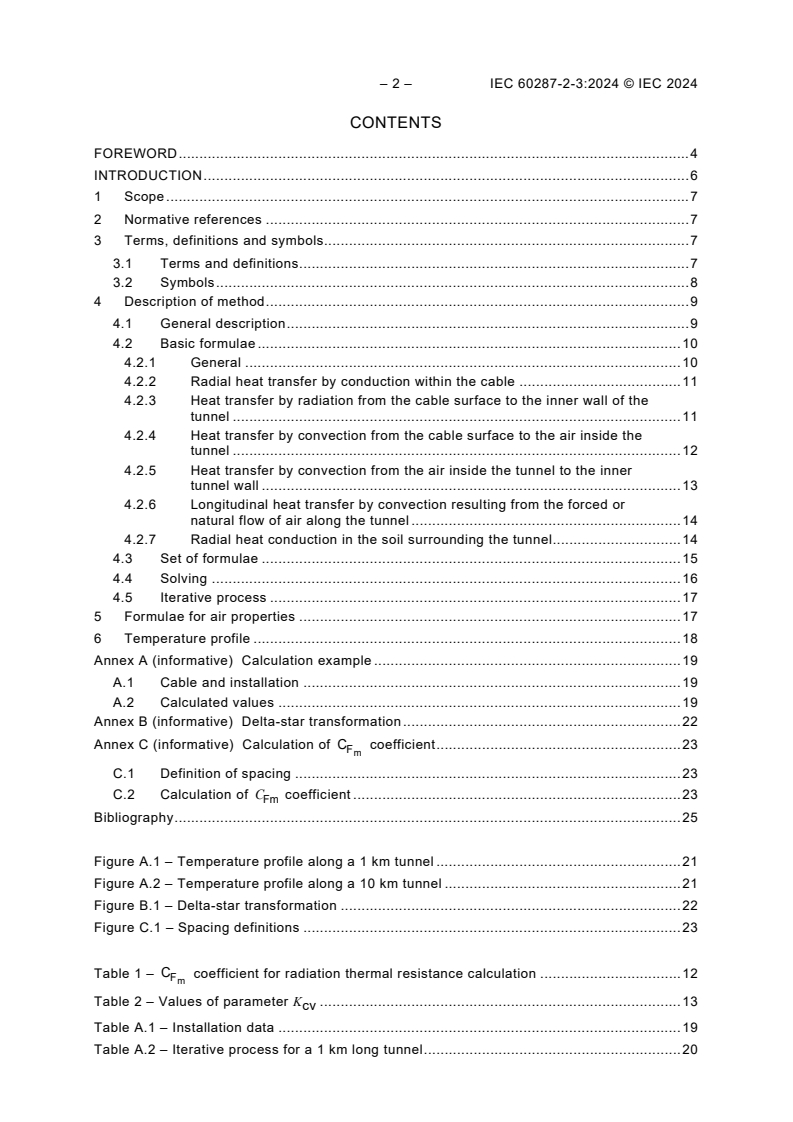
IEC 60287-2-3:2024 - Electric cables - Calculation of the current rating - Part 2-3: Thermal resistance - Cables installed in ventilated tunnels Released:6/28/2024 Isbn:9782832290620
IEC 60287-2-3:2024 RLV - Electric cables - Calculation of the current rating - Part 2-3: Thermal resistance - Cables installed in ventilated tunnels Released:6/28/2024 Isbn:9782832293706
Frequently Asked Questions
IEC 60287-2-3:2024 is a standard published by the International Electrotechnical Commission (IEC). Its full title is "Electric cables - Calculation of the current rating - Part 2-3: Thermal resistance - Cables installed in ventilated tunnels". This standard covers: IEC 60287-2-3:2024 describes a method for calculating the continuous current rating factor for cables of all voltages installed in ventilated tunnels. The method is applicable to any type of cable. The method applies to natural as well as forced ventilation. Longitudinal heat transfer within the cables and the surroundings of the tunnel is assumed to be negligible. All cables are assumed to be identical within the tunnel and it is assumed that the tunnel cross-section does not change with distance along the tunnel.
IEC 60287-2-3:2024 describes a method for calculating the continuous current rating factor for cables of all voltages installed in ventilated tunnels. The method is applicable to any type of cable. The method applies to natural as well as forced ventilation. Longitudinal heat transfer within the cables and the surroundings of the tunnel is assumed to be negligible. All cables are assumed to be identical within the tunnel and it is assumed that the tunnel cross-section does not change with distance along the tunnel.
IEC 60287-2-3:2024 is classified under the following ICS (International Classification for Standards) categories: 29.060.20 - Cables. The ICS classification helps identify the subject area and facilitates finding related standards.
IEC 60287-2-3:2024 has the following relationships with other standards: It is inter standard links to IEC 60287-2-3:2017. Understanding these relationships helps ensure you are using the most current and applicable version of the standard.
You can purchase IEC 60287-2-3:2024 directly from iTeh Standards. The document is available in PDF format and is delivered instantly after payment. Add the standard to your cart and complete the secure checkout process. iTeh Standards is an authorized distributor of IEC standards.
Standards Content (Sample)
IEC 60287-2-3 ®
Edition 2.0 2024-06
INTERNATIONAL
STANDARD
Electric cables – Calculation of the current rating –
Part 2-3: Thermal resistance – Cables installed in ventilated tunnels
All rights reserved. Unless otherwise specified, no part of this publication may be reproduced or utilized in any form
or by any means, electronic or mechanical, including photocopying and microfilm, without permission in writing from
either IEC or IEC's member National Committee in the country of the requester. If you have any questions about IEC
copyright or have an enquiry about obtaining additional rights to this publication, please contact the address below or
your local IEC member National Committee for further information.
IEC Secretariat Tel.: +41 22 919 02 11
3, rue de Varembé info@iec.ch
CH-1211 Geneva 20 www.iec.ch
Switzerland
About the IEC
The International Electrotechnical Commission (IEC) is the leading global organization that prepares and publishes
International Standards for all electrical, electronic and related technologies.
About IEC publications
The technical content of IEC publications is kept under constant review by the IEC. Please make sure that you have the
latest edition, a corrigendum or an amendment might have been published.
IEC publications search - webstore.iec.ch/advsearchform IEC Products & Services Portal - products.iec.ch
The advanced search enables to find IEC publications by a Discover our powerful search engine and read freely all the
variety of criteria (reference number, text, technical publications previews, graphical symbols and the glossary.
committee, …). It also gives information on projects, replaced With a subscription you will always have access to up to date
and withdrawn publications. content tailored to your needs.
IEC Just Published - webstore.iec.ch/justpublished
Electropedia - www.electropedia.org
Stay up to date on all new IEC publications. Just Published
The world's leading online dictionary on electrotechnology,
details all new publications released. Available online and once
containing more than 22 500 terminological entries in English
a month by email.
and French, with equivalent terms in 25 additional languages.
Also known as the International Electrotechnical Vocabulary
IEC Customer Service Centre - webstore.iec.ch/csc
(IEV) online.
If you wish to give us your feedback on this publication or need
further assistance, please contact the Customer Service
Centre: sales@iec.ch.
IEC 60287-2-3 ®
Edition 2.0 2024-06
INTERNATIONAL
STANDARD
Electric cables – Calculation of the current rating –
Part 2-3: Thermal resistance – Cables installed in ventilated tunnels
INTERNATIONAL
ELECTROTECHNICAL
COMMISSION
ICS 29.060.20 ISBN 978-2-8322-9062-0
– 2 – IEC 60287-2-3:2024 © IEC 2024
CONTENTS
FOREWORD . 4
INTRODUCTION . 6
1 Scope . 7
2 Normative references . 7
3 Terms, definitions and symbols. 7
3.1 Terms and definitions . 7
3.2 Symbols . 8
4 Description of method . 9
4.1 General description . 9
4.2 Basic formulae . 10
4.2.1 General . 10
4.2.2 Radial heat transfer by conduction within the cable . 11
4.2.3 Heat transfer by radiation from the cable surface to the inner wall of the
tunnel . 11
4.2.4 Heat transfer by convection from the cable surface to the air inside the
tunnel . 12
4.2.5 Heat transfer by convection from the air inside the tunnel to the inner
tunnel wall . 13
4.2.6 Longitudinal heat transfer by convection resulting from the forced or
natural flow of air along the tunnel . 14
4.2.7 Radial heat conduction in the soil surrounding the tunnel. 14
4.3 Set of formulae . 15
4.4 Solving . 16
4.5 Iterative process . 17
5 Formulae for air properties . 17
6 Temperature profile . 18
Annex A (informative) Calculation example . 19
A.1 Cable and installation . 19
A.2 Calculated values . 19
Annex B (informative) Delta-star transformation . 22
Annex C (informative) Calculation of C coefficient . 23
F
m
C.1 Definition of spacing . 23
C.2 Calculation of C coefficient . 23
Fm
Bibliography . 25
Figure A.1 – Temperature profile along a 1 km tunnel . 21
Figure A.2 – Temperature profile along a 10 km tunnel . 21
Figure B.1 – Delta-star transformation . 22
Figure C.1 – Spacing definitions . 23
Table 1 – C coefficient for radiation thermal resistance calculation . 12
F
m
Table 2 – Values of parameter K . 13
cv
Table A.1 – Installation data . 19
Table A.2 – Iterative process for a 1 km long tunnel . 20
Table C.1 – Expression for C coefficient calculation . 23
F
m
– 4 – IEC 60287-2-3:2024 © IEC 2024
INTERNATIONAL ELECTROTECHNICAL COMMISSION
____________
ELECTRIC CABLES –
CALCULATION OF THE CURRENT RATING –
Part 2-3: Thermal resistance – Cables installed in ventilated tunnels
FOREWORD
1) The International Electrotechnical Commission (IEC) is a worldwide organization for standardization comprising
all national electrotechnical committees (IEC National Committees). The object of IEC is to promote international
co-operation on all questions concerning standardization in the electrical and electronic fields. To this end and
in addition to other activities, IEC publishes International Standards, Technical Specifications, Technical Reports,
Publicly Available Specifications (PAS) and Guides (hereafter referred to as "IEC Publication(s)"). Their
preparation is entrusted to technical committees; any IEC National Committee interested in the subject dealt with
may participate in this preparatory work. International, governmental and non-governmental organizations liaising
with the IEC also participate in this preparation. IEC collaborates closely with the International Organization for
Standardization (ISO) in accordance with conditions determined by agreement between the two organizations.
2) The formal decisions or agreements of IEC on technical matters express, as nearly as possible, an international
consensus of opinion on the relevant subjects since each technical committee has representation from all
interested IEC National Committees.
3) IEC Publications have the form of recommendations for international use and are accepted by IEC National
Committees in that sense. While all reasonable efforts are made to ensure that the technical content of IEC
Publications is accurate, IEC cannot be held responsible for the way in which they are used or for any
misinterpretation by any end user.
4) In order to promote international uniformity, IEC National Committees undertake to apply IEC Publications
transparently to the maximum extent possible in their national and regional publications. Any divergence between
any IEC Publication and the corresponding national or regional publication shall be clearly indicated in the latter.
5) IEC itself does not provide any attestation of conformity. Independent certification bodies provide conformity
assessment services and, in some areas, access to IEC marks of conformity. IEC is not responsible for any
services carried out by independent certification bodies.
6) All users should ensure that they have the latest edition of this publication.
7) No liability shall attach to IEC or its directors, employees, servants or agents including individual experts and
members of its technical committees and IEC National Committees for any personal injury, property damage or
other damage of any nature whatsoever, whether direct or indirect, or for costs (including legal fees) and
expenses arising out of the publication, use of, or reliance upon, this IEC Publication or any other IEC
Publications.
8) Attention is drawn to the Normative references cited in this publication. Use of the referenced publications is
indispensable for the correct application of this publication.
9) IEC draws attention to the possibility that the implementation of this document may involve the use of (a)
patent(s). IEC takes no position concerning the evidence, validity or applicability of any claimed patent rights in
respect thereof. As of the date of publication of this document, IEC had not received notice of (a) patent(s), which
may be required to implement this document. However, implementers are cautioned that this may not represent
the latest information, which may be obtained from the patent database available at https://patents.iec.ch. IEC
shall not be held responsible for identifying any or all such patent rights.
IEC 60287-2-3 has been prepared by IEC technical committee 20: Electric cables. It is an
International Standard.
This second edition cancels and replaces the first edition published in 2017. This edition
constitutes a technical revision.
This edition includes the following significant technical changes with respect to the previous
edition:
a) symbols alignment with other parts of the IEC 60287 series.
The text of this International Standard is based on the following documents:
Draft Report on voting
20/2175/FDIS 20/2182/RVD
Full information on the voting for its approval can be found in the report on voting indicated in
the above table.
The language used for the development of this International Standard is English.
This document was drafted in accordance with ISO/IEC Directives, Part 2, and developed in
accordance with ISO/IEC Directives, Part 1 and ISO/IEC Directives, IEC Supplement, available
at www.iec.ch/members_experts/refdocs. The main document types developed by IEC are
described in greater detail at www.iec.ch/publications.
A list of all parts in the IEC 60287 series, published under the general title Electric cables –
Calculation of the current rating, can be found on the IEC website.
The committee has decided that the contents of this document will remain unchanged until the
stability date indicated on the IEC website under webstore.iec.ch in the data related to the
specific document. At this date, the document will be
• reconfirmed,
• withdrawn, or
• revised.
– 6 – IEC 60287-2-3:2024 © IEC 2024
INTRODUCTION
In the IEC 60287 series, IEC 60287-1 provides general formulae for ratings and power losses
of electric cables.
The IEC 60287-2 series presents formulae or calculation methods for thermal resistances.
IEC 60287-2-1 provides calculation methods for dealing with cables installed in free air
(see IEC 60287-2-1:2015, 4.2.1).
IEC 60287-2-2 provides a method and data for calculating reduction factors for cables in groups
running horizontally in free air.
IEC 60287-2-1 and IEC 60287-2-2 consider heat transfer only in a plane perpendicular to the
cables; they assume there is no longitudinal heat transfer.
This part of IEC 60287 deals with the rating for cables installed in ventilated tunnels. In such
situations, consideration of longitudinal temperature gradients is involved as the air flowing in
the tunnel removes some heat from the cables.
Heat transfer with the moving air is convective and is assumed to be either laminar or turbulent
depending on the air velocity. The transition situation between laminar and turbulent air flows
is ignored.
A general simplified method is provided to estimate the permissible current-carrying capacity
of cables installed in ventilated tunnels, the ventilation being either natural or forced.
Only steady states are considered, where the inlet air temperature and the cable loading are
constant for a sufficient time for steady temperatures to be achieved.
Where multiple circuits are involved, their characteristics are assumed to be identical.
The main features of the calculation method for cables in tunnels with forced ventilation can be
found in Electra n°143 – 144 (1992)[1] , as the report of a CIGRE working group, including the
erratum in Electra n°209 (2003).
___________
Numbers in square brackets refer to the Bibliography.
ELECTRIC CABLES –
CALCULATION OF THE CURRENT RATING –
Part 2-3: Thermal resistance – Cables installed in ventilated tunnels
1 Scope
This part of IEC 60287 describes a method for calculating the continuous current rating factor
for cables of all voltages installed in ventilated tunnels. The method is applicable to any type of
cable.
The method applies to natural as well as forced ventilation.
Longitudinal heat transfer within the cables and the surroundings of the tunnel is assumed to
be negligible.
All cables are assumed to be identical within the tunnel and it is assumed that the tunnel cross-
section does not change with distance along the tunnel.
2 Normative references
The following documents are referred to in the text in such a way that some or all of their content
constitutes requirements of this document. For dated references, only the edition cited applies.
For undated references, the latest edition of the referenced document (including any
amendments) applies.
IEC 60287-1-1, Electric cables – Calculation of the current rating – Part 1-1: Current rating
equations (100 % load factor) and calculation of losses – General
IEC 60287-2-1, Electric cables – Calculation of the current rating – Part 2-1: Thermal resistance
– Calculation of thermal resistance
3 Terms, definitions and symbols
3.1 Terms and definitions
No terms and definitions are listed in this document.
ISO and IEC maintain terminology databases for use in standardization at the following
addresses:
• IEC Electropedia: available at https://www.electropedia.org/
• ISO Online browsing platform: available at https://www.iso.org/obp
– 8 – IEC 60287-2-3:2024 © IEC 2024
3.2 Symbols
A
inner tunnel cross-sectional area
m
t
C
heat capacity of the air flow W/K
av
C
volumetric heat capacity of air W · s/(m · K)
vair
*
D external diameter of cable m
e
D
inner diameter of the tunnel m
t
C
coefficient for the calculation of radiation shape factor -
Fm
I current in one conductor (RMS value) A
K
convection factor -
cv
K
radiation shape factor -
r
K
effective emissivity -
t
L*
depth of tunnel axis m
t
N number of cables -
P
Prandtl number -
r
-
Re Reynolds number
alternating current resistance of conductor with sustained application of a rated
R
Ω/m
R
current I i.e. at standard maximum permissible temperature
R
T
thermal resistance per core between conductor and sheath K · m/W
T
thermal resistance between sheath and armour K · m/W
T K · m/W
thermal resistance of external serving
T
K · m/W
equivalent thermal resistance of cable surrounding
4t
T K · m/W
convection thermal resistance between cable and air
as
T K · m/W
convection thermal resistance between air and inner wall of the tunnel
at
T K · m/W
external thermal resistance of the tunnel
e
T
K · m/W
radiation thermal resistance between cable and inner wall of the tunnel
st
T* K · m/W
equivalent star thermal resistance of air
a
T* K · m/W
equivalent star thermal resistance of cable
s
T* K · m/W
equivalent star thermal resistance of tunnel wall
t
V
air velocity m/s
air
W (z ) heat removed by the air, at the point z on the cable route
W/m
a t t
W (z )
heat removed by the air, at tunnel outlet W/m
a tot
W
losses in a conductor per unit length, assuming maximum conductor temperature W/m
c
W
dielectric losses per unit length per phase W/m
d
W
total heat generated by cable W/m
ktot
2 5/4
h heat dissipation coefficient given in IEC 60287-2-1 for cables in still air W/(m · K )
k
thermal conductivity for air W/(m · K)
air
n number of conductors or cores in a cable
s axial separation between two adjacent cables (mm) mm
s
ratio between spacing and cable diameter -
r
z
reference length (see Formula (16)) m
z
coordinate corresponding to the tunnel axis m
t
z
length of the tunnel m
tot
∆θ
fictitious increase of ambient temperature to account for the ventilation K
θ
temperature at ground level °C
a
θ (0)
air temperature at tunnel inlet °C
at
air temperature, at the point z on the cable route
θ (z )
°C
t
at t
θ (z )
air temperature at tunnel outlet °C
at tot
θ (z ) conductor temperature, at the point z on the cable route
°C
c t t
θ
maximum permissible conductor temperature °C
c_max
θ (z )
temperature at the star point after delta-star transformation °C
e t
temperature of the cable surface, at the point z on the cable route
θ (z )
°C
t
s t
θ (z )
temperature of the cable surface, at tunnel outlet °C
s tot
θ (z ) temperature of the
...
IEC 60287-2-3 ®
Edition 2.0 2024-06
REDLINE VERSION
INTERNATIONAL
STANDARD
colour
inside
Electric cables – Calculation of the current rating –
Part 2-3: Thermal resistance – Cables installed in ventilated tunnels
All rights reserved. Unless otherwise specified, no part of this publication may be reproduced or utilized in any form
or by any means, electronic or mechanical, including photocopying and microfilm, without permission in writing from
either IEC or IEC's member National Committee in the country of the requester. If you have any questions about IEC
copyright or have an enquiry about obtaining additional rights to this publication, please contact the address below or
your local IEC member National Committee for further information.
IEC Secretariat Tel.: +41 22 919 02 11
3, rue de Varembé info@iec.ch
CH-1211 Geneva 20 www.iec.ch
Switzerland
About the IEC
The International Electrotechnical Commission (IEC) is the leading global organization that prepares and publishes
International Standards for all electrical, electronic and related technologies.
About IEC publications
The technical content of IEC publications is kept under constant review by the IEC. Please make sure that you have the
latest edition, a corrigendum or an amendment might have been published.
IEC publications search - webstore.iec.ch/advsearchform IEC Products & Services Portal - products.iec.ch
The advanced search enables to find IEC publications by a Discover our powerful search engine and read freely all the
variety of criteria (reference number, text, technical publications previews, graphical symbols and the glossary.
committee, …). It also gives information on projects, replaced With a subscription you will always have access to up to date
and withdrawn publications. content tailored to your needs.
IEC Just Published - webstore.iec.ch/justpublished
Electropedia - www.electropedia.org
Stay up to date on all new IEC publications. Just Published
The world's leading online dictionary on electrotechnology,
details all new publications released. Available online and once
containing more than 22 500 terminological entries in English
a month by email.
and French, with equivalent terms in 25 additional languages.
Also known as the International Electrotechnical Vocabulary
IEC Customer Service Centre - webstore.iec.ch/csc
(IEV) online.
If you wish to give us your feedback on this publication or need
further assistance, please contact the Customer Service
Centre: sales@iec.ch.
IEC 60287-2-3 ®
Edition 2.0 2024-06
REDLINE VERSION
INTERNATIONAL
STANDARD
colour
inside
Electric cables – Calculation of the current rating –
Part 2-3: Thermal resistance – Cables installed in ventilated tunnels
INTERNATIONAL
ELECTROTECHNICAL
COMMISSION
ICS 29.060.20 ISBN 978-2-8322-9370-6
– 2 – IEC 60287-2-3:2024 RLV © IEC 2024
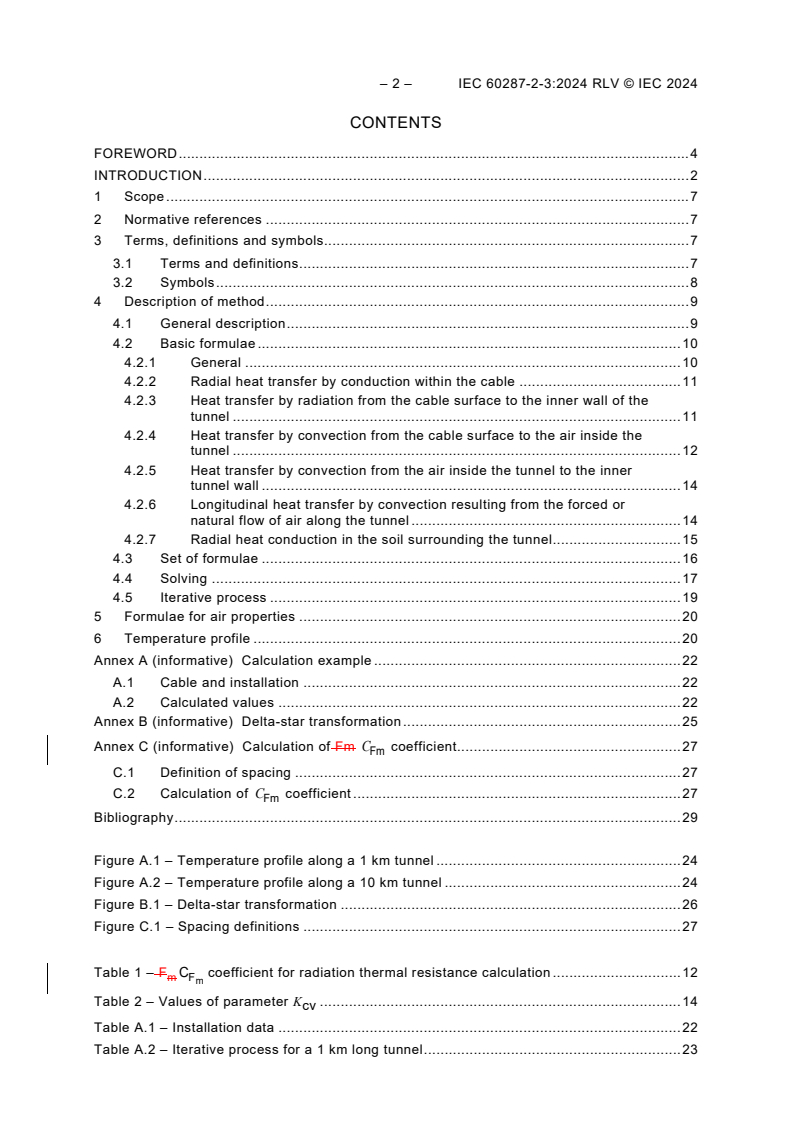
CONTENTS
FOREWORD . 4
INTRODUCTION . 2
1 Scope . 7
2 Normative references . 7
3 Terms, definitions and symbols. 7
3.1 Terms and definitions . 7
3.2 Symbols . 8
4 Description of method . 9
4.1 General description . 9
4.2 Basic formulae . 10
4.2.1 General . 10
4.2.2 Radial heat transfer by conduction within the cable . 11
4.2.3 Heat transfer by radiation from the cable surface to the inner wall of the
tunnel . 11
4.2.4 Heat transfer by convection from the cable surface to the air inside the
tunnel . 12
4.2.5 Heat transfer by convection from the air inside the tunnel to the inner
tunnel wall . 14
4.2.6 Longitudinal heat transfer by convection resulting from the forced or
natural flow of air along the tunnel . 14
4.2.7 Radial heat conduction in the soil surrounding the tunnel. 15
4.3 Set of formulae . 16
4.4 Solving . 17
4.5 Iterative process . 19
5 Formulae for air properties . 20
6 Temperature profile . 20
Annex A (informative) Calculation example . 22
A.1 Cable and installation . 22
A.2 Calculated values . 22
Annex B (informative) Delta-star transformation . 25
Annex C (informative) Calculation of Fm C coefficient. 27
Fm
C.1 Definition of spacing . 27
C
C.2 Calculation of coefficient . 27
Fm
Bibliography . 29
Figure A.1 – Temperature profile along a 1 km tunnel . 24
Figure A.2 – Temperature profile along a 10 km tunnel . 24
Figure B.1 – Delta-star transformation . 26
Figure C.1 – Spacing definitions . 27
Table 1 – F C coefficient for radiation thermal resistance calculation . 12
F
m
m
Table 2 – Values of parameter K . 14
cv
Table A.1 – Installation data . 22
Table A.2 – Iterative process for a 1 km long tunnel . 23
Table C.1 – Expression for F C coefficient calculation . 28
m F
m
– 4 – IEC 60287-2-3:2024 RLV © IEC 2024
INTERNATIONAL ELECTROTECHNICAL COMMISSION
____________
ELECTRIC CABLES –
CALCULATION OF THE CURRENT RATING –
Part 2-3: Thermal resistance – Cables installed in ventilated tunnels
FOREWORD
1) The International Electrotechnical Commission (IEC) is a worldwide organization for standardization comprising
all national electrotechnical committees (IEC National Committees). The object of IEC is to promote international
co-operation on all questions concerning standardization in the electrical and electronic fields. To this end and
in addition to other activities, IEC publishes International Standards, Technical Specifications, Technical Reports,
Publicly Available Specifications (PAS) and Guides (hereafter referred to as "IEC Publication(s)"). Their
preparation is entrusted to technical committees; any IEC National Committee interested in the subject dealt with
may participate in this preparatory work. International, governmental and non-governmental organizations liaising
with the IEC also participate in this preparation. IEC collaborates closely with the International Organization for
Standardization (ISO) in accordance with conditions determined by agreement between the two organizations.
2) The formal decisions or agreements of IEC on technical matters express, as nearly as possible, an international
consensus of opinion on the relevant subjects since each technical committee has representation from all
interested IEC National Committees.
3) IEC Publications have the form of recommendations for international use and are accepted by IEC National
Committees in that sense. While all reasonable efforts are made to ensure that the technical content of IEC
Publications is accurate, IEC cannot be held responsible for the way in which they are used or for any
misinterpretation by any end user.
4) In order to promote international uniformity, IEC National Committees undertake to apply IEC Publications
transparently to the maximum extent possible in their national and regional publications. Any divergence between
any IEC Publication and the corresponding national or regional publication shall be clearly indicated in the latter.
5) IEC itself does not provide any attestation of conformity. Independent certification bodies provide conformity
assessment services and, in some areas, access to IEC marks of conformity. IEC is not responsible for any
services carried out by independent certification bodies.
6) All users should ensure that they have the latest edition of this publication.
7) No liability shall attach to IEC or its directors, employees, servants or agents including individual experts and
members of its technical committees and IEC National Committees for any personal injury, property damage or
other damage of any nature whatsoever, whether direct or indirect, or for costs (including legal fees) and
expenses arising out of the publication, use of, or reliance upon, this IEC Publication or any other IEC
Publications.
8) Attention is drawn to the Normative references cited in this publication. Use of the referenced publications is
indispensable for the correct application of this publication.
9) IEC draws attention to the possibility that the implementation of this document may involve the use of (a)
patent(s). IEC takes no position concerning the evidence, validity or applicability of any claimed patent rights in
respect thereof. As of the date of publication of this document, IEC had not received notice of (a) patent(s), which
may be required to implement this document. However, implementers are cautioned that this may not represent
the latest information, which may be obtained from the patent database available at https://patents.iec.ch. IEC
shall not be held responsible for identifying any or all such patent rights.
This redline version of the official IEC Standard allows the user to identify the changes
made to the previous edition IEC 60287-2-3:2017. A vertical bar appears in the margin
wherever a change has been made. Additions are in green text, deletions are in
strikethrough red text.
IEC 60287-2-3 has been prepared by IEC technical committee 20: Electric cables. It is an
International Standard.
This second edition cancels and replaces the first edition published in 2017. This edition
constitutes a technical revision.
This edition includes the following significant technical changes with respect to the previous
edition:
a) symbols alignment with other parts of the IEC 60287 series.
The text of this International Standard is based on the following documents:
Draft Report on voting
20/2175/FDIS 20/2182/RVD
Full information on the voting for its approval can be found in the report on voting indicated in
the above table.
The language used for the development of this International Standard is English.
This document was drafted in accordance with ISO/IEC Directives, Part 2, and developed in
accordance with ISO/IEC Directives, Part 1 and ISO/IEC Directives, IEC Supplement, available
at www.iec.ch/members_experts/refdocs. The main document types developed by IEC are
described in greater detail at www.iec.ch/publications.
A list of all parts in the IEC 60287 series, published under the general title Electric cables –
Calculation of the current rating, can be found on the IEC website.
The committee has decided that the contents of this document will remain unchanged until the
stability date indicated on the IEC website under webstore.iec.ch in the data related to the
specific document. At this date, the document will be
• reconfirmed,
• withdrawn, or
• revised.
IMPORTANT – The "colour inside" logo on the cover page of this document indicates
that it contains colours which are considered to be useful for the correct understanding
of its contents. Users should therefore print this document using a colour printer.
– 6 – IEC 60287-2-3:2024 RLV © IEC 2024
INTRODUCTION
In the IEC 60287 series, IEC 60287-1 provides general formulae for ratings and power losses
of electric cables.
The IEC 60287-2 series presents formulae or calculation methods for thermal resistances.
IEC 60287-2-1 provides calculation methods for dealing with cables installed in free air
(see IEC 60287-2-1:2015, 4.2.1).
IEC 60287-2-2 provides a method and data for calculating reduction factors for cables in groups
running horizontally in free air.
IEC 60287-2-1 and IEC 60287-2-2 consider heat transfer only in a plane perpendicular to the
cables; they assume there is no longitudinal heat transfer.
This part of IEC 60287 deals with the rating for cables installed in ventilated tunnels. In such
situations, consideration of longitudinal temperature gradients is involved as the air flowing in
the tunnel removes some heat from the cables.
Heat transfer with the moving air is convective and is assumed to be either laminar or turbulent
depending on the air velocity. The transition situation between laminar and turbulent air flows
is ignored.
A general simplified method is provided to estimate the permissible current-carrying capacity
of cables installed in ventilated tunnels, the ventilation being either natural or forced.
Only steady states are considered, where the inlet air temperature and the cable loading are
constant for a sufficient time for steady temperatures to be achieved.
Where multiple circuits are involved, their characteristics are assumed to be identical.
The main features of the calculation method for cables in tunnels with forced ventilation can be
found in Electra n°143 – 144 (1992)[1] , as the report of a CIGRE working group, including the
erratum in Electra n°209 (2003).
___________
Numbers in square brackets refer to the Bibliography.
ELECTRIC CABLES –
CALCULATION OF THE CURRENT RATING –
Part 2-3: Thermal resistance – Cables installed in ventilated tunnels
1 Scope
This part of IEC 60287 describes a method for calculating the continuous current rating factor
for cables of all voltages installed in ventilated tunnels. The method is applicable to any type of
cable.
The method applies to natural as well as forced ventilation.
Longitudinal heat transfer within the cables and the surroundings of the tunnel is assumed to
be negligible.
All cables are assumed to be identical within the tunnel and it is assumed that the tunnel cross-
section does not change with distance along the tunnel.
2 Normative references
The following documents are referred to in the text in such a way that some or all of their content
constitutes requirements of this document. For dated references, only the edition cited applies.
For undated references, the latest edition of the referenced document (including any
amendments) applies.
IEC 60287-1-1, Electric cables – Calculation of the current rating – Part 1-1: Current rating
equations (100 % load factor) and calculation of losses – General
IEC 60287-2-1:2015, Electric cables – Calculation of the current rating – Part 2-1: Thermal
resistance – Calculation of thermal resistance
3 Terms, definitions and symbols
3.1 Terms and definitions
No terms and definitions are listed in this document.
ISO and IEC maintain terminology databases for use in standardization at the following
addresses:
• IEC Electropedia: available at https://www.electropedia.org/
• ISO Online browsing platform: available at https://www.iso.org/obp
– 8 – IEC 60287-2-3:2024 RLV © IEC 2024
3.2 Symbols
A
inner tunnel cross-sectional area
m
t
C
heat capacity of the air flow W/K
av
C
volumetric heat capacity of air W · s/(m · K)
vair
*
D external diameter of cable m
e
D
inner diameter of the tunnel m
t
F C
coefficient for the calculation of radiation shape factor -
m Fm
I current in one conductor (RMS value) A
K
convection factor -
cv
K
radiation shape factor -
r
K
effective emissivity -
t
L L*
depth of tunnel axis m
t t
N number of cables -
P
Prandtl number -
r
-
Re Reynolds number
alternating current resistance of conductor at its maximum operating temperature
RR with sustained application of a rated current I i.e. at standard maximum
Ω/m
R R
permissible temperature
T
thermal resistance per core between conductor and sheath K · m/W
T
thermal resistance between sheath and armour K · m/W
T K · m/W
thermal resistance of external serving
T K · m/W
equivalent thermal resistance of cable surrounding
4t
T K · m/W
convection thermal resistance between cable and air
as
T K · m/W
convection thermal resistance between air and inner wall of the tunnel
at
T K · m/W
external thermal resistance of the tunnel
e
T
K · m/W
radiation thermal resistance between cable and inner wall of the tunnel
st
T T* K · m/W
equivalent star thermal resistance of air
a a
T T* K · m/W
equivalent star thermal resistance of cable
s s
T T* K · m/W
equivalent star thermal resistance of tunnel wall
t t
VV
air velocity m/s
air
W (zz ) heat removed by the air, at the point zz on the cable route
W/m
a t t
W (Lz )
heat removed by the air, at tunnel outlet W/m
a tot
W
losses in a conductor per unit length, assuming maximum conductor temperature W/m
c
W
dielectric losses per unit length per phase W/m
d
W W
total heat generated by cable W/m
k ktot
2 5/4
h heat dissipation coefficient given in IEC 60287-2-1 for cables in still air
W/(m · K )
k
thermal conductivity for air W/(m · K)
air
n number of conductors or cores in a cable
s
axial separation between two adjacent cables (mm) mm
s -
ratio between spacing and cable diameter
r
L z
reference length (see Formula (16)) m
0 0
zz
coordinate corresponding to the tunnel axis m
t
Lz
length of the tunnel m
tot
∆θ
fictitious increase of ambient temperature to account for the ventilation K
θ
temperature at ground level °C
a
θ (0)
air temperature at tunnel inlet °C
at
θ (zz ) air temperature, at the point zz on the cable route
°C
at t t
θ (Lz )
air temperature at tunnel outlet °C
at tot
θ(z)θ (z ) conductor temperature, at the point zz on the cable route
°C
c t t
θ
maximum permissible conductor temperature °C
c_max
θ (zz )
temperature at the star point after delta-star transformation °C
e t
θ (zz ) temperature of the cable surface, at the point zz on the cable route
°C
s t t
θ (Lz )
temperature of the cable surface, at tunnel outlet °C
s tot
θ (zz ) temperature of the inner tunnel wall, at the point zz on the cable route
°C
t t t
θ (Lz )
temperature of the inner tunnel wall, at tunnel outlet °C
t tot
ratio of the total losses in metallic sheaths to the total conductor losses (sheath/ or
λ
-
screen loss factor)
λ
ratio of the total losses in armour to the total conductor losses (armour loss factor) -
kinematic viscosity for air
ν m /s
ρ ρ
soil thermal resistivity K · m/W
soil
2 4
σ
Stefan-Boltzmann constant
W/(m · K )
B
4 Description of method
4.1 General description
The method is based on the calculation of the temperature of the cable surface, the air in the
tunnel and the tunnel wall, as a function of the heat generated by the cables.
For any location along the cable route, a set of formulae is developed, involving:
• heat transfer formulae describing heat transfer mechanisms by radiation and convection
between the cables, the air in the tunnel and the tunnel wall;
• energy balance formulae for cables, air in the tunnel and tunnel wall;
• heat transfer formulae for conduction in the surroundings of the tunnel.
This set of formulae may be written in such a way that:
• the heat removed by the air, W (zz ), is linked to the derivative of the air temperature with
a t
respect to the longitudinal coordinate of the tunnel;
• every other formula is approximated as a thermal Ohm's law linking temperature drop and
heat flow through a thermal resistance; the heat flow is derived from the heat generated by
the cables, W W , and the heat removed by the air, W (zz ).
k ktot a t
Some of the thermal resistances depend on the air temperature and consequently on the
distance along the tunnel.
– 10 – IEC 60287-2-3:2024 RLV © IEC 2024
This may be dealt with by dividing the tunnel route into elementary lengths, so that:
• the heat removed by the air is proportional to the difference in the air temperature between
elementary length outlet and inlet;
• the thermal resistances may be considered constant for the elementary length.
For typical installations considered in the CIGRE work [1], it was recognized that assuming
constant thermal resistances along the tunnel route, computed using temperatures at the tunnel
outlet, does not lead to a serious error.
With this assumption, solving the set of formulae is straightforward and the temperatures of the
cable surface, air and tunnel wall are easily derived as a function of the cable losses.
The permissible current is then derived from the heat transfer formula for conduction within the
cable linking the temperature drop between the conductor and the cable surface to the losses
in the cables.
As temperatures at the tunnel outlet are not known, an iterative process is necessary.
The heat generated by a cable, W W , is assumed to be constant along the cable route and
k ktot
is calculated for the maximum permissible conductor temperature, leading to an estimate of the
current rating that is on the safe side.
W = n ⋅ [W ⋅ (1+ λ + λ ) + W ]
k c 1 2 d
W = n⋅ W ⋅+1 λλ+ +W
( ) (1)
ktot c 1 2 d
W = R ⋅ I²
c
(2)
W R⋅ I
cR
where
W W is the total heat generated by a cable (W/m);
k ktot
n is the number of conductors in a cable;
W is the losses in a conductor per unit length, assuming maximum conductor temperature
c
(W/m);
λ is the ratio of the total losses in metallic sheaths to the total conductor losses;
λ is the ratio of the total losses in armour to the total conductor losses;
W is the dielectric losses per unit length per phase (W/m);
d
RR is the alternating current resistance of conductor at its maximum operating temperature
R
with sustained application of a rated I current i.e. at standard maximum permissible
R
temperature (Ω/m);
I is the current in one conductor (RMS value) (A).
4.2 Basic formulae
4.2.1 General
The following heat transfer mechanisms are taken into account:
=
• radial heat transfer by conduction within the cable;
• heat transfer by radiation from the cable surface to the tunnel wall;
• heat transfer by convection from the cable surface to the air inside the tunnel;
• heat transfer by convection from the air inside the tunnel to the tunnel wall;
• longitudinal heat transfer by convection resulting from the forced or natural flow of air along
the tunnel.
4.2.2 Radial heat transfer by conduction within the cable
The conductor temperature is derived from the formula given in IEC 60287-1-1.
T
θ(z) =θ (z) + W ⋅ [T + n ⋅ (1+ λ )⋅ T + n ⋅ (1+ λ + λ )⋅ T ]+ W ⋅ + n ⋅ (T + T )
s c 1 1 2 1 2 3 d 2 3
T
θ zzθ +W⋅ T+⋅nλ1+⋅T+⋅nλ1++λ⋅T+W⋅ +⋅n T+T
( ) ( ) ( ) ( ) ( ) (3)
c t st c 1 1 2 1 2 3 d 2 3
where
θ(z)θ (z ) is the conductor temperature, at the point z z on the cable route (°C);
c t t
θ (zz ) is the temperature of the cable surface, at the point zz on the cable route (°C);
s t t
T is the thermal resistance per core between conductor and sheath (K · m/W);
T is the thermal resistance between sheath and armour (K · m/W);
T is the thermal resistance of external serving (K · m/W);
z is the coordinate corresponding to the tunnel axis (m).
t
The loss coefficients and thermal resistances are defined in IEC 60287-1-1 and IEC 60287-2-1.
4.2.3 Heat transfer by radiation from the cable surface to the inner wall of the tunnel
This heat transfer is modelled by Ohm's thermal law, characterized by a thermal resistance:
1 1
T = ⋅
st
2 2
*
[(θ (L) + 273) + (θ (L) + 273)]
π ⋅ D ⋅ K ⋅ K ⋅σ ⋅ [(θ (L) + 273) + (θ (L) + 273) ]
s t
e t r b s t
T ⋅
st
(4)
*
θθz ++273 z + 273
( s ( tot ) ) ( t ( tot ) )
π⋅ D ⋅ KK⋅ ⋅σθ⋅ z + 273 + θ z + 273
e t r b s ( tot ) ) t ( tot ) )
( (
where
D * is the cable diameter (m);
e
−8 2 4
σ is Stefan-Boltzmann constant, 5,67 × 10 (W/m · K );
B
θ (L)θ (z ) is the cable surface at the tunnel outlet (°C);
s s tot
θ (L)θ (z ) is the tunnel surface temperatures at the tunnel outlet (°C);
t t tot
=
=
– 12 – IEC 60287-2-3:2024 RLV © IEC 2024
K is the emissivity of the cable surface (typically 0,9 for served cable);
t
K is the radiation shape factor taking into account the radiation areas;
r
z is the length of the tunnel (m).
tot
K may be expressed as:
r
1− F
m
K =
r
1− (1− K )⋅ F
t m
1− C
Fm
K =
r
11−− K ⋅ C
( )
t Fm
where
C F is a coefficient given in Table 1 and in Annex C.
Fm m
Table 1 – F C coefficient for radiation thermal resistance calculation
m F
m
Installation
F C
m Fm
Single cable 0
Two cables touching 0,182
Two cables spaced 2 × D *
0,081
e
Two cables spaced 3 × D *
0,054
e
M: 0,363
Three cables touching
O: 0,182
M: 0,163
Three cables spaced 2 × D *
e
O: 0,081
M: 0,107
Three cables spaced 3 × D *
e
O: 0,054
Trefoil touching 0,348
Key
M Middle cable
O Outer cable
4.2.4 Heat transfer by convection from the cable surface to the air inside the tunnel
The convective heat transfer from the cable surface to the air in the tunnel depends on the air
flow characteristics, the velocity of the air being the leading parameter.
Where laminar air flow occurs, the convection thermal resistance is given by Formula (5):
T =
as
0,25
*
π ⋅ D ⋅ h − ⋅ [θ (L) −θ (L)]
e s at
0,25
30 ⋅ T
st
T =
as
0,25
1 (5)
*
π⋅ D ⋅ h − ⋅ θθzz−
e s ( tot ) at ( tot )
0,25
30 ⋅T
st
where
h is the heat dissipation coefficient given in IEC 60287-2-1 for cables in still air
2 5/4
· K ));
(W/(m
θ (Lz ) is the air temperature at the tunnel outlet (°C);
at tot
θ (z ) is the temperature of the cable surface, at tunnel outlet;
s tot
T is the radiation thermal resistance between the cable and inner wall of the tunnel.
st
Formula (5) applies if the Reynolds number is less than 2 000.
If the Reynolds number is higher, the thermal resistance is first assumed to be given by
Formula (6), valid for turbulent air flow.
T =
as (6)
0,65
π⋅ kK⋅ ⋅Re
air cv
where
Re is the Reynolds number;
*
V ⋅ D
e
Re =
ν
*
V ⋅ D
air e
Re =
ν
ν is the kinematic viscosity for air (m /s);
k is the thermal conductivity for air (W/(m · K));
air
VV is the air velocity (m/s);
air
K is an experimentally determined constant convection factor for which values are given in
cv
Table 2.
– 14 – IEC 60287-2-3:2024 RLV © IEC 2024
Table 2 – Values of parameter K
cv
Cable arrangement K
cv
Single cable 0,130
b
0,086
3 cables touching horizontally
a
0,115
3 cables spaced horizontally
b
0,086
3 cables touching vertically
a
0,115
3 cables spaced vertically
3 cables touching in trefoil 0,070
a
To be used where the spacing is larger than 2 × D *.
e
b
To be used where the spacing is smaller or equal to 2 × D *.
e
The values from Formulae (5) and (6) are compared and the higher of the two values is used.
4.2.5 Heat transfer by convection from the air inside the tunnel to the inner tunnel
wall
This transfer is modelled by Ohm's thermal law, characterized by a thermal resistance:
If the Reynolds number is greater than 2 500, the air flow is assumed turbulent and the following
relationship applies:
T =
at (7)
0,8 0,4
π⋅ k ⋅0,023 ⋅Re ⋅P
air r
where
Re is the Reynolds number;
V ⋅ D
t
Re =
ν
V ⋅ D
air t
Re =
ν
P is the Prandtl number;
r
ν
P C ⋅
r vair
k
air
C is the specific heat of air per unit volume (J/(m · K));
vair
D is the inner diameter of the tunnel (m).
t
If the Reynolds number is less than 2 500, the thermal resistance is considered negligible.
4.2.6 Longitudinal heat transfer by convection resulting from the forced or natural
flow of air along the tunnel
The heat removed by the air, W (zz ), is linked to the air temperature variations according to:
a t
=
∂θ (z)
at
W (z) = C ⋅
a av
∂z
∂θ (z )
at t
WCz ⋅
( ) (8)
a t av
∂z
t
where
is the coordinate corresponding to the tunnel axis (m);
z
t
C is the heat capacity of the air flow (W/K);
av
C = C ⋅V ⋅ A
av vair t
C C ⋅⋅V A
(9)
av vair air t
A is the inner tunnel cross-sectional area (m ).
t
4.2.7 Radial heat conduction in the soil surrounding the tunnel
For circular tunnels the thermal resistance of the surrounding soil is expressed by:
ρ
soil
T = ⋅ ln[u + u² −1]
e
2 ⋅ π
ρ
T= ⋅ln uu+−² 1
(10)
e
2 ⋅π
Where
2 ⋅ L
t
u =
D
t
*
2 ⋅ L
t
u =
;
D
t
ρ ρ is the soil thermal resistivity (K · m/W);
soil
L L* is the depth of the tunnel axis (m);
t t
D is the inner diameter of the tunnel (m).
t
For rectangular tunnels the thermal resistance of the surrounding soil is expressed by:
ρ L
soil t
T = ⋅ ln3,388 ⋅
e
2 ⋅ π
A
t
=
=
– 16 – IEC 60287-2-3:2024 RLV © IEC 2024
*
ρ L
t
T=⋅⋅ln 3,388
(11)
e
2 ⋅π
A
t
where
A is the inner tunnel cross-sectional area (m ).
t
For deep tunnels, these formulae will produce conservative results because of soil thermal
inertia. This subject is under consideration.
4.3 Set of formulae
A delta-star transformation is used to derive the following set of formulae:
θ (z) −θ (z) = T ⋅ N ⋅W
s e s k
θ (z) −θ (z) = T ⋅ (N ⋅W − W (z))
e t t k a
θ (z) −θ (z) = T ⋅ (N ⋅W − W (z))
t a e k a
θ (z) −θ (z) = −T ⋅W (z)
at e a a
∂θ (z)
at
W (z) = C ⋅
a av
∂z
*
θ zz−θ = T⋅⋅NW
( ) ( )
s t e t s ktot
*
θ zz−θ =T⋅⋅NW −W z
( ) ( ) ( )
( )
et t t t ktot at
θ zz−θ =T⋅⋅NW −W z
( ) ( ) ( ( ))
t t at e ktot at
(12)
*
θ zz−θ =−TW⋅ z
( ) ( ) ( )
at t et a at
∂
θ (z )
at t
WCz ⋅
( )
a t av
∂z
t
where
zz is the coordinate corresponding to the tunnel axis;
t
W is the total heat generated by the cable (W/m).
ktot
W (z ) is the heat removed by the air, at the point z on the cable route (W/m);
a t t
T T* is the equivalent star thermal resistance of the cable (K · m/W);
s s
T T* is the equivalent star thermal resistance of the tunnel wall (K · m/W);
t t
T T* is the equivalent star thermal resistance of air (K · m/W);
a a
=
defined as follows:
T T
st as
⋅
N N
T =
s
T T
st as
+ + T
at
N N
T
st
T ⋅
at
N
T =
t
T T
st as
+ + T
at
N N
T
as
T .
at
N
T =
a
T T
st as
+ + T
at
N N
TT
st as
⋅
NN
*
T =
s
TT
st as
+ + T
at
NN
T
st
T ⋅
at
N
*
T =
(13)
t
TT
st as
+ + T
at
NN
T
as
T .
at
N
*
T =
a
TT
st as
+ + T
at
NN
The delta-star transformation is shown diagrammatically in Annex B.
4.4 Solving
The permissible current rating is obtained from Formula (14) which is similar to the classical
formula for cable rating given in IEC 60287-1-1:
T
θ − [θ +Δθ ]− W ⋅ + n ⋅ (T + T + T )
max a 0 d 2 3 4t
I =
R ⋅ [T + n ⋅ (1+ λ )⋅ T + n ⋅ (1+ λ + λ )⋅ (T + T )]
1 1 2 1 2 3 4t
– 18 – IEC 60287-2-3:2024 RLV © IEC 2024
T
θ − θ +Δθ −W ⋅ +⋅n TTT+ +
[ ] ( )
c _max a 0 d 2 3 4t
(14)
I =
RT⋅ +⋅n 11+λT⋅ +⋅n +λ +λ ⋅T +T
( ) ( ) ( )
1 1 2 1 2 3 4t
where
∆θ is the fictitious increase of ambient temperature to account for the ventilation (K);
L
−
T + T
L
t e
( )
Δθ = [θ 0 −θ ]⋅ ⋅ e
0 at a
T + T + T
a t e
z
tot
* −
TT+
z
te
(15)
Δθ θ 0e−θ⋅ ⋅
( )
0 at a
**
TTT++
a t e
T is the equivalent thermal resistance of cable surrounding (K· · m/W);
4t
L
−
T + T
t e L
0
T = N ⋅ T + (T + T )⋅ 1− ⋅ e
4t s t e
T + T + T
a t e
z
tot
*
−
TT+
** z
te
T = NT⋅ + T + T ⋅ 1e− ⋅
(16)
( )
4t s t e
**
TTT++
a t e
L z is the reference length (m);
0 0
L = (T + T + T )⋅ C
(17)
0 a t e av
**
z= TTT++ ⋅ C
(17)
( )
0 a t e av
θ θ is the maximum permissible conductor temperature (°C).
max c_max
The air temperature θ (Lz ) at the tunnel outlet is estimated from:
at tot
L
−
L
θ (L) =θ (0)+ [θ + (T + T )⋅ N ⋅W −θ (0)]⋅ 1− e
at at a t e k at
=
z
tot
−
* z
0
θ (z ) θ (0)+ θ+ TTN+ ⋅⋅W−θ (0)⋅−1e
(18)
at tot at a ( t e ) ktot at
The cable surface temperature and the tunnel wall temperature at the tunnel outlet are derived
from the air temperature by:
θ (L) =θ (L) + T ⋅W (L) + T ⋅ N ⋅W
s at a a s k
**
θ zzθ +T⋅W z+T⋅NW⋅
( ) ( ) ( ) (19)
s tot at tot a a tot s ktot
θ (L) =θ (L) + T ⋅W (L) − T ⋅ [N ⋅W − W (L)]
t at a a t k a
(20)
**
θ zzθ +T⋅W z−⋅T NW⋅ −W z
( ) ( ) ( ) ( )
t tot at tot a a tot t ktot a tot
where
W (Lz ) is the heat removed by the air at the tunnel outlet, given by:
a tot
(T + T )⋅ N ⋅W − [θ (L) −θ ]
t e k at a
W (L) =
a
T + T + T
a t e
*
TTN+ ⋅⋅W − θ (z ) −θ
( t e ) ktot at tot a
(21)
W z =
( )
a tot
**
TTT++
a t e
4.5 Iterative process
The thermal resistances T , T T* , T* and T T* are calculated from estimates of the cable
a s a s t t
surface temperature, the tunnel wall temperature and the air temperature at the tunnel outlet,
using Formula (4), Formula (5) or Formula (6), Formula (7) and Formula (13).
The cable permissible current is derived from Formula (14) through Formula (15), Formula (16),
Formula (17), T being derived from Formula (10) and Formula (11) and C being derived from
e av
Formula (9).
Losses in the cables are calculated with Formula (1) and Formula (2).
The air temperature at the tunnel outlet is calculated with Formula (18), the cable surface
temperature and the tunnel wall temperature are calculated with Formula (19) and Formula (20),
using Formula (21).
The calculation is repeated using these new estimates of the cable surface temperature, the
tunnel wall temperature and the air temperature at the tunnel outlet as input, until convergence.
=
=
=
– 20 – IEC 60287-2-3:2024 RLV © IEC 2024
As first estimates, the temperatures at the tunnel outlet are taken as the air temperature at the
tunnel inlet.
5 Formulae for air properties
Formula (22) to Formula (25) provide the required properties needed for air at the appropriate
temperature:
The thermal conductivity for air is expressed by:
−2 −5
k = 2,42 ⋅10 + 7,2 ⋅10 ⋅θ (L)
air at
−25−
k 2,42⋅10+⋅7,2 10⋅θ z (22)
( )
air at tot
The kinematic viscosity for air is expressed by:
−5 −8
ν = 1,32 ⋅10 + 9,5 ⋅10 ⋅θ (L)
at
−−58
νθ= 1,32⋅10 +⋅9,5 10⋅ z (23)
( )
at tot
The Prandtl number for air is expressed by:
−4
Pr = 0,715 − 2,5 ⋅10 ⋅θ (L)
at
−4
P 0,715−⋅2,5 10⋅θ (z ) (24)
r at tot
The volumetric heat capacity of air, C , being derived from P , k and ν is expressed by:
vair r air
k
air
C P⋅
(25)
vair r
ν
6 Temperature profile
Formula (26) gives the air temperature θ (zz ) in any location zz along the tunnel.
at t t
z
−
L
θ (z) =θ (0)+ [θ + (T + T )⋅ N ⋅W −θ (0)]⋅ 1− e
at at a t e k at
=
=
=
z
t
−
* z
0
θ (z ) θ (0)+ θ+ TTN+ ⋅⋅W−θ (0)⋅−1e
(26)
at t at a ( t e ) ktot at
where
, T W , T* , T and L z have been determined according to Clause 4;
W
k t ktot t e 0 0
z is the coordinate corresponding to the tunnel axis (m).
t
A complete calculation example can be found in Annex A.
=
– 22 – IEC 60287-2-3:2024 RLV © IEC 2024
Annex A
(informative)
Calculation example
A.1 Cable and installation
The example given in Table A.1 considers three single-core cables without armour (T = 0 and
λ = 0) spaced vertically within a circular ventilated tunnel (the spacing between the cables
being three times their diameter).
Table A.1 – Installation data
Cables Symbol Value Unit
Number of cables N 3 -
Number of conductors in a cable n 1 -
D *
0,122
Cable outer diameter e m
Alternating current resistance of conductor at its maximum operating
RR
1,28E-05 Ω/m
R
temperature
W
4,0
Dielectric losses per unit length per phase d W/m
λ
0,045 03
Sheath/ or screen loss factor 1 -
θ
Maximum permissible conductor temperature c_max °C
T
0,341
Thermal resistance per core between conductor and sheath 1 K · m/W
T
0,038
Thermal resistance of external serving 3 K · m/W
Tunnel and surroundings
ρ ρ
1,0
Soil thermal resistivity K · m/W
soil
L L*
4,0
Depth of tunnel axis t t m
D
3,0
Inner tunnel diameter t m
Lz
1 000
Length of the tunnel tot m
θ
Temperature at ground level a °C
(0)
θ
Air temperature at tunnel inlet at °C
VV
Air velocity air m/s
Constants
K
0,115
Convection factor cv -
K
0,90
Radiation shape factor r -
K
0,90
Effective emissivity t -
A.2 Calculated values
The number of significant figures given in Table A.2 does not indicate the accuracy of the
calculations but is intended to assist those developing a calculation tool.
Table A.2 – Iterative process for a 1 km long tunnel
Iteration Formula 1 2 3
assumed θ (Lz )
20 52,11 52,15
s tot
assumed θ (Lz )
20 36,83 37,89
t tot
assumed θ (Lz )
20 36,49 37,30
at tot
T
(10) 0,261 0,261 0,261
e
T
(4) 0,564 6 0,443 6 0,441 3
st
k
(22) 0,026 0,027 0,027
air
-5 -5 -5
ν (23)
1,51 × 10 1,666 65 × 10 1,674 34 × 10
Re (6) 16 159 14 640 14 573
T
(6) 0,198 5 0,202 3 0,202 5
as
Pr (24) 0,710 0 0,705 9 0,705 7
Re (7) 397 351 360 003 358 351
T
(7) 0,020 5 0,021 3 0,021 3
at
T T*
(13) 0,045 3 0,042 1 0,042 1
s s
T T*
(13) 0,014 1 0,013 3 0,013 3
t t
T T*
(13) 0,004 9 0,006 1 0,006 1
a a
C
(25) 1 206 1 136 1 133
vair
C
(9) 17 044 16 063 16 019
av
L z
(17) 4 764 4 496 4 484
0 0
∆θ
(15) 0 0 0
T
(16) 0,303 7 0,304 5 0,304 8
4t
I (14) 2 758 2 756 2 755
W
(2) 97,3 97,2 97,2
c
W W
(1) 105,7 105,6 105,6
k ktot
θ (Lz )
(18) 36,49 37,30 37,33
at tot
W (Lz )
(21) 252,58 248,11 247,84
a tot
θ (Lz )
(19) 52,11 52,15 52,17
s tot
θ (Lz )
(20) 36,83 37,89 37,93
t tot
The temperature profile along the 1 km length of the tunnel is given in Figure A.1.
– 24 – IEC 60287-2-3:2024 RLV © IEC 2024
Figure A.1 – Temperature profile along a 1 km tunnel
In the example given in Figure A.1 the thermal properties of the air have been determined for
the calculated air temperature in the tunnel at each stage in the iteration. If the air thermal
properties were determined at a temperature of 30 °C, the current rating would be 2 764 A,
compared to 2 755 A calculated above.
Repeating the calculation using the same data, except for a tunnel length of 10 000 m, results
in a current rating of 1 999 A. The temperature profile along the 10 km tunnel is shown in
Figure A.2.
Figure A.2 – Temperature profile along a 10 km tunnel
If the air thermal properties are determined for a temperature of 30 °C, the permissible current
is found to be 2 018 A, instead of 1 999 A. This difference is considered to be insignificant.
Annex B
(informative)
Delta-star transformation
The heat transfer mechanism in the tunnel and the delta-star given in 4.3 is shown in Figure B.1.
W
rad
θ (z) θ (z)
s t
T T
T
st e
N.W
k
T
as
T
at
W W
conv conv
W (z)
a
θ (z)
at
Delta-star transformation
θ (z) θ (z)
s t
T T
3 e
T
T
s
t
θ (z)
e
N.W
k
T
a
W (z)
a
θ (z)
at
IEC
– 26 – IEC 60287-2-3:2024 RLV © IEC 2024
Figure B.1 – Delta-star transformation
Annex C
(informative)
C
Calculation of Fm coefficient
Fm
C.1 Definition of spacing
The spacing between cables is defined as the distance between the cables' axes (see
Figure C.1).
Figure C.1 – Spacing definitions
C
C.2 Calculation of F coefficient
Fm
m
The coefficient F C can be calculated with the expressions given in Table C.1.
m Fm
– 28 – IEC 60287-2-3:2024 RLV © IEC 2024
Table C.1 – Expression for F C coefficient calculation
m F
m
0,5
1 1
F = arcsin + (s −1) − s
m
π s
Two cables
0,5
C arcsin+ ss− 1−
( )
Fm r r
π
s
r
0,5
2 1
F = arcsin + (s −1) − s
m
π s
Middle cable
0,5
C arcsin+ ss− 1−
( )
Fm r r
π
s
r
Three cables
0,5
1 1
F = arcsin + (s −1) − s
m
π s
Outer cables
0,5
C arcsin+ ss− 1−
( )
Fm r r
π
s
r
1 1 π
F = + ⋅ −1
m
6 π 2
Trefoil touching
1 1 π
...
Questions, Comments and Discussion
Ask us and Technical Secretary will try to provide an answer. You can facilitate discussion about the standard in here.
Loading comments...