

IEC 62496-2-5:2022
(Main)Optical circuit boards - Basic test and measurement procedures - Part 2-5: Flexibility test for flexible opto-electric circuits
General Information
- Abstract
IEC 62496-2-5:2022 defines a test method for folding flexibility inspection of flexible opto-electric circuits with a flexibility tester endurance tester and presents a guideline for a step stress test method for finding the predetermined minimum mechanical folding radii below which the flexible opto-electric circuits can be damaged by intended folding distortion. Here, test samples are used instead of products for the flexibility test of their flexible opto-electric circuits, and the test samples have the same material, layer structure, processing technology and equipment as the products.
- Status
- Published
- Publication Date
- 06-Dec-2022
- Technical Committee
- TC 91 - Electronics assembly technology
- Drafting Committee
- JWG 9 - TC 86/JWG 9
- Current Stage
- PPUB - Publication issued
- Start Date
- 07-Dec-2022
- Completion Date
- 30-Dec-2022
Overview
IEC 62496-2-5:2022 is an international standard developed by the International Electrotechnical Commission (IEC) that defines basic test and measurement procedures for flexible opto-electric circuits. Specifically, Part 2-5 addresses the flexibility test for flexible opto-electric circuits. This standard introduces a test method using a flexibility endurance tester to inspect the folding flexibility of flexible opto-electric circuits. It also provides guidelines for a step stress test to identify the predetermined minimum mechanical folding radii, below which these circuits risk damage due to folding distortion.
The flexibility test uses test samples replicating the material composition, layer structure, and processing technology of actual products, ensuring test results are representative and reliable. IEC 62496-2-5:2022 plays a crucial role in quality assurance and reliability testing for manufacturers and developers of flexible optical circuit boards.
Key Topics
Scope and Purpose
Establishes a standardized test method for folding flexibility to assess mechanical endurance and performance integrity of flexible opto-electric circuits.Test Apparatus
Details the required equipment, including flexibility testers, folding jigs of varying radii, optical and electrical measurement sources, photo detectors, and control systems.Sample Preparation
Specifies the use of test samples with identical material and structural characteristics as final products. Covers types of flexible optical circuit boards:- Optical fiber-type flexible opto-electric circuit boards
- Planar waveguide optical circuit boards
Testing Procedures
Defines step-by-step processes for flexibility testing including:- Initial optical and electrical performance measurement
- Setting and folding of the sample on the folding jig
- Dynamic flexibility endurance testing
- Final optical, electrical, and mechanical performance assessments
Step Stress Test Guidelines
Provides methodology for gradually reducing folding radius to determine minimum safe bending radii before damage occurs.Reporting
Requires detailed documentation of test conditions, methodology, results, and performance changes for transparency and reproducibility.Normative References
Integrates relevant standards such as IEC 60068-1 for environmental testing, IEC 60793-2 for optical fiber specifications, and ISO 5626 for folding endurance determination.
Applications
IEC 62496-2-5:2022 is essential for industries involved with the design, manufacture, and quality control of flexible opto-electric circuits and optical circuit boards. Key applications include:
Advanced Electronics Manufacturing
Enabling development of flexible optical circuits used in telecommunication devices, wearable electronics, and flexible displays.Opto-Electronic Device Testing
Ensuring reliable performance of flexible opto-electric circuits in varying mechanical stress conditions.Research and Development
Guiding material scientists and engineers in evaluating new flexible materials and structures for optical circuits.Quality Assurance
Verifying the mechanical durability and folding endurance of opto-electric circuits before product release.Standardization Compliance
Assisting manufacturers to meet global compliance requirements for optical circuit board testing.
Related Standards
IEC 62496-2-5:2022 is part of the broader IEC 62496 series addressing optical circuit board technologies. Relevant related standards include:
- IEC 62496-1: Fundamental terminology and general test methods for optical circuit boards.
- IEC 62496-2-1: Measurement methods for optical attenuation and isolation in optical circuit boards.
- IEC 60793-2: Optical fiber product specifications essential for optical fiber-type circuit testing.
- IEC 60068-1: General environmental testing applicable to electronic and optical circuit board evaluation.
- ISO 5626: Paper folding endurance test methods, referenced for folding endurance measurement concepts.
Summary
IEC 62496-2-5:2022 establishes a comprehensive and standardized approach to testing the folding flexibility of flexible opto-electric circuits, safeguarding product reliability across various industries. By defining detailed test procedures, equipment requirements, and performance criteria, this standard enables manufacturers and developers to accurately assess mechanical endurance and minimize failure risks due to folding-induced damage. Adherence to IEC 62496-2-5 supports innovation and market readiness for flexible optical circuit solutions worldwide.
Get Certified
Connect with accredited certification bodies for this standard

ANCE
Mexican certification and testing association.

Intertek Slovenia
Intertek testing, inspection, and certification services in Slovenia.

LNE (Laboratoire National de Métrologie et d'Essais)
French national laboratory for metrology and testing.
Sponsored listings
Frequently Asked Questions
IEC 62496-2-5:2022 is a standard published by the International Electrotechnical Commission (IEC). Its full title is "Optical circuit boards - Basic test and measurement procedures - Part 2-5: Flexibility test for flexible opto-electric circuits". This standard covers: IEC 62496-2-5:2022 defines a test method for folding flexibility inspection of flexible opto-electric circuits with a flexibility tester endurance tester and presents a guideline for a step stress test method for finding the predetermined minimum mechanical folding radii below which the flexible opto-electric circuits can be damaged by intended folding distortion. Here, test samples are used instead of products for the flexibility test of their flexible opto-electric circuits, and the test samples have the same material, layer structure, processing technology and equipment as the products.
IEC 62496-2-5:2022 defines a test method for folding flexibility inspection of flexible opto-electric circuits with a flexibility tester endurance tester and presents a guideline for a step stress test method for finding the predetermined minimum mechanical folding radii below which the flexible opto-electric circuits can be damaged by intended folding distortion. Here, test samples are used instead of products for the flexibility test of their flexible opto-electric circuits, and the test samples have the same material, layer structure, processing technology and equipment as the products.
IEC 62496-2-5:2022 is classified under the following ICS (International Classification for Standards) categories: 33.180.01 - Fibre optic systems in general. The ICS classification helps identify the subject area and facilitates finding related standards.
IEC 62496-2-5:2022 is available in PDF format for immediate download after purchase. The document can be added to your cart and obtained through the secure checkout process. Digital delivery ensures instant access to the complete standard document.
Standards Content (Sample)
IEC 62496-2-5 ®
Edition 1.0 2022-12
INTERNATIONAL
STANDARD
NORME
INTERNATIONALE
colour
inside
Optical circuit boards – Basic test and measurement procedures –
Part 2-5: Flexibility test for flexible opto-electric circuits
Cartes a circuits optiques – Procédures fondamentales d’essais et de mesures –
Partie 2-5: Essai de flexibilité pour les circuits optoélectriques souples
All rights reserved. Unless otherwise specified, no part of this publication may be reproduced or utilized in any form
or by any means, electronic or mechanical, including photocopying and microfilm, without permission in writing from
either IEC or IEC's member National Committee in the country of the requester. If you have any questions about IEC
copyright or have an enquiry about obtaining additional rights to this publication, please contact the address below or
your local IEC member National Committee for further information.
Droits de reproduction réservés. Sauf indication contraire, aucune partie de cette publication ne peut être reproduite ni
utilisée sous quelque forme que ce soit et par aucun procédé, électronique ou mécanique, y compris la photocopie et
les microfilms, sans l'accord écrit de l'IEC ou du Comité national de l'IEC du pays du demandeur. Si vous avez des
questions sur le copyright de l'IEC ou si vous désirez obtenir des droits supplémentaires sur cette publication, utilisez
les coordonnées ci-après ou contactez le Comité national de l'IEC de votre pays de résidence.
IEC Secretariat Tel.: +41 22 919 02 11
3, rue de Varembé info@iec.ch
CH-1211 Geneva 20 www.iec.ch
Switzerland
About the IEC
The International Electrotechnical Commission (IEC) is the leading global organization that prepares and publishes
International Standards for all electrical, electronic and related technologies.
About IEC publications
The technical content of IEC publications is kept under constant review by the IEC. Please make sure that you have the
latest edition, a corrigendum or an amendment might have been published.
IEC publications search - webstore.iec.ch/advsearchform IEC Products & Services Portal - products.iec.ch
The advanced search enables to find IEC publications by a Discover our powerful search engine and read freely all the
variety of criteria (reference number, text, technical publications previews. With a subscription you will always have
committee, …). It also gives information on projects, replaced access to up to date content tailored to your needs.
and withdrawn publications.
Electropedia - www.electropedia.org
IEC Just Published - webstore.iec.ch/justpublished
The world's leading online dictionary on electrotechnology,
Stay up to date on all new IEC publications. Just Published
containing more than 22 300 terminological entries in English
details all new publications released. Available online and once
and French, with equivalent terms in 19 additional languages.
a month by email.
Also known as the International Electrotechnical Vocabulary
(IEV) online.
IEC Customer Service Centre - webstore.iec.ch/csc
If you wish to give us your feedback on this publication or need
further assistance, please contact the Customer Service
Centre: sales@iec.ch.
A propos de l'IEC
La Commission Electrotechnique Internationale (IEC) est la première organisation mondiale qui élabore et publie des
Normes internationales pour tout ce qui a trait à l'électricité, à l'électronique et aux technologies apparentées.
A propos des publications IEC
Le contenu technique des publications IEC est constamment revu. Veuillez vous assurer que vous possédez l’édition la
plus récente, un corrigendum ou amendement peut avoir été publié.
Recherche de publications IEC - Découvrez notre puissant moteur de recherche et consultez
webstore.iec.ch/advsearchform gratuitement tous les aperçus des publications. Avec un
La recherche avancée permet de trouver des publications IEC abonnement, vous aurez toujours accès à un contenu à jour
en utilisant différents critères (numéro de référence, texte, adapté à vos besoins.
comité d’études, …). Elle donne aussi des informations sur les
projets et les publications remplacées ou retirées. Electropedia - www.electropedia.org
Le premier dictionnaire d'électrotechnologie en ligne au monde,
IEC Just Published - webstore.iec.ch/justpublished
avec plus de 22 300 articles terminologiques en anglais et en
Restez informé sur les nouvelles publications IEC. Just
français, ainsi que les termes équivalents dans 19 langues
Published détaille les nouvelles publications parues.
additionnelles. Egalement appelé Vocabulaire
Disponible en ligne et une fois par mois par email.
Electrotechnique International (IEV) en ligne.
Service Clients - webstore.iec.ch/csc
Si vous désirez nous donner des commentaires sur cette
publication ou si vous avez des questions contactez-nous:
sales@iec.ch.
IEC Products & Services Portal - products.iec.ch
IEC 62496-2-5 ®
Edition 1.0 2022-12
INTERNATIONAL
STANDARD
NORME
INTERNATIONALE
colour
inside
Optical circuit boards – Basic test and measurement procedures –
Part 2-5: Flexibility test for flexible opto-electric circuits
Cartes a circuits optiques – Procédures fondamentales d’essais et de mesures
–
Partie 2-5: Essai de flexibilité pour les circuits optoélectriques souples
INTERNATIONAL
ELECTROTECHNICAL
COMMISSION
COMMISSION
ELECTROTECHNIQUE
INTERNATIONALE
ICS 33.180.01 ISBN 978-2-8322-6119-4
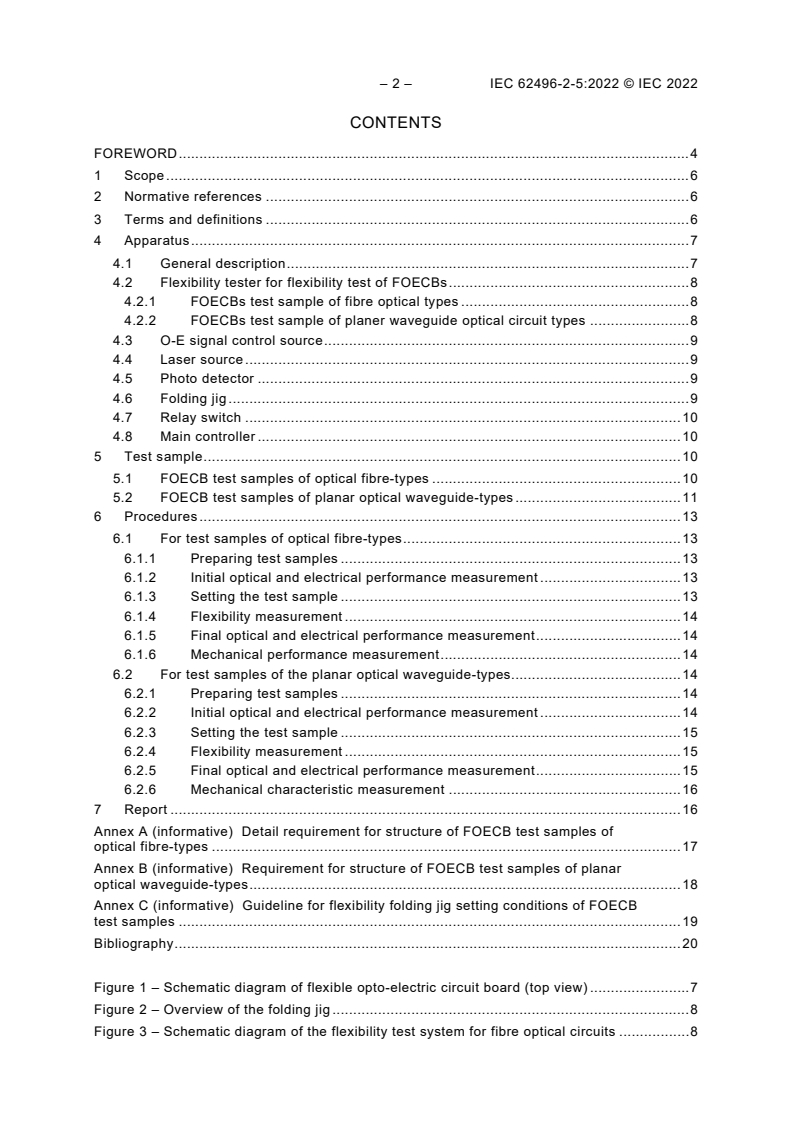
– 2 – IEC 62496-2-5:2022 © IEC 2022
CONTENTS
FOREWORD . 4
1 Scope . 6
2 Normative references . 6
3 Terms and definitions . 6
4 Apparatus . 7
4.1 General description . 7
4.2 Flexibility tester for flexibility test of FOECBs . 8
4.2.1 FOECBs test sample of fibre optical types . 8
4.2.2 FOECBs test sample of planer waveguide optical circuit types . 8
4.3 O-E signal control source . 9
4.4 Laser source . 9
4.5 Photo detector . 9
4.6 Folding jig . 9
4.7 Relay switch . 10
4.8 Main controller . 10
5 Test sample . 10
5.1 FOECB test samples of optical fibre-types . 10
5.2 FOECB test samples of planar optical waveguide-types . 11
6 Procedures . 13
6.1 For test samples of optical fibre-types . 13
6.1.1 Preparing test samples . 13
6.1.2 Initial optical and electrical performance measurement . 13
6.1.3 Setting the test sample . 13
6.1.4 Flexibility measurement . 14
6.1.5 Final optical and electrical performance measurement . 14
6.1.6 Mechanical performance measurement . 14
6.2 For test samples of the planar optical waveguide-types. 14
6.2.1 Preparing test samples . 14
6.2.2 Initial optical and electrical performance measurement . 14
6.2.3 Setting the test sample . 15
6.2.4 Flexibility measurement . 15
6.2.5 Final optical and electrical performance measurement . 15
6.2.6 Mechanical characteristic measurement . 16
7 Report . 16
Annex A (informative) Detail requirement for structure of FOECB test samples of
optical fibre-types . 17
Annex B (informative) Requirement for structure of FOECB test samples of planar
optical waveguide-types . 18
Annex C (informative) Guideline for flexibility folding jig setting conditions of FOECB
test samples . 19
Bibliography . 20
Figure 1 – Schematic diagram of flexible opto-electric circuit board (top view) . 7
Figure 2 – Overview of the folding jig . 8
Figure 3 – Schematic diagram of the flexibility test system for fibre optical circuits . 8
Figure 4 – Schematic diagram of the flexibility test system for planar waveguide optical
circuits . 9
Figure 5 – Flexibility folding jigs (from the left, folding radius r is 1,0 mm, 2,0 mm, 3,0
mm, 4,0 mm, 5,0 mm and 10,0 mm) . 10
Figure 6 – Schematic diagram of FOECB test samples of optical fibre-types . 11
Figure 7 – Schematic diagram of FOECB test samples of planar optical waveguide-
types. 12
Figure B.1 – Schematic diagram of the flexibility test system for planar waveguide
optical circuits . 18
Figure C.1 – An example of measurement result of optical loss versus bending
diameter . 19
– 4 – IEC 62496-2-5:2022 © IEC 2022
INTERNATIONAL ELECTROTECHNICAL COMMISSION
____________
OPTICAL CIRCUIT BOARDS –
BASIC TEST AND MEASUREMENT PROCEDURES –
Part 2-5: Flexibility test for flexible opto-electric circuits
FOREWORD
1) The International Electrotechnical Commission (IEC) is a worldwide organization for standardization comprising
all national electrotechnical committees (IEC National Committees). The object of IEC is to promote international
co-operation on all questions concerning standardization in the electrical and electronic fields. To this end and
in addition to other activities, IEC publishes International Standards, Technical Specifications, Technical Reports,
Publicly Available Specifications (PAS) and Guides (hereafter referred to as “IEC Publication(s)”). Their
preparation is entrusted to technical committees; any IEC National Committee interested in the subject dealt with
may participate in this preparatory work. International, governmental and non-governmental organizations liaising
with the IEC also participate in this preparation. IEC collaborates closely with the International Organization for
Standardization (ISO) in accordance with conditions determined by agreement between the two organizations.
2) The formal decisions or agreements of IEC on technical matters express, as nearly as possible, an international
consensus of opinion on the relevant subjects since each technical committee has representation from all
interested IEC National Committees.
3) IEC Publications have the form of recommendations for international use and are accepted by IEC National
Committees in that sense. While all reasonable efforts are made to ensure that the technical content of IEC
Publications is accurate, IEC cannot be held responsible for the way in which they are used or for any
misinterpretation by any end user.
4) In order to promote international uniformity, IEC National Committees undertake to apply IEC Publications
transparently to the maximum extent possible in their national and regional publications. Any divergence between
any IEC Publication and the corresponding national or regional publication shall be clearly indicated in the latter.
5) IEC itself does not provide any attestation of conformity. Independent certification bodies provide conformity
assessment services and, in some areas, access to IEC marks of conformity. IEC is not responsible for any
services carried out by independent certification bodies.
6) All users should ensure that they have the latest edition of this publication.
7) No liability shall attach to IEC or its directors, employees, servants or agents including individual experts and
members of its technical committees and IEC National Committees for any personal injury, property damage or
other damage of any nature whatsoever, whether direct or indirect, or for costs (including legal fees) and
expenses arising out of the publication, use of, or reliance upon, this IEC Publication or any other IEC
Publications.
8) Attention is drawn to the Normative references cited in this publication. Use of the referenced publications is
indispensable for the correct application of this publication.
9) Attention is drawn to the possibility that some of the elements of this IEC Publication may be the subject of patent
rights. IEC shall not be held responsible for identifying any or all such patent rights.
IEC 62496-2-5 has been prepared by IEC technical committee 86: Fibre optics. It is an
International Standard.
The text of this International Standard is based on the following documents:
Draft Report on voting
86/605/FDIS 86/609/RVD
Full information on the voting for its approval can be found in the report on voting indicated in
the above table.
The language used for the development of this International Standard is English.
This document was drafted in accordance with ISO/IEC Directives, Part 2, and developed in
accordance with ISO/IEC Directives, Part 1 and ISO/IEC Directives, IEC Supplement, available
at www.iec.ch/members_experts/refdocs. The main document types developed by IEC are
described in greater detail at www.iec.ch/standardsdev/publications.
A list of all parts in the IEC 62496 series, published under the general title Optical circuit boards,
can be found on the IEC website.
The committee has decided that the contents of this document will remain unchanged until the
stability date indicated on the IEC website under webstore.iec.ch in the data related to the
specific document. At this date, the document will be
• reconfirmed,
• withdrawn,
• replaced by a revised edition, or
• amended.
IMPORTANT – The "colour inside" logo on the cover page of this document indicates that it
contains colours which are considered to be useful for the correct understanding of its
contents. Users should therefore print this document using a colour printer.
– 6 – IEC 62496-2-5:2022 © IEC 2022
OPTICAL CIRCUIT BOARDS –
BASIC TEST AND MEASUREMENT PROCEDURES –
Part 2-5: Flexibility test for flexible opto-electric circuits
1 Scope
This part of IEC 62496 defines a test method for folding flexibility inspection of flexible opto-
electric circuits with a flexibility tester endurance tester and presents a guideline for a step
stress test method for finding the predetermined minimum mechanical folding radii below which
the flexible opto-electric circuits can be damaged by intended folding distortion. Here, test
samples are used instead of products for the flexibility test of their flexible opto-electric circuits,
and the test samples have the same material, layer structure, processing technology and
equipment as the products.
2 Normative references
The following documents are referred to in the text in such a way that some or all of their content
constitutes requirements of this document. For dated references, only the edition cited applies.
For undated references, the latest edition of the referenced document (including any
amendments) applies.
IEC 60068-1, Environmental testing – Part 1: General and guidance
IEC 60793-2 (all parts), Optical fibres – Part 2: Product specifications
IEC 62496-2-1, Optical circuit boards – Part 2-1: Measurements – Optical attenuation and
isolation
ISO 5626:1993, Paper – Determination of folding endurance
3 Terms and definitions
For the purposes of this document, the terms and definitions given in IEC 62496-1 and the
following apply.
ISO and IEC maintain terminology databases for use in standardization at the following
addresses:
• IEC Electropedia: available at https://www.electropedia.org/
• ISO Online browsing platform: available at https://www.iso.org/obp
3.1
flexible opto-electric circuit board
flexible circuit board that contains both optic and electric circuits integrated into a flexible sheet
Figure 1 – Schematic diagram of flexible opto-electric circuit board (top view)
Note 1 to entry: Figure 1 shows an example of the top view of a flexible opto-electric circuit board.
Note 2 to entry: There are two types of flexible opto-electric circuit board: optical fibre-types and planer optical
waveguide-types.
[SOURCE: ISO 5626:1993, Clause 1]
3.2
flexibility tester
instrument for folding endurance test of flexible sheets with interchangeable folding heads,
allowing a range of thickness up to 1,25 mm
Note 1 to entry: In general, it is called the MIT folding endurance tester.
4 Apparatus
4.1 General description
The flexibility test system for flexibility test of the flexible opto-electric circuit board (hereafter
FOECB) shall be used for finding of the minimum folding radii of both optic and electric circuits
of the FOECB before any functional damage occurs. An existing flexibility folding method has
been used for testing the folding flexibility of only electric circuits. However, in this document,
it shall be used for testing the folding flexibility of both optic and electric circuits.
Since the test sample for fibre optical type should be connected to the flexibility test system
through an optical fibre, real-time monitoring may be possible. Accordingly, the flexibility tester
shall be configured with a real-time monitoring system using a laser signal device to accurately
know the time of breakage of the optical fibres.
Generally, test samples for planar waveguide optical circuits are difficult to measure through
real-time monitoring because it is not easy to connect to a flexibility test device through an
optical fibre. Therefore, the test sample should be tested by connecting only electric circuits as
in the existing flexibility folding method. The failure time of the test sample should be measured
separately using a visual light on the planar waveguide circuits.
But, in case of that the test sample for planar waveguide optical circuits shall use optical fibres
with connector to coupling with the optical waveguide, flexibility test of the test samples can be
possible with real-time monitoring.
In addition, these tests should be measured in the process of replacing the holding jig.The test
sample shall be clamped by the folding jig within the main controller as shown in Figure 2.
– 8 – IEC 62496-2-5:2022 © IEC 2022
a) Photograph diagram of the folding jig b) Photograph of a folding jig and test sample
Figure 2 – Overview of the folding jig
4.2 Flexibility tester for flexibility test of FOECBs
4.2.1 FOECBs test sample of fibre optical types
The flexibility test system for fibre optical circuits should be configured to stop the folding action
of the test sample if any damage starts to appear in its optical and electrical sections. Therefore,
the flexibility test system shall be composed of an optic-electric signal control source (hereafter
referred as O-E signal control source), test sample, and main controller, as shown in Figure 3.
Figure 3 – Schematic diagram of the flexibility test system for fibre optical circuits
4.2.2 FOECBs test sample of planer waveguide optical circuit types
The flexibility test system for planer waveguide optical circuits shall be constructed in the same
form as the folding flexibility test method for existing electrical circuits, as shown in Figure 4.
Figure 4 – Schematic diagram of the flexibility test system
for planar waveguide optical circuits
4.3 O-E signal control source
An O-E signal control source shall be composed of a laser source, photo detector, relay switch,
electric power source, optical fibre, and optical connectors. The O-E signal control source
supplies an optical signal to the test sample, and allows the photo detector to control the relay
switch based on detected optical signal for on-off switching of the electric signal flow (current)
within the flexibility test system.
4.4 Laser source
The optical output power of the laser source shall have enough larger of the minimum detected
power of optical detector and attenuation (optical loss) of samples. The laser source in the O-
E signal control source sends an optical signal to the test sample via its optical input terminal
connected to the protruded optical fibre. The wavelength and mode of the laser source should
be chosen according to the application to be used. The launching mode of the laser source
should be appropriate to the application of the relevant specification of O-E circuit board.
4.5 Photo detector
The minimum detected optical power of the photo detector shall be enough to detect the optical
power after attenuating the optical power by the test sample and light source power. The photo
detector detects the optic signal flow in the test sample. The photo detector output controls the
relay switch inside the O-E signal control source. Therefore, the output current of the photo
detector should be above the minimum operating voltage of the relay switch with a proper
resistance for the current output. The photo detector shall have enough response frequency to
detect the optical power change (deviation) by the attenuation change caused by the folding
distortion. At minimum, the response frequency for the photo detector should be 10 times or
more than the folding duration (0° to 90°), or kHz order will be necessary.
4.6 Folding jig
The size of the jig shall be selected according to the test samples. Several types of folding jigs
with different bending radii are required to apply various bending tests to the test sample.
Folding jigs of 6 different curvature radii (1,0 mm, 2,0 mm, 3,0 mm, 4,0 mm, 5,0 mm, and
10,0 mm) should be prepared (see Figure 5).
– 10 – IEC 62496-2-5:2022 © IEC 2022
Figure 5 – Flexibility folding jigs (from the left, folding radius r is
1,0 mm, 2,0 mm, 3,0 mm, 4,0 mm, 5,0 mm and 10,0 mm)
4.7 Relay switch
The switching time shall be at least one tenth of the folding speed. The relay switch plays a role
of direct on-off switching control of the electric circuit in the flexibility test system. That is, once
the photo detector detects the optic signal flow in the test sample, the relay switch stays in the
on-state. If the photo detector fails to detect the optic signal flow in the test sample, the relay
switch turns to the off-state. The relay switch operates the flexibility test system depending on
the detected optical signal output at the photo detector, which is subject to the physical state
of the test sample (e.g., either broken or non-broken state of the optic circuit).
4.8 Main controller
The main controller shall control the electrical current to fold the folding jig with enough
accuracy to test. The main controller supplies an electric current to the test sample and
mechanically controls the folding action of the test sample. The main controller may consist of
the main controller and the mechanical control means of folding, separately. Generally, the
main controller emits the electric signal by itself to perform the mechanical folding operation on
the test sample. The typical electric current flowing through the main controller ranges from
1 mA to 10 mA.
5 Test sample
5.1 FOECB test samples of optical fibre-types
Test samples of optical fibre-types shall have a pigtailed shape (see Figure 6). The optical
fibres used in the test samples may be single-mode and/or multimode fibres. Depending on
applications, glass optical fibres, polymer optical fibres, and specialty optical fibres may be
used to form the optical circuits.
The optical circuits shall be positioned at a central part of the entire FOECB test samples. The
electrical circuits shall be positioned at peripheral areas of the optical circuit in a symmetrical
structure. The symmetrical structure shall have superior characteristics in size stability from the
viewpoint of design and reliability for the FOECB test samples, as shown in Figure 6.
The test samples of the optical fibre-types shall have a protruded structure with a length of l9
at one side. The protruded length (l ) shall be maintained with sufficient length over 100 mm
for easy connection with other fibres (e.g., fibre fusion splicing). The other side of the test
samples shall have a continuous fibre bending area over a 6-mm diameter with a non-end state
as shown in Figure 6. The bending state over the 6-mm diameter for glass optical fibres shall
be maintained to minimize their optical bending loss.
A detail requirement for structure of FOECB test samples of optical fibre-types is described in
Annex A.
A position mark shall be assigned on the test sample for locating the folding position with a
clamp of the flexibility test system.
The size of the test samples should be confirmed in accordance with the flexibility folding jigs
(see 4.6). As illustrated in Figure 6, the nominal dimensions of the total length (l ) of the test
sample shall be 130 mm within 10 % tolerance, and the nominal dimensions of the width (l ) of
the test sample shall be 2,5 mm to 50 mm within 10 % tolerance. It is recommended that the
length (l ) of the test samples from its one edge to the clamp position mark and the length (l )
2 3
from the clamp position mark of the bending area to the other edge are chosen to be 100 mm
and 30 mm, respectively. The bending diameter (l ) of the optical circuit, spacing (l ) between
4 8
two optical circuit lines, and the number of optical circuits shall be decided in accordance with
the user’s requirements. The pattern width (l ) of the electrical circuit lines also shall be decided
in accordance with the user’s requirements. The thickness (l ) of the FOECB test samples is
very critical because it influences the minimum mechanical folding radius r. The thickness of
the test sample shall be from 150 µm to 500 μm for the FOECB test samples of the general
glass fibres defined in IEC 60793-2 series with polymer over-clad protection. The thickness of
the test samples should be same as that for products. If there are any differences, the thickness
of the test samples shall be decided in accordance with the user’s requirements.
Key
1 electric circuit
2 optic circuit
3 position mark for clamp (folding)
a side view of test sample
b top view of test sample
Figure 6 – Schematic diagram of FOECB test samples of optical fibre-types
5.2 FOECB test samples of planar optical waveguide-types
The optical circuits shall be positioned at a central part of the entire FOECB test samples. The
electrical circuits shall be positioned at a peripheral area of the optical circuit in a symmetrical
structure. The symmetrical structure shall have superior characteristics in size stability from the
viewpoint of design and reliability for the FOECB test samples as shown in Figure 7.
The test samples of the planar optical waveguide-types shall have a non-protruded structure at
both side (see Figure 7). The number of optical circuit lines shall be at least three for crosstalk
testing.
– 12 – IEC 62496-2-5:2022 © IEC 2022
A requirement for structure of FOECB test samples of planar optical waveguide-types is
described in Annex B.
A position mark shall be assigned on the test sample for locating the folding position with a
clamp of the flexibility test system.
The size of the test samples should be confirmed in accordance with the flexibility folding jigs
) of the test
(see 4.6). As illustrated in Figure 7, the nominal dimensions of the total length (l
sample shall be 130 mm within 10 % tolerance, and the nominal dimensions of the width (l ) of
the test sample shall be 2,5 mm to 50 mm within 10 % tolerance. It is recommended that the
length (l ) of test samples from its one edge to the clamp position mark are chosen to be 100
mm. The optical circuits shall be composed of over three optical waveguides. The spacing (l )
between two optical waveguides shall be decided in accordance with the user’s requirements.
The pattern width (l ) of the electrical circuit lines also shall be decided in accordance with the
user’s requirements. The thickness (l ) of the FOECB test sample is very critical because it
influences the minimum mechanical folding radius r. The thickness of test samples shall be
from 50 µm to 1 000 µm for FOECB test samples of the planar optical waveguide-types. The
thickness of the test samples should be same as that for products. If there are any differences,
the thickness of the test samples shall be decided in accordance with the user’s requirements.
Key
1 electric circuit
2 optic circuit
3 position mark for clamp (folding)
a side view of test sample
b top view of test sample
X1, X2, X3: input port of optical circuit
X1’, X2’, X3’: output port of optical circuit
Figure 7 – Schematic diagram of FOECB test samples
of planar optical waveguide-types
6 Procedures
6.1 For test samples of optical fibre-types
6.1.1 Preparing test samples
Prepare a number of the test samples having the same physical conditions in the same
fabrication processes.
The number of test samples should be at least 18 including 3 test samples per jig for 6 different
test jigs with folding radii of 1,0 mm, 2,0 mm, 3,0 mm, 4,0 mm, 5,0 mm and 10,0 mm.
The test sample should be 2,5 mm to 50 mm wide with a sufficient length (over 100 mm length)
to be suitable for the test instrument being used. Edges of test samples should be clean-cut to
align parallel to the edge on the opposite end.
The test sample should be initially free from any folds, wrinkles or blemishes. The portion of the
test sample where the folding action takes place should not contain any watermark traces.
Take care not to handle with bare hands any part of the test piece that is exposed between the
clamps.
6.1.2 Initial optical and electrical performance measurement
Before applying the flexibility folding test, the optical attenuation and electrical performances
of the test samples shall be measured both for no-bended and bended conditions. Optical
performance shall be measured according to IEC 62496-2-1. Electrical performance shall be
measured by LCR meter.
6.1.3 Setting the test sample
Since the test sample of the optical fibre-types has a protruded structure, both the optical fibre
and electric cable shall be connected to the test sample (see Figure 3).
The procedure for connecting the test sample to the flexibility test system is as follows:
a) Connect the optic fibres to the protruded fibres of the test sample
b) Make the optic fibre and electric wire connections between the test sample and an O-E
signal control source
c) Mount the test sample to a folding jig in flexibility test system
The flexibility folding conditions for the test samples shall be as follows:
– A set of 100, 500, 1 000, 5 000 and 10 000 folding cycles is used as the basis point for
finding an appearance of breakage and/or crack of the test samples
– Folding radius r: 1,0 mm to 10,0 mm
– Pulling force: 5 N to 15 N
– Folding speed: 30 cycles/min to 175 cycles/min
– Folding angle: 135° ± 5°
A general guideline for the flexibility folding jig setting conditions of the FOECB test samples is
described in Annex C.
Record the pulling force, thickness and the width (cross-section) of the test sample and the
bending angle. If required, the temperature chamber of controllable from −40 °C to +100 °C
should be prepared. The test ambient temperature should be decided between users and
manufacturers.
– 14 – IEC 62496-2-5:2022 © IEC 2022
6.1.4 Flexibility measurement
Appearance of any breakage and/or crack of the test sample during the folding test process
should be monitored through the monitor panel of the flexibility tester main controller. The
folding test shall be repeated with the flexibility folding jigs of a series of different radii (see
Figure 3) by replacing one by one. The flexibility folding test should be started with the jig of a
large folding radius r value (10,0 mm) at the beginning, and repeated by replacing it with
another jig of gradually reduced folding radius r until any breakage and/or crack of the test
sample starts to appear during the folding process. Once any damage appears during the
folding process, then the folding radius r of the jig shall be regarded as a critical point value for
the folding limit of the test sample.
Any damage and delamination during the folding test cannot be observed during real-time
monitoring, so appeared damage cannot be used as a termination criteria. Therefore, the
damage and delamination appearance test during the folding test process also shall be
regarded as the termination criteria.
6.1.5 Final optical and electrical performance measurement
After the final folding test, the test sample should be kept in the standard atmospheric condition
defined in IEC 60068-1 during more than or equal to 2 hours. Then, measure the optical
attenuation and electrical performance of the test sample in the same conditions as ones used
for the same measurement before the folding test. Calculate the deviation of the measured
optical attenuation and electrical resistance values between before and after the folding test.
6.1.6 Mechanical performance measurement
After the final optical and electrical characteristic measurement, inspect the test samples for
any peeling and buckling of the circuit layer. If required, optical fibres dimensions, optical fibres
pitch (relative core locations), the peeling strength should be measured.
6.2 For test samples of the planar optical waveguide-types
6.2.1 Preparing test samples
Prepare a number of the test samples having the same physical conditions in the same
fabrication processes.
The number of the test samples should be at least 18, including 3 test samples per jig for 6
different test jigs with folding radii of 1,0 mm, 2,0 mm, 3,0 mm, 4,0 mm, 5,0 mm and 10,0 mm.
The test sample should be 2,5 mm to 50 mm wide with a sufficient length (over 100 mm length)
to be suitable for the test instrument being used. Edges of the test samples should be clean-
cut to align parallel to the edge on the opposite end.
The test sample should be initially free from any folds, wrinkles or blemishes. The portion of the
test sample where the folding action takes place should not contain any watermark traces.
Take care not to handle with bare hands any part of the test piece that is exposed between the
clamps.
6.2.2 Initial optical and electrical performance measurement
Before applying the flexibility folding test, the optical performance (attenuation and crosstalk)
and electric performance of the test samples shall be measured both for no-bended and bended
conditions.
Optic performance should be measured according to IEC 62496-2-1. Electrical performance
shall be measured by LCR meter.
6.2.3 Setting the test sample
Since the test sample of the planar waveguide-types has a non-protruded structure, only the
electric cable should be connected to the test sample (see Figure B.1).
The procedure for connecting the test sample to the flexibility test system is as follows:
a) Mount the test sample to a folding jig in flexibility test system
b) Make the electric wire connections between the test sample and a main controller
Take care of the test sample not to cause any damage during the mounting process.
The flexibility folding conditions for the test sample are as follows:
– A set of 100, 500, 5 000, and 10 000 folding cycles is used as the basis point for finding an
appearance of breakage and/or crack of the test sample
– Folding radius r: 1,0 mm to 10,0 mm
– Pulling force: 5 N to 15 N
– Folding speed: 90 cycles/min to 175 cycles/min
– Folding angle: 135° ± 5°
Record the pulling force, thickness and the width (cross-section) of the test sample and the
bending angle. If required, the temperature chamber of controllable from −40 °C to +100 °C
should be prepared. The test ambient temperature should be decided between users and
manufacturers.
6.2.4 Flexibility measurement
Appearance of any breakage and/or crack of electric circuits inside the test sample during the
folding test process should be monitored through the monitor panel of the flexibility tester main
controller. The folding test shall be repeated with the flexibility folding jigs of a series of different
radii (see Figure 3) by replacing one by one. The flexibility folding test should be started with
the jig of a large folding radius r value (10,0 mm) at the beginning, and repeated by replacing
it with another jig of gradually reduced folding radius r until any breakage and/or crack of the
test sample starts to appear during the folding process. Once any damage appears during the
folding process, then the folding radius r of the jig shall be regarded as a critical point value for
the folding limit of the test sample.
After the end of the flexibility folding test, whether the optical circuit in the test sample is
damaged or not, should be determined through evaluation of separate optical performance.
Any damage and delamination during the folding test cannot be observed during real-time
monitoring, so appeared damage cannot be used as a termination criteria. Therefore, the
damage and delamination appearance test during the folding test process also shall be
regarded as the termination criteria.
6.2.5 Final optical and electrical performance measurement
After the folding test, the test sample should be kept in the standard atmospheric condition
(defined in IEC 60068-1) more than or equal to 2 hours. Measure the optical performance
(attenuation and crosstalk) and electrical performance same as the measurement condition
before the folding test. Calculate the deviation of optical performance (attenuation and
crosstalk)/electrical resistance values between before and after the folding test.
– 16 – IEC 62496-2-5:2022 © IEC 2022
6.2.6 Mechanical characteristic measurement
After the final optical and electrical characteristic test, inspect the test samples for any peeling
and buckling of the circuit layers. If required in the relevant document, optical core dimensions,
optical core pitch (relative core locations), and peeling strength should be measured.
7 Report
In cases where the specification of the present flexibility measurement shall be included in the
report, the following shall be explained in detail:
a) model number of the test sample
b) manufacturer information of the rest sample
c) material type of the test sample
d) layer structure of the test sample
e) test sample size: W (Width) × L (Length) × T (Thickness) (mm)
f) test sample type: optical fibre-types (single-mode or multimode) or planar optical
waveguide-types (single-mode or multimode)
g) type of light source, its launching condition
h) type of optical detector and its response frequency
i) ambient temperature and humidity conditions
j) flexibility folding test conditions (folding radius, pulling force, folding cycle, folding angle)
k) optical performance (attenuation and crosstalk) and electric performance (resistance
values) before and after folding test
l) average limit of flexibility (folding cycle number at folding radius) should be reported at least
with three specimens
Annex A
(informative)
Detail requirement for structure of FOECB
test samples of optical fibre-types
Test samples of optical fibre-types can be broken suddenly during the flexibility folding test. In
particular, optical circuits composed of glass fibres are relatively rigid compared to those with
polymer fibres, and can be easily broken in repeated folding processes. Accordingly, optical
attenuation values and electrical resistance values of test samples of optical fibre-types should
be monitored in real-time to confirm the presence of breakage during the flexibility folding test.
Accordingly, one side of test samples of optical fibre-types should be formed with a protruding
optical fibre, and the opposite side thereof should be formed with a non-protruding structure.
When the test sample is m
...