

IEC TR 63431:2025
(Main)Optical fibre cables - Microduct technology - Guidance
General Information
- Abstract
IEC TR 63431:2025 which is a Technical report, document identifies issues which can be considered when adopting microduct technology for the provision of optical communications networks. It supplements the microduct sections of IEC 60794‑5 series of publications and refers to products and practices in current use. This documents also describes design types, colour codes, repairs, and environmental expectations, including guidance to standards and methods of installation.
- Status
- Published
- Publication Date
- 07-Sep-2025
- Technical Committee
- SC 86A - Fibres and cables
Overview
IEC TR 63431:2025 - "Optical fibre cables - Microduct technology - Guidance" (Edition 1.0, 2025‑09) is a Technical Report from the IEC that provides practical guidance for adopting microduct technology in optical communications networks. It supplements the microduct sections of the IEC 60794‑5 series and documents current products, practices and considerations for design, installation and maintenance of microduct systems. Microducts are small, flexible tubes (typically ≤ 20 mm OD) used to install optical fibres by blowing, pushing or pulling.
Key Topics
- Microduct types and assemblies: definitions and examples of outdoor vs indoor microducts, single thick‑walled, bundled, flat formed bundles, protected vs unprotected microducts.
- Design and dimensions: guidance on microduct sizes, standard dimension ratio (SDR), OD/ID considerations and packaging.
- Installation methods: practical guidance for blowing applications, pushing, pulling and surface/aerial mounting.
- Mechanical and environmental properties: burst pressure, tensile behaviour, temperature performance, post‑shrinkage due to tension or temperature, and long‑term pressure testing.
- Identification and colour coding: recommended colour codes (RAL and IEC 60757 references) and marking practices for easy identification in networks.
- Testing, storage and delivery: installation performance tests, test rig examples, packaging, transport and storage advice.
- Repairs and maintenance: repair techniques (e.g., gel‑wrap kits), repair scenarios and recommended practices for field repair of microducts.
- Accessories and connectors: common practice of push‑fit connectors and implications when connecting dissimilar duct sizes.
- Informative annexes: associated documents, ITU‑T references and conference papers helpful for deeper study.
Applications
IEC TR 63431:2025 is aimed at practical deployment of microducts in:
- Broadband network operators and ISPs planning ducted or blown fibre installs
- Cable manufacturers and microduct suppliers designing products to fit network needs
- Installation contractors and field engineers performing blowing/pushing/pulling operations
- Utilities, municipalities and property developers specifying direct bury (DB), duct‑installed (DI) or in‑building microduct systems
- Standards writers and consultants aligning procurement and testing procedures
Related standards
- IEC 60794‑5 (Microduct cabling for installation by blowing) - normative complement
- IEC 60794‑1‑1 (Generic specification - General)
- ITU‑T recommendations (referenced in Annex A) - useful for interoperability and detailed blown‑fibre guidance
This Technical Report is practical, product‑focused guidance for anyone specifying, installing or maintaining microduct optical fibre systems and helps ensure reliable, maintainable microduct deployments.
Get Certified
Connect with accredited certification bodies for this standard

ANCE
Mexican certification and testing association.

Intertek Slovenia
Intertek testing, inspection, and certification services in Slovenia.

LNE (Laboratoire National de Métrologie et d'Essais)
French national laboratory for metrology and testing.
Sponsored listings
Frequently Asked Questions
IEC TR 63431:2025 is a technical report published by the International Electrotechnical Commission (IEC). Its full title is "Optical fibre cables - Microduct technology - Guidance". This standard covers: IEC TR 63431:2025 which is a Technical report, document identifies issues which can be considered when adopting microduct technology for the provision of optical communications networks. It supplements the microduct sections of IEC 60794‑5 series of publications and refers to products and practices in current use. This documents also describes design types, colour codes, repairs, and environmental expectations, including guidance to standards and methods of installation.
IEC TR 63431:2025 which is a Technical report, document identifies issues which can be considered when adopting microduct technology for the provision of optical communications networks. It supplements the microduct sections of IEC 60794‑5 series of publications and refers to products and practices in current use. This documents also describes design types, colour codes, repairs, and environmental expectations, including guidance to standards and methods of installation.
IEC TR 63431:2025 is classified under the following ICS (International Classification for Standards) categories: 33.180.01 - Fibre optic systems in general. The ICS classification helps identify the subject area and facilitates finding related standards.
IEC TR 63431:2025 is available in PDF format for immediate download after purchase. The document can be added to your cart and obtained through the secure checkout process. Digital delivery ensures instant access to the complete standard document.
Standards Content (Sample)
IEC TR 63431 ®
Edition 1.0 2025-09
TECHNICAL
REPORT
Optical fibre cables - Microduct technology - Guidance
ICS 33.180.01 ISBN 978-2-8327-0710-4
All rights reserved. Unless otherwise specified, no part of this publication may be reproduced or utilized in any form or
by any means, electronic or mechanical, including photocopying and microfilm, without permission in writing from either
IEC or IEC's member National Committee in the country of the requester. If you have any questions about IEC copyright
or have an enquiry about obtaining additional rights to this publication, please contact the address below or your local
IEC member National Committee for further information.
IEC Secretariat Tel.: +41 22 919 02 11
3, rue de Varembé info@iec.ch
CH-1211 Geneva 20 www.iec.ch
Switzerland
About the IEC
The International Electrotechnical Commission (IEC) is the leading global organization that prepares and publishes
International Standards for all electrical, electronic and related technologies.
About IEC publications
The technical content of IEC publications is kept under constant review by the IEC. Please make sure that you have the
latest edition, a corrigendum or an amendment might have been published.
IEC publications search - IEC Products & Services Portal - products.iec.ch
webstore.iec.ch/advsearchform Discover our powerful search engine and read freely all the
The advanced search enables to find IEC publications by a publications previews, graphical symbols and the glossary.
variety of criteria (reference number, text, technical With a subscription you will always have access to up to date
committee, …). It also gives information on projects, content tailored to your needs.
replaced and withdrawn publications.
Electropedia - www.electropedia.org
The world's leading online dictionary on electrotechnology,
IEC Just Published - webstore.iec.ch/justpublished
Stay up to date on all new IEC publications. Just Published containing more than 22 500 terminological entries in English
details all new publications released. Available online and and French, with equivalent terms in 25 additional languages.
once a month by email. Also known as the International Electrotechnical Vocabulary
(IEV) online.
IEC Customer Service Centre - webstore.iec.ch/csc
If you wish to give us your feedback on this publication or
need further assistance, please contact the Customer
Service Centre: sales@iec.ch.
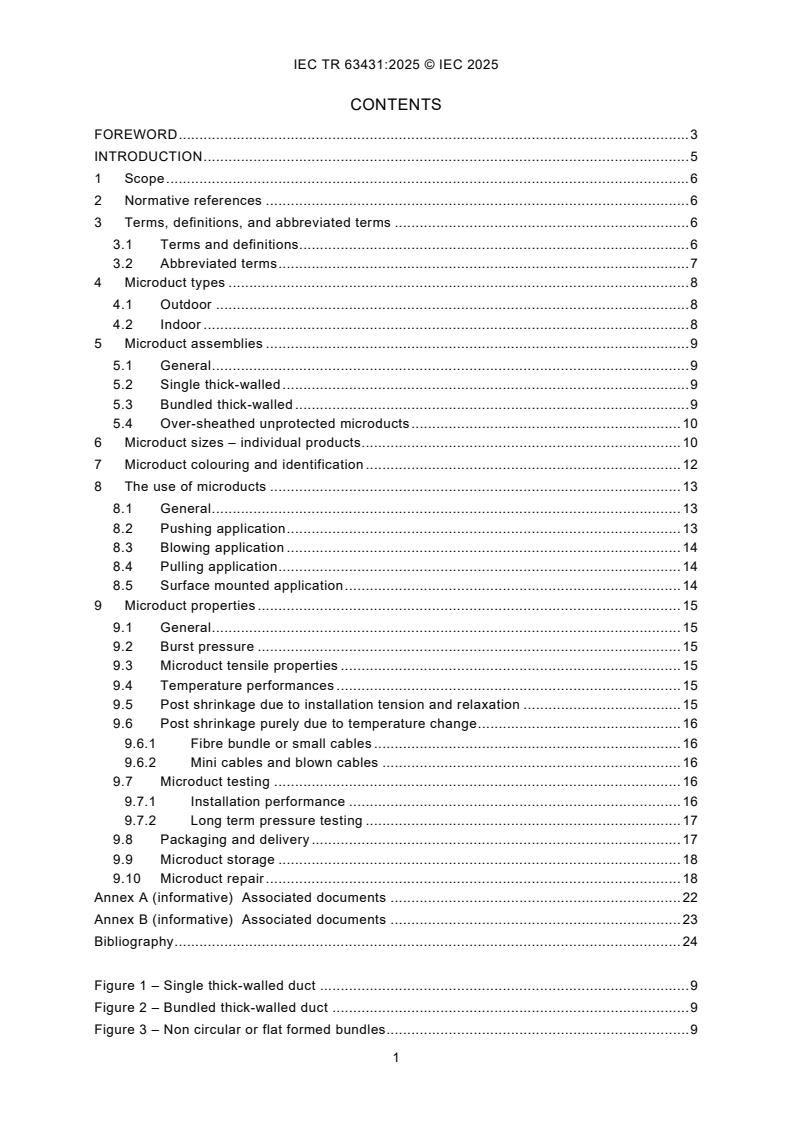
CONTENTS
FOREWORD . 3
INTRODUCTION . 5
1 Scope . 6
2 Normative references . 6
3 Terms, definitions, and abbreviated terms . 6
3.1 Terms and definitions. 6
3.2 Abbreviated terms . 7
4 Microduct types . 8
4.1 Outdoor . 8
4.2 Indoor . 8
5 Microduct assemblies . 9
5.1 General . 9
5.2 Single thick-walled . 9
5.3 Bundled thick-walled . 9
5.4 Over-sheathed unprotected microducts . 10
6 Microduct sizes – individual products . 10
7 Microduct colouring and identification . 12
8 The use of microducts . 13
8.1 General . 13
8.2 Pushing application . 13
8.3 Blowing application . 14
8.4 Pulling application . 14
8.5 Surface mounted application . 14
9 Microduct properties . 15
9.1 General . 15
9.2 Burst pressure . 15
9.3 Microduct tensile properties . 15
9.4 Temperature performances . 15
9.5 Post shrinkage due to installation tension and relaxation . 15
9.6 Post shrinkage purely due to temperature change . 16
9.6.1 Fibre bundle or small cables . 16
9.6.2 Mini cables and blown cables . 16
9.7 Microduct testing . 16
9.7.1 Installation performance . 16
9.7.2 Long term pressure testing . 17
9.8 Packaging and delivery . 17
9.9 Microduct storage . 18
9.10 Microduct repair . 18
Annex A (informative) Associated documents . 22
Annex B (informative) Associated documents . 23
Bibliography . 24
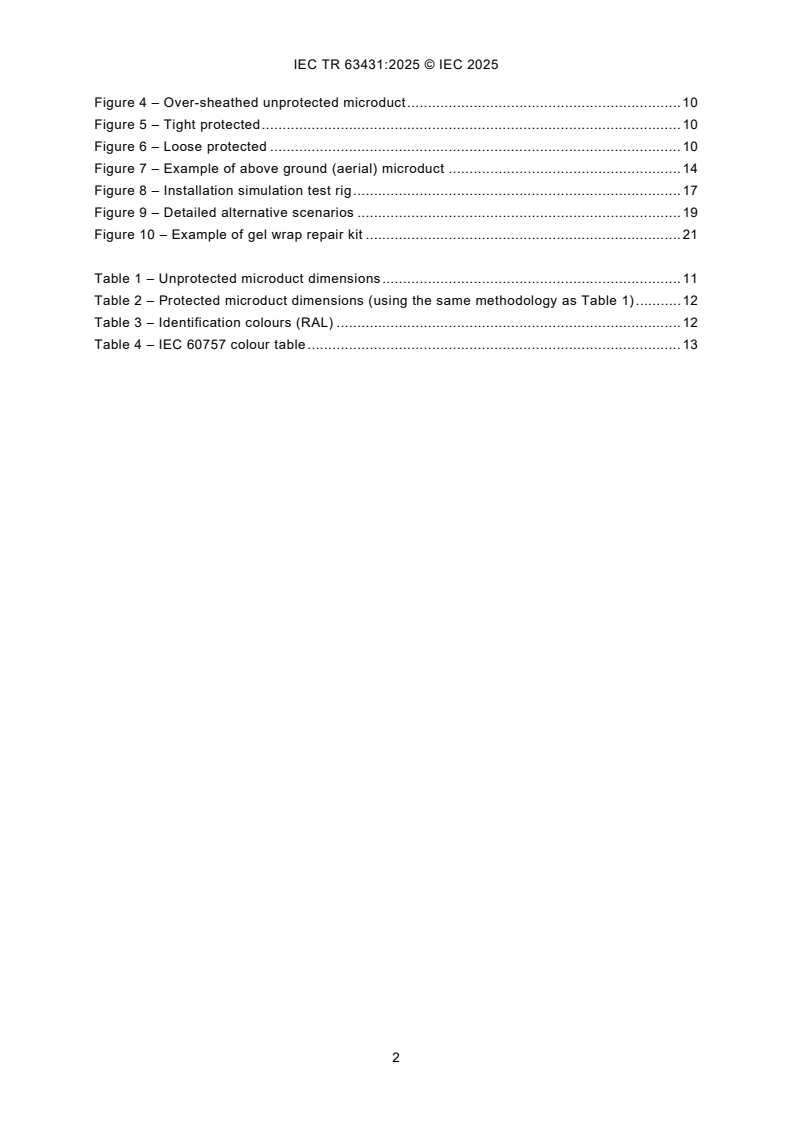
Figure 1 – Single thick-walled duct . 9
Figure 2 – Bundled thick-walled duct . 9
Figure 3 – Non circular or flat formed bundles . 9
Figure 4 – Over-sheathed unprotected microduct . 10
Figure 5 – Tight protected . 10
Figure 6 – Loose protected . 10
Figure 7 – Example of above ground (aerial) microduct . 14
Figure 8 – Installation simulation test rig . 17
Figure 9 – Detailed alternative scenarios . 19
Figure 10 – Example of gel wrap repair kit . 21
Table 1 – Unprotected microduct dimensions . 11
Table 2 – Protected microduct dimensions (using the same methodology as Table 1) . 12
Table 3 – Identification colours (RAL) . 12
Table 4 – IEC 60757 colour table . 13
INTERNATIONAL ELECTROTECHNICAL COMMISSION
____________
Optical fibre cables - Microduct technology - Guidance
FOREWORD
1) The International Electrotechnical Commission (IEC) is a worldwide organization for standardization comprising
all national electrotechnical committees (IEC National Committees). The object of IEC is to promote international
co-operation on all questions concerning standardization in the electrical and electronic fields. To this end and
in addition to other activities, IEC publishes International Standards, Technical Specifications, Technical Reports,
Publicly Available Specifications (PAS) and Guides (hereafter referred to as "IEC Publication(s)"). Their
preparation is entrusted to technical committees; any IEC National Committee interested in the subject dealt with
may participate in this preparatory work. International, governmental and non-governmental organizations liaising
with the IEC also participate in this preparation. IEC collaborates closely with the International Organization for
Standardization (ISO) in accordance with conditions determined by agreement between the two organizations.
2) The formal decisions or agreements of IEC on technical matters express, as nearly as possible, an international
consensus of opinion on the relevant subjects since each technical committee has representation from all
interested IEC National Committees.
3) IEC Publications have the form of recommendations for international use and are accepted by IEC National
Committees in that sense. While all reasonable efforts are made to ensure that the technical content of IEC
Publications is accurate, IEC cannot be held responsible for the way in which they are used or for any
misinterpretation by any end user.
4) In order to promote international uniformity, IEC National Committees undertake to apply IEC Publications
transparently to the maximum extent possible in their national and regional publications. Any divergence between
any IEC Publication and the corresponding national or regional publication shall be clearly indicated in the latter.
5) IEC itself does not provide any attestation of conformity. Independent certification bodies provide conformity
assessment services and, in some areas, access to IEC marks of conformity. IEC is not responsible for any
services carried out by independent certification bodies.
6) All users should ensure that they have the latest edition of this publication.
7) No liability shall attach to IEC or its directors, employees, servants or agents including individual experts and
members of its technical committees and IEC National Committees for any personal injury, property damage or
other damage of any nature whatsoever, whether direct or indirect, or for costs (including legal fees) and
expenses arising out of the publication, use of, or reliance upon, this IEC Publication or any other IEC
Publications.
8) Attention is drawn to the Normative references cited in this publication. Use of the referenced publications is
indispensable for the correct application of this publication.
9) IEC draws attention to the possibility that the implementation of this document may involve the use of (a)
patent(s). IEC takes no position concerning the evidence, validity or applicability of any claimed patent rights in
respect thereof. As of the date of publication of this document, IEC had not received notice of (a) patent(s), which
may be required to implement this document. However, implementers are cautioned that this may not represent
the latest information, which may be obtained from the patent database available at https://patents.iec.ch. IEC
shall not be held responsible for identifying any or all such patent rights.
IEC TR 63431 has been prepared by subcommittee 86A: Fibre and cables, of IEC technical
committee 86A: Fibre optics. It is a Technical Report.
The text of this Technical Report is based on the following documents:
Draft Report on voting
86A/2609/DTR 86A/2620/RVDTR
Full information on the voting for its approval can be found in the report on voting indicated in
the above table.
The language used for the development of this Technical Report is English.
This document was drafted in accordance with ISO/IEC Directives, Part 2, and developed in
accordance with ISO/IEC Directives, Part 1 and ISO/IEC Directives, IEC Supplement, available
at www.iec.ch/members_experts/refdocs. The main document types developed by IEC are
described in greater detail at www.iec.ch/publications.
The committee has decided that the contents of this document will remain unchanged until the
stability date indicated on the IEC website under webstore.iec.ch in the data related to the
specific document. At this date, the document will be
– reconfirmed,
– withdrawn, or
– revised.
INTRODUCTION
Microduct technology concerns the installation of optical fibre or copper transmission members
into small 'microducts' which are typically 20 mm or less in outer diameter. The installation
process is normally pushing, blowing or (less commonly) pulling, or a combination of these
methods. Microducts can be packaged in several different ways to form bundles which are
suitable for above ground, aerial, ducted and buried installations. In addition, specialised
versions are available to meet in-building needs where localised fire protection measures are
required. Microducts are commonly joined together by push-fit connectors (rather than
compression fittings). These fittings can also connect dissimilar size microduct although there
can be installation consequences for this. As well as their mechanical, temperature and
(sometimes) fire performance, different microducts can be optimised for fibre installation by the
use of low friction inner linings or low friction materials forming the entire product. Annex A
contains potentially useful ITU-T references. Annex B contains potentially useful conference
papers.
1 Scope
This document identifies issues which can be considered when adopting microduct technology
for the provision of optical communications networks. It supplements the microduct sections of
IEC 60794-5 series of publications and refers to products and practices in current use.
This documents also describes design types, colour codes, repairs, and environmental
expectations, including guidance to standards and methods of installation.
2 Normative references
The following documents are referred to in the text in such a way that some or all of their content
constitutes requirements of this document. For dated references, only the edition cited applies.
For undated references, the latest edition of the referenced document (including any
amendments) applies.
IEC 60794-1-1, Optical fibre cables - Part 1-1: Generic specification - General
IEC 60794-5, Optical fibre cables - Part 5: Sectional specification - Microduct cabling for
installation by blowing
3 Terms, definitions, and abbreviated terms
3.1 Terms and definitions
For the purposes of this document, the terms and definitions given in IEC 60794-5,
IEC 60794-1-1, and the following apply.
ISO and IEC maintain terminology databases for use in standardization at the following
addresses:
– IEC Electropedia: available at https://www.electropedia.org/
– ISO Online browsing platform: available at https://www.iso.org/obp
3.1.1
blowing application
method by which the cable and fibre unit are inserted into the microduct using air pressure
3.1.2
burst pressure
pressure at which the microduct fails
3.1.3
duct installed
DI
microducts which are intended to be deployed inside existing large ducts
3.1.4
direct bury
DB
microduct capable of being buried without any extra protection
3.1.5
field assembled optical fibre cable
specified combination of fibre units and microducts placed together in the field
3.1.6
flat formed bundles
multi element microducts within a flat outer form
3.1.7
loose protected
duct partially filled with inner microducts that are loosely situated
3.1.8
non circular
product that is more than 10 % oval from maximum diameter to minimum diameter
3.1.9
microduct
small, flexible lightweight tube with an outer diameter typically of 20 mm or less
3.1.10
tight protected
fully filled outer duct where inner microducts are packed closely
3.1.11
unprotected microducts
microduct that needs further protection to be provided by another duct or housing (closure)
3.1.12
protected microducts
ducts that are suitable to be placed in the outside or indoor network without further protection
3.1.13
pulling application
installation of elements through the insertion of a cord or rope pulled from an open end
3.1.14
pushing application
elements that are inserted into a duct using force provided at the near end of the route
3.1.15
standard dimension ratio
outer diameter of a microduct divided by the wall thickness of the microduct
3.2 Abbreviated terms
For the purposes of this document, the following abbreviated terms apply:
CoF coefficient of dynamic friction
CSA cross sectional area
D dimension
DB direct bury
DI duct installed
HDPE high density polyethylene
ID inside diameter
LDPE low density polyethylene
MDPE medium density polyethylene
MDU multiple dwelling unit
OD outer diameter
PE polyethylene
QAZD UL designation (code) for field assembled optical fibre cable
SDR standard dimension ratio
UV ultraviolet
4 Microduct types
4.1 Outdoor
IEC 60794-5 series standards currently recognise unprotected and protected microducts. The
unprotected products are simply those that are not designed for installation unless protected
by another means.
However, there are several types of protected microduct that require explanation:
a) Duct installed (DI) which are intended to be deployed inside existing large ducts which can
also contain existing cables and other existing, smaller ducts.
b) Direct bury (DB) which are intended to be deployed straight into the ground
Both microduct types can have a 'thin' wall thickness (defined by SDR) or a 'thick' wall (again
defined by SDR). The former generally has a thicker outer sheath containing several microducts
compared with the thick wall type.
Microducts can also be used for aerial deployment, provided suitable strength members are
used to provide resistance to wind and ice loading under operational and environmental
conditions. Ensure the added weight of the cable is included in the microduct strength
evaluation.
4.2 Indoor
Indoor microducts typically do not require the same blow length as outdoor types and can be
subject to national and regional fire regulations. IEC TR 62222 provides guidance on
communication cable testing, but not specific information on microducts. In Europe,
CLC TR 50510 offers suggestions regarding applicable testing. In summary there are two
common approaches:
a) Test the microduct and fibre product with the microduct empty and its minimum and
maximum payloads. This treats the microduct as a field assembled optical fibre cable. This
approach is used in the USA and other regions via the UL certification system (Class QAZD)
for GP, Riser and Plenum Applications.
b) Test the microduct under existing conduit regulations (for instance IEC 61386-22 for pliable
conduit). Ensure that any fibre products used to populate approved microducts are approved
to the corresponding cable requirement.
Approach (a) offers the advantage that the product as deployed is tested, but requires wider
acceptance. Approach (b) is an 'off the shelf' solution but might not accommodate fibre unit and
microduct products described in IEC 60794-5-20.
It has been observed during testing that some combinations of IEC 60795-5-10 microduct and
indoor cable have resulted in poorer fire performance for the combination than for each
individual product.
5 Microduct assemblies
5.1 General
Unprotected microducts are described in IEC 60794-5 as microducts requiring additional
protection before deployment. Protected microducts are suitable for deployment in the field.
The different assembly types are shown in Figure 1 to Figure 6:
5.2 Single thick-walled
Note that an indication of whether a microduct is 'thick-walled' can be made using the item's
standard dimension ratio (SDR).
Figure 1 – Single thick-walled duct
SDR = D/s
Typically, a SDR of < 10 for an HDPE microduct indicates that it is 'thick-walled', however a
lower number and SDR of < 8 can be used in some cases. Note that this only an approximation
applicable to HDPE microducts and the microduct typically meets the specification for such a
product.
5.3 Bundled thick-walled
Figure 2 – Bundled thick-walled duct
These assemblies use a group of two or more thick-walled microducts in a package that is
typically contained within a relatively thin wrapping sheath, and are suitable for DI and DB
applications.
Figure 3 – Non circular or flat formed bundles
These are commonly used directly into the ground or on surfaces.
5.4 Over-sheathed unprotected microducts
Figure 4 – Over-sheathed unprotected microduct
This assembly uses a group of one or more unprotected microducts which are covered in
protection layer(s) to confer physical reinforcement, and is suitable for DI and DB applications.
Figure 5 – Tight protected
Figure 6 – Loose protected
Tight protected constructions (Figure 4 and Figure 5) contain microducts that are fixed in
position within the outer sheath whilst loose protected constructions contain microducts that are
free to move.
6 Microduct sizes – individual products
IEC standards do not specify standard sizes. However, a guide is provided in EN 50411-6-1 for
unprotected microduct as shown in Table 1 with an equivalent dimension set for protected
microduct shown in Table 2.
Table 1 – Unprotected microduct dimensions
Nominal size Minimum outer Maximum outer Minimum wall Minimum inner
diameter diameter thickness diameter
(OD/ID)
mm mm mm mm mm
3/2,1 2,9 3,1 0,45 2,0
4/2,1 3,9 4,1 0,95 2,0
4/2,5 3,9 4,1 0,75 2,4
4/3 3,9 4,1 0,60 2,7
5/2,1 4,9 5,1 1,45 2,0
5/3,5 4,9 5,1 0,75 3,4
6/2,7 5,9 6,1 1,55 2,6
6/4 5,9 6,1 1,00 3,9
7/3,5 6,9 7,1 1,75 3,4
7/4 6,8 7,2 1,45 3,9
7/5,5 6,9 7,1 0,75 5,4
8/3,5 (see note) 7,9 8,1 2,25 3,4
8/4 7,9 8,1 2,0 3,9
8/5 7,9 8,1 1,5 4,9
8/6 7,9 8,1 1,00 5,9
8,5/6 8,4 8,6 1,25 5,9
10/6 (see note) 9,8 10,2 1,95 5,9
10/8 9,8 10,2 0,95 7,9
12/8 (see note) 11,8 12,2 1,95 7,9
12/9 11,8 12,2 1,45 8,9
12/9,4 11,8 12,2 1,25 9,3
12/10 11,8 12,2 0,95 9,9
14/10 (see note) 13,8 14,2 1,95 9,9
14/11 13,8 14,2 1,45 10,9
14/11,4 13,8 14,2 1,25 11,3
15/12 14,8 15,2 1,45 11,9
16/10 (see note) 15,8 16,2 2,95 9,9
16/12 (see note) 15,8 16,2 1,95 11,9
16/13 15,8 16,2 1,45 12,9
NOTE These sizes are for reference only as they are thick-walled products and can be used as protected
microduct (nominal wall thickness ≥ 2 mm). The dimensions are provided in this table for interfacing with microduct
connectors.
Table 2 – Protected microduct dimensions (using the same methodology as Table 1)
Nominal size Minimum outer Maximum outer Minimum wall Minimum inner
diameter diameter thickness diameter
(OD/ID)
mm mm mm mm mm
7/3,5 6,9 7,1 1,70 3,4
8/4 (see note) 7,9 8,1 1,95 3,9
10/6 9,8 10,2 1,95 5,9
12/8 11,8 12,2 1,95 7,9
14/10 13,8 14,2 1,95 9,9
16/12 15,8 16,2 1,95 11,9
18/14 17,8 18,2 1,95 13,9
20/15 19,8 20,2 2,45 14,9
20/16 19,8 20,2 1,95 15,9
NOTE 8/3,5 and 8/4,5 products are also available with the same tolerances.
7 Microduct colouring and identification
The microducts can be colour coded. Ensure the twelve basic colours are clearly identifiable
and not mistaken for other colours. For this purpose, the potential RAL colour is shown in
Table 3 with a colour sample (depending on the substrate and the printing inks, deviations from
the RAL colour are possible). Microducts can be translucent or solid colour. Relevant RAL
colours are shown in Table 3.
Table 3 – Identification colours (RAL)
Colour Red Green Blue Yellow White Grey
Abbreviation rd gn bl ye wt gr
Number 1 2 3 4 5 6
Number 13 14 15 16 17 18
RAL code RAL 3020 RAL 6001 RAL 5015 RAL 1018 RAL9010 RAL 7045
Colour Brown Violet Turquoise Black Orange Pink
Abbreviation br vi tk bk or pi
Number 7 8 9 10 11 12
Number 19 20 21 22 23 24
RAL code RAL 8015 RAL 4005 RAL 6027 RAL 9005 RAL 2003 RAL 3015
Other, non-RAL based schemes can be equally applicable and the sequencing is shown here
only as an example. IEC 60757 is a commonly used and accepted colour scheme (see Table 4).
It uses the colours and codes shown in Table 4, but is not specifically colour matched.
Table 4 – IEC 60757 colour table
Colour Letter code
Black BK
Brown BN
Red RD
Orange OG
Green GN
Yellow YE
Blue BU
Violet VT
Grey GY
White WH
Pink PK
Gold GD
Turquoise TQ
Silver SR
A further wiring-based colour scheme is also available in IEC 60304.
In some regions it can be prefer
...