

IEC 60794-2-20:2008
(Main)Optical fibre cables - Part 2-20: Indoor cables - Family specification for multi-fibre optical distribution cables
General Information
- Abstract
IEC 60794-2-20:2008 is a family specification covering multi-fibre optical distribution cables for indoor use. The requirements of the sectional specification IEC 60794-2 are applicable to cables covered by this standard. The main changes from the previous edition include:
- cable crush to be measured both during and after load;
- cable torsion test length parameter correlated to cable outer diameter;
- cable description and construction blank detail specification annexes;
- MICE environment blank detail specification is addressed in Annex B.
This publication is to be read in conjunction with IEC 60794-1-1:2001, IEC 60794-1-2:2003 and IEC 60794-2:2002.
- Status
- Published
- Publication Date
- 04-Nov-2008
- Technical Committee
- SC 86A - Fibres and cables
- Current Stage
- DELPUB - Deleted Publication
- Start Date
- 05-Nov-2013
- Completion Date
- 28-Aug-2026
Buy Documents
IEC 60794-2-20:2008 - Optical fibre cables - Part 2-20: Indoor cables - Family specification for multi-fibre optical distribution cables Released:11/5/2008
IEC 60794-2-20:2008 - Optical fibre cables - Part 2-20: Indoor cables - Family specification for multi-fibre optical distribution cables Released:11/5/2008
Overview
IEC 60794-2-20:2008 - Optical fibre cables - Part 2-20: Indoor cables - Family specification for multi-fibre optical distribution cables - is an IEC family specification for multi‑fibre indoor distribution cables. It complements the sectional specification IEC 60794-2 and is intended to be read together with IEC 60794-1-1:2001 and IEC 60794-1-2:2003. The standard defines construction principles, materials, identification, expected service life (minimum 15 years), and a suite of mechanical, environmental, transmission and fire‑performance tests tailored to indoor installations.
Key Topics
- Scope and design life
- Covers multi‑fibre cables for indoor use with a designed lifetime of at least 15 years.
- No fibre splice in a delivery length unless agreed between customer and supplier.
- Each individual fibre must be identifiable throughout the cable length.
- Accepted optical fibres
- Permits A1 multimode fibres (IEC 60793‑2‑10) and specified single‑mode fibres (IEC 60793‑2‑50 classes B1.1, B1.3, B6_a, B6_b).
- Cable construction options
- Tight or semi‑tight buffered fibres (buffer diameters and removability requirements are specified).
- Ruggedised fibres, slotted cores, tubes, stranded tubes and ribbon structures are described.
- Buffer details
- Tight buffer: nominal diameter 0.3–1.0 mm (±0.05 mm); removable together with primary coating over 15–25 mm (as agreed).
- Semi‑tight buffer: nominal diameter 0.3–1.3 mm (±0.05 mm); removable over 0.3–2.0 m.
- Tests and performance
- Mechanical: tensile, crush (measured both during and after load), impact, bending (including repeated and low‑temperature), flexing, torsion (test length correlated to cable outer diameter), kink.
- Environmental: temperature cycling and transmission performance checks.
- Fire performance: requirements referenced (e.g., IEC 62222).
- Document additions (edition 2, 2008)
- Crush measurement during and after load; torsion test length correlated to outer diameter; blank detail specification annexes for description/construction; Annex B addresses MICE environments for industrial premises.
Applications and Users
- Intended for manufacturers, product designers, test laboratories, specifiers, network integrators, building services engineers and procurement teams responsible for indoor optical distribution (e.g., telecom risers, horizontal cabling, data centres, campus backbones).
- Useful when specifying indoor multi‑fibre optical distribution cables, ensuring compliance with mechanical, environmental and fire‑safety requirements, and for preparing factory and site acceptance tests.
Related Standards
- IEC 60794-1-1:2001 (generic requirements)
- IEC 60794-1-2:2003 (test methods)
- IEC 60794-2:2002 (sectional specification for indoor cables)
- IEC 60793 series (optical fibre product specifications)
- IEC 62222 (fire performance of communication cables)
- ISO/IEC 24702 (MICE installation environments - referenced in Annex B)
Keywords: IEC 60794-2-20:2008, indoor optical fibre cables, multi‑fibre optical distribution cables, MICE environment, cable crush test, torsion test, slotted core, ribbon fibre, buffer removal.
Relations
- Effective Date
- 05-Sep-2023
- Effective Date
- 05-Sep-2023
Buy Documents
IEC 60794-2-20:2008 - Optical fibre cables - Part 2-20: Indoor cables - Family specification for multi-fibre optical distribution cables Released:11/5/2008
IEC 60794-2-20:2008 - Optical fibre cables - Part 2-20: Indoor cables - Family specification for multi-fibre optical distribution cables Released:11/5/2008
Get Certified
Connect with accredited certification bodies for this standard

ANCE
Mexican certification and testing association.

Intertek Slovenia
Intertek testing, inspection, and certification services in Slovenia.

LNE (Laboratoire National de Métrologie et d'Essais)
French national laboratory for metrology and testing.
Sponsored listings
Frequently Asked Questions
IEC 60794-2-20:2008 is a standard published by the International Electrotechnical Commission (IEC). Its full title is "Optical fibre cables - Part 2-20: Indoor cables - Family specification for multi-fibre optical distribution cables". This standard covers: IEC 60794-2-20:2008 is a family specification covering multi-fibre optical distribution cables for indoor use. The requirements of the sectional specification IEC 60794-2 are applicable to cables covered by this standard. The main changes from the previous edition include: - cable crush to be measured both during and after load; - cable torsion test length parameter correlated to cable outer diameter; - cable description and construction blank detail specification annexes; - MICE environment blank detail specification is addressed in Annex B. This publication is to be read in conjunction with IEC 60794-1-1:2001, IEC 60794-1-2:2003 and IEC 60794-2:2002.
IEC 60794-2-20:2008 is a family specification covering multi-fibre optical distribution cables for indoor use. The requirements of the sectional specification IEC 60794-2 are applicable to cables covered by this standard. The main changes from the previous edition include: - cable crush to be measured both during and after load; - cable torsion test length parameter correlated to cable outer diameter; - cable description and construction blank detail specification annexes; - MICE environment blank detail specification is addressed in Annex B. This publication is to be read in conjunction with IEC 60794-1-1:2001, IEC 60794-1-2:2003 and IEC 60794-2:2002.
IEC 60794-2-20:2008 is classified under the following ICS (International Classification for Standards) categories: 33.180.01 - Fibre optic systems in general. The ICS classification helps identify the subject area and facilitates finding related standards.
IEC 60794-2-20:2008 has the following relationships with other standards: It is inter standard links to IEC 60794-2-20:2003, IEC 60794-2-20:2013. Understanding these relationships helps ensure you are using the most current and applicable version of the standard.
IEC 60794-2-20:2008 is available in PDF format for immediate download after purchase. The document can be added to your cart and obtained through the secure checkout process. Digital delivery ensures instant access to the complete standard document.
Standards Content (Sample)
IEC 60794-2-20
Edition 2.0 2008-11
INTERNATIONAL
STANDARD
Optical fibre cables –
Part 2-20: Indoor cables – Family specification for multi-fibre optical distribution
cables
All rights reserved. Unless otherwise specified, no part of this publication may be reproduced or utilized in any form
or by any means, electronic or mechanical, including photocopying and microfilm, without permission in writing from
either IEC or IEC's member National Committee in the country of the requester.
If you have any questions about IEC copyright or have an enquiry about obtaining additional rights to this publication,
please contact the address below or your local IEC member National Committee for further information.
IEC Central Office
3, rue de Varembé
CH-1211 Geneva 20
Switzerland
Email: inmail@iec.ch
Web: www.iec.ch
About the IEC
The International Electrotechnical Commission (IEC) is the leading global organization that prepares and publishes
International Standards for all electrical, electronic and related technologies.
About IEC publications
The technical content of IEC publications is kept under constant review by the IEC. Please make sure that you have the
latest edition, a corrigenda or an amendment might have been published.
ƒ Catalogue of IEC publications: www.iec.ch/searchpub
The IEC on-line Catalogue enables you to search by a variety of criteria (reference number, text, technical committee,…).
It also gives information on projects, withdrawn and replaced publications.
ƒ IEC Just Published: www.iec.ch/online_news/justpub
Stay up to date on all new IEC publications. Just Published details twice a month all new publications released. Available
on-line and also by email.
ƒ Electropedia: www.electropedia.org
The world's leading online dictionary of electronic and electrical terms containing more than 20 000 terms and definitions
in English and French, with equivalent terms in additional languages. Also known as the International Electrotechnical
Vocabulary online.
ƒ Customer Service Centre: www.iec.ch/webstore/custserv
If you wish to give us your feedback on this publication or ne urther assistance, please visit the Customer Service
ed f
Centre FAQ or contact us:
Email: csc@iec.ch
Tel.: +41 22 919 02 11
Fax: +41 22 919 03 00
IEC 60794-2-20
Edition 2.0 2008-11
INTERNATIONAL
STANDARD
Optical fibre cables –
Part 2-20: Indoor cables – Family specification for multi-fibre optical distribution
cables
INTERNATIONAL
ELECTROTECHNICAL
COMMISSION
PRICE CODE
T
ICS 33.180.01 ISBN 978-2-88910-291-4
– 2 – 60794-2-20 © IEC:2008(E)
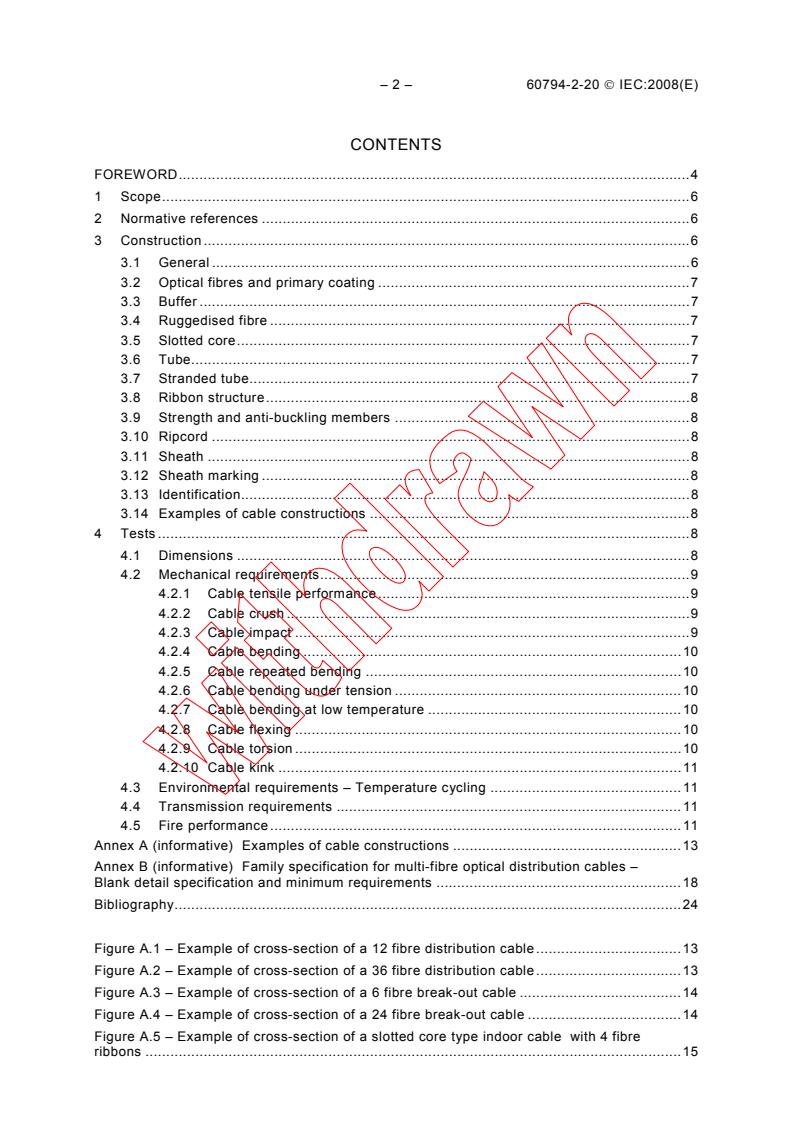
CONTENTS
FOREWORD.4
1 Scope.6
2 Normative references .6
3 Construction .6
3.1 General .6
3.2 Optical fibres and primary coating .7
3.3 Buffer .7
3.4 Ruggedised fibre .7
3.5 Slotted core.7
3.6 Tube.7
3.7 Stranded tube.7
3.8 Ribbon structure.8
3.9 Strength and anti-buckling members .8
3.10 Ripcord .8
3.11 Sheath .8
3.12 Sheath marking .8
3.13 Identification.8
3.14 Examples of cable constructions .8
4 Tests .8
4.1 Dimensions .8
4.2 Mechanical requirements.9
4.2.1 Cable tensile performance .9
4.2.2 Cable crush .9
4.2.3 Cable impact .9
4.2.4 Cable bending .10
4.2.5 Cable repeated bending .10
4.2.6 Cable bending under tension .10
4.2.7 Cable bending at low temperature .10
4.2.8 Cable flexing .10
4.2.9 Cable torsion .10
4.2.10 Cable kink .11
4.3 Environmental requirements – Temperature cycling .11
4.4 Transmission requirements .11
4.5 Fire performance.11
Annex A (informative) Examples of cable constructions .13
Annex B (informative) Family specification for multi-fibre optical distribution cables –
Blank detail specification and minimum requirements .18
Bibliography.24
Figure A.1 – Example of cross-section of a 12 fibre distribution cable.13
Figure A.2 – Example of cross-section of a 36 fibre distribution cable.13
Figure A.3 – Example of cross-section of a 6 fibre break-out cable .14
Figure A.4 – Example of cross-section of a 24 fibre break-out cable .14
Figure A.5 – Example of cross-section of a slotted core type indoor cable with 4 fibre
ribbons .15
60794-2-20 © IEC:2008(E) – 3 –
Figure A.6 – Example of cross-section of an SZ (reverse oscillating lay) slotted core
type indoor cable with 2 fibre ribbons.15
Figure A.7 – Example of cross-section of an SZ (reverse oscillating lay) slotted core
type indoor cable with 4 fibre bundles .16
Figure A.8 – Example of multi-fibre unitube cable .16
Figure A.9 – Example of multi-fibre cable.17
Table 1 – Dimensions of buffered fibres.7
Table 2 – Sample temperature cycling values .11
Table B.1 – Cable description .18
Table B.2 – Cable element.19
Table B.3 – Cable construction .20
Table B.4 – Installation and operating conditions .20
Table B.5 – Tests applicable.21
Table B.6 – Specifications for industrial premises installations as defined in
ISO/IEC 24702.22
– 4 – 60794-2-20 © IEC:2008(E)
INTERNATIONAL ELECTROTECHNICAL COMMISSION
___________
OPTICAL FIBRE CABLES –
Part 2-20: Indoor cables –
Family specification for multi-fibre optical distribution cables
FOREWORD
1) The International Electrotechnical Commission (IEC) is a worldwide organization for standardization comprising
all national electrotechnical committees (IEC National Committees). The object of IEC is to promote
international co-operation on all questions concerning standardization in the electrical and electronic fields. To
this end and in addition to other activities, IEC publishes International Standards, Technical Specifications,
Technical Reports, Publicly Available Specifications (PAS) and Guides (hereafter referred to as “IEC
Publication(s)”). Their preparation is entrusted to technical committees; any IEC National Committee interested
in the subject dealt with may participate in this preparatory work. International, governmental and non-
governmental organizations liaising with the IEC also participate in this preparation. IEC collaborates closely
with the International Organization for Standardization (ISO) in accordance with conditions determined by
agreement between the two organizations.
2) The formal decisions or agreements of IEC on technical matters express, as nearly as possible, an international
consensus of opinion on the relevant subjects since each technical committee has representation from all
interested IEC National Committees.
3) IEC Publications have the form of recommendations for international use and are accepted by IEC National
Committees in that sense. While all reasonable efforts are made to ensure that the technical content of IEC
Publications is accurate, IEC cannot be held responsible for the way in which they are used or for any
misinterpretation by any end user.
4) In order to promote international uniformity, IEC National Committees undertake to apply IEC Publications
transparently to the maximum extent possible in their national and regional publications. Any divergence
between any IEC Publication and the corresponding national or regional publication shall be clearly indicated in
the latter.
5) IEC provides no marking procedure to indicate its approval and cannot be rendered responsible for any
equipment declared to be in conformity with an IEC Publication.
6) All users should ensure that they have the latest edition of this publication.
7) No liability shall attach to IEC or its directors, employees, servants or agents including individual experts and
members of its technical committees and IEC National Committees for any personal injury, property damage or
other damage of any nature whatsoever, whether direct or indirect, or for costs (including legal fees) and
expenses arising out of the publication, use of, or reliance upon, this IEC Publication or any other IEC
Publications.
8) Attention is drawn to the Normative references cited in this publication. Use of the referenced publications is
indispensable for the correct application of this publication.
9) Attention is drawn to the possibility that some of the elements of this IEC Publication may be the subject of
patent rights. IEC shall not be held responsible for identifying any or all such patent rights.
International Standard IEC 60794-2-20 has been prepared by subcommittee 86A: Fibres and
cables, of IEC technical committee 86: Fibre optics.
This second edition cancels and replaces the first edition published in 2003. It constitutes a
technical revision.
The main changes from the previous edition include:
– cable crush to be measured both during and after load;
– cable torsion test length parameter correlated to cable outer diameter;
– cable description and construction blank detail specification annexes;
– MICE environment blank detail specification is addressed in Annex B.
This standard is to be used in conjunction with IEC 60794-1-1 and IEC 60794-1-2, and
IEC 60794-2.
60794-2-20 © IEC:2008(E) – 5 –
The text of this standard is based on the following documents:
CDV Report on voting
86A/1187/CDV 86A/1221/RVC
Full information on the voting for the approval of this standard can be found in the report on
voting indicated in the above table.
This publication has been drafted in accordance with the ISO/IEC Directives, Part 2.
A list of all parts of IEC 60794 series, published under the general title Optical fibre cables,
can be found on the IEC website.
The committee has decided that the contents of this publication will remain unchanged until
the maintenance result date indicated on the IEC web site under "http://webstore.iec.ch" in
the data related to the specific publication. At this date, the publication will be
• reconfirmed,
• withdrawn,
• replaced by a revised edition, or
• amended.
A bilingual version of this publication may be issued at a later date.
– 6 – 60794-2-20 © IEC:2008(E)
OPTICAL FIBRE CABLES –
Part 2-20: Indoor cables –
Family specification for multi-fibre optical distribution cables
1 Scope
This part of IEC 60794 is a family specification covering multi-fibre optical distribution cables
for indoor use. The requirements of the sectional specification IEC 60794-2 are applicable to
cables covered by this standard.
Annex B contains requirements that supersede the normal requirements in case the cables
are intended to be used in installation governed by the MICE table of ISO/IEC 24702 (i.e.
Industrial premises).
2 Normative references
The following referenced documents are indispensable for the application of this document.
For dated references, only the edition cited applies. For undated references, the latest edition
of the referenced document (including any amendments) applies.
They complete the normative references already listed in the generic specification
(IEC 60794-1-1, Clause 2, and IEC 60794-1-2, Clause 2).
IEC 60189-1, Low-frequency cables and wires with PVC insulation and PVC sheath – Part 1:
General test and measuring methods
IEC 60304, Standard colours for insulation for low-frequency cables and wires
IEC 60793-2-10, Optical fibres – Part 2-10: Product specifications – Sectional specification for
category A1 multimode fibres
IEC 60793-2-50, Optical fibres – Part 2-50: Product specifications – Sectional specification for
class B single-mode fibres
IEC 60794-2, Optical fibre cables – Part 2: Indoor cables – Sectional specification
IEC 60811-1-4, Common test methods for insulating and sheathing materials of electric
cables – Part 1: Methods for general application – Section four: Tests at low temperature
IEC 62222, Fire performance of communication cables installed in buildings
3 Construction
3.1 General
In addition to the constructional requirements in IEC 60794-2, the following considerations
apply to multi-fibre indoor cables.
The cable shall be designed and manufactured for an expected operating lifetime of at least
15 years. In this context, the attenuation at the operational wavelength(s) of the optical fibres
contained in the installed cable shall not exceed values agreed between customer and
60794-2-20 © IEC:2008(E) – 7 –
supplier. The materials in the cable shall not present a health or environmental hazard within
its intended use.
There shall be no fibre splice in a delivery length unless otherwise agreed by customer and
supplier.
It shall be possible to identify each individual fibre throughout the length of the cable.
3.2 Optical fibres and primary coating
A1 multimode fibres which meet the requirements of IEC 60793-2-10 or B1.1, B1.3, B6_a, and
B6_b single-mode optical fibres which meet the requirements of IEC 60793-2-50 shall be used.
The linear coefficient of optical fibre attenuation and attenuation point discontinuity may be
affected by the cable manufacturing process. Maximum values for these optical
characteristics shall be agreed between customer and supplier.
3.3 Buffer
If a tight or semi-tight (loosely applied) buffer is required, it shall consist of one or more layers
of inert material. The buffer shall be easily removable. For tight buffers, the buffer and fibre
primary coating shall be removable in one operation over a length of 15 mm to 25 mm,
depending on customer requirements. For semi-tight buffers, the buffer shall be easily
removable over a length of 0,3 m to 2,0 m.
Buffer dimensions are shown in Table 1.
Table 1 – Dimensions of buffered fibres
Buffer type Nominal diameter Tolerances
mm mm
Semi-tight buffer 0,3 - 1,3
±0,05
Tight buffer 0,3 - 1,0
±0,05
3.4 Ruggedised fibre
Further protection can be provided to tight or semi-tight secondary coated fibres by
surrounding them with non-metallic strength members within a sheath of suitable material.
3.5 Slotted core
The slotted core is obtained by extruding a suitable material with a defined number of slots,
providing helical or SZ (reverse-oscillating lay) configuration along the core. One or more
primary coated fibres or optical elements such as ribbons or fibre bundles are located in each
slot.
3.6 Tube
One or more primary coated or buffered fibres or ribbons are packaged (loosely or not) in a
tube construction which may be filled. The tube may be reinforced with a composite wall.
3.7 Stranded tube
Multiple tubes, containing one or more primary coated or buffered fibres or ribbons, are
stranded around a central member. For the sake of preserving cable geometry, some tubes
may be "filler" or "empty" elements not containing optical fibres.
– 8 – 60794-2-20 © IEC:2008(E)
3.8 Ribbon structure
Ribbon structures shall conform to IEC 60794-3, 6.5 and 8.2.3. Fibres shall be arranged to be
parallel and formed into ribbons so that the fibres remain parallel and do not cross over.
Unless otherwise specified, each ribbon shall be uniquely identified with a printed legend or
by uniquely colouring the reference fibre and/or by colouring the matrix material of the ribbon.
3.9 Strength and anti-buckling members
The cable shall be designed with sufficient strength members to meet installation and service
conditions so that the fibres are not subjected to strain in excess of limits agreed between
customer and supplier.
The strength and/or anti-buckling members may be either metallic or non-metallic and may be
located in the cable core and/or under the sheath and/or in the sheath.
3.10 Ripcord
If required, a ripcord may be provided beneath the sheath.
3.11 Sheath
The cable shall have an overall protective sheath. The cable diameter shall be specified in the
relevant blank detail specification (or product) specification.
3.12 Sheath marking
If required, the cable shall be marked as agreed between the customer and the supplier.
3.13 Identification
Optical fibres, secondary coatings and sub-unit sheaths shall be easily and uniquely
identifiable through the use of a suitable colour code (i.e. IEC 60304) and/or an easily visible
numbering scheme to be agreed between the customer and the supplier.
3.14 Examples of cable constructions
Examples of some main types of cable construction are shown in Annex A. Other
configurations (e.g. multi-
...
IEC 60794-2-20 ®
Edition 2.0 2008-11
INTERNATIONAL
STANDARD
NORME
INTERNATIONALE
colour
inside
Optical fibre cables –
Part 2-20: Indoor cables – Family specification for multi-fibre optical distribution
cables
Câbles à fibres optiques –
Partie 2-20: Câbles intérieurs – Spécification de famille pour les câbles de
distribution optiques multifibres
All rights reserved. Unless otherwise specified, no part of this publication may be reproduced or utilized in any form or by
any means, electronic or mechanical, including photocopying and microfilm, without permission in writing from either IEC or
IEC's member National Committee in the country of the requester.
If you have any questions about IEC copyright or have an enquiry about obtaining additional rights to this publication,
please contact the address below or your local IEC member National Committee for further information.
Droits de reproduction réservés. Sauf indication contraire, aucune partie de cette publication ne peut être reproduite
ni utilisée sous quelque forme que ce soit et par aucun procédé, électronique ou mécanique, y compris la photocopie
et les microfilms, sans l'accord écrit de la CEI ou du Comité national de la CEI du pays du demandeur.
Si vous avez des questions sur le copyright de la CEI ou si vous désirez obtenir des droits supplémentaires sur cette
publication, utilisez les coordonnées ci-après ou contactez le Comité national de la CEI de votre pays de résidence.
IEC Central Office
3, rue de Varembé
CH-1211 Geneva 20
Switzerland
Email: inmail@iec.ch
Web: www.iec.ch
About the IEC
The International Electrotechnical Commission (IEC) is the leading global organization that prepares and publishes
International Standards for all electrical, electronic and related technologies.
About IEC publications
The technical content of IEC publications is kept under constant review by the IEC. Please make sure that you have the
latest edition, a corrigenda or an amendment might have been published.
Catalogue of IEC publications: www.iec.ch/searchpub
The IEC on-line Catalogue enables you to search by a variety of criteria (reference number, text, technical committee,…).
It also gives information on projects, withdrawn and replaced publications.
IEC Just Published: www.iec.ch/online_news/justpub
Stay up to date on all new IEC publications. Just Published details twice a month all new publications released. Available
on-line and also by email.
Electropedia: www.electropedia.org
The world's leading online dictionary of electronic and electrical terms containing more than 20 000 terms and definitions
in English and French, with equivalent terms in additional languages. Also known as the International Electrotechnical
Vocabulary online.
Customer Service Centre: www.iec.ch/webstore/custserv
If you wish to give us your feedback on this publication or need further assistance, please visit the Customer Service
Centre FAQ or contact us:
Email: csc@iec.ch
Tel.: +41 22 919 02 11
Fax: +41 22 919 03 00
A propos de la CEI
La Commission Electrotechnique Internationale (CEI) est la première organisation mondiale qui élabore et publie des
normes internationales pour tout ce qui a trait à l'électricité, à l'électronique et aux technologies apparentées.
A propos des publications CEI
Le contenu technique des publications de la CEI est constamment revu. Veuillez vous assurer que vous possédez
l’édition la plus récente, un corrigendum ou amendement peut avoir été publié.
Catalogue des publications de la CEI: www.iec.ch/searchpub/cur_fut-f.htm
Le Catalogue en-ligne de la CEI vous permet d’effectuer des recherches en utilisant différents critères (numéro de référence,
texte, comité d’études,…). Il donne aussi des informations sur les projets et les publications retirées ou remplacées.
Just Published CEI: www.iec.ch/online_news/justpub
Restez informé sur les nouvelles publications de la CEI. Just Published détaille deux fois par mois les nouvelles
publications parues. Disponible en-ligne et aussi par email.
Electropedia: www.electropedia.org
Le premier dictionnaire en ligne au monde de termes électroniques et électriques. Il contient plus de 20 000 termes et
définitions en anglais et en français, ainsi que les termes équivalents dans les langues additionnelles. Egalement appelé
Vocabulaire Electrotechnique International en ligne.
Service Clients: www.iec.ch/webstore/custserv/custserv_entry-f.htm
Si vous désirez nous donner des commentaires sur cette publication ou si vous avez des questions, visitez le FAQ du
Service clients ou contactez-nous:
Email: csc@iec.ch
Tél.: +41 22 919 02 11
Fax: +41 22 919 03 00
IEC 60794-2-20 ®
Edition 2.0 2008-11
INTERNATIONAL
STANDARD
NORME
INTERNATIONALE
colour
inside
Optical fibre cables –
Part 2-20: Indoor cables – Family specification for multi-fibre optical distribution
cables
Câbles à fibres optiques –
Partie 2-20: Câbles intérieurs – Spécification de famille pour les câbles de
distribution optiques multifibres
INTERNATIONAL
ELECTROTECHNICAL
COMMISSION
COMMISSION
ELECTROTECHNIQUE
PRICE CODE
INTERNATIONALE
CODE PRIX T
ICS 33.180.01 ISBN 978-2-88912-615-6
– 2 – 60794-2-20 IEC:2008
CONTENTS
FOREWORD . 4
1 Scope . 6
2 Normative references . 6
3 Construction . 6
3.1 General . 6
3.2 Optical fibres and primary coating . 7
3.3 Buffer . 7
3.4 Ruggedised fibre . 7
3.5 Slotted core . 7
3.6 Tube. 7
3.7 Stranded tube. 7
3.8 Ribbon structure . 8
3.9 Strength and anti-buckling members . 8
3.10 Ripcord . 8
3.11 Sheath . 8
3.12 Sheath marking . 8
3.13 Identification. 8
3.14 Examples of cable constructions . 8
4 Tests . 8
4.1 Dimensions . 8
4.2 Mechanical requirements . 9
4.2.1 Cable tensile performance . 9
4.2.2 Cable crush . 9
4.2.3 Cable impact . 9
4.2.4 Cable bending . 10
4.2.5 Cable repeated bending . 10
4.2.6 Cable bending under tension . 10
4.2.7 Cable bending at low temperature . 10
4.2.8 Cable flexing . 10
4.2.9 Cable torsion . 10
4.2.10 Cable kink . 11
4.3 Environmental requirements – Temperature cycling . 11
4.4 Transmission requirements . 11
4.5 Fire performance . 11
Annex A (informative) Examples of cable constructions . 13
Annex B (informative) Family specification for multi-fibre optical distribution cables –
Blank detail specification and minimum requirements . 18
Bibliography . 24
Figure A.1 – Example of cross-section of a 12 fibre distribution cable . 13
Figure A.2 – Example of cross-section of a 36 fibre distribution cable . 13
Figure A.3 – Example of cross-section of a 6 fibre break-out cable . 14
Figure A.4 – Example of cross-section of a 24 fibre break-out cable . 14
Figure A.5 – Example of cross-section of a slotted core type indoor cable with 4 fibre
ribbons . 15
60794-2-20 IEC:2008 – 3 –
Figure A.6 – Example of cross-section of an SZ (reverse oscillating lay) slotted core
type indoor cable with 2 fibre ribbons . 15
Figure A.7 – Example of cross-section of an SZ (reverse oscillating lay) slotted core
type indoor cable with 4 fibre bundles . 16
Figure A.8 – Example of multi-fibre unitube cable . 16
Figure A.9 – Example of multi-fibre cable . 17
Table 1 – Dimensions of buffered fibres . 7
Table 2 – Sample temperature cycling values . 11
Table B.1 – Cable description . 18
Table B.2 – Cable element . 19
Table B.3 – Cable construction . 20
Table B.4 – Installation and operating conditions . 20
Table B.5 – Tests applicable . 21
Table B.6 – Specifications for industrial premises installations as defined in
ISO/IEC 24702 . 22
– 4 – 60794-2-20 IEC:2008
INTERNATIONAL ELECTROTECHNICAL COMMISSION
___________
OPTICAL FIBRE CABLES –
Part 2-20: Indoor cables –
Family specification for multi-fibre optical distribution cables
FOREWORD
1) The International Electrotechnical Commission (IEC) is a worldwide organization for standardization comprising
all national electrotechnical committees (IEC National Committees). The object of IEC is to promote
international co-operation on all questions concerning standardization in the electrical and electronic fields. To
this end and in addition to other activities, IEC publishes International Standards, Technical Specifications,
Technical Reports, Publicly Available Specifications (PAS) and Guides (hereafter referred to as “IEC
Publication(s)”). Their preparation is entrusted to technical committees; any IEC National Committee interested
in the subject dealt with may participate in this preparatory work. International, governmental and non-
governmental organizations liaising with the IEC also participate in this preparation. IEC collaborates closely
with the International Organization for Standardization (ISO) in accordance with conditions determined by
agreement between the two organizations.
2) The formal decisions or agreements of IEC on technical matters express, as nearly as possible, an international
consensus of opinion on the relevant subjects since each technical committee has representation from all
interested IEC National Committees.
3) IEC Publications have the form of recommendations for international use and are accepted by IEC National
Committees in that sense. While all reasonable efforts are made to ensure that the technical content of IEC
Publications is accurate, IEC cannot be held responsible for the way in which they are used or for any
misinterpretation by any end user.
4) In order to promote international uniformity, IEC National Committees undertake to apply IEC Publications
transparently to the maximum extent possible in their national and regional publications. Any divergence
between any IEC Publication and the corresponding national or regional publication shall be clearly indicated in
the latter.
5) IEC itself does not provide any attestation of conformity. Independent certification bodies provide conformity
assessment services and, in some areas, access to IEC marks of conformity. IEC is not responsible for any
services carried out by independent certification bodies.
6) All users should ensure that they have the latest edition of this publication.
7) No liability shall attach to IEC or its directors, employees, servants or agents including individual experts and
members of its technical committees and IEC National Committees for any personal injury, property damage or
other damage of any nature whatsoever, whether direct or indirect, or for costs (including legal fees) and
expenses arising out of the publication, use of, or reliance upon, this IEC Publication or any other IEC
Publications.
8) Attention is drawn to the Normative references cited in this publication. Use of the referenced publications is
indispensable for the correct application of this publication.
9) Attention is drawn to the possibility that some of the elements of this IEC Publication may be the subject of
patent rights. IEC shall not be held responsible for identifying any or all such patent rights.
International Standard IEC 60794-2-20 has been prepared by subcommittee 86A: Fibres and
cables, of IEC technical committee 86: Fibre optics.
This second edition cancels and replaces the first edition published in 2003. It constitutes a
technical revision.
The main changes from the previous edition include:
– cable crush to be measured both during and after load;
– cable torsion test length parameter correlated to cable outer diameter;
– cable description and construction blank detail specification annexes;
– MICE environment blank detail specification is addressed in Annex B.
This standard is to be used in conjunction with IEC 60794-1-1 and IEC 60794-1-2, and
IEC 60794-2.
60794-2-20 IEC:2008 – 5 –
This bilingual version, published in 2011-07, corresponds to the English version.
The text of this standard is based on the following documents:
CDV Report on voting
86A/1187/CDV 86A/1221/RVC
Full information on the voting for the approval of this standard can be found in the report on
voting indicated in the above table.
The French version of this standard has not been voted upon.
This publication has been drafted in accordance with the ISO/IEC Directives, Part 2.
A list of all parts of IEC 60794 series, published under the general title Optical fibre cables,
can be found on the IEC website.
The committee has decided that the contents of this publication will remain unchanged until
the stability date indicated on the IEC web site under "http://webstore.iec.ch" in the data
related to the specific publication. At this date, the publication will be
• reconfirmed,
• withdrawn,
• replaced by a revised edition, or
• amended.
IMPORTANT – The 'colour inside' logo on the cover page of this publication indicates
that it contains colours which are considered to be useful for the correct
understanding of its contents. Users should therefore print this document using a
colour printer.
– 6 – 60794-2-20 IEC:2008
OPTICAL FIBRE CABLES –
Part 2-20: Indoor cables –
Family specification for multi-fibre optical distribution cables
1 Scope
This part of IEC 60794 is a family specification covering multi-fibre optical distribution cables
for indoor use. The requirements of the sectional specification IEC 60794-2 are applicable to
cables covered by this standard.
Annex B contains requirements that supersede the normal requirements in case the cables
are intended to be used in installation governed by the MICE table of ISO/IEC 24702 (i.e.
industrial premises).
2 Normative references
The following referenced documents are indispensable for the application of this document.
For dated references, only the edition cited applies. For undated references, the latest edition
of the referenced document (including any amendments) applies.
They complete the normative references already listed in the generic specification
(IEC 60794-1-1, Clause 2, and IEC 60794-1-2, Clause 2).
IEC 60189-1, Low-frequency cables and wires with PVC insulation and PVC sheath – Part 1:
General test and measuring methods
IEC 60304, Standard colours for insulation for low-frequency cables and wires
IEC 60793-2-10, Optical fibres – Part 2-10: Product specifications – Sectional specification for
category A1 multimode fibres
IEC 60793-2-50, Optical fibres – Part 2-50: Product specifications – Sectional specification for
class B single-mode fibres
IEC 60794-2, Optical fibre cables – Part 2: Indoor cables – Sectional specification
IEC 60811-1-4, Common test methods for insulating and sheathing materials of electric
cables – Part 1: Methods for general application – Section four: Tests at low temperature
IEC 62222, Fire performance of communication cables installed in buildings
3 Construction
3.1 General
In addition to the constructional requirements in IEC 60794-2, the following considerations
apply to multi-fibre indoor cables.
The cable shall be designed and manufactured for an expected operating lifetime of at least
15 years. In this context, the attenuation at the operational wavelength(s) of the optical fibres
contained in the installed cable shall not exceed values agreed between customer and
60794-2-20 IEC:2008 – 7 –
supplier. The materials in the cable shall not present a health or environmental hazard within
its intended use.
There shall be no fibre splice in a delivery length unless otherwise agreed by customer and
supplier.
It shall be possible to identify each individual fibre throughout the length of the cable.
3.2 Optical fibres and primary coating
A1 multimode fibres which meet the requirements of IEC 60793-2-10 or B1.1, B1.3, B6_a, and
B6_b single-mode optical fibres which meet the requirements of IEC 60793-2-50 shall be used.
The linear coefficient of optical fibre attenuation and attenuation point discontinuity may be
affected by the cable manufacturing process. Maximum values for these optical
characteristics shall be agreed between customer and supplier.
3.3 Buffer
If a tight or semi-tight (loosely applied) buffer is required, it shall consist of one or more layers
of inert material. The buffer shall be easily removable. For tight buffers, the buffer and fibre
primary coating shall be removable in one operation over a length of 15 mm to 25 mm,
depending on customer requirements. For semi-tight buffers, the buffer shall be easily
removable over a length of 0,3 m to 2,0 m.
Buffer dimensions are shown in Table 1.
Table 1 – Dimensions of buffered fibres
Buffer type Nominal diameter Tolerances
mm mm
Semi-tight buffer 0,3 - 1,3
±0,05
Tight buffer 0,3 - 1,0
±0,05
3.4 Ruggedised fibre
Further protection can be provided to tight or semi-tight secondary coated fibres by
surrounding them with non-metallic strength members within a sheath of suitable material.
3.5 Slotted core
The slotted core is obtained by extruding a suitable material with a defined number of slots,
providing helical or SZ (reverse-oscillating lay) configuration along the core. One or more
primary coated fibres or optical elements such as ribbons or fibre bundles are located in each
slot.
3.6 Tube
One or more primary coated or buffered fibres or ribbons are packaged (loosely or not) in a
tube construction which may be filled. The tube may be reinforced with a composite wall.
3.7 Stranded tube
Multiple tubes, containing one or more primary coated or buffered fibres or ribbons, are
stranded around a central member. For the sake of preserving cable geometry, some tubes
may be "filler" or "empty" elements not containing optical fibres.
– 8 – 60794-2-20 IEC:2008
3.8 Ribbon structure
Ribbon structures shall conform to IEC 60794-3, 6.5 and 8.2.3. Fibres shall be arranged to be
parallel and formed into ribbons so that the fibres remain parallel and do not cross over.
Unless otherwise specified, each ribbon shall be uniquely identified with a printed legend or
by uniquely colouring the reference fibre and/or by colouring the matrix material of the ribbon.
3.9 Strength and anti-buckling members
The cable shall be designed with sufficient strength members to meet installation and service
conditions so that the fibres are not subjected to strain in excess of limits agreed between
customer and supplier.
The strength and/or anti-buckling members may be either metallic or non-metallic and may be
located in the cable core and/or under the sheath and/or in the sheath.
3.10 Ripcord
If required, a ripcord may be provided beneath the sheath.
3.11 Sheath
The cable shall have an overall protective sheath. The cable diameter shall be specified in the
relevant blank detail specification (or product) specification.
3.12 Sheath marking
If required, the cable shall be marked as agreed between the customer and the supplier.
3.13 Identification
Optical fibres, secondary coatings and sub-unit sheaths shall be easily and uniquely
identifiable through the use of a suitable colour code (i.e. IEC 60304) and/or an easily visible
numbering scheme to be agreed between the customer and the supplier.
3.14 Examples of cable constructions
Examples of some main types of cable construction are shown in Annex A. Other
configurations (e.g. multi-layer constructions) are not precluded if they meet the mechanical,
environmental and transmission requirements given in this specification.
4 Tests
Compliance with relevant detail specification requirements shall be verified by carrying out
tests selected from the following subclauses. It is not intended that all tests be carried out; the
frequency of testing shall be agreed between the customer and the supplier.
Unless otherwise specified, all tests shall be carried out at ambient temperature. Attenuation
measurements shall be conducted at the highest specified wavelength.
4.1 Dimensions
The fibre dimensions and tolerances shall be verified in accordance with test method
IEC 60793-1-20, method C or IEC 60793-1-21. The diameter of the buffer and of the cable, as
well as the thickness of the sheath, shall be measured in accordance with the methods of
IEC 60189-1.
60794-2-20 IEC:2008 – 9 –
4.2 Mechanical requirements
Some of the following tests can be performed on a short sample length of cable which is still
an integral part of a longer length. Thus it becomes possible to detect permanent changes in
attenuation within the measurement uncertainty of the equipment used (see 3.8.2,
Assessment of uncertainties in IEC 60794-1-2). The wavelength and maximum value of this
attenuation change shall be agreed between the customer and the supplier.
4.2.1 Cable tensile performance
Method: IEC 60794-1-2-E1A and/or E1B
Diameter of chuck drums
and transfer devices: not smaller than the minimum bending diameter specified
for the cable under load
Velocity of transfer device: either 100 mm/min or 100 N/min
Load and duration: 400 N or the weight of 1 km of cable, whichever is greater,
and for a minimum period of 5 min
Length of sample: sufficient to achieve the desired accuracy of measurement
of attenuation change (typically 300 m) and shall be
agreed between the customer and the supplier
Requirements: for E1A there shall be no change in attenuation after the
test,
for E1B allowed fibre strain to be agreed between supplier
and customer.
There shall be no visible damage to the cable elements
NOTE 1 Fibre strain above 60 % of the proof test of the all-glass fibre while under test load is not recommended.
NOTE 2 For certain applications specifying MICE classification of ISO/IEC 24702 and related standards, different
load and duration values may be agreed between the customer and the supplier.
4.2.2 Cable crush
Method: IEC 60794-1-2-E3
Force during installation: 500 N
Duration during installation: 1 min
Force during operation: ffs
Duration during operation: ffs
Length between test locations: 500 mm
Requirements: no change in attenuation during the operational test and
after the installation test. There shall be no visible damage
to the cable elements
NOTE For certain applications specifying MICE classification of ISO/IEC 24702 and related standards, different
force values may be agreed between the customer and the supplier.
4.2.3 Cable impact
Method: IEC 60794-1-2-E4
Radius of striking surface: 12,5 mm
Impact energy: 1,0 J
Number of impacts: at least 3, each separated by at least 500 mm
Requirements: no fibre breakage
NOTE For certain applications specifying MICE classification of ISO/IEC 24702 and related standards, impact
energy values may be agreed between customer and supplier.
– 10 – 60794-2-20 IEC:2008
4.2.4 Cable bending
Method: IEC 60794-1-2-E11A
Mandrel diameter: 20 times cable diameter
Number of turns per helix: 6
Number of cycles: 10
Requirements: no fibre breakage
NOTE For certain applications specifying MICE classification of ISO/IEC 24702 and related standards, different
mandrel diameter values may be agreed between the customer and the supplier.
4.2.5 Cable repeated bending
Method: IEC 60794-1-2-E6
Bending radius: 20 times cable diameter
Number of cycles: 25
Mass of weights: 4 kg
Requirements: under visual examination without magnification there shall
be no damage to the sheath and to the cable elements
4.2.6 Cable bending under tension
Method: IEC 60794-1-2-E18
Bending radius: 20 times cable diameter
Load: 400 N or weight of 1 km of cable, whichever is greater
Requirements: no change in attenuation after the test, and
there shall be no visible damage to the cable elements
4.2.7 Cable bending at low temperature
Method: IEC 60794-1-2-E11A (see IEC 60811-1-4, Clause 8)
Bending radius: 10 times cable diameter
Test temperature: 0 °C, –10 °C or –15 °C depending on application and
customer requirements
Number of turns per helix: according to Clause 8 of IEC 60811-1-4
Number of cycles: 2
Requirements: in addition to the requirements of Clause 8 of IEC 60811-
1-4, no fibre shall break during the test
4.2.8 Cable flexing
Method: IEC 60794-1-2-E8
Number of cycles: 100
Pulley diameter: 20 times cable diameter
Mass of weights: 2 kg (minimum)
Requirements: no fibre breakage
NOTE For certain applications specifying MICE classification of ISO/IEC 24702 and related standards, different
pulley diameter values may be agreed between the customer and the supplier.
4.2.9 Cable torsion
Method: IEC 60794-1-2-E7
Number of cycles: 10
Distance between fixed and rotation clamp: 125 times cable diameter but not more than 2,0 m
Tension load: 20 N
60794-2-20 IEC:2008 – 11 –
Requirements: no fibre breakage
NOTE For certain applications specifying MICE classification of ISO/IEC 24702 and related standards, different
values for the number of cycles may be agreed between customer and supplier.
4.2.10 Cable kink
Method: IEC 60794-1-2-E10
Minimum loop diameter: 20 times cable diameter
Requirement: no kink shall occur
4.3 Environmental requirements – Temperature cycling
Method: IEC 60794-1-2-F1
Table 2 – Sample temperature cycling values
Low temperature High temperature
T T
A B
a
a) 0 °C +50 °C
a
b)
–5 °C +50 °C
a
c)
–20 °C +60 °C
a
d) –40 °C +75 °C
a
Condition a), b) c) or d) shall be selected depending on
application and customer requirements, for example condition
c) is appropriate for applications to ISO/IEC 11801.
Period: t = sufficient time such that the cable has reached
thermal stability throughout its entire length at the
specified temperature (e.g. 8 h ≤ t ≤ 24 h)
Number of cycles: 2
Length of sample: sufficient to achieve the desired accuracy of measurement
of attenuation
Requirements: the wavelength and maximum increase in attenuation both
at T and T and after returning to thermal stability at
A B
ambient temperature shall be agreed between the
customer and the supplier
4.4 Transmission requirements
The transmission requirements shall be verified in accordance with IEC 60793-2 and shall be
agreed between the customer and the supplier. Maximum cable attenuation shall comply with
IEC 60794-1-1.
4.5 Fire performance
IEC/TR 62222 provides guidance and recommendations for the requirements and test
methods for the fire performance of communication cables when installed in buildings. The
recommendations relate to typical applications and installation practices, and an assessment
of the fire hazards presented. Applicable legislation and regulation are also taken into account.
IEC/TR 62222 references several IEC fire performance test methods and also other test
methods that may be required by local or National legislation and regulation. The tests to be
applied, and the requirements, shall be agreed between the customer and supplier taking into
– 12 – 60794-2-20 IEC:2008
account the fire hazard presented by the end use application of the patchcord assembly in
which the cable is intended to be used.
60794-2-20 IEC:2008 – 13 –
Annex A
(informative)
Examples of cable constructions
Coated fibre
Thermoplastic buffer
Strength member
Dielectric central member
Overcoat
Sheath
IEC 1992/08
Figure A.1 – Example of cross-section of a 12 fibre distribution cable
Buffered fibre
Subunit sheath
Strength member
Overcoat
Dielectric central member
Strength member
Dielectric central member
Ripcord
Sheath
IEC 1993/08
Figure A.2 – Example of cross-section of a 36 fibre distribution cable
– 14 – 60794-2-20 IEC:2008
Coated fibre
Thermoplastic buffer
Strength member
Subunit sheath
Strength member
Dielectric central member
Overcoat
Sheath
IEC 1994/08
Figure A.3 – Example of cross-section of a 6 fibre break-out cable
Dielectric central member
Single fibre subunit
6 fibre unit
Dielectric central member
Strength member
Sheath
Ripcord
IEC 1995/08
Figure A.4 – Example of cross-section of a 24 fibre break-out cable
60794-2-20 IEC:2008 – 15 –
Sheath
4 fibre ribbon
Slotted core
Strength member
Ripcord
IEC 1996/08
Figure A.5 – Example of cross-section of a slotted core type indoor cable
with 4 fibre ribbons
Sheath
2 fibre ribbon
SZ slotted rod
Strength member
Ripcord
IEC 1997/08
Figure A.6 – Example of cross-section of an SZ (reverse oscillating lay) slotted core
type indoor cable with 2 fibre ribbons
– 16 – 60794-2-20 IEC:2008
Sheath
4 fibre bundles
SZ slotted rod
Strength member
Ripcord
IEC 1998/08
Figure A.7 – Example of cross-section of an SZ (reverse oscillating lay) slotted core
type indoor cable with 4 fibre bundles
Fibres (loose or bundled)
Tube
Strength member
Sheath
IEC 1999/08
Figure A.8 – Example of multi-fibre unitube cable
60794-2-20 IEC:2008 – 17 –
Coated fibres
Thermoplastic buffer
Strength member
Sheath
IEC 2000/08
Figure A.9 – Example of multi-fibre cable
– 18 – 60794-2-20 IEC:2008
Annex B
(informative)
Family specification for multi-fibre optical distribution cables –
Blank detail specification and minimum requirements
B.1 Blank detail specification
B.1.1 Cable description
Table B.1 – Cable description
(1) Prepared by (2) Document No:
Issue:
Date:
(3) Available from (4) Generic specification: IEC 60794-1-1
Sectional specification: IEC 60794-2
(5) Additional references: ISO/IEC 24702 if required
(6) Cable description:
(7) Cable construction:
Optical fibres
Range of fibre count
Modularity
Construction Additional remarks
- single coloured fibre
- tube – filled
- tube – unfilled
- slotted core – filled
- slotted core – unfilled
- tight or semi-tight buffer
- ribbon in slotted core
- ribbon in tube
- strength elements – non metallic
- strength elements – metallic
Lay-up
- stranding (helical or reverse oscillating/SZ)
- single unit
- hybrid configuration
- other
Insulated copper conductors
- AWG
- solid/stranded
- insulation material
Inner sheath
- material
- minimum wall thickness
Peripheral strength member
- metallic
- non-metallic
60794-2-20 IEC:2008 – 19 –
Table B.1 (continued)
Outer Sheath
- material
- minimum wall thickness
Additional armouring
- non-metallic armouring
- metallic armouring
Marking identification
- customer requirement
- identification of supplier
(8) Application information:
Application
Maximum outer diameter (d) mm
Rated maximum tensile load N
Minimum bending radius for operation mm or nxd
Minimum bending radius under load mm or nxd
Temperature range:
- transport and storage ºC
- installation ºC
- operation ºC
Manufacturing cable length
- typical m
- nominal/tolerances: −0 +1%
B.1.2 Cable element
Table B.2 – Cable element
Characteristics (9) IEC 60794-2 Family Test methods Remarks (13)
Clause/subclause requirements (12)
(10) (11)
Cable element
Tight/semi-tight buffer
Slotted core
Tube
Compound flow and
evaporation
Outer diameter
Ribbon
Filler
Insulated copper conductor
Central strength member
– 20 – 60794-2-20 IEC:2008
B.1.3 Cable construction
Table B.3 – Cable construction
Characteristics (9) IEC 60794-2 Family Test methods (12) Remarks (13)
Clause/subclause requirements
(10) (11)
Lay-up 6.2 acc. DS Visual inspection
Cable core 6.3 acc. DS
Strength member 6.4 Acc. DS Visual inspection
- central
- peripheral
Outer cable sheath 6.6
Material IEC 60794-2,
6.6.3
Minimum sheath Acc. DS IEC 60811-1-1
thickness
Outer diameter Acc. DS IEC 60811-1-1
Optional protection Acc. DS
Sheath marking 6.7
Configuration, Acc. DS Visual inspection
dimensions
Abrasion resistance Acc. DS
IEC 60794-1-2,
Method E2B, Method 1
Or
IEC 60794-1-2,
Method E2B, Method 2
Sheath abrasion 8.10 Acc. DS IEC 60794-1-2,
Method E2A
Cable length
B.1.4 Installation and operating conditions
Table B.4 – Installation and operating conditions
Characteristics (9) IEC 60794-2 Family Test methods (12) Remarks (13)
Clause/subclause requirements
(10) (11)
General requirements
Bend of cable element
IEC 60794-1-2,
Method G1
Tube kinking IEC 60794-1-2,
Method G7
Ribbons:
- dimensions IEC 60794-2
7.2.3.1
- separability of IEC 60794-1-2,
individual fibres Method G5
from ribbon or acc. DS
- ribbon stripping
- torsion IEC 60794-1-2,
Method G6
60794-2-20 IEC:2008 – 21 –
B.1.5 Mechanical and environmental tests
Table B.5 – Tests applicable
Characteristics (9) IEC 60794-2 Family Test methods (12) Remarks (13)
Clause/subclause requirements
(10) (11)
Tensile performance IEC 60794-1-2,
Method E1A and E1B
Installation capability
(selection from the
following)
- bending under IEC 60794-1-2,
tension Method E18
- repeated bending IEC 60794-1-2,
Method E6
- impact IEC 60794-1-2,
Method E4
- kink IEC 60794-1-2,
Method E10
- torsion IEC 60794-1-2,
Method E7
Cable bend IEC 60794-1-2,
Method E11
Crush IEC 60794-1-2,
Method E3
Temperature cycling IEC 60794-1-2,
Method F1
Ageing
- coating adhesion IEC 60794-1-2,
stability Method E5
- finished cable
B.2 Additional requirements for cables subject to the MICE environmental
classification (ISO/IEC 24702 and related standards)
B.2.1 General
Cables intended for installation according to ISO/IEC 24702 and related standards may
require the specification of additional tests to ensure their suitability in the applicable
environments defined by the mechanical, ingress, climatic and chemical, and electromagnetic
(MICE) classification. For supplemental guidance, see IEC/TR 62362. Required tests may be
selected from Table B.6 below.
– 22 – 60794-2-20 IEC:2008
B.2.2 Applicable additional specifications for industrial premises installations as
defined in ISO/IEC 24702
Table B.6 – Specifications for industrial premises installations
as defined in ISO/IEC 24702
Characteristics MICE classification of ISO/IEC 24702 Test method
a, b
and related standards
MECHANICAL M M M
1 2 3
a
Shock/bump
–2 –2 –2
Peak acceleration 40 ms 100 ms 250 ms IEC 60721-3-3
a
Vibration
Displacement amplitude 1,5 mm 7,0 mm 15,0 mm IEC 60721-1
(2 Hz to 9 Hz)
–2 –2 –2
Acceleration amplitude 5 ms 20 ms 50 ms IEC 60721-1
(9 Hz to 500 Hz)
Tensile force (see NOTE 1) As required As required As required IEC 60794-1-2,
Method E1
Crush 180 N/ 733 N/ 1 467 N/
100 mm 100 mm 100 mm
Crush Requirement above Requirement above Requirement above IEC 60794-1-2,
converted to converted to converted to
Method E3
requirement for IEC requirement for IEC requirement for IEC
plate/plate test plate/plate test plate/plate test
Impact 1 J 10 J 30 J IEC 60794-1-2,
Striking surface Striking surface Striking surface
Method E4
radius : radius : radius :
10 mm or 300 mm 10 mm or 300 mm 10 mm or 300 mm
Bending (see NOTE 1) As required As required As required IEC 60794-1-2,
Method E6
Flexing (see NOTE 1) As required As required As required IEC 60794-1-2,
Method E8
Torsion (see NOTE 1) As required As required As required IEC 60794-1-2,
Method E7
INGRESS I I I
1 2 3
b
Immersion N/A Intermittent liquid jet Intermittent liquid jet IEC 60794-1-2,
Method F3
≤ 12,5 l/min ≤ 12,5 l/min
≥ 6,3 mm/jet ≥ 6,3 mm/jet
> 2,5 m distance > 2,5 m distance
and
immersion
≤ 1m for ≤ 30 min
CLIMATIC and CHEMICAL C C C
1 2 3
Temperature cycling −10 °C to +60 °C −25 °C to +70 °C −40 °C to +70 °C IEC 60794-1-2,
(ambient and rate of Method F1
change)
b –2 –2 –2
Solar radiation 700 Wm 1 120 Wm 1 120 Wm IEC 60721-1
b
Humidity 5 % to 85 % (non- 5 % to 95 % 5 % to 95 % IEC 60721-3-3
condensing) (condensing) (condensing)
–6 –6 –6
Liquid pollution
Concentration × 10 Concentration × 10 Concentration × 10
contaminants
60794-2-20 IEC:2008 – 23 –
Characteristics MICE classification of ISO/IEC 24702 Test method
a, b
and related standards
(see NOTE 2)
Sodium chloride (salt/sea 0 IEC 60721-1
< 0,3 < 0,3
b
water)
b
Oil (dry-air concentration) 0
< 0,005 < 0,5
(for oil types see NOTE 1)
a
4 4
Sodium stearate (soap) None ISO/IEC 24702
> 5 × 10 aqueous > 5 × 10 aqueous
non-gelling gelling
Gaseous pollution Mean/peak Mean/peak Mean/peak
–6 –6 –6
contaminants concentration × 10 concentration × 10 concentration × 10
(see Note2)
a
Hydrogen sulphide < 0,003/< 0,01 < 0,05/< 0,5 < 10/< 50 IEC 60654-4
a
Sulphur dioxide IEC 60654-4
< 0,01/< 0,03 < 0,1/< 0,3 < 5/< 15
a
Sulphur trioxide (ffs) IEC 60654-4
< 0,01/< 0,03 < 0,1/<0,3 < 5/< 15
Chlorine wet (> 50 % < 0,0005 < 0,005/< 0,03 < 0,05/< 0,3 IEC 60654-4
b
humidity)
/< 0,001
Chlorine dry (< 50 % < 0,002/<0,01 < 0,02/< 0,1 < 0,2/< 1,0 IEC 60654-4
b
humidity)
b
Hydrogen chloride IEC 60654-4
0/< 0,06 < 0,06/< 0,3 < 0,6/< 3,0
b
Hydrogen fluoride IEC 60654-4
< 0,001/< 0,005 < 0,01/< 0,05 < 0,1/< 1,0
b
Ammonia < 1,0/<5,0 < 10,0/< 50,0 < 50/< 250 IEC 60654-4
b
Oxides of nitrogen IEC 60654-4
< 0,05/< 0,1 < 0,5/< 1,0 < 5/< 10
b
Ozone IEC 60654-4
< 0,002/< 0,005 < 0,025/< 0,05 < 0,1/< 1
ELECTRO-MAGNETIC E E
E
1 2 3
(for cables containing
electrically conductive
elements)
Electrostatic discharge – 4 kV 4 kV 4 kV IEC 61326-1
a
Contact (0,667 µC)
Electrostatic discharge – 8 kV 8 kV 8 kV IEC 61326-1
a
Air (0,132 µC)
a
Radiated RF – AM 3 V/m @ (80 to 3 V/m @ (80 to 10 V/m @ (80 to IEC 61000-2-5
1 000) MHz 1 000) MHz 1 000) MHz
3 V/m @ (1 400 to 3 V/m @ (1 400 to 3 V/m @ (1 400 to
2 000) MHz 2 000) MHz 2 000) MHz
1 V/m @ (2 000 to 1 V/m @ (2 000 to 1 V/m @ (2 000 to
2 700) MHz 2 700) MHz 2 700) MHz
a
Conducted RF 3 V@ 150 kHz to 3 V@ 150 kHz to 10 V@ 150 kHz to IEC 61000-6-2
80 MHz 80 MHz 80 MHz
b
EFT/B (comms) 500 V 1 000 V 1 000 V IEC 61326-1
Surge (transient ground 500 V 1 000 V 1 000 V IEC 61000-6-2
potential difference) –
b
signal, line to earth
–1 –1 –1
Magnetic field 1 Am 3 Am 30 Am IEC 61326-1
b
(50/60 Hz)
NOTE 1 This aspect of environmental classification is installation-specific and should be considered in association with
IEC 61918 and the appropriate component specification.
NOTE 2 A single dimensional characteristic, i.e. Concentration x 10-6, was chosen to unify limits from different standards.
a
Subclause 6.2.2 of ISO/IEC 24702 provides the basis for requirements.
b
Annex F of ISO/IEC 24702 explains the background to classification boundaries.
– 24 – 60
...