

IEC 62391-1:2006
(Main)Fixed electric double-layer capacitors for use in electronic equipment - Part 1: Generic specification
General Information
- Abstract
IEC 62391-1:2006 applies to fixed electric double layer capacitors (hereafter called "capacitor(s)") mainly used in DC circuits of electronic equipment. It establishes standard terms, inspection procedures and methods of test for use in sectional and detail specifications of electronic components for quality assessment or any other purpose.
- Status
- Published
- Publication Date
- 09-Apr-2006
- Technical Committee
- TC 40 - Capacitors and resistors for electronic equipment
- Drafting Committee
- MT 62391-1 - TC 40/MT 62391-1
- Current Stage
- DELPUB - Deleted Publication
- Start Date
- 23-Oct-2015
- Completion Date
- 28-Aug-2026
Buy Documents
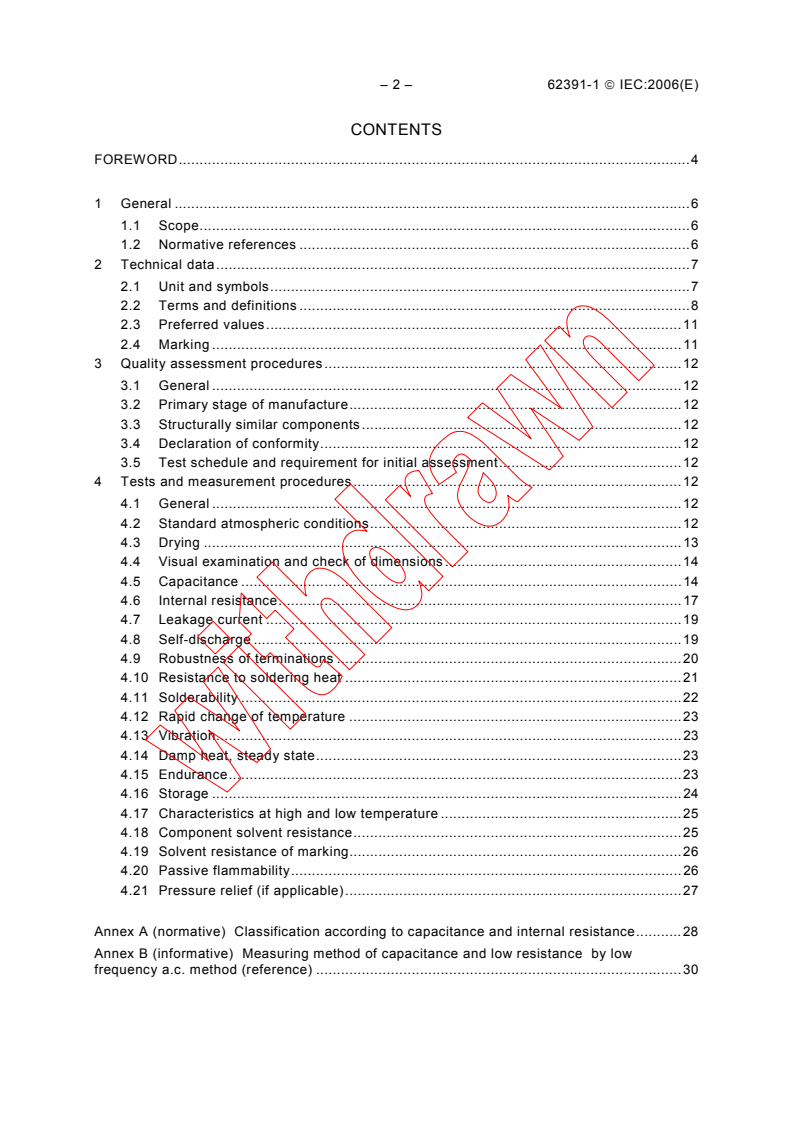
IEC 62391-1:2006 - Fixed electric double-layer capacitors for use in electronic equipment - Part 1: Generic specification Released:4/10/2006
IEC 62391-1:2006 - Fixed electric double-layer capacitors for use in electronic equipment - Part 1: Generic specification Released:4/10/2006
Overview
IEC 62391-1:2006 is the international generic specification for fixed electric double‑layer capacitors (commonly called supercapacitors) intended mainly for use in DC circuits of electronic equipment. The standard defines uniform terms, inspection procedures, and methods of test for use in sectional and detail specifications, supporting consistent quality assessment, product qualification and procurement.
Key Topics
The standard covers technical data, quality assessment and detailed test procedures, including:
- Units, symbols and terminology - alignment with IEC/ISO electrical vocabularies.
- Terms & definitions - type, style, grade, d.c. capacitor, rated capacitance, category temperature range, etc.
- Marking and preferred values - labelling and nominal value series for components.
- Quality assessment procedures - primary manufacture checks, structurally similar components, declaration of conformity and initial assessment test schedules.
- Tests and measurement procedures:
- Capacitance measurement methods (including low‑frequency a.c. reference in annex).
- Internal (equivalent series) resistance measurement.
- Leakage current and self‑discharge tests.
- Robustness of terminations, solderability and resistance to soldering heat.
- Environmental and mechanical tests: rapid temperature change, vibration, damp heat (steady state), endurance and storage.
- Solvent and marking resistance, passive flammability and pressure relief (where applicable).
- Annexes: classification by capacitance and internal resistance; reference measuring method for capacitance and low resistance.
Applications
IEC 62391-1 is practical for:
- Capacitor manufacturers - to define product specifications, quality control and type approval.
- Test laboratories - implementing standardized test methods for performance verification.
- OEMs and electronic designers - specifying components for backup power, energy buffering, power‑conditioning and other DC applications.
- Procurement and quality engineers - comparing suppliers, ensuring conformity and writing sectional/detail specifications.
- Certification bodies and standards writers - aligning national/regional specifications with international practice.
Using IEC 62391-1 helps ensure repeatable, comparable test results, safer component selection, and clearer supplier declarations for fixed electric double‑layer capacitors / supercapacitors.
Related standards
- IEC 62391-2 (Sectional specification - power application)
- IEC 60068 series (environmental testing)
- IEC 60027, IEC 60050 (symbols, vocabulary)
- IEC 60617 (graphical symbols)
- IEC 60695-11-5 (flammability test), IEC 61760-1 (SMD specification)
- ISO 1000 (SI units)
IEC 62391-1 is essential reading for anyone specifying, testing or sourcing fixed electric double‑layer capacitors in electronic equipment.
Relations
- Effective Date
- 05-Sep-2023
Buy Documents
IEC 62391-1:2006 - Fixed electric double-layer capacitors for use in electronic equipment - Part 1: Generic specification Released:4/10/2006
IEC 62391-1:2006 - Fixed electric double-layer capacitors for use in electronic equipment - Part 1: Generic specification Released:4/10/2006
Frequently Asked Questions
IEC 62391-1:2006 is a standard published by the International Electrotechnical Commission (IEC). Its full title is "Fixed electric double-layer capacitors for use in electronic equipment - Part 1: Generic specification". This standard covers: IEC 62391-1:2006 applies to fixed electric double layer capacitors (hereafter called "capacitor(s)") mainly used in DC circuits of electronic equipment. It establishes standard terms, inspection procedures and methods of test for use in sectional and detail specifications of electronic components for quality assessment or any other purpose.
IEC 62391-1:2006 applies to fixed electric double layer capacitors (hereafter called "capacitor(s)") mainly used in DC circuits of electronic equipment. It establishes standard terms, inspection procedures and methods of test for use in sectional and detail specifications of electronic components for quality assessment or any other purpose.
IEC 62391-1:2006 is classified under the following ICS (International Classification for Standards) categories: 31.060.10 - Fixed capacitors. The ICS classification helps identify the subject area and facilitates finding related standards.
IEC 62391-1:2006 has the following relationships with other standards: It is inter standard links to IEC 62391-1:2015. Understanding these relationships helps ensure you are using the most current and applicable version of the standard.
IEC 62391-1:2006 is available in PDF format for immediate download after purchase. The document can be added to your cart and obtained through the secure checkout process. Digital delivery ensures instant access to the complete standard document.
Standards Content (Sample)
INTERNATIONAL IEC
STANDARD 62391-1
First edition
2006-04
Fixed electric double-layer capacitors
for use in electronic equipment –
Part 1:
Generic specification
Reference number
Publication numbering
As from 1 January 1997 all IEC publications are issued with a designation in the
60000 series. For example, IEC 34-1 is now referred to as IEC 60034-1.
Consolidated editions
The IEC is now publishing consolidated versions of its publications. For example,
edition numbers 1.0, 1.1 and 1.2 refer, respectively, to the base publication, the
base publication incorporating amendment 1 and the base publication incorporating
amendments 1 and 2.
Further information on IEC publications
The technical content of IEC publications is kept under constant review by the IEC,
thus ensuring that the content reflects current technology. Information relating to
this publication, including its validity, is available in the IEC Catalogue of
publications (see below) in addition to new editions, amendments and corrigenda.
Information on the subjects under consideration and work in progress undertaken
by the technical committee which has prepared this publication, as well as the list
of publications issued, is also available from the following:
• IEC Web Site (www.iec.ch)
• Catalogue of IEC publications
The on-line catalogue on the IEC web site (www.iec.ch/searchpub) enables you to
search by a variety of criteria including text searches, technical committees
and date of publication. On-line information is also available on recently issued
publications, withdrawn and replaced publications, as well as corrigenda.
• IEC Just Published
This summary of recently issued publications (www.iec.ch/online_news/ justpub)
is also available by email. Please contact the Customer Service Centre (see
below) for further information.
• Customer Service Centre
If you have any questions regarding this publication or need further assistance,
please contact the Customer Service Centre:
Email: custserv@iec.ch
Tel: +41 22 919 02 11
Fax: +41 22 919 03 00
INTERNATIONAL IEC
STANDARD 62391-1
First edition
2006-04
Fixed electric double-layer capacitors
for use in electronic equipment –
Part 1:
Generic specification
IEC 2006 Copyright - all rights reserved
No part of this publication may be reproduced or utilized in any form or by any means, electronic or
mechanical, including photocopying and microfilm, without permission in writing from the publisher.
International Electrotechnical Commission, 3, rue de Varembé, PO Box 131, CH-1211 Geneva 20, Switzerland
Telephone: +41 22 919 02 11 Telefax: +41 22 919 03 00 E-mail: inmail@iec.ch Web: www.iec.ch
PRICE CODE
Commission Electrotechnique Internationale V
International Electrotechnical Commission
МеждународнаяЭлектротехническаяКомиссия
For price, see current catalogue
– 2 – 62391-1 IEC:2006(E)
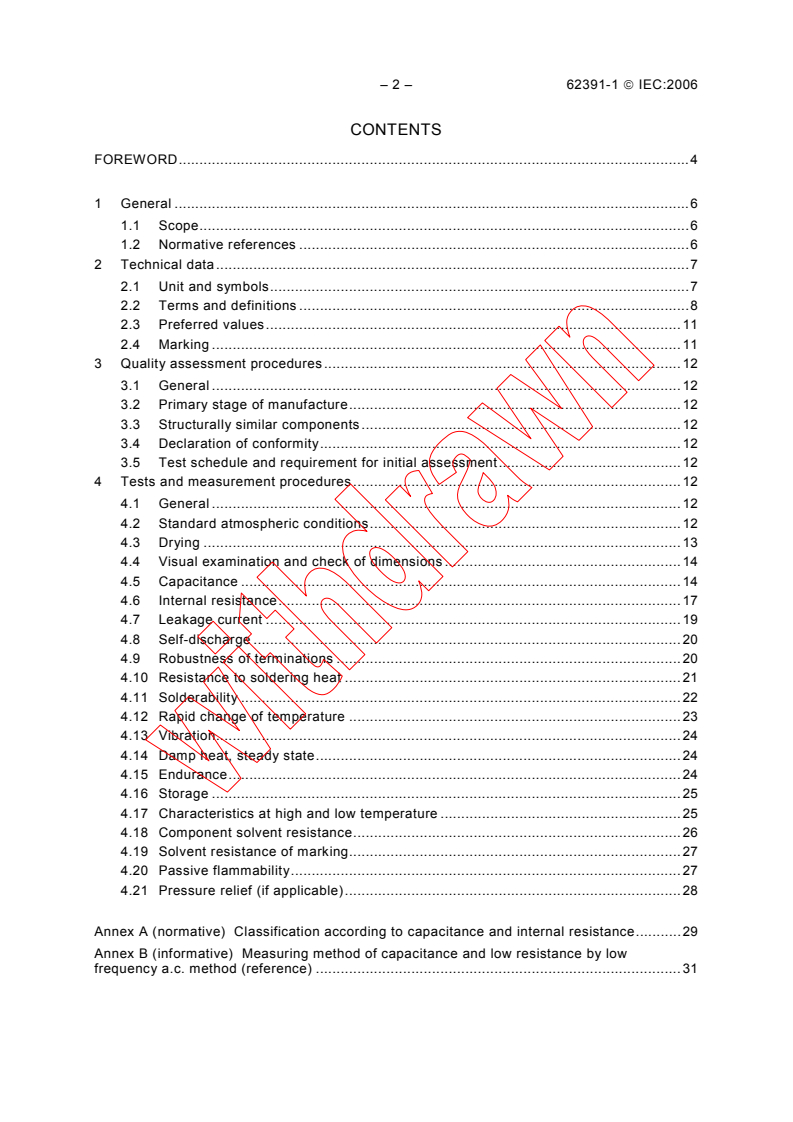
CONTENTS
FOREWORD.4
1 General .6
1.1 Scope.6
1.2 Normative references .6
2 Technical data.7
2.1 Unit and symbols.7
2.2 Terms and definitions .8
2.3 Preferred values.11
2.4 Marking .11
3 Quality assessment procedures.12
3.1 General .12
3.2 Primary stage of manufacture.12
3.3 Structurally similar components.12
3.4 Declaration of conformity.12
3.5 Test schedule and requirement for initial assessment.12
4 Tests and measurement procedures.12
4.1 General .12
4.2 Standard atmospheric conditions.12
4.3 Drying .13
4.4 Visual examination and check of dimensions.14
4.5 Capacitance .14
4.6 Internal resistance.17
4.7 Leakage current .19
4.8 Self-discharge .19
4.9 Robustness of terminations .20
4.10 Resistance to soldering heat .21
4.11 Solderability .22
4.12 Rapid change of temperature .23
4.13 Vibration.23
4.14 Damp heat, steady state.23
4.15 Endurance.23
4.16 Storage .24
4.17 Characteristics at high and low temperature .25
4.18 Component solvent resistance.25
4.19 Solvent resistance of marking.26
4.20 Passive flammability.26
4.21 Pressure relief (if applicable).27
Annex A (normative) Classification according to capacitance and internal resistance.28
Annex B (informative) Measuring method of capacitance and low resistance by low
frequency a.c. method (reference) .30
62391-1 IEC:2006(E) – 3 –
Figure 1 − Circuit for constant current discharge method .14
Figure 2 – Voltage characteristic between capacitor terminals .15
Figure 3 − Circuit for constant resistance charging method .16
Figure 4 − Circuit for a.c. resistance method.17
Figure 5 − Voltage characteristic between capacitor terminals .18
Figure 6 − Self-discharge test diagram .19
Figure A.1 − Conceptual rendering orientated by characteristics in each classification.29
Figure B.1 − Capacitance measuring system by low frequency a.c. method .30
Table 1 – Reference test: standard atmospheric conditions .13
Table 2 – Discharge conditions .15
Table 3 − Discharge current.18
Table 4 – Tensile force .20
Table 5 – Torque .21
Table 6 – Severities and requirements .27
Table A.1 − Measurement items for electric performance.29
– 4 – 62391-1 IEC:2006(E)
INTERNATIONAL ELECTROTECHNICAL COMMISSION
____________
FIXED ELECTRIC DOUBLE-LAYER CAPACITORS
FOR USE IN ELECTRONIC EQUIPMENT
Part 1: Generic specification
FOREWORD
1) The International Electrotechnical Commission (IEC) is a worldwide organization for standardization comprising
all national electrotechnical committees (IEC National Committees). The object of IEC is to promote
international co-operation on all questions concerning standardization in the electrical and electronic fields. To
this end and in addition to other activities, IEC publishes International Standards, Technical Specifications,
Technical Reports, Publicly Available Specifications (PAS) and Guides (hereafter referred to as “IEC
Publication(s)”). Their preparation is entrusted to technical committees; any IEC National Committee interested
in the subject dealt with may participate in this preparatory work. International, governmental and non-
governmental organizations liaising with the IEC also participate in this preparation. IEC collaborates closely
with the International Organization for Standardization (ISO) in accordance with conditions determined by
agreement between the two organizations.
2) The formal decisions or agreements of IEC on technical matters express, as nearly as possible, an international
consensus of opinion on the relevant subjects since each technical committee has representation from all
interested IEC National Committees.
3) IEC Publications have the form of recommendations for international use and are accepted by IEC National
Committees in that sense. While all reasonable efforts are made to ensure that the technical content of IEC
Publications is accurate, IEC cannot be held responsible for the way in which they are used or for any
misinterpretation by any end user.
4) In order to promote international uniformity, IEC National Committees undertake to apply IEC Publications
transparently to the maximum extent possible in their national and regional publications. Any divergence
between any IEC Publication and the corresponding national or regional publication shall be clearly indicated in
the latter.
5) IEC provides no marking procedure to indicate its approval and cannot be rendered responsible for any
equipment declared to be in conformity with an IEC Publication.
6) All users should ensure that they have the latest edition of this publication.
7) No liability shall attach to IEC or its directors, employees, servants or agents including individual experts and
members of its technical committees and IEC National Committees for any personal injury, property damage or
other damage of any nature whatsoever, whether direct or indirect, or for costs (including legal fees) and
expenses arising out of the publication, use of, or reliance upon, this IEC Publication or any other IEC
Publications.
8) Attention is drawn to the Normative references cited in this publication. Use of the referenced publications is
indispensable for the correct application of this publication.
9) Attention is drawn to the possibility that some of the elements of this IEC Publication may be the subject of
patent rights. IEC shall not be held responsible for identifying any or all such patent rights.
International Standard IEC 62391-1 has been prepared by IEC technical committee 40:
Capacitors and resistors for electronic equipment.
The text of this standard is based on the following documents:
FDIS Report on voting
40/1640/FDIS 40/1712/RVD
Full information on the voting for the approval of this standard can be found in the report on
voting indicated in the above table.
This publication has been drafted in accordance with the ISO/IEC Directives, Part 2.
62391-1 IEC:2006(E) – 5 –
IEC 62391 consists of the following parts, under the general title Fixed electric double layer
capacitors for use in electronic equipment
Part 1: Generic specification
Part 2: Sectional specification – Electric double-layer capacitors for power application
The sectional specification mentioned above does have a blank detail specification being a
supplementary document, containing requirements for style, layout and minimum content of
detail specifications.
The committee has decided that the contents of this publication will remain unchanged until
the maintenance result date indicated on the IEC web site under "http://webstore.iec.ch" in
the data related to the specific publication. At this date, the publication will be
• reconfirmed;
• withdrawn;
• replaced by a revised edition, or
• amended.
A bilingual version of this standard may be issued at a later date.
– 6 – 62391-1 IEC:2006(E)
FIXED ELECTRIC DOUBLE-LAYER CAPACITORS
FOR USE IN ELECTRONIC EQUIPMENT
Part 1: Generic specification
1 General
1.1 Scope
This part of IEC 62391 applies to fixed electric double layer capacitors (hereafter called
“capacitor(s)”) mainly used in DC circuits of electronic equipment.
It establishes standard terms, inspection procedures and methods of test for use in sectional
and detail specifications of electronic components for quality assessment or any other
purpose.
1.2 Normative references
The following referenced documents are indispensable for the application of this document.
For dated references, only the edition cited applies. For undated references, the latest edition
of the referenced document (including any amendments) applies.
IEC 60027 (all parts), Letter symbols to be used in electrical technology
IEC 60050 (all parts), International Electrotechnical Vocabulary (IEV)
IEC 60062, Marking codes for resistors and capacitors
IEC 60063, Preferred number series for resistors and capacitors
IEC 60068-1:1988, Environmental testing – Part 1: General and guidance
Amendment 1 (1992)
IEC 60068-2-1:1990, Environmental testing – Part 2: Tests – Tests A: Cold
Amendment 1 (1993)
Amendment 2 (1994)
IEC 60068-2-2:1974, Environmental testing – Part 2: Tests – Tests B: Dry Heat
Amendment 1 (1993)
Amendment 2 (1994)
IEC 60068-2-6:1995, Environmental testing – Part 2: Tests – Test Fc: Vibration (sinusoidal)
IEC 60068-2-14:1984, Environmental testing – Part 2: Tests – Test N: Change of temperature
Amendment 1 (1986)
IEC 60068-2-20:1979, Environmental testing – Part 2: Tests – Test T: Soldering
Amendment 2 (1987)
IEC 60068-2-21:1999, Environmental testing – Part 2-21: Tests – Test U: Robustness of
terminations and integral mounting devices
62391-1 IEC:2006(E) – 7 –
IEC 60068-2-45:1980, Environmental testing – Part 2: Tests – Test XA and guidance:
Immersion in cleaning solvents
Amendment 1 (1993)
IEC 60068-2-47:1999, Environmental testing – Part 2-47: Test methods – Mounting of
components, equipment and other articles for vibration, impact and similar dynamic tests
IEC 60068-2-58:2004, Environmental testing – Part 2-58: Tests – Test Td: Test methods for
solderability, resistance to dissolution of metallization and to soldering heat of surface
mounting devices (SMD)
IEC 60068-2-78:2001, Environmental testing – Part 2-78: Tests – Test Cab: Damp heat,
steady state.
IEC 60294:1969, Measurement of the dimensions of a cylindrical component having two axial
terminations
IEC 60617 (all parts) [DB] , Graphical symbols for diagrams
IEC 60695-11-5: Fire hazard testing – Part 11-5: Test flames – Needle-flame test method:
Apparatus, confirmatory test arrangement and guidance
IEC 60717:1981, Method for the determination of the space required by capacitors and
resistors with unidirectional terminations
IEC 61760-1:1998, Surface mounting technology – Part 1: Standard method for the
specification of surface mounting components (SMDs)
QC001002-3, Rules of procedure – Part 3: Approval procedures
ISO 1000:1992, SI units and recommendations for the use of their multiples and of certain
other units
2 Technical data
2.1 Unit and symbols
Units, graphical symbols, letter symbols and terminology shall, whenever possible, be taken
from the following publications:
– IEC 60027
– IEC 60050
– IEC 60617
– ISO 1000
When further items are required they should be derived in accordance with the principles of
the publications listed above.
___________
“DB” refers to the IEC on-line database.
To be published.
– 8 – 62391-1 IEC:2006(E)
2.2 Terms and definitions
For the purpose of this document, the following definitions apply:
2.2.1
type
group of components having similar design features and the similarity of whose manufacturing
techniques enables them to be grouped together either for qualification approval or for quality
conformance inspection; they are generally covered by a single detail specification
NOTE Components described in several detail specifications, may, in some cases, be considered as belonging to
the same type.
2.2.2
style
subdivision of a type, generally based on dimensional factors; a style may include several
variants, generally of a mechanical order
2.2.3
grade
term to indicate an additional general characteristic concerning the intended application of the
component which may only be used in combination with one or more words (e.g. long life
grade) and not by a single letter or number
2.2.4
family (of electronic components)
group of components which predominantly displays a particular physical attribute and/or fulfils
a defined function
2.2.5
subfamily (of electronic components)
group of components within a family manufactured by similar technological methods
2.2.6
d.c. capacitor
capacitor designed essentially for application with direct voltage
NOTE A d.c. capacitor may not be suitable for use on a.c. supplies.
2.2.7
rated capacitance
C
R
designated capacitance value usually indicated on the capacitor
2.2.8
category temperature range
range of ambient temperatures for which the capacitor has been designed to operate
continuously; this is given by the lower and upper category temperature
2.2.9
lower category temperature
minimum ambient temperature for which a capacitor has been designed to operate
continuously
2.2.10
upper category temperature
maximum ambient temperature for which a capacitor has been designed to operate
continuously
62391-1 IEC:2006(E) – 9 –
2.2.11
rated temperature
maximum ambient temperature at which the rated voltage may be continuously applied
2.2.12
rated voltage (d.c.)
U
R
maximum direct voltage or peak value of pulse voltage which may be applied continuously to
a capacitor at any temperature between the lower category temperature and the rated
temperature
2.2.13
category voltage
U
C
maximum voltage which may be applied continuously to a capacitor at its upper category
temperature
2.2.14
temperature derated voltage
maximum voltage that may be applied continuously to a capacitor when it is at any
temperature between the rated temperature and the upper category temperature
NOTE Information on the voltage/temperature dependence at temperatures between the rated temperature and
the upper category temperature should, if applicable, be given in the relevant specification.
2.2.15
surge voltage ratio
quotient of the maximum instantaneous voltage which may be applied to the terminations of
the capacitor for a specified time at any temperature within the category temperature range
and the rated voltage or the temperature derated voltage, as appropriate
NOTE The number of times per hour that this voltage may be applied should be specified.
2.2.16
rated ripple voltage
r.m.s. value of the maximum allowable alternating voltage at a specified frequency
superimposed on the d.c. voltage at which the capacitor may be operated continuously at a
specified temperature
NOTE The sum of the direct voltage and the peak value of the alternating voltage applied to the capacitor should
not exceed the rated voltage or temperature derated voltage as applicable.
2.2.17
reverse voltage (for polar capacitors only)
voltage applied to the capacitor terminations in the reverse polarity direction
2.2.18
rated ripple current
r.m.s. value of the maximum allowable alternating current of a specified frequency, at which
the capacitor may be operated continuously at a specified temperature
2.2.19
time constant
product of the internal resistance (including circuit resistance) and the capacitance, normally
expressed in seconds
2.2.20
internal resistance
expresses the resistance component in an equivalent series circuit of capacitance and
resistance of a capacitor, given in ohms (Ω)
– 10 – 62391-1 IEC:2006(E)
2.2.21
IR drop
voltage drop between the capacitor terminals that is generated at the start of discharge and
quantified by the product of the discharge current and the internal resistance of the capacitor
2.2.22
maximum temperature of a capacitor
temperature at the hottest point of its external surface
NOTE The terminations are considered to be part of the external surface.
2.2.23
minimum temperature of a capacitor
temperature at the coldest point of the external surface
NOTE The terminations are considered to be part of the external surface.
2.2.24
minimum storage temperature
minimum ambient temperature which the capacitor should withstand in the non-operating
condition without damage
2.2.25
maximum storage temperature
maximum ambient temperature which is equal to the upper category temperature of the
capacitor
2.2.26
temperature characteristic of capacitance
maximum reversible variation of capacitance produced over a given temperature range within
the category temperature range, normally expressed as a percentage of the capacitance
related to a reference temperature of 20 °C
NOTE The term characterizing this property applies mainly to capacitors of which the variations of capacitance as
a function of temperature, linear or non-linear, cannot be expressed with precision and certainty.
2.2.27
visible damage
visible damage which reduces the usability of the capacitor for its intended purpose
2.2.28
leakage current
value of the current that flows through a capacitor after a charge for a fixed period of time,
given in amperes (A)
2.2.29
self discharge
voltage held while being left for a fixed period of time under no load after a charge for a fixed
period of time
2.2.30
temperature rise
temperature rise of the capacitor relative to the ambient temperature resulting from the losses
in the capacitor due to operation under a.c. or pulse conditions
2.2.31
insulated capacitor
capacitor in which all terminations of a section may be raised to a potential different (but not
less than the rated voltage) from that of any conducting surface with which the case is liable
to come into contact in normal use
62391-1 IEC:2006(E) – 11 –
2.2.32
uninsulated capacitor
capacitor in which one or more of the terminations of a section cannot be raised to a potential
different (but not less than the rated voltage) from that of any conducting surface with which
the case is liable to come into contact in normal use
2.2.33
surface mount capacitor
fixed capacitor whose small dimensions and nature or shape of terminations make it suitable
for use in hybrid circuits and on printed boards
2.2.34
passive flammability
flammability caused by external heating of the component (e.g. by flames)
2.2.35
active flammability
flammability (self-ignition) caused by internal heating of the component (e.g. sparking due to
insufficient internal contact)
2.2.36
category of passive flammability
category of passive flammability is given by the maximum burning time after a specified time
of flame application
2.2.37
mass
mass of the component with all fixed parts
2.2.38
volume
component body without terminations
2.3 Preferred values
2.3.1 General
Each sectional specification shall prescribe the preferred values appropriate to the subfamily;
for rated capacitance, see also 2.3.2.
2.3.2 Preferred values of rated capacitance
The preferred values of rated capacitance shall be taken from the series specified in
IEC 60063.
2.4 Marking
2.4.1 General
The sectional specification shall indicate the identification criteria and other information to be
shown on the capacitor and/or packing.
The order of priority for marking small capacitors shall be specified.
2.4.2 Coding
When coding is used for capacitance value, tolerance or date of manufacture, the method
shall be selected from those given in IEC 60062.
– 12 – 62391-1 IEC:2006(E)
3 Quality assessment procedures
3.1 General
When this standard, and any related standards are used for the purpose of a full quality
assessment system such as IEC Quality Assessment System for Electronic Components
(IECQ), compliance with IEC QC 001002-3 is required.
3.2 Primary stage of manufacture
The primary stage of manufacture shall be specified in the sectional specification.
3.3 Structurally similar components
The structurally similar components shall be specified in the sectional specification.
3.4 Declaration of conformity
The declaration of conformity shall be specified in the sectional specification.
3.5 Test schedule and requirement for initial assessment
The test schedule and requirement for initial assessment shall be specified in the sectional
specification.
4 Tests and measurement procedures
4.1 General
The sectional and/or blank detail specification shall indicate the tests to be made, which
measurements are to be made before and after each test or subgroup of tests, and the
sequence in which they shall be made. The stages of each test shall be carried out in the
order written. The measuring conditions shall be the same for initial and final measurements.
If national specifications within any quality assessment system include methods other than
those specified in the above specifications, they shall be fully described.
Limits given in all specifications are absolute limits. The principle to take measurement
uncertainty into account shall be applied (see Annex C to Clause 2 of IEC QC 001002-3).
4.2 Standard atmospheric conditions
4.2.1 Standard atmospheric conditions for testing
Unless otherwise specified, all tests and measurements shall be made under standard
atmospheric conditions for testing as given in 5.3 of IEC 60068-1:
– temperature: 15 °C to 35 °C;
– relative humidity: 25 % to 75 %;
– air pressure: 86 kPa to 106 kPa.
Before the measurements are made, the capacitor shall be stored at the measuring
temperature for a time sufficient to allow the entire capacitor to reach this temperature. The
period as prescribed for recovery at the end of a test is normally sufficient for this purpose.
62391-1 IEC:2006(E) – 13 –
When measurements are made at a temperature other than the specified temperature, the
results shall, where necessary, be corrected to the specified temperature. The ambient
temperature during the measurements shall be stated in the test report. In the event of a
dispute, the measurements shall be repeated using one of the referee temperatures (as given
in 4.2.3) and such other conditions as are prescribed in this specification.
When tests are conducted in a sequence, the final measurements of one test may be taken as
the initial measurements for the succeeding test.
During measurements the capacitor shall not be exposed to draughts, direct sunlight or other
influences likely to cause error.
4.2.2 Recovery conditions
Unless otherwise specified, recovery shall take place under the standard atmospheric
conditions for testing (4.2.1).
If recovery under closely controlled conditions is necessary, the controlled recovery
conditions of 5.4.1 of IEC 60068-1 shall be used.
Unless otherwise specified in the relevant specification, a duration of 1 h to 2 h shall be used.
4.2.3 Referee conditions
For referee purposes, one of the standard atmospheric conditions for referee tests taken from
5.2 of IEC 60068-1, as given in Table 1 below, shall be selected:
Table 1 – Reference test: standard atmospheric conditions
Temperature Relative humidity Air pressure
°C % kPa
20 ± 1 63 to 67 86 to 106
23 ± 1 48 to 52 86 to 106
25 ± 1 48 to 52 86 to 106
27 ± 1 63 to 67 86 to 106
4.2.4 Reference conditions
For reference purposes, the standard atmospheric conditions for reference given in 5.1 of
IEC 60068-1 apply:
– temperature: 20 °C;
– air pressure: 101,3 kPa.
4.3 Drying
Unless otherwise specified in the relevant specification, the capacitor shall be conditioned for
96 h ± 4 h by heating in a circulating air oven at a temperature of 55 °C ± 2 °C and a relative
humidity not exceeding 20 %.
The capacitor shall then be allowed to cool in a desiccator using a suitable desiccant, such as
activated alumina or silica gel, and shall be kept therein from the time of removal from the
oven to the beginning of the specified tests.
○
○ ● ●
●
○
– 14 – 62391-1 IEC:2006(E)
4.4 Visual examination and check of dimensions
4.4.1 Visual examination
The condition, workmanship and finish shall be satisfactory, as checked by visual examination.
Marking shall be legible, as checked by visual examination and shall conform to the
requirements of the detail specification.
4.4.2 Dimensions (gauging)
The dimensions indicated in the detail specification as being suitable for gauging shall be
checked, and shall comply with the values prescribed in the detail specification.
When applicable, measurements shall be made in accordance with IEC 60294 or IEC 60717.
4.4.3 Dimensions (detail)
All dimensions prescribed in the detail specification shall be checked and shall comply with
the values prescribed.
4.5 Capacitance
4.5.1 Constant current discharge method
4.5.1.1 Measuring circuit
A
S
Constant current/ Constant Current
+
constant voltage
Discharger
C
x
V
power supply
Key
d.c. ammeter
A
d.c. voltmeter
V
S changeover switch
C capacitor under test
x
Figure 1 − Circuit for constant current discharge method
4.5.1.2 Measuring method
a) If the d.c. voltage of the constant current/constant voltage power supply is not specified in
the individual standards, set at the rated voltage (U ).
R
b) Set the constant current value of the c
...
IEC 62391-1 ®
Edition 1.0 2006-04
INTERNATIONAL
STANDARD
NORME
INTERNATIONALE
Fixed electric double-layer capacitors for use in electronic equipment –
Part 1: Generic specification
Condensateurs électriques fixes à double couche utilisés dans les équipements
électroniques –
Partie 1: Spécification générique
All rights reserved. Unless otherwise specified, no part of this publication may be reproduced or utilized in any form
or by any means, electronic or mechanical, including photocopying and microfilm, without permission in writing from
either IEC or IEC's member National Committee in the country of the requester.
If you have any questions about IEC copyright or have an enquiry about obtaining additional rights to this publication,
please contact the address below or your local IEC member National Committee for further information.
Droits de reproduction réservés. Sauf indication contraire, aucune partie de cette publication ne peut être reproduite ni
utilisée sous quelque forme que ce soit et par aucun procédé, électronique ou mécanique, y compris la photocopie et les
microfilms, sans l'accord écrit de la CEI ou du Comité national de la CEI du pays du demandeur.
Si vous avez des questions sur le copyright de la CEI ou si vous désirez obtenir des droits supplémentaires sur cette
publication, utilisez les coordonnées ci-après ou contactez le Comité national de la CEI de votre pays de résidence.
IEC Central Office Tel.: +41 22 919 02 11
3, rue de Varembé Fax: +41 22 919 03 00
CH-1211 Geneva 20 info@iec.ch
Switzerland www.iec.ch
About the IEC
The International Electrotechnical Commission (IEC) is the leading global organization that prepares and publishes
International Standards for all electrical, electronic and related technologies.
About IEC publications
The technical content of IEC publications is kept under constant review by the IEC. Please make sure that you have the
latest edition, a corrigenda or an amendment might have been published.
Useful links:
IEC publications search - www.iec.ch/searchpub Electropedia - www.electropedia.org
The advanced search enables you to find IEC publications The world's leading online dictionary of electronic and
by a variety of criteria (reference number, text, technical electrical terms containing more than 30 000 terms and
committee,…). definitions in English and French, with equivalent terms in
It also gives information on projects, replaced and additional languages. Also known as the International
withdrawn publications. Electrotechnical Vocabulary (IEV) on-line.
IEC Just Published - webstore.iec.ch/justpublished Customer Service Centre - webstore.iec.ch/csc
Stay up to date on all new IEC publications. Just Published If you wish to give us your feedback on this publication
details all new publications released. Available on-line and or need further assistance, please contact the
also once a month by email. Customer Service Centre: csc@iec.ch.
A propos de la CEI
La Commission Electrotechnique Internationale (CEI) est la première organisation mondiale qui élabore et publie des
Normes internationales pour tout ce qui a trait à l'électricité, à l'électronique et aux technologies apparentées.
A propos des publications CEI
Le contenu technique des publications de la CEI est constamment revu. Veuillez vous assurer que vous possédez
l’édition la plus récente, un corrigendum ou amendement peut avoir été publié.
Liens utiles:
Recherche de publications CEI - www.iec.ch/searchpub Electropedia - www.electropedia.org
La recherche avancée vous permet de trouver des Le premier dictionnaire en ligne au monde de termes
publications CEI en utilisant différents critères (numéro de électroniques et électriques. Il contient plus de 30 000
référence, texte, comité d’études,…). termes et définitions en anglais et en français, ainsi que
Elle donne aussi des informations sur les projets et les les termes équivalents dans les langues additionnelles.
publications remplacées ou retirées. Egalement appelé Vocabulaire Electrotechnique
International (VEI) en ligne.
Just Published CEI - webstore.iec.ch/justpublished
Service Clients - webstore.iec.ch/csc
Restez informé sur les nouvelles publications de la CEI.
Just Published détaille les nouvelles publications parues. Si vous désirez nous donner des commentaires sur
Disponible en ligne et aussi une fois par mois par email. cette publication ou si vous avez des questions
contactez-nous: csc@iec.ch.
IEC 62391-1 ®
Edition 1.0 2006-04
INTERNATIONAL
STANDARD
NORME
INTERNATIONALE
Fixed electric double-layer capacitors for use in electronic equipment –
Part 1: Generic specification
Condensateurs électriques fixes à double couche utilisés dans les équipements
électroniques –
Partie 1: Spécification générique
INTERNATIONAL
ELECTROTECHNICAL
COMMISSION
COMMISSION
ELECTROTECHNIQUE
PRICE CODE
INTERNATIONALE
CODE PRIX V
ICS 31.060.10 ISBN 978-2-83220-140-4
– 2 – 62391-1 IEC:2006
CONTENTS
FOREWORD . 4
1 General . 6
1.1 Scope . 6
1.2 Normative references . 6
2 Technical data . 7
2.1 Unit and symbols . 7
2.2 Terms and definitions . 8
2.3 Preferred values . 11
2.4 Marking . 11
3 Quality assessment procedures . 12
3.1 General . 12
3.2 Primary stage of manufacture . 12
3.3 Structurally similar components . 12
3.4 Declaration of conformity . 12
3.5 Test schedule and requirement for initial assessment . 12
4 Tests and measurement procedures . 12
4.1 General . 12
4.2 Standard atmospheric conditions . 12
4.3 Drying . 13
4.4 Visual examination and check of dimensions . 14
4.5 Capacitance . 14
4.6 Internal resistance . 17
4.7 Leakage current . 19
4.8 Self-discharge . 20
4.9 Robustness of terminations . 20
4.10 Resistance to soldering heat . 21
4.11 Solderability . 22
4.12 Rapid change of temperature . 23
4.13 Vibration. 24
4.14 Damp heat, steady state . 24
4.15 Endurance . 24
4.16 Storage . 25
4.17 Characteristics at high and low temperature . 25
4.18 Component solvent resistance . 26
4.19 Solvent resistance of marking . 27
4.20 Passive flammability . 27
4.21 Pressure relief (if applicable) . 28
Annex A (normative) Classification according to capacitance and internal resistance . 29
Annex B (informative) Measuring method of capacitance and low resistance by low
frequency a.c. method (reference) . 31
62391-1 IEC:2006 – 3 –
Figure 1 − Circuit for constant current discharge method . 14
Figure 2 – Voltage characteristic between capacitor terminals . 15
Figure 3 − Circuit for constant resistance charging method . 16
Figure 4 − Circuit for a.c. resistance method . 17
Figure 5 − Voltage characteristic between capacitor terminals . 19
Figure 6 − Self-discharge test diagram . 20
Figure A.1 − Conceptual rendering orientated by characteristics in each classification . 30
Figure B.1 − Capacitance measuring system by low frequency a.c. method . 31
Table 1 – Reference test: standard atmospheric conditions . 13
Table 2 – Discharge conditions . 15
Table 3 − Discharge current . 18
Table 4 – Tensile force . 21
Table 5 – Torque . 21
Table 6 – Severities and requirements . 28
Table A.1 − Measurement items for electric performance . 30
– 4 – 62391-1 IEC:2006
INTERNATIONAL ELECTROTECHNICAL COMMISSION
____________
FIXED ELECTRIC DOUBLE-LAYER CAPACITORS
FOR USE IN ELECTRONIC EQUIPMENT –
Part 1: Generic specification
FOREWORD
1) The International Electrotechnical Commission (IEC) is a worldwide organization for standardization comprising
all national electrotechnical committees (IEC National Committees). The object of IEC is to promote
international co-operation on all questions concerning standardization in the electrical and electronic fields. To
this end and in addition to other activities, IEC publishes International Standards, Technical Specifications,
Technical Reports, Publicly Available Specifications (PAS) and Guides (hereafter referred to as “IEC
Publication(s)”). Their preparation is entrusted to technical committees; any IEC National Committee interested
in the subject dealt with may participate in this preparatory work. International, governmental and non-
governmental organizations liaising with the IEC also participate in this preparation. IEC collaborates closely
with the International Organization for Standardization (ISO) in accordance with conditions determined by
agreement between the two organizations.
2) The formal decisions or agreements of IEC on technical matters express, as nearly as possible, an international
consensus of opinion on the relevant subjects since each technical committee has representation from all
interested IEC National Committees.
3) IEC Publications have the form of recommendations for international use and are accepted by IEC National
Committees in that sense. While all reasonable efforts are made to ensure that the technical content of IEC
Publications is accurate, IEC cannot be held responsible for the way in which they are used or for any
misinterpretation by any end user.
4) In order to promote international uniformity, IEC National Committees undertake to apply IEC Publications
transparently to the maximum extent possible in their national and regional publications. Any divergence
between any IEC Publication and the corresponding national or regional publication shall be clearly indicated in
the latter.
5) IEC provides no marking procedure to indicate its approval and cannot be rendered responsible for any
equipment declared to be in conformity with an IEC Publication.
6) All users should ensure that they have the latest edition of this publication.
7) No liability shall attach to IEC or its directors, employees, servants or agents including individual experts and
members of its technical committees and IEC National Committees for any personal injury, property damage or
other damage of any nature whatsoever, whether direct or indirect, or for costs (including legal fees) and
expenses arising out of the publication, use of, or reliance upon, this IEC Publication or any other IEC
Publications.
8) Attention is drawn to the Normative references cited in this publication. Use of the referenced publications is
indispensable for the correct application of this publication.
9) Attention is drawn to the possibility that some of the elements of this IEC Publication may be the subject of
patent rights. IEC shall not be held responsible for identifying any or all such patent rights.
International Standard IEC 62391-1 has been prepared by IEC technical committee 40:
Capacitors and resistors for electronic equipment.
This bilingual version (2012-06) corresponds to the monolingual English version, published in
2006-04.
The text of this standard is based on the following documents:
FDIS Report on voting
40/1640/FDIS 40/1712/RVD
Full information on the voting for the approval of this standard can be found in the report on
voting indicated in the above table.
The French version of this standard has not been voted upon.
62391-1 IEC:2006 – 5 –
This publication has been drafted in accordance with the ISO/IEC Directives, Part 2.
IEC 62391 consists of the following parts, under the general title Fixed electric double layer
capacitors for use in electronic equipment
Part 1: Generic specification
Part 2: Sectional specification – Electric double-layer capacitors for power application
The sectional specification mentioned above does have a blank detail specification being a
supplementary document, containing requirements for style, layout and minimum content of
detail specifications.
The committee has decided that the contents of this publication will remain unchanged until
the maintenance result date indicated on the IEC web site under "http://webstore.iec.ch" in
the data related to the specific publication. At this date, the publication will be
• reconfirmed;
• withdrawn;
• replaced by a revised edition, or
• amended.
– 6 – 62391-1 IEC:2006
FIXED ELECTRIC DOUBLE-LAYER CAPACITORS
FOR USE IN ELECTRONIC EQUIPMENT –
Part 1: Generic specification
1 General
1.1 Scope
This part of IEC 62391 applies to fixed electric double layer capacitors (hereafter called
“capacitor(s)”) mainly used in DC circuits of electronic equipment.
It establishes standard terms, inspection procedures and methods of test for use in sectional
and detail specifications of electronic components for quality assessment or any other
purpose.
1.2 Normative references
The following referenced documents are indispensable for the application of this document.
For dated references, only the edition cited applies. For undated references, the latest edition
of the referenced document (including any amendments) applies.
IEC 60027 (all parts), Letter symbols to be used in electrical technology
IEC 60050 (all parts), International Electrotechnical Vocabulary (IEV)
IEC 60062, Marking codes for resistors and capacitors
IEC 60063, Preferred number series for resistors and capacitors
IEC 60068-1:1988, Environmental testing – Part 1: General and guidance
Amendment 1 (1992)
IEC 60068-2-1:1990, Environmental testing – Part 2: Tests – Tests A: Cold
Amendment 1 (1993)
Amendment 2 (1994)
IEC 60068-2-2:1974, Environmental testing – Part 2: Tests – Tests B: Dry Heat
Amendment 1 (1993)
Amendment 2 (1994)
IEC 60068-2-6:1995, Environmental testing – Part 2: Tests – Test Fc: Vibration (sinusoidal)
IEC 60068-2-14:1984, Environmental testing – Part 2: Tests – Test N: Change of temperature
Amendment 1 (1986)
IEC 60068-2-20:1979, Environmental testing – Part 2: Tests – Test T: Soldering
Amendment 2 (1987)
IEC 60068-2-21:1999, Environmental testing – Part 2-21: Tests – Test U: Robustness of
terminations and integral mounting devices
62391-1 IEC:2006 – 7 –
IEC 60068-2-45:1980, Environmental testing – Part 2: Tests – Test XA and guidance:
Immersion in cleaning solvents
Amendment 1 (1993)
IEC 60068-2-47:1999, Environmental testing – Part 2-47: Test methods – Mounting of
components, equipment and other articles for vibration, impact and similar dynamic tests
IEC 60068-2-58:2004, Environmental testing – Part 2-58: Tests – Test Td: Test methods for
solderability, resistance to dissolution of metallization and to soldering heat of surface
mounting devices (SMD)
IEC 60068-2-78:2001, Environmental testing – Part 2-78: Tests – Test Cab: Damp heat,
steady state.
IEC 60294:1969, Measurement of the dimensions of a cylindrical component having two axial
terminations
IEC 60617 (all parts) [DB] , Graphical symbols for diagrams
IEC 60695-11-5: Fire hazard testing – Part 11-5: Test flames – Needle-flame test method:
Apparatus, confirmatory test arrangement and guidance
IEC 60717:1981, Method for the determination of the space required by capacitors and
resistors with unidirectional terminations
IEC 61760-1:1998, Surface mounting technology – Part 1: Standard method for the
specification of surface mounting components (SMDs)
QC001002-3, Rules of procedure – Part 3: Approval procedures
ISO 1000:1992, SI units and recommendations for the use of their multiples and of certain
other units
2 Technical data
2.1 Unit and symbols
Units, graphical symbols, letter symbols and terminology shall, whenever possible, be taken
from the following publications:
– IEC 60027
– IEC 60050
– IEC 60617
– ISO 1000
When further items are required they should be derived in accordance with the principles of
the publications listed above.
___________
DB” refers to the IEC on-line database.
– 8 – 62391-1 IEC:2006
2.2 Terms and definitions
For the purpose of this document, the following terms and definitions apply:
2.2.1
type
group of components having similar design features and the similarity of whose manufacturing
techniques enables them to be grouped together either for qualification approval or for quality
conformance inspection; they are generally covered by a single detail specification
NOTE Components described in several detail specifications, may, in some cases, be considered as belonging to
the same type.
2.2.2
style
subdivision of a type, generally based on dimensional factors; a style may include several
variants, generally of a mechanical order
2.2.3
grade
term to indicate an additional general characteristic concerning the intended application of the
component which may only be used in combination with one or more words (e.g. long life
grade) and not by a single letter or number
2.2.4
family (of electronic components)
group of components which predominantly displays a particular physical attribute and/or fulfils
a defined function
2.2.5
subfamily (of electronic components)
group of components within a family manufactured by similar technological methods
2.2.6
d.c. capacitor
capacitor designed essentially for application with direct voltage
NOTE A d.c. capacitor may not be suitable for use on a.c. supplies.
2.2.7
rated capacitance
C
R
designated capacitance value usually indicated on the capacitor
2.2.8
category temperature range
range of ambient temperatures for which the capacitor has been designed to operate
continuously; this is given by the lower and upper category temperature
2.2.9
lower category temperature
minimum ambient temperature for which a capacitor has been designed to operate
continuously
2.2.10
upper category temperature
maximum ambient temperature for which a capacitor has been designed to operate
continuously
62391-1 IEC:2006 – 9 –
2.2.11
rated temperature
maximum ambient temperature at which the rated voltage may be continuously applied
2.2.12
rated voltage (d.c.)
U
R
maximum direct voltage or peak value of pulse voltage which may be applied continuously to
a capacitor at any temperature between the lower category temperature and the rated
temperature
2.2.13
category voltage
U
C
maximum voltage which may be applied continuously to a capacitor at its upper category
temperature
2.2.14
temperature derated voltage
maximum voltage that may be applied continuously to a capacitor when it is at any
temperature between the rated temperature and the upper category temperature
NOTE Information on the voltage/temperature dependence at temperatures between the rated temperature and
the upper category temperature should, if applicable, be given in the relevant specification.
2.2.15
surge voltage ratio
quotient of the maximum instantaneous voltage which may be applied to the terminations of
the capacitor for a specified time at any temperature within the category temperature range
and the rated voltage or the temperature derated voltage, as appropriate
NOTE The number of times per hour that this voltage may be applied should be specified.
2.2.16
rated ripple voltage
r.m.s. value of the maximum allowable alternating voltage at a specified frequency
superimposed on the d.c. voltage at which the capacitor may be operated continuously at a
specified temperature
NOTE The sum of the direct voltage and the peak value of the alternating voltage applied to the capacitor should
not exceed the rated voltage or temperature derated voltage as applicable.
2.2.17
reverse voltage (for polar capacitors only)
voltage applied to the capacitor terminations in the reverse polarity direction
2.2.18
rated ripple current
r.m.s. value of the maximum allowable alternating current of a specified frequency, at which
the capacitor may be operated continuously at a specified temperature
2.2.19
time constant
product of the internal resistance (including circuit resistance) and the capacitance, normally
expressed in seconds
2.2.20
internal resistance
expresses the resistance component in an equivalent series circuit of capacitance and
resistance of a capacitor, given in ohms (Ω)
– 10 – 62391-1 IEC:2006
2.2.21
IR drop
voltage drop between the capacitor terminals that is generated at the start of discharge and
quantified by the product of the discharge current and the internal resistance of the capacitor
2.2.22
maximum temperature of a capacitor
temperature at the hottest point of its external surface
NOTE The terminations are considered to be part of the external surface.
2.2.23
minimum temperature of a capacitor
temperature at the coldest point of the external surface
NOTE The terminations are considered to be part of the external surface.
2.2.24
minimum storage temperature
minimum ambient temperature which the capacitor should withstand in the non-operating
condition without damage
2.2.25
maximum storage temperature
maximum ambient temperature which is equal to the upper category temperature of the
capacitor
2.2.26
temperature characteristic of capacitance
maximum reversible variation of capacitance produced over a given temperature range within
the category temperature range, normally expressed as a percentage of the capacitance
related to a reference temperature of 20 °C
NOTE The term characterizing this property applies mainly to capacitors of which the variations of capacitance as
a function of temperature, linear or non-linear, cannot be expressed with precision and certainty.
2.2.27
visible damage
visible damage which reduces the usability of the capacitor for its intended purpose
2.2.28
leakage current
value of the current that flows through a capacitor after a charge for a fixed period of time,
given in amperes (A)
2.2.29
self discharge
voltage held while being left for a fixed period of time under no load after a charge for a fixed
period of time
2.2.30
temperature rise
temperature rise of the capacitor relative to the ambient temperature resulting from the losses
in the capacitor due to operation under a.c. or pulse conditions
2.2.31
insulated capacitor
capacitor in which all terminations of a section may be raised to a potential different (but not
less than the rated voltage) from that of any conducting surface with which the case is liable
to come into contact in normal use
62391-1 IEC:2006 – 11 –
2.2.32
uninsulated capacitor
capacitor in which one or more of the terminations of a section cannot be raised to a potential
different (but not less than the rated voltage) from that of any conducting surface with which
the case is liable to come into contact in normal use
2.2.33
surface mount capacitor
fixed capacitor whose small dimensions and nature or shape of terminations make it suitable
for use in hybrid circuits and on printed boards
2.2.34
passive flammability
flammability caused by external heating of the component (e.g. by flames)
2.2.35
active flammability
flammability (self-ignition) caused by internal heating of the component (e.g. sparking due to
insufficient internal contact)
2.2.36
category of passive flammability
category of passive flammability is given by the maximum burning time after a specified time
of flame application
2.2.37
mass
mass of the component with all fixed parts
2.2.38
volume
component body without terminations
2.3 Preferred values
2.3.1 General
Each sectional specification shall prescribe the preferred values appropriate to the subfamily;
for rated capacitance, see also 2.3.2.
2.3.2 Preferred values of rated capacitance
The preferred values of rated capacitance shall be taken from the series specified in
IEC 60063.
2.4 Marking
2.4.1 General
The sectional specification shall indicate the identification criteria and other information to be
shown on the capacitor and/or packing.
The order of priority for marking small capacitors shall be specified.
2.4.2 Coding
When coding is used for capacitance value, tolerance or date of manufacture, the method
shall be selected from those given in IEC 60062.
– 12 – 62391-1 IEC:2006
3 Quality assessment procedures
3.1 General
When this standard, and any related standards are used for the purpose of a full quality
assessment system such as IEC Quality Assessment System for Electronic Components
(IECQ), compliance with IEC QC 001002-3 is required.
3.2 Primary stage of manufacture
The primary stage of manufacture shall be specified in the sectional specification.
3.3 Structurally similar components
The structurally similar components shall be specified in the sectional specification.
3.4 Declaration of conformity
The declaration of conformity shall be specified in the sectional specification.
3.5 Test schedule and requirement for initial assessment
The test schedule and requirement for initial assessment shall be specified in the sectional
specification.
4 Tests and measurement procedures
4.1 General
The sectional and/or blank detail specification shall indicate the tests to be made, which
measurements are to be made before and after each test or subgroup of tests, and the
sequence in which they shall be made. The stages of each test shall be carried out in the
order written. The measuring conditions shall be the same for initial and final measurements.
If national specifications within any quality assessment system include methods other than
those specified in the above specifications, they shall be fully described.
Limits given in all specifications are absolute limits. The principle to take measurement
uncertainty into account shall be applied (see Annex C to Clause 2 of IEC QC 001002-3).
4.2 Standard atmospheric conditions
4.2.1 Standard atmospheric conditions for testing
Unless otherwise specified, all tests and measurements shall be made under standard
atmospheric conditions for testing as given in 5.3 of IEC 60068-1:
– temperature: 15 °C to 35 °C;
– relative humidity: 25 % to 75 %;
– air pressure: 86 kPa to 106 kPa.
Before the measurements are made, the capacitor shall be stored at the measuring
temperature for a time sufficient to allow the entire capacitor to reach this temperature. The
period as prescribed for recovery at the end of a test is normally sufficient for this purpose.
62391-1 IEC:2006 – 13 –
When measurements are made at a temperature other than the specified temperature, the
results shall, where necessary, be corrected to the specified temperature. The ambient
temperature during the measurements shall be stated in the test report. In the event of a
dispute, the measurements shall be repeated using one of the referee temperatures (as given
in 4.2.3) and such other conditions as are prescribed in this specification.
When tests are conducted in a sequence, the final measurements of one test may be taken as
the initial measurements for the succeeding test.
During measurements the capacitor shall not be exposed to draughts, direct sunlight or other
influences likely to cause error.
4.2.2 Recovery conditions
Unless otherwise specified, recovery shall take place under the standard atmospheric
conditions for testing (4.2.1).
If recovery under closely controlled conditions is necessary, the controlled recovery
conditions of 5.4.1 of IEC 60068-1 shall be used.
Unless otherwise specified in the relevant specification, a duration of 1 h to 2 h shall be used.
4.2.3 Referee conditions
For referee purposes, one of the standard atmospheric conditions for referee tests taken from
5.2 of IEC 60068-1, as given in Table 1 below, shall be selected:
Table 1 – Reference test: standard atmospheric conditions
Temperature Relative humidity Air pressure
°C % kPa
20 ± 1 63 to 67 86 to 106
48 to 52 86 to 106
23 ± 1
48 to 52 86 to 106
25 ± 1
63 to 67 86 to 106
27 ± 1
4.2.4 Reference conditions
For reference purposes, the standard atmospheric conditions for reference given in 5.1 of
IEC 60068-1 apply:
– temperature: 20 °C;
– air pressure: 101,3 kPa.
4.3 Drying
Unless otherwise specified in the relevant specification, the capacitor shall be conditioned for
96 h ± 4 h by heating in a circulating air oven at a temperature of 55 °C ± 2 °C and a relative
humidity not exceeding 20 %.
The capacitor shall then be allowed to cool in a desiccator using a suitable desiccant, such as
activated alumina or silica gel, and shall be kept therein from the time of removal from the
oven to the beginning of the specified tests.
○
○ ● ●
●
○
– 14 – 62391-1 IEC:2006
4.4 Visual examination and check of dimensions
4.4.1 Visual examination
The condition, workmanship and finish shall be satisfactory, as checked by visual examination.
Marking shall be legible, as checked by visual examination and shall conform to the
requirements of the detail specification.
4.4.2 Dimensions (gauging)
The dimensions indicated in the detail specification as being suitable for gauging shall be
checked, and shall comply with the values prescribed in the detail specification.
When applicable, measurements shall be made in accordance with IEC 60294 or IEC 60717.
4.4.3 Dimensions (detail)
All dimensions prescribed in the detail specification shall be checked and shall comply with
the values prescribed.
4.5 Capacitance
4.5.1 Constant current discharge method
4.5.1.1 Measuring circuit
A
S
Constant current/ Constant Current
+
constant voltage
Discharger
C
x
V
power supply
Key
A
d.c. ammeter
V
d.c. voltmeter
S changeover switch
C capacitor under test
x
Figure 1 − Circuit for constant current discharge method
4.5.1.2 Measuring method
a) If the d.c. voltage of the constant current/constant voltage power supply is not specified in
the individual standards, set at the rated voltage (U ).
R
b) Set the constant current value of the constant current discharger to the discharge current
specified in Table 2.
62391-1 IEC:2006 – 15 –
c) Turn the switch S to the d.c. power supply, and unless otherwise specified in the individual
standards, apply voltage and charge for 30 min after the constant current/ constant
voltage power supply has achieved the rated voltage.
d) After a charge for 30 min has finished, change over the switch S to the constant current
discharger, and discharge with a constant current.
e) Unless otherwise specified in the individual standards, measure the time t and t where
1 2
the voltage between capacitor terminals at the time of discharge reduces from U to U as
1 2
shown in Figure 2, and calculate the capacitance value by the following formula:
U
R
∆U
U
∆U : IR drop
U
t t Time (s)
1 2
30 min
Figure 2 – Voltage characteristic between capacitor terminals
I × (t − t )
2 1
C =
U − U
1 2
where
C is the capacitance (F);
I is the discharge current (A);
U is the measurement starting voltage (V);
U is the measurement end voltage (V);
t is the time from discharge start to reach U (s);
1 1
t is the time from discharge start to reach U (s).
2 2
f) The discharge current I and the voltages U and U at the time of discharge voltage drop
1 2
shall be as per Table 2. The method classification shall be in accordance with the
individual standards.
Table 2 – Discharge conditions
Classification Class 1 Class 2 Class 3 Class 4
Application Memory Energy storage Power Instantaneous
backup power
Charge time 30 min 30 min 30 min 30 min
I (mA) 1 × C 0,4 × CU 4 × CU 40 × CU
R R R
U The value to be 80 % of the charging voltage (0,8 × U )
1 R
The value to be 40 % of the charging voltage (0,4 × U )
U
R
NOTE C is the rated capacitance in F (Farad), and U is the rated voltage in V (Volt).
R
NOTE The discharge current I shall be set in accordance with the following:
a) If ∆U exceeds 5 % (0,05 × U ) of the charging voltage in the initial characteristics, the current value may be
3 R
reduced by one half, one fifth or one tenth.
Voltage (V)
– 16 – 62391-1 IEC:2006
b) The number of significant figures for the discharge current value of 10 A or less shall be one digit; the second
digit of the calculated value should be rounded down.
c) The number of significant figures for the discharge current value exceeding 10 A shall be two digits; the third
digit of the calculated value should be rounded down.
4.5.1.3 The relevant specification shall prescribe
a) method classification;
b) applied voltage other than the rated voltage;
c) charging time other than 30 min;
d) constant current discharge value other than that in Table 2;
e) U and U at the time of discharge voltage drop other than those in Table 2.
1 2
4.5.2
Constant resistance charging method
4.5.2.1 Measuring circuit
Measurement shall be made using the measuring circuit shown in Figure 3.
S
●
° °
R
+
Constant voltage
C
x
V
power supply
●
Key
R series resistance
S switch
V
d.c. voltmeter
C capacitor under test
x
Figure 3 − Circuit for constant resistance charging method
4.5.2.2 Measuring method
a) Prior to measurement, short-circuit between capacitor terminals for 30 min or more and
discharge sufficiently.
b) Measure the time constant (τ) when the d.c. voltage of U is applied, and calculate the
R
capacitance value by the following formula:
τ
C =
R
●
62391-1 IEC:2006 – 17 –
where
C is the capacitance (F);
τ is the charging time up to 0,632 × U (s);
R
R is the series resistance (Ω).
c) Set the value of R so that τ becomes 60 s to 120 s.
4.5.2.3 The relevant specification shall prescribe
a) applied voltage other than the rated voltage;
b) series resistance R when the time constant is other than 60 s to 120 s.
4.6 Internal resistance
4.6.1 AC resistance method
4.6.1.1 Measuring circuit
Measurement shall be made using the measuring circuit shown in Figure 4.
A
+
V
C
x
•
Key
oscillator
a.c. ammeter
A
V a.c. voltmeter
C capacitor under test
x
Figure 4 − Circuit for a.c. resistance method
4.6.1.2 Measuring method
a) The internal resistance R of a capacitor shall be calculated by the following formula:
a
U
R =
a
I
where
R is the a.c. internal resistance (Ω);
a
U is the effective value of a.c. voltage (V r.m.s.);
I is the effective value of a.c. current (A r.m.s.).
– 18 – 62391-1 IEC:2006
b) The frequency of the measuring voltage shall be 1 kHz.
c) The a.c. current shall be from 1 mA to 10 mA.
4.6.2 DC resistance method
4.6.2.1 Measuring method
a) Use the measuring circuit, shown in Figure 1 in 4.5.1.1 (Constant current discharge
method). If the applied voltage is not specified in the individual standards, set at the rated
voltage. Use a voltage recorder to measure the voltage between capacitor terminals.
b) Turn the switch S to the d.c. power supply and unless otherwise specified in the individual
standards, apply voltage and charge for 30 min after the constant current/ constant
voltage power supply has achieved the rated voltage.
c) After a charge for 30 min has finished, change over the switch S to the constant current
discharger. Unless otherwise specified in the individual standards, discharge with a
constant current specified in Table 3.
d) Record the time-varying voltages between the capacitor terminals with a voltage recorder.
e)
e) Draw an auxiliary line while extending the straight part of the time-varying voltages
between the capacitor terminals obtained from the voltage recorder, read the voltage drop
∆U obtained from the intersection of the auxiliary line and the time base at the time of
discharge start shown in Figure 5, and then calculate the internal resistance R by the
d
following formula.
∆ U
R =
d
I
where
R is the d.c. internal resistance (Ω);
d
∆U is the drop voltage (V);
I is the discharge current (A).
f) The discharge current I shall be as per Table 3. The method classification shall be in
accordance with the individual standards.
Table 3 − Discharge current
Classification Class 1 Class 2 Class 3 Class 4
I (mA) 10 × C 4 × CU 40 × CU 400 × CU
R R R
NOTE C is the rated capacitance in F (Farad), and U is the rated voltage in V (Volt).
R
NOTE The discharge current I shall be set in accordance with the following:
a) If ∆U exceeds 20 % (0,20 × U ) of the charging voltage, the current value may be reduced by one half, one
3 R
fifth or one tenth.
b) The number of significant figures for the discharge current value of 10 A or less shall be one digit; the second
digit of the calculated value should be rounded down.
c) The number of significant figures for the discharge current value exceeding 10 A shall be two digits; the third
digit of the calculated value should be rounded down.
62391-1 IEC:2006 – 19 –
U
R
(1)
∆U
∆U
30 min
Time
(1)
The drop voltage does not indicate the voltage ∆U that drops instantaneously at the time of discharge start,
but the dropped voltage ∆U obtained from the intersection of the auxiliary line extended from the straight part
and the time base at the time of discharge start.
Figure 5 − Voltage characteristic between capacitor terminals
4.6.2.2 The relevant specification shall prescribe
a) method classification;
b) applied voltage other than the rated voltage;
c) charging time other than 30 min;
d) discharge current value other than that in Table 3.
4.7 Leakage current
4.7.1 Measuring method
a) Discharge duration.
Before this measurement is made, the capacitors shall be fully discharged. Discharge
procedure shall take 1 h to 24 h and shall be specified in the relevant specification.
b) The leakage current shall be measured, unless otherwise prescribed in the relevant
specification, using the direct voltage (U ) appropriate to the test temperature.
R
Electrification period after maximum 30 min charge-up time to reach 95 % of the applied
voltage shall be selected from 30 min, 1 h, 2 h, 4 h, 8 h, 12 h, 24 h or 48 h and shall be
specified in the relevant specification.
c) A steady source of power such as a regulated power supply shall be used.
d) Unless otherwise specified in the relevant specification, apply the voltage to a capacitor
through a protective resistor of 1 000 Ω or less.
4.7.2 The relevant specification shall prescribe:
a) The leakage current limit at a reference temperature of 20 °C, and at other specified
temperatures;
b) When necessary, the correction factor, if the measurements are made at a temperature
other than 20 °C, but within the range of temperatures covered by the standard
atmospheric conditions for testing;
c) The electrification time;
d) Resistance value of protective resistor other than 1 000 Ω.
Voltage (V)
– 20 – 62391-1 IEC:2006
4.8 Self-discharge
4.8.1 Measuring method (refer to Figure 6)
a) Before this measurement is made, the capacitors shall be fully discharged. Discharge
procedure shall take 1
...