

CISPR 16-1-5:2014
(Main)Specification for radio disturbance and immunity measuring apparatus and methods - Part 1-5: Radio disturbance and immunity measuring apparatus - Antenna calibration sites and reference test sites for 5 MHz to 18 GHz
General Information
- Abstract
CISPR 16-1-5:2014 specifies the requirements for calibration sites in the frequency range 5 MHz to 18 GHz used to perform antenna calibrations according to CISPR 16-1-6. It also specifies the requirements for reference test sites that are used for the validation of compliance test sites in the frequency range 30 MHz to 1 000 MHz according to CISPR 16-1-4. It has the status of a basic EMC standard in accordance with IEC Guide 107. Measurement instrumentation specifications are given in CISPR 16-1-1 and CISPR 16-1-4. Further information and background on uncertainties in general is given in CISPR 16-4, which can also be helpful in establishing uncertainty estimates for the calibration processes of antennas and site validation measurements. This second edition cancels and replaces the first edition published in 2003, and its Amendment 1 (2012). It constitutes a technical revision which includes the following significant technical changes with respect to the previous edition:
- site validation methods for other sites covered in CISPR 16-1-6 are added;
- smaller step sizes are specified for swept frequency measurements;
- the minimum ground plane size is increased;
- and other miscellaneous technical and editorial refinements are included. Keywords: electromagnetic compatibility
The contents of the corrigendum 1 of August 2020 have been included in this copy.
- Status
- Published
- Publication Date
- 15-Dec-2016
- Technical Committee
- CIS/A - Radio-interference measurements and statistical methods
- Current Stage
- PPUB - Publication issued
- Start Date
- 17-Dec-2014
- Completion Date
- 31-Dec-2014
Buy Documents


CISPR 16-1-5:2014+AMD1:2016 CSV - Specification for radio disturbance and immunity measuring apparatus and methods - Part 1-5: Radio disturbance and immunity measuring apparatus - Antenna calibration sites and reference test sites for 5 MHz to 18 GHz Released:12/16/2016
CISPR 16-1-5:2014 - Specification for radio disturbance and immunity measuring apparatus and methods - Part 1-5: Radio disturbance and immunity measuring apparatus - Antenna calibration sites and reference test sites for 5 MHz to 18 GHz Released:12/17/2014
Overview
CISPR 16-1-5:2014 is an international standard published by the IEC under the domain of electromagnetic compatibility (EMC). It specifies the requirements and validation procedures for antenna calibration sites (CALTS) and reference test sites (REFTS) covering the frequency range from 5 MHz to 18 GHz. The standard focuses on ensuring precision and reliability in antenna calibration methods used for radio disturbance and immunity measuring apparatus. As a foundational EMC publication, CISPR 16-1-5 supports compliance testing, site validation, and uncertainty evaluation in antenna calibration, thereby enabling consistent and internationally accepted measurement practices.
This edition, which supersedes the 2003 version and its 2012 amendment, introduces enhanced site validation methods, increased ground plane size requirements, smaller frequency sweep step sizes, and other technical refinements. It is aligned with related CISPR standards such as CISPR 16-1-4, 16-1-6, and CISPR 16-4, which collectively address instrumentation specs and uncertainty estimation.
Key Topics
Antenna Calibration Test Sites (CALTS) Specifications:
Detailed criteria for establishing calibration sites that cover from 5 MHz to 1 GHz for antenna factor calibration, including physical site parameters, test antenna characteristics, and site validation techniques.Reference Test Sites (REFTS) Validation:
Methods for validating reference test sites used to verify compliance test sites’ accuracy in the frequency range 30 MHz to 1 GHz.Frequency Range Coverage and Site Validation Methods:
Requirements cover 5 MHz to 18 GHz, including specific procedures for:- Conducted and radiated interference measurements
- Validation techniques using site attenuation measurements, power transfer between antennas, swept frequency SIL (Site Interference Level) measurements, and antenna height scans.
Uncertainty Estimation and Measurement Accuracy:
Guidance on calculating measurement uncertainties related to antenna factors and site validation, referencing CISPR 16-4 for comprehensive uncertainty frameworks.Physical Site Requirements:
Includes specifications for ground plane size, absorber usage, antenna support reflection reduction, and minimal ground reflection approaches for maintaining measurement fidelity.Technical Enhancements in Edition 2:
- Addition of site validation procedures for other site types specified in CISPR 16-1-6
- Stricter frequency step size in swept measurements enhancing resolution
- Increased minimum ground plane size for better reflection control
- Incorporation of corrigenda to ensure up-to-date technical accuracy
Applications
EMC Testing Laboratories:
CISPR 16-1-5 provides essential guidelines for labs performing antenna calibrations critical for EMC compliance testing of electronic devices across industry sectors.Antenna Manufacturers and Calibration Service Providers:
Use this standard to establish traceable and validated calibration sites, ensuring antenna performance can be reliably quantified and documented.Regulatory Authorities and Certification Bodies:
The standard facilitates mutual recognition of EMC measurement results by providing uniform site validation and calibration practices across jurisdictions.Research and Development:
Engineers calibrate antennas with precision for conducted and radiated immunity measurements, helping drive innovation in radio frequency (RF) components and systems.Quality Assurance in Telecommunications and Aerospace:
Ensures antennas used in critical communications meet rigorous calibration standards for interference immunity and emission limits compliance.
Related Standards
CISPR 16-1-1:
Defines the general measurement instrumentation specifications for radio disturbance and immunity apparatus.CISPR 16-1-4:
Focuses on test sites used for compliance testing in the frequency range 30 MHz to 1 GHz, complementing CALTS and REFTS validation.CISPR 16-1-6:
Covers methods used for antenna calibration, which are implemented according to calibration sites specified in CISPR 16-1-5.CISPR 16-4:
Provides extensive guidance on uncertainty evaluation in EMC measurements, critical for establishing confidence in calibration and site validation processes.
Keywords: antenna calibration sites, reference test sites, radio disturbance, immunity measuring apparatus, electromagnetic compatibility, EMC standard, antenna calibration methods, site validation, measurement uncertainties, CISPR 16-1-5, IEC EMC standards, frequency range 5 MHz to 18 GHz, antenna factor calibration.
Relations
- Effective Date
- 05-Sep-2023
- Effective Date
- 05-Sep-2023
- Effective Date
- 05-Sep-2023
- Effective Date
- 05-Sep-2023
Buy Documents
CISPR 16-1-5:2014+AMD1:2016 CSV - Specification for radio disturbance and immunity measuring apparatus and methods - Part 1-5: Radio disturbance and immunity measuring apparatus - Antenna calibration sites and reference test sites for 5 MHz to 18 GHz Released:12/16/2016
CISPR 16-1-5:2014 - Specification for radio disturbance and immunity measuring apparatus and methods - Part 1-5: Radio disturbance and immunity measuring apparatus - Antenna calibration sites and reference test sites for 5 MHz to 18 GHz Released:12/17/2014
Get Certified
Connect with accredited certification bodies for this standard

ANCE
Mexican certification and testing association.

Intertek Slovenia
Intertek testing, inspection, and certification services in Slovenia.

LNE (Laboratoire National de Métrologie et d'Essais)
French national laboratory for metrology and testing.
Sponsored listings
Frequently Asked Questions
CISPR 16-1-5:2014 is a standard published by the International Electrotechnical Commission (IEC). Its full title is "Specification for radio disturbance and immunity measuring apparatus and methods - Part 1-5: Radio disturbance and immunity measuring apparatus - Antenna calibration sites and reference test sites for 5 MHz to 18 GHz". This standard covers: CISPR 16-1-5:2014 specifies the requirements for calibration sites in the frequency range 5 MHz to 18 GHz used to perform antenna calibrations according to CISPR 16-1-6. It also specifies the requirements for reference test sites that are used for the validation of compliance test sites in the frequency range 30 MHz to 1 000 MHz according to CISPR 16-1-4. It has the status of a basic EMC standard in accordance with IEC Guide 107. Measurement instrumentation specifications are given in CISPR 16-1-1 and CISPR 16-1-4. Further information and background on uncertainties in general is given in CISPR 16-4, which can also be helpful in establishing uncertainty estimates for the calibration processes of antennas and site validation measurements. This second edition cancels and replaces the first edition published in 2003, and its Amendment 1 (2012). It constitutes a technical revision which includes the following significant technical changes with respect to the previous edition: - site validation methods for other sites covered in CISPR 16-1-6 are added; - smaller step sizes are specified for swept frequency measurements; - the minimum ground plane size is increased; - and other miscellaneous technical and editorial refinements are included. Keywords: electromagnetic compatibility The contents of the corrigendum 1 of August 2020 have been included in this copy.
CISPR 16-1-5:2014 specifies the requirements for calibration sites in the frequency range 5 MHz to 18 GHz used to perform antenna calibrations according to CISPR 16-1-6. It also specifies the requirements for reference test sites that are used for the validation of compliance test sites in the frequency range 30 MHz to 1 000 MHz according to CISPR 16-1-4. It has the status of a basic EMC standard in accordance with IEC Guide 107. Measurement instrumentation specifications are given in CISPR 16-1-1 and CISPR 16-1-4. Further information and background on uncertainties in general is given in CISPR 16-4, which can also be helpful in establishing uncertainty estimates for the calibration processes of antennas and site validation measurements. This second edition cancels and replaces the first edition published in 2003, and its Amendment 1 (2012). It constitutes a technical revision which includes the following significant technical changes with respect to the previous edition: - site validation methods for other sites covered in CISPR 16-1-6 are added; - smaller step sizes are specified for swept frequency measurements; - the minimum ground plane size is increased; - and other miscellaneous technical and editorial refinements are included. Keywords: electromagnetic compatibility The contents of the corrigendum 1 of August 2020 have been included in this copy.
CISPR 16-1-5:2014 is classified under the following ICS (International Classification for Standards) categories: 33.100.10 - Emission; 33.100.20 - Immunity. The ICS classification helps identify the subject area and facilitates finding related standards.
CISPR 16-1-5:2014 has the following relationships with other standards: It is inter standard links to CISPR 16-1-5:2014/AMD1:2016, CISPR 16-1-5:2014/COR1:2020, CISPR 16-1-5:2003, CISPR 16-1-5:2003/AMD1:2012. Understanding these relationships helps ensure you are using the most current and applicable version of the standard.
CISPR 16-1-5:2014 is available in PDF format for immediate download after purchase. The document can be added to your cart and obtained through the secure checkout process. Digital delivery ensures instant access to the complete standard document.
Standards Content (Sample)
CISPR 16-1-5 ®
Edition 2.1 2016-12
CONSOLIDATED VERSION
INTERNATIONAL
STANDARD
NORME
INTERNATIONALE
colour
inside
INTERNATIONAL SPECIAL COMMITTEE ON RADIO INTERFERENCE
COMITÉ INTERNATIONAL SPÉCIAL DES PERTURBATIONS RADIOÉLECTRIQUES
BASI C EMC PUBLICATION
PUBLICATION FONDAMENTALE EN CEM
Specification for radio disturbance and immunity measuring apparatus and
methods – Part 1-5: Radio disturbance and immunity measuring apparatus –
Antenna calibration sites and reference test sites for 5 MHz to 18 GHz
Spécification des méthodes et des appareils de mesure des perturbations
radioélectriques et de l'immunité aux perturbations radioélectriques –
Partie 1-5: Appareils de mesure des perturbations radioélectriques et de l'immunité
aux perturbations radioélectriques – Emplacements d'étalonnage d'antenne et
emplacements d'essai de référence pour la plage comprise entre 5 MHz et 18 GHz
All rights reserved. Unless otherwise specified, no part of this publication may be reproduced or utilized in any form
or by any means, electronic or mechanical, including photocopying and microfilm, without permission in writing from
either IEC or IEC's member National Committee in the country of the requester. If you have any questions about IEC
copyright or have an enquiry about obtaining additional rights to this publication, please contact the address below or
your local IEC member National Committee for further information.
Droits de reproduction réservés. Sauf indication contraire, aucune partie de cette publication ne peut être reproduite
ni utilisée sous quelque forme que ce soit et par aucun procédé, électronique ou mécanique, y compris la photocopie
et les microfilms, sans l'accord écrit de l'IEC ou du Comité national de l'IEC du pays du demandeur. Si vous avez des
questions sur le copyright de l'IEC ou si vous désirez obtenir des droits supplémentaires sur cette publication, utilisez
les coordonnées ci-après ou contactez le Comité national de l'IEC de votre pays de résidence.
IEC Central Office Tel.: +41 22 919 02 11
3, rue de Varembé Fax: +41 22 919 03 00
CH-1211 Geneva 20 info@iec.ch
Switzerland www.iec.ch
About the IEC
The International Electrotechnical Commission (IEC) is the leading global organization that prepares and publishes
International Standards for all electrical, electronic and related technologies.
About IEC publications
The technical content of IEC publications is kept under constant review by the IEC. Please make sure that you have the
latest edition, a corrigenda or an amendment might have been published.
IEC Catalogue - webstore.iec.ch/catalogue Electropedia - www.electropedia.org
The stand-alone application for consulting the entire The world's leading online dictionary of electronic and
bibliographical information on IEC International Standards, electrical terms containing 20 000 terms and definitions in
Technical Specifications, Technical Reports and other English and French, with equivalent terms in 16 additional
documents. Available for PC, Mac OS, Android Tablets and languages. Also known as the International Electrotechnical
iPad. Vocabulary (IEV) online.
IEC publications search - www.iec.ch/searchpub IEC Glossary - std.iec.ch/glossary
The advanced search enables to find IEC publications by a 65 000 electrotechnical terminology entries in English and
variety of criteria (reference number, text, technical French extracted from the Terms and Definitions clause of
committee,…). It also gives information on projects, replaced IEC publications issued since 2002. Some entries have been
and withdrawn publications. collected from earlier publications of IEC TC 37, 77, 86 and
CISPR.
IEC Just Published - webstore.iec.ch/justpublished
Stay up to date on all new IEC publications. Just Published IEC Customer Service Centre - webstore.iec.ch/csc
details all new publications released. Available online and If you wish to give us your feedback on this publication or
also once a month by email. need further assistance, please contact the Customer Service
Centre: csc@iec.ch.
A propos de l'IEC
La Commission Electrotechnique Internationale (IEC) est la première organisation mondiale qui élabore et publie des
Normes internationales pour tout ce qui a trait à l'électricité, à l'électronique et aux technologies apparentées.
A propos des publications IEC
Le contenu technique des publications IEC est constamment revu. Veuillez vous assurer que vous possédez l’édition la
plus récente, un corrigendum ou amendement peut avoir été publié.
Catalogue IEC - webstore.iec.ch/catalogue Electropedia - www.electropedia.org
Application autonome pour consulter tous les renseignements
Le premier dictionnaire en ligne de termes électroniques et
bibliographiques sur les Normes internationales,
électriques. Il contient 20 000 termes et définitions en anglais
Spécifications techniques, Rapports techniques et autres
et en français, ainsi que les termes équivalents dans 16
documents de l'IEC. Disponible pour PC, Mac OS, tablettes
langues additionnelles. Egalement appelé Vocabulaire
Android et iPad.
Electrotechnique International (IEV) en ligne.
Recherche de publications IEC - www.iec.ch/searchpub
Glossaire IEC - std.iec.ch/glossary
La recherche avancée permet de trouver des publications IEC
65 000 entrées terminologiques électrotechniques, en anglais
en utilisant différents critères (numéro de référence, texte,
et en français, extraites des articles Termes et Définitions des
comité d’études,…). Elle donne aussi des informations sur les
publications IEC parues depuis 2002. Plus certaines entrées
projets et les publications remplacées ou retirées.
antérieures extraites des publications des CE 37, 77, 86 et
CISPR de l'IEC.
IEC Just Published - webstore.iec.ch/justpublished
Restez informé sur les nouvelles publications IEC. Just Service Clients - webstore.iec.ch/csc
Published détaille les nouvelles publications parues. Si vous désirez nous donner des commentaires sur cette
Disponible en ligne et aussi une fois par mois par email. publication ou si vous avez des questions contactez-nous:
csc@iec.ch.
CISPR 16-1-5 ®
Edition 2.1 2016-12
CONSOLIDATED VERSION
INTERNATIONAL
STANDARD
NORME
INTERNATIONALE
colour
inside
INTERNATIONAL SPECIAL COMMITTEE ON RADIO INTERFERENCE
C OMITÉ INTERNATIONAL SPÉCIAL DES PERTURBATIONS RADIOÉLECTRIQUES
BASIC EMC PUBLICATION
PUBLICATION FONDAMENTALE EN CEM
Specification for radio disturbance and immunity measuring apparatus and
methods – Part 1-5: Radio disturbance and immunity measuring apparatus –
Antenna calibration sites and reference test sites for 5 MHz to 18 GHz
Spécification des méthodes et des appareils de mesure des perturbations
radioélectriques et de l'immunité aux perturbations radioélectriques –
Partie 1-5: Appareils de mesure des perturbations radioélectriques et de l'immunité
aux perturbations radioélectriques – Emplacements d'étalonnage d'antenne et
emplacements d'essai de référence pour la plage comprise entre 5 MHz et 18 GHz
INTERNATIONAL
ELECTROTECHNICAL
COMMISSION
COMMISSION
ELECTROTECHNIQUE
INTERNATIONALE
ICS 33.100.10; 33.100.20 ISBN 978-2-8322-3774-8
colour
inside
CISPR 16-1-5 ®
Edition 2.1 2016-12
CONSOLIDATED VERSION
REDLINE VERSION
VERSION REDLINE
colour
inside
INTERNATIONAL SPECIAL COMMITTEE ON RADIO INTERFERENCE
COMITÉ INTERNATIONAL SPÉCIAL DES PERTURBATIONS RADIOÉLECTRIQUES
BASI C EMC PUBLICATION
PUBLICATION FONDAMENTALE EN CEM
Specification for radio disturbance and immunity measuring apparatus and
methods – Part 1-5: Radio disturbance and immunity measuring apparatus –
Antenna calibration sites and reference test sites for 5 MHz to 18 GHz
Spécification des méthodes et des appareils de mesure des perturbations
radioélectriques et de l'immunité aux perturbations radioélectriques –
Partie 1-5: Appareils de mesure des perturbations radioélectriques et de l'immunité
aux perturbations radioélectriques – Emplacements d'étalonnage d'antenne et
emplacements d'essai de référence pour la plage comprise entre 5 MHz et 18 GHz
– 2 – CISPR 16-1-5:2014+AMD1:2016 CSV
IEC 2016
CONTENTS
FOREWORD . 6
INTRODUCTION . 8
1 Scope . 10
2 Normative references . 10
3 Terms, definitions and abbreviations . 10
3.1 Terms and definitions . 10
3.1.1 Antenna terms . 11
3.1.2 Measurement site terms . 13
3.1.3 Other terms . 14
3.2 Abbreviations . 15
4 Specifications and validation procedures for CALTS and REFTS from 5 MHz to
1 000 MHz . 16
4.1 General . 16
4.2 Antenna calibration test site (CALTS) specification . 16
4.2.1 General . 16
4.2.2 Normative specification . 17
4.3 Test antenna specification . 17
4.3.1 General . 17
4.3.2 Details of the required characteristics of the test antenna . 18
4.4 Antenna calibration test site validation procedure . 20
4.4.1 General . 20
4.4.2 Test set-up . 20
4.4.3 Test frequencies and receive antenna heights . 22
4.4.4 SIL measurements . 22
4.4.5 Swept frequency SIL measurements . 25
4.4.6 Identifying and reducing reflections from antenna supports . 28
4.5 Antenna calibration test site acceptance criteria . 28
4.5.1 General . 28
4.5.2 Measurement uncertainties . 28
4.5.3 Acceptance criteria . 29
4.6 Calibration site with a metal ground plane for biconical antennas and tuned
dipole antennas over the frequency range 30 MHz to 300 MHz . 30
4.7 Validation of a REFTS . 31
4.7.1 General . 31
4.7.2 Validation for horizontal polarization . 31
4.7.3 Validation for vertical polarization . 31
4.8 Validation report for CALTS and REFTS . 33
4.8.1 General . 33
4.8.2 Validation report requirements . 33
4.9 Site validation for the calibration of biconical and dipole antennas, and the
biconical part of hybrid antennas in vertical polarization . 34
4.10 Validation of a CALTS using vertical polarization from 5 MHz to 30 MHz for
the calibration of monopole antennas . 35
4.10.1 General . 35
4.10.2 Uncertainty evaluation . 36
IEC 2016
5 . Validation methods for a FAR from 30 MHz to 18 GHz 36
5.1 General . 36
5.2 Validation procedure 1 GHz to 18 GHz . 37
5.2.1 Power transfer between two antennas . 37
5.2.2 Measurement procedure for validation from 1 GHz to 18 GHz . 37
5.2.3 Analysis of results . 39
5.2.4 Acceptance criterion . 40
5.2.5 Chamber performance versus polarization . 41
5.2.6 Uncertainty . 41
5.3 Validation of a FAR for the calibration of antennas by alternative methods. 42
5.3.1 General . 42
5.3.2 Validation of a FAR from 30 MHz to 1 GHz . 42
5.3.3 Alternative validation of a FAR for the calibration of LPDA antennas
above 1 GHz. 42
5.3.4 Alternative validation of a FAR applying time-domain measurements
above 500 MHz. 43
5.4 Validation of a FAR for antenna radiation pattern measurements above
1 GHz . 43
6 Validation methods for sites used for the calibration of directive antennas . 43
6.1 Validation of the calibration site minimizing ground reflection by a height
≥ 4 m . 43
6.1.1 Measurement procedure . 43
6.1.2 Uncertainties . 45
6.2 Validation of the calibration site minimizing ground reflection by use of
absorber . 46
7 Site validation by comparison of antenna factors, and application of RSM to
evaluate the uncertainty contribution of a SAC site . 47
7.1 Use of SAM for site validation by comparison of antenna factors . 47
7.2 Application of RSM to evaluate the measurement uncertainty contribution of
a calibration site comprising a SAC . 48
Annex A (informative) CALTS characteristics and validation . 50
A.1 General . 50
A.2 The reflecting plane . 50
A.2.1 Reflecting plane construction . 50
A.2.2 Plane-edge effects and plane surroundings . 51
A.3 Ancillary equipment . 51
A.4 Additional stringent CALTS validation testing . 52
A.4.1 General . 52
A.4.2 Antenna-height scan measurements . 52
A.4.3 Frequency scan measurements . 53
Annex B (informative) Test antenna considerations. 56
B.1 General . 56
B.2 Example and verification of a test antenna . 56
B.3 Determination of balun properties . 58
B.3.1 The ideal lossless balun . 58
B.3.2 Relations between balun properties and S-parameters . 59
B.3.3 Insertion loss measurements . 60
– 4 – CISPR 16-1-5:2014+AMD1:2016 CSV
IEC 2016
Annex C (informative) Antenna and SIL theory . 63
C.1 Analytical relations . 63
C.1.1 General . 63
C.1.2 Total length of the test antenna . 64
C.1.3 Theoretical SIL . 65
C.1.4 Calculation example . 69
C.2 Computations by the MoM. 72
C.2.1 General . 72
C.2.2 Antenna input impedance . 73
C.2.3 Total length of the test antenna . 73
C.2.4 SIL computations . 73
C.2.5 Antenna factor (AF) computations . 80
Annex D (informative) Pascal Program used in C.1.4 . 84
Annex E (informative) Validation procedure checklist . 88
Annex F (informative) Evidence that field taper of VP site validation method has
negligible effect on measured antenna factor . 90
F.1 Investigation of vertical field taper . 90
F.2 Calibration of biconical antennas using vertical polarization . 90
Bibliography . 92
Figure 1 – Schematic diagram of the test antenna . 18
Figure 2 – Adjustment of a telescopic wire element to the length L . 19
we
Figure 3 – Determination of V (f) or V (f) . 23
r1 r2
Figure 4 – Determination of V (f) with the wire antennas in their specified positions . 23
s
Figure 5 – Example NSIL: horizontal polarization, antenna height 2 m, separation
10 m . 26
Figure 6 – NSIL of the four pairs of calculable dipoles at 10 m separation and using
the alternative heights for the 600 MHz to 1 000 MHz pair according to Table 5 . 27
Figure 7 – Relation between the quantities used in the SIL acceptance criterion . 29
Figure 8 – Set-up of site validation for EMC antenna calibrations above 1 GHz in a
FAR, also showing distance between antenna phase centres . 38
Figure 9 – Example plots of [A (d) − A (d )] in dB against distance in m at 1 GHz
i m i m 3 m
to 18 GHz in 1 GHz steps, corrected for LPDA and horn phase centres . 40
Figure 10 – Example of antenna set-up for an LPDA antenna calibration in the
frequency range above 200 MHz . 44
Figure 11 – Example of SIL versus antenna height measured at 200 MHz with two
LPDA antennas in vertical polarization at 2,5 m distance between their midpoints
above the reflecting ground plane of an OATS . 45
Figure 12 – Illustration of distances of transmit horn to omni-directional receive
antenna and reflective building, and transmitted signal paths A and B . 45
Figure B.1 – Example of a test antenna . 58
Figure B.2 – Diagram of the measurement of S and S , and of S and S , when
11 12 22 21
generator and load are interchanged . 59
Figure B.3 – Schematic diagram for determination of the insertion loss A (f) . 61
Figure B.4 – Schematic diagram for determination of the insertion loss A (f) . 61
Figure C.1 – Network model for A calculations . 66
i c
Figure C.2 – Equivalent circuit to the network in Figure C.1 . 66
IEC 2016
Figure C.3 – Definition of the mutual couplings, feed-terminal voltages and antenna
currents of the antennas above the reflecting plane and their images . 67
Figure C.4 – Cascade combination of the baluns and the site two-port network . 74
Figure C.5 – Flow chart showing how SIL is obtained by combining the measured balun
S-parameters and the NEC calculated S-parameters of the site two-port network . 75
Figure F.1 – Field uniformity with height step 1 m to 2,6 m, normalized to field at 1,8 m
height; monocone at 15 m range . 90
Figure F.2 – Averaging of height steps, SAM, B.4.2 in CISPR 16-1-6:2014 . 91
Table 1 – Summary of site validation methods by subclause number . 9
Table 2 – Maximum tolerances for d = 10 m . 18
Table 3 – Frequency and fixed receive antenna height data for SIL measurements at
24 frequencies, with h = 2 m and d = 10 m [specified in 4.4.2.3 and 4.4.2.4] . 22
t
Table 4 – RSM frequency steps . 25
Table 5 (informative) – Antenna heights for SIL measurements . 26
Table 6 – Antenna set-up for the SIL measurement of the calibration site using
horizontally polarized resonant dipole antennas (see also 4.4.4 for SIL at 250 MHz and
300 MHz) . 31
Table 7 – Antenna heights . 32
Table 8 – Example measurement uncertainty budget for SIL between two monopole
antennas . 36
Table 9 – Example measurement uncertainty budget for FAR validation method at and
above 1 GHz . 41
Table 10 – Example measurement uncertainty budget for the site validation method in
6.1.1 . 46
Table 11 – Maximum tolerances for validation set-up at d = 10 m . 49
Table A.1 – Example of fixed-length calculable dipole antennas and their subdivision of
the frequency range 30 MHz to 1 000 MHz . 51
Table A.2 – Receive antenna heights and centre frequencies . 54
Table C.1 – Example numerical (analytical) calculation of L , A (see C.1.4.2) . 69
a i c
Table C.2 – Example numerical (analytical) calculation of ∆A (see C.1.4.3) . 71
t
Table C.3 – Example numerical (analytical) calculation of h and ∆h . 72
rc rt
Table C.4 – Example numerical (analytical) calculation of f and ∆f . 72
c t
Table C.5 – MoM example calculation of A for vertical polarization, h = 2 m, except
i c t
h = 2,75 m at 30 MHz, 35 MHz and 40 MHz . 78
t
– 6 – CISPR 16-1-5:2014+AMD1:2016 CSV
IEC 2016
INTERNATIONAL ELECTROTECHNICAL COMMISSION
INTERNATIONAL SPECIAL COMMITTEE ON RADIO INTERFERENCE
____________
SPECIFICATION FOR RADIO DISTURBANCE AND IMMUNITY
MEASURING APPARATUS AND METHODS –
Part 1-5: Radio disturbance and immunity measuring apparatus –
Antenna calibration sites and reference test sites for 5 MHz to 18 GHz
FOREWORD
1) The International Electrotechnical Commission (IEC) is a worldwide organization for standardization comprising
all national electrotechnical committees (IEC National Committees). The object of IEC is to promote
international co-operation on all questions concerning standardization in the electrical and electronic fields. To
this end and in addition to other activities, IEC publishes International Standards, Technical Specifications,
Technical Reports, Publicly Available Specifications (PAS) and Guides (hereafter referred to as “IEC
Publication(s)”). Their preparation is entrusted to technical committees; any IEC National Committee interested
in the subject dealt with may participate in this preparatory work. International, governmental and non-
governmental organizations liaising with the IEC also participate in this preparation. IEC collaborates closely
with the International Organization for Standardization (ISO) in accordance with conditions determined by
agreement between the two organizations.
2) The formal decisions or agreements of IEC on technical matters express, as nearly as possible, an international
consensus of opinion on the relevant subjects since each technical committee has representation from all
interested IEC National Committees.
3) IEC Publications have the form of recommendations for international use and are accepted by IEC National
Committees in that sense. While all reasonable efforts are made to ensure that the technical content of IEC
Publications is accurate, IEC cannot be held responsible for the way in which they are used or for any
misinterpretation by any end user.
4) In order to promote international uniformity, IEC National Committees undertake to apply IEC Publications
transparently to the maximum extent possible in their national and regional publications. Any divergence
between any IEC Publication and the corresponding national or regional publication shall be clearly indicated in
the latter.
5) IEC itself does not provide any attestation of conformity. Independent certification bodies provide conformity
assessment services and, in some areas, access to IEC marks of conformity. IEC is not responsible for any
services carried out by independent certification bodies.
6) All users should ensure that they have the latest edition of this publication.
7) No liability shall attach to IEC or its directors, employees, servants or agents including individual experts and
members of its technical committees and IEC National Committees for any personal injury, property damage or
other damage of any nature whatsoever, whether direct or indirect, or for costs (including legal fees) and
expenses arising out of the publication, use of, or reliance upon, this IEC Publication or any other IEC
Publications.
8) Attention is drawn to the Normative references cited in this publication. Use of the referenced publications is
indispensable for the correct application of this publication.
9) Attention is drawn to the possibility that some of the elements of this IEC Publication may be the subject of
patent rights. IEC shall not be held responsible for identifying any or all such patent rights.
This consolidated version of the official IEC Standard and its amendment has been prepared
for user convenience.
CISPR 16-1-5 edition 2.1 contains the second edition (2014-12) [documents CISPR/
A/1086A/FDIS and CISPR/A/1097/RVD], its corrigendum 1 (2020-08) and its amendment 1
(2016-12) [documents CISPR/A/1183/FDIS and CISPR/A/1198/RVD].
In this Redline version, a vertical line in the margin shows where the technical content is
modified by amendment 1. Additions are in green text, deletions are in strikethrough red text. A
separate Final version with all changes accepted is available in this publication.
IEC 2016
International Standard CISPR 16-1-5 has been prepared by CISPR subcommittee A: Radio-
interference measurements and statistical methods.
It has the status of a basic EMC publication in accordance with IEC Guide 107,
Electromagnetic compatibility – Guide to the drafting of electromagnetic
compatibility publications.
This edition includes the following significant technical changes with respect to the previous
edition:
– site validation methods for other sites covered in CISPR 16-1-6 are added;
– smaller step sizes are specified for swept-frequency measurements;
– the minimum ground plane size is increased;
– other miscellaneous technical and editorial refinements are included.
A list of all parts of the CISPR 16 series can be found, under the general title Specification for
radio disturbance and immunity measuring apparatus and methods, on the IEC website.
This publication has been drafted in accordance with the ISO/IEC Directives, Part 2.
The committee has decided that the contents of this amendment and the base publication will
remain unchanged until the stability date indicated on the IEC web site under
"http://webstore.iec.ch" in the data related to the specific publication. At this date, the
publication will be
• reconfirmed,
• withdrawn,
• replaced by a revised edition, or
• amended.
IMPORTANT – The 'colour inside' logo on the cover page of this publication indicates
that it contains colours which are considered to be useful for the correct
understanding of its contents. Users should therefore print this document using a
colour printer.
– 8 – CISPR 16-1-5:2014+AMD1:2016 CSV
IEC 2016
INTRODUCTION
This standard describes validation procedures for Calibration Test Sites (CALTS) that are
used to calibrate antennas in the frequency range 5 MHz to 18 GHz. The associated antenna
calibration procedures are described in CISPR 16-1-6.
Due to problems with suppressing ground reflections in the frequency range 30 MHz to
200 MHz, the main function of a reflecting ground plane is for the calibration of dipole,
biconical, and hybrid antennas over the frequency range for which their H-plane patterns are
uniform. The free-space antenna factor, F , for dipole antennas may be measured in a free-
a
space environment above 200 MHz. Because of the difficulty of reducing reflections from
objects that surround an antenna, and in particular the ground surface, a flat metal ground
plane is used to ensure reproducibility of results and to enable the ground reflected signal to
be precisely removed mathematically.
Requirements for the construction of a CALTS are given in Annex A. The specifications and
validation procedures for a CALTS are given in Clause 4. The most precise way of validating
a CALTS is to use calculable dipole antennas, which are the basis of the validation procedure
in this standard. The design principles of calculable antennas are given in Annex B, and the
theory and methods for calculating site insertion loss (SIL) are given in Annex C and Annex D.
Validation procedures for other antenna calibration sites are given in Clause 5 through
Clause 7. Where an antenna calibration method utilizes the ground reflection, a CALTS is
required. The validation methods are summarized in Table 1 with reference to the associated
antenna calibration methods in CISPR 16-1-6.
All site validation methods involve the measurement of SIL between two antennas. It is critical
that the validation of the site itself not be unduly compromised by reflections from antenna
supports; see A.3 for associated guidance.
IEC 2016
Table 1 – Summary of site validation methods by subclause number
CISPR 16-1-
CISPR 16-1-5
6:2014 Frequency
validation
Calibration Antenna
calibration range
Polarization Notes
method(s)
site(s) type(s)
method(s)
MHz
Subclause
Subclause
With
CALTS for
1 4.10 G.1 5 to 30 Monopole VP tolerance of
monopoles
± 1 dB
CALTS or Biconical,
2 4, 7.2 8.4 30 to 1 000 HP SSM
a
SAC LPDA, hybrid
At large
CALTS or Biconical, height or with
3 4 9.2.2 30 to 300 HP or VP
SAC hybrid, dipole absorber on
ground
Biconical,
30 to 300
hybrid, dipole
4 FAR 5.3.2 9.2.2 HP
Biconical,
60 to 1 000
dipole
5 REFTS 4.7
Biconical,
9.3 30 to 300 VP
hybrid
CALTS 4.9
9.4.2
LPDA, HP with
6 Free space 6.1 200 to 18 000 VP
hybrid, horn greater height
9.4.3
LPDA, With absorber
7 Free space 6.2 9.4.4 200 to 18 000 VP (or HP)
hybrid, horn on ground
8 FAR 5.3.3 9.5 1 000 to 18 000 Horn, LPDA HP or VP
9 FAR 5.3.2 9.2 and 9.4 140 to 1 000 LPDA, hybrid HP or VP
Biconical,
10 CALTS 4.6 B.4, B.5 30 to 300 HP
dipole
Transfer of
properties
Use primarily
of a
for SAM and
validated
FAR, for
7.1
site to a Any, but not
particular
11 site not A.9.4 30 and above monopole or HP or VP
(excluding
antenna types
validated loop
5.3 FAR)
and
by
frequencies,
methods in
except 5.3
other
clauses
a
A CALTS is well specified as being free of reflecting obstacles, and if the antenna supports have negligible
reflections the ground plane itself is likely to provide results that agree with the theoretical performance to better
than 0,5 dB. However for a Semi Anechoic Chamber (SAC), it is important that the entire allowed acceptance
criterion of 1 dB is not taken up by wall reflections, leaving no latitude for other uncertainty components such as
reducing reflections from masts and cables.
– 10 – CISPR 16-1-5:2014+AMD1:2016 CSV
IEC 2016
SPECIFICATION FOR RADIO DISTURBANCE AND IMMUNITY
MEASURING APPARATUS AND METHODS –
Part 1-5: Radio disturbance and immunity measuring apparatus –
Antenna calibration sites and reference test sites for 5 MHz to 18 GHz
1 Scope
This part of CISPR 16 specifies the requirements for calibration sites in the frequency range
5 MHz to 18 GHz used to perform antenna calibrations according to CISPR 16-1-6. It also
specifies the requirements for reference test sites (REFTS) that are used for the validation of
compliance test sites (COMTS) in the frequency range 30 MHz to 1 000 MHz according to
CISPR 16-1-4.
It has the status of a basic EMC standard in accordance with IEC Guide 107, Electromagnetic
compatibility – Guide to the drafting of electromagnetic compatibility publications.
Measurement instrumentation specifications are given in CISPR 16-1-1 [1] and CISPR 16-1-
4. Further information and background on uncertainties in general is given in CISPR 16-4 [3],
which can also be helpful in establishing uncertainty estimates for the calibration processes of
antennas and site validation measurements.
2 Normative references
The following documents, in whole or in part, are normatively referenced in this document and
are indispensable for its application. For dated references, only the edition cited applies. For
undated references, the latest edition of the referenced document (including any
amendments) applies.
CISPR 16-1-4:2010, Specification for radio disturbance and immunity measuring apparatus
and methods – Part 1-4: Radio disturbance and immunity measuring apparatus – Antennas
and test sites for radiated disturbance measurements
CISPR 16-1-4:2010/AMD 1:2012
CISPR 16-1-6:2014, Specification for radio disturbance and immunity measuring apparatus
and methods – Part 1-6: Radio disturbance and immunity measuring apparatus – EMC
antenna calibration
CISPR 16-1-6:2014/AMD1:2016
IEC 60050 (all parts), International Electrotechnical Vocabulary (available at
)
3 Terms, definitions and abbreviations
3.1 Terms and definitions
For the purposes of this document, the terms and definitions given in IEC 60050, as well as
the following apply.
NOTE Full terms for abbreviations not already given in 3.1 are listed in 3.2.
____________
Numbers in square brackets refer to the bibliography.
IEC 2016
3.1.1 Antenna terms
3.1.1.1
antenna
transducer that converts the guided electromagnetic energy of the feed line into a radiated
wave in space and vice versa
Note 1 to entry: In the context of this standard, for antennas for which a balun is intrinsic to the functioning of the
antenna, the term “antenna” includes the balun.
3.1.1.2
biconical antenna
symmetric antenna formed by two conical radiating elements having a common axis, and
adjacent vertices at which they are fed
Note 1 to entry: For use in the VHF band, biconical antennas are usually made of two conical-shaped wire cages.
Often each cage has a cross-bar connecting the centre conductor and one of the peripheral wires to remove a
narrowband resonance. Such shorting cross-bars can affect the characteristics of the antenna above 215 MHz. For
more details, see also A.4.3 of CISPR 16-1-6:2014.
3.1.1.3
broadband antenna
antenna having acceptable characteristics over a wide range of radio frequencies
3.1.1.4
calculable antenna
dipole-like antenna of which the antenna factor of a single antenna, and the site insertion loss
between a pair of antennas, may be calculated using either analytical or numerical (method of
moments) techniques based on the dimensions, load impedance and geometrical parameters,
and that can be verified by measurement
Note 1 to entry: An example of a calculable antenna is that specified in Annex B. Another example is a simple
loop antenna.
Note 2 to entry: Effects of the balun are typically accounted for by S-parameters measurements of the balun
network, or the balun structure can be modelled.
3.1.1.5
horn antenna
antenna consisting of a waveguide section in which the cross-sectional area increases
towards an open end, which is known as the aperture
Note 1 to entry: Rectangular-waveguide pyramidal horn antennas are popular in the microwave frequency range
above about 1 GHz. Double-ridged-waveguide horn antennas (DRH; sometimes also referred to as DRG horn, for
double-ridged-guide) cover a very wide frequency range. The mainlobe of some DRH antennas splits into several
beams at higher frequencies.
3.1.1.6
hybrid antenna
antenna consisting of a wire-element log-periodic dipole array section and a broadband dipole
section
Note 1 to entry: The longest element of the LPDA section (see 3.1.1.7) is typically resonant at approximately
200 MHz, and the boom is lengthened at the open-circuit end to feed the connected broadband dipole (e.g.
biconical or bowtie) section. Over the range 30 MHz to 200 MHz, the broadband dipole exhibits a performance
similar to a biconical antenna, notably in the variation of height-dependent antenna factor.
Note 2 to entry: A common-mode choke is typically used at the open-circuit end (i.e. rear) of the boom to
minimize parasitic (unintended) RF currents on the outer conductor of the coaxial cable flowing into the measuring
receiver.
– 12 – CISPR 16-1-5:2014+AMD1:2016 CSV
IEC 2016
3.1.1.7
log-periodic dipole array antenna
LPDA antenna
antenna comprising an array of linear dipole elements whose dimensions and spacings
increase logarithmically with frequency from the tip to the rear end of the antenna
3.1.1.8
resonant dipole antenna
tuned dipole antenna
antenna consisting of two straight collinear conductors of equal length, placed end to end,
separated by a small gap constituting a balanced feed, with each conductor approximately a
quarter-wavelength long such that at the specified frequency the input impedance of the
antenna measured across the gap has zero reactance when the dipole is located in free
space
Note 1 to entry: A resonant dipole antenna is also a calculable antenna (see 3.1.1.4). In this standard the term
“linear dipole” implies “two straight collinear conductors,” in contrast to the biconical dipole, or array of dipoles as
in the LPDA antenna.
3.1.
...
CISPR 16-1-5 ®
Edition 2.0 2014-12
INTERNATIONAL
STANDARD
NORME
INTERNATIONALE
colour
inside
INTERNATIONAL SPECIAL COMMITTEE ON RADIO INTERFERENCE
COMITÉ INTERNATIONAL SPÉCIAL DES PERTURBATIONS RADIOÉLECTRIQUES
BASIC EMC PUBLICATION
PUBLICATION FONDAMENTALE EN CEM
Specification for radio disturbance and immunity measuring apparatus and methods –
Part 1-5: Radio disturbance and immunity measuring apparatus – Antenna calibration
sites and reference test sites for 5 MHz to 18 GHz
Spécification des méthodes et des appareils de mesure des perturbations
radioélectriques et de l'immunité aux perturbations radioélectriques –
Partie 1-5: Appareils de mesure des perturbations radioélectriques et de l'immunité aux
perturbations radioélectriques – Emplacements d'étalonnage d'antenne et
emplacements d'essai de référence pour la plage comprise entre 5 MHz et 18 GHz
All rights reserved. Unless otherwise specified, no part of this publication may be reproduced or utilized in any form
or by any means, electronic or mechanical, including photocopying and microfilm, without permission in writing from
either IEC or IEC's member National Committee in the country of the requester. If you have any questions about IEC
copyright or have an enquiry about obtaining additional rights to this publication, please contact the address below or
your local IEC member National Committee for further information.
Droits de reproduction réservés. Sauf indication contraire, aucune partie de cette publication ne peut être reproduite
ni utilisée sous quelque forme que ce soit et par aucun procédé, électronique ou mécanique, y compris la photocopie
et les microfilms, sans l'accord écrit de l'IEC ou du Comité national de l'IEC du pays du demandeur. Si vous avez des
questions sur le copyright de l'IEC ou si vous désirez obtenir des droits supplémentaires sur cette publication, utilisez
les coordonnées ci-après ou contactez le Comité national de l'IEC de votre pays de résidence.
IEC Central Office Tel.: +41 22 919 02 11
3, rue de Varembé Fax: +41 22 919 03 00
CH-1211 Geneva 20 info@iec.ch
Switzerland www.iec.ch
About the IEC
The International Electrotechnical Commission (IEC) is the leading global organization that prepares and publishes
International Standards for all electrical, electronic and related technologies.
About IEC publications
The technical content of IEC publications is kept under constant review by the IEC. Please make sure that you have the
latest edition, a corrigenda or an amendment might have been published.
IEC Catalogue - webstore.iec.ch/catalogue Electropedia - www.electropedia.org
The stand-alone application for consulting the entire The world's leading online dictionary of electronic and
bibliographical information on IEC International Standards, electrical terms containing more than 30 000 terms and
Technical Specifications, Technical Reports and other definitions in English and French, with equivalent terms in 14
documents. Available for PC, Mac OS, Android Tablets and additional languages. Also known as the International
iPad. Electrotechnical Vocabulary (IEV) online.
IEC publications search - www.iec.ch/searchpub IEC Glossary - std.iec.ch/glossary
The advanced search enables to find IEC publications by a More than 55 000 electrotechnical terminology entries in
variety of criteria (reference number, text, technical English and French extracted from the Terms and Definitions
committee,…). It also gives information on projects, replaced clause of IEC publications issued since 2002. Some entries
and withdrawn publications. have been collected from earlier publications of IEC TC 37,
77, 86 and CISPR.
IEC Just Published - webstore.iec.ch/justpublished
Stay up to date on all new IEC publications. Just Published IEC Customer Service Centre - webstore.iec.ch/csc
details all new publications released. Available online and If you wish to give us your feedback on this publication or
also once a month by email. need further assistance, please contact the Customer Service
Centre: csc@iec.ch.
A propos de l'IEC
La Commission Electrotechnique Internationale (IEC) est la première organisation mondiale qui élabore et publie des
Normes internationales pour tout ce qui a trait à l'électricité, à l'électronique et aux technologies apparentées.
A propos des publications IEC
Le contenu technique des publications IEC est constamment revu. Veuillez vous assurer que vous possédez l’édition la
plus récente, un corrigendum ou amendement peut avoir été publié.
Catalogue IEC - webstore.iec.ch/catalogue Electropedia - www.electropedia.org
Application autonome pour consulter tous les renseignements
Le premier dictionnaire en ligne de termes électroniques et
bibliographiques sur les Normes internationales,
électriques. Il contient plus de 30 000 termes et définitions en
Spécifications techniques, Rapports techniques et autres
anglais et en français, ainsi que les termes équivalents dans
documents de l'IEC. Disponible pour PC, Mac OS, tablettes
14 langues additionnelles. Egalement appelé Vocabulaire
Android et iPad.
Electrotechnique International (IEV) en ligne.
Recherche de publications IEC - www.iec.ch/searchpub
Glossaire IEC - std.iec.ch/glossary
Plus de 55 000 entrées terminologiques électrotechniques, en
La recherche avancée permet de trouver des publications IEC
en utilisant différents critères (numéro de référence, texte, anglais et en français, extraites des articles Termes et
comité d’études,…). Elle donne aussi des informations sur les Définitions des publications IEC parues depuis 2002. Plus
projets et les publications remplacées ou retirées. certaines entrées antérieures extraites des publications des
CE 37, 77, 86 et CISPR de l'IEC.
IEC Just Published - webstore.iec.ch/justpublished
Service Clients - webstore.iec.ch/csc
Restez informé sur les nouvelles publications IEC. Just
Published détaille les nouvelles publications parues. Si vous désirez nous donner des commentaires sur cette
Disponible en ligne et aussi une fois par mois par email. publication ou si vous avez des questions contactez-nous:
csc@iec.ch.
CISPR 16-1-5 ®
Edition 2.0 2014-12
INTERNATIONAL
STANDARD
NORME
INTERNATIONALE
colour
inside
INTERNATIONAL SPECIAL COMMITTEE ON RADIO INTERFERENCE
COMITÉ INTERNATIONAL SPÉCIAL DES PERTURBATIONS RADIOÉLECTRIQUES
BASIC EMC PUBLICATION
PUBLICATION FONDAMENTALE EN CEM
Specification for radio disturbance and immunity measuring apparatus and methods –
Part 1-5: Radio disturbance and immunity measuring apparatus – Antenna calibration
sites and reference test sites for 5 MHz to 18 GHz
Spécification des méthodes et des appareils de mesure des perturbations
radioélectriques et de l'immunité aux perturbations radioélectriques –
Partie 1-5: Appareils de mesure des perturbations radioélectriques et de l'immunité aux
perturbations radioélectriques – Emplacements d'étalonnage d'antenne et
emplacements d'essai de référence pour la plage comprise entre 5 MHz et 18 GHz
INTERNATIONAL
ELECTROTECHNICAL
COMMISSION
COMMISSION
ELECTROTECHNIQUE
PRICE CODE
INTERNATIONALE
CODE PRIX XD
ICS 33.100.10; 33.100.20 ISBN 978-2-8322-1932-4
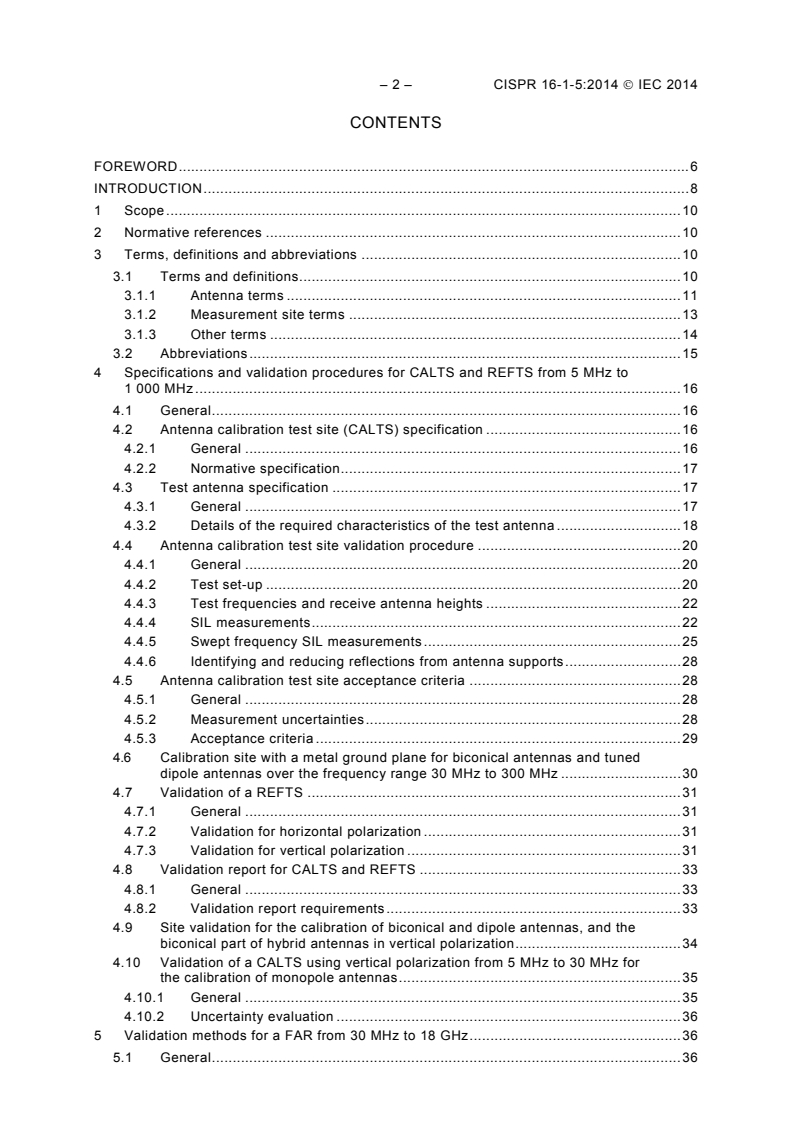
– 2 – CISPR 16-1-5:2014 IEC 2014
CONTENTS
FOREWORD . 6
INTRODUCTION . 8
1 Scope . 10
2 Normative references . 10
3 Terms, definitions and abbreviations . 10
3.1 Terms and definitions . 10
3.1.1 Antenna terms . 11
3.1.2 Measurement site terms . 13
3.1.3 Other terms . 14
3.2 Abbreviations . 15
4 Specifications and validation procedures for CALTS and REFTS from 5 MHz to
1 000 MHz . 16
4.1 General . 16
4.2 Antenna calibration test site (CALTS) specification . 16
4.2.1 General . 16
4.2.2 Normative specification . 17
4.3 Test antenna specification . 17
4.3.1 General . 17
4.3.2 Details of the required characteristics of the test antenna . 18
4.4 Antenna calibration test site validation procedure . 20
4.4.1 General . 20
4.4.2 Test set-up . 20
4.4.3 Test frequencies and receive antenna heights . 22
4.4.4 SIL measurements . 22
4.4.5 Swept frequency SIL measurements . 25
4.4.6 Identifying and reducing reflections from antenna supports . 28
4.5 Antenna calibration test site acceptance criteria . 28
4.5.1 General . 28
4.5.2 Measurement uncertainties . 28
4.5.3 Acceptance criteria . 29
4.6 Calibration site with a metal ground plane for biconical antennas and tuned
dipole antennas over the frequency range 30 MHz to 300 MHz . 30
4.7 Validation of a REFTS . 31
4.7.1 General . 31
4.7.2 Validation for horizontal polarization . 31
4.7.3 Validation for vertical polarization . 31
4.8 Validation report for CALTS and REFTS . 33
4.8.1 General . 33
4.8.2 Validation report requirements . 33
4.9 Site validation for the calibration of biconical and dipole antennas, and the
biconical part of hybrid antennas in vertical polarization . 34
4.10 Validation of a CALTS using vertical polarization from 5 MHz to 30 MHz for
the calibration of monopole antennas . 35
4.10.1 General . 35
4.10.2 Uncertainty evaluation . 36
5 Validation methods for a FAR from 30 MHz to 18 GHz . 36
5.1 General . 36
5.2 Validation procedure 1 GHz to 18 GHz . 37
5.2.1 Power transfer between two antennas . 37
5.2.2 Measurement procedure for validation from 1 GHz to 18 GHz . 37
5.2.3 Analysis of results . 39
5.2.4 Acceptance criterion . 40
5.2.5 Chamber performance versus polarization . 41
5.2.6 Uncertainty . 41
5.3 Validation of a FAR for the calibration of antennas by alternative methods. 42
5.3.1 General . 42
5.3.2 Validation of a FAR from 30 MHz to 1 GHz . 42
5.3.3 Alternative validation of a FAR for the calibration of LPDA antennas
above 1 GHz. 42
5.3.4 Alternative validation of a FAR applying time-domain measurements
above 500 MHz. 43
6 Validation methods for sites used for the calibration of directive antennas . 43
6.1 Validation of the calibration site minimizing ground reflection by a height
≥ 4 m . 43
6.1.1 Measurement procedure . 43
6.1.2 Uncertainties . 45
6.2 Validation of the calibration site minimizing ground reflection by use of
absorber . 46
7 Site validation by comparison of antenna factors, and application of RSM to
evaluate the uncertainty contribution of a SAC site . 47
7.1 Use of SAM for site validation by comparison of antenna factors . 47
7.2 Application of RSM to evaluate the measurement uncertainty contribution of
a calibration site comprising a SAC . 48
Annex A (informative) CALTS characteristics and validation . 50
A.1 General . 50
A.2 The reflecting plane . 50
A.2.1 Reflecting plane construction . 50
A.2.2 Plane-edge effects and plane surroundings . 51
A.3 Ancillary equipment . 51
A.4 Additional stringent CALTS validation testing . 52
A.4.1 General . 52
A.4.2 Antenna-height scan measurements . 52
A.4.3 Frequency scan measurements . 53
Annex B (informative) Test antenna considerations. 56
B.1 General . 56
B.2 Example and verification of a test antenna . 56
B.3 Determination of balun properties . 58
B.3.1 The ideal lossless balun . 58
B.3.2 Relations between balun properties and S-parameters . 59
B.3.3 Insertion loss measurements . 60
Annex C (informative) Antenna and SIL theory . 63
C.1 Analytical relations . 63
C.1.1 General . 63
C.1.2 Total length of the test antenna . 64
C.1.3 Theoretical SIL . 65
C.1.4 Calculation example . 69
– 4 – CISPR 16-1-5:2014 IEC 2014
C.2 Computations by the MoM. 72
C.2.1 General . 72
C.2.2 Antenna input impedance . 73
C.2.3 Total length of the test antenna . 73
C.2.4 SIL computations . 73
C.2.5 Antenna factor (AF) computations . 80
Annex D (informative) Pascal Program used in C.1.4 . 84
Annex E (informative) Validation procedure checklist . 88
Annex F (informative) Evidence that field taper of VP site validation method has
negligible effect on measured antenna factor . 90
F.1 Investigation of vertical field taper . 90
F.2 Calibration of biconical antennas using vertical polarization . 90
Bibliography . 92
Figure 1 – Schematic diagram of the test antenna . 18
Figure 2 – Adjustment of a telescopic wire element to the length L . 19
we
Figure 3 – Determination of V (f) or V (f) . 23
r1 r2
Figure 4 – Determination of V (f) with the wire antennas in their specified positions . 23
s
Figure 5 – Example NSIL: horizontal polarization, antenna height 2 m, separation
10 m . 26
Figure 6 – NSIL of the four pairs of calculable dipoles at 10 m separation and using
the alternative heights for the 600 MHz to 1 000 MHz pair according to Table 5 . 27
Figure 7 – Relation between the quantities used in the SIL acceptance criterion . 29
Figure 8 – Set-up of site validation for EMC antenna calibrations above 1 GHz in a
FAR, also showing distance between antenna phase centres . 38
Figure 9 – Example plots of [A (d) − A (d )] in dB against distance in m at 1 GHz
i m i m 3 m
to 18 GHz in 1 GHz steps, corrected for LPDA and horn phase centres . 40
Figure 10 – Example of antenna set-up for an LPDA antenna calibration in the
frequency range above 200 MHz . 44
Figure 11 – Example of SIL versus antenna height measured at 200 MHz with two
LPDA antennas in vertical polarization at 2,5 m distance between their midpoints
above the reflecting ground plane of an OATS . 45
Figure 12 – Illustration of distances of transmit horn to omni-directional receive
antenna and reflective building, and transmitted signal paths A and B . 45
Figure B.1 – Example of a test antenna . 58
Figure B.2 – Diagram of the measurement of S and S , and of S and S , when
11 12 22 21
generator and load are interchanged . 59
Figure B.3 – Schematic diagram for determination of the insertion loss A (f) . 61
Figure B.4 – Schematic diagram for determination of the insertion loss A (f) . 61
Figure C.1 – Network model for A calculations . 66
i c
Figure C.2 – Equivalent circuit to the network in Figure C.1 . 66
Figure C.3 – Definition of the mutual couplings, feed-terminal voltages and antenna
currents of the antennas above the reflecting plane and their images . 67
Figure C.4 – Cascade combination of the baluns and the site two-port network . 74
Figure C.5 – Flow chart showing how SIL is obtained by combining the measured balun
S-parameters and the NEC calculated S-parameters of the site two-port network . 75
Figure F.1 – Field uniformity with height step 1 m to 2,6 m, normalized to field at 1,8 m
height; monocone at 15 m range . 90
Figure F.2 – Averaging of height steps, SAM, B.4.2 in CISPR 16-1-6:2014 . 91
Table 1 – Summary of site validation methods by subclause number . 9
Table 2 – Maximum tolerances for d = 10 m . 18
Table 3 – Frequency and fixed receive antenna height data for SIL measurements at
24 frequencies, with h = 2 m and d = 10 m [specified in 4.4.2.3 and 4.4.2.4] . 22
t
Table 4 – RSM frequency steps . 25
Table 5 (informative) – Antenna heights for SIL measurements . 26
Table 6 – Antenna set-up for the SIL measurement of the calibration site using
horizontally polarized resonant dipole antennas (see also 4.4.4 for SIL at 250 MHz and
300 MHz) . 31
Table 7 – Antenna heights . 32
Table 8 – Example measurement uncertainty budget for SIL between two monopole
antennas . 36
Table 9 – Example measurement uncertainty budget for FAR validation method at and
above 1 GHz . 41
Table 10 – Example measurement uncertainty budget for the site validation method in
6.1.1 . 46
Table 11 – Maximum tolerances for validation set-up at d = 10 m . 49
Table A.1 – Example of fixed-length calculable dipole antennas and their subdivision of
the frequency range 30 MHz to 1 000 MHz . 51
Table A.2 – Receive antenna heights and centre frequencies . 54
Table C.1 – Example numerical (analytical) calculation of L , A (see C.1.4.2) . 69
a i c
Table C.2 – Example numerical (analytical) calculation of ∆A (see C.1.4.3) . 71
t
Table C.3 – Example numerical (analytical) calculation of h and ∆h . 72
rc rt
Table C.4 – Example numerical (analytical) calculation of f and ∆f . 72
c t
Table C.5 – MoM example calculation of A for vertical polarization, h = 2 m, except
i c t
h = 2,75 m at 30 MHz, 35 MHz and 40 MHz . 78
t
– 6 – CISPR 16-1-5:2014 IEC 2014
INTERNATIONAL ELECTROTECHNICAL COMMISSION
INTERNATIONAL SPECIAL COMMITTEE ON RADIO INTERFERENCE
____________
SPECIFICATION FOR RADIO DISTURBANCE AND IMMUNITY
MEASURING APPARATUS AND METHODS –
Part 1-5: Radio disturbance and immunity measuring apparatus –
Antenna calibration sites and reference test sites for 5 MHz to 18 GHz
FOREWORD
1) The International Electrotechnical Commission (IEC) is a worldwide organization for standardization comprising
all national electrotechnical committees (IEC National Committees). The object of IEC is to promote
international co-operation on all questions concerning standardization in the electrical and electronic fields. To
this end and in addition to other activities, IEC publishes International Standards, Technical Specifications,
Technical Reports, Publicly Available Specifications (PAS) and Guides (hereafter referred to as “IEC
Publication(s)”). Their preparation is entrusted to technical committees; any IEC National Committee interested
in the subject dealt with may participate in this preparatory work. International, governmental and non-
governmental organizations liaising with the IEC also participate in this preparation. IEC collaborates closely
with the International Organization for Standardization (ISO) in accordance with conditions determined by
agreement between the two organizations.
2) The formal decisions or agreements of IEC on technical matters express, as nearly as possible, an international
consensus of opinion on the relevant subjects since each technical committee has representation from all
interested IEC National Committees.
3) IEC Publications have the form of recommendations for international use and are accepted by IEC National
Committees in that sense. While all reasonable efforts are made to ensure that the technical content of IEC
Publications is accurate, IEC cannot be held responsible for the way in which they are used or for any
misinterpretation by any end user.
4) In order to promote international uniformity, IEC National Committees undertake to apply IEC Publications
transparently to the maximum extent possible in their national and regional publications. Any divergence
between any IEC Publication and the corresponding national or regional publication shall be clearly indicated in
the latter.
5) IEC itself does not provide any attestation of conformity. Independent certification bodies provide conformity
assessment services and, in some areas, access to IEC marks of conformity. IEC is not responsible for any
services carried out by independent certification bodies.
6) All users should ensure that they have the latest edition of this publication.
7) No liability shall attach to IEC or its directors, employees, servants or agents including individual experts and
members of its technical committees and IEC National Committees for any personal injury, property damage or
other damage of any nature whatsoever, whether direct or indirect, or for costs (including legal fees) and
expenses arising out of the publication, use of, or reliance upon, this IEC Publication or any other IEC
Publications.
8) Attention is drawn to the Normative references cited in this publication. Use of the referenced publications is
indispensable for the correct application of this publication.
9) Attention is drawn to the possibility that some of the elements of this IEC Publication may be the subject of
patent rights. IEC shall not be held responsible for identifying any or all such patent rights.
International Standard CISPR 16-1-5 has been prepared by CISPR subcommittee A: Radio-
interference measurements and statistical methods.
This second edition cancels and replaces the first edition published in 2003, and its
Amendment 1 (2012). It constitutes a technical revision.
It has the status of a basic EMC publication in accordance with IEC Guide 107,
Electromagnetic compatibility – Guide to the drafting of electromagnetic compatibility
publications.
This edition includes the following significant technical changes with respect to the previous
edition:
– site validation methods for other sites covered in CISPR 16-1-6 are added;
– smaller step sizes are specified for swept-frequency measurements;
– the minimum ground plane size is increased;
– other miscellaneous technical and editorial refinements are included.
The text of this standard is based on the following documents:
FDIS Report on voting
CISPR/A/1086A/FDIS CISPR/A/1097/RVD
Full information on the voting for the approval of this standard can be found in the report on
voting indicated in the above table.
A list of all parts of the CISPR 16 series can be found, under the general title Specification for
radio disturbance and immunity measuring apparatus and methods, on the IEC website.
This publication has been drafted in accordance with the ISO/IEC Directives, Part 2.
The committee has decided that the contents of this amendment and the base publication will
remain unchanged until the stability date indicated on the IEC web site under
"http://webstore.iec.ch" in the data related to the specific publication. At this date, the
publication will be
• reconfirmed,
• withdrawn,
• replaced by a revised edition, or
• amended.
IMPORTANT – The 'colour inside' logo on the cover page of this publication indicates
that it contains colours which are considered to be useful for the correct
understanding of its contents. Users should therefore print this document using a
colour printer.
– 8 – CISPR 16-1-5:2014 IEC 2014
INTRODUCTION
This standard describes validation procedures for Calibration Test Sites (CALTS) that are
used to calibrate antennas in the frequency range 5 MHz to 18 GHz. The associated antenna
calibration procedures are described in CISPR 16-1-6.
Due to problems with suppressing ground reflections in the frequency range 30 MHz to
200 MHz, the main function of a reflecting ground plane is for the calibration of dipole,
biconical, and hybrid antennas over the frequency range for which their H-plane patterns are
uniform. The free-space antenna factor, F , for dipole antennas may be measured in a free-
a
space environment above 200 MHz. Because of the difficulty of reducing reflections from
objects that surround an antenna, and in particular the ground surface, a flat metal ground
plane is used to ensure reproducibility of results and to enable the ground reflected signal to
be precisely removed mathematically.
Requirements for the construction of a CALTS are given in Annex A. The specifications and
validation procedures for a CALTS are given in Clause 4. The most precise way of validating
a CALTS is to use calculable dipole antennas, which are the basis of the validation procedure
in this standard. The design principles of calculable antennas are given in Annex B, and the
theory and methods for calculating site insertion loss (SIL) are given in Annex C and Annex D.
Validation procedures for other antenna calibration sites are given in Clause 5 through
Clause 7. Where an antenna calibration method utilizes the ground reflection, a CALTS is
required. The validation methods are summarized in Table 1 with reference to the associated
antenna calibration methods in CISPR 16-1-6.
All site validation methods involve the measurement of SIL between two antennas. It is critical
that the validation of the site itself not be unduly compromised by reflections from antenna
supports; see A.3 for associated guidance.
Table 1 – Summary of site validation methods by subclause number
CISPR 16-1-
CISPR 16-1-5
6:2014 Frequency
validation
Calibration Antenna
calibration range
Polarization Notes
method(s)
site(s) type(s)
method(s)
MHz
Subclause
Subclause
With
CALTS for
1 4.10 G.1 5 to 30 Monopole VP tolerance of
monopoles
± 1 dB
CALTS or Biconical,
2 4, 7.2 8.4 30 to 1 000 HP SSM
a
SAC LPDA, hybrid
At large
CALTS or Biconical, height or with
3 4 9.2.2 30 to 300 HP or VP
SAC hybrid, dipole absorber on
ground
Biconical,
30 to 300
hybrid, dipole
4 FAR 5.3.2 9.2.2 HP
Biconical,
60 to 1 000
dipole
5 REFTS 4.7
Biconical,
9.3 30 to 300 VP
hybrid
CALTS 4.9
9.4.2
LPDA, HP with
6 Free space 6.1 200 to 18 000 VP
hybrid, horn greater height
9.4.3
LPDA, With absorber
7 Free space 6.2 9.4.4 200 to 18 000 VP (or HP)
hybrid, horn on ground
8 FAR 5.3.3 9.5 1 000 to 18 000 Horn, LPDA HP or VP
9 FAR 5.3.2 9.2 and 9.4 140 to 1 000 LPDA, hybrid HP or VP
Biconical,
10 CALTS 4.6 B.4, B.5 30 to 300 HP
dipole
Transfer of
properties
Use primarily
of a
for SAM and
validated
FAR, for
7.1
site to a Any, but not
particular
11 site not A.9.4 30 and above monopole or HP or VP
(excluding
antenna types
validated loop
5.3 FAR)
and
by
frequencies,
methods in
except 5.3
other
clauses
a
A CALTS is well specified as being free of reflecting obstacles, and if the antenna supports have negligible
reflections the ground plane itself is likely to provide results that agree with the theoretical performance to better
than 0,5 dB. However for a Semi Anechoic Chamber (SAC), it is important that the entire allowed acceptance
criterion of 1 dB is not taken up by wall reflections, leaving no latitude for other uncertainty components such as
reducing reflections from masts and cables.
– 10 – CISPR 16-1-5:2014 IEC 2014
SPECIFICATION FOR RADIO DISTURBANCE AND IMMUNITY
MEASURING APPARATUS AND METHODS –
Part 1-5: Radio disturbance and immunity measuring apparatus –
Antenna calibration sites and reference test sites for 5 MHz to 18 GHz
1 Scope
This part of CISPR 16 specifies the requirements for calibration sites in the frequency range
5 MHz to 18 GHz used to perform antenna calibrations according to CISPR 16-1-6. It also
specifies the requirements for reference test sites (REFTS) that are used for the validation of
compliance test sites (COMTS) in the frequency range 30 MHz to 1 000 MHz according to
CISPR 16-1-4.
It has the status of a basic EMC standard in accordance with IEC Guide 107, Electromagnetic
compatibility – Guide to the drafting of electromagnetic compatibility publications.
Measurement instrumentation specifications are given in CISPR 16-1-1 [1] and CISPR 16-1-
4. Further information and background on uncertainties in general is given in CISPR 16-4 [3],
which can also be helpful in establishing uncertainty estimates for the calibration processes of
antennas and site validation measurements.
2 Normative references
The following documents, in whole or in part, are normatively referenced in this document and
are indispensable for its application. For dated references, only the edition cited applies. For
undated references, the latest edition of the referenced document (including any
amendments) applies.
CISPR 16-1-4:2010, Specification for radio disturbance and immunity measuring apparatus
and methods – Part 1-4: Radio disturbance and immunity measuring apparatus – Antennas
and test sites for radiated disturbance measurements
CISPR 16-1-4:2010/AMD 1:2012
CISPR 16-1-6:2014, Specification for radio disturbance and immunity measuring apparatus
and methods – Part 1-6: Radio disturbance and immunity measuring apparatus – EMC
antenna calibration
IEC 60050 (all parts), International Electrotechnical Vocabulary (available at
)
3 Terms, definitions and abbreviations
3.1 Terms and definitions
For the purposes of this document, the terms and definitions given in IEC 60050, as well as
the following apply.
NOTE Full terms for abbreviations not already given in 3.1 are listed in 3.2.
____________
Numbers in square brackets refer to the bibliography.
3.1.1 Antenna terms
3.1.1.1
antenna
transducer that converts the guided electromagnetic energy of the feed line into a radiated
wave in space and vice versa
Note 1 to entry: In the context of this standard, for antennas for which a balun is intrinsic to the functioning of the
antenna, the term “antenna” includes the balun.
3.1.1.2
biconical antenna
symmetric antenna formed by two conical radiating elements having a common axis, and
adjacent vertices at which they are fed
Note 1 to entry: For use in the VHF band, biconical antennas are usually made of two conical-shaped wire cages.
Often each cage has a cross-bar connecting the centre conductor and one of the peripheral wires to remove a
narrowband resonance. Such shorting cross-bars can affect the characteristics of the antenna above 215 MHz. For
more details, see also A.4.3 of CISPR 16-1-6:2014.
3.1.1.3
broadband antenna
antenna having acceptable characteristics over a wide range of radio frequencies
3.1.1.4
calculable antenna
dipole-like antenna of which the antenna factor of a single antenna, and the site insertion loss
between a pair of antennas, may be calculated using either analytical or numerical (method of
moments) techniques based on the dimensions, load impedance and geometrical parameters,
and that can be verified by measurement
Note 1 to entry: An example of a calculable antenna is that specified in Annex B. Another example is a simple
loop antenna.
Note 2 to entry: Effects of the balun are typically accounted for by S-parameters measurements of the balun
network, or the balun structure can be modelled.
3.1.1.5
horn antenna
antenna consisting of a waveguide section in which the cross-sectional area increases
towards an open end, which is known as the aperture
Note 1 to entry: Rectangular-waveguide pyramidal horn antennas are popular in the microwave frequency range
above about 1 GHz. Double-ridged-waveguide horn antennas (DRH; sometimes also referred to as DRG horn, for
double-ridged-guide) cover a very wide frequency range. The mainlobe of some DRH antennas splits into several
beams at higher frequencies.
3.1.1.6
hybrid antenna
antenna consisting of a wire-element log-periodic dipole array section and a broadband dipole
section
Note 1 to entry: The longest element of the LPDA section (see 3.1.1.7) is typically resonant at approximately
200 MHz, and the boom is lengthened at the open-circuit end to feed the connected broadband dipole (e.g.
biconical or bowtie) section. Over the range 30 MHz to 200 MHz, the broadband dipole exhibits a performance
similar to a biconical antenna, notably in the variation of height-dependent antenna factor.
Note 2 to entry: A common-mode choke is typically used at the open-circuit end (i.e. rear) of the boom to
minimize parasitic (unintended) RF currents on the outer conductor of the coaxial cable flowing into the measuring
receiver.
– 12 – CISPR 16-1-5:2014 IEC 2014
3.1.1.7
log-periodic dipole array antenna
LPDA antenna
antenna comprising an array of linear dipole elements whose dimensions and spacings
increase logarithmically with frequency from the tip to the rear end of the antenna
3.1.1.8
resonant dipole antenna
tuned dipole antenna
antenna consisting of two straight collinear conductors of equal length, placed end to end,
separated by a small gap constituting a balanced feed, with each conductor approximately a
quarter-wavelength long such that at the specified frequency the input impedance of the
antenna measured across the gap has zero reactance when the dipole is located in free
space
Note 1 to entry: A resonant dipole antenna is also a calculable antenna (see 3.1.1.4). In this standard the term
“linear dipole” implies “two straight collinear conductors,” in contrast to the biconical dipole, or array of dipoles as
in the LPDA antenna.
3.1.1.9
standard antenna
STA
antenna for which the AF is calculated or measured precisely
Note 1 to entry: Precision is attainable by a calculable antenna such as specified in 4.3. Alternatively an STA may
be an antenna of a type similar to the AUC that has been calibrated to lower uncertainties than required for the
AUC, e.g. by the three antenna method.
Note 2 to entry: An STA is used for measurements by the standard antenna method (see 4.3.5, etc. of CISPR 16-
1-6:2014). An STA is mechanically robust such that reproducibility of AF to better than ± 0,2 dB is maintained with
continuous use of the STA. Balance and cross-polar criteria applicable to the STA are found in 6.3.2 and 6.3.3 of
CISPR 16-1-6:2014.
3.1.1.10
balun
device for transforming an unbalanced transmission line to a balanced transmission line and
vice versa
Note 1 to entry: A balun is used, for example, to couple balanced antenna elements to an unbalanced feed line,
such as a coaxial cable. A balun may exhibit inherent impedance transformation differing from unity.
3.1.1.11
test antenna
combination of the resonant dipole antenna and the specified balun
Note 1 to entry: The definition is for the purposes of this standard only (see also 3.1.1.8 resonant dipole antenna,
and 3.1.1.12 wire antenna). The test antenna is described in 4.3.
3.1.1.12
wire antenna
a specified structure consisting of one or more metallic wires or rods for radiating or receiving
electromagnetic waves
Note 1 to entry: A wire antenna does not contain a balun.
Note 2 to entry: In the context of this standard, a wire antenna connected to a balun is called a “test a
...