


IEC 60502-4:2010
(Main)Power cables with extruded insulation and their accessories for rated voltages from 1 kV (Um = 1,2 kV) up to 30 kV (Um = 36 kV) - Part 4: Test requirements on accessories for cables with rated voltages from 6 kV (Um = 7,2 kV) up to 30 kV (Um = 36 kV)
General Information
- Abstract
IEC 60502-4:2010 specifies the test requirements for type testing of accessories for power cables with rated voltages from 3,6/6 (7,2) kV up to 18/30 (36) kV, complying with IEC 60502-2. Accessories for special applications, such as aerial cables, submarine or ship cables or hazardous situations (explosive environments, fire-resistant cables or seismic conditions), are not included. It is not necessary to repeat these tests, once successfully completed, unless changes are made in the materials, design or manufacturing process which might affect the performance characteristics. Test methods are included in IEC 61442. Significant technical changes with respect to the previous edition are as follows:
a) the range of approval has been revised;
b) a water immersion test requirement for outdoor terminations has been introduced;
c) examination of accessories at the end of the test sequence is to be recorded in a test report for information only;
d) both the a.c. and d.c. test are to be carried out;
e) the heating cycle test has been added to Table 11.
- Status
- Published
- Publication Date
- 14-Dec-2010
- Technical Committee
- TC 20 - Electric cables
- Drafting Committee
- WG 16 - TC 20/WG 16
- Current Stage
- DELPUB - Deleted Publication
- Start Date
- 15-Nov-2023
- Completion Date
- 31-May-2021
Buy Documents
IEC 60502-4:2010 - Power cables with extruded insulation and their accessories for rated voltages from 1 kV (U<sub>m</sub> = 1,2 kV) up to 30 kV (U<sub>m</sub> = 36 kV) - Part 4: Test requirements on accessories for cables with rated voltages from 6 kV (U<sub>m</sub> = 7,2 kV) up to 30 kV (U<sub>m</sub> = 36 kV) Released:12/15/2010
Overview
IEC 60502-4:2010 is an international standard developed by the International Electrotechnical Commission (IEC) that specifies test requirements for accessories used with power cables featuring extruded insulation. These accessories are designed for cables with rated voltages from 6 kV (Um = 7.2 kV) up to 30 kV (Um = 36 kV). This part of IEC 60502 complements IEC 60502-2, which covers the cable specifications themselves.
The standard outlines rigorous type testing protocols to ensure that cable accessories such as terminations, joints, connectors, and stop ends meet the necessary safety and performance criteria. The testing covers electrical, mechanical, and environmental factors to confirm reliability under operating conditions.
Notably, IEC 60502-4 excludes accessories for special applications like aerial cables, submarine cables, ship cables, and hazardous environments such as explosive atmospheres or seismic zones.
Key Topics
Scope and Purpose
- Defines type test requirements for cable accessories compatible with extruded insulated power cables rated 6 kV to 30 kV.
- Ensures that accessories comply with performance characteristics without needing repeated testing unless design or material modifications occur.
Test Methods and Sequences
- Test methods align with IEC 61442, which provides detailed procedures for power cable accessory testing.
- Includes tests for both alternating current (a.c.) and direct current (d.c.) electrical stress.
- Introduces a water immersion test for outdoor terminations to verify environmental resistance.
- Incorporates a heating cycle test to assess thermal endurance.
- Test sequences prescribe inspections of accessories at the end of testing, with results documented for informational purposes.
Range of Approval
- Establishes allowable conductor cross-sectional areas and insulation types for accessory testing approval.
- Defines conditions under which tests may be extended to different cable configurations or insulating materials.
- Specifies that once an accessory passes full testing, retesting is only needed if changes affect performance.
Documentation and Compliance
- Requires detailed test setup, results recording, and reporting to assure transparency.
- Products certified to IEC 60502-4 demonstrate international compliance, supporting market acceptance.
- Does not invalidate existing national approvals but may require additional assessment for equivalency.
Applications
IEC 60502-4:2010 is essential for manufacturers, testing laboratories, utilities, and engineers involved in specifying, producing, and approving power cable accessories designed for medium-voltage networks. Practical uses include:
- Design verification and type approval of cable terminations, joints, connectors, and stop ends rated for 6 kV to 30 kV systems.
- Ensuring compatibility and reliable performance of accessories used in industrial, commercial, and utility power distribution networks.
- Facilitating international trade and regulatory acceptance through adherence to recognized testing standards.
- Supporting quality assurance and safety management by providing measurable criteria for accessory durability and behavior under operational stresses.
This standard serves as a benchmark for testing power cable accessories to confirm they withstand mechanical, electrical, and environmental stresses encountered during installation and service life.
Related Standards
- IEC 60502-2:2005 – Covers the general specifications for power cables with extruded insulation for the same voltage range.
- IEC 61442:2005 – Details test methods for accessories used with power cables rated from 6 kV up to 30 kV.
- IEC 60183 – Guide for selecting high-voltage cables.
- IEC 61238-1 – Specifies requirements and test methods for compression and mechanical connectors used on power cables up to 30 kV.
- Other IEC 60502 Parts – Encompass cables and accessories for voltages below 6 kV and related systems.
By ensuring comprehensive testing of cable accessories under the IEC 60502-4 framework, stakeholders can achieve enhanced safety, reliability, and interoperability in medium-voltage power distribution infrastructures.
Keywords: IEC 60502-4, power cable accessories, extruded insulation, type testing, rated voltage 6 kV to 30 kV, medium-voltage cables, cable terminations, cable joints, cable connectors, IEC standards, electrical accessory testing, cable accessory certification, power distribution network safety.
Relations
- Effective Date
- 10-Feb-2026
- Effective Date
- 05-Sep-2023
- Effective Date
- 05-Sep-2023
Buy Documents
IEC 60502-4:2010 - Power cables with extruded insulation and their accessories for rated voltages from 1 kV (U<sub>m</sub> = 1,2 kV) up to 30 kV (U<sub>m</sub> = 36 kV) - Part 4: Test requirements on accessories for cables with rated voltages from 6 kV (U<sub>m</sub> = 7,2 kV) up to 30 kV (U<sub>m</sub> = 36 kV) Released:12/15/2010
Get Certified
Connect with accredited certification bodies for this standard

IMQ S.p.A. (Certification)
Italian electrical product certification.

SLG Prüf- und Zertifizierungs GmbH
German testing and certification body.

UL Solutions
Global safety science company with testing, inspection and certification.
Sponsored listings
Frequently Asked Questions
IEC 60502-4:2010 is a standard published by the International Electrotechnical Commission (IEC). Its full title is "Power cables with extruded insulation and their accessories for rated voltages from 1 kV (U<sub>m</sub> = 1,2 kV) up to 30 kV (U<sub>m</sub> = 36 kV) - Part 4: Test requirements on accessories for cables with rated voltages from 6 kV (U<sub>m</sub> = 7,2 kV) up to 30 kV (U<sub>m</sub> = 36 kV)". This standard covers: IEC 60502-4:2010 specifies the test requirements for type testing of accessories for power cables with rated voltages from 3,6/6 (7,2) kV up to 18/30 (36) kV, complying with IEC 60502-2. Accessories for special applications, such as aerial cables, submarine or ship cables or hazardous situations (explosive environments, fire-resistant cables or seismic conditions), are not included. It is not necessary to repeat these tests, once successfully completed, unless changes are made in the materials, design or manufacturing process which might affect the performance characteristics. Test methods are included in IEC 61442. Significant technical changes with respect to the previous edition are as follows: a) the range of approval has been revised; b) a water immersion test requirement for outdoor terminations has been introduced; c) examination of accessories at the end of the test sequence is to be recorded in a test report for information only; d) both the a.c. and d.c. test are to be carried out; e) the heating cycle test has been added to Table 11.
IEC 60502-4:2010 specifies the test requirements for type testing of accessories for power cables with rated voltages from 3,6/6 (7,2) kV up to 18/30 (36) kV, complying with IEC 60502-2. Accessories for special applications, such as aerial cables, submarine or ship cables or hazardous situations (explosive environments, fire-resistant cables or seismic conditions), are not included. It is not necessary to repeat these tests, once successfully completed, unless changes are made in the materials, design or manufacturing process which might affect the performance characteristics. Test methods are included in IEC 61442. Significant technical changes with respect to the previous edition are as follows: a) the range of approval has been revised; b) a water immersion test requirement for outdoor terminations has been introduced; c) examination of accessories at the end of the test sequence is to be recorded in a test report for information only; d) both the a.c. and d.c. test are to be carried out; e) the heating cycle test has been added to Table 11.
IEC 60502-4:2010 is classified under the following ICS (International Classification for Standards) categories: 01 - GENERALITIES. TERMINOLOGY. STANDARDIZATION. DOCUMENTATION; 29.060.20 - Cables. The ICS classification helps identify the subject area and facilitates finding related standards.
IEC 60502-4:2010 has the following relationships with other standards: It is inter standard links to EN IEC 62613-1:2018, IEC 60502-4:2005, IEC 60502-4:2023. Understanding these relationships helps ensure you are using the most current and applicable version of the standard.
IEC 60502-4:2010 is available in PDF format for immediate download after purchase. The document can be added to your cart and obtained through the secure checkout process. Digital delivery ensures instant access to the complete standard document.
Standards Content (Sample)
IEC 60502-4 ®
Edition 3.0 2010-12
INTERNATIONAL
STANDARD
NORME
INTERNATIONALE
Power cables with extruded insulation and their accessories for rated voltages
from 1 kV (U = 1,2 kV) up to 30 kV (U = 36 kV) –
m m
Part 4: Test requirements on accessories for cables with rated voltages from
6 kV (U = 7,2 kV) up to 30 kV (U = 36 kV)
m m
Câbles d'énergie à isolant extrudé et leurs accessoires pour des tensions
assignées de 1 kV (U = 1,2 kV) à 30 kV (U = 36 kV) –
m m
Partie 4: Exigences d'essai pour accessoires de câbles de tensions assignées
de 6 kV (U = 7,2 kV) à 30 kV (U = 36 kV)
m m
All rights reserved. Unless otherwise specified, no part of this publication may be reproduced or utilized in any form or by
any means, electronic or mechanical, including photocopying and microfilm, without permission in writing from either IEC or
IEC's member National Committee in the country of the requester.
If you have any questions about IEC copyright or have an enquiry about obtaining additional rights to this publication,
please contact the address below or your local IEC member National Committee for further information.
Droits de reproduction réservés. Sauf indication contraire, aucune partie de cette publication ne peut être reproduite
ni utilisée sous quelque forme que ce soit et par aucun procédé, électronique ou mécanique, y compris la photocopie
et les microfilms, sans l'accord écrit de la CEI ou du Comité national de la CEI du pays du demandeur.
Si vous avez des questions sur le copyright de la CEI ou si vous désirez obtenir des droits supplémentaires sur cette
publication, utilisez les coordonnées ci-après ou contactez le Comité national de la CEI de votre pays de résidence.
IEC Central Office
3, rue de Varembé
CH-1211 Geneva 20
Switzerland
Email: inmail@iec.ch
Web: www.iec.ch
About the IEC
The International Electrotechnical Commission (IEC) is the leading global organization that prepares and publishes
International Standards for all electrical, electronic and related technologies.
About IEC publications
The technical content of IEC publications is kept under constant review by the IEC. Please make sure that you have the
latest edition, a corrigenda or an amendment might have been published.
§ Catalogue of IEC publications: www.iec.ch/searchpub
The IEC on-line Catalogue enables you to search by a variety of criteria (reference number, text, technical committee,…).
It also gives information on projects, withdrawn and replaced publications.
§ IEC Just Published: www.iec.ch/online_news/justpub
Stay up to date on all new IEC publications. Just Published details twice a month all new publications released. Available
on-line and also by email.
§ Electropedia: www.electropedia.org
The world's leading online dictionary of electronic and electrical terms containing more than 20 000 terms and definitions
in English and French, with equivalent terms in additional languages. Also known as the International Electrotechnical
Vocabulary online.
§ Customer Service Centre: www.iec.ch/webstore/custserv
If you wish to give us your feedback on this publication or need further assistance, please visit the Customer Service
Centre FAQ or contact us:
Email: csc@iec.ch
Tel.: +41 22 919 02 11
Fax: +41 22 919 03 00
A propos de la CEI
La Commission Electrotechnique Internationale (CEI) est la première organisation mondiale qui élabore et publie des
normes internationales pour tout ce qui a trait à l'électricité, à l'électronique et aux technologies apparentées.
A propos des publications CEI
Le contenu technique des publications de la CEI est constamment revu. Veuillez vous assurer que vous possédez
l’édition la plus récente, un corrigendum ou amendement peut avoir été publié.
§ Catalogue des publications de la CEI: www.iec.ch/searchpub/cur_fut-f.htm
Le Catalogue en-ligne de la CEI vous permet d’effectuer des recherches en utilisant différents critères (numéro de référence,
texte, comité d’études,…). Il donne aussi des informations sur les projets et les publications retirées ou remplacées.
§ Just Published CEI: www.iec.ch/online_news/justpub
Restez informé sur les nouvelles publications de la CEI. Just Published détaille deux fois par mois les nouvelles
publications parues. Disponible en-ligne et aussi par email.
§ Electropedia: www.electropedia.org
Le premier dictionnaire en ligne au monde de termes électroniques et électriques. Il contient plus de 20 000 termes et
définitions en anglais et en français, ainsi que les termes équivalents dans les langues additionnelles. Egalement appelé
Vocabulaire Electrotechnique International en ligne.
§ Service Clients: www.iec.ch/webstore/custserv/custserv_entry-f.htm
Si vous désirez nous donner des commentaires sur cette publication ou si vous avez des questions, visitez le FAQ du
Service clients ou contactez-nous:
Email: csc@iec.ch
Tél.: +41 22 919 02 11
Fax: +41 22 919 03 00
IEC 60502-4 ®
Edition 3.0 2010-12
INTERNATIONAL
STANDARD
NORME
INTERNATIONALE
Power cables with extruded insulation and their accessories for rated voltages
from 1 kV (U = 1,2 kV) up to 30 kV (U = 36 kV) –
m m
Part 4: Test requirements on accessories for cables with rated voltages from
6 kV (U = 7,2 kV) up to 30 kV (U = 36 kV)
m m
Câbles d'énergie à isolant extrudé et leurs accessoires pour des tensions
assignées de 1 kV (U = 1,2 kV) à 30 kV (U = 36 kV) –
m m
Partie 4: Exigences d'essai pour accessoires de câbles de tensions assignées
de 6 kV (U = 7,2 kV) à 30 kV (U = 36 kV)
m m
INTERNATIONAL
ELECTROTECHNICAL
COMMISSION
COMMISSION
ELECTROTECHNIQUE
PRICE CODE
INTERNATIONALE
V
CODE PRIX
ICS 29.060.20 ISBN 978-2-88912-294-3
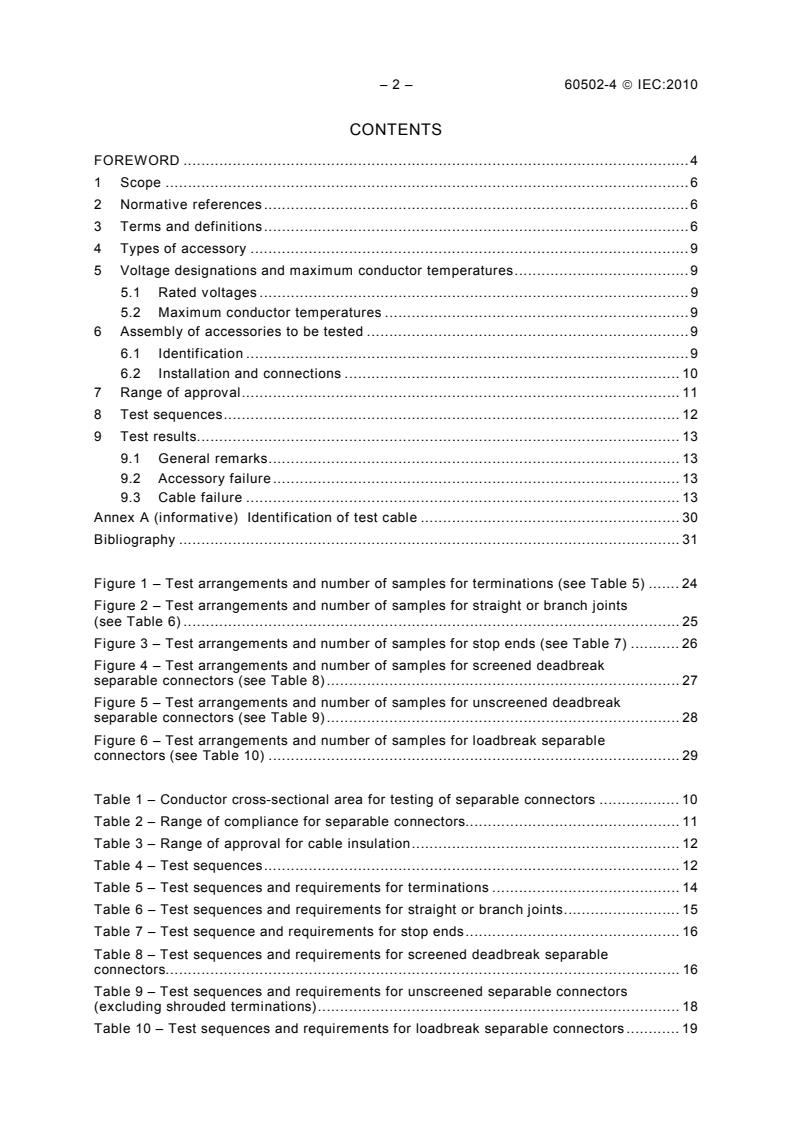
– 2 – 60502-4 ã IEC:2010
CONTENTS
FOREW ORD . 4
1 Scope . 6
2 Normativ e references . 6
3 Terms and definitions . 6
4 Types of accessory . 9
5 Voltage designations and maximum conductor temperatures . 9
5.1 Rated voltages . 9
5.2 Maximum conductor temperatures . 9
6 Assembly of accessories to be tested . 9
6.1 Identif ication . 9
6.2 Installation and connections . 10
7 Range of approval . 11
8 Test sequences . 12
9 Test results. 13
9.1 General remarks . 13
9.2 Accessory failure . 13
9.3 Cable failure . 13
Annex A (informative) Identification of test cable . 30
Bibliography . 31
Figure 1 – Test arrangements and number of samples for terminations (see Table 5) . 24
Figure 2 – Test arrangements and number of samples for straight or branch joints
(see Table 6) . 25
Figure 3 – Test arrangements and number of samples for stop ends (see Table 7) . 26
Figure 4 – Test arrangements and number of samples for screened deadbreak
separable connectors (see Table 8) . 27
Figure 5 – Test arrangements and number of samples for unscreened deadbreak
separable connectors (see Table 9) . 28
Figure 6 – Test arrangements and number of samples for loadbreak separable
connectors (see Table 10) . 29
Table 1 – Conductor cross-sectional area for testing of separable connectors . 10
Table 2 – Range of compliance for separable connectors. 11
Table 3 – Range of approval for cable insulation . 12
Table 4 – Test sequences . 12
Table 5 – Test sequences and requirements for terminations . 14
Table 6 – Test sequences and requirements for straight or branch joints . 15
Table 7 – Test sequence and requirements for stop ends . 16
Table 8 – Test sequences and requirements for screened deadbreak separable
connectors. 16
Table 9 – Test sequences and requirements for unscreened separable connectors
(excluding shrouded terminations) . 18
Table 10 – Test sequences and requirements for loadbreak separable connectors . 19
60502-4 ã IEC:2010 – 3 –
Table 11 – Additional tests for smaller and/or larger conductor cross-sectional areas
(see 7.1) . 20
Table 12 – Additional tests for different types of cable insulation semiconducting
screen and approval from round to shaped conductors (not applicable to stop ends,
see 7.1 and 7.3) . 21
Table 13 – Summary of tests . 22
Table 14 – Summary of test voltages and requirements (see Clause 9) . 23
– 4 – 60502-4 ã IEC:2010
INTERNATIONAL ELECTROTECHNICAL COMMISSION
____________
POWER CABLES WITH EXTRUDED INSULATION AND THEIR ACCESSORIES
FOR RATED VOLTAGES FROM 1 kV (U = 1,2 kV) UP TO 30 kV (U = 36 kV) –
m m
Part 4: Test requirements on accessories for cables with rated voltages
from 6 kV (U = 7,2 kV) up to 30 kV (U = 36 kV)
m m
FOREWORD
1) The International Electrotechnical Commission (IEC) is a worldwide organization for standardization comprising
all national electrotechnical committees (IEC National Committees). The object of IEC is to promote international
co-operation on all questions concerning standardization in the electrical and electronic fields. To this end and in
addition to other activities, IEC publishes International Standards, Technical Specifications, Technical Reports,
Publicly Available Specifications (PAS) and Guides (hereafter referred to as “IEC Publication(s)”). Their
preparation is entrusted to technical committees; any IEC National Committee interested in the subject dealt with
may participate in this preparatory work. International, governmental and non-governmental organizations liaising
with the IEC also participate in this preparation. IEC collaborates closely with the International Organization for
Standardization (ISO) in accordance with conditions determined by agreement between the two organizations.
2) The formal decisions or agreements of IEC on technical matters express, as nearly as possible, an international
consensus of opinion on the relevant subjects since each technical committee has representation from all
interested IEC National Committees.
3) IEC Publications have the form of recommendations for international use and are accepted by IEC National
Committees in that sense. While all reasonable efforts are made to ensure that the technical content of IEC
Publications is accurate, IEC cannot be held responsible for the way in which they are used or for any
misinterpretation by any end user.
4) In order to promote international uniformity, IEC National Committees undertake to apply IEC Publications
transparently to the maximum extent possible in their national and regional publications. Any divergence between
any IEC Publication and the corresponding national or regional publication shall be clearly indicated in the latter.
5) IEC itself does not provide any attestation of conformity. Independent certification bodies provide conformity assessment services
and, in some areas, access to IEC marks of conformity. IEC is not responsible for any services carried out by independent
certification bodies.
6) All users should ensure that they have the latest edition of this publication.
7) No liability shall attach to IEC or its directors, employees, servants or agents including individual experts and
members of its technical committees and IEC National Committees for any personal injury, property damage or
other damage of any nature whatsoever, whether direct or indirect, or for costs (including legal fees) and
expenses arising out of the publication, use of, or reliance upon, this IEC Publication or any other IEC
Publications.
8) Attention is drawn to the Normative references cited in this publication. Use of the referenced publications is
indispensable for the correct application of this publication.
9) Attention is drawn to the possibility that some of the elements of this IEC Publication may be the subject of
patent rights. IEC shall not be held responsible for identifying any or all such patent rights.
International Standard IEC 60502-4 has been prepared by IEC technical committee 20:
Electric cables.
This third edition cancels and replaces the second edition, published in 2005, and
constitutes a technical revision.
Significant technical changes with respect to the previous edition are as follows:
a) the range of approval has been revised;
b) a water immersion test requirement for outdoor terminations has been introduced;
c) examination of accessories at the end of the test sequence is to be recorded in a test
report for information only;
d) both the a.c. and d.c. test are to be carried out;
60502-4 ã IEC:2010 – 5 –
e) the heating cycle test has been added to Table 11.
The text of this standard is based on the following documents:
FDIS Report on voting
20/1181/FDIS 20/1208/RVD
Full information on the voting for the approval of this standard can be found in the report on
voting indicated in the above table.
This publication has been drafted in accordance with the ISO/IEC Directives, Part 2.
IEC 60502 consists of the following parts, under the general title Power cables with
extruded insulation and their accessories for rated voltages from 1 kV (U = 1,2 kV) up to
m
30 kV (U = 36 kV):
m
Part 1: Cables for rated voltages of 1 kV (U = 1,2 kV) and 3 kV (U = 3,6 kV);
m m
Part 2: Cables for rated voltages from 6 kV (U = 7,2 kV) up to 30 kV (U = 36 kV);
m m
Part 3: Reserved;
Part 4: Test requirements on accessories for cables with rated voltages from 6 kV
(Um = 7,2 kV) up to 30 kV (Um = 36 kV).
The committee has decided that the contents of this amendment and the base publication
will remain unchanged until the stability date indicated on the IEC web site under
"http://webstore.iec.ch" in the data related to the specific publication. At this date, the
publication will be
• reconfirmed,
• withdrawn,
• replaced by a revised edition, or
• amended.
– 6 – 60502-4 ã IEC:2010
POWER CABLES WITH EXTRUDED INSULATION AND THEIR ACCESSORIES
FOR RATED VOLTAGES FROM 1 kV (U = 1,2 kV) UP TO 30 kV (U = 36 kV) –
m m
Part 4: Test requirements on accessories for cables with rated voltages
from 6 kV (U = 7,2 kV) up to 30 kV (U = 36 kV)
m m
1 Scope
This part of IEC 60502 specifies the test requirements for type testing of accessories for
power cables with rated voltages from 3,6/6 (7,2) kV up to 18/30 (36) kV, complying with
IEC 60502-2.
Accessories for special applications, such as aerial cables, submarine or ship cables or
hazardous situations (explosive environments, fire-resistant cables or seismic conditions),
are not included.
It is not necessary to repeat these tests, once successfully completed, unless changes are
made in the materials, design or manufacturing process which might affect the performance
characteristics.
Test methods are included in IEC 61442.
NOTE This standard does not invalidate existing approvals of products achieved on the basis of national standards
and specifications and/or the demonstration of satisfactory service performance. However, products approved
according to such national standards or specifications cannot directly claim approval to this IEC standard. It may be
possible, subject to agreement between supplier and purchaser, and/or the relevant conformity assessment body, to
demonstrate that conformity to the earlier standard can be used to claim conformity to this standard, provided an
assessment is made of any additional type testing that may need to be carried out. Any such additional testing that is
part of a sequence of testing cannot be done separately.
2 Normative references
The following referenced documents are indispensable for the application of this document.
For dated references, only the edition cited applies. For undated references, the latest
edition of the referenced document (including amendments) applies.
IEC 60183, Guide to the selection of high-voltage cables
IEC 60502-2:2005, Power cables with extruded insulation and their accessories for rated
voltages from 1 kV (U = 1,2 kV) up to 30 kV (U = 36 kV) – Part 2: Cables for rated
m m
voltages from 6 kV (U = 7,2 kV) up to 30 kV (U = 36 kV)
m m
IEC 61238-1, Compression and mechanical connectors for power cables for rated voltages
up to 30 kV (Um = 36 kV) – Part 1: Test methods and requirements
IEC 61442:2005, Test methods for accessories for power cables with rated voltages from
6 kV (U = 7,2 kV) up to 30 kV (U = 36 kV)
m m
3 Terms and definitions
For the purposes of this document, the following terms and definitions apply.
60502-4 ã IEC:2010 – 7 –
3.1
connector
metallic device to connect cable conductors together
[IEC 60050-461:2008, 461-17-03] [1]
3.2
termination
device fitted to the end of a cable to ensure electrical connection with other parts of the
system and to maintain the insulation up to the point of connection
[IEC 60050-461:2008, 461-10-01]
3.3
indoor termination
termination intended for use where it is not exposed to either solar radiation or weathering
3.4
outdoor termination
termination intended for use where it is exposed to either solar radiation or weathering or
both
3.5
terminal box
air- or compound-filled box fully enclosing a termination
[IEC 60050-461:2008, 461-10-03, modified]
3.6
shrouded termination
indoor termination with additional insulation at the bushing connection and used in an air-
filled terminal box
3.7
straight joint
accessory making a connection between two cables to form a continuous circuit
[IEC 60050-461:2008, 461-11-01]
3.8
branch joint
accessory making a connection of a branch cable to a main cable
[IEC 60050-461:2008, 461-11-17]
3.9
transition joint
straight or branch joint making a connection between cables having different types of
insulation
[IEC 60050-461:2008, 461-11-04, modified]
3.10
stop end
accessory providing a means of insulating the unconnected end of an energized cable
___________
References in square brackets refer to the Bibliography.
– 8 – 60502-4 ã IEC:2010
[IEC 60050-461:2008, 461-10-07, modified]
3.11
separable connector
fully insulated termination permitting the connection and the disconnection of a cable to
other equipment
3.12
screened separable connector
separable connector which has a fully screened external surface
3.13
unscreened separable connector
separable connector which does not have an external screen
3.14
plug-in type separable connector
separable connector in which the electrical contact is made by a sliding device
3.15
bolted-type separable connector
separable connector in which the electrical contact is made by a bolted device
3.16
deadbreak connector
separable connector designed to be connected and disconnected on de-energized circuits
only
3.17
loadbreak connector
separable connector designed to be connected and disconnected on energized circuits
3.18
range-taking accessory
accessory designed to take more than one cross-section of cable
3.19
tracking
irreversible degradation by formation of paths, which are conductive even under dry
conditions, starting and developing on the surface of an insulating material and which may
occur on surfaces in contact with air and also on the interfaces between different insulating
materials
3.20
erosion
irreversible and non-conducting degradation of the surface of the insulator that occurs by
loss of material, and which may be uniform, localized or tree shaped
NOTE Shallow surface traces, commonly tree-shaped, may occur on terminations, after partial flashover. These
traces are acceptable as long as they are non-conductive. When they are conductive they are classed as tracking.
3.21
metallic housing
metal enclosure in intimate contact with the outer screen of a separable connector and
having at least the same current carrying capacity to earth as the metallic screen of the
cable with which the separable connector is to be used
60502-4 ã IEC:2010 – 9 –
4 Types of accessory
The accessories covered by this standard are listed below:
– indoor and outdoor terminations of all designs, including terminal boxes;
– straight joints, branch joints and stop ends of all designs, suitable for use underground
or in air;
– screened or unscreened plug-in type or bolted type separable connectors.
NOTE Transition joints connecting cables with extruded insulation to paper-insulated cables are not included in the
scope of this standard. The requirements for these accessories are dealt with in IEC 60055 [2].
5 Voltage designations and maximum conductor temperatures
5.1 Rated voltages
The rated voltages U /U (U ) of accessories considered in this standard are given in 4.1 of
0 m
IEC 60502-2:2005.
For a given application, the rated voltage of an accessory shall be consistent with that of
the cable, and shall be suitable for the operating condition of the system in which they are
used, in accordance with the recommendations of IEC 60183.
5.2 Maximum conductor temperatures
The accessories shall be suitable for use on cables having the conductor temperatures
specified in 4.2 of IEC 60502-2:2005 for normal operation.
The maximum conductor temperatures of the cables under short-circuit conditions are given
in Table 3 of IEC 60502-2:2005.
6 Assembly of accessories to be tested
6.1 Identification
6.1.1 Cables used for testing shall comply with IEC 60502-2 and shall be of the same
rated voltage as the accessories to be tested.
Constructional details of the cables shall be identified (refer to Annex A).
6.1.2 Connectors used within the accessories shall be correctly identified with respect to
– assembly technique,
– tooling, dies and necessary setting,
– preparation of contact surfaces, if applicable,
– type, reference number and any other identification of the connector,
– details of the type test approval,
– the standard with which they comply (i.e. IEC 61238-1).
6.1.3 Accessories to be tested shall be correctly identified with respect to
– name of manufacturer.
– type, designation, manufacturing date or code.
– minimum and maximum cable cross-sections, material and shape of cable conductor.
– 10 – 60502-4 ã IEC:2010
– minimum and maximum cable insulation diameters,
– rated voltage (see 5.1),
– installation instructions (reference and date),
– inside dimensions or type of terminal box if applicable.
6.2 Installation and connections
6.2.1 Unless otherwise specified, the conductor cross-sectional area shall be as follows:
2 2 2
a) for terminations, joints and stop ends: 120 mm or 150 mm or 185 mm ;
b) for separable connectors: each rating shall be tested as indicated in Table 1, using
either aluminium or copper conductors.
Table 1 – Conductor cross-sectional area for testing of separable connectors
Conductor cross-sectional area
Rating
mm
A Cu Al
200/250 50 70
400 95 150
600/630 185 300
800 300 400
1 250 500 630
NOTE 1 The current value should be sufficient to achieve the specified conductor
temperature (see 9.1 of IEC 61442:2005).
NOTE 2 The use of these conductor cross-sectional areas may lead to overheating
of the bushing while achieving the required conductor temperature. Under these
circumstances, it is permissible to use a conductor cross-sectional area one size
smaller. If a bushing failure occurs, the test should be declared void (see 9.2 of this
standard).
6.2.2 Accessories shall be assembled in the manner specified by the manufacturer's
instructions, with the grade and quantity of materials supplied, including lubricants, if any.
6.2.3 Accessories shall be dry and clean, but neither the cables nor the accessories shall
be subjected to any form of conditioning which might modify the electrical or thermal or
mechanical performance of the test assemblies.
NOTE Contact with chemicals, e.g. transformer oil, may affect the properties of the accessory and should be
avoided.
6.2.4 Unless otherwise specified, separable connectors shall be connected to their mating
bushing.
6.2.5 Where terminations or separable connectors are to be tested, the connection
between either lugs or bushings shall have the same electrical cross-sectional area as that
of the cable conductor.
6.2.6 For unscreened separable connectors, the minimum phase-to-phase and phase-to-
earth clearances, recommended by the manufacturer, shall be tested.
6.2.7 Where branch joints are to be tested, only the main cable shall carry the heating
current.
60502-4 ã IEC:2010 – 11 –
6.2.8 The main details regarding test mounting, especially supporting devices, shall be
recorded.
6.2.9 Test arrangements and number of samples are detailed in Figures 1 to 5.
7 Range of approval
7.1 For terminations, joints and stop ends, compliance for one type of accessory for the
range of cable conductor cross-sections from 95 mm² to 300 mm² shall be obtained by
successfully completing all the appropriate tests of Tables 5 to 7 on one of the cross-
sections specified in 6.2.1.
For separable connectors, compliance for one type of accessory for the range of cable
conductor cross-sections given in Table 2 shall be obtained by successfully completing all
the appropriate tests of Table 8 to 10 on the cross-section specified in Table 1 in 6.2.1 b).
Extension of the range of compliance for the same type of accessory to larger or smaller
cable conductor cross-sections shall be obtained by successfully completing the additional
test sequence in Table 11, on the appropriate larger or smaller cross-section.
For extension of compliance of separable connectors to larger cable conductor cross-
sections, the test current shall be limited to the rating of the mating bushing.
Table 2 – Range of compliance for separable connectors
Cable conductor cross-sectional area
Rating of separable
Range of compliance
connector
mm
A Min. Max.
200/250 25 95
400 95 240
600/630 95 300
800 150 400
1 250 240 630
7.2 Approval is independent of the cable conductor material: tests may therefore be
carried out using cables with either aluminium or copper conductors.
7.3 Tests performed on accessories installed on cables having shaped conductors shall be
deemed to cover the same type of accessory when used on cables having circular
conductors; however, the converse does not apply.
In order to achieve extension of approval from round to sector-shaped conductors,
additional tests shall be performed according to Table 12. Stop ends shall be tested as in
Table 7 using half the number of samples in Figure 3.
7.4 Approval is dependent on the cable insulation tested as detailed in Table 3.
– 12 – 60502-4 ã IEC:2010
Table 3 – Range of approval for cable insulation
Insulation of test cable Range of approval
XLPE XLPE, EPR, HEPR and PVC
EPR or HEPR EPR, HEPR and PVC
PVC PVC
7.5 The additional tests specified in Table 12 shall be carried out to achieve extension of
approval for different types of cable insulation semiconducting screens. Stop ends shall be
tested as in Table 7 using half the number of samples in Figure 3.
7.6 Approval obtained by testing on a non longitudinally water-blocked type of cable shall
be extended to a cable with means of longitudinal water-blocking in the metallic screen area
but otherwise of the same design. The converse shall not apply.
7.7 Tests performed on three-core accessories shall be deemed to cover single-core
accessories of the same design. The converse shall not apply.
7.8 Compliance of an accessory tested for a specified U shall extend to operation of the
accessory at a lower U provided that the radial electrical stress at the insulation screen of
the cable of lower U is not greater than that of the test cable.
In addition, for separable connectors, the screen fault current initiation test shall be carried
out at the lowest U for which compliance is required.
8 Test sequences
The tests applicable to accessories shall be carried out in the sequences listed in the tables
and figures mentioned in Table 4.
Table 4 – Test sequences
Accessories Table Figure
Terminations 5 1
Straight or branch joints 6 2
Stop ends 7 3
Screened deadbreak separable connectors 8 4
Unscreened deadbreak separable connectors 9 5
a a
Loadbreak separable connectors 10 6
Additional tests for smallest and largest conductor cross-sectional areas 11 –
Additional tests for different types of cable insulations screen and
approval from round to shaped conductors 12 –
NOTE In Tables 5 to 9, the symbols have the meaning given in IEC 61442, i.e:
I short-circuit current (r.m.s. value) in the metallic screen;
sc
I short-circuit current (initial peak value) in the conductor;
d
q maximum permissible short-circuit temperature of the cable conductor.
sc
a
Under consideration.
Tests on terminations and joints may be combined, provided the sequences and
requirements are the same.
60502-4 ã IEC:2010 – 13 –
A summary of the tests required is given in Table 13. The test voltages and requirements
are summarized in Table 14.
9 Test results
9.1 General remarks
All test samples, tested as indicated in Clause 7 and Tables 5 to 12, shall meet the
requirements for all test sequences.
If any of the test samples do not meet the requirements, they shall be dismantled, inspected
to determine if 9.2 or 9.3 applies and the result of the inspection recorded.
The examination at the end of a test sequence is for information only, but the results shall
be recorded in the test report.
9.2 Accessory failure
If an accessory fails to meet the requirements due to either installation or test procedure
errors, the test shall be declared void without discrediting the accessories.
The complete test sequence shall be repeated on a new set of samples.
If there is no evidence of such error, the type of accessory is not approved.
9.3 Cable failure
If a cable fails beyond any part of an accessory, the tests shall be declared void without
discrediting the accessories. Tests may be repeated using new accessories (start testing
from the beginning of the test sequence) or alternatively by repair of the cable (continue
testing from the point of break).
– 14 – 60502-4 ã IEC:2010
Table 5 – Test sequences and requirements for terminations
Test methods Test sequences
a
Tests Requirements
of IEC 61442 (see Figure 1)
1.1 1.2 1.3 1.4 1.5
1 AC and DC voltage AC for 5 min at 4,5 U and d.c. Clauses 4 and 5 x x x
for 15 min at 4 U
b
AC (wet) 1 min at 4 U Clause 4 x
c
2 Partial discharge 10 pC max. at 1,73 U Clause 7 x
d
3 Impulse at q 10 impulses of each polarity Clause 6 x
t
e d
4 Heating cycles in air 9.2 and 9.3 x
60 cycles at q and 2,5 U
t 0
b e d
5 Immersion test 10 cycles at q 9.5 x
t
c
6 Partial discharge 10 pC max. at 1,73 U Clause 7 x
d, f
at q and ambient
t
temperature
h
7 Thermal short-circuit Two short-circuits at I of the Clause 10 x X
sc
g
(screen) cable screen.
No visible deterioration
h
8 Thermal short-circuit Two short-circuits to raise Clause 11 x X
(conductor) conductor to q of the cable.
sc
No visible deterioration
i
9 Dynamic short-circuit One short-circuit at I Clause 12 x
d
No visible deterioration
10 Impulse 10 impulses of each polarity Clause 6 x x x
11 AC voltage 15 min at 2,5 U Clause 4 x x x
j, k
12 Humidity 300 h at 1,25 U , see Table 13 Clause 13 x
b, k
13 Salt fog 1 000 h at 1,25 U , see Table 13 Clause 13 x
l
14 Examination For information only – x x x x x
a
Unless otherwise specified, tests shall be carried out at ambient temperature.
b
For outdoor terminations only.
c
Not required for accessories installed on 3,6/6 (7,2) kV cables having unscreened insulation.
d
q is the maximum cable conductor temperature in normal operation +5 K to 10 K.
t
e
8 h total with ³2 h steady and ³3 h cooling.
f
Measurement is made at the end of the heating period.
g
This test is only required for terminations that are equipped with a connection to, or adaptor for, the metallic screen of
the cable.
h
Thermal short-circuit may be combined with the dynamic short-circuit.
i
Only required for single-core cable accessories designed for initial peak currents i > 80 kA and three-core accessories
p
designed for i > 63 kA . Value of I shall be declared by the manufacturer.
p d
j
For indoor terminations only. Not required for compound-filled terminal boxes. Shrouded terminations shall be tested
in a three-phase condition.
k
Not required for terminations having porcelain insulators.
l
It is advised that the accessory be examined for signs of any of the following:
(i) cracking in the filling media and/or tape or tube components; and/or
(ii) a moisture path across a primary seal; and/or
(iii) corrosion and/or tracking and/or erosion; and/or
(iv) leakage of any insulating material.
60502-4 ã IEC:2010 – 15 –
Table 6 – Test sequences and requirements for straight or branch joints
Test
Test methods
a
Tests Requirements sequences
of IEC 61442
(see Figure 2)
2.1 2.2 2.3
1 AC and DC voltage AC for 5 min at 4,5 U and d.c. for Clauses 4 and 5 x x x
15 min at 4 U
b, c
2 Partial discharge 10 pC max. at 1,73 U Clause 7 x
c, d
3 Impulse at q 10 impulses of each polarity Clause 6 x
t
e c, d
4 Heating cycles in air 9.2 and 9.3 x
30 cycles at q and 2,5 U
t 0
e c, d
5 Heating cycles under 30 cycles at q and 2,5 U , 9.2 and 9.3 x
t 0
water
water height 1 m
b, c
6 Partial discharge at 10 pC max. at 1,73 U Clause 7 x
c,d, f
q and ambient
t
temperature
g
7 Thermal short-circuit Two short-circuits at I of the cable Clause 10 x x
sc
c
(screen) screen.
No visible deterioration
g
8 Thermal short-circuit Two short-circuits to raise conductor Clause 11 x X
c
(conductor)
to q of the cable.
sc
No visible deterioration
9 Dynamic One short-circuit at I . Clause 12 x
d
h
short-circuit No visible deterioration
10 Impulse 10 impulses of each polarity Clause 6 x x x
11 AC voltage 15 min at 2,5 U Clause 4 x x x
i
12 Examination For information only – x x x
a
Unless otherwise specified, tests shall be carried out at ambient temperature.
b
Not required for accessories installed on 3,6/6 (7,2) kV cables having unscreened insulation.
c
For transition joints (extruded insulation to extruded insulation), the testing parameters are those for the lower
rated cable.
d
q is the maximum cable conductor temperature in normal operation +5 K to 10 K.
t
e
8 h total with ³2 h steady and ³3 h cooling.
f
Measurement is made at the end of the heating period.
g
Thermal short-circuit may be combined with the dynamic short-circuit.
h
Only required for single-core cable accessories designed for initial peak currents i >80 kA and three-core
p
accessories designed for i >63 kA. Value of I shall be declared by the manufacturer.
p d
i
It is advised that the accessory is examined for signs of any of the following:
(i) cracking in the filling media and/or tape or tube components; and/or
(ii) a moisture path across a primary seal; and/or
(iii) corrosion and/or tracking and/or erosion; and/or
(iv) leakage of any insulating material.
– 16 – 60502-4 ã IEC:2010
Table 7 – Test sequence and requirements for stop ends
Test
Test methods
a
Tests Requirements sequence
of IEC 61442
(see Figure 3)
3.1
1 AC and DC voltage AC for 5 min at 4,5 U and d.c. for Clauses 4 and 5 x
15 min at 4 U
b
2 Partial discharge 10 pC max. at 1,73 U Clause 7 x
3 Impulse 10 impulses of each polarity Clause 6 x
4 AC voltage 500 h at 2,5 U Clause 4 x
b
5 Partial discharge 10 pC max. at 1,73 U Clause 7 x
6 Impulse 10 impulses of each polarity Clause 6 x
7 AC voltage 15 min at 2,5 U Clause 4 x
c
8 Examination For information only – x
a
Unless otherwise specified, tests shall be carried out at ambient temperature.
b
Not required for accessories installed on 3,6/6 (7,2) kV cables having unscreened insulation.
c
It is advised that the accessory is examined for signs of any of the following:
(i) cracking in the filling media and/or tape or tube components; and/or
(ii) a moisture path across a primary seal; and/or
(iii) corrosion and/or tracking and/or erosion; and/or
(iv) leakage of any insulating material.
Table 8 – Test sequences and requirements for screened deadbreak separable connectors
Test methods Test sequences
a
Tests Requirements
of IEC 61442 (see Figure 4)
4.1 4.2 4.3 4.4
1 AC and DC voltage AC for 5 min at 4,5 U and d.c. for Clauses 4 and 5 x x x
15 min at 4 U
b
2 Partial discharge 10 pC max. at 1,73 U Clause 7 x
c
3 Impulse at q 10 impulses of each polarity Clause 6 x
t
g
4 Thermal short-circuit Two short-circuits at I of Clause 10 x X
sc
f
(screen) the cable screen.
No visible deterioration
g
5 Thermal short-circuit Two short-circuits to raise Clause 11 x X
(conductor) conductor to q of the cable.
sc
No visible deterioration
6 Dynamic short-circuit One short-circuit at I . Clause 12 x
d
h
No visible deterioration
d c l
7 Heating cycles in air 30 cycles at q and 2,5 U Clause 9 x
t 0
d c l
8 Heating cycles under Clause 9 x
30 cycles at q and 2,5 U
t 0
water
i
9 Disconnect/connect Five times. – x x x
No visible damage to contact
b
10 Partial discharge at 10 pC max. at 1,73 U Clause 7 x
c, e
q and ambient
t
temperature
11 Impulse 10 impulses of each polarity Clause 6 x x x
12 AC voltage 15 min at 2,5 U Clause 4 x x x
60502-4 ã IEC:2010 – 17 –
Test methods Test sequences
a
Tests Requirements
of IEC 61442 (see Figure 4)
13 Operating eye Axial force 1 300 N for 1 min. Clause 19 x
Torque 14 N × m
b
14 Partial discharge 10 pC max. at 1,73 U Clause 7 x
m
15 Examination For information only – x x x x
j
16 Screen resistance Clause 15
Maximum 5 000 W
17 Screen leakage Maximum 0,5 mA at U Clause 16 Tests 16 to 20 are
m
j
carried out on
current
separate samples.
j, k
18 Fault current initiation See notes Clause 17
For tests 16 and 19,
19 Operating force Force <900 N Clause 18
no cable is required.
20 Capacitive test point Capacitance of test point to cable Clause 20
For tests 17, 18 and
conductor:
20, appropriate cable
lengths are to be
C > 1,0 pF
tc
used
Ratio of capacitance of test point
to earth C and capacitance of test
te
point to cable conductor C :
tc
C /C £ 12,0
te tc
a
Unless otherwise specified, tests shall be carried out at ambient temperature.
b
Not required for accessories installed on 3,6/6 (7,2) kV cables having unscreened insulation.
c
q is the maximum cable conductor temperature in normal operation +5 K to 10 K.
t
d
8 h total with ³2 h steady and ³3 h cooling.
e
Measurement is made at the end of the heating period.
f
This test applies only to separable connectors that are equipped with a connection to, or adaptor for, the metallic
screen of the cable.
g
Thermal short-circuit may be combined with the dynamic short-circuit.
h
Only required for single-core cable accessories designed for initial peak currents i > 80 kA and three-core
p
accessories designed for i > 63 kA. Value of I shall be declared by the manufacturer.
p d
i
The test shall be carried out only when the cable is de-energized.
j
The test is required for separable connectors without a metallic housing or with a removable metallic housing. The
metallic housing shall be removed prior to the test. This test is not required for separable connectors which can
only be used in service with the metallic housing in position.
k
For solidly earthed systems, the fault initiation shall occur within 3 s. For unearthed or impedance earthed
systems, the fault current shall flow continuously.
l
Current, see Table 1.
m
It is advised that the accessory is examined for signs of any of the following:
(i) cracking in the filling media and/or tape or tube components; and/or
(ii) a moisture path across a primary seal; and/or
(iii) corrosion and/or tracking and/or erosion; and/or
(iv) leakage of any insulating material.
– 18 – 60502-4 ã IEC:2010
Table 9 – Test sequences and requirements for unscreened separable connectors
(excluding shrouded terminations)
Test methods Test sequences
a
Tests Requirements
of IEC 61442 (see Figure 5)
5.1 5.2 5.3 5.4
1 AC and DC voltage AC for 5 min at 4,5 U and d.c. for Clauses 4 and 5 x x x
15 min at 4 U
b
2 Partial discharge 10 pC max. at 1,73 U Clause 7 x
c
3 Impulse at q 10 impulses of each polarity Clause 6 x
t
g
4 Thermal short-circuit Two short-circuits at I of Clause 10 x x
sc
f
(screen)
the cable screen.
No visible deterioration
g
5 Thermal short-circuit Two short-circuits to raise Clause 11 x X
(conductor)
conductor to q of the cable.
sc
No visible deterioration
6 Dynamic One short-circuit at I . Clause 12 x
d
h
short-circuit
No visibl
...