

IEC TS 61994-4-3:2008
(Main)Piezoelectric and dielectric devices for frequency control and selection - Glossary - Part 4-3: Materials - Materials for dielectric devices
General Information
- Abstract
Specifies the terms and definitions for materials applied for devices using waveguide type dielectric resonators representing the state-of-the-art, which are intended for use in the standards and documents of IEC technical committee 49.
- Status
- Published
- Publication Date
- 21-Feb-2008
- Technical Committee
- TC 49 - Piezoelectric, dielectric and electrostatic devices and associated materials for frequency control, selection and detection
- Drafting Committee
- WG 10 - TC 49/WG 10
- Current Stage
- PPUB - Publication issued
- Start Date
- 22-Feb-2008
- Completion Date
- 30-Apr-2008
Buy Documents

IEC TS 61994-4-3:2008 - Piezoelectric and dielectric devices for frequency control and selection - Glossary - Part 4-3: Materials - Materials for dielectric devices Released:2/22/2008
Overview
IEC TS 61994-4-3:2008 is a Technical Specification published by the International Electrotechnical Commission (IEC). It focuses on the terminology and definitions for materials used in dielectric devices, specifically waveguide type dielectric resonators. This document forms part of the essential references for professionals and organizations working with frequency control and selection components. The technical specification supports international consistency and effective communication across standards, benefiting manufacturers, designers, and users in the electronics and telecommunications sectors.
Key Topics
- Dielectric Materials: The standard defines dielectric materials as those primarily exhibiting dielectric properties. These materials are critical in the creation of resonators for high-frequency applications.
- Dielectric Resonator Materials: Materials designed to function in ultra high frequency (UHF) and super high frequency (SHF) ranges. They require high relative permittivity, low loss factors, and minimal temperature coefficient of permittivity.
- Key Material Properties:
- Electric Constant (ε0): Defined as the permittivity of vacuum, a fundamental constant used in material evaluation.
- Relative Permittivity (εr): The ratio of a material’s absolute permittivity to the electric constant, critical for material selection.
- Loss Angle and Loss Factor: Quantitative measures of energy dissipation in dielectric materials.
- Quality Factor (Q0): Inversely proportional to loss, the quality factor expresses the material’s efficiency in frequency-dependent applications.
- Temperature Coefficient of Permittivity (TCε): Indicates how permittivity changes with temperature, important for maintaining device stability across varying environments.
- Coefficient of Linear Thermal Expansion (α): Describes dimensional stability of the material under temperature changes.
Applications
The standardized terminology and definitions serve a variety of practical applications, including:
- Design and Manufacturing: Assists manufacturers and designers in the selection and characterization of materials for dielectric resonators and supports precision in frequency control devices for telecommunications, broadcasting, and radar systems.
- Quality Assurance and Testing: Ensures consistent interpretation of material properties, facilitating reliable performance evaluation and quality control.
- Standard Development: Provides foundational terms for IEC Technical Committee 49 and other standards bodies developing documents for piezoelectric and dielectric devices.
- International Trade and Compliance: Supports global trade by establishing uniform definitions, reducing barriers caused by differing terminology in technical documentation.
Related Standards
- IEC 61338-1:2004 – Waveguide type dielectric resonators – Generic specification. This standard provides further definitions and specifications for dielectric resonators and is indispensable for professionals working with dielectric materials in frequency control devices.
- IEC TS 61994 Series – The broader series offers comprehensive glossaries and technical references for piezoelectric and dielectric devices, covering a wide range of materials and component types.
Practical Value
By adopting IEC TS 61994-4-3:2008, organizations and professionals ensure precise communication, improve compatibility of materials in global markets, and enhance the reliability of dielectric devices used for frequency control and selection. This standard supports the effective development, application, and maintenance of electronic components, contributing directly to advancements in wireless communications, sensors, and high-frequency systems.
For the most up-to-date information or related documents, consult the IEC website or relevant technical committee publications.
Buy Documents
IEC TS 61994-4-3:2008 - Piezoelectric and dielectric devices for frequency control and selection - Glossary - Part 4-3: Materials - Materials for dielectric devices Released:2/22/2008
Frequently Asked Questions
IEC TS 61994-4-3:2008 is a technical specification published by the International Electrotechnical Commission (IEC). Its full title is "Piezoelectric and dielectric devices for frequency control and selection - Glossary - Part 4-3: Materials - Materials for dielectric devices". This standard covers: Specifies the terms and definitions for materials applied for devices using waveguide type dielectric resonators representing the state-of-the-art, which are intended for use in the standards and documents of IEC technical committee 49.
Specifies the terms and definitions for materials applied for devices using waveguide type dielectric resonators representing the state-of-the-art, which are intended for use in the standards and documents of IEC technical committee 49.
IEC TS 61994-4-3:2008 is classified under the following ICS (International Classification for Standards) categories: 01.040.31 - Electronics (Vocabularies); 31.140 - Piezoelectric devices. The ICS classification helps identify the subject area and facilitates finding related standards.
IEC TS 61994-4-3:2008 is available in PDF format for immediate download after purchase. The document can be added to your cart and obtained through the secure checkout process. Digital delivery ensures instant access to the complete standard document.
Standards Content (Sample)
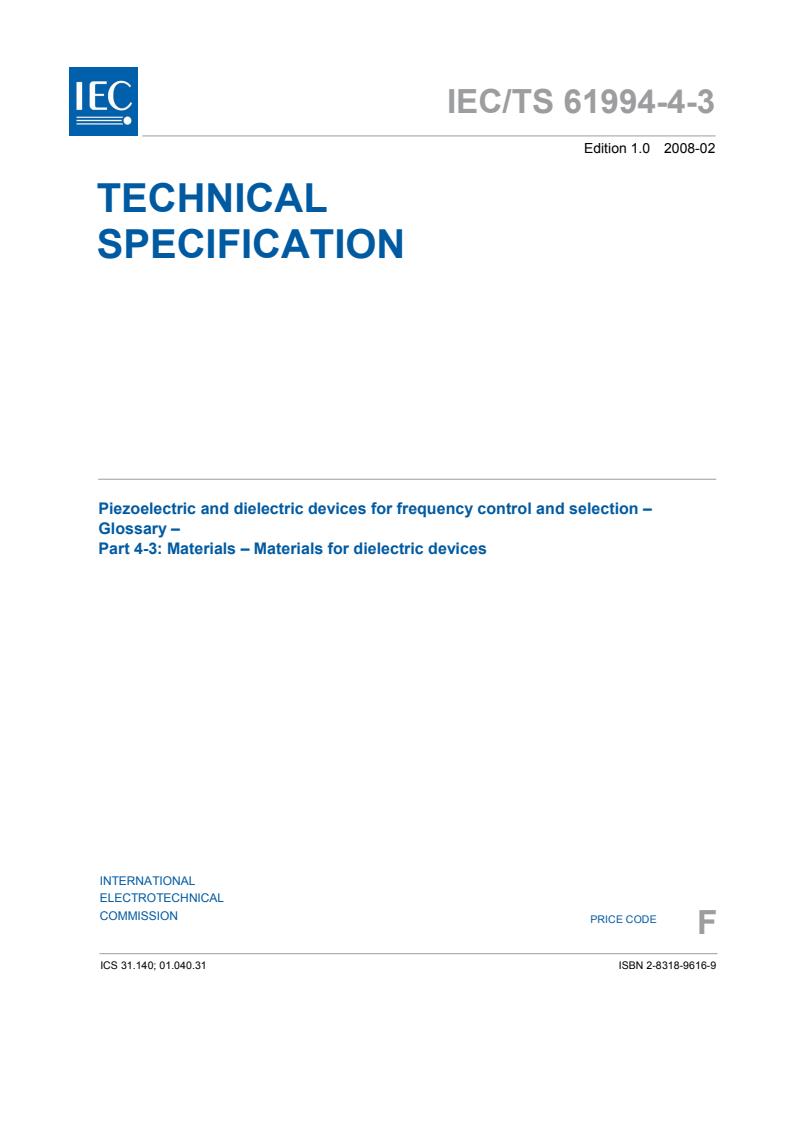
IEC/TS 61994-4-3
Edition 1.0 2008-02
TECHNICAL
SPECIFICATION
Piezoelectric and dielectric devices for frequency control and selection –
Glossary –
Part 4-3: Materials – Materials for dielectric devices
IEC/TS 61994-4-3:2008(E)
All rights reserved. Unless otherwise specified, no part of this publication may be reproduced or utilized in any form
or by any means, electronic or mechanical, including photocopying and microfilm, without permission in writing from
either IEC or IEC's member National Committee in the country of the requester.
If you have any questions about IEC copyright or have an enquiry about obtaining additional rights to this publication,
please contact the address below or your local IEC member National Committee for further information.
IEC Central Office
3, rue de Varembé
CH-1211 Geneva 20
Switzerland
Email: inmail@iec.ch
Web: www.iec.ch
About the IEC
The International Electrotechnical Commission (IEC) is the leading global organization that prepares and publishes
International Standards for all electrical, electronic and related technologies.
About IEC publications
The technical content of IEC publications is kept under constant review by the IEC. Please make sure that you have the
latest edition, a corrigenda or an amendment might have been published.
ƒ Catalogue of IEC publications: www.iec.ch/searchpub
The IEC on-line Catalogue enables you to search by a variety of criteria (reference number, text, technical committee,…).
It also gives information on projects, withdrawn and replaced publications.
ƒ IEC Just Published: www.iec.ch/online_news/justpub
Stay up to date on all new IEC publications. Just Published details twice a month all new publications released. Available
on-line and also by email.
ƒ Electropedia: www.electropedia.org
The world's leading online dictionary of electronic and electrical terms containing more than 20 000 terms and definitions
in English and French, with equivalent terms in additional languages. Also known as the International Electrotechnical
Vocabulary online.
ƒ Customer Service Centre: www.iec.ch/webstore/custserv
If you wish to give us your feedback on this publication or need further assistance, please visit the Customer Service
Centre FAQ or contact us:
Email: csc@iec.ch
Tel.: +41 22 919 02 11
Fax: +41 22 919 03 00
IEC/TS 61994-4-3
Edition 1.0 2008-02
TECHNICAL
SPECIFICATION
Piezoelectric and dielectric devices for frequency control and selection –
Glossary –
Part 4-3: Materials – Materials for dielectric devices
INTERNATIONAL
ELECTROTECHNICAL
COMMISSION
PRICE CODE
F
ICS 31.140; 01.040.31 ISBN 2-8318-9616-9
– 2 – TS 61994-4-3 © IEC:2008(E)
INTERNATIONAL ELECTROTECHNICAL COMMISSION
____________
PIEZOELECTRIC AND DIELECTRIC DEVICES
FOR FREQUENCY CONTROL AND SELECTION –
GLOSSARY –
Part 4-3: Materials –
Materials for dielectric devices
FOREWORD
1) The International Electrotechnical Commission (IEC) is a worldwide organization for standardization comprising
all national electrotechnical committees (IEC National Committees). The object of IEC is to promote
international co-operation on all questions concerning standardization in the electrical and electronic fields. To
this end and in addition to other activities, IEC publishes International Standards, Technical Specifications,
Technical Reports, Publicly Available Specifications (PAS) and Guides (hereafter referred to as “IEC
Publication(s)”). Their preparation is entrusted to technical committees; any IEC National Committee interested
in the subject dealt with may participate in this preparatory work. International, governmental and non-
governmental organizations liaising with the IEC also participate in this preparation. IEC collaborates closely
with the International Organization for Standardization (ISO) in accordance with conditions determined by
agreement between the two organizations.
2) The formal decisions or agreements of IEC on technical matters express, as nearly as possible, an international
consensus of opinion on the relevant subjects since each technical committee has representation from all
interested IEC National Committees.
3) IEC Publications have the form of recommendations for international use and are accepted by IEC National
Committees in that sense. While all reasonable efforts are made to ensure that the technical content of IEC
Publications is accurate, IEC cannot be held responsible for the way in which they are used or for any
misinterpretation by any end user.
4) In order to promote international uniformity, IEC National Committees undertake to apply IEC Publications
transparently to the maximum extent possible in their national and regional publications. Any divergence
between any IEC Publication and the corresponding national or regional publication shall be clearly indicated in
the latter.
5) IEC provides no marking procedure to indicate its approval and cannot be rendered responsible for any
equipment declared to be in conformity with an IEC Publication.
6) All users should ensure that they have the latest edition of this publication.
7) No liability shall attach to IEC or its directors, employees, servants or agents including individual experts and
members of its technical committees and IEC National Committees for any personal injury, property damage or
other damage of any nature whatsoever, whether direct or indirect, or for costs (including legal fees) and
expenses arising out of the publication, use of, or reliance upon, this IEC Publication or any other IEC
Publications.
8) Attention is drawn to the Normative references cited in this publication. Use of the referenced publications is
indispensable for the correct application of this publication.
9) Attention is drawn to the possibility that some of the elements of this IEC Publication may be the subject of
patent rights. IEC shall not be held responsible for identifying any or all such patent rights.
The
...