

CISPR TR 31:2003
(Main)Database on the characteristics of radio services
General Information
- Abstract
This Technical Report covers the rationale behind the actual database covering the characteristics of radio services. The objective of the database is to register those characteristics which are relevant for derivation and specification of limits for disturbance emissions from electric and/or electronic equipment, systems and installations. Committees responsible for generic and/or product emission EMC standards should use this information together with CISPR 23.
- Status
- Published
- Publication Date
- 22-Oct-2003
- Technical Committee
- CIS/H - Limits for the protection of radio services
- Current Stage
- DELPUB - Deleted Publication
- Start Date
- 18-Sep-2012
- Completion Date
- 28-Aug-2026
Overview
CISPR TR 31:2003 is a Technical Report published by the International Electrotechnical Commission (IEC) that provides a comprehensive database on the characteristics of radio services. The database’s primary purpose is to support the development and specification of limits for disturbance emissions generated by electric and electronic devices, systems, and installations. It serves as a valuable resource for committees responsible for electromagnetic compatibility (EMC) standards, ensuring that emission limits adequately protect radio services from interference.
This living database, maintained as a spreadsheet accessible through the IEC EMC Zone website, contains detailed technical and operational parameters of various radio systems worldwide. By referencing this database, stakeholders can better understand the nature of radio services and set disturbance emission limits grounded in international consensus and technical data.
Key Topics
- Radio System Identification: Names and specification references for a variety of radio communications systems used in diverse applications.
- Frequency Bands: Specification of receiving frequency bands in megahertz (MHz), with clear band edge references.
- Protection Parameters: Critical metrics such as receiving field strength, protection ratio (the acceptable interference level relative to the wanted signal), and antenna gain.
- Operational Characteristics:
- Receiving bandwidth (kHz)
- Isolation distances between receivers and interfering sources (meters)
- Systematic isolation due to installation practices (dB)
- Duty cycle indicating receiver operating period (percentage of active reception time)
- Modulation and Interference Types: Details of modulation schemes, duplex/simplex modes, and identification of the most harmful interference forms (e.g., broadband, narrowband, pulsed).
- Safety and Security Aspects: Identification of radio services related to safety or security systems.
- Usage Scope: Information regarding whether the service is fixed, mobile, or both, plus geographic application areas (regional or worldwide).
- Output Power and Antenna Characteristics: Transmitter output power or effective radiated power (ERP), including antenna gain details.
Applications
- EMC Standardization: The database informs the setting of EMC emission limits by providing essential characteristics that influence susceptibility and interference potential for existing radio services.
- Product and System Design: Designers of electric and electronic systems use the database to evaluate potential interference impacts during the development phase and ensure compliance with international EMC standards.
- Regulatory Assessment: Regulatory bodies utilize the database as a reference to assess compatibility of new equipment and systems with incumbent radio services.
- Interference Mitigation: Understanding specific radio service characteristics aids in developing targeted strategies for interference avoidance and mitigation.
- Global Harmonization: Supports international cooperation by providing a unified, up-to-date repository of radio service parameters critical to emission regulation worldwide.
Related Standards
- CISPR 23 - This standard complements CISPR TR 31 by defining the principles for determining disturbance emission limits for industrial, scientific, and medical (ISM) equipment, based on information contained within the CISPR TR 31 database.
- IEC EMC Standards - Various generic and product-specific emission standards rely on the database as a reference to specify disturbance emission limits to protect radio services.
- ISO/IEC Directives, Part 2 - Governs the drafting and structure of IEC technical reports and standards, including CISPR TR 31.
Keywords: CISPR TR 31, IEC, radio services database, electromagnetic compatibility, EMC standards, disturbance emissions, protection limits, radio interference, emission limits, radio frequency bands, modulation schemes, safety-related radio services, EMC Zone, international standards.
Relations
- Effective Date
- 05-Sep-2023
Get Certified
Connect with accredited certification bodies for this standard

ANCE
Mexican certification and testing association.

Intertek Slovenia
Intertek testing, inspection, and certification services in Slovenia.

LNE (Laboratoire National de Métrologie et d'Essais)
French national laboratory for metrology and testing.
Sponsored listings
Frequently Asked Questions
CISPR TR 31:2003 is a technical report published by the International Electrotechnical Commission (IEC). Its full title is "Database on the characteristics of radio services". This standard covers: This Technical Report covers the rationale behind the actual database covering the characteristics of radio services. The objective of the database is to register those characteristics which are relevant for derivation and specification of limits for disturbance emissions from electric and/or electronic equipment, systems and installations. Committees responsible for generic and/or product emission EMC standards should use this information together with CISPR 23.
This Technical Report covers the rationale behind the actual database covering the characteristics of radio services. The objective of the database is to register those characteristics which are relevant for derivation and specification of limits for disturbance emissions from electric and/or electronic equipment, systems and installations. Committees responsible for generic and/or product emission EMC standards should use this information together with CISPR 23.
CISPR TR 31:2003 is classified under the following ICS (International Classification for Standards) categories: 33.100.10 - Emission. The ICS classification helps identify the subject area and facilitates finding related standards.
CISPR TR 31:2003 has the following relationships with other standards: It is inter standard links to CISPR TR 31:2012. Understanding these relationships helps ensure you are using the most current and applicable version of the standard.
CISPR TR 31:2003 is available in PDF format for immediate download after purchase. The document can be added to your cart and obtained through the secure checkout process. Digital delivery ensures instant access to the complete standard document.
Standards Content (Sample)
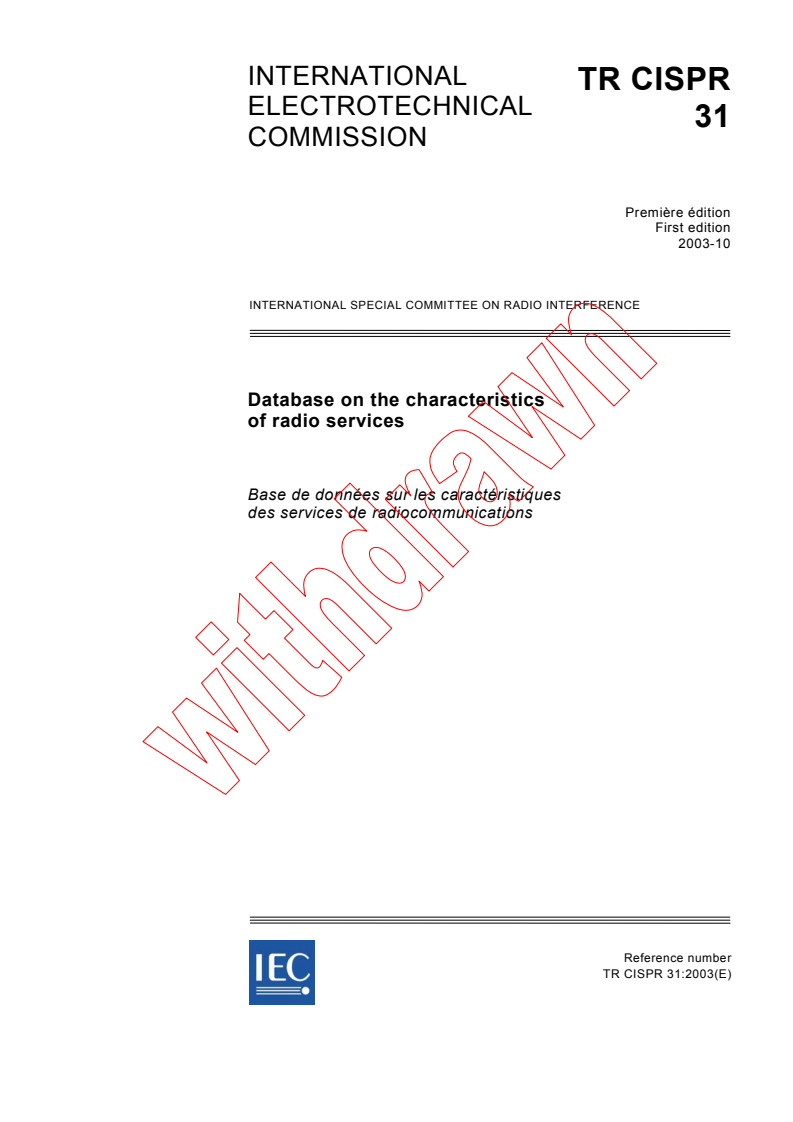
INTERNATIONAL
TR CISPR
ELECTROTECHNICAL
COMMISSION
Première édition
First edition
2003-10
INTERNATIONAL SPECIAL COMMITTEE ON RADIO INTERFERENCE
Database on the characteristics
of radio services
Base de données sur les caractéristiques
des services de radiocommunications
Reference number
TR CISPR 31:2003(E)
Consolidated editions
The IEC is now publishing consolidated versions of its publications. For example,
edition numbers 1.0, 1.1 and 1.2 refer, respectively, to the base publication, the
base publication incorporating amendment 1 and the base publication incorporating
amendments 1 and 2.
Further information on IEC publications
The technical content of IEC publications is kept under constant review by the IEC,
thus ensuring that the content reflects current technology. Information relating to
this publication, including its validity, is available in the IEC Catalogue of
publications (see below) in addition to new editions, amendments and corrigenda.
Information on the subjects under consideration and work in progress undertaken
by the technical committee which has prepared this publication, as well as the list
of publications issued, is also available from the following:
• IEC Web Site (www.iec.ch)
• Catalogue of IEC publications
The on-line catalogue on the IEC web site (www.iec.ch/searchpub) enables you to
search by a variety of criteria including text searches, technical committees
and date of publication. On-line information is also available on recently issued
publications, withdrawn and replaced publications, as well as corrigenda.
• IEC Just Published
This summary of recently issued publications (www.iec.ch/online_news/ justpub)
is also available by email. Please contact the Customer Service Centre (see
below) for further information.
• Customer Service Centre
If you have any questions regarding this publication or need further assistance,
please contact the Customer Service Centre:
Email: custserv@iec.ch
Tel: +41 22 919 02 11
Fax: +41 22 919 03 00
INTERNATIONAL
TR CISPR
ELECTROTECHNICAL
COMMISSION
Première édition
First edition
2003-10
INTERNATIONAL SPECIAL COMMITTEE ON RADIO INTERFERENCE
Database on the characteristics
of radio services
Base de données sur les caractéristiques
des services de radiocommunications
IEC 2003 Copyright - all rights reserved
No part of this publication may be reproduced or utilized in any form or by any means, electronic or
mechanical, including photocopying and microfilm, without permission in writing from the publisher.
International Electrotechnical Commission, 3, rue de Varembé, PO Box 131, CH-1211 Geneva 20, Switzerland
Telephone: +41 22 919 02 11 Telefax: +41 22 919 03 00 E-mail: inmail@iec.ch Web: www.iec.ch
PRICE CODE
H
Commission Electrotechnique Internationale
International Electrotechnical Commission
Международная Электротехническая Комиссия
For price, see current catalogue
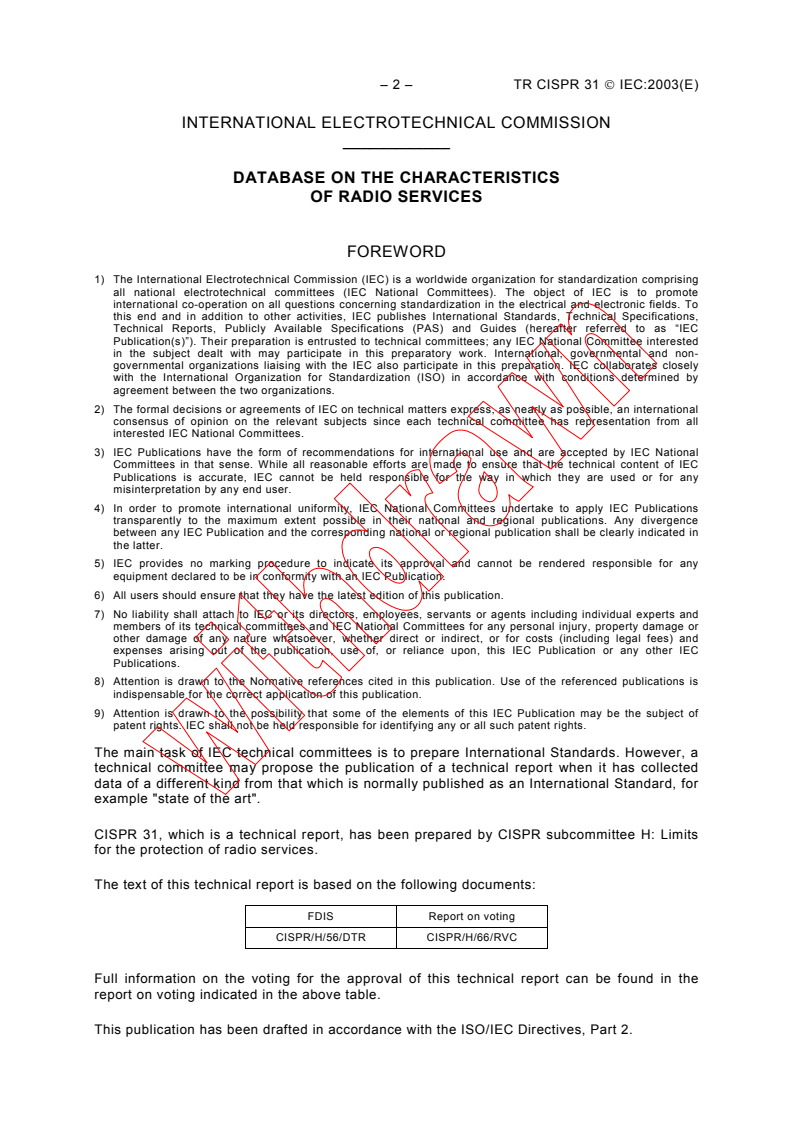
– 2 – TR CISPR 31 IEC:2003(E)
INTERNATIONAL ELECTROTECHNICAL COMMISSION
____________
DATABASE ON THE CHARACTERISTICS
OF RADIO SERVICES
FOREWORD
1) The International Electrotechnical Commission (IEC) is a worldwide organization for standardization comprising
all national electrotechnical committees (IEC National Committees). The object of IEC is to promote
international co-operation on all questions concerning standardization in the electrical and electronic fields. To
this end and in addition to other activities, IEC publishes International Standards, Technical Specifications,
Technical Reports, Publicly Available Specifications (PAS) and Guides (hereafter referred to as “IEC
Publication(s)”). Their preparation is entrusted to technical committees; any IEC National Committee interested
in the subject dealt with may participate in this preparatory work. International, governmental and non-
governmental organizations liaising with the IEC also participate in this preparation. IEC collaborates closely
with the International Organization for Standardization (ISO) in accordance with conditions determined by
agreement between the two organizations.
2) The formal decisions or agreements of IEC on technical matters express, as nearly as possible, an international
consensus of opinion on the relevant subjects since each technical committee has representation from all
interested IEC National Committees.
3) IEC Publications have the form of recommendations for international use and are accepted by IEC National
Committees in that sense. While all reasonable efforts are made to ensure that the technical content of IEC
Publications is accurate, IEC cannot be held responsible for the way in which they are used or for any
misinterpretation by any end user.
4) In order to promote international uniformity, IEC National Committees undertake to apply IEC Publications
transparently to the maximum extent possible in their national and regional publications. Any divergence
between any IEC Publication and the corresponding national or regional publication shall be clearly indicated in
the latter.
5) IEC provides no marking procedure to indicate its approval and cannot be rendered responsible for any
equipment declared to be in conformity with an IEC Publication.
6) All users should ensure that they have the latest edition of this publication.
7) No liability shall attach to IEC or its directors, employees, servants or agents including individual experts and
members of its technical committees and IEC National Committees for any personal injury, property damage or
other damage of any nature whatsoever, whether direct or indirect, or for costs (including legal fees) and
expenses arising out of the publication, use of, or reliance upon, this IEC Publication or any other IEC
Publications.
8) Attention is drawn to the Normative references cited in this publication. Use of the referenced publications is
indispensable for the correct application of this publication.
9) Attention is drawn to the possibility that some of the elements of this IEC Publication may be the subject of
patent rights. IEC shall not be held responsible for identifying any or all such patent rights.
The main task of IEC technical committees is to prepare International Standards. However, a
technical committee may propose the publication of a technical report when it has collected
data of a different kind from that which is normally published as an International Standard, for
example "state of the art".
CISPR 31, which is a technical report, has been prepared by CISPR subcommittee H: Limits
for the protection of radio services.
The text of this technical report is based on the following documents:
FDIS Report on voting
CISPR/H/56/DTR CISPR/H/66/RVC
Full information on the voting for the approval of this technical report can be found in the
report on voting indicated in the above table.
This publication has been drafted in accordance with the ISO/IEC Directives, Part 2.
TR CISPR 31 IEC:2003(E) – 3 –
The committee has decided that the contents of this publication will remain unchanged until
2006. At this date, the publication will be
• reconfirmed;
• withdrawn;
• replaced by a revised edition, or
• amended.
– 4 – TR CISPR 31 IEC:2003(E)
DATABASE ON THE CHARACTERISTICS
OF RADIO SERVICES
1 Scope and object
This Technical Report covers the rationale behind the actual database covering the
characteristics of radio services. The database is a “living document” in the format of a
spreadsheet file in the
...