

IEC TR 62051:1999
(Main)Electricity metering - Glossary of terms
General Information
- Abstract
This technical report provides definitions of terms used in present and future standards on electrical energy measurement, prepared by IEC TC 13. These terms cover electrical energy measurement, tariff and load control, and customer/utility information exchange systems. The report includes terms on Distribution Automation Systems not covered by IEC 60050(371). The report also covers terms on customer/utility information exchange, electricity prepayment systems, and dependablility of electricity metering equipment.
This publication is of high relevance for Smart Grid.
- Status
- Published
- Publication Date
- 22-Apr-1999
- Technical Committee
- TC 13 - Electrical energy measurement and control
- Drafting Committee
- WG 14 - TC 13/WG 14
- Current Stage
- PPUB - Publication issued
- Start Date
- 31-Mar-1993
- Completion Date
- 28-Aug-2026
Overview
IEC TR 62051:1999 is a technical report published by the International Electrotechnical Commission (IEC TC 13) that provides a comprehensive glossary of terms for electricity metering. Issued as a first edition in 1999, the document collects and standardizes definitions used in current and future standards for electrical energy measurement, tariffing, load control and customer/utility information exchange systems. It also expands terminology for Distribution Automation Systems (DAS) - including Distribution Line Carrier (DLC) topics - electricity prepayment and metering dependability. This report is highly relevant to Smart Grid programs where consistent vocabulary is essential.
Key Topics
- Metering terminology: standardized definitions for physical meters, basic metering functions, configuration and auto-configuration, and access points.
- Meter reading methods: six access cases from conventional visual reading to distant WAN-based remote reading.
- Data communications and protocols: vocabulary related to OSI layers, DLMS/DLC concepts, messaging and encoding (referenced standards).
- Tariffs and billing: terms covering Time-of-Use (TOU), customer authorization and billing vocabulary.
- Load management and control: definitions for demand, load control, demand-side management and related transducers.
- Distribution Automation (DAS/DLC): terminology for distribution line carrier, remote/central units and automation architectures not fully covered in IEC 60050(371).
- Prepayment and customer/utility information exchange (CUIE): specific terms for prepaid electricity systems and customer communication gateways.
- Dependability and quality: vocabulary for reliability, maintainability, availability and other dependability topics for metering equipment.
- Acronyms and abbreviations: extensive list (e.g., DLMS, DLC, HHU, SCADA) for consistent use in standards and technical documents.
Applications
IEC TR 62051 is a practical reference used by:
- Standards writers and technical committees to ensure consistent term usage across metering standards.
- Utilities and grid operators when specifying procurement, interoperability and documentation for metering and DAS projects.
- Meter manufacturers and vendors to align product specifications, interfaces and user documentation.
- System integrators and software developers implementing meter reading, DLMS/DLC and customer information exchange solutions.
- Regulators and consultants preparing regulations, tenders and educational material for Smart Grid and advanced metering infrastructures (AMI).
Related standards (if applicable)
Relevant references and companion documents cited within IEC TR 62051 include:
- IEC 60050 (International Electrotechnical Vocabulary / IEV)
- IEC 61107 (meter reading, tariff and load control data exchange)
- DLMS / Distribution Line Message Specification
- IEC 60027, IEC 60417, IEC 60617 (symbols & letter symbols)
- ISO/IEC OSI references (e.g., ISO/IEC 7498) and other IEC/ISO protocol and encoding standards
IEC TR 62051:1999 is best used as the authoritative glossary when drafting, reviewing or implementing metering-related standards, specifications and Smart Grid projects.
Relations
- Effective Date
- 10-Feb-2026
- Effective Date
- 10-Feb-2026
- Effective Date
- 10-Feb-2026
- Effective Date
- 10-Feb-2026
- Effective Date
- 10-Feb-2026
- Effective Date
- 10-Feb-2026
- Effective Date
- 10-Feb-2026
- Effective Date
- 10-Feb-2026
- Effective Date
- 10-Feb-2026
- Effective Date
- 10-Feb-2026
- Effective Date
- 10-Feb-2026
- Effective Date
- 10-Feb-2026
- Effective Date
- 10-Feb-2026
- Effective Date
- 10-Feb-2026
- Effective Date
- 10-Feb-2026
Get Certified
Connect with accredited certification bodies for this standard

DIBt (Deutsches Institut für Bautechnik)
German Institute for Building Technology.
DIN CERTCO
DIN Group product certification.

Aboma Certification B.V.
Specialized in construction, metal, and transport sectors.
Sponsored listings
Frequently Asked Questions
IEC TR 62051:1999 is a technical report published by the International Electrotechnical Commission (IEC). Its full title is "Electricity metering - Glossary of terms". This standard covers: This technical report provides definitions of terms used in present and future standards on electrical energy measurement, prepared by IEC TC 13. These terms cover electrical energy measurement, tariff and load control, and customer/utility information exchange systems. The report includes terms on Distribution Automation Systems not covered by IEC 60050(371). The report also covers terms on customer/utility information exchange, electricity prepayment systems, and dependablility of electricity metering equipment. This publication is of high relevance for Smart Grid.
This technical report provides definitions of terms used in present and future standards on electrical energy measurement, prepared by IEC TC 13. These terms cover electrical energy measurement, tariff and load control, and customer/utility information exchange systems. The report includes terms on Distribution Automation Systems not covered by IEC 60050(371). The report also covers terms on customer/utility information exchange, electricity prepayment systems, and dependablility of electricity metering equipment. This publication is of high relevance for Smart Grid.
IEC TR 62051:1999 is classified under the following ICS (International Classification for Standards) categories: 91.140.50 - Electricity supply systems. The ICS classification helps identify the subject area and facilitates finding related standards.
IEC TR 62051:1999 has the following relationships with other standards: It is inter standard links to EN 62056-62:2002, EN 62056-7-5:2016, EN 62056-6-1:2017, EN IEC 62055-42:2022, EN IEC 62056-6-1:2024, EN 62056-4-7:2016, EN 62056-46:2002/A1:2007, EN 62056-5-3:2017, EN 62056-8-5:2017, EN 62056-8-3:2013, EN 62056-53:2007, EN 62056-62:2007, EN 62056-46:2002, EN 62056-6-2:2013, EN 62055-31:2005. Understanding these relationships helps ensure you are using the most current and applicable version of the standard.
IEC TR 62051:1999 is available in PDF format for immediate download after purchase. The document can be added to your cart and obtained through the secure checkout process. Digital delivery ensures instant access to the complete standard document.
Standards Content (Sample)
TECHNICAL IEC
REPORT
First edition
1999-03
Electricity metering –
Glossary of terms
Lecture des compteurs électriques –
Glossaire de termes
Reference number
IEC 62051:1999(E)
Numbering
As from 1 January 1997 all IEC publications are issued with a designation in the
60000 series.
Consolidated publications
Consolidated versions of some IEC publications including amendments are
available. For example, edition numbers 1.0, 1.1 and 1.2 refer, respectively, to the
base publication, the base publication incorporating amendment 1 and the base
publication incorporating amendments 1 and 2.
Validity of this publication
The technical content of IEC publications is kept under constant review by the IEC,
thus ensuring that the content reflects current technology.
Information relating to the date of the reconfirmation of the publication is available
in the IEC catalogue.
Information on the subjects under consideration and work in progress undertaken
by the technical committee which has prepared this publication, as well as the list
of publications issued, is to be found at the following IEC sources:
• IEC web site*
•
Catalogue of IEC publications
Published yearly with regular updates
(On-line catalogue)*
• IEC Bulletin
Available both at the IEC web site* and as a printed periodical
Terminology, graphical and letter symbols
For general terminology, readers are referred to IEC 60050: International
Electrotechnical Vocabulary (IEV).
For graphical symbols, and letter symbols and signs approved by the IEC for
general use, readers are referred to publications IEC 60027: Letter symbols to be
used in electrical technology, IEC 60417: Graphical symbols for use on equipment.
Index, survey and compilation of the single sheets and IEC 60617: Graphical symbols
for diagrams.
* See web site address on title page.
TECHNICAL IEC
REPORT
First edition
1999-04
Electricity metering –
Glossary of terms
Lecture des compteurs électriques –
Glossaire de termes
IEC 1999 Copyright - all rights reserved
No part of this publication may be reproduced or utilized in any form or by any means, electronic or
mechanical, including photocopying and microfilm, without permission in writing from the publisher.
International Electrotechnical Commission 3, rue de Varembé Geneva, Switzerland
Telefax: +41 22 919 0300 e-mail: inmail@iec.ch IEC web site http://www.iec.ch
Commission Electrotechnique Internationale
PRICE CODE
XA
International Electrotechnical Commission
For price, see current catalogue
– 2 – 62051 © IEC:1999(E)
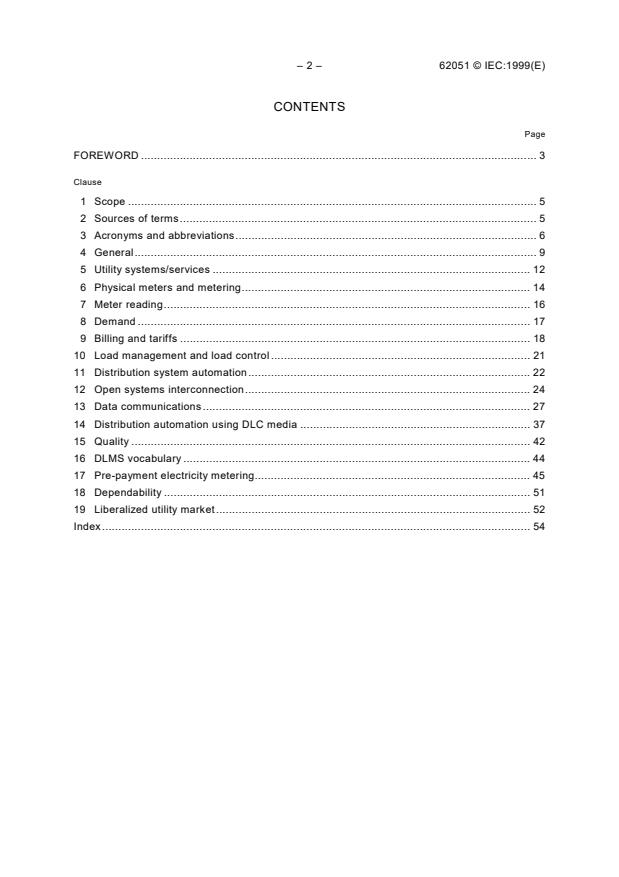
CONTENTS
Page
FOREWORD . 3
Clause
1 Scope . 5
2 Sources of terms. 5
3 Acronyms and abbreviations. 6
4 General. 9
5 Utility systems/services . 12
6 Physical meters and metering. 14
7 Meter reading. 16
8 Demand . 17
9 Billing and tariffs . 18
10 Load management and load control . 21
11 Distribution system automation. 22
12 Open systems interconnection. 24
13 Data communications . 27
14 Distribution automation using DLC media . 37
15 Quality . 42
16 DLMS vocabulary . 44
17 Pre-payment electricity metering. 45
18 Dependability .51
19 Liberalized utility market. 52
Index. 54
62051 © IEC:1999(E) – 3 –
INTERNATIONAL ELECTROTECHNICAL COMMISSION
____________
ELECTRICITY METERING –
GLOSSARY OF TERMS
FOREWORD
1) The IEC (International Electrotechnical Commission) is a worldwide organization for standardization comprising
all national electrotechnical committees (IEC National Committees). The object of the IEC is to promote
international co-operation on all questions concerning standardization in the electrical and electronic fields. To
this end and in addition to other activities, the IEC publishes International Standards. Their preparation is
entrusted to technical committees; any IEC National Committee interested in the subject dealt with may
participate in this preparatory work. International, governmental and non-governmental organizations liaising
with the IEC also participate in this preparation. The IEC collaborates closely with the International Organization
for Standardization (ISO) in accordance with conditions determined by agreement between the two
organizations.
2) The formal decisions or agreements of the IEC on technical matters express, as nearly as possible, an
international consensus of opinion on the relevant subjects since each technical committee has representation
from all interested National Committees.
3) The documents produced have the form of recommendations for international use and are published in the form
of standards, technical specifications, technical reports or guides and they are accepted by the National
Committees in that sense.
4) In order to promote international unification, IEC National Committees undertake to apply IEC International
Standards transparently to the maximum extent possible in their national and regional standards. Any
divergence between the IEC Standard and the corresponding national or regional standard shall be clearly
indicated in the latter.
5) The IEC provides no marking procedure to indicate its approval and cannot be rendered responsible for any
equipment declared to be in conformity with one of its standards.
6) Attention is drawn to the possibility that some of the elements of this technical report may be the subject of
patent rights. The IEC shall not be held responsible for identifying any or all such patent rights.
The main task of IEC technical committees is to prepare International Standards. However, a
technical committee may propose the publication of a technical report when it has collected
data of a different kind from that which is normally published as an International Standard, for
example "state of the art".
Technical reports do not necessarily have to be reviewed until the data they provide are
considered to be no longer valid or useful.
IEC 62051, which is a technical report, has been prepared by IEC technical committee 13:
Equipment for electrical energy measurement and load control.
The text of this technical report is based on the following documents:
Enquiry draft Report on voting
13/1151/CDV 13/1178/RVC
Full information on the voting for the approval of this technical report can be found in the report
on voting indicated in the above table.
This publication has been drafted in accordance with the ISO/IEC Directives, Part 3.
This document, which is purely informative, is not to be regarded as an International Standard.
– 4 – 62051 © IEC:1999(E)
The definitions in this glossary are intended to assist in understanding the work of technical
committee 13.
The preparation of this report is based on the
• Australian Standard AS 4140.
In addition, the following standard organizations have contributed to the preparation of this
technical report:
• CEN technical committee 294, working group 2;
• USA and Canada AMRA/AMSI/IC/IEEE joint working group.
62051 © IEC:1999(E) – 5 –
ELECTRICITY METERING –
GLOSSARY OF TERMS
1 Scope
This technical report provides definitions of specific terms which may be used for drafting
standards for electrical energy measurement, tariff and load control, and customer/utility
information exchange systems.
Standards and technical reports which deal with Distribution Automation Systems (DAS) using
Distribution Line Carrier (DLC) systems use a number of terms with specific meaning, which
are not defined in IEC 60050(371). The present technical report includes these terms and their
definitions, as well as those terms that are already defined in IEC 60050(371). It presents a
comprehensive means of referring to terms used in standard documents on customer/utility
information exchange (CUIE) systems prepared or being prepared by IEC TC 13.
This report also incorporates specific terms used in present and future standards on electricity
pre-payment systems, and specific terms concerning the dependability of electricity metering
equipment.
2 Sources of terms
The following documents were used to establish this glossary of terms.
General terms given in the IEC 60050 series are repeated with reference to the appropriate IEV
term. Other sources are identified by a figure in brackets which refers to the following list:
(1) American National Standards Institute: IEEE Standard Dictionary of Electrical and
Electronics Terms (1984)
(2) IEC 60050(351): International Electrotechnical Vocabulary (IEV) – Chapter 351:
Automatic control
(3) IEC 60050(721):1992, International Electrotechnical Vocabulary (IEV) – Chapter 721:
Telegraphy, facsimile and data communication
(4) ISO/IEC 2382-9:1995, Information technology – Vocabulary – Part 9: Data communication
(5) Australian Standard AS 4140-1995: Metering and utility information exchange – Glossary
of terms
(6) IEC 60050(191):1990, International Electrotechnical Vocabulary (IEV) – Chapter 191:
Dependability and quality of service
(7) IEC/TR3 60870-1-3:1997, Telecontrol equipment and systems – Part 1: General
considerations – Section 3: Glossary
(8) ISO/IEC 7498-1:1994, Information technology – Open Systems Interconnection – Basic
Reference Model – The Basic Model
(9) ISO/IEC 10731:1994, Information technology – Open Systems Interconnection – Basic
Reference Model – Conventions for the definition of OSI services (source: ITU-T X.210:
1993)
(10) IEC 60050(161):1990, International Electrotechnical Vocabulary (IEV) – Chapter 161:
Electromagnetic compatibility
– 6 – 62051 © IEC:1999(E)
(11) ISO 8402:1994, Quality management and quality assurance – Vocabulary
(12) South African Specification NRS009-1. Electricity Sales Systems – Part 1: Glossary and
System Overview. (Subsequently published as South African Standard: SABS 1524-0)
(13) IEC 60050(691):1973, International Electrotechnical Vocabulary (IEV) – Chapter 691:
Tariffs for electricity
(14) ISO/IEC 2382-14:1997, Information technology – Vocabulary – Part 14: Reliability,
maintainability and availability
(15) IEC 61107:1996, Data exchange for meter reading, tariff and load control – Direct local
data exchange
(16) IEC 61134-4-41:1996, Distribution automation using distribution line carrier systems –
Part 4: Data communication protocols – Section 41: Application protocol distribution line
message specification
(17) ISO/IEC 9506-1:1990, Industrial automation systems – Manufacturing message specification –
Part 1: Service definition
(18) ISO/IEC 9506-2:1990, Industrial automation systems – Manufacturing message specification –
Part 2: Protocol specification
(19) ISO 8824:1990, Information technology – Open Systems Interconnection – Specification of
Abstract Syntax Notation One (ASN.1) (Provisionally retained edition)
(20) ISO 8825:1990, Information technology – Open Systems Interconnection – Specification of
Basic Encoding Rules for Abstract Syntax Notation One (ASN.1) (Provisionally retained edition)
(21) IEC 60050(371):1984, International Electrotechnical Vocabulary (IEV) – Chapter 371:
Telecontrol
(22) IEC 60050(702):1992, International Electrotechnical Vocabulary (IEV) – Chapter 702:
Oscillations, signals and related devices
3 Acronyms and abbreviations
AP Application Process (application layer/OSI)
API Application Program Interface
ASK Amplitude Shift Keying
ASN.1 Abstract Syntax Notation 1 (ISO 8824)
A-XDR Adapted eXternal Data Representation – (IEC TC 57 WG 09 NWIP)
BER Basic Encoding Rules – ISO 8825
CA Customer Authorization
*
CAU * Customer Automation Unit
CEN European Committee for Standardization
CENELEC Comité Européen de Normalisation ELECtrotechnique
CCG* Customer Communication Gateway
CCITT Comité Consultatif International Télégraphique et Téléphonique (see ITU-T)
CCT Complex Control Transducer
CI* Central Interface
CLI* Central Low Voltage Interface
________
*
These terms are used in some countries.
62051 © IEC:1999(E) – 7 –
CLCU* Central Low Voltage Communication Unit
CLPU* Central Low Voltage Processing Unit
CLU* Central Low Voltage Unit
CMCU* Central Medium Voltage Communication Unit
CMI* Central Medium Voltage Interface
CMPU* Central Medium Voltage Processing Unit
CMT Complex Measuring Transducer
CMU* Central Medium Voltage Unit
CPE* Customer Premises Equipment
CPU Central Processing Unit
∗
CU Control Unit
CVS Common Vending System
C&M* Control and Metering Unit
DA Distribution Automation
DAS Distribution Automation System
dB Decibel
dBm dB referred to 1 mW at 600 Ω
DCE Data Circuit-terminating Equipment
DES Data Encryption Standard
DFM Distributed Facilities Management
DLC Distribution Line Carrier
DLMS Distribution Line Message Specification
DMS Distribution Management System
DOV Data Over Voice
DPSK Differential Phase Shift Keying
DS Data Set
DSA Distribution System Automation
DSM Demand Side Management
DTE Data Terminal Equipment
EIA Electronic Industries Association
EMC Electromagnetic compatibility
FSK Frequency Shift Keying
FPI Fault Passage Indicator
HAS Home Automation System
HV High Voltage
HHU Hand Held Unit
ID IDentification number
IEEE Institute of Electrical and Electronics Engineers
IMS Industrial Messaging System
IR Infrared
ISDN Integrated Services Digital Network
ISO International Standards Organization
ITU-T International Telecommunications Union – Telecommunications
LAN Local Area Network
LLAC Logical Link Access Control
LLC Logical Link Control
LV Low Voltage
________
∗
These terms are used in some countries.
– 8 – 62051 © IEC:1999(E)
MAC Medium Access Control
MAP Meter Accounting Process
MDT Mean Down Time
MES Maximum Error In Service
MEV Maximum Error in Verification
MIB Management Information Base
MMS Manufacturing Message Specification (ISO/IEC 9506-1 and ISO/IEC 9506-2)
MODEM MOdulator and DEModulator
MTBF Mean Time Between Failures
MV Medium Voltage
NET Network
OSI Open System Interconnection
PER Packed Encoding Rules
PEP Peak Envelope Power
PLC Power Line Carrier
POST Point Of Sale Terminal
PSK Phase Shift Keying
PSTN Public Switched Telephone Network
PSDN Packet Switched Data Network
PTT Public Telephone and Telegraph
RLI* Remote Low Voltage Interface
RLCU* Remote Low Voltage Communication Unit
RLPU* Remote Low Voltage Processing Unit
RLVU* Remote Low Voltage Unit
RMCU* Remote Medium Voltage Communication Unit
RMI* Remote Medium Voltage Interface
RMPU* Remote Medium Voltage Processing Unit
RMVU Remote Medium Voltage Unit
∗
RMU Ring Main Unit
SCADA Supervisory Control and Data Acquisition
SCT Simple Control Transducer
SHA Secure Hash Algorithm
SMAP System Management Application Process
SMT Simple Measuring Transducer
S-FSK Spread Frequency Shift Keying
TI Task Invocation
TOU Time of Use
UBUS Utility Bus
VAA Virtual Application Association
VDE Virtual Distribution Equipment (not to be confused with Verband Deutscher
Elektrotechniker)
V.24 Definition for interchange circuits between DTE and DCE
WAN Wide Area Network
________
∗
These terms are used in some countries.
62051 © IEC:1999(E) – 9 –
4 General
4.1 Access method (for meter reading)
The method and technology used for reading a meter:
– Case 0: single meter, local visual reading (conventional visual reading)
– Case A: single meter, local direct electronic reading (automatic reading with a HHU)
– Case B: single meter, local remote reading (outdoor reading of an indoor meter)
– Case C: single meter, distant remote reading (remote access of a single meter)
– Case D: meter network, local remote reading (reading at a LAN access point)
– Case E: meter network, distant remote reading (reading at a WAN access point)
NOTE – CEN TC 294 WG1/N65 (user requirements) specifies these six cases.
4.2 Access point
A physical interface point used to transfer data from/to the meter network. It may be a gateway
from a LAN to a higher order network or an interface to a temporary reading equipment such as
a HHU, a portable PC, etc.
4.3 Architecture
The overall requirement and application of the communication network, indicating structure and
hierarchy.
4.4 Automatically
The capability to produce a desired response to certain predetermined conditions without direct
human intervention.
4.5 Basic metering functions
The most essential functions which are implemented in every meter. A system should provide
full compatibility with complex meters independent of the amount of other functions provided.
4.6 Company
Term used to refer to a business entity, the purpose of which is to supply a product or service (11).
NOTE – Figures in brackets refer to clause 2: Sources of terms.
4.7 Configuration
Setting of measurement and communication parameters to operate the meter correctly.
4.7.1 Auto-configuration
The capability of a communication system to auto-identify and configure new meters on the
network.
4.7.2 Manual-configuration
Setting measurement and communication parameters to operate the meter correctly.
– 10 – 62051 © IEC:1999(E)
4.7.3 Re-configuration
Restoring the correct configuration of a network after a modification or replacement of a meter.
4.8 Customer
The purchaser and/or user of a product or service supplied by a company (service provider,
utility, manufacturer ).
NOTE 1 – In a contractual situation, the "customer" may be called the "purchaser".
NOTE 2 – The "customer" may be for example the ultimate consumer, user, beneficiary or purchaser.
NOTE 3 – The "customer" can be either external or internal to a company.
4.9 Customer/utility data exchange
The exchange of information (readings, billings, messages) between customers and utilities via
one or more communication networks, using appropriate interfaces between systems and
entities.
4.10 Customer premises equipment (CPE)
Equipment which is installed at the customer premises.
4.11 Customer service management system
The system normally used by customer service staff who have direct contact with the public,
configured for the modification of data and the entry of any relationships between various data
elements, e.g.
a) applications for supply;
b) automatic phone transfers for domestic customers;
c) registered customers;
d) premises;
e) registered guarantors;
f) guarantee agreements;
g) requests for services.
Data may be accessed by identifiers such as customer name, guarantor name, account
number, guarantee number or meter number. The system usually contains all customer and
installation details, and can process the agreement for supply. It may provide displays (browse
screens) to assist in identifying a customer or installation (in case of insufficient information),
and maintain a comprehensive history of all changes to important agreements so that an
agreement may be subsequently reconstructed.
4.12 Domestic meter
A meter for installation in domestic customers' premises.
4.13 Electromagnetic compatibility
The ability of a device, equipment or system to function satisfactorily in its electromagnetic
environment without introducing intolerable electromagnetic disturbances to anything in that
environment (IEV 161-01-07).
62051 © IEC:1999(E) – 11 –
4.14 Electromagnetic compatibility level
The specified value of an electromagnetic disturbance for which electromagnetic compatibility
with a very high degree of probability exists for the equipment operating within a given system
or part of a system (IEV 161-03-10).
4.15 Electromagnetic disturbance
Any electromagnetic phenomenon which may degrade the performance of a device, equipment
or system (IEV 161-01-05).
4.16 Electromagnetic emission
The phenomenon by which electromagnetic energy emanates from a source (IEV 161-01-08).
4.17 Electromagnetic interference
Degradation of the performance of a device, equipment or system caused by an electro-
magnetic disturbance (IEV 161-01-06).
4.18 Function
A function is a process which constantly or at certain intervals, automatically or on demand,
performs certain activities, such as sampling data, reading a data set, verifying or changing a
status, or activating a switch. An application is composed of one or more functions. A function
can be basic or optional.
4.19 Hand-held unit (HHU)
A portable device for reading and programming equipment or meters at the customer’s
premises or at the access point.
4.20 Interoperability
The capability to operate products (meters), from different types and manufacturers, on the
same network under the same conditions and rules.
4.21 Meter
A device for measuring and totalling the variable consumption of a product. In general a meter
consists of a sensor and an integrating device which displays the total consumption in metro-
logical units.
4.22 Metering and control
The facility to record inputs from utility metering systems within the premises and to provide
unique signals to control its availability.
4.23 Optional functions
All other functions except the basic functions. They are part of the standard procedure but on
implementation they can be omitted whenever not needed.
4.24 Organization
A company, corporation, firm, enterprise or institution, or part thereof, whether incorporated or
not, public or private, which has its own functions and administration (11).
– 12 – 62051 © IEC:1999(E)
4.25 Real time
The actual time during which a physical process occurs, e.g. pertaining to a system or mode of
operation in which computation is performed during the time that an external process occurs, in
order that the computation results can be used to control, monitor, or respond in a timely
manner and in the correct logical sequence to the external process.
4.26 Real-time system
A system whose response time is comparable to the physical process duration.
4.27 Remote
Capable of producing a desired response over a distance.
4.28 Remote meter reading
The facility to interrogate and recover metering data from an on-site meter by communication
from a remote access point.
4.29 Severity level
Value of an influencing electromagnetic quantity specified for an immunity test.
NOTE – A test standard can specify several severity levels according to several immunity levels.
4.30 Smart meter
A complex meter with extended features, which may include load control, tariff management, etc.
4.31 Utility
A provider of electricity, gas, water, heat, telecommunications or other related services to its
customers.
5 Utility systems/services
5.1 Disconnection/reconnection
The removal of supply to a customer premises by physical disconnection of the supply.
Reconnection is the reverse operation, i.e. restoration of supply.
5.2 Distributed facilities management (DFM)
The corporate system which records the detailed information about distribution facilities. The
record should include the location and basic information with the associated data base
containing the detailed information about the facilities. An automation system may provide
direct input and updating of mapping power line carrier information, e.g. low voltage mapping
by low voltage distribution line carrier systems.
Also known as automated mapping/facilities management or geographic information system.
5.3 Loss-of-supply monitoring
The provision of a facility for remote indication to the utility of a total or partial loss of supply at
the equipment location.
62051 © IEC:1999(E) – 13 –
5.4 Meter asset management
The system which maintains data on the characteristics of meters and metering equipment to
assist in their management and efficient operation and replacement. All devices approaching
the stage where maintenance and recalibration is required are identified in reports for testing
and replacement to ensure the metering accuracy. The location of equipment may be easily
traced at any point in time to provide control over its utilization.
5.5 Network management
A set of functions which provides the network operator with the ability to monitor, coordinate
and control the use of network resources. Key areas include the following:
a) fault management: testing and verification, detection, isolation and correction;
b) configuration management: inventory of network equipment, rearrangement of the network,
connection and disconnection of services, setting of options and addresses;
c) performance management: measurement and analysis of usage levels and response times,
adjustment/timing of network configuration;
d) accounting management: collection and correlation of usage data, allocation of costs;
e) security management: authentication and control of various levels of access to terminals
and the network, recording access for analysis and audit trail.
5.6 On-selling (reselling)
The sale by an intermediate party of a product or service (purchased from a producer or
supplier) to a third party (usually an end-user) invariably at a margin over cost.
5.7 Real-time investigations
The facility to perform investigations, from a remote location, into the performance of the
distribution or communications network by measuring and analysing the parameters required to
determine the state of that network in real time.
5.8 Service order management
The activity of providing the facility for the production of all service or work orders associated
with the connection, maintenance and disconnection of supply to a customer. Service order
requests are generally recorded in the service order management subsystem via the consumer
services subsystem. These requests are subsequently translated into printed service orders at
the discretion of the particular service depot for the necessary action.
5.9 Service provider
An organization which provides a product or service to a customer or a utility.
5.10 Value added services
Services other than basic that can be provided at the customer premises, e.g. security and
medical alarms, banking and full electronic funds transfer.
5.11 Wheeling
The direct sale by a producer of a product or service, via a second party transmission or
distribution system, to a third party (usually an end-user). The second party will normally
charge a transport or haulage fee.
– 14 – 62051 © IEC:1999(E)
6 Physical meters and metering
6.1 Absolute encoder
A device which produces an electrical coded signal, representing the actual value of the
mechanical meter index.
6.2 Active pulser
A pulse-emitting device which needs external power to operate the pulse-generating circuit.
6.3 Clock
A time-based device for generating time references with a defined period.
6.4 Clock/calendar
A clock with full date facilities.
6.5 Complex control transducer (CCT)
A transducer-electronics that accepts one or more data values, transmitted as a data message
and converts it into some physical actions that control the utility supply to the customer.
6.6 Complex measuring transducer (CMT)
A transducer-electronics that converts some physical property into one or more data values
that are transmitted as a data message.
6.7 Customer reference number
Unique customer identification number.
6.8 Encoder converter
A device with an electronic circuit to process the encoder signal (with or without display) able to
convert the consumption into a standardized data message. The converter may contain further
meter data and/or handle several meters.
6.9 Export metering (customer export metering)
A metering system capable of measuring and recording a product or service supplied by the
customer to the utility (5).
NOTE 1 – This is the definition as used in IEC metering product standards, and is common in Europe. In some
countries, the reverse concept may exist i.e. this would be described as import metering.
NOTE 2 – There is no world standard convention for the unqualified term export metering; accordingly great care
must be taken when using this term.
6.10 Identification number (ID)
A unique (random) number (given by the utility or service provider) as a meter and/or customer
identification for the utility database.
NOTE – May be identical with the manufacturer’s serial number.
62051 © IEC:1999(E) – 15 –
6.11 Import metering (customer import metering)
A metering system capable of measuring and recording a product or service supplied to the
customer by the utility (5).
NOTE 1 – This is the definition as used in IEC metering product standards, and is common in Europe. In some
countries, the reverse concept may exist i.e. this would be described as export metering.
NOTE 2 – There is no world standard convention for the unqualified term import metering; accordingly great care
must be taken when using this term.
6.12 Passive pulser
A pulse-emitting device, which does not need electrical power for operation. Pulses are
generated by the switching of an external control circuit.
6.13 Pulse collector
A pulse-counting device with an electronic totalizer (with or without display) capable of
converting consumption into a standardized data message. The pulse collector may contain
further meter data from one or several meters.
6.14 Pulser
A device coupled to a sensor or meter which produces incremental pulses with a defined value
of the measured media.
6.15 Register
An allocated section of the memory in the control and metering unit to record (and usually
display) details as determined by the programme in the unit.
6.16 Remote programming
The facility to set and change tariff parameters in an on-site meter by communications from a
point remote from the meter.
6.17 Resolution
Smallest increment of the measured media, indicated on the meter index or in the data content.
6.18 Self-generating pulser
A pulse emitting device which produces electrical pulses powered by the energy of the
measured media.
6.19 Sensor
A device used to detect, measure or record physical phenomena.
6.20 Serial number
A sequential meter number (given by the meter manufacturer) as a permanent product
identification. According to DLMS, it represents a world-wide-unique number.
– 16 – 62051 © IEC:1999(E)
6.21 Service order management
The activity of providing the facility for the production of all service or work orders associated
with the connection, maintenance and disconnection of supply to a customer. Service order
requests are generally recorded in the service order management subsystem via the consumer
services subsystem. These requests are subsequently translated into printed service orders at
the discretion of the particular service depot for the necessary action.
6.22 Simple control transducer (SCT)
A device that accepts a change between two states to perform some physical action that
controls the utility supply to the customer (5). (See Smart control transducer.)
6.23 Simple measuring transducer (SMT)
A device that indicates a change between two states that is proportional to the value of some
physical property (5). (See Smart measuring transducer.)
6.24 Tamper monitoring
A facility to detect attempts to corrupt the metering equipment or the data stored within it.
6.25 Theft detection
A facility to identify attempts to circumvent the metering system. It may raise an alarm
message automatically.
6.26 Time-of-use (TOU) metering
Metering equipment that records metered or measured quantities according to the periods of
the day (e.g. consumption for peak load hours, consumption for day hours, consumption for low
load hours) and different days of the week, month or year.
6.27 Timer
A time-based element for measuring the passing of time from some defined or triggered event
to the next event, i.e. the elapsed time.
6.28 Transducer
A device that converts a variable physical quantity from one system to another according to a
physical law.
7 Meter reading
7.1 Ad hoc meter reading
The reading of a meter other than routine readings. It includes all special readings in response
to the utility-initiated or customer-initiated enquiries, such as internal bill checking, account
queries from customers, check readings, initial and final readings for change of occupancy,
tariff change, and on disconnection and reconnection of a meter.
7.2 Billing date register
A separate register to store the meter index at the billing date (a date determined by the utility
or service provider to conclude a pre-determinated billing period). A set of several billing dates
is possible to provide season-tariff-information.
62051 © IEC:1999(E) – 17 –
7.3 Outdoor reading
Meter reading by access to a public accessible area (e.g. outdoor cabinet, mail box, etc.).
7.4 Reading date
The date on which the billing data is retrieved from a meter. Historically the billing date and the
reading date have been the same since the billing period concluded at the precise time the
meter was read.
7.5 Reading plug (reading head)
Physical interface or access point for meter reading.
7.6 Routine meter reading
The capturing of information on the consumption of customers to update customer databases,
initiated as part of the normal billing cycle, or by some other automatic or pre-programmed
requirement. The readings may be performed during a billing period or at the end of a billing
period: during a billing period all the current registers are read and stored in the utility customer
database; no registers are reset; at the end of a billing period a request for a billing reading is
made. This will consist of a reading of all current and billing registers.
7.7 Visual reading
Conventional meter reading by a person.
8 Demand
8.1 Block interval demand
The calculation of demand over the integration period with no overlapping subintervals from
previous demand calculations.
EXAMPLE: For a 30 min integration period, successive integration periods may end at 09:30,
10:00, 10:30 and so on.
8.2 Cumulative maximum demand
Value held in a register to which the new maximum demand values are added at the end of
each billing period.
8.3 Demand integration period
The interval of time upon which the demand measurement is based.
EXAMPLE: 15 min, 30 min.
8.4 Maximum demand
The highest value of average demand recorded to date during the specified or billing period.
8.5 Rising demand
The average demand for the time elapsed since the beginning of the current integration period.
It is calculated through dividing the consumption since the beginning of the current integration
period by the time elapsed.
– 18 – 62051 © IEC:1999(E)
8.6 Sliding-window (rolling-interval) demand
The calculation of demand averaged over an integration period which includes subintervals of
previous demand calculations.
EXAMPLE: An integration period of 30 min with a subinterval of 5 min. If the first integration
period commences at 09:00, successive integration periods will begin at 09:05, 09:10, and so
on (the periods ending at 09:30, 09:35, 09:40, and so on).
9 Billing and tariffs
9.1 Account adjustment
The act of recording and calculating adjustments to accounts which have been incorrectly billed
or incorrectly charged. Two types of account adjustments may be performed: financial
adjustments which involve changes to the account and to the outstanding amount, or meter
adjustments which involve changes in meter information which is used in the billing calculation.
The financial impact of the adjustment is calculated and the changes are recorded and where
necessary, a revised account is issued.
9.2 Billing
The process of producing and delivering a bill (an account) for payment by a customer,
calculated from the tariff schedule, and for the majority of customers, the consumption
measured and recorded by the metering system. Bills are also calculated on estimated
consumption and for unmetered installations. Customers are billed at regular cycles, e.g.
monthly, bi-monthly, quarterly, or yearly and when an account is finalized or when a special
reading is requested.
9.3 Billing date
A date, determined by the utility or service provider, to conclude a pre-determinated billing
period for use in the customer account preparation. All consumption during the billing period is
recorded and transferred to the billing date register. Several billing dates are possible.
9.4 Billing period
The billing period is the time between consecutive billing dates, nominally in months, e.g. one,
three or six months, but in practice defined as a number of days, e.g. 28, 31, 60, 89, 90, 91.
9.5 Block tariff
A tariff which consists of more than one level of consumption, during a fixed time period, where
the price per unit is constant within each level of consumption but varies from one level to
another, i.e. a tariff in which the charge is based on a series of different consumption blocks
supplied during a specified period.
EXAMPLE: Consumption Tariff
First 100 kWh per month x/kWh
Next 900 kWh per month y/kWh
Remaining kWh in month z/kWh
9.6 Collection of payments
The system to record the collection of customer payments, the transfer of items between
accounts, the maintenance and daily reconciliation of ledgers, and the provision of
management reports. Financial history is kept on the system to facilitate customer enquiries.
62051 © IEC:1999(E) – 19 –
9.7 Interruptible tariff
A tariff applicable where supply may be interrupted, totally or partially, to limit demand on the
system according to pre-agreed contract terms.
9.8 Maximum daily quantity
Maximum consumption rate of product or service over a defined daily interval.
9.9 Maximum hourly quantity
Maximum consumption rate of product or service over a defined hourly interval.
9.10 Metering parameters
All those parameters which include tariff, pricing and load control structures and apply to
complex tariffs such as TOU (time of use) tariffs which typically have different rates applied
during the 24 hour period and different sets of rates applying on different days of the week.
9.11 Price/rate matrix
The prices applied to each tariff-rate included in the time/rate matrix.
9.12 Rebate
A discount or actual payment to the customer for a different (reduced) quality of service, e.g.
interruption of supply, or community service obligation, e.g. to a specified socially
disadvantaged group, or following an overpayment.
9.13 Receipting (cash collection)
The system to record the collection of customer payments, the transfer of items between
accounts, the maintenance and daily reconciliation of ledgers, and the provision of
management reports. Financial history is kept on the system to facilitate customer enquiries.
9.14 Restricted-hours tariff
A tariff applicable to supplies available only during specified hours.
EXAMPLE: Item Tariff
(All) consumption from 21:00 to 07:00 x/kWh
9.15 Seasonal time of use tariff
TOU tariff with seasonality.
9.16 Seasonality
A change in the tariff structure at fixed times (see billing date) during the year to allow for
seasonal variations, typically winter, spring, summer and autumn.
9.17 Service standing charge
Fixed charge portion of a tariff over a period of time.
– 20 – 62051 © IEC:1999(E)
9.18 Special tariff
Individual tariffs based on a special agreement or tariff contract. Examples of special tariffs are
given in IEC 60050(691).
9.19 Spot pricing
The setting by a utility or service provider of a price (for a product or service) that is then
applicable for a nominated time to encourage the customer to increase or decrease demand to
match the available utility system capacity.
9.20 Tariff
The price structure applied to the consumption of a product or service provided to a customer.
Where a customer is supplied under a number of tariffs, the installation is divided so that
meters are able to measure each separate portion of the total consumption to be charged at
the nominated tariff. The price structure may also include a fixed component such as a supply
or service charge. Tariffs might be the subject of a specific contract (13).
9.21 Time-of-use demand tariff
A tariff comprising different rates for demand and/or consumption which vary according to the
time of use either over a 24 h period or between weekday and weekend (and sometimes public
holidays) use. For example, rates for peak-load hours and for low-load hours.
EXAMPLE: Consumtion Tariff
Weekdays from: Demand charge: x1/kW
07:00 to 21:00 Energy charge: y1/kWh
Weekdays from: Demand charge: x2/kW
21:00 to 07:00 Energy charge: y2/kWh
Weekends Demand charge: x3/kW
Energy charge: y3/kWh
9.22 Time-of-use tariff
A tariff comprising different rates according to the time of use over a 24 h period (or between
weekdays and a weekend or a public holiday), e.g. rates for peak-load hours and low-load
hours.
EXAMPLE: Consumption Tariff
Weekdays from 07:00 to 21:00 x/kWh
Weekdays from 21:00 to 07:00 y/kWh
Weekends z/kWh
9.23 Time/rate matrix
The table of the time periods, for each day category, to which each rate applies. This is used to
allocate consumption/demands on a real-time basis to meet the requirements of the tariffs. A
matrix will be required for the current tariff and a new matrix may be communicated to the
control and metering unit for implementation of a tariff change.
62051 © IEC:1999(E) – 21 –
10 Load management and load control
10.1 Appliance consumption monitoring
The act of recording the consumption of specific appliances by the logging of data on a
particular appliance or by real time analysis of load on the meter.
10.2 Appliance control
The process by which a customer and/or the utility can connect or disconnect specific
appliances to/from the supply or modify the operation of specific appliances upon command via
the customer communications gateway or an in-house controller.
10.3 Computerized operations management
An integrated system approach using computer technology for automatic and/or remote data
collection and/or control to improve utility operations.
10.4 Demand side management (DSM)
The implementation of programmes designed to influence product or service demands for the
mutual benefit of the utility and its customers. These programmes are structured to enable the
utility to benefit by inducing changes to the time pattern, and the magnitude of demand which
maximizes the production and cost effective
...