

IEC 62056-8-8:2020
(Main)Electricity metering data exchange - The DLMS/COSEM suite - Part 8-8: Communication profile for ISO/IEC 14908 series networks
General Information
- Abstract
IEC 62056-8-8:2020 describes how the DLMS/COSEM Application layer and the COSEM object model, as specified in IEC 62056‑5‑3:2017, IEC 62056‑6‑1:2017 and IEC 62056‑6‑2:2017, can be used over the lower layers specified in the IEC 14908 series, forming a DLMS/COSEM ISO/IEC 14908 communication profile. This document is part of the IEC 62056 series. Its structure follows IEC 62056-1-0 and IEC TS 62056-1-1.
- Status
- Published
- Publication Date
- 27-Apr-2020
- Technical Committee
- TC 13 - Electrical energy measurement and control
- Drafting Committee
- WG 14 - TC 13/WG 14
- Current Stage
- PPUB - Publication issued
- Start Date
- 28-Apr-2020
- Completion Date
- 30-Apr-2020
Overview
IEC 62056-8-8:2020 is an international standard published by the International Electrotechnical Commission (IEC) as part of the IEC 62056 series, which is widely recognized for specifying data exchange protocols for electricity metering. This standard details a communication profile that enables the use of the DLMS/COSEM suite - including its application layer and object model - over networks based on the ISO/IEC 14908 series.
By describing how DLMS/COSEM operates over ISO/IEC 14908 networks, IEC 62056-8-8 provides a foundation for the interoperability of smart metering solutions and energy management systems, supporting reliable and standardized data exchange especially in neighborhood area networks (NAN). The structure of the standard follows principles established in other key parts of the IEC 62056 series, ensuring consistency across implementation platforms.
Key Topics
Communication Profile for ISO/IEC 14908 Networks
Defines how the DLMS/COSEM application layer and object modeling are mapped onto the lower layers as specified by the ISO/IEC 14908 series, including control network protocol stacks and power line channel specifications.Integration with the COSEM Object Model
Outlines the use of the COSEM (Companion Specification for Energy Metering) object model when communicating over ISO/IEC 14908 networks, based on references to IEC 62056‑5‑3, IEC 62056‑6‑1, and IEC 62056‑6‑2.Layered Communication Architecture
Specifies how each communication layer, from the physical to the application layer, should be configured and interconnected, ensuring seamless data exchange and system compatibility.Security and Management
Considers the necessary mechanisms for secure data transfer, registration, addressing schemes, connection management, and overall configuration within the network.Conformance and Interoperability
Facilitates standardized implementations, which is critical for device interoperability, vendor neutrality, and system scalability.
Applications
Smart Metering Systems
IEC 62056-8-8 is primarily used in smart electricity metering, where secure and reliable data exchange over ISO/IEC 14908-compliant networks is required. This enables utilities and third-party energy service providers to collect, manage, and analyze energy usage data across large-scale deployments.Neighborhood Area Networks (NAN)
The standard is particularly relevant for devices connected within neighborhood or community networks, providing a communication bridge between metering endpoints and utility back-office systems.Energy Management and Automation
Supports energy automation systems with open, standardized protocols, facilitating integration with building management, distributed energy resources, and control platforms that utilize ISO/IEC 14908 technology, such as LonWorks.Multi-Vendor Ecosystems
By standardizing the data exchange profile, IEC 62056-8-8 encourages the use of interoperable products from multiple manufacturers, simplifying procurement and deployments for utilities and system integrators.
Related Standards
IEC 62056 Series
The reference framework for metering data exchange, including:- IEC 62056-5-3: Defines the application layer for DLMS/COSEM.
- IEC 62056-6-1 and IEC 62056-6-2: Specify the COSEM object modeling.
- IEC 62056-1-0: Outlines the general structure for communication profiles.
- IEC TS 62056-1-1: Provides additional structure guidance.
ISO/IEC 14908 Series
International standards on control network protocols and physical channel specifications, fundamental to the targeted communication environments addressed in IEC 62056-8-8.Other DLMS/COSEM Profile Standards
IEC 62056-8-x parts address communication profiles for other media (e.g., TCP/IP, HDLC), supporting a wide variety of network topologies and infrastructures.
Implementing IEC 62056-8-8:2020 ensures a high level of robustness, future compatibility, and security for electricity metering data exchange on ISO/IEC 14908-based networks-paving the way for smart grid developments and advanced metering infrastructure (AMI) solutions.
Get Certified
Connect with accredited certification bodies for this standard

BSI Group
BSI (British Standards Institution) is the business standards company that helps organizations make excellence a habit.

DIBt (Deutsches Institut für Bautechnik)
German Institute for Building Technology.
DIN CERTCO
DIN Group product certification.
Sponsored listings
Frequently Asked Questions
IEC 62056-8-8:2020 is a standard published by the International Electrotechnical Commission (IEC). Its full title is "Electricity metering data exchange - The DLMS/COSEM suite - Part 8-8: Communication profile for ISO/IEC 14908 series networks". This standard covers: IEC 62056-8-8:2020 describes how the DLMS/COSEM Application layer and the COSEM object model, as specified in IEC 62056‑5‑3:2017, IEC 62056‑6‑1:2017 and IEC 62056‑6‑2:2017, can be used over the lower layers specified in the IEC 14908 series, forming a DLMS/COSEM ISO/IEC 14908 communication profile. This document is part of the IEC 62056 series. Its structure follows IEC 62056-1-0 and IEC TS 62056-1-1.
IEC 62056-8-8:2020 describes how the DLMS/COSEM Application layer and the COSEM object model, as specified in IEC 62056‑5‑3:2017, IEC 62056‑6‑1:2017 and IEC 62056‑6‑2:2017, can be used over the lower layers specified in the IEC 14908 series, forming a DLMS/COSEM ISO/IEC 14908 communication profile. This document is part of the IEC 62056 series. Its structure follows IEC 62056-1-0 and IEC TS 62056-1-1.
IEC 62056-8-8:2020 is classified under the following ICS (International Classification for Standards) categories: 17.220 - Electricity. Magnetism. Electrical and magnetic measurements; 35.110 - Networking; 91.140.50 - Electricity supply systems. The ICS classification helps identify the subject area and facilitates finding related standards.
IEC 62056-8-8:2020 is available in PDF format for immediate download after purchase. The document can be added to your cart and obtained through the secure checkout process. Digital delivery ensures instant access to the complete standard document.
Standards Content (Sample)
IEC 62056-8-8 ®
Edition 1.0 2020-04
INTERNATIONAL
STANDARD
NORME
INTERNATIONALE
colour
inside
Electricity metering data exchange – The DLMS/COSEM suite –
Part 8-8: Communication profile for ISO/IEC 14908 series networks
Échange des données de comptage de l'électricité – La suite DLMS/COSEM –
Partie 8-8: Profil de communication pour réseaux de la série ISO/IEC 14908
All rights reserved. Unless otherwise specified, no part of this publication may be reproduced or utilized in any form
or by any means, electronic or mechanical, including photocopying and microfilm, without permission in writing from
either IEC or IEC's member National Committee in the country of the requester. If you have any questions about IEC
copyright or have an enquiry about obtaining additional rights to this publication, please contact the address below or
your local IEC member National Committee for further information.
Droits de reproduction réservés. Sauf indication contraire, aucune partie de cette publication ne peut être reproduite
ni utilisée sous quelque forme que ce soit et par aucun procédé, électronique ou mécanique, y compris la photocopie
et les microfilms, sans l'accord écrit de l'IEC ou du Comité national de l'IEC du pays du demandeur. Si vous avez des
questions sur le copyright de l'IEC ou si vous désirez obtenir des droits supplémentaires sur cette publication, utilisez
les coordonnées ci-après ou contactez le Comité national de l'IEC de votre pays de résidence.
IEC Central Office Tel.: +41 22 919 02 11
3, rue de Varembé info@iec.ch
CH-1211 Geneva 20 www.iec.ch
Switzerland
About the IEC
The International Electrotechnical Commission (IEC) is the leading global organization that prepares and publishes
International Standards for all electrical, electronic and related technologies.
About IEC publications
The technical content of IEC publications is kept under constant review by the IEC. Please make sure that you have the
latest edition, a corrigendum or an amendment might have been published.
IEC publications search - webstore.iec.ch/advsearchform Electropedia - www.electropedia.org
The advanced search enables to find IEC publications by a The world's leading online dictionary on electrotechnology,
variety of criteria (reference number, text, technical containing more than 22 000 terminological entries in English
committee,…). It also gives information on projects, replaced and French, with equivalent terms in 16 additional languages.
and withdrawn publications. Also known as the International Electrotechnical Vocabulary
(IEV) online.
IEC Just Published - webstore.iec.ch/justpublished
Stay up to date on all new IEC publications. Just Published IEC Glossary - std.iec.ch/glossary
details all new publications released. Available online and 67 000 electrotechnical terminology entries in English and
once a month by email. French extracted from the Terms and Definitions clause of
IEC publications issued since 2002. Some entries have been
IEC Customer Service Centre - webstore.iec.ch/csc collected from earlier publications of IEC TC 37, 77, 86 and
If you wish to give us your feedback on this publication or CISPR.
need further assistance, please contact the Customer Service
Centre: sales@iec.ch.
A propos de l'IEC
La Commission Electrotechnique Internationale (IEC) est la première organisation mondiale qui élabore et publie des
Normes internationales pour tout ce qui a trait à l'électricité, à l'électronique et aux technologies apparentées.
A propos des publications IEC
Le contenu technique des publications IEC est constamment revu. Veuillez vous assurer que vous possédez l’édition la
plus récente, un corrigendum ou amendement peut avoir été publié.
Recherche de publications IEC - Electropedia - www.electropedia.org
webstore.iec.ch/advsearchform Le premier dictionnaire d'électrotechnologie en ligne au
La recherche avancée permet de trouver des publications IEC monde, avec plus de 22 000 articles terminologiques en
en utilisant différents critères (numéro de référence, texte, anglais et en français, ainsi que les termes équivalents dans
comité d’études,…). Elle donne aussi des informations sur les 16 langues additionnelles. Egalement appelé Vocabulaire
projets et les publications remplacées ou retirées. Electrotechnique International (IEV) en ligne.
IEC Just Published - webstore.iec.ch/justpublished Glossaire IEC - std.iec.ch/glossary
Restez informé sur les nouvelles publications IEC. Just 67 000 entrées terminologiques électrotechniques, en anglais
Published détaille les nouvelles publications parues. et en français, extraites des articles Termes et Définitions des
Disponible en ligne et une fois par mois par email. publications IEC parues depuis 2002. Plus certaines entrées
antérieures extraites des publications des CE 37, 77, 86 et
Service Clients - webstore.iec.ch/csc CISPR de l'IEC.
Si vous désirez nous donner des commentaires sur cette
publication ou si vous avez des questions contactez-nous:
sales@iec.ch.
IEC 62056-8-8 ®
Edition 1.0 2020-04
INTERNATIONAL
STANDARD
NORME
INTERNATIONALE
colour
inside
Electricity metering data exchange – The DLMS/COSEM suite –
Part 8-8: Communication profile for ISO/IEC 14908 series networks
Échange des données de comptage de l'électricité – La suite DLMS/COSEM –
Partie 8-8: Profil de communication pour réseaux de la série ISO/IEC 14908
INTERNATIONAL
ELECTROTECHNICAL
COMMISSION
COMMISSION
ELECTROTECHNIQUE
INTERNATIONALE
ICS 17.220; 35.110; 91.140.50 ISBN 978-2-8322-8082-9
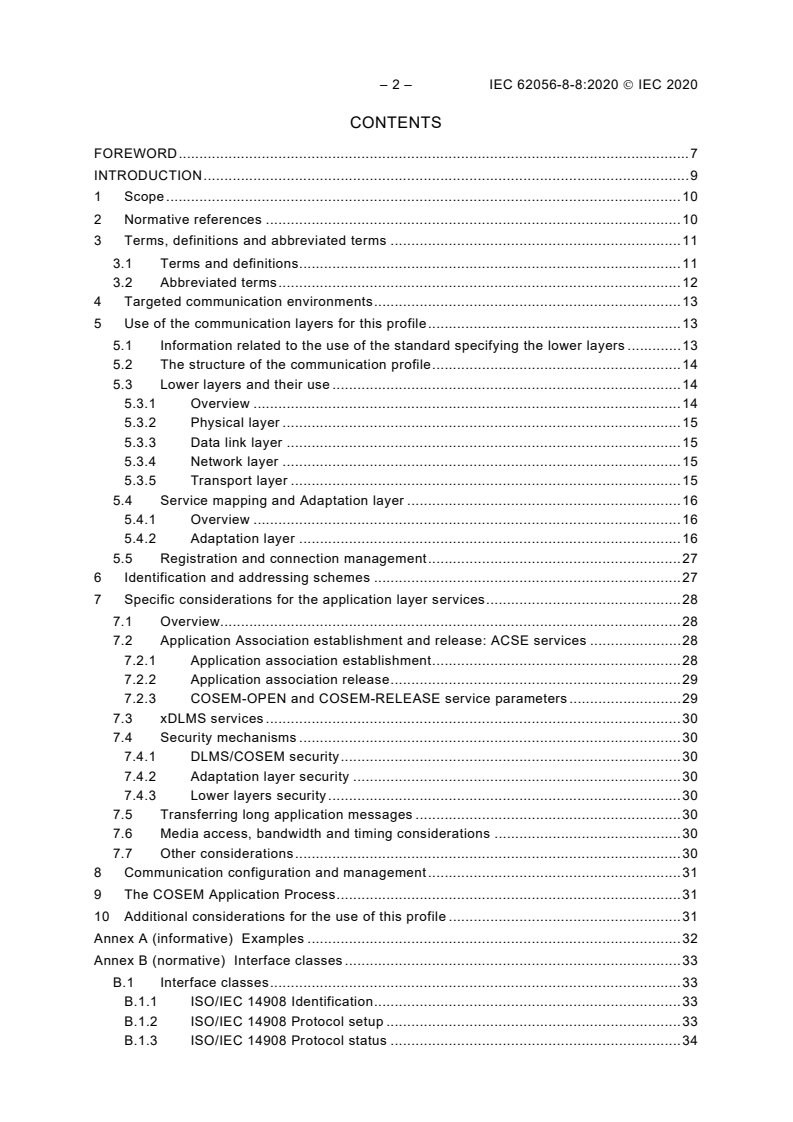
– 2 – IEC 62056-8-8:2020 IEC 2020
CONTENTS
FOREWORD . 7
INTRODUCTION . 9
1 Scope . 10
2 Normative references . 10
3 Terms, definitions and abbreviated terms . 11
3.1 Terms and definitions . 11
3.2 Abbreviated terms . 12
4 Targeted communication environments . 13
5 Use of the communication layers for this profile . 13
5.1 Information related to the use of the standard specifying the lower layers . 13
5.2 The structure of the communication profile . 14
5.3 Lower layers and their use . 14
5.3.1 Overview . 14
5.3.2 Physical layer . 15
5.3.3 Data link layer . 15
5.3.4 Network layer . 15
5.3.5 Transport layer . 15
5.4 Service mapping and Adaptation layer . 16
5.4.1 Overview . 16
5.4.2 Adaptation layer . 16
5.5 Registration and connection management . 27
6 Identification and addressing schemes . 27
7 Specific considerations for the application layer services . 28
7.1 Overview. 28
7.2 Application Association establishment and release: ACSE services . 28
7.2.1 Application association establishment . 28
7.2.2 Application association release . 29
7.2.3 COSEM-OPEN and COSEM-RELEASE service parameters . 29
7.3 xDLMS services . 30
7.4 Security mechanisms . 30
7.4.1 DLMS/COSEM security . 30
7.4.2 Adaptation layer security . 30
7.4.3 Lower layers security . 30
7.5 Transferring long application messages . 30
7.6 Media access, bandwidth and timing considerations . 30
7.7 Other considerations . 30
8 Communication configuration and management . 31
9 The COSEM Application Process . 31
10 Additional considerations for the use of this profile . 31
Annex A (informative) Examples . 32
Annex B (normative) Interface classes . 33
B.1 Interface classes . 33
B.1.1 ISO/IEC 14908 Identification . 33
B.1.2 ISO/IEC 14908 Protocol setup . 33
B.1.3 ISO/IEC 14908 Protocol status . 34
B.1.4 ISO/IEC 14908 Diagnostic . 35
B.2 Relation to OBIS . 37
Annex C (informative) Implementation guide and migration path . 38
C.1 General . 38
C.2 Client-server model . 38
C.2.1 General . 38
C.2.2 Clients . 38
C.2.3 Servers . 39
C.2.4 Application associations . 39
C.3 The COSEM objects. 40
C.3.1 COSEM object model. 40
C.3.2 Referencing methods . 41
C.3.3 The object_list . 42
C.3.4 Mandatory COSEM objects . 42
C.3.5 Application specific objects . 42
C.3.6 Utility table objects . 42
Annex D (informative) OSGP-AES-128-PSK security suite . 46
D.1 General . 46
D.2 Background. 47
D.2.1 Overview . 47
D.2.2 System Assumptions . 47
D.2.3 Threat Model . 47
D.2.4 Design goals . 48
D.2.5 Inspiration . 48
D.3 Terms and definition, abbreviated terms and notation . 48
D.3.1 Terms and definitions . 48
D.3.2 Abbreviated terms . 50
D.3.3 Notation . 50
D.3.4 Other conventions . 50
D.4 Cryptographic Primitives . 51
D.4.1 General . 51
D.4.2 CMAC . 51
D.4.3 CCM . 51
D.5 Cryptographic Functions . 52
D.5.1 Overview . 52
D.5.2 OSGP_KDF: Key Derivation Function . 52
D.5.3 OSGP_MAC: Message Authentication Code Function . 52
D.5.4 OSGP_MAC_VERIFY: Message Authentication Code Verification
Function . 53
D.5.5 OSGP_AE/OSGP_AD: Authenticated Encryption/Decryption Function . 53
D.5.6 OSGP_CSPRNG: Cryptographically Secure Pseudo Random Number
Generator . 55
D.6 Keys . 56
D.7 Secure channel initialization . 58
D.7.1 Overview . 58
D.7.2 Secure Channel State (CryptoContext) . 58
D.7.3 Flow . 58
D.7.4 Security Suite Negotiation . 63
D.7.5 LNAP Commissioning . 64
– 4 – IEC 62056-8-8:2020 IEC 2020
D.7.6 Error Handling and Intrusion Detection . 64
D.7.7 Messages . 64
D.8 Secure Channel Communication . 67
D.8.1 General . 67
D.8.2 The General Process . 68
D.8.3 Unicast communication . 69
D.8.4 Broadcast Communication . 73
D.9 Firmware Downloading . 75
D.10 Key Management . 76
D.10.1 Renewing the Short-term, Meter-unique Keys . 76
D.10.2 Renewing the Short-term, Domain-unique Keys . 76
D.10.3 UpdateDomainKeysRequest . 77
D.10.4 UpdateDomainKeysResponse . 77
D.11 Updating the Long-term, Meter-unique Keys . 77
D.11.1 General . 77
D.11.2 Key Validity Periods . 78
D.12 Error Messages . 78
D.12.1 Overview . 78
D.12.2 AuthenticationFailure . 78
D.12.3 SequenceError . 78
D.13 Security considerations . 78
D.13.1 Reasoning . 78
D.13.2 Recommendation and Guidance for Implementers . 81
Annex E (normative) Repeating mechanism . 83
E.1 Overview. 83
E.2 Terms and definitions . 83
E.3 Protocol specification . 84
E.3.1 Overview . 84
E.3.2 Addressing . 84
E.3.3 Service types . 84
E.3.4 Timers . 84
E.3.5 Request flow . 85
E.3.6 Response flow . 85
E.3.7 Authentication. 85
E.3.8 Examples. 86
E.3.9 Broadcast . 87
E.4 Downlink frame format . 87
E.4.1 Overview . 87
E.4.2 Proxy parameters of request frame . 88
E.5 Uplink Frame format . 92
E.5.1 Overview . 92
E.5.2 Proxy success . 92
E.5.3 Repeating Failure . 93
E.5.4 Authentication failure . 93
Annex F (informative) ISO/IEC 14908-3 Registration and monitoring of LNAPs . 94
F.1 Scope . 94
F.2 Terms and definitions . 94
F.3 Metering device lifecycle . 94
F.4 ATM Protocol . 95
F.4.1 General . 95
F.4.2 ATM roles . 95
F.4.3 Automatic discovery. 95
F.4.4 Discovery domain . 96
F.4.5 ATM messages . 96
F.5 Commissioning . 100
F.5.1 Overview . 100
F.5.2 Commissioning operations . 100
Bibliography . 101
Figure 1 – Functional reference architecture . 13
Figure 2 – Structure of the communication profile . 14
Figure 3 – Adaptation layer structure . 17
Figure 4 – Unprotected Adaptation layer PDU structure . 18
Figure 5 – Protected Adaptation layer PDU structure . 19
Figure 6 – Adaptation layer services . 20
Figure 7 – Client and server ADP_DATA services . 24
Figure D.1 – Key hierarchy diagram . 56
Figure D.2 – Secure channel establishment . 59
Figure D.3 – Challenge request . 60
Figure D.4 – Challenge response . 60
Figure D.5 – Commission Request . 61
Figure D.6 – Commission response . 62
Figure D.7 – Crypto context establishment . 67
Figure D.8 – Authenticate encryption mechanism . 68
Figure D.9 – Authenticated decryption . 69
Figure E.1 – Unacknowledged message exchange . 86
Figure E.2 – Request / Response message . 86
Figure E.3 – Error during request transmission . 86
Figure E.4 – Error during response transmission . 87
Figure E.5 – Proxy Repeater proxy message . 87
Figure E.6 – Proxy Agent proxy message format . 87
Figure E.7 – Proxy Target message format . 88
Figure E.8 – Normal ProxyTrailer . 90
Figure E.9 – Alternate Key Proxy Trailer . 90
Figure E.10 – Proxy SICB field structure . 90
Figure E.11 – Alternate Key format . 91
Figure E.12 – ProxySubnetNode Address (Type1) . 92
Figure E.13 – ProxyUniqueNode_ID Address (Type 2) . 92
Figure E.14 – ProxyBroadcast Address (Type 3) . 92
Figure E.15 – ProxySubnetNode Compact Address (Type 5 and 7) . 92
Figure E.16 – ProxyUniqueNodeCompact Address (Type 6) . 92
Table 1 – Control field. 18
– 6 – IEC 62056-8-8:2020 IEC 2020
Table 2 – Client and Server SAP. 28
Table 3 – Application associations and data exchange in the DLMS/COSEM over
ISO/IEC14908 profile . 29
Table C.1 – Pre-established association parameters . 40
Table C.2 – base_name range for tables categories . 43
Table C.3 – base_names for standard tables BT00 to BT79 . 44
Table D.1 – Security logical layers . 46
Table D.2 – Key type and their scope . 57
Table D.3 – Challenge request . 65
Table D.4 – Challenge response . 65
Table D.5 – Commission request . 66
Table D.6 – Commission response structure . 67
Table D.7 – Request message . 70
Table D.8 – response message structure . 70
Table D.9 – Nonce construction . 70
Table D.10 – Associated Data construction . 71
Table D.11 – Broadcast message . 74
Table D.12 – Broadcast nonce . 74
Table D.13 – Broadcast Associated Data . 74
Table D.14 – Update Domain Keys request . 77
Table D.15 – Update Domain Keys response . 77
Table D.16 – AuthenticationFailure message . 78
Table D.17 – SequenceError message . 78
Table D.18 – Example of risks . 82
Table E.1 – ProxyHeader format . 88
Table E.2 – ProxyDetailedAddress format . 89
Table E.3 – ProxyUniformAddress format . 89
Table E.4 – ProxyTx control format . 89
Table E.5 – Address Type values . 90
Table E.6 – Service types . 91
Table E.7 – Mode types . 91
Table E.8 – Repeating success response. 93
Table E.9 – Repeating Failure. 93
Table E.10 – Authentication failure code . 93
Table F.1 – ATM Message header structure . 97
Table F.2 – ATM payloads . 97
Table F.3 – ATM-query-ID request structure . 98
Table F.4 – ATM-query-ID response structure . 98
Table F.5 – ATM-respond-to-query request structure . 99
Table F.6 – ATM respond-to-query response structure . 99
Table F.7 – Flags . 100
INTERNATIONAL ELECTROTECHNICAL COMMISSION
____________
ELECTRICITY METERING DATA EXCHANGE –
THE DLMS/COSEM SUITE –
Part 8-8: Communication profile for ISO/IEC 14908 series networks
FOREWORD
1) The International Electrotechnical Commission (IEC) is a worldwide organization for standardization comprising
all national electrotechnical committees (IEC National Committees). The object of IEC is to promote international
co-operation on all questions concerning standardization in the electrical and electronic fields. To this end and
in addition to other activities, IEC publishes International Standards, Technical Specifications, Technical Reports,
Publicly Available Specifications (PAS) and Guides (hereafter referred to as "IEC Publication(s)"). Their
preparation is entrusted to technical committees; any IEC National Committee interested in the subject dealt with
may participate in this preparatory work. International, governmental and non-governmental organizations liaising
with the IEC also participate in this preparation. IEC collaborates closely with the International Organization for
Standardization (ISO) in accordance with conditions determined by agreement between the two organizations.
2) The formal decisions or agreements of IEC on technical matters express, as nearly as possible, an international
consensus of opinion on the relevant subjects since each technical committee has representation from all
interested IEC National Committees.
3) IEC Publications have the form of recommendations for international use and are accepted by IEC National
Committees in that sense. While all reasonable efforts are made to ensure that the technical content of IEC
Publications is accurate, IEC cannot be held responsible for the way in which they are used or for any
misinterpretation by any end user.
4) In order to promote international uniformity, IEC National Committees undertake to apply IEC Publications
transparently to the maximum extent possible in their national and regional publications. Any divergence between
any IEC Publication and the corresponding national or regional publication shall be clearly indicated in the latter.
5) IEC itself does not provide any attestation of conformity. Independent certification bodies provide conformity
assessment services and, in some areas, access to IEC marks of conformity. IEC is not responsible for any
services carried out by independent certification bodies.
6) All users should ensure that they have the latest edition of this publication.
7) No liability shall attach to IEC or its directors, employees, servants or agents including individual experts and
members of its technical committees and IEC National Committees for any personal injury, property damage or
other damage of any nature whatsoever, whether direct or indirect, or for costs (including legal fees) and
expenses arising out of the publication, use of, or reliance upon, this IEC Publication or any other IEC
Publications.
8) Attention is drawn to the Normative references cited in this publication. Use of the referenced publications is
indispensable for the correct application of this publication.
9) Attention is drawn to the possibility that some of the elements of this IEC Publication may be the subject of patent
rights. IEC shall not be held responsible for identifying any or all such patent rights.
International Standard IEC 62056-8-8 has been prepared by IEC technical committee 13,
Electrical energy measurement and control.
The text of this International Standard is based on the following documents:
CDV Report on voting
13/1783/CDV 13/1792/RVC
Full information on the voting for the approval of this International Standard can be found in the
report on voting indicated in the above table.
This document has been drafted in accordance with the ISO/IEC Directives, Part 2.
A list of all parts in the IEC 62056 series, published under the general title Electricity metering
data exange – The DLMS/COSEM suite, can be found on the IEC website.
– 8 – IEC 62056-8-8:2020 IEC 2020
The committee has decided that the contents of this document will remain unchanged until the
stability date indicated on the IEC website under "http://webstore.iec.ch" in the data related to
the specific document. At this date, the document will be
• reconfirmed,
• withdrawn,
• replaced by a revised edition, or
• amended.
IMPORTANT – The 'colour inside' logo on the cover page of this publication indicates
that it contains colours which are considered to be useful for the correct understanding
of its contents. Users should therefore print this document using a colour printer.
INTRODUCTION
The IEC 62056 DLMS/COSEM suite provides specific communication profile standards for
communication media relevant for smart metering.
Such communication profile standards specify how the COSEM data model and the
DLMS/COSEM application layer can be used on the lower communication media-specific
protocol layers.
Communication profile standards refer to communication standards that are part of the
IEC 62056 DLMS/COSEM suite or to any other open communication standard.
This International Standard specifies DLMS/COSEM communication profile using
ISO/IEC 14908‑1:2012, Information technology – Control network protocol – Part 1: Protocol
stack and ISO/IEC 14908‑3:2012, Information technology – Control network protocol – Part 3:
Power line channel specification. It applies for devices installed on the neighbourhood area
network.
It follows the rules defined in IEC 62056‑5‑3:2017, Annex A, and in IEC 62056-1-0, and
IEC TS 62056-1-1 for its structure.
– 10 – IEC 62056-8-8:2020 IEC 2020
ELECTRICITY METERING DATA EXCHANGE –
THE DLMS/COSEM SUITE –
Part 8-8: Communication profile for ISO/IEC 14908 series networks
1 Scope
This part of IEC 62056 describes how the DLMS/COSEM Application layer and the COSEM
object model as specified in IEC 62056‑5‑3:2017, IEC 62056‑6‑1:2017 and IEC 62056‑6‑2:2017
can be used over the lower layers specified in the IEC 14908 series, forming a DLMS/COSEM
ISO/IEC 14908 communication profile.
This document is part of the IEC 62056 series. Its structure follows IEC 62056-1-0 and
IEC TS 62056-1-1.
Annex A (informative) provides examples of representative instances of data exchange.
NOTE This Annex A is included and referenced for consistency with other parts of the IEC 62056 suite, but it is
empty.
Annex B (normative) defines COSEM interface classes and related OBIS codes for setting up
and managing the DLMS/COSEM communication profile for IEC 14908 networks. These
interface classes and OBIS codes will be moved later to IEC 62056-6-2 and IEC 62056-6-1.
Annex C (informative) provides an implementation guide and specifies a migration path from
Utility Tables based applications to DLMS/COSEM based applications.
Annex D (informative) specifies the OSGP-AES-128-PSK security suite for optional use on the
adaptation layer level.
Annex E (normative) specifies the repeating mechanism over the ISO 14908-3 Power Line
Channel network.
Annex F (informative) specifies ISO/IEC 14908-3 Registration and monitoring of LNAPs.
2 Normative references
The following documents are referred to in the text in such a way that some or all of their content
constitutes requirements of this document. For dated references, only the edition cited applies.
For undated references, the latest edition of the referenced document (including any
amendments) applies.
IEC 62056‑5‑3:2017, Electricity metering data exchange – The DLMS/COSEM suite – Part 5‑3:
DLMS/COSEM application layer
IEC 62056‑6‑1:2017, Electricity metering data exchange – The DLMS/COSEM suite – Part 6‑1:
Object Identification System (OBIS)
‑2:
IEC 62056‑6‑2:2017, Electricity metering data exchange – The DLMS/COSEM suite – Part 6
COSEM interface classes
ISO/IEC 14908‑1:2012, Information technology – Control network protocol – Part 1: Protocol
stack
ISO/IEC 14908‑3:2012, Information technology – Control network protocol – Part 3: Power line
channel specification
EN 50065‑1, Signalling on low‑voltage electrical installations in the frequency range 3 kHz to
148,5 kHz – Part 1: General requirements, frequency bands and electromagnetic disturbances
3 Terms, definitions and abbreviated terms
For the purposes of this document, the following terms and definitions apply.
ISO and IEC maintain terminological databases for use in standardization at the following
addresses:
• IEC Electropedia: available at http://www.electropedia.org/
• ISO Online browsing platform: available at http://www.iso.org/obp
NOTE All the messages in this document use the big endian format
3.1 Terms and definitions
3.1.1
domain
logical network that is a unit for addressing
Note 1 to entry: Subnet (see below) and node addresses are assigned by the administrator responsible for the
domain, and they have meaning only in the context of that domain.
Note 2 to entry: All nodes belongs to the same domain to be able to address each other.
3.1.2
node
abstraction for a physical node that represents the highest degree of address resolvability on a
network
Note 1 to entry: A node is identified (addressed) within a subnet by its (logical) node identifier called Node_ID. A
physical node may belong to more than one subnet; when it does, it is assigned one (logical) node number for each
subnet to which it belongs. A physical node may belong to at most two subnets; these subnets are parts of different
domains. A node may also be identified (absolutely) within a network by its Unique_Node_ID which is immutable.
3.1.3
subnet
set of nodes accessible through the same link layer protocol
Note 1 to entry: In a logical address, a subnet is identified by a Subnet_ID.
3.1.4
transaction
sequence of messages that are correlated
Note 1 to entry: For example, a request and the response to the request are all part of a single transaction. A
transaction succeeds when all the expected messages from every node involved in the transaction are received at
least once. A transaction fails if any of the expected messages within the transaction are not received.
– 12 – IEC 62056-8-8:2020 IEC 2020
3.2 Abbreviated terms
Abbreviated term Meaning
AA Application Association
AARE Application Association Response
AARQ Application Association Request
ACSE Association Control Service Element
ADD Automated Device Discovery
AdpPDU Adaptation layer PDU
AL Application layer
AP Application Process
APDU Application Protocol Data Unit
ASE Application Service Element
ATM Automated Topology Management
BPSK Binary Phase Shift Keyed
COSEM Companion Specification of Energy Metering
CRC Cyclic Redundancy Code
CSM
...