

IEC 62056-8-5:2017
(Main)Electricity metering data exchange - The DLMS/COSEM suite - Part 8-5: Narrow-band OFDM G3-PLC communication profile for neighbourhood networks
General Information
- Abstract
IEC 62056-8-5:2017 specifies the IEC 62056 DLMS/COSEM communication profile for metering purposes based on the Recommendations ITU-T G.9901: Narrowband orthogonal frequency division multiplexing power line communication transceivers - Power spectral density specification and ITU-T G.9903:2014, Narrowband orthogonal frequency division multiplexing power line communication transceivers for G3-PLC networks, an Orthogonal Frequency Division Multiplexing (OFDM) Power Line Communications (PLC) protocol.
The contents of the corrigendum of December 2017 have been included in this copy.
- Status
- Published
- Publication Date
- 09-Aug-2017
- Technical Committee
- TC 13 - Electrical energy measurement and control
- Current Stage
- PPUB - Publication issued
- Start Date
- 10-Aug-2017
- Completion Date
- 21-Aug-2017
Buy Documents
IEC 62056-8-5:2017 - Electricity metering data exchange - The DLMS/COSEM suite - Part 8-5: Narrow-band OFDM G3-PLC communication profile for neighbourhood networks Released:8/10/2017
IEC 62056-8-5:2017 - Electricity metering data exchange - The DLMS/COSEM suite - Part 8-5: Narrow-band OFDM G3-PLC communication profile for neighbourhood networks Released:1/9/2018
Overview
IEC 62056-8-5:2017 is an international standard developed by the International Electrotechnical Commission (IEC) for electricity metering data exchange using the DLMS/COSEM suite. This part of the series focuses specifically on the narrow-band Orthogonal Frequency Division Multiplexing (OFDM) G3-PLC communication profile for neighbourhood networks. It sets requirements for communication profiles based on ITU-T G.9901 (power spectral density specification) and ITU-T G.9903 (narrowband OFDM transceivers for G3-PLC networks), enabling robust and scalable power line communication for smart metering infrastructures. This standard is essential for ensuring interoperability and efficiency in Advanced Metering Infrastructure (AMI) deployments.
Key Topics
DLMS/COSEM Communication Profile
Defines how the COSEM object model and DLMS/COSEM application layer are implemented over G3-PLC networks, supporting both decentralized and centralized AMI architectures.G3-PLC Technology
Employs narrow-band OFDM modulation to achieve reliable data transfer over existing low-voltage electricity distribution networks despite interference or noise.Layered Protocol Stack
- Physical Layer: Specifies OFDM on multiple international frequency bands (e.g., CENELEC, ARIB, FCC).
- MAC Layer: Supports secure network association, mesh topology, channel access management, and efficient data handling.
- 6LoWPAN Adaptation Layer: Facilitates data transfer between the MAC and IPv6 network layers, leveraging header compression for efficiency.
- IPv6 Networking: Supports broad IP-based applications and direct communication with Head-End Systems (HES).
- UDP Transport Layer: Uses User Datagram Protocol to ensure simple and flexible data transport.
Security and Reliability
The standard outlines the use of secure device association, data integrity methods, and supports robust error correction to maintain reliable meter data exchanges.Network Architecture
Describes roles for Personal Area Network (PAN) coordinators and PAN devices, typical for neighbourhood network deployments in smart grid environments.
Applications
IEC 62056-8-5:2017 is designed for use in smart electricity metering, utility data management, and neighbourhood network communications. Typical practical applications include:
- Advanced Metering Infrastructure (AMI): Enables utilities to collect, process, and manage electricity consumption data from smart meters through existing powerlines.
- Demand Response and Load Control: Supports real-time data exchange needed for grid optimization and consumer-based demand management.
- Remote Metering: Provides utilities with cost-efficient remote reading, facilitating timely and accurate billing, outage detection, and service quality monitoring.
- Interoperability in Multi-vendor Environments: By adhering to open standards, the profile enables seamless integration between devices from different manufacturers within a single neighbourhood network.
Related Standards
IEC 62056-8-5:2017 is closely connected to other standards in metering communication and smart grid networks, such as:
IEC 62056 Series:
- IEC 62056-1-0: Smart metering standardization framework
- IEC 62056-4-7: DLMS/COSEM transport layer for IP networks
- IEC 62056-5-3: DLMS/COSEM application layer
- IEC 62056-6-1: Object identification system (OBIS)
- IEC 62056-9-7: Communication profile for TCP-UDP/IP networks
ITU-T Recommendations:
- ITU-T G.9901: Power spectral density for narrowband PLC
- ITU-T G.9903: OFDM PLC transceivers for G3-PLC networks
IETF RFCs:
- RFC 2460: IPv6 Specification
- RFC 768: User Datagram Protocol (UDP)
- RFC 4944 and RFC 6282: Adaptation and compression for 6LoWPAN
Implementing IEC 62056-8-5:2017 enhances interoperability, future-proofs smart grid communication investments, and simplifies the integration of advanced data analytics and real-time grid management. This standard is a critical component in the evolution of efficient and secure smart electricity metering networks leveraging narrow-band OFDM G3-PLC technology.
Relations
- Effective Date
- 05-Sep-2023
Buy Documents
IEC 62056-8-5:2017 - Electricity metering data exchange - The DLMS/COSEM suite - Part 8-5: Narrow-band OFDM G3-PLC communication profile for neighbourhood networks Released:8/10/2017
IEC 62056-8-5:2017 - Electricity metering data exchange - The DLMS/COSEM suite - Part 8-5: Narrow-band OFDM G3-PLC communication profile for neighbourhood networks Released:1/9/2018
Get Certified
Connect with accredited certification bodies for this standard

BSI Group
BSI (British Standards Institution) is the business standards company that helps organizations make excellence a habit.

DIBt (Deutsches Institut für Bautechnik)
German Institute for Building Technology.
DIN CERTCO
DIN Group product certification.
Sponsored listings
Frequently Asked Questions
IEC 62056-8-5:2017 is a standard published by the International Electrotechnical Commission (IEC). Its full title is "Electricity metering data exchange - The DLMS/COSEM suite - Part 8-5: Narrow-band OFDM G3-PLC communication profile for neighbourhood networks". This standard covers: IEC 62056-8-5:2017 specifies the IEC 62056 DLMS/COSEM communication profile for metering purposes based on the Recommendations ITU-T G.9901: Narrowband orthogonal frequency division multiplexing power line communication transceivers - Power spectral density specification and ITU-T G.9903:2014, Narrowband orthogonal frequency division multiplexing power line communication transceivers for G3-PLC networks, an Orthogonal Frequency Division Multiplexing (OFDM) Power Line Communications (PLC) protocol. The contents of the corrigendum of December 2017 have been included in this copy.
IEC 62056-8-5:2017 specifies the IEC 62056 DLMS/COSEM communication profile for metering purposes based on the Recommendations ITU-T G.9901: Narrowband orthogonal frequency division multiplexing power line communication transceivers - Power spectral density specification and ITU-T G.9903:2014, Narrowband orthogonal frequency division multiplexing power line communication transceivers for G3-PLC networks, an Orthogonal Frequency Division Multiplexing (OFDM) Power Line Communications (PLC) protocol. The contents of the corrigendum of December 2017 have been included in this copy.
IEC 62056-8-5:2017 is classified under the following ICS (International Classification for Standards) categories: 17.220 - Electricity. Magnetism. Electrical and magnetic measurements; 35.110 - Networking; 91.140.50 - Electricity supply systems. The ICS classification helps identify the subject area and facilitates finding related standards.
IEC 62056-8-5:2017 has the following relationships with other standards: It is inter standard links to IEC 62056-8-5:2017/COR1:2017. Understanding these relationships helps ensure you are using the most current and applicable version of the standard.
IEC 62056-8-5:2017 is available in PDF format for immediate download after purchase. The document can be added to your cart and obtained through the secure checkout process. Digital delivery ensures instant access to the complete standard document.
Standards Content (Sample)
IEC 62056-8-5 ®
Edition 1.0 2017-08
INTERNATIONAL
STANDARD
colour
inside
Electricity metering data exchange –The DLMS/COSEM suite –
Part 8-5: Narrow-band OFDM G3-PLC communication profile
for neighbourhood networks
All rights reserved. Unless otherwise specified, no part of this publication may be reproduced or utilized in any form
or by any means, electronic or mechanical, including photocopying and microfilm, without permission in writing from
either IEC or IEC's member National Committee in the country of the requester. If you have any questions about IEC
copyright or have an enquiry about obtaining additional rights to this publication, please contact the address below or
your local IEC member National Committee for further information.
IEC Central Office Tel.: +41 22 919 02 11
3, rue de Varembé Fax: +41 22 919 03 00
CH-1211 Geneva 20 info@iec.ch
Switzerland www.iec.ch
About the IEC
The International Electrotechnical Commission (IEC) is the leading global organization that prepares and publishes
International Standards for all electrical, electronic and related technologies.
About IEC publications
The technical content of IEC publications is kept under constant review by the IEC. Please make sure that you have the
latest edition, a corrigenda or an amendment might have been published.
IEC Catalogue - webstore.iec.ch/catalogue Electropedia - www.electropedia.org
The stand-alone application for consulting the entire The world's leading online dictionary of electronic and
bibliographical information on IEC International Standards, electrical terms containing 20 000 terms and definitions in
Technical Specifications, Technical Reports and other English and French, with equivalent terms in 16 additional
documents. Available for PC, Mac OS, Android Tablets and languages. Also known as the International Electrotechnical
iPad. Vocabulary (IEV) online.
IEC publications search - www.iec.ch/searchpub IEC Glossary - std.iec.ch/glossary
The advanced search enables to find IEC publications by a 65 000 electrotechnical terminology entries in English and
variety of criteria (reference number, text, technical French extracted from the Terms and Definitions clause of
committee,…). It also gives information on projects, replaced IEC publications issued since 2002. Some entries have been
and withdrawn publications. collected from earlier publications of IEC TC 37, 77, 86 and
CISPR.
IEC Just Published - webstore.iec.ch/justpublished
Stay up to date on all new IEC publications. Just Published IEC Customer Service Centre - webstore.iec.ch/csc
details all new publications released. Available online and If you wish to give us your feedback on this publication or
also once a month by email. need further assistance, please contact the Customer Service
Centre: csc@iec.ch.
IEC 62056-8-5 ®
Edition 1.0 2017-08
INTERNATIONAL
STANDARD
colour
inside
Electricity metering data exchange –The DLMS/COSEM suite –
Part 8-5: Narrow-band OFDM G3-PLC communication profile
for neighbourhood networks
INTERNATIONAL
ELECTROTECHNICAL
COMMISSION
ICS 17.220; 35.110; 91.140.50 ISBN 978-2-8322-4612-2
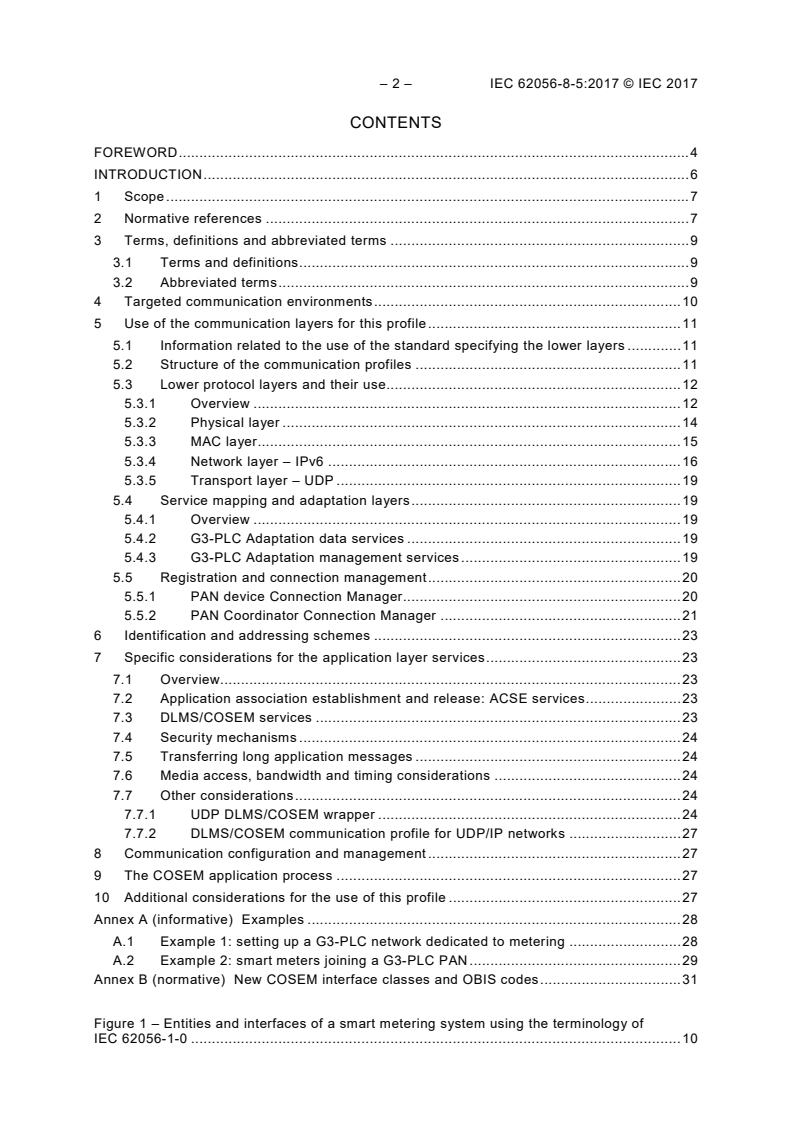
– 2 – IEC 62056-8-5:2017 © IEC 2017
CONTENTS
FOREWORD . 4
INTRODUCTION . 6
1 Scope . 7
2 Normative references . 7
3 Terms, definitions and abbreviated terms . 9
3.1 Terms and definitions . 9
3.2 Abbreviated terms . 9
4 Targeted communication environments . 10
5 Use of the communication layers for this profile . 11
5.1 Information related to the use of the standard specifying the lower layers . 11
5.2 Structure of the communication profiles . 11
5.3 Lower protocol layers and their use. 12
5.3.1 Overview . 12
5.3.2 Physical layer . 14
5.3.3 MAC layer. 15
5.3.4 Network layer – IPv6 . 16
5.3.5 Transport layer – UDP . 19
5.4 Service mapping and adaptation layers . 19
5.4.1 Overview . 19
5.4.2 G3-PLC Adaptation data services . 19
5.4.3 G3-PLC Adaptation management services . 19
5.5 Registration and connection management . 20
5.5.1 PAN device Connection Manager. 20
5.5.2 PAN Coordinator Connection Manager . 21
6 Identification and addressing schemes . 23
7 Specific considerations for the application layer services . 23
7.1 Overview. 23
7.2 Application association establishment and release: ACSE services . 23
7.3 DLMS/COSEM services . 23
7.4 Security mechanisms . 24
7.5 Transferring long application messages . 24
7.6 Media access, bandwidth and timing considerations . 24
7.7 Other considerations . 24
7.7.1 UDP DLMS/COSEM wrapper . 24
7.7.2 DLMS/COSEM communication profile for UDP/IP networks . 27
8 Communication configuration and management . 27
9 The COSEM application process . 27
10 Additional considerations for the use of this profile . 27
Annex A (informative) Examples . 28
A.1 Example 1: setting up a G3-PLC network dedicated to metering . 28
A.2 Example 2: smart meters joining a G3-PLC PAN . 29
Annex B (normative) New COSEM interface classes and OBIS codes . 31
Figure 1 – Entities and interfaces of a smart metering system using the terminology of
IEC 62056-1-0 . 10
Figure 2 – G3-PLC protocol architecture . 12
Figure 3 – PAN device communication profile architecture . 13
Figure 4 – PAN coordinator communication profile architecture . 13
Figure 5 – IPv6 address formats . 16
Figure 6 – IPv6 Addressing plan example . 17
Figure 7 – IPv6 Link-local address composition . 18
Figure A.1 – PAN coordinator initialisation . 28
Figure A.2 – PAN device initialisation and bootstrapping. 30
Table 1 – 16-bit short addresses allocation rule . 18
Table 2 – UDP port numbering . 19
Table 3 – Selections from IEC 62056-4-7:2015 . 25
Table 4 – Selections from IEC 62056-9-7:2013 . 27
– 4 – IEC 62056-8-5:2017 © IEC 2017
INTERNATIONAL ELECTROTECHNICAL COMMISSION
____________
ELECTRICITY METERING DATA EXCHANGE –
THE DLMS/COSEM SUITE –
Part 8-5: Narrow-band OFDM G3-PLC communication profile
for neighbourhood networks
FOREWORD
1) The International Electrotechnical Commission (IEC) is a worldwide organization for standardization comprising
all national electrotechnical committees (IEC National Committees). The object of IEC is to promote
international co-operation on all questions concerning standardization in the electrical and electronic fields. To
this end and in addition to other activities, IEC publishes International Standards, Technical Specifications,
Technical Reports, Publicly Available Specifications (PAS) and Guides (hereafter referred to as “IEC
Publication(s)”). Their preparation is entrusted to technical committees; any IEC National Committee interested
in the subject dealt with may participate in this preparatory work. International, governmental and
non-governmental organizations liaising with the IEC also participate in this preparation. IEC collaborates
closely with the International Organization for Standardization (ISO) in accordance with conditions determined
by agreement between the two organizations.
2) The formal decisions or agreements of IEC on technical matters express, as nearly as possible, an international
consensus of opinion on the relevant subjects since each technical committee has representation from all
interested IEC National Committees.
3) IEC Publications have the form of recommendations for international use and are accepted by IEC National
Committees in that sense. While all reasonable efforts are made to ensure that the technical content of IEC
Publications is accurate, IEC cannot be held responsible for the way in which they are used or for any
misinterpretation by any end user.
4) In order to promote international uniformity, IEC National Committees undertake to apply IEC Publications
transparently to the maximum extent possible in their national and regional publications. Any divergence
between any IEC Publication and the corresponding national or regional publication shall be clearly indicated in
the latter.
5) IEC itself does not provide any attestation of conformity. Independent certification bodies provide conformity
assessment services and, in some areas, access to IEC marks of conformity. IEC is not responsible for any
services carried out by independent certification bodies.
6) All users should ensure that they have the latest edition of this publication.
7) No liability shall attach to IEC or its directors, employees, servants or agents including individual experts and
members of its technical committees and IEC National Committees for any personal injury, property damage or
other damage of any nature whatsoever, whether direct or indirect, or for costs (including legal fees) and
expenses arising out of the publication, use of, or reliance upon, this IEC Publication or any other IEC
Publications.
8) Attention is drawn to the Normative references cited in this publication. Use of the referenced publications is
indispensable for the correct application of this publication.
9) Attention is drawn to the possibility that some of the elements of this IEC Publication may be the subject of
patent rights. IEC shall not be held responsible for identifying any or all such patent rights.
The International Electrotechnical Commission (IEC) draws attention to the fact that it is
claimed that compliance with this International Standard may involve the use of a
maintenance service concerning the stack of protocols on which the present standard
IEC 62056-8-5 is based.
The IEC takes no position concerning the evidence, validity and scope of this maintenance
service.
The provider of the maintenance service has assured the IEC that he is willing to provide
services under reasonable and non-discriminatory terms and conditions for applicants
throughout the world. In this respect, the statement of the provider of the maintenance service
is registered with the IEC. Information may be obtained from:
G3-PLC Alliance
34 Place des Corolles
92079 Paris La Défense Cedex>
www.g3-plc.com
International Standard IEC 62056-8-5 has been prepared by IEC technical committee 13:
Electrical energy measurement and control.
The text of this International Standard is based on the following documents:
CDV Report on voting
13/1708/CDV 13/1740/RVC
Full information on the voting for the approval of this International Standard can be found in
the report on voting indicated in the above table.
A list of all parts in the IEC 62056 series, published under the general title Electricity metering
data exchange – The DLMS/COSEM suite, can be found on the IEC website.
This document has been drafted in accordance with the ISO/IEC Directives, Part 2.
The committee has decided that the contents of this document will remain unchanged until the
stability date indicated on the IEC website under "http://webstore.iec.ch" in the data related to
the specific document. At this date, the document will be
• reconfirmed,
• withdrawn,
• replaced by a revised edition, or
• amended.
A bilingual version of this publication may be issued at a later date.
The contents of the corrigendum of December 2017 have been included in this copy.
IMPORTANT – The 'colour inside' logo on the cover page of this publication indicates
that it contains colours which are considered to be useful for the correct
understanding of its contents. Users should therefore print this document using a
colour printer.
– 6 – IEC 62056-8-5:2017 © IEC 2017
INTRODUCTION
As defined in IEC 62056-1-0, the IEC 62056 DLMS/COSEM suite provides specific
communication profile standards for communication media relevant for smart metering.
Such communication profile standards specify how the COSEM data model and the
DLMS/COSEM application layer can be used on the lower, communication media-specific
protocol layers.
Communication profile standards refer to communication standards that are part of the
IEC 62056 DLMS/COSEM suite or to any other open communication standard.
This International Standard specifies the DLMS/COSEM communication profile for ITU-
T G.9903:2014 PLC communication based on OFDM technology.
ITU-T G.9903 PLC is designed to meet the following aims:
• Robustness: the communication profile shall be suited to severe powerline environments
(see 5.3.2);
• Performance and scalability: it embeds adaptive modulation to use the proper modulation
according to the quality of the link (see 5.3.2) within dense environments (up to
2 000 nodes in the same PAN);
• Security: it shall offer a secure environment (see 7.4);
• Openness: it shall be based on open standards in order to support multi-supplier solutions
(see Clause 5);
• Flexibility and future proof: it shall be able to support future applications through using
IPv6 networking capabilities (see 5.3.4).
This standard follows the rules defined in IEC 62056-5-3:2017, Annex A.
ELECTRICITY METERING DATA EXCHANGE –
THE DLMS/COSEM SUITE –
Part 8-5: Narrow-band OFDM G3-PLC communication profile
for neighbourhood networks
1 Scope
This part of IEC 62056 specifies the IEC 62056 DLMS/COSEM communication profile for
metering purposes based on the Recommendations ITU-T G.9901: Narrowband orthogonal
frequency division multiplexing power line communication transceivers – Power spectral
density specification and ITU-T G.9903:2014, Narrowband orthogonal frequency division
multiplexing power line communication transceivers for G3-PLC networks, an Orthogonal
Frequency Division Multiplexing (OFDM) Power Line Communications (PLC) protocol.
The physical layer provides a modulation technique that efficiently utilizes the allowed
bandwidth within the CENELEC A (3 kHz – 95 kHz), CENELEC B (95 kHz – 125 kHz), ARIB
(10 kHz – 450 kHz) and FCC (no specific frequency band limitations) bands, thereby allowing
the use of advanced channel coding techniques. This enables a robust communication in the
presence of narrowband interference, impulsive noise, and frequency selective attenuation.
The medium access control (MAC) layer allows the transmission of MAC frames through the
use of the power line physical channel. It provides data services, frame validation control,
node association and secure services.
The 6LoWPAN adaptation sublayer enables an efficient interaction between the MAC and the
IPv6 network layer. The use of the IPv6 network protocol – the latest generation of IP
protocols – opens a wide range of potential applications and services for metering purposes
(but the applications are not limited to metering).
The transport layer, the application layer and the data model are as specified in the
IEC 62056 DLMS/COSEM suite.
The scope of this communication profile standard is restricted to aspects concerning the use
of communication protocols in conjunction with the COSEM data model and the
DLMS/COSEM application layer. Data structures specific to a communication protocol are out
of the scope of this communication profile standard.
NOTE They are specified in the specific protocol standards.
Any project specific definitions of data structures and data contents may be provided in
project specific companion specifications.
2 Normative references
The following documents are referred to in the text in such a way that some or all of their
content constitutes requirements of this document. For dated references, only the edition
cited applies. For undated references, the latest edition of the referenced document (including
any amendments) applies.
IEC 60050-300, International Electrotechnical Vocabulary – Electrical and electronic
measurements and measuring instruments – Part 311: General terms relating to
measurements – Part 312: General terms relating to electrical measurements – Part 313:
– 8 – IEC 62056-8-5:2017 © IEC 2017
Types of electrical measuring instruments – Part 314: Specific terms according to the type of
instrument
IEC TR 62051, Electricity metering – Glossary of terms
IEC TR 62051-1, Electricity metering – Data exchange for meter reading, tariff and load
control – Glossary of terms – Part 1: Terms related to data exchange with metering equipment
using DLMS/COSEM
IEC 62056-1-0, Electricity metering data exchange – The DLMS/COSEM suite – Part 1-0:
Smart metering standardisation framework
IEC 62056-4-7:2015, Electricity metering data exchange – The DLMS/COSEM suite –
Part 4-7: DLMS/COSEM transport layer for IP networks
IEC 62056-5-3:2017, Electricity metering data exchange – The DLMS/COSEM suite – Part 5-
3: DLMS/COSEM application layer
IEC 62056-6-1, Electricity metering data exchange – The DLMS/COSEM suite – Part 6-1:
Object identification system (OBIS)
IEC 62056-6-2, Electricity metering data exchange – The DLMS/COSEM suite – Part 6-2:
COSEM interface classes
IEC 62056-9-7:2013, Electricity metering data exchange – The DLMS/COSEM suite –
Part 9-7: Communication profile for TCP-UDP/IP networks
Recommendation ITU-T G.9903:2014, Narrowband Orthogonal Frequency Division
Multiplexing Power Line Communication Transceivers for G3-PLC Networks available at
http://www.itu.int/rec/T-REC-G.9903/en
IETF RFC 768, User Datagram Protocol. Edited by J. Postel. August 1980. Available from
http://www.ietf.org/rfc/rfc768.txt
IETF RFC 2460, Internet Protocol, Version 6 (IPv6) Specification. Edited by S. Deering,
R. Hinden. December 1998. Available from http://www.ietf.org/rfc/rfc2460.txt
IETF RFC 4193, Unique Local IPv6 Unicast Addresses. Edited by R. Hinden, B. Haberman.
October 2005. Available from http://www.ietf.org/rfc/rfc4193.txt
IETF RFC 4291, IP Version 6 Addressing Architecture. Edited by R. Hinden, S. Deering.
February 2006. Available from http://www.ietf.org/rfc/rfc4291.txt
IETF RFC 4944, Transmission of IPv6 Packets over IEEE 802.15.4 Networks. Available from
http://www.ietf.org/rfc/rfc2460.txt
IETF RFC 6282, Compression Format for IPv6 Datagrams over IEEE 802.15.4-Based
Networks. Available from http://www.ietf.org/rfc/rfc2460.txt
IETF RFC 4861, Neighbor Discovery for IP version 6 (IPv6). Available from
http://www.ietf.org/rfc/rfc4861.txt
IETF RFC 4862, IPv6 Stateless Address Autoconfiguration. Available from
http://www.ietf.org/rfc/rfc4862.txt
IEEE 802.15.4:IEEE Standard for Low-Rate Wireless Networks
3 Terms, definitions and abbreviated terms
3.1 Terms and definitions
For the purposes of this document, the terms and definitions given in IEC 60050-300,
IEC TR 62051, IEC TR 62051-1 and the following apply.
NOTE Where there is a difference between the definitions in the glossaries and those contained in communication
profile standards established by TC 13, then the latter take precedence in applications of the relevant standard.
ISO and IEC maintain terminological databases for use in standardization at the following
addresses:
• IEC Electropedia: available at http://www.electropedia.org/
• ISO Online browsing platform: available at http://www.iso.org/obp
3.1.1
PAN coordinator
entity implementing the G3-PLC protocol capable of controlling the network
3.1.2
PAN device
entity implementing the G3-PLC protocol which does not embed coordinator functionalities
3.2 Abbreviated terms
AA Application Association
APDU Application Layer Protocol Data Unit
ARIB Association of Radio Industries and Businesses (Japan)
6LoWPAN IPv6 over Low power Wireless Personal Area Networks
CENELEC European Committee for Electrotechnical Standardization
COSEM Companion Specification for Energy Metering
DLMS Device Language Message Specification
FCC Federal Communications Commission (US)
IEC International Electrotechnical Commission
IP Internet Protocol
ITU-T International Telecommunication Union – Telecommunication
LBA LoWPAN Bootstrapping Agent
LBP LoWPAN Bootstrapping Protocol
MAC Media Access Control
NNAP Neighbourhood Network Access Point
OFDM Orthogonal Frequency Division Multiplexing
OSI Open System Interconnection
PAN Personal Area Network
PLC Power Line Communication
PSK Pre-Shared Key
TCP Transmission Control Protocol
UDP User Datagram Protocol
Furthermore, the abbreviations given in ITU-T G.9903:2014, Clause 4 also apply.
– 10 – IEC 62056-8-5:2017 © IEC 2017
4 Targeted communication environments
The DLMS/COSEM narrow-band OFDM G3-PLC communication profile for neighbourhood
networks is intended for remote data exchange on Neighbourhood Networks (NN) between
Neighbourhood Network Access Points (NNAPs) and Local Network Access Points (LNAPs) or
End Devices using OFDM technology over the low voltage electricity distribution network as a
communication medium. The functional reference architecture is shown in Figure 1.
End devices – typically electricity meters – comprise application functions and communication
functions. They may be connected directly to the NNAP via the C interface, or to an LNAP via
an M interface, while the LNAP is connected to the NNAP via the C interface. The LNAP
function may be co-located with the metering functions.
A NNAP comprises gateway functions and it may comprise concentrator functions. Upstream,
it is connected to the Metering Head End System (HES) using suitable communication media
and protocols. The communication channel between the NNAP and HES is out of scope of
this document.
End devices and LNAPs may communicate to different NNAPs, but to one NNAP only at a
time. From the PLC communication point of view, the NNAP acts as the PAN coordinator
while end devices and LNAPs act as PAN devices.
NNAPs and similarly LNAPs may communicate to each other, but this is out of the scope of
this document, which covers the C interface only.
When the NNAP has concentrator functions, it acts as a DLMS/COSEM client. When the
NNAP has gateway functionality only, then the HES plays the role of a DLMS/COSEM client.
The end devices or the LNAPs play the role of DLMS/COSEM servers.
A mixed architecture is also possible, i.e. both the HES and the NNAP can act as a client.
Simple
Metering H1
consumer
device
Home automation
display
system
G1 C M
L
M
G1 LNAP Local network H2
access point
N
C C
H3
NNAP Neighbourhood network
access point
G2
G1
HES Head end system
IEC
Figure 1 – Entities and interfaces of a smart metering system
using the terminology of IEC 62056-1-0
WAN Wide area network
NN Neighbourhood
LN Local network
5 Use of the communication layers for this profile
5.1 Information related to the use of the standard specifying the lower layers
The proposed communication model natively integrates a network layer and an IP suite
transport layer which opens the way to a vast range of Internet applications and ensures great
flexibility in the system architecture. It provides the possibility of having:
• either a decentralized architecture, where the NNAP (also known as data concentrator)
acts as an application relay, with more or less autonomy. The exchanges at application
level in this case are limited to the dialogue between the meters / LNAPs and the NNAPs;
• or a more centralized architecture in which the NNAP simply acts as a network gateway
and the meters (LNAPs dialogue directly with HES from an application layer point of view).
A combination of these architectures is also possible. A centralized architecture can be
dedicated for sensitive and/or on-demand requests whereas distributed architecture can be
used for recurrent operations.
The network layer chosen is based on the IPv6 protocol (IETF RFC 2460).
The protocol used for the transport layer is UDP (IETF RFC 768), which provides unreliable
transport of datagrams in connectionless mode. Reliability of exchanges within the PLC
network is brought by the combination of lower layer robustness (such as retries or physical
layer forward error correction) and DLMS/COSEM services.
The ITU-T G.9903:2014 specification defines a standardized header compression mechanism
based on IETF RFC 6282 enabling IPv6 and UDP header compression.
5.2 Structure of the communication profiles
The protocol stack uses the following protocol layers as shown in Figure 2:
• The DLMS/COSEM Application layer as specified in IEC 62056-5-3 covering the
Application, Presentation and Session functionalities;
• The DLMS/COSEM Transport layer as specified in IEC 62056-4-7:2015, used with the
DLMS/COSEM UDP/IPv6 profile over the G3-PLC network;
• The ITU-T G.9903:2014 Data link layer, that consists of the IETF 6LoWPAN Adaptation
Layer (IETF RFC 4944, IETF RFC 6282) and the MAC sublayer;
• The ITU-T G.9903:2014 Physical layer adapted to the band used (see ITU-T G.9903:2014,
Clause 7).
Following this reference model, a profile is fully defined using G3-PLC physical and data link
layers, UDP/IPv6, the DLMS/COSEM application layer and the COSEM object model.
NOTE The COSEM interface classes for setting up and managing data exchange over the narrow-band OFDM
G3-PLC networks are specified in IEC 62056-6-2.
– 12 – IEC 62056-8-5:2017 © IEC 2017
COSEM Application Process
IEC 62056-6-1, IEC 62056-6-2
DLMS/COSEM Application layer
IEC 62056-5-3
COSEM APDUs
DLMS/COSEM Transport layer
IEC 62056-4-7
DLMS/COSEM wrapper
UDP
IETF RFC 768
IPv6
IETF RFC 2460
Adaptation layer
(IETF 6LoWPAN based)
MAC Control
MAC Data services
services
MAC layer
(IEEE 802.15.4 based)
ITU-T G.9903 Narrow-band OFDM PLC Data link layer for G3-PLC network
PHY Control services PHY Data services
ITU-T G.9903 Narrow-band OFDM PLC Physical layer for G3-PLC network
IEC
Figure 2 – G3-PLC protocol architecture
5.3 Lower protocol layers and their use
5.3.1 Overview
The UDP/IPv6 based communication profile is fully in line with the DLMS/COSEM
communication profile for UDP/IP, as specified in IEC 62056-9-7:2013. Refer to that standard
for more information. This subclause provides information related to the binding of UDP/IPv6
layers with the ITU-T G.9903:2014 protocol layers.
The general architecture is the following, see Figures 3 and 4:
IEC
Figure 3 – PAN device communication profile architecture
IEC
Figure 4 – PAN coordinator communication profile architecture
– 14 – IEC 62056-8-5:2017 © IEC 2017
The Configuration Manager (for the PAN device and the PAN Coordinator) is in charge of
managing the configuration of the ITU-T G.9903:2014 sublayers. The following service
primitives are used to access ITU-T G.9903:2014 configuration attributes:
• ADPM-SET.request, .confirm;
• ADPM-GET.request, .confirm.
For more details about configuration service primitives, see ITU-T G.9903:2014, 9.4.6.
5.3.2 Physical layer
5.3.2.1 Overview
This layer provides the interface between the equipment and the physical transmission
medium that is the power line. It transmits and receives MPDUs between neighbour nodes.
The physical layer uses OFDM modulation. The OFDM signal uses a frequency bandwidth
depending on the frequency band used: 54,6875 kHz for the CENELEC A band for example.
For more details about the G3-PLC PHY layer, see ITU-T G.9903:2014, Clause 7.
5.3.2.2 G3-PLC PHY data plane services
G3-PLC PHY data plane services are generated / used by the MAC layer entity whenever data
have to be transmitted to / received from (a) peer MAC entity(ies) using the PHY transmission
procedures. See ITU-T G.9903:2014, 7.17.1. They are the following:
• PD-DATA.request: allows the MAC layer entity to request the transmission of an MPDU to
a peer MAC entity;
• PD-DATA.confirm: allows the PHY layer entity to confirm the end of the transmission of an
MPDU to the local MAC entity;
• PD-DATA.indication: allows the PHY layer entity to transfer a PPDU from the PHY to the
local MAC entity;
• PD-ACK.request: allows the MAC layer entity to send an ACK PHY frame to the peer MAC
entity via the local PHY entity;
• PD-ACK.confirm: allows the PHY layer entity to confirm the end of the transmission of an
ACK PHY frame to the local MAC entity;
• PD-ACK.indication: allows the PHY layer entity to indicate that an ACK PHY frame has
been received from a peer MAC entity.
5.3.2.3 G3-PLC PHY management plane services
G3-PLC PHY management plane services are used to manage the physical layer by the MAC
layer. See ITU-T G.9903:2014, 7.17.2. They are described below:
• PLME_SET: allows the MAC layer entity to set the characteristics (power, modulation,
etc.) to be used for PHY packet transmission;
• PLME_GET: allows the MAC layer entity to get physical information from the last physical
packet received: channel characteristics (power, modulation, etc.), the signal noise ratio
(SNR) global or per each carrier and the phase differential with the neighbour;
• PLME_SET_TRX_STATE: allows the MAC layer entity to change the mode of the PHY
layer either in transmission or reception mode;
• PLME_CS: allows the MAC layer entity to get media status using carrier sense (either idle
or busy). This information is used by the CSMA-CA algorithm implemented in the MAC
layer.
5.3.3 MAC layer
5.3.3.1 Overview
A G3-PLC subnetwork is a mesh network with two types of nodes, PAN Coordinator and PAN
device. The PAN coordinator is at the root of the mesh network and acts as the master node
that provides the subnetwork with connectivity. There is one PAN coordinator in a subnetwork.
Any other subnetwork node is a PAN device.
The PAN Coordinator manages the G3-PLC subnetwork’s resources and connections. PAN
devices have to follow a registration process to securely join the subnetwork.
PAN devices start in a “non-associated” state before discovering their environment
(neighbouring PAN coordinators and PAN devices) to register to the G3-PLC subnetwork.
Once the registration process has been successfully completed, the PAN device receives a
short MAC address and may automatically serve as a router for other PAN devices attempting
to connect to the subnetwork.
The functions offered by the MAC layer are:
• Channel Access implementation using the CSMA/CA algorithm;
• Inter-frame (IFS) spacing management;
• Management of the priority access to the channel following the type of MPDU to transmit;
• Automatic Repeat Request (ARQ) mechanism between nodes based on acknowledged
and unacknowledged retransmission;
• MAC packet (MPDU) segmentation and reassembly to / from PHY layer;
• MAC packet (MPDU) ciphering.
5.3.3.2 G3-PLC MAC data services
G3-PLC MAC data services are generated / used by the Adaptation layer entity whenever
data have to be transmitted to / received from (a) peer Adaptation entity(ies) using the MAC
transmission procedures. See ITU-T G.9903:2014, 9.3.3. They are the following:
• MCPS-DATA: is used for sending or receiving unicast, multicast or broadcast data.
5.3.3.3 G3-PLC MAC management services
G3-PLC MAC management services are generated / used between the local Adaptation layer
entity and the local MAC entity. See ITU-T G.9903:2014, 9.3.3. They are the following:
• MLME-BEACON-NOTIFY: allows the MAC layer entity to send to the Adaptation layer
entity information received from a neighbour during neighbourhood discovery;
• MLME-GET: allows the Adaptation layer entity to request the value of a given
configuration PIB attribute from the MAC layer entity;
• MLME-RESET: allows the Adaptation layer entity to reset the MAC layer entity to its
default state;
• MLME-SCAN: used by the Adaptation layer entity to initiate an active channel scan to
discover the neighbourhood G3-PLC network;
• MLME-COMM-STATUS: allows the local MAC layer entity to inform the Adaptation layer
entity about the status of a communication;
• MLME-SET: allows the Adaptation layer entity to set the value of a given configuration PIB
attribute of the MAC layer entity;
• MLME-START: allows the Adaptation layer entity to initiate a new G3-PLC subnetwork
(new PAN). This service is only used by the PAN Coordinator;
– 16 – IEC 62056-8-5:2017 © IEC 2017
• MLME-SYNC-LOSS: allows the MAC layer entity to indicate to the Adaptation layer entity
a detection of an alternate PAN network (i.e. another G3-PLC subnetwork managed by
another PAN Coordinator).
5.3.4 Network layer – IPv6
5.3.4.1 Overview
This subclause describes how IPv6 is supported over ITU-T G.9903 layers.
The IPv6 protocol has to be implemented in conformance with IETF RFC 2460 and the
appropriate updates to the protocol. The following subclauses specify the IPv6 addressing
plan meeting architectural considerations, guaranteeing overall scalability and enabling IP
end-to-end communications (direct IP communication between the HES and the meters as
mentioned in 5.1).
5.3.4.2 IPv6 addressing plan
The most important feature of IPv6 is a much larger address space than that of IPv4: IPv6
addresses length is 128 bits compared to the 32-bit IPv4 addresses. Furthermore, compared
to IPv4, IPv6 supports multi-addressing on one physical interface (global, unique or link local
IPv6 addresses).
IPv6 addresses are typically composed of two logical parts: a 64-bit (sub-)network prefix used
for routing, and a 64-bit host part used to identify a host within the network.
The formats allowed for an IPv6 address are shown in Figure 5 (see
http://www.iana.org/assignments/ipv6-address-space/). In order to facilitate the representation
of IPv6 addresses, a specific notation defined in IETF RFC 4291 has been specified by IETF
(e.g. FF00::/8).
128 bits
IPv6 address
IPv6 Prefix Interface Identifier
format
(IETF RFC 4291)
64 bits 64 bits
Global Unicast
001 Global Prefix SID Interface Identifier
Address
2000::/3
45 bits 16 bits
1111110 Global ID SID Interface Identifier
Unique Local Address
FD00::/7
40 bits 16 bits
1111111010 Zeroes Interface Identifier
Link Local Address
FE80::/10
54 bits
11111111 flgs scop Group ID
Multicast Address
FF00::/8
4 4
112 bits
bits bits
IEC
Figure 5 – IPv6 address formats
Where:
• Global Unicast Address (GUA) is a routable address in the whole internet network and is
composed as follows:
– Global Prefix assigned by IANA (see http://www.iana.org/assignments/ipv6-unicast-
address-assignments/);
– Subnet ID (SID) allocated by the network administrator; and
– Interface Identifier either generated from the interface's MAC address (using modified
EUI-64 format), or obtained from a DHCPv6 server, or assigned manually;
• Unique Local Address (ULA) defined in IETF RFC 4193 is a unicast address only
applicable to a private network. This type of address is not routable outside the private
network. The Global ID and the Subnet ID (SID) are allocated by the network
administrator;
• Link Local Address is a unicast address allowed for a local link. This type of address is not
routable outside a local link;
• Multicast Address allows simultaneous addressing of different devices of a network.
Following the scope (scop field) of the address, the multicast group may be either
Interface-local, Link-local, Admin-local, Site-local, Organization-local or global. For more
information about the flgs and scop fields, see IETF RFC 4291:2006, 2.7.
It is important to note that there is no broadcast address defined in IPv6.
For more information concerning IPv6 addressing, see IETF RFC 4291.
ITU-T G.9903:2014 allows the use of all these address types. It is to be noted that both PAN
coordinators and PAN devices are provisioned with one default link-local scope multicast
address (0xFF02::0001) corresponding to the 0x8001 adaptation layer group ID.
ULA type addresses are recommended to be used for end-to-end communication between
external IP hosts and devices belonging to the subnetwork in addition to the link-local
addresses the use of which is restricted to local communication between devices belonging to
the subnetwork. Alternatively, GUA addresses may be used as well (although the ability to
route this type of addresses over the Internet should be taken into account).
Figure 6 shows an example of IPv6 addressing plan using the ITU-T G.9903:2014
communication profile:
AMI Head End System
ULA: FD00:0000:00AC:0000:Id NNAP2
ULA: FD00:0000:00AB:0000:Id NNAP1
WAN
Link-local: FE80::Id NNAP2
Link-local: FE80::Id NNAP1
Link-local: FE80::Id NNAP1
Neighbourhood
Neighbourhood
Network Access
Network Access
Point (NNAP)
Meter communication
Point (NNAP)
functions
ULA: FD00:0000:00AC:0000:Id Meter4
ULA: FD00:0000:00AB:0000:Id Meter1 NAN NAN
Link-local: FE80::Id Meter4
Link-local: FE80::Id Meter1
Meter communication
Meter communication Meter communication
functions
functions functions
ULA: FD00:0000:00AB:0000:Id Meter2 ULA: FD00:0000:00AC:0000:Id Meter3
Link-local: FE80::Id Meter2 Link-local: FE80::Id Meter3
IEC
Figure 6 – IPv6 Addressing plan example
– 18 – IEC 62056-8-5:2017 © IEC 2017
Prefix construction is based on the 0xFD/8 static ULA prefix, the global ID is used to
guarantee a unique prefix for each NNAP (in the example given, the Global IDs
0x00:0000:00AB and 0x00:0000:00AC are used) and the Subnet ID are reserved for future
use (it is set to 0x0000).
For each PAN device in the G3-PLC network, the COSEM configuration object “IPv6Setup”
(class_id = 48, see IEC 62056-6-2) lists the valid multicast addresses which reflects the
possible combinations derived from the group table entries and, eventually, relevant context
information.
5.3.4.3 IPv6 address provisioning
In order to comply with the IPv6 addressing plan outlined previously, IPv6 address
provisioning is carried out in two steps:
• When a new PAN device joins a G3-PLC PAN, the bootstrapping procedure specified in
ITU-T G.9903:2014 is applied as stated in ITU-T G.9903:2014,9.4.4.2.2. This
commissioning procedure results in the secure delivery of an IPv6 link-local address
composed as follows; see Figure 7.
IEC
Figure 7 – IPv6 Link-local address composition
• The link-local prefix (FE80::/10) and a 64-bit interface identifier derived from the 16-bit
PAN ID; and
• The 16-bit short address allocated by the PAN Coordinator during the bootstrapping
procedure.
The 16-bit short addresses shall be provisioned as described in Table 1:
Table 1 – 16-bit short addresses allocation rule
Device type Valid range
PAN Coordinator 0x0000
PAN device 0x0001 – 0x7FFF
Multicast addresses 0x8000 – 0x9FFF
Reserved addresses 0xA000 – 0xFFFE
• Once the PAN device has successfully joined the network, a second phase consists in the
assignment of an IPv6 ULA address to the device, composed of a prefix advertised by the
PAN coordinator and a 64-bit interface identifier corresponding to the interface identifier of
the previously provisioned IPv6 link-local address. For the management of the IPv6 prefix,
see ITU-T G.9903:2014, Table 9-28.
5.3.5 Transport layer – UDP
This subclause focuses on the use of the UDP protocol (see IETF RFC 768) within the ITU-
T G.9903:2014 communication profile. The DLMS/COSEM Application layer has an interface
with the UDP transport layer through the UDP/COSEM wrapper.
Table 2 summarizes the valid UDP port numbers for the DLMS/COSEM over the ITU-
T G.9903:2014 profile:
Table 2 – UDP port numbering
Application DLMS Serv
...
IEC 62056-8-5 ®
Edition 1.0 2017-08
INTERNATIONAL
STANDARD
NORME
INTERNATIONALE
colour
inside
Electricity metering data exchange –The DLMS/COSEM suite –
Part 8-5: Narrow-band OFDM G3-PLC communication profile for neighbourhood
networks
Échange des données de comptage de l'électricité – La suite DLMS/COSEM –
Partie 8-5: Profil de communication OFDM G3-CPL à bande étroite pour les
réseaux de voisinage
All rights reserved. Unless otherwise specified, no part of this publication may be reproduced or utilized in any form
or by any means, electronic or mechanical, including photocopying and microfilm, without permission in writing from
either IEC or IEC's member National Committee in the country of the requester. If you have any questions about IEC
copyright or have an enquiry about obtaining additional rights to this publication, please contact the address below or
your local IEC member National Committee for further information.
Droits de reproduction réservés. Sauf indication contraire, aucune partie de cette publication ne peut être reproduite
ni utilisée sous quelque forme que ce soit et par aucun procédé, électronique ou mécanique, y compris la photocopie
et les microfilms, sans l'accord écrit de l'IEC ou du Comité national de l'IEC du pays du demandeur. Si vous avez des
questions sur le copyright de l'IEC ou si vous désirez obtenir des droits supplémentaires sur cette publication, utilisez
les coordonnées ci-après ou contactez le Comité national de l'IEC de votre pays de résidence.
IEC Central Office Tel.: +41 22 919 02 11
3, rue de Varembé Fax: +41 22 919 03 00
CH-1211 Geneva 20 info@iec.ch
Switzerland www.iec.ch
About the IEC
The International Electrotechnical Commission (IEC) is the leading global organization that prepares and publishes
International Standards for all electrical, electronic and related technologies.
About IEC publications
The technical content of IEC publications is kept under constant review by the IEC. Please make sure that you have the
latest edition, a corrigenda or an amendment might have been published.
IEC Catalogue - webstore.iec.ch/catalogue Electropedia - www.electropedia.org
The stand-alone application for consulting the entire The world's leading online dictionary of electronic and
bibliographical information on IEC International Standards, electrical terms containing 20 000 terms and definitions in
Technical Specifications, Technical Reports and other English and French, with equivalent terms in 16 additional
documents. Available for PC, Mac OS, Android Tablets and languages. Also known as the International Electrotechnical
iPad. Vocabulary (IEV) online.
IEC publications search - www.iec.ch/searchpub IEC Glossary - std.iec.ch/glossary
The advanced search enables to find IEC publications by a 65 000 electrotechnical terminology entries in English and
variety of criteria (reference number, text, technical French extracted from the Terms and Definitions clause of
committee,…). It also gives information on projects, replaced IEC publications issued since 2002. Some entries have been
and withdrawn publications. collected from earlier publications of IEC TC 37, 77, 86 and
CISPR.
IEC Just Published - webstore.iec.ch/justpublished
Stay up to date on all new IEC publications. Just Published IEC Customer Service Centre - webstore.iec.ch/csc
details all new publications released. Available online and If you wish to give us your feedback on this publication or
also once a month by email. need further assistance, please contact the Customer Service
Centre: csc@iec.ch.
A propos de l'IEC
La Commission Electrotechnique Internationale (IEC) est la première organisation mondiale qui élabore et publie des
Normes internationales pour tout ce qui a trait à l'électricité, à l'électronique et aux technologies apparentées.
A propos des publications IEC
Le contenu technique des publications IEC est constamment revu. Veuillez vous assurer que vous possédez l’édition la
plus récente, un corrigendum ou amendement peut avoir été publié.
Catalogue IEC - webstore.iec.ch/catalogue Electropedia - www.electropedia.org
Application autonome pour consulter tous les renseignements
Le premier dictionnaire en ligne de termes électroniques et
bibliographiques sur les Normes internationales,
électriques. Il contient 20 000 termes et définitions en anglais
Spécifications techniques, Rapports techniques et autres
et en français, ainsi que les termes équivalents dans 16
documents de l'IEC. Disponible pour PC, Mac OS, tablettes
langues additionnelles. Egalement appelé Vocabulaire
Android et iPad.
Electrotechnique International (IEV) en ligne.
Recherche de publications IEC - www.iec.ch/searchpub
Glossaire IEC - std.iec.ch/glossary
65 000 entrées terminologiques électrotechniques, en anglais
La recherche avancée permet de trouver des publications IEC
en utilisant différents critères (numéro de référence, texte, et en français, extraites des articles Termes et Définitions des
comité d’études,…). Elle donne aussi des informations sur les publications IEC parues depuis 2002. Plus certaines entrées
projets et les publications remplacées ou retirées. antérieures extraites des publications des CE 37, 77, 86 et
CISPR de l'IEC.
IEC Just Published - webstore.iec.ch/justpublished
Service Clients - webstore.iec.ch/csc
Restez informé sur les nouvelles publications IEC. Just
Published détaille les nouvelles publications parues. Si vous désirez nous donner des commentaires sur cette
Disponible en ligne et aussi une fois par mois par email. publication ou si vous avez des questions contactez-nous:
csc@iec.ch.
IEC 62056-8-5 ®
Edition 1.0 2017-08
INTERNATIONAL
STANDARD
NORME
INTERNATIONALE
colour
inside
Electricity metering data exchange –The DLMS/COSEM suite –
Part 8-5: Narrow-band OFDM G3-PLC communication profile for neighbourhood
networks
Échange des données de comptage de l'électricité – La suite DLMS/COSEM –
Partie 8-5: Profil de communication OFDM G3-CPL à bande étroite pour les
réseaux de voisinage
INTERNATIONAL
ELECTROTECHNICAL
COMMISSION
COMMISSION
ELECTROTECHNIQUE
INTERNATIONALE
ICS 17.220; 35.110; 91.140.50 ISBN 978-2-8322-5179-9
– 2 – IEC 62056-8-5:2017 © IEC 2017
CONTENTS
CONTENTS . 2
FOREWORD . 4
INTRODUCTION . 6
1 Scope . 7
2 Normative references . 7
3 Terms, definitions and abbreviated terms . 9
3.1 Terms and definitions . 9
3.2 Abbreviated terms . 9
4 Targeted communication environments . 10
5 Use of the communication layers for this profile . 11
5.1 Information related to the use of the standard specifying the lower layers . 11
5.2 Structure of the communication profiles . 11
5.3 Lower protocol layers and their use. 12
5.3.1 Overview . 12
5.3.2 Physical layer . 14
5.3.3 MAC layer. 15
5.3.4 Network layer – IPv6 . 16
5.3.5 Transport layer – UDP . 19
5.4 Service mapping and adaptation layers . 19
5.4.1 Overview . 19
5.4.2 G3-PLC Adaptation data services . 19
5.4.3 G3-PLC Adaptation management services . 19
5.5 Registration and connection management . 20
5.5.1 PAN device Connection Manager. 20
5.5.2 PAN Coordinator Connection Manager . 21
6 Identification and addressing schemes . 23
7 Specific considerations for the application layer services . 23
7.1 Overview. 23
7.2 Application association establishment and release: ACSE services . 23
7.3 DLMS/COSEM services . 23
7.4 Security mechanisms . 24
7.5 Transferring long application messages . 24
7.6 Media access, bandwidth and timing considerations . 24
7.7 Other considerations . 24
7.7.1 UDP DLMS/COSEM wrapper . 24
7.7.2 DLMS/COSEM communication profile for UDP/IP networks . 27
8 Communication configuration and management . 27
9 The COSEM application process . 27
10 Additional considerations for the use of this profile . 27
Annex A (informative) Examples . 28
A.1 Example 1: setting up a G3-PLC network dedicated to metering . 28
A.2 Example 2: smart meters joining a G3-PLC PAN . 29
Annex B (normative) New COSEM interface classes and OBIS codes . 31
Figure 1 – Entities and interfaces of a smart metering system using the terminology of
IEC 62056-1-0 . 10
Figure 2 – G3-PLC protocol architecture . 12
Figure 3 – PAN device communication profile architecture . 13
Figure 4 – PAN coordinator communication profile architecture . 13
Figure 5 – IPv6 address formats . 16
Figure 6 – IPv6 Addressing plan example . 17
Figure 7 – IPv6 Link-local address composition . 18
Figure A.1 – PAN coordinator initialisation . 28
Figure A.2 – PAN device initialisation and bootstrapping. 30
Table 1 – 16-bit short addresses allocation rule . 18
Table 2 – UDP port numbering . 19
Table 3 – Selections from IEC 62056-4-7:2015 . 25
Table 4 – Selections from IEC 62056-9-7:2013 . 27
– 4 – IEC 62056-8-5:2017 © IEC 2017
INTERNATIONAL ELECTROTECHNICAL COMMISSION
____________
ELECTRICITY METERING DATA EXCHANGE –
THE DLMS/COSEM SUITE –
Part 8-5: Narrow-band OFDM G3-PLC communication profile
for neighbourhood networks
FOREWORD
1) The International Electrotechnical Commission (IEC) is a worldwide organization for standardization comprising
all national electrotechnical committees (IEC National Committees). The object of IEC is to promote
international co-operation on all questions concerning standardization in the electrical and electronic fields. To
this end and in addition to other activities, IEC publishes International Standards, Technical Specifications,
Technical Reports, Publicly Available Specifications (PAS) and Guides (hereafter referred to as "IEC
Publication(s)"). Their preparation is entrusted to technical committees; any IEC National Committee interested
in the subject dealt with may participate in this preparatory work. International, governmental and
non-governmental organizations liaising with the IEC also participate in this preparation. IEC collaborates
closely with the International Organization for Standardization (ISO) in accordance with conditions determined
by agreement between the two organizations.
2) The formal decisions or agreements of IEC on technical matters express, as nearly as possible, an international
consensus of opinion on the relevant subjects since each technical committee has representation from all
interested IEC National Committees.
3) IEC Publications have the form of recommendations for international use and are accepted by IEC National
Committees in that sense. While all reasonable efforts are made to ensure that the technical content of IEC
Publications is accurate, IEC cannot be held responsible for the way in which they are used or for any
misinterpretation by any end user.
4) In order to promote international uniformity, IEC National Committees undertake to apply IEC Publications
transparently to the maximum extent possible in their national and regional publications. Any divergence
between any IEC Publication and the corresponding national or regional publication shall be clearly indicated in
the latter.
5) IEC itself does not provide any attestation of conformity. Independent certification bodies provide conformity
assessment services and, in some areas, access to IEC marks of conformity. IEC is not responsible for any
services carried out by independent certification bodies.
6) All users should ensure that they have the latest edition of this publication.
7) No liability shall attach to IEC or its directors, employees, servants or agents including individual experts and
members of its technical committees and IEC National Committees for any personal injury, property damage or
other damage of any nature whatsoever, whether direct or indirect, or for costs (including legal fees) and
expenses arising out of the publication, use of, or reliance upon, this IEC Publication or any other IEC
Publications.
8) Attention is drawn to the Normative references cited in this publication. Use of the referenced publications is
indispensable for the correct application of this publication.
9) Attention is drawn to the possibility that some of the elements of this IEC Publication may be the subject of
patent rights. IEC shall not be held responsible for identifying any or all such patent rights.
The International Electrotechnical Commission (IEC) draws attention to the fact that it is
claimed that compliance with this International Standard may involve the use of a
maintenance service concerning the stack of protocols on which the present standard
IEC 62056-8-5 is based.
The IEC takes no position concerning the evidence, validity and scope of this maintenance
service.
The provider of the maintenance service has assured the IEC that he is willing to provide
services under reasonable and non-discriminatory terms and conditions for applicants
throughout the world. In this respect, the statement of the provider of the maintenance service
is registered with the IEC. Information may be obtained from:
G3-PLC Alliance
34 Place des Corolles
92079 Paris La Défense Cedex>
www.g3-plc.com
International Standard IEC 62056-8-5 has been prepared by IEC technical committee 13:
Electrical energy measurement and control.
This bilingual version (2018-01) corresponds to the monolingual English version, published in
2017-08.
The text of this International Standard is based on the following documents:
CDV Report on voting
13/1708/CDV 13/1740/RVC
Full information on the voting for the approval of this International Standard can be found in
the report on voting indicated in the above table.
A list of all parts in the IEC 62056 series, published under the general title Electricity metering
data exchange – The DLMS/COSEM suite, can be found on the IEC website.
This document has been drafted in accordance with the ISO/IEC Directives, Part 2.
The committee has decided that the contents of this document will remain unchanged until the
stability date indicated on the IEC website under "http://webstore.iec.ch" in the data related to
the specific document. At this date, the document will be
• reconfirmed,
• withdrawn,
• replaced by a revised edition, or
• amended.
IMPORTANT – The 'colour inside' logo on the cover page of this publication indicates
that it contains colours which are considered to be useful for the correct
understanding of its contents. Users should therefore print this document using a
colour printer.
– 6 – IEC 62056-8-5:2017 © IEC 2017
INTRODUCTION
As defined in IEC 62056-1-0, the IEC 62056 DLMS/COSEM suite provides specific
communication profile standards for communication media relevant for smart metering.
Such communication profile standards specify how the COSEM data model and the
DLMS/COSEM application layer can be used on the lower, communication media-specific
protocol layers.
Communication profile standards refer to communication standards that are part of the
IEC 62056 DLMS/COSEM suite or to any other open communication standard.
This International Standard specifies the DLMS/COSEM communication profile for ITU-
T G.9903:2014 PLC communication based on OFDM technology.
ITU-T G.9903 PLC is designed to meet the following aims:
• Robustness: the communication profile shall be suited to severe powerline environments
(see 5.3.2);
• Performance and scalability: it embeds adaptive modulation to use the proper modulation
according to the quality of the link (see 5.3.2) within dense environments (up to
2 000 nodes in the same PAN);
• Security: it shall offer a secure environment (see 7.4);
• Openness: it shall be based on open standards in order to support multi-supplier solutions
(see Clause 5);
• Flexibility and future proof: it shall be able to support future applications through using
IPv6 networking capabilities (see 5.3.4).
This standard follows the rules defined in IEC 62056-5-3:2017, Annex A.
ELECTRICITY METERING DATA EXCHANGE –
THE DLMS/COSEM SUITE –
Part 8-5: Narrow-band OFDM G3-PLC communication profile
for neighbourhood networks
1 Scope
This part of IEC 62056 specifies the IEC 62056 DLMS/COSEM communication profile for
metering purposes based on the Recommendations ITU-T G.9901: Narrowband orthogonal
frequency division multiplexing power line communication transceivers – Power spectral
density specification and ITU-T G.9903:2014, Narrowband orthogonal frequency division
multiplexing power line communication transceivers for G3-PLC networks, an Orthogonal
Frequency Division Multiplexing (OFDM) Power Line Communications (PLC) protocol.
The physical layer provides a modulation technique that efficiently utilizes the allowed
bandwidth within the CENELEC A (3 kHz – 95 kHz), CENELEC B (95 kHz – 125 kHz), ARIB
(10 kHz – 450 kHz) and FCC (no specific frequency band limitations) bands, thereby allowing
the use of advanced channel coding techniques. This enables a robust communication in the
presence of narrowband interference, impulsive noise, and frequency selective attenuation.
The medium access control (MAC) layer allows the transmission of MAC frames through the
use of the power line physical channel. It provides data services, frame validation control,
node association and secure services.
The 6LoWPAN adaptation sublayer enables an efficient interaction between the MAC and the
IPv6 network layer. The use of the IPv6 network protocol – the latest generation of IP
protocols – opens a wide range of potential applications and services for metering purposes
(but the applications are not limited to metering).
The transport layer, the application layer and the data model are as specified in the
IEC 62056 DLMS/COSEM suite.
The scope of this communication profile standard is restricted to aspects concerning the use
of communication protocols in conjunction with the COSEM data model and the
DLMS/COSEM application layer. Data structures specific to a communication protocol are out
of the scope of this communication profile standard.
NOTE They are specified in the specific protocol standards.
Any project specific definitions of data structures and data contents may be provided in
project specific companion specifications.
2 Normative references
The following documents are referred to in the text in such a way that some or all of their
content constitutes requirements of this document. For dated references, only the edition
cited applies. For undated references, the latest edition of the referenced document (including
any amendments) applies.
IEC 60050-300, International Electrotechnical Vocabulary – Electrical and electronic
measurements and measuring instruments – Part 311: General terms relating to
measurements – Part 312: General terms relating to electrical measurements – Part 313:
– 8 – IEC 62056-8-5:2017 © IEC 2017
Types of electrical measuring instruments – Part 314: Specific terms according to the type of
instrument
IEC TR 62051, Electricity metering – Glossary of terms
IEC TR 62051-1, Electricity metering – Data exchange for meter reading, tariff and load
control – Glossary of terms – Part 1: Terms related to data exchange with metering equipment
using DLMS/COSEM
IEC 62056-1-0, Electricity metering data exchange – The DLMS/COSEM suite – Part 1-0:
Smart metering standardisation framework
IEC 62056-4-7:2015, Electricity metering data exchange – The DLMS/COSEM suite –
Part 4-7: DLMS/COSEM transport layer for IP networks
IEC 62056-5-3:2017, Electricity metering data exchange – The DLMS/COSEM suite – Part 5-
3: DLMS/COSEM application layer
IEC 62056-6-1, Electricity metering data exchange – The DLMS/COSEM suite – Part 6-1:
Object identification system (OBIS)
IEC 62056-6-2, Electricity metering data exchange – The DLMS/COSEM suite – Part 6-2:
COSEM interface classes
IEC 62056-9-7:2013, Electricity metering data exchange – The DLMS/COSEM suite –
Part 9-7: Communication profile for TCP-UDP/IP networks
Recommendation ITU-T G.9903:2014, Narrowband Orthogonal Frequency Division
Multiplexing Power Line Communication Transceivers for G3-PLC Networks available at
http://www.itu.int/rec/T-REC-G.9903/en
IETF RFC 768, User Datagram Protocol. Edited by J. Postel. August 1980. Available from
http://www.ietf.org/rfc/rfc768.txt
IETF RFC 2460, Internet Protocol, Version 6 (IPv6) Specification. Edited by S. Deering,
R. Hinden. December 1998. Available from http://www.ietf.org/rfc/rfc2460.txt
IETF RFC 4193, Unique Local IPv6 Unicast Addresses. Edited by R. Hinden, B. Haberman.
October 2005. Available from http://www.ietf.org/rfc/rfc4193.txt
IETF RFC 4291, IP Version 6 Addressing Architecture. Edited by R. Hinden, S. Deering.
February 2006. Available from http://www.ietf.org/rfc/rfc4291.txt
IETF RFC 4944, Transmission of IPv6 Packets over IEEE 802.15.4 Networks. Available from
http://www.ietf.org/rfc/rfc2460.txt
IETF RFC 6282, Compression Format for IPv6 Datagrams over IEEE 802.15.4-Based
Networks. Available from http://www.ietf.org/rfc/rfc2460.txt
IETF RFC 4861, Neighbor Discovery for IP version 6 (IPv6). Available from
http://www.ietf.org/rfc/rfc4861.txt
IETF RFC 4862, IPv6 Stateless Address Autoconfiguration. Available from
http://www.ietf.org/rfc/rfc4862.txt
IEEE 802.15.4:IEEE Standard for Low-Rate Wireless Networks
3 Terms, definitions and abbreviated terms
3.1 Terms and definitions
For the purposes of this document, the terms and definitions given in IEC 60050-300,
IEC TR 62051, IEC TR 62051-1 and the following apply.
NOTE Where there is a difference between the definitions in the glossaries and those contained in communication
profile standards established by TC 13, then the latter take precedence in applications of the relevant standard.
ISO and IEC maintain terminological databases for use in standardization at the following
addresses:
• IEC Electropedia: available at http://www.electropedia.org/
• ISO Online browsing platform: available at http://www.iso.org/obp
3.1.1
PAN coordinator
entity implementing the G3-PLC protocol capable of controlling the network
3.1.2
PAN device
entity implementing the G3-PLC protocol which does not embed coordinator functionalities
3.2 Abbreviated terms
AA Application Association
APDU Application Layer Protocol Data Unit
ARIB Association of Radio Industries and Businesses (Japan)
6LoWPAN IPv6 over Low power Wireless Personal Area Networks
CENELEC European Committee for Electrotechnical Standardization
COSEM Companion Specification for Energy Metering
DLMS Device Language Message Specification
FCC Federal Communications Commission (US)
IEC International Electrotechnical Commission
IP Internet Protocol
ITU-T International Telecommunication Union – Telecommunication
LBA LoWPAN Bootstrapping Agent
LBP LoWPAN Bootstrapping Protocol
MAC Media Access Control
NNAP Neighbourhood Network Access Point
OFDM Orthogonal Frequency Division Multiplexing
OSI Open System Interconnection
PAN Personal Area Network
PLC Power Line Communication
PSK Pre-Shared Key
TCP Transmission Control Protocol
UDP User Datagram Protocol
Furthermore, the abbreviations given in ITU-T G.9903:2014, Clause 4 also apply.
– 10 – IEC 62056-8-5:2017 © IEC 2017
4 Targeted communication environments
The DLMS/COSEM narrow-band OFDM G3-PLC communication profile for neighbourhood
networks is intended for remote data exchange on Neighbourhood Networks (NN) between
Neighbourhood Network Access Points (NNAPs) and Local Network Access Points (LNAPs) or
End Devices using OFDM technology over the low voltage electricity distribution network as a
communication medium. The functional reference architecture is shown in Figure 1.
End devices – typically electricity meters – comprise application functions and communication
functions. They may be connected directly to the NNAP via the C interface, or to an LNAP via
an M interface, while the LNAP is connected to the NNAP via the C interface. The LNAP
function may be co-located with the metering functions.
A NNAP comprises gateway functions and it may comprise concentrator functions. Upstream,
it is connected to the Metering Head End System (HES) using suitable communication media
and protocols. The communication channel between the NNAP and HES is out of scope of
this document.
End devices and LNAPs may communicate to different NNAPs, but to one NNAP only at a
time. From the PLC communication point of view, the NNAP acts as the PAN coordinator
while end devices and LNAPs act as PAN devices.
NNAPs and similarly LNAPs may communicate to each other, but this is out of the scope of
this document, which covers the C interface only.
When the NNAP has concentrator functions, it acts as a DLMS/COSEM client. When the
NNAP has gateway functionality only, then the HES plays the role of a DLMS/COSEM client.
The end devices or the LNAPs play the role of DLMS/COSEM servers.
A mixed architecture is also possible, i.e. both the HES and the NNAP can act as a client.
Simple
Metering H1
consumer
device
Home automation
display
system
G1 C M
L
M
G1 LNAP Local network H2
access point
N
C C
H3
NNAP Neighbourhood network
access point
G2
G1
HES Head end system
IEC
Figure 1 – Entities and interfaces of a smart metering system
using the terminology of IEC 62056-1-0
WAN Wide area network
NN Neighbourhood
LN Local network
5 Use of the communication layers for this profile
5.1 Information related to the use of the standard specifying the lower layers
The proposed communication model natively integrates a network layer and an IP suite
transport layer which opens the way to a vast range of Internet applications and ensures great
flexibility in the system architecture. It provides the possibility of having:
• either a decentralized architecture, where the NNAP (also known as data concentrator)
acts as an application relay, with more or less autonomy. The exchanges at application
level in this case are limited to the dialogue between the meters / LNAPs and the NNAPs;
• or a more centralized architecture in which the NNAP simply acts as a network gateway
and the meters (LNAPs dialogue directly with HES from an application layer point of view).
A combination of these architectures is also possible. A centralized architecture can be
dedicated for sensitive and/or on-demand requests whereas distributed architecture can be
used for recurrent operations.
The network layer chosen is based on the IPv6 protocol (IETF RFC 2460).
The protocol used for the transport layer is UDP (IETF RFC 768), which provides unreliable
transport of datagrams in connectionless mode. Reliability of exchanges within the PLC
network is brought by the combination of lower layer robustness (such as retries or physical
layer forward error correction) and DLMS/COSEM services.
The ITU-T G.9903:2014 specification defines a standardized header compression mechanism
based on IETF RFC 6282 enabling IPv6 and UDP header compression.
5.2 Structure of the communication profiles
The protocol stack uses the following protocol layers as shown in Figure 2:
• The DLMS/COSEM Application layer as specified in IEC 62056-5-3 covering the
Application, Presentation and Session functionalities;
• The DLMS/COSEM Transport layer as specified in IEC 62056-4-7:2015, used with the
DLMS/COSEM UDP/IPv6 profile over the G3-PLC network;
• The ITU-T G.9903:2014 Data link layer, that consists of the IETF 6LoWPAN Adaptation
Layer (IETF RFC 4944, IETF RFC 6282) and the MAC sublayer;
• The ITU-T G.9903:2014 Physical layer adapted to the band used (see ITU-T G.9903:2014,
Clause 7).
Following this reference model, a profile is fully defined using G3-PLC physical and data link
layers, UDP/IPv6, the DLMS/COSEM application layer and the COSEM object model.
NOTE The COSEM interface classes for setting up and managing data exchange over the narrow-band OFDM
G3-PLC networks are specified in IEC 62056-6-2.
– 12 – IEC 62056-8-5:2017 © IEC 2017
COSEM Application Process
IEC 62056-6-1, IEC 62056-6-2
DLMS/COSEM Application layer
IEC 62056-5-3
COSEM APDUs
DLMS/COSEM Transport layer
IEC 62056-4-7
DLMS/COSEM wrapper
UDP
IETF RFC 768
IPv6
IETF RFC 2460
Adaptation layer
(IETF 6LoWPAN based)
MAC Control
MAC Data services
services
MAC layer
(IEEE 802.15.4 based)
ITU-T G.9903 Narrow-band OFDM PLC Data link layer for G3-PLC network
PHY Control services PHY Data services
ITU-T G.9903 Narrow-band OFDM PLC Physical layer for G3-PLC network
IEC
Figure 2 – G3-PLC protocol architecture
5.3 Lower protocol layers and their use
5.3.1 Overview
The UDP/IPv6 based communication profile is fully in line with the DLMS/COSEM
communication profile for UDP/IP, as specified in IEC 62056-9-7:2013. Refer to that standard
for more information. This subclause provides information related to the binding of UDP/IPv6
layers with the ITU-T G.9903:2014 protocol layers.
The general architecture is the following, see Figures 3 and 4:
IEC
Figure 3 – PAN device communication profile architecture
IEC
Figure 4 – PAN coordinator communication profile architecture
– 14 – IEC 62056-8-5:2017 © IEC 2017
The Configuration Manager (for the PAN device and the PAN Coordinator) is in charge of
managing the configuration of the ITU-T G.9903:2014 sublayers. The following service
primitives are used to access ITU-T G.9903:2014 configuration attributes:
• ADPM-SET.request, .confirm;
• ADPM-GET.request, .confirm.
For more details about configuration service primitives, see ITU-T G.9903:2014, 9.4.6.
5.3.2 Physical layer
5.3.2.1 Overview
This layer provides the interface between the equipment and the physical transmission
medium that is the power line. It transmits and receives MPDUs between neighbour nodes.
The physical layer uses OFDM modulation. The OFDM signal uses a frequency bandwidth
depending on the frequency band used: 54,687 5 kHz for the CENELEC A band for example.
For more details about the G3-PLC PHY layer, see ITU-T G.9903:2014, Clause 7.
5.3.2.2 G3-PLC PHY data plane services
G3-PLC PHY data plane services are generated / used by the MAC layer entity whenever data
have to be transmitted to / received from (a) peer MAC entity(ies) using the PHY transmission
procedures. See ITU-T G.9903:2014, 7.17.1. They are the following:
• PD-DATA.request: allows the MAC layer entity to request the transmission of an MPDU to
a peer MAC entity;
• PD-DATA.confirm: allows the PHY layer entity to confirm the end of the transmission of an
MPDU to the local MAC entity;
• PD-DATA.indication: allows the PHY layer entity to transfer a PPDU from the PHY to the
local MAC entity;
• PD-ACK.request: allows the MAC layer entity to send an ACK PHY frame to the peer MAC
entity via the local PHY entity;
• PD-ACK.confirm: allows the PHY layer entity to confirm the end of the transmission of an
ACK PHY frame to the local MAC entity;
• PD-ACK.indication: allows the PHY layer entity to indicate that an ACK PHY frame has
been received from a peer MAC entity.
5.3.2.3 G3-PLC PHY management plane services
G3-PLC PHY management plane services are used to manage the physical layer by the MAC
layer. See ITU-T G.9903:2014, 7.17.2. They are described below:
• PLME_SET: allows the MAC layer entity to set the characteristics (power, modulation,
etc.) to be used for PHY packet transmission;
• PLME_GET: allows the MAC layer entity to get physical information from the last physical
packet received: channel characteristics (power, modulation, etc.), the signal noise ratio
(SNR) global or per each carrier and the phase differential with the neighbour;
• PLME_SET_TRX_STATE: allows the MAC layer entity to change the mode of the PHY
layer either in transmission or reception mode;
• PLME_CS: allows the MAC layer entity to get media status using carrier sense (either idle
or busy). This information is used by the CSMA-CA algorithm implemented in the MAC
layer.
5.3.3 MAC layer
5.3.3.1 Overview
A G3-PLC subnetwork is a mesh network with two types of nodes, PAN Coordinator and PAN
device. The PAN coordinator is at the root of the mesh network and acts as the master node
that provides the subnetwork with connectivity. There is one PAN coordinator in a subnetwork.
Any other subnetwork node is a PAN device.
The PAN Coordinator manages the G3-PLC subnetwork's resources and connections. PAN
devices have to follow a registration process to securely join the subnetwork.
PAN devices start in a "non-associated" state before discovering their environment
(neighbouring PAN coordinators and PAN devices) to register to the G3-PLC subnetwork.
Once the registration process has been successfully completed, the PAN device receives a
short MAC address and may automatically serve as a router for other PAN devices attempting
to connect to the subnetwork.
The functions offered by the MAC layer are:
• Channel Access implementation using the CSMA/CA algorithm;
• Inter-frame (IFS) spacing management;
• Management of the priority access to the channel following the type of MPDU to transmit;
• Automatic Repeat Request (ARQ) mechanism between nodes based on acknowledged
and unacknowledged retransmission;
• MAC packet (MPDU) segmentation and reassembly to/from PHY layer;
• MAC packet (MPDU) ciphering.
5.3.3.2 G3-PLC MAC data services
G3-PLC MAC data services are generated/used by the Adaptation layer entity whenever data
have to be transmitted to/received from (a) peer Adaptation entity(ies) using the MAC
transmission procedures. See ITU-T G.9903:2014, 9.3.3. They are the following:
• MCPS-DATA: is used for sending or receiving unicast, multicast or broadcast data.
5.3.3.3 G3-PLC MAC management services
G3-PLC MAC management services are generated / used between the local Adaptation layer
entity and the local MAC entity. See ITU-T G.9903:2014, 9.3.3. They are the following:
• MLME-BEACON-NOTIFY: allows the MAC layer entity to send to the Adaptation layer
entity information received from a neighbour during neighbourhood discovery;
• MLME-GET: allows the Adaptation layer entity to request the value of a given
configuration PIB attribute from the MAC layer entity;
• MLME-RESET: allows the Adaptation layer entity to reset the MAC layer entity to its
default state;
• MLME-SCAN: used by the Adaptation layer entity to initiate an active channel scan to
discover the neighbourhood G3-PLC network;
• MLME-COMM-STATUS: allows the local MAC layer entity to inform the Adaptation layer
entity about the status of a communication;
• MLME-SET: allows the Adaptation layer entity to set the value of a given configuration PIB
attribute of the MAC layer entity;
• MLME-START: allows the Adaptation layer entity to initiate a new G3-PLC subnetwork
(new PAN). This service is only used by the PAN Coordinator;
– 16 – IEC 62056-8-5:2017 © IEC 2017
• MLME-SYNC-LOSS: allows the MAC layer entity to indicate to the Adaptation layer entity
a detection of an alternate PAN network (i.e. another G3-PLC subnetwork managed by
another PAN Coordinator).
5.3.4 Network layer – IPv6
5.3.4.1 Overview
This subclause describes how IPv6 is supported over ITU-T G.9903 layers.
The IPv6 protocol has to be implemented in conformance with IETF RFC 2460 and the
appropriate updates to the protocol. The following subclauses specify the IPv6 addressing
plan meeting architectural considerations, guaranteeing overall scalability and enabling IP
end-to-end communications (direct IP communication between the HES and the meters as
mentioned in 5.1).
5.3.4.2 IPv6 addressing plan
The most important feature of IPv6 is a much larger address space than that of IPv4: IPv6
addresses length is 128 bits compared to the 32-bit IPv4 addresses. Furthermore, compared
to IPv4, IPv6 supports multi-addressing on one physical interface (global, unique or link local
IPv6 addresses).
IPv6 addresses are typically composed of two logical parts: a 64-bit (sub-)network prefix used
for routing, and a 64-bit host part used to identify a host within the network.
The formats allowed for an IPv6 address are shown in Figure 5 (see
http://www.iana.org/assignments/ipv6-address-space/). In order to facilitate the representation
of IPv6 addresses, a specific notation defined in IETF RFC 4291 has been specified by IETF
(e.g. FF00::/8).
128 bits
IPv6 address
IPv6 Prefix Interface Identifier
format
(IETF RFC 4291)
64 bits 64 bits
Global Unicast
001 Global Prefix SID Interface Identifier
Address
2000::/3
45 bits 16 bits
1111110 Global ID SID Interface Identifier
Unique Local Address
FD00::/7
40 bits 16 bits
1111111010 Zeroes Interface Identifier
Link Local Address
FE80::/10
54 bits
11111111 flgs scop Group ID
Multicast Address
FF00::/8
4 4
112 bits
bits bits
IEC
Figure 5 – IPv6 address formats
Where:
• Global Unicast Address (GUA) is a routable address in the whole internet network and is
composed as follows:
– Global Prefix assigned by IANA (see http://www.iana.org/assignments/ipv6-unicast-
address-assignments/);
– Subnet ID (SID) allocated by the network administrator; and
– Interface Identifier either generated from the interface's MAC address (using modified
EUI-64 format), or obtained from a DHCPv6 server, or assigned manually;
• Unique Local Address (ULA) defined in IETF RFC 4193 is a unicast address only
applicable to a private network. This type of address is not routable outside the private
network. The Global ID and the Subnet ID (SID) are allocated by the network
administrator;
• Link Local Address is a unicast address allowed for a local link. This type of address is not
routable outside a local link;
• Multicast Address allows simultaneous addressing of different devices of a network.
Following the scope (scop field) of the address, the multicast group may be either
Interface-local, Link-local, Admin-local, Site-local, Organization-local or global. For more
information about the flgs and scop fields, see IETF RFC 4291:2006, 2.7.
It is important to note that there is no broadcast address defined in IPv6.
For more information concerning IPv6 addressing, see IETF RFC 4291.
ITU-T G.9903:2014 allows the use of all these address types. It is to be noted that both PAN
coordinators and PAN devices are provisioned with one default link-local scope multicast
address (0xFF02::0001) corresponding to the 0x8001 adaptation layer group ID.
ULA type addresses are recommended to be used for end-to-end communication between
external IP hosts and devices belonging to the subnetwork in addition to the link-local
addresses the use of which is restricted to local communication between devices belonging to
the subnetwork. Alternatively, GUA addresses may be used as well (although the ability to
route this type of addresses over the Internet should be taken into account).
Figure 6 shows an example of IPv6 addre
...