


IEC 60998-2-2:2002
(Main)Connecting devices for low-voltage circuits for household and similar purposes - Part 2-2: Particular requirements for connecting devices as separate entities with screwless-type clamping units
Connecting devices for low-voltage circuits for household and similar purposes - Part 2-2: Particular requirements for connecting devices as separate entities with screwless-type clamping units
This standard applies to connecting devices with screwless-type clamping units primarily suitable for connecting unprepared conductors. This Part 2-1 is intended to be used in conjunction with IEC 60998-1. It was established on the basis of the second edition (2002) of that standard. This second edition cancels and replaces the first edition published in 1991 and constitutes a technical revision.
Dispositifs de connexion pour circuits basse tension pour usage domestique et analogue - Partie 2-2: Règles particulières pour dispositifs de connexion en tant que parties séparées avec organes de serrage sans vis
La présente norme s'applique aux dispositifs de connexion avec organes de serrage sans vis principalement prévus pour la connexion de conducteurs non préparés. La présente Partie 2-1 est destinée à être utilisée conjointement avec la CEI 60998-1. Elle a été établie sur la base de la deuxième édition (2002) de cette norme. Cette deuxième édition annule et remplace la première édition parue en 1991, dont elle constitue une révision technique.
General Information
- Status
- Published
- Publication Date
- 17-Dec-2002
- Technical Committee
- TC 23 - Electrical accessories
- Current Stage
- PPUB - Publication issued
- Start Date
- 18-Dec-2002
- Completion Date
- 31-Jan-2003
Overview
IEC 60998-2-2:2002 is an international standard published by the International Electrotechnical Commission (IEC) that specifies particular requirements for connecting devices used in low-voltage circuits for household and similar purposes. This part of the IEC 60998 series focuses exclusively on connecting devices as separate entities that utilize screwless-type clamping units, primarily suitable for connecting unprepared conductors. It is designed to be used alongside IEC 60998-1 and incorporates a comprehensive technical revision from the first edition published in 1991.
This standard plays a crucial role in ensuring the safety, reliability, and compatibility of screwless connecting devices in residential and similar low-voltage electrical installations. Its clear guidelines address performance, construction, protection against electric shock, and testing methods to meet the demanding conditions of household electrical circuits.
Key Topics
Scope & Application
IEC 60998-2-2 applies to screwless-type clamping units used in assembly as separate entities, focusing on secure and reliable electrical connections without the need for screws. Specific attention is given to conductors that are unprepared (without prior stripping or treatment).Main Characteristics
The standard defines essential properties including rated connecting capacity, mechanical strength, insulation resistance, and resistance to aging, moisture, and heat.Safety & Protection
Protection against electric shock and reliable conductor connection methods are core requirements. The standard specifies insulation distances, creepage paths, and appropriate mechanical designs to prevent hazards.Testing Procedures
Comprehensive test methods are detailed, covering temperature rise, mechanical deflection, durability, resistance to ingress of solids and liquids, and electromagnetic compatibility (EMC).Marking & Classification
Each device must have clear marking for identification of manufacturer, rated capacity, and compliance. Devices are classified based on construction, type of conductors supported, and clamping mechanisms.Construction Requirements
The physical design requirements ensure durability and safe operation including resistance to abnormal heat and fire, mechanical load, and environmental factors.
Applications
Household Electrical Wiring
The standard governs devices used in residential wiring systems, where safety and ease of installation are paramount.Similar Low-Voltage Circuits
Product designs for offices, commercial buildings, and similar environments where low-voltage circuits are prevalent can rely on compliance with IEC 60998-2-2.Screwless Connection Devices
It targets modern connection solutions that improve installation speed and reliability by eliminating screw tightening, offering advantages such as vibration resistance and ease of maintenance.Electrical Component Manufacturing
Manufacturers designing connection terminals, blocks, or separate connecting units for low-voltage distribution and control systems must align products with this standard for global market acceptance.
Related Standards
IEC 60998-1 - General requirements for connecting devices in low-voltage household circuits; IEC 60998-2-2 extends and specifies particular aspects relevant to screwless connections.
IEC 60998 (Series) - Covers a broad range of connecting devices for low-voltage applications including screw-type, spring-type, and other clamping mechanisms.
IEC 60947 - Standards for low-voltage switchgear and controlgear which may interact with connecting devices in integrated installations.
ISO/IEC Directives - The preparation and revision of IEC 60998-2-2 follow these guidelines, ensuring consistency with international standardization practices.
Keywords: IEC 60998-2-2, screwless-type clamping units, low-voltage connecting devices, household electrical circuits, electrical safety standard, unprepared conductors, connecting device testing, IEC standards, electrical wiring connectors, screwless connectors for households.
Frequently Asked Questions
IEC 60998-2-2:2002 is a standard published by the International Electrotechnical Commission (IEC). Its full title is "Connecting devices for low-voltage circuits for household and similar purposes - Part 2-2: Particular requirements for connecting devices as separate entities with screwless-type clamping units". This standard covers: This standard applies to connecting devices with screwless-type clamping units primarily suitable for connecting unprepared conductors. This Part 2-1 is intended to be used in conjunction with IEC 60998-1. It was established on the basis of the second edition (2002) of that standard. This second edition cancels and replaces the first edition published in 1991 and constitutes a technical revision.
This standard applies to connecting devices with screwless-type clamping units primarily suitable for connecting unprepared conductors. This Part 2-1 is intended to be used in conjunction with IEC 60998-1. It was established on the basis of the second edition (2002) of that standard. This second edition cancels and replaces the first edition published in 1991 and constitutes a technical revision.
IEC 60998-2-2:2002 is classified under the following ICS (International Classification for Standards) categories: 29.120.20 - Connecting devices. The ICS classification helps identify the subject area and facilitates finding related standards.
You can purchase IEC 60998-2-2:2002 directly from iTeh Standards. The document is available in PDF format and is delivered instantly after payment. Add the standard to your cart and complete the secure checkout process. iTeh Standards is an authorized distributor of IEC standards.
Standards Content (Sample)
IEC 60998-2-2 ®
Edition 2.0 2002-12
INTERNATIONAL
STANDARD
NORME
INTERNATIONALE
Connecting devices for low-voltage circuits for household and similar
purposes –
Part 2-2: Particular requirements for connecting devices as separate entities
with screwless-type clamping units
Dispositifs de connexion pour circuits basse tension pour usage domestique et
analogue –
Partie 2-2: Règles particulières pour dispositifs de connexion en tant que parties
séparées avec organes de serrage sans vis
All rights reserved. Unless otherwise specified, no part of this publication may be reproduced or utilized in any form or by
any means, electronic or mechanical, including photocopying and microfilm, without permission in writing from either IEC or
IEC's member National Committee in the country of the requester.
If you have any questions about IEC copyright or have an enquiry about obtaining additional rights to this publication,
please contact the address below or your local IEC member National Committee for further information.
Droits de reproduction réservés. Sauf indication contraire, aucune partie de cette publication ne peut être reproduite
ni utilisée sous quelque forme que ce soit et par aucun procédé, électronique ou mécanique, y compris la photocopie
et les microfilms, sans l'accord écrit de la CEI ou du Comité national de la CEI du pays du demandeur.
Si vous avez des questions sur le copyright de la CEI ou si vous désirez obtenir des droits supplémentaires sur cette
publication, utilisez les coordonnées ci-après ou contactez le Comité national de la CEI de votre pays de résidence.
IEC Central Office
3, rue de Varembé
CH-1211 Geneva 20
Switzerland
Email: inmail@iec.ch
Web: www.iec.ch
About the IEC
The International Electrotechnical Commission (IEC) is the leading global organization that prepares and publishes
International Standards for all electrical, electronic and related technologies.
About IEC publications
The technical content of IEC publications is kept under constant review by the IEC. Please make sure that you have the
latest edition, a corrigenda or an amendment might have been published.
ƒ Catalogue of IEC publications: www.iec.ch/searchpub
The IEC on-line Catalogue enables you to search by a variety of criteria (reference number, text, technical committee,…).
It also gives information on projects, withdrawn and replaced publications.
ƒ IEC Just Published: www.iec.ch/online_news/justpub
Stay up to date on all new IEC publications. Just Published details twice a month all new publications released. Available
on-line and also by email.
ƒ Electropedia: www.electropedia.org
The world's leading online dictionary of electronic and electrical terms containing more than 20 000 terms and definitions
in English and French, with equivalent terms in additional languages. Also known as the International Electrotechnical
Vocabulary online.
ƒ Customer Service Centre: www.iec.ch/webstore/custserv
If you wish to give us your feedback on this publication or need further assistance, please visit the Customer Service
Centre FAQ or contact us:
Email: csc@iec.ch
Tel.: +41 22 919 02 11
Fax: +41 22 919 03 00
A propos de la CEI
La Commission Electrotechnique Internationale (CEI) est la première organisation mondiale qui élabore et publie des
normes internationales pour tout ce qui a trait à l'électricité, à l'électronique et aux technologies apparentées.
A propos des publications CEI
Le contenu technique des publications de la CEI est constamment revu. Veuillez vous assurer que vous possédez
l’édition la plus récente, un corrigendum ou amendement peut avoir été publié.
ƒ Catalogue des publications de la CEI: www.iec.ch/searchpub/cur_fut-f.htm
Le Catalogue en-ligne de la CEI vous permet d’effectuer des recherches en utilisant différents critères (numéro de référence,
texte, comité d’études,…). Il donne aussi des informations sur les projets et les publications retirées ou remplacées.
ƒ Just Published CEI: www.iec.ch/online_news/justpub
Restez informé sur les nouvelles publications de la CEI. Just Published détaille deux fois par mois les nouvelles
publications parues. Disponible en-ligne et aussi par email.
ƒ Electropedia: www.electropedia.org
Le premier dictionnaire en ligne au monde de termes électroniques et électriques. Il contient plus de 20 000 termes et
définitions en anglais et en français, ainsi que les termes équivalents dans les langues additionnelles. Egalement appelé
Vocabulaire Electrotechnique International en ligne.
ƒ Service Clients: www.iec.ch/webstore/custserv/custserv_entry-f.htm
Si vous désirez nous donner des commentaires sur cette publication ou si vous avez des questions, visitez le FAQ du
Service clients ou contactez-nous:
Email: csc@iec.ch
Tél.: +41 22 919 02 11
Fax: +41 22 919 03 00
IEC 60998-2-2 ®
Edition 2.0 2002-12
INTERNATIONAL
STANDARD
NORME
INTERNATIONALE
Connecting devices for low-voltage circuits for household and similar
purposes –
Part 2-2: Particular requirements for connecting devices as separate entities
with screwless-type clamping units
Dispositifs de connexion pour circuits basse tension pour usage domestique et
analogue –
Partie 2-2: Règles particulières pour dispositifs de connexion en tant que
parties séparées avec organes de serrage sans vis
INTERNATIONAL
ELECTROTECHNICAL
COMMISSION
COMMISSION
ELECTROTECHNIQUE
PRICE CODE
INTERNATIONALE
S
CODE PRIX
ICS 29.120.20 ISBN 2-8318-6778-9
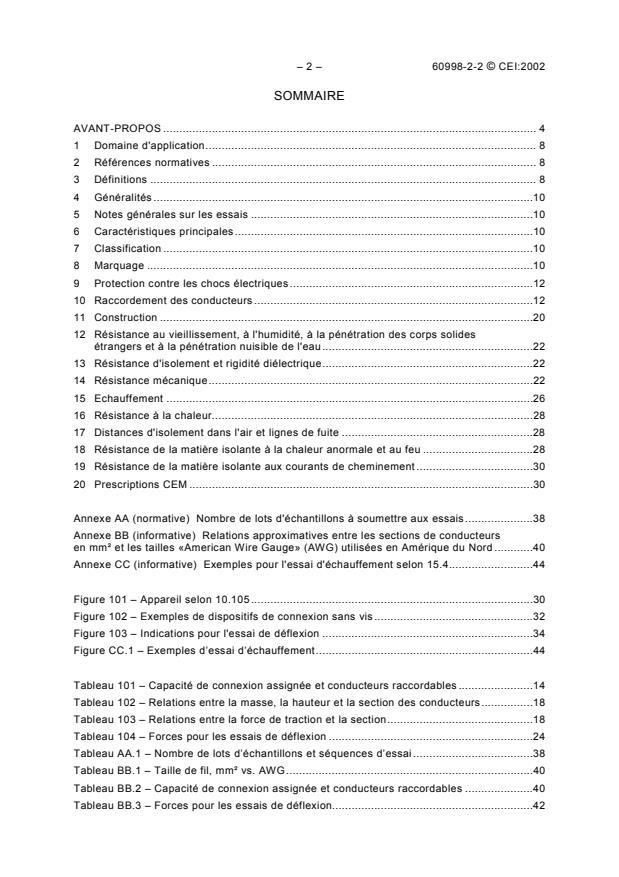
– 2 – 60998-2-2 © CEI:2002
SOMMAIRE
AVANT-PROPOS . 4
1 Domaine d'application. 8
2 Références normatives . 8
3 Définitions . 8
4 Généralités .10
5 Notes générales sur les essais .10
6 Caractéristiques principales.10
7 Classification .10
8 Marquage .10
9 Protection contre les chocs électriques .12
10 Raccordement des conducteurs .12
11 Construction .20
12 Résistance au vieillissement, à l'humidité, à la pénétration des corps solides
étrangers et à la pénétration nuisible de l'eau.22
13 Résistance d'isolement et rigidité diélectrique.22
14 Résistance mécanique.22
15 Echauffement .26
16 Résistance à la chaleur.28
17 Distances d'isolement dans l'air et lignes de fuite .28
18 Résistance de la matière isolante à la chaleur anormale et au feu .28
19 Résistance de la matière isolante aux courants de cheminement .30
20 Prescriptions CEM .30
Annexe AA (normative) Nombre de lots d'échantillons à soumettre aux essais.38
Annexe BB (informative) Relations approximatives entre les sections de conducteurs
en mm² et les tailles «American Wire Gauge» (AWG) utilisées en Amérique du Nord .40
Annexe CC (informative) Exemples pour l'essai d'échauffement selon 15.4.44
Figure 101 – Appareil selon 10.105.30
Figure 102 – Exemples de dispositifs de connexion sans vis.32
Figure 103 – Indications pour l'essai de déflexion .34
Figure CC.1 – Exemples d’essai d’échauffement.44
Tableau 101 – Capacité de connexion assignée et conducteurs raccordables .14
Tableau 102 – Relations entre la masse, la hauteur et la section des conducteurs.18
Tableau 103 – Relations entre la force de traction et la section.18
Tableau 104 – Forces pour les essais de déflexion .24
Tableau AA.1 – Nombre de lots d’échantillons et séquences d’essai .38
Tableau BB.1 – Taille de fil, mm² vs. AWG.40
Tableau BB.2 – Capacité de connexion assignée et conducteurs raccordables .40
Tableau BB.3 – Forces pour les essais de déflexion.42
60998-2-2 © IEC:2002 – 3 –
CONTENTS
FOREWORD . 5
1 Scope . 9
2 Normative references. 9
3 Definitions . 9
4 General .11
5 General notes on tests.11
6 Main characteristics .11
7 Classification .11
8 Marking .11
9 Protection against electric shock.13
10 Connection of conductors .13
11 Construction .21
12 Resistance to ageing, to humid conditions, to ingress of solid foreign objects and
to harmful ingress of water.23
13 Insulation resistance and electric strength .23
14 Mechanical strength.23
15 Temperature rise .27
16 Resistance to heat .29
17 Clearances and creepage distances .29
18 Resistance of insulating material to abnormal heat and fire.29
19 Resistance of insulating material to tracking .31
20 EMC requirement.31
Annex AA (normative) Number of sets of samples to be submitted to the tests.39
Annex BB (informative) Approximate relationship between conductors of cross-
sectional areas in mm² and American Wire Gauge (AWG) sizes as used in North
America .41
Annex CC (informative) Examples for temperature-rise test according to 15.4.45
Figure 101 – Test apparatus according to 10.105 .31
Figure 102 – Examples of screwless-type clamping units .33
Figure 103 – Information for the bending test .35
Figure CC.1 – Temperature-rise test – examples .45
Table 101 – Rated connecting capacity and connectable conductors.15
Table 102 – Relationship between mass, height and cross-sectional area of conductors .19
Table 103 – Relationship between pull force and cross-sectional area .19
Table 104 – Deflection test forces .25
Table AA.1 – Number of sets of samples and test sequences.39
Table BB.1 – Wire size, mm² versus AWG.41
Table BB.2 – Rated connecting capacity and connectable conductors.41
Table BB.3 – Deflection test forces .43
– 4 – 60998-2-2 © CEI:2002
COMMISSION ÉLECTROTECHNIQUE INTERNATIONALE
___________
DISPOSITIFS DE CONNEXION POUR CIRCUITS BASSE TENSION
POUR USAGE DOMESTIQUE ET ANALOGUE –
Partie 2-2: Règles particulières pour dispositifs
de connexion en tant que parties séparées avec
organes de serrage sans vis
AVANT-PROPOS
1) La CEI (Commission Électrotechnique Internationale) est une organisation mondiale de normalisation
composée de l'ensemble des comités électrotechniques nationaux (Comités nationaux de la CEI). La CEI a
pour objet de favoriser la coopération internationale pour toutes les questions de normalisation dans les
domaines de l'électricité et de l'électronique. A cet effet, la CEI, entre autres activités, publie des Normes
internationales. Leur élaboration est confiée à des comités d'études, aux travaux desquels tout Comité national
intéressé par le sujet traité peut participer. Les organisations internationales, gouvernementales et non
gouvernementales, en liaison avec la CEI, participent également aux travaux. La CEI collabore étroitement
avec l'Organisation Internationale de Normalisation (ISO), selon des conditions fixées par accord entre les
deux organisations.
2) Les décisions ou accords officiels de la CEI concernant les questions techniques représentent, dans la mesure
du possible, un accord international sur les sujets étudiés, étant donné que les Comités nationaux intéressés
sont représentés dans chaque comité d’études.
3) Les documents produits se présentent sous la forme de recommandations internationales. Ils sont publiés
comme normes, spécifications techniques, rapports techniques ou guides et agréés comme tels par les
Comités nationaux.
4) Dans le but d'encourager l'unification internationale, les Comités nationaux de la CEI s'engagent à appliquer de
façon transparente, dans toute la mesure possible, les Normes internationales de la CEI dans leurs normes
nationales et régionales. Toute divergence entre la norme de la CEI et la norme nationale ou régionale
correspondante doit être indiquée en termes clairs dans cette dernière.
5) La CEI n’a fixé aucune procédure concernant le marquage comme indication d’approbation et sa responsabilité
n’est pas engagée quand un matériel est déclaré conforme à l’une de ses normes.
6) L’attention est attirée sur le fait que certains des éléments de la présente Norme internationale peuvent faire
l’objet de droits de propriété intellectuelle ou de droits analogues. La CEI ne saurait être tenue pour
responsable de ne pas avoir identifié de tels droits de propriété et de ne pas avoir signalé leur existence.
La Norme internationale CEI 60998-2-2 a été établie par le sous-comité 23F: Dispositifs de
connexion, du comité d'études 23 de la CEI: Petit appareillage.
Cette deuxième édition annule et remplace la première édition parue en 1991, dont elle
constitue une révision technique.
Le texte de cette norme est issu des documents suivants:
FDIS RVD
23F/143/FDIS 23F/149/RVD
Le rapport de vote indiqué dans le tableau ci-dessus donne toute information sur le vote ayant
abouti à l'approbation de cette norme.
Cette publication a été rédigée selon les Directives ISO/CEI, Partie 2.
60998-2-2 © IEC:2002 – 5 –
INTERNATIONAL ELECTROTECHNICAL COMMISSION
___________
CONNECTING DEVICES FOR LOW-VOLTAGE CIRCUITS
FOR HOUSEHOLD AND SIMILAR PURPOSES –
Part 2-2: Particular requirements for connecting
devices as separate entities with
screwless-type clamping units
FOREWORD
1) The IEC (International Electrotechnical Commission) is a worldwide organization for standardization comprising
all national electrotechnical committees (IEC National Committees). The object of the IEC is to promote
international co-operation on all questions concerning standardization in the electrical and electronic fields. To
this end and in addition to other activities, the IEC publishes International Standards. Their preparation is
entrusted to technical committees; any IEC National Committee interested in the subject dealt with may
participate in this preparatory work. International, governmental and non-governmental organizations liaising
with the IEC also participate in this preparation. The IEC collaborates closely with the International
Organization for Standardization (ISO) in accordance with conditions determined by agreement between the
two organizations.
2) The formal decisions or agreements of the IEC on technical matters express, as nearly as possible, an
international consensus of opinion on the relevant subjects since each technical committee has representation
from all interested National Committees.
3) The documents produced have the form of recommendations for international use and are published in the form
of standards, technical specifications, technical reports or guides and they are accepted by the National
Committees in that sense.
4) In order to promote international unification, IEC National Committees undertake to apply IEC International
Standards transparently to the maximum extent possible in their national and regional standards. Any
divergence between the IEC Standard and the corresponding national or regional standard shall be clearly
indicated in the latter.
5) The IEC provides no marking procedure to indicate its approval and cannot be rendered responsible for any
equipment declared to be in conformity with one of its standards.
6) Attention is drawn to the possibility that some of the elements of this International Standard may be the subject
of patent rights. The IEC shall not be held responsible for identifying any or all such patent rights.
International Standard IEC 60998-2-2 has been prepared by subcommittee 23F: Connecting
devices, of IEC technical committee 23: Electrical accessories.
This second edition cancels and replaces the first edition published in 1991 and constitutes
a technical revision.
The text of this standard is based on the following documents:
FDIS Report on voting
23F/143/FDIS 23F/149/RVD
Full information on the voting for the approval of this standard can be found in the report on
voting indicated in the above table.
This publication has been drafted in accordance with the ISO/IEC Directives, Part 2.
– 6 – 60998-2-2 © CEI:2002
La présente norme constitue la Partie 2-2 de la série CEI 60998, publiée sous le titre général
Dispositifs de connexion pour circuits basse tension pour usage domestique et analogue.
Cette série se compose de la Partie 1, consacrée aux règles générales, et d’un certain
nombre de Parties 2, qui donnent les règles particulières.
Au moment de la publication de la présente partie, les parties suivantes sont déjà publiées:
Partie 1: Règles générales
Partie 2-1: Règles particulières pour dispositifs de connexion en tant que parties séparées
avec organes de serrage à vis
Partie 2-2: Règles particulières pour dispositifs de connexion en tant que parties séparées
avec organes de serrage sans vis
Partie 2-3: Règles particulières pour dispositifs de connexion en tant que parties séparées
avec organes de serrage à perçage d’isolant
Partie 2-4: Règles particulières pour dispositifs de connexion par épissure
Partie 2-5: Règles particulières pour les boîtes de connexion (jonction et/ou dérivation) pour
bornes ou dispositifs de connexion.
La présente Partie 2-2 est destinée à être utilisée conjointement avec la CEI 60998-1. Elle a
été établie sur la base de la deuxième édition (2002) de cette norme.
Elle complète et modifie les articles correspondants de la CEI 60998-1 de façon à la
transformer en norme CEI: Règles particulières pour dispositifs de connexion en tant que
parties séparées avec organes de serrage sans vis.
Lorsqu'un paragraphe particulier de la Partie 1 n'est pas mentionné dans cette Partie 2-2, ce
paragraphe s'applique pour autant qu'il est raisonnable. Lorsque la présente norme spécifie
«addition», «modification» ou «remplacement», la prescription, la modalité d'essai ou le
commentaire correspondant de la Partie 1 doit être adapté en conséquence.
Dans la présente norme:
a) les caractères d'imprimerie suivants sont employés:
– prescriptions proprement dites: caractères romains;
– modalités d'essais: caractères italiques;
– commentaires: petits caractères romains.
b) les paragraphes et les figures qui sont complémentaires à ceux de la Partie 1 sont
numérotés à partir de 101; les annexes complémentaires sont appelées AA, BB, etc.
Le comité a décidé que le contenu de cette publication ne sera pas modifié avant 2010.
A cette date, la publication sera
• reconduite;
• supprimée;
• remplacée par une édition révisée, ou
• amendée.
60998-2-2 © IEC:2002 – 7 –
This standard constitutes Part 2-2 of the IEC 60998 series, published under the general title
Connecting devices for low voltage circuits for household and similar purposes. This series
consists of Part 1, devoted to general requirements, and various Parts 2, devoted to particular
requirements.
At the moment of the publication of this part, the following parts had already been published.
Part 1: General requirements
Part 2-1: Particular requirements for connecting devices as separate entities with screw-
type clamping units
Part 2-2: Particular requirements for connecting devices as separate entities with
screwless-type clamping units
Part 2-3: Particular requirements for connecting devices as separate entities with insulation
piercing clamping units
Part 2-4: Particular requirements for twist-on connecting devices
Part 2-5: Particular requirements for connecting boxes (junction and/or tapping) for
terminals or connecting devices.
This Part 2-2 is intended to be used in conjunction with IEC 60998-1. It was established on
the basis of the second edition (2002) of that standard.
It supplements or modifies the corresponding clauses in IEC 60998-1, so as to convert that
publication into the IEC standard: Particular requirements for connecting devices as separate
entities with screwless-type clamping units.
Where a particular subclause of Part 1 is not mentioned in this Part 2-2, that subclause
applies as far as is reasonable. Where this standard states “addition”, “modification” or
“replacement”, the relevant requirements, test specification or explanatory matter in Part 1
should be adapted accordingly.
In this standard:
a) the following print types are used:
– requirements proper: in roman type;
– test specifications: in italic type;
– explanatory matter: in smaller roman type.
b) Subclauses and figures which are additional to those in Part 1 are numbered starting from
101; additional annexes are lettered AA, BB, etc.
The committee has decided that the contents of this publication will remain unchanged until 2010.
At this date, the publication will be
• reconfirmed;
• withdrawn;
• replaced by a revised edition, or
• amended.
– 8 – 60998-2-2 © CEI:2002
DISPOSITIFS DE CONNEXION POUR CIRCUITS BASSE TENSION
POUR USAGE DOMESTIQUE ET ANALOGUE –
Partie 2-2: Règles particulières pour dispositifs
de connexion en tant que parties séparées avec
organes de serrage sans vis
1 Domaine d'application
L'article de la Partie 1 est applicable.
Addition:
La présente norme s'applique aux dispositifs de connexion avec organes de serrage sans vis
principalement prévus pour la connexion de conducteurs non préparés.
Dans la présente norme, les bornes sans vis sont désignées sous le nom de bornes.
NOTE La présente norme ne concerne pas les dispositifs de connexion à perçage de l'isolant (CEI 60998-2-3), les
capuchons de connexion par épissure (CEI 60998-2-4) et les bornes plates à connexion rapide (CEI 60998-2-5).
2 Références normatives
L'article de la Partie 1 est applicable.
3 Définitions
L'article de la Partie 1 est applicable avec les exceptions suivantes:
Addition:
3.101
borne sans vis
borne pour la connexion et la déconnexion de deux ou plusieurs conducteurs, la connexion
étant réalisée directement ou indirectement au moyen de ressorts, pièces formant coin ou
systèmes analogues
NOTE Des exemples de bornes sans vis sont donnés à la Figure 102.
3.101.1
borne universelle
borne pour la connexion et la déconnexion de tous les types de conducteurs (rigides et
souples)
3.101.2
borne non universelle
borne pour la connexion et la déconnexion d'un certain type de conducteurs seulement (par
exemple conducteurs massifs seulement ou conducteurs rigides [massifs ou câblés]
seulement)
60998-2-2 © IEC:2002 – 9 –
CONNECTING DEVICES FOR LOW-VOLTAGE CIRCUITS
FOR HOUSEHOLD AND SIMILAR PURPOSES –
Part 2-2: Particular requirements for connecting
devices as separate entities with
screwless-type clamping units
1 Scope
This clause of Part 1 is applicable.
Addition:
This standard applies to connecting devices with screwless-type clamping units primarily
suitable for connecting unprepared conductors.
In this standard, screwless-type terminals are referred to as terminals.
NOTE This standard does not include insulation piercing connecting devices (IEC 60998-2-3), twist-on connecting
devices (IEC 60998-2-4) and flat, quick-connect terminations (IEC 60998-2-5).
2 Normative references
This clause of Part 1 is applicable.
3 Definitions
This clause of Part 1 is applicable except as follows:
Addition:
3.101
screwless-type terminal
terminal for the connection and subsequent disconnection of two or more conductors, the
connection being made directly or indirectly by means of springs, wedges, or the like
NOTE Examples of screwless-type terminals are given in Figure 102.
3.101.1
universal terminal
terminal for the connection and disconnection of all types of conductors (rigid and flexible)
3.101.2
non-universal terminal
terminal for the connection and disconnection of a certain kind of conductor only (for
example, solid conductors only or rigid [solid and stranded] conductors only)
– 10 – 60998-2-2 © CEI:2002
3.101.3
borne pousse-fil
borne non universelle dans laquelle la connexion est réalisée en introduisant un conducteur
rigide (massif ou câblé)
4 Généralités
L'article de la Partie 1 est applicable.
5 Notes générales sur les essais
L'article de la Partie 1 est applicable avec les exceptions suivantes:
5.3 Remplacement:
Les essais sont effectués dans l'ordre énuméré, pour chaque lot, en Annexe AA.
5.4 Remplacement de la première phrase par la suivante:
Le nombre nécessaire d’échantillons neufs à soumettre aux essais est réparti en lots comme
indiqué à l'Annexe AA, et la conformité à cette norme est établie si tous les essais sont
satisfaisants.
6 Caractéristiques principales
L'article de la Partie 1 est applicable.
7 Classification
L'article de la Partie 1 est applicable avec l'exception suivante:
Addition:
7.101 Classification selon les types de conducteurs que la borne peut recevoir
7.101.1 Bornes universelles
7.101.2 Bornes non universelles
– bornes pour conducteurs massifs;
– bornes pour conducteurs rigides;
– bornes pour conducteurs souples.
8 Marquage
L'article de la Partie 1 est applicable avec l'exception suivante:
60998-2-2 © IEC:2002 – 11 –
3.101.3
push-wire terminal
non-universal terminal in which the connection is made by pushing in rigid (solid or stranded)
conductors
4 General
This clause of Part 1 is applicable.
5 General notes on tests
This clause of Part 1 is applicable except as follows:
5.3 Replacement:
The tests are carried out in the sequence listed for each set in Annex AA.
5.4 Replacement of the first sentence by the following:
The necessary number of new samples to be submitted to the tests are divided into sets as
detailed in Annex AA and this standard is met if all tests are satisfied.
6 Main characteristics
This clause of Part 1 is applicable.
7 Classification
This clause of Part 1 is applicable except as follows:
Addition:
7.101 Classification according to the types of conductors
which the terminal can accept
7.101.1 Universal terminal
7.101.2 Non-universal terminal
– terminals for solid conductors ;
– terminals for rigid conductors;
– terminals for flexible conductors.
8 Marking
This clause of Part 1 is applicable except as follows:
– 12 – 60998-2-2 © CEI:2002
8.101 Addition:
Les bornes non universelles classifiées selon le 7.101.2 doivent être marquées ainsi:
– avec la lettre «s» ou les lettres «sol» pour les bornes déclarées pour conducteurs massifs;
– avec la lettre «r» pour les bornes déclarées pour conducteurs rigides;
– avec la lettre «f» pour les bornes déclarées pour conducteurs souples.
Ce marquage doit être visible en un endroit approprié sur le produit final ou sur la plus petite
unité d'emballage ou dans la documentation technique et/ou les catalogues.
8.102 Addition:
Un marquage approprié indiquant la longueur d'isolation à enlever avant insertion du
conducteur dans la borne doit figurer sur le produit ou sur la plus petite unité d'emballage ou
dans la documentation technique et/ou les catalogues.
9 Protection contre les chocs électriques
L'article de la Partie 1 est applicable.
10 Raccordement des conducteurs
L'article de la Partie 1 est applicable avec les exceptions suivantes:
Addition:
10.101 La connexion ou la déconnexion des conducteurs doit être effectuée
– soit en utilisant un outil d'usage courant ou un dispositif approprié incorporé à la borne et
servant à l'ouvrir et à faciliter l'insertion ou le retrait des conducteurs (par exemple pour
les bornes universelles);
– soit par simple insertion. Pour la déconnexion des conducteurs, une manœuvre autre
qu'une traction sur le conducteur uniquement doit être nécessaire (par exemple pour les
bornes pousse-fil).
10.102 Les bornes doivent pouvoir recevoir deux ou plusieurs conducteurs de sections
nominales et, le cas échéant, de composition, différentes.
Les bornes universelles doivent pouvoir recevoir des conducteurs non préparés rigides
(massifs ou câblés) et souples.
Les bornes non universelles doivent pouvoir recevoir les types de conducteurs déclarés
par le fabricant.
La relation entre la capacité de connexion assignée des organes de serrage et des
conducteurs raccordables ainsi que les indications des diamètres des conducteurs sont
données au Tableau 101.
60998-2-2 © IEC:2002 – 13 –
8.101 Addition:
Non-universal terminals classified according to 7.101.2 shall be marked as follows:
– with the letter(s) “s” or “sol” for terminals declared for solid conductors;
– with the letter “r” for terminals declared for rigid conductors;
– with the letter “f” for terminals declared for flexible conductors.
This marking shall appear where it is practical on the end product or on the smallest package
unit or in technical information and/or catalogues.
8.102 Addition:
An appropriate marking indicating the length of insulation to be removed before insertion of
the conductor into the terminal shall be shown on the product or on the smallest package unit
or in technical information and/or catalogues.
9 Protection against electric shock
This clause of Part 1 is applicable.
10 Connection of conductors
This clause of Part 1 is applicable except as follows:
Addition:
10.101 The connection or disconnection of conductors shall be made
– either by the use of a general purpose tool or a convenient device integral with the
terminal to open it and to assist the insertion or the withdrawal of the conductors (for
example, for universal terminals);
– or by simple insertion. For the disconnection of the conductors an operation other than a
pull on the conductor only shall be necessary (for example, for push-wire terminals).
10.102 Terminals shall accept two or more conductors of the same or of different nominal
cross-sectional areas or compositions if applicable.
Universal terminals shall accept rigid (solid or stranded) and flexible unprepared conductors.
Non-universal terminals shall accept the types of conductors declared by the manufacturer.
The relationship between the rated connecting capacity of clamping units and connectable
conductors as well as data on diameters of conductors are given in Table 101.
– 14 – 60998-2-2 © CEI:2002
10.103 Chaque borne doit accepter des conducteurs des types et sections indiqués dans le
Tableau 101, pour la valeur de capacité de connexion assignée qui lui est applicable. Les
bornes doivent, en outre, permettre la connexion appropriée d'au moins les deux plus petites
sections successives, par exemple:
a) une borne ayant une capacité de connexion assignée de 1 mm doit serrer solidement un
2 2 2
conducteur rigide et/ou souple de 0,5 mm , 0,75 mm et 1 mm ;
b) une borne ayant une capacité de connexion assignée de 10 mm doit serrer solidement
2 2 2
des conducteurs rigides de 4 mm , 6 mm et 10 mm et/ou des conducteurs souples de
2 2
4 mm et 6 mm .
c) une borne ayant une capacité de connexion assignée de 25 mm doit serrer solidement
2 2 2
des conducteurs rigides de 10 mm , 16 mm et 25 mm et/ou des conducteurs souples de
2 2 2
6 mm , 10 mm et 16 mm .
d) une borne pour des conducteurs souples uniquement et ayant une capacité de connexion
2 2 2
assignée de 25 mm doit serrer solidement des conducteurs souples de 10 mm ; 16 mm
et 25 mm .
(Exception: certains types spéciaux de bornes peuvent recevoir une plus petite gamme de
sections, comme déclaré par le fabricant.)
Tableau 101 – Capacité de connexion assignée et conducteurs raccordables
Conducteurs raccordables et leurs diamètres théoriques
Capacité de
Métrique
connexion
Rigides Souples
assignée
Massifs Câblés
mm² mm² ø mm ø mm mm² ø mm
0,2 0,2 0,51 0,53 0,2 0,61
0,34 0,34 0,63 0,66 0,34 0,8
0,5 0,5 0,9 1,1 0,5 1,1
0,75 0,75 1,0 1,2 0,75 1,3
1,0 1,0 1,2 1,4 1,0 1,5
1,5 1,5 1,5 1,7 1,5 1,8
a
2,5 2,5 1,9 2,2 2,5 2,3
a
4,0 4,0 2,4 2,7 4,0 2,9
a
6,0 6,0 2,9 3,3 4,0 2,9
10,0 10,0 3,7 4,2 6,0 3,9
16,0 16,0 4,6 5,3 10,0 5,1
25,0 25,0 - 6,6 16,0 6,3
35,0 35,0 - 7,9 25,0 7,8
NOTE 1 La correspondance pour les conducteurs AWG est donnée dans le Tableau BB.2
de l’Annexe BB.
NOTE 2 Les diamètres des conducteurs rigides et souples les plus gros sont basés sur le
Tableau 1 de la CEI 60228 et de la CEI 60344 et pour les conducteurs AWG, sur les
Publications ASTM B172-71, ICEA S-19-81, ICEA S-66-524 et ICEA S-65-516.
a
Dimensions pour les conducteurs souples de classe 5 uniquement, conformes à la
CEI 60228A.
60998-2-2 © IEC:2002 – 15 –
10.103 Each terminal shall accept conductors of cross-sectional areas and types as
indicated in Table 101, for the relevant values of the rated connecting capacity. Terminals
shall provide, in addition, appropriate connection of at least the two successive smaller cross-
sectional areas, for example:
a) a terminal having the rated connecting capacity of 1 mm² shall clamp reliably a rigid and/or
flexible conductor of 0,5 mm², 0,75 mm² and 1 mm²;
b) a terminal having the rated connecting capacity of 10 mm² shall clamp reliably rigid
conductors of 4 mm², 6 mm² and 10 mm² and/or flexible conductors of 4 mm² and 6 mm².
c) a terminal having the rated connecting capacity of 25 mm² shall clamp reliably rigid
conductors of 10 mm², 16 mm² and 25 mm² and/or flexible conductors of 6 mm², 10mm²
and 16 mm².
d) a terminal for flexible conductors only and having a rated connecting capacity of 25 mm²
shall clamp reliably flexible conductors of 10 mm², 16 mm² and 25 mm².
(Exception: special types of terminals may accept a smaller range of cross-sectional areas as
declared by the manufacturer.)
Table 101 – Rated connecting capacity and connectable conductors
Connectable conductors and their theoretical diameters
Rated
Metric
connecting
Rigid Flexible
capacity
Solid Stranded
mm² mm² ø mm ø mm mm² ø mm
0,2 0,2 0,51 0,53 0,2 0,61
0,34 0,34 0,63 0,66 0,34 0,8
0,5 0,5 0,9 1,1 0,5 1,1
0,75 0,75 1,0 1,2 0,75 1,3
1,0 1,0 1,2 1,4 1,0 1,5
1,5 1,5 1,5 1,7 1,5 1,8
a
2,5 2,5 1,9 2,2 2,5 2,3
a
4,0 4,0 2,4 2,7 4,0 2,9
a
6,0 6,0 2,9 3,3 4,0 2,9
10,0 10,0 3,7 4,2 6,0 3,9
16,0 16,0 4,6 5,3 10,0 5,1
25,0 25,0 - 6,6 16,0 6,3
35,0 35,0 - 7,9 25,0 7,8
NOTE 1 Correspondence with AWG is given in Table BB.2 in Annex BB.
NOTE 2 Diameters of the largest rigid and flexible conductors are based on Table 1 of
IEC 60228 and IEC 60344 and for AWG conductors, on ASTM B172-71, ICEA Publication
S-19-81, ICEA Publication S-66-524 and ICEA Publication S-65-516.
a
Dimensions for Class 5 flexible conductors only, according to IEC 60228A.
– 16 – 60998-2-2 © CEI:2002
10.104 La conformité avec les prescriptions des paragraphes 10.101 à 10.103 doit être
vérifiée par examen et par les essais suivants:
10.104.1 L'essai est effectué sur trois bornes neuves avec des conducteurs en cuivre, du
type et de la section indiqués au Tableau 101, ayant le plus petit puis le plus grand diamètre
de conducteur raccordé à chaque organe de serrage.
La connexion puis la déconnexion doivent être effectuées cinq fois avec le conducteur du plus
petit diamètre et cinq fois avec le conducteur du plus grand diamètre.
Des conducteurs neufs doivent être utilisés chaque fois, sauf pour la cinquième fois, où le
conducteur utilisé pour la quatrième insertion est serré au même endroit.
Pour chaque insertion, les conducteurs doivent être soit poussés aussi profondément que
possible dans la borne, soit insérés de telle façon que le raccordement soit évident.
Après ces essais, la borne ne doit pas être endommagée au point d'affecter son utilisation
ultérieure.
10.104.2 Trois bornes neuves sont équipées avec des conducteurs neufs du type et de la
section indiqués au Tableau 101. Avant insertion dans la borne, les brins des conducteurs
rigides câblés et des conducteurs souples doivent être reformés.
Il doit être possible d'introduire le conducteur dans la borne sans effort excessif dans le cas des
bornes universelles et avec l'effort nécessaire à la main dans le cas des bornes pousse-fil.
Le conducteur est soit enfoncé aussi profondément que possible dans la borne, soit inséré,
de telle façon que le raccordement soit évident.
Après l'essai, aucun brin du conducteur ne doit s'être échappé de la borne.
Addition:
10.105 Trois organes de serrage neufs sont équipés avec des conducteurs neufs de
nombre, de section et de type (souple et/ou câblé rigide) spécifiés par le fabricant avec
l'appareil représenté à la Figure 101.
Les essais suivants doivent être effectués en utilisant des échantillons neufs pour
a) les conducteurs de la plus petite section;
b) les conducteurs de la plus grosse section.
La longueur du conducteur d'essai doit être de 75 mm supérieure à la hauteur H spécifiée au
Tableau 102.
On raccorde alors le conducteur d'essai dans l'organe de serrage de la manière appropriée.
Le conducteur est soumis à l'essai suivant:
L'extrémité du conducteur doit être passée à travers un manchon de taille appropriée dans un
plateau placé à une hauteur H en dessous de l'équipement comme indiqué au Tableau 102.
Le manchon doit être placé dans un plan horizontal de telle manière que son axe décrive un
cercle de 75 mm de diamètre, concentrique avec l'organe de serrage, dans un plan horizontal;
on fait alors tourner le plateau à une vitesse de (10 ± 2) t/min.
60998-2-2 © IEC:2002 – 17 –
10.104 Compliance with the requirements of 10.101 to 10.103 shall be checked by
inspection, and by the following tests:
10.104.1 The test is carried out on three new terminals with copper conductors of the type
and the cross-sectional area, in accordance with Table 101, having the smallest and then the
largest diameter conductor being connected to each clamping unit.
This connection and subsequent disconnection shall be made 5 times with the smallest
diameter conductor and 5 times with the largest diameter conductor.
New conductors shall be used each time, except for the 5th time, when the conductor used for
the 4th insertion is clamped at the same place.
For each insertion, the conductors are either pushed as far as possible into the terminal or
shall be inserted so that adequate connection is obvious.
After these tests, the terminal shall not be damaged in such a way as to impair its further use.
10.104.2 Three new terminals are fitted with new conductors of the type and of the cross-
sectional area according to Table 101. Before insertion into the terminal, wires of stranded
rigid conductors and flexible conductors shall be reshaped.
It shall be possible to fit the conductor into the terminal without undue force in the case of
universal terminals and with the force necessary by hand in the case of push-wire terminals.
The conductor is either pushed as far as possible into the terminal or has to be inserted so
that adequate connection is obvious.
After the test, no wire of the conductor shall have escaped outside the terminal.
Addition:
10.105 Three new clamping units are fitted with new conductors of number, cross-sectional
area and type (flexible and/or rigid stranded) specified by the manufacturer in the equipment
shown in Figure 101.
The following tests shall be carried out using new samples for each of the following:
a) the conductors of the smallest cross-sectional area;
b) the conductors of the largest cross-sectional area.
The length of the test conductor shall be 75 mm longer than the height H specified in
Table 102.
The test con
...
Questions, Comments and Discussion
Ask us and Technical Secretary will try to provide an answer. You can facilitate discussion about the standard in here.
Loading comments...