

IEC 60998-1:2002
(Main)Connecting devices for low-voltage circuits for household and similar purposes - Part 1: General requirements
General Information
- Abstract
This part of IEC 60998 applies to connecting devices as separate entities for the connection of two or more electrical copper conductors (complying with IEC 60228 or IEC 60344) rigid (solid or stranded) or flexible, having a cross-sectional area of 0,2 mm2 up to and including 35 mm2 and equivalent AWG conductors with a rated voltage not exceeding 1 000 V a.c. up to and including 1 000 Hz and 1 500 V d.c. where electrical energy is used for house-hold and similar purposes. This standard constitutes Part 1 of the IEC 60998 series, published under the general title Connecting devices for low-voltage circuits for household and similar purposes. This series consists of this Part 1, devoted to general requirements, and various Parts 2, devoted to particular requirements. This second edition cancels and replaces the first edition published in 1990 and constitutes a technical revision. The contents of the interpretation sheet of March 2005 have been included in this copy.
- Status
- Published
- Publication Date
- 12-Dec-2002
- Technical Committee
- TC 23 - Electrical accessories
- Current Stage
- PPUB - Publication issued
- Start Date
- 13-Dec-2002
- Completion Date
- 31-Jan-2003
Overview
IEC 60998-1:2002, titled "Connecting devices for low-voltage circuits for household and similar purposes - Part 1: General requirements", is an international standard developed by the International Electrotechnical Commission (IEC). This standard specifies general requirements for connecting devices used to join electrical copper conductors in low-voltage household circuits. It applies to connecting devices designed for conductors ranging from 0.2 mm² to 35 mm² (or equivalent AWG sizes), supporting rated voltages up to 1000 V AC and 1500 V DC.
IEC 60998-1 forms Part 1 of the IEC 60998 series, which covers various parts targeting specific technical and safety requirements related to household and similar low-voltage wiring devices. The 2002 edition updated and replaced the original 1990 standard, incorporating technical revisions and clarifications including the integration of interpretation notes from 2005.
Key Topics
Scope and Application
The standard covers connecting devices as separate entities, focused on safety and functionality when connecting multiple copper conductors in residential and similar environments. It addresses rigid or flexible conductors compliant with IEC 60228 or IEC 60344.General and Technical Requirements
- Electrical rated voltage: Up to 1000 V AC (up to 1000 Hz) and 1500 V DC.
- Conductor sizes: 0.2 mm² up to 35 mm² (and equivalent AWG sizes).
- Mechanical stability: Ensuring reliable retention of current-carrying parts primarily through mechanical means, not reliant on grease or non-mechanical aids.
- Protection against electric shock: Devices must meet defined safety parameters to guard users.
- Resistance to ageing, humidity, and ingress: Durability requirements to maintain safe operation under various conditions.
- Electrical properties: Insulation resistance, dielectric strength, and temperature rise limits for safe and efficient operation.
- Marking and classification: Clear classification for use-cases and proper labeling for identification.
- Compliance with electromagnetic compatibility (EMC) requirements to avoid interference.
Testing and Certification
The standard outlines procedures for testing the devices' mechanical strength, electrical safety, resistance to environmental factors, and thermal performance.Interpretation Guidance
Clarifications on interpreting certain clauses (e.g., Clause 18 concerning the mechanical retention of components) provide practical guidance to manufacturers and testing bodies.
Applications
IEC 60998-1 is critical for manufacturers, designers, and testing laboratories involved in the production and certification of connecting devices-such as terminal blocks, connectors, and multiway terminals-used in:
- Household electrical installations
- Residential wiring devices
- Small commercial and similar low-voltage electrical circuits
- Electrical connectors compliant with North American AWG wire sizes, enhancing global applicability
- Ensuring compliance with safety, mechanical, and electrical performance in low-voltage applications
This standard benefits product developers by providing comprehensive guidelines to design devices that ensure safe and reliable electrical connections, protecting end-users from electrical shock and product failure.
Related Standards
The IEC 60998 series includes other parts that build upon the general requirements established in Part 1:
- IEC 60998-2: Specifies particular requirements for certain types of connecting devices such as connecting blocks and other specialized connectors.
- IEC 60228: Defines conductor sizes and classifications, referenced for compliance with conductor types used in IEC 60998-1.
- IEC 60344: Offers additional conductor standards referenced for compatibility.
Additionally, manufacturers often consider relevant national and regional standards for household electrical installations to ensure full regulatory compliance alongside IEC 60998-1.
Keywords: IEC 60998-1, connecting devices, low-voltage circuits, household electrical connectors, copper conductor connection standards, electrical safety, terminal blocks, IEC standard, AWG wire sizes, low-voltage wiring devices, electric shock protection, IEC 60228, IEC 60344, mechanical retention, electrical insulation, EMC requirements.
Relations
- Effective Date
- 05-Sep-2023
- Effective Date
- 05-Sep-2023
- Effective Date
- 05-Sep-2023
Get Certified
Connect with accredited certification bodies for this standard

IMQ S.p.A. (Certification)
Italian electrical product certification.

SLG Prüf- und Zertifizierungs GmbH
German testing and certification body.

UL Solutions
Global safety science company with testing, inspection and certification.
Sponsored listings
Frequently Asked Questions
IEC 60998-1:2002 is a standard published by the International Electrotechnical Commission (IEC). Its full title is "Connecting devices for low-voltage circuits for household and similar purposes - Part 1: General requirements". This standard covers: This part of IEC 60998 applies to connecting devices as separate entities for the connection of two or more electrical copper conductors (complying with IEC 60228 or IEC 60344) rigid (solid or stranded) or flexible, having a cross-sectional area of 0,2 mm2 up to and including 35 mm2 and equivalent AWG conductors with a rated voltage not exceeding 1 000 V a.c. up to and including 1 000 Hz and 1 500 V d.c. where electrical energy is used for house-hold and similar purposes. This standard constitutes Part 1 of the IEC 60998 series, published under the general title Connecting devices for low-voltage circuits for household and similar purposes. This series consists of this Part 1, devoted to general requirements, and various Parts 2, devoted to particular requirements. This second edition cancels and replaces the first edition published in 1990 and constitutes a technical revision. The contents of the interpretation sheet of March 2005 have been included in this copy.
This part of IEC 60998 applies to connecting devices as separate entities for the connection of two or more electrical copper conductors (complying with IEC 60228 or IEC 60344) rigid (solid or stranded) or flexible, having a cross-sectional area of 0,2 mm2 up to and including 35 mm2 and equivalent AWG conductors with a rated voltage not exceeding 1 000 V a.c. up to and including 1 000 Hz and 1 500 V d.c. where electrical energy is used for house-hold and similar purposes. This standard constitutes Part 1 of the IEC 60998 series, published under the general title Connecting devices for low-voltage circuits for household and similar purposes. This series consists of this Part 1, devoted to general requirements, and various Parts 2, devoted to particular requirements. This second edition cancels and replaces the first edition published in 1990 and constitutes a technical revision. The contents of the interpretation sheet of March 2005 have been included in this copy.
IEC 60998-1:2002 is classified under the following ICS (International Classification for Standards) categories: 29.120.20 - Connecting devices. The ICS classification helps identify the subject area and facilitates finding related standards.
IEC 60998-1:2002 has the following relationships with other standards: It is inter standard links to IEC 60998-1:2002/ISH1:2005, IEC 60998-1:1990, IEC 60998-1:1990/AMD1:1998. Understanding these relationships helps ensure you are using the most current and applicable version of the standard.
IEC 60998-1:2002 is available in PDF format for immediate download after purchase. The document can be added to your cart and obtained through the secure checkout process. Digital delivery ensures instant access to the complete standard document.
Standards Content (Sample)
IEC 60998-1 ®
Edition 2.0 2002-12
INTERNATIONAL
STANDARD
NORME
INTERNATIONALE
Connecting devices for low-voltage circuits for household and similar
purposes –
Part 1: General requirements
Dispositifs de connexion pour circuits basse tension pour usage domestique
et analogue –
Partie 1: Règles générales
All rights reserved. Unless otherwise specified, no part of this publication may be reproduced or utilized in any form or by
any means, electronic or mechanical, including photocopying and microfilm, without permission in writing from either IEC or
IEC's member National Committee in the country of the requester.
If you have any questions about IEC copyright or have an enquiry about obtaining additional rights to this publication,
please contact the address below or your local IEC member National Committee for further information.
Droits de reproduction réservés. Sauf indication contraire, aucune partie de cette publication ne peut être reproduite
ni utilisée sous quelque forme que ce soit et par aucun procédé, électronique ou mécanique, y compris la photocopie
et les microfilms, sans l'accord écrit de la CEI ou du Comité national de la CEI du pays du demandeur.
Si vous avez des questions sur le copyright de la CEI ou si vous désirez obtenir des droits supplémentaires sur cette
publication, utilisez les coordonnées ci-après ou contactez le Comité national de la CEI de votre pays de résidence.
IEC Central Office
3, rue de Varembé
CH-1211 Geneva 20
Switzerland
Email: inmail@iec.ch
Web: www.iec.ch
About the IEC
The International Electrotechnical Commission (IEC) is the leading global organization that prepares and publishes
International Standards for all electrical, electronic and related technologies.
About IEC publications
The technical content of IEC publications is kept under constant review by the IEC. Please make sure that you have the
latest edition, a corrigenda or an amendment might have been published.
ƒ Catalogue of IEC publications: www.iec.ch/searchpub
The IEC on-line Catalogue enables you to search by a variety of criteria (reference number, text, technical committee,…).
It also gives information on projects, withdrawn and replaced publications.
ƒ IEC Just Published: www.iec.ch/online_news/justpub
Stay up to date on all new IEC publications. Just Published details twice a month all new publications released. Available
on-line and also by email.
ƒ Electropedia: www.electropedia.org
The world's leading online dictionary of electronic and electrical terms containing more than 20 000 terms and definitions
in English and French, with equivalent terms in additional languages. Also known as the International Electrotechnical
Vocabulary online.
ƒ Customer Service Centre: www.iec.ch/webstore/custserv
If you wish to give us your feedback on this publication or need further assistance, please visit the Customer Service
Centre FAQ or contact us:
Email: csc@iec.ch
Tel.: +41 22 919 02 11
Fax: +41 22 919 03 00
A propos de la CEI
La Commission Electrotechnique Internationale (CEI) est la première organisation mondiale qui élabore et publie des
normes internationales pour tout ce qui a trait à l'électricité, à l'électronique et aux technologies apparentées.
A propos des publications CEI
Le contenu technique des publications de la CEI est constamment revu. Veuillez vous assurer que vous possédez
l’édition la plus récente, un corrigendum ou amendement peut avoir été publié.
ƒ Catalogue des publications de la CEI: www.iec.ch/searchpub/cur_fut-f.htm
Le Catalogue en-ligne de la CEI vous permet d’effectuer des recherches en utilisant différents critères (numéro de référence,
texte, comité d’études,…). Il donne aussi des informations sur les projets et les publications retirées ou remplacées.
ƒ Just Published CEI: www.iec.ch/online_news/justpub
Restez informé sur les nouvelles publications de la CEI. Just Published détaille deux fois par mois les nouvelles
publications parues. Disponible en-ligne et aussi par email.
ƒ Electropedia: www.electropedia.org
Le premier dictionnaire en ligne au monde de termes électroniques et électriques. Il contient plus de 20 000 termes et
définitions en anglais et en français, ainsi que les termes équivalents dans les langues additionnelles. Egalement appelé
Vocabulaire Electrotechnique International en ligne.
ƒ Service Clients: www.iec.ch/webstore/custserv/custserv_entry-f.htm
Si vous désirez nous donner des commentaires sur cette publication ou si vous avez des questions, visitez le FAQ du
Service clients ou contactez-nous:
Email: csc@iec.ch
Tél.: +41 22 919 02 11
Fax: +41 22 919 03 00
IEC 60998-1 ®
Edition 2.0 2002-12
INTERNATIONAL
STANDARD
NORME
INTERNATIONALE
Connecting devices for low-voltage circuits for household and similar
purposes –
Part 1: General requirements
Dispositifs de connexion pour circuits basse tension pour usage domestique
et analogue –
Partie 1: Règles générales
INTERNATIONAL
ELECTROTECHNICAL
COMMISSION
COMMISSION
ELECTROTECHNIQUE
PRICE CODE
INTERNATIONALE
T
CODE PRIX
ICS 29.120.20 ISBN 2-8318-6780-0
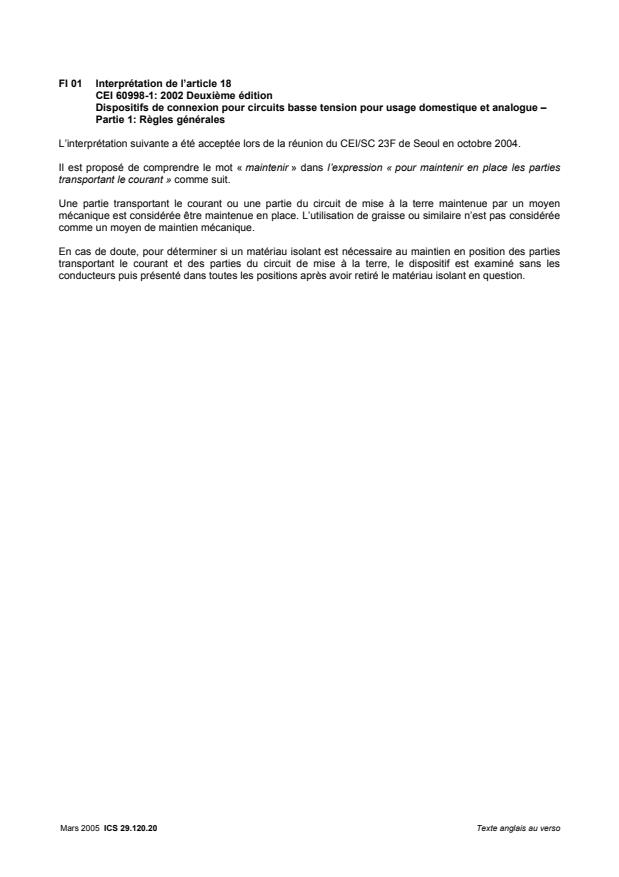
FI 01 Interprétation de l’article 18
CEI 60998-1: 2002 Deuxième édition
Dispositifs de connexion pour circuits basse tension pour usage domestique et analogue –
Partie 1: Règles générales
L’interprétation suivante a été acceptée lors de la réunion du CEI/SC 23F de Seoul en octobre 2004.
Il est proposé de comprendre le mot « maintenir » dans l’expression « pour maintenir en place les parties
transportant le courant » comme suit.
Une partie transportant le courant ou une partie du circuit de mise à la terre maintenue par un moyen
mécanique est considérée être maintenue en place. L’utilisation de graisse ou similaire n’est pas considérée
comme un moyen de maintien mécanique.
En cas de doute, pour déterminer si un matériau isolant est nécessaire au maintien en position des parties
transportant le courant et des parties du circuit de mise à la terre, le dispositif est examiné sans les
conducteurs puis présenté dans toutes les positions après avoir retiré le matériau isolant en question.
Mars 2005 ICS 29.120.20 Texte anglais au verso
IS 01 Interpretation of Clause 18
Connecting devices for low-voltage circuits for household and similar purposes –
Part 1: General requirements
The following interpretation was agreed at the Seoul meeting of IEC/SC 23F held in October 2004.
It is proposed to understand the word “retain” in the expression “ to retain current-carrying parts” as
follows:
A current carrying part or a part of the earthing circuit retained by a mechanical means is
considered to be retained in position. The use of grease or the like is not considered to be
mechanical means.
In case of doubt, to determine whether an insulating material is necessary to retain current carrying parts and
parts of the earthing circuit in position, the device is examined without conductors while held in all positions
with the insulating material in question removed.
March 2005 ICS 29.120.20 French text overleaf
– 2 – 60998-1 © CEI:2002
SOMMAIRE
AVANT-PROPOS . 4
1 Domaine d'application . 8
2 Références normatives . 8
3 Termes et définitions.10
4 Généralités .14
5 Notes générales sur les essais.14
6 Caractéristiques principales .14
7 Classification .16
8 Marquage .16
9 Protection contre les chocs électriques.18
10 Connexion des conducteurs .20
11 Construction .20
12 Résistance au vieillissement, à l'humidité, à la pénétration des corps solides et
à la pénétration nuisible de l'eau .22
13 Résistance d'isolement et rigidité diélectrique.26
14 Résistance mécanique .28
15 Echauffement.32
16 Résistance à la chaleur .34
17 Distances d'isolement dans l'air et lignes de fuite .36
18 Résistance de la matière isolante à la chaleur anormale et au feu .38
19 Résistance de la matière isolante aux courants de cheminement .40
20 Prescriptions CEM .40
Annexe A (informative) Présentation schématique des dispositifs de connexion en tant
que base pour les définitions .44
Annexe B (informative) Relations approximatives entre les sections de conducteurs
en millimètres carrés et les tailles «American Wire Gauge» (AWG) utilisées en
Amérique du Nord .46
Figure 1 – Dispositif de connexion à une seule borne.42
Figure 2 – Barrette de jonction.42
Tableau 1 – Relations entre la tension d'isolement assignée et la tension d'essai.28
Tableau 2 – Relations entre la capacité de connexion assignée et le courant d'essai.34
Tableau 3 – Distances d'isolement dans l'air et lignes de fuite .36
Tableau B.1 – Taille de fil, mm vs. AWG .46
60998-1 © IEC:2002 – 3 –
CONTENTS
FOREWORD . 5
1 Scope . 9
2 Normative references. 9
3 Terms and definitions.11
4 General.15
5 General notes on tests .15
6 Main characteristics .15
7 Classification .17
8 Marking.17
9 Protection against electric shock .19
10 Connection of conductors.21
11 Construction .21
12 Resistance to ageing, to humidity conditions, to ingress of solid objects and
to harmful ingress of water .23
13 Insulation resistance and electric strength .27
14 Mechanical strength .29
15 Temperature rise .33
16 Resistance to heat .35
17 Clearances and creepage distances .37
18 Resistance of insulating material to abnormal heat and fire.39
19 Resistance of insulating material to tracking .41
20 EMC requirements .41
Annex A (informative) Schematic presentation of connecting devices as a basis
for the definitions.45
Annex B (informative) Approximate relationship between conductors of cross-
sectional areas in square millimeters and American Wire Gauge (AWG) sizes
as used in North America .47
Figure 1 – Single terminal device.43
Figure 2 – Multiway terminal device .43
Table 1 – Relationship between rated insulation voltage and test voltage .29
Table 2 – Relationship between rated connecting capacity and test current .35
Table 3 – Clearances and creepage distances .37
Table B.1 – Wire size, mm versus AWG.47
– 4 – 60998-1 © CEI:2002
COMMISSION ÉLECTROTECHNIQUE INTERNATIONALE
____________
DISPOSITIFS DE CONNEXION POUR CIRCUITS BASSE TENSION
POUR USAGE DOMESTIQUE ET ANALOGUE –
Partie 1: Règles générales
AVANT-PROPOS
1) La CEI (Commission Electrotechnique Internationale) est une organisation mondiale de normalisation composée
de l'ensemble des comités électrotechniques nationaux (Comités nationaux de la CEI). La CEI a pour objet de
favoriser la coopération internationale pour toutes les questions de normalisation dans les domaines de
l'électricité et de l'électronique. A cet effet, la CEI, entre autres activités, publie des Normes internationales.
Leur élaboration est confiée à des comités d'études, aux travaux desquels tout Comité national intéressé par le
sujet traité peut participer. Les organisations internationales, gouvernementales et non gouvernementales, en
liaison avec la CEI, participent également aux travaux. La CEI collabore étroitement avec l'Organisation
Internationale de Normalisation (ISO), selon des conditions fixées par accord entre les deux organisations.
2) Les décisions ou accords officiels de la CEI concernant les questions techniques représentent, dans la mesure
du possible, un accord international sur les sujets étudiés, étant donné que les Comités nationaux intéressés
sont représentés dans chaque comité d’études.
3) Les documents produits se présentent sous la forme de recommandations internationales. Ils sont publiés
comme normes, spécifications techniques, rapports techniques ou guides et agréés comme tels par les Comités
nationaux.
4) Dans le but d'encourager l'unification internationale, les Comités nationaux de la CEI s'engagent à appliquer de
façon transparente, dans toute la mesure possible, les Normes internationales de la CEI dans leurs normes
nationales et régionales. Toute divergence entre la norme de la CEI et la norme nationale ou régionale
correspondante doit être indiquée en termes clairs dans cette dernière.
5) La CEI n’a fixé aucune procédure concernant le marquage comme indication d’approbation et sa responsabilité
n’est pas engagée quand un matériel est déclaré conforme à l’une de ses normes.
6) L’attention est attirée sur le fait que certains des éléments de la présente Norme internationale peuvent faire
l’objet de droits de propriété intellectuelle ou de droits analogues. La CEI ne saurait être tenue pour
responsable de ne pas avoir identifié de tels droits de propriété et de ne pas avoir signalé leur existence.
La Norme internationale CEI 60998-1 a été établie par le sous-comité 23F: Dispositifs de
connexion, du comité d'études 23 de la CEI: Petit appareillage.
Cette deuxième édition annule et remplace la première édition parue en 1990, dont elle
constitue une révision technique.
Le texte de cette norme est issu des documents suivants:
FDIS Rapport de vote
23F/141/FDIS 23F/147/RVD
Le rapport de vote indiqué dans le tableau ci-dessus donne toute information sur le vote ayant
abouti à l'approbation de cette norme.
Cette publication a été rédigée selon les Directives ISO/CEI, Partie 2.
La présente norme constitue la Partie 1 de la série CEI 60998, publiée sous le titre général
Dispositifs de connexion pour circuits basse tension pour usage domestique et analogue. Cette
série se compose de la présente Partie 1, consacrée aux règles générales, et d’un certain
nombre de Parties 2, qui donnent les règles particulières.
60998-1 © IEC:2002 – 5 –
INTERNATIONAL ELECTROTECHNICAL COMMISSION
____________
CONNECTING DEVICES FOR LOW-VOLTAGE CIRCUITS
FOR HOUSEHOLD AND SIMILAR PURPOSES –
Part 1: General requirements
FOREWORD
1) The IEC (International Electrotechnical Commission) is a worldwide organization for standardization comprising
all national electrotechnical committees (IEC National Committees). The object of the IEC is to promote
international co-operation on all questions concerning standardization in the electrical and electronic fields. To
this end and in addition to other activities, the IEC publishes International Standards. Their preparation is
entrusted to technical committees; any IEC National Committee interested in the subject dealt with may
participate in this preparatory work. International, governmental and non-governmental organizations liaising
with the IEC also participate in this preparation. The IEC collaborates closely with the International Organization
for Standardization (ISO) in accordance with conditions determined by agreement between the two
organizations.
2) The formal decisions or agreements of the IEC on technical matters express, as nearly as possible, an
international consensus of opinion on the relevant subjects since each technical committee has representation
from all interested National Committees.
3) The documents produced have the form of recommendations for international use and are published in the form
of standards, technical specifications, technical reports or guides and they are accepted by the National
Committees in that sense.
4) In order to promote international unification, IEC National Committees undertake to apply IEC International
Standards transparently to the maximum extent possible in their national and regional standards. Any
divergence between the IEC Standard and the corresponding national or regional standard shall be clearly
indicated in the latter.
5) The IEC provides no marking procedure to indicate its approval and cannot be rendered responsible for any
equipment declared to be in conformity with one of its standards.
6) Attention is drawn to the possibility that some of the elements of this International Standard may be the subject
of patent rights. The IEC shall not be held responsible for identifying any or all such patent rights.
International Standard IEC 60998-1 has been prepared by subcommittee 23F: Connecting
devices, of IEC technical committee 23: Electrical accessories.
This second edition cancels and replaces the first edition published in 1990 and constitutes
a technical revision.
The text of this standard is based on the following documents:
FDIS Report on voting
23F/141/FDIS 23F/147/RVD
Full information on the voting for the approval of this standard can be found in the report on
voting indicated in the above table.
This publication has been drafted in accordance with the ISO/IEC Directives, Part 2.
This standard constitutes Part 1 of the IEC 60998 series, published under the general title
Connecting devices for low-voltage circuits for household and similar purposes. This series
consists of this Part 1, devoted to general requirements, and various Parts 2, devoted to
particular requirements.
� ������ �������������������
���������������������������������������������������������������������������������������������
����������� �����������������
������������������������������������������������������������������������������������������ ���
������������������������������
������������������������������������������������������������������������������������������ ���
�������������������������������� �
������������������������������������������������������������������������������������������ ���
��������������������������������������������
�����������������������������������������������������������������������������
������������������������������������������������������������������������������������������������
������������������������������������
����������������������������������������������������������������������������������
�� ����������������������������������������������������
– modalités d'essais: caractères italiques;
�� �����������������������������������������
�
�����������������������������������������������������������������������������������������������
��������������������������
�� ������������
�� �����������
�� ��������������������������������������
�� ���������
����������������������������������������������������������������������������������������������
������������
60998-1 © IEC:2002 – 7 –
At the moment of the publication of this part, the following parts had already been published:
Part 1: General requirements
Part 2-1: Particular requirements for connecting devices as separate entities with screw-type
clamping units
Part 2-2: Particular requirements for connecting devices as separate entities with screwless-
type clamping units
Part 2-3: Particular requirements for connecting devices as separate entities with insulation
piercing clamping units
Part 2-4: Particular requirements for twist-on connecting devices
Part 2-5: Particular requirements for connecting boxes (junction and/or tapping) for terminals
or connecting devices.
In this publication, the following print types are used:
– requirements proper: in roman type;
– test specifications: in italic type;
– explanatory matter: in smaller roman type.
The committee has decided that the contents of this publication will remain unchanged until 2010.
At this date, the publication will be
• reconfirmed;
• withdrawn;
• replaced by a revised edition, or
• amended
The contents of the interpretation sheet 1 of March 2005 have been included in this copy.
– 8 – 60998-1 © CEI:2002
DISPOSITIFS DE CONNEXION POUR CIRCUITS BASSE TENSION
POUR USAGE DOMESTIQUE ET ANALOGUE –
Partie 1: Règles générales
1 Domaine d'application
La présente partie de la CEI 60998 s'applique aux dispositifs de connexion en tant que parties
séparées pour la connexion de deux ou plusieurs conducteurs électriques en cuivre
(conformes à la CEI 60228 ou à la CEI 60344), rigides (massifs ou câblés) ou souples, ayant
2 2
une section de 0,2 mm à 35 mm inclus, et aux conducteurs AWG équivalents, ayant une
tension assignée ne dépassant pas 1 000 V en courant alternatif jusqu'à 1 000 Hz et 1 500 V
inclus en courant continu, dans les cas où l'énergie électrique est utilisée pour des usages
domestiques et analogues.
NOTE Les capacités de connexion assignées inférieures à 0,5 mm se réfèrent à la CEI 60344 et les capacités de
connexion assignées égales ou supérieures à 0,5 mm se réfèrent à la CEI 60228.
Les dispositifs de connexion nécessitant l'utilisation d'outils spéciaux, excepté pour les
dispositifs de connexion par capuchon et les dispositifs de connexion à perçage d'isolant ne
sont pas conformes à la présente norme.
Cette norme comprend les règles générales à utiliser conjointement avec les Parties 2
appropriées, qui contiennent les règles particulières détaillées applicables aux divers types de
dispositifs de connexion:
– les dispositifs avec organes de serrage de type à vis (CEI 60998-2-1);
– les dispositifs avec organes de serrage sans vis (CEI 60998-2-2);
– les dispositifs avec organes de serrage à perçage d'isolant (CEI 60998-2-3);
– les dispositifs de connexion par épissure (CEI 60998-2-4);
– les dispositifs comportant des boîtes de connexion (jonction et/ou dérivation) (CEI 60998-2-5).
2 Références normatives
Les documents de référence suivants sont indispensables pour l'application du présent
document. Pour les références datées, seule l'édition citée s'applique. Pour les références non
datées, la dernière édition du document de référence s'applique (y compris les éventuels
amendements).
CEI 60068-2-32:1975, Essais fondamentaux climatiques et de robustesse mécanique –
Partie 2: Essais – Essai Ed: Chute libre
CEI 60068-2-75:1997, Essais d'environnement – Partie 2: Essais – Essais Eh: Essais aux
marteaux
CEI 60112:1979, Méthode pour déterminer les indices de résistance et de tenue au chemine-
ment des matériaux isolants solides dans des conditions humides
CEI 60228:1978, Ames des câbles isolés
Amendement 1 (1993)
CEI 60344:1980, Guide pour le calcul de la résistance des conducteurs de cuivre nu ou
recouvert dans les câbles et fils pour basses fréquences
60998-1 © IEC:2002 – 9 –
CONNECTING DEVICES FOR LOW-VOLTAGE CIRCUITS
FOR HOUSEHOLD AND SIMILAR PURPOSES –
Part 1: General requirements
1 Scope
This part of IEC 60998 applies to connecting devices as separate entities for the connection of
two or more electrical copper conductors (complying with IEC 60228 or IEC 60344) rigid (solid
2 2
or stranded) or flexible, having a cross-sectional area of 0,2 mm up to and including 35 mm
and equivalent AWG conductors with a rated voltage not exceeding 1 000 V a.c. up to and
including 1 000 Hz and 1 500 V d.c. where electrical energy is used for household and similar
purposes.
NOTE Rated connecting capacities lower than 0,5 mm are referred to IEC 60344 and rated connecting capacities
equal to, or higher than, 0,5 mm are referred to IEC 60228.
Connecting devices that require the use of special tools other than for twist-on connecting
devices and insulation piercing connecting devices do not comply with this standard.
This standard contains the general requirements to be used together with the relevant Part 2,
containing detailed particular requirements for
– devices with screw-type clamping units (IEC 60998-2-1);
– devices with screwless-type clamping units (IEC 60998-2-2);
– devices with insulation piercing clamping units (IEC 60998-2-3);
– devices with twist-on connecting devices (IEC 60998-2-4);
– devices with connecting boxes (junction and/or tapping) (IEC 60998-2-5).
2 Normative references
The following referenced documents are indispensable for the application of this document. For
dated references, only the edition cited applies. For undated references, the latest edition of
the referenced document (including any amendments) applies.
IEC 60068-2-32:1975, Basic environmental testing procedures – Part 2: Tests – Test Ed:
Free fall
IEC 60068-2-75:1997, Environmental testing – Part 2: Tests – Test Eh: Hammer tests
IEC 60112:1979, Method for determining the comparative and the proof tracking indices of solid
insulating materials under moist conditions
IEC 60228:1978, Conductors of insulated cables
Amendment 1 (1993)
IEC 60344:1980, Guide to the calculation of resistance of plain and coated copper conductors
of low-frequency cables and wires
– 10 – 60998-1 © CEI:2002
CEI 60529:1989, Degrés de protection procurés par les enveloppes (Code IP)
CEI 60695-2-10:2000, Essais relatifs aux risques du feu – Partie 2-10: Essai au fil
incandescent/chauffant – Appareillage et méthode commune d'essai
CEI 60695-10-2:1995, Essais relatifs aux risques du feu – Partie 10: Guide et méthodes
d'essai pour la minimalisation des effets de chaleurs anormales sur des produits
électrotechniques impliqués dans des feux – Section 2: Méthode pour vérifier la résistance à la
chaleur des produits en matériaux non métalliques au moyen de l'essai à la bille – Publication
fondamentale de sécurité
CEI 61032:1997, Protection des personnes et des matériels par les enveloppes – Calibres
d'essai pour la vérification
ISO 1456:1988, Revêtements métalliques – Dépôts électrolytiques de nickel plus chrome et de
cuivre plus nickel plus chrome
ISO 2081:1986, Revêtements métalliques – Dépôts électrolytiques de zinc sur fer ou acier
ISO 2093:1986, Dépôts électrolytiques d'étain – Spécifications et méthodes d'essai
3 Termes et définitions
Pour les besoins de la présente norme, les définitions suivantes s'appliquent.
3.1
connexion
connexion électrique entre deux ou plusieurs conducteurs ou entre une pièce conductrice et un
ou plusieurs conducteurs
3.2
jonction
connexion entre deux ou plusieurs extrémités de conducteur
3.3
dérivation
connexion d'une extrémité de conducteur (appelé «conducteur dérivé») en tout point d'un autre
conducteur (appelé «conducteur principal»)
3.4
dispositif de connexion
dispositif pour la connexion électrique de deux ou plusieurs conducteurs comprenant une ou
plusieurs bornes, et si nécessaire une isolation et/ou des pièces complémentaires (voir
Annexe A)
3.5
borne
pièce conductrice unipolaire composée d'un ou plusieurs organes de serrage et d'une isolation
si nécessaire (voir Annexe A)
3.6
organes de serrage
pièces d'une borne nécessaire au serrage mécanique et à la connexion électrique du ou des
conducteurs, y compris les pièces nécessaires assurant une pression de contact correcte (voir
Annexe A)
60998-1 © IEC:2002 – 11 –
IEC 60529:1989, Degrees of protection provided by enclosures (IP Code)
IEC 60695-2-10:2000, Fire hazard testing – Part 2-10: Glowing/hot-wire based test methods –
Glow-wire apparatus and common test procedure
IEC 60695-10-2:1995, Fire hazard testing – Part 10: Guidance and test methods for the
minimization of the effects of abnormal heat on electrotechnical products involved in fires –
Section 2: Method for testing products made from non-metallic materials for resistance to heat
using the ball pressure test – Basic safety publication
IEC 61032:1997, Protection of persons and equipment by enclosures – Probes for verification
ISO 1456:1988, Metallic coatings – Electrodeposited coatings of nickel plus chromium and of
copper plus nickel plus chromium
ISO 2081:1986, Metallic coatings – Electroplated coatings of zinc on iron or steel
ISO 2093:1986, Electroplated coatings of tin – Specification and test methods
3 Terms and definitions
For the purpose of this standard, the following definitions apply.
3.1
connection
electrical connection between two or more conductors or between a conducting part and one or
more conductors
3.2
junction
connection between two or more conductor ends
3.3
tapping
connection of a conductor end (called “tapped conductor”) on any point of another conductor
(called “main conductor”)
3.4
connecting device
device for the electrical connection of two or more conductors comprising one or more
terminals and, if necessary, insulation and/or ancillary parts (see Annex A)
3.5
terminal
conductive part of one pole composed of one or more clamping unit(s) and insulation if
necessary (see Annex A)
3.6
clamping unit
part(s) of a terminal necessary for the mechanical clamping and the electrical connection
of the conductor(s), including the parts which are necessary to ensure correct contact pressure
(see Annex A)
– 12 – 60998-1 © CEI:2002
3.7
pièce complémentaire
pièce d'un dispositif de connexion servant à assurer la protection électrique et mécanique et/ou
le montage par exemple, d'une base, d'une enveloppe, d'un profilé, etc. (voir Annexe A)
3.8
capacité de connexion assignée
section du ou des plus gros conducteurs rigides à raccorder, déclarée par le constructeur du
dispositif de connexion. Dans le cas d'un dispositif de connexion pour conducteurs flexibles
uniquement, la capacité de connexion assignée est la section du plus gros conducteur flexible
à raccorder
3.9
tension d'isolement assignée
tension d'un composant, d'un dispositif ou d'un matériel, à laquelle on se réfère pour les essais
diélectriques et pour les lignes de fuite
3.10
courant assigné
courant attribué au dispositif par le constructeur
3.11
distance d'isolement dans l'air
distance la plus courte dans l'air entre deux parties conductrices
3.12
ligne de fuite
distance la plus courte le long de la surface d'une matière isolante entre deux parties
conductrices
3.13
température ambiante
température de l'air entourant le dispositif de connexion et, le cas échéant, son enveloppe
3.14
échauffement
différence entre la température de la partie soumise aux essais, y compris, le cas échéant, son
enveloppe, mesurée en charge selon la spécification d'essai et à la température ambiante
3.15
barrette de jonction
dispositif de connexion comprenant plusieurs bornes, isolées les unes des autres dans un
support commun en matière isolante et susceptibles d'être subdivisées par l'utilisateur pour
obtenir des dispositifs de connexion consistant en une ou plusieurs bornes
3.16
conducteur non préparé
conducteur qui a été coupé et dont l'isolation a été retirée sur une certaine longueur pour son
introduction dans une borne
NOTE Un conducteur remis en forme pour introduction dans une borne, ou dont les brins sont retoronnés pour
consolider son extrémité, est considéré comme un conducteur non préparé.
60998-1 © IEC:2002 – 13 –
3.7
ancillary part
part of a connecting device providing electrical and mechanical protection and/or mounting, for
example, a base, an enclosure, a mounting rail, etc. (see Annex A)
3.8
rated connecting capacity
cross-sectional area of the largest rigid conductor(s) to be connected as stated by the
manufacturer of the connecting device. In the case of a connecting device for flexible con-
ductors only, the rated connecting capacity is the cross-sectional area of the largest flexible
conductor to be connected
3.9
rated insulation voltage
voltage of a component, device or piece of equipment to which dielectric voltage tests and
creepage distances are referred
3.10
rated current
current assigned to the device by the manufacturer
3.11
clearance
shortest distance in air between two conductive parts
3.12
creepage distance
shortest distance along the surface of an insulating material between two conductive parts
3.13
ambient temperature
temperature of the air surrounding the connecting device together with its enclosure, if any
3.14
temperature rise
difference between the temperature of the part under test, together with its enclosure, if any,
measured under load according to the test specification and the ambient temperature
3.15
multiway terminal device
connecting device that consists of several terminals, insulated from each other in a common
housing of insulating material, which are capable of being subdivided by the user to make
connecting devices consisting of one or more terminals
3.16
unprepared conductor
conductor which has been cut and the insulation of which has been removed over a certain
length for insertion into a terminal
NOTE A conductor, the shape of which is arranged for introduction into a terminal, or of which the strands are
twisted to consolidate the end, is considered to be an unprepared conductor.
– 14 – 60998-1 © CEI:2002
4 Généralités
Les dispositifs de connexion doivent être conçus et construits de manière qu'en usage normal
leur fonctionnement soit satisfaisant et sans danger pour l'utilisateur ou l'environnement
immédiat.
La vérification est effectuée en exécutant tous les essais spécifiés.
5 Notes générales sur les essais
5.1 Les essais de la présente norme sont des essais de type.
5.2 Sauf spécification contraire, les échantillons sont soumis aux essais en état de livraison
et installés comme en usage normal, à la température ambiante de 20 °C ± 5 °C.
5.3 Les essais sont effectués dans l'ordre des articles.
5.4 A moins qu'il en soit spécifié autrement, trois échantillons sont soumis à tous les essais
et les conditions sont satisfaites si tous les essais sont effectués avec succès. Si un seul des
échantillons ne satisfait pas à l'un des essais à cause d'un défaut d'assemblage ou d'usinage,
cet essai et tous les essais précédents qui peuvent avoir influencé les résultats de l'essai
doivent être répétés, et, de plus, les essais suivants doivent être effectués, à la séquence
exigée, sur un nouveau jeu complet d’échantillons, l'ensemble devant répondre aux exigences.
NOTE Le demandeur peut soumettre le jeu d’échantillons supplémentaire qui pourrait lui être demandé, dans le
cas de la défaillance d’un échantillon, avec le nombre d’échantillons spécifié en 5.4. La plate-forme d’essai
soumettra alors aux essais, sans autre demande, les échantillons supplémentaires et c’est seulement dans le cas
d’un nouvel échec que le produit sera refusé. Si le jeu d’échantillons supplémentaire n’est pas soumis en même
temps, l’échec d’un échantillon entraînera le rejet.
6 Caractéristiques principales
6.1 Les valeurs préférentielles de la tension nominale d'isolement du dispositif de connexion
sont 125 V, 250 V, 300 V, 400 V, 500 V, 600 V, 690 V, 800 V, 1 000 V en courant alternatif et
en courant continu et 1 500 V en courant continu.
2 2 2
6.2 Les capacités de connexion assignées normalisées sont 0,2 mm , 0,34 mm , 0,5 mm ,
2 2 2 2 2 2 2 2 2 2
0,75 mm , 1 mm , 1,5 mm , 2,5 mm , 4 mm , 6 mm , 10 mm , 16 mm , 25 mm et 35 mm .
NOTE 1 Actuellement dans certains pays, on peut utiliser la désignation par calibres de fil (par exemple AWG aux
Etats-Unis et au Canada) au lieu d'exprimer la section en mm² (voir Annexe B).
NOTE 2 En Grande-Bretagne, 1,25 mm constitue une capacité de connexion assignée standard.
6.3 Les températures ambiantes supérieures à 40 °C nécessitent un marquage T.
Les valeurs préférentielles sont 55 °C, 85 °C, 110 °C, 140 °C et 200 °C. Si d'autres valeurs
sont utilisées, elles doivent être des multiples de 5 °C.
60998-1 © IEC:2002 – 15 –
4 General
Connecting devices shall be so designed and constructed that in normal use their performance
is reliable and without danger to the user or surroundings.
Compliance is checked by carrying out all tests specified.
5 General notes on tests
5.1 Tests according to this standard are type tests.
5.2 Unless otherwise specified, the samples are tested as delivered and installed as in normal
use, at an ambient temperature of 20 °C ± 5 °C.
5.3 The tests are carried out in the order of the clauses.
5.4 Unless otherwise stated, three samples are submitted to all the tests and the
requirements are satisfied if all the tests are met. If only one of the samples does not satisfy
a test due to an assembly or manufacturing fault, that test and any preceding ones which may
have influenced the results of the test shall be repeated and also the tests which follow shall be
made in the required sequence on another full set of samples, all of which shall comply with
the requirements.
NOTE The applicant may submit, together with the number of samples specified in 5.4, the additional set of
samples which may be wanted, should one sample fail. The testing station will then, without further request, test
additional samples and will reject only if a further failure occurs. If the additional set of samples is not submitted at
the same time, the failure of one sample will entail rejection.
6 Main characteristics
6.1 The preferred values of the rated insulation voltage of the connecting device are 125 V,
250 V, 300 V, 400 V, 500 V, 600 V, 690 V, 800 V, 1 000 V a.c. and d.c., and 1 500 V d.c
2 2 2 2
6.2 The standard rated connecting capacities are 0,2 mm , 0,34 mm , 0,5 mm , 0,75 mm ,
2 2 2 2 2 2 2 2 2
1 mm , 1,5 mm , 2,5 mm , 4 mm , 6 mm , 10 mm , 16 mm , 25 mm and 35 mm .
NOTE 1 For the time being, designation by wire gauges may be used in some countries (for example AWG in the
United States and Canada), instead of the cross-sectional areas expressed in mm² (see Annex B).
NOTE 2 In the United Kingdom, 1,25 mm² is a standard rated connecting capacity.
6.3 Ambient temperatures above 40 °C require T marking.
The preferred values are 55 °C, 85 °C, 110 °C, 140 °C and 200 °C. If other values are used,
they shall be multiples of 5 °C.
– 16 – 60998-1 © CEI:2002
7 Classification
Les dispositifs de connexion en tant que parties séparées sont classés comme suit:
7.1 Classification selon le nombre de bornes
– dispositifs à borne unique;
– dispositifs à bornes multiples.
7.2 Classification selon la fonction
– dispositifs de jonction;
– dispositifs de dérivation;
– dispositifs de jonction et de dérivation.
7.3 Classification selon la protection contre les chocs électriques
– dispositifs sans protection;
– dispositifs avec protection.
7.4 Classification selon les moyens de fixation
– dispositifs sans moyens de fixation (le maintien en place n'est assuré que par la rigidité des
conducteurs qui leur sont connectés);
– dispositifs avec moyens de fixation (le maintien en place est assuré par leurs propres
moyens de fixation ou par des moyens associés, tels que vis, supports profilés ou
analogues).
7.5 Classification selon la température ambiante maximale d'utilisation
du dispositif de connexion (température nominale)
– dispositifs sans marquage T, pour des températures ambiantes inférieures ou égales à
40 °C;
– dispositifs avec marquage T, pour des températures ambiantes supérieures à 40 °C.
7.6 Classification selon la protection contre la pénétration nuisible de l'eau
et de l'humidité et contre les objets solides étrangers
Pour la description des degrés IP, voir la CEI 60529.
8 Marquage
8.1 Les marquages et indications figurant ci-de
...