


IEC 60350:1999
(Main)Electric cooking ranges, hobs, ovens and grills for household use - Methods for measuring performance
General Information
- Abstract
Applies to ranges, cooking tables, ovens and similar appliances for household use. This publication defines the principal performance characteristics of these appliances and describes the standard methods for measuring these characteristics. A colour shade chart is provided with the printed standard. For the electronic version this colour shade chart (IEC 60350-CHAR) can be ordered separately, to ensure accurate colour reproduction.
- Status
- Replaced
- Publication Date
- 28-Apr-2009
- Technical Committee
- SC 59K - Performance of household and similar electrical cooking appliances
- Current Stage
- DELPUB - Deleted Publication
- Start Date
- 16-Dec-2011
- Completion Date
- 28-Aug-2026
Buy Documents
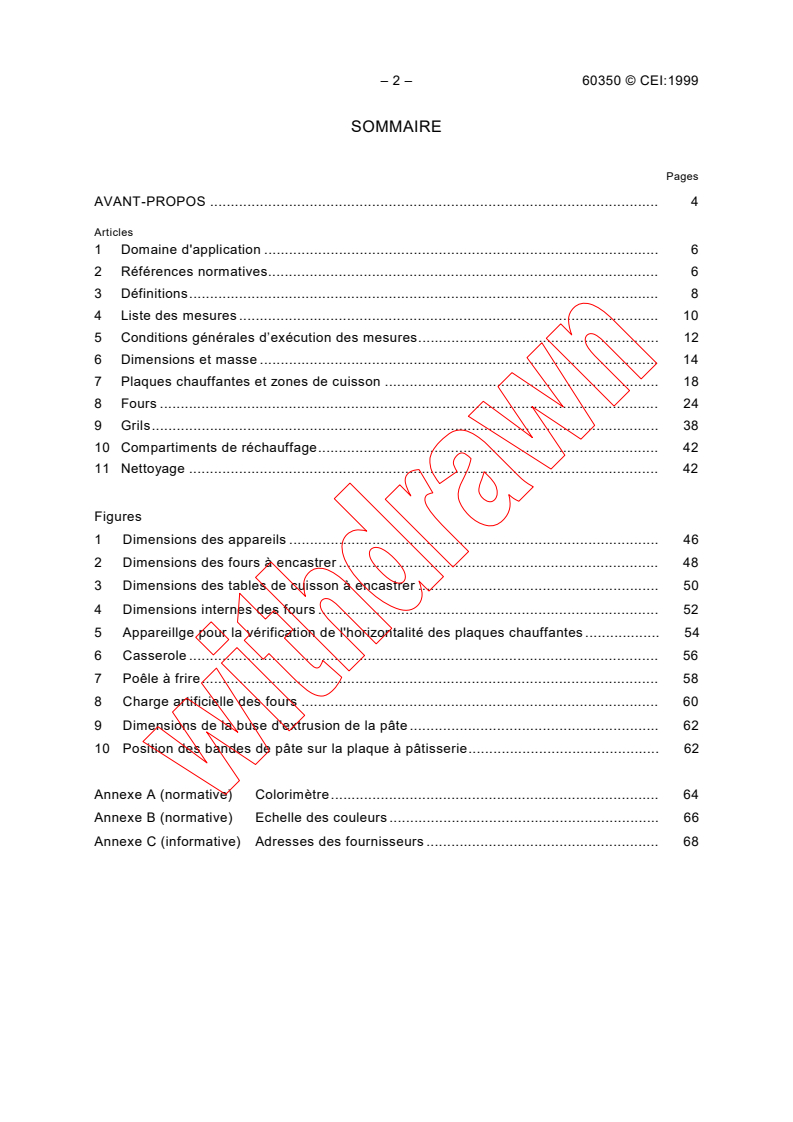
IEC 60350:1999 - Electric cooking ranges, hobs, ovens and grills for household use - Methods for measuring performance Released:4/30/1999
IEC 60350:1999+AMD1:2005 CSV - Electric cooking ranges, hobs, ovens and grills for household use - Methods for measuring performance Released:7/20/2005
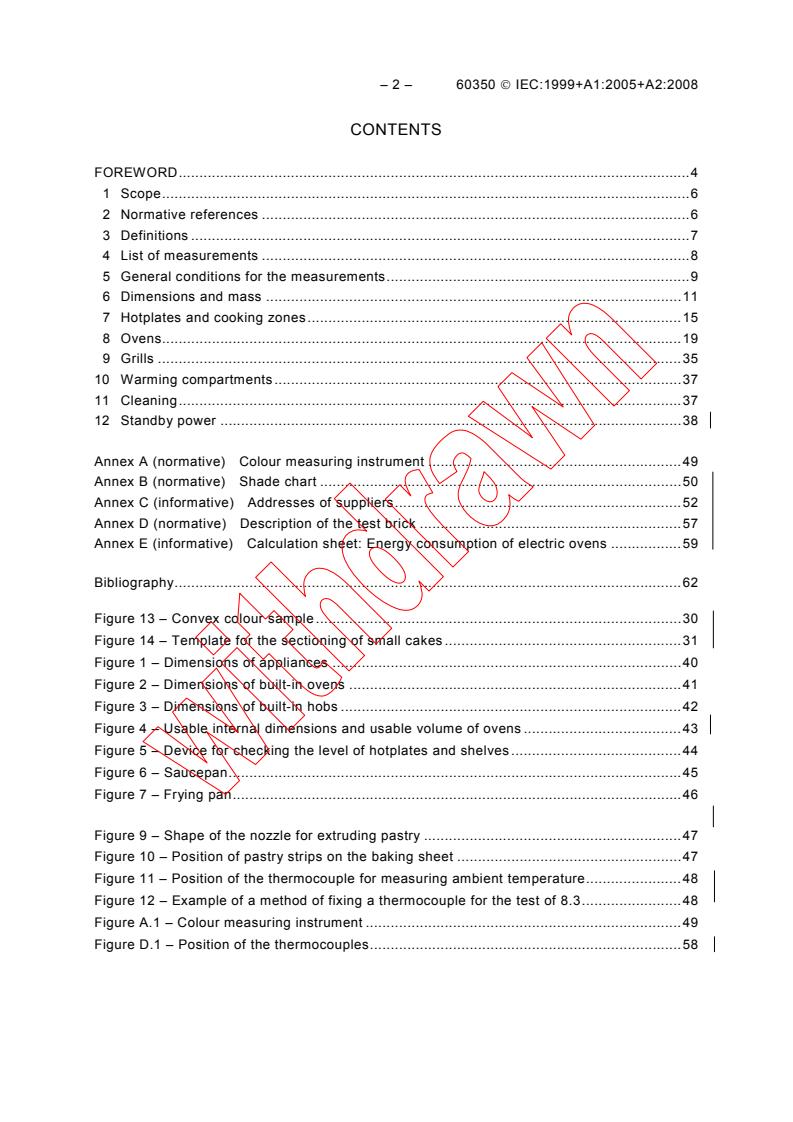
IEC 60350:1999+AMD1:2005+AMD2:2008 CSV - Electric cooking ranges, hobs, ovens and grills for household use - Methods for measuring performance Released:4/29/2009
Relations
- Effective Date
- 05-Sep-2023
- Effective Date
- 05-Sep-2023
- Effective Date
- 05-Sep-2023
- Effective Date
- 05-Sep-2023
Buy Documents
IEC 60350:1999 - Electric cooking ranges, hobs, ovens and grills for household use - Methods for measuring performance Released:4/30/1999
IEC 60350:1999+AMD1:2005 CSV - Electric cooking ranges, hobs, ovens and grills for household use - Methods for measuring performance Released:7/20/2005
IEC 60350:1999+AMD1:2005+AMD2:2008 CSV - Electric cooking ranges, hobs, ovens and grills for household use - Methods for measuring performance Released:4/29/2009
Frequently Asked Questions
IEC 60350:1999 is a standard published by the International Electrotechnical Commission (IEC). Its full title is "Electric cooking ranges, hobs, ovens and grills for household use - Methods for measuring performance". This standard covers: Applies to ranges, cooking tables, ovens and similar appliances for household use. This publication defines the principal performance characteristics of these appliances and describes the standard methods for measuring these characteristics. A colour shade chart is provided with the printed standard. For the electronic version this colour shade chart (IEC 60350-CHAR) can be ordered separately, to ensure accurate colour reproduction.
Applies to ranges, cooking tables, ovens and similar appliances for household use. This publication defines the principal performance characteristics of these appliances and describes the standard methods for measuring these characteristics. A colour shade chart is provided with the printed standard. For the electronic version this colour shade chart (IEC 60350-CHAR) can be ordered separately, to ensure accurate colour reproduction.
IEC 60350:1999 is classified under the following ICS (International Classification for Standards) categories: 97.040.20 - Cooking ranges, working tables, ovens and similar appliances. The ICS classification helps identify the subject area and facilitates finding related standards.
IEC 60350:1999 has the following relationships with other standards: It is inter standard links to IEC 60350-2:2011, IEC 60350-1:2011, IEC 60350:1999/AMD2:2008, IEC 60350:1999/AMD1:2005. Understanding these relationships helps ensure you are using the most current and applicable version of the standard.
IEC 60350:1999 is available in PDF format for immediate download after purchase. The document can be added to your cart and obtained through the secure checkout process. Digital delivery ensures instant access to the complete standard document.
Standards Content (Sample)
NORME CEI
INTERNATIONALE IEC
INTERNATIONAL
Deuxième édition
STANDARD
Second edition
1999-04
Cuisinières, foyers de cuisson, fours électriques
et grils à usage domestique –
Méthodes de mesure de l'aptitude à la fonction
Electric cooking ranges, hobs, ovens
and grills for household use –
Methods for measuring performance
Numéro de référence
Reference number
CEI/IEC 60350:1999
Numéros des publications Numbering
Depuis le 1er janvier 1997, les publications de la CEI As from 1 January 1997 all IEC publications are
sont numérotées à partir de 60000. issued with a designation in the 60000 series.
Publications consolidées Consolidated publications
Les versions consolidées de certaines publications de Consolidated versions of some IEC publications
la CEI incorporant les amendements sont disponibles. including amendments are available. For example,
Par exemple, les numéros d’édition 1.0, 1.1 et 1.2 edition numbers 1.0, 1.1 and 1.2 refer, respectively, to
indiquent respectivement la publication de base, la the base publication, the base publication incor-
publication de base incorporant l’amendement 1, et la porating amendment 1 and the base publication
publication de base incorporant les amendements 1 incorporating amendments 1 and 2.
et 2.
Validité de la présente publication Validity of this publication
Le contenu technique des publications de la CEI est The technical content of IEC publications is kept
constamment revu par la CEI afin qu'il reflète l'état under constant review by the IEC, thus ensuring that
actuel de la technique. the content reflects current technology.
Des renseignements relatifs à la date de reconfir- Information relating to the date of the reconfirmation
mation de la publication sont disponibles dans le of the publication is available in the IEC catalogue.
Catalogue de la CEI.
Les renseignements relatifs à des questions à l’étude et Information on the subjects under consideration and
des travaux en cours entrepris par le comité technique work in progress undertaken by the technical
qui a établi cette publication, ainsi que la liste des committee which has prepared this publication, as well
publications établies, se trouvent dans les documents ci- as the list of publications issued, is to be found at the
dessous: following IEC sources:
• «Site web» de la CEI* • IEC web site*
• Catalogue des publications de la CEI • Catalogue of IEC publications
Publié annuellement et mis à jour Published yearly with regular updates
régulièrement (On-line catalogue)*
(Catalogue en ligne)*
• IEC Bulletin
• Bulletin de la CEI Available both at the IEC web site* and
Disponible à la fois au «site web» de la CEI* as a printed periodical
et comme périodique imprimé
Terminology, graphical and letter
Terminologie, symboles graphiques
symbols
et littéraux
For general terminology, readers are referred to
En ce qui concerne la terminologie générale, le lecteur IEC 60050: International Electrotechnical Vocabulary
se reportera à la CEI 60050: Vocabulaire Electro- (IEV).
technique International (VEI).
For graphical symbols, and letter symbols and signs
Pour les symboles graphiques, les symboles littéraux approved by the IEC for general use, readers are
et les signes d'usage général approuvés par la CEI, le referred to publications IEC 60027: Letter symbols to
lecteur consultera la CEI 60027: Symboles littéraux à be used in electrical technology, IEC 60417: Graphical
utiliser en électrotechnique, la CEI 60417: Symboles symbols for use on equipment. Index, survey and
graphiques utilisables sur le matériel. Index, relevé et compilation of the single sheets and IEC 60617:
compilation des feuilles individuelles, et la CEI 60617: Graphical symbols for diagrams.
Symboles graphiques pour schémas.
* See web site address on title page.
* Voir adresse «site web» sur la page de titre.
NORME CEI
INTERNATIONALE IEC
INTERNATIONAL
Deuxième édition
STANDARD
Second edition
1999-04
Cuisinières, foyers de cuisson, fours électriques
et grils à usage domestique –
Méthodes de mesure de l'aptitude à la fonction
Electric cooking ranges, hobs, ovens
and grills for household use –
Methods for measuring performance
IEC 1999 Droits de reproduction réservés Copyright - all rights reserved
Aucune partie de cette publication ne peut être reproduite ni No part of this publication may be reproduced or utilized in
utilisée sous quelque forme que ce soit et par aucun procédé, any form or by any means, electronic or mechanical,
électronique ou mécanique, y compris la photo-copie et les including photocopying and microfilm, without permission in
microfilms, sans l'accord écrit de l'éditeur. writing from the publisher.
International Electrotechnical Commission 3, rue de Varembé Geneva, Switzerland
Telefax: +41 22 919 0300 e-mail: inmail@iec.ch IEC web site http://www.iec.ch
CODE PRIX
Commission Electrotechnique Internationale
W
PRICE CODE
International Electrotechnical Commission
Pour prix, voir catalogue en vigueur
For price, see current catalogue
– 2 – 60350 © CEI:1999
SOMMAIRE
Pages
AVANT-PROPOS . 4
Articles
1 Domaine d'application. 6
2 Références normatives. 6
3 Définitions. 8
4 Liste des mesures . 10
5 Conditions générales d’exécution des mesures. 12
6 Dimensions et masse . 14
7 Plaques chauffantes et zones de cuisson . 18
8 Fours. 24
9 Grils. 38
10 Compartiments de réchauffage. 42
11 Nettoyage. 42
Figures
1 Dimensions des appareils . 46
2 Dimensions des fours à encastrer . 48
3 Dimensions des tables de cuisson à encastrer . 50
4 Dimensions internes des fours . 52
5 Appareillge pour la vérification de l'horizontalité des plaques chauffantes . 54
6 Casserole . 56
7 Poêle à frire. 58
8 Charge artificielle des fours . 60
9 Dimensions de la buse d'extrusion de la pâte . 62
10 Position des bandes de pâte sur la plaque à pâtisserie. 62
Annexe A (normative) Colorimètre. 64
Annexe B (normative) Echelle des couleurs . 66
Annexe C (informative) Adresses des fournisseurs . 68
60350 © IEC:1999 – 3 –
CONTENTS
Page
FOREWORD . 5
Clause
1 Scope. 7
2 Normative references. 7
3 Definitions. 9
4 List of measurements . 11
5 General conditions for the measurements . 13
6 Dimensions and mass. 15
7 Hotplates and cooking zones . 19
8 Ovens. 25
9 Grills.39
10 Warming compartments. 43
11 Cleaning . 43
Figures
1 Dimensions of appliances . 47
2 Dimensions of built-in ovens . 49
3 Dimensions of built-in hobs . 51
4 Internal dimensions of ovens. 53
5 Device for checking the level of hotplates and shelves . 55
6 Saucepan . 57
7 Frying pan . 59
8 Artificial load for ovens . 61
9 Shape of the nozzle for extruding pastry. 63
10 Position of pastry strips on the baking sheet. 63
Annex A (normative) Colour measuring instrument. 65
Annex B (normative) Shade chart . 67
Annex C (informative) Addresses of suppliers . 69
– 4 – 60350 © CEI:1999
COMMISSION ÉLECTROTECHNIQUE INTERNATIONALE
____________
CUISINIÈRES, FOYERS DE CUISSON, FOURS ÉLECTRIQUES
ET GRILS À USAGE DOMESTIQUE –
MÉTHODES DE MESURE DE L'APTITUDE À LA FONCTION
AVANT-PROPOS
1) La CEI (Commission Electrotechnique Internationale) est une organisation mondiale de normalisation composée
de l'ensemble des comités électrotechniques nationaux (Comités nationaux de la CEI). La CEI a pour objet de
favoriser la coopération internationale pour toutes les questions de normalisation dans les domaines de
l'électricité et de l'électronique. A cet effet, la CEI, entre autres activités, publie des Normes internationales.
Leur élaboration est confiée à des comités d'études, aux travaux desquels tout Comité national intéressé par le
sujet traité peut participer. Les organisations internationales, gouvernementales et non gouvernementales, en
liaison avec la CEI, participent également aux travaux. La CEI collabore étroitement avec l'Organisation
Internationale de Normalisation (ISO), selon des conditions fixées par accord entre les deux organisations.
2) Les décisions ou accords officiels de la CEI concernant les questions techniques représentent, dans la mesure
du possible un accord international sur les sujets étudiés, étant donné que les Comités nationaux intéressés
sont représentés dans chaque comité d’études.
3) Les documents produits se présentent sous la forme de recommandations internationales. Ils sont publiés
comme normes, rapports techniques ou guides et agréés comme tels par les Comités nationaux.
4) Dans le but d'encourager l'unification internationale, les Comités nationaux de la CEI s'engagent à appliquer de
façon transparente, dans toute la mesure possible, les Normes internationales de la CEI dans leurs normes
nationales et régionales. Toute divergence entre la norme de la CEI et la norme nationale ou régionale
correspondante doit être indiquée en termes clairs dans cette dernière.
5) La CEI n’a fixé aucune procédure concernant le marquage comme indication d’approbation et sa responsabilité
n’est pas engagée quand un matériel est déclaré conforme à l’une de ses normes.
6) L’attention est attirée sur le fait que certains des éléments de la présente Norme internationale peuvent faire
l’objet de droits de propriété intellectuelle ou de droits analogues. La CEI ne saurait être tenue pour
responsable de ne pas avoir identifié de tels droits de propriété et de ne pas avoir signalé leur existence.
La Norme internationale CEI 60350 a été établie par le sous-comité 59B: Cuisinières,
réchauds, fours et appareils analogues, du comité d'études 59 de la CEI: Aptitude à la fonction
des appareils électrodomestiques.
Cette deuxième édition annule et remplace la première édition parue en 1971 et en constitue
une révision technique.
Le texte de cette norme est issu des documents suivants:
FDIS Rapport de vote
59B/67/FDIS 59B/68/RVD
Le rapport de vote indiqué dans le tableau ci-dessus donne toute information sur le vote ayant
abouti à l'approbation de cette norme.
Les annexes A et B font partie intégrante de cette norme.
L’annexe C est donnée uniquement à titre d'information.
Les termes figurant en caractères gras dans les textes sont définis à l'article 3.
60350 © IEC:1999 – 5 –
INTERNATIONAL ELECTROTECHNICAL COMMISSION
___________
ELECTRIC COOKING RANGES, HOBS, OVENS AND GRILLS
FOR HOUSEHOLD USE –
METHODS FOR MEASURING PERFORMANCE
FOREWORD
1) The IEC (International Electrotechnical Commission) is a worldwide organization for standardization comprising
all national electrotechnical committees (IEC National Committees). The object of the IEC is to promote
international co-operation on all questions concerning standardization in the electrical and electronic fields. To
this end and in addition to other activities, the IEC publishes International Standards. Their preparation is
entrusted to technical committees; any IEC National Committee interested in the subject dealt with may
participate in this preparatory work. International, governmental and non-governmental organizations liaising
with the IEC also participate in this preparation. The IEC collaborates closely with the International Organization
for Standardization (ISO) in accordance with conditions determined by agreement between the two
organizations.
2) The formal decisions or agreements of the IEC on technical matters express, as nearly as possible, an
international consensus of opinion on the relevant subjects since each technical committee has representation
from all interested National Committees.
3) The documents produced have the form of recommendations for international use and are published in the form
of standards, technical reports or guides and they are accepted by the National Committees in that sense.
4) In order to promote international unification, IEC National Committees undertake to apply IEC International
Standards transparently to the maximum extent possible in their national and regional standards. Any
divergence between the IEC Standard and the corresponding national or regional standard shall be clearly
indicated in the latter.
5) The IEC provides no marking procedure to indicate its approval and cannot be rendered responsible for any
equipment declared to be in conformity with one of its standards.
6) Attention is drawn to the possibility that some of the elements of this International Standard may be the subject
of patent rights. The IEC shall not be held responsible for identifying any or all such patent rights.
International Standard IEC 60350 has been prepared by subcommittee 59B: Cooking ranges,
working tables, ovens and similar appliances, of IEC technical committee 59: Performance of
household electrical appliances.
This second edition cancels and replaces the first edition published in 1971, and constitutes a
technical revision.
The text of this standard is based on the following documents:
FDIS Report on voting
59B/67/FDIS 59B/68/RVD
Full information on the voting for the approval of this standard can be found in the report on
voting indicated in the above table.
Annexes A and B form an integral part of this standard.
Annex C is for information only.
Words in bold in the text are defined in clause 3.
– 6 – 60350 © CEI:1999
CUISINIÈRES, FOYERS DE CUISSON, FOURS ÉLECTRIQUES
ET GRILS À USAGE DOMESTIQUE –
MÉTHODES DE MESURE DE L'APTITUDE À LA FONCTION
1 Domaine d'application
La présente Norme internationale définit des méthodes de mesure de l’aptitude à la fonction
des cuisinières, des tables de cuisson, des fours électriques et des grils à usage
domestique.
NOTE 1 – Les appareils couverts par la présente norme peuvent être posés sur le sol, encastrés ou prévus pour
être placés sur un plan de travail.
NOTE 2 – Cette norme ne s’applique pas
– aux fours à micro-ondes (CEI 60705);
*
– aux appareils de cuisson mobiles, aux grilloirs et appareils de fonction analogue
La présente norme a pour objet d’énumérer et de définir les principales caractéristiques
d’aptitude à la fonction des appareils concernés qui intéressent le consommateur et de décrire
des méthodes normalisées pour la vérification de ces caractéristiques.
NOTE 3 – Etant donné que les résultats de certains essais peuvent varier d’un laboratoire à un autre, il est
considéré que ces essais ne sont pas reproductibles. Ils sont donc destinés uniquement à des fins d'essais
comparatifs.
La présente norme ne spécifie pas les prescriptions d’aptitude à la fonction.
NOTE 4 – Cette norme ne traite pas des prescriptions de sécurité (CEI 60335-2-6 et CEI 60335-2-9).
2 Références normatives
Les documents normatifs suivants contiennent des dispositions qui, par suite de la référence
qui y est faite, constituent des dispositions valables pour la présente Norme internationale.
Pour les références datées, les amendements ultérieurs ou les révisions de ces publications ne
s’appliquent pas. Toutefois, les parties prenantes aux accords fondés sur la présente Norme
internationale sont invitées à rechercher la possibilité d'appliquer les éditions les plus récentes
des documents normatifs indiqués ci-après. Pour les références non datées, la dernière édition
du document normatif en référence s’applique. Les membres de la CEI et de l'ISO possèdent
le registre des Normes internationales en vigueur.
ISO 7724-1:1984, Peintures et vernis – Colorimétrie – Partie 1: Principes
ISO 7724-2:1984, Peintures et vernis – Colorimétrie – Partie 2: Mesurage de la couleur
ISO 7724-3:1984, Peintures et vernis – Colorimétrie – Partie 3: Calcul des différences de
couleur
ISO/CIE 10526:1991, Illuminants colorimétriques normalisés CIE
ISO/CIE 10527:1991, Observateurs de références colorimétriques CIE
CIE 15.2:1986, Colorimétrie
___________
*
CEI 61817, en préparation.
60350 © IEC:1999 – 7 –
ELECTRIC COOKING RANGES, HOBS, OVENS AND GRILLS
FOR HOUSEHOLD USE –
METHODS FOR MEASURING PERFORMANCE
1 Scope
This International Standard defines methods for measuring the performance of electric
cooking ranges, hobs, ovens and grills for household use.
NOTE 1 – Appliances covered by this standard may be built-in or for placing on a working surface or the floor.
NOTE 2 – This standard does not apply to
– microwave ovens (IEC 60705),
*
– portable appliances for cooking, grilling and similar functions
This standard defines the main performance characteristics of these appliances which are of
interest to the user and specifies methods for measuring these characteristics.
NOTE 3 – Some of the tests which are specified in this standard are not considered to be reproducible since the
results may vary between laboratories. They are therefore intended for comparative testing purposes only.
This standard does not specify requirements for performance.
NOTE 4 – This standard does not deal with safety requirements (IEC 60335-2-6 and IEC 60335-2-9).
2 Normative references
The following normative documents contain provisions which, through reference in this text,
constitute provisions of this International Standard. At the time of publication, the edition
indicated was valid. All normative documents are subject to revision, and parties to agreements
based on this International Standard are encouraged to investigate the possibility of applying
the most recent edition of the normative document indicated below. Members of IEC and ISO
maintain registers of currently valid International Standards.
ISO 7724-1:1984, Paints and varnishes – Colorimetry – Part 1: Principles
ISO 7724-2:1984, Paints and varnishes – Colorimetry – Part 2: Colour measurement
ISO 7724-3:1984, Paints and varnishes – Colorimetry – Part 3: Calculation of colour
differences
ISO/CIE 10526:1991, CIE standard colorimetric illuminants
ISO/CIE 10527:1991, CIE standard colorimetric observers
CIE 15.2:1986, Colorimetry
___________
*
IEC 61817, in preparation.
– 8 – 60350 © CEI:1999
3 Définitions
Pour les besoins de la présente Norme internationale, les définitions suivantes s’appliquent:
3.1
cuisinière
appareil possédant une et au moins un . Elle peut comporter un
table de cuisson four gril
3.2
table de cuisson
appareil ou partie d’un appareil qui comporte une ou plusieurs zones de cuisson
NOTE – Une table de cuisson est également appelée plaque de cuisson.
3.3
zone de cuisson
partie de la table de cuisson ou zone repérée sur la surface d’une table de cuisson sur
laquelle on place les casseroles à chauffer
3.4
plaque chauffante
partie solidaire de la surface de la table de cuisson qui forme la zone de cuisson
3.5
plaque chauffante pleine
plaque chauffante ayant une surface pleine, généralement en fonte, incorporant un élément
chauffant
3.6
plaque chauffante tubulaire
plaque chauffante dont l’élément chauffant est constitué d’une gaine tubulaire placée dans un
plan pratiquement plat
3.7
table de cuisson vitrocéramique
table de cuisson dans laquelle les éléments chauffants sont situés sous une surface
vitrocéramique
3.8
table de cuisson par induction
table de cuisson sur laquelle la casserole est chauffée au moyen de courants de Foucault
NOTE 1 – Les courants de Foucault sont induits dans le fond de la casserole par un champ magnétique généré par
une bobine.
NOTE 2 – La surface de la table de cuisson peut être vitrocéramique.
3.9
gril
appareil ou partie d’appareil dans lequel l’aliment est cuit au moyen de chaleur rayonnante
3.10
four
appareil ou compartiment d’une dans lequel l’aliment est cuit par rayonnement, par
cuisinière
convection naturelle, par circulation forcée de l’air ou par combinaison de ces méthodes de
chauffage
60350 © IEC:1999 – 9 –
3 Definitions
For the purposes of this International Standard the following definitions apply.
3.1
cooking range
appliance having a hob and at least one oven. It may incorporate a grill
3.2
hob
appliance or part of an appliance which incorporates one or more cooking zones
NOTE – A hob is also known as a cooktop.
3.3
cooking zone
part of the hob or area marked on the surface of a hob on which pans are placed for heating
3.4
hotplate
part attached to the surface of a hob which forms a cooking zone
3.5
solid hotplate
hotplate having a closed surface which is usually constructed from cast iron with an integrated
heating element
3.6
tubular hotplate
hotplate having a surface which is formed by the configuration of a tubular sheathed heating
element in a substantially flat plane
3.7
glass ceramic hob
hob in which the heating elements are located beneath a glass ceramic surface
3.8
induction cooking zone
on which the pan is heated by means of eddy currents
cooking zone
NOTE 1 – The eddy currents are induced in the bottom of the pan by the electromagnetic field of a coil.
NOTE 2 – The hob surface may be of glass ceramic.
3.9
grill
appliance or part of an appliance in which food is cooked by radiant heat
3.10
oven
appliance or compartment of a cooking range in which food is cooked by radiation, by natural
convection, by forced-air circulation or by a combination of these heating methods
– 10 – 60350 © CEI:1999
3.11
four autonettoyant par pyrolyse
four dans lequel les salissures de cuisson sont enlevées par élévation de la température du
four à une valeur suffisamment haute
3.12
four autonettoyant par catalyse
four dans lequel les salissures de cuisson sont enlevées par décomposition sur un revêtement
spécial
3.13
compartiment de réchauffage
compartiment séparé, dans lequel les assiettes sont placées pour être préchauffées avant le
service ou dans lequel les aliments sont maintenus à une température adaptée au service
4 Liste des mesures
L’aptitude à la fonction des appareils est déterminée par les essais énumérés en 4.1 à 4.6:
4.1 Dimensions et masse
Les mesures suivantes sont effectuées:
– dimensions hors tout (voir 6.1);
– dimensions des plaques chauffantes et des zones de cuisson (voir 6.2);
– dimensions internes des fours (voir 6.3);
– dimensions des étagères (voir 6.4);
– dimensions des grilles du gril (voir 6.5);
– dimensions des compartiments de réchauffage (voir 6.6);
– horizontalité des plaques chauffantes (voir 6.7);
– distance entre les plaques chauffantes ou les zones de cuisson (voir 6.8);
– horizontalité de l’étagère (voir 6.9);
– masse de l’appareil (voir 6.10).
4.2 Plaques chauffantes et zones de cuisson
Les essais suivants sont effectués:
– aptitude à chauffer de l’eau (voir 7.1);
– aptitude à contrôler la température d’une charge (voir 7.2);
– répartition de la chaleur (voir 7.3).
4.3 Four
Les essais suivants sont effectués:
– préchauffage du four à vide (voir 8.1);
– précision de la commande (voir 8.2);
– consommation d’énergie (voir 8.3);
– répartition de la chaleur (voir 8.4);
– aptitude à fournir de la chaleur (voir 8.5).
60350 © IEC:1999 – 11 –
3.11
pyrolytic self-cleaning oven
oven in which cooking deposits are removed by heating the oven to a sufficiently high
temperature
3.12
oven with catalytic cleaning
oven in which cooking deposits are removed by breaking them down on a special coating
3.13
warming compartment
separate compartment in which dishes are placed in order to preheat them prior to serving, or
in which food is maintained at serving temperature
4 List of measurements
The performance of the appliance is determined by the tests listed in 4.1 to 4.6.
4.1 Dimensions and mass
The following measurements are carried out:
– overall dimensions (see 6.1);
– dimensions of hotplates and cooking zones (see 6.2);
– internal dimensions of ovens (see 6.3);
– dimensions of shelves (see 6.4);
– dimensions of grill grids (see 6.5);
– dimensions of warming compartments (see 6.6);
– level of hotplates (see 6.7);
– distance between the hotplates or cooking zones (see 6.8);
– level of the shelf (see 6.9);
– mass of the appliance (see 6.10).
4.2 Hotplates and cooking zones
The following tests are carried out:
– ability to heat water (see 7.1);
– ability to control the temperature of a load (see 7.2);
– heat distribution (see 7.3).
4.3 Oven
The following tests are carried out:
– preheating the empty oven (see 8.1);
– accuracy of the control (see 8.2);
– energy consumption (see 8.3);
– heat distribution (see 8.4);
– ability to supply heat (see 8.5).
– 12 – 60350 © CEI:1999
4.4 Gril
Les essais suivants sont effectués:
– surface de grillage (voir 9.1);
– grillage (voir 9.2).
4.5 Compartiment de réchauffage
L’essai suivant est effectué:
– commande de température et consommation d’énergie (voir article 10).
4.6 Nettoyage
Les essais suivants sont effectués:
– capacité des tables de cuisson à retenir les liquides répandus (voir 11.1);
– nettoyage des fours autonettoyants par pyrolyse (voir 11.2);
– nettoyage des fours autonettoyants par catalyse (voir 11.3).
5 Conditions générales d’exécution des mesures
Sauf spécification contraire, les mesures sont effectuées dans les conditions suivantes.
5.1 Salle d’essai
Les essais sont réalisés dans une salle pratiquement exempte de courants d’air dans laquelle
la température ambiante est maintenue à 20 °C ± 5 °C.
5.2 Tension
L’appareil est alimenté à la tension assignée ±1 %.
Si une plage de tension est spécifiée, les essais sont effectués, l’appareil étant alimenté à la
tension nominale du pays où il est prévu de l'utiliser.
5.3 Instrumentation
La précision de l’appareil de mesure comprenant un couple thermoélectrique doit être de 0,5 K
à l’intérieur de la plage de température 0 °C à 100 °C et de 2 K à l’intérieur de la plage de
température 100 °C à 300 °C.
La précision de l’appareil de mesure de consommation d’énergie doit être de 1 %.
5.4 Positionnement de l’appareil
Les appareils encastrés sont installés selon les instructions d’installation. Les autres appareils
sont placés dos contre un mur, sauf spécification contraire dans les instructions.
Les appareils à poser sur le sol sont positionnés entre des éléments de cuisine. Les appareils
à poser sur table sont placés loin des murs.
60350 © IEC:1999 – 13 –
4.4 Grill
The following tests are carried out:
– grilling area (see 9.1);
– grilling (see 9.2).
4.5 Warming compartments
The following test is carried out:
– temperature control and energy consumption (see clause 10).
4.6 Cleaning
The following tests are carried out:
– spillage capacity of hobs (see 11.1);
– cleaning of pyrolytic self-cleaning ovens (see 11.2);
– cleaning of ovens with catalytic cleaning (see 11.3).
5 General conditions for the measurements
Unless otherwise specified, the measurements are made under the following conditions.
5.1 Test room
The tests are carried out in a substantially draught-free room in which the ambient temperature
is maintained at 20 °C ± 5 °C.
5.2 Voltage
The appliance is supplied at rated voltage, ±1 %.
If the appliance has a rated voltage range, the tests are carried out at the nominal voltage of
the country where the appliance is intended to be used.
5.3 Instrumentation
The temperature measuring instrument including thermocouples shall have an accuracy of
0,5 K within the temperature range of 0 °C to 100 °C and an accuracy of 2 K within the
temperature range 100 °C to 300 °C.
The energy measuring meter shall have an accuracy of 1 %.
5.4 Positioning the appliance
Built-in appliances are installed in accordance with the instructions for installation. Other
appliances are placed with their back against a wall, unless otherwise specified in the
instructions.
Floor-standing appliances are positioned between kitchen cabinets. Table-top appliances are
positioned away from side walls.
– 14 – 60350 © CEI:1999
5.5 Préchauffage
L’appareil est initialement à la température de la pièce. Cependant, si un préchauffage est
spécifié pour l’essai, l’appareil est préchauffé selon les instructions d’utilisation. Si aucune
instruction n’est donnée, l’appareil est considéré comme préchauffé après que le thermostat a
pour la première fois commandé la coupure.
5.6 Positionnement des commandes
La commande est positionnée pour donner la température spécifiée pour l’essai. Cependant, si
la température ne peut être atteinte pour des raisons de construction, le positionnement le plus
proche correspondant à la température spécifiée est choisi.
6 Dimensions et masse
6.1 Dimensions hors tout
Les dimensions hors tout de l’appareil sont mesurées et exprimées en millimètres comme suit:
– pour les cuisinières et les appareils posés sur le sol, on mesure les dimensions données en
figure 1;
– pour les fours à encastrer, on mesure les dimensions données en figure 2;
– pour les tables de cuisson à encastrer, on mesure les dimensions données en figure 3.
6.2 Dimensions des plaques chauffantes et des zones de cuisson
Les dimensions principales des plaques chauffantes et des zones de cuisson sont
déterminées comme suit:
– pour les plaques chauffantes pleines, on mesure le diamètre de la surface destinée à
venir directement en contact avec le fond des casseroles;
– pour les plaques chauffantes tubulaires, on mesure le diamètre du plus petit cercle
circonscrit à l’élément chauffant, à l’exclusion des terminaisons;
– pour les tables vitrocéramiques, on mesure les diamètres des zones de cuisson.
Les dimensions sont données en millimètres et arrondies aux 5 mm les plus proches.
Si les plaques chauffantes ou les zones de cuisson ne sont pas circulaires, les dimensions
sont déterminées comme suit:
– on mesure la longueur des côtés des formes rectangulaires,
– on mesure la plus grande et la plus petite dimension pour les formes ellipsoïdales ou
analogues.
NOTE – Si les marquages repérant les zones de cuisson ne sont pas clairs, ceci doit être consigné.
6.3 Dimensions internes des fours
La hauteur, la largeur et la profondeur du volume utile du four sont mesurées comme indiqué
figure 4 et consignées en millimètres.
Le volume est calculé à partir de ces trois dimensions et consigné en litres.
6.4 Dimensions des étagères
La largeur et la profondeur utiles de l’étagère sont mesurées. Les dimensions sont
déterminées 5 mm au-dessus de la surface de l’étagère.
60350 © IEC:1999 – 15 –
5.5 Preheating
The appliance is initially at room temperature. However, if preheating is specified, the
appliance is preheated in accordance with the instructions for use. If no instructions are given,
the appliance is considered to be preheated after the thermostat has switched off the first time.
5.6 Setting of controls
The control is set to give the temperature specified for the test. However, if the temperature
cannot be attained due to the construction of the control, the nearest setting related to the
specified temperature is chosen.
6 Dimensions and mass
6.1 Overall dimensions
The overall dimensions of the appliance are measured and stated in millimetres as follows.
– cooking ranges and other appliances placed on a surface are measured as shown in
figure 1;
– built-in ovens are measured as shown in figure 2;
– built-in hobs are measured as shown in figure 3.
6.2 Dimensions of hotplates and cooking zones
The main dimensions of hotplates and cooking zones are determined as follows:
–for solid hotplates, the diameter of the surface intended to come into direct contact with
the bottom of saucepans is measured;
–for tubular hotplates, the diameter of the smallest periphery excluding any lead-in section
is measured;
– for glass ceramic hobs, the diameters of the cooking zones are measured.
The dimensions are indicated in millimetres rounded to the nearest 5 mm.
If the hotplates or cooking zones are not circular the dimensions are determined as follows:
– for rectangular shapes, the lengths of the sides are measured;
– for elliptical and similar shapes, the major and minor dimensions are measured.
NOTE – If the markings identifying cooking zones are not clear, this is stated.
6.3 Internal dimensions of ovens
The height, width and depth of the usable volume within the oven are measured as shown in
figure 4 and stated in millimetres.
The volume is calculated from these three dimensions and stated in litres.
6.4 Dimensions of shelves
The usable width and usable depth of the shelf are measured. The dimensions are determined
5 mm above the surface of the shelf.
– 16 – 60350 © CEI:1999
La surface est calculée et consignée en centimètres carrés, arrondie aux 10 cm les plus
proches.
NOTE – L’étagère peut être une grille ou une plaque à pâtisserie
6.5 Dimensions des grilles de gril
La largeur et la profondeur de la grille sont mesurées.
La surface est calculée et consignée en centimètres carrés, arrondie aux 10 cm les plus
proches.
NOTE – Si la grille de grillage est l’étagère d’un four, ses dimensions sont mesurées suivant 6.4.
6.6 Dimensions des compartiments de réchauffage
La hauteur, la largeur et la profondeur du volume utile à l’intérieur du compartiment de
réchauffage sont déterminées et consignées en millimètres.
NOTE – Lorsqu’un élément chauffant est situé à l’intérieur du compartiment de réchauffage, les dimensions sont
mesurées en tenant compte de ses parties les plus protubérantes.
6.7 Horizontalité des plaques chauffantes
Les cuisinières ayant des pieds réglables et les tables de cuisson sont installées de façon
que le périmètre de la table de cuisson soit horizontal.
Un appareil consistant en un disque et un anneau circulaire est placé au centre de la plaque
chauffante. Un niveau à bulle est placé au centre de l’anneau, comme montré figure 5.
Une masse de 3 kg est placée sur chacune des plaques chauffantes restantes.
On fait tourner le niveau à bulle dans la position où il montre le plus d’inclinaison par rapport à
l’horizontale. Son côté le plus bas est alors soulevé à l’horizontale par insertion de cales entre
le niveau et l’anneau.
La vérification est effectuée sur chaque plaque chauffante.
L’écart par rapport à l’horizontale est donné par l’épaisseur, en millimètres, de la cale utilisée.
Il est exprimé en pourcentage arrondi au 0,1 % le plus proche.
NOTE – La conversion directe des millimètres en pourcentage est possible compte tenu du diamètre de l’anneau
égal à 100 mm.
6.8 Distance entre plaques chauffantes ou zones de cuisson
La distance la plus courte entre les bords adjacents des plaques chauffantes ou des zones
de cuisson est mesurée et consignée en millimètres, arrondis au millimètre le plus proche. Si
la table de cuisson comporte plus de deux plaques chauffantes ou zones de cuisson, on
détermine la distance entre chaque paire.
NOTE – Le résultat peut être consigné à l’aide d’un croquis.
6.9 Horizontalité de l’étagère
L’étagère du four est insérée dans le four à mi-hauteur
NOTE 1 – L’étagère peut être une grille ou une plaque à pâtisserie.
60350 © IEC:1999 – 17 –
The surface area is calculated and stated in square centimetres, rounded to the nearest
10 cm .
NOTE – The shelf may be a grid or a baking sheet.
6.5 Dimensions of grill grids
The width and depth of the grill grid are measured.
The surface area is calculated and stated in square centimetres, rounded to the nearest 10 cm .
NOTE – If the grill grid is the shelf of an oven, the dimensions are measured in accordance with 6.4.
6.6 Dimensions of warming compartments
The height, width and depth of the usable volume within the warming compartment are
measured and indicated in millimetres.
NOTE – When a heating element is located inside the warming compartment, the dimensions are measured up to
its most protruding part.
6.7 Level of hotplates
Cooking ranges with adjustable feet and hobs are installed with the perimeter of the hob
surface horizontal.
A device consisting of a disc and an annular ring is placed centrally on the hotplate. A spirit
level is placed centrally on the ring, as shown in figure 5.
A mass of 3 kg is placed on each of the remaining hotplates.
The spirit level is rotated to the position where it shows the maximum inclination from the
horizontal. Its lower side is then lifted to the horizontal by inserting a feeler gauge between the
level and the ring.
The measurement is carried out on each hotplate.
The deviation from the horizontal is given by the thickness of the gauge, in millimetres, to two
decimal places. It is expressed as a percentage, rounded to the nearest 0,1 %.
NOTE – The direct conversion from millimetres to percentage is possible due to the ring having a diameter of
100 mm.
6.8 Distance between hotplates or cooking zones
The shortest distance between the edges of adjacent hotplates or cooking zones is
measured and indicated in millimetres, rounded to the nearest millimetre. If the hob has more
than two hotplates or cooking zones, the distance between each pair is determined.
NOTE – The result may be shown by means of a sketch.
6.9 Level of shelf
The shelf is placed in a central position in the oven.
NOTE 1 – The shelf may be a grid or a baking sheet.
– 18 – 60350 © CEI:1999
Un dispositif comprenant un disque et un anneau circulaire est placé au centre de l’étagère. Le
niveau à bulle est placé au centre de l’anneau comme indiqué figure 5. On fait tourner le
niveau à bulle jusqu’à la détection de la plus grande inclinaison par rapport à l’horizontale. Son
côté le plus bas est alors ajusté à l’horizontale en insérant une cale entre le niveau et l’anneau.
L’écart par rapport à l’horizontale est donné par l’épaisseur en millimètres de la cale utilisée,
avec deux décimales. Il est exprimé en pourcentage, arrondi au 0,1 % le plus proche.
NOTE 2 – La conversion directe de millimètres en pourcentage est possible compte tenu du diamètre de l’anneau
égal à 100 mm.
6.10 Masse de l’appareil
La masse de l’appareil, y compris les accessoires, est déterminée et exprimée en
kilogrammes, arrondis au kilogramme le plus proche.
7 Plaques chauffantes et zones de cuisson
7.1 Aptitude à chauffer de l’eau
L’objet de cet essai est d’estimer le transfert de chaleur de la zone de cuisson à l’eau
contenue dans une casserole.
NOTE 1 – Cet essai n’est applicable que pour des essais comparatifs.
Pour l’essai, on utilise une casserole en acier qui couvre complètement la zone de cuisson,
comme indiqué figure 6.
NOTE 2 – Pour éviter toute déformation du fond, on peut utiliser pour le chauffage de l’eau une casserole dont les
parois verticales sont collées au fond avec de la colle au silicone.
NOTE 3 – On peut utiliser des casseroles disponibles dans le commerce et ayant des propriétés thermiques et
mécaniques équivalentes.
La casserole est remplie d’une quantité d’eau potable comme spécifié dans le tableau 1. La
température de l’eau est de 15 °C ± 1 °C. La casserole recouverte d’un couvercle est placée
au centre de la zone de cuisson.
NOTE 4 – Pour les zones de cuisson non circulaires, une casserole de forme appropriée peut être utilisée.
Tableau 1 – Quantité d’eau dans la casserole
Diamètre de la zone de cuisson Quantité d’eau
mm
"
≤145
1,5
>145 et ≤180
>180 et ≤220
La zone de cuisson est chauffée avec le réglage de la commande placé sur la position la plus
élevée. Pendant l’essai, l’eau est remuée continuellement à l’aide d’un agitateur non
métallique. On mesure le temps mis pour que la température de l’eau s’élève de 75 K ainsi que
la consommation d’énergie. L’essai est répété avec la casserole tournée de 90°.
On détermine la valeur moyenne des deux résultats.
Le temps est consigné en minutes et secondes. La consommation d’énergie est exprimée en
wattheures.
60350 © IEC:1999 – 19 –
A device consisting of a disc and an annular ring is placed centrally on the shelf. A spirit level
is placed centrally on the ring as shown in figure 5. The spirit level is rotated to the position
where it shows the maximum inclination from the horizontal. Its lower side is then lifted to the
horizontal by inserting a feeler gauge between the level and the ring.
The deviation from the horizontal is given by the thickness of the gauge, in millimetres, to two
decimal places. It is expressed as a percentage, rounded to the nearest 0,1 %.
NOTE 2 – The direct conversion from millimetres to percentage is possible due to the ring hav
...
IEC 60350
Edition 2.1 2005-07
INTERNATIONAL
STANDARD
NORME
INTERNATIONALE
Electric cooking ranges, hobs, ovens and grills for household use – Methods for
measuring performance
Cuisinières, foyers de cuisson, fours électriques et grils à usage domestique –
Méthodes de mesure de l'aptitude à la fonction
All rights reserved. Unless otherwise specified, no part of this publication may be reproduced or utilized in any form or by
any means, electronic or mechanical, including photocopying and microfilm, without permission in writing from either IEC or
IEC's member National Committee in the country of the requester.
If you have any questions about IEC copyright or have an enquiry about obtaining additional rights to this publication,
please contact the address below or your local IEC member National Committee for further information.
Droits de reproduction réservés. Sauf indication contraire, aucune partie de cette publication ne peut être reproduite
ni utilisée sous quelque forme que ce soit et par aucun procédé, électronique ou mécanique, y compris la photocopie
et les microfilms, sans l'accord écrit de la CEI ou du Comité national de la CEI du pays du demandeur.
Si vous avez des questions sur le copyright de la CEI ou si vous désirez obtenir des droits supplémentaires sur cette
publication, utilisez les coordonnées ci-après ou contactez le Comité national de la CEI de votre pays de résidence.
IEC Central Office
3, rue de Varembé
CH-1211 Geneva 20
Switzerland
Email: inmail@iec.ch
Web: www.iec.ch
About the IEC
The International Electrotechnical Commission (IEC) is the leading global organization that prepares and publishes
International Standards for all electrical, electronic and related technologies.
About IEC publications
The technical content of IEC publications is kept under constant review by the IEC. Please make sure that you have the
latest edition, a corrigenda or an amendment might have been published.
ƒ Catalogue of IEC publications: www.iec.ch/searchpub
The IEC on-line Catalogue enables you to search by a variety of criteria (reference number, text, technical committee,…).
It also gives information on projects, withdrawn and replaced publications.
ƒ IEC Just Published: www.iec.ch/online_news/justpub
Stay up to date on all new IEC publications. Just Published details twice a month all new publications released. Available
on-line and also by email.
ƒ Electropedia: www.electropedia.org
The world's leading online dictionary of electronic and electrical terms containing more than 20 000 terms and definitions
in English and French, with equivalent terms in additional languages. Also known as the International Electrotechnical
Vocabulary online.
ƒ Customer Service Centre: www.iec.ch/webstore/custserv
If you wish to give us your feedback on this publication or need further assistance, please visit the Customer Service
Centre FAQ or contact us:
Email: csc@iec.ch
Tel.: +41 22 919 02 11
Fax: +41 22 919 03 00
A propos de la CEI
La Commission Electrotechnique Internationale (CEI) est la première organisation mondiale qui élabore et publie des
normes internationales pour tout ce qui a trait à l'électricité, à l'électronique et aux technologies apparentées.
A propos des publications CEI
Le contenu technique des publications de la CEI est constamment revu. Veuillez vous assurer que vous possédez
l’édition la plus récente, un corrigendum ou amendement peut avoir été publié.
ƒ Catalogue des publications de la CEI: www.iec.ch/searchpub/cur_fut-f.htm
Le Catalogue en-ligne de la CEI vous permet d’effectuer des recherches en utilisant différents critères (numéro de référence,
texte, comité d’études,…). Il donne aussi des informations sur les projets et les publications retirées ou remplacées.
ƒ Just Published CEI: www.iec.ch/online_news/justpub
Restez informé sur les nouvelles publications de la CEI. Just Published détaille deux fois par mois les nouvelles
publications parues. Disponible en-ligne et aussi par email.
ƒ Electropedia: www.electropedia.org
Le premier dictionnaire en ligne au monde de termes électroniques et électriques. Il contient plus de 20 000 termes et
définitions en anglais et en français, ainsi que les termes équivalents dans les langues additionnelles. Egalement appelé
Vocabulaire Electrotechnique International en ligne.
ƒ Service Clients: www.iec.ch/webstore/custserv/custserv_entry-f.htm
Si vous désirez nous donner des commentaires sur cette publication ou si vous avez des questions, visitez le FAQ du
Service clients ou contactez-nous:
Email: csc@iec.ch
Tél.: +41 22 919 02 11
Fax: +41 22 919 03 00
IEC 60350
Edition 2.1 2005-07
INTERNATIONAL
STANDARD
NORME
INTERNATIONALE
Electric cooking ranges, hobs, ovens and grills for household use – Methods for
measuring performance
Cuisinières, foyers de cuisson, fours électriques et grils à usage domestique –
Méthodes de mesure de l'aptitude à la fonction
INTERNATIONAL
ELECTROTECHNICAL
COMMISSION
COMMISSION
ELECTROTECHNIQUE
PRICE CODE
INTERNATIONALE
CR
CODE PRIX
ICS 97.040.20 ISBN 2-8318-8089-0
– 2 – 60350 CEI:1999+A1:2005
SOMMAIRE
AVANT-PROPOS.4
1 Domaine d'application .8
2 Références normatives.8
3 Définitions .10
4 Liste des mesures .14
5 Conditions générales d’exécution des mesures .16
6 Dimensions et masse .18
7 Plaques chauffantes et zones de cuisson .24
8 Fours.32
9 Grils .58
10 Compartiments de réchauffage.62
11 Nettoyage.62
Annexe A (normative) Colorimètre .84
Annexe B (normative) Echelle des couleurs.86
Annexe C (informative) Adresses des fournisseurs .88
Annexe D (normative) Description de la brique d’essai .90
Annexe E (informative) .94
Bibliographie.100
Figure 1 – Dimensions des appareils .66
Figure 2 – Dimensions des fours à encastrer .68
Figure 3 – Dimensions des tables de cuisson à encastrer .70
Figure 4 – Dimensions internes des fours .72
Figure 5 – Appareillage pour la vérification de l’horizontalité des plaques chauffantes .74
Figure 6 – Casserole .76
Figure 7 – Poêle à frire .78
Figure 9 – Dimensions de la buse d’extrusion de la pâte.80
Figure 10 – Position des bandes de pâte sur la plaque à pâtisserie .80
Figure 11 – Position du couple thermoélectrique pour la mesure
de la température ambiante .82
Figure 12 – Exemple d’une méthode de fixation d’un couple thermoélectrique
pour l’essai de 8.3 .82
Figure A.1 – Colorimètre.84
Figure D.1 – Position des couples thermoélectriques .92
Tableau 1 – Quantité d’eau dans la casserole.24
Tableau 2 – Ingrédients et durées de cuisson .28
Tableau 3 – Ingrédients .50
Tableau 4 − Quantités.30
Tableau 5 − Temps de friture .32
Tableau 6 – Réglages du four .40
60350 IEC:1999+A1:2005 – 3 –
CONTENTS
FOREWORD.5
1 Scope.9
2 Normative references .9
3 Definitions .11
4 List of measurements .15
5 General conditions for the measurements.17
6 Dimensions and mass .19
7 Hotplates and cooking zones.25
8 Ovens.33
9 Grills .59
10 Warming compartments .63
11 Cleaning.63
Annex A (normative) Colour measuring instrument .85
Annex B (normative) Shade chart .87
Annex C (informative) Addresses of suppliers.89
Annex D (normative) Description of the test brick .91
Annex E (informative) Calculation sheet: Energy consumption of electric ovens .95
Bibliography.101
Figure 1 – Dimensions of appliances .67
Figure 2 – Dimensions of built-in ovens .69
Figure 3 – Dimensions of built-in hobs .71
Figure 4 – Internal dimensions of ovens.73
Figure 5 – Device for checking the level of hotplates and shelves .75
Figure 6 – Saucepan.77
Figure 7 – Frying pan.79
Figure 9 – Shape of the nozzle for extruding pastry .81
Figure 10 – Position of pastry strips on the baking sheet .81
Figure 11 – Position of the thermocouple for measuring ambient temperature.83
Figure 12 – Example of a method of fixing a thermocouple for the test of 8.3.83
Figure A.1 – Colour measuring instrument .85
Figure D.1 – Position of the thermocouples.93
Table 1 – Quantity of water in the saucepan .25
Table 2 – Ingredients and cooking durations .29
Table 3 – Ingredients .51
Table 4 − Quantities.31
Table 5 − Frying times .33
Table 6 – Oven settings .41
– 4 – 60350 © CEI:1999+A1:2005
COMMISSION ÉLECTROTECHNIQUE INTERNATIONALE
____________
CUISINIÈRES, FOYERS DE CUISSON, FOURS ÉLECTRIQUES
ET GRILS À USAGE DOMESTIQUE –
MÉTHODES DE MESURE DE L'APTITUDE À LA FONCTION
AVANT-PROPOS
1) La Commission Electrotechnique Internationale (CEI) est une organisation mondiale de normalisation
composée de l'ensemble des comités électrotechniques nationaux (Comités nationaux de la CEI). La CEI a
pour objet de favoriser la coopération internationale pour toutes les questions de normalisation dans les
domaines de l'électricité et de l'électronique. A cet effet, la CEI – entre autres activités – publie des Normes
internationales, des Spécifications techniques, des Rapports techniques, des Spécifications accessibles au
public (PAS) et des Guides (ci-après dénommés "Publication(s) de la CEI"). Leur élaboration est confiée à des
comités d'études, aux travaux desquels tout Comité national intéressé par le sujet traité peut participer. Les
organisations internationales, gouvernementales et non gouvernementales, en liaison avec la CEI, participent
également aux travaux. La CEI collabore étroitement avec l'Organisation Internationale de Normalisation (ISO),
selon des conditions fixées par accord entre les deux organisations.
2) Les décisions ou accords officiels de la CEI concernant les questions techniques représentent, dans la mesure
du possible, un accord international sur les sujets étudiés, étant donné que les Comités nationaux de la CEI
intéressés sont représentés dans chaque comité d’études.
3) Les Publications de la CEI se présentent sous la forme de recommandations internationales et sont agréées
comme telles par les Comités nationaux de la CEI. Tous les efforts raisonnables sont entrepris afin que la CEI
s'assure de l'exactitude du contenu technique de ses publications; la CEI ne peut pas être tenue responsable
de l'éventuelle mauvaise utilisation ou interprétation qui en est faite par un quelconque utilisateur final.
4) Dans le but d'encourager l'uniformité internationale, les Comités nationaux de la CEI s'engagent, dans toute la
mesure possible, à appliquer de façon transparente les Publications de la CEI dans leurs publications
nationales et régionales. Toutes divergences entre toutes Publications de la CEI et toutes publications
nationales ou régionales correspondantes doivent être indiquées en termes clairs dans ces dernières.
5) La CEI n’a prévu aucune procédure de marquage valant indication d’approbation et n'engage pas sa
responsabilité pour les équipements déclarés conformes à une de ses Publications.
6) Tous les utilisateurs doivent s'assurer qu'ils sont en possession de la dernière édition de cette publication.
7) Aucune responsabilité ne doit être imputée à la CEI, à ses administrateurs, employés, auxiliaires ou
mandataires, y compris ses experts particuliers et les membres de ses comités d'études et des Comités
nationaux de la CEI, pour tout préjudice causé en cas de dommages corporels et matériels, ou de tout autre
dommage de quelque nature que ce soit, directe ou indirecte, ou pour supporter les coûts (y compris les frais
de justice) et les dépenses découlant de la publication ou de l'utilisation de cette Publication de la CEI ou de
toute autre Publication de la CEI, ou au crédit qui lui est accordé.
8) L'attention est attirée sur les références normatives citées dans cette publication. L'utilisation de publications
référencées est obligatoire pour une application correcte de la présente publication.
9) L’attention est attirée sur le fait que certains des éléments de la présente Publication de la CEI peuvent faire
l’objet de droits de propriété intellectuelle ou de droits analogues. La CEI ne saurait être tenue pour
responsable de ne pas avoir identifié de tels droits de propriété et de ne pas avoir signalé leur existence.
La Norme internationale CEI 60350 a été établie par le sous-comité 59B: Cuisinières,
réchauds, fours et appareils analogues, du comité d'études 59 de la CEI: Aptitude à la
fonction des appareils électrodomestiques.
La présente version consolidée de la CEI 60350 comprend la deuxième édition (1999)
[documents 59B/67/FDIS et 59B/68/RVD] et son amendement 1 (2005) [documents
59K/104/FDIS et 59K/111/RVD].
Le contenu technique de cette version consolidée est donc identique à celui de l'édition de
base et à son amendement; cette version a été préparée par commodité pour l'utilisateur.
Elle porte le numéro d'édition 2.1.
Une ligne verticale dans la marge indique où la publication de base a été modifiée par
l'amendement 1.
Les termes figurant en caractères gras dans les textes sont définis à l'article 3.
60350 © IEC:1999+A1:2005 – 5 –
INTERNATIONAL ELECTROTECHNICAL COMMISSION
____________
ELECTRIC COOKING RANGES, HOBS, OVENS AND GRILLS
FOR HOUSEHOLD USE –
METHODS FOR MEASURING PERFORMANCE
FOREWORD
1) The International Electrotechnical Commission (IEC) is a worldwide organization for standardization comprising
all national electrotechnical committees (IEC National Committees). The object of IEC is to promote
international co-operation on all questions concerning standardization in the electrical and electronic fields. To
this end and in addition to other activities, IEC publishes International Standards, Technical Specifications,
Technical Reports, Publicly Available Specifications (PAS) and Guides (hereafter referred to as “IEC
Publication(s)”). Their preparation is entrusted to technical committees; any IEC National Committee interested
in the subject dealt with may participate in this preparatory work. International, governmental and non-
governmental organizations liaising with the IEC also participate in this preparation. IEC collaborates closely
with the International Organization for Standardization (ISO) in accordance with conditions determined by
agreement between the two organizations.
2) The formal decisions or agreements of IEC on technical matters express, as nearly as possible, an international
consensus of opinion on the relevant subjects since each technical committee has representation from all
interested IEC National Committees.
3) IEC Publications have the form of recommendations for international use and are accepted by IEC National
Committees in that sense. While all reasonable efforts are made to ensure that the technical content of IEC
Publications is accurate, IEC cannot be held responsible for the way in which they are used or for any
misinterpretation by any end user.
4) In order to promote international uniformity, IEC National Committees undertake to apply IEC Publications
transparently to the maximum extent possible in their national and regional publications. Any divergence
between any IEC Publication and the corresponding national or regional publication shall be clearly indicated in
the latter.
5) IEC provides no marking procedure to indicate its approval and cannot be rendered responsible for any
equipment declared to be in conformity with an IEC Publication.
6) All users should ensure that they have the latest edition of this publication.
7) No liability shall attach to IEC or its directors, employees, servants or agents including individual experts and
members of its technical committees and IEC National Committees for any personal injury, property damage or
other damage of any nature whatsoever, whether direct or indirect, or for costs (including legal fees) and
expenses arising out of the publication, use of, or reliance upon, this IEC Publication or any other IEC
Publications.
8) Attention is drawn to the Normative references cited in this publication. Use of the referenced publications is
indispensable for the correct application of this publication.
9) Attention is drawn to the possibility that some of the elements of this IEC Publication may be the subject of
patent rights. IEC shall not be held responsible for identifying any or all such patent rights.
International Standard IEC 60350 has been prepared by subcommittee 59B: Cooking ranges,
working tables, ovens and similar appliances, of IEC technical committee 59: Performance of
household electrical appliances.
This consolidated version of IEC 60350 consists of the second edition (1999) [documents
59B/67/FDIS and 59B/68/RVD] and its amendment 1 (2005) [documents 59K/104/FDIS and
59K/111/RVD].
The technical content is therefore identical to the base edition and its amendment and has
been prepared for user convenience.
It bears the edition number 2.1
A vertical line in the margin shows where the base publication has been modified by
amendment 1.
Words in bold in the text are defined in clause 3.
– 6 – 60350 CEI:1999+A1:2005
Le comité a décidé que le contenu de la publication de base et de ses amendements ne sera
pas modifié avant la date de maintenance indiquée sur le site web de la CEI sous
"http://webstore.iec.ch" dans les données relatives à la publication recherchée. A cette date,
la publication sera
• reconduite,
• supprimée,
• remplacée par une édition révisée, ou
• amendée.
60350 IEC:1999+A1:2005 – 7 –
The committee has decided that the contents of the base publication and its amendments will
remain unchanged until the maintenance result date indicated on the IEC web site under
"http://webstore.iec.ch" in the data related to the specific publication. At this date,
the publication will be
• reconfirmed,
• withdrawn,
• replaced by a revised edition, or
• amended.
– 8 – 60350 CEI:1999+A1:2005
CUISINIÈRES, FOYERS DE CUISSON, FOURS ÉLECTRIQUES
ET GRILS À USAGE DOMESTIQUE –
MÉTHODES DE MESURE DE L'APTITUDE À LA FONCTION
1 Domaine d'application
La présente Norme internationale définit des méthodes de mesure de l’aptitude à la fonction
des cuisinières, des tables de cuisson, des fours électriques et des grils à usage
domestique.
NOTE 1 Les appareils couverts par la présente norme peuvent être posés sur le sol, encastrés ou prévus pour
être placés sur un plan de travail.
NOTE 2 Cette norme ne s’applique pas
– aux fours à micro-ondes (CEI 60705);
*
– aux appareils de cuisson mobiles, aux grilloirs et appareils de fonction analogue
La présente norme a pour objet d’énumérer et de définir les principales caractéristiques
d’aptitude à la fonction des appareils concernés qui intéressent le consommateur et de
décrire des méthodes normalisées pour la vérification de ces caractéristiques.
NOTE 3 Etant donné que les résultats de certains essais peuvent varier d’un laboratoire à un autre, il est
considéré que ces essais ne sont pas reproductibles. Ils sont donc destinés uniquement à des fins d'essais
comparatifs.
La présente norme ne spécifie pas les prescriptions d’aptitude à la fonction.
NOTE 4 Cette norme ne traite pas des prescriptions de sécurité (CEI 60335-2-6 et CEI 60335-2-9).
NOTE 5 Pour la mesure de la consommation d’énergie et du temps de chauffage d’une charge (voir 8.3), la
présente norme n’est de plus pas applicable aux:
− fours micro-ondes combinés;
− fours de petite cavité;
− fours sans dispositif de commande de température;
− fonctions de chauffage autres que celles qui sont définies en 3.16 à 3.18.
2 Références normatives
Les documents de référence suivants sont indispensables pour l'application du présent
document. Pour les références datées, seule l'édition citée s'applique. Pour les références
non datées, la dernière édition du document de référence s'applique (y compris les éventuels
amendements).
CEI 60584-2:1982, Couples thermoélectriques – Partie 2: Tolérances
Amendement 1 (1989)
ISO 7724-1:1984, Peintures et vernis – Colorimétrie – Partie 1: Principes
ISO 7724-2:1984, Peintures et vernis – Colorimétrie – Partie 2: Mesurage de la couleur
ISO 7724-3:1984, Peintures et vernis – Colorimétrie – Partie 3: Calcul des différences de
couleur
ISO/CIE 10526:1991, Illuminants colorimétriques normalisés CIE
_________
*
CEI 61817, en préparation.
60350 IEC:1999+A1:2005 – 9 –
ELECTRIC COOKING RANGES, HOBS, OVENS AND GRILLS
FOR HOUSEHOLD USE –
METHODS FOR MEASURING PERFORMANCE
1 Scope
This International Standard defines methods for measuring the performance of electric
cooking ranges, hobs, ovens and grills for household use.
NOTE 1 Appliances covered by this standard may be built-in or for placing on a working surface or the floor.
NOTE 2 This standard does not apply to
– microwave ovens (IEC 60705),
*
– portable appliances for cooking, grilling and similar functions
This standard defines the main performance characteristics of these appliances which are of
interest to the user and specifies methods for measuring these characteristics.
NOTE 3 Some of the tests which are specified in this standard are not considered to be reproducible since the
results may vary between laboratories. They are therefore intended for comparative testing purposes only.
This standard does not specify requirements for performance.
NOTE 4 This standard does not deal with safety requirements (IEC 60335-2-6 and IEC 60335-2-9).
NOTE 5 For measurement of energy consumption and time for heating a load (see 8.3), this standard is
furthermore not applicable to:
− microwave combination ovens;
− small cavity ovens;
− ovens without adjustable temperature control;
− heating functions other than defined in 3.16 to 3.18.
2 Normative references
The following referenced documents are indispensable for the application of this document.
For dated references, only the edition cited applies. For undated references, the latest edition
of the referenced document (including any amendments) applies.
IEC 60584-2:1982, Thermocouples – Part 2: Tolerances
Amendment 1 (1989)
ISO 7724-1:1984, Paints and varnishes – Colorimetry – Part 1: Principles
ISO 7724-2:1984, Paints and varnishes – Colorimetry – Part 2: Colour measurement
ISO 7724-3:1984, Paints and varnishes – Colorimetry – Part 3: Calculation of colour
differences
ISO/CIE 10526:1991, CIE standard colorimetric illuminants
________
*
IEC 61817, in preparation.
– 10 – 60350 CEI:1999+A1:2005
ISO/CIE 10527:1991, Observateurs de références colorimétriques CIE
CIE 15.2:1986, Colorimétrie
3 Définitions
Pour les besoins de la présente Norme internationale, les définitions suivantes s’appliquent:
3.1
cuisinière
appareil possédant une table de cuisson et au moins un four. Elle peut comporter un gril
3.2
table de cuisson
appareil ou partie d’un appareil qui comporte une ou plusieurs zones de cuisson
NOTE Une table de cuisson est également appelée plaque de cuisson.
3.3
zone de cuisson
partie de la table de cuisson ou zone repérée sur la surface d’une table de cuisson sur
laquelle on place les casseroles à chauffer
3.4
plaque chauffante
partie solidaire de la surface de la table de cuisson qui forme la zone de cuisson
3.5
plaque chauffante pleine
plaque chauffante ayant une surface pleine, généralement en fonte, incorporant un élément
chauffant
3.6
plaque chauffante tubulaire
plaque chauffante dont l’élément chauffant est constitué d’une gaine tubulaire placée dans
un plan pratiquement plat
3.7
table de cuisson vitrocéramique
table de cuisson dans laquelle les éléments chauffants sont situés sous une surface
vitrocéramique
3.8
table de cuisson par induction
table de cuisson sur laquelle la casserole est chauffée au moyen de courants de Foucault
NOTE 1 Les courants de Foucault sont induits dans le fond de la casserole par un champ magnétique généré par
une bobine.
NOTE 2 La surface de la table de cuisson peut être vitrocéramique.
3.9
gril
appareil ou partie d’appareil dans lequel l’aliment est cuit au moyen de chaleur rayonnante
60350 IEC:1999+A1:2005 – 11 –
ISO/CIE 10527:1991, CIE standard colorimetric observers
CIE 15.2:1986, Colorimetry
3 Definitions
For the purposes of this International Standard the following definitions apply.
3.1
cooking range
appliance having a hob and at least one oven. It may incorporate a grill
3.2
hob
appliance or part of an appliance which incorporates one or more cooking zones
NOTE A hob is also known as a cooktop.
3.3
cooking zone
part of the hob or area marked on the surface of a hob on which pans are placed for heating
3.4
hotplate
part attached to the surface of a hob which forms a cooking zone
3.5
solid hotplate
hotplate having a closed surface which is usually constructed from cast iron with an
integrated heating element
3.6
tubular hotplate
hotplate having a surface which is formed by the configuration of a tubular sheathed heating
element in a substantially flat plane
3.7
glass ceramic hob
hob in which the heating elements are located beneath a glass ceramic surface
3.8
induction cooking zone
cooking zone on which the pan is heated by means of eddy currents
NOTE 1 The eddy currents are induced in the bottom of the pan by the electromagnetic field of a coil.
NOTE 2 The hob surface may be of glass ceramic.
3.9
grill
appliance or part of an appliance in which food is cooked by radiant heat
– 12 – 60350 CEI:1999+A1:2005
3.10
four
appareil ou compartiment d’une cuisinière dans lequel l’aliment est cuit par rayonnement, par
convection naturelle, par circulation forcée de l’air ou par combinaison de ces méthodes de
chauffage
3.11
four autonettoyant par pyrolyse
four dans lequel les salissures de cuisson sont enlevées par élévation de la température du
four à une valeur suffisamment haute
3.12
four autonettoyant par catalyse
four dans lequel les salissures de cuisson sont enlevées par décomposition sur un
revêtement spécial
3.13
compartiment de réchauffage
compartiment séparé, dans lequel les assiettes sont placées pour être préchauffées avant le
service ou dans lequel les aliments sont maintenus à une température adaptée au service
3.14
four de petite cavité
four avec les dimensions suivantes liées au volume utilisable:
– largeur et profondeur <250 mm,
– ou hauteur <120 mm
NOTE La définition des fours de petite cavité dans la présente norme est due à la taille de la charge d’essai
utilisée en 8.3.
3.15
appareil à cavité multiple
appareil qui a plus d’une cavité de four séparée dans laquelle la nourriture est cuite et qui
peut être commandé de façon indépendante, mais qui ne peut être installé séparément
3.16
fonction de chauffage conventionnelle
transmission de chauffage à la nourriture par radiation et convection naturelle uniquement
NOTE Cela n’inclut pas les fours qui n’ont qu’un élément chauffant supérieur (c’est-à-dire la fonction grill).
3.17
fonction à ventilation forcée
transmission de chaleur à la nourriture par convection d’air pulsé, c’est-à-dire en faisant
circuler l’air à l’aide d’un ventilateur
NOTE Cela n’inclut pas les fonctions de circulation d’air ne faisant fonctionner qu’un élément grill.
3.18
fonction de vapeur brûlante
transmission de chaleur à la nourriture avec vapeur chaude (température >> 100 °C) à
pression ambiante (1 bar)
60350 IEC:1999+A1:2005 – 13 –
3.10
oven
appliance or compartment of a cooking range in which food is cooked by radiation, by natural
convection, by forced-air circulation or by a combination of these heating methods
3.11
pyrolytic self-cleaning oven
oven in which cooking deposits are removed by heating the oven to a sufficiently high
temperature
3.12
oven with catalytic cleaning
oven in which cooking deposits are removed by breaking them down on a special coating
3.13
warming compartment
separate compartment in which dishes are placed in order to preheat them prior to serving, or
in which food is maintained at serving temperature
3.14
small cavity oven
oven with the following dimensions related to the usable volume:
– both width and depth <250 mm,
– or height <120 mm
NOTE The definition of small cavity ovens in this standard is due to the size of the test load used in 8.3.
3.15
multiple cavity appliance
appliance that has more than one separate oven cavity in which food is cooked and which
can be controlled independently, but cannot be installed separately
3.16
conventional heating function
heat transmission to the food by radiation and natural convection only
NOTE This does not include ovens that have a top heating element only (i.e. for the grilling function).
3.17
forced air circulation function
heat transmission to the food by forced air convection, i.e. circulating the air with the help of a
fan
NOTE This does not include circulated air functions which operate a grill element only.
3.18
hot steam function
heat transmission to the food with hot steam (Temperature >> 100 °C) at ambient pressure
(1 bar)
– 14 – 60350 CEI:1999+A1:2005
4 Liste des mesures
L’aptitude à la fonction des appareils est déterminée par les essais énumérés en 4.1 à 4.6:
4.1 Dimensions et masse
Les mesures suivantes sont effectuées:
– dimensions hors tout (voir 6.1);
– dimensions des plaques chauffantes et des zones de cuisson (voir 6.2);
– dimensions internes des fours (voir 6.3);
– dimensions des étagères (voir 6.4);
– dimensions des grilles du gril (voir 6.5);
– dimensions des compartiments de réchauffage (voir 6.6);
– horizontalité des plaques chauffantes (voir 6.7);
– distance entre les plaques chauffantes ou les zones de cuisson (voir 6.8);
– horizontalité de l’étagère (voir 6.9);
– masse de l’appareil (voir 6.10).
4.2 Plaques chauffantes et zones de cuisson
Les essais suivants sont effectués:
– aptitude à chauffer de l’eau (voir 7.1);
– aptitude à contrôler la température d’une charge (voir 7.2);
– répartition de la chaleur (voir 7.3).
4.3 Four
Les essais suivants sont effectués:
– préchauffage du four à vide (voir 8.1);
– précision de la commande (voir 8.2);
– consommation d’énergie et temps de chauffage d’une charge (8.3);
– répartition de la chaleur (voir 8.4);
– aptitude à fournir de la chaleur (voir 8.5).
4.4 Gril
Les essais suivants sont effectués:
– surface de grillage (voir 9.1);
– grillage (voir 9.2).
4.5 Compartiment de réchauffage
L’essai suivant est effectué:
– commande de température et consommation d’énergie (voir article 10).
60350 IEC:1999+A1:2005 – 15 –
4 List of measurements
The performance of the appliance is determined by the tests listed in 4.1 to 4.6.
4.1 Dimensions and mass
The following measurements are carried out:
– overall dimensions (see 6.1);
– dimensions of hotplates and cooking zones (see 6.2);
– internal dimensions of ovens (see 6.3);
– dimensions of shelves (see 6.4);
– dimensions of grill grids (see 6.5);
– dimensions of warming compartments (see 6.6);
– level of hotplates (see 6.7);
– distance between the hotplates or cooking zones (see 6.8);
– level of the shelf (see 6.9);
– mass of the appliance (see 6.10).
4.2 Hotplates and cooking zones
The following tests are carried out:
– ability to heat water (see 7.1);
– ability to control the temperature of a load (see 7.2);
– heat distribution (see 7.3).
4.3 Oven
The following tests are carried out:
– preheating the empty oven (see 8.1);
– accuracy of the control (see 8.2);
– energy consumption and time for heating a load (8.3);
– heat distribution (see 8.4);
– ability to supply heat (see 8.5).
4.4 Grill
The following tests are carried out:
– grilling area (see 9.1);
– grilling (see 9.2).
4.5 Warming compartments
The following test is carried out:
– temperature control and energy consumption (see clause 10).
– 16 – 60350 CEI:1999+A1:2005
4.6 Nettoyage
Les essais suivants sont effectués:
– capacité des tables de cuisson à retenir les liquides répandus (voir 11.1);
– nettoyage des fours autonettoyants par pyrolyse (voir 11.2);
– nettoyage des fours autonettoyants par catalyse (voir 11.3).
5 Conditions générales d’exécution des mesures
Sauf spécification contraire, les mesures sont effectuées dans les conditions suivantes.
5.1 Salle d’essai
Les essais sont réalisés dans une salle pratiquement exempte de courants d’air dans laquelle
la température ambiante est maintenue à 20 °C ± 5 °C.
Pour les essais 8.1 et 8.3, une température de (23 ± 2) °C doit être maintenue pendant toute
la durée de l’essai.
Cette température ambiante est mesurée à un point qui est à la même hauteur que le centre
du volume utilisable de la cavité du four à l’essai et à une distance de 0,5 m en diagonale à
partir d’un des bords frontaux de l’appareil, voir la Figure 11.
La mesure de la température ambiante ne doit pas être influencée par l’appareil lui-même ou
par tout autre appareil.
5.2 Alimentation électrique
L’appareil est alimenté à la tension assignée ±1 %.
Si une plage de tension est spécifiée, les essais sont effectués, l’appareil étant alimenté à la
tension nominale du pays où il est prévu de l'utiliser.
Pour les essais 8.1 et 8.3:
− la tension d’alimentation doit être maintenue à la borne principale à la tension assignée
± 1 %, pendant que les éléments chauffants sont allumés;
− la fréquence d'alimentation doit être à la fréquence assignée ± 1 % pendant toute la durée
de l'essai. Si une plage de fréquences est indiquée, la fréquence d'essai doit alors être la
fréquence nominale du pays dans lequel l’appareil est destiné à être utilisé.
NOTE Dans le cas d’un câble fixe, la fiche (ou l’extrémité du câble) est le point de référence pour maintenir la
tension.
5.3 Instrumentation
La précision de l’appareil de mesure comprenant un couple thermoélectrique doit être de
0,5 K à l’intérieur de la plage de température 0 °C à 100 °C et de 2 K à l’intérieur de la plage
de température 100 °C à 300 °C.
La précision de l’appareil de mesure de consommation d’énergie doit être de 1 %.
60350 IEC:1999+A1:2005 – 17 –
4.6 Cleaning
The following tests are carried out:
– spillage capacity of hobs (see 11.1);
– cleaning of pyrolytic self-cleaning ovens (see 11.2);
– cleaning of ovens with catalytic cleaning (see 11.3).
5 General conditions for the measurements
Unless otherwise specified, the measurements are made under the following conditions.
5.1 Test room
The tests are carried out in a substantially draught-free room in which the ambient
temperature is maintained at 20 °C ± 5 °C.
For tests 8.1 and 8.3, (23 ± 2) °C shall be maintained during the complete test.
This ambient temperature is measured at a point that is at the same height as the centre of
the usable volume of the oven cavity in test and at a distance of 0,5 m diagonally from one of
the front edges of the appliance, see Figure 11.
The measurement of the ambient temperature shall not be influenced by the appliance itself
or by any other appliance.
5.2 Electricity supply
The appliance is supplied at rated voltage, ±1 %.
If the appliance has a rated voltage range, the tests are carried out at the nominal voltage of
the country where the appliance is intended to be used.
For tests 8.1 and 8.3:
− the supply voltage shall be maintained at the main terminal at the rated voltage ±1 %,
while the heating elements are switched on;
− the supply frequency shall be at the rated frequency ±1 % throughout the test. If a
frequency range is indicated, then the test frequency shall be the nominal frequency of the
country in which the appliance is intended to be used.
NOTE In case of a fixed cable, the plug (or the end of the cable) is the reference point to maintain the voltage.
5.3 Instrumentation
The temperature measuring instrument including thermocouples shall have an accuracy of
0,5 K within the temperature range of 0 °C to 100 °C and an accuracy of 2 K within the
temperature range 100 °C to 300 °C.
The energy measuring meter shall have an accuracy of 1 %.
– 18 – 60350 CEI:1999+A1:2005
Pour les essais 8.1 et 8.3:
− les mesures de la température de l’air dans le four vide sont faites avec un couple
thermoélectrique avec un point soudé (et non une plaque de cuivre noire);
− les mesures de température dans la brique (voir 8.3) sont faites avec deux couples
thermoélectriques avec un tube d’acier de 1 mm de diamètre, classe 1 conformément à la
CEI 60584-2. Le couple thermoélectrique doit être précis à ±1,5 K.
NOTE Le tube d’acier du couple thermoélectrique facilite l’insertion du couple thermoélectrique dans la
brique. D’autres types de couples thermoélectriques peuvent être utilisés à condition de montrer qu’ils
donnent les mêmes résultats. (Il convient de veiller à ce que le point de mesure soit le premier point de
contact des deux thermofils.)
− le système de mesure de température hormis le couple thermoélectrique doit
...
IEC 60350
Edition 2.2 2009-04
INTERNATIONAL
STANDARD
NORME
INTERNATIONALE
Electric cooking ranges, hobs, ovens and grills for household use – Methods for
measuring performance
Cuisinières, foyers de cuisson, fours électriques et grils à usage domestique –
Méthodes de mesure de l'aptitude à la fonction
All rights reserved. Unless otherwise specified, no part of this publication may be reproduced or utilized in any form or by
any means, electronic or mechanical, including photocopying and microfilm, without permission in writing from either IEC or
IEC's member National Committee in the country of the requester.
If you have any questions about IEC copyright or have an enquiry about obtaining additional rights to this publication,
please contact the address below or your local IEC member National Committee for further information.
Droits de reproduction réservés. Sauf indication contraire, aucune partie de cette publication ne peut être reproduite
ni utilisée sous quelque forme que ce soit et par aucun procédé, électronique ou mécanique, y compris la photocopie
et les microfilms, sans l'accord écrit de la CEI ou du Comité national de la CEI du pays du demandeur.
Si vous avez des questions sur le copyright de la CEI ou si vous désirez obtenir des droits supplémentaires sur cette
publication, utilisez les coordonnées ci-après ou contactez le Comité national de la CEI de votre pays de résidence.
IEC Central Office
3, rue de Varembé
CH-1211 Geneva 20
Switzerland
Email: inmail@iec.ch
Web: www.iec.ch
About the IEC
The International Electrotechnical Commission (IEC) is the leading global organization that prepares and publishes
International Standards for all electrical, electronic and related technologies.
About IEC publications
The technical content of IEC publications is kept under constant review by the IEC. Please make sure that you have the
latest edition, a corrigenda or an amendment might have been published.
ƒ Catalogue of IEC publications: www.iec.ch/searchpub
The IEC on-line Catalogue enables you to search by a variety of criteria (reference number, text, technical committee,…).
It also gives information on projects, withdrawn and replaced publications.
ƒ IEC Just Published: www.iec.ch/online_news/justpub
Stay up to date on all new IEC publications. Just Published details twice a month all new publications released. Available
on-line and also by email.
ƒ Electropedia: www.electropedia.org
The world's leading online dictionary of electronic and electrical terms containing more than 20 000 terms and definitions
in English and French, with equivalent terms in additional languages. Also known as the International Electrotechnical
Vocabulary online.
ƒ Customer Service Centre: www.iec.ch/webstore/custserv
If you wish to give us your feedback on this publication or need further assistance, please visit the Customer Service
Centre FAQ or contact us:
Email: csc@iec.ch
Tel.: +41 22 919 02 11
Fax: +41 22 919 03 00
A propos de la CEI
La Commission Electrotechnique Internationale (CEI) est la première organisation mondiale qui élabore et publie des
normes internationales pour tout ce qui a trait à l'électricité, à l'électronique et aux technologies apparentées.
A propos des publications CEI
Le contenu technique des publications de la CEI est constamment revu. Veuillez vous assurer que vous possédez
l’édition la plus récente, un corrigendum ou amendement peut avoir été publié.
ƒ Catalogue des publications de la CEI: www.iec.ch/searchpub/cur_fut-f.htm
Le Catalogue en-ligne de la CEI vous permet d’effectuer des recherches en utilisant différents critères (numéro de référence,
texte, comité d’études,…). Il donne aussi des informations sur les projets et les publications retirées ou remplacées.
ƒ Just Published CEI: www.iec.ch/online_news/justpub
Restez informé sur les nouvelles publications de la CEI. Just Published détaille deux fois par mois les nouvelles
publications parues. Disponible en-ligne et aussi par email.
ƒ Electropedia: www.electropedia.org
Le premier dictionnaire en ligne au monde de termes électroniques et électriques. Il contient plus de 20 000 termes et
définitions en anglais et en français, ainsi que les termes équivalents dans les langues additionnelles. Egalement appelé
Vocabulaire Electrotechnique International en ligne.
ƒ Service Clients: www.iec.ch/webstore/custserv/custserv_entry-f.htm
Si vous désirez nous donner des commentaires sur cette publication ou si vous avez des questions, visitez le FAQ du
Service clients ou contactez-nous:
Email: csc@iec.ch
Tél.: +41 22 919 02 11
Fax: +41 22 919 03 00
IEC 60350
Edition 2.2 2009-04
INTERNATIONAL
STANDARD
NORME
INTERNATIONALE
Electric cooking ranges, hobs, ovens and grills for household use – Methods for
measuring performance
Cuisinières, foyers de cuisson, fours électriques et grils à usage domestique –
Méthodes de mesure de l'aptitude à la fonction
INTERNATIONAL
ELECTROTECHNICAL
COMMISSION
COMMISSION
ELECTROTECHNIQUE
PRICE CODE
INTERNATIONALE
CT
CODE PRIX
ICS 97.040.20 ISBN 2-8318-9913-3
– 2 – 60350 © IEC:1999+A1:2005+A2:2008
CONTENTS
FOREWORD.4
1 Scope.6
2 Normative references .6
3 Definitions .7
4 List of measurements .8
5 General conditions for the measurements.9
6 Dimensions and mass .11
7 Hotplates and cooking zones.15
8 Ovens.19
9 Grills .35
10 Warming compartments .37
11 Cleaning.37
12 Standby power .38
Annex A (normative) Colour measuring instrument .49
Annex B (normative) Shade chart .50
Annex C (informative) Addresses of suppliers.52
Annex D (normative) Description of the test brick .57
Annex E (informative) Calculation sheet: Energy consumption of electric ovens .59
Bibliography.62
Figure 13 – Convex colour sample.30
Figure 14 – Template for the sectioning of small cakes .31
Figure 1 – Dimensions of appliances .40
Figure 2 – Dimensions of built-in ovens .41
Figure 3 – Dimensions of built-in hobs .42
Figure 4 – Usable internal dimensions and usable volume of ovens .43
Figure 5 – Device for checking the level of hotplates and shelves .44
Figure 6 – Saucepan.45
Figure 7 – Frying pan.46
Figure 9 – Shape of the nozzle for extruding pastry .47
Figure 10 – Position of pastry strips on the baking sheet .47
Figure 11 – Position of the thermocouple for measuring ambient temperature.48
Figure 12 – Example of a method of fixing a thermocouple for the test of 8.3.48
Figure A.1 – Colour measuring instrument .49
Figure D.1 – Position of the thermocouples.58
60350 © IEC:1999+A1:2005+A2:2008 – 3 –
Table 1 – Quantity of water in the saucepan .15
Table 2 – Ingredients and cooking durations .16
Table 4 − Quantities.18
Table 5 − Frying times .18
Table 6 – Oven settings .22
Table 3 – Ingredients .27
Table B.1 – Classification of shade numbers.50
Table B.2 – Examples for the shade charts .51
Table C.1 – Ingredient specification .53
– 4 – 60350 © IEC:1999+A1:2005+A2:2008
INTERNATIONAL ELECTROTECHNICAL COMMISSION
____________
ELECTRIC COOKING RANGES, HOBS, OVENS AND GRILLS
FOR HOUSEHOLD USE –
METHODS FOR MEASURING PERFORMANCE
FOREWORD
1) The International Electrotechnical Commission (IEC) is a worldwide organization for standardization comprising
all national electrotechnical committees (IEC National Committees). The object of IEC is to promote
international co-operation on all questions concerning standardization in the electrical and electronic fields. To
this end and in addition to other activities, IEC publishes International Standards, Technical Specifications,
Technical Reports, Publicly Available Specifications (PAS) and Guides (hereafter referred to as “IEC
Publication(s)”). Their preparation is entrusted to technical committees; any IEC National Committee interested
in the subject dealt with may participate in this preparatory work. International, governmental and non-
governmental organizations liaising with the IEC also participate in this preparation. IEC collaborates closely
with the International Organization for Standardization (ISO) in accordance with conditions determined by
agreement between the two organizations.
2) The formal decisions or agreements of IEC on technical matters express, as nearly as possible, an international
consensus of opinion on the relevant subjects since each technical committee has representation from all
interested IEC National Committees.
3) IEC Publications have the form of recommendations for international use and are accepted by IEC National
Committees in that sense. While all reasonable efforts are made to ensure that the technical content of IEC
Publications is accurate, IEC cannot be held responsible for the way in which they are used or for any
misinterpretation by any end user.
4) In order to promote international uniformity, IEC National Committees undertake to apply IEC Publications
transparently to the maximum extent possible in their national and regional publications. Any divergence
between any IEC Publication and the corresponding national or regional publication shall be clearly indicated in
the latter.
5) IEC provides no marking procedure to indicate its approval and cannot be rendered responsible for any
equipment declared to be in conformity with an IEC Publication.
6) All users should ensure that they have the latest edition of this publication.
7) No liability shall attach to IEC or its directors, employees, servants or agents including individual experts and
members of its technical committees and IEC National Committees for any personal injury, property damage or
other damage of any nature whatsoever, whether direct or indirect, or for costs (including legal fees) and
expenses arising out of the publication, use of, or reliance upon, this IEC Publication or any other IEC
Publications.
8) Attention is drawn to the Normative references cited in this publication. Use of the referenced publications is
indispensable for the correct application of this publication.
9) Attention is drawn to the possibility that some of the elements of this IEC Publication may be the subject of
patent rights. IEC shall not be held responsible for identifying any or all such patent rights.
International Standard IEC 60350 has been prepared by subcommittee 59B: Cooking ranges,
working tables, ovens and similar appliances, of IEC technical committee 59: Performance of
household electrical appliances.
This consolidated version of IEC 60350 consists of the second edition (1999) [documents
59B/67/FDIS and 59B/68/RVD], its amendment 1 (2005) [documents 59K/104/FDIS and
59K/111/RVD] and its amendment 2 (2008) [documents 59K/161/FDIS and 59K/163/RVD].
The technical content is therefore identical to the base edition and its amendments and has
been prepared for user convenience.
It bears the edition number 2.2
A vertical line in the margin shows where the base publication has been modified by
amendments 1 and 2.
60350 © IEC:1999+A1:2005+A2:2008 – 5 –
Words in bold in the text are defined in clause 3.
The committee has decided that the contents of the base publication and its amendments will
remain unchanged until the maintenance result date indicated on the IEC web site under
"http://webstore.iec.ch" in the data related to the specific publication. At this date,
the publication will be
• reconfirmed,
• withdrawn,
• replaced by a revised edition, or
• amended.
– 6 – 60350 © IEC:1999+A1:2005+A2:2008
ELECTRIC COOKING RANGES, HOBS, OVENS AND GRILLS
FOR HOUSEHOLD USE –
METHODS FOR MEASURING PERFORMANCE
1 Scope
This International Standard defines methods for measuring the performance of electric
cooking ranges, hobs, ovens and grills for household use.
NOTE 1 Appliances covered by this standard may be built-in or for placing on a working surface or the floor.
NOTE 2 This standard does not apply to
– microwave ovens (IEC 60705),
*
– portable appliances for cooking, grilling and similar functions
This standard defines the main performance characteristics of these appliances which are of
interest to the user and specifies methods for measuring these characteristics.
NOTE 3 Some of the tests which are specified in this standard are not considered to be reproducible since the
results may vary between laboratories. They are therefore intended for comparative testing purposes only.
This standard does not specify requirements for performance.
NOTE 4 This standard does not deal with safety requirements (IEC 60335-2-6 and IEC 60335-2-9).
NOTE 5 For measurement of energy consumption and time for heating a load (see 8.3), this standard is
furthermore not applicable to:
− microwave combination ovens;
− small cavity ovens;
− ovens without adjustable temperature control;
− heating functions other than defined in 3.16 to 3.18.
2 Normative references
The following referenced documents are indispensable for the application of this document.
For dated references, only the edition cited applies. For undated references, the latest edition
of the referenced document (including any amendments) applies.
IEC 60584-2:1982, Thermocouples – Part 2: Tolerances
Amendment 1 (1989)
IEC 62301:2005, Household electrical appliances – Measurement of standby power
ISO 7724-1:1984, Paints and varnishes – Colorimetry – Part 1: Principles
ISO 7724-2:1984, Paints and varnishes – Colorimetry – Part 2: Colour measurement
ISO 7724-3:1984, Paints and varnishes – Colorimetry – Part 3: Calculation of colour
differences
ISO/CIE 10526:1991, CIE standard colorimetric illuminants
ISO/CIE 10527:1991, CIE standard colorimetric observers
CIE 15.2:1986, Colorimetry
________
*
IEC 61817, in preparation.
60350 © IEC:1999+A1:2005+A2:2008 – 7 –
3 Definitions
For the purposes of this International Standard the following definitions apply.
3.1
cooking range
appliance having a hob and at least one oven. It may incorporate a grill
3.2
hob
appliance or part of an appliance which incorporates one or more cooking zones
NOTE A hob is also known as a cooktop.
3.3
cooking zone
part of the hob or area marked on the surface of a hob on which pans are placed for heating
3.4
hotplate
part attached to the surface of a hob which forms a cooking zone
3.5
solid hotplate
hotplate having a closed surface which is usually constructed from cast iron with an
integrated heating element
3.6
tubular hotplate
hotplate having a surface which is formed by the configuration of a tubular sheathed heating
element in a substantially flat plane
3.7
glass ceramic hob
hob in which the heating elements are located beneath a glass ceramic surface
3.8
induction cooking zone
cooking zone on which the pan is heated by means of eddy currents
NOTE 1 The eddy currents are induced in the bottom of the pan by the electromagnetic field of a coil.
NOTE 2 The hob surface may be of glass ceramic.
3.9
grill
appliance or part of an appliance in which food is cooked by radiant heat
3.10
oven
appliance or compartment of a cooking range in which food is cooked by radiation, by natural
convection, by forced-air circulation or by a combination of these heating methods
3.11
pyrolytic self-cleaning oven
oven in which cooking deposits are removed by heating the oven to a sufficiently high
temperature
3.12
oven with catalytic cleaning
oven in which cooking deposits are removed by breaking them down on a special coating
– 8 – 60350 © IEC:1999+A1:2005+A2:2008
3.13
warming compartment
separate compartment in which dishes are placed in order to preheat them prior to serving, or
in which food is maintained at serving temperature
3.14
small cavity oven
oven with the following dimensions related to the usable volume:
– both width and depth <250 mm,
– or height <120 mm
NOTE The definition of small cavity ovens in this standard is due to the size of the test load used in 8.3.
3.15
multiple cavity appliance
appliance that has more than one separate oven cavity in which food is cooked and which
can be controlled independently, but cannot be installed separately
3.16
conventional heating function
heat transmission to the food by radiation and natural convection only
NOTE This does not include ovens that have a top heating element only (i.e. for the grilling function).
3.17
forced air circulation function
heat transmission to the food by forced air convection, i.e. circulating the air with the help of a
fan
NOTE This does not include circulated air functions which operate a grill element only.
3.18
hot steam function
heat transmission to the food with hot steam (Temperature >> 100 °C) at ambient pressure
(1 bar)
4 List of measurements
The performance of the appliance is determined by the tests listed in 4.1 to 4.6.
4.1 Dimensions and mass
The following measurements are carried out:
– overall dimensions (see 6.1);
– dimensions of hotplates and cooking zones (see 6.2);
– internal dimensions of ovens (see 6.3);
– dimensions of shelves (see 6.4);
– dimensions of grill grids (see 6.5);
– dimensions of warming compartments (see 6.6);
– level of hotplates (see 6.7);
– distance between the hotplates or cooking zones (see 6.8);
– level of the shelf (see 6.9);
– mass of the appliance (see 6.10).
60350 © IEC:1999+A1:2005+A2:2008 – 9 –
4.2 Hotplates and cooking zones
The following tests are carried out:
– ability to heat water (see 7.1);
– ability to control the temperature of a load (see 7.2);
– heat distribution (see 7.3).
4.3 Oven
The following tests are carried out:
– preheating the empty oven (see 8.1);
– accuracy of the control (see 8.2);
– energy consumption and time for heating a load (8.3);
– heat distribution (see 8.4);
– ability to supply heat (see 8.5).
4.4 Grill
The following tests are carried out:
– grilling area (see 9.1);
– grilling (see 9.2).
4.5 Warming compartments
The following test is carried out:
– temperature control and energy consumption (see clause 10).
4.6 Cleaning
The following tests are carried out:
– spillage capacity of hobs (see 11.1);
– cleaning of pyrolytic self-cleaning ovens (see 11.2);
– cleaning of ovens with catalytic cleaning (see 11.3).
5 General conditions for the measurements
Unless otherwise specified, the measurements are made under the following conditions.
5.1 Test room
The tests are carried out in a substantially draught-free room in which the ambient
temperature is maintained at 20 °C ± 5 °C.
For tests 8.1, 8.3 and 8.4.2, 23 °C ± 2 °C shall be maintained during the complete test.
This ambient temperature is measured at a point that is at the same height as the centre of
the usable volume of the oven cavity in test and at a distance of 0,5 m diagonally from one of
the front edges of the appliance, see Figure 11.
The measurement of the ambient temperature shall not be influenced by the appliance itself
or by any other appliance.
– 10 – 60350 © IEC:1999+A1:2005+A2:2008
5.2 Electricity supply
The appliance is supplied at rated voltage, ±1 %.
If the appliance has a rated voltage range, the tests are carried out at the nominal voltage of
the country where the appliance is intended to be used.
For tests 8.1 and 8.3:
− the supply voltage shall be maintained at the main terminal at the rated voltage ±1 %,
while the heating elements are switched on;
− the supply frequency shall be at the rated frequency ±1 % throughout the test. If a
frequency range is indicated, then the test frequency shall be the nominal frequency of the
country in which the appliance is intended to be used.
NOTE In case of a fixed cable, the plug (or the end of the cable) is the reference point to maintain the voltage.
5.3 Instrumentation
The temperature measuring instrument including thermocouples shall have an accuracy of
0,5 K within the temperature range of 0 °C to 100 °C and an accuracy of 2 K within the
temperature range 100 °C to 300 °C.
The energy measuring meter shall have an accuracy of 1 %.
For tests 8.1 and 8.3:
− air temperature measurements in the empty oven are made with a thermocouple with a
welded point (not with a black copper plate);
− temperature measurements in the brick (see 8.3) are made with two thermocouples with
1 mm steel tube diameter, class 1 according to IEC 60584-2. The thermocouple shall be
accurate to ± 1,5 K.
NOTE The steel tube of the thermocouple eases the insertion of the thermocouple into the brick. Other types
of thermocouples may be used provided they are shown to give the same results. (Care should be taken that
the measuring point is the first contact point of the two thermowires.)
− the temperature measurement system excluding the thermocouple shall be accurate to
±1,0 K.
− the energy measurements shall be accurate to ±1,5 % or ±10 Wh, whatever is the greater;
− the measurement of the voltage shall be accurate to ±0,5 %;
− the measurements of mass shall be accurate to ±3 g;
− the measurements of time shall be accurate to ±5 s;
− the scale for weighing the ingredients shall be accurate to ±0,1 g.
5.4 Positioning the appliance
Built-in appliances are installed in accordance with the instructions for installation. Other
appliances are placed with their back against a wall, unless otherwise specified in the
instructions.
Floor-standing appliances are positioned between kitchen cabinets. Table-top appliances are
positioned away from side walls.
For tests 8.1 and 8.3 on ovens with integrated air-extraction by a fan (or similar device) to the
outside of the building, the air outlet is discharged into a flue which has a pressure drop of
50 Pa when there is an airflow of 200 m /h.
NOTE The condition of measurement for ovens with integrated air-extraction is similar to IEC 61591:1997.
60350 © IEC:1999+A1:2005+A2:2008 – 11 –
5.5 Preheating
The appliance is initially at room temperature. However, if preheating is specified, the appliance
is preheated in accordance with the instructions for use. If no instructions are given, the
appliance is considered to be preheated after the thermostat has switched off the first time.
5.6 Setting of controls
The control is set to give the temperature specified for the test. However, if the temperature
cannot be attained due to the construction of the control, the nearest setting related to the
specified temperature is chosen.
6 Dimensions and mass
6.1 Overall dimensions
The overall dimensions of the appliance are measured and stated in millimetres as follows.
– cooking ranges and other appliances placed on a surface are measured as shown in
Figure 1;
– built-in ovens are measured as shown in Figure 2;
– built-in hobs are measured as shown in Figure 3.
6.2 Dimensions of hotplates and cooking zones
The main dimensions of hotplates and cooking zones are determined as follows:
– for solid hotplates, the diameter of the surface intended to come into direct contact with
the bottom of saucepans is measured;
– for tubular hotplates, the diameter of the smallest periphery excluding any lead-in section
is measured;
– for glass ceramic hobs, the diameters of the cooking zones are measured.
The dimensions are indicated in millimetres rounded to the nearest 5 mm.
If the hotplates or cooking zones are not circular the dimensions are determined as follows:
– for rectangular shapes, the lengths of the sides are measured;
– for elliptical and similar shapes, the major and minor dimensions are measured.
NOTE If the markings identifying cooking zones are not clear, this is stated.
6.3 Usable internal dimensions and usable volume of ovens
Removable items specified in the user instructions shall be removed before a measurement is
carried out.
The measurement of the usable oven volume is to be carried out at ambient temperature.
The height, width and depth of the usable volume in the cavity shall be measured in
accordance with 6.3.1 to 6.3.3. The measurement procedure is also shown in Figure 4a.
For verification purposes a gauge, as shown in Figure 4b, shall be used to determine all of the
three dimensions. The gauge shall be used without appreciable force.
Dimensions are stated in millimetres.
– 12 – 60350 © IEC:1999+A1:2005+A2:2008
6.3.1 Usable height
The usable height is the maximum length of a cylinder with a diameter of 200 mm reaching
vertically from the centre of the cavity floor to the lowest point on the ceiling. The lowest point
of the ceiling can be constituted by a lamp, a heating element or similar object in the area of
the cylinder.
In the event that either the width or the depth of the cavity is less than 250 mm, the diameter
of the cylinder to be measured shall be reduced to 120 mm.
NOTE The centre of the cavity bottom is defined by the middle of the usable depth and the middle of the usable
width.
6.3.2 Usable width
The usable width is the maximum length of a cylinder with a diameter of 200 mm reaching
horizontally from the left-hand side wall to the right-hand side wall of the cavity.
In the event that either the height or the depth of the cavity is less than 250 mm, the diameter
of the cylinder to be measured shall be reduced to 120 mm.
NOTE The centre of the side wall of the cavity is defined by the middle of the usable depth and the middle of the
usable height.
6.3.3 Usable depth
The usable depth is the maximum length of a cylinder with a diameter of 200 mm reaching
horizontally from the centre of the rear wall to the inner face of the closed door.
In the event that either the width or the height of the cavity is less than 250 mm, the diameter
of the cylinder to be measured shall be reduced to 120 mm.
For measuring the usable depth, the gauge is placed on a support in such a way that the axis lies
horizontally in the centre of the cavity, the axis being extended slightly over the expected usable
depth. The door is closed carefully so that the gauge is compressed to give the usable depth.
NOTE The centre of the rear wall of the cavity is defined by the middle of the usable height and the middle of the
usable width.
6.3.4 Usable volume
The usable volume is calculated from these three dimensions and is stated in litres rounded to
the next full litre.
6.4 Overall internal dimensions and overall volume of ovens
Where the surfaces forming the boundaries of the cavity incorporate protrusions or
depressions, the planes used for measurement shall be those comprising the largest
percentages of the total areas of the surfaces. Holes in surfaces shall be disregarded when
calculating areas for this determination.
The following volumes or spaces shall be disregarded:
– those occupied by removable items specified by the manufacturer as not essential for the
operation of the appliance, such as shelves, racks or temperature probes;
– those occupied by heating elements;
– those occupied by minor irregularities in the cooking compartment walls, including covers
over temperature sensors and lamps;
– those occupied by the convection baffle;
– corner radii smaller than 50 mm at the intersections of the interior surfaces of the cooking
cavity.
60350 © IEC:1999+A1:2005+A2:2008 – 13 –
Dimensions are stated in millimetres.
NOTE The overall dimensions of warming drawers may be measured using the same principles.
6.4.1 Overall height (H)
Overall height (H) is the maximum vertical distance in mm between the plane of the cooking
cavity bottom and the plane of the cavity ceiling.
6.4.2 Overall width (W)
Overall width (W) is the maximum horizontal distance in mm between the planes of the cavity
side walls.
6.4.3 Overall depth (D)
Overall depth (D) is the maximum horizontal distance in mm from the plane of the inside
surface of the door when closed to the plane of the rear cavity wall.
6.4.4 Overall volume of rectangular cavities
The overall volume is the total internal volume of the cavity in which cooking takes place,
expressed as the product of H, W and D determined as above, divided by 10 and rounded to
the nearest litre.
6.4.5 Overall volume of non-rectangular cavities
Non-rectangular cavities shall have the volume of any non-conforming section such as a
curved door or cavity wall determined by direct measurement and the application of
conventional geometrical calculations. The remainder of the cavity shall be treated as a
rectangular cavity and the individual volumes added together. The volume is expressed to the
nearest litre.
6.5 Dimensions of shelves
The usable width and usable depth of the shelf are measured. The dimensions are determined
5 mm above the surface of the shelf.
The surface area is calculated and stated in square centimetres, rounded to the nearest
10 cm .
NOTE The shelf may be a grid or a baking sheet.
6.6 Dimensions of grill grids
The width and depth of the grill grid are measured.
The surface area is calculated and stated in square centimetres, rounded to the nearest 10 cm .
NOTE If the grill grid is the shelf of an oven, the dimensions are measured in accordance with 6.4.
6.7 Dimensions of warming compartments
The height, width and depth of the usable volume within the warming compartment are
measured and indicated in millimetres.
NOTE When a heating element is located inside the warming compartment, the dimensions are measured up to
its most protruding part.
– 14 – 60350 © IEC:1999+A1:2005+A2:2008
6.8 Level of hotplates
Cooking ranges with adjustable feet and hobs are installed with the perimeter of the hob
surface horizontal.
A device consisting of a disc and an annular ring is placed centrally on the hotplate. A spirit
level is placed centrally on the ring, as shown in Figure 5.
A mass of 3 kg is placed on each of the remaining hotplates.
The spirit level is rotated to the position where it shows the maximum inclination from the
horizontal. Its lower side is then lifted to the horizontal by inserting a feeler gauge between
the level and the ring.
The measurement is carried out on each hotplate.
The deviation from the horizontal is given by the thickness of the gauge, in millimetres, to two
decimal places. It is expressed as a percentage, rounded to the nearest 0,1 %.
NOTE The direct conversion from millimetres to percentage is possible due to the ring having a diameter of
100 mm.
6.9 Distance between hotplates or cooking zones
The shortest distance between the edges of adjacent hotplates or cooking zones is
measured and indicated in millimetres, rounded to the nearest millimetre. If the hob has more
than two hotplates or cooking zones, the distance between each pair is determined.
NOTE The result may be shown by means of a sketch.
6.10 Level of shelf
The shelf is placed in a central position in the oven.
NOTE 1 The shelf may be a grid or a baking sheet.
A device consisting of a disc and an annular ring is placed centrally on the shelf. A spirit level
is placed centrally on the ring as shown in Figure 5. The spirit level is rotated to the position
where it shows the maximum inclination from the horizontal. Its lower side is then lifted to the
horizontal by inserting a feeler gauge between the level and the ring.
The deviation from the horizontal is given by the thickness of the gauge, in millimetres, to two
decimal places. It is expressed as a percentage, rounded to the nearest 0,1 %.
NOTE 2 The direct conversion from millimetres to percentage is possible due to the ring having a diameter of
100 mm.
6.11 Mass of the appliance
The mass of the appliance, including accessories, is determined and expressed in kilograms,
rounded to the nearest kilogram.
60350 © IEC:1999+A1:2005+A2:2008 – 15 –
7 Hotplates and cooking zones
7.1 Ability to heat water
The purpose of this test is to assess the heat transfer from the cooking zone to water in a
pan.
NOTE 1 This test is applicable for comparative testing only.
A steel saucepan which completely covers the cooking zone is used for the test, as specified
in Figure 6.
NOTE 2 In order to prevent distortion of the base, a pan with sidewalls glued to the base by silicon-rubber may be
used for heating water.
NOTE 3 Commercially available pans which have equivalent thermal and mechanical properties may be used.
The saucepan is filled with the quantity of potable water specified in Table 1. The water has a
temperature of 15 °C ± 1 °C. The saucepan covered with the lid is positioned centrally on the
cooking zone.
NOTE 4 For non-circular cooking zones, an appropriately shaped saucepan may be used.
Table 1 – Quantity of water in the saucepan
Diameter of cooking zone Quantity of water
mm
l
≤145 1
1,5
>145 and ≤180
>180 and ≤220
The cooking zone is heated with the control set at maximum. During the test the water is
stirred continuously with the aid of a non-metallic stirrer. The time taken for the water
temperature to rise by 75 K and the corresponding energy consumption are measured. The
test is repeated with the pan turned through 90°.
The average value of the two results is determined.
The time is stated in minutes and seconds. The energy consumption is expressed in
watt-hours.
7.2 Ability to control the temperature of a load
7.2.1 Temperature control
The purpose of this test is to check the function of a control.
NOTE 1 This test is applicable for comparative testing only.
NOTE 2 Controls may be automatic, step-by-step, energy-regulated or temperature-regulated.
A saucepan as shown in Figure 6 but without a lid is filled to a height of 30 mm with fresh
sunflower oil at room temperature and placed on the cooking zone.
NOTE 3 Sunflower oil is considered to be fresh if it has not been used more than three times.
The cooking zone is heated with the control set at the minimum marked position. The
temperature at the centre of the oil is recorded continuously by means of a thermocouple.
The oil is not stirred. The time taken for the oil to reach a steady temperature is measured.
– 16 – 60350 © IEC:1999+A1:2005+A2:2008
The test is repeated with the control set at the maximum position and also at an intermediate
position.
NOTE 4 If a steady temperature is not reached within 30 min or when the oil temperature reaches 250 °C, the test
is interrupted and the result noted.
The heating-up time and the temperature obtained for each setting are stated.
7.2.2 Temperature overshoot
The purpose of this test is to assess the heat retention of the hotplate.
NOTE This test is applicable for comparative testing only.
A saucepan, as shown in Figure 6 but without a lid, is filled to a height of 30 mm with fresh
sunflower oil at room temperature and placed on the cooking zone.
The cooking zone is heated with the control set at the maximum position. The temperature at
the centre of the oil is recorded. When the oil temperature reaches 80 °C ± 0,5 °C, the supply
is switched off. The temperature in the oil is recorded continuously until the temperature starts
declining.
The temperature overshoot is the difference between the highest recorded temperature and
the temperature of the oil when the supply is switched off.
The temperature overshoot is stated in kelvins.
7.3 Heat distribution
The purpose of this test is to determine whether the cooking zone can steadily maintain a
medium-high temperature and an even heat distribution when frying continuously.
NOTE This test is applicable for comparative testing only.
The assessment is made by frying a batch of pancakes in a frying pan, as shown in Figure 7.
7.3.1 Recipe for pancakes
The quantities of ingredients and approximate cooking durations corresponding to the
diameter of the cooking zone are given in Table 2.
Table 2 – Ingredients and cooking durations
Ingredients Diameter of the cooking zone
mm
≤145 >145 and ≤180 >180 and ≤220
White wheat flour, without raising agent 140 g 140 g 200 g
Fresh milk, fat content 3 % to 4 % 270 g 270 g 400 g
Egg (without shell) 110 g 110 g 160 g
Salt 3 g 3 g 4 g
Batter quantity for each pancake 45 ml 55 ml 85 ml
Cooking duration for the first side 40 s to 60 s 50 s to 70 s 60 s to 80 s
60350 © IEC:1999+A1:2005+A2:2008 – 17 –
7.3.2 Procedure
Whisk the milk and egg together, sieve the flour and salt together and add to the milk and egg
mixture.
Leave the batter to rest for one hour at room temperature before baking the pancakes.
Grease the frying pan with approximately 5 g of vegetable oil. Heat the pan until the centre of
the base has reached a temperature of 230 °C ± 5 °C. Pour the relevant quantity of batter into
the pan.
Fry the pancake until bubbles appear in the upper surface and the batter has set
(approximate times are shown in Table 2). Turn the pancake and fry until the second side is
golden brown. Fry a total of eight pancakes, maintaining the same orientation between the
frying pan and the cooking zone.
NOTE 1 A preliminary test may be necessary to determine the control setting in order to achieve the specified
temperature.
NOTE 2 The frying pan is only greased for the first pancake.
NOTE 3 A contact probe can be used to measure the temperature of the pan.
7.3.3 Assessment
The evenness of browning of the side which is fried first is evaluated for each pancake by
using the shade chart of annex B.
The browning of each quadrant is determined. The difference between the lightest and the
darkest shade of each pancake is stated.
The average browning of each pancake is determined. The maximum difference between
these average values is stated.
7.4 Heat performance of hobs
7.4.1 Test purpose
Ceramic and induction hobs utilise electronic components for thermal protection. Temperature
sensors are integrated into the hob or range, which reduce or cut off the power to the cooking
zones when temperatures reach critical limits. Also, the electronic control system itself may
require thermal protection. This design characteristic may alter the hobs’ ability to heat food.
The purpose of the test method is to determine the heating performance of hobs that have
thermal protection.
7.4.2 Test procedure
Select saucepans according to Figure 6. Use the saucepan with oil on the cooking zone that
has the maximum diameter according to Table 4. On the other cooking zones, fill the
saucepans with water as indicated in Table 4. The water and the oil shall be at ambient
temperature. The chips shall be frozen at −18 °C ± 2 °C.
– 18 – 60350 © IEC:1999+A1:2005+A2:2008
Table 4 − Quantities
Quantity of fresh sunflower oil in the saucepan
Diameter of cooking zone Quantity of oil Quantity of potato chips
mm l g
≤145 1 200
>145 and ≤180 2 350
≥180 and ≤220 3 500
Quantity of potable water in the saucepan
Diameter of cooking zone Quantity of water
mm l
≤145 1
>145 and ≤180 1,5
≥180 and ≤220 2
The vessels filled with water are covered with glass lids. The temperature of the oil is
recorded continuously by means of a suitable temperature sensor. The position of the sensors
shall be 10 mm above the bottom of the saucepan and at a distance of 10 mm from the side of
the saucepan. The vessels shall be centred over the cooking zones.
NOTE 1 Thermocouples are suitable solutions for sensors.
Set the power level for the saucepan selected for frying to maximum power.
Set the power level for the remaining saucepans to maximum power.
For a hob range equipped with an oven, the oven is to be operated. Set the thermostat so that
the mean oven temperature is 180 °C ± 5 °C for ovens with forced air circulation and 200 °C ±
5 °C for ovens with natural convection. Operate the oven and be sure it is empty. When the
oven reaches the temperature or after a maximum time of 20 min, set all cooking zone
controls to maximum.
NOTE 2 An oven with a “cooling” fan can have a favourable influence on the thermal characteristics of the hob; in
this case, the oven is not operated. A cooling fan is not the same as a convection fan. A convection fan is visible in
the rear of th
...