


IEC 60350:1999/AMD2:2008
(Amendment)Amendment 2 - Electric cooking ranges, hobs, ovens and grills for household use - Methods for measuring performance
General Information
- Abstract
- Status
- Replaced
- Publication Date
- 10-Mar-2008
- Technical Committee
- SC 59K - Performance of household and similar electrical cooking appliances
- Drafting Committee
- WG 1 - TC 59/SC 59K/WG 1
- Current Stage
- DELPUB - Deleted Publication
- Start Date
- 16-Dec-2011
- Completion Date
- 28-Aug-2026
Buy Documents
IEC 60350:1999/AMD2:2008 - Amendment 2 - Electric cooking ranges, hobs, ovens and grills for household use - Methods for measuring performance Released:3/11/2008
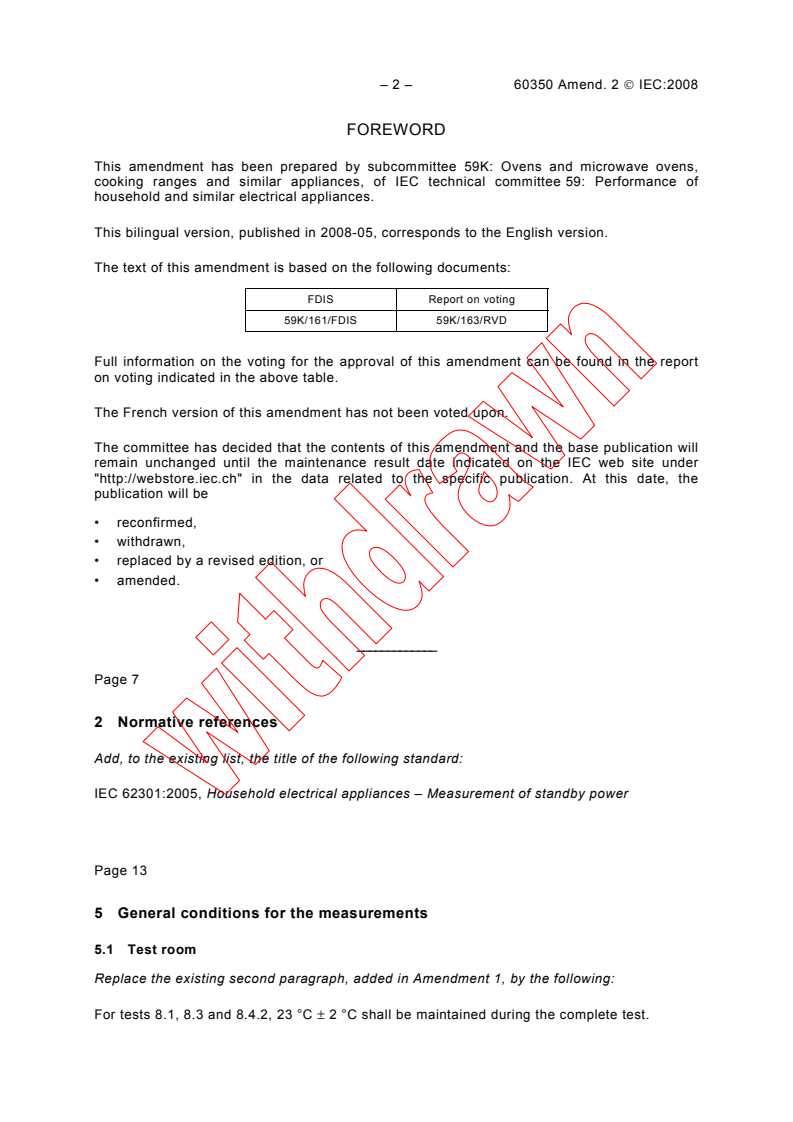
IEC 60350:1999/AMD2:2008 - Amendment 2 - Electric cooking ranges, hobs, ovens and grills for household use - Methods for measuring performance Released:3/11/2008
Relations
- Effective Date
- 05-Sep-2023
- Effective Date
- 05-Sep-2023
- Effective Date
- 05-Sep-2023
Buy Documents
IEC 60350:1999/AMD2:2008 - Amendment 2 - Electric cooking ranges, hobs, ovens and grills for household use - Methods for measuring performance Released:3/11/2008
IEC 60350:1999/AMD2:2008 - Amendment 2 - Electric cooking ranges, hobs, ovens and grills for household use - Methods for measuring performance Released:3/11/2008
Frequently Asked Questions
IEC 60350:1999/AMD2:2008 is a standard published by the International Electrotechnical Commission (IEC). Its full title is "Amendment 2 - Electric cooking ranges, hobs, ovens and grills for household use - Methods for measuring performance". This standard covers: Amendment 2 - Electric cooking ranges, hobs, ovens and grills for household use - Methods for measuring performance
Amendment 2 - Electric cooking ranges, hobs, ovens and grills for household use - Methods for measuring performance
IEC 60350:1999/AMD2:2008 is classified under the following ICS (International Classification for Standards) categories: 97.040.20 - Cooking ranges, working tables, ovens and similar appliances. The ICS classification helps identify the subject area and facilitates finding related standards.
IEC 60350:1999/AMD2:2008 has the following relationships with other standards: It is inter standard links to IEC 60350-2:2011, IEC 60350-1:2011, IEC 60350:1999. Understanding these relationships helps ensure you are using the most current and applicable version of the standard.
IEC 60350:1999/AMD2:2008 is available in PDF format for immediate download after purchase. The document can be added to your cart and obtained through the secure checkout process. Digital delivery ensures instant access to the complete standard document.
Standards Content (Sample)
IEC 60350
Edition 2.0 2008-03
INTERNATIONAL
STANDARD
AMENDMENT 2
Electric cooking ranges, hobs, ovens and grills for household use – Methods for
measuring performance
IEC 60350 A2:2008(E)
All rights reserved. Unless otherwise specified, no part of this publication may be reproduced or utilized in any form
or by any means, electronic or mechanical, including photocopying and microfilm, without permission in writing from
either IEC or IEC's member National Committee in the country of the requester.
If you have any questions about IEC copyright or have an enquiry about obtaining additional rights to this publication,
please contact the address below or your local IEC member National Committee for further information.
IEC Central Office
3, rue de Varembé
CH-1211 Geneva 20
Switzerland
Email: inmail@iec.ch
Web: www.iec.ch
About the IEC
The International Electrotechnical Commission (IEC) is the leading global organization that prepares and publishes
International Standards for all electrical, electronic and related technologies.
About IEC publications
The technical content of IEC publications is kept under constant review by the IEC. Please make sure that you have the
latest edition, a corrigenda or an amendment might have been published.
ƒ Catalogue of IEC publications: www.iec.ch/searchpub
The IEC on-line Catalogue enables you to search by a variety of criteria (reference number, text, technical committee,…).
It also gives information on projects, withdrawn and replaced publications.
ƒ IEC Just Published: www.iec.ch/online_news/justpub
Stay up to date on all new IEC publications. Just Published details twice a month all new publications released. Available
on-line and also by email.
ƒ Electropedia: www.electropedia.org
The world's leading online dictionary of electronic and electrical terms containing more than 20 000 terms and definitions
in English and French, with equivalent terms in additional languages. Also known as the International Electrotechnical
Vocabulary online.
ƒ Customer Service Centre: www.iec.ch/webstore/custserv
If you wish to give us your feedback on this publication or need further assistance, please visit the Customer Service
Centre FAQ or contact us:
Email: csc@iec.ch
Tel.: +41 22 919 02 11
Fax: +41 22 919 03 00
IEC 60350
Edition 2.0 2008-03
INTERNATIONAL
STANDARD
AMENDMENT 2
Electric cooking ranges, hobs, ovens and grills for household use – Methods for
measuring performance
INTERNATIONAL
ELECTROTECHNICAL
COMMISSION
PRICE CODE
R
ICS 97.040.20 ISBN 2-8318-9645-2
– 2 – 60350 Amend. 2 © IEC:2008(E)
FOREWORD
This amendment has been prepared by subcommittee 59K: Ovens and microwave ovens,
cooking ranges and similar appliances, of IEC technical committee 59: Performance of
household electrical appliances.
The text of this amendment is based on the following documents:
FDIS Report on voting
59K/161/FDIS 59K/163/RVD
Full information on the voting for the approval of this amendment can be found in the report
on voting indicated in the above table.
The committee has decided that the contents of this amendment and the base publication will
remain unchanged until the maintenance result date indicated on the IEC web site under
"http://webstore.iec.ch" in the data related to the specific publication. At this date, the
publication will be
• reconfirmed,
• withdrawn,
• replaced by a revised edition, or
• amended.
A bilingual version of this publication may be issued at a later date.
_____________
Page 7
2 Normative references
Add, to the existing list, the title of the following standard:
IEC 62301:2005, Household electrical appliances – Measurement of standby power
Page 13
5 General conditions for the measurements
5.1 Test room
Replace the existing second paragraph, added in Amendment 1, by the following:
For tests 8.1, 8.3 and 8.4.2, 23°C ± 2 °C shall be maintained during the complete test.
60350 Amend. 2 © IEC:2008(E) – 3 –
5.3 Instrumentation
th
Add the following 8 dash at the end of the existing list added in Amendment 1:
– the scale for weighing the ingredients shall be accurate to ±0,1 g.
Page 15
6 Dimensions and mass
6.3 Internal dimensions of ovens
Replace the existing title and text of this subclause by the following:
6.3 Usable internal dimensions and usable volume of ovens
Removable items specified in the user instructions shall be removed before a measurement is
carried out.
The measurement of the usable oven volume is to be carried out at ambient temperature.
The height, width and depth of the usable volume in the cavity shall be measured in
accordance with 6.3.1 to 6.3.3. The measurement procedure is also shown in Figure 4a.
For verification purposes a gauge, as shown in Figure 4b, shall be used to determine all of the
three dimensions. The gauge shall be used without appreciable force.
Dimensions are stated in millimetres.
6.3.1 Usable height
The usable height is the maximum length of a cylinder with a diameter of 200 mm reaching
vertically from the centre of the cavity floor to the lowest point on the ceiling. The lowest point
of the ceiling can be constituted by a lamp, a heating element or similar object in the area of
the cylinder.
In the event that either the width or the depth of the cavity is less than 250 mm, the diameter
of the cylinder to be measured shall be reduced to 120 mm.
NOTE The centre of the cavity bottom is defined by the middle of the usable depth and the middle of the usable
width.
6.3.2 Usable width
The usable width is the maximum length of a cylinder with a diameter of 200 mm reaching
horizontally from the left-hand side wall to the right-hand side wall of the cavity.
In the event that either the height or the depth of the cavity is less than 250 mm, the diameter
of the cylinder to be measured shall be reduced to 120 mm.
NOTE The centre of the side wall of the cavity is defined by the middle of the usable depth and the middle of the
usable height.
– 4 – 60350 Amend. 2 © IEC:2008(E)
6.3.3 Usable depth
The usable depth is the maximum length of a cylinder with a diameter of 200 mm reaching
horizontally from the centre of the rear wall to the inner face of the closed door.
In the event that either the width or the height of the cavity is less than 250 mm, the diameter
of the cylinder to be measured shall be reduced to 120 mm.
For measuring the usable depth, the gauge is placed on a support in such a way that the axis
lies horizontally in the centre of the cavity, the axis being extended slightly over the expected
usable depth. The door is closed carefully so that the gauge is compressed to give the usable
depth.
NOTE The centre of the rear wall of the cavity is defined by the middle of the usable height and the middle of the
usable width.
6.3.4 Usable volume
The usable volume is calculated from these three dimensions and is stated in litres rounded to
the next full litre.
Page 15
Add the following new subclause 6.4:
6.4 Overall internal dimensions and overall volume of ovens
Where the surfaces forming the boundaries of the cavity incorporate protrusions or
depressions, the planes used for measurement shall be those comprising the largest
percentages of the total areas of the surfaces. Holes in surfaces shall be disregarded when
calculating areas for this determination.
The following volumes or spaces shall be disregarded:
– those occupied by removable items specified by the manufacturer as not essential for the
operation of the appliance, such as shelves, racks or temperature probes;
– those occupied by heating elements;
– those occupied by minor irregularities in the cooking compartment walls, including covers
over temperature sensors and lamps;
– those occupied by the convection baffle;
– corner radii smaller than 50 mm at the intersections of the interior surfaces of the cooking
cavity.
Dimensions are stated in millimetres.
NOTE The overall dimensions of warming drawers may be measured using the same principles.
6.4.1 Overall height (H)
Overall height (H) is the maximum vertical distance in mm between the plane of the cooking
cavity bottom and the plane of the cavity ceiling.
6.4.2 Overall width (W)
Overall width (W) is the maximum horizontal distance in mm between the planes of the cavity
side walls.
60350 Amend. 2 © IEC:2008(E) – 5 –
6.4.3 Overall depth (D)
Overall depth (D) is the maximum horizontal distance in mm from the plane of the inside
surface of the door when closed to the plane of the rear cavity wall.
6.4.4 Overall volume of rectangular cavities
The overall volume is the total internal volume of the cavity in which cooking takes place,
expressed as the product of H, W and D determined as above, divided by 10 and rounded to
the nearest litre.
6.4.5 Overall volume of non-rectangular cavities
Non-rectangular cavities shall have the volume of any non-conforming section such as a
curved door or cavity wall determined by direct measurement and the application of
conventional geometrical calculations. The remainder of the cavity shall be treated as a
rectangular cavity and the individual volumes added together. The volume is expressed to the
nearest litre.
Renumber existing subclauses 6.4 to 6.10 as 6.5 to 6.11, respectively.
Page 31
8.4.2 Small cakes
Replace the entire existing subclause 8.4.2 by the following new subclause:
8.4.2 Small cakes
This test is intended to assess the vertical and horizontal heat distribution, especially for a
mixture that rises during cooking.
NOTE The test is carried out using the general conditions of measurements as stated in Clause 5.
8.4.2.1 Ingredients
The quantities of ingredients for 30 to 40 small cakes are indicated in Table 3. For a
reproducible result always prepare the same amount and discard any surplus mixture.
– 6 – 60350 Amend. 2 © IEC:2008(E)
Table 3 – Ingredients
Quantities
Ingredients Remarks
g
Unsalted butter should be used. If unsalted butter is not
Butter, with a fat content of
available the salt content of butter should be subtracted from
340 ± 0,5
83 % ± 2 %
the salt added to the mixture.
White sugar, fine (grain size d95/d05: 90 % of the sugar crystals shall have a grain size of
340 ± 0,5
0,10 mm – 0,35 mm, d95/d05) 0,10 mm – 0,35 mm
Middle sized hen eggs (approximately 55 g ± 5 g) are beaten
and sieved until homogeneous, then weighed.
Eggs
300 ± 1
If frozen egg mixture is used, follow the instructions of
Clause C.1.
Wheat flour
Gluten: at least 24,0 %
without raising agent, unbleached
450 ± 1
Mineral content: maximum 0,5 %
(dry substance)
Phosphate baking powder (double acting) shall be used (not
baking soda).
Baking powder
15 ± 0,5
Salt 6 ± 0,1
NOTE 1 For reproducible results ingredients as defined in Annex C shall be used.
NOTE 2 The eggs are sieved to remove any chalazae.
NOTE 3 If more than 40 small cakes are required, two identical kitchen machines should be used simultaneously.
8.4.2.2 Paper cases
As the paper quality affects the rising height and spreading, only the paper cases specified in
Annex C shall be used for reproducible results. The paper cases are 48 mm in base diameter
and 29 mm in height. They are made of 70 g/m bleached greaseproof paper.
NOTE A supplier of paper cases is indicated in Annex C.
8.4.2.3 Quantity
The baking sheet shall be measured according to 6.4 and cover at least 80 % of the usable
width and 70 % of the usable depth of the cavity measured according to 6.3. If the supplied
baking sheet or the sheet recommended in the instructions fits these dimensions, this baking
sheet shall be used. If the supplied or recommended baking sheet does not fit the above
condition or no recommendation is given, then a baking sheet fitting the above condition,
made of aluminium, no coating, matt finished, 0,9 mm ± 0,1 mm thickness, lip height
maximum 6 mm shall be used.
The width and the depth of the baking sheets are measured in accordance with 6.4 and each
divided by 75 mm to give the number of small cakes to be placed along its sides. The
numbers are rounded down to give a whole number of cakes. Multiply the number of cakes
from the depth and the width to give the total number for the whole tray.
Example:
A width of 470 mm divided by 75 mm equals 6,3. This gives 6 columns of cakes.
A depth of 295 mm divided by 75 mm equals 3,9. This gives 3 rows of cakes.
60350 Amend. 2 © IEC:2008(E) – 7 –
Therefore the total number of cakes on the tray is 18.
The base of the outermost cakes should be at a distance of approximately 14 mm from the
edge of the usable area of the baking sheet measured according to 6.4. Distribute the cakes
evenly on the tray, in such a way that they do not touch each other.
The manufacturer’s instructions regarding the number of baking sheets which may be cooked
simultaneously are followed.
8.4.2.4 Procedure
All ingredients shall be at ambient temperature before starting.
Beat together butter and sugar in a food mixer until it becomes soft and pale in colour so that
all the sugar is incorporated into the mix. Gradually add the egg mixture. Sift the flour, baking
powder and salt together and gently fold into the mixture; loosen the mixture as required from
the edge of the bowl to ensure that the mixture is homogeneous.
The temperature of the mixture shall be 23 °C ± 2 °C directly after mixing.
NOTE 1 A suitable food mixer for which the mixing time has been determined is indicated in Annex C.
NOTE 2 Ensure that the paper cases maintain a uniform circular shape by carefully peeling cases from the
outside of the batch without distortion.
Weigh 28 g ± 0,5 g of the mixture into the centre of the paper cases and place them evenly on
the baking sheets. Bake immediately.
NOTE 3 The tests are carried out using corrected temperature control settings according to the differences
determined by the test of 8.2.
a) Baking on one level
Follow the operating instructions with respect to the heating function, temperature, shelf
position and preheating. If preheating is recommended, small cakes are placed in the oven
when the end of the preheating phase is indicated, for example by visual or acoustic signal, or
after a recommended pre-heating time. If no instructions are given, the oven is set to 160 °C for
forced air circulation function or to 185 °C for conventional heating function and the baking
sheet is placed in the middle of the usable cavity of the cold oven. While the small cakes are
baking, the position of the baking sheet shall not be changed.
The baking time shall not exceed 40 min when baking on one level (including preheating
time).
b) Baking on two levels
The baking sheets are placed simultaneously in the oven one above the other and removed
simultaneously at the end of baking. While the small cakes are baking, the position of the
baking sheets shall not be changed. Follow the operating instructions with respect to the
heating function, temperature, shelf position and preheating. If preheating is recommended,
the small cakes are placed in the oven when the end of the preheating phase is indicated, for
example by visual or acoustic signal, or after a recommended pre-heating time.
If no instructions for small cakes on two levels are given, the oven is set to 160 °C for forced
air circulation function and the baking sheets are spaced evenly in the cold oven. The
horizontal position of the baking sheets shall be in the middle of the cavity base area. The
vertical position of the sheets shall be spaced at one third and two third of the usable height
of the ovens as near as possible without modifying the shelf racks.
– 8 – 60350 Amend. 2 © IEC:2008(E)
NOTE 4 Baking on two levels is not carried out for small oven cavities, as defined in 3.14
The baking time shall not exceed 50 min when baking on two levels (including preheating
time).
c) Baking on more than two levels
If the operating instructions recommend baking on more than two levels simultaneously then
cakes are baked in accordance with the instructions (heating function, temperature, shelf
position, preheating and baking time).
8.4.2.5 Assessment
Within 30 min after baking, the paper cases are very carefully removed so that the largest
base area possible can be assessed. For assessment according to 8.4.2.5.3, at least 50 % of
the base shall be undamaged. Otherwise the test shall be repeated.
NOTE Cooling the small cakes quickly can aid clean removal of paper cases.
Browning of the top and base of the cakes, the differences of browning between these, and
the evenness of rise, are assessed within one hour after baking. If small cakes have been
baked on several levels simultaneously, each sheet shall be assessed separately (single
result) and additionally they are assessed together (overall result).
The requirements of the results of these small cakes baked on one or more levels are
different. This shall be considered in the evaluation.
8.4.2.5.1 Visual assessment
For comparative results the evaluation of browning may be done by a visual check using the
criteria for assessment in 8.4.2.5.3.
The shade numbers of the Table B.1 of Annex B are used to evaluate browning. For a visual
check, the same background colour and illumination shall be used for each tray.
8.4.2.5.2 Digital assessment
For reproducible results of the evaluation of browning any digital measurement system shall
be used which meets the following requirements when the measurements are taken.
a) Evenness of light distribution on the measurement area
of a uniform coloured shade chart shall be measured over the
The reflection value R
y
entire surface to be analysed, for example, the size of the baking sheet or one small cake.
The shade chart shall be coloured in shade number 10, which is defined in Annex B.
The mean value of the reflection value R over the entire surface is determined. More than
v
90 % of the entire surface may deviate from the mean value by up to ±5 %. Less than
10 % of the entire surface may deviate by up to ±8 %.
2 2
The entire surface is divided in 1 cm sections. None of the mean values of the 1 cm
sections shall deviate by more than ±5 % of the mean value of the entire surface.
NOTE 1 Shade number 10 is used to check the quality of the illumination as it is the most desired shade.
NOTE 2 Each small ca
...
IEC 60350
Edition 2.0 2008-03
INTERNATIONAL
STANDARD
NORME
INTERNATIONALE
AMENDMENT 2
AMENDEMENT 2
Electric cooking ranges, hobs, ovens and grills for household use – Methods for
measuring performance
Cuisinières, foyers de cuisson, fours électriques et grils à usage domestique –
Méthodes de mesure de l'aptitude à la fonction
IEC 60350 A2:2008
All rights reserved. Unless otherwise specified, no part of this publication may be reproduced or utilized in any form or by
any means, electronic or mechanical, including photocopying and microfilm, without permission in writing from either IEC or
IEC's member National Committee in the country of the requester.
If you have any questions about IEC copyright or have an enquiry about obtaining additional rights to this publication,
please contact the address below or your local IEC member National Committee for further information.
Droits de reproduction réservés. Sauf indication contraire, aucune partie de cette publication ne peut être reproduite
ni utilisée sous quelque forme que ce soit et par aucun procédé, électronique ou mécanique, y compris la photocopie
et les microfilms, sans l'accord écrit de la CEI ou du Comité national de la CEI du pays du demandeur.
Si vous avez des questions sur le copyright de la CEI ou si vous désirez obtenir des droits supplémentaires sur cette
publication, utilisez les coordonnées ci-après ou contactez le Comité national de la CEI de votre pays de résidence.
IEC Central Office
3, rue de Varembé
CH-1211 Geneva 20
Switzerland
Email: inmail@iec.ch
Web: www.iec.ch
About the IEC
The International Electrotechnical Commission (IEC) is the leading global organization that prepares and publishes
International Standards for all electrical, electronic and related technologies.
About IEC publications
The technical content of IEC publications is kept under constant review by the IEC. Please make sure that you have the
latest edition, a corrigenda or an amendment might have been published.
ƒ Catalogue of IEC publications: www.iec.ch/searchpub
The IEC on-line Catalogue enables you to search by a variety of criteria (reference number, text, technical committee,…).
It also gives information on projects, withdrawn and replaced publications.
ƒ IEC Just Published: www.iec.ch/online_news/justpub
Stay up to date on all new IEC publications. Just Published details twice a month all new publications released. Available
on-line and also by email.
ƒ Electropedia: www.electropedia.org
The world's leading online dictionary of electronic and electrical terms containing more than 20 000 terms and definitions
in English and French, with equivalent terms in additional languages. Also known as the International Electrotechnical
Vocabulary online.
ƒ Customer Service Centre: www.iec.ch/webstore/custserv
If you wish to give us your feedback on this publication or need further assistance, please visit the Customer Service
Centre FAQ or contact us:
Email: csc@iec.ch
Tel.: +41 22 919 02 11
Fax: +41 22 919 03 00
A propos de la CEI
La Commission Electrotechnique Internationale (CEI) est la première organisation mondiale qui élabore et publie des
normes internationales pour tout ce qui a trait à l'électricité, à l'électronique et aux technologies apparentées.
A propos des publications CEI
Le contenu technique des publications de la CEI est constamment revu. Veuillez vous assurer que vous possédez
l’édition la plus récente, un corrigendum ou amendement peut avoir été publié.
ƒ Catalogue des publications de la CEI: www.iec.ch/searchpub/cur_fut-f.htm
Le Catalogue en-ligne de la CEI vous permet d’effectuer des recherches en utilisant différents critères (numéro de référence,
texte, comité d’études,…). Il donne aussi des informations sur les projets et les publications retirées ou remplacées.
ƒ Just Published CEI: www.iec.ch/online_news/justpub
Restez informé sur les nouvelles publications de la CEI. Just Published détaille deux fois par mois les nouvelles
publications parues. Disponible en-ligne et aussi par email.
ƒ Electropedia: www.electropedia.org
Le premier dictionnaire en ligne au monde de termes électroniques et électriques. Il contient plus de 20 000 termes et
définitions en anglais et en français, ainsi que les termes équivalents dans les langues additionnelles. Egalement appelé
Vocabulaire Electrotechnique International en ligne.
ƒ Service Clients: www.iec.ch/webstore/custserv/custserv_entry-f.htm
Si vous désirez nous donner des commentaires sur cette publication ou si vous avez des questions, visitez le FAQ du
Service clients ou contactez-nous:
Email: csc@iec.ch
Tél.: +41 22 919 02 11
Fax: +41 22 919 03 00
IEC 60350
Edition 2.0 2008-03
INTERNATIONAL
STANDARD
NORME
INTERNATIONALE
AMENDMENT 2
AMENDEMENT 2
Electric cooking ranges, hobs, ovens and grills for household use – Methods for
measuring performance
Cuisinières, foyers de cuisson, fours électriques et grils à usage domestique –
Méthodes de mesure de l'aptitude à la fonction
INTERNATIONAL
ELECTROTECHNICAL
COMMISSION
COMMISSION
ELECTROTECHNIQUE
PRICE CODE
INTERNATIONALE
S
CODE PRIX
ICS 97.040.20 ISBN 2-8318-9797-1
– 2 – 60350 Amend. 2 © IEC:2008
FOREWORD
This amendment has been prepared by subcommittee 59K: Ovens and microwave ovens,
cooking ranges and similar appliances, of IEC technical committee 59: Performance of
household and similar electrical appliances.
This bilingual version, published in 2008-05, corresponds to the English version.
The text of this amendment is based on the following documents:
FDIS Report on voting
59K/161/FDIS 59K/163/RVD
Full information on the voting for the approval of this amendment can be found in the report
on voting indicated in the above table.
The French version of this amendment has not been voted upon.
The committee has decided that the contents of this amendment and the base publication will
remain unchanged until the maintenance result date indicated on the IEC web site under
"http://webstore.iec.ch" in the data related to the specific publication. At this date, the
publication will be
• reconfirmed,
• withdrawn,
• replaced by a revised edition, or
• amended.
_____________
Page 7
2 Normative references
Add, to the existing list, the title of the following standard:
IEC 62301:2005, Household electrical appliances – Measurement of standby power
Page 13
5 General conditions for the measurements
5.1 Test room
Replace the existing second paragraph, added in Amendment 1, by the following:
For tests 8.1, 8.3 and 8.4.2, 23 °C ± 2 °C shall be maintained during the complete test.
60350 Amend. 2 © IEC:2008 – 3 –
5.3 Instrumentation
th
Add the following 8 dash at the end of the existing list added in Amendment 1:
– the scale for weighing the ingredients shall be accurate to ±0,1 g.
Page 15
6 Dimensions and mass
6.3 Internal dimensions of ovens
Replace the existing title and text of this subclause by the following:
6.3 Usable internal dimensions and usable volume of ovens
Removable items specified in the user instructions shall be removed before a measurement is
carried out.
The measurement of the usable oven volume is to be carried out at ambient temperature.
The height, width and depth of the usable volume in the cavity shall be measured in
accordance with 6.3.1 to 6.3.3. The measurement procedure is also shown in Figure 4a.
For verification purposes a gauge, as shown in Figure 4b, shall be used to determine all of the
three dimensions. The gauge shall be used without appreciable force.
Dimensions are stated in millimetres.
6.3.1 Usable height
The usable height is the maximum length of a cylinder with a diameter of 200 mm reaching
vertically from the centre of the cavity floor to the lowest point on the ceiling. The lowest point
of the ceiling can be constituted by a lamp, a heating element or similar object in the area of
the cylinder.
In the event that either the width or the depth of the cavity is less than 250 mm, the diameter
of the cylinder to be measured shall be reduced to 120 mm.
NOTE The centre of the cavity bottom is defined by the middle of the usable depth and the middle of the usable
width.
6.3.2 Usable width
The usable width is the maximum length of a cylinder with a diameter of 200 mm reaching
horizontally from the left-hand side wall to the right-hand side wall of the cavity.
In the event that either the height or the depth of the cavity is less than 250 mm, the diameter
of the cylinder to be measured shall be reduced to 120 mm.
NOTE The centre of the side wall of the cavity is defined by the middle of the usable depth and the middle of the
usable height.
6.3.3 Usable depth
The usable depth is the maximum length of a cylinder with a diameter of 200 mm reaching
horizontally from the centre of the rear wall to the inner face of the closed door.
– 4 – 60350 Amend. 2 © IEC:2008
In the event that either the width or the height of the cavity is less than 250 mm, the diameter
of the cylinder to be measured shall be reduced to 120 mm.
For measuring the usable depth, the gauge is placed on a support in such a way that the axis
lies horizontally in the centre of the cavity, the axis being extended slightly over the expected
usable depth. The door is closed carefully so that the gauge is compressed to give the usable
depth.
NOTE The centre of the rear wall of the cavity is defined by the middle of the usable height and the middle of the
usable width.
6.3.4 Usable volume
The usable volume is calculated from these three dimensions and is stated in litres rounded to
the next full litre.
Page 15
Add the following new subclause 6.4:
6.4 Overall internal dimensions and overall volume of ovens
Where the surfaces forming the boundaries of the cavity incorporate protrusions or
depressions, the planes used for measurement shall be those comprising the largest
percentages of the total areas of the surfaces. Holes in surfaces shall be disregarded when
calculating areas for this determination.
The following volumes or spaces shall be disregarded:
– those occupied by removable items specified by the manufacturer as not essential for the
operation of the appliance, such as shelves, racks or temperature probes;
– those occupied by heating elements;
– those occupied by minor irregularities in the cooking compartment walls, including covers
over temperature sensors and lamps;
– those occupied by the convection baffle;
– corner radii smaller than 50 mm at the intersections of the interior surfaces of the cooking
cavity.
Dimensions are stated in millimetres.
NOTE The overall dimensions of warming drawers may be measured using the same principles.
6.4.1 Overall height (H)
Overall height (H) is the maximum vertical distance in mm between the plane of the cooking
cavity bottom and the plane of the cavity ceiling.
6.4.2 Overall width (W)
Overall width (W) is the maximum horizontal distance in mm between the planes of the cavity
side walls.
6.4.3 Overall depth (D)
Overall depth (D) is the maximum horizontal distance in mm from the plane of the inside
surface of the door when closed to the plane of the rear cavity wall.
60350 Amend. 2 © IEC:2008 – 5 –
6.4.4 Overall volume of rectangular cavities
The overall volume is the total internal volume of the cavity in which cooking takes place,
expressed as the product of H, W and D determined as above, divided by 10 and rounded to
the nearest litre.
6.4.5 Overall volume of non-rectangular cavities
Non-rectangular cavities shall have the volume of any non-conforming section such as a
curved door or cavity wall determined by direct measurement and the application of
conventional geometrical calculations. The remainder of the cavity shall be treated as a
rectangular cavity and the individual volumes added together. The volume is expressed to the
nearest litre.
Renumber existing subclauses 6.4 to 6.10 as 6.5 to 6.11, respectively.
Page 31
8.4.2 Small cakes
Replace the entire existing subclause 8.4.2 by the following new subclause:
8.4.2 Small cakes
This test is intended to assess the vertical and horizontal heat distribution, especially for a
mixture that rises during cooking.
NOTE The test is carried out using the general conditions of measurements as stated in Clause 5.
8.4.2.1 Ingredients
The quantities of ingredients for 30 to 40 small cakes are indicated in Table 3. For a
reproducible result always prepare the same amount and discard any surplus mixture.
– 6 – 60350 Amend. 2 © IEC:2008
Table 3 – Ingredients
Quantities
Ingredients Remarks
g
Unsalted butter should be used. If unsalted butter is not
Butter, with a fat content of
available the salt content of butter should be subtracted from
340 ± 0,5
83 % ± 2 %
the salt added to the mixture.
White sugar, fine (grain size d95/d05: 90 % of the sugar crystals shall have a grain size of
340 ± 0,5
0,10 mm – 0,35 mm, d95/d05) 0,10 mm – 0,35 mm
Middle sized hen eggs (approximately 55 g ± 5 g) are beaten
and sieved until homogeneous, then weighed.
Eggs
300 ± 1
If frozen egg mixture is used, follow the instructions of
Clause C.1.
Wheat flour
Gluten: at least 24,0 %
without raising agent, unbleached
450 ± 1
Mineral content: maximum 0,5 %
(dry substance)
Phosphate baking powder (double acting) shall be used (not
baking soda).
Baking powder
15 ± 0,5
Salt 6 ± 0,1
NOTE 1 For reproducible results ingredients as defined in Annex C shall be used.
NOTE 2 The eggs are sieved to remove any chalazae.
NOTE 3 If more than 40 small cakes are required, two identical kitchen machines should be used simultaneously.
8.4.2.2 Paper cases
As the paper quality affects the rising height and spreading, only the paper cases specified in
Annex C shall be used for reproducible results. The paper cases are 48 mm in base diameter
and 29 mm in height. They are made of 70 g/m bleached greaseproof paper.
NOTE A supplier of paper cases is indicated in Annex C.
8.4.2.3 Quantity
The baking sheet shall be measured according to 6.4 and cover at least 80 % of the usable
width and 70 % of the usable depth of the cavity measured according to 6.3. If the supplied
baking sheet or the sheet recommended in the instructions fits these dimensions, this baking
sheet shall be used. If the supplied or recommended baking sheet does not fit the above
condition or no recommendation is given, then a baking sheet fitting the above condition,
made of aluminium, no coating, matt finished, 0,9 mm ± 0,1 mm thickness, lip height
maximum 6 mm shall be used.
The width and the depth of the baking sheets are measured in accordance with 6.4 and each
divided by 75 mm to give the number of small cakes to be placed along its sides. The
numbers are rounded down to give a whole number of cakes. Multiply the number of cakes
from the depth and the width to give the total number for the whole tray.
EXAMPLE
A width of 470 mm divided by 75 mm equals 6,3. This gives 6 columns of cakes.
A depth of 295 mm divided by 75 mm equals 3,9. This gives 3 rows of cakes.
60350 Amend. 2 © IEC:2008 – 7 –
Therefore the total number of cakes on the tray is 18.
The base of the outermost cakes should be at a distance of approximately 14 mm from the
edge of the usable area of the baking sheet measured according to 6.4. Distribute the cakes
evenly on the tray, in such a way that they do not touch each other.
The manufacturer’s instructions regarding the number of baking sheets which may be cooked
simultaneously are followed.
8.4.2.4 Procedure
All ingredients shall be at ambient temperature before starting.
Beat together butter and sugar in a food mixer until it becomes soft and pale in colour so that
all the sugar is incorporated into the mix. Gradually add the egg mixture. Sift the flour, baking
powder and salt together and gently fold into the mixture; loosen the mixture as required from
the edge of the bowl to ensure that the mixture is homogeneous.
The temperature of the mixture shall be 23 °C ± 2 °C directly after mixing.
NOTE 1 A suitable food mixer for which the mixing time has been determined is indicated in Annex C.
NOTE 2 Ensure that the paper cases maintain a uniform circular shape by carefully peeling cases from the
outside of the batch without distortion.
Weigh 28 g ± 0,5 g of the mixture into the centre of the paper cases and place them evenly on
the baking sheets. Bake immediately.
NOTE 3 The tests are carried out using corrected temperature control settings according to the differences
determined by the test of 8.2.
a) Baking on one level
Follow the operating instructions with respect to the heating function, temperature, shelf
position and preheating. If preheating is recommended, small cakes are placed in the oven
when the end of the preheating phase is indicated, for example by visual or acoustic signal, or
after a recommended pre-heating time. If no instructions are given, the oven is set to 160 °C for
forced air circulation function or to 185 °C for conventional heating function and the baking
sheet is placed in the middle of the usable cavity of the cold oven. While the small cakes are
baking, the position of the baking sheet shall not be changed.
The baking time shall not exceed 40 min when baking on one level (including preheating
time).
b) Baking on two levels
The baking sheets are placed simultaneously in the oven one above the other and removed
simultaneously at the end of baking. While the small cakes are baking, the position of the
baking sheets shall not be changed. Follow the operating instructions with respect to the
heating function, temperature, shelf position and preheating. If preheating is recommended,
the small cakes are placed in the oven when the end of the preheating phase is indicated, for
example by visual or acoustic signal, or after a recommended pre-heating time.
If no instructions for small cakes on two levels are given, the oven is set to 160 °C for forced
air circulation function and the baking sheets are spaced evenly in the cold oven. The
horizontal position of the baking sheets shall be in the middle of the cavity base area. The
vertical position of the sheets shall be spaced at one third and two third of the usable height
of the ovens as near as possible without modifying the shelf racks.
– 8 – 60350 Amend. 2 © IEC:2008
NOTE 4 Baking on two levels is not carried out for small oven cavities, as defined in 3.14.
The baking time shall not exceed 50 min when baking on two levels (including preheating
time).
c) Baking on more than two levels
If the operating instructions recommend baking on more than two levels simultaneously then
cakes are baked in accordance with the instructions (heating function, temperature, shelf
position, preheating and baking time).
8.4.2.5 Assessment
Within 30 min after baking, the paper cases are very carefully removed so that the largest
base area possible can be assessed. For assessment according to 8.4.2.5.3, at least 50 % of
the base shall be undamaged. Otherwise the test shall be repeated.
NOTE Cooling the small cakes quickly can aid clean removal of paper cases.
Browning of the top and base of the cakes, the differences of browning between these, and
the evenness of rise, are assessed within one hour after baking. If small cakes have been
baked on several levels simultaneously, each sheet shall be assessed separately (single
result) and additionally they are assessed together (overall result).
The requirements of the results of these small cakes baked on one or more levels are
different. This shall be considered in the evaluation.
8.4.2.5.1 Visual assessment
For comparative results the evaluation of browning may be done by a visual check using the
criteria for assessment in 8.4.2.5.3.
The shade numbers of the Table B.1 of Annex B are used to evaluate browning. For a visual
check, the same background colour and illumination shall be used for each tray.
8.4.2.5.2 Digital assessment
For reproducible results of the evaluation of browning any digital measurement system shall
be used which meets the following requirements when the measurements are taken.
a) Evenness of light distribution on the measurement area
of a uniform coloured shade chart shall be measured over the
The reflection value R
y
entire surface to be analysed, for example, the size of the baking sheet or one small cake.
The shade chart shall be coloured in shade number 10, which is defined in Annex B.
The mean value of the reflection value R over the entire surface is determined. More than
v
90 % of the entire surface may deviate from the mean value by up to ±5 %. Less than
10 % of the entire surface may deviate by up to ±8 %.
2 2
The entire surface is divided in 1 cm sections. None of the mean values of the 1 cm
sections shall deviate by more than ±5 % of the mean value of the entire surface.
NOTE 1 Shade number 10 is used to check the quality of the illumination as it is the most desired shade.
NOTE 2 Each small cake can be measured separately.
b) Recognition of the reference colours
The shade numbers defined in Annex B shall be confirmed in all positions of the surface to
be assessed.
This is ensured using the following check:
Flat circular calibrated colour samples with a diameter of 70 mm in every shade number
defined in Annex B are placed at a height of 28 mm. The reflection value R of the
y
60350 Amend. 2 © IEC:2008 – 9 –
calibrated colour samples shall be measured in the corners of the area to be assessed
(where the outermost small cakes are positioned during the measurement), as well as in
the centre.
The reflection value R of the calibrated colour samples shall be measured with the
y
deviations given in Annex B.
NOTE 3 To ensure that the light conditions and the focal length which will be used for the assessment are
comparable, the colour samples should be at the height of 28 mm.
NOTE 4 Squared colour samples with a length of 70 mm and width of 70 mm could be used as well.
NOTE 5 Technical details are not fixed in order to be open for technical progress (e.g. camera, software).
c) Consistent colour recognition on a convex surface
A convex colour sample (shape as defined in Figure 13) with a smooth and matt finished
surface painted in shade number 10, is placed at a height of 13 mm in the corners of the
area to be assessed (where the outermost small cakes are positioned during the
measurement), as well as in the centre. The reflection value is measured in 13 sections
(defined in Figure 14). The mean value of the reflection values of all sections in each
position is calculated. The extreme values may deviate by ±9 % of the mean value.
Definition of the convex colour sample: A ball with a smooth surface and a diameter of
100 mm is cut at a depth of 15 mm, as illustrated in Figure 13, and the smaller section is
used as the convex colour sample.
NOTE 6 The surface of the convex colour sample should be <35 specular gloss value for an angle of 85°
(according to ISO 2813:1994).
NOTE 7 To ensure that the light conditions and the focal length which will be used for the assessment are
comparable, the convex colour samples (height of convex colour sample is 15 mm) should be positioned at the height of
13 mm (total height 28 mm at the highest point).
Dimensions in millimetres
IEC 337/08
Figure 13 – Convex colour sample
d) Definition of the illuminance
The measurement is taken under a full spectral fluorescent triband or equivalent from
6 000 K to 7 000 K, colour rendering index R > 90 % illumination.
a
NOTE 8 Suppliers for suitable lamps are indicated in Clause C.3.
NOTE 9 A supplier of a colour measuring system which meets these requirements, is given in Clause C.4.
h = 15
D = 100
– 10 – 60350 Amend. 2 © IEC:2008
8.4.2.5.3 Criteria for assessment (digital and visual)
a) Evaluation on the top of the small cakes
The top of each small cake is divided into 13 nearly equally sized sections, as shown
schematically in Figure 14.
The values are adapted to the size and shape of each small cake.
Key
D Dimension of small cake
D Dimension of middle section
D Dimension of central section
IEC 338/08
5 1
D = × D = 0,6 × D D = × D = 0,3 × D
2 1 1 3 1 1
13 13
Figure 14 – Template for the sectioning of small cakes
The arithmetic average of reflection value R is calculated for the whole area of each section.
y
A shade number is determined according to Annex B and noted for each section.
1 Acceptable browning on the top
The average browning on the top of each single sheet and of all sheets baked simultaneously
is calculated by dividing the sum of the shade numbers by thirteen times the number of cakes.
sum of the shade numbers
average browning =
13 × number of cakes
The average browning on the top is reported to one decimal place (single results per sheet
and overall result).
Results of the test according to 8.4.2 shall only be accepted if the average browning on the
top of all baking sheets baked simultaneously is in the range of 9,5 to 10,5. Otherwise, the
test shall be repeated with a modified setting. If the baking time exceeds 40 min (preheating
time included) for baking on one level or 50 min (preheating time included) for baking on two
levels respectively, the oven temperature shall be increased accordingly.
NOTE 1 The average browning should be within the given range for a comparable result.
D
D
D
60350 Amend. 2 © IEC:2008 – 11 –
2 CPB (cakes properly browned) on the top
All cakes with at least one section having a shade number outside the range 8 to 12 are not
included.
CPB = Number of cakes where all sections have shade numbers between 8 and 12
3 PPB (percentage properly browned) on the top
PPB = CPB / total number of cakes * 100 %
4 Browning difference on the top
The maximum difference between the shade numbers of all sections is determined and
reported as browning difference on the top of each baking sheet separately and of all sheets
baked simultaneously (single results per sheet and overall results).
b) Evaluation of the base of the small cakes
The reflection value R for the undamaged part of the base of each small cake is determined.
y
A shade number is determined according to Annex B and noted for each small cake.
NOTE 2 At least 50 % of the base of each small cake should not be damaged after removing the paper case.
Otherwise the test should be repeated.
1 Average browning on the base
The average browning on the base for each sheet separately and of all sheets baked
simultaneously is calculated by dividing the sum of the shade numbers by the number of
cakes.
sum of the shade numbers
Average browning of the bottom =
number of cakes
The average browning on the base is reported to one decimal place (single results per sheet
and overall result).
2 Browning difference on the base
The maximum browning difference between the shade numbers is determined and reported as
browning difference on the base of each baking sheet separately and of all sheets baked
simultaneously (single result per sheet and overall result).
c) Evaluation of the browning difference between top and base (top - base)
The browning difference between top and base is calculated by subtracting the average
browning on the base from the average browning on the top.
top − base = average browning on the top - average browning on the base
The browning difference between top and base (absolute value) is reported for each sheet
separately and of all sheets baked simultaneously (single results per sheet and overall result).
d) Measurement of the height of small cakes
The highest point of each small cake is measured and recorded in millimetres. Cutting or
stabbing shall not affect the height of the cake.
– 12 – 60350 Amend. 2 © IEC:2008
The minimum height and the maximum height shall be recorded for each sheet separately.
Page 45
Add, after subclause 11.3, the following new clause.
12 Standby power
The standby power shall be determined in accordance to IEC 62301:2005 with the following
modifications.
For multifunctional appliances which may consist of a variety of different hobs and ovens
which are designed to be combined in a single range, the recommended combination as
declared in the manufacturer’s instruction are used for the test.
For the determination of standby power, the appliance shall be in the state recommended in
the manufacturer’s instructions, if any, when the product (intended function) is not in use.
NOTE 1 Appropriate advices in the manufacturer’s instructions on how to reduce standby power has to be taken
into account when preparing the appliance for test.
When testing appliances that are fitted with a clock, the clock shall be adjusted to the correct
time and date as specified in the instructions. If an option is provided to switch off the display,
it is tested in this mode.
NOTE 2 If the brightness of the display can be altered by the user, the brightest illumination should be selected
for the measurement. If the brightness of the display is affected by the ambient light conditions, a steady state
condition should be used during the measurement and the ambient illumination level recorded in the test report.
The appliance shall be at ambient temperature before the power is monitored.
The appliance shall be connected to the power source and allowed to stabilize before the
measurements are made.
If the power reading is not stable the power consumption in each relevant mode shall be
determined as an average power measurement over a period of not less than 30 min.
When preparing the test report for multifunction appliances the combination of types of main
powered parts (hobs, ovens, grills, warming plates, griddles etc) used for the measurement
shall be recorded in addition to the brand, model, type, and serial number of each part.
Page 53
Figure 4 – Internal dimensions of ovens
Replace the existing figure and its title by the following new Figure 4, encompassing
Figures 4a and 4b.
60350 Amend. 2 © IEC:2008 – 13 –
d
g
Key
d usable depth
g heating element
h usable height
w usable width
w
IEC 339/08
Figure 4a – Measurement procedure
D
Key
D = 200 mm or 120 mm
X = dimension to be measured
(See subclauses 6.3.1, 6.3.2 and 6.3.3)
IEC 340/08
Figure 4b – Gauge for determining the usable volume
Figure 4 – Usable internal dimensions and usable volume of ovens
X
h
– 14 – 60350 Amend. 2 © IEC:2008
Page 67
Replace the title and the entire text of Annex B by the following:
Annex B
(normative)
Shade chart
This Annex specifies the relation between reflection value R and shade numbers
y
corresponding to NCS shade charts.
Table B.1 – Classification of shade numbers
Tolerances for
Measured reflection value R Shade number
y
8.4.2.5.2
<
≥
7,2 17
±14 %
7,2 9,3 ±13 % 16
9,3 12,2 ±12 % 15
12,2 16,4 14
±11 %
16,4 20,1 13
±10 %
20,1 22,9 ±10 % 12
22,9 26,5 11
±9 %
26,5 31,7 10
±9 %
31,7 38,5 ±8 % 9
38,5 46,9 8
±8 %
46,9 54,2 7
±8 %
54,2 64,3 ±8 % 6
64,3 75,2 ±8 % 5
75,2 4
±8 %
60350 Amend. 2 © IEC:2008 – 15 –
Table B.2 – Examples for the shade charts
NCS
Shade chart L* R
y
S 8502-Y 30,3 6,4
S 7020-Y50R 34,4 8,2
S 6030-Y50R 38,6 10,4
S 5040-Y40R 44,5 14,2
S 4050-Y30R 50,4 18,8
S 4040-Y30R 53,4 21,4
S 4030-Y30R 56,6 24,5
S 3040-Y30R 60,5 28,7
S 2060-Y20R 65,7 34,9
S 2040-Y20R 71,1 42,3
S 1050-Y20R 77,1 51,7
S 1040-Y20R 80,1 56,9
S 0530-Y10R 88,1 72,3
S 0520-Y10R 90,9 78,3
NOTE 1 The measured reflection value R does not correlate linearly to the visual perception. Although the widths
y
of the intervals given above increase with increasing reflection value R , visually the steps from shade number to
y
shade number are fairly uniform.
NOTE 2 R Reflection values are calculated from the L* values based on the CIE L*a*b* colour system. (D65
y
1964, T/8°).
NOTE 3 Shade numbers defined in Table B.1 are used for the visual and digital assessment instead of colour
gauge, reference BS 3999: Part 5G to provide intermediate shades.
NOTE 4 The NCS shade charts can be ordered at official NCS Centres all over the world. The following address
shows potential distributors.
Sweden (Head Office) Telephone: +46-(0)8-617 47 00
Scandinavian Colour Institute AB Fax: +46-(0)8-617 47 47
Visitors: Igeldammsgatan 30
Address: P.O. Box 49022, S -100 28 Stockholm
Internet: www.ncscolour.com
E-mail: info@ncscolour.comPost
– 16 – 60350 Amend. 2 © IEC:2008
Page 69
Replace the entire text of Annex C by the following:
Annex C
(informative)
Addresses of suppliers
C.1 General
The following information is given for the convenience of users of this standard and does not
constitute an endorsement by the IEC.
C.2 Testing ingredients for small cakes
(see 8.4.2.5.2)
All ingredients for preparation of small cakes as specified in this standard and the paper
cases may be obtained from: Stamminger & Demirel Testmaterialien
Telephone: +49 9123 98 89 75
Fax: +49 9123 98 84 89
e-mail: r.stamminger@web.de
Erbsenbodenstr. 31
D-91207 Lauf – Germany
www.sta-de.com
All ingredients used for reproducible results shall be from the same batch. It is recommended
that the ingredients used match the definitions in the Table C.1.
60350 Amend. 2 © IEC:2008 – 17 –
Table C.1 – Ingredient specification
Problems of
Ingredients Quality criteria
constant quality
Butter Variation with season Ingredients: cow’s cream, lactobacilli
and region of origin
Fat content 82,5 % (minimum 82 %)
Salt content
Water content <16 %
Unsalted, pH value in serum 5,2 – 6,3
Sugar Humidity uptake Disaccharide Saccharose, anhydrous
Refined white sugar EU cat.1 “Raffinade fein
RFF” grain size 0,10 mm – 0,35 mm, d95/d05
Egg mixture Variation of Hen’s egg mixture, pasteurised, homogeneous
biochemical
Packed in Tetra Brik , deep frozen (at least –
constitution of eggs
18 °C)
with season and
nutrition
pH 6,4 – 7,0
Dry substance 22,7 % – 23,7 %
Flour Variation with season Wheat flour (triticum aestivum L.)
and region of origin
Mineral content: maximum 0,5 % (dry
Humidity uptake substance)
Additives Hhumidity: maximum 15,0 %
Falling number: at least 250 s
Gluten: at least 24,0 %
Sedimentation: at least 26 ml
Protein: approx.10,6 % (dry substance)
Fat: approx. 1,0 %
Carbohydrates: approx. 70,9 %
Energy: approx.1 409 kJ /
approx.332 kcal
Additive: ascorbic acid
Salt Grain size <1 mm
Baking powder Relation and sort of Substance of content:
expanding agent
Natriumhydrogencarbonate (E 500, 33,3 %),
Dinatriumdiphosphate (E 450, 46,7 %)
Wheat starch
___________
Tetra Brik is the trade name of a product supplied by Stamminger & Demirel.Testmaterialien. This information is
given for the convenience of users of this document and does not constitute an endorsement by IEC of the
product named. Equivalent products may be used if they can be shown to lead to the same results.
– 18 – 60350 Amend. 2 © IEC:2008
a) Specification for the paper cases
48 mm in base diameter and 29 mm in height. 70 g/m² bleached greaseproof paper
Manufacturer: Bacher und Demmler GmbH & Co. KG
Kaiser-Wilh.-Str. 7-15
12247 Berlin
Germany
bu@demmler.de
Telephone: + 49 (0) 30 77 000 8-0;Fax: 0049 (0) 30 77 000 8 – 54
Artikel no: Backförmchen weiß, PE 4,8/2,9cm, 70 4812 70 109 20 14
b) Handling the frozen egg mixture
For defrosting the frozen whole egg package put approximately 5 l of water into a large vessel
at a temperature of 30 °C ± 2 °C. Put one Tetra Brik of frozen egg into the warm water so that
it is covered completely. It might be necessary to weight it down, e.g. with a cup. Stir the
water from time to time and shake the Tetra Brik.
After one hour discard the first lot of water and completely renew with another 5 l of warm
water at 30 °C ± 2 °C completely covering the Tetra Brik again. Stir the water from time to
time and shake the Tetra Brik.
It should be defrosted within 2 h. The whole egg mixture can be used when it has reached a
temperature of 23 °C ± 2 °C. Open the Tetra Brik and mix the egg with a fork for approximate
30 s until it looks homogenous and can thus be used like fresh egg.
After opening, the Tetra Brik must be used within one day. The egg mixture is beaten with a
fork until homogeneous, prior to use. An unopened Tetra Brik can be stored in a fridge.
C.3 Food mixer
(see 8.4.2)
Specification: Power rating: (550 ± 50) W
• Revolutions per minute
R/min
Level 1 Level 2 Level 3 Level 4
% % % %
Wire whisk
53 ± 5 93 ± 5 185 ± 5 325 ± 5
• Wire balloon whisk
• Bowl, approximately 3 500 cm , top diameter 23 cm ± 2 cm
• The machine should be able to beat the sugar and butter to a soft and pale mixture in
approximately 5 min. A supplier is:
Bosch und Siemens Hausgeräte GmbH
Werner von Siemens Straße 200
D-83301 Traunreut
Fax +49 8669 30 2098
BSH-Foodmixer-Info@bshg.com
60350 Amend. 2 © IEC:2008 – 19 –
Recommended mixing time (small cakes) determined for Bosch MUM 4600:
Mixing time Recommended
(small cakes) setting
Beat together butter and Approx. 5 min After stirring at
sugar level 1 speed up to
level 4
Add egg mixture Approx. 2,5 min Start with level 1
and gradually
increase to level 4
Fold in flour, baking Approx. 1 min After stirring at
powder and salt level 1 process at
level 4
C.4 Lamps for digital measurement systems
(see 8.4.2.5.2)
Possible suppliers are:
1. NARVA - Lichtquellen GmbH + Co. KG
Narva Typ “BIO light 960”
www.narva-bel.de
office@nava-bel.de
Telephone: +49 37322/17200
Fax: +49 37322/17203
2. ELEC Handels AG Beleuchtungssysteme
True-light Typ ESL 15
elech@bluewin.ch
www.truelight.ch/elec/index.html
Eichenweg 33
CH-8121 Benglen ZH
Telephone: +41 44 825 24 14
Fax: +41 44 825 28 73
C.5 Digital measurement system
Possible suppliers are:
1. SLG Prüf- und Zertifizierungs GmbH
Burgstädterstraße 20
Germany – 09232 Hartmannsdorf
http://www.slg.de.com
service@slg.de.com
Telephone: +49(0)3722/7323-0
Fax: +49(0)3722/7323-899
2. Ing.-Büro W. Neubauer
Paradiesweg 4
Germany - 96148 Baunach
http://www.fpga-design.de
wn@fpga-design.de
Telephone: +49(0)170/296 60 38
– 20 – 60350 Amend. 2 © IEC:2008
C.6 Colour measuring instrument
(see 8.4.1 and Annex A)
A supplier of the colour measuring instrument is:
Dr. Lange
Postfach 19 02 29
40549 Düsseldorf
C.7 Brick for testing energy consumption of ovens
(see 8.3)
Bricks are available under the type designation “Skamol Hipor” from the following supplier:
Skamol Insulation
Östergade 58-60
DK-7900 Nyköbing Mors
Denmark
Page 71
Bibliography
Add, at the end of the existing list, the following new reference:
ISO 2813:1994, Paints and varnishes – Determination of specular gloss of non-metallic paint
films at 20°, 60° and 85°
___________
– 22 – 60350 Amend. 2 © CEI:2008
AVANT-PROPOS
Le présent amendement a été établi par le sous-comité 59 K: Fours et fours à micro-ondes,
cuisinières et appareils analogues, du comité d'études 59 de la CEI: Aptitude à la fonction des
appareils électrodomestiques.
La présente version bilingue, publiée en 2008-05, correspond à la version anglaise.
Le texte anglais de cet amendement est issu des documents 59K/161/FDIS et 59K/163/RVD.
Le rapport de vote 59K/163/RVD donne toute information sur le vote ayant abouti à
l’approbation de cet amendement.
La version française de cet amendement n’a pas été soumise au vote.
Le comité a décidé que le contenu de cet amendement et de la publication de base ne sera
pas modifié avant la date de maintenance indiquée sur le site web de la CEI sous
«http://webstore.iec.ch» dans les données relatives à la publication recherchée. A cette date,
la publication sera
• reconduite,
• supprimée,
• remplacée par une édition révisée, ou
• amendée.
_____________
Page 6
2 Références normatives
Ajouter la nouvelle référence suivante:
CEI 62301:2005, Appareils électrodomestiques – Mesure de la consommation en veille
Page 12
5 Conditions générales d’exécution des mesures
5.1 Salle d’essai
Remplacer le deuxième alinéa existant, ajouté dans l’Amendement 1, par ce qui suit:
Pour les essais de 8.1, 8.3 et 8.4.2, une température de 23 °C ± 2 °C doit être maintenue
pendant toute la durée de l’essai.
5.3 Instrumentation
Ajouter le huitième tiret suivant à la fin de la liste existante ajoutée dans l’Amendement 1:
– la balance nécessaire à la pesée des ingrédients doit être précise à ±0,1 g.
60350 Amend. 2 © CEI:2008 – 23 –
Page 14
6 Dimensions et masse
6.3 Dimensions internes des fours
Remplacer le titre et le texte existants de ce paragraphe par ce qui suit:
6.3 Dimensions intérieures utiles et volume utile des fours
Les accessoires amovibles spécifiés dans les instructions d’utilisation doivent être retirés
avant d’effectuer une mesure.
La mesure du volume utile du four doit être effectuée à la température ambiante.
La hauteur, la largeur et la profondeur du volume utile de la cavité doivent être mesurées
conformément à paragraphes 6.3.1 à 6.3.3. La procédure de mesure est également illustrée à
la Figure 4a.
Pour des besoins de vérification, la jauge spécifiée à la Figure 4b doit être utilisée pour
déterminer chacune des trois dimensions. La jauge doit être utilisée sans force appréciable.
Les dimensions sont exprimées en millimètres.
6.3.1 Hauteur utile
La hauteur utile est la longueur maximale d’un cylindre de diamètre 200 mm qui s’insère
verticalement entre le centre du plancher de la cavité et le point le plus bas du plafond. Le
point le plus bas du plafond peut être constitué d’une lampe, d’un élément chauffant ou d’un
objet similaire dans la surface du cylindre.
Si une des deux autres dimensions de la cavité, dans le cas présent largeur ou profondeur,
est inférieure à 250 mm, le diamètre du cylindre doit être réduit à 120 mm.
NOTE Le centre du plancher de la cavité est défini par le milieu de la profondeur utile et le milieu de la largeur
utile.
6.3.2 Largeur utile
La largeur utile est la longueur maximale d’un cylindre de diamètre 200 mm qui s’insère
horizontalement entre la paroi latérale droite de la cavité et la paroi latérale gauche de la
cavité.
Si une des deux autres dimensions de la cavité, dans le cas présent hauteur ou profondeur,
est inférieure à 250 mm, le diamètre du cylindre doit être réduit à 120 mm.
NOTE Le centre de la paroi latérale de la cavité est défini par le milieu de la profondeur utile et le milieu de la
hauteur utile.
6.3.3 Profondeur utile
La profondeur utile est la longueur maximale d’un cylindre de diamètre 200 mm qui s’insère
horizontalement entre le centre de la paroi arrière de la cavité et la face intérieure de la porte
fermée.
Si une des deux autres dimensions de la cavité, dans le cas présent largeur ou hauteur, est
inférieure à 250 mm, le diamètre du cylindre doit être réduit à 120 mm.
– 24 – 60350 Amend. 2 © CEI:2008
Pour mesurer la profondeur utile, la jauge est placée sur un support de façon telle que son
axe soit situé horizontalement au centre de la cavité, la longueur de l’axe étant légèrement
supérieure à la profondeur utile attendue. La porte est ensuite fermée soigneusement de
façon à
...