

IEC 61591:2023
(Main)Cooking fume extractors - Methods for measuring performance
General Information
- Abstract
IEC 61591:2023 applies to cooking fume extractors incorporating a fan for the recirculation or extraction mode situated in a household kitchen. It can also be used for cooking fume extractors where the fan is mounted separately from the appliance, but controlled by the appliance when the fan is defined in the technical documentation (e.g. name plate data) and instructions for installation. This document deals also with down-draft systems arranged beside, behind or under the cooking appliance. This document defines the main performance characteristics of these appliances, which are of interest to the user, and specifies methods for measuring these characteristics. This document does not specify a classification or ranking for performance. This document does not deal with safety requirements that are in accordance with IEC 60335-1 and IEC 60335-2-31. Cooking fume extractors without fans operated by a central ventilation system are covered in EN 13141-3. This third edition cancels and replaces the second edition published in 2019. This edition constitutes a technical revision.
This edition includes the following significant technical changes with respect to the previous edition:
a) new definition of working point, see 3.19;
b) new definition for lowest setting and automatic setting, see 3.17 and 3.18;
c) revised requirements for installation and positioning, see 6.2;
d) added a normative reference ISO 5801 for the specification of the pressure compensation chamber, see Clause 10;
e) separate clauses for determining the volumetric airflow and fluid dynamic efficiency, see Clauses 10 and 11;
f) new approach for determining the fluid dynamic efficiency ("9-point calculation");
g) new definitions, new clause and new Annex B regarding the measurement of low-power modes;
h) new Annex A: assumption for the parameter b.
- Status
- Published
- Publication Date
- 24-Aug-2026
- Technical Committee
- SC 59K - Performance of household and similar electrical cooking appliances
- Drafting Committee
- MT 3 - TC 59/SC 59K/MT 3
- Current Stage
- PPUB - Publication issued
- Start Date
- 27-Mar-2023
- Completion Date
- 24-Apr-2023
Buy Documents
REDLINE IEC 61591:2023 CMV - Cooking fume extractors - Methods for measuring performance Released:3/27/2023
IEC 61591:2023+AMD1:2026 CSV - Cooking fume extractors - Methods for measuring performance
IEC 61591:2023 - Cooking fume extractors - Methods for measuring performance Released:3/27/2023
Overview - IEC 61591:2023 (Cooking fume extractors - Methods for measuring performance)
IEC 61591:2023 (Edition 3.0) specifies standardized methods to measure the main performance characteristics of household cooking fume extractors (range hoods and down‑draft systems) that incorporate a fan for extraction or recirculation. The document applies where the fan is part of the appliance or is mounted separately but controlled by the appliance, and it defines test conditions, measurement points and calculation methods of parameters that matter to users and manufacturers. This edition replaces IEC 61591:2019 and introduces a number of technical revisions.
Key topics and technical requirements
- Scope and test conditions: test room, installation and positioning, electricity supply, filters and instrumentation requirements.
- Airflow measurement: methods to determine volumetric airflow, pressure compensation chamber specification (normative reference to ISO 5801).
- Fluid Dynamic Efficiency (FDE): separate clause and a new 9‑point calculation method to determine FDE and corrected working points (new definition of working point).
- Acoustical noise: airborne sound measurement procedures.
- Low‑power modes: new definitions and Annex B specifying measurement of off, standby and networked standby power consumption.
- Grease absorption & odour reduction: chamber set‑ups and measurement procedures for capture performance.
- Lighting effectiveness: measurement positions and assessment criteria for integrated lighting.
- Dimensions and mass: overall dimensions, appliance‑to‑cooktop distances and mass measurement.
- Changes introduced: new definitions for lowest setting and automatic setting, revised installation/positioning rules, and Annex A assumptions for parameter b.
Note: IEC 61591:2023 defines measurement methods and performance metrics but does not assign classifications or safety requirements (safety is covered separately by IEC 60335‑1 and IEC 60335‑2‑31). Cooking extractors without local fans but served by central ventilation are covered by EN 13141‑3.
Practical applications - who uses IEC 61591:2023
- Manufacturers: validate product performance, optimize fan and hood design, prepare technical documentation and user information.
- Test laboratories / certification bodies: perform repeatable, comparable performance tests for product verification.
- Design and R&D teams: use standardized metrics (airflow, FDE, grease capture) to benchmark prototypes.
- Procurement, retailers and specifiers: rely on measured performance data when comparing models.
- Regulators and standards committees: reference consistent measurement procedures when developing regional requirements.
Related standards
- IEC 60335‑1 and IEC 60335‑2‑31 - safety and household appliance requirements (not covered by IEC 61591).
- ISO 5801 - referenced for pressure compensation chamber specification.
- EN 13141‑3 - covers cooking fume extractors without local fans (central ventilation).
Keywords: IEC 61591:2023, cooking fume extractors, performance measurement, volumetric airflow, fluid dynamic efficiency, grease absorption, odour reduction, low‑power modes, extraction, recirculation.
Relations
- Amended By
IEC 61591:2023/AMD1:2026 - Amendment 1 - Cooking fume extractors - Methods for measuring performance - Effective Date
- 15-Nov-2024
- Effective Date
- 05-Sep-2023
Buy Documents
REDLINE IEC 61591:2023 CMV - Cooking fume extractors - Methods for measuring performance Released:3/27/2023
IEC 61591:2023+AMD1:2026 CSV - Cooking fume extractors - Methods for measuring performance
IEC 61591:2023 - Cooking fume extractors - Methods for measuring performance Released:3/27/2023
Frequently Asked Questions
IEC 61591:2023 is a standard published by the International Electrotechnical Commission (IEC). Its full title is "Cooking fume extractors - Methods for measuring performance". This standard covers: IEC 61591:2023 applies to cooking fume extractors incorporating a fan for the recirculation or extraction mode situated in a household kitchen. It can also be used for cooking fume extractors where the fan is mounted separately from the appliance, but controlled by the appliance when the fan is defined in the technical documentation (e.g. name plate data) and instructions for installation. This document deals also with down-draft systems arranged beside, behind or under the cooking appliance. This document defines the main performance characteristics of these appliances, which are of interest to the user, and specifies methods for measuring these characteristics. This document does not specify a classification or ranking for performance. This document does not deal with safety requirements that are in accordance with IEC 60335-1 and IEC 60335-2-31. Cooking fume extractors without fans operated by a central ventilation system are covered in EN 13141-3. This third edition cancels and replaces the second edition published in 2019. This edition constitutes a technical revision. This edition includes the following significant technical changes with respect to the previous edition: a) new definition of working point, see 3.19; b) new definition for lowest setting and automatic setting, see 3.17 and 3.18; c) revised requirements for installation and positioning, see 6.2; d) added a normative reference ISO 5801 for the specification of the pressure compensation chamber, see Clause 10; e) separate clauses for determining the volumetric airflow and fluid dynamic efficiency, see Clauses 10 and 11; f) new approach for determining the fluid dynamic efficiency ("9-point calculation"); g) new definitions, new clause and new Annex B regarding the measurement of low-power modes; h) new Annex A: assumption for the parameter b.
IEC 61591:2023 applies to cooking fume extractors incorporating a fan for the recirculation or extraction mode situated in a household kitchen. It can also be used for cooking fume extractors where the fan is mounted separately from the appliance, but controlled by the appliance when the fan is defined in the technical documentation (e.g. name plate data) and instructions for installation. This document deals also with down-draft systems arranged beside, behind or under the cooking appliance. This document defines the main performance characteristics of these appliances, which are of interest to the user, and specifies methods for measuring these characteristics. This document does not specify a classification or ranking for performance. This document does not deal with safety requirements that are in accordance with IEC 60335-1 and IEC 60335-2-31. Cooking fume extractors without fans operated by a central ventilation system are covered in EN 13141-3. This third edition cancels and replaces the second edition published in 2019. This edition constitutes a technical revision. This edition includes the following significant technical changes with respect to the previous edition: a) new definition of working point, see 3.19; b) new definition for lowest setting and automatic setting, see 3.17 and 3.18; c) revised requirements for installation and positioning, see 6.2; d) added a normative reference ISO 5801 for the specification of the pressure compensation chamber, see Clause 10; e) separate clauses for determining the volumetric airflow and fluid dynamic efficiency, see Clauses 10 and 11; f) new approach for determining the fluid dynamic efficiency ("9-point calculation"); g) new definitions, new clause and new Annex B regarding the measurement of low-power modes; h) new Annex A: assumption for the parameter b.
IEC 61591:2023 is classified under the following ICS (International Classification for Standards) categories: 97.040.20 - Cooking ranges, working tables, ovens and similar appliances. The ICS classification helps identify the subject area and facilitates finding related standards.
IEC 61591:2023 has the following relationships with other standards: It is inter standard links to IEC 61591:2023/AMD1:2026, IEC 61591:2019. Understanding these relationships helps ensure you are using the most current and applicable version of the standard.
IEC 61591:2023 is available in PDF format for immediate download after purchase. The document can be added to your cart and obtained through the secure checkout process. Digital delivery ensures instant access to the complete standard document.
Standards Content (Sample)
IEC 61591 ®
Edition 3.0 2023-03
COMMENTED VERSION
INTERNATIONAL
STANDARD
colour
inside
Cooking fume extractors – Methods for measuring performance
All rights reserved. Unless otherwise specified, no part of this publication may be reproduced or utilized in any form
or by any means, electronic or mechanical, including photocopying and microfilm, without permission in writing from
either IEC or IEC's member National Committee in the country of the requester. If you have any questions about IEC
copyright or have an enquiry about obtaining additional rights to this publication, please contact the address below or
your local IEC member National Committee for further information.
IEC Secretariat Tel.: +41 22 919 02 11
3, rue de Varembé info@iec.ch
CH-1211 Geneva 20 www.iec.ch
Switzerland
About the IEC
The International Electrotechnical Commission (IEC) is the leading global organization that prepares and publishes
International Standards for all electrical, electronic and related technologies.
About IEC publications
The technical content of IEC publications is kept under constant review by the IEC. Please make sure that you have the
latest edition, a corrigendum or an amendment might have been published.
IEC publications search - webstore.iec.ch/advsearchform IEC Products & Services Portal - products.iec.ch
The advanced search enables to find IEC publications by a
Discover our powerful search engine and read freely all the
variety of criteria (reference number, text, technical publications previews. With a subscription you will always
committee, …). It also gives information on projects, replaced have access to up to date content tailored to your needs.
and withdrawn publications.
Electropedia - www.electropedia.org
IEC Just Published - webstore.iec.ch/justpublished
The world's leading online dictionary on electrotechnology,
Stay up to date on all new IEC publications. Just Published
containing more than 22 300 terminological entries in English
details all new publications released. Available online and
and French, with equivalent terms in 19 additional languages.
once a month by email.
Also known as the International Electrotechnical Vocabulary
(IEV) online.
IEC Customer Service Centre - webstore.iec.ch/csc
If you wish to give us your feedback on this publication or
need further assistance, please contact the Customer Service
Centre: sales@iec.ch.
IEC 61591 ®
Edition 3.0 2023-03
COMMENTED VERSION
INTERNATIONAL
STANDARD
colour
inside
Cooking fume extractors – Methods for measuring performance
INTERNATIONAL
ELECTROTECHNICAL
COMMISSION
ICS 97.040.20 ISBN 978-2-8322-6733-2
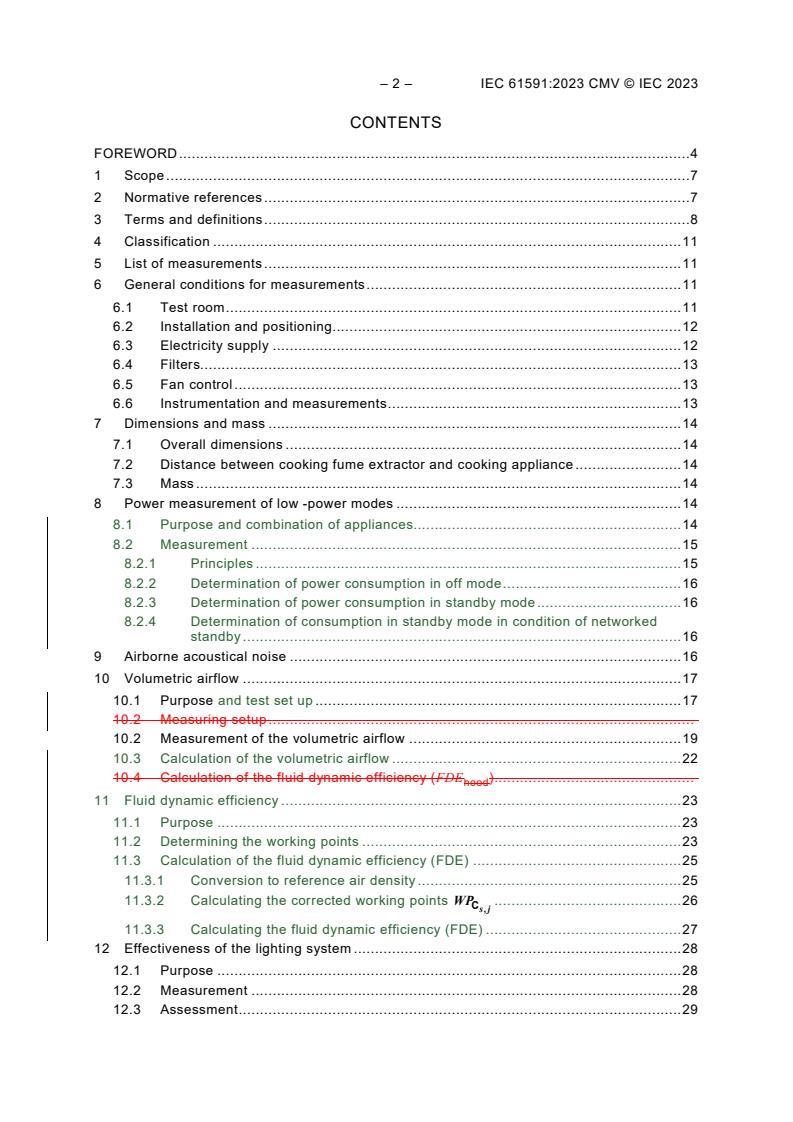
– 2 – IEC 61591:2023 CMV © IEC 2023
CONTENTS
FOREWORD .4
1 Scope .7
2 Normative references .7
3 Terms and definitions .8
4 Classification . 11
5 List of measurements . 11
6 General conditions for measurements . 11
6.1 Test room . 11
6.2 Installation and positioning . 12
6.3 Electricity supply . 12
6.4 Filters. 13
6.5 Fan control . 13
6.6 Instrumentation and measurements . 13
7 Dimensions and mass . 14
7.1 Overall dimensions . 14
7.2 Distance between cooking fume extractor and cooking appliance . 14
7.3 Mass . 14
8 Power measurement of low -power modes . 14
8.1 Purpose and combination of appliances. 14
8.2 Measurement . 15
8.2.1 Principles . 15
8.2.2 Determination of power consumption in off mode . 16
8.2.3 Determination of power consumption in standby mode . 16
8.2.4 Determination of consumption in standby mode in condition of networked
standby . 16
9 Airborne acoustical noise . 16
10 Volumetric airflow . 17
10.1 Purpose and test set up . 17
10.2 Measuring setup .
10.2 Measurement of the volumetric airflow . 19
10.3 Calculation of the volumetric airflow . 22
10.4 Calculation of the fluid dynamic efficiency (FDE ) .
hood
11 Fluid dynamic efficiency . 23
11.1 Purpose . 23
11.2 Determining the working points . 23
11.3 Calculation of the fluid dynamic efficiency (FDE) . 25
11.3.1 Conversion to reference air density . 25
11.3.2 Calculating the corrected working points WP . 26
C
sj,
11.3.3 Calculating the fluid dynamic efficiency (FDE) . 27
12 Effectiveness of the lighting system . 28
12.1 Purpose . 28
12.2 Measurement . 28
12.3 Assessment . 29
13 Odour reduction . 29
13.1 Purpose . 29
13.2 Measuring setup . 29
13.3 Measurement . 31
13.4 Calculation of the odour reduction factor . 31
14 Grease absorption. 32
14.1 Purpose . 32
14.2 Measuring setup . 32
14.3 Preparation . 37
14.3.1 Determining the mass . 37
14.3.2 Warm-up period . 38
14.3.3 Determining the working point WP . 38
14.4 Measurement . 38
14.5 Assessment . 38
Annex A (informative) Assumption for the parameter b (see Table 3) . 40
Annex B (normative) Low power mode measurements . 41
Bibliography . 42
List of comments . 43
Figure 1 – Measurement of airflow . 18
Figure 2 – Example working point of a cooking fume extractor in extraction mode .
Figure 3 – Example diagram of the best efficiency point (BEP) .
Figure 2 – 9 working points of a cooking fume extractor in extraction mode (example) . 24
Figure 3 – Measurement points for assessing the effectiveness of the lighting system . 29
Figure 4 – Example of a test room . 30
Figure 5 – Chamber for the grease absorption of a range hood or a microwave hood
combination . 34
Figure 6 – Chamber for the grease absorption of a down-draft system . 36
Figure 7 – Cookware used for measuring the grease absorption . 37
Figure A.1 – Typical ducting . 40
Table 1 – Instruments. 13
Table 2 – Measurements . 14
Table 3 – Parameters for the calculation of resistance curves – . 19
Table 4 – Relevant measurement points for assessing the effectiveness of the lighting
system . 28
Table B.1 – Step by step instruction for measuring low power modes . 41
– 4 – IEC 61591:2023 CMV © IEC 2023
INTERNATIONAL ELECTROTECHNICAL COMMISSION
____________
COOKING FUME EXTRACTORS –
METHODS FOR MEASURING PERFORMANCE
FOREWORD
1) The International Electrotechnical Commission (IEC) is a worldwide organization for standardization comprising
all national electrotechnical committees (IEC National Committees). The object of IEC is to promote international
co-operation on all questions concerning standardization in the electrical and electronic fields. To this end and
in addition to other activities, IEC publishes International Standards, Technical Specifications, Technical Reports,
Publicly Available Specifications (PAS) and Guides (hereafter referred to as "IEC Publication(s)"). Their
preparation is entrusted to technical committees; any IEC National Committee interested in the subject dealt with
may participate in this preparatory work. International, governmental and non-governmental organizations liaising
with the IEC also participate in this preparation. IEC collaborates closely with the International Organization for
Standardization (ISO) in accordance with conditions determined by agreement between the two organizations.
2) The formal decisions or agreements of IEC on technical matters express, as nearly as possible, an international
consensus of opinion on the relevant subjects since each technical committee has representation from all
interested IEC National Committees.
3) IEC Publications have the form of recommendations for international use and are accepted by IEC National
Committees in that sense. While all reasonable efforts are made to ensure that the technical content of IEC
Publications is accurate, IEC cannot be held responsible for the way in which they are used or for any
misinterpretation by any end user.
4) In order to promote international uniformity, IEC National Committees undertake to apply IEC Publications
transparently to the maximum extent possible in their national and regional publications. Any divergence between
any IEC Publication and the corresponding national or regional publication shall be clearly indicated in the latter.
5) IEC itself does not provide any attestation of conformity. Independent certification bodies provide conformity
assessment services and, in some areas, access to IEC marks of conformity. IEC is not responsible for any
services carried out by independent certification bodies.
6) All users should ensure that they have the latest edition of this publication.
7) No liability shall attach to IEC or its directors, employees, servants or agents including individual experts and
members of its technical committees and IEC National Committees for any personal injury, property damage or
other damage of any nature whatsoever, whether direct or indirect, or for costs (including legal fees) and
expenses arising out of the publication, use of, or reliance upon, this IEC Publication or any other IEC
Publications.
8) Attention is drawn to the Normative references cited in this publication. Use of the referenced publications is
indispensable for the correct application of this publication.
9) Attention is drawn to the possibility that some of the elements of this IEC Publication may be the subject of patent
rights. IEC shall not be held responsible for identifying any or all such patent rights.
This commented version (CMV) of the official standard IEC 61591:2023 edition 3.0 allows
the user to identify the changes made to the previous IEC 61591:2019 edition 2.0.
Furthermore, comments from IEC SC 59K experts are provided to explain the reasons of
the most relevant changes, or to clarify any part of the content.
A vertical bar appears in the margin wherever a change has been made. Additions are in
green text, deletions are in strikethrough red text. Experts' comments are identified by a
blue-background number. Mouse over a number to display a pop-up note with the
comment.
This publication contains the CMV and the official standard. The full list of comments is
available at the end of the CMV.
IEC 61591 has been prepared by subcommittee 59K: Performance of household and similar
electrical cooking appliances, of IEC technical committee 59: Performance of household and
similar electrical appliances. It is an International Standard.
This third edition cancels and replaces the second edition published in 2019. This edition
constitutes a technical revision.
This edition includes the following significant technical changes with respect to the previous
edition:
a) new definition of working point, see 3.19;
b) new definition for lowest setting and automatic setting, see 3.17 and 3.18;
c) revised requirements for installation and positioning, see 6.2;
d) added a normative reference ISO 5801 for the specification of the pressure compensation
chamber, see Clause 10;
e) separate clauses for determining the volumetric airflow and fluid dynamic efficiency, see
Clauses 10 and 11;
f) new approach for determining the fluid dynamic efficiency ("9-point calculation");
g) new definitions, new clause and new Annex B regarding the measurement of low-power
modes;
h) new Annex A: assumption for the parameter b.
The text of this International Standard is based on the following documents:
Draft Report on voting
59K/352/CDV 59K/361/RVC
Full information on the voting for its approval can be found in the report on voting indicated in
the above table.
The language used for the development of this International Standard is English.
This document was drafted in accordance with ISO/IEC Directives, Part 2, and developed in
accordance with ISO/IEC Directives, Part 1 and ISO/IEC Directives, IEC Supplement, available
at www.iec.ch/members_experts/refdocs. The main document types developed by IEC are
described in greater detail at www.iec.ch/publications.
In this standard, the following print types are used:
– terms listed in Clause 3: Arial bold.
– 6 – IEC 61591:2023 CMV © IEC 2023
The committee has decided that the contents of this document will remain unchanged until the
stability date indicated on the IEC website under webstore.iec.ch in the data related to the
specific document. At this date, the document will be
• reconfirmed,
• withdrawn,
• replaced by a revised edition, or
• amended.
IMPORTANT – The "colour inside" logo on the cover page of this document indicates that it
contains colours which are considered to be useful for the correct understanding of its
contents. Users should therefore print this document using a colour printer.
COOKING FUME EXTRACTORS –
METHODS FOR MEASURING PERFORMANCE
1 Scope
This document applies to cooking fume extractors incorporating a fan for the recirculation
or extraction mode situated in a household kitchen.
It can also be used for cooking fume extractors where the fan is mounted separately from the
appliance, but controlled by the appliance when the fan is defined in the technical
documentation (e.g. name plate data) and instructions for installation.
This document deals also with down-draft systems arranged beside, behind or under the
cooking appliance.
This document defines the main performance characteristics of these appliances, which are of
interest to the user, and specifies methods for measuring these characteristics.
This document does not specify a classification or ranking for performance.
NOTE 1 This document does not deal with safety requirements that are in accordance with IEC 60335-1 and
IEC 60335-2-31.
NOTE 2 Cooking fume extractors without fans operated by a central ventilation system are covered in EN 13141-3.
2 Normative references
The following documents are referred to in the text in such a way that some or all of their content
constitutes requirements of this document. For dated references, only the edition cited applies.
For undated references, the latest edition of the referenced document (including any
amendments) applies.
IEC 60584-1, Thermocouples – Part 1: EMF specifications and tolerances
IEC 60704-2-13, Household and similar electrical appliances – Test code for the determination
of airborne acoustical noise – Part 2-13: Particular requirements for range hoods and other
cooking fume extractors
IEC 60751, Industrial platinum resistance thermometers and platinum temperature sensors
IEC 62301:2011, Household electrical appliances – Measurement of standby power
IEC 63474:— , Electrical and electronic household and office equipment – Measurement of
networked standby power consumption of edge equipment
ISO 5167-1, Measurement of fluid flow by means of pressure differential devices inserted in
circular cross-section conduits running full – Part 1: General principles and requirements
ISO 5167-2, Measurement of fluid flow by means of pressure differential devices inserted in
circular cross-section conduits running full – Part 2: Orifice plates
__________
Under preparation. Stage at the time of development: IEC CDV 63474:2022.
– 8 – IEC 61591:2023 CMV © IEC 2023
ISO 5167-3, Measurement of fluid flow by means of pressure differential devices inserted in
circular cross-section conduits running full – Part 3: Nozzles and Venturi nozzles
ISO 5167-4, Measurement of fluid flow by means of pressure differential devices inserted in
circular cross-section conduits running full – Part 4: Venturi tubes
ISO 5801:2017, Fans – Performance testing using standardized airways
ISO 80000-1:2009, Quantities and units – Part 1: General
3 Terms and definitions
For the purposes of this document, the following terms and definitions apply.
ISO and IEC maintain terminology databases for use in standardization at the following
addresses:
• IEC Electropedia: available at https://www.electropedia.org/
• ISO Online browsing platform: available at https://www.iso.org/obp
3.1
active mode
mode in which the appliance is connected to a mains power source, has been activated, and is
performing any of the intended functions
EXAMPLE Intended functions are running the fan or operating the lighting system.
Note 1 to entry: Associated activities include displaying information, software download, sensor controlled
automatic mode and communication with the hob.
3.2
cooking fume extractor
CFE
appliance with fan and filter intended to collect and treat cooking fumes, which can be operated
in recirculation mode or extraction mode
3.3
range hood
cooking fume extractor installed over a cooking appliance
3.3.1
wall range hood
range hood mounted to the wall
3.3.2
island range hood
range hood mounted to the ceiling
3.3.3
ceiling range hood
range hood integrated onto or into the ceiling
3.3.4
built-in range hood
range hood mounted onto or into a cabinet
3.4
microwave hood combination
cooking fume extractor integrated in a microwave oven
3.5
multiple combination hood
cooking fume extractor where the fan is mounted separately of the appliance, but controlled
by the appliance
3.6
down-draft system
cooking fume extractor intended for installation adjacent to a cooking appliance or integrated
in a cooking appliance that draws vapour down into a duct
Note 1 to entry: A down-draft system can also be a system where the fan is mounted separately from the appliance
but controlled by the appliance.
3.7
recirculation mode
mode of a cooking fume extractor that discharges air back into the room, which includes an
odour-reduction filter
3.8
extraction mode
vented mode
ducted mode
mode of a cooking fume extractor that discharges the air to the outside of the building by
means of ducting
Note 1 to entry: Extraction mode is also known as "vented mode" or "ducted mode".
3.9
rated voltage
voltage assigned to the cooking fume extractor by the manufacturer
3.10
grease absorption factor
G
FE
percentage of grease retained within a grease filter
3.11
grease filter
components for absorbing grease, which are intended to be replaced or removed for cleaning
without tools
3.12
odour-reduction filter
components for reducing odour
3.13
odour reduction factor
capability of the cooking fume extractor to reduce odours
3.14
odour dispersion time
time taken to reduce odours to a defined level after the odour generating source has been
switched off
– 10 – IEC 61591:2023 CMV © IEC 2023
3.15
highest continuous setting for normal use
control setting of cooking fume extractor at highest speed, excluding the boost position
setting
Note 1 to entry: Marked setting on the appliance, which is described in the instructions for use.
3.16
boost position setting
marked control setting at maximum fan speed, which is automatically limited in duration
Note 1 to entry: Marked setting on the appliance, which is described in the instructions for use.
3.17
lowest setting
marked control setting at which the cooking fume extractor operates at its lowest speed
3.18
automatic setting
control setting of cooking fume extractor where the fan speed is altered by a sensor or time
Note 1 to entry: Automatic settings are not used for calculation of the fluid dynamic efficiency (FDE).
3.19
working point
WP
intersection point of pressure/airflow curve and resistance curve – measured WP and
compensated to reference air density WP
C
3.17
best efficiency point
BEP
maximum value of the efficiency of a cooking fume extractor
Note 1 to entry: This term applies to the French language only.
3.20
lighting system
devices used for the illumination of the cooking surface, excluding ambient illumination unless
there is only one control switch
Note 1 to entry: Power supply units and controllers are included.
3.21
illumination
E
middle
average illumination of the lighting system on the cooking surface, measured in lux, under
standard conditions
3.22
network
communication infrastructure with a topology of links, an architecture and which includes the
physical components, organizational principles, communication procedures and formats
(protocols)
Note 1 to entry: An infrared (IR) remote control is not considered to be a network.
3.23
off mode
condition in which the appliance is connected to the mains and is not providing any active mode
or standby function and where the mode may persist for an indefinite time
Note 1 to entry: The following shall also be considered as off mode
a) conditions providing only an indication of off mode;
b) conditions providing only functionalities intended to ensure electromagnetic compatibility.
3.24
standby mode
condition where the appliance is connected to the mains and provides only the following
functions, which may persist for an indefinite time:
a) reactivation function, or reactivation function and a mere indication of enabled reactivation
function; and/or
b) information or status display; and/or
c) detection function for emergency measures.
3.25
standby mode in condition of networked standby
condition where the appliance is connected to the mains and provides only the reactivation
function through a connection to a network, which may persist for an indefinite time.
Note 1 to entry: This mode is only applicable to appliances that provide a connection function to a network.
4 Classification
According to the mode:
– recirculation mode;
– extraction mode.
A cooking fume extractor may can be constructed to incorporate both modes.
5 List of measurements
Performance is determined by assessing the following:
– overall dimensions;
– mass;
– power measurement of low-power modes;
– airborne acoustical noise;
– volumetric airflow;
– fluid dynamic efficiency;
– effectiveness and electric power input of the lighting system;
– ability to reduce odours;
– ability to absorb grease.
6 General conditions for measurements
6.1 Test room
The tests are carried out in a draught-free room. The ambient temperature of the room is
maintained at (23 ± 2) °C. The absolute air pressure shall be between 91,3 kPa and 106,3 kPa.
– 12 – IEC 61591:2023 CMV © IEC 2023
6.2 Installation and positioning
The appliance has to be clean and free of any residues of packaging material and protective
foil.
All tests have to be carried out following the order of the clauses of this document with one and
the same appliance.
or the down-draft system) is installed above a cooking
The cooking fume extractor (except f
appliance with the distance of (600 ± 10) mm. The distance is determined between the lowest
level of the cooking fume extractor and the highest level of the cooking appliance. The cooking
fume extractor is installed and operated in accordance with the manufacturer’s instructions
(except for the distance above the cooking appliance).
Any extendible visor, which is extendable for normal use in accordance with the manufacturer’s
instructions, shall be opened accordingly. If no instructions are given, the extendible visor is
fully opened.
Any pull-out or swing-out mechanism that can be opened to a position for normal use in
accordance with the manufacturer's instructions shall be opened during all tests. Positions that
are for cleaning and maintenance purposes only shall be not considered. If the manufacturer’s
instruction does not state any information, the pull-out or swing-out mechanism shall be
completely closed.
The position for the pull-out or swing-out mechanism shall be maintained unchanged for all
tests except low power mode measurements in Clause 8. 1
If the down-draft system can be elevated, the manufacturer’s instructions are followed;
otherwise, it shall be measured in its maximum elevated position for use.
The maximum sized duct in accordance with the manfacturer’s instructions is to be used.
For all tests, the appliance is operated with unchanged default factory settings (e.g. brightness
of the display or changeable light colour). Supplementary parts that are part of the appliance
are mounted in accordance with the manufacturer’s instructions. Ensure that no network is
connected to the appliance for the duration of the measurement, except for the remote control.
If there are different options delivered with the CFE, then, for all tests, the air outlet with its
properties closest to a theoretical resistance curve for a flue pipe with b = 0,000 125 shall be
used. This setup shall be kept for all measurements described in this document.
NOTE More information for b is given in Table 3.
All tests, except the measurements for low-power modes (see Clause 8), are carried out:
– with the default factory settings except adjusting extraction or recirculation mode, if
necessary;
– ensure that no network is connected to the appliance for the duration of the measurement.
Before the measurement is made, any conditioning of the CFE, unless explicitly required in this
document, is not allowed.
Ensure that any automatic modes settings, where the fan speed is altered, are switched off.
6.3 Electricity supply
The cooking fume extractor is supplied at the rated voltage ±1 %. The supply voltage shall
be recorded at the point where the appliance is connected to the mains supply during all tests. 2
If the appliance has a rated voltage range, the tests are carried out at the nominal voltage of
the country where the appliance is intended to be used.
The supply frequency shall be at the rated frequency ±1 % throughout the test. If a frequency
range is indicated, then the test frequency shall be that of the nominal frequency of the country
in which the appliance is intended to be used.
6.4 Filters
For all tests, it shall be ensured that all filters are positioned correctly.
For appliances with more than one grease filter, the filters shall be positioned with no gap in
between (centrally positioned).
6.5 Fan control
Cooking fume extractors shall be tested in the highest continuous setting for normal use,
as stated in the manufacturer’s instructions.
6.6 Instrumentation and measurements
Instruments used and measurements made for this document shall comply with the
specifications in Table 1 and Table 2. The accuracy is applied to the measured value.
Table 1 – Instruments
Parameter Unit Minimum Accuracy Additional
resolution requirements
Mass g 0,1 g ±0,5 g
Temperature °C 0,1 °C ±1,5 K Thermocouple type J or
K in accordance with
IEC 60584-1
or
PT100 sensor in
accordance with
IEC 60751.
Time s 1 s ±1 s
Power W - ±1 %
Illuminance lx - ±10 % Value under
consideration –
International standard
about illuminance
classification is pending.
Pressure/Air pressure Pa - ±1 % The accuracy is for
pressures ≤ 150 Pa and
at least 1,5 Pa.
– 14 – IEC 61591:2023 CMV © IEC 2023
Table 2 – Measurements
Parameter Unit Minimum Accuracy Additional requirements
resolution
Voltage V - ±0,5 % -
Volumetric airflow ±2 %
m /h
Power measurement - - In accordance with IEC 62301
If numbers have to be rounded, they shall be rounded to the nearest number in accordance with
ISO 80000-1:2009, Clause B.3, Rule B. If the rounding takes place to the right of the comma,
the omitted places shall not be filled with zeros.
The tolerances specified for parameters within this document, using the symbol "±", indicate
the allowable limits of variation from the specified targets outside which the test or results shall
be invalid. The statement of tolerance shall not be used for deliberate variation of these
specified targets. 3
7 Dimensions and mass
7.1 Overall dimensions
The overall dimensions of the cooking fume extractor are measured. The longest width, depth
and height, including any control knobs or other projections, are stated in millimetres rounded
to 10 mm. If dimensions are variable while the cooking fume extractor is operated in normal
use, then the minimum and maximum sizes are stated.
For cooking fume extractors with extraction mode, the dimensions of the air-outlet orifice
are measured and stated.
7.2 Distance between cooking fume extractor and cooking appliance
The shortest distance between the lowest level of the cooking fume extractor, except down-
draft systems, and the highest level of the cooking appliance is measured and indicated in
millimetres, rounded to 10 mm.
7.3 Mass
The mass of the cooking fume extractor, including any filters, supply cord and plug, is
measured and stated in kilograms, rounded to one decimal place.
8 Power measurement of low-power modes
The power of low-power modes are measured in accordance with IEC 62301.
8.1 Purpose and combination of appliances
This clause sets out determination of off mode, standby mode and standby mode in
condition of networked standby. Other low-power modes can exist in some appliances, but
for the current designs, these are not considered important in terms of duration and energy
consumption.
8.2 Measurement
8.2.1 Principles
The requirements of IEC 62301 and IEC 63474 shall be observed in addition to the following
requirements.
However, IEC 62301:2011,5.3 (procedure) and the requirement defining air speed in
IEC 62301:2011, 4.2 shall not apply.
When testing appliances that are fitted with a clock, the clock shall be adjusted to the correct
time and date as specified in the instructions.
If energy consumption is influenced by the continuously changing displayed time of a clock, a
measurement period of 24 h is necessary. The average value from this measurement is noted.
If the appliance has an ambient light sensor, two illuminance levels in accordance with
IEC 62301 shall be measured during the 24 h period, each illuminance level for 12 h.
If an option is provided to the user to switch off the display, both the switched on and switched
off mode are to be tested and reported.
Ensure that the following conditions remain relevant for the duration of the measurement: 5
– instructions for use regarding installation, operation and settings (as applicable) are
followed;
– the appliance shall be connected to mains power for the duration of the test; if the appliance
is supplied without cable, a cable length of 1 m shall be used;
– no adverse warning indicators are present;
– follow the manufacturer's instructions regarding the configuration of network connectivity
(where applicable);
– ensure that the network is connected to the appliance (when required);
– after each appliance interaction, wait at least 15 min before commencing with
measurements; and
– no interference during measurement by any interaction.
Some appliances can require software updates to ensure secure network operations. It is
recommended to allow those updates to be installed and to make a note of it in the test report.
Updates can occur or can be requested after activation of network capability and the update
process can affect energy during measurement. The measurement starts after the completion
of any software update.
The required power consumption can be determined by measuring the power consumption
directly for a certain period of time (not less than 10 min). The data shall be recorded at regular
intervals of 1 s or less throughout the test using a data logger or computer. The average power
is given in watts and rounded with two valid digits after the decimal point.
Alternatively, the energy consumption can be measured for a certain period of time (not less
than 10 min) and the power consumption be calculated by dividing the measured energy
consumption (measured in Wh) by the duration of the measurement (in h). The calculated power
is given in watts and rounded with two valid digits after the decimal point.
Appliance interactions during an active mode shall not be considered for measurement. A step-
by-step instruction for measuring the low-power modes is given in Annex B (Table B.1).
– 16 – IEC 61591:2023 CMV © IEC 2023
8.2.2 Determination of power consumption in off mode
This subclause is only applicable to appliances providing an off mode.
The appliance under test should be set to off mode in accordance with the manufacturer's
instructions. All actions required to set to off mode shall be taken into account.
In all cases, off mode shall be determined over a period of not less than 10 min. The power
consumption of the off mode is the average of the measured data.
If the appliance provides an off mode, it should be described by the manufacturer.
8.2.3 Determination of power consumption in standby mode
This subclause is only applicable to appliances providing a standby mode.
The appliance under test should be set to standby mode in accordance with the manufacturer's
instructions.
In all cases, standby mode shall be determined over a period of not less than 10 min. The
power consumption of the standby mode is the average of the measured data.
If the appliance provides a standby mode, it should be described by the manufacturer.
8.2.4 Determination of consumption in standby mode in condition of networked
standby 6
This subclause is only applicable to appliances providing a standby mode in condition of
networked standby.
For appliances with network connectivity, follow the manufacturer’s instructions regarding the
configuration of the appliance and ensure that the network (e.g. LAN or WLAN) is connected
to the appliance and activated.
The highest possible power consumption can be reached when the appliance is not only
connected to the network, but also to a remote user interface (i.e. mobile app). Avoid any
interaction with the remote user interface during the 15 min waiting time and the measurement.
In all cases, standby mode in condition of networked standby shall be determined over a
period of not less than 10 min. The power consumption of the standby mode in condition of
networked standby is the average of the measured data.
Ensure that there is no download and no update running during the measurement.
The test report shall contain the description of the network connection used.
9 Airborne acoustical noise
Where an airborne acoustical noise measurement is required, it shall be measured in
accordance with IEC 60704-2-13.
NOTE A possible procedure for the statistical determination of declared noise values is described in IEC 60704-3.
10 Volumetric airflow
10.1 Purpose and test set up
The purpose of this test is to determine the volumetric airflow in general (see 10.3) and at the
best efficiency point (BEP) (see 10.4).
The volumetric airflow is measured in accordance with the methods contained measurement
shall comply with the requirements stated in ISO 5167‑1, ISO 5167-2, ISO 5167-3 and
ISO 5167-4.
10.2 Measuring setup
The maximum possible air-outlet of the cooking fume extractor is connected to a pressure
compensation chamber (see Figure 1). The duct diameter needs to be the same as that of the
air-outlet.
A cooking fume extractor without ducting, e.g. a cooking fume extractor with recirculation
mode, is connected directly to the pressure compensation chamber as shown in Figure 1b).
The pressure compensation chamber shall be adapted to the dimensions of the cooking fume
extractor under test.
The air outlet of the CFE is connected to a pressure compensation chamber in accordance with
Figure 1 and 6.2. For this, the inner diameter of the air outlet of the CFE shall be measured.
The diameter of the connecting duct shall be determined in accordance with Table 3. The
connecting duct shall be a rigid straight duct with smooth inner wall. A CFE without ducting,
e.g. a CFE with recirculation mode, is connected directly to the pressure compensation
chamber as shown in Figure 1b).
The pressure compensation chamber shall comply with the requirements stated in
ISO 5801:2017, 9.5, with the following additional specification: the test chamber dimension D4
(see ISO 5801) shall be at least 750 mm. The distance J (see ISO 5801) can be either limited
by a straightener or by the chamber wall with outlet area. 7
The pressure tapping point for the static pressure gauge shall have the half distance of J with
a tolerance of ± 50 mm (see ISO 5801). If there is more than one pressure tapping point, all of
them shall be at this distance around the chamber. Additionally, the measured values shall be
averaged.
– 18 – IEC 61591:2023 CMV © IEC 2023
a) Setup for CFE with duct
b) Setup for CFE without duct
c) Multiple combination hood or down-draft system with fan for indoor use
d) Multiple combination hood or down-draft system with fan for outdoor use
Key
a 5 times the inner diameter of the duct, which 4 auxiliary fan
shall be sealed
1 cooking fume extractor 5 baffle
2 pressure compensation chamber 6 static pressure gauge
3 pressure differential device for airflow 7 separately mounted fan
measurement
Figure 1 – Measurement of airflow
Follow the manufacturer’s instructions regarding the distance between points 1 and 7, as shown
in Figure 1c) and 1d). If there is no value for the distance given, then the distance a is used.
A CFE in recirculation mode can have air outlets with different geometries as "air outlet areas".
These have to be adapted to the pressure compensation chamber.
For non-circular ducts, a virtual diameter is considered
...
IEC 61591 ®
Edition 3.1 2026-08
INTERNATIONAL
STANDARD
CONSOLIDATED VERSION
Cooking fume extractors - Methods for measuring performance
ICS 97.040.20 ISBN 978-2-8327-1475-1
All rights reserved. Unless otherwise specified, no part of this publication may be reproduced or utilized in any form or
by any means, electronic or mechanical, including photocopying and microfilm, without permission in writing from either
IEC or IEC's member National Committee in the country of the requester. If you have any questions about IEC copyright
or have an enquiry about obtaining additional rights to this publication, please contact the address below or your local
IEC member National Committee for further information.
IEC Secretariat Tel.: +41 22 919 02 11
3, rue de Varembé info@iec.ch
CH-1211 Geneva 20 www.iec.ch
Switzerland
About the IEC
The International Electrotechnical Commission (IEC) is the leading global organization that prepares and publishes
International Standards for all electrical, electronic and related technologies.
About IEC publications
The technical content of IEC publications is kept under constant review by the IEC. Please make sure that you have the
latest edition, a corrigendum or an amendment might have been published.
IEC publications search - IEC Products & Services Portal - products.iec.ch
webstore.iec.ch/advsearchform Discover our powerful search engine and read freely all the
The advanced search enables to find IEC publications by a publications previews, graphical symbols and the glossary.
variety of criteria (reference number, text, technical With a subscription you will always have access to up to date
committee, …). It also gives information on projects, content tailored to your needs.
replaced and withdrawn publications.
Electropedia - www.electropedia.org
The world's leading online dictionary on electrotechnology,
IEC Just Published - webstore.iec.ch/justpublished
Stay up to date on all new IEC publications. Just Published containing more than 22 500 terminological entries in English
details all new publications released. Available online and and French, with equivalent terms in 25 additional languages.
once a month by email. Also known as the International Electrotechnical Vocabulary
(IEV) online.
IEC Customer Service Centre - webstore.iec.ch/csc
If you wish to give us your feedback on this publication or
need further assistance, please contact the Customer
Service Centre: sales@iec.ch.
CONTENTS
FOREWORD . 3
1 Scope . 5
2 Normative references . 5
3 Terms and definitions . 6
4 Classification . 9
5 List of measurements . 9
6 General conditions for measurements . 9
6.1 Test room . 9
6.2 Installation and positioning. 10
6.3 Electricity supply . 10
6.4 Filters . 10
6.5 Fan control . 11
6.6 Instrumentation and measurements . 11
7 Dimensions and mass . 12
7.1 Overall dimensions . 12
7.2 Distance between cooking fume extractor and cooking appliance . 12
7.3 Mass . 12
8 Power measurement of low-power modes . 12
8.1 Purpose and combination of appliances . 12
8.2 Measurement . 12
8.2.1 Principles . 12
8.2.2 Determination of power consumption in off mode . 13
8.2.3 Determination of power consumption in standby mode . 13
8.2.4 Determination of consumption in standby mode in condition of
networked standby. 14
9 Airborne acoustical noise. 14
10 Volumetric airflow . 14
10.1 Purpose and test set up . 14
10.2 Measurement of the volumetric airflow . 16
10.3 Calculation of the volumetric airflow . 17
11 Fluid dynamic efficiency . 17
11.1 Purpose . 17
11.2 Determining the working points . 17
11.3 Calculation of the fluid dynamic efficiency (FDE). 19
11.3.1 Conversion to reference air density . 19
WP
11.3.2 Calculating the corrected working points . 20
C
sj,
11.3.3 Calculating the fluid dynamic efficiency (FDE) . 21
12 Effectiveness of the lighting system . 22
12.1 Purpose . 22
12.2 Measurement . 22
12.3 Assessment . 23
13 Odour reduction . 23
13.1 Purpose . 23
13.2 Measuring setup . 23
13.3 Measurement . 25
13.4 Calculation of the odour reduction factor . 25
14 Grease absorption . 26
14.1 Purpose . 26
14.2 Measuring setup . 26
14.3 Preparation . 30
14.3.1 Determining the mass . 30
14.3.2 Warm-up period . 31
14.3.3 Determining the working point WP . 31
14.4 Measurement . 31
14.5 Assessment . 31
Annex A (informative) Assumption for the parameter b (see Table 3) . 33
Annex B (normative) Low power mode measurements . 34
Annex C (informative) Uncertainty of measurement . 35
Bibliography . 36
Figure 1 – Measurement of airflow . 15
Figure 2 – 9 working points of a cooking fume extractor in extraction mode (example) . 18
Figure 3 – Measurement points for assessing the effectiveness of the lighting system . 23
Figure 4 – Example of a test room . 24
Figure 5 – Chamber for the grease absorption of a range hood or a microwave hood
combination . 28
Figure 6 – Chamber for the grease absorption of a down-draft system . 29
Figure 7 – Cookware used for measuring the grease absorption . 30
Figure A.1 – Typical ducting . 33
Table 1 – Instruments . 11
Table 2 – Measurements. 11
Table 3 – Parameters for the calculation of resistance curves – . 16
Table 4 – Relevant measurement points for assessing the effectiveness of the lighting
system . 22
Table B.1 – Step by step instruction for measuring low power modes . 34
Table C.1 - Relative and absolute expanded uncertainty* (k = 2) . 35
INTERNATIONAL ELECTROTECHNICAL COMMISSION
____________
COOKING FUME EXTRACTORS –
METHODS FOR MEASURING PERFORMANCE
FOREWORD
1) The International Electrotechnical Commission (IEC) is a worldwide organization for standardization comprising
all national electrotechnical committees (IEC National Committees). The object of IEC is to promote international
co-operation on all questions concerning standardization in the electrical and electronic fields. To this end and
in addition to other activities, IEC publishes International Standards, Technical Specifications, Technical Reports,
Publicly Available Specifications (PAS) and Guides (hereafter referred to as "IEC Publication(s)"). Their
preparation is entrusted to technical committees; any IEC National Committee interested in the subject dealt with
may participate in this preparatory work. International, governmental and non-governmental organizations liaising
with the IEC also participate in this preparation. IEC collaborates closely with the International Organization for
Standardization (ISO) in accordance with conditions determined by agreement between the two organizations.
2) The formal decisions or agreements of IEC on technical matters express, as nearly as possible, an international
consensus of opinion on the relevant subjects since each technical committee has representation from all
interested IEC National Committees.
3) IEC Publications have the form of recommendations for international use and are accepted by IEC National
Committees in that sense. While all reasonable efforts are made to ensure that the technical content of IEC
Publications is accurate, IEC cannot be held responsible for the way in which they are used or for any
misinterpretation by any end user.
4) In order to promote international uniformity, IEC National Committees undertake to apply IEC Publications
transparently to the maximum extent possible in their national and regional publications. Any divergence between
any IEC Publication and the corresponding national or regional publication shall be clearly indicated in the latter.
5) IEC itself does not provide any attestation of conformity. Independent certification bodies provide conformity
assessment services and, in some areas, access to IEC marks of conformity. IEC is not responsible for any
services carried out by independent certification bodies.
6) All users should ensure that they have the latest edition of this publication.
7) No liability shall attach to IEC or its directors, employees, servants or agents including individual experts and
members of its technical committees and IEC National Committees for any personal injury, property damage or
other damage of any nature whatsoever, whether direct or indirect, or for costs (including legal fees) and
expenses arising out of the publication, use of, or reliance upon, this IEC Publication or any other IEC
Publications.
8) Attention is drawn to the Normative references cited in this publication. Use of the referenced publications is
indispensable for the correct application of this publication.
9) Attention is drawn to the possibility that some of the elements of this IEC Publication may be the subject of patent
rights. IEC shall not be held responsible for identifying any or all such patent rights.
This consolidated version of the official IEC Standard and its amendment has been prepared
for user convenience.
IEC 61591 edition 3.1 contains the third edition (2023-03) [documents 59K/352/CDV and
59K/361/RVC] and its amendment 1 (2026-08) [documents 59K/424/CDV and 59K/432/RVC].
In this Redline version, a vertical line in the margin shows where the technical content is
modified by amendment 1. Additions are in green text, deletions are in strikethrough red text.
A separate Final version with all changes accepted is available in this publication.
IEC 61591 has been prepared by subcommittee 59K: Performance of household and similar
electrical cooking appliances, of IEC technical committee 59: Performance of household and
similar electrical appliances. It is an International Standard.
This third edition cancels and replaces the second edition published in 2019. This edition
constitutes a technical revision.
This edition includes the following significant technical changes with respect to the previous
edition:
a) new definition of working point, see 3.19;
b) new definition for lowest setting and automatic setting, see 3.17 and 3.18;
c) revised requirements for installation and positioning, see 6.2;
d) added a normative reference ISO 5801 for the specification of the pressure compensation
chamber, see Clause 10;
e) separate clauses for determining the volumetric airflow and fluid dynamic efficiency, see
Clauses 10 and 11;
f) new approach for determining the fluid dynamic efficiency ("9-point calculation");
g) new definitions, new clause and new Annex B regarding the measurement of low-power
modes;
h) new Annex A: assumption for the parameter b.
The text of this International Standard is based on the following documents:
Draft Report on voting
59K/352/CDV 59K/361/RVC
Full information on the voting for its approval can be found in the report on voting indicated in
the above table.
The language used for the development of this International Standard is English.
This document was drafted in accordance with ISO/IEC Directives, Part 2, and developed in
accordance with ISO/IEC Directives, Part 1 and ISO/IEC Directives, IEC Supplement, available
at www.iec.ch/members_experts/refdocs. The main document types developed by IEC are
described in greater detail at www.iec.ch/publications.
In this standard, the following print types are used:
– terms listed in Clause 3: Arial bold.
The committee has decided that the contents of this document will remain unchanged until the
stability date indicated on the IEC website under webstore.iec.ch in the data related to the
specific document. At this date, the document will be
• reconfirmed,
• withdrawn,
• replaced by a revised edition, or
• amended.
COOKING FUME EXTRACTORS –
METHODS FOR MEASURING PERFORMANCE
1 Scope
This document applies to cooking fume extractors incorporating a fan for the recirculation
or extraction mode situated in a household kitchen.
It can also be used for cooking fume extractors where the fan is mounted separately from the
appliance, but controlled by the appliance when the fan is defined in the technical
documentation (e.g. name plate data) and instructions for installation.
This document deals also with down-draft systems arranged beside, behind or under the
cooking appliance.
This document defines the main performance characteristics of these appliances, which are of
interest to the user, and specifies methods for measuring these characteristics.
This document does not specify a classification or ranking for performance.
NOTE 1 This document does not deal with safety requirements that are in accordance with IEC 60335-1 and
IEC 60335-2-31.
NOTE 2 Cooking fume extractors without fans operated by a central ventilation system are covered in EN 13141-3.
2 Normative references
The following documents are referred to in the text in such a way that some or all of their content
constitutes requirements of this document. For dated references, only the edition cited applies.
For undated references, the latest edition of the referenced document (including any
amendments) applies.
IEC 60584-1, Thermocouples – Part 1: EMF specifications and tolerances
IEC 60704-2-13, Household and similar electrical appliances – Test code for the determination
of airborne acoustical noise – Part 2-13: Particular requirements for range hoods and other
cooking fume extractors
IEC 60751, Industrial platinum resistance thermometers and platinum temperature sensors
IEC 62301:2011, Household electrical appliances – Measurement of standby power for
appliances and equipment
IEC 63474:— , Electrical and electronic household and office equipment – Measurement of
networked standby power consumption of edge equipment
ISO 5167-1, Measurement of fluid flow by means of pressure differential devices inserted in
circular cross-section conduits running full – Part 1: General principles and requirements
__________
Under preparation. Stage at the time of development: IEC CDV 63474:2022.
ISO 5167-2, Measurement of fluid flow by means of pressure differential devices inserted in
circular cross-section conduits running full – Part 2: Orifice plates
ISO 5167-3, Measurement of fluid flow by means of pressure differential devices inserted in
circular cross-section conduits running full – Part 3: Nozzles and Venturi nozzles
ISO 5167-4, Measurement of fluid flow by means of pressure differential devices inserted in
circular cross-section conduits running full – Part 4: Venturi tubes
ISO 5801:2017, Fans – Performance testing using standardized airways
ISO 80000-1:20092022, Quantities and units – Part 1: General
3 Terms and definitions
For the purposes of this document, the following terms and definitions apply.
ISO and IEC maintain terminology databases for use in standardization at the following
addresses:
• IEC Electropedia: available at https://www.electropedia.org/
• ISO Online browsing platform: available at https://www.iso.org/obp
3.1
active mode
mode in which the appliance is connected to a mains power source, has been activated, and is
performing any of the intended functions
EXAMPLE Intended functions are running the fan or operating the lighting system.
Note 1 to entry: Associated activities include displaying information, software download, sensor controlled
automatic mode and communication with the hob.
3.2
cooking fume extractor
CFE
appliance with fan and filter intended to collect and treat cooking fumes, which can be operated
in recirculation mode or extraction mode
3.3
range hood
cooking fume extractor installed over a cooking appliance
3.3.1
wall range hood
range hood mounted to the wall
3.3.2
island range hood
range hood mounted to the ceiling
3.3.3
ceiling range hood
range hood integrated onto or into the ceiling
3.3.4
built-in range hood
range hood mounted onto or into a cabinet
3.4
microwave hood combination
cooking fume extractor integrated in a microwave oven
3.5
multiple combination hood
cooking fume extractor where the fan is mounted separately of the appliance, but controlled
by the appliance
3.6
down-draft system
cooking fume extractor intended for installation adjacent to a cooking appliance or integrated
in a cooking appliance that draws vapour down into a duct
Note 1 to entry: A down-draft system can also be a system where the fan is mounted separately from the appliance
but controlled by the appliance.
3.7
recirculation mode
mode of a cooking fume extractor that discharges air back into the room, which includes an
odour-reduction filter
3.8
extraction mode
vented mode
ducted mode
mode of a cooking fume extractor that discharges the air to the outside of the building by
means of ducting
Note 1 to entry: Extraction mode is also known as "vented mode" or "ducted mode".
3.9
rated voltage
voltage assigned to the cooking fume extractor by the manufacturer
3.10
grease absorption factor
G
FE
percentage of grease retained within a grease filter
3.11
grease filter
components for absorbing grease, which are intended to be replaced or removed for cleaning
without tools
3.12
odour-reduction filter
components for reducing odour
3.13
odour reduction factor
capability of the cooking fume extractor to reduce odours
3.14
odour dispersion time
time taken to reduce odours to a defined level after the odour generating source has been
switched off
3.15
highest continuous setting for normal use
control setting of cooking fume extractor at highest speed, excluding the boost position
setting
Note 1 to entry: Marked setting on the appliance, which is described in the instructions for use.
3.16
boost position setting
marked control setting at maximum fan speed, which is automatically limited in duration
Note 1 to entry: Marked setting on the appliance, which is described in the instructions for use.
3.17
lowest setting
marked control setting at which the cooking fume extractor operates at its lowest speed
3.18
automatic setting
control setting of cooking fume extractor where the fan speed is altered by a sensor or time
Note 1 to entry: Automatic settings are not used for calculation of the fluid dynamic efficiency (FDE).
3.19
working point
WP
intersection point of pressure/airflow curve and resistance curve – measured WP and
compensated to reference air density WP
C
3.20
lighting system
devices used for the illumination of the cooking surface, excluding ambient illumination unless
there is only one control switch
Note 1 to entry: Power supply units and controllers are included.
3.21
illumination
E
middle
average illumination of the lighting system on the cooking surface, measured in lux, under
standard conditions
3.22
network
communication infrastructure with a topology of links, an architecture and which includes the
physical components, organizational principles, communication procedures and formats
(protocols)
Note 1 to entry: An infrared (IR) remote control is not considered to be a network.
3.23
off mode
condition in which the appliance is connected to the mains and is not providing any active mode
or standby function and where the mode may persist for an indefinite time
Note 1 to entry: The following shall also be considered as off mode
a) conditions providing only an indication of off mode;
b) conditions providing only functionalities intended to ensure electromagnetic compatibility.
3.24
standby mode
condition where the appliance is connected to the mains and provides only the following
functions, which may can persist for an indefinite time duration:
a) reactivation function, or reactivation function and a mere indication of enabled reactivation
function; and/or
b) information or status display; and/or
c) detection function for emergency measures protective function.
EXAMPLE 1 An example for the protective function is an acoustical signal when touch controls are overflowed with
water.
EXAMPLE 2 An example for the reactivation function is an internal touch control sensor, which continuously
monitors any user’s interaction.
[SOURCE: IEC 60350-1:2023, 3.17, and IEC 60350-1:2023/AMD1:2025, 3.17, modified – "one
or more of" has been deleted from the definition, item b) has been included in item a), item c)
has been modified and examples have been added.]
3.25
standby mode in condition of networked standby
condition where the appliance is connected to the mains and provides only the reactivation
function through a connection to a network, which may persist for an indefinite time.
Note 1 to entry: This mode is only applicable to appliances that provide a connection function to a network.
4 Classification
According to the mode:
– recirculation mode;
– extraction mode.
A cooking fume extractor can be constructed to incorporate both modes.
5 List of measurements
Performance is determined by assessing the following:
– overall dimensions;
– mass;
– power measurement of low-power modes;
– airborne acoustical noise;
– volumetric airflow;
– fluid dynamic efficiency;
– effectiveness and electric power input of the lighting system;
– ability to reduce odours;
– ability to absorb grease.
6 General conditions for measurements
6.1 Test room
The tests are carried out in a draught-free room. The ambient temperature of the room is
maintained at (23 ± 2) °C. The absolute air pressure shall be between 91,3 kPa and 106,3 kPa.
6.2 Installation and positioning
The appliance has to be clean and free of any residues of packaging material and protective
foil.
All tests have to be carried out following the order of the clauses of this document with one and
the same appliance.
The cooking fume extractor (except for the down-draft system) is installed above a cooking
appliance with the distance of (600 ± 10) mm. The distance is determined between the lowest
level of the cooking fume extractor and the highest level of the cooking appliance.
For the lowest level of the cooking fume extractor, any pull-out or swing-out mechanisms are
not considered.
Any pull-out or swing-out mechanism that can be opened to a position for normal use in
accordance with the manufacturer's instructions shall be opened during all tests. Positions that
are for cleaning and maintenance purposes only shall be not considered. If the manufacturer’s
instruction does not state any information, the pull-out or swing-out mechanism shall be
completely closed.
The position for the pull-out or swing-out mechanism shall be maintained unchanged for all
tests except low power mode measurements in Clause 8.
If the down-draft system can be elevated, the manufacturer’s instructions are followed;
otherwise, it shall be measured in its maximum elevated position for use.
If there are different options delivered with the CFE, then, for all tests, the air outlet with its
properties closest to a theoretical resistance curve for a flue pipe with b = 0,000 125 shall be
used. This setup shall be kept for all measurements described in this document.
NOTE More information for b is given in Table 3.
All tests, except the measurements for low-power modes (see Clause 8), are carried out:
– with the default factory settings except adjusting extraction or recirculation mode, if
necessary;
– ensure that no network is connected to the appliance for the duration of the measurement.
Before the measurement is made, any conditioning of the CFE, unless explicitly required in this
document, is not allowed.
Ensure that any automatic settings are switched off.
6.3 Electricity supply
The cooking fume extractor is supplied at the rated voltage ±1 %. The supply voltage shall
be recorded at the point where the appliance is connected to the mains supply during all tests.
If the appliance has a rated voltage range, the tests are carried out at the nominal voltage of
the country where the appliance is intended to be used.
The supply frequency shall be at the rated frequency ±1 % throughout the test. If a frequency
range is indicated, then the test frequency shall be that of the nominal frequency of the country
in which the appliance is intended to be used.
6.4 Filters
For all tests, it shall be ensured that all filters are positioned correctly.
For appliances with more than one grease filter, the filters shall be positioned with no gap in
between (centrally positioned).
6.5 Fan control
Cooking fume extractors shall be tested in the highest continuous setting for normal use,
as stated in the manufacturer’s instructions.
6.6 Instrumentation and measurements
Instruments used and measurements made for this document shall comply with the
specifications in Table 1 and Table 2. The accuracy is applied to the measured value.
Table 1 – Instruments
Parameter Unit Minimum Accuracy Additional
resolution requirements
Mass g 0,1 g ±0,5 g
Temperature °C 0,1 °C ±1,5 K Thermocouple type J or
K in accordance with
IEC 60584-1
or
PT100 sensor in
accordance with
IEC 60751.
Time s 1 s ±1 s
Power W - ±1 %
Illuminance lx - ±10 % Value under
consideration –
International standard
about illuminance
classification is pending.
Pressure/Air pressure Pa - ±1 % The accuracy is for
pressures ≤ 150 Pa and
at least 1,5 Pa.
Linear dimensions for
mm 1 mm ±1 mm
cabinets, countertop
and width of CFE
Table 2 – Measurements
Parameter Unit Accuracy Additional requirements
Voltage V ±0,5 % -
Volumetric airflow m /h ±2 %
Power measurement - In accordance with IEC 62301
If numbers have to be rounded, they shall be rounded to the nearest number in accordance with
ISO 80000-1:2009, Clause B.3, Rule B. If the rounding takes place to the right of the comma,
the omitted places shall not be filled with zeros.
The tolerances specified for parameters within this document, using the symbol "±", indicate
the allowable limits of variation from the specified targets outside which the test or results shall
be invalid. The statement of tolerance shall not be used for deliberate variation of these
specified targets.
7 Dimensions and mass
7.1 Overall dimensions
The overall dimensions of the cooking fume extractor are measured. The longest width, depth
and height, including any control knobs or other projections, are stated in millimetres rounded
to 10 mm. If dimensions are variable while the cooking fume extractor is operated in normal
use, then the minimum and maximum sizes are stated.
For cooking fume extractors with extraction mode, the dimensions of the air-outlet orifice
are measured and stated.
7.2 Distance between cooking fume extractor and cooking appliance
The shortest distance between the lowest level of the cooking fume extractor, except down-
draft systems, and the highest level of the cooking appliance is measured and indicated in
millimetres, rounded to 10 mm.
7.3 Mass
The mass of the cooking fume extractor, including any filters, supply cord and plug, is
measured and stated in kilograms, rounded to one decimal place.
8 Power measurement of low-power modes
8.1 Purpose and combination of appliances
This clause sets out determination of off mode, standby mode and standby mode in
condition of networked standby. Other low-power modes can exist in some appliances, but
for the current designs, these are not considered important in terms of duration and energy
consumption.
8.2 Measurement
8.2.1 Principles
The requirements of IEC 62301 and IEC 63474 shall be observed applied in addition to the
following requirements.
However, IEC 62301:2011,5.3 (procedure) and the requirement defining air speed in
IEC 62301:2011, 4.2 shall not apply.
However, instruments and measurements shall not be in accordance with 6.6 but with the
requirements set in IEC 62301.
When testing appliances that are fitted with a clock, the clock shall be adjusted to the correct
time and date as specified in the instructions.
If energy consumption is influenced by the continuously changing displayed time of a clock, a
measurement period of 24 h is necessary. The average value from this measurement is noted.
If the appliance has an ambient light sensor, two illuminance levels in accordance with
IEC 62301 shall be measured during the 24 h period, each illuminance level for 12 h.
If an option is provided to the user to switch off the display, both the switched on and switched
off mode are to be tested and reported.
Ensure that the following conditions remain relevant for the duration of the measurement:
– instructions for use regarding installation, operation and settings (as applicable) are
followed;
– the appliance shall be connected to mains power for the duration of the test; if the appliance
is supplied without cable, a cable length of 1 m shall be used;
– no adverse warning indicators are present;
– follow the manufacturer's instructions regarding the configuration of network connectivity
(where applicable);
– ensure that the network is connected to the appliance (when required);
– after each appliance interaction, wait at least 15 20 min before commencing with
measurements; and
– no interference during measurement by any interaction.
Some appliances can require software updates to ensure secure network operations. It is
recommended to allow those updates to be installed and to make a note of it in the test report.
Updates can occur or can be requested after activation of network capability and the update
process can affect energy during measurement. The measurement starts after the completion
of any software update.
The required power consumption can be determined by measuring the power consumption
directly for a certain period of time (not less than 10 min). The data shall be recorded at regular
intervals of 1 s or less throughout the test using a data logger or computer. The average power
is given in watts and rounded with two valid digits after the decimal point.
Alternatively, the energy consumption can be measured for a certain period of time (not less
than 10 min) and the power consumption be calculated by dividing the measured energy
consumption (measured in Wh) by the duration of the measurement (in h). The calculated power
is given in watts and rounded with two valid digits after the decimal point.
Appliance interactions during an active mode shall not be considered for measurement. A step-
by-step instruction for measuring the low-power modes is given in Annex B (Table B.1).
8.2.2 Determination of power consumption in off mode
This subclause is only applicable to appliances providing an off mode.
The appliance under test should be set to off mode in accordance with the manufacturer's
instructions. All actions required to set to off mode shall be taken into account.
In all cases, off mode shall be determined over a period of not less than 10 min. The power
consumption of the off mode is the average of the measured data.
If the appliance provides an off mode, it should be described by the manufacturer.
8.2.3 Determination of power consumption in standby mode
This subclause is only applicable to appliances providing a standby mode.
The appliance under test should be set to standby mode in accordance with the manufacturer's
instructions.
In all cases, standby mode shall be determined over a period of not less than 10 min. The
power consumption of the standby mode is the average of the measured data.
If the appliance provides a standby mode, it should be described by the manufacturer.
8.2.4 Determination of consumption in standby mode in condition of networked
standby
This subclause is only applicable to appliances providing a standby mode in condition of
networked standby.
For appliances with network connectivity, follow the manufacturer’s instructions regarding the
configuration of the appliance and ensure that the network (e.g. LAN or WLAN) is connected
to the appliance and activated.
The highest possible power consumption can be reached when the appliance is not only
connected to the network, but also to a remote user interface (i.e. mobile app). Avoid any
interaction with the remote user interface during the 15 20 min waiting time and the
measurement.
In all cases, standby mode in condition of networked standby shall be determined over a
period of not less than 10 min. The power consumption of the standby mode in condition of
networked standby is the average of the measured data.
Ensure that there is no download and no update running during the measurement.
The test report shall contain the description of the network connection used.
9 Airborne acoustical noise
Where an airborne acoustical noise measurement is required, it shall be measured in
accordance with IEC 60704-2-13.
NOTE A possible procedure for the statistical determination of declared noise values is described in IEC 60704-3.
10 Volumetric airflow
10.1 Purpose and test set up
The purpose of this test is to determine the volumetric airflow.
The volumetric airflow measurement shall comply with the requirements stated in ISO 5167‑1,
ISO 5167-2, ISO 5167-3 and ISO 5167-4.
The air outlet of the CFE is connected to a pressure compensation chamber in accordance with
Figure 1 and 6.2. For this, the inner diameter of the air outlet of the CFE shall be measured.
The diameter of the connecting duct shall be determined in accordance with Table 3. The
connecting duct shall be a rigid straight duct with smooth inner wall. A CFE without ducting,
e.g. a CFE with recirculation mode, is connected directly to the pressure compensation
chamber as shown in Figure 1b).
The pressure compensation chamber shall comply with the requirements stated in
ISO 5801:2017, 9.5, with the following additional specification: the test chamber dimension D4
(see ISO 5801) shall be at least 750 mm. The distance J (see ISO 5801) can be either limited
by a straightener or by the chamber wall with outlet area.
The pressure tapping point for the static pressure gauge shall have the half distance of J with
a tolerance of ± 50 mm (see ISO 5801). If there is more than one pressure tapping point, all of
them shall be at this distance around the chamber. Additionally, the measured values shall be
averaged.
a) Setup for CFE with duct
b) Setup for CFE without duct
c) Multiple combination hood or down-draft system with fan for indoor use
d) Multiple combination hood or down-draft system with fan for outdoor use
Key
a 5 times the inner diameter of the duct, which 4 auxiliary fan
shall be sealed
1 cooking fume extractor 5 baffle
2 pressure compensation chamber 6 static pressure gauge
3 pressure differential device for airflow 7 separately mounted fan
measurement
Figure 1 – Measurement of airflow
Follow the manufacturer’s instructions regarding the distance between points 1 and 7, as shown
in Figure 1c) and 1d). If there is no value for the distance given, then the distance a is used.
A CFE in recirculation mode can have air outlets with different geometries. These have to be
adapted to the pressure compensation chamber.
For non-circular ducts, a virtual diameter that represents the same cross-section is considered
as the inner diameter of the air outlet.
The grease filter is installed for the test.
The odour-reduction filter is not installed for the test, except if the test is done in recirculation
mode.
10.2 Measurement of the volumetric airflow
The CFE is operated at the highest continuous setting for normal use for at least 1 800 s
for warming up.
The CFE is operated and, by suitably adjusting the auxiliary fan or the baffle, the airflow
corresponding to various pressures can be determined.
The measurements are made with the controls positioned at the highest continuous setting
for normal use, at the lowest setting, and at the boost position setting, if any.
The airflow in recirculation mode is determined when the static pressure in the compensation
chamber is at ambient pressure. For the measurement of the grease absorption in recirculation
mode in Clause 14, the pressure drop of the odour-reduction filter has to be determined.
The airflow in extraction mode is determined for discharge into a flue, which has the following
pressure drop depending on the inner diameter of the air-outlet when there is an airflow of
200 m /h:
Table 3 shows the parameter for the calculation of the resistance curve dependent on the
measured inner diameter of the air-outlet in order to report the volumetric airflows for the used
control settings.
Table 3 – Parameters for the calculation of resistance curves –
Inner diameter d Diameter Inner diameter of b
D
of the air outlet category D the connecting
in mm pipe in mm
≤ 110 100 100 ± 2 0,000 75
110 < d ≤ 135 125 0,000 375
125 ± 3
135 < d ≤ 175 150 0,000 125
150 ± 5
175 < d ≤
...
IEC 61591 ®
Edition 3.0 2023-03
INTERNATIONAL
STANDARD
NORME
INTERNATIONALE
colour
inside
Cooking fume extractors – Methods for measuring performance
Extracteurs de fumée de cuisine – Méthodes de mesure de l’aptitude à la
fonction
All rights reserved. Unless otherwise specified, no part of this publication may be reproduced or utilized in any form
or by any means, electronic or mechanical, including photocopying and microfilm, without permission in writing from
either IEC or IEC's member National Committee in the country of the requester. If you have any questions about IEC
copyright or have an enquiry about obtaining additional rights to this publication, please contact the address below or
your local IEC member National Committee for further information.
Droits de reproduction réservés. Sauf indication contraire, aucune partie de cette publication ne peut être reproduite ni
utilisée sous quelque forme que ce soit et par aucun procédé, électronique ou mécanique, y compris la photocopie et
les microfilms, sans l'accord écrit de l'IEC ou du Comité national de l'IEC du pays du demandeur. Si vous avez des
questions sur le copyright de l'IEC ou si vous désirez obtenir des droits supplémentaires sur cette publication, utilisez
les coordonnées ci-après ou contactez le Comité national de l'IEC de votre pays de résidence.
IEC Secretariat Tel.: +41 22 919 02 11
3, rue de Varembé info@iec.ch
CH-1211 Geneva 20 www.iec.ch
Switzerland
About the IEC
The International Electrotechnical Commission (IEC) is the leading global organization that prepares and publishes
International Standards for all electrical, electronic and related technologies.
About IEC publications
The technical content of IEC publications is kept under constant review by the IEC. Please make sure that you have the
latest edition, a corrigendum or an amendment might have been published.
IEC publications search - webstore.iec.ch/advsearchform IEC Products & Services Portal - products.iec.ch
The advanced search enables to find IEC publications by a Discover our powerful search engine and read freely all the
variety of criteria (reference number, text, technical publications previews. With a subscription you will always have
committee, …). It also gives information on projects, replaced access to up to date content tailored to your needs.
and withdrawn publications.
Electropedia - www.electropedia.org
IEC Just Published - webstore.iec.ch/justpublished
The world's leading online dictionary on electrotechnology,
Stay up to date on all new IEC publications. Just Published
containing more than 22 300 terminological entries in English
details all new publications released. Available online and once
and French, with equivalent terms in 19 additional languages.
a month by email.
Also known as the International Electrotechnical Vocabulary
(IEV) online.
IEC Customer Service Centre - webstore.iec.ch/csc
If you wish to give us your feedback on this publication or need
further assistance, please contact the Customer Service
Centre: sales@iec.ch.
A propos de l'IEC
La Commission Electrotechnique Internationale (IEC) est la première organisation mondiale qui élabore et publie des
Normes internationales pour tout ce qui a trait à l'électricité, à l'électronique et aux technologies apparentées.
A propos des publications IEC
Le contenu technique des publications IEC est constamment revu. Veuillez vous assurer que vous possédez l’édition la
plus récente, un corrigendum ou amendement peut avoir été publié.
Recherche de publications IEC - Découvrez notre puissant moteur de recherche et consultez
webstore.iec.ch/advsearchform gratuitement tous les aperçus des publications. Avec un
La recherche avancée permet de trouver des publications IEC abonnement, vous aurez toujours accès à un contenu à jour
en utilisant différents critères (numéro de référence, texte, adapté à vos besoins.
comité d’études, …). Elle donne aussi des informations sur les
projets et les publications remplacées ou retirées. Electropedia - www.electropedia.org
Le premier dictionnaire d'électrotechnologie en ligne au monde,
IEC Just Published - webstore.iec.ch/justpublished
avec plus de 22 300 articles terminologiques en anglais et en
Restez informé sur les nouvelles publications IEC. Just
français, ainsi que les termes équivalents dans 19 langues
Published détaille les nouvelles publications parues.
additionnelles. Egalement appelé Vocabulaire
Disponible en ligne et une fois par mois par email.
Electrotechnique International (IEV) en ligne.
Service Clients - webstore.iec.ch/csc
Si vous désirez nous donner des commentaires sur cette
publication ou si vous avez des questions contactez-nous:
sales@iec.ch.
IEC Products & Services Portal - products.iec.ch
IEC 61591 ®
Edition 3.0 2023-03
INTERNATIONAL
STANDARD
NORME
INTERNATIONALE
colour
inside
Cooking fume extractors – Methods for measuring performance
Extracteurs de fumée de cuisine – Méthodes de mesure de l’aptitude à la
fonction
INTERNATIONAL
ELECTROTECHNICAL
COMMISSION
COMMISSION
ELECTROTECHNIQUE
INTERNATIONALE
ICS 97.040.20 ISBN 978-2-8322-6665-6
– 2 – IEC 61591:2023 © IEC 2023
CONTENTS
FOREWORD . 4
1 Scope . 6
2 Normative references . 6
3 Terms and definitions . 7
4 Classification . 10
5 List of measurements . 10
6 General conditions for measurements . 10
6.1 Test room . 10
6.2 Installation and positioning . 10
6.3 Electricity supply . 11
6.4 Filters . 11
6.5 Fan control . 11
6.6 Instrumentation and measurements . 12
7 Dimensions and mass . 12
7.1 Overall dimensions . 12
7.2 Distance between cooking fume extractor and cooking appliance. 13
7.3 Mass . 13
8 Power measurement of low-power modes . 13
8.1 Purpose and combination of appliances . 13
8.2 Measurement . 13
8.2.1 Principles . 13
8.2.2 Determination of power consumption in off mode . 14
8.2.3 Determination of power consumption in standby mode . 14
8.2.4 Determination of consumption in standby mode in condition of
networked standby . 14
9 Airborne acoustical noise . 15
10 Volumetric airflow . 15
10.1 Purpose and test set up . 15
10.2 Measurement of the volumetric airflow . 17
10.3 Calculation of the volumetric airflow . 18
11 Fluid dynamic efficiency . 18
11.1 Purpose . 18
11.2 Determining the working points . 18
11.3 Calculation of the fluid dynamic efficiency (FDE) . 20
11.3.1 Conversion to reference air density . 20
11.3.2 Calculating the corrected working points WP . 21
C
sj,
11.3.3 Calculating the fluid dynamic efficiency (FDE) . 22
12 Effectiveness of the lighting system . 23
12.1 Purpose . 23
12.2 Measurement . 23
12.3 Assessment . 24
13 Odour reduction . 24
13.1 Purpose . 24
13.2 Measuring setup . 24
13.3 Measurement . 26
13.4 Calculation of the odour reduction factor . 26
14 Grease absorption . 27
14.1 Purpose . 27
14.2 Measuring setup . 27
14.3 Preparation . 30
14.3.1 Determining the mass . 30
14.3.2 Warm-up period . 31
14.3.3 Determining the working point WP . 31
14.4 Measurement . 31
14.5 Assessment . 31
Annex A (informative) Assumption for the parameter b (see Table 3) . 33
Annex B (normative) Low power mode measurements . 34
Bibliography . 35
Figure 1 – Measurement of airflow . 16
Figure 2 – 9 working points of a cooking fume extractor in extraction mode (example) . 19
Figure 3 – Measurement points for assessing the effectiveness of the lighting system . 24
Figure 4 – Example of a test room . 25
Figure 5 – Chamber for the grease absorption of a range hood or a microwave hood
combination . 29
Figure 6 – Chamber for the grease absorption of a down-draft system . 29
Figure 7 – Cookware used for measuring the grease absorption . 30
Figure A.1 – Typical ducting. 33
Table 1 – Instruments . 12
Table 2 – Measurements . 12
Table 3 – Parameters for the calculation of resistance curves – . 17
Table 4 – Relevant measurement points for assessing the effectiveness of the lighting
system . 23
Table B.1 – Step by step instruction for measuring low power modes . 34
– 4 – IEC 61591:2023 © IEC 2023
INTERNATIONAL ELECTROTECHNICAL COMMISSION
____________
COOKING FUME EXTRACTORS –
METHODS FOR MEASURING PERFORMANCE
FOREWORD
1) The International Electrotechnical Commission (IEC) is a worldwide organization for standardization comprising
all national electrotechnical committees (IEC National Committees). The object of IEC is to promote international
co-operation on all questions concerning standardization in the electrical and electronic fields. To this end and
in addition to other activities, IEC publishes International Standards, Technical Specifications, Technical Reports,
Publicly Available Specifications (PAS) and Guides (hereafter referred to as "IEC Publication(s)"). Their
preparation is entrusted to technical committees; any IEC National Committee interested in the subject dealt with
may participate in this preparatory work. International, governmental and non-governmental organizations liaising
with the IEC also participate in this preparation. IEC collaborates closely with the International Organization for
Standardization (ISO) in accordance with conditions determined by agreement between the two organizations.
2) The formal decisions or agreements of IEC on technical matters express, as nearly as possible, an international
consensus of opinion on the relevant subjects since each technical committee has representation from all
interested IEC National Committees.
3) IEC Publications have the form of recommendations for international use and are accepted by IEC National
Committees in that sense. While all reasonable efforts are made to ensure that the technical content of IEC
Publications is accurate, IEC cannot be held responsible for the way in which they are used or for any
misinterpretation by any end user.
4) In order to promote international uniformity, IEC National Committees undertake to apply IEC Publications
transparently to the maximum extent possible in their national and regional publications. Any divergence between
any IEC Publication and the corresponding national or regional publication shall be clearly indicated in the latter.
5) IEC itself does not provide any attestation of conformity. Independent certification bodies provide conformity
assessment services and, in some areas, access to IEC marks of conformity. IEC is not responsible for any
services carried out by independent certification bodies.
6) All users should ensure that they have the latest edition of this publication.
7) No liability shall attach to IEC or its directors, employees, servants or agents including individual experts and
members of its technical committees and IEC National Committees for any personal injury, property damage or
other damage of any nature whatsoever, whether direct or indirect, or for costs (including legal fees) and
expenses arising out of the publication, use of, or reliance upon, this IEC Publication or any other IEC
Publications.
8) Attention is drawn to the Normative references cited in this publication. Use of the referenced publications is
indispensable for the correct application of this publication.
9) Attention is drawn to the possibility that some of the elements of this IEC Publication may be the subject of patent
rights. IEC shall not be held responsible for identifying any or all such patent rights.
IEC 61591 has been prepared by subcommittee 59K: Performance of household and similar
electrical cooking appliances, of IEC technical committee 59: Performance of household and
similar electrical appliances. It is an International Standard.
This third edition cancels and replaces the second edition published in 2019. This edition
constitutes a technical revision.
This edition includes the following significant technical changes with respect to the previous
edition:
a) new definition of working point, see 3.19;
b) new definition for lowest setting and automatic setting, see 3.17 and 3.18;
c) revised requirements for installation and positioning, see 6.2;
d) added a normative reference ISO 5801 for the specification of the pressure compensation
chamber, see Clause 10;
e) separate clauses for determining the volumetric airflow and fluid dynamic efficiency, see
Clauses 10 and 11;
f) new approach for determining the fluid dynamic efficiency ("9-point calculation");
g) new definitions, new clause and new Annex B regarding the measurement of low-power
modes;
h) new Annex A: assumption for the parameter b.
The text of this International Standard is based on the following documents:
Draft Report on voting
59K/352/CDV 59K/361/RVC
Full information on the voting for its approval can be found in the report on voting indicated in
the above table.
The language used for the development of this International Standard is English.
This document was drafted in accordance with ISO/IEC Directives, Part 2, and developed in
accordance with ISO/IEC Directives, Part 1 and ISO/IEC Directives, IEC Supplement, available
at www.iec.ch/members_experts/refdocs. The main document types developed by IEC are
described in greater detail at www.iec.ch/publications.
In this standard, the following print types are used:
– terms listed in Clause 3: Arial bold.
The committee has decided that the contents of this document will remain unchanged until the
stability date indicated on the IEC website under webstore.iec.ch in the data related to the
specific document. At this date, the document will be
• reconfirmed,
• withdrawn,
• replaced by a revised edition, or
• amended.
IMPORTANT – The "colour inside" logo on the cover page of this document indicates that it
contains colours which are considered to be useful for the correct understanding of its
contents. Users should therefore print this document using a colour printer.
– 6 – IEC 61591:2023 © IEC 2023
COOKING FUME EXTRACTORS –
METHODS FOR MEASURING PERFORMANCE
1 Scope
This document applies to cooking fume extractors incorporating a fan for the recirculation
or extraction mode situated in a household kitchen.
It can also be used for cooking fume extractors where the fan is mounted separately from the
appliance, but controlled by the appliance when the fan is defined in the technical
documentation (e.g. name plate data) and instructions for installation.
This document deals also with down-draft systems arranged beside, behind or under the
cooking appliance.
This document defines the main performance characteristics of these appliances, which are of
interest to the user, and specifies methods for measuring these characteristics.
This document does not specify a classification or ranking for performance.
NOTE 1 This document does not deal with safety requirements that are in accordance with IEC 60335-1 and
IEC 60335-2-31.
NOTE 2 Cooking fume extractors without fans operated by a central ventilation system are covered in EN 13141-3.
2 Normative references
The following documents are referred to in the text in such a way that some or all of their content
constitutes requirements of this document. For dated references, only the edition cited applies.
For undated references, the latest edition of the referenced document (including any
amendments) applies.
IEC 60584-1, Thermocouples – Part 1: EMF specifications and tolerances
IEC 60704-2-13, Household and similar electrical appliances – Test code for the determination
of airborne acoustical noise – Part 2-13: Particular requirements for range hoods and other
cooking fume extractors
IEC 60751, Industrial platinum resistance thermometers and platinum temperature sensors
IEC 62301:2011, Household electrical appliances – Measurement of standby power
IEC 63474:— , Electrical and electronic household and office equipment – Measurement of
networked standby power consumption of edge equipment
ISO 5167-1, Measurement of fluid flow by means of pressure differential devices inserted in
circular cross-section conduits running full – Part 1: General principles and requirements
ISO 5167-2, Measurement of fluid flow by means of pressure differential devices inserted in
circular cross-section conduits running full – Part 2: Orifice plates
__________
Under preparation. Stage at the time of development: IEC CDV 63474:2022.
ISO 5167-3, Measurement of fluid flow by means of pressure differential devices inserted in
circular cross-section conduits running full – Part 3: Nozzles and Venturi nozzles
ISO 5167-4, Measurement of fluid flow by means of pressure differential devices inserted in
circular cross-section conduits running full – Part 4: Venturi tubes
ISO 5801:2017, Fans – Performance testing using standardized airways
ISO 80000-1:2009, Quantities and units – Part 1: General
3 Terms and definitions
For the purposes of this document, the following terms and definitions apply.
ISO and IEC maintain terminology databases for use in standardization at the following
addresses:
• IEC Electropedia: available at https://www.electropedia.org/
• ISO Online browsing platform: available at https://www.iso.org/obp
3.1
active mode
mode in which the appliance is connected to a mains power source, has been activated, and is
performing any of the intended functions
EXAMPLE Intended functions are running the fan or operating the lighting system.
Note 1 to entry: Associated activities include displaying information, software download, sensor controlled
automatic mode and communication with the hob.
3.2
cooking fume extractor
CFE
appliance with fan and filter intended to collect and treat cooking fumes, which can be operated
in recirculation mode or extraction mode
3.3
range hood
cooking fume extractor installed over a cooking appliance
3.3.1
wall range hood
range hood mounted to the wall
3.3.2
island range hood
range hood mounted to the ceiling
3.3.3
ceiling range hood
range hood integrated onto or into the ceiling
3.3.4
built-in range hood
range hood mounted onto or into a cabinet
– 8 – IEC 61591:2023 © IEC 2023
3.4
microwave hood combination
cooking fume extractor integrated in a microwave oven
3.5
multiple combination hood
cooking fume extractor where the fan is mounted separately of the appliance, but controlled
by the appliance
3.6
down-draft system
cooking fume extractor intended for installation adjacent to a cooking appliance or integrated
in a cooking appliance that draws vapour down into a duct
Note 1 to entry: A down-draft system can also be a system where the fan is mounted separately from the appliance
but controlled by the appliance.
3.7
recirculation mode
mode of a cooking fume extractor that discharges air back into the room, which includes an
odour-reduction filter
3.8
extraction mode
vented mode
ducted mode
mode of a cooking fume extractor that discharges the air to the outside of the building by
means of ducting
Note 1 to entry: Extraction mode is also known as "vented mode" or "ducted mode".
3.9
rated voltage
voltage assigned to the cooking fume extractor by the manufacturer
3.10
grease absorption factor
G
FE
percentage of grease retained within a grease filter
3.11
grease filter
components for absorbing grease, which are intended to be replaced or removed for cleaning
without tools
3.12
odour-reduction filter
components for reducing odour
3.13
odour reduction factor
capability of the cooking fume extractor to reduce odours
3.14
odour dispersion time
time taken to reduce odours to a defined level after the odour generating source has been
switched off
3.15
highest continuous setting for normal use
control setting of cooking fume extractor at highest speed, excluding the boost position
setting
Note 1 to entry: Marked setting on the appliance, which is described in the instructions for use.
3.16
boost position setting
marked control setting at maximum fan speed, which is automatically limited in duration
Note 1 to entry: Marked setting on the appliance, which is described in the instructions for use.
3.17
lowest setting
marked control setting at which the cooking fume extractor operates at its lowest speed
3.18
automatic setting
control setting of cooking fume extractor where the fan speed is altered by a sensor or time
Note 1 to entry: Automatic settings are not used for calculation of the fluid dynamic efficiency (FDE).
3.19
working point
WP
intersection point of pressure/airflow curve and resistance curve – measured WP and
compensated to reference air density WP
C
3.20
lighting system
devices used for the illumination of the cooking surface, excluding ambient illumination unless
there is only one control switch
Note 1 to entry: Power supply units and controllers are included.
3.21
illumination
E
middle
average illumination of the lighting system on the cooking surface, measured in lux, under
standard conditions
3.22
network
communication infrastructure with a topology of links, an architecture and which includes the
physical components, organizational principles, communication procedures and formats
(protocols)
Note 1 to entry: An infrared (IR) remote control is not considered to be a network.
3.23
off mode
condition in which the appliance is connected to the mains and is not providing any active mode
or standby function and where the mode may persist for an indefinite time
Note 1 to entry: The following shall also be considered as off mode
a) conditions providing only an indication of off mode;
b) conditions providing only functionalities intended to ensure electromagnetic compatibility.
– 10 – IEC 61591:2023 © IEC 2023
3.24
standby mode
condition where the appliance is connected to the mains and provides only the following
functions, which may persist for an indefinite time:
a) reactivation function, or reactivation function and a mere indication of enabled reactivation
function; and/or
b) information or status display; and/or
c) detection function for emergency measures.
3.25
standby mode in condition of networked standby
condition where the appliance is connected to the mains and provides only the reactivation
function through a connection to a network, which may persist for an indefinite time.
Note 1 to entry: This mode is only applicable to appliances that provide a connection function to a network.
4 Classification
According to the mode:
– recirculation mode;
– extraction mode.
A cooking fume extractor can be constructed to incorporate both modes.
5 List of measurements
Performance is determined by assessing the following:
– overall dimensions;
– mass;
– power measurement of low-power modes;
– airborne acoustical noise;
– volumetric airflow;
– fluid dynamic efficiency;
– effectiveness and electric power input of the lighting system;
– ability to reduce odours;
– ability to absorb grease.
6 General conditions for measurements
6.1 Test room
The tests are carried out in a draught-free room. The ambient temperature of the room is
maintained at (23 ± 2) °C. The absolute air pressure shall be between 91,3 kPa and 106,3 kPa.
6.2 Installation and positioning
The appliance has to be clean and free of any residues of packaging material and protective
foil.
All tests have to be carried out following the order of the clauses of this document with one and
the same appliance.
The cooking fume extractor (except for the down-draft system) is installed above a cooking
appliance with the distance of (600 ± 10) mm. The distance is determined between the lowest
level of the cooking fume extractor and the highest level of the cooking appliance.
Any pull-out or swing-out mechanism that can be opened to a position for normal use in
accordance with the manufacturer's instructions shall be opened during all tests. Positions that
are for cleaning and maintenance purposes only shall be not considered. If the manufacturer’s
instruction does not state any information, the pull-out or swing-out mechanism shall be
completely closed.
The position for the pull-out or swing-out mechanism shall be maintained unchanged for all
tests except low power mode measurements in Clause 8.
If the down-draft system can be elevated, the manufacturer’s instructions are followed;
otherwise, it shall be measured in its maximum elevated position for use.
If there are different options delivered with the CFE, then, for all tests, the air outlet with its
properties closest to a theoretical resistance curve for a flue pipe with b = 0,000 125 shall be
used. This setup shall be kept for all measurements described in this document.
NOTE More information for b is given in Table 3.
All tests, except the measurements for low-power modes (see Clause 8), are carried out:
– with the default factory settings except adjusting extraction or recirculation mode, if
necessary;
– ensure that no network is connected to the appliance for the duration of the measurement.
Before the measurement is made, any conditioning of the CFE, unless explicitly required in this
document, is not allowed.
Ensure that any automatic settings are switched off.
6.3 Electricity supply
The cooking fume extractor is supplied at the rated voltage ±1 %. The supply voltage shall
be recorded at the point where the appliance is connected to the mains supply during all tests.
If the appliance has a rated voltage range, the tests are carried out at the nominal voltage of
the country where the appliance is intended to be used.
The supply frequency shall be at the rated frequency ±1 % throughout the test. If a frequency
range is indicated, then the test frequency shall be that of the nominal frequency of the country
in which the appliance is intended to be used.
6.4 Filters
For all tests, it shall be ensured that all filters are positioned correctly.
For appliances with more than one grease filter, the filters shall be positioned with no gap in
between (centrally positioned).
6.5 Fan control
Cooking fume extractors shall be tested in the highest continuous setting for normal use,
as stated in the manufacturer’s instructions.
– 12 – IEC 61591:2023 © IEC 2023
6.6 Instrumentation and measurements
Instruments used and measurements made for this document shall comply with the
specifications in Table 1 and Table 2. The accuracy is applied to the measured value.
Table 1 – Instruments
Parameter Unit Minimum Accuracy Additional
resolution requirements
Mass g 0,1 g ±0,5 g
Temperature °C 0,1 °C ±1,5 K Thermocouple type J or
K in accordance with
IEC 60584-1
or
PT100 sensor in
accordance with
IEC 60751.
Time s 1 s ±1 s
Power W - ±1 %
Value under
Illuminance lx - ±10 %
consideration –
International standard
about illuminance
classification is pending.
Pressure/Air pressure Pa - ±1 % The accuracy is for
pressures ≤ 150 Pa and
at least 1,5 Pa.
Table 2 – Measurements
Parameter Unit Accuracy Additional requirements
Voltage V ±0,5 % -
Volumetric airflow ±2 %
m /h
Power measurement - In accordance with IEC 62301
If numbers have to be rounded, they shall be rounded to the nearest number in accordance with
ISO 80000-1:2009, Clause B.3, Rule B. If the rounding takes place to the right of the comma,
the omitted places shall not be filled with zeros.
The tolerances specified for parameters within this document, using the symbol "±", indicate
the allowable limits of variation from the specified targets outside which the test or results shall
be invalid. The statement of tolerance shall not be used for deliberate variation of these
specified targets.
7 Dimensions and mass
7.1 Overall dimensions
The overall dimensions of the cooking fume extractor are measured. The longest width, depth
and height, including any control knobs or other projections, are stated in millimetres rounded
to 10 mm. If dimensions are variable while the cooking fume extractor is operated in normal
use, then the minimum and maximum sizes are stated.
For cooking fume extractors with extraction mode, the dimensions of the air-outlet orifice
are measured and stated.
7.2 Distance between cooking fume extractor and cooking appliance
The shortest distance between the lowest level of the cooking fume extractor, except down-
draft systems, and the highest level of the cooking appliance is measured and indicated in
millimetres, rounded to 10 mm.
7.3 Mass
The mass of the cooking fume extractor, including any filters, supply cord and plug, is
measured and stated in kilograms, rounded to one decimal place.
8 Power measurement of low-power modes
8.1 Purpose and combination of appliances
This clause sets out determination of off mode, standby mode and standby mode in
condition of networked standby. Other low-power modes can exist in some appliances, but
for the current designs, these are not considered important in terms of duration and energy
consumption.
8.2 Measurement
8.2.1 Principles
The requirements of IEC 62301 and IEC 63474 shall be observed in addition to the following
requirements.
However, IEC 62301:2011,5.3 (procedure) and the requirement defining air speed in
IEC 62301:2011, 4.2 shall not apply.
When testing appliances that are fitted with a clock, the clock shall be adjusted to the correct
time and date as specified in the instructions.
If energy consumption is influenced by the continuously changing displayed time of a clock, a
measurement period of 24 h is necessary. The average value from this measurement is noted.
If the appliance has an ambient light sensor, two illuminance levels in accordance with
IEC 62301 shall be measured during the 24 h period, each illuminance level for 12 h.
If an option is provided to the user to switch off the display, both the switched on and switched
off mode are to be tested and reported.
Ensure that the following conditions remain relevant for the duration of the measurement:
– instructions for use regarding installation, operation and settings (as applicable) are
followed;
– the appliance shall be connected to mains power for the duration of the test; if the appliance
is supplied without cable, a cable length of 1 m shall be used;
– no adverse warning indicators are present;
– follow the manufacturer's instructions regarding the configuration of network connectivity
(where applicable);
– ensure that the network is connected to the appliance (when required);
– after each appliance interaction, wait at least 15 min before commencing with
measurements; and
– no interference during measurement by any interaction.
– 14 – IEC 61591:2023 © IEC 2023
Some appliances can require software updates to ensure secure network operations. It is
recommended to allow those updates to be installed and to make a note of it in the test report.
Updates can occur or can be requested after activation of network capability and the update
process can affect energy during measurement. The measurement starts after the completion
of any software update.
The required power consumption can be determined by measuring the power consumption
directly for a certain period of time (not less than 10 min). The data shall be recorded at regular
intervals of 1 s or less throughout the test using a data logger or computer. The average power
is given in watts and rounded with two valid digits after the decimal point.
Alternatively, the energy consumption can be measured for a certain period of time (not less
than 10 min) and the power consumption be calculated by dividing the measured energy
consumption (measured in Wh) by the duration of the measurement (in h). The calculated power
is given in watts and rounded with two valid digits after the decimal point.
Appliance interactions during an active mode shall not be considered for measurement. A step-
by-step instruction for measuring the low-power modes is given in Annex B (Table B.1).
8.2.2 Determination of power consumption in off mode
This subclause is only applicable to appliances providing an off mode.
The appliance under test should be set to off mode in accordance with the manufacturer's
instructions. All actions required to set to off mode shall be taken into account.
In all cases, off mode shall be determined over a period of not less than 10 min. The power
consumption of the off mode is the average of the measured data.
If the appliance provides an off mode, it should be described by the manufacturer.
8.2.3 Determination of power consumption in standby mode
This subclause is only applicable to appliances providing a standby mode.
The appliance under test should be set to standby mode in accordance with the manufacturer's
instructions.
In all cases, standby mode shall be determined over a period of not less than 10 min. The
power consumption of the standby mode is the average of the measured data.
If the appliance provides a standby mode, it should be described by the manufacturer.
8.2.4 Determination of consumption in standby mode in condition of networked
standby
This subclause is only applicable to appliances providing a standby mode in condition of
networked standby.
For appliances with network connectivity, follow the manufacturer’s instructions regarding the
configuration of the appliance and ensure that the network (e.g. LAN or WLAN) is connected
to the appliance and activated.
The highest possible power consumption can be reached when the appliance is not only
connected to the network, but also to a remote user interface (i.e. mobile app). Avoid any
interaction with the remote user interface during the 15 min waiting time and the measurement.
In all cases, standby mode in condition of networked standby shall be determined over a
period of not less than 10 min. The power consumption of the standby mode in condition of
networked standby is the average of the measured data.
Ensure that there is no download and no update running during the measurement.
The test report shall contain the description of the network connection used.
9 Airborne acoustical noise
Where an airborne acoustical noise measurement is required, it shall be measured in
accordance with IEC 60704-2-13.
NOTE A possible procedure for the statistical determination of declared noise values is described in IEC 60704-3.
10 Volumetric airflow
10.1 Purpose and test set up
The purpose of this test is to determine the volumetric airflow.
The volumetric airflow measurement shall comply with the requirements stated in ISO 5167‑1,
ISO 5167-2, ISO 5167-3 and ISO 5167-4.
The air outlet of the CFE is connected to a pressure compensation chamber in accordance with
Figure 1 and 6.2. For this, the inner diameter of the air outlet of the CFE shall be measured.
The diameter of the connecting duct shall be determined in accordance with Table 3. The
connecting duct shall be a rigid straight duct with smooth inner wall. A CFE without ducting,
e.g. a CFE with recirculation mode, is connected directly to the pressure compensation
chamber as shown in Figure 1b).
The pressure compensation chamber shall comply with the requirements stated in
ISO 5801:2017, 9.5, with the following additional specification: the test chamber dimension D4
(see ISO 5801) shall be at least 750 mm. The distance J (see ISO 5801) can be either limited
by a straightener or by the chamber wall with outlet area.
The pressure tapping point for the static pressure gauge shall have the half distance of J with
a tolerance of ± 50 mm (see ISO 5801). If there is more than one pressure tapping point, all of
them shall be at this distance around the chamber. Additionally, the measured values shall be
averaged.
– 16 – IEC 61591:2023 © IEC 2023
a) Setup for CFE with duct
b) Setup for CFE without duct
c) Multiple combination hood or down-draft system with fan for indoor use
d) Multiple combination hood or down-draft system with fan for outdoor use
Key
a 5 times the inner diameter of the duct, which 4 auxiliary fan
shall be sealed
1 cooking fume extractor 5 baffle
2 pressure compensation chamber 6 static pressure gauge
3 pressure differential device for airflow 7 separately mounted fan
measurement
Figure 1 – Measurement of airflow
Follow the manufacturer’s instructions regarding the distance between points 1 and 7, as shown
in Figure 1c) and 1d). If there is no value for the distance given, then the distance a is used.
A CFE in recirculation mode can have air outlets with different geometries. These have to be
adapted to the pressure compensation chamber.
For non-circular ducts, a virtual diameter that represents the same cross-section is considered
as the inner diameter of the air outlet.
The grease filter is installed for the test.
The odour-reduction filter is not installed for the test, except if the test is done in recirculation
mode.
10.2 Measurement of the volumetric airflow
The CFE is operated at the highest continuous setting for normal use for at least 1 800 s
for warming up.
The CFE is opera
...