


IEC PAS 62508:2007
(Main)Guidance on human factors engineering for system life cycle applications
Guidance on human factors engineering for system life cycle applications
This PAS describes the process on human factors (HF) influencing system dependability design and provides HF methods and practices applicable to system life-cycle implementation to achieve dependability performance.
General Information
- Status
- Replaced
- Publication Date
- 24-Jun-2007
- Technical Committee
- TC 56 - Dependability
- Drafting Committee
- WG 3 - TC 56/WG 3
- Current Stage
- DELPUB - Deleted Publication
- Start Date
- 29-Jun-2010
- Completion Date
- 14-Feb-2026
Relations
- Effective Date
- 05-Sep-2023
- Effective Date
- 26-Oct-2025

Get Certified
Connect with accredited certification bodies for this standard

BSI Group
BSI (British Standards Institution) is the business standards company that helps organizations make excellence a habit.

Bureau Veritas
Bureau Veritas is a world leader in laboratory testing, inspection and certification services.

DNV
DNV is an independent assurance and risk management provider.
Sponsored listings
Frequently Asked Questions
IEC PAS 62508:2007 is a technical specification published by the International Electrotechnical Commission (IEC). Its full title is "Guidance on human factors engineering for system life cycle applications". This standard covers: This PAS describes the process on human factors (HF) influencing system dependability design and provides HF methods and practices applicable to system life-cycle implementation to achieve dependability performance.
This PAS describes the process on human factors (HF) influencing system dependability design and provides HF methods and practices applicable to system life-cycle implementation to achieve dependability performance.
IEC PAS 62508:2007 is classified under the following ICS (International Classification for Standards) categories: 03.100.40 - Research and development; 03.120.01 - Quality in general. The ICS classification helps identify the subject area and facilitates finding related standards.
IEC PAS 62508:2007 has the following relationships with other standards: It is inter standard links to IEC 62508:2010, IEC 62508:2025. Understanding these relationships helps ensure you are using the most current and applicable version of the standard.
IEC PAS 62508:2007 is available in PDF format for immediate download after purchase. The document can be added to your cart and obtained through the secure checkout process. Digital delivery ensures instant access to the complete standard document.
Standards Content (Sample)
PUBLICLY
IEC
AVAILABLE
PAS 62508
SPECIFICATION
First edition
Pre-Standard
2007-06
Guidance on human factors engineering
for system life cycle applications
Reference number
IEC/PAS 62508:2007(E)
All rights reserved. Unless otherwise specified, no part of this publication may be reproduced or utilized in any form
or by any means, electronic or mechanical, including photocopying and microfilm, without permission in writing from
either IEC or IEC's member National Committee in the country of the requester.
If you have any questions about IEC copyright or have an enquiry about obtaining additional rights to this publication,
please contact the address below or your local IEC member National Committee for further information.
IEC Central Office
3, rue de Varembé
CH-1211 Geneva 20
Switzerland
Email: inmail@iec.ch
Web: www.iec.ch
About the IEC
The International Electrotechnical Commission (IEC) is the leading global organization that prepares and publishes
International Standards for all electrical, electronic and related technologies.
About IEC publications
The technical content of IEC publications is kept under constant review by the IEC. Please make sure that you have the
latest edition, a corrigenda or an amendment might have been published.
ƒ Catalogue of IEC publications: www.iec.ch/searchpub
The IEC on-line Catalogue enables you to search by a variety of criteria (reference number, text, technical committee,…).
It also gives information on projects, withdrawn and replaced publications.
ƒ IEC Just Published: www.iec.ch/online_news/justpub
Stay up to date on all new IEC publications. Just Published details twice a month all new publications released. Available
on-line and also by email.
ƒ Customer Service Centre: www.iec.ch/webstore/custserv
If you wish to give us your feedback on this publication or need further assistance, please visit the Customer Service
Centre FAQ or contact us:
Email: csc@iec.ch
Tel.: +41 22 919 02 11
Fax: +41 22 919 03 00
PUBLICLY
IEC
AVAILABLE
PAS 62508
SPECIFICATION
First edition
Pre-Standard
2007-06
Guidance on human factors engineering
for system life cycle applications
PRICE CODE
Commission Electrotechnique Internationale U
International Electrotechnical Commission
МеждународнаяЭлектротехническаяКомиссия
For price, see current catalogue
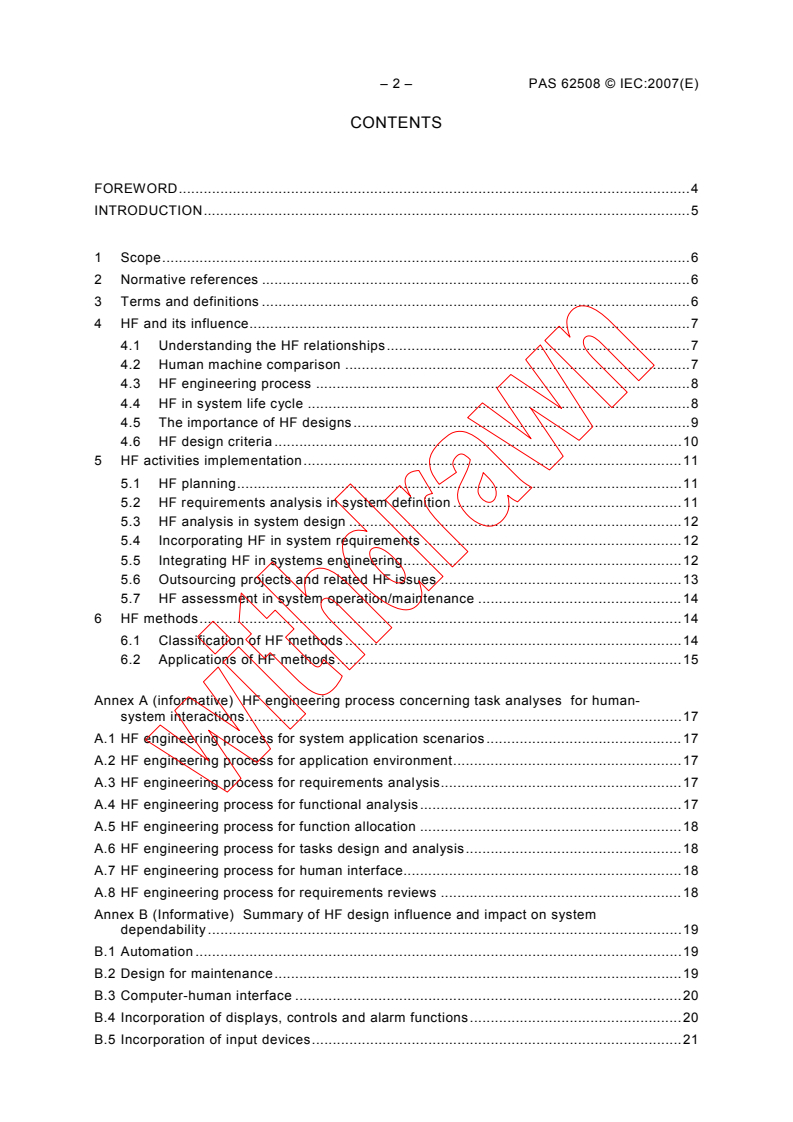
– 2 – PAS 62508 © IEC:2007(E)
CONTENTS
FOREWORD.4
INTRODUCTION.5
1 Scope.6
2 Normative references .6
3 Terms and definitions .6
4 HF and its influence.7
4.1 Understanding the HF relationships.7
4.2 Human machine comparison .7
4.3 HF engineering process .8
4.4 HF in system life cycle .8
4.5 The importance of HF designs.9
4.6 HF design criteria .10
5 HF activities implementation.11
5.1 HF planning.11
5.2 HF requirements analysis in system definition .11
5.3 HF analysis in system design .12
5.4 Incorporating HF in system requirements .12
5.5 Integrating HF in systems engineering.12
5.6 Outsourcing projects and related HF issues .13
5.7 HF assessment in system operation/maintenance .14
6 HF methods.14
6.1 Classification of HF methods .14
6.2 Applications of HF methods.15
Annex A (informative) HF engineering process concerning task analyses for human-
system interactions.17
A.1 HF engineering process for system application scenarios .17
A.2 HF engineering process for application environment.17
A.3 HF engineering process for requirements analysis.17
A.4 HF engineering process for functional analysis.17
A.5 HF engineering process for function allocation .18
A.6 HF engineering process for tasks design and analysis.18
A.7 HF engineering process for human interface.18
A.8 HF engineering process for requirements reviews .18
Annex B (Informative) Summary of HF design influence and impact on system
dependability.19
B.1 Automation .19
B.2 Design for maintenance.19
B.3 Computer-human interface .20
B.4 Incorporation of displays, controls and alarm functions.20
B.5 Incorporation of input devices.21
PAS 62508 © IEC:2007(E) – 3 –
B.6 Environment .21
B.7 Safety.21
B.8 Security.21
Annex C (Informative) Summary of methods for HF analysis, design and development
and test and evaluation .22
C.1 HF analysis methods .22
C.2 HF methods for design and development.24
C.3 HF methods for test and evaluation .25
C.4 Summary of application areas for HF methods.26
Bibliography.27
Figure 1 – Human factors influence in the system life cycle process .9
Table C.1 – Summary of application areas for HF methods .26
– 4 – PAS 62508 © IEC:2007(E)
INTERNATIONAL ELECTROTECHNICAL COMMISSION
____________
GUIDANCE ON HUMAN FACTORS ENGINEERING
FOR SYSTEM LIFE CYCLE APPLICATIONS
FOREWORD
1) The International Electrotechnical Commission (IEC) is a worldwide organization for standardization comprising
all national electrotechnical committees (IEC National Committees). The object of IEC is to promote
international co-operation on all questions concerning standardization in the electrical and electronic fields. To
this end and in addition to other activities, IEC publishes International Standards, Technical Specifications,
Technical Reports, Publicly Available Specifications (PAS) and Guides (hereafter referred to as “IEC
Publication(s)”). Their preparation is entrusted to technical committees; any IEC National Committee interested
in the subject dealt with may participate in this preparatory work. International, governmental and non-
governmental organizations liaising with the IEC also participate in this preparation. IEC collaborates closely
with the International Organization for Standardization (ISO) in accordance with conditions determined by
agreement between the two organizations.
2) The formal decisions or agreements of IEC on technical matters express, as nearly as possible, an international
consensus of opinion on the relevant subjects since each technical committee has representation from all
interested IEC National Committees.
3) IEC Publications have the form of recommendations for international use and are accepted by IEC National
Committees in that sense. While all reasonable efforts are made to ensure that the technical content of IEC
Publications is accurate, IEC cannot be held responsible for the way in which they are used or for any
misinterpretation by any end user.
4) In order to promote international uniformity, IEC National Committees undertake to apply IEC Publications
transparently to the maximum extent possible in their national and regional publications. Any divergence
between any IEC Publication and the corresponding national or regional publication shall be clearly indicated in
the latter.
5) IEC provides no marking procedure to indicate its approval and cannot be rendered responsible for any
equipment declared to be in conformity with an IEC Publication.
6) All users should ensure that they have the latest edition of this publication.
7) No liability shall attach to IEC or its directors, employees, servants or agents including individual experts and
members of its technical committees and IEC National Committees for any personal injury, property damage or
other damage of any nature whatsoever, whether direct or indirect, or for costs (including legal fees) and
expenses arising out of the publication, use of, or reliance upon, this IEC Publication or any other IEC
Publications.
8) Attention is drawn to the Normative references cited in this publication. Use of the referenced publications is
indispensable for the correct application of this publication.
9) Attention is drawn to the possibility that some of the elements of this IEC Publication may be the subject of
patent rights. IEC shall not be held responsible for identifying any or all such patent rights.
A PAS is a technical specification not fulfilling the requirements for a standard but made
available to the public.
IEC-PAS 62508 has been processed by technical committee 56: Dependability.
The text of this PAS is based on the This PAS was approved for
following document: publication by the P-members of the
committee concerned as indicated in
the following document:
Draft PAS Report on voting
56/1163/PAS 56/1184/RVN
Following publication of this PAS, which is a pre-standard publication, the technical committee
or subcommittee concerned will transform it into an International Standard.
This PAS shall remain valid for an initial maximum period of three years starting from
2007-06. The validity may be extended for a single three-year period, following which it shall
be revised to become another type of normative document or shall be withdrawn.
PAS 62508 © IEC:2007(E) – 5 –
INTRODUCTION
This PAS provides technical information on human factors (HF) for engineering and
implementation of systems. It fills the urgent need for an HF standard currently not available
among the ISO or IEC standards.
HF is one of the key system elements that have significant influence on the system design to
achieve dependability performance and service quality. This PAS provides guidance and
criteria to facilitate the incorporation of HF requirements in system development and
operation. It permits practical HF applications and design trade-offs with other key system
hardware and software elements for cost-effective implementation. The technical contents of
this PAS are based on human engineering standards and guidelines established by the FAA
and NASA. Technical approaches and HF methods are adopted from industry best practices
suitable for systems engineering applications.
The HF and human reliability knowledge base covers a broad scope of technical and scientific
work. This PAS focuses on the engineering aspects for HF applications in the system life-
cycle process. It does not address the human reliability issues involving the study of human
anatomy, anthropometry, biomechanics, physiology, and psychology affecting system design
and operation with human interactions.
– 6 – PAS 62508 © IEC:2007(E)
GUIDANCE ON HUMAN FACTORS ENGINEERING
FOR SYSTEM LIFE CYCLE APPLICATIONS
1 Scope
This PAS describes the process on human factors (HF) influencing system dependability
design and provides HF methods and practices applicable to system life-cycle implementation
to achieve dependability performance.
2 Normative references
The following referenced documents are applicable to this document. For dated references,
only the edition cited applies. For undated references, the latest edition of the referenced
document (including any amendments) applies.
IEC 60300-1, Dependability management – Part 1: Dependability management systems
IEC 60300-2, Dependability management – Part 2: Guidelines for dependability management
IEC 60300-3-15, Dependability management – Part 3-15: Guidance to engineering of system
dependability
3 Terms and definitions
For the purposes of this document, the following terms and definitions apply.
3.1
human factors (HF)
knowledge on human abilities, limitations, and other human characteristics that are relevant to
the design and application of products affecting human-system performance
3.2
human factors engineering
application of human factors knowledge to the design of tools, machines, systems, tasks,
jobs, and environment for safe, comfortable, and effective human use
3.3
human reliability
study of human performance in terms of probability that a person will correctly perform some
system-required activity during a given time period (if time is a limiting factor) without
performing any extraneous activity that can degrade the system
NOTE The application of human reliability knowledge is often referred to as human reliability engineering, human
engineering, or human system engineering. It is sometimes used interchangeably as human factors engineering
and the scope of application may vary for each application.
3.4
ergonomics
study of scientific information concerning humans to the design of objects, systems and
environment for human use incorporating elements from many subjects including human
anatomy, physiology, and psychology in the design
NOTE Ergonomics is sometimes used interchangeably as human factors engineering. There are minor differences
in approach.
———————
To be published.
PAS 62508 © IEC:2007(E) – 7 –
4 HF and its influence
4.1 Understanding the HF relationships
The term “HF” is mainly used in North America. The term “ergonomics” is used in Europe and
other parts of the world. HF involves working to make the environment function natural to
human use. Ergonomics is matching the task and product to the human user. Ergonomics and
HF engineering are often used interchangeably in the work environment. Both describe the
interaction between the human user and the task demands, and the human-machine
relationships. The difference between them is that ergonomics focuses on how the task
affects the user, and HF engineering emphasizes the design to reduce the potential of human
error in system operation. It is the HF engineering aspects influencing dependability
performance that needs to be addressed in system dependability standards.
The relationship of HF to system is that humans are often deployed and used in system
functions. The linkage of HF to dependability is that human functions affect the influencing
characteristics of reliability, maintainability and maintenance support in system performance.
Human reliability is related to the field of HF engineering. It refers to the study of reliability of
humans in various fields such as information processing, manufacturing, transportation,
medicine and service operation. Human performance can be affected by many factors such as
age, circadian rhythms, state of mind, physical health, attitude, emotions, propensity for
certain common mistakes such as errors and cognitive biases.
The broader issues concerning the study of human reliability are directly linked to the possible
adverse consequences of human errors or oversights, especially when the human is engaged
in a crucial part of a complex system for safety, security or mission critical applications
involving human machine and human system interactions. HF engineering utilizes the human
reliability knowledge base for application in user-centric and error-tolerant designs by
adapting appropriate technologies to enhance human-system operation.
4.2 Human machine comparison
The following presents an overview of human versus machine abilities for comparison.
Although rapid advances in technologies have significantly increased the machine abilities,
this overview presents a classical observation that remains valid in the HF field.
Humans surpass machines in
• ability to detect small amount of visual and acoustic energy;
• ability to perceive patterns of light or sound;
• ability to improvise and use flexible procedures;
• ability to store very large amounts of information for long periods and to recall relevant
facts at the appropriate time;
• ability to reason inductively;
• ability to exercise judgement.
Machines surpass humans in
• ability to respond quickly to control signals and to apply great force smoothly and
precisely;
• ability to perform repetitive and routine tasks;
• ability to store information briefly and then to erase it completely;
• ability to reason deductively, including computational ability;
• ability to handle highly complex operations;
– 8 – PAS 62508 © IEC:2007(E)
• ability to do many different things at once.
The major differences between humans and machines are as follows.
• Machines can be modified, redesigned, and retrofit whereas humans cannot. Humans are
born with innate, genetically determined differences that are shaped by the environment.
Innate aptitudes or abilities are developed through education and training.
• Machines can be manufactured to be identical to provide exact output and duplicate
precise operation. Humans are not identical and vary across all sensory, cognitive,
physical and performance characteristics. Specific aspects of human performance can be
made more equal through education and training.
4.3 HF engineering process
HF engineering involves the process of engineering the human into systems. The inclusion of
humans in systems has the advantage of the human’s intuitive reaction, flexibility to adapt to
situations, and the capability of performing many functions and tasks. However, human has
limitations in cognitive and physical capabilities for task performance. The inherent qualities in
the human element as a system attribute can be exploited for design trade-offs with
interacting hardware and software elements contributing in a holistic manner to enhance
system performance. The aim is to maximize the overall system capabilities in performance
operation.
Involvement of HF engineering at early design stages has extensive influence to maximizing
the return on investments and optimizing the system capabilities in performance operation.
The critical impact areas for HF engineering participation in system design and operation
include
• early identification of critical system functions that are considered suitable and
advantageous for human interaction by analysis of system operating scenario;
• user-oriented task designs for timing and operating task sequence through HF engineering
activity in system decomposition and functional analysis for ease and expediency in
human-machine operation;
• consideration of human capabilities and limitations when making function allocation
decisions for cost-effective application and training needs;
• integrating the human requirements into the system design process for optimizing the
system performance compatibility of human-machine interface and interoperability;
• the process of engineering human into systems includes task analyses of the systems
engineering process and the HF engineering process. The relevant tasks, decisions, and
information common between the two processes can be used as basis to identify areas of
interactions between the human and the system.
Annex A provides additional information on the HF engineering process concerning task
analyses for human system interactions.
4.4 HF in system life cycle
HF as a technical discipline is closely associated with systems engineering and system life-
cycle process. The system life cycle concept adopted from IEC 60300-3-15 is shown in Figure
1 to identify the key HF influence in the system life cycle. The system life-cycle stages are
briefly described as follows.
The concept/definition stage is to identify the market needs, define/identify the operational
use environment/timeline, define preliminary system requirements and confirm feasible design
solutions by producing technical specifications for the system design.
The design/development stage is to plan and execute selected engineering design solutions
for realization of system functions.
PAS 62508 © IEC:2007(E) – 9 –
Realization/implementation stage is to execute make-buy decisions for acquisition and
deployment of subsystem elements.
The operation/maintenance stage is used to deploy the system for delivery of service and to
support system operational capability by means of maintenance.
The enhancement stage is to improve system performance with added features to meet
growing user demands on the system.
The retirement/decommissioning stage is to end the existence of the system entity.
Retirement/
Decommission
Enhancement
Concept/
Definition
Design/
Operation/Maintenance
Development
•HF issues
Realization/
related to
Implementation
disposals,
recycling, and
•Define HF
reuse
objectives
•Operation/
•Analyze HF
maintenance
requirements
•Skills training
records
•Health and safety
•Allocate HF •Corrective/ •Review in-service
awareness
functions HF performance
preventive actions
•Implement fault
•HF design for •Incidents •Process
management procedures
usability and improvements
reporting
•Regulatory compliance
compatibility •HF error analysis
Figure 1 – Human factors influence in the system life-cycle process
4.5 The importance of HF designs
The HF activities complement the dependability projects and work programmes. Dependability
is the ability of a system to perform as and when required to meet specific objectives.
Dependability describes the availability performance of a system influenced by its
performance characteristics of reliability, maintainability and maintenance support. The
principles of dependability management are presented in IEC 60300-1. The applications of
dependability management techniques are described in IEC 60300-2.
HF activities have significant impact on system dependability design and performance
operation. The HF issues when identified and applied early in the system life-cycle design
process would
• increase productivity, improve performance, and gain greater user satisfaction;
• reduce errors in design and operation;
• simplify system operation and maintenance procedures;
• reduce time in user support;
• reduce the need for special skills training;
• reduce risks of serious accidents;
– 10 – PAS 62508 © IEC:2007(E)
• result in cost avoidance and optimize life-cycle costs.
4.6 HF design criteria
The premise for HF design and operation related to safety, security or mission critical
application of complex systems is to avoid catastrophic impact and negative consequences.
HF standardization facilitates system integration, enhances interoperability of system
elements, and improves serviceability and overall dependability performance.
The HF design criteria are based on the following.
a) Fitness for use
• Make system durable, reliable and applicable for its intended use.
• Allocate functions appropriately.
• Test with users.
b) Simplicity
• Design for simplicity.
• Minimize training.
• Make functions obvious.
c) Consistency
• Make design consistent.
• Be consistent with user experience with real life objects and similar system.
d) Standardization
• Standardize hardware and software.
• Maintain identical interfaces for identical functions.
• Make controls, displays, markings, coding, labelling, and arrangement uniform.
• Make appearance distinctive.
• Standardize terminology, look, and feel.
• Make functionally similar equipment interchangeable.
e) Safety
• Incorporate safety factors.
• Provide fail-safe design.
• Make system error resistant and tolerant.
• Warning of potentially unsafe actions.
• Provide emergency procedures.
f) User-centred perspective
• Provide timely and informative feedback.
• Use familiar terms and images.
• Design within user abilities.
• Maximize human performance.
• Minimize training requirements.
• Facilitate transfer of skills.
• Accommodate physical diversity.
g) Maintenance support
• Provide logistic support where needed.
PAS 62508 © IEC:2007(E) – 11 –
• Design for common tools.
• Make system easy to maintain and accessible.
Annex B summarizes the HF design influence and impact on system dependability.
5 HF activities implementation
5.1 HF planning
A HF plan is essential to establish a strategy for managing HF effort to support system
development and operation. The objective is to address HF issues to improve total system
performance and reduce developmental and life-cycle costs. This is achieved by optimizing
human performance when the system is operated and maintained in the application
environment. The planning approach should consider
• identifying the target system of interest and application environment;
• identifying legacy issues of existing system in enhancement projects;
• focusing on the tasks with human involvement in the system life cycle;
• early identification and resolution of human performance issues;
• assigning HF specialists responsible for activities coordination;
• determining the human capabilities and limitations for appropriate task designs;
• establishing a strategy for task implementation involving human interactions;
• project tailoring for system integration;
• incorporation of assurance provisions and review process.
An HF plan should be developed in early concept/definition stage of the system life cycle to
maximize its effectiveness to influence system definition and framework development. The HF
plan should be part of the system overall plan.
5.2 HF requirements analysis in system definition
HF requirements definition is needed for application scenario and mission analysis of the
system of interest. This activity gathers essential information to develop system requirements,
prepare cost-benefit and risk analyses, and develop plans, specifications, and statement of
work. The HF requirements analysis provides the necessary information and relevant data to
• determine HF issues in system application and operating scenario;
• integrate HF principles into the system context;
• tailor the project to HF content in the system;
• establish HF plan and strategy.
The objective is to achieve a human-centred, error-resistant and tolerant system framework
that is suitable and usable for effective system operation. HF requirements should address
• human-system interfaces influencing user performance efficiency and effectiveness;
• system architecture design affecting the human-system interactions;
• interoperability of system elements consisting of hardware, software and humans;
• system application environment impacting human resources and requirements.
The HF requirements analysis should be conducted in conjunction with the HF plan during the
concept/definition stage of the system life cycle. This facilitates the tailoring process working
to meet specific project needs in system definition. The project tailoring process is described
in IEC 60300-2.
– 12 – PAS 62508 © IEC:2007(E)
5.3 HF analysis in system design
HF analysis in system design is conducted during the design/development stage of the
system life cycle. The objective is to ensure that
• human system capabilities and limitations are properly reflected in the system
requirements;
• human system performance characteristics are providing relevant information to identify
design options and alternatives;
• human system performance risks and cost impacts are appropriately addressed.
The HF analysis approach should consider
• human performance such as human capabilities and limitations, workload, function
allocation, hardware and software design, decision aids, environmental constraints, and
team versus individual performance;
• training needs such as duration of training, training effectiveness, skills retraining, training
devices and facilities, and embedded training;
• staffing requirements such as staffing levels, team composition, and organizational
structure;
• personnel selection such as minimum skill levels, special skills, competency and
experience;
• health and safety issues such as hazardous materials and conditions, system and
equipment design for safe operation, operational and procedural constraints, biomedical
influences, protective equipment, and warnings and alarms requirements.
5.4 Incorporating HF in system requirements
The purpose of incorporating HF in system requirements is to
• provide HF inputs to development of system specifications;
• include HF requirements in quality assurance process;
• include HF requirements for outsourcing and subcontracting;
• establish HF procedures for system operation and maintenance.
For human performance influencing the system design and application, the system
specifications and operation and maintenance procedures should consider
• staffing constraints;
• system operator and maintainer skills;
• training requirements;
• level of comprehension of the end users.
Incorporation of HF requirements in system specifications should be completed during the
design/development stage of the system life cycle.
5.5 Integrating HF in systems engineering
The purpose of integrating HF in systems engineering is to
• develop or enhance human-system interface;
• achieve human performance design objective and effectiveness in system operation and
maintenance support;
• establish system operating scenario;
• optimize utilization of personnel resources, skills, training, and costs;
PAS 62508 © IEC:2007(E) – 13 –
• address resource allocation for automation and for task simplification;
• incorporate HF needs in system enhancement and retirement, equipment assembly and
disassembly, and disposal of parts.
Integrating HF in systems engineering is done throughout the system life cycle, especially
during the design/development, realization/implementation and operation/maintenance
stages, where HF has the most influence on systems engineering tasks related to design
enhancements, safety features, automation impacts, human-system performance trade-offs,
ease of use, and workload.
Specific systems engineering activities related to HF include
• systems engineering planning and incorporation of HF requirements to identify critical
issues for technical resolution;
• development of system design configuration based on functional analysis and function
allocation contributed by human elements, and HF task design trade-offs with hardware
and software system functions;
• task analysis to determine the information flow and processing requirements by operators,
maintainers, and end users to accomplish the system performance objectives;
• test and evaluation of system functions involving human interactions to determine
operational effectiveness and conformance to established HF requirements and system
performance criteria.
5.6 Outsourcing projects and related HF issues
The HF requirements should be incorporated in system specifications and procurement
documents. This is crucial for the system to achieve its objectives for coherent design and
consistent performance involving proper function allocation and interactions of hardware,
software and human elements in system design and operation. The outsourcing of
subsystems development requiring human operation is common in today’s complex system
development and enhancement projects. Incorporation of commercial-off-the-shelf (COTS)
products as system functions often has cost benefits. System support services are frequently
used for contract maintenance. The success factors are dependent on the collaborative
efforts of the acquirers and suppliers, the system integrators and service providers through
application of supply-chain management and quality assurance processes. Since HF involves
multi-disciplinary actions, technical experts are sometimes required to deal with resolution of
critical HF issues related to outsourcing and procurement needs.
Outsourcing HF projects should consider
• human system interface requirements to achieve the level of human performance during
system operation and maintenance;
• maximizing the economical demands on utilization of available human resources, skills,
and training;
• staffing implications of the human resources required, job classification, skill levels, and
experience needed for the projects;
• evaluation for design automation trade-off with human operation in terms of applicability,
efficiency and cost implications;
• potential system safety and health hazards areas involving human-system interactions;
• quality assurance provisions for procurement contracts.
Outsourcing projects should be identified during concept/definition stage of the system life
cycle. The procurement contracts should be well established at the completion of the
design/development stage. This would permit time for subcontractor evaluation, multiple
sourcing of preferred suppliers, and COTS product assessment for incorporation as system
functions to facilitate the system integration process.
– 14 – PAS 62508 © IEC:2007(E)
5.7 HF assessment in system operation/maintenance
HF assessment in system operation/maintenance is to ensure that HF considerations are
adequately integrated into the system for effective performance operation. The assessment is
conducted during the operation/maintenance stage of the system life cycle. The assessment
is achieved by system testing and performance verification. This is to produce evidence of
conformance to HF requirements in an application environment. The HF assessment process
should
• measure human performance in critical tasks;
• determine efficiency and effectiveness of human intervention;
• maintain HF test records and assessment data as basis for evaluation and improvement.
Human performance testing of COTS products should take advantage of available information
from the product manufacturers, records of warranty returns, previous commercial testing, and
product use experience.
The HF assessment results should be analyzed to support recommendations in design
changes where appropriate, provide rationale for human performance improvements, or
implement training solutions. The HF information flow should include sharing with Integrated
logistics support (ILS) programmes where applicable. ILS is a disciplined approach to
integrate support considerations into design, to acquire the necessary initial support for the
system, and to identify life-cycle support requirements. The HF programme provides the
human resource and performance dimension for logistics support requirements and functions.
Close coordination between the HF and ILS programs will reduce data redundancies and
result in more effective use and sharing of information.
6 HF methods
6.1 Classification of HF methods
HF methods are classified as follows.
a) HF analysis methods
HF analysis methods are used to define system concepts, describe application/mission
scenarios, determine functional requirements, and assign tasks for appropriate skills
allocation. The various analyses provide a means for identifying HF-related goals, objectives,
critical design issues, and further evaluation needs to meet system performance requirements
involving human interactions.
b) HF methods for design and development
HF methods for design and development are used to incorporate all necessary HF design
criteria into the human system interface design. The human system interface includes system
hardware, software, procedures, work environments, and facilities associated with the system
functions requiring human interactions. The process is to convert the results of the HF
analysis activities into HF training and skill level design criteria for HF project development
and implementation.
c) HF methods for test and evaluation
HF methods for test and evaluation are used to verify human system interface and procedures
to ensure that the system can be operated, maintained, supported, and controlled in its
intended operating environment by the users. These methods facilitate identification of critical
HF issues in operation and maintenance for problem resolution and process improvement.
Annex C provides a summary of practical methods for HF analysis, evaluation and
assessment.
PAS 62508 © IEC:2007(E) – 15 –
6.2 Applications of HF methods
The HF methods for general analysis, evaluation and assessment applications are based on
systems engineering techniques. They should be used in conjunction with other engineering
methods and technical disciplines in system design and implementation. The HF methods
listed in Annex C facilitate the accomplishments of one or more of the following tasks.
1) Application/mission effectiveness criteria.
2) Detailed design requirements.
3) Concepts formulation ideas.
4) Personnel requirements information.
5) Operational procedures development.
6) Training system development.
7) Maintenance system development.
8) System operational evaluation.
9) Additional HF analysis.
Other application areas related to implementation of HF activities include
a) HF planning
• project management;
• cost-benefits and risk analysis;
• decision-making process.
b) Human-system performance assessment
• situation assessment;
• function allocation;
• cognitive assessment.
c) modelling and simulation
• human performance modelling;
• information flow analysis and simulation;
• human-machine integrated design and analysis system.
d) human computer interaction
• human computer mock-up;
• diagnostic evaluation;
• cognitive walkthrough;
• usability inspection.
e) knowledge elicitation
• cognitive task analysis;
• interview, questionnaire, and observation.
f) physical ergonomics
• empirical models;
• standards.
g) safety
• accident investigation;
• human error;
– 16 – PAS 62508 © IEC:2007(E)
• human reliability;
• risk assessment.
HF tools are mostly developed for specific applications. They often incorporate experienced
database and custom design criteria in dedicated computerized systems. These HF tools are
upgraded or changed to meet specific application needs which become difficult for generic
application purposes. They are referenced in various literatures and not included in this PAS.
PAS 62508 © IEC:2007(E) – 17 –
Annex A
(Informative)
HF engineering process concerning task analyses
for human system interactions
A.1 HF engineering process for system application scenarios
System inputs HF engineering outputs
• System scenarios • Estimate of staffing requirements
• Mission profiles and timelines • Verification of workload and task
assignments
• Concept of system operations
• Evaluation of skills and training
• Technology limitations
requirements
• Regulatory constraints
• Identification of potential problem areas
• Legacy issues related to operation and maintenance
A.2 HF engineering process for application environment
System inputs HF engineering outputs
• Natural environmental conditions • Effects of predicted natural
(weather, topology, time of day) environmental conditions
• Induced environmental conditions • Design constraints reflecting the natural
(lighting, noise, vibration, induced heat) environmental conditions
• Strategies to mitigate environmental
impact on users
A.3 HF engineering process for requirements analysis
System inputs HF engineering outputs
• Source requirements and application • Users’ knowledge, skills and abilities to
constraints perform tasks
• Human capabilities and limitations • Human performance requirements in
terms of time for task completion and
• System capabilities and limitations
competency required
• HF engineering design requirements to
support operators and maintainers
• Knowledge and experience database
establishment
A.4 HF engineering process for functional analysis
System inputs HF engineering outputs
• Mission analysis • Functional flow diagrams
• Activity analysis • Functional architecture
• Requirements analysis • Critical functions identification
• Decision actions
• Design characteristics to support users
– 18 – P
...
Questions, Comments and Discussion
Ask us and Technical Secretary will try to provide an answer. You can facilitate discussion about the standard in here.
Loading comments...