

IEC 60300-3-14:2024
(Main)Dependability management - Part 3-14: Application guide - Supportability and support
General Information
- Abstract
IEC 60300-3-14:2024 introduces the dependability attribute of supportability (and support) and the relationship with related dependability attributes of reliability, maintainability and availability.
This document can be used at any time during an item’s life to guide the planning and implementing of supportability and support activities focused on achieving an intended balance of performance, cost and risk. All activities can be tailored to the nature of the item and its conditions of use.
Guidance is offered on how supportability and support activities can be applied at any life cycle stage for newly designed items, existing items available for commercial procurement, or for items during their operational life.
This document considers the life cycle implications by formally managing risks associated with the management and delivery of activities to create, operate, maintain and refurbish an item to achieve its stated purpose.
This document describes the:
- nature of supportability and support;
- role of supportability and support in achieving item value over its life;
- trade-offs associated with supportability and support to achieve desired balance of cost, performance and risk during the life of an item;
- importance of aligning the structure of an organization with its objectives, with the ultimate aim of improving efficiency and effectiveness in order to deliver the required supportability and support.
This second edition cancels and replaces the first edition published in 2004. This edition constitutes a technical revision.
This edition includes the following significant technical changes with respect to the previous edition:
a) consistency with the other core dependability standards prepared by IEC TC 56;
b) expansion of supportability and support principles and activities in dependability.
- Status
- Published
- Publication Date
- 08-Aug-2024
- Technical Committee
- TC 56 - Dependability
- Drafting Committee
- MT 23 - TC 56/MT 23
- Current Stage
- PPUB - Publication issued
- Start Date
- 09-Aug-2024
- Completion Date
- 09-Aug-2024
Overview
IEC 60300-3-14:2024 is an international standard published by the International Electrotechnical Commission (IEC) that provides practical guidance on supportability management and support in the context of dependability. This document is part of the IEC 60300 dependability management series and introduces the concept of supportability as a key attribute alongside reliability, maintainability, and availability.
Supportability is the ability of an item to be effectively supported so it can perform as required throughout its useful life. The standard addresses the planning and implementation of support and supportability activities at any stage of an item's lifecycle - from concept and design to operation, refurbishment, and disposal. By formally managing risk and assessing trade-offs in cost, performance, and operational requirements, stakeholders can achieve optimal value, efficiency, and resilience for equipment, systems, and processes.
Key Topics
Supportability and Support Concepts
- Explains the nature and role of supportability in achieving dependable, high-performing products and systems.
- Describes how supportability interacts with related attributes: reliability, maintainability, and overall availability.
Lifecycle Approach
- Guidance for applying supportability principles at every life cycle stage: design, development, realization, operation, and disposal.
- Emphasizes the importance of risk management and continuous improvement in support solutions.
Planning and Implementation
- Detailed approaches to defining supportability requirements, selecting appropriate support measures, and aligning organizational resources.
- Insights into balancing cost, risk, and performance through effective support activities.
Organizational Alignment
- The need to structure support functions and processes to improve efficiency and effectiveness.
- Recommendations for aligning support capabilities with business objectives for long-term asset value.
Technical Changes in the 2024 Edition
- Greater consistency with other core IEC dependability standards.
- Expanded coverage of supportability and support principles.
Applications
IEC 60300-3-14:2024 is applicable across diverse industries and sectors, wherever product or system dependability and lifecycle optimization are critical. Typical applications include:
Design & Engineering
- Designing for supportability ensures equipment and systems are easier and more cost-effective to maintain and operate over time.
- Enhances resilience by ensuring resources, spares, and information are available when needed.
Asset Management
- Supports lifecycle management of assets through structured support and maintenance planning, reducing total cost of ownership.
Operations & Maintenance
- Improves reliability and uptime with robust support processes, effective documentation, and access to trained personnel and tools.
Procurement & Supply Chain
- Informs decisions regarding off-the-shelf, modified, or custom solutions based on supportability metrics and requirements.
- Helps in supplier selection, spares management, and contract support arrangements.
Sustainability & Circular Economy
- Promotes sustainable lifecycle practices such as refurbishing, recycling, and reducing obsolescence risk.
Related Standards
For a comprehensive approach to dependability management, consider these IEC standards:
- IEC 60300-1: Dependability management – Overview and management of dependability activities.
- IEC 60300-3-4: Guidance on writing and verifying dependability requirements in specifications.
- IEC 60300-3-10: Application guide for maintainability – how to analyze and assure maintainability.
- IEC 60050-192: International Electrotechnical Vocabulary – Reliability, availability, maintainability, and supportability definitions.
Summary
Implementing IEC 60300-3-14:2024 enables organizations to achieve effective supportability and support strategies. By integrating dependability attributes with lifecycle management, stakeholders benefit from improved efficiency, risk reduction, cost optimization, and enhanced customer confidence in facilities, systems, and products. For further details or to obtain the standard, visit the IEC Webstore.
Relations
- Effective Date
- 05-Sep-2023
Get Certified
Connect with accredited certification bodies for this standard

BSI Group
BSI (British Standards Institution) is the business standards company that helps organizations make excellence a habit.

Bureau Veritas
Bureau Veritas is a world leader in laboratory testing, inspection and certification services.

DNV
DNV is an independent assurance and risk management provider.
Sponsored listings
Frequently Asked Questions
IEC 60300-3-14:2024 is a standard published by the International Electrotechnical Commission (IEC). Its full title is "Dependability management - Part 3-14: Application guide - Supportability and support". This standard covers: IEC 60300-3-14:2024 introduces the dependability attribute of supportability (and support) and the relationship with related dependability attributes of reliability, maintainability and availability. This document can be used at any time during an item’s life to guide the planning and implementing of supportability and support activities focused on achieving an intended balance of performance, cost and risk. All activities can be tailored to the nature of the item and its conditions of use. Guidance is offered on how supportability and support activities can be applied at any life cycle stage for newly designed items, existing items available for commercial procurement, or for items during their operational life. This document considers the life cycle implications by formally managing risks associated with the management and delivery of activities to create, operate, maintain and refurbish an item to achieve its stated purpose. This document describes the: - nature of supportability and support; - role of supportability and support in achieving item value over its life; - trade-offs associated with supportability and support to achieve desired balance of cost, performance and risk during the life of an item; - importance of aligning the structure of an organization with its objectives, with the ultimate aim of improving efficiency and effectiveness in order to deliver the required supportability and support. This second edition cancels and replaces the first edition published in 2004. This edition constitutes a technical revision. This edition includes the following significant technical changes with respect to the previous edition: a) consistency with the other core dependability standards prepared by IEC TC 56; b) expansion of supportability and support principles and activities in dependability.
IEC 60300-3-14:2024 introduces the dependability attribute of supportability (and support) and the relationship with related dependability attributes of reliability, maintainability and availability. This document can be used at any time during an item’s life to guide the planning and implementing of supportability and support activities focused on achieving an intended balance of performance, cost and risk. All activities can be tailored to the nature of the item and its conditions of use. Guidance is offered on how supportability and support activities can be applied at any life cycle stage for newly designed items, existing items available for commercial procurement, or for items during their operational life. This document considers the life cycle implications by formally managing risks associated with the management and delivery of activities to create, operate, maintain and refurbish an item to achieve its stated purpose. This document describes the: - nature of supportability and support; - role of supportability and support in achieving item value over its life; - trade-offs associated with supportability and support to achieve desired balance of cost, performance and risk during the life of an item; - importance of aligning the structure of an organization with its objectives, with the ultimate aim of improving efficiency and effectiveness in order to deliver the required supportability and support. This second edition cancels and replaces the first edition published in 2004. This edition constitutes a technical revision. This edition includes the following significant technical changes with respect to the previous edition: a) consistency with the other core dependability standards prepared by IEC TC 56; b) expansion of supportability and support principles and activities in dependability.
IEC 60300-3-14:2024 is classified under the following ICS (International Classification for Standards) categories: 03.100.40 - Research and development; 03.120.01 - Quality in general. The ICS classification helps identify the subject area and facilitates finding related standards.
IEC 60300-3-14:2024 has the following relationships with other standards: It is inter standard links to IEC 60300-3-14:2004. Understanding these relationships helps ensure you are using the most current and applicable version of the standard.
IEC 60300-3-14:2024 is available in PDF format for immediate download after purchase. The document can be added to your cart and obtained through the secure checkout process. Digital delivery ensures instant access to the complete standard document.
Standards Content (Sample)
IEC 60300-3-14 ®
Edition 2.0 2024-08
INTERNATIONAL
STANDARD
NORME
INTERNATIONALE
Dependability management –
Part 3-14: Application guide – Supportability and support
Gestion de la sûreté de fonctionnement –
Partie 3-14: Guide d’application – Supportabilité et soutien
All rights reserved. Unless otherwise specified, no part of this publication may be reproduced or utilized in any form
or by any means, electronic or mechanical, including photocopying and microfilm, without permission in writing from
either IEC or IEC's member National Committee in the country of the requester. If you have any questions about IEC
copyright or have an enquiry about obtaining additional rights to this publication, please contact the address below or
your local IEC member National Committee for further information.
Droits de reproduction réservés. Sauf indication contraire, aucune partie de cette publication ne peut être reproduite ni
utilisée sous quelque forme que ce soit et par aucun procédé, électronique ou mécanique, y compris la photocopie et
les microfilms, sans l'accord écrit de l'IEC ou du Comité national de l'IEC du pays du demandeur. Si vous avez des
questions sur le copyright de l'IEC ou si vous désirez obtenir des droits supplémentaires sur cette publication, utilisez
les coordonnées ci-après ou contactez le Comité national de l'IEC de votre pays de résidence.
IEC Secretariat Tel.: +41 22 919 02 11
3, rue de Varembé info@iec.ch
CH-1211 Geneva 20 www.iec.ch
Switzerland
About the IEC
The International Electrotechnical Commission (IEC) is the leading global organization that prepares and publishes
International Standards for all electrical, electronic and related technologies.
About IEC publications
The technical content of IEC publications is kept under constant review by the IEC. Please make sure that you have the
latest edition, a corrigendum or an amendment might have been published.
IEC publications search - webstore.iec.ch/advsearchform IEC Products & Services Portal - products.iec.ch
The advanced search enables to find IEC publications by a Discover our powerful search engine and read freely all the
variety of criteria (reference number, text, technical publications previews, graphical symbols and the glossary.
committee, …). It also gives information on projects, replaced With a subscription you will always have access to up to date
and withdrawn publications. content tailored to your needs.
IEC Just Published - webstore.iec.ch/justpublished
Electropedia - www.electropedia.org
Stay up to date on all new IEC publications. Just Published
The world's leading online dictionary on electrotechnology,
details all new publications released. Available online and once
containing more than 22 500 terminological entries in English
a month by email.
and French, with equivalent terms in 25 additional languages.
Also known as the International Electrotechnical Vocabulary
IEC Customer Service Centre - webstore.iec.ch/csc
(IEV) online.
If you wish to give us your feedback on this publication or need
further assistance, please contact the Customer Service
Centre: sales@iec.ch.
A propos de l'IEC
La Commission Electrotechnique Internationale (IEC) est la première organisation mondiale qui élabore et publie des
Normes internationales pour tout ce qui a trait à l'électricité, à l'électronique et aux technologies apparentées.
A propos des publications IEC
Le contenu technique des publications IEC est constamment revu. Veuillez vous assurer que vous possédez l’édition la
plus récente, un corrigendum ou amendement peut avoir été publié.
Recherche de publications IEC - IEC Products & Services Portal - products.iec.ch
webstore.iec.ch/advsearchform Découvrez notre puissant moteur de recherche et consultez
La recherche avancée permet de trouver des publications IEC gratuitement tous les aperçus des publications, symboles
en utilisant différents critères (numéro de référence, texte, graphiques et le glossaire. Avec un abonnement, vous aurez
comité d’études, …). Elle donne aussi des informations sur les toujours accès à un contenu à jour adapté à vos besoins.
projets et les publications remplacées ou retirées.
Electropedia - www.electropedia.org
IEC Just Published - webstore.iec.ch/justpublished
Le premier dictionnaire d'électrotechnologie en ligne au monde,
Restez informé sur les nouvelles publications IEC. Just
avec plus de 22 500 articles terminologiques en anglais et en
Published détaille les nouvelles publications parues.
français, ainsi que les termes équivalents dans 25 langues
Disponible en ligne et une fois par mois par email.
additionnelles. Egalement appelé Vocabulaire
Electrotechnique International (IEV) en ligne.
Service Clients - webstore.iec.ch/csc
Si vous désirez nous donner des commentaires sur cette
publication ou si vous avez des questions contactez-nous:
sales@iec.ch.
IEC 60300-3-14 ®
Edition 2.0 2024-08
INTERNATIONAL
STANDARD
NORME
INTERNATIONALE
Dependability management –
Part 3-14: Application guide – Supportability and support
Gestion de la sûreté de fonctionnement –
Partie 3-14: Guide d’application – Supportabilité et soutien
INTERNATIONAL
ELECTROTECHNICAL
COMMISSION
COMMISSION
ELECTROTECHNIQUE
INTERNATIONALE
ICS 03.100.40, 03.120.01 ISBN 978-2-8322-9382-9
– 2 – IEC 60300-3-14:2024 © IEC 2024
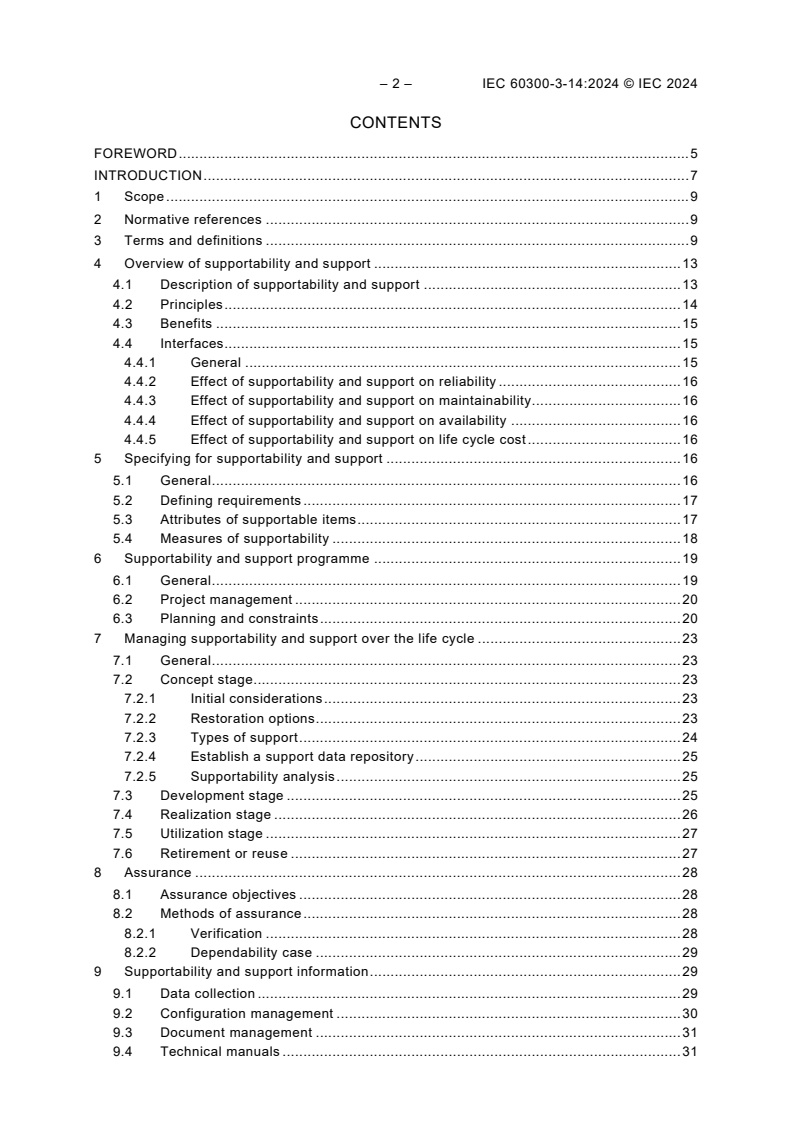
CONTENTS
FOREWORD . 5
INTRODUCTION . 7
1 Scope . 9
2 Normative references . 9
3 Terms and definitions . 9
4 Overview of supportability and support . 13
4.1 Description of supportability and support . 13
4.2 Principles . 14
4.3 Benefits . 15
4.4 Interfaces . 15
4.4.1 General . 15
4.4.2 Effect of supportability and support on reliability . 16
4.4.3 Effect of supportability and support on maintainability . 16
4.4.4 Effect of supportability and support on availability . 16
4.4.5 Effect of supportability and support on life cycle cost . 16
5 Specifying for supportability and support . 16
5.1 General . 16
5.2 Defining requirements . 17
5.3 Attributes of supportable items . 17
5.4 Measures of supportability . 18
6 Supportability and support programme . 19
6.1 General . 19
6.2 Project management . 20
6.3 Planning and constraints . 20
7 Managing supportability and support over the life cycle . 23
7.1 General . 23
7.2 Concept stage . 23
7.2.1 Initial considerations . 23
7.2.2 Restoration options . 23
7.2.3 Types of support . 24
7.2.4 Establish a support data repository . 25
7.2.5 Supportability analysis . 25
7.3 Development stage . 25
7.4 Realization stage . 26
7.5 Utilization stage . 27
7.6 Retirement or reuse . 27
8 Assurance . 28
8.1 Assurance objectives . 28
8.2 Methods of assurance . 28
8.2.1 Verification . 28
8.2.2 Dependability case . 29
9 Supportability and support information . 29
9.1 Data collection . 29
9.2 Configuration management . 30
9.3 Document management . 31
9.4 Technical manuals . 31
9.4.1 General . 31
9.4.2 Development of a technical manual . 33
9.4.3 Evaluation . 34
9.4.4 Amendment of documentation . 34
9.4.5 Event reporting . 34
9.4.6 Communication . 34
10 Resource management . 35
10.1 Provision of resources . 35
10.2 Human resources . 35
10.3 Training . 35
10.4 Support equipment . 36
10.4.1 General . 36
10.4.2 Types of support equipment . 36
10.4.3 Selection of support equipment . 37
10.4.4 Support equipment data . 37
10.4.5 Automatic test equipment . 37
10.4.6 Calibration . 38
10.4.7 Repair of support equipment . 38
10.4.8 Built-in test equipment (BITE) . 38
10.5 Support facilities . 39
10.5.1 Work area facilities . 39
10.5.2 Administration and technical facilities . 39
10.5.3 Facilities for computerized support information systems . 39
10.6 Spare parts and consumables . 40
10.6.1 General . 40
10.6.2 Spare parts’ quality . 40
10.6.3 Spare parts’ quantification . 41
10.6.4 Spare parts’ identification . 42
Annex A (informative) Maintenance types influencing supportability and support . 43
A.1 General . 43
A.2 Repair whilst the essential functions of the system continue to operate . 43
A.2.1 Redundancy of a part . 43
A.2.2 Standby redundancy . 43
A.2.3 Redundancy for a subsystem . 43
A.2.4 Redundancy for a defined time period . 44
A.2.5 Maintenance during low performance demand or dwell time . 44
A.3 Maintenance when the system is not operating . 44
A.3.1 Planned stoppage . 44
A.3.2 Operate to failure . 45
Annex B (Informative) Supportability and support analysis . 46
B.1 Techniques associated with supportability analysis . 46
B.2 Feasibility estimation . 46
B.3 Allocation . 47
B.4 Prediction . 47
B.5 Detailed analysis approach . 48
B.6 Costs considered during the detailed analysis approach . 48
B.6.1 Individual costs . 48
B.6.2 Cost interactions . 50
B.6.3 Cost comparison examples . 50
– 4 – IEC 60300-3-14:2024 © IEC 2024
Annex C (informative) Economic ordering of replacements . 53
C.1 Performance and specification considerations . 53
C.2 Continuous ordering of spare parts . 53
C.3 Batch ordering of spare parts . 53
Annex D (informative) Example of support delay times and other associated times . 55
D.1 Example timeline . 55
D.2 Delay time assessments . 56
Bibliography . 57
Figure 1 – Spare parts provisioning process . 42
INTERNATIONAL ELECTROTECHNICAL COMMISSION
____________
DEPENDABILITY MANAGEMENT –
Part 3-14: Application guide – Supportability and support
FOREWORD
1) The International Electrotechnical Commission (IEC) is a worldwide organization for standardization comprising
all national electrotechnical committees (IEC National Committees). The object of IEC is to promote international
co-operation on all questions concerning standardization in the electrical and electronic fields. To this end and
in addition to other activities, IEC publishes International Standards, Technical Specifications, Technical Reports,
Publicly Available Specifications (PAS) and Guides (hereafter referred to as “IEC Publication(s)”). Their
preparation is entrusted to technical committees; any IEC National Committee interested in the subject dealt with
may participate in this preparatory work. International, governmental and non-governmental organizations liaising
with the IEC also participate in this preparation. IEC collaborates closely with the International Organization for
Standardization (ISO) in accordance with conditions determined by agreement between the two organizations.
2) The formal decisions or agreements of IEC on technical matters express, as nearly as possible, an international
consensus of opinion on the relevant subjects since each technical committee has representation from all
interested IEC National Committees.
3) IEC Publications have the form of recommendations for international use and are accepted by IEC National
Committees in that sense. While all reasonable efforts are made to ensure that the technical content of IEC
Publications is accurate, IEC cannot be held responsible for the way in which they are used or for any
misinterpretation by any end user.
4) In order to promote international uniformity, IEC National Committees undertake to apply IEC Publications
transparently to the maximum extent possible in their national and regional publications. Any divergence between
any IEC Publication and the corresponding national or regional publication shall be clearly indicated in the latter.
5) IEC itself does not provide any attestation of conformity. Independent certification bodies provide conformity
assessment services and, in some areas, access to IEC marks of conformity. IEC is not responsible for any
services carried out by independent certification bodies.
6) All users should ensure that they have the latest edition of this publication.
7) No liability shall attach to IEC or its directors, employees, servants or agents including individual experts and
members of its technical committees and IEC National Committees for any personal injury, property damage or
other damage of any nature whatsoever, whether direct or indirect, or for costs (including legal fees) and
expenses arising out of the publication, use of, or reliance upon, this IEC Publication or any other IEC
Publications.
8) Attention is drawn to the Normative references cited in this publication. Use of the referenced publications is
indispensable for the correct application of this publication.
9) IEC draws attention to the possibility that the implementation of this document may involve the use of (a)
patent(s). IEC takes no position concerning the evidence, validity or applicability of any claimed patent rights in
respect thereof. As of the date of publication of this document, IEC had not received notice of (a) patent(s), which
may be required to implement this document. However, implementers are cautioned that this may not represent
the latest information, which may be obtained from the patent database available at https://patents.iec.ch. IEC
shall not be held responsible for identifying any or all such patent rights.
IEC 60300-3-14 has been prepared by IEC technical committee 56: Dependability. It is an
International Standard.
This second edition cancels and replaces the first edition published in 2004. This edition
constitutes a technical revision.
This edition includes the following significant technical changes with respect to the previous
edition:
a) consistency with the other core dependability standards prepared by IEC TC 56;
b) expansion of supportability and support principles and activities in dependability.
– 6 – IEC 60300-3-14:2024 © IEC 2024
The text of this International Standard is based on the following documents:
Draft Report on voting
56/2050/FDIS 56/2055/RVD
Full information on the voting for its approval can be found in the report on voting indicated in
the above table.
The language used for the development of this International Standard is English.
This document was drafted in accordance with ISO/IEC Directives, Part 2 and developed in
accordance with ISO/IEC Directives, Part 1 and ISO/IEC Directives, IEC Supplement, available
at www.iec.ch/members_experts/refdocs. The main document types developed by IEC are
described in greater detail at www.iec.ch/standardsdev/publications.
A list of all parts in the IEC 60300 series, published under the general title Dependability
management, can be found on the IEC website.
The committee has decided that the contents of this document will remain unchanged until the
stability date indicated on the IEC website under webstore.iec.ch in the data related to the
specific document. At this date, the document will be
• reconfirmed,
• withdrawn, or
• revised.
INTRODUCTION
This document provides guidance on how to identify and apply appropriate analysis and
assurance techniques for supportability and support on an item. This document includes good
practice, the measures appropriate for requirements and how to evaluate them. This document
also includes the relationship with other dependability attributes together with the elements of
an effective supportability and support programme. Support, in the context of this document, is
the provision of quality resources to enable an item to perform as required. Supportability
focuses on:
• identifying and quantifying:
– support for a defined item in a given context of use;
– time to provide that support;
– resourcing, cost and quality of the support activity;
– quality of the delivered support;
• influencing the design of an item and support arrangements to achieve value over the item’s
life.
A primary objective of "designing for item supportability" is to influence the support activity
during operations and maintenance. However, supportability is not just an attribute of the design
as it is also dependent on the conditions of use and the organization providing the support
arrangements. Achieving the desired capabilities inherent in an item design implies that the
necessary support capability is also designed, implemented and continuously evolved to align
with changes to the item’s configuration and its conditions of use including the capability of the
managing organization and its suppliers. Supportability of an item ensures that:
• support requirements to achieve a desired item capability are balanced and known;
• financial capability to deliver that support is known for the short and long term;
• there is a desired balance between item design, the design of the support and the design of
the organization delivering that support in order to achieve technical and financial
requirements.
Support is a major contributor to the overall costs for an item to operate smoothly throughout
its life for a given life profile. The current trend is to extend the life of an item by ensuring spares
and other support resources are readily available over a longer period of time (particularly for
items which will have problems such as obsolescence. The current trend also aims to ensure
that parts are retired and recycled in a sustainable manner. Supportability will benefit from
innovative solutions if it is to meet these future sustainability and circularity demands.
An item which is easily supported is better able to withstand adversity and recover from it. Such
an item is more resilient and less reliant on the people and systems that can be affected by
serious adverse events and situations.
An effective supportability and support programme ensures that the customer will have
increased confidence in the support organization, with lower life cycle costs, improved
availability and fewer modifications due to supportability deficiencies. In turn, this will result in
improved customer confidence in the item leading to improved sales as well as improved sales
for future items from the same company.
– 8 – IEC 60300-3-14:2024 © IEC 2024
This document is one of the "top-level" interrelated dependability standards that provide
managers and technical personnel with guidance on how to effectively plan and implement
dependability activities. Other documents in the suite are:
• IEC 60300-1 which highlights the importance and benefits of managing dependability. It
gives guidance on dependability activities and how to integrate them into an existing
management system and life cycle processes;
• IEC 60300-3-4 which provides guidance for writing dependability requirements in
specifications, together with the means of assuring the achievement of those requirements;
• IEC 60300-3-10 which provides guidance on how to identify and apply appropriate analysis
and assurance techniques for maintainability (and maintenance);
• guidance documents to cover reliability and availability which are under development.
DEPENDABILITY MANAGEMENT –
Part 3-14: Application guide – Supportability and support
1 Scope
This part of IEC 60300 introduces the dependability attribute of supportability (and support) and
the relationship with related dependability attributes of reliability, maintainability and
availability.
This document can be used at any time during an item’s life to guide the planning and
implementing of supportability and support activities focused on achieving an intended balance
of performance, cost and risk. All activities can be tailored to the nature of the item and its
conditions of use.
Guidance is offered on how supportability and support activities can be applied at any life cycle
stage for newly designed items, existing items available for commercial procurement, or for
items during their operational life.
This document considers the life cycle implications by formally managing risks associated with
the management and delivery of activities to create, operate, maintain and refurbish an item to
achieve its stated purpose.
This document describes the:
• nature of supportability and support;
• role of supportability and support in achieving item value over its life;
• trade-offs associated with supportability and support to achieve desired balance of cost,
performance and risk during the life of an item;
• importance of aligning the structure of an organization with its objectives, with the ultimate
aim of improving efficiency and effectiveness in order to deliver the required supportability
and support.
2 Normative references
There are no normative references in this document.
3 Terms and definitions
For the purposes of this document, the following terms and definitions apply.
ISO and IEC maintain terminology databases for use in standardization at the following
addresses:
• IEC Electropedia: available at https://www.electropedia.org/
• ISO Online browsing platform: available at https://www.iso.org/obp
– 10 – IEC 60300-3-14:2024 © IEC 2024
3.1
availability
ability to be in a state to perform as required under given conditions
Note 1 to entry: Availability depends upon the combined attributes of the reliability (IEV 192-01-24), maintainability
(IEV 192-01-27), supportability (IEV 192-01-31) and the maintenance and support provided.
Note 2 to entry: Given conditions include aspects that affect availability, such as: mode of operation, stress levels,
environmental conditions and maintenance, as well as conditions defined in the life profile.
Note 3 to entry: Availability can be quantified using measures defined in IEC 60050-192, Section 192-08,
Availability related measures.
[SOURCE: IEC 60050-192:2015, 192-01-23, modified – The definition is no longer specific,
"under given conditions" has been added and the existing Notes to entry have been replaced
with new Notes to entry.]
3.2
built-in test
BIT
integrated capability of a test item enabling automatic fault recognition and fault localization
[SOURCE: IEC 60706-5:2007, 3.1.1]
3.3
built-in test equipment
BITE
hardware and firmware built into an item exclusively for the purpose of carrying out built-in test
3.4
corrective maintenance
maintenance carried out after fault detection to effect restoration
Note 1 to entry: Corrective maintenance of software invariably involves some modification.
[SOURCE: IEC 60050-192:2015, 192-06-06]
3.5
dependability
ability to perform as and when required
Note 1 to entry: A dependable item or service is one where there is justified confidence that it operates as desired
and satisfies agreed stakeholder expectations.
Note 2 to entry: In most cases, the term "dependability" is used as an umbrella term to express its core attributes
of reliability, maintainability and supportability and the resulting availability. In some cases, attributes such as
resilience, recoverability, durability, integrity, safety, security, and trustworthiness are included in or overlap with
dependability.
Note 3 to entry: In order to express the ability to perform, requirements are specified in terms of functions to be
performed, when the performance is to be achieved, and the life profile conditions.
Note 4 to entry: The attributes of dependability can be expressed qualitatively or quantitatively.
Note 5 to entry: It is also a common practice to use the term "dependability" in the context of a subject of study or
discipline.
[SOURCE: IEC 60050-192:2015, 192-01-22, modified – The definition is no longer specific,
existing Notes to entry have been replaced with new Notes to entry.]
3.6
item
subject being considered
Note 1 to entry: The item can be an individual part, component, material, device, functional unit, equipment,
subsystem, system, product, service or process.
Note 2 to entry: The item can consist of hardware, software, people or any combination thereof.
Note 3 to entry: The item is often comprised of elements that can each be individually considered. See sub item
(IEV 192-01-02) and indenture level (IEV 192-01-05).
[SOURCE: IEC 60050-192:2015, 192-01-01, modified – In Note 1 to entry, "material, product,
service or process" has been added and the Notes referring to IEC 60050-191 have been
deleted.]
3.7
life cycle
series of identifiable stages through which an item goes, from its conception to disposal
EXAMPLE A typical system life cycle consists of: concept and definition; design and development; construction,
installation and commissioning; operation and maintenance; mid-life upgrading, or life extension; and
decommissioning and disposal.
Note 1 to entry: The stages identified will vary with the application.
[SOURCE: IEC 60050-192:2015, 192-01-09]
3.8
life profile
stresses on an item, their levels, content, duration and sequence encountered during the life
cycle
Note 1 to entry: Stresses can be internal (such as operating cycles) or external (such as environmental stress, input
power level and rate of service requests over the network).
Note 2 to entry: Life profile can be actual, expected or predicted.
3.9
maintainability
ability to be retained in, or restored to a state to perform as required, under given conditions
Note 1 to entry: Given conditions include location for maintenance, accessibility, maintenance procedures and
maintenance resources as well as conditions defined in the life profile.
Note 2 to entry: Maintainability can be quantified using appropriate measures. See IEC 60050-192:2015, Section
192-07, Maintainability and maintenance support: measures.
[SOURCE: IEC 60050-192:2015, 192-01-27, modified – The definition has been generalized
and reworded, "of use and maintenance" has been deleted and the existing Notes to entry have
been replaced with new Notes to entry.]
3.10
maintenance concept
maintenance objectives, line of maintenance, indenture levels, maintenance levels,
maintenance support and their interrelationships
Note 1 to entry: The maintenance concept provides the basis for maintenance planning, determining supportability
requirements and developing logistic support.
[SOURCE: IEC 60050-192:2015, 192-06-02, modified – The first preferred term "maintenance
policy" has been deleted and in the Note, "policy" has been replaced with "concept".]
– 12 – IEC 60300-3-14:2024 © IEC 2024
3.11
mean waiting time
MWT
average time for a spare part to be made available to repair an item
Note 1 to entry: If a spare part is available as a stock item, then the waiting time is zero. The worst waiting time is
the repair turnaround time.
3.12
off-the-shelf
OTS
non-developmental item of supply that is both commercial and sold in substantial quantities in
the commercial marketplace
Note 1 to entry: Sometimes referred to as COTS (commercial off-the-shelf) or MOTS (modified off-the-shelf).
[SOURCE: IEC 62741:2015, 3.1.3]
3.13
preventive maintenance
maintenance carried out to mitigate degradation and reduce the probability of failure
Note 1 to entry: See also condition-based maintenance (IEV 192-06-07) and scheduled maintenance
(IEV 192-06-12).
[SOURCE: IEC 60050-192:2015, 192-06-05, modified – The second preferred term
"preventative maintenance" has been deleted.]
3.14
repair turnaround time
RTRT
time taken for a failed part to be repaired and returned to store (including transportation)
3.15
replacement rate
rate at which an item is replaced to meet specified operational requirements over a period of
time
Note 1 to entry: The likelihood of failures detected when no fault is found shall be included in the calculation of the
replacement rate. Some failures (secondary failures) are induced by external events, such as inappropriate repair,
failure of other items. For these reasons the replacement rate, and not the failure rate, shall be applied in spare parts
quantification. The replacement rate includes all factors which are influencing the number of replacements of an item.
3.16
special type equipment
STE
equipment which is required for performing a specific task for a specific item
EXAMPLE Tools, jigs and test equipment.
3.17
support
provision of resources to enable an item to continue to function as required
Note 1 to entry: Examples of resources are human effort, training, tools, jigs, test equipment, lifting equipment,
materials, spare parts, facilities, documentation, information and information systems.
Note 2 to entry: Support provides a quality resource to the correct location at the best time for the optimum cost,
taking into account environmental, social and economic impacts.
3.18
supportability
ability of an item to be supported to perform as required with a defined life profile and given
resources
[SOURCE: IEC 60050-192:2015, 192-01-31, modified – The definition has been generalized
and extended and the Note to entry has been deleted.]
3.19
system
combination of interacting parts that achieve one or more purposes
Note 1 to entry: A system is sometimes considered as a product or as the service it provides.
Note 2 to entry: Parts can include the associated equipment, facilities, material, computer programs, firmware,
technical documentation, other systems, services and personnel required.
[SOURCE: IEC 60050-192:2015, 192-01-03, modified – The definition has been reworded to be
specific and the existing Notes to entry have been replaced with new Notes to entry.]
3.20
useful life
interval, from the defined first use until a defined end state is reached, due to performance,
obsolescence or economic factors
Note 1 to entry: The first use has to be defined. In this context, "first use" excludes testing activities prior to hand-
over of the item to the end-user. The "first use" can commence after an initial period of early mortality.
Note 2 to entry: The end state has to be defined and can include safety margins that prevent the onset of failure or
percentages of accumulated failures.
Note 3 to entry: The applicable interval expressed in units appropriate to the item concerned, e.g. calendar time,
operating cycles, distance run, etc., and the units should always be clearly stated.
Note 4 to entry: In some cases, the useful life of an item is more than that required by an organization in which
case it will have residual value and can be repurposed.
Note 5 to entry: For items where the useful life ends when the item fails, the life of the item can be specified as the
time when a stated percentage of the items have failed. This is often stated as a L or B value for 10 % accumulated
10 10
failures.
Note 6 to entry: For consumer products and other products produced in large volumes, where only a small
percentage of the products fail, the L or B value can be used as an approximation.
10 10
[SOURCE: IEC 60050-192:2015, 192-02-27, modified – The definition is no longer specific, has
been reworded and the existing Note to entry has been replaced with new Notes to entry.]
4 Overview of supportability and support
4.1 Description of supportability and support
Supportability is involved with identifying and quantifying the support required for a defined item
in a given context of use, time to provide that support, resourcing, cost and quality of that
support, and quality of the delivered support. Specifically, supportability addresses "what is
required" for an item to continue to function as well as "how to implement" this requirement.
The "what is required" element is inherent within the item design, but the way in which it is
implemented is determined by the organization undertaking the support. Hence the
organizational aspects can heavily influence supportability and therefore supportability should
be an integral part of the design and development of an item. Supportability can change during
the life of an item: for example, if the number of items requiring support changes.
– 14 – IEC 60300-3-14:2024 © IEC 2024
Support is the provision of resources to enable an item to continue to function as required
throughout its life for a given life profile. Examples of resources are personnel, training, tools,
jigs, test equipment, lifting equipment, materials, spare parts, facilities, documentation,
information and information systems including the maintenance and calibration of these
resources. In essence, support provides a quality resource (including quantity) to the correct
location at the best time for the optimum cost, taking into account environmental, social and
economic impacts.
In order to clarify the difference between supportability and support: supportability management
establishes the required support and manages changes (improvements) within the area of
support which can involve changes to the item design as well as changes in the organizational
structure; support addresses the day to day management and operation for the provision of the
specified support resources in order to ensure that the quality of these resources and their
timeliness of delivery is always maintained.
There are two types of supportability and support that can be considered: operational and
maintenance. Operational support examples can be providing accommodation and sustenance
for an aircrew that has landed in a foreign country or providing a helpdesk service. However,
the boundaries of support have to be clearly understood. The above examples are support, but
will not necessarily be within a support organization. For example, they can form part of the
duties conducted by customer services which the company has classified as a separate cost
centre involving support and non-support activities and therefore excluded from support
accountability. Measurement of specific support activities for quality, timeliness and cost-
effectiveness cannot be easily obtained from the data if the organization has other non-support
duties and the effectiveness and efficiency of the organization is measured collectively. As
mentioned in 5.4, measures for cost centres and profit centres are outside the scope of this
document.
Interface boundaries are also an important consideration. For example, the maintenance
support organization is responsible for ordering spare parts, but the purchasing of these spare
parts can be conducted by a procurement department. Procurement can be responsible for
determining the financial viability of a company and also conducting competitive bidding. These
would be outside the responsibilities of support, but the support organization has to clearly
understand this interface if any undue delay is to be pre-empted for the timely delivery of the
spare part.
4.2 Principles
Supportability and support are founded on a set of principles. Applying these principles will
ensure that the support organization is economically viable and that the reliability,
maintainability an
...