

IEC 61160:2005
(Main)Design review
General Information
- Abstract
This International Standard makes recommendations for the implementation of design review as a means of verifying that the design input requirements have been met and stimulating the improvement of the product's design. The intention is for it to be applied during the design and development phase of a product's life cycle.
- Status
- Published
- Publication Date
- 26-Sep-2005
- Technical Committee
- TC 56 - Dependability
- Current Stage
- PPUB - Publication issued
- Start Date
- 27-Sep-2005
- Completion Date
- 31-Dec-2005
Buy Documents
IEC 61160:2005 - Design review Released:9/27/2005
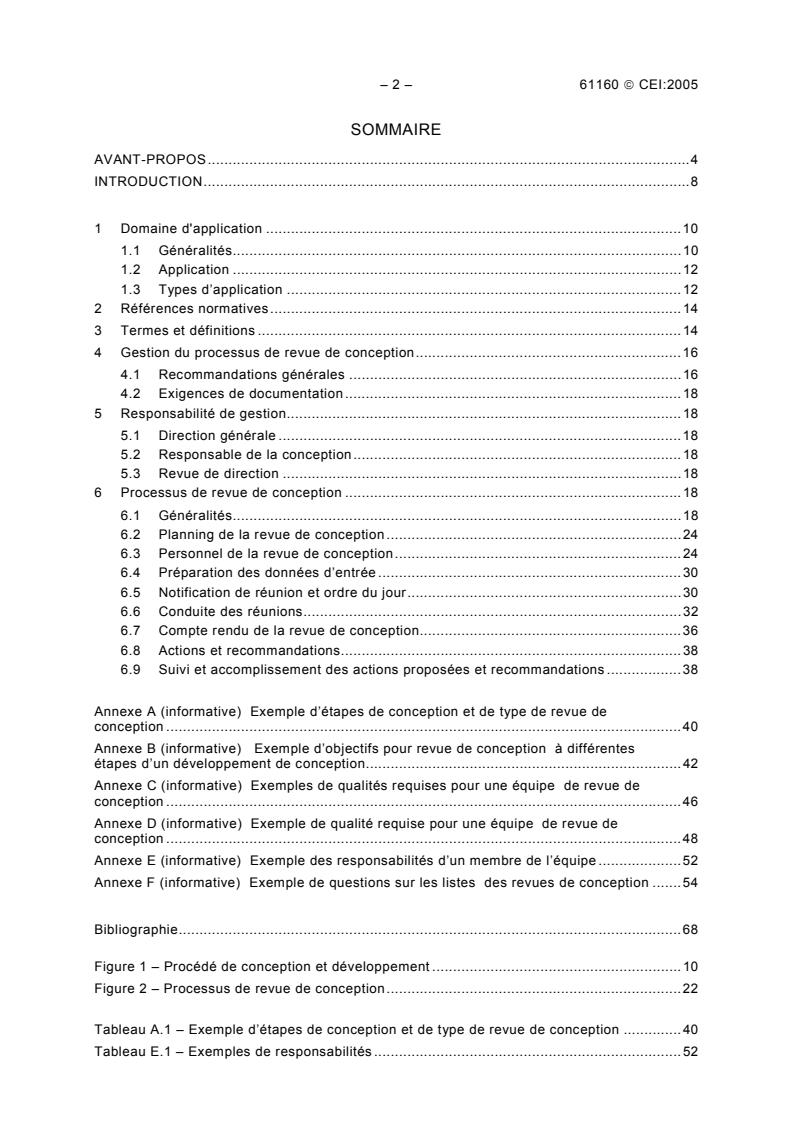
IEC 61160:2005 - Design review Released:9/27/2005
Overview
IEC 61160:2005 - Design review is an International Electrotechnical Commission (IEC) recommendation for implementing formal design review as part of the design and development phase. The standard explains how design reviews verify that design input requirements have been met and how they stimulate product improvement, increased dependability, and reduced lifecycle costs. IEC 61160 is intended to be applied across product development projects and tailored to the size, risk and complexity of each program.
Key topics and technical requirements
- Purpose and scope
- Verify conformity to design input requirements (performance, safety, dependability, EMC, human factors, environment, lifecycle costs).
- Provide recommendations to improve design robustness and effectiveness.
- Design review process elements
- Planning and integration into the design and development schedule.
- Preparation of an input package (documentation and evidence for review).
- Meeting notification, agenda, conduct of review meetings, and recording minutes.
- Actions, recommendations, follow-up and closure of action items.
- Management and roles
- Responsibilities of top management, design manager and review panel.
- Management review and decision authority remain with the design manager.
- Personnel and specialization
- Involvement of reliability, maintenance, availability, safety and human-factor specialists where relevant.
- Guidance on selecting review panel attributes and member responsibilities (see informative annexes).
- Supporting materials
- Informative annexes provide examples: design stages, review objectives, panel attributes, meeting topics, roles and checklist questions.
Practical applications and users
IEC 61160 is practical for organizations seeking structured, auditable design verification processes to improve product quality and reduce late-stage design changes. Typical users:
- Design managers and engineering leads - to plan and run reviews.
- Project managers - to integrate reviews into schedules and risk management.
- Quality assurance teams - to ensure compliance with design input requirements.
- Reliability/maintenance engineers, human factors and safety specialists - to supply subject-matter input.
- Suppliers, customers and consultants - for contract reviews and interface verification.
Benefits include earlier detection of design gaps, strengthened evidence for verification, reduced rework costs and improved product dependability.
Related standards
- ISO 9001:2000 - design and development management (referenced for process alignment)
- IEC 62198:2001 - project risk management (application guidance)
- IEC 60050-191:1990 - vocabulary: dependability and quality of service
Keywords: IEC 61160, design review, design verification, design input requirements, product dependability, design review checklist, design and development process.
Buy Documents
IEC 61160:2005 - Design review Released:9/27/2005
IEC 61160:2005 - Design review Released:9/27/2005
Get Certified
Connect with accredited certification bodies for this standard

BSI Group
BSI (British Standards Institution) is the business standards company that helps organizations make excellence a habit.

Bureau Veritas
Bureau Veritas is a world leader in laboratory testing, inspection and certification services.

DNV
DNV is an independent assurance and risk management provider.
Sponsored listings
Frequently Asked Questions
IEC 61160:2005 is a standard published by the International Electrotechnical Commission (IEC). Its full title is "Design review". This standard covers: This International Standard makes recommendations for the implementation of design review as a means of verifying that the design input requirements have been met and stimulating the improvement of the product's design. The intention is for it to be applied during the design and development phase of a product's life cycle.
This International Standard makes recommendations for the implementation of design review as a means of verifying that the design input requirements have been met and stimulating the improvement of the product's design. The intention is for it to be applied during the design and development phase of a product's life cycle.
IEC 61160:2005 is classified under the following ICS (International Classification for Standards) categories: 03.100.40 - Research and development; 03.120.01 - Quality in general. The ICS classification helps identify the subject area and facilitates finding related standards.
IEC 61160:2005 is available in PDF format for immediate download after purchase. The document can be added to your cart and obtained through the secure checkout process. Digital delivery ensures instant access to the complete standard document.
Standards Content (Sample)
INTERNATIONAL IEC
STANDARD 61160
Second edition
2005-09
Design review
Reference number
Publication numbering
As from 1 January 1997 all IEC publications are issued with a designation in the
60000 series. For example, IEC 34-1 is now referred to as IEC 60034-1.
Consolidated editions
The IEC is now publishing consolidated versions of its publications. For example,
edition numbers 1.0, 1.1 and 1.2 refer, respectively, to the base publication, the
base publication incorporating amendment 1 and the base publication incorporating
amendments 1 and 2.
Further information on IEC publications
The technical content of IEC publications is kept under constant review by the IEC,
thus ensuring that the content reflects current technology. Information relating to
this publication, including its validity, is available in the IEC Catalogue of
publications (see below) in addition to new editions, amendments and corrigenda.
Information on the subjects under consideration and work in progress undertaken
by the technical committee which has prepared this publication, as well as the list
of publications issued, is also available from the following:
• IEC Web Site (www.iec.ch)
• Catalogue of IEC publications
The on-line catalogue on the IEC web site (www.iec.ch/searchpub) enables you to
search by a variety of criteria including text searches, technical committees
and date of publication. On-line information is also available on recently issued
publications, withdrawn and replaced publications, as well as corrigenda.
• IEC Just Published
This summary of recently issued publications (www.iec.ch/online_news/ justpub)
is also available by email. Please contact the Customer Service Centre (see
below) for further information.
• Customer Service Centre
If you have any questions regarding this publication or need further assistance,
please contact the Customer Service Centre:
Email: custserv@iec.ch
Tel: +41 22 919 02 11
Fax: +41 22 919 03 00
INTERNATIONAL IEC
STANDARD 61160
Second edition
2005-09
Design review
IEC 2005 Copyright - all rights reserved
No part of this publication may be reproduced or utilized in any form or by any means, electronic or
mechanical, including photocopying and microfilm, without permission in writing from the publisher.
International Electrotechnical Commission, 3, rue de Varembé, PO Box 131, CH-1211 Geneva 20, Switzerland
Telephone: +41 22 919 02 11 Telefax: +41 22 919 03 00 E-mail: inmail@iec.ch Web: www.iec.ch
PRICE CODE
Commission Electrotechnique Internationale V
International Electrotechnical Commission
МеждународнаяЭлектротехническаяКомиссия
For price, see current catalogue
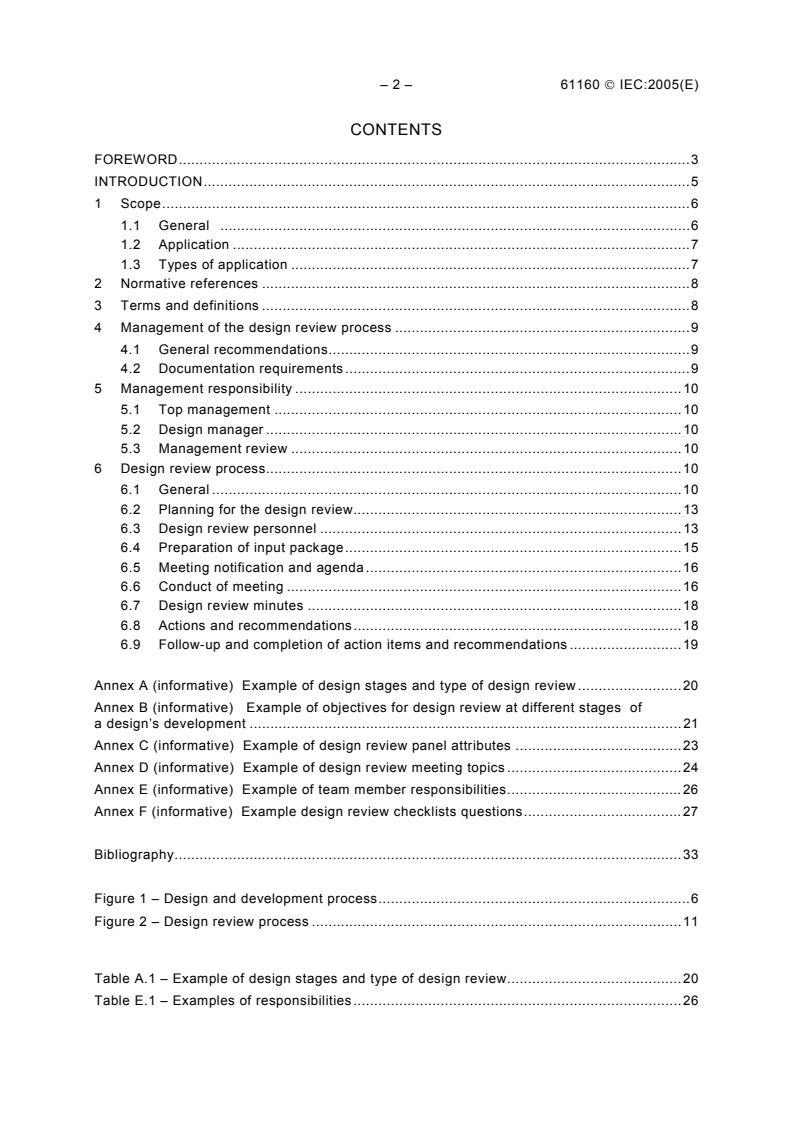
– 2 – 61160 IEC:2005(E)
CONTENTS
FOREWORD.3
INTRODUCTION.5
1 Scope.6
1.1 General .6
1.2 Application .7
1.3 Types of application .7
2 Normative references .8
3 Terms and definitions .8
4 Management of the design review process .9
4.1 General recommendations.9
4.2 Documentation requirements.9
5 Management responsibility .10
5.1 Top management .10
5.2 Design manager .10
5.3 Management review .10
6 Design review process.10
6.1 General .10
6.2 Planning for the design review.13
6.3 Design review personnel .13
6.4 Preparation of input package.15
6.5 Meeting notification and agenda .16
6.6 Conduct of meeting .16
6.7 Design review minutes .18
6.8 Actions and recommendations.18
6.9 Follow-up and completion of action items and recommendations .19
Annex A (informative) Example of design stages and type of design review .20
Annex B (informative) Example of objectives for design review at different stages of
a design’s development .21
Annex C (informative) Example of design review panel attributes .23
Annex D (informative) Example of design review meeting topics .24
Annex E (informative) Example of team member responsibilities.26
Annex F (informative) Example design review checklists questions.27
Bibliography.33
Figure 1 – Design and development process.6
Figure 2 – Design review process .11
Table A.1 – Example of design stages and type of design review.20
Table E.1 – Examples of responsibilities.26
61160 IEC:2005(E) – 3 –
INTERNATIONAL ELECTROTECHNICAL COMMISSION
____________
DESIGN REVIEW
FOREWORD
1) The International Electrotechnical Commission (IEC) is a worldwide organization for standardization comprising
all national electrotechnical committees (IEC National Committees). The object of IEC is to promote
international co-operation on all questions concerning standardization in the electrical and electronic fields. To
this end and in addition to other activities, IEC publishes International Standards, Technical Specifications,
Technical Reports, Publicly Available Specifications (PAS) and Guides (hereafter referred to as “IEC
Publication(s)”). Their preparation is entrusted to technical committees; any IEC National Committee interested
in the subject dealt with may participate in this preparatory work. International, governmental and non-
governmental organizations liaising with the IEC also participate in this preparation. IEC collaborates closely
with the International Organization for Standardization (ISO) in accordance with conditions determined by
agreement between the two organizations.
2) The formal decisions or agreements of IEC on technical matters express, as nearly as possible, an international
consensus of opinion on the relevant subjects since each technical committee has representation from all
interested IEC National Committees.
3) IEC Publications have the form of recommendations for international use and are accepted by IEC National
Committees in that sense. While all reasonable efforts are made to ensure that the technical content of IEC
Publications is accurate, IEC cannot be held responsible for the way in which they are used or for any
misinterpretation by any end user.
4) In order to promote international uniformity, IEC National Committees undertake to apply IEC Publications
transparently to the maximum extent possible in their national and regional publications. Any divergence
between any IEC Publication and the corresponding national or regional publication shall be clearly indicated in
the latter.
5) IEC provides no marking procedure to indicate its approval and cannot be rendered responsible for any
equipment declared to be in conformity with an IEC Publication.
6) All users should ensure that they have the latest edition of this publication.
7) No liability shall attach to IEC or its directors, employees, servants or agents including individual experts and
members of its technical committees and IEC National Committees for any personal injury, property damage or
other damage of any nature whatsoever, whether direct or indirect, or for costs (including legal fees) and
expenses arising out of the publication, use of, or reliance upon, this IEC Publication or any other IEC
Publications.
8) Attention is drawn to the Normative references cited in this publication. Use of the referenced publications is
indispensable for the correct application of this publication.
9) Attention is drawn to the possibility that some of the elements of this IEC Publication may be the subject of
patent rights. IEC shall not be held responsible for identifying any or all such patent rights.
This International Standard has been prepared by IEC technical committee 56: Dependability.
This second edition cancels and replaces the first edition published in 1992 and its
amendment 1(1994) and constitutes a technical revision.
The major changes with regard to the previous edition concerns the inclusion of the previous
amendment which dealt with environmental effects (10.2.7), human factors (19.2.9) and legal
matters (10.2.10), as well as clarification of responsibilities for the design review process and
the design review process itself.
The text of this standard is based on the following documents:
FDIS Report on voting
56/1044/FDIS 56/1064/RVD
Full information on the voting for the approval of this standard can be found in the report on
voting indicated in the above table.
This publication has been drafted in accordance with the ISO/IEC Directives, Part 2.
– 4 – 61160 IEC:2005(E)
The committee has decided that the contents of this publication will remain unchanged until
the maintenance result date indicated on the IEC web site under "http://webstore.iec.ch" in
the data related to the specific publication. At this date, the publication will be
• reconfirmed,
• withdrawn,
• replaced by a revised edition, or
• amended.
A bilingual version of this publication may be issued at a later date.
61160 IEC:2005(E) – 5 –
INTRODUCTION
The dependability of a product is enhanced through implementation of necessary disciplines
during the design and development phases of a product’s life cycle. Like other technical and
engineering disciplines, a design review needs to be properly managed in order to achieve its
objectives.
Properly implemented, design reviews enhance the potential for delivering a product of the
required dependability, quality, performance, safety and potential for reduction in costs and
delivery schedule. Both supplier and customer can utilize it.
A design review is an advisory activity. It is intended primarily to provide verification of the
work of the design development team, and to provide recommendations, where possible, to
improve the product or process and its realization. Thus design reviews should be considered
as a confirmation and refining procedure and not a creative one.
Design reviews, regardless of frequency or depth cannot replace good product definitions,
design specifications, and management of the design and development process. Used as a
control process, design reviews can provide the necessary verification of the successful
outcome of the design effort at a given time.
Design reviews should not be confused with day-to-day management of a design project. The
design manager carries the responsibility for the design and the final decisions for the
response to a design review’s actions and recommendations. Design reviews when properly
conducted, increase confidence that design and development activities were carried out with
due regard to all pertinent requirements for a product throughout its life cycle.
The application of this standard needs to be tailored to the needs of the design and
development project or task in question and the organization preparing the design.
– 6 – 61160 IEC:2005(E)
DESIGN REVIEW
1 Scope
1.1 General
This International Standard makes recommendations for the implementation of design review
as a means of verifying that the design input requirements have been met and stimulating the
improvement of the product’s design. The intention is for it to be applied during the design
and development phase of a product’s life cycle.
It provides guidelines for planning and conducting a design review and specific details
concerning contributions by specialists in reliability, maintenance, maintenance support and
availability.
The process for design and development is outlined in Figure 1 and requirements for
management of the design and development process overall are given in ISO 9001:2000. The
stages at which the design review or reviews are to be held should be determined during the
development of the plan for the design.
D
Need for product
or process identified
E
S
Design planning
I
ISO 9001:2000 – 7.3.1
G
N
Design change Design input
ISO 9001:2000 – 7.3.7
ISO 9001:2000 – 7.3.2
R
E
Design process
V
I
E
Design verification Design outputs
w
ISO 9001:2000 – 7.3.5 ISO 9000:2000 – 7.3.3
ISO9001
7.3.4
Design validation
ISO 9001:2000 – 7.3.6
Completed design
IEC 1541/05
NOTE Reference to the clauses of ISO 9001:2000 is for information only.
Figure 1 – Design and development process
61160 IEC:2005(E) – 7 –
The objectives of a design review include:
• assessing whether the proposed solution meets the design input requirements that
include, but are not limited to: specified general performance requirements, dependability,
lifecycle costs, safety, endurance, environment, electromagnetic compatibility, human
factors;
• assessing whether the proposed solution is the most robust, efficient and effective
solution to achieve the product requirements;
• providing recommendations as required for achieving the design input requirements;
• assessing the status of the design in terms of the completeness of the drawings and
specifications;
• assessing the evidence to support the verification of the design performance;
• proposing improvements.
Design review facilitates assessment of the status of the design against the input require-
ments, identification of opportunities for improvement and guides the design manager towards
appropriate action. It accelerates maturing of the product by reducing the time needed to
stabilize design details, and allows product realization to proceed without frequent
interruptions. Design review can also stimulate early product improvement.
1.2 Application
The stage or stages at which a design review is to be performed should be determined in the
design and development planning stage of a project or a design task. Influencing factors
should include customer requirements, regulatory requirements, the size and complexity of
the product, the use to which the product is to be put, and the consequences of failure.
The cost to correct deficiencies in a design and the potential consequences increase as the
design nears completion. Also, as the design progresses towards completion, so the flexibility
to implement a change to correct a deficiency or to optimize the design decreases.
Each organization undertaking design and development should adopt either a comprehensive
design review programme as presented in this standard, or tailor a more limited one to meet
specific product and/or process needs.
The design review should be incorporated into the organization’s overall management system
and, as applicable, each project’s schedule.
Limitations of size and resources of the organization, project value, product benefits, risks
and complexity, all influence the size and frequency of design reviews. In smaller
organizations, it could be necessary to supplement staff with personnel from suppliers,
consultants and other outside advisors.
1.3 Types of application
There are two types of application: either an in-house created requirement for a new design,
or a design requirement from an external source. In the case of the latter, the risk of a
misunderstanding is much greater. Any misunderstanding could become a contractual issue
and design review meetings with the client will be of primary importance to ensure that the
emerging design meets the client's requirements.
A design review should be held:
• prior to order acceptance to ensure that the scope of work is established together with all
the parameters that need to be met for an acceptable design;
– 8 – 61160 IEC:2005(E)
• prior to detail design to ensure that the members of the design team have first-hand
knowledge of all detail requirements. Interface provisions should be established and a list
of defining documentation scheduled for submission and approval between the parties;
• at suitable points during detail design to review all interface provisions and agree on the
test procedures for verifying that the design meets contract requirements.
2 Normative references
The following referenced documents are indispensable for the application of this document.
For dated references, only the edition cited applies. For undated references, the latest edition
of the referenced document (including any amendments) applies.
IEC 60050-191:1990, International Electrotechnical Vocabulary (IEV) – Chapter 191: Depend-
ability and quality of service
IEC 62198:2001, Project risk management – Application guidelines
3 Terms and definitions
For the purposes of this document the terms and definitions of IEC 60050(191) apply,
together with the following additional definitions.
3.1
action item
question to be resolved by the design manager or nominated person
3.2
review
activity undertaken to determine the suitability, adequacy and effectiveness of the subject
matter to achieve established objectives
[ISO 9000:2000, definition 3.8.7]
3.3
design and development
set of processes that transforms requirements into specified characteristics or into the
specification of a product, process or system
NOTE 1 The terms “design” and “development” are sometimes used synonymously and sometimes used to define
different stages of the overall design and development process.
NOTE 2 A qualifier can be applied to indicate the nature of what is being designed and developed (e.g. product
design and development or process design and development).
[ISO 9000:2000, definition 3.4.4]
3.4
design review
planned, documented independent review of an existing or proposed design
NOTE 1 Objectives include evaluation of the design’s capability to fulfil the specified requirements, identify any
actual or potential deficiencies, proposing enhancements.
NOTE 2 Design review by itself is not sufficient to ensure proper design.
NOTE 3 The design can be for a product or process.
NOTE 4 The design review can be achieved by means of a meeting or other documented process.
61160 IEC:2005(E) – 9 –
3.5
design manager
person responsible for the product or process’ design and development
NOTE For the purposes of this standard, the term “design manager” is used. In practice, other titles are used for
this function depending on the organization’s size and structure, and/or the contractual arrangements.
3.6
verification
confirmation, through the provision of objective evidence, that specified requirements have
been fulfilled
[ISO 9000:2000, 3.8.4]
3.7
validation
confirmation, through the provision of objective evidence, that the requirements for a specified
intended use or application have been fulfilled.
[ISO 9000:2000, 3.8.5]
4 Management of the design review process
4.1 General recommendations
The organization should establish and maintain a management system to direct and control
those design review activities that are part of the organization’s overall management system.
For designs reviews this should include:
a) identifying the functions and activities needed for the organization’s design reviews;
b) establishing the design review objectives and plan to achieve these objectives during
design planning;
c) ensuring timely implementation of the design review activities during all applicable design
phases;
d) assessing the criteria and methods for performance assessment, evaluation and accept-
ance of the product;
e) providing resources and information necessary to achieve required design reviews;
f) monitoring the design review activities and, measuring and analysing the results for
continual improvement.
4.2 Documentation requirements
The management system documentation for design review should include:
a) documented commitment and objectives for design review;
b) documented procedures for management of the design review process;
c) records arising from the design review activities;
d) records of completion of action items and recommendations.
– 10 – 61160 IEC:2005(E)
5 Management responsibility
5.1 Top management
Top management of the design organization should communicate and demonstrate its
commitment to the design review process to all personnel involved.
Achieving this includes:
• defining the management responsibilities and authorities for design review;
• ensuring the required resources for design reviews are available.
5.2 Design manager
The design manager’s responsibilities should include but not limited to:
• developing and implementing a design plan that includes the points at which design
reviews are required;
• selecting an independent suitably experienced person to chair the design review meeting
or meetings, as applicable, or otherwise defined;
• preparing and providing the design data required for each scheduled design review’s input
package;
• ensuring that actions and recommendations arising from a design review meeting are
responded to and completed in a timely manner.
NOTE For external designs, the contract may define requirements for some of these.
5.3 Management review
At planned intervals, top management should review its procedures and practices for design
reviews to ensure their continuing suitability, adequacy and effectiveness. This can be carried
out as a part of an organizational management review process. The design review records
can be analysed for opportunities for process improvement.
6 Design review process
6.1 General
Design reviews require careful planning, organization and reporting. This clause provides a
framework for implementation of the design review process itself. Specific details will depend
on the product and the type of design review (see Annex A).
Care should be taken to prevent the design review from dictating the ultimate design.
Decisions are made everyday which bear on the design of the product or process under
review. If each decision is subjected to an independent review, the review team would, in
essence become the designer with the potential for increased development time and costs.
Conversely, if the first design review occurred only just before production or use, its benefit
could be questionable as there may be little opportunity to influence the situation without a
significant time or cost penalty.
The process for design review is outlined in Figure 2. The stages at which design reviews are
held should be established during the development of the design plan. In determining the
stage or stages at which a design review is to be held factors to be taken into account
include:
61160 IEC:2005(E) – 11 –
The size and complexity of the product. For example:
• is it a simple design or a minor upgrade;
• is it a product involving multiple systems;
• is it a complex system?
What would be the impact of a delay in delivery or failure of the product? Project risk
management tools given in IEC 62198 can be utilized in assessing this.
The most critical design stage will be the conceptual design. This is usually carried out in
support of a submission for authorisation to proceed with a design project or to enable a
proposal to be submitted to a client. The major objective will be to verify the design feasibility,
estimate the cost and to plan its execution.
The design feasibility or risk can be ranked as follows:
a) customized design based on the selection from a range of proven components and
materials;
b) design that involves the use of an unproven component, material or subcontractor;
c) design based on the interpolation of existing experience;
d) design based on the extrapolation of existing experience;
e) a completely new design or application of unproven technology.
Designs that have a high risk will require more design reviews as a measure of risk
management. In the case of a new design to be released for series production the detail
design could be considered to be that of a prototype. The need for an intensive design review
of the results of prototype testing will be critical for deciding on the features needed to ensure
a reliable final design. In extreme cases it could even result in a decision for abandonment.
Start
Design manager
No All Yes
Responses to
completed
actions and
recommendations
Planning of Meeting
6.8
design review
notification
6.2
and agenda
6.5
Design manager
Selection of
Conducting
Signs the
design review
design
minutes closing
team Follow up and
Review meeting
the minutes
6.3
completion of
6.6
6.9
actions and
recommendations
6.9
Prepare and
Preparation of
End
distribute
input package
the design review
6.4
minutes 6.7
Review of design Response and completion of actions and recommendations
IEC 1542/05
NOTE Numbers refer to the applicable clause in this standard.
Figure 2 – Design review process
– 12 – 61160 IEC:2005(E)
The principal objectives of a design review are to provide confidence that the product’s
requirements have been identified and can be met in an efficient and effective manner, and
will result in a dependable and useful product. In particular, the objectives of a design review
include, but are not limited to:
1) the product meets specified requirements in a cost-effective manner;
2) the design and development plan includes the strategy for confirming and demonstrating
that performance requirements can be met;
3) the design satisfies customer and interfacing requirements;
4) the product and its elements, as required, can be safely and economically disposed of;
5) required design, manufacturing and installation methods are being utilized;
6) costs have been optimized after considering all product requirements;
7) scheduling considerations are taken into account;
8) recommendations are provided for improvement of design;
9) components are used within their specified performance and stress ratings;
10) earlier recommendations have been addressed;
11) that the design’s drawings, software codes and specifications is full and complete.
Normally only the recommendations from the review should be documented, but for safety
issues it is important to list all the risks considered and the reason for recommending or not
recommending actions.
As a result of the action items identified and recommendations made, matters the design
manager should consider include, but are not limited to, changes in the design’s concepts,
specifications, plans, schedules, or, impact on safety or environmental requirements, product
quality, manufacturing, installation, operation and maintenance procedures and costs.
For an effective design review, the subjects and results of discussions during each design
review need to be documented to permit continuity and follow-up until design decisions have
been completed. Sufficient documentation should be contained in the meeting’s minutes so
that successive design reviews avert repeated coverage of the same problems and avoid
significant loss of insight and understanding of relevant issues. If continuity and follow-up are
achieved, succeeding review effort can be directed to more pressing aspects of the product’s
design. The meeting’s minutes supporting documentation and follow-up are discussed in 6.7
and 6.9.
The specific objectives depend on the type of design review being undertaken and the product
or process being designed. Clear explanations by the chair of objectives and scope of each
design review will focus attention on specific areas of the design, and minimize misplaced
comments. Typical objectives and activities for each type of design review are given in
Annex B.
Design review meetings are independent of those meetings undertaken as a part of the
ongoing planning, scheduling and development of the design.
The design manager or those directly involved in the design should not chair design reviews.
Depending on whether the design project is internally or externally funded, the conduct of the
review and the stances taken by the individuals can vary.
61160 IEC:2005(E) – 13 –
6.2 Planning for the design review
The point or points at which design review occurs should be determined during the design
planning stage. Ideally design reviews should be conducted before taking a decision that can
prove costly, time consuming, or difficult to reverse. This should take into account the
identified risks for the design and/or project.
In this way any changes arising from a design review can be made with less impact on
schedule or cost. Additionally, cost, schedule and performance improvements can more
readily be adopted if reviews are conducted before making a significant commitment at major
points in the design process.
The design manager should consider the conditions and constraints imposed by a particular
project in the scheduling of design reviews and the optimum number should be determined to
maximize return on time spent.
Only a few organizations or projects will have a need for all types of design review.
6.3 Design review personnel
6.3.1 General
Design reviews are normally carried out by an independent review panel who receive
presentations and information from those responsible for the design. The personnel involved
are normally:
a) the design review panel that includes but is not limited to:
• the chair;
• the secretary;
• persons representing functions which could affect the product or process quality, but
not directly involved in the design;
• relevant specialists, not involved in development of the product under review;
• customer/users, as practical.
b) the design manager and the design team members as necessary to present the design
and answer questions.
To avoid conflicts of interest the persons authorizing or approving further steps in the design
process should normally not be a panel member.
The design review panel should include people with special knowledge and experience from
different spheres. The composition should be such that the participants, collectively, cover a
sufficiently wide and detailed field of knowledge to permit consideration of all pertinent
aspects of the product. Care should be taken to keep the team to a workable size.
6.3.2 Design review chair
The chair should have broad technical knowledge and experience that includes design, the
ability and confidence to manage personnel and to work equally well with technical and non-
technical persons. Leadership and understanding in dealing with others is of utmost
importance.
The chair's responsibilities and authority should include:
a) agreeing to the objectives and scope for the design review;
b) agreeing to selection of panel members in consultation with management;
– 14 – 61160 IEC:2005(E)
c) establishing meeting agendas for delegated meeting or meetings;
d) ensuring that participants understand what is required of them;
e) ensuring that sufficient time is allocated for design review activities;
f) ensuring that the meeting’s input package is issued to designated persons;
g) assigning tasks to participants in preparation for meetings;
h) chairing the design review meeting;
i) ensuring that relevant issues from the meeting are recorded;
j) ensuring that actions and recommendations from earlier meetings have been satisfactorily
addressed and closed, as appropriate;
k) ensuring that the focus of the meeting is the design and not individuals;
l) ensuring that there is input from all present;
m) reviewing and approving the design review meeting’s minutes;
n) ensuring that the meeting’s minutes are issued to designated persons;
o) striving for consensus in the review team in case of differences of opinion. If consensus
cannot be reached forward minority as well as majority view(s) for decision.
To maintain the integrity and objectivity of the design review team, where possible, the chair
should not be associated with the project’s design activities. However, in a small company, an
employee with all necessary qualifications and not participating in some way in the project
may not be available. Consideration should then be given to engaging an outsider. In any
event, the chair should be able to maintain the respect of all participants.
6.3.3 Design review secretary
A secretary should be appointed to record the results of the meeting and enable the chair to
maintain focus on the meeting. Where possible, the same person should serve as the
secretary for the defined design reviews for a specific product. The qualifications and
experience for the secretary should be similar to those for the chair, but can be less stringent.
The secretary's duties and responsibilities should include:
a) sending out invitations with sufficient time for members to prepare for the meeting;
b) distributing agendas;
c) follow up on distribution of input data for review by participants;
d) organizing, assembling and distributing responses to inquiries or assignments;
e) taking minutes;
f) preparing the meeting’s minutes;
g) issuing the meeting’s minutes to designated persons;
h) assisting the chair in following up action items and recommendations, as applicable.
NOTE If a separate, independent, secretary cannot be appointed, it is usually better for a representative from the
design team to act as the secretary.
If the organization is of sufficient size, the position of secretary can be used as training for
future service as design review chair. In selecting a secretary, the following factors should be
considered:
– previous participation in design review activity;
– technical training and comparable experience;
– communication skills;
– involvement in similar projects;
– non-involvement in work on the product or process under review.
61160 IEC:2005(E) – 15 –
6.3.4 Specialists
The specialists should be selected taking into account the product, the product’s objectives,
and the type of design review (see Annex A).
Specialists should be represented on the design review panel at the appropriate stage in the
product’s development. Their specializations can include, but are not limited to: reliability and
maintainability engineering, performance estimation, testing and acceptance/certification,
quality management, structures engineering, manufacturing engineering, safety, environ-
mental engineering, legal matters, advertising and marketing, finance, logistics.
6.3.5 Design manager
The design manager, or at least one representative of the design team, needs to participate in
the whole review in order to explain the rationale of the design decision taken, answer
questions and help the review panel identified and evaluate potential problems, their probable
consequences and possible actions. Representatives should be selected to attend design
review meetings pertaining to their respective roles in the design and development process.
It may not be possible for all such persons to attend throughout in light of team size
restrictions. Participants can therefore be invited only to those portions of a meeting that
pertain to the area where they should contribute. However, all potential participants should
receive the agenda and any portion of the input data package that is relevant to their
expertise. Additional representatives from the design team can participate as observers where
agreed by the chair. These observers do not have the right to speak unless the chair gives
permission.
6.4 Preparation of input package
The design manager is responsible for putting together the information relevant to the design
review to be undertaken.
According to the design stage the input data package should include some or all of the
following:
a) design plan;
b) original requirements (these can include: the customer’s request for quotes,
specifications, standards, regulatory requirements);
c) anticipated customer needs, developed and supported by market surveys and competitors'
activities;
d) documented design assumptions;
e) design trade-off studies and analyses;
f) a list of any questions from the design review panel on the design to be reviewed;
g) reliability, availability and maintainability allocations and predictions;
h) planned logistics support;
i) designer's proposals and alternative considerations which include drawings and
calculations;
j) information and data on similar products;
k) competitive product data;
l) cost estimates and trade-off rationale;
m) specifications and drawings;
n) manufacturing, tooling and producibility studies;
o) performance test reports, analyses and requirements;
p) field failure or malfunction reports;
– 16 – 61160 IEC:2005(E)
q) quality control analyses of processes and supplies;
r) inspection reports;
s) life cycle targets and cost data.
6.5 Meeting notification and agenda
The secretary, in conjunction with the chair, should prepare a notification and agenda for the
meeting and circulate them to participants, and as applicable, their supervisors, sufficiently in
advance of the design review to allow participants to prepare for the meeting.
The notification and agenda should state:
a) the date, time and venue of the meeting
b) the scope and objectives for the design review meeting;
c) the project name and identification number;
d) participants and their functions;
e) the type and duration of the design review;
f) the section of the project under review, if appropriate;
g) topics to be discussed can include, for example:
• a review of the objectives of the design project;
• a description of the design features and performance characteristics of the product;
• a review of design and technical progress to date and problems encountered;
• a review of outstanding and future areas of work and any concerns arising;
• an assessment of all pertinent aspects of the design against a Design Review
checklist;
• a summary of findings by the review panel;
h) the persons who will make presentations;
i) reference documents and the contents of any attached input data package.
6.6 Conduct of meeting
6.6.1 General
If the panel members are not experienced in design reviews, an orientation session should be
conducted explaining the general objectives, philosophy, and practice.
The introductory comments should set a constructive tone and climate. The chair should
review the objectives of the meeting and relate them to the overall objectives and procedures
for the design review process. The chair should stress the need to ask questions and to avoid
negative and personally oriented comments.
Questions that imply pre-judgement should be avoided.
Panel members should feel free to question their peers. They should not see their
responsibility as being solely to ask why something was done in a particular way.
Whenever necessary, the review participants should be assured that all questions raised,
subsequent investigations requested, and opinions expressed do not reflect on anyone's
personality, ability or integrity. The entire team, under the direction of the chair, should ensure
that the design review process does not become a personality contest either among the panel
members or between the panel and the design team.
61160 IEC:2005(E) – 17 –
The panel members should always remember that they serve in an advisory capacity and that
their prime purpose is to assist those responsible for the product’s design in achieving the
optimum result. They are not there to provide a solution to any deficiencies identified.
6.6.2 Presentations
The design manager and the other members representing the design and development team
should present, as required, aspects of the design under review.
6.6.3 Meeting protocol
The chair should ensure that presentation and questioning proceed systematically.
The review process is one of constructive questions and answers. Derogatory questions or
responses should not be permitted, nor should there be a flat refusal to discuss a topic unless
there are specific issues of commercial confidentiality or national security involved. Questions
should be framed in terms of requests for information or inquiry as to reasons for design and
development decisions.
Panel members can submit questions to the chair in advance to allow for a prepared
response. These questions can be considered complex or minor. To facilitate progress of the
meeting, minor questions can be closed before start of the meeting. These questions would
be a part of the meetings input package.
Typographical errors, or minor editorial matters relating to the input data themselves should
not be discussed at the design review. The secretary should arrange for correction of these as
needed. Any substantive corrections should be discussed review participants.
The design review process should not confer approval or disapproval of the design and
development documents
...
IEC 61160
Edition 2.0 2005-09
INTERNATIONAL
STANDARD
NORME
INTERNATIONALE
Design review
Revue de conception
All rights reserved. Unless otherwise specified, no part of this publication may be reproduced or utilized in any form or by
any means, electronic or mechanical, including photocopying and microfilm, without permission in writing from either IEC or
IEC's member National Committee in the country of the requester.
If you have any questions about IEC copyright or have an enquiry about obtaining additional rights to this publication,
please contact the address below or your local IEC member National Committee for further information.
Droits de reproduction réservés. Sauf indication contraire, aucune partie de cette publication ne peut être reproduite
ni utilisée sous quelque forme que ce soit et par aucun procédé, électronique ou mécanique, y compris la photocopie
et les microfilms, sans l'accord écrit de la CEI ou du Comité national de la CEI du pays du demandeur.
Si vous avez des questions sur le copyright de la CEI ou si vous désirez obtenir des droits supplémentaires sur cette
publication, utilisez les coordonnées ci-après ou contactez le Comité national de la CEI de votre pays de résidence.
IEC Central Office
3, rue de Varembé
CH-1211 Geneva 20
Switzerland
Email: inmail@iec.ch
Web: www.iec.ch
About the IEC
The International Electrotechnical Commission (IEC) is the leading global organization that prepares and publishes
International Standards for all electrical, electronic and related technologies.
About IEC publications
The technical content of IEC publications is kept under constant review by the IEC. Please make sure that you have the
latest edition, a corrigenda or an amendment might have been published.
ƒ Catalogue of IEC publications: www.iec.ch/searchpub
The IEC on-line Catalogue enables you to search by a variety of criteria (reference number, text, technical committee,…).
It also gives information on projects, withdrawn and replaced publications.
ƒ IEC Just Published: www.iec.ch/online_news/justpub
Stay up to date on all new IEC publications. Just Published details twice a month all new publications released. Available
on-line and also by email.
ƒ Electropedia: www.electropedia.org
The world's leading online dictionary of electronic and electrical terms containing more than 20 000 terms and definitions
in English and French, with equivalent terms in additional languages. Also known as the International Electrotechnical
Vocabulary online.
ƒ Customer Service Centre: www.iec.ch/webstore/custserv
If you wish to give us your feedback on this publication or need further assistance, please visit the Customer Service
Centre FAQ or contact us:
Email: csc@iec.ch
Tel.: +41 22 919 02 11
Fax: +41 22 919 03 00
A propos de la CEI
La Commission Electrotechnique Internationale (CEI) est la première organisation mondiale qui élabore et publie des
normes internationales pour tout ce qui a trait à l'électricité, à l'électronique et aux technologies apparentées.
A propos des publications CEI
Le contenu technique des publications de la CEI est constamment revu. Veuillez vous assurer que vous possédez
l’édition la plus récente, un corrigendum ou amendement peut avoir été publié.
ƒ Catalogue des publications de la CEI: www.iec.ch/searchpub/cur_fut-f.htm
Le Catalogue en-ligne de la CEI vous permet d’effectuer des recherches en utilisant différents critères (numéro de référence,
texte, comité d’études,…). Il donne aussi des informations sur les projets et les publications retirées ou remplacées.
ƒ Just Published CEI: www.iec.ch/online_news/justpub
Restez informé sur les nouvelles publications de la CEI. Just Published détaille deux fois par mois les nouvelles
publications parues. Disponible en-ligne et aussi par email.
ƒ Electropedia: www.electropedia.org
Le premier dictionnaire en ligne au monde de termes électroniques et électriques. Il contient plus de 20 000 termes et
définitions en anglais et en français, ainsi que les termes équivalents dans les langues additionnelles. Egalement appelé
Vocabulaire Electrotechnique International en ligne.
ƒ Service Clients: www.iec.ch/webstore/custserv/custserv_entry-f.htm
Si vous désirez nous donner des commentaires sur cette publication ou si vous avez des questions, visitez le FAQ du
Service clients ou contactez-nous:
Email: csc@iec.ch
Tél.: +41 22 919 02 11
Fax: +41 22 919 03 00
IEC 61160
Edition 2.0 2005-09
INTERNATIONAL
STANDARD
NORME
INTERNATIONALE
Design review
Revue de conception
INTERNATIONAL
ELECTROTECHNICAL
COMMISSION
COMMISSION
ELECTROTECHNIQUE
PRICE CODE
INTERNATIONALE
V
CODE PRIX
ICS 03.120.01; 03.100.40 ISBN 2-8318-8512-4
– 2 – 61160 © CEI:2005
SOMMAIRE
AVANT-PROPOS.4
INTRODUCTION.8
1 Domaine d'application .10
1.1 Généralités.10
1.2 Application .12
1.3 Types d’application .12
2 Références normatives.14
3 Termes et définitions .14
4 Gestion du processus de revue de conception.16
4.1 Recommandations générales .16
4.2 Exigences de documentation.18
5 Responsabilité de gestion.18
5.1 Direction générale .18
5.2 Responsable de la conception.18
5.3 Revue de direction .18
6 Processus de revue de conception .18
6.1 Généralités.18
6.2 Planning de la revue de conception .24
6.3 Personnel de la revue de conception.24
6.4 Préparation des données d’entrée .30
6.5 Notification de réunion et ordre du jour.30
6.6 Conduite des réunions.32
6.7 Compte rendu de la revue de conception.36
6.8 Actions et recommandations.38
6.9 Suivi et accomplissement des actions proposées et recommandations .38
Annexe A (informative) Exemple d’étapes de conception et de type de revue de
conception .40
Annexe B (informative) Exemple d’objectifs pour revue de conception à différentes
étapes d’un développement de conception.42
Annexe C (informative) Exemples de qualités requises pour une équipe de revue de
conception .46
Annexe D (informative) Exemple de qualité requise pour une équipe de revue de
conception .48
Annexe E (informative) Exemple des responsabilités d’un membre de l’équipe .52
Annexe F (informative) Exemple de questions sur les listes des revues de conception .54
Bibliographie.68
Figure 1 – Procédé de conception et développement .10
Figure 2 – Processus de revue de conception.22
Tableau A.1 – Exemple d’étapes de conception et de type de revue de conception .40
Tableau E.1 – Exemples de responsabilités .52
61160 © IEC:2005 – 3 –
CONTENTS
FOREWORD.5
INTRODUCTION.9
1 Scope.11
1.1 General .11
1.2 Application .13
1.3 Types of application .13
2 Normative references .15
3 Terms and definitions .15
4 Management of the design review process .17
4.1 General recommendations.17
4.2 Documentation requirements.19
5 Management responsibility .19
5.1 Top management .19
5.2 Design manager .19
5.3 Management review .19
6 Design review process.19
6.1 General .19
6.2 Planning for the design review.25
6.3 Design review personnel .25
6.4 Preparation of input package.31
6.5 Meeting notification and agenda .31
6.6 Conduct of meeting .33
6.7 Design review minutes .37
6.8 Actions and recommendations.39
6.9 Follow-up and completion of action items and recommendations .39
Annex A (informative) Example of design stages and type of design review .41
Annex B (informative) Example of objectives for design review at different stages of
a design’s development .43
Annex C (informative) Example of design review panel attributes .47
Annex D (informative) Example of design review meeting topics .49
Annex E (informative) Example of team member responsibilities.53
Annex F (informative) Example design review checklists questions.55
Bibliography.69
Figure 1 – Design and development process.11
Figure 2 – Design review process .23
Table A.1 – Example of design stages and type of design review.41
Table E.1 – Examples of responsibilities.53
– 4 – 61160 © CEI:2005
COMMISSION ÉLECTROTECHNIQUE INTERNATIONALE
___________
REVUE DE CONCEPTION
AVANT-PROPOS
1) La Commission Electrotechnique Internationale (CEI) est une organisation mondiale de normalisation
composée de l'ensemble des comités électrotechniques nationaux (Comités nationaux de la CEI). La CEI a
pour objet de favoriser la coopération internationale pour toutes les questions de normalisation dans les
domaines de l'électricité et de l'électronique. A cet effet, la CEI – entre autres activités – publie des Normes
internationales, des Spécifications techniques, des Rapports techniques, des Spécifications accessibles au
public (PAS) et des Guides (ci-après dénommés "Publication(s) de la CEI"). Leur élaboration est confiée à des
comités d'études, aux travaux desquels tout Comité national intéressé par le sujet traité peut participer. Les
organisations internationales, gouvernementales et non gouvernementales, en liaison avec la CEI, participent
également aux travaux. La CEI collabore étroitement avec l'Organisation Internationale de Normalisation (ISO),
selon des conditions fixées par accord entre les deux organisations.
2) Les décisions ou accords officiels de la CEI concernant les questions techniques représentent, dans la mesure
du possible, un accord international sur les sujets étudiés, étant donné que les Comités nationaux de la CEI
intéressés sont représentés dans chaque comité d’études.
3) Les Publications de la CEI se présentent sous la forme de recommandations internationales et sont agréées
comme telles par les Comités nationaux de la CEI. Tous les efforts raisonnables sont entrepris afin que la CEI
s'assure de l'exactitude du contenu technique de ses publications; la CEI ne peut pas être tenue responsable
de l'éventuelle mauvaise utilisation ou interprétation qui en est faite par un quelconque utilisateur final.
4) Dans le but d'encourager l'uniformité internationale, les Comités nationaux de la CEI s'engagent, dans toute la
mesure possible, à appliquer de façon transparente les Publications de la CEI dans leurs publications
nationales et régionales. Toutes divergences entre toutes Publications de la CEI et toutes publications
nationales ou régionales correspondantes doivent être indiquées en termes clairs dans ces dernières.
5) La CEI n’a prévu aucune procédure de marquage valant indication d’approbation et n'engage pas sa
responsabilité pour les équipements déclarés conformes à une de ses Publications.
6) Tous les utilisateurs doivent s'assurer qu'ils sont en possession de la dernière édition de cette publication.
7) Aucune responsabilité ne doit être imputée à la CEI, à ses administrateurs, employés, auxiliaires ou
mandataires, y compris ses experts particuliers et les membres de ses comités d'études et des Comités
nationaux de la CEI, pour tout préjudice causé en cas de dommages corporels et matériels, ou de tout autre
dommage de quelque nature que ce soit, directe ou indirecte, ou pour supporter les coûts (y compris les frais
de justice) et les dépenses découlant de la publication ou de l'utilisation de cette Publication de la CEI ou de
toute autre Publication de la CEI, ou au crédit qui lui est accordé.
8) L'attention est attirée sur les références normatives citées dans cette publication. L'utilisation de publications
référencées est obligatoire pour une application correcte de la présente publication.
9) L’attention est attirée sur le fait que certains des éléments de la présente Publication de la CEI peuvent faire
l’objet de droits de propriété intellectuelle ou de droits analogues. La CEI ne saurait être tenue pour
responsable de ne pas avoir identifié de tels droits de propriété et de ne pas avoir signalé leur existence.
La présente Norme internationale a été établie par le Comité d'études 56 de la CEI: Sûreté de
fonctionnement.
Cette deuxième édition annule et remplace la première édition parue en 1992 et son
amendement 1 (1994) et constitue une révision technique.
Les changements majeurs par rapport à l’édition précédente comprennent l’incorporation de
l’amendement précédent, traitant des effets environnementaux (10.2.7), des facteurs humains
(10.2.9) et des sujets légaux (10.2.10) ainsi que la clarification sur les responsabilités pour le
processus de revue de conception et sur le processus de revue de conception lui-même.
Cette version bilingue, publiée en 2006-02, correspond à la version anglaise.
Le texte anglais de cette norme est issu des documents 61F/1044/FDIS et 61F/1064/RVD. Le
rapport de vote 61F/1064/RVD donne toute information sur le vote ayant abouti à
l’approbation de cette norme.
61160 © IEC:2005 – 5 –
INTERNATIONAL ELECTROTECHNICAL COMMISSION
____________
DESIGN REVIEW
FOREWORD
1) The International Electrotechnical Commission (IEC) is a worldwide organization for standardization comprising
all national electrotechnical committees (IEC National Committees). The object of IEC is to promote
international co-operation on all questions concerning standardization in the electrical and electronic fields. To
this end and in addition to other activities, IEC publishes International Standards, Technical Specifications,
Technical Reports, Publicly Available Specifications (PAS) and Guides (hereafter referred to as “IEC
Publication(s)”). Their preparation is entrusted to technical committees; any IEC National Committee interested
in the subject dealt with may participate in this preparatory work. International, governmental and non-
governmental organizations liaising with the IEC also participate in this preparation. IEC collaborates closely
with the International Organization for Standardization (ISO) in accordance with conditions determined by
agreement between the two organizations.
2) The formal decisions or agreements of IEC on technical matters express, as nearly as possible, an international
consensus of opinion on the relevant subjects since each technical committee has representation from all
interested IEC National Committees.
3) IEC Publications have the form of recommendations for international use and are accepted by IEC National
Committees in that sense. While all reasonable efforts are made to ensure that the technical content of IEC
Publications is accurate, IEC cannot be held responsible for the way in which they are used or for any
misinterpretation by any end user.
4) In order to promote international uniformity, IEC National Committees undertake to apply IEC Publications
transparently to the maximum extent possible in their national and regional publications. Any divergence
between any IEC Publication and the corresponding national or regional publication shall be clearly indicated in
the latter.
5) IEC provides no marking procedure to indicate its approval and cannot be rendered responsible for any
equipment declared to be in conformity with an IEC Publication.
6) All users should ensure that they have the latest edition of this publication.
7) No liability shall attach to IEC or its directors, employees, servants or agents including individual experts and
members of its technical committees and IEC National Committees for any personal injury, property damage or
other damage of any nature whatsoever, whether direct or indirect, or for costs (including legal fees) and
expenses arising out of the publication, use of, or reliance upon, this IEC Publication or any other IEC
Publications.
8) Attention is drawn to the Normative references cited in this publication. Use of the referenced publications is
indispensable for the correct application of this publication.
9) Attention is drawn to the possibility that some of the elements of this IEC Publication may be the subject of
patent rights. IEC shall not be held responsible for identifying any or all such patent rights.
This International Standard has been prepared by IEC technical committee 56: Dependability.
This second edition cancels and replaces the first edition published in 1992 and its
amendment 1(1994) and constitutes a technical revision.
The major changes with regard to the previous edition concern the inclusion of the previous
amendment which dealt with environmental effects (10.2.7), human factors (10.2.9) and legal
matters (10.2.10), as well as clarification of responsibilities for the design review process and
the design review process itself.
This bilingual version, published in 2006-02, corresponds to the English version.
The text of this standard is based on the following documents:
FDIS Report on voting
56/1044/FDIS 56/1064/RVD
Full information on the voting for the approval of this standard can be found in the report on
voting indicated in the above table.
– 6 – 61160 © CEI:2005
La version française de cette norme n’a pas été soumise au vote.
Cette publication a été rédigée selon les Directives ISO/CEI, Partie 2.
Le comité a décidé que le contenu de cette publication ne sera pas modifié avant la date de
maintenance indiquée sur le site web de la CEI sous «http://webstore.iec.ch» dans les
données relatives à la publication recherchée. A cette date, la publication sera
• reconduite;
• supprimée;
• remplacée par une édition révisée, ou
• amendée.
61160 © IEC:2005 – 7 –
The French version of this standard has not been voted upon.
This publication has been drafted in accordance with the ISO/IEC Directives, Part 2.
The committee has decided that the contents of this publication will remain unchanged until
the maintenance result date indicated on the IEC web site under "http://webstore.iec.ch" in
the data related to the specific publication. At this date, the publication will be
• reconfirmed,
• withdrawn,
• replaced by a revised edition, or
• amended.
– 8 – 61160 © CEI:2005
INTRODUCTION
La sûreté de fonctionnement d’un produit est améliorée par la mise en œuvre de disciplines
nécessaires pendant les phases de conception et de développement du cycle de vie d’un
produit. Comme d’autres disciplines techniques et d’ingénierie, une revue de conception doit
être correctement dirigée pour atteindre ses objectifs.
Mises en œuvre correctement, les revues de conception augmentent potentiellement la sûreté
de fonctionnement, la qualité, la performance, la sécurité nécessaire d’un produit et les
possibilités de réduction de coûts et de planning de livraison. Le fournisseur et le client
peuvent l’utiliser.
Une revue de conception est une activité de conseil. Elle est prévue en premier lieu pour
apporter une vérification du travail de l’équipe de développement et pour fournir des
recommandations, quand cela est possible, pour améliorer le produit ou le procédé et sa
réalisation. Il convient donc de considérer la revue de conception comme une procédure
d'affinement et non comme une procédure créative.
Les revues de conception, indépendamment de leur fréquence ou de leur profondeur d'action,
ne peuvent pas remplacer de bonnes définitions de produits, des spécifications de
conception, ainsi que l’organisation de la conception et le processus de développement.
Utilisées comme processus de maîtrise, elles peuvent permettre de vérifier l’atteinte du
résultat de l'effort de conception à un moment donné.
Il convient de ne pas confondre la revue de conception avec la gestion quotidienne d'un
projet. Le responsable de la conception endosse la responsabilité de la conception et des
décisions finales pour répondre aux actions et recommandations d’une revue de conception.
Les revues de conception correctement menées augmentent la confiance dans un bon
déroulement des activités de conception et de développement en conformité avec les
exigences requises pour un produit, et cela tout au long de sa durée de vie.
L’application de cette norme doit être ajustée aux besoins du projet de conception de
développement ou de la tâche en question et de l’organisation préparant la conception.
61160 © IEC:2005 – 9 –
INTRODUCTION
The dependability of a product is enhanced through implementation of necessary disciplines
during the design and development phases of a product’s life cycle. Like other technical and
engineering disciplines, a design review needs to be properly managed in order to achieve its
objectives.
Properly implemented, design reviews enhance the potential for delivering a product of the
required dependability, quality, performance, safety and potential for reduction in costs and
delivery schedule. Both supplier and customer can utilize it.
A design review is an advisory activity. It is intended primarily to provide verification of the
work of the design development team, and to provide recommendations, where possible, to
improve the product or process and its realization. Thus design reviews should be considered
as a confirmation and refining procedure and not a creative one.
Design reviews, regardless of frequency or depth cannot replace good product definitions,
design specifications, and management of the design and development process. Used as a
control process, design reviews can provide the necessary verification of the successful
outcome of the design effort at a given time.
Design reviews should not be confused with day-to-day management of a design project. The
design manager carries the responsibility for the design and the final decisions for the
response to a design review’s actions and recommendations. Design reviews when properly
conducted, increase confidence that design and development activities were carried out with
due regard to all pertinent requirements for a product throughout its life cycle.
The application of this standard needs to be tailored to the needs of the design and
development project or task in question and the organization preparing the design.
– 10 – 61160 © CEI:2005
REVUE DE CONCEPTION
1 Domaine d'application
1.1 Généralités
La présente Norme internationale donne des recommandations pour la mise en œuvre de la
revue de conception comme moyen de vérifier que les exigences de la conception sont
respectées et stimuler l’amélioration de la conception du produit. Son but est d’être appliquée
pendant la phase de conception et de développement du cycle de vie d’un produit.
Elle comprend des lignes directrices pour la planification et la conduite de revues de
conception, ainsi que des détails spécifiques concernant les contributions apportées par les
spécialistes en fiabilité, en maintenance, en logistique de maintenance et en disponibilité.
Le procédé de conception et de développement est souligné à la Figure 1 et les exigences
pour l’organisation de la conception et de l’ensemble du processus de développement sont
données dans l’ISO 9001:2000. Il convient de déterminer les étapes auxquelles la ou les
revues de conception seront tenues pendant le développement du plan de conception.
R
E
V
Ressources nécessaires U
au produit ou processus
E
identifié
D
Planning de conception
E
ISO 9001:2000 – 7.3.1
C
Modification de conception Donnée d’entrée de conception O
ISO 9001:2000 – 7.3.7
ISO 9001:2000 – 7.3.2
N
C
E
Processus
P
de conception
T
I
O
Données de sortie
Vérification de la conception
ISO 9001:2000 – 7.3.5 de conception
N
ISO 9000:2000 – 7.3.3
ISO9001
7.3.4
Validation de
la conception
ISO 9001:2000 – 7.3.6
Conception terminée
IEC 1541/05
NOTE La référence aux articles de l’ISO 9001:2000 est uniquement à titre d’information.
Figure 1 – Procédé de conception et développement
61160 © IEC:2005 – 11 –
DESIGN REVIEW
1 Scope
1.1 General
This International Standard makes recommendations for the implementation of design review
as a means of verifying that the design input requirements have been met and stimulating the
improvement of the product’s design. The intention is for it to be applied during the design
and development phase of a product’s life cycle.
It provides guidelines for planning and conducting a design review and specific details
concerning contributions by specialists in reliability, maintenance, maintenance support and
availability.
The process for design and development is outlined in Figure 1 and requirements for
management of the design and development process overall are given in ISO 9001:2000. The
stages at which the design review or reviews are to be held should be determined during the
development of the plan for the design.
D
Need for product
or process identified
E
S
Design planning
I
ISO 9001:2000 – 7.3.1
G
N
Design change Design input
ISO 9001:2000 – 7.3.7
ISO 9001:2000 – 7.3.2
R
E
Design process
V
I
E
Design verification Design outputs
w
ISO 9001:2000 – 7.3.5 ISO 9000:2000 – 7.3.3
ISO9001
7.3.4
Design validation
ISO 9001:2000 – 7.3.6
Completed design
IEC 1541/05
NOTE Reference to the clauses of ISO 9001:2000 is for information only.
Figure 1 – Design and development process
– 12 – 61160 © CEI:2005
Parmi les objectifs d’une revue de conception se trouvent:
• l’évaluation de la solution proposée pour déterminer si elle répond aux exigences de
conception qui comprennent, sans y être limitées: les exigences de performance
générales spécifiées, la sûreté de fonctionnement, les coûts du cycle de vie, la sécurité,
l’endurance, l’environnement, la compatibilité électromagnétique, les facteurs humains;
• l’évaluation de la solution proposée qui doit être la plus robuste, efficace et effective pour
répondre aux exigences du produit;
• la fourniture de recommandations comme exigé pour répondre aux exigences de
conception;
• l’évaluation de l’état de la conception en termes d’exhaustivité des dessins et des
spécifications;
• l’évaluation de preuves pour soutenir la vérification des performances de conception;
• des propositions d’amélioration.
La revue de conception facilite l’évaluation de l’état de la conception par rapport aux
exigences, l’identification des opportunités pour l’amélioration et guide le responsable de la
conception vers les actions appropriées. Elle accélère la maturité du produit ou du processus
en réduisant le temps nécessaire à la stabilisation des détails de conception et permet de
réaliser la production sans interruptions fréquentes. La revue de conception a également une
influence sur l'amélioration précoce du produit.
1.2 Application
Il convient que l’étape ou les étapes auxquelles une revue de conception doit être réalisée
soient déterminées au moment de la planification de la conception et du développement d’un
projet ou d’une tâche de conception. Il convient d’inclure dans les facteurs influents les
exigences du client, les exigences juridiques, la taille et la complexité du produit, l’utilisation à
laquelle le produit est destiné et les conséquences de défaillances.
Le coût de correction des déficiences d’une conception et l’augmentation des conséquences
potentielles croissent à l’approche de la phase finale de conception. Plus la conception
s’approche de sa phase finale, plus la flexibilité pour mettre en œuvre une modification pour
corriger une déficience ou optimiser la conception diminue.
Il convient que toute organisation entreprenant de concevoir ou de développer adopte un
programme de revue de conception détaillé tel que présenté dans cette norme, ou en réalise
un autre plus limité, sur mesure, afin de répondre au produit spécifique et/ou besoins du
procédé.
Il convient que la revue de conception soit incorporée dans le système de gestion de
l’ensemble de l’organisation et, selon le cas, le planning de chaque projet.
Les limitations concernant la taille et les ressources de l'organisation, le chiffre d'affaires lié
au projet, les bénéfices tirés du produit, les risques encourus de même que la complexité sont
autant d'éléments qui influent sur le processus de revue. Au sein d'organisations de taille
réduite, il peut être nécessaire de compléter l'équipe de participants en faisant appel à du
personnel provenant de fournisseurs, de consultants ou autres conseillers extérieurs.
1.3 Types d’application
Il y a deux types d’application: soit une exigence interne pour une nouvelle conception, soit
une exigence de conception provenant de l’extérieur. Dans le dernier cas, le risque
d’équivoque est plus important. Toute équivoque peut mener à une difficulté contractuelle et
les réunions de revue de conception avec le client seront de première importance pour
assurer que la conception qui en découle répond aux exigences du client.
61160 © IEC:2005 – 13 –
The objectives of a design review include:
• assessing whether the proposed solution meets the design input requirements that
include, but are not limited to: specified general performance requirements, dependability,
lifecycle costs, safety, endurance, environment, electromagnetic compatibility, human
factors;
• assessing whether the proposed solution is the most robust, efficient and effective
solution to achieve the product requirements;
• providing recommendations as required for achieving the design input requirements;
• assessing the status of the design in terms of the completeness of the drawings and
specifications;
• assessing the evidence to support the verification of the design performance;
• proposing improvements.
Design review facilitates assessment of the status of the design against the input require-
ments, identification of opportunities for improvement and guides the design manager towards
appropriate action. It accelerates maturing of the product by reducing the time needed to
stabilize design details, and allows product realization to proceed without frequent
interruptions. Design review can also stimulate early product improvement.
1.2 Application
The stage or stages at which a design review is to be performed should be determined in the
design and development planning stage of a project or a design task. Influencing factors
should include customer requirements, regulatory requirements, the size and complexity of
the product, the use to which the product is to be put, and the consequences of failure.
The cost to correct deficiencies in a design and the potential consequences increase as the
design nears completion. Also, as the design progresses towards completion, so the flexibility
to implement a change to correct a deficiency or to optimize the design decreases.
Each organization undertaking design and development should adopt either a comprehensive
design review programme as presented in this standard, or tailor a more limited one to meet
specific product and/or process needs.
The design review should be incorporated into the organization’s overall management system
and, as applicable, each project’s schedule.
Limitations of size and resources of the organization, project value, product benefits, risks
and complexity, all influence the size and frequency of design reviews. In smaller
organizations, it could be necessary to supplement staff with personnel from suppliers,
consultants and other outside advisors.
1.3 Types of application
There are two types of application: either an in-house created requirement for a new design,
or a design requirement from an external source. In the case of the latter, the risk of a
misunderstanding is much greater. Any misunderstanding could become a contractual issue
and design review meetings with the client will be of primary importance to ensure that the
emerging design meets the client's requirements.
– 14 – 61160 © CEI:2005
Il convient qu’une revue de conception soit tenue:
• avant de lancer l’ordre d’acceptation, pour vérifier que le domaine de travail est établi en
fonction de tous les paramètres qui doivent être respectés pour une conception
acceptable;
• avant de détailler la conception, pour vérifier que les membres de l’équipe de conception
ont une connaissance de première main de toutes les exigences de détail. Il convient que
des dispositions d’interface soient établies et une liste de documents de définition
programmée pour être soumises et approuvées par les différentes parties;
• à des points adaptés pendant la revue détaillée, pour revoir toutes les dispositions
d’interface et se mettre d’accord sur les procédures d’essai pour vérifier que la conception
répond aux exigences de contrat.
2 Références normatives
Les documents de référence suivants sont indispensables pour l'application du présent
document. Pour les références datées, seule l'édition citée s'applique. Pour les références
non datées, la dernière édition du document de référence s'applique (y compris les éventuels
amendements).
CEI 60050-191:1990, Vocabulaire Electrotechnique International (VEI) – Chapitre 191: Sûreté
de fonctionnement et qualité de service
CEI 62198:2001, Gestion des risques liés à un projet – Lignes directrices pour l’application
3 Termes et définitions
Pour les besoins du présent document, les termes et définitions de la CEI 60050(191)
s'appliquent avec les définitions complémentaires suivantes.
3.1
élément pour action
question devant être résolue par le responsable de la conception ou la personne nommée
3.2
revue
examen entrepris pour déterminer la pertinence, l’adéquation et l’efficacité de ce qui est
examiné à atteindre les objectifs définis
[ISO 9000:2000, définition 3.8.7]
3.3
conception et développement
ensemble de processus qui transforme des exigences en caractéristiques spécifiées ou en
spécification d’un produit, d’un processus ou d’un système
NOTE 1 Les termes « conception » et « développement » sont parfois utilisés comme synonymes et parfois
utilisés pour définir des étapes différentes du processus global de conception et de développement.
NOTE 2 Un qualificatif peut être employé pour indiquer la nature de ce qui est conçu et développé (par exemple
conception et développement de produit ou conception et développement de processus).
[ISO 9000:2000, définition 3.4.4]
61160 © IEC:2005 – 15 –
A design review should be held:
• prior to order acceptance to ensure that the scope of work is established together with all
the parameters that need to be met for an acceptable design;
• prior to detail design to ensure that the members of the design team have first-hand
knowledge of all detail requirements. Interface provisions should be established and a list
of defining documentation scheduled for submission and approval between the parties;
• at suitable points during detail design to review all interface provisions and agree on the
test procedures for verifying that the design meets contract requirements.
2 Normative references
The following referenced documents are indispensable for the application of this document.
For dated references, only the edition cited applies. For undated references, the latest edition
of the referenced document (including any amendments) applies.
IEC 60050-191:1990, International Electrotechnical Vocabulary (IEV) – Chapter 191: Depend-
ability and quality of service
IEC 62198:2001, Project risk management – Application guidelines
3 Terms and definitions
For the purposes of this document the terms and definitions of IEC 60050(191) apply,
together with the following additional definitions.
3.1
action item
question to be resolved by the design manager or nominated person
3.2
review
activity undertaken to determine the suitability, adequacy and effectiveness of the subject
matter to achieve established objectives
[ISO 9000:2000, definition 3.8.7]
3.3
design and development
set of processes that transforms requirements into specified characteristics or into the
specification of a product, process or system
NOTE 1 The terms “design” and “development” are sometimes used synonymously and sometimes used to define
different stages of the overall design and development process.
NOTE 2 A qualifier can be applied to indicate the nature of what is being designed and developed (e.g. product
design and development or process design and development).
[ISO 9000:2000, definition 3.4.4]
– 16 – 61160 © CEI:2005
3.4
revue de conception
planifiée, revue indépendante et documentée d’une conception existante ou proposée
NOTE 1 Les objectifs incluent l’évaluation de la capacité de conception à remplir les exigences spécifiées,
identifier toute déficiences réelles ou potentielles, en proposant des améliorations.
NOTE 2 La revue de conception en elle-même n’est pas suffisante pour assurer une conception correcte.
NOTE 3 La conception peut être pour un produit ou un procédé.
NOTE 4 La revue de conception peut être réalisée par l’organisation d’une réunion ou autre processus
documenté.
3.5
responsable de la conception
personne responsable de la conception et du développement du processus ou du produit
NOTE Pour les besoins de cette norme, le terme « responsable de conception » est utilisé. Dans la pratique
d’autres titres sont utilisés pour cette fonction dépendant de la taille et de la structure de l’organisation, et/ou
d’arrangements contractuels.
3.6
vérification
confirmation par des preuves tangibles que les exigences spécifiées ont été satisfaites
[ISO 9000:2000, définition 3.8.4]
3.7
validation
confirmation par des preuves tangibles que les exigences pour une utilisation spécifique ou
une application prévues ont été satisfaites
[ISO 9000:2000, définition 3.8.5]
4 Gestion du processus de revue de conception
4.1 Recommandations générales
Il convient que l’organisation établisse et maintienne un système de gestion pour diriger et
contrôler les activités de revue de conception qui font partie du système de gestion de
l’ensemble de l’organisation.
Il convient que cela inclue pour les revues de conception:
a) l’identification des fonctions et activités nécessaires aux revues de
...