

IEC 60300-3-16:2008
(Main)Dependability management - Part 3-16: Application guide - Guidelines for specification of maintenance support services
General Information
- Abstract
IEC 60300-3-16:2008 describes a framework for the specification of services related to the maintenance support of products, systems and equipment that are carried out during the operation and maintenance phase. The purpose of this standard is to outline, in a generic manner, the development of agreements for maintenance support services as well as guidelines for the management and monitoring of these agreements by both the company and the service provider.
- Status
- Published
- Publication Date
- 07-Oct-2008
- Technical Committee
- TC 56 - Dependability
- Current Stage
- PPUB - Publication issued
- Start Date
- 08-Oct-2008
- Completion Date
- 15-Oct-2008
Overview
IEC 60300-3-16:2008, titled Dependability management - Part 3-16: Application guide - Guidelines for specification of maintenance support services, is an international standard published by the International Electrotechnical Commission (IEC). This standard provides a structured framework for specifying and managing maintenance support services during the operation and maintenance phase of products, systems, and equipment. It focuses on generic guidelines for developing maintenance agreements and outlines effective management and monitoring practices for both companies and maintenance service providers.
The standard is fundamental for organizations seeking to ensure the dependability and operational continuity of their assets through well-defined maintenance support contracts. It caters to a broad range of users including suppliers, maintenance organizations, and owners or operators-referred to collectively as the “company.”
Key Topics
Maintenance Support Services Specification
IEC 60300-3-16 details how to specify maintenance support services effectively, encompassing services related to:
- Maintenance labour
- Spare parts provision
- Training on maintenance activities
- Repairs and overhauls
- Refurbishment and modifications
The standard distinguishes between limited service agreements and comprehensive long term service agreements (LTSA), emphasizing performance guarantees and the alignment of service levels with operational needs.
Agreement Development and Management
A core element of IEC 60300-3-16 is the creation of clear, mutually agreed maintenance service agreements. These agreements must:
- Define the scope and responsibilities for both company and service provider
- Outline technical, organizational, and commercial arrangements
- Include monitoring processes to track service performance and compliance
The standard also emphasizes the importance of management responsibility and communication channels to sustain effective collaboration and issue resolution throughout the contract lifecycle.
Lifecycle and Obsolescence Considerations
IEC 60300-3-16 encourages integrating maintenance support service planning into the overall lifecycle management of items-from design and development phases through operation and eventual obsolescence. This lifecycle approach helps organizations anticipate maintenance needs and potential challenges, such as spare parts availability or technology updates, thereby sustaining dependability over time.
Applications
IEC 60300-3-16:2008 serves as a practical guide for:
- Manufacturers embedding maintenance support arrangements within warranty and post-sale service frameworks.
- Operators and asset managers seeking to outsource or enhance maintenance service delivery with clearly defined contracts.
- Maintenance service providers looking to establish standardized service agreements focused on performance and reliability.
- Procurement teams tasked with evaluating and selecting maintenance support vendors.
- Quality and dependability professionals aiming to implement consistent maintenance processes for improved equipment availability and safety compliance.
By following this standard, organizations can reduce equipment downtime, optimize maintenance costs, and improve overall operational reliability through structured service agreements.
Related Standards
IEC 60300-3-16 is part of the IEC 60300 series on dependability management, complementing several related documents that enhance the maintenance and support framework, including:
- IEC 60300-3-2: Dependability management – Collection of dependability data from the field
- IEC 60300-3-3: Dependability management – Life cycle costing
- IEC 60300-3-10: Dependability management – Maintainability application guide
- IEC 60300-3-12: Dependability management – Integrated logistic support
- IEC 60300-3-14: Dependability management – Maintenance and maintenance support
- IEC 60706-2: Maintainability of equipment – Requirements during design and development
- IEC 62402: Obsolescence management – Application guide
These standards collectively provide best practices for managing the reliability, availability, maintainability, and lifecycle aspects of technical systems.
Keywords: IEC 60300-3-16, maintenance support services, dependability management, maintenance agreements, long term service agreement, operational reliability, maintenance specification, lifecycle maintenance, IEC standards, maintenance contract management, integrated logistic support, asset management.
Get Certified
Connect with accredited certification bodies for this standard

BSI Group
BSI (British Standards Institution) is the business standards company that helps organizations make excellence a habit.

Bureau Veritas
Bureau Veritas is a world leader in laboratory testing, inspection and certification services.

DNV
DNV is an independent assurance and risk management provider.
Sponsored listings
Frequently Asked Questions
IEC 60300-3-16:2008 is a standard published by the International Electrotechnical Commission (IEC). Its full title is "Dependability management - Part 3-16: Application guide - Guidelines for specification of maintenance support services". This standard covers: IEC 60300-3-16:2008 describes a framework for the specification of services related to the maintenance support of products, systems and equipment that are carried out during the operation and maintenance phase. The purpose of this standard is to outline, in a generic manner, the development of agreements for maintenance support services as well as guidelines for the management and monitoring of these agreements by both the company and the service provider.
IEC 60300-3-16:2008 describes a framework for the specification of services related to the maintenance support of products, systems and equipment that are carried out during the operation and maintenance phase. The purpose of this standard is to outline, in a generic manner, the development of agreements for maintenance support services as well as guidelines for the management and monitoring of these agreements by both the company and the service provider.
IEC 60300-3-16:2008 is classified under the following ICS (International Classification for Standards) categories: 03.100.40 - Research and development; 03.120.01 - Quality in general. The ICS classification helps identify the subject area and facilitates finding related standards.
IEC 60300-3-16:2008 is available in PDF format for immediate download after purchase. The document can be added to your cart and obtained through the secure checkout process. Digital delivery ensures instant access to the complete standard document.
Standards Content (Sample)
IEC 60300-3-16
Edition 1.0 2008-10
INTERNATIONAL
STANDARD
NORME
INTERNATIONALE
Dependability management –
Part 3-16: Application guide – Guidelines for specification of maintenance
support services
Gestion de la sûreté de fonctionnement –
Partie 3-16: Guide d’application – Lignes directrices pour la spécification des
services de support de maintenance
All rights reserved. Unless otherwise specified, no part of this publication may be reproduced or utilized in any form or by
any means, electronic or mechanical, including photocopying and microfilm, without permission in writing from either IEC or
IEC's member National Committee in the country of the requester.
If you have any questions about IEC copyright or have an enquiry about obtaining additional rights to this publication,
please contact the address below or your local IEC member National Committee for further information.
Droits de reproduction réservés. Sauf indication contraire, aucune partie de cette publication ne peut être reproduite
ni utilisée sous quelque forme que ce soit et par aucun procédé, électronique ou mécanique, y compris la photocopie
et les microfilms, sans l'accord écrit de la CEI ou du Comité national de la CEI du pays du demandeur.
Si vous avez des questions sur le copyright de la CEI ou si vous désirez obtenir des droits supplémentaires sur cette
publication, utilisez les coordonnées ci-après ou contactez le Comité national de la CEI de votre pays de résidence.
IEC Central Office
3, rue de Varembé
CH-1211 Geneva 20
Switzerland
Email: inmail@iec.ch
Web: www.iec.ch
About the IEC
The International Electrotechnical Commission (IEC) is the leading global organization that prepares and publishes
International Standards for all electrical, electronic and related technologies.
About IEC publications
The technical content of IEC publications is kept under constant review by the IEC. Please make sure that you have the
latest edition, a corrigenda or an amendment might have been published.
ƒ Catalogue of IEC publications: www.iec.ch/searchpub
The IEC on-line Catalogue enables you to search by a variety of criteria (reference number, text, technical committee,…).
It also gives information on projects, withdrawn and replaced publications.
ƒ IEC Just Published: www.iec.ch/online_news/justpub
Stay up to date on all new IEC publications. Just Published details twice a month all new publications released. Available
on-line and also by email.
ƒ Electropedia: www.electropedia.org
The world's leading online dictionary of electronic and electrical terms containing more than 20 000 terms and definitions
in English and French, with equivalent terms in additional languages. Also known as the International Electrotechnical
Vocabulary online.
ƒ Customer Service Centre: www.iec.ch/webstore/custserv
If you wish to give us your feedback on this publication or need further assistance, please visit the Customer Service
Centre FAQ or contact us:
Email: csc@iec.ch
Tel.: +41 22 919 02 11
Fax: +41 22 919 03 00
A propos de la CEI
La Commission Electrotechnique Internationale (CEI) est la première organisation mondiale qui élabore et publie des
normes internationales pour tout ce qui a trait à l'électricité, à l'électronique et aux technologies apparentées.
A propos des publications CEI
Le contenu technique des publications de la CEI est constamment revu. Veuillez vous assurer que vous possédez
l’édition la plus récente, un corrigendum ou amendement peut avoir été publié.
ƒ Catalogue des publications de la CEI: www.iec.ch/searchpub/cur_fut-f.htm
Le Catalogue en-ligne de la CEI vous permet d’effectuer des recherches en utilisant différents critères (numéro de référence,
texte, comité d’études,…). Il donne aussi des informations sur les projets et les publications retirées ou remplacées.
ƒ Just Published CEI: www.iec.ch/online_news/justpub
Restez informé sur les nouvelles publications de la CEI. Just Published détaille deux fois par mois les nouvelles
publications parues. Disponible en-ligne et aussi par email.
ƒ Electropedia: www.electropedia.org
Le premier dictionnaire en ligne au monde de termes électroniques et électriques. Il contient plus de 20 000 termes et
définitions en anglais et en français, ainsi que les termes équivalents dans les langues additionnelles. Egalement appelé
Vocabulaire Electrotechnique International en ligne.
ƒ Service Clients: www.iec.ch/webstore/custserv/custserv_entry-f.htm
Si vous désirez nous donner des commentaires sur cette publication ou si vous avez des questions, visitez le FAQ du
Service clients ou contactez-nous:
Email: csc@iec.ch
Tél.: +41 22 919 02 11
Fax: +41 22 919 03 00
IEC 60300-3-16
Edition 1.0 2008-10
INTERNATIONAL
STANDARD
NORME
INTERNATIONALE
Dependability management –
Part 3-16: Application guide – Guidelines for specification of maintenance
support services
Gestion de la sûreté de fonctionnement –
Partie 3-16: Guide d’application – Lignes directrices pour la spécification des
services de support de maintenance
INTERNATIONAL
ELECTROTECHNICAL
COMMISSION
COMMISSION
ELECTROTECHNIQUE
PRICE CODE
INTERNATIONALE
T
CODE PRIX
ICS 03.100.40; 03.120.01 ISBN 978-2-88910-100-9
– 2 – 60300-3-16 © IEC:2008
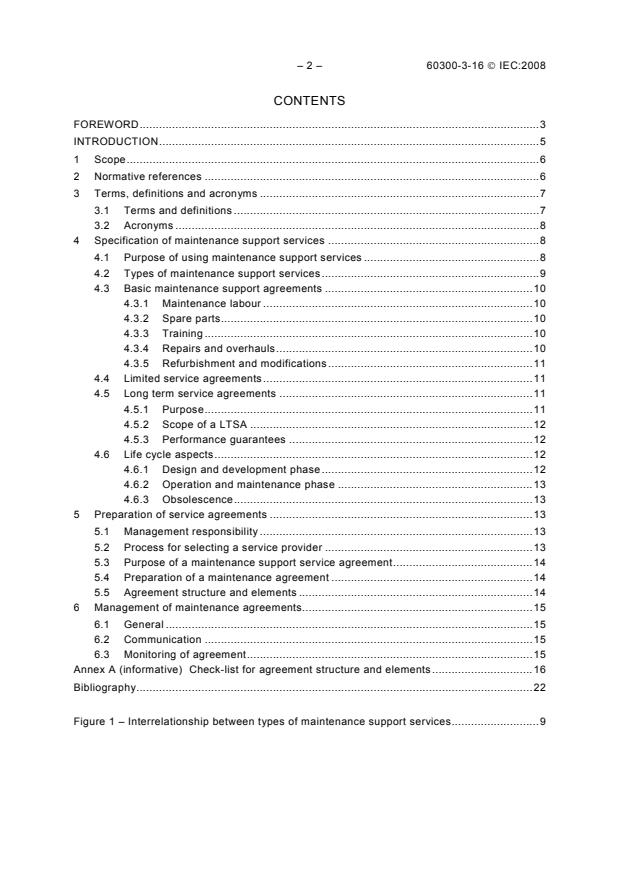
CONTENTS
FOREWORD.3
INTRODUCTION.5
1 Scope.6
2 Normative references .6
3 Terms, definitions and acronyms .7
3.1 Terms and definitions .7
3.2 Acronyms .8
4 Specification of maintenance support services .8
4.1 Purpose of using maintenance support services .8
4.2 Types of maintenance support services.9
4.3 Basic maintenance support agreements .10
4.3.1 Maintenance labour .10
4.3.2 Spare parts.10
4.3.3 Training .10
4.3.4 Repairs and overhauls.10
4.3.5 Refurbishment and modifications .11
4.4 Limited service agreements.11
4.5 Long term service agreements .11
4.5.1 Purpose.11
4.5.2 Scope of a LTSA .12
4.5.3 Performance guarantees .12
4.6 Life cycle aspects.12
4.6.1 Design and development phase.12
4.6.2 Operation and maintenance phase .13
4.6.3 Obsolescence.13
5 Preparation of service agreements .13
5.1 Management responsibility .13
5.2 Process for selecting a service provider .13
5.3 Purpose of a maintenance support service agreement.14
5.4 Preparation of a maintenance agreement .14
5.5 Agreement structure and elements .14
6 Management of maintenance agreements.15
6.1 General .15
6.2 Communication .15
6.3 Monitoring of agreement.15
Annex A (informative) Check-list for agreement structure and elements.16
Bibliography.22
Figure 1 – Interrelationship between types of maintenance support services.
60300-3-16 © IEC:2008 – 3 –
INTERNATIONAL ELECTROTECHNICAL COMMISSION
____________
DEPENDABILITY MANAGEMENT –
Part 3-16: Application guide –
Guidelines for specification of maintenance support services
FOREWORD
1) The International Electrotechnical Commission (IEC) is a worldwide organization for standardization comprising
all national electrotechnical committees (IEC National Committees). The object of IEC is to promote
international co-operation on all questions concerning standardization in the electrical and electronic fields. To
this end and in addition to other activities, IEC publishes International Standards, Technical Specifications,
Technical Reports, Publicly Available Specifications (PAS) and Guides (hereafter referred to as “IEC
Publication(s)”). Their preparation is entrusted to technical committees; any IEC National Committee interested
in the subject dealt with may participate in this preparatory work. International, governmental and non-
governmental organizations liaising with the IEC also participate in this preparation. IEC collaborates closely
with the International Organization for Standardization (ISO) in accordance with conditions determined by
agreement between the two organizations.
2) The formal decisions or agreements of IEC on technical matters express, as nearly as possible, an international
consensus of opinion on the relevant subjects since each technical committee has representation from all
interested IEC National Committees.
3) IEC Publications have the form of recommendations for international use and are accepted by IEC National
Committees in that sense. While all reasonable efforts are made to ensure that the technical content of IEC
Publications is accurate, IEC cannot be held responsible for the way in which they are used or for any
misinterpretation by any end user.
4) In order to promote international uniformity, IEC National Committees undertake to apply IEC Publications
transparently to the maximum extent possible in their national and regional publications. Any divergence
between any IEC Publication and the corresponding national or regional publication shall be clearly indicated in
the latter.
5) IEC provides no marking procedure to indicate its approval and cannot be rendered responsible for any
equipment declared to be in conformity with an IEC Publication.
6) All users should ensure that they have the latest edition of this publication.
7) No liability shall attach to IEC or its directors, employees, servants or agents including individual experts and
members of its technical committees and IEC National Committees for any personal injury, property damage or
other damage of any nature whatsoever, whether direct or indirect, or for costs (including legal fees) and
expenses arising out of the publication, use of, or reliance upon, this IEC Publication or any other IEC
Publications.
8) Attention is drawn to the Normative references cited in this publication. Use of the referenced publications is
indispensable for the correct application of this publication.
9) Attention is drawn to the possibility that some of the elements of this IEC Publication may be the subject of
patent rights. IEC shall not be held responsible for identifying any or all such patent rights.
International Standard IEC 60300-3-16 has been prepared by IEC technical committee 56:
Dependability.
The text of this standard is based on the following documents:
FDIS Report on voting
56/1271/FDIS 56/1290/RVD
Full information on the voting for the approval of this standard can be found in the report on
voting indicated in the above table.
This publication has been drafted in accordance with the ISO/IEC Directives, Part 2.
A list of all parts of the IEC 60300 series, under the general title Dependability management
can be found on the IEC website.
– 4 – 60300-3-16 © IEC:2008
The committee has decided that the contents of this publication will remain unchanged until
the maintenance result date indicated on the IEC web site under "http://webstore.iec.ch" in
the data related to the specific publication. At this date, the publication will be
• reconfirmed,
• withdrawn,
• replaced by a revised edition, or
• amended.
60300-3-16 © IEC:2008 – 5 –
INTRODUCTION
The use of maintenance agreements is now a common means of providing maintenance
support services to owners and operators of products, systems and equipment. These
services may be included in the initial design and development phase but they may also be
considered and implemented during the operation and maintenance phase.
Specification of maintenance support services requires not only the preparation of an
agreement but also management and monitoring of services during its implementation.
Agreements may be informal arrangements between the two parties or they may entail a
formal contract. Maintenance support services can range in scope from simple ones that
might entail repair of a specific type of item to long term, inclusive arrangements with
guarantees based on a relevant measure of performance.
The agreement must address responsibilities of both the service provider and the company
(and possibly the responsibilities of any warrantee service provided, if another company is
involved) with respect to scope and level of services, technical arrangements, organizational
arrangements, commercial aspects, legal obligations and contractual requirements. This
standard deals only with the service aspects of the agreement and not with legal or
contractual requirements.
– 6 – 60300-3-16 © IEC:2008
DEPENDABILITY MANAGEMENT –
Part 3-16: Application guide –
Guidelines for specification of maintenance support services
1 Scope
This part of IEC 60300 describes a framework for the specification of services related to the
maintenance support of products, systems and equipment that are carried out during the
operation and maintenance phase. The purpose of this standard is to outline, in a generic
manner, the development of agreements for maintenance support services as well as
guidelines for the management and monitoring of these agreements by both the company and
the service provider.
This standard is intended for use by a wide range of suppliers, maintenance support
organizations and users and can be applied to all items. For consistency in this standard, the
user, operator and owner are referred to as the company and the organization or vendor
providing the maintenance support service is called the service provider.
This standard is applicable to items, which include all types of products, equipment and
systems (hardware and software). Most of these require a certain level of maintenance to
ensure that their required functionality, dependability, capability, economic, safety and
regulatory requirements are achieved.
NOTE For consistency, this standard will use the term “item” as defined in 3.1.4, except where the context
requires otherwise.
2 Normative references
The following referenced documents are indispensable for the application of this document.
For dated references, only the edition cited applies. For undated references, the latest edition
of the referenced document (including any amendments) applies.
IEC 60300-3-2, Dependability management – Part 3-2: Application guide – Collection of
dependability data from the field
IEC 60300-3-3, Dependability management – Part 3-3: Application guide – Life cycle costing
IEC 60300-3-10, Dependability management – Part 3-10: Application guide – Maintainability
IEC 60300-3-12, Dependability management – Part 3-12: Application guide – Integrated
logistic support
IEC 60300-3-14, Dependability management – Part 3-14: Application guide – Maintenance
and maintenance support
IEC 60706-2, Maintainability of equipment – Part 2: Maintainability requirements and studies
during the design and development phase
IEC 62402, Obsolescence management – Application guide
60300-3-16 © IEC:2008 – 7 –
3 Terms, definitions and acronyms
For the purposes of this document, the following terms, definitions and acronyms apply.
3.1 Terms and definitions
3.1.1
company
recipient of a maintenance support service provided by the maintenance support service
provider
3.1.2
corrective maintenance
maintenance carried out after fault recognition and intended to put an item into a state in
which it can perform a required function
NOTE In French, the term “dépannage” sometimes implies a provisional restoration.
[IEV 191-07-08:1990]
3.1.3
integrated logistic support
ILS
management method by which all the logistic support services required by a customer can be
brought together in a structured way and in harmony with a product
3.1.4
item
entity
any part, component, device, subsystem, functional unit, equipment or system that can be
individually considered
NOTE 1 An item may consist of hardware, software or both, and may also, in particular cases, include people.
NOTE 2 In French the term “entité” is preferred to the term “dispositif” due to its more general meaning. The term
“dispositif” is also the common equivalent to the English term “device”.
NOTE 3 In French the term “individu” is used mainly in statistics.
NOTE 4 A number of items, e.g. a population of items or a sample, may itself be considered as an item.
NOTE 5 A software item may be source code, object code, job control code, control code or a collection of these
items.
[IEV 191-01-01:1990, modified]
3.1.5
maintenance
combination of all technical and administrative actions, including supervision actions,
intended to retain an item in, or restore it to, a state in which it can perform a required
function
[IEV 191-07-01:1990]
3.1.6
maintenance action
maintenance task
sequence of elementary maintenance activities carried out for a given purpose
NOTE Examples are fault diagnosis, fault localization, function check-out, or combinations thereof.
[IEV 191-07-18:1990]
– 8 – 60300-3-16 © IEC:2008
3.1.7
maintenance concept
interrelationship between the maintenance echelons, the indenture levels and the levels of
maintenance to be applied for the maintenance of an item
3.1.8
maintenance policy
general approach to the provision of maintenance and maintenance support based on the
objectives and policies of owners, users and customers
3.1.9
maintenance support
resources required to maintain an item, under a given maintenance concept and guided by a
maintenance policy
NOTE Resources include human resources, support equipment, materials and spare parts, maintenance facilities,
documentation, information and maintenance information systems.
3.1.10
preventive maintenance
maintenance carried out at predetermined intervals or according to prescribed criteria and
intended to reduce the probability of failure or the degradation of the functioning of an item
NOTE 1 Preventive maintenance includes condition-based tasks that consist of condition monitoring, inspection
and functional testing.
NOTE 2 Predetermined intervals apply to repair or replacement that are carried out at specific intervals such as
elapsed time, operating hours, distance, number of cycles or other relevant measures.
[IEV 191-07-07:1990, modified]
3.1.11
service provider
party (e.g. internal or external organization, manufacturer, etc.) that has agreed to undertake
responsibility for providing a given maintenance support service and obtaining, when specified,
supplies in accordance with an agreement
NOTE This may include the provision of a consultancy service.
3.2 Acronyms
ILS integrated logistic support
LTSA long term service agreement
SLA service level agreement
RCM reliability centred maintenance
4 Specification of maintenance support services
4.1 Purpose of using maintenance support services
Many organizations and users of products, systems and equipment may require the
assistance of internal or external service providers for maintenance support during the
operation and maintenance phase of the life cycle. Many of these services involve an
agreement that details the services being provided and how they are to be managed,
monitored and controlled.
Some of these services are short-term and limited in their scope of application. Other services
continue for a longer time period and may involve guarantees of performance related to
customer requirements. The latter necessitate a more complicated agreement and ongoing
management and monitoring between the parties.
60300-3-16 © IEC:2008 – 9 –
The reasons for obtaining maintenance support services may include:
– to optimize availability;
– to reduce costs or achieve cost stability;
– a lack of available expertise and resources by customer or user;
– low frequency of maintenance activities;
– lower costs due to economies of scale that can be achieved by a service provider;
– higher level of expertise available from equipment manufacturers and third parties.
4.2 Types of maintenance support services
Externally provided maintenance support services can be divided into three major categories:
– basic maintenance support agreements;
– limited service agreements;
– long term service agreements (LTSA).
The interrelationship between these types of services is illustrated in Figure 1.
Long term
service agreements
Limited service agreements
Basic maintenance support agreements
Refurbishment
Maintenance Spare Training Repairs and
labor parts overhauls and modifications
IEC 1566/08
Figure 1 – Interrelationship between types of maintenance support services
Typically, the lowest level of maintenance support service is provided on the basis of a
specific need, normally for a specific type or manufacturer of hardware and software.
Manufacturers traditionally provide these basic services to support their off-the-shelf
products. Limited service agreements and LTSAs are generally applicable to major
equipment, systems or facilities. They consist of many of the service components at the
– 10 – 60300-3-16 © IEC:2008
lowest level but in addition, include performance guarantees and a specifically tailored
agreement.
4.3 Basic maintenance support agreements
4.3.1 Maintenance labour
External service providers may supply maintenance staff who have specified skills to carry out
preventive or corrective maintenance tasks. These skills also include work-related activities
such as safety and environmental procedures. A single expert or a larger number of workers
may be provided along with the necessary supervision.
Maintenance staff will have maintenance-related skills and qualifications that might include:
– basic labour skills;
– trades qualifications such as millwright, mechanic, electrical or instrumentation with
certification as required;
– operation of special tools and support equipment;
– equipment-specific knowledge (hardware and software);
– manufacturer-specific knowledge; and
– other specialized knowledge, training and experience.
4.3.2 Spare parts
Spare parts and other materials needed for maintenance are available not only from the
original equipment manufacturer but often also from other sources. The specifications and
quality of the spare parts and materials are determined by the original equipment
manufacturer and also based on their operational environment and use. Ensuring that this
quality is met is a shared responsibility between the manufacturer of the spare parts and the
company unless transferred by contract to the service provider.
4.3.3 Training
Many manufacturers of more complex items will offer training on operation and maintenance
of their equipment. This training may be held at the manufacturer or facilities operated by the
company. The use of specialized tools and support equipment may be a major focus of the
training.
4.3.4 Repairs and overhauls
A very common maintenance support service is the repair or overhaul of item. The item may
undergo a repair by replacement only of a failed component. An overhaul is done with the
intent of restoring it to virtually new condition or upgrading the item. Some type of warranty
may be included in the agreement to protect the company against the consequences of
premature failures caused by the overhaul or repair.
For smaller items, the process is straightforward and the repaired item may not be returned to
the original company. It may instead become part of an exchange program.
With a major piece of equipment, the scope of the repair tasks may depend on its condition
which can only be determined after disassembly.
The repairs or overhauls are normally carried out in a special repair shop fully staffed and
equipped to complete them in the most efficient manner possible with strict quality processes.
However, for large items that are difficult to transport, the work may be done on site.
60300-3-16 © IEC:2008 – 11 –
4.3.5 Refurbishment and modifications
Refurbishment usually applies to major items and may involve improvements in functionality
such as output and efficiency. Modifications may be implemented which are not necessarily
related to maintenance needs. Refurbishment may be performed close to the normal end of
an item’s life to extend it for a longer time period.
4.4 Limited service agreements
It may be advantageous for a company to establish an agreement with a service provider or
equipment manufacturer that entails a more comprehensive set of maintenance support
services. These agreements may include a combination of the basic services listed in 4.3.
The time period and level of service should be defined accordingly. The time period of the
agreement is normally relatively short, e.g. on a yearly basis. The agreement may also be
restricted to providing agreed upon services to only a portion of the item.
Limited service agreements may include services such as:
– maintenance labour to assist with a major maintenance activity such as a facility
shutdown;
– provision of maintenance staff for regular preventive and corrective maintenance actions
for a specified time period;
– single sourcing of spare parts where the supplier guarantees a certain availability,
response time and pricing;
– provision of repair and overhaul services for certain items for a specified time period;
– training of staff;
– condition monitoring of items;
– a program to refurbish and modify items;
– development of maintenance policy and concept;
– preparation or review of maintenance tasks using a method such as RCM.
The performance of the agreement is verified by the measurement of a quality indicator
appropriate for the service provided. Normally a limited warranty is provided for the services
provided, work being done or parts that have been supplied.
4.5 Long term service agreements
4.5.1 Purpose
Long term service agreements consist of a comprehensive set of maintenance support
services for a longer time period with performance guarantees that relate to the major function
of the item. A LTSA is often provided by a supplier or manufacturer of major items at a facility.
It may also include in its scope all of the other items at that facility, known as balance of
plant.
LTSAs assure comprehensive item coverage with predictable costs so that a company can
better forecast annual budgeting requirements and minimize the variability of life cycle costs
(see IEC 60300-3-3). All or most costs are covered and item risk related to maintenance is
removed or reduced. One disadvantage may be that the costs may be higher than a company
could potentially achieve by performing its own maintenance activities and assuming its own
risk.
Another major reason for a LTSA is the expertise that an original item manufacturer has in its
design or that a service provider may have obtained through extensive experience with a
certain type of item. There is also the benefit of economy of scale if the services are supplied
to a large number of item users.
– 12 – 60300-3-16 © IEC:2008
A LTSA may be referred to as a service level agreement (SLA) and the performance
guarantees may be defined in terms of Quality of Services (QoS) indicators which may be
qualitative and/or quantitative.
4.5.2 Scope of a LTSA
The scope of a LTSA is comprehensive and long term, typically a period of 3-10 years and
even longer in some circumstances. It may include
– maintenance management services consisting of development of maintenance policy and
concept, planning and scheduling of maintenance actions, managing of spare parts
inventory and management of maintenance data using a computerized maintenance
management system;
– provision of maintenance staff for regular preventive and corrective maintenance actions
possibly by dedicated staff located at the facility;
– supply of all spare parts and materials;
– repair and overhaul services for specified items;
– training of staff;
– condition monitoring of items;
– refurbishment and modification of items;
– regular reporting of services supplied and item performance achieved;
– obsolescence management.
4.5.3 Performance guarantees
The performance and success of the LTSA is measured by means of a guarantee that is
related to the major function of the item to the company. Service or QoS “guarantees” to
specific performance levels are becoming more predominant. Guarantees may consist of a
dependability measure such as availability or a performance measure such as power output or
energy delivered. A performance target may be set with an incentive if a higher threshold is
exceeded. If the performance does not meet the target, a financial penalty may be charged
against the service provider.
The method used to measure performance has to be clearly defined and carefully monitored.
As well, the extent of liability by the service provider has to be defined. For example,
business-related losses are generally excluded from performance guarantees.
4.6 Life cycle aspects
4.6.1 Design and development phase
The evaluation of maintainability during the design phase (see IEC 60300-3-10 and
IEC 60706-2) may include the possibility or necessity for the use of external service providers
to supply either limited maintenance support services or a more comprehensive LTSA to the
company. Trade-offs can then be considered and the most effective solution for
maintainability and maintenance support can then be implemented in the design.
Implementation of a service agreement may be possible only when the user of the item is
known. The company has three options:
– provision of all of the maintenance by the company;
– giving part of the maintenance to a service provider;
– entrusting all of the maintenance to a service provider.
For products where an integrated logistics support (ILS) approach is applied
(see IEC 60300-3-12), all maintenance and maintenance support activities are completely
60300-3-16 © IEC:2008 – 13 –
planned and provided for prior to the operation and maintenance phase. This often entails the
use of external service providers and the need for service agreements.
4.6.2 Operation and maintenance phase
When existing products are incorporated in complex systems by another manufacturer or
organization and are then supplied to a company, maintenance support is usually established
by the company during the operation and maintenance phase (see IEC 60300-3-14). External
maintenance support services are determined by a company since each one will have
different capabilities for performing maintenance and maintenance support activities and thus
the need and economic viability of external maintenance support services will vary. Other
factors that will influence the use of external services are the availability and accessibility of
those services to a specific company.
4.6.3 Obsolescence
The major reasons for parts obsolescence is the cessation of production capability as well as
diminishing demand. However, the use of service providers may hasten or extend the
obsolescence of items since maintenance support, in their parts consumption, is a major
factor in the ability of a company to successfully operate and maintain items. Obsolescence
may be forced on a company if a service provider ceases to provide maintenance support
services and no alternatives are available. On the other hand, the life of an item may be
extended if a third party service provider is able to continue maintenance support even though
the original manufacturer has ceased support for that item. Please refer to IEC 62402 for
further details on the management of obsolescence.
5 Preparation of service agreements
5.1 Management responsibility
Management has overall responsibility for establishing the maintenance policy for all items,
including the extent to which level of maintenance support services should be outsourced to
external service providers. This policy may change over time as economic factors and the
availability and accessibility of service providers changes.
Management is thus responsible for the preparation, evaluation and monitoring of
maintenance agreements that are put in place.
5.2 Process for selecting a service provider
Prior to a maintenance agreement being agreed upon, a user or operator of items will
normally go through a process of selecting a maintenance service provider. The actual
process used will be guided by company policy for obtaining services. In general, this process
may involve the preparation of a Formal Request for Proposal which documents:
– the specific services being requested;
– the response that is required and possibly a list of questions that need to be answered;
– a draft of the agreement terms that are expected to be part of the final agreement;
– the process and method for selecting the successful bidder;
– where and when the response is to be delivered.
Service providers allowed to bid on an agreement may need to be pre-qualified to establish
basic conditions for an agreement. The Formal Request for Proposal is then sent to the list of
acceptable vendors. Once the bids are received, a selection process is used to decide on the
successful bidder. At this point, a negotiation process may need to be initiated to finalize the
scope, terms and conditions and deal with exceptions. The final agreement can then be
prepared.
– 14 – 60300-3-16 © IEC:2008
5.3 Purpose of a maintenance support service agreement
A maintenance support service agreement is a functional as well as a legal agreement
between a company and a service provider. It defines the services being provided and
clarifies objectives and respective responsibilities. Agreements are usually set up with an
external service provider but may also be made with a service group internal to the company.
Internal agreements may be easier to execute but the same approach should be taken in
order to ensure that both parties will be satisfied with the end result.
The purpose of a maintenance support service agreement is:
– to specify the services being provided and any constraints that may apply;
– to define performance guarantees that are to be met and incentives or penalties that may
apply if the performance guarantee is exceeded or not met, respectively;
– to clearly establish and document contractual responsibilities;
– to define legal and regulatory obligations that have to be met;
– to assist with resolution of conflicts that may arise;
– to make provisions for extra work that may arise such as the incorporation of
modifications requested by the company or suggested by the service provider;
– to enable expected benefits to be realized by both company and service provider.
5.4 Preparation of a maintenance agreement
The preparation of a maintenance agreement consists of the following steps:
– deciding which maintenance support services are desired to be outsourced;
– deciding on the type of maintenance agreement which may be appropriate;
– defining the specific scope of services required;
– setting out performance guarantees and related incentives or penalties;
– determining legal and regulatory obligations that must be met by the service provider and
the owner / operator;
– outlining the commercial terms that will apply.
Each individual agreement should be drafted, and negotiated where appropriate, to take into
account the specific aspects arising from the work required on the items to be maintained, the
parties involved and any applicable laws and regulations.
5.5 Agreement structure and elements
The following standard elements and a template are provided to simplify preparation of
maintenance agreements. An agreement will typically have these major elements:
– general section with descriptive information on the nature of the agreement and its
objectives;
– scope of services agreed upon;
– technical arrangements related to the performance of duties;
– organizational arrangements;
– commercial aspects;
– legal obligations by both parties;
– contractual requirements.
Since legal obligations and contractual requirements will vary with the jurisdictions where the
items are located, they will not be described in this standard.
60300-3-16 © IEC:2008 – 15 –
A standard check-list for use when drafting maintenance agreements is provided in Annex A.
It is intended as a working tool and offers typical headings which are not exhaustive and
which parties may or may not include, exclude, modify and adapt to their own contractual
relationship. It is not binding for the parties to use any part of this template and not all
elements will be applicable to every agreement.
6 Management of maintenance agreements
6.1 General
Maintenance agreements need to be managed and monitored to ensure that objectives of the
company are met and payment to the service provider can be made. If performance
guarantees are involved, documentation of results and actual performance is crucial to
minimize disputes. In particular, a LTSA requires considerable attention because of the long
term nature of the agreement. A company may wish to prepare and approve a management
plan to cover the use of maintenance agreements to ensure they are consistent with company
objectives and policies.
6.2 Communication
Clear lines of communication are essential to efficient execution of maintenance activities.
Specific positions, names and contact information need to be up-to-date at all times. Where
possible, the type of communication desired (face-to-face meeting, phone, email, written
report, etc.) should be identified in the agreement or specifically agreed upon later.
Activities that involve communication between company and service provider include items
such as:
– provision of necessary information by the company to the service provider with respect to
operating procedures, location of items, operating and maintenance history, etc. and
changes to this information as it occurs;
– approval by company for initiation of specific activities covered by the agreement;
– agreement on scheduling of activities and management of changes or delays to timing;
– submission of technical documentation by the service provider to the company on work
performed or services rendered;
– verification of services rendered and actual performance for purpose of payment;
– communication between parties on issues and disagreements.
6.3 Monitoring of agreement
Both the service provider and the company have responsibilities for monitoring the status of
the agreement to verify that the terms of the agreement are being met. Included in these
responsibilities are:
– verification of work performed and services provided;
– accurate measurement of performance used for guarantees;
– compliance with health, safety and environmental requirements;
– maintaining confidentiality of information;
– resolution of issues and disagreements;
– adequate documentation of technical records;
– official reporting between service provider and company;
– ensuring qualifications and competence of personnel supplied by the service provider;
– verification of compliance with company operating practices and procedures.
Guidelines on the collection of dependability data are provided in IEC 60300-3-2.
– 16 – 60300-3-16 © IEC:2008
Annex A
(informative)
Check-list for agreement structure and elements
A.1 General
These elements cover general aspects of the agreement.
ELEMENTS PURPOSE PROPOSED CONTENT
1 General
1.1 Title General heading used for the Short description of the agreement such as
agreement “Maintenance support services agreement for
preventive maintenance of large electric
motors”
1.2 Parties Identification of parties involved Names, addresses and contact information for
in the agreement both parties
1.3 Description General description of the nature
of the agreement
1.4 Objective Statement of the objective that This describes the intent of both parties and
the company is trying to achieve. the objectives they are trying to achieve. It may
Stating the general intention of include a general statement of the level of
the parties and the purposes of performance expected and guarantees that are
the agreement may be especially required
important for long-term
agreements when changing
conditions may make adjustments
to the agreement necessary
1.5 Definitions In the area of maintenance many Technical, legal and commercial terms should
terms are often used with be defined. Where possible, national or
different or ambiguous meanings. international standards should be used and
Therefore, terms should be referenced instead of narrow company
defined in a way that is common definitions
to the parties
A.2 Scope of services
This describes the specific services that are to be provided by the service provider.
ELEMENTS PURPOSE PROPOSED CONTENT
2 Scope of services
2.
...