


IEC 62508:2025
(Main)Guidance on human aspects of dependability
General Information
- Abstract
IEC 62508: 2025 provides guidance on current knowledge and practice concerning dependability in an operational environment, in terms of the humans, teams and organizations involved in conducting the work. It is part of a suite of IEC standards that are intended to address the dependability of both the technical and human elements of equipment and organizations.
This document describes the human elements of a typical operational system, and the importance of those elements to overall dependability. It also describes the means of assessing how well these elements are functioning, and general concepts on how the reliability of humans can be improved. These elements typically include the individual workers, the groups or teams into which they are organized, the interfaces between humans and technical systems, and the overall organization.
The following guidance is applicable to any industry that depends on human-systems interactions involving the technology, software, or systems of work required to support the production and safety objectives of an organization. This document primarily addresses complex technical systems, but some parts are also applicable to the manufacturing of industrial and consumer products. Principles for design of the human-machine interface (usability) are described, and further information can be found in the technical literature and in relevant product standards. Although this document does not specifically cover worker health or safety, the application of this document can raise related issues, particularly in process safety, which is closely associated with system reliability.
This second edition cancels and replaces the first edition published in 2010. This edition constitutes a technical revision.
This edition includes the following significant technical changes with respect to the previous edition:
a) The emphasis on user-centred design in the previous edition was reduced in favour of a greater emphasis on human dependability in an existing operational environment.
b) The emphasis on human error and error-rate determination methods was reduced in favour of a greater emphasis on means of providing organizational support for the workforce in their execution of required tasks.
c) Where appropriate, discussions of human factors in an operational environment were aligned with current theory, terminology and practice.
- Status
- Published
- Publication Date
- 18-Jun-2025
- Technical Committee
- TC 56 - Dependability
- Drafting Committee
- MT 21 - TC 56/MT 21
- Current Stage
- PPUB - Publication issued
- Start Date
- 19-Jun-2025
- Completion Date
- 30-May-2025
Overview
IEC 62508:2025, titled Guidance on Human Aspects of Dependability, is an international standard developed by the International Electrotechnical Commission (IEC) that provides comprehensive guidance on the human factors influencing the dependability of operational systems. This 2025 edition supersedes the 2010 version, reflecting important advancements and current best practices related to human roles within socio-technical environments. The standard focuses on the interaction of humans, teams, and organizations with technical systems to enhance reliability and operational safety.
Essentially, IEC 62508:2025 addresses how people impact the dependability of complex technical systems, emphasizing human performance, team dynamics, organizational structures, and their interface with machines. It guides industries reliant on human-machine interactions, including sectors involved with safety-critical and production systems. While primarily targeting complex technical systems, the principles outlined also extend to manufacturing of industrial and consumer products.
Key Topics
Human Elements of Dependability
The standard defines the human components within operational systems, including individual workers, teams, and organizational environments. It examines human strengths, limitations, and roles in achieving system reliability.Socio-Technical System Components
IEC 62508 categorizes dependability elements into task, human, machine, team, organizational, physical, and cultural components that collectively influence system performance.Human Factors and Performance Shaping
It highlights internal and external factors shaping human reliability such as fatigue, training, stress, team coherence, work environment, and information processing.Dependability Assessment and Improvement
The document provides methods for analyzing human-related failures, human-system interaction failures, and machine failures. It introduces frameworks for identifying countermeasures to minimize human error and enhance operational dependability.Human Dependability Programs
The standard outlines a phased approach to improving human dependability, covering failure analysis, data interpretation, workforce support, and decision-making enhancement.Human-Centred Design Integration
Emphasizing a shift from user-centered design towards optimizing dependability within existing environments, IEC 62508 details design principles and activities for embedding human factors early in the product and system lifecycle-from concept through to decommissioning.Operational Environment and Organizational Support
It stresses the importance of organizational culture, team structure, and operational feedback loops as contributors to dependable operations.
Applications
IEC 62508:2025 is applicable across any industry that depends on complex interactions between humans and technical systems, including but not limited to:
Industrial Automation and Control Systems
Enhancing safety and reliability in manufacturing plants by optimizing human-machine interfaces and team coordination.Process Safety and Risk Management
Improving the reliability of operations in process industries where human elements significantly affect safety outcomes.Transportation Systems
Supporting dependable human operation and organizational structures in railways, aviation, and vehicular systems.Healthcare Technology
Designing medical devices and operational protocols that consider human factors for higher dependability.Consumer Product Manufacturing
Applying human factors guidance to ensure usability and reliability in consumer electronic devices and appliances.
In all contexts, organizations can utilize IEC 62508 to design better training programs, develop human reliability analyses, and structure work environments that support sustained human dependability.
Related Standards
IEC 62508 is part of a broader family of IEC standards addressing dependability that integrate both technical and human factors. Users may also consider:
IEC 61508 - Functional Safety of Electrical/Electronic/Programmable Electronic Safety-Related Systems, which complements human factors considerations with technical safety lifecycle requirements.
ISO 9241 - Ergonomics of Human-System Interaction, providing extensive guidelines on usability and interface design relevant to human-machine interactions.
IEC TR 62061 - Safety of Machinery - Functional Safety, offering methods for incorporating safety and human factors into machinery design.
ISO 31000 - Risk Management, enabling organizations to integrate human dependability risks with overall risk management frameworks.
IEC 61131 Series - Programmable Controllers, relevant for automation systems with a strong human interface component.
By following IEC 62508 alongside these standards, organizations can achieve a holistic approach to dependability that optimally balances human and technical factors.
Keywords: IEC 62508, human dependability, socio-technical systems, human factors engineering, operational reliability, human-machine interface, organizational support, human reliability analysis, human-centred design, industrial safety standards, process safety, dependability standards.
Relations
- Revises
IEC PAS 62508:2007 - Guidance on human factors engineering for system life cycle applications - Effective Date
- 26-Oct-2025
- Effective Date
- 05-Sep-2023
Get Certified
Connect with accredited certification bodies for this standard

BSI Group
BSI (British Standards Institution) is the business standards company that helps organizations make excellence a habit.

Bureau Veritas
Bureau Veritas is a world leader in laboratory testing, inspection and certification services.

DNV
DNV is an independent assurance and risk management provider.
Sponsored listings
Frequently Asked Questions
IEC 62508:2025 is a standard published by the International Electrotechnical Commission (IEC). Its full title is "Guidance on human aspects of dependability". This standard covers: IEC 62508: 2025 provides guidance on current knowledge and practice concerning dependability in an operational environment, in terms of the humans, teams and organizations involved in conducting the work. It is part of a suite of IEC standards that are intended to address the dependability of both the technical and human elements of equipment and organizations. This document describes the human elements of a typical operational system, and the importance of those elements to overall dependability. It also describes the means of assessing how well these elements are functioning, and general concepts on how the reliability of humans can be improved. These elements typically include the individual workers, the groups or teams into which they are organized, the interfaces between humans and technical systems, and the overall organization. The following guidance is applicable to any industry that depends on human-systems interactions involving the technology, software, or systems of work required to support the production and safety objectives of an organization. This document primarily addresses complex technical systems, but some parts are also applicable to the manufacturing of industrial and consumer products. Principles for design of the human-machine interface (usability) are described, and further information can be found in the technical literature and in relevant product standards. Although this document does not specifically cover worker health or safety, the application of this document can raise related issues, particularly in process safety, which is closely associated with system reliability. This second edition cancels and replaces the first edition published in 2010. This edition constitutes a technical revision. This edition includes the following significant technical changes with respect to the previous edition: a) The emphasis on user-centred design in the previous edition was reduced in favour of a greater emphasis on human dependability in an existing operational environment. b) The emphasis on human error and error-rate determination methods was reduced in favour of a greater emphasis on means of providing organizational support for the workforce in their execution of required tasks. c) Where appropriate, discussions of human factors in an operational environment were aligned with current theory, terminology and practice.
IEC 62508: 2025 provides guidance on current knowledge and practice concerning dependability in an operational environment, in terms of the humans, teams and organizations involved in conducting the work. It is part of a suite of IEC standards that are intended to address the dependability of both the technical and human elements of equipment and organizations. This document describes the human elements of a typical operational system, and the importance of those elements to overall dependability. It also describes the means of assessing how well these elements are functioning, and general concepts on how the reliability of humans can be improved. These elements typically include the individual workers, the groups or teams into which they are organized, the interfaces between humans and technical systems, and the overall organization. The following guidance is applicable to any industry that depends on human-systems interactions involving the technology, software, or systems of work required to support the production and safety objectives of an organization. This document primarily addresses complex technical systems, but some parts are also applicable to the manufacturing of industrial and consumer products. Principles for design of the human-machine interface (usability) are described, and further information can be found in the technical literature and in relevant product standards. Although this document does not specifically cover worker health or safety, the application of this document can raise related issues, particularly in process safety, which is closely associated with system reliability. This second edition cancels and replaces the first edition published in 2010. This edition constitutes a technical revision. This edition includes the following significant technical changes with respect to the previous edition: a) The emphasis on user-centred design in the previous edition was reduced in favour of a greater emphasis on human dependability in an existing operational environment. b) The emphasis on human error and error-rate determination methods was reduced in favour of a greater emphasis on means of providing organizational support for the workforce in their execution of required tasks. c) Where appropriate, discussions of human factors in an operational environment were aligned with current theory, terminology and practice.
IEC 62508:2025 is classified under the following ICS (International Classification for Standards) categories: 03.120.01 - Quality in general. The ICS classification helps identify the subject area and facilitates finding related standards.
IEC 62508:2025 has the following relationships with other standards: It is inter standard links to IEC PAS 62508:2007, IEC 62508:2010. Understanding these relationships helps ensure you are using the most current and applicable version of the standard.
IEC 62508:2025 is available in PDF format for immediate download after purchase. The document can be added to your cart and obtained through the secure checkout process. Digital delivery ensures instant access to the complete standard document.
Standards Content (Sample)
IEC 62508 ®
Edition 2.0 2025-06
INTERNATIONAL
STANDARD
NORME
INTERNATIONALE
Guidance on human aspects of dependability
Lignes directrices relatives aux facteurs humains dans la sûreté de
fonctionnement
ICS 03.120.01 ISBN 978-2-8327-0487-5
All rights reserved. Unless otherwise specified, no part of this publication may be reproduced or utilized in any form or
by any means, electronic or mechanical, including photocopying and microfilm, without permission in writing from either
IEC or IEC's member National Committee in the country of the requester. If you have any questions about IEC copyright
or have an enquiry about obtaining additional rights to this publication, please contact the address below or your local
IEC member National Committee for further information.
Droits de reproduction réservés. Sauf indication contraire, aucune partie de cette publication ne peut être reproduite ni
utilisée sous quelque forme que ce soit et par aucun procédé, électronique ou mécanique, y compris la photocopie et
les microfilms, sans l'accord écrit de l'IEC ou du Comité national de l'IEC du pays du demandeur. Si vous avez des
questions sur le copyright de l'IEC ou si vous désirez obtenir des droits supplémentaires sur cette publication, utilisez
les coordonnées ci-après ou contactez le Comité national de l'IEC de votre pays de résidence.
IEC Secretariat Tel.: +41 22 919 02 11
3, rue de Varembé info@iec.ch
CH-1211 Geneva 20 www.iec.ch
Switzerland
About the IEC
The International Electrotechnical Commission (IEC) is the leading global organization that prepares and publishes
International Standards for all electrical, electronic and related technologies.
About IEC publications
The technical content of IEC publications is kept under constant review by the IEC. Please make sure that you have the
latest edition, a corrigendum or an amendment might have been published.
IEC publications search - IEC Products & Services Portal - products.iec.ch
webstore.iec.ch/advsearchform Discover our powerful search engine and read freely all the
The advanced search enables to find IEC publications by a publications previews, graphical symbols and the glossary.
variety of criteria (reference number, text, technical With a subscription you will always have access to up to date
committee, …). It also gives information on projects, content tailored to your needs.
replaced and withdrawn publications.
Electropedia - www.electropedia.org
IEC Just Published - webstore.iec.ch/justpublished The world's leading online dictionary on electrotechnology,
Stay up to date on all new IEC publications. Just Published containing more than 22 500 terminological entries in English
details all new publications released. Available online and and French, with equivalent terms in 25 additional languages.
once a month by email. Also known as the International Electrotechnical Vocabulary
(IEV) online.
IEC Customer Service Centre - webstore.iec.ch/csc
If you wish to give us your feedback on this publication or
need further assistance, please contact the Customer
Service Centre: sales@iec.ch.
A propos de l'IEC
La Commission Electrotechnique Internationale (IEC) est la première organisation mondiale qui élabore et publie des
Normes internationales pour tout ce qui a trait à l'électricité, à l'électronique et aux technologies apparentées.
A propos des publications IEC
Le contenu technique des publications IEC est constamment revu. Veuillez vous assurer que vous possédez l’édition la
plus récente, un corrigendum ou amendement peut avoir été publié.
Recherche de publications IEC - IEC Products & Services Portal - products.iec.ch
webstore.iec.ch/advsearchform Découvrez notre puissant moteur de recherche et consultez
La recherche avancée permet de trouver des publications gratuitement tous les aperçus des publications, symboles
IEC en utilisant différents critères (numéro de référence, graphiques et le glossaire. Avec un abonnement, vous aurez
texte, comité d’études, …). Elle donne aussi des toujours accès à un contenu à jour adapté à vos besoins.
informations sur les projets et les publications remplacées
ou retirées. Electropedia - www.electropedia.org
Le premier dictionnaire d'électrotechnologie en ligne au
IEC Just Published - webstore.iec.ch/justpublished monde, avec plus de 22 500 articles terminologiques en
Restez informé sur les nouvelles publications IEC. Just anglais et en français, ainsi que les termes équivalents
Published détaille les nouvelles publications parues. dans 25 langues additionnelles. Egalement appelé
Disponible en ligne et une fois par mois par email. Vocabulaire Electrotechnique International (IEV) en ligne.
Service Clients - webstore.iec.ch/csc
Si vous désirez nous donner des commentaires sur cette
publication ou si vous avez des questions contactez-
nous: sales@iec.ch.
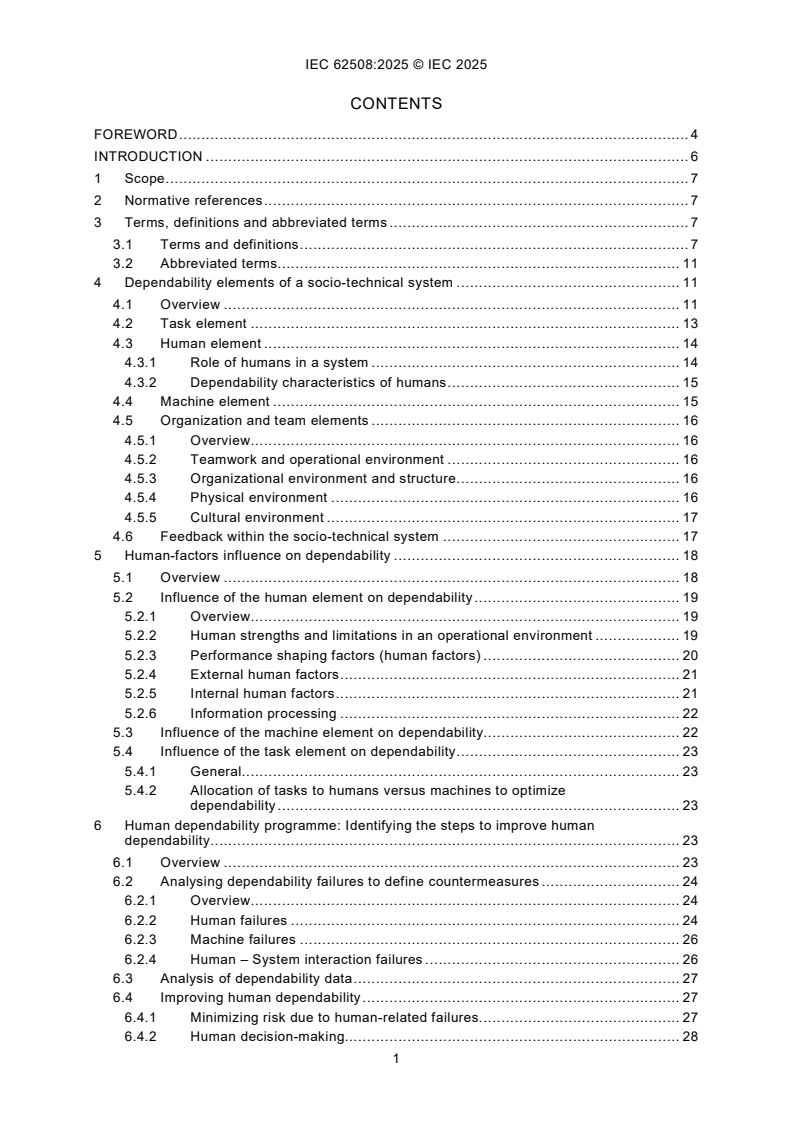
CONTENTS
FOREWORD . 4
INTRODUCTION . 6
1 Scope . 7
2 Normative references . 7
3 Terms, definitions and abbreviated terms . 7
3.1 Terms and definitions . 7
3.2 Abbreviated terms. 11
4 Dependability elements of a socio-technical system . 11
4.1 Overview . 11
4.2 Task element . 13
4.3 Human element . 14
4.3.1 Role of humans in a system . 14
4.3.2 Dependability characteristics of humans . 15
4.4 Machine element . 15
4.5 Organization and team elements . 16
4.5.1 Overview . 16
4.5.2 Teamwork and operational environment . 16
4.5.3 Organizational environment and structure . 16
4.5.4 Physical environment . 16
4.5.5 Cultural environment . 17
4.6 Feedback within the socio-technical system . 17
5 Human-factors influence on dependability . 18
5.1 Overview . 18
5.2 Influence of the human element on dependability . 19
5.2.1 Overview . 19
5.2.2 Human strengths and limitations in an operational environment . 19
5.2.3 Performance shaping factors (human factors) . 20
5.2.4 External human factors . 21
5.2.5 Internal human factors . 21
5.2.6 Information processing . 22
5.3 Influence of the machine element on dependability. 22
5.4 Influence of the task element on dependability . 23
5.4.1 General. 23
5.4.2 Allocation of tasks to humans versus machines to optimize
dependability . 23
6 Human dependability programme: Identifying the steps to improve human
dependability . 23
6.1 Overview . 23
6.2 Analysing dependability failures to define countermeasures . 24
6.2.1 Overview . 24
6.2.2 Human failures . 24
6.2.3 Machine failures . 26
6.2.4 Human – System interaction failures . 26
6.3 Analysis of dependability data . 27
6.4 Improving human dependability . 27
6.4.1 Minimizing risk due to human-related failures. 27
6.4.2 Human decision-making. 28
6.5 Improving machine dependability through a human-factors approach . 28
6.6 Improving socio-technical system dependability . 29
7 Human dependability at each life-cycle stage . 29
7.1 Overview of human dependability aspects of life-cycle stages . 29
7.2 Concept and definition stage . 30
7.2.1 Concept stage . 30
7.2.2 Human-centred design planning . 31
7.2.3 System requirements . 31
7.2.4 Human-centred design requirements . 31
7.3 Design and development stage . 32
7.3.1 Human-centred design principles . 32
7.3.2 Human-centred design guidelines . 32
7.3.3 Human-centred design activities . 34
7.3.4 Integrating human dependability into design and development . 34
7.3.5 Human dependability analysis in design and development . 35
7.4 Realization and implementation stage . 35
7.5 Operations and maintenance stage. 36
7.6 Enhancement stage . 37
7.7 Retirement or decommissioning stage. 37
Annex A (informative) Examples of human reliability analysis (HRA) methods . 38
Annex B (informative) Summary of human-oriented design activities and their impact
on system dependability . 42
B.1 Overview . 42
B.2 Automation . 42
B.3 Design for maintainability . 43
B.4 Human-machine interface . 43
B.5 Incorporation of displays, controls, and alarm functions . 44
B.6 Incorporation of input devices . 44
B.7 Environment . 45
B.8 Safety. 45
B.9 Security . 45
Annex C (informative) Processes for human-centred design . 46
Bibliography . 53
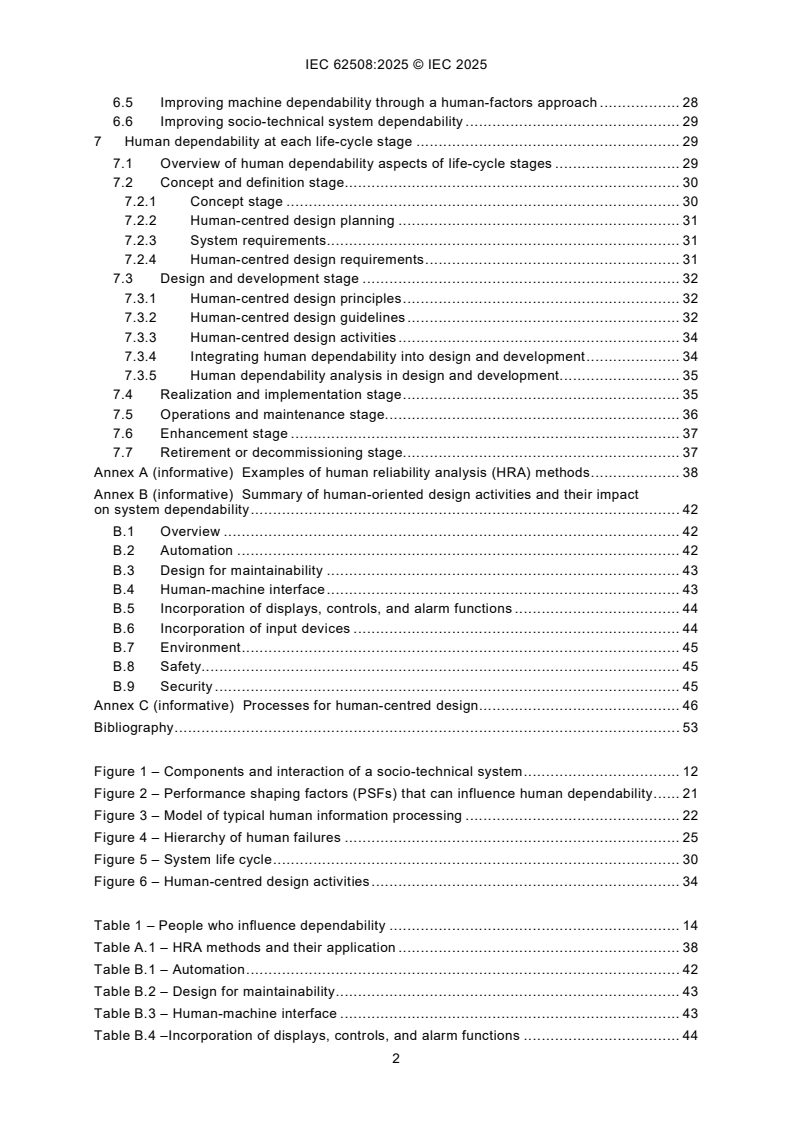
Figure 1 – Components and interaction of a socio-technical system . 12
Figure 2 – Performance shaping factors (PSFs) that can influence human dependability . 21
Figure 3 – Model of typical human information processing . 22
Figure 4 – Hierarchy of human failures . 25
Figure 5 – System life cycle . 30
Figure 6 – Human-centred design activities . 34
Table 1 – People who influence dependability . 14
Table A.1 – HRA methods and their application . 38
Table B.1 – Automation . 42
Table B.2 – Design for maintainability . 43
Table B.3 – Human-machine interface . 43
Table B.4 –Incorporation of displays, controls, and alarm functions . 44
Table B.5 – Incorporation of input devices. 44
Table B.6 – Environment . 45
Table B.7 – Safety . 45
Table B.8 – Security . 45
Table C.1 – Examples of methods and techniques that contribute to human-centred
design . 46
INTERNATIONAL ELECTROTECHNICAL COMMISSION
____________
Guidance on human aspects of dependability
FOREWORD
1) The International Electrotechnical Commission (IEC) is a worldwide organization for standardization comprising
all national electrotechnical committees (IEC National Committees). The object of IEC is to promote international
co-operation on all questions concerning standardization in the electrical and electronic fields. To this end and
in addition to other activities, IEC publishes International Standards, Technical Specifications, Technical Reports,
Publicly Available Specifications (PAS) and Guides (hereafter referred to as "IEC Publication(s)"). Their
preparation is entrusted to technical committees; any IEC National Committee interested in the subject dealt with
may participate in this preparatory work. International, governmental and non-governmental organizations liaising
with the IEC also participate in this preparation. IEC collaborates closely with the International Organization for
Standardization (ISO) in accordance with conditions determined by agreement between the two organizations.
2) The formal decisions or agreements of IEC on technical matters express, as nearly as possible, an international
consensus of opinion on the relevant subjects since each technical committee has representation from all
interested IEC National Committees.
3) IEC Publications have the form of recommendations for international use and are accepted by IEC National
Committees in that sense. While all reasonable efforts are made to ensure that the technical content of IEC
Publications is accurate, IEC cannot be held responsible for the way in which they are used or for any
misinterpretation by any end user.
4) In order to promote international uniformity, IEC National Committees undertake to apply IEC Publications
transparently to the maximum extent possible in their national and regional publications. Any divergence between
any IEC Publication and the corresponding national or regional publication shall be clearly indicated in the latter.
5) IEC itself does not provide any attestation of conformity. Independent certification bodies provide conformity
assessment services and, in some areas, access to IEC marks of conformity. IEC is not responsible for any
services carried out by independent certification bodies.
6) All users should ensure that they have the latest edition of this publication.
7) No liability shall attach to IEC or its directors, employees, servants or agents including individual experts and
members of its technical committees and IEC National Committees for any personal injury, property damage or
other damage of any nature whatsoever, whether direct or indirect, or for costs (including legal fees) and
expenses arising out of the publication, use of, or reliance upon, this IEC Publication or any other IEC
Publications.
8) Attention is drawn to the Normative references cited in this publication. Use of the referenced publications is
indispensable for the correct application of this publication.
9) IEC draws attention to the possibility that the implementation of this document may involve the use of (a)
patent(s). IEC takes no position concerning the evidence, validity or applicability of any claimed patent rights in
respect thereof. As of the date of publication of this document, IEC had not received notice of (a) patent(s), which
may be required to implement this document. However, implementers are cautioned that this may not represent
the latest information, which may be obtained from the patent database available at https://patents.iec.ch. IEC
shall not be held responsible for identifying any or all such patent rights.
IEC 62508 has been prepared by IEC Technical Committee 56: Dependability. It is an
International Standard.
This second edition cancels and replaces the first edition published in 2010. This edition
constitutes a technical revision.
This edition includes the following significant technical changes with respect to the previous
edition:
a) The emphasis on user-centred design in the previous edition was reduced in favour of a
greater emphasis on human dependability in an existing operational environment.
b) The emphasis on human error and error-rate determination methods was reduced in favour
of a greater emphasis on means of providing organizational support for the workforce in
their execution of required tasks.
c) Where appropriate, discussions of human factors in an operational environment were
aligned with current theory, terminology and practice.
The text of this International Standard is based on the following documents:
Draft Report on voting
56/2074/FDIS 56/2096A/RVD
Full information on the voting for its approval can be found in the report on voting indicated in
the above table.
The language used for the development of this International Standard is English.
This document was drafted in accordance with ISO/IEC Directives, Part 2, and developed in
accordance with ISO/IEC Directives, Part 1 and ISO/IEC Directives, IEC Supplement, available
at www.iec.ch/members_experts/refdocs. The main document types developed by IEC are
described in greater detail at www.iec.ch/publications.
The committee has decided that the contents of this document will remain unchanged until the
stability date indicated on the IEC website under webstore.iec.ch in the data related to the
specific document. At this date, the document will be
• reconfirmed,
• withdrawn, or
• revised.
INTRODUCTION
This document is intended as a basic guide for managers, engineers and other professionals.
It concerns good practice for improving dependability of humans in an operational environment,
as well as optimizing the interactions between humans and equipment, software, and
organizational systems. Modern workplaces often involve the integration of humans with
complex technologies and production systems. This document is intended to assist
management to:
• understand the basis for human dependability, including designing equipment and systems
to minimize human error rather than overly relying on the workforce to act correctly,
• assess the risks related to human performance in an operational environment, and
• implement changes in an operational environment in order to improve the effectiveness of
personnel in relation to the technology and systems with which they interact.
One objective in implementing the guidelines in this document is to facilitate the optimization of
interactions between humans and equipment, software, facilities, services and organizational
systems. A second objective is to reduce the potential for failures to occur that can adversely
affect production, equipment maintenance, safety or the well-being of the workforce. Towards
this end, guidance on applicable methods and metrics are included for assessing the risks
associated with human dependability.
This document is not intended as a handbook or theoretical guide to the fields of human factors
or human-systems interactions. These are available elsewhere, and some useful references
are listed in the bibliography. Rather, it is intended as a tool for managers and engineers who
are tasked with designing, assessing or controlling the human and technical elements of their
area of responsibility.
Rather than being a review of human "undependability", the aim is to describe the elements of
operational systems that positively contribute to human performance. This document provides
an awareness of the relative importance of these elements to dependability, and the tools for
assessing how well they are functioning in the organization, and how they can be enhanced.
In accordance with other dependability standards (cf. IEC 60300-1), the term ‘human reliability’
will refer to qualitative and, when appropriate, quantitative measures of human performance.
The term "human dependability" will be applied more broadly to the ability of humans to conduct
a task or job as-required and when-required, with an outcome that satisfies agreed stakeholder
expectations. The concepts of "maintainability" and "supportability" will still apply, but in the
broader context of the organizational factors required for maintaining and supporting human
performance.
Although knowledge of the field of human factors in the workplace and principles of human-
centred design would be useful, this document will help managers, engineers and other
professionals to identify the areas of their responsibility that would benefit from improvement in
terms of human dependability, and to put in place interventions designed to optimize human
performance.
This document primarily addresses complex technical systems, but some parts are also
applicable to manufacturing of mass-produced industrial and consumer products. Principles for
the design of the human-machine interface (usability) are described, and further information
can be found in technical literature and in relevant product standards.
1 Scope
This document provides guidance on current knowledge and practice concerning dependability
in an operational environment, in terms of the humans, teams and organizations involved in
conducting the work. It is part of a suite of IEC standards that are intended to address the
dependability of both the technical and human elements of equipment and organizations.
This document describes the human elements of a typical operational system, and the
importance of those elements to overall dependability. It also describes the means of assessing
how well these elements are functioning, and general concepts on how the reliability of humans
can be improved. These elements typically include the individual workers, the groups or teams
into which they are organized, the interfaces between humans and technical systems, and the
overall organization.
The following guidance is applicable to any industry that depends on human-systems
interactions involving the technology, software, or systems of work required to support the
production and safety objectives of an organization. This document primarily addresses
complex technical systems, but some parts are also applicable to the manufacturing of industrial
and consumer products. Principles for design of the human-machine interface (usability) are
described, and further information can be found in the technical literature and in relevant
product standards. Although this document does not specifically cover worker health or safety,
the application of this document can raise related issues, particularly in process safety, which
is closely associated with system reliability.
2 Normative references
The following documents are referred to in the text in such a way that some or all of their content
constitutes requirements of this document. For dated references, only the edition cited applies.
For undated references, the latest edition of the referenced document (including any
amendments) applies.
IEC 60050-192:2015, International Electrotechnical Vocabulary (IEV) – Part 192: Dependability,
available at www.electropedia.org
3 Terms, definitions and abbreviated terms
3.1 Terms and definitions
For the purposes of this document, the terms and definitions given in IEC 60050-192 and the
following apply.
ISO and IEC maintain terminology databases for use in standardization at the following
addresses:
• IEC Electropedia: available at https://www.electropedia.org/
• ISO Online browsing platform: available at https://www.iso.org/obp
3.1.1
dependability
ability to perform as and when required
Note 1 to entry: A dependable item or service is one where there is justified confidence that it operates as desired
and satisfies agreed stakeholder expectations.
Note 2 to entry: In most cases, the term "dependability" is used as an umbrella term to express its core attributes
of reliability, maintainability, and supportability and the attribute of availability derived therefrom. In some cases,
attributes such as resilience, recoverability, durability, integrity, safety, security, trustworthiness are also included in
or overlap with dependability.
Note 3 to entry: In order to express the ability to perform, requirements are specified in terms of the functions to be
performed, when the performance is to be achieved, and the life profile conditions, as specified by customers, users,
or stakeholders.
Note 4 to entry: The attributes of dependability can be expressed qualitatively or quantitatively.
Note 5 to entry: It is also a common practice to use the term "dependability" in the context of a subject of study or
discipline.
[SOURCE: IEC 60050-192:2015, 192-01-22, modified – The domain has been
deleted and the Notes to entry have been replaced with new Notes to entry.]
3.1.2
ergonomics
human factors
HF
scientific discipline concerned with the understanding of interactions among human and other
elements of a system, and the profession that applies theory, principles, data and methods to
design in order to optimize human well-being and overall system performance
[SOURCE: ISO 6385:2016, 2.3]
3.1.3
human error resistance
ability of a system to minimize the probability of human error occurring
3.1.4
human aspects
abilities, limitations, and other human characteristics that are relevant to the design, operation
or maintenance of systems and their components, affecting overall system performance
3.1.5
human-centred design
approach to systems design and development that aims to make interactive systems more
usable by focusing on the use of the system, applying human factors, ergonomics and usability
knowledge and techniques
Note 1 to entry: Usable systems provide a number of benefits including improved productivity, enhanced user well-
being, avoidance of stress, increased accessibility, and reduced risk of harm.
Note 2 to entry: This standard uses the term "human-oriented design" to refer to the need to take account of humans
in system design but retains the term "human-centred design" used in ISO standards to refer to the specific principles
and activities.
Note 3 to entry: The term "human-centred design" is used rather than "user-centred design" in order to emphasize
that this document addresses a number of stakeholders, not just those typically considered as users. However, in
practice, these terms are often used synonymously.
[SOURCE: ISO 9241-210:2019, 3.7, modified – Note 2 to entry has been added, and Notes 1
and 3 to entry have been renumbered.]
3.1.6
human error
discrepancy between the human action taken or omitted, and that intended or required
[SOURCE: IEC 60050-192:2015, 192-03-14, modified – the example has been omitted.]
3.1.7
human error probability
probability that an operator will fail in an assigned task
Note 1 to entry: This can be based on the ratio of the average number of errors within a certain task in relation to
the overall number of error possibilities for this type of task.
Note 2 to entry: Human error probability is expressed as a distribution, where the distribution is determined in
accordance with the human variations and situational variations under which the task is to be conducted.
3.1.8
human failure
occurrence of a deviation from the human action that is necessary for achieving an objective,
regardless of the reason for that deviation
Note 1 to entry: For any particular system or situation, the range of human failures is the combination of human
errors and violations that lead to system failures or hazardous outcomes, or both.
3.1.9
human-oriented design
user-centric approach to design by adapting technologies to meet human performance
requirements, account for human limitations, achieve mental comfort and enhance overall
system performance
3.1.10
human reliability
ability of human beings to complete a task under given conditions within a defined period of
time and within the acceptance limits
3.1.10.1
human dependability
ability of humans to conduct a task or job as required and when required, with an outcome that
satisfies agreed stakeholder expectations
3.1.11
human reliability analysis
human reliability assessment
systematic process to evaluate human reliability
Note 1 to entry: Evaluation methods can be qualitative alone or can be expanded to provide quantitative results.
3.1.12
machine
non-human component of a system that assists humans to achieve the organization's output
Note 1 to entry: Machine includes hardware and software used to perform physical, computational, decisional and
creative tasks.
3.1.13
mistake
deficiency or failure in the judgemental or inferential process involved in the selection of an
objective or in specification of the means to achieve it, irrespective of whether or not the actions
run according to plan
3.1.14
performance shaping factors
characteristics of the task, workplace or organizational environment that influence the outcome
of human activities
3.1.15
requirement
statement which translates or expresses a need and its associated constraints and conditions
Note 1 to entry: Requirements exist at different levels in the system structure.
Note 2 to entry: A requirement is an expression of one or more particular needs in a very specific, precise and
unambiguous manner.
Note 3 to entry: A requirement always relates to a system, software or service, or other item of interest.
Note 4 to entry: A requirement is a statement where evidence or assurance of compliance can be provided.
[SOURCE: ISO/IEC/IEEE 29148:2018, 3.1.19, modified – Note 4 to entry has been added.]
3.1.16
situational awareness
human perception of the elements in the environment within a specified or implied volume of
time and space, the comprehension of their meaning and the projection of their status in the
near future
3.1.17
socio-technical system
set of interrelated or interacting technical, human and organizational elements which produce
an output generally based on inputs and tasks
EXAMPLES A system producing IT, a factory production line, an office processing paperwork or a mine extracting
minerals.
Note 1 to entry: In the context of dependability, a system will have:
– a defined purpose expressed in terms of intended functions,
– stated conditions of operation or use, and
– defined boundaries.
Note 2 to entry: The structure of a system can be hierarchical.
Note 3 to entry: For some systems, such as information technology products, data is an important part of the
system.
3.1.18
task
defined activity that is assigned to a person or machine in order to achieve a specific goal
Note 1 to entry: These activities can be physical, perceptual or cognitive.
Note 2 to entry: While goals are independent of the means used to achieve them, tasks describe particular means
of achieving goals.
3.1.19
violation
deliberate, but not necessarily malicious, deviation from practices deemed necessary
3.1.20
workplace
permanent, temporary, physical, or virtual location where tasks are accomplished
EXAMPLE A component of a socio-technical system.
3.2 Abbreviated terms
ASEP accident sequence evaluation programme
ATHEANA a technique for human error analysis
CAD computer-aided design
CAHR connectionism assessment of human reliability
CARA controller action reliability assessment
CPC common performance condition
CREAM cognitive reliability and error analysis method
EFC error-forcing context
ESAT Experten-System zur Aufgaben-Taxonomie (expert system for task taxonomy)
FMEA failure modes and effects analysis
FMECA failure modes effects and criticality analysis
HEART human error assessment and reduction technique
HEP human error probability
HF human factors
HRA Human Reliability Analysis
HR human resources
HSI human-system interactions
ILS integrated logistics support
IT information technology
MERMOS méthode d'évaluation de la réalisation des missions opérateur pour la sûreté
(method for evaluating the accomplishment of an operator's safety tasks)
ORE operator reliability experiments
PSF performance shaping factor
RR reliability rating
SHERPA systematic human error reduction and prediction approach
SLI success likelihood index
SLIM success likelihood index methodology
SPAR-H standardized plant analysis risk-human reliability analysis
THERP technique for human error rate prediction
4 Dependability elements of a socio-technical system
4.1 Overview
Human actions can have a strong influence on the dependability of the whole system and the
quality of the output. Therefore, important benefits accrue from consideration of human aspects,
among which are preventing failures, improving system performance, promoting safe systems
of work, increasing reliability and enhancing cost effectiveness. A system that requires human
interaction involves human(s), machine(s) and the organizational and physical environment in
which they operate. The dependability of the system and the efficiency and effectiveness with
which the output or tasks of the system are achieved depend on each component of the system
individually and the interactions between them (Figure 1).
Figure 1 – Components and interaction of a socio-technical system
The elements shown in Figure 1 are as follows.
• Task element: what the work system is expected to achieve (4.2).
• Human or team element: person or people who perform the task (4.3).
• Machine: technical component of the system designed to support achievement of the work
system tasks by interacting with the human element (4.4).
• Team and organizational element: structure of the social and organizational operating
environment, and systems for organizing the human element (4.5).
• Physical and cultural environment: factors in the operational environment that can influence
the humans and organization (4.5.3).
• Output: that which the system achieves with the required level of effectiveness, efficiency
and satisfaction.
• Feedback: information exchanged between elements of the system to indicate successful
or unsuccessful achievement of the output (4.6).
• In addition, all the elements of the system are influenced by performance shaping factors
(PSFs) (5.2.2).
Dependability is usually characterized in terms of reliability, maintainability, supportability, and
availability. In some cases, attributes such as resilience, recoverability, durability, and integrity,
are also included in dependability. Dependability is critical at all life-cycle stages. Dependability
also affects other attributes such as safety and environmental protection, where the inability to
perform a required function can result in safety-related or environmentally damaging
consequences. Dependability should therefore be actively managed throughout the system life
cycle. Clause 7 describes the details of human dependability at each life-cycle stage.
NOTE The dependability objective can be different from the safety objective at each life-cycle stage because
dependability is defined as "ability to perform as and when required" and safety is "freedom from unacceptable risk".
Although this document does not directly refer to safety nor environmental issues, much of the guidance in this
document can also be applied to them.
4.2 Task element
Achieving the goals of a socio-technical system can require the satisfactory completion of many
tasks. The objective of the socio-technical system is to complete these tasks with a desired
effectiveness and output quality, within an efficient timeframe, in accordance with defined
processes and procedures (including safe methods of work).
Tasks within an operational environment vary depending on the work system. Tasks can be
value-adding or non-value adding; both can affect dependability. Examples of different types of
tasks include:
• design of the system (not covered by this document);
• construction tasks e.g. assembling, connecting, testing and commissioning;
• operational tasks e.g. sampling, monitoring, changing configurations, adjustment of
parameters, removing impediments;
• maintenance tasks e.g. inspection, fault-finding, cleaning, repair or replacement, calibration,
lubrication, updating;
• travelling and movement within the system;
• transferring information e.g. communication, reporting, handovers and briefings;
• supervision e.g. planning, issuing directions to personnel, monitoring and correcting;
• training, instruction and assessment e.g. determining skills required, determining skills
level, assigning to appropriate training courses and materials.
The allocation of tasks between humans and technology (such as machines and software)
should be based on performance criteria, such as performance demands (e.g. work constraints,
speed of response, frequency of action, need for judgement and decision-making) and relative
capabilities of humans versus technology (see 5.4.2 for allocation of tasks to humans versus
machines). The dependability of humans involved in executing tasks can be affected by factors
such as difficulty or complexity, and how routine or unusual the task is, as well as support
factors, such as the clarity of procedures, resources and time available, and the quality of
planning and training.
Design of tasks and jobs within an operational environment should manage the risks associated
with that work, pre-empt potential workarounds, and minimize the potential for excessively high
or low workload (either physical or cognitive workload).
Tasks can be described by objectives, resource allocation, and operational procedures. To
improve understanding, a complex task is usually decomposed into sub-tasks in hierarchical or
chronological order. The accomplishment of each task can be measured through the use of key
performance indicators. Maximizing or minimizing these indicators, as appropriate, while
managing other task requirements and constraints, will assist in achieving the organization’s
objectives.
Resource allocation describes the natural, machine, and human resources that contribute to
successfully executing the task. Operating procedures include standard operating procedures
that describe how to complete the task in normal operating conditions, as well as emergency
operating procedures that describe how to recover from incidents and accidents or minimize
further damage and risk.
4.3 Human element
4.3.1 Role of humans in a system
The role of humans in a system is to perform a task or tasks, such as interacting with technology
or other humans, in order to produce a defined product or achieve a defined outcome. The
human operator can either have an active role (e.g. when maintaining or operating a piece of
equipment) or a monitoring role (e.g. process control, air traffic control, or supervising the
workforce).
Human influences on dependability can either be positive (e.g. changing operating parameters
or resolving system faults to prevent system breakdowns), or negative (e.g. poor decision-
making or not adhering to procedures). Humans can influence the function of a system through
action or inaction. Even in an automated system, a human is part of the system through planning,
design, installation, maintenance and monitoring, which includes responding to alarms or
unsafe conditions.
A range of people (shown in Table 1) can be involved in the different phases in the life cycle of
a system. Each influences the dependability of the s
...