

IEC 62960:2020
(Main)Dependability reviews during the life cycle
General Information
- Abstract
IEC 62960:2020 provides guidance on a review methodology for dependability from a technical perspective that is applicable at all stages of a system life cycle. Its application can improve the dependability of a system throughout its life cycle by triggering appropriate actions at appropriate times to address potential dependability problems.
It provides guidance for developers, manufacturers, users and third-party independent reviewers such as consulting organizations.
This document describes a dependability review methodology focusing on:
- coherence of review activities across life cycle stages and their impact on dependability;
- stakeholder identification and how this affects dependability review activities;
- the relationships between different types of reviews;
- procedures for effective dependability reviews;
- examples of dependability review activities.
- Status
- Published
- Publication Date
- 17-Mar-2020
- Technical Committee
- TC 56 - Dependability
- Current Stage
- PPUB - Publication issued
- Start Date
- 18-Mar-2020
- Completion Date
- 06-Mar-2020
Overview
IEC 62960:2020 is an international standard developed by the International Electrotechnical Commission (IEC) that provides comprehensive guidance on conducting dependability reviews throughout the entire life cycle of a system. This standard establishes a methodology aimed at improving system dependability by triggering timely and appropriate actions to address potential dependability issues. It is designed for use by developers, manufacturers, users, and independent third-party reviewers, such as consulting organizations.
The standard emphasizes a structured review process calibrated for all life cycle stages-from concept and development to utilization and retirement. By adhering to the IEC 62960:2020 framework, organizations can systematically evaluate and enhance critical dependability aspects including reliability, maintainability, availability, safety, and security.
Key Topics
IEC 62960:2020 focuses on several core elements related to dependability reviews during a system’s life cycle:
- Coherence of Review Activities: Ensures consistent review processes across different life cycle phases, promoting alignment and improved dependability outcomes.
- Stakeholder Identification: Guides identification of all relevant stakeholders involved in dependability efforts, clarifying their roles and influence in the review process.
- Relationships Between Review Types: Explains how various technical and status reviews interrelate and how they contribute collectively to dependability assurance.
- Review Procedures: Details practical steps including planning, preparation, conducting meetings, documenting outcomes, and follow-up actions to ensure effective dependability evaluations.
- Examples of Review Activities: Provides illustrative cases and input packages specific to life cycle stages such as concept, design, realization, utilization, enhancement, and retirement.
- Dependability Topics: Addresses comprehensive subjects such as reliability, maintainability, maintenance support, quality assurance, environmental impact, product safety, human factors, legal matters, durability, and security considerations.
Applications
IEC 62960:2020 is applicable across industries that demand rigorous dependability management for electrical, electronic, and related systems. Practical applications include:
- Product Development: Integrating dependability reviews into the system development life cycle enhances design robustness and minimizes future failures or maintenance challenges.
- Quality and Safety Assurance: Organizations can leverage this standard for periodic assessments to ensure compliance with safety and regulatory requirements while maintaining high product quality.
- Maintenance Planning: Dependability reviews support more effective maintenance strategies by identifying potential reliability risks and areas needing improvement.
- Third-Party Audits: Consulting bodies, certification agencies, and independent reviewers can adopt IEC 62960:2020 as a benchmark for evaluating dependability throughout system phases.
- Lifecycle Management: The standard facilitates continuous dependability evaluation, enabling proactive decisions regarding system enhancements, upgrades, or safe retirement.
By embedding IEC 62960:2020’s methodologies, stakeholders can achieve higher system availability and customer satisfaction while reducing lifecycle costs through informed risk management and corrective actions.
Related Standards
IEC 62960:2020 complements other international standards focusing on dependability and system safety, including but not limited to:
- IEC 61508 Series: Functional safety of electrical/electronic/programmable electronic safety-related systems.
- IEC 60300 Series: Dependability management covering dependability programs and reliability data.
- ISO 9001: Quality management systems requirements, which integrate elements of reliability and continuous improvement.
- ISO/IEC 25010: Systems and software engineering - Systems and software Quality Requirements and Evaluation (SQuaRE) - System and software quality models.
Together, these standards provide a holistic framework for ensuring system dependability, safety, and performance from design through decommissioning stages.
For organizations aiming to establish robust dependability assurance processes and maximize product lifecycle performance, IEC 62960:2020 is an essential international standard offering practical, actionable guidance for structured dependability reviews.
Get Certified
Connect with accredited certification bodies for this standard

BSI Group
BSI (British Standards Institution) is the business standards company that helps organizations make excellence a habit.

Bureau Veritas
Bureau Veritas is a world leader in laboratory testing, inspection and certification services.

DNV
DNV is an independent assurance and risk management provider.
Sponsored listings
Frequently Asked Questions
IEC 62960:2020 is a standard published by the International Electrotechnical Commission (IEC). Its full title is "Dependability reviews during the life cycle". This standard covers: IEC 62960:2020 provides guidance on a review methodology for dependability from a technical perspective that is applicable at all stages of a system life cycle. Its application can improve the dependability of a system throughout its life cycle by triggering appropriate actions at appropriate times to address potential dependability problems. It provides guidance for developers, manufacturers, users and third-party independent reviewers such as consulting organizations. This document describes a dependability review methodology focusing on: - coherence of review activities across life cycle stages and their impact on dependability; - stakeholder identification and how this affects dependability review activities; - the relationships between different types of reviews; - procedures for effective dependability reviews; - examples of dependability review activities.
IEC 62960:2020 provides guidance on a review methodology for dependability from a technical perspective that is applicable at all stages of a system life cycle. Its application can improve the dependability of a system throughout its life cycle by triggering appropriate actions at appropriate times to address potential dependability problems. It provides guidance for developers, manufacturers, users and third-party independent reviewers such as consulting organizations. This document describes a dependability review methodology focusing on: - coherence of review activities across life cycle stages and their impact on dependability; - stakeholder identification and how this affects dependability review activities; - the relationships between different types of reviews; - procedures for effective dependability reviews; - examples of dependability review activities.
IEC 62960:2020 is classified under the following ICS (International Classification for Standards) categories: 03.120.01 - Quality in general. The ICS classification helps identify the subject area and facilitates finding related standards.
IEC 62960:2020 is available in PDF format for immediate download after purchase. The document can be added to your cart and obtained through the secure checkout process. Digital delivery ensures instant access to the complete standard document.
Standards Content (Sample)
IEC 62960 ®
Edition 1.0 2020-03
INTERNATIONAL
STANDARD
NORME
INTERNATIONALE
Dependability reviews during the life cycle
Revues de la sûreté de fonctionnement au cours du cycle de vie
All rights reserved. Unless otherwise specified, no part of this publication may be reproduced or utilized in any form
or by any means, electronic or mechanical, including photocopying and microfilm, without permission in writing from
either IEC or IEC's member National Committee in the country of the requester. If you have any questions about IEC
copyright or have an enquiry about obtaining additional rights to this publication, please contact the address below or
your local IEC member National Committee for further information.
Droits de reproduction réservés. Sauf indication contraire, aucune partie de cette publication ne peut être reproduite
ni utilisée sous quelque forme que ce soit et par aucun procédé, électronique ou mécanique, y compris la photocopie
et les microfilms, sans l'accord écrit de l'IEC ou du Comité national de l'IEC du pays du demandeur. Si vous avez des
questions sur le copyright de l'IEC ou si vous désirez obtenir des droits supplémentaires sur cette publication, utilisez
les coordonnées ci-après ou contactez le Comité national de l'IEC de votre pays de résidence.
IEC Central Office Tel.: +41 22 919 02 11
3, rue de Varembé info@iec.ch
CH-1211 Geneva 20 www.iec.ch
Switzerland
About the IEC
The International Electrotechnical Commission (IEC) is the leading global organization that prepares and publishes
International Standards for all electrical, electronic and related technologies.
About IEC publications
The technical content of IEC publications is kept under constant review by the IEC. Please make sure that you have the
latest edition, a corrigendum or an amendment might have been published.
IEC publications search - webstore.iec.ch/advsearchform Electropedia - www.electropedia.org
The advanced search enables to find IEC publications by a The world's leading online dictionary on electrotechnology,
variety of criteria (reference number, text, technical containing more than 22 000 terminological entries in English
committee,…). It also gives information on projects, replaced and French, with equivalent terms in 16 additional languages.
and withdrawn publications. Also known as the International Electrotechnical Vocabulary
(IEV) online.
IEC Just Published - webstore.iec.ch/justpublished
Stay up to date on all new IEC publications. Just Published IEC Glossary - std.iec.ch/glossary
details all new publications released. Available online and 67 000 electrotechnical terminology entries in English and
once a month by email. French extracted from the Terms and Definitions clause of
IEC publications issued since 2002. Some entries have been
IEC Customer Service Centre - webstore.iec.ch/csc collected from earlier publications of IEC TC 37, 77, 86 and
If you wish to give us your feedback on this publication or CISPR.
need further assistance, please contact the Customer Service
Centre: sales@iec.ch.
A propos de l'IEC
La Commission Electrotechnique Internationale (IEC) est la première organisation mondiale qui élabore et publie des
Normes internationales pour tout ce qui a trait à l'électricité, à l'électronique et aux technologies apparentées.
A propos des publications IEC
Le contenu technique des publications IEC est constamment revu. Veuillez vous assurer que vous possédez l’édition la
plus récente, un corrigendum ou amendement peut avoir été publié.
Recherche de publications IEC - Electropedia - www.electropedia.org
webstore.iec.ch/advsearchform Le premier dictionnaire d'électrotechnologie en ligne au
La recherche avancée permet de trouver des publications IEC monde, avec plus de 22 000 articles terminologiques en
en utilisant différents critères (numéro de référence, texte, anglais et en français, ainsi que les termes équivalents dans
comité d’études,…). Elle donne aussi des informations sur les 16 langues additionnelles. Egalement appelé Vocabulaire
projets et les publications remplacées ou retirées. Electrotechnique International (IEV) en ligne.
IEC Just Published - webstore.iec.ch/justpublished Glossaire IEC - std.iec.ch/glossary
Restez informé sur les nouvelles publications IEC. Just 67 000 entrées terminologiques électrotechniques, en anglais
Published détaille les nouvelles publications parues. et en français, extraites des articles Termes et Définitions des
Disponible en ligne et une fois par mois par email. publications IEC parues depuis 2002. Plus certaines entrées
antérieures extraites des publications des CE 37, 77, 86 et
Service Clients - webstore.iec.ch/csc CISPR de l'IEC.
Si vous désirez nous donner des commentaires sur cette
publication ou si vous avez des questions contactez-nous:
sales@iec.ch.
IEC 62960 ®
Edition 1.0 2020-03
INTERNATIONAL
STANDARD
NORME
INTERNATIONALE
Dependability reviews during the life cycle
Revues de la sûreté de fonctionnement au cours du cycle de vie
INTERNATIONAL
ELECTROTECHNICAL
COMMISSION
COMMISSION
ELECTROTECHNIQUE
INTERNATIONALE
ICS 03.120.01 ISBN 978-2-8322-7977-9
– 2 – IEC 62960:2020 IEC 2020
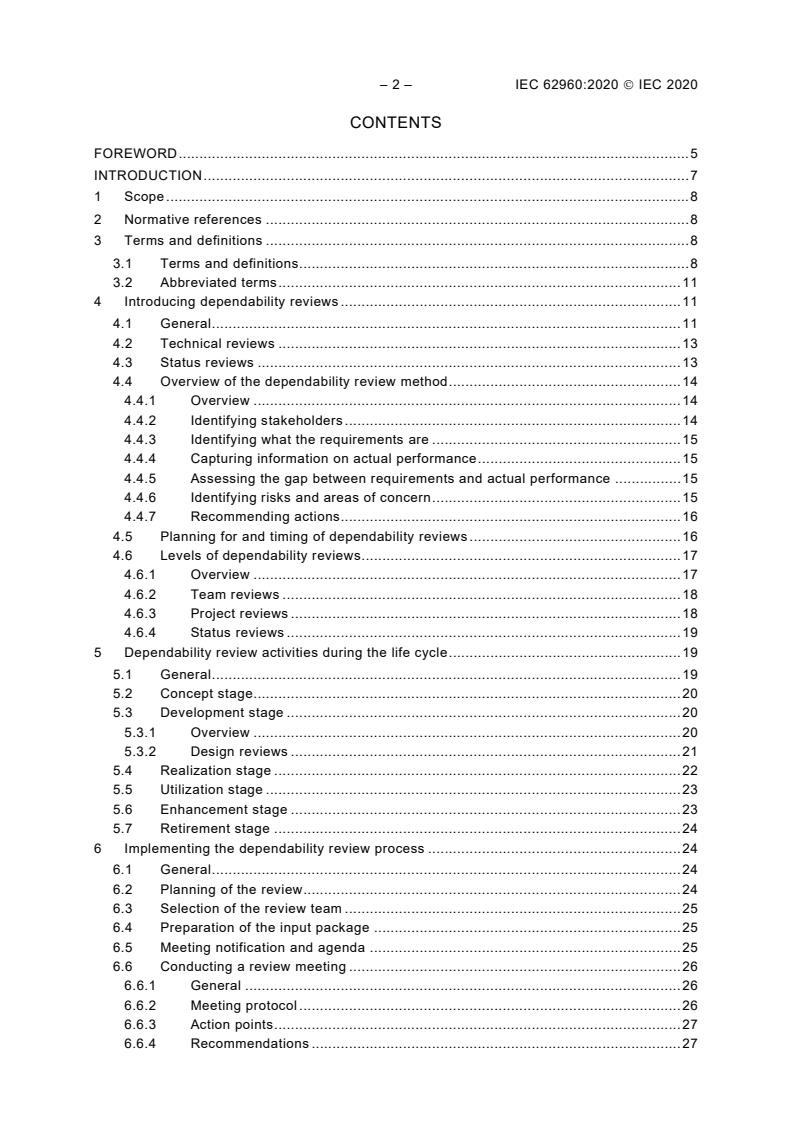
CONTENTS
FOREWORD . 5
INTRODUCTION . 7
1 Scope . 8
2 Normative references . 8
3 Terms and definitions . 8
3.1 Terms and definitions . 8
3.2 Abbreviated terms . 11
4 Introducing dependability reviews . 11
4.1 General . 11
4.2 Technical reviews . 13
4.3 Status reviews . 13
4.4 Overview of the dependability review method . 14
4.4.1 Overview . 14
4.4.2 Identifying stakeholders . 14
4.4.3 Identifying what the requirements are . 15
4.4.4 Capturing information on actual performance . 15
4.4.5 Assessing the gap between requirements and actual performance . 15
4.4.6 Identifying risks and areas of concern . 15
4.4.7 Recommending actions . 16
4.5 Planning for and timing of dependability reviews . 16
4.6 Levels of dependability reviews . 17
4.6.1 Overview . 17
4.6.2 Team reviews . 18
4.6.3 Project reviews . 18
4.6.4 Status reviews . 19
5 Dependability review activities during the life cycle . 19
5.1 General . 19
5.2 Concept stage . 20
5.3 Development stage . 20
5.3.1 Overview . 20
5.3.2 Design reviews . 21
5.4 Realization stage . 22
5.5 Utilization stage . 23
5.6 Enhancement stage . 23
5.7 Retirement stage . 24
6 Implementing the dependability review process . 24
6.1 General . 24
6.2 Planning of the review . 24
6.3 Selection of the review team . 25
6.4 Preparation of the input package . 25
6.5 Meeting notification and agenda . 25
6.6 Conducting a review meeting . 26
6.6.1 General . 26
6.6.2 Meeting protocol . 26
6.6.3 Action points . 27
6.6.4 Recommendations . 27
6.6.5 Rejected action points and recommendations . 27
6.6.6 Meeting conclusion . 27
6.7 Preparing and distributing review minutes . 27
6.7.1 General . 27
6.7.2 Minutes. 28
6.8 Actions and recommendations from a review . 28
6.9 Follow-up and completion of action points and recommendations . 29
Annex A (informative) Examples of an input package for a review . 30
A.1 Concept stage . 30
A.2 Development stage . 30
A.3 Realization stage . 30
A.4 Utilization stage . 31
A.5 Enhancement stage . 31
A.6 Retirement stage . 32
Annex B (informative) Examples of objectives for dependability reviews during the life
cycle . 33
B.1 General . 33
B.2 Concept stage . 33
B.3 Development stage . 33
B.3.1 Conceptual design review . 33
B.3.2 Detail design review . 33
B.3.3 Final design review . 34
B.4 Realization stage . 34
B.5 Utilization stage . 35
B.5.1 Operation . 35
B.5.2 Maintenance . 35
B.6 Enhancement stage . 35
B.7 Retirement stage . 36
Annex C (informative) Considerations during dependability reviews through the life
cycle . 37
C.1 General . 37
C.2 Examples of dependability review considerations in the concept stage . 37
C.3 Examples of dependability review considerations in the development stage . 38
C.4 Examples of dependability review considerations in the realization stage . 39
C.5 Examples of dependability review considerations in the utilization stage . 40
C.6 Examples of dependability review considerations in the enhancement stage . 41
C.7 Examples of dependability review considerations in the retirement stage . 42
Annex D (informative) Functions and responsibilities of some key persons for a
technical review . 43
D.1 General . 43
D.2 Chair . 43
D.3 Secretary . 44
D.4 Relevant specialists . 44
D.5 Project or team manager and members . 45
D.6 Customers and users . 45
Annex E (informative) Dependability topics for a review . 46
E.1 General . 46
E.2 Reliability . 46
E.3 Maintainability . 46
– 4 – IEC 62960:2020 IEC 2020
E.4 Maintenance . 47
E.5 Maintenance support. 47
E.6 Availability . 47
E.7 Quality assurance . 48
E.8 Environmental effects . 49
E.9 Product safety . 50
E.10 Human factors . 50
E.11 Legal matters . 51
E.12 Durability . 52
E.13 Security . 52
E.14 Property damage . 52
E.15 Accountability . 53
Bibliography . 54
Figure 1 – Flow of reviews during a life cycle stage . 18
Figure 2 – Implementing the review process . 24
INTERNATIONAL ELECTROTECHNICAL COMMISSION
____________
DEPENDABILITY REVIEWS DURING THE LIFE CYCLE
FOREWORD
1) The International Electrotechnical Commission (IEC) is a worldwide organization for standardization comprising
all national electrotechnical committees (IEC National Committees). The object of IEC is to promote international
co-operation on all questions concerning standardization in the electrical and electronic fields. To this end and
in addition to other activities, IEC publishes International Standards, Technical Specifications, Technical Reports,
Publicly Available Specifications (PAS) and Guides (hereafter referred to as “IEC Publication(s)”). Their
preparation is entrusted to technical committees; any IEC National Committee interested in the subject dealt with
may participate in this preparatory work. International, governmental and non-governmental organizations liaising
with the IEC also participate in this preparation. IEC collaborates closely with the International Organization for
Standardization (ISO) in accordance with conditions determined by agreement between the two organizations.
2) The formal decisions or agreements of IEC on technical matters express, as nearly as possible, an international
consensus of opinion on the relevant subjects since each technical committee has representation from all
interested IEC National Committees.
3) IEC Publications have the form of recommendations for international use and are accepted by IEC National
Committees in that sense. While all reasonable efforts are made to ensure that the technical content of IEC
Publications is accurate, IEC cannot be held responsible for the way in which they are used or for any
misinterpretation by any end user.
4) In order to promote international uniformity, IEC National Committees undertake to apply IEC Publications
transparently to the maximum extent possible in their national and regional publications. Any divergence between
any IEC Publication and the corresponding national or regional publication shall be clearly indicated in the latter.
5) IEC itself does not provide any attestation of conformity. Independent certification bodies provide conformity
assessment services and, in some areas, access to IEC marks of conformity. IEC is not responsible for any
services carried out by independent certification bodies.
6) All users should ensure that they have the latest edition of this publication.
7) No liability shall attach to IEC or its directors, employees, servants or agents including individual experts and
members of its technical committees and IEC National Committees for any personal injury, property damage or
other damage of any nature whatsoever, whether direct or indirect, or for costs (including legal fees) and
expenses arising out of the publication, use of, or reliance upon, this IEC Publication or any other IEC Publications.
8) Attention is drawn to the Normative references cited in this publication. Use of the referenced publications is
indispensable for the correct application of this publication.
9) Attention is drawn to the possibility that some of the elements of this IEC Publication may be the subject of patent
rights. IEC shall not be held responsible for identifying any or all such patent rights.
International Standard IEC 62960 has been prepared by IEC technical committee 56:
Dependability.
The text of this International Standard is based on the following documents:
FDIS Report on voting
56/1874/FDIS 56/1878/RVD
Full information on the voting for the approval of this International Standard can be found in the
report on voting indicated in the above table.
This document has been drafted in accordance with the ISO/IEC Directives, Part 2.
– 6 – IEC 62960:2020 IEC 2020
The committee has decided that the contents of this document will remain unchanged until the
stability date indicated on the IEC website under "http://webstore.iec.ch" in the data related to
the specific document. At this date, the document will be
• reconfirmed,
• withdrawn,
• replaced by a revised edition, or
• amended.
IMPORTANT – The 'colour inside' logo on the cover page of this publication indicates
that it contains colours which are considered to be useful for the correct understanding
of its contents. Users should therefore print this document using a colour printer.
INTRODUCTION
Dependability is the ability to perform as and when required. Dependability has many attributes
but is usually characterized in terms of reliability, maintainability, supportability (including
maintenance and support) and availability. These attributes are subject to change over the life
cycle and can benefit from regular review.
Benefits of dependability review throughout the life cycle include:
– discovering and mitigating or eliminating weaknesses in the early life cycle stages before
they manifest as dependability problems in later stages;
– identifying and treating problems which might occur later in the life cycle, and providing
feedback to prevent their recurrence and to adapt systems to changes in environment and
other factors;
– providing assurance of dependability and of the systems and processes that aim to achieve
dependability;
– continually improving the dependability of the system in order to maintain or improve a
commercial advantage.
Systems are becoming increasingly complex and constantly changing. This raises specific
problems that need attention. Systems are changing in the following ways. A system is often
developed, and/or utilized, in organizations across national borders and industry sectors.
Changes such as legislation affecting one country or industry sector may necessitate a change
to the system. System requirements can also change over time as technology, environmental
conditions and societal demands change.
Dependability reviews are mainly used for large systems, but even small products such as
mobile phones are complicated systems that may require dependability reviews.
Organizations involved in different parts of the life cycle might not be able to share a common
purpose. For example, an engineering design company during the development and realization
stages may not be able to fully anticipate the needs of stakeholders at the utilization stage.
More generally, it is becoming increasingly difficult to predict at some earlier stage potential
dependability problems that can occur at a later life cycle stage. Dependability reviews carried
out at appropriate points during the life cycle can assist in addressing all of the above issues.
This document provides guidance on dependability reviews as part of an organization’s
technical review processes. It provides a coherent set of principles for dependability reviews
which could be useful in addition to, and in support of, general monitoring and dependability
assurance carried out by various organizations at different life cycle stages.
In many cases dependability aspects of a system are covered in other reviews such as design
reviews or manufacturability reviews. In these cases, the procedures given in this document
can be applied. The informative annexes can be used as checklists to cover all technical
relevant aspects.
Dependability reviews described in this document are a key part of a dependability management
system as described in IEC 60300-1.
– 8 – IEC 62960:2020 IEC 2020
DEPENDABILITY REVIEWS DURING THE LIFE CYCLE
1 Scope
This document provides guidance on a review methodology for dependability from a technical
perspective that is applicable at all stages of a system life cycle. Its application can improve
the dependability of a system throughout its life cycle by triggering appropriate actions at
appropriate times to address potential dependability problems.
It provides guidance for developers, manufacturers, users and third-party independent
reviewers such as consulting organizations.
This document describes a dependability review methodology focusing on:
– coherence of review activities across life cycle stages and their impact on dependability;
– stakeholder identification and how this affects dependability review activities;
– the relationships between different types of reviews;
– procedures for effective dependability reviews;
– examples of dependability review activities.
2 Normative references
The following documents are referred to in the text in such a way that some or all of their content
constitutes requirements of this document. For dated references, only the edition cited applies.
For undated references, the latest edition of the referenced document (including any
amendments) applies.
IEC 60050-192, International electrotechnical vocabulary – Part 192: Dependability
(available at http://www.electropedia.org)
3 Terms and definitions
3.1 Terms and definitions
For the purposes of this document, the terms and definitions given in IEC 60050-192 and the
following apply.
ISO and IEC maintain terminological databases for use in standardization at the following
addresses:
• IEC Electropedia: available at http://www.electropedia.org/
• ISO Online browsing platform: available at http://www.iso.org/obp
3.1.1
dependability management
coordinated activities to direct and control an organization with regard to dependability
Note 1 to entry: Dependability management is part of an organization’s overall management.
[SOURCE: IEC 60300-1:2014, 3.1.4]
3.1.2
dependability plan
set of scheduled activities that when carried out are aimed to achieve dependability objectives
and targets for an item
[SOURCE: IEC 60300-1:2014, 3.1.6, modified – "that when carried out are aimed" added.]
3.1.3
dependability review
review which focuses on the dependability aspects of an item, system or process being
reviewed
Note 1 to entry: A dependability review can be a standalone review or a part of a review covering wider aspects.
3.1.4
design review
planned and documented review of an existing or proposed design
Note 1 to entry: Objectives include evaluation of the design’s capability to fulfil the specified requirements,
identification for any actual or potential deficiencies, proposing enhancements.
Note 2 to entry: A design review by itself is not sufficient to ensure proper design.
Note 3 to entry: The design can be for a product or process.
Note 4 to entry: The design review can be achieved by means of a meeting or other documented process.
3.1.5
gap analysis
method to compare what is achieved with what is required in order to identify differences and
make improvements
3.1.6
item
subject being considered
Note 1 to entry: The item may be an individual part, component, device, functional unit, equipment, subsystem, or
system.
Note 2 to entry: The item may consist of hardware, software, people or any combination thereof.
Note 3 to entry: The item often comprises elements that may each be individually considered.
[SOURCE: IEC 60050-192:2015, 192-01-01, modified – Note 3 modified by omission of internal
references and Notes 4 and 5 deleted.]
3.1.7
life cycle
series of identifiable stages through which an item goes, from its conception to disposal
EXAMPLE A typical system life cycle consists of: concept and definition; design and development; construction,
installation and commissioning; operation and maintenance; mid-life upgrading, or life extension and
decommissioning and disposal.
Note 1 to entry: The stages identified will vary with the application.
[SOURCE: IEC 60050-192:2015, 192-01-09]
3.1.8
management
coordinated activities to direct and control an organization
– 10 – IEC 62960:2020 IEC 2020
Note 1 to entry: Management can include establishing policies and objectives and processes to achieve these
objectives.
Note 2 to entry: The word "management" sometimes refers to people, i.e. a person or group of people with authority
and responsibility for the conduct and control of an organization. When "management" is used in this sense, it should
always be used with some form of qualifier to avoid confusion with the concept of "management" as a set of activities
defined above. For example, "management shall…" is deprecated whereas "top management shall…" is acceptable.
Otherwise different words should be adopted to convey the concept when related to people, e.g. managerial or
managers.
[SOURCE: ISO 9000:2015, 3.3.3]
3.1.9
project
unique process, consisting of a set of coordinated and controlled activities with start and finish
dates, undertaken to achieve an objective conforming to specific requirements, including the
constraints of time, cost and resources
Note 1 to entry: The project's organization is normally temporary and established for the lifetime of the project.
Note 2 to entry: The complexity of the interactions among project activities is not necessarily related to the project
size.
[SOURCE: ISO 9000:2015, 3.4.2, modified – Notes 1 to 3 deleted.]
3.1.10
project milestone
specific and predetermined point in a project at which certain deliverables are expected to have
been attained, or at which a measurable amount of progress is to be expected
3.1.11
project review
review of the project output
3.1.12
review
activity undertaken to determine the suitability, adequacy and effectiveness of the subject
matter to achieve established objectives
[SOURCE: ISO Guide 73:2009, 3.8.2.2, modified – Note deleted.]
3.1.13
stakeholder
person or organization that can affect, be affected by, or perceive themselves to be affected by
a decision or activity
Note 1 to entry: This definition is more general than that given in IEC/ISO/IEEE 15288:2015.
[SOURCE: IEC 60300-1:2014, 3.1.5, modified – Note 1 added.]
3.1.14
status review
review of the overall project status with respect to established objectives
Note 1 to entry: The status review consists of a technical part where status information is gathered and structured
and a management part where the status is determined and appropriate decisions are taken.
3.1.15
system
set of interrelated items that collectively fulfil a requirement
Note 1 to entry: A system is considered to have a defined real or abstract boundary.
Note 2 to entry: External resources (from outside the system boundary) may be required for the system to operate.
Note 3 to entry: A system structure may be hierarchical, e.g. system, subsystem, component, etc.
Note 4 to entry: Conditions of use and maintenance should be expressed or implied within the requirement.
[SOURCE: IEC 60050-192:2015, 192-01-03]
3.1.16
team
two or more persons working together with a set of complementary skills required to complete
a task
Note 1 to entry: A member of the team is appointed as the team leader.
Note 2 to entry: The team can include persons-in-training.
3.1.17
team review
review of the team output
EXAMPLE Mechanical team, electronic team or software team as input to the technical part of the status review.
3.1.18
technical review
review of technical aspects of a process or a work product by a team of technically-qualified
personnel that examines the suitability of the work product for its intended use and identifies
risks and discrepancies from specifications and standards
Note 1 to entry: Subjects whose technical aspects may be reviewed include application of new technology, product
line diversification, make-buy decisions, timeline for new product introduction and review of the suitability/adequacy
of the technical specification.
[SOURCE: ISO/IEC 20246:2017, 3.18, modified – "formal peer review" replaced with "review of
technical aspects of a process", "risks" added and Note 1 replaced.]
3.2 Abbreviated terms
COTS commercial-off-the-shelf
FMEA modes and effects analysis
FTA fault tree analysis
MMH maintenance man-hours
MTBF mean operating time between failures
MTTF mean time to first failure
MTTR mean time to restoration
PoF physics of failure
RTM requirements traceability matrix
4 Introducing dependability reviews
4.1 General
Dependability reviews are key activities in the dependability plan. The persons in charge of
dependability reviews have the responsibility for ensuring that dependability reviews are carried
out during the life cycle.
Reviews involve investigating the current situation in order to compare it with what is expected
or required. Reviews identify discrepancies, risks and potential problems, analyse them and
recommend improvements.
– 12 – IEC 62960:2020 IEC 2020
Dependability reviews comprise a coherent set of reviews for different aspects of dependability.
These reviews are performed repeatedly throughout the life cycle, continually providing follow-
up actions and assessment of their effectiveness.
Dependability reviews can be performed from various perspectives, such as:
– the dependability attributes of an item including reliability, maintainability, supportability and
availability;
– other time related characteristics of an item such as durability and recoverability;
– dependability related functions such as safety and security;
– cost efficiency, including both life cycle cost and the short term cost;
– activities carried out to achieve or assess dependability outcomes;
– effectiveness of dependability processes;
– accountability of, and to, various stakeholders for potential failures;
– adaptation to changes in requirements, environments, objectives and/or purpose of the
system.
A dependability review provides assurance that dependability is achieved throughout the life
cycle either by demonstrating that requirements are met or by identifying problems and making
improvements. A dependability review can be used to provide evidence that a dependability
claim is satisfied as part of a dependability case (IEC 62741 [3] gives guidance on the content
of a dependability case and establishes general principles for its preparation).
Systematic dependability reviews across the system life cycle enable agile corrective
redirection of effort with less waste. This is particularly beneficial given the current trends for
increasing system complexity, tightening development time and prolonged operational life.
Some environments or conditions for the trends include:
– ubiquitous network connection to any range of systems controlled by others;
– frequent changes in the system's context such as user expectation and competitions in the
market;
– inability to discard the old and start anew due to, for example cost consideration and
preferences for "circular economy".
Dependability reviews help identify, predict and correct problems as they arise in the system
life cycle while they are small enough to be addressed.
There are various types of dependability reviews. The type of dependability review performed
at a life cycle stage should be appropriate to that life cycle stage. This is best managed and
documented through the dependability plan. Dependability review activities during the life cycle
are described in Clause 5.
A review can be internal where the review team involves people closely involved with the subject
under review or it can be external where the review team involves only independent people. In
this case the team which is the subject of the review provides evidence to the external review
team.
Management problems such as accountability and changes in business objectives have
consequences for dependability. Such problems can therefore form part of a dependability
review. In this case both technical experts and managers can be involved.
____________
Numbers in square brackets refer to the Bibliography.
Dependability reviews can be categorized as technical reviews or management reviews. The
principles of this document can be applied equally to all types of review. However, this
document focuses on technical reviews. The management part of reviews in the status review
is not covered. Both technical reviews and management reviews take place at each stage of
the life cycle, often as an integral part of other reviews rather than as a standalone activity.
Subclauses 4.2 and 4.3 describe technical reviews and status reviews.
4.2 Technical reviews
Technical reviews identify and analyse potential problems and opportunities, and recommend
actions for improvement. They also provide assurance that processes are operating effectively
and requirements are met.
Technical reviews can include design reviews, operation reviews, maintenance reviews, risk
reviews or reviews of other technical aspects of an item or process. They may focus on
dependability or dependability may be considered as part of a wider performance review.
Technical reviews of dependability can involve:
– reviews of the achieved or predicted dependability of an item where the objective is to
improve dependability of the item itself by evaluating dependability measures and by
exploring opportunities for improvement;
– reviews of the processes and activities planned to achieve dependability in order to learn
lessons and improve future processes and activities.
Participants should have a technical understanding of the system under review and of the
reliability, maintenance and supportability disciplines.
The participants should include experts who are independent from the design of the system and
have necessary skills to analyse how items, systems and processes could fail. Participation of
such experts is most important for securing independence and quality of the review. Participants
might include, for example, quality professionals, reliability professionals, ergonomics
professionals, safety analysts and test personnel.
Management should normally not participate in a technical review. The customer or user of the
system or process may participate in a technical review.
Each technical review should designate a chair of the meeting (the facilitator), who can assign
a secretary to assist the review.
4.3 Status reviews
The purpose of a status review is to provide the management group, and sometimes the
customer, with information about how a project is progressing, and in some cases, to authorize
the continuation of a project to the next phase in the project plan. Some status reviews are held
at project milestones and are referred to as "milestone reviews". Some milestone reviews also
include a decision on whether, or not the project can proceed and may be referred to as "gate
reviews". In some cases a stage payment is dependent on the result of the status review.
A status review of dependability starts with a phase where information and evidence related to
dependability are collected and structured. The structured information is then presented to
management for review and decisions.
The team for a status review should include people that have the authority to devote resources
to the project and remove obstacles. The participants in the technical part of the status review
are typically the chair, the secretary, the project leaders and the team leaders for the different
project teams. Once consensus on the status of the technical problems has been reached, the
status review can proceed to the management phase, where usually the programme manager,
the management and, possibly, the customer participate. Care should be taken so that serious
problems reported by the team leaders in the project review are not presented as tasks for the
next project phase without reporting their potential impact if left unsolved.
– 14 – IEC 62960:2020 IEC 2020
4.4 Overview of the dependability review method
4.4.1 Overview
Dependability can be reviewed as a separate issue or as part of other reviews. In either case
the dependability review should involve the following stages:
– identifying stakeholders;
– identifying what the requirements are;
– capturing information on actual performance;
– assessing the gap between requirements and actual performance;
– identifying risks and areas of concern;
– recommending actions.
If changes are introduced, their effectiveness should be checked, and a judgment should be
made about whether any additional action or actions are required.
4.4.2 Identifying stakeholders
It is important for persons or organizations developing and operating systems to clearly
recognize who their stakeholders are, since their ultimate aim is to satisfy the needs of these
stakeholders. Stakeholders should therefore be identified and means of communication with
them established. For some systems, it is relatively easy to identify stakeholders and they do
not change through the lifecycle. For other systems, it may be difficult to identify all stakeholders
at the outset and to fully determi
...