


IEC 60227-5:2024
(Main)Polyvinyl chloride insulated cables of rated voltages up to and including 450/750 V - Part 5: Flexible cables (cords)
Polyvinyl chloride insulated cables of rated voltages up to and including 450/750 V - Part 5: Flexible cables (cords)
IEC 60227-5:2024 details the particular specifications or polyvinyl chloride insulated flexible cables (cords), of rated voltages up to and including 300/500 V. This document provides the particular requirements for flexible cables (cords) which apply in addition to the appropriate requirements specified in IEC 60227-1, which apply to all cables. The tests for cables specified in the IEC 60227 series are described in IEC 63294.
Conducteurs et câbles isolés au polychlorure de vinyle, de tension assignée au plus égale à 450/750 V - Partie 5: Câbles souples
General Information
- Status
- Published
- Publication Date
- 21-Feb-2024
- Technical Committee
- TC 20 - Electric cables
- Drafting Committee
- WG 17 - TC 20/WG 17
- Current Stage
- PPUB - Publication issued
- Start Date
- 22-Feb-2024
- Completion Date
- 15-Mar-2024
Relations
- Effective Date
- 05-Sep-2023
Overview
IEC 60227-5:2024 is the International Electrotechnical Commission (IEC) standard that specifies particular requirements for polyvinyl chloride (PVC) insulated flexible cables (cords). Part 5 of the IEC 60227 series supplements the general requirements in IEC 60227‑1 and applies to flexible cords used at low voltages. The IEC 60227 series covers PVC insulated cables up to 450/750 V, while Part 5 provides the particular specifications for flexible cords (the scope specifically refers to rated voltages up to and including 300/500 V). Test methods referenced in this part are described in IEC 63294.
Key topics and technical requirements
The standard addresses the essential elements manufacturers, test laboratories and compliance bodies need for safe, reliable flexible cords:
- Code designation and rated voltages for different cord types
- Construction requirements including conductors, insulation, core assembly, fillers and overall dimensions
- Sheath specifications where applicable (light, ordinary and heat‑resistant PVC‑sheathed cords)
- Specific cord types covered: flat tinsel cord, cords for indoor decorative lighting chains, light PVC‑sheathed cords, ordinary PVC‑sheathed cords, and heat‑resistant cords (conductor temperature up to 90 °C)
- Mandatory tests and test procedures such as bending/flexing tests, drop tests, long‑term insulation resistance (d.c.), and other type‑specific mechanical and electrical tests
- Guidance on use for each cord type and tabulated data (general data and tests) to support selection and verification
Practical applications
IEC 60227-5:2024 is directly applicable to:
- Manufacturers of appliance and equipment cords, decorative lighting chains and flexible power cords
- Product designers and OEMs specifying flexible PVC cords for consumer and commercial products
- Testing and certification laboratories performing compliance and type approval testing
- Procurement and regulatory teams validating that supplied cords meet international safety and performance requirements
Using the standard helps ensure product safety, interchangeability and regulatory compliance, and supports consistent testing and quality control across suppliers and markets.
Who should use this standard
- Cable and cord manufacturers
- Test labs and conformity assessment bodies
- Electrical safety engineers and compliance officers
- Product designers, OEMs and procurement professionals
Related standards
- IEC 60227-1 (general requirements for PVC insulated cables)
- IEC 63294 (tests for cables specified in the IEC 60227 series)
- Other parts of the IEC 60227 series covering different cable types and ratings
Keywords: IEC 60227-5:2024, PVC insulated flexible cables, flexible cords, polyvinyl chloride insulated cables, cable construction, cable testing, IEC standard, heat‑resistant cord.
IEC 60227-5:2024 - Polyvinyl chloride insulated cables of rated voltages up to and including 450/750 V - Part 5: Flexible cables (cords) Released:2/22/2024 Isbn:9782832282625
IEC 60227-5:2024 RLV - Polyvinyl chloride insulated cables of rated voltages up to and including 450/750 V - Part 5: Flexible cables (cords) Released:2/22/2024 Isbn:9782832283707
Frequently Asked Questions
IEC 60227-5:2024 is a standard published by the International Electrotechnical Commission (IEC). Its full title is "Polyvinyl chloride insulated cables of rated voltages up to and including 450/750 V - Part 5: Flexible cables (cords)". This standard covers: IEC 60227-5:2024 details the particular specifications or polyvinyl chloride insulated flexible cables (cords), of rated voltages up to and including 300/500 V. This document provides the particular requirements for flexible cables (cords) which apply in addition to the appropriate requirements specified in IEC 60227-1, which apply to all cables. The tests for cables specified in the IEC 60227 series are described in IEC 63294.
IEC 60227-5:2024 details the particular specifications or polyvinyl chloride insulated flexible cables (cords), of rated voltages up to and including 300/500 V. This document provides the particular requirements for flexible cables (cords) which apply in addition to the appropriate requirements specified in IEC 60227-1, which apply to all cables. The tests for cables specified in the IEC 60227 series are described in IEC 63294.
IEC 60227-5:2024 is classified under the following ICS (International Classification for Standards) categories: 29.060.20 - Cables. The ICS classification helps identify the subject area and facilitates finding related standards.
IEC 60227-5:2024 has the following relationships with other standards: It is inter standard links to IEC 60227-5:2011. Understanding these relationships helps ensure you are using the most current and applicable version of the standard.
IEC 60227-5:2024 is available in PDF format for immediate download after purchase. The document can be added to your cart and obtained through the secure checkout process. Digital delivery ensures instant access to the complete standard document.
Standards Content (Sample)
IEC 60227-5 ®
Edition 4.0 2024-02
INTERNATIONAL
STANDARD
Polyvinyl chloride insulated cables of rated voltages up to and including
450/750 V –
Part 5: Flexible cables (cords)
All rights reserved. Unless otherwise specified, no part of this publication may be reproduced or utilized in any form
or by any means, electronic or mechanical, including photocopying and microfilm, without permission in writing from
either IEC or IEC's member National Committee in the country of the requester. If you have any questions about IEC
copyright or have an enquiry about obtaining additional rights to this publication, please contact the address below or
your local IEC member National Committee for further information.
IEC Secretariat Tel.: +41 22 919 02 11
3, rue de Varembé info@iec.ch
CH-1211 Geneva 20 www.iec.ch
Switzerland
About the IEC
The International Electrotechnical Commission (IEC) is the leading global organization that prepares and publishes
International Standards for all electrical, electronic and related technologies.
About IEC publications
The technical content of IEC publications is kept under constant review by the IEC. Please make sure that you have the
latest edition, a corrigendum or an amendment might have been published.
IEC publications search - webstore.iec.ch/advsearchform IEC Products & Services Portal - products.iec.ch
The advanced search enables to find IEC publications by a Discover our powerful search engine and read freely all the
variety of criteria (reference number, text, technical publications previews, graphical symbols and the glossary.
committee, …). It also gives information on projects, replaced With a subscription you will always have access to up to date
and withdrawn publications. content tailored to your needs.
IEC Just Published - webstore.iec.ch/justpublished
Electropedia - www.electropedia.org
Stay up to date on all new IEC publications. Just Published
The world's leading online dictionary on electrotechnology,
details all new publications released. Available online and once
containing more than 22 500 terminological entries in English
a month by email.
and French, with equivalent terms in 25 additional languages.
Also known as the International Electrotechnical Vocabulary
IEC Customer Service Centre - webstore.iec.ch/csc
(IEV) online.
If you wish to give us your feedback on this publication or need
further assistance, please contact the Customer Service
Centre: sales@iec.ch.
IEC 60227-5 ®
Edition 4.0 2024-02
INTERNATIONAL
STANDARD
Polyvinyl chloride insulated cables of rated voltages up to and including
450/750 V –
Part 5: Flexible cables (cords)
INTERNATIONAL
ELECTROTECHNICAL
COMMISSION
ICS 29.060.20 ISBN 978-2-8322-8262-5
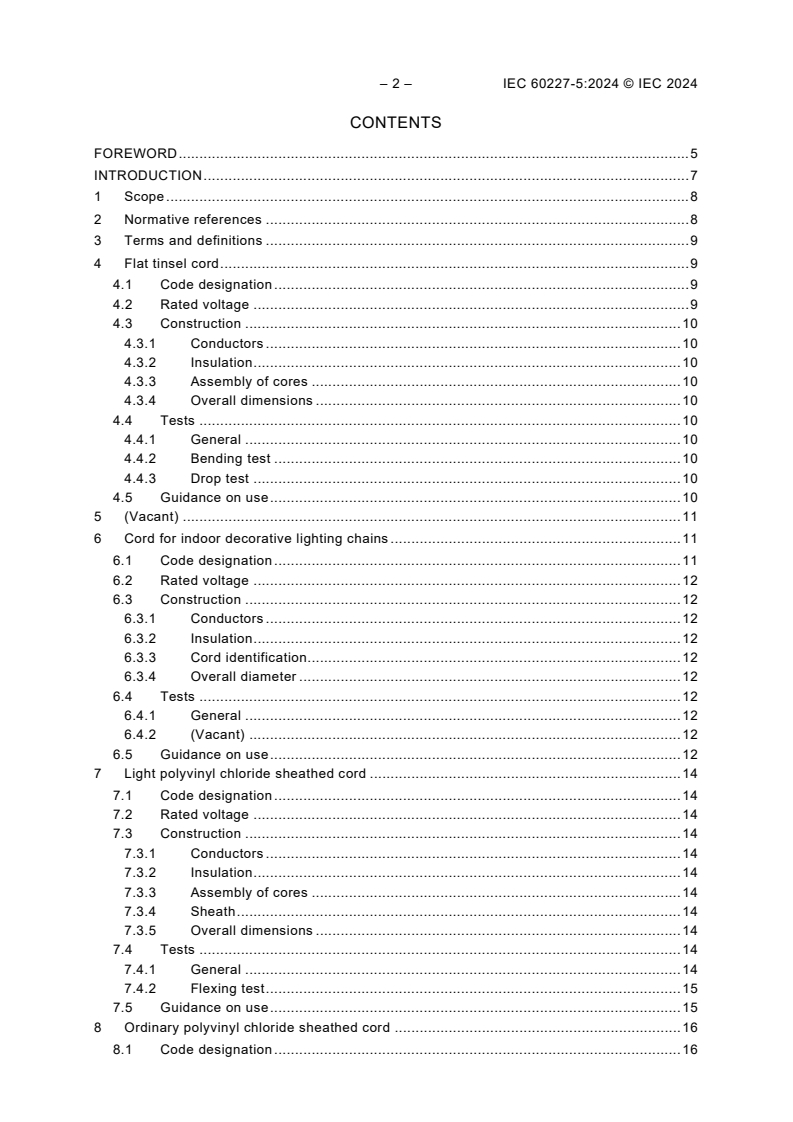
– 2 – IEC 60227-5:2024 © IEC 2024
CONTENTS
FOREWORD . 5
INTRODUCTION . 7
1 Scope . 8
2 Normative references . 8
3 Terms and definitions . 9
4 Flat tinsel cord . 9
4.1 Code designation . 9
4.2 Rated voltage . 9
4.3 Construction . 10
4.3.1 Conductors . 10
4.3.2 Insulation . 10
4.3.3 Assembly of cores . 10
4.3.4 Overall dimensions . 10
4.4 Tests . 10
4.4.1 General . 10
4.4.2 Bending test . 10
4.4.3 Drop test . 10
4.5 Guidance on use . 10
5 (Vacant) . 11
6 Cord for indoor decorative lighting chains . 11
6.1 Code designation . 11
6.2 Rated voltage . 12
6.3 Construction . 12
6.3.1 Conductors . 12
6.3.2 Insulation . 12
6.3.3 Cord identification . 12
6.3.4 Overall diameter . 12
6.4 Tests . 12
6.4.1 General . 12
6.4.2 (Vacant) . 12
6.5 Guidance on use . 12
7 Light polyvinyl chloride sheathed cord . 14
7.1 Code designation . 14
7.2 Rated voltage . 14
7.3 Construction . 14
7.3.1 Conductors . 14
7.3.2 Insulation . 14
7.3.3 Assembly of cores . 14
7.3.4 Sheath . 14
7.3.5 Overall dimensions . 14
7.4 Tests . 14
7.4.1 General . 14
7.4.2 Flexing test . 15
7.5 Guidance on use . 15
8 Ordinary polyvinyl chloride sheathed cord . 16
8.1 Code designation . 16
8.2 Rated voltage . 17
8.3 Construction . 17
8.3.1 Conductors . 17
8.3.2 Insulation . 17
8.3.3 Assembly of cores and fillers, if any . 17
8.3.4 Sheath . 17
8.3.5 Overall dimensions . 17
8.4 Tests . 18
8.4.1 General . 18
8.4.2 Flexing test . 18
8.5 Guidance on use . 19
9 Heat-resistant light PVC-sheathed cord for a maximum conductor temperature of
90 °C . 20
9.1 Code designation . 20
9.2 Rated voltage . 20
9.3 Construction . 20
9.3.1 Conductors . 20
9.3.2 Insulation . 21
9.3.3 Assembly of cores . 21
9.3.4 Sheath . 21
9.3.5 Overall dimensions . 21
9.4 Tests . 21
9.4.1 General . 21
9.4.2 Flexing test . 21
9.5 Guidance on use . 22
10 Heat-resistant ordinary PVC-sheathed cord for a maximum conductor temperature
of 90 °C . 24
10.1 Code designation . 24
10.2 Rated voltage . 24
10.3 Construction . 24
10.3.1 Conductors . 24
10.3.2 Insulation . 24
10.3.3 Assembly of cores and fillers, if any . 24
10.3.4 Sheath . 24
10.3.5 Overall dimensions . 24
10.4 Tests . 25
10.4.1 General . 25
10.4.2 Flexing test . 25
10.5 Guidance on use . 26
Bibliography . 28
Table 1 – General data for type 60227 IEC 41 . 11
Table 2 – Tests for type 60227 IEC 41 . 11
Table 3 – General data for type 60227 IEC 43 . 13
Table 4 – Tests for type 60227 IEC 43 . 13
Table 5 – Mass of weight and diameter of pulleys . 15
Table 6 – General data for type 60227 IEC 52 . 15
– 4 – IEC 60227-5:2024 © IEC 2024
Table 7 – Tests for type 60227 IEC 52 . 16
Table 8 – General data for type 60227 IEC 53 . 18
Table 9 – Mass of weight and diameter of pulleys . 19
Table 10 – Tests for type 60227 IEC 53 . 19
Table 11 – Mass of weight and diameter of pulleys . 22
Table 12 – General data for type 60227 IEC 56 . 22
Table 13 – Tests for type 60227 IEC 56 . 23
Table 14 – General data for type 60227 IEC 57 . 25
Table 15 – Mass of weight and diameter of pulleys . 26
Table 16 – Tests for type 60227 IEC 57 . 26
INTERNATIONAL ELECTROTECHNICAL COMMISSION
____________
POLYVINYL CHLORIDE INSULATED CABLES
OF RATED VOLTAGES UP TO AND INCLUDING 450/750 V –
Part 5: Flexible cables (cords)
FOREWORD
1) The International Electrotechnical Commission (IEC) is a worldwide organization for standardization comprising
all national electrotechnical committees (IEC National Committees). The object of IEC is to promote international
co-operation on all questions concerning standardization in the electrical and electronic fields. To this end and
in addition to other activities, IEC publishes International Standards, Technical Specifications, Technical Reports,
Publicly Available Specifications (PAS) and Guides (hereafter referred to as “IEC Publication(s)”). Their
preparation is entrusted to technical committees; any IEC National Committee interested in the subject dealt with
may participate in this preparatory work. International, governmental and non-governmental organizations liaising
with the IEC also participate in this preparation. IEC collaborates closely with the International Organization for
Standardization (ISO) in accordance with conditions determined by agreement between the two organizations.
2) The formal decisions or agreements of IEC on technical matters express, as nearly as possible, an international
consensus of opinion on the relevant subjects since each technical committee has representation from all
interested IEC National Committees.
3) IEC Publications have the form of recommendations for international use and are accepted by IEC National
Committees in that sense. While all reasonable efforts are made to ensure that the technical content of IEC
Publications is accurate, IEC cannot be held responsible for the way in which they are used or for any
misinterpretation by any end user.
4) In order to promote international uniformity, IEC National Committees undertake to apply IEC Publications
transparently to the maximum extent possible in their national and regional publications. Any divergence between
any IEC Publication and the corresponding national or regional publication shall be clearly indicated in the latter.
5) IEC itself does not provide any attestation of conformity. Independent certification bodies provide conformity
assessment services and, in some areas, access to IEC marks of conformity. IEC is not responsible for any
services carried out by independent certification bodies.
6) All users should ensure that they have the latest edition of this publication.
7) No liability shall attach to IEC or its directors, employees, servants or agents including individual experts and
members of its technical committees and IEC National Committees for any personal injury, property damage or
other damage of any nature whatsoever, whether direct or indirect, or for costs (including legal fees) and
expenses arising out of the publication, use of, or reliance upon, this IEC Publication or any other IEC
Publications.
8) Attention is drawn to the Normative references cited in this publication. Use of the referenced publications is
indispensable for the correct application of this publication.
9) IEC draws attention to the possibility that the implementation of this document may involve the use of (a)
patent(s). IEC takes no position concerning the evidence, validity or applicability of any claimed patent rights in
respect thereof. As of the date of publication of this document, IEC had not received notice of (a) patent(s), which
may be required to implement this document. However, implementers are cautioned that this may not represent
the latest information, which may be obtained from the patent database available at https://patents.iec.ch. IEC
shall not be held responsible for identifying any or all such patent rights.
IEC 60227-5 has been prepared by IEC technical committee 20: Electric cables. It is an
International Standard.
This fourth edition cancels and replaces the third edition published in 2011. This edition
constitutes a technical revision.
This edition includes the following significant technical changes with respect to the previous
edition:
a) the reference to tests according to IEC 60227-2 has been withdrawn and replaced with a
reference to IEC 63294;
b) normative references have been updated.
– 6 – IEC 60227-5:2024 © IEC 2024
The text of this International Standard is based on the following documents:
Draft Report on voting
20/2143/FDIS 20/2156/RVD
Full information on the voting for its approval can be found in the report on voting indicated in
the above table.
The language used for the development of this International Standard is English.
This document was drafted in accordance with ISO/IEC Directives, Part 2, and developed in
accordance with ISO/IEC Directives, Part 1 and ISO/IEC Directives, IEC Supplement, available
at www.iec.ch/members_experts/refdocs. The main document types developed by IEC are
described in greater detail at www.iec.ch/publications.
A list of all parts in the IEC 60227 series, published under the general title Polyvinyl chloride
insulated cables of rated voltages up to and including 450/750 V, can be found on the IEC
website.
This document is to be used in conjunction with IEC 60227-1:— .
The committee has decided that the contents of this document will remain unchanged until the
stability date indicated on the IEC website under webstore.iec.ch in the data related to the
specific document. At this date, the document will be
• reconfirmed,
• withdrawn, or
• revised.
___________
Fourth edition under preparation. Stage at the time of publication IEC FDIS 60227-1:2023.
INTRODUCTION
The IEC 60227 series, published under the general title Polyvinyl chloride insulated cables of
rated voltages up to and including 450/750 V, consists of the following parts:
IEC 60227-1, General requirements;
IEC 60227-2, Test methods (withdrawn and replaced by IEC 63294);
IEC 60227-3, Non-sheathed cables for fixed wiring;
IEC 60227-4, Sheathed cables for fixed wiring;
IEC 60227-5, Flexible cables (cords);
IEC 60227-6, Lift cables and cables for flexible connections;
IEC 60227-7, Flexible cables screened and unscreened with two or more conductors and of
rated voltages up to and including 300/500 V.
This part of IEC 60227, when used in conjunction with IEC 60227-1, forms the complete
standard for flexible cables (cords).
– 8 – IEC 60227-5:2024 © IEC 2024
POLYVINYL CHLORIDE INSULATED CABLES
OF RATED VOLTAGES UP TO AND INCLUDING 450/750 V –
Part 5: Flexible cables (cords)
1 Scope
This part of IEC 60227 details the particular specifications or polyvinyl chloride insulated flexible
cables (cords), of rated voltages up to and including 300/500 V.
This document provides the particular requirements for flexible cables (cords) which apply in
addition to the appropriate requirements specified in IEC 60227-1, which apply to all cables.
The tests for cables specified in the IEC 60227 series are described in IEC 63294.
2 Normative references
The following documents are referred to in the text in such a way that some or all of their content
constitutes requirements of this document. For dated references, only the edition cited applies.
For undated references, the latest edition of the referenced document (including any
amendments) applies.
IEC 60227-1:— , Polyvinyl chloride insulated cables of rated voltages up to and including
450/750 V – Part 1: General requirements
IEC 60228, Conductors of insulated cables
IEC 60332-1-2, Tests on electric and optical fibre cables under fire conditions – Part 1-2: Test
for vertical flame propagation for a single insulated wire or cable – Procedure for 1 kW pre-
mixed flame
IEC 60811-401, Electric and optical fibre cables – Test methods for non-metallic materials –
Part 401: Miscellaneous tests – Thermal ageing methods – Ageing in an air oven
IEC 60811-405, Electric and optical fibre cables – Test methods for non-metallic materials –
Part 405: Miscellaneous tests – Thermal stability test for PVC insulations and PVC sheaths
IEC 60811-409, Electric and optical fibre cables – Test methods for non-metallic materials –
Part 409: Miscellaneous tests – Loss of mass test for thermoplastic insulations and sheaths
IEC 60811-501, Electric and optical fibre cables – Test methods for non-metallic materials –
Part 501: Mechanical tests – Tests for determining the mechanical properties of insulating and
sheathing compounds
IEC 60811-504, Electric and optical fibre cables – Test methods for non-metallic materials –
Part 504: Mechanical tests – Bending tests at low temperature for insulation and sheaths
___________
Fourth edition under preparation. Stage at the time of publication IEC FDIS 60227-1:2023.
IEC 60811-505, Electric and optical fibre cables – Test methods for non-metallic materials –
Part 505: Mechanical tests – Elongation at low temperature for insulations and sheaths
IEC 60811-506, Electric and optical fibre cables – Test methods for non-metallic materials –
Part 506: Mechanical tests – Impact test at low temperature for insulations and sheaths
IEC 60811-508, Electric and optical fibre cables – Test methods for non-metallic materials –
Part 508: Mechanical tests – Pressure test at high temperature for insulation and sheaths
IEC 60811-509, Electric and optical fibre cables – Test methods for non-metallic materials –
Part 509: Mechanical tests – Test for resistance of insulations and sheaths to cracking (heat
shock test)
IEC 62440, Electric cables with a rated voltage not exceeding 450/750 V – Guide to use
IEC 63294:2021, Test methods for electric cables with rated voltages up to and including
450/750 V.
3 Terms and definitions
For the purposes of this document, the terms and definitions given in IEC 60227-1 and the
following apply.
ISO and IEC maintain terminology databases for use in standardization at the following
addresses:
• IEC Electropedia: available at https://www.electropedia.org/
• ISO Online browsing platform: available at https://www.iso.org/obp
3.1
type test
test made before supplying a type of cable covered by this document on a general commercial
basis in order to demonstrate satisfactory performance characteristics to meet the intended
application
Note 1 to entry: Type tests are of such a nature that, after they have been made, it is not necessary for them to be
repeated, unless changes are made in the cable materials or design which can change the performance
characteristics.
Note 2 to entry: The symbol T is used to refer to type tests.
3.2
sample test
test made on samples of completed cable or components taken from a completed cable to verify
that the finished product meets the design standards
Note 1 to entry: The symbol S is used to refer to sample tests.
4 Flat tinsel cord
4.1 Code designation
60227 IEC 41.
4.2 Rated voltage
300/300 V.
– 10 – IEC 60227-5:2024 © IEC 2024
4.3 Construction
4.3.1 Conductors
Number of conductors: 2.
Each conductor shall comprise a number of strands or groups of strands, twisted together, each
strand being composed of one or more flattened wires of copper or copper alloy, helically wound
on a thread of cotton, polyamide or similar material.
The conductor resistance shall not exceed the value given in Table 1, column 5.
4.3.2 Insulation
The insulation shall be polyvinyl chloride compound of type PVC/D applied around each
conductor.
The specified value of the insulation thickness is given in Table 1, column 1.
The insulation resistance shall be not less than the value given in Table 1, column 4.
4.3.3 Assembly of cores
The conductors shall be laid parallel and covered with the insulation.
The insulation shall be provided with a groove on both sides, between the conductors, to
facilitate separation of the cores.
4.3.4 Overall dimensions
The mean overall dimensions shall be within the limits given in Table 1, columns 2 and 3.
4.4 Tests
4.4.1 General
Compliance with the requirements of 4.3 shall be checked by inspection and by the sample
tests and type tests given in Table 2.
4.4.2 Bending test
The requirements are given in IEC 60227-1:—, 6.6.3.3.
4.4.3 Drop test
The requirements are given in IEC 60227-1:—, 6.6.3.4.
4.5 Guidance on use
The maximum conductor temperature in normal use is 70 °C.
The use of the cable type 60227 IEC 41 shall comply with IEC 62440, which provides guidance
on the safe use of electric cables with a rated voltage not exceeding 450/750 V.
IEC 60
...
IEC 60227-5 ®
Edition 4.0 2024-02
REDLINE VERSION
INTERNATIONAL
STANDARD
colour
inside
Polyvinyl chloride insulated cables of rated voltages up to and including
450/750 V –
Part 5: Flexible cables (cords)
All rights reserved. Unless otherwise specified, no part of this publication may be reproduced or utilized in any form
or by any means, electronic or mechanical, including photocopying and microfilm, without permission in writing from
either IEC or IEC's member National Committee in the country of the requester. If you have any questions about IEC
copyright or have an enquiry about obtaining additional rights to this publication, please contact the address below or
your local IEC member National Committee for further information.
IEC Secretariat Tel.: +41 22 919 02 11
3, rue de Varembé info@iec.ch
CH-1211 Geneva 20 www.iec.ch
Switzerland
About the IEC
The International Electrotechnical Commission (IEC) is the leading global organization that prepares and publishes
International Standards for all electrical, electronic and related technologies.
About IEC publications
The technical content of IEC publications is kept under constant review by the IEC. Please make sure that you have the
latest edition, a corrigendum or an amendment might have been published.
IEC publications search - webstore.iec.ch/advsearchform IEC Products & Services Portal - products.iec.ch
The advanced search enables to find IEC publications by a Discover our powerful search engine and read freely all the
variety of criteria (reference number, text, technical publications previews, graphical symbols and the glossary.
committee, …). It also gives information on projects, replaced With a subscription you will always have access to up to date
and withdrawn publications. content tailored to your needs.
IEC Just Published - webstore.iec.ch/justpublished
Electropedia - www.electropedia.org
Stay up to date on all new IEC publications. Just Published
The world's leading online dictionary on electrotechnology,
details all new publications released. Available online and once
containing more than 22 500 terminological entries in English
a month by email.
and French, with equivalent terms in 25 additional languages.
Also known as the International Electrotechnical Vocabulary
IEC Customer Service Centre - webstore.iec.ch/csc
(IEV) online.
If you wish to give us your feedback on this publication or need
further assistance, please contact the Customer Service
Centre: sales@iec.ch.
IEC 60227-5 ®
Edition 4.0 2024-02
REDLINE VERSION
INTERNATIONAL
STANDARD
colour
inside
Polyvinyl chloride insulated cables of rated voltages up to and including
450/750 V –
Part 5: Flexible cables (cords)
INTERNATIONAL
ELECTROTECHNICAL
COMMISSION
ICS 29.060.20 ISBN 978-2-8322-8370-7
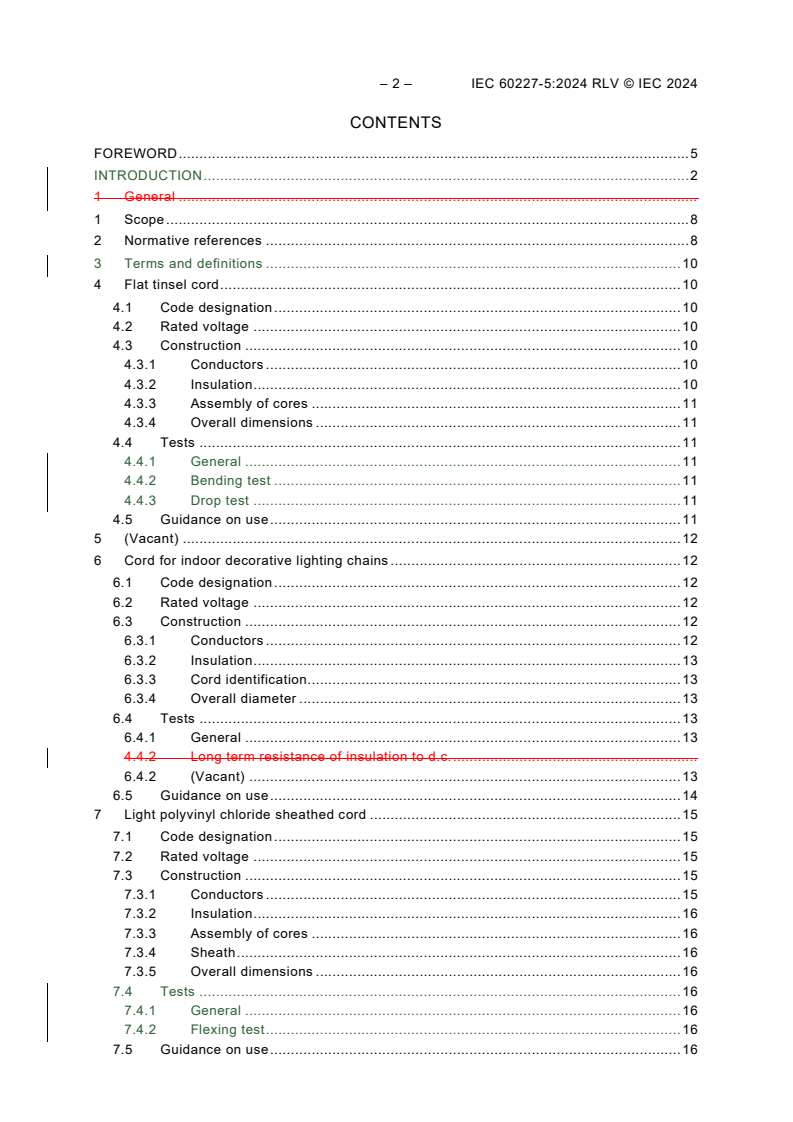
– 2 – IEC 60227-5:2024 RLV © IEC 2024
CONTENTS
FOREWORD . 5
INTRODUCTION . 2
1 General .
1 Scope . 8
2 Normative references . 8
3 Terms and definitions . 10
4 Flat tinsel cord . 10
4.1 Code designation . 10
4.2 Rated voltage . 10
4.3 Construction . 10
4.3.1 Conductors . 10
4.3.2 Insulation . 10
4.3.3 Assembly of cores . 11
4.3.4 Overall dimensions . 11
4.4 Tests . 11
4.4.1 General . 11
4.4.2 Bending test . 11
4.4.3 Drop test . 11
4.5 Guidance on use . 11
5 (Vacant) . 12
6 Cord for indoor decorative lighting chains . 12
6.1 Code designation . 12
6.2 Rated voltage . 12
6.3 Construction . 12
6.3.1 Conductors . 12
6.3.2 Insulation . 13
6.3.3 Cord identification . 13
6.3.4 Overall diameter . 13
6.4 Tests . 13
6.4.1 General . 13
4.4.2 Long term resistance of insulation to d.c. .
6.4.2 (Vacant) . 13
6.5 Guidance on use . 14
7 Light polyvinyl chloride sheathed cord . 15
7.1 Code designation . 15
7.2 Rated voltage . 15
7.3 Construction . 15
7.3.1 Conductors . 15
7.3.2 Insulation . 16
7.3.3 Assembly of cores . 16
7.3.4 Sheath . 16
7.3.5 Overall dimensions . 16
7.4 Tests . 16
7.4.1 General . 16
7.4.2 Flexing test . 16
7.5 Guidance on use . 16
8 Ordinary polyvinyl chloride sheathed cord . 18
8.1 Code designation . 18
8.2 Rated voltage . 19
8.3 Construction . 19
8.3.1 Conductors . 19
8.3.2 Insulation . 19
8.3.3 Assembly of cores and fillers, if any . 19
8.3.4 Sheath . 19
8.3.5 Overall dimensions . 19
8.4 Tests . 20
8.4.1 General . 20
8.4.2 Flexing test . 20
8.5 Guidance on use . 20
9 Heat-resistant light PVC-sheathed cord for a maximum conductor temperature of
90 °C . 23
9.1 Code designation . 23
9.2 Rated voltage . 23
9.3 Construction . 23
9.3.1 Conductors . 23
9.3.2 Insulation . 23
9.3.3 Assembly of cores . 23
9.3.4 Sheath . 23
9.3.5 Overall dimensions . 23
9.4 Tests . 24
9.4.1 General . 24
9.4.2 Flexing test . 24
9.5 Guidance on use . 24
10 Heat-resistant ordinary PVC-sheathed cord for a maximum conductor temperature
of 90 °C . 26
10.1 Code designation . 26
10.2 Rated voltage . 26
10.3 Construction . 26
10.3.1 Conductors . 26
10.3.2 Insulation . 26
10.3.3 Assembly of cores and fillers, if any . 26
10.3.4 Sheath . 27
10.3.5 Overall dimensions . 27
10.4 Tests . 28
10.4.1 General . 28
10.4.2 Flexing test . 28
10.5 Guidance on use . 28
Bibliography . 28
Table 1 – General data for type 60227 IEC 41 . 11
Table 2 – Tests for type 60227 IEC 41 . 12
Table 3 – General data for type 60227 IEC 43 . 14
Table 4 – Tests for type 60227 IEC 43 . 15
– 4 – IEC 60227-5:2024 RLV © IEC 2024
Table 5 – Mass of weight and diameter of pulleys . 17
Table 6 – General data for type 60227 IEC 52 . 17
Table 7 – Tests for type 60227 IEC 52 . 18
Table 8 – General data for type 60227 IEC 53 . 20
Table 9 – Mass of weight and diameter of pulleys . 21
Table 10 – Tests for type 60227 IEC 53 . 22
Table 11 – Mass of weight and diameter of pulleys . 24
Table 12 – General data for type 60227 IEC 56 . 25
Table 13 – Tests for type 60227 IEC 56 . 25
Table 14 – General data for type 60227 IEC 57 . 27
Table 15 – Mass of weight and diameter of pulleys . 28
Table 16 – Tests for type 60227 IEC 57 . 30
INTERNATIONAL ELECTROTECHNICAL COMMISSION
____________
POLYVINYL CHLORIDE INSULATED CABLES
OF RATED VOLTAGES UP TO AND INCLUDING 450/750 V –
Part 5: Flexible cables (cords)
FOREWORD
1) The International Electrotechnical Commission (IEC) is a worldwide organization for standardization comprising
all national electrotechnical committees (IEC National Committees). The object of IEC is to promote international
co-operation on all questions concerning standardization in the electrical and electronic fields. To this end and
in addition to other activities, IEC publishes International Standards, Technical Specifications, Technical Reports,
Publicly Available Specifications (PAS) and Guides (hereafter referred to as “IEC Publication(s)”). Their
preparation is entrusted to technical committees; any IEC National Committee interested in the subject dealt with
may participate in this preparatory work. International, governmental and non-governmental organizations liaising
with the IEC also participate in this preparation. IEC collaborates closely with the International Organization for
Standardization (ISO) in accordance with conditions determined by agreement between the two organizations.
2) The formal decisions or agreements of IEC on technical matters express, as nearly as possible, an international
consensus of opinion on the relevant subjects since each technical committee has representation from all
interested IEC National Committees.
3) IEC Publications have the form of recommendations for international use and are accepted by IEC National
Committees in that sense. While all reasonable efforts are made to ensure that the technical content of IEC
Publications is accurate, IEC cannot be held responsible for the way in which they are used or for any
misinterpretation by any end user.
4) In order to promote international uniformity, IEC National Committees undertake to apply IEC Publications
transparently to the maximum extent possible in their national and regional publications. Any divergence between
any IEC Publication and the corresponding national or regional publication shall be clearly indicated in the latter.
5) IEC itself does not provide any attestation of conformity. Independent certification bodies provide conformity
assessment services and, in some areas, access to IEC marks of conformity. IEC is not responsible for any
services carried out by independent certification bodies.
6) All users should ensure that they have the latest edition of this publication.
7) No liability shall attach to IEC or its directors, employees, servants or agents including individual experts and
members of its technical committees and IEC National Committees for any personal injury, property damage or
other damage of any nature whatsoever, whether direct or indirect, or for costs (including legal fees) and
expenses arising out of the publication, use of, or reliance upon, this IEC Publication or any other IEC
Publications.
8) Attention is drawn to the Normative references cited in this publication. Use of the referenced publications is
indispensable for the correct application of this publication.
9) IEC draws attention to the possibility that the implementation of this document may involve the use of (a)
patent(s). IEC takes no position concerning the evidence, validity or applicability of any claimed patent rights in
respect thereof. As of the date of publication of this document, IEC had not received notice of (a) patent(s), which
may be required to implement this document. However, implementers are cautioned that this may not represent
the latest information, which may be obtained from the patent database available at https://patents.iec.ch. IEC
shall not be held responsible for identifying any or all such patent rights.
This redline version of the official IEC Standard allows the user to identify the changes
made to the previous edition IEC 60227-5:2011. A vertical bar appears in the margin
wherever a change has been made. Additions are in green text, deletions are in
strikethrough red text.
– 6 – IEC 60227-5:2024 RLV © IEC 2024
IEC 60227-5 has been prepared by IEC technical committee 20: Electric cables. It is an
International Standard.
This fourth edition cancels and replaces the third edition published in 2011. This edition
constitutes a technical revision.
This edition includes the following significant technical changes with respect to the previous
edition:
a) the reference to tests according to IEC 60227-2 has been withdrawn and replaced with a
reference to IEC 63294;
b) normative references have been updated.
The text of this International Standard is based on the following documents:
Draft Report on voting
20/2143/FDIS 20/2156/RVD
Full information on the voting for its approval can be found in the report on voting indicated in
the above table.
The language used for the development of this International Standard is English.
This document was drafted in accordance with ISO/IEC Directives, Part 2, and developed in
accordance with ISO/IEC Directives, Part 1 and ISO/IEC Directives, IEC Supplement, available
at www.iec.ch/members_experts/refdocs. The main document types developed by IEC are
described in greater detail at www.iec.ch/publications.
A list of all parts in the IEC 60227 series, published under the general title Polyvinyl chloride
insulated cables of rated voltages up to and including 450/750 V, can be found on the IEC
website.
This document is to be used in conjunction with IEC 60227-1:— .
The committee has decided that the contents of this document will remain unchanged until the
stability date indicated on the IEC website under webstore.iec.ch in the data related to the
specific document. At this date, the document will be
• reconfirmed,
• withdrawn, or
• revised.
IMPORTANT – The "colour inside" logo on the cover page of this document indicates
that it contains colours which are considered to be useful for the correct understanding
of its contents. Users should therefore print this document using a colour printer.
___________
Fourth edition under preparation. Stage at the time of publication IEC FDIS 60227-1:2023.
INTRODUCTION
The IEC 60227 series, published under the general title Polyvinyl chloride insulated cables of
rated voltages up to and including 450/750 V, consists of the following parts:
IEC 60227-1, General requirements;
IEC 60227-2, Test methods (withdrawn and replaced by IEC 63294);
IEC 60227-3, Non-sheathed cables for fixed wiring;
IEC 60227-4, Sheathed cables for fixed wiring;
IEC 60227-5, Flexible cables (cords);
IEC 60227-6, Lift cables and cables for flexible connections;
IEC 60227-7, Flexible cables screened and unscreened with two or more conductors and of
rated voltages up to and including 300/500 V.
This part of IEC 60227, when used in conjunction with IEC 60227-1, forms the complete
standard for flexible cables (cords).
– 8 – IEC 60227-5:2024 RLV © IEC 2024
POLYVINYL CHLORIDE INSULATED CABLES
OF RATED VOLTAGES UP TO AND INCLUDING 450/750 V –
Part 5: Flexible cables (cords)
1 General
1 Scope
This part of IEC 60227 details the particular specifications or polyvinyl chloride insulated flexible
cables (cords), of rated voltages up to and including 300/500 V.
All cables comply with the appropriate requirements given in IEC 60227-1 and each individual
type of cable complies with the particular requirements of this part.
This document provides the particular requirements for flexible cables (cords) which apply in
addition to the appropriate requirements specified in IEC 60227-1, which apply to all cables.
The tests for cables specified in the IEC 60227 series are described in IEC 63294.
2 Normative references
The following documents are referred to in the text in such a way that some or all of their content
constitutes requirements of this document. For dated references, only the edition cited applies.
For undated references, the latest edition of the referenced document (including any
amendments) applies.
NOTE The IEC 60811 series is currently undergoing a revision, which will lead to a restructuring of its parts. A
description of this, as well as a cross-reference table between the current and planned parts will be given in
IEC 60811-100.
IEC 60227-1:2007— , Polyvinyl chloride insulated cables of rated voltages up to and including
450/750 V – Part 1: General requirements
IEC 60227-2:1997, Polyvinyl chloride insulated cables of rated voltages up to and including
450/750 V – Part 2: Test methods
Amendment 1 (2003)
IEC 60228, Conductors of insulated cables
IEC 60332-1-2, Tests on electric and optical fibre cables under fire conditions – Part 1-2: Test
for vertical flame propagation for a single insulated wire or cable – Procedure for 1 kW pre-
mixed flame
IEC 60811-1-1:1993, Common test methods for insulating and sheathing materials of electric
cables – Part 1: Methods for general application – Section 1: Measurement of thickness and
overall dimensions – Tests for determining the mechanical properties
Amendment 1 (2001)
___________
Fourth edition under preparation. Stage at the time of publication IEC FDIS 60227-1:2023.
IEC 60811-1-2:1985, Common test methods for insulating and sheathing materials of electric
cables – Part 1: Methods for general application – Section Two: Thermal ageing methods
Amendment 1 (1989)
Amendment 2 (2000)
IEC 60811-1-4:1985, Common test methods for insulating and sheathing materials of electric
cables – Part 1: Methods for general application – Section Four: Tests at low temperature
Amendment 1 (1993)
Amendment 2 (2001)
IEC 60811-3-1:1985, Common test methods for insulating and sheathing materials of electric
cables – Part 3: Methods specific to PVC compounds – Section One: Pressure test at high
temperature – Tests for resistance to cracking
Amendment 1 (1994)
Amendment 2 (2001)
IEC 60811-3-2:1985, Common test methods for insulating and sheathing materials of electric
cables – Part 3: Methods specific to PVC compounds – Section Two: Loss of mass test –
Thermal stability test
Amendment 1 (1993)
Amendment 2 (2003)
IEC 60811-401, Electric and optical fibre cables – Test methods for non-metallic materials –
Part 401: Miscellaneous tests – Thermal ageing methods – Ageing in an air oven
IEC 60811-405, Electric and optical fibre cables – Test methods for non-metallic materials –
Part 405: Miscellaneous tests – Thermal stability test for PVC insulations and PVC sheaths
IEC 60811-409, Electric and optical fibre cables – Test methods for non-metallic materials –
Part 409: Miscellaneous tests – Loss of mass test for thermoplastic insulations and sheaths
IEC 60811-501, Electric and optical fibre cables – Test methods for non-metallic materials –
Part 501: Mechanical tests – Tests for determining the mechanical properties of insulating and
sheathing compounds
IEC 60811-504, Electric and optical fibre cables – Test methods for non-metallic materials –
Part 504: Mechanical tests – Bending tests at low temperature for insulation and sheaths
IEC 60811-505, Electric and optical fibre cables – Test methods for non-metallic materials –
Part 505: Mechanical tests – Elongation at low temperature for insulations and sheaths
IEC 60811-506, Electric and optical fibre cables – Test methods for non-metallic materials –
Part 506: Mechanical tests – Impact test at low temperature for insulations and sheaths
IEC 60811-508, Electric and optical fibre cables – Test methods for non-metallic materials –
Part 508: Mechanical tests – Pressure test at high temperature for insulation and sheaths
IEC 60811-509, Electric and optical fibre cables – Test methods for non-metallic materials –
Part 509: Mechanical tests – Test for resistance of insulations and sheaths to cracking (heat
shock test)
IEC 62440, Electric cables with a rated voltage not exceeding 450/750 V – Guide to use
IEC 63294:2021, Test methods for electric cables with rated voltages up to and including
450/750 V.
– 10 – IEC 60227-5:2024 RLV © IEC 2024
3 Terms and definitions
For the purposes of this document, the terms and definitions given in IEC 60227-1 and the
following apply.
ISO and IEC maintain terminology databases for use in standardization at the following
addresses:
• IEC Electropedia: available at https://www.electropedia.org/
• ISO Online browsing platform: available at https://www.iso.org/obp
3.1
type test
test made before supplying a type of cable covered by this document on a general commercial
basis in order to demonstrate satisfactory performance characteristics to meet the intended
application
Note 1 to entry: Type tests are of such a nature that, after they have been made, it is not necessary for them to be
repeated, unless changes are made in the cable materials or design which can change the performance
characteristics.
Note 2 to entry: The symbol T is used to refer to type tests.
3.2
sample test
test made on samples of completed cable or components taken from a completed cable to verify
that the finished product meets the design standards
Note 1 to entry: The symbol S is used to refer to sample tests.
4 Flat tinsel cord
4.1 Code designation
60227 IEC 41.
4.2 Rated voltage
300/300 V.
4.3 Construction
4.3.1 Conductors
Number of conductors: 2.
Each conductor shall comprise a number of strands or groups of strands, twisted together, each
strand being composed of one or more flattened wires of copper or copper alloy, helically wound
on a thread of cotton, polyamide or similar material.
The conductor resistance shall not exceed the value given in Table 1, column 5.
4.3.2 Insulation
The insulation shall be polyvinyl chloride compound of type PVC/D applied around each
conductor.
The specified value of the insulation thickness shall comply with the specified value is given in
Table 1, column 1.
The insulation resistance shall be not less than the value given in Table 1, column 4.
4.3.3 Assembly of cores
The conductors shall be laid parallel and covered with the insulation.
The insulation shall be provided with a groove on both sides, between the conductors, to
facilitate separation of the cores.
4.3.4 Overall dimensions
The mean overall dimensions shall be within the limits given in Table 1, columns 2 and 3.
4.4 Tests
4.4.1 General
Compliance with the requirements of 4.3 shall be checked by inspection and by the sample
tests and type tests given in Table 2.
4.4.2 Bending test
The requirements are given in IEC 60227-1:—, 6.6.3.3.
4.4.3 Drop test
The requirements are given in IEC 60227-1:—, 6.6.3.4.
4.5 Guidance on use
The maximum conductor temperature in normal use is 70 °C.
NOTE Other guidelines are under consideration.
The use of the cable type 60227 IEC 41 shall comply with IEC 62440, which provides guidance
on the safe use of electric cables with a rated voltage not exceeding 450/750 V.
Table 1 – General data for type 60227 IEC 41
1 2 3 4 5
Maximum
Insulation Minimum insulation
a
Mean overall dimensions conductor
thickness resistance at 70 °C
resistance at 20 °C
Specified value Lower limit Upper limit MΩ · km Ω/km
mm mm mm
0,8 2,2 × 4,4 3,5 × 7,0 0,019 270
a
The mean overall dimensions have been calculated in accordance with IEC 60719.
– 12 – IEC 60227-5:2024 RLV © IEC 2024
Table 2 – Tests for type 60227 IEC 41
1 2 3 4
Test method described in
Category
Ref. No. Test
of test
1 Electrical tests
1.1 Resistance of conductors T, S 60227-2 IEC 63294:2021, 5.1
1.2 Voltage test on completed cable at 2 000 V T, S 60227-2 IEC 63294:2021, 5.2
1.3 Insulation resistance at 70 °C T 60227-2 IEC 63294:2021, 5.4
IEC 60227-1:—, Table 3
Provisions covering constructional 60227-1
and dimensional characteristics 60227-2
Checking of compliance with constructional T, S IEC 60227-1
2.1
provisions Inspection and manual test
2.2 Measurement of insulation thickness T, S 60227-2 IEC 63294:2021, 6.2
2.3 Measurement of overall dimensions T, S 60227-2 IEC 63294:2021, 6.4
3 Mechanical properties of insulation
Tensile test before and after ageing T 60811-1-1 60811-1-2
3.1
IEC 60811-501
3.2 Loss of mass test T 60811-3-2 IEC 60811-409
4 Pressure test at high temperature T 60811-3-1 IEC 60811-508
5 Elasticity at low temperature
5.1 Bending test for insulation at low temperature T 60811-1-4 IEC 60811-504
6 Heat shock test T 60811-3-1 IEC 60811-509
7 Mechanical strength of completed cable
Bending test T 60227-2 IEC 63294:2021, 6.8
7.1
See also 4.4.2 of this document
Drop test T 60227-2 IEC 63294:2021, 6.10
7.2
See also 4.4.3 of this document
8 Test of flame retardance T 60332-1 IEC 60332-1-2
5 (Vacant)
6 Cord for indoor decorative lighting chains
6.1 Code designation
60227 IEC 43.
6.2 Rated voltage
300/300 V.
6.3 Construction
6.3.1 Conductors
Number of conductors: 1.
The conductor shall comply with the requirements given in IEC 60228 for Class 6 conductors.
6.3.2 Insulation
The insulation shall be polyvinyl chloride of type PVC/D, it shall consist of two layers and applied
by dual extrusion around the conductor.
The outer layer of insulation shall be of a colour contrasting with that of the inner layer but shall
adhere to the inner layer.
The combined thickness of the inner and outer layer of insulation shall comply with the overall
thickness specified in Table 5, columns 3 and 4, but at no point the thickness of either layer
shall be less than the value specified in column 2.
The specified value of combined thickness of the inner and outer layers of insulation is given in
Table 3, column 4, the minimum thickness of the combined layers at any point is given in
Table 3, column 3 but at no point the thickness of either layer shall be less than the value
specified in Table 3, column 2.
The insulation resistance at 70 °C shall be not less than the values given in Table 5 Table 3,
column 7.
6.3.3 Cord identification
Preferred colour of outer layer: green.
6.3.4 Overall diameter
The mean overall diameter shall be within the limits given in Table 5 Table 3, columns 5 and 6.
6.4 Tests
6.4.1 General
Compliance with the requirements of 6.3 shall be checked by inspection and by the sample
tests and type tests given in Table 6 Table 4, and additionally by the test for long term resistance
of insulation to d.c., as given in 4.4.2.
4.4.2 Long term resistance of insulation to d.c.
a) Test sample
Carry out the test on a sample of cable of 5 m length from which all coverings have been
removed. The cores of flat unsheathed cords shall not be separated.
For cables having up to five cores, each core shall be tested. For multicore cables having more
than five cores, one core of each colour in the cable shall be tested, and where the number of
colours is less than 5, duplicate coloured cores shall be tested as necessary to bring the number
of cores tested up to a minimum of 5.
Take care to avoid damage to the core(s) during removal of the coverings.
b) Procedure
Immerse the sample in an aqueous solution of sodium chloride having a concentration of 10 g/l
and a temperature of (60 ± 5) °C, with a length of about 250 mm at each end of the sample
projecting above the solution. Connect the negative pole of a 220 V d.c. supply to the
conductor(s) of the sample and the positive pole to a copper electrode immersed in the solution,
for a period of 240 h.
c) Requirement
– 14 – IEC 60227-5:2024 RLV © IEC 2024
No breakdown of the insulation shall occur during the test and, after the test, the exterior of the
insulation shall show no sign of damage.
Discoloration of the insulation should be ignored.
6.4.2 (Vacant)
6.5 Guidance on use
Maximum conductor temperature in normal use: 70 °C.
The use of the cable type 60227 IEC 43 shall comply with IEC 62440, which provides guidance
on the safe use of electric cables with a rated voltage not exceeding 450/750 V.
Table 3 – General data for type 60227 IEC 43
1 2 3 4 5 6 7
Nominal
Minimum
cross- Thickness of Overall Overall
insulation
a
sectional each layer of insulation insulation
Mean overall diameter
resistance at
area of insulation thickness thickness
70 °C
conductor
Minimum Minimum Mean Lower Upper
value value Specified limit limit
value
mm2 mm mm mm mm mm MΩ · km
0,5 0,2 0,6 0,7 2,3 2,7 0,014
0,75 0,2 0,6 0,7 2,4 2,9 0,012
a
The mean overall dimensions have been calculated in accordance with IEC 60719.
Table 4 – Tests for type 60227 IEC 43
1 2 3 4
Category
Ref. No. Tests Test method described in
of test
1 Electrical tests
1.1 Resistance of conductors T, S 60227-2 IEC 63294:2021, 5.1
1.2 Voltage test on completed cable at 2 000 V T, S 60227-2 IEC 63294:2021, 5.3
Insulation resistance at 70 °C T 60227-2 IEC 63294:2021, 5.4
1.3
IEC 60227-1:—, Table 3
Long term resistance of insulation to direct T 60227-5 IEC 63294:2021, 5.6
1.4
current at 60 ± 5 °C for a period of 240 h
Constructional and dimensional characteristics 60227-1
60227-2
Checking of compliance with constructional T, S IEC 60227-1
2.1
provisions Inspection and manual test
Measurement of insulation thickness of inner T, S 60227-5 60227-2
2.2
layer (minimum thickness only) IEC 63294:2021, 6.2
Measurement of insulation thickness of outer T, S 60227-2 IEC 63294:2021, 6.2
2.3
layer (minimum thickness only)
2.4 Measurement of overall thickness T, S 60227-2 IEC 63294:2021, 6.2
2.5 Measurement of overall diameter T, S 60227-2 IEC 63294:2021, 6.4
3 Mechanical properties of insulation
a
3.1 T 60811-1-1 IEC 60811-501
Tensile test before ageing
a
T 60811-1-2 IEC 60811-501
3.2 Tensile test after ageing
a
3.3 T 60811-3-2 IEC 60811-409
Loss of mass test
a
T 60811-3-1 IEC 60811-508
4 Pressure test at high temperature
5 Elasticity at low temperature
a
T 60811-1-4 IEC 60811-504
5.1 Bend test for insulation
a
T 60811-3-1 IEC 60811-509
6 Heat shock test
7 Test of flame retardance T 60332-1 IEC 60332-1-2
a
Because of the simultaneous extrusion of the same compound for both layers of insulation, the composite layer
shall be tested as one layer and evaluated accordingly.
7 Light polyvinyl chloride sheathed cord
7.1 Code designation
60227 IEC 52.
7.2 Rated voltage
300/300 V.
7.3 Construction
7.3.1 Conductors
Number of conductors: 2 and 3.
The conductors shall comply with the requirements given in IEC 60228 for class 5.
– 16 – IEC 60227-5:2024 RLV © IEC 2024
7.3.2 Insulation
The insulation shall be polyvinyl chloride compound of type PVC/D applied around each
conductor.
The specified value of insulation thickness shall comply with the specified value is given in
Table 6, column 2.
The insulation resistance shall be not less than the values given in Table 6, column 6.
7.3.3 Assembly of cores
Circular cord: the cores shall be twisted together.
Flat cord: the cores shall be laid parallel.
7.3.4 Sheath
The sheath shall be polyvinyl chloride compound of type PVC/ST5 applied around the cores.
The sheath thickness shall comply with The specified value of sheath thickness is given in
Table 6, column 3.
The sheath may fill the spaces between the cores, thus forming a filling, but it shall not adhere to
the cores. The assembly of cores may be surrounded by a separator, which shall not adhere to
the cores.
The assembly of circular cords shall have a practically circular cross-section.
7.3.5 Overall dimensions
The mean overall diameter of circular cords and the mean overall dimensions of flat cords shall
be within the limits given in Table 6, columns 4 and 5.
7.4 Tests
7.4.1 General
Compliance with the requirements of 7.3 shall be checked by inspection and by the sample
tests and type tests given in Table 7.
7.4.2 Flexing test
7.4.2.1 General
The requirements are given in IEC 60227-1:—, 6.6.3.2.
7.4.2.2 Sample preparation
The mass of the weight and the diameter of pulleys A and B are given in Table 5.
Table 5 – Mass of weight and diameter of pulleys
Nominal cross- Mass of weight Diameter of
Number of cores
a
sectional area
pulleys
kg mm
mm
0,5 0,5 60
2 0,75 1,0 80
0,5 0,5 80
3 0,75 1,0 80
a
Diameter measured at the lowest point of the groove.
7.4.2.3 Current loading of cores
During the flexing test, the cable sample shall be loaded as follows:
+10
• two- and three-core cables: all cores to be loaded with 1 A/mm %.
7.5 Guidance on use
Maximum conductor temperature in normal use: 70 °C.
NOTE Other guidelines are under consideration.
The use of the cable type 60227 IEC 52 shall comply with IEC 62440, which provides guidance
on the safe use of electric cables with a rated voltage not exceeding 450/750 V.
Table 6 – General data for type 60227 IEC 52
1 2 3 4 5 6
Number and Thickness of Thickness of Mean overall Minimum insulation
a
nominal cross- insulation sheath resistance at 70 °C
dimensions
sectional area of
conductors
Specified value Specified value Lower Upper
limit limit
mm mm mm mm MΩ · km
mm
2 × 0,5 0,5 0,6 4,6 5,9 0,012
or or
3,0 × 4,9 3,7 × 5,9
2 × 0,75 0,5 0,6 4,9 6,3 0,010
or or
3,2 × 5,2 3,8 × 6,3
3 × 0,5 0,5 0,6 4,9 6,3 0,012
3 × 0,75 0,5 0,6 5,2 6,7 0,010
a
The mean overall dimensions have been calculated in accordance with IEC 60719.
– 18 – IEC 60227-5:2024 RLV © IEC 2024
Table 7 – Tests for type 60227 IEC 52
1 2 3 4
Ref. No. Test Category of test Test method described in
1 Electrical tests
1.1 Resistance of conductors T, S 60227-2 IEC 63294:2021, 5.1
1.2 Voltage test on cores at 1 500 V T, S 60227-2 IEC 63294:2021, 5.3
1.3 Voltage test on completed cable at 2 000 V T, S 60227-2 IEC 63294:2021, 5.2
Insulation resistance at 70 °C T 60227-2 IEC 63294:2021, 5.4
1.4
IEC 60227-1:—, Table 3
Provisions covering constructional 60227-1
and dimensional characteristics 60227-2
Checking of compliance with constructional T, S IEC 60227-1
2.1
provisions Inspection and manual test
2.2 Measurement of insulation thickness T, S 60227-2 IEC 63294:2021, 6.2
2.3 Measurement of sheath thickness T, S 60227-2 IEC 63294:2021, 6.3
2.4 Measurement of overall dimensions:
• mean value
2.4.1 T, S 60227-2 IEC 63294:2021, 6.4
• ovality
2.4.2 T, S 60227-2 IEC 63294:2021, 6.4
3 Mechanical properties of insulation
3.1 Tensile test before and after ageing T 60811-1-2 IEC 60811-501
3.2 Loss of mass test T 60811-3-2 IEC 60811-409
4 Mechanical properties of sheath
4.1 Tensile test before and after ageing T 60811-1-2 IEC 60811-501
4.2 Loss of mass test T 60811-3-2 IEC 60811-409
5 Pressure test at high temperature
5.1 Insulation T 60811-3-1 IEC 60811-508
5.2 Sheath T 60811-3-1 IEC 60811-508
Elasticity and impact strength at low
temperature
6.1 Bending test for insulation at low temperature T 60811-1-4 IEC 60811-504
6.2 Bending test for sheath at low temperature T 60811-1-4 IEC 60811-504
Impact test on completed cable at low T 60811-1-4 IEC 60811-504
6.3
temperature
7 Heat shock test
7.1 Insulation T 60811-3-1 IEC 60811-509
7.2 Sheath T 60811-3-1 IEC 60811-509
8 Mechanical strength of completed cable
Flexing test T 60227-2 IEC 63294:2021, 6.6
8.1
See also 7.4.2 of this document
9 Test of flame retardance T 60332-1 IEC 60332-1-2
8 Ordinary polyvinyl chloride sheathed cord
8.1 Code designation
60227 IEC 53.
...
Questions, Comments and Discussion
Ask us and Technical Secretary will try to provide an answer. You can facilitate discussion about the standard in here.
Loading comments...