

IEC 60747-16-2:2001
(Main)Semiconductor devices - Part 16-2: Microwave integrated circuits - Frequency prescalers
General Information
- Abstract
Provides terminology and letter symbols, essential ratings and characteristics, as well as measuring methods for the integrated circuit micowave frequency prescalers.
- Status
- Published
- Publication Date
- 21-Jan-2008
- Technical Committee
- SC 47E - Discrete semiconductor devices
- Drafting Committee
- WG 2 - TC 47/SC 47E/WG 2
- Current Stage
- PPUB - Publication issued
- Start Date
- 22-Mar-2001
- Completion Date
- 31-Oct-2000
Buy Documents
IEC 60747-16-2:2001 - Semiconductor devices - Part 16-2: Microwave integrated circuits - Frequency prescalers Released:3/22/2001
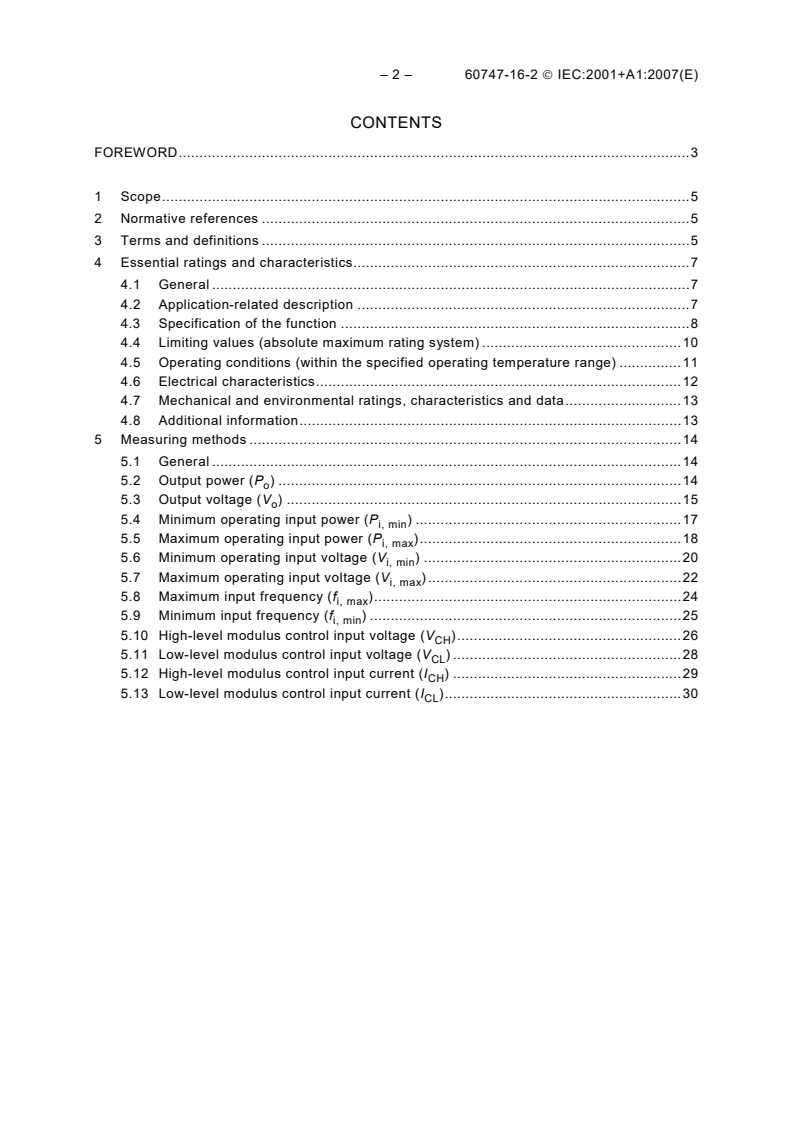
IEC 60747-16-2:2001+AMD1:2007 CSV - Semiconductor devices - Part 16-2: Microwave integrated circuits - Frequency prescalers Released:1/22/2008
Overview
IEC 60747-16-2:2001 is an international standard developed by the International Electrotechnical Commission (IEC) that specifies the essential terminology, ratings, characteristics, and measurement methods for integrated circuit microwave frequency prescalers. Frequency prescalers are critical semiconductor devices used within microwave integrated circuits for frequency division, especially in high-frequency communication and radar applications. This standard ensures uniformity and clarity in technical communication and product specification, serving manufacturers, designers, and users of microwave integrated circuits.
Key Topics
- Terminology and Symbols
- Defines standardized terms and letter symbols for frequency prescalers, ensuring consistency across documentation and development.
- Essential Ratings and Characteristics
- Outlines minimum and maximum electrical ratings (voltage, current, power, temperature) for safety and performance.
- Details operational parameters such as input/output power, frequency limits, and division ratios.
- Device Types and Functional Description
- Distinguishes between fixed modulus and two modulus (dual modulus) frequency prescalers.
- Specifies requirements for circuit identification, device functions, and packaging information.
- Electrical and Environmental Considerations
- Specifies mechanical ratings, environmental conditions, and any compatibility or interfacing requirements.
- Testing and Measuring Methods
- Prescribes detailed procedures for measuring output power, output voltage, input power minimum/maximum, and input voltage thresholds.
- Covers handling precautions, especially concerning electrostatic sensitivity.
Applications
Microwave frequency prescalers covered by IEC 60747-16-2 are widely applied in:
- Communication Systems
- Used in phase-locked loops (PLLs) for frequency synthesis in radio transmitters and receivers, satellite systems, and wireless infrastructure.
- Radar and Navigation
- Implemented in frequency down-conversion and signal processing for radar and navigation equipment.
- Test and Measurement Equipment
- Integral to high-frequency signal generators and spectrum analyzers, where accurate frequency division is required.
- Consumer Electronics
- Utilized in satellite TV receivers, direct broadcast systems (DBS), and various RF-enabled devices.
- Research and Development
- Supports design and prototyping of new high-frequency integrated circuits and systems.
This standard supports equipment interoperability, product safety, and quality assurance by providing detailed methods for evaluating performance and compliance.
Related Standards
Integrating IEC 60747-16-2 with other relevant standards ensures holistic semiconductor device management. Common related standards include:
- IEC 60747-1: General requirements for semiconductor devices.
- IEC 60617: Standardized graphical symbols for diagrams, useful for schematic representation.
- IEC 60748 Series: Standards addressing digital, analog, and interface integrated circuits.
- IEC 61340-5-1 & IEC/TR 61340-5-2: Electrostatic protection of electronic devices, vital for handling prescalers and other sensitive components.
Anyone involved in the design, manufacture, or use of microwave integrated circuits or frequency prescalers will benefit from understanding and applying IEC 60747-16-2. Adhering to this standard helps ensure consistency, reliability, and safety in high-frequency applications and facilitates international trade and collaboration in the semiconductor industry.
Relations
- Effective Date
- 05-Sep-2023
Buy Documents
IEC 60747-16-2:2001 - Semiconductor devices - Part 16-2: Microwave integrated circuits - Frequency prescalers Released:3/22/2001
IEC 60747-16-2:2001+AMD1:2007 CSV - Semiconductor devices - Part 16-2: Microwave integrated circuits - Frequency prescalers Released:1/22/2008
Frequently Asked Questions
IEC 60747-16-2:2001 is a standard published by the International Electrotechnical Commission (IEC). Its full title is "Semiconductor devices - Part 16-2: Microwave integrated circuits - Frequency prescalers". This standard covers: Provides terminology and letter symbols, essential ratings and characteristics, as well as measuring methods for the integrated circuit micowave frequency prescalers.
Provides terminology and letter symbols, essential ratings and characteristics, as well as measuring methods for the integrated circuit micowave frequency prescalers.
IEC 60747-16-2:2001 is classified under the following ICS (International Classification for Standards) categories: 31.080.01 - Semiconductor devices in general. The ICS classification helps identify the subject area and facilitates finding related standards.
IEC 60747-16-2:2001 has the following relationships with other standards: It is inter standard links to IEC 60747-16-2:2001/AMD1:2007. Understanding these relationships helps ensure you are using the most current and applicable version of the standard.
IEC 60747-16-2:2001 is available in PDF format for immediate download after purchase. The document can be added to your cart and obtained through the secure checkout process. Digital delivery ensures instant access to the complete standard document.
Standards Content (Sample)
INTERNATIONAL IEC
STANDARD
60747-16-2
First edition
2001-03
Semiconductor devices –
Part 16-2:
Microwave integrated circuits –
Frequency prescalers
Dispositifs à semiconducteurs –
Partie 16-2:
Circuits intégrés hyperfréquences –
Diviseurs préalables de fréquence
Reference number
Publication numbering
As from 1 January 1997 all IEC publications are issued with a designation in the
60000 series. For example, IEC 34-1 is now referred to as IEC 60034-1.
Consolidated editions
The IEC is now publishing consolidated versions of its publications. For example,
edition numbers 1.0, 1.1 and 1.2 refer, respectively, to the base publication, the
base publication incorporating amendment 1 and the base publication incorporating
amendments 1 and 2.
Further information on IEC publications
The technical content of IEC publications is kept under constant review by the IEC,
thus ensuring that the content reflects current technology. Information relating to
this publication, including its validity, is available in the IEC Catalogue of
publications (see below) in addition to new editions, amendments and corrigenda.
Information on the subjects under consideration and work in progress undertaken
by the technical committee which has prepared this publication, as well as the list
of publications issued, is also available from the following:
• IEC Web Site (www.iec.ch)
• Catalogue of IEC publications
The on-line catalogue on the IEC web site (www.iec.ch/catlg-e.htm) enables
you to search by a variety of criteria including text searches, technical
committees and date of publication. On-line information is also available on
recently issued publications, withdrawn and replaced publications, as well as
corrigenda.
• IEC Just Published
This summary of recently issued publications (www.iec.ch/JP.htm) is also
available by email. Please contact the Customer Service Centre (see below) for
further information.
• Customer Service Centre
If you have any questions regarding this publication or need further assistance,
please contact the Customer Service Centre:
Email: custserv@iec.ch
Tel: +41 22 919 02 11
Fax: +41 22 919 03 00
INTERNATIONAL IEC
STANDARD
60747-16-2
First edition
2001-03
Semiconductor devices –
Part 16-2:
Microwave integrated circuits –
Frequency prescalers
Dispositifs à semiconducteurs –
Partie 16-2:
Circuits intégrés hyperfréquences –
Diviseurs préalables de fréquence
IEC 2001 Copyright - all rights reserved
No part of this publication may be reproduced or utilized in any form or by any means, electronic or
mechanical, including photocopying and microfilm, without permission in writing from the publisher.
International Electrotechnical Commission 3, rue de Varembé Geneva, Switzerland
Telefax: +41 22 919 0300 e-mail: inmail@iec.ch IEC web site http://www.iec.ch
Commission Electrotechnique Internationale
PRICE CODE
U
International Electrotechnical Commission
For price, see current catalogue
– 2 – 60747-16-2 IEC:2001(E)
CONTENTS
FOREWORD . 3
1 Scope . 4
2 Normative references. 4
3 Terms and definitions. 4
4 Essential ratings and characteristics . 6
4.1 General. 6
4.2 Application-related description. 6
4.3 Specification of the function. 7
4.4 Limiting values (absolute maximum rating system). 9
4.5 Operating conditions (within the specified operating temperature range). 10
4.6 Electrical characteristics . 11
4.7 Mechanical and environmental ratings, characteristics and data . 12
4.8 Additional information . 12
5 Measuring methods. 13
5.1 General. 13
5.2 Output power (P ). 13
o
5.3 Output voltage (V ) . 14
o
5.4 Minimum operating input power (P ). 16
i, min
5.5 Maximum operating input power (P ) . 17
i, max
5.6 Minimum operating input voltage (V ) . 19
i, min
5.7 Maximum operating input voltage (V ) . 21
i, max
5.8 Maximum input frequency (f ) . 23
i, max
5.9 Minimum input frequency (f ). 24
i, min
5.10 High-level modulus control input voltage (V ) . 25
CH
5.11 Low-level modulus control input voltage (V ) . 27
CL
5.12 High-level modulus control input current (I ). 28
CH
5.13 Low-level modulus control input current (I ) . 29
CL
60747-16-2 © IEC:2001(E) – 3 –
INTERNATIONAL ELECTROTECHNICAL COMMISSION
____________
SEMICONDUCTOR DEVICES –
Part 16-2: Microwave integrated circuits –
Frequency prescalers
FOREWORD
1) The IEC (International Electrotechnical Commission) is a worldwide organization for standardization comprising
all national electrotechnical committees (IEC National Committees). The object of the IEC is to promote
international co-operation on all questions concerning standardization in the electrical and electronic fields. To
this end and in addition to other activities, the IEC publishes International Standards. Their preparation is
entrusted to technical committees; any IEC National Committee interested in the subject dealt with may
participate in this preparatory work. International, governmental and non-governmental organizations liaising
with the IEC also participate in this preparation. The IEC collaborates closely with the International
Organization for Standardization (ISO) in accordance with conditions determined by agreement between the
two organizations.
2) The formal decisions or agreements of the IEC on technical matters express, as nearly as possible, an
international consensus of opinion on the relevant subjects since each technical committee has representation
from all interested National Committees.
3) The documents produced have the form of recommendations for international use and are published in the form
of standards, technical specifications, technical reports or guides and they are accepted by the National
Committees in that sense.
4) In order to promote international unification, IEC National Committees undertake to apply IEC International
Standards transparently to the maximum extent possible in their national and regional standards. Any
divergence between the IEC Standard and the corresponding national or regional standard shall be clearly
indicated in the latter.
5) The IEC provides no marking procedure to indicate its approval and cannot be rendered responsible for any
equipment declared to be in conformity with one of its standards.
6) Attention is drawn to the possibility that some of the elements of this International Standard may be the subject
of patent rights. The IEC shall not be held responsible for identifying any or all such patent rights.
International Standard IEC 60474-16-2 has been prepared by subcommittee 47E: Discrete
semiconductor devices, of IEC technical committee 47: Semiconductor devices.
The text of this standard is based on the following documents:
FDIS Report on voting
47E/160/FDIS 47E/172/RVD
Full information on the voting for the approval of this standard can be found in the report on
voting indicated in the above table.
This publication has been drafted in accordance with the ISO/IEC Directives, Part 3.
The committee has decided that the contents of this publication will remain unchanged until
2006. At this date, the publication will be
reconfirmed;
withdrawn;
replaced by a revised edition, or
amended.
– 4 – 60747-16-2 IEC:2001(E)
SEMICONDUCTOR DEVICES –
Part 16-2: Microwave integrated circuits –
Frequency prescalers
1 Scope
This part of IEC 60747 provides new measuring methods, terminology and letter symbols, as
well as essential ratings and characteristics for integrated circuit microwave frequency
prescalers.
2 Normative references
The following normative documents contain provisions which, through reference in this text,
constitute provisions of this part of IEC 60747. For dated references, subsequent amend-
ments to, or revisions of, any of these publications do not apply. However, parties to
agreements based on this part of IEC 60747 are encouraged to investigate the possibility of
applying the most recent editions of the normative documents indicated below. For undated
references, the latest edition of the normative document referred to applies. Members of IEC
and ISO maintain registers of currently valid International Standards.
IEC 60617-12, Graphical symbols for diagrams – Part 12: Binary logic elements
IEC 60617-13, Graphical symbols for diagrams – Part 13: Analogue elements
IEC 60747-1, Semiconductor devices – Discrete devices – Part 1: General
IEC 60748-2, Semiconductor devices – Integrated circuits – Part 2: Digital integrated circuits
IEC 60748-3, Semiconductor devices. Integrated circuits – Part 3: Analogue integrated
circuits
IEC 60748-4, Semiconductor devices – Integrated circuits – Part 4: Interface integrated
circuits
3 Terms and definitions
For the purpose of this part of IEC 60747, the following terms and definitions apply:
3.1
power supply voltage V
xxi
(terminal voltage)
d.c. voltage required to be applied to an 'i'-th terminal noted by 'xx'
3.2
power supply current I
xxi
d.c. current flowing through an 'i'-th terminal noted by 'xx'
3.3
output power Po
a.c. power measured at the output terminal
60747-16-2 © IEC:2001(E) – 5 –
3.4
output voltage V
o
amplitude of voltage swing measured at the output terminal
3.5
input power P
i
a.c. power delivered to the input terminal
3.6
input voltage V
i
amplitude of input voltage swing
3.7
high-level modulus control input voltage V
CH
control voltage value to transfer the division ratio from low-level modulus to high-level
modulus
3.8
low-level modulus control input voltage V
CL
control voltage value to transfer the division ratio from high-level modulus to low-level
modulus
3.9
high-level modulus control input current I
CH
control current value to transfer the division ratio from low-level modulus to high-level
modulus
3.10
low-level modulus control input current I
CL
control current value to transfer the division ratio from high-level modulus to low-level
modulus
3.11
input frequency f
i
input frequency for which the device functions
3.12
division ratio N
ratio of the output frequency and input frequency
3.13
set-up time t
set
(under consideration)
– 6 – 60747-16-2 IEC:2001(E)
4 Essential ratings and characteristics
4.1 General
This clause gives ratings and characteristics required for specifying integrated circuit
microwave frequency prescalers used at the microwave or millimetre-wave frequency band.
The integrated circuits contain fixed and two modulus prescalers.
4.1.1 Circuit identification and types
4.1.1.1 Designation and types
Indication of type (device name), category of circuit and technology applied should be given.
Microwave frequency prescalers are divided into two categories:
• type A: fixed modulus type;
• type B: two modulus type.
4.1.1.2 General function description
A general description should be made of the function performed by the integrated circuit
microwave frequency prescalers, and the features for the application.
4.1.1.3 Manufacturing technology
The manufacturing technology, e.g. semiconductor monolithic integrated circuit, thin film
integrated circuit, micro-assembly, should be stated. This statement should include details of
the semiconductor technologies such as MESFET, MISFET, MOSFET, Si bipolar transistor,
HBT, etc.
4.1.1.4 Package identification
The following should be stated:
a) chip or packaged form;
b) IEC and/or national reference number of the outline drawing or of the drawing of a non-
standard package including terminal numbering;
c) principal package material, for example, metal, ceramic, plastic;
d) for chip form, outlines, dimensions, pad sizes, contact material, and recommended contact
technologies.
4.1.1.5 Main application
The main application should be stated if necessary. If the device has restrictive applications,
these should be stated here.
4.2 Application-related description
Information on the application of the integrated circuit and its relation to the associated
devices should be given.
60747-16-2 © IEC:2001(E) – 7 –
4.2.1 Conformance to system and/or interface information
It should be stated whether the integrated circuit conforms to an application system and/or an
interface standard or recommendation.
Detailed information about application systems, equipment and circuits such as VSAT
systems, DBS receivers, and microwave landing systems should also be given.
4.2.2 Overall block diagram
A block diagram of the applied systems should be given if necessary.
4.2.3 Reference data
The most important properties required to permit comparison between derivative types should
be given.
4.2.4 Electrical compatibility
It should be stated whether the integrated circuit is electrically compatible with other particular
integrated circuits or families of integrated circuits, or whether special interfaces are required.
Details should be given concerning the type of input and output circuits, for example,
input/output impedances, d.c. block, open-drain.
Interchangeability with other devices, if any, should be given.
4.2.5 Associated devices
If applicable, the following should be stated here:
– devices necessary for correct operation (list with type number, name, and function);
– peripheral devices with direct interfacing (list with type number, name, and function).
4.3 Specification of the function
4.3.1 Detailed block diagram-functional blocks
A detail block diagram or equivalent circuit information concerning the integrated circuit
microwave frequency prescalers should be given. The block diagram should be composed of
the following:
a) functional blocks;
b) mutual interconnections among the functional blocks;
c) individual functional units within the functional blocks;
d) mutual interconnections among the individual functional blocks;
e) function of each external connection;
f) inter-dependence between the separate functional blocks.
The block diagram should identify the function of each external connection, and where no
ambiguity can arise, can also show the terminal symbols and/or numbers. If the encapsulation
has metallic parts, any connection to them from external terminals should be indicated. The
connections with any associated external electrical elements should be stated, where
necessary.
– 8 – 60747-16-2 IEC:2001(E)
For the purpose of providing additional information, the complete electrical circuit diagram can
be reproduced, though this will not necessarily involve giving indications of the function. Rules
governing such diagrams may be obtained from IEC 60617-12 or IEC 60617-13.
4.3.2 Identification and function of terminals
All terminals should be identified on the block diagram (supply terminals, input or output
terminals, input/output terminals).
The terminal functions 1) to 4) should be indicated in a table as follows:
Function of terminal
1) Terminal
3) Input/output 4) Type of
Terminal number Terminal symbol 2) Function
designation
identification input/output
circuits
1) Terminal designation
A terminal name indicating the function of the terminal should be given. Supply terminals,
ground terminals, blank terminals (with abbreviation NC) and non-usable terminals (with
abbreviation NU) should be distinguished.
2) Function
A brief indication of terminal function should be given:
– each function of multi-role terminals, i.e. terminals having multiple functions;
– each function of integrated circuits selected by mutual pin connections or function
selection data applied to the function selection pin such as mode selection pin.
3) Input/output identification
Input, output, input/output, and multiple input/output terminals should be distinguished.
4) Type of input/output circuits
The type of input and output circuits, for example, input/output impedances, with or
without d.c. block, etc., should be distinguished.
5) Type of ground
If the baseplate of the package is used as ground, this should be stated.
Example:
Supply voltages
Integrated
Input(s) NC
circuit
microwave
frequency
NU Output(s)
prescalers
Ground
IEC 113/01
60747-16-2 © IEC:2001(E) – 9 –
4.3.3 Functional description
The function performed by the circuit should be specified and include the following
information:
– basic function;
– relation to external terminals;
– operation mode (for example, set-up method, preference, etc.);
– interrupt handling.
4.3.4 Family-related characteristics
In this part, all family specific functional descriptions shall be provided (with reference to
IEC 60748-2, IEC 60748-3 and IEC 60748-4).
If ratings and characteristics and function characteristics exist for the family, the relevant part
of IEC 60748 should be used (for example, for microprocessors, see IEC 60748-2, Chapter III,
section 3).
NOTE For each new device family, specific items shall be added to the relevant part of IEC 60748.
4.4 Limiting values (absolute maximum rating system)
The table of these values should contain the following.
– Any interdependence of limiting conditions shall be specified.
– If externally connected and/or attached elements, for example heatsinks, have an
influence on the values of the ratings, the ratings shall be prescribed for the integrated
circuit with the elements connected and/or attached.
– If limiting values are exceeded for transient overload, the permissible excess and their
durations shall be specified.
– Where minimum and maximum values differ during programming of the device, this should
be stated.
– All voltages are referenced to a specified reference terminal (V , GND, etc.).
ss
– In satisfying the following clauses, if maximum and/or minimum values are quoted, the
manufacturer must indicate whether he refers to the absolute magnitude or to the
algebraic value of the quantity.
– The ratings given must cover the operation of the multi-function integrated circuit over the
specified range of operating temperatures. Where such ratings are temperature-
dependent, such dependence should be indicated.
4.4.1 Electrical limiting values
Limiting values should be specified as follows:
Subclause Parameters Min. Max.
4.4.1.1 Power supply voltage(s) + +
4.4.1.2 Power supply current(s) (where appropriate) +
4.4.1.3 Terminal voltage(s) (where appropriate) + +
4.4.1.4 Terminal current(s) (where appropriate) +
4.4.1.5 Input power +
4.4.1.6 Power dissipation (where appropriate) +
– 10 – 60747-16-2 IEC:2001(E)
The detail specification may indicate those values within the table including notes 1 and 2.
Parameters Symbols Min. Max. Unit
(Note 1, Note 2)
NOTE 1 Where appropriate, in accordance with the type of circuit considered.
NOTE 2 For power supply voltage range:
– limiting value(s) of the continuous voltage(s) at the supply terminal(s) with respect to a
special electrical reference point;
– where appropriate, limiting value between specified supply terminals;
– when more than one voltage supply is required, a statement should be made as to
whether the sequence in which these supplies are applied is significant; if so, the
sequence should be stated;
– when more than one supply is needed, it may be necessary to state the combinations of
ratings for these supply voltages and currents.
4.4.2 Temperatures
a) Operating temperature
b) Storage temperature
c) Channel temperature
d) Lead temperature (for soldering)
The detail specification may indicate those values within the table including the note.
Parameters Symbols Min. Max. Unit
(Note)
NOTE Where appropriate, in accordance with the type of circuit considered.
4.5 Operating conditions (within the specified operating temperature range)
They are not to be inspected but may be used for quality assessment purposes.
4.5.1 Power supplies – positive and/or negative values
4.5.2 Initialization sequences (where appropriate)
If special initialization sequences are necessary, the power supply sequencing and
initialization procedure should be specified.
4.5.3 Input voltage(s) or input signal (where appropriate)
For RF input signal, waveform and characteristic impedance should be specified.
4.5.4 Output current(s) (where appropriate)
RF or d.c. current with relevant impedance should be specified.
60747-16-2 © IEC:2001(E) – 11 –
4.5.5 Voltage and/or current of other terminal(s)
4.5.6 External elements (where appropriate)
4.5.7 Operating temperature range
4.6 Electrical characteristics
The characteristics shall apply over the full operating temperature range, unless otherwise
specified.
Each characteristic of 4.6.1 and 4.6.2 should be stated: either
a) over the specified range of operating temperatures, or
b) at a temperature of 25 °C, and at maximum and minimum operating temperatures.
The parameters should be specified according to the type as follows:
Types
Subclause Parameters Min. Type* Max.
AB
4.6.1 Power supply current(s) + + + +
4.6.2 Output power + + + +
4.6.3 Output voltage + + + +
4.6.4 Minimum operating input power + + + +
4.6.5 Maximum operating input power + + + +
4.6.6 Minimum operating input voltage + + + +
4.6.7 Maximum operating input voltage + + + +
4.6.8 High-level modulus control input voltage + + + +
4.6.9 Low-level modulus control input voltage + + + +
4.6.10 High-level modulus control input current + + +
4.6.11 Low-level modulus control input current + + +
4.6.12 Minimum operating input frequency + + + +
4.6.13 Maximum operating input frequency + + + +
4.6.14 Set-up time + + + +
* Optional.
NOTE 1 It is necessary to select either the parameter set of 4.6.2, 4.6.4 and 4.6.5 or that of 4.6.3,
4.6.6 and 4.6.7.
NOTE 2 The values of 4.6.2 and 4.6.3 depend on output impedance.
NOTE 3 The values of 3.6.4, 3.6.5, 3.6.6 and 3.6.7 depend on input impedance.
The detail specification may indicate those values within the table.
Characteristics Symbols Conditions Min. Typ.* Max. Units
*Optional
– 12 – 60747-16-2 IEC:2001(E)
4.7 Mechanical and environmental ratings, characteristics and data
Any specific mechanical and environmental ratings applicable should be stated. (See also
IEC 60747-1, Chapter VI, clause 7.)
4.8 Additional information
Where appropriate, the information detailed in the following subclauses should be given.
4.8.1 Equivalent input and output circuit
Detail information should be given regarding the type of input and output circuits, for example,
input/output impedances, d.c. block, open-drain.
4.8.2 Internal protection
A statement shall be given to indicate whether the integrated circuit contains internal
protection against high static voltages or electrical fields.
4.8.3 Capacitors at terminals
If capacitors for input/output d.c. block are needed, these capacitances should be stated.
4.8.4 Thermal resistance
4.8.5 Interconnections to other types of circuit
Where appropriate, details of the interconnections to other circuits, for example, detector
circuit for AGC, sense amplifiers, buffer, should be given.
4.8.6 Effects of externally connected component(s)
Curves or data indicating the effect of externally connected component(s) that influence the
characteristics may be given.
4.8.7 Recommendations for any associated device(s)
For example, decoupling of the power supply to a high-frequency device should be stated.
4.8.8 Handling precautions
Where appropriate, handling precautions specific to the circuit should be stated. (See also
IEC 60747-1, Chapter IX concerning electrostatic-sensitive devices.)
4.8.9 Application data
4.8.10 Other application information
4.8.11 Date of issue of the data sheet
60747-16-2 © IEC:2001(E) – 13 –
5 Measuring methods
5.1 General
This clause prescribes measuring methods for electrical characteristics of integrated circuit
microwave frequency prescalers used at microwave frequency bands.
5.1.1 General precautions
The general precautions listed in clause 1 of IEC 60747-1, Chapter VII, will be applied. In
addition, special care should be taken to use low-ripple d.c. supplies and to decouple
adequately all bias supply voltages at the frequency of measurement. Although the level of
the input and/or output signal can be specified in either power or voltage, in this document it
is expressed in power unless otherwise specified.
5.1.2 Characteristic impedance
Input/output impedances of the device should be fixed. Generally, the input impedance of the
device should be 50 Ω; if it is much higher than 50 Ω, then a shunt resistor of 50 Ω should be
connected to the port.
5.1.3 Handling precautions
When handling electrostatic-sensitive devices, reference should be made to the handling
precautions given in IEC 60747-1, Chapter IX, clause 1.
5.1.4 Types
The devices in this clause are both packaged and chip types.
5.2 Output power (P )
o
5.2.1 Purpose
To measure the output power under specified conditions.
5.2.2 Circuit diagram
Spectrum
Signal Power Power Power
analyzer
generator divider divider divider
f f
o
i
Device
BC
dB being
G
measured
Variable
A
D
Bias supply
attenuator
f W
W
Frequency Power Power
meter meter 1 meter 2
IEC 114/01
Figure 1 – Circuit for the measurement of output power
– 14 – 60747-16-2 IEC:2001(E)
5.2.3 Principle of measurements
In the circuit diagram shown in figure 1, the input power P and output power P of the device
i o
being measured are derived from the following equati
...
IEC 60747-16-2 ®
Edition 1.1 2008-01
CONSOLIDATED VERSION
INTERNATIONAL
STANDARD
colour
inside
Semiconductor devices –
Part 16-2: Microwave integrated circuits – Frequency prescalers
All rights reserved. Unless otherwise specified, no part of this publication may be reproduced or utilized in any form
or by any means, electronic or mechanical, including photocopying and microfilm, without permission in writing from
either IEC or IEC's member National Committee in the country of the requester.
If you have any questions about IEC copyright or have an enquiry about obtaining additional rights to this publication,
please contact the address below or your local IEC member National Committee for further information.
IEC Central Office Tel.: +41 22 919 02 11
3, rue de Varembé Fax: +41 22 919 03 00
CH-1211 Geneva 20 info@iec.ch
Switzerland www.iec.ch
About the IEC
The International Electrotechnical Commission (IEC) is the leading global organization that prepares and publishes
International Standards for all electrical, electronic and related technologies.
About IEC publications
The technical content of IEC publications is kept under constant review by the IEC. Please make sure that you have the
latest edition, a corrigenda or an amendment might have been published.
Useful links:
IEC publications search - www.iec.ch/searchpub Electropedia - www.electropedia.org
The advanced search enables you to find IEC publications The world's leading online dictionary of electronic and
by a variety of criteria (reference number, text, technical electrical terms containing more than 30 000 terms and
committee,…). definitions in English and French, with equivalent terms in
It also gives information on projects, replaced and additional languages. Also known as the International
withdrawn publications. Electrotechnical Vocabulary (IEV) on-line.
IEC Just Published - webstore.iec.ch/justpublished Customer Service Centre - webstore.iec.ch/csc
Stay up to date on all new IEC publications. Just Published If you wish to give us your feedback on this publication
details all new publications released. Available on-line and or need further assistance, please contact the
also once a month by email. Customer Service Centre: csc@iec.ch.
IEC 60747-16-2 ®
Edition 1.1 2008-01
CONSOLIDATED VERSION
INTERNATIONAL
STANDARD
colour
inside
Semiconductor devices –
Part 16-2: Microwave integrated circuits – Frequency prescalers
INTERNATIONAL
ELECTROTECHNICAL
COMMISSION
ICS 31.080.01 ISBN 2-8318-9451-4
– 2 – 60747-16-2 © IEC:2001+A1:2007(E)
CONTENTS
FOREWORD.3
1 Scope.5
2 Normative references.5
3 Terms and definitions .5
4 Essential ratings and characteristics.7
4.1 General.7
4.2 Application-related description .7
4.3 Specification of the function .8
4.4 Limiting values (absolute maximum rating system) .10
4.5 Operating conditions (within the specified operating temperature range) .11
4.6 Electrical characteristics.12
4.7 Mechanical and environmental ratings, characteristics and data.13
4.8 Additional information.13
5 Measuring methods.14
5.1 General.14
5.2 Output power (P ) .14
o
5.3 Output voltage (V ) .15
o
) .17
5.4 Minimum operating input power (P
i, min
5.5 Maximum operating input power (P ).18
i, max
5.6 Minimum operating input voltage (V ) .20
i, min
5.7 Maximum operating input voltage (V ) .22
i, max
5.8 Maximum input frequency (f ).24
i, max
5.9 Minimum input frequency (f ) .25
i, min
).26
5.10 High-level modulus control input voltage (V
CH
5.11 Low-level modulus control input voltage (V ) .28
CL
5.12 High-level modulus control input current (I ) .29
CH
5.13 Low-level modulus control input current (I ).30
CL
60747-16-2 © IEC:2001+A1:2007(E) – 3 –
INTERNATIONAL ELECTROTECHNICAL COMMISSION
____________
SEMICONDUCTOR DEVICES –
Part 16-2: Microwave integrated circuits –
Frequency prescalers
FOREWORD
1) The International Electrotechnical Commission (IEC) is a worldwide organization for standardization comprising
all national electrotechnical committees (IEC National Committees). The object of IEC is to promote
international co-operation on all questions concerning standardization in the electrical and electronic fields. To
this end and in addition to other activities, IEC publishes International Standards, Technical Specifications,
Technical Reports, Publicly Available Specifications (PAS) and Guides (hereafter referred to as “IEC
Publication(s)”). Their preparation is entrusted to technical committees; any IEC National Committee interested
in the subject dealt with may participate in this preparatory work. International, governmental and non-
governmental organizations liaising with the IEC also participate in this preparation. IEC collaborates closely
with the International Organization for Standardization (ISO) in accordance with conditions determined by
agreement between the two organizations.
2) The formal decisions or agreements of IEC on technical matters express, as nearly as possible, an international
consensus of opinion on the relevant subjects since each technical committee has representation from all
interested IEC National Committees.
3) IEC Publications have the form of recommendations for international use and are accepted by IEC National
Committees in that sense. While all reasonable efforts are made to ensure that the technical content of IEC
Publications is accurate, IEC cannot be held responsible for the way in which they are used or for any
misinterpretation by any end user.
4) In order to promote international uniformity, IEC National Committees undertake to apply IEC Publications
transparently to the maximum extent possible in their national and regional publications. Any divergence
between any IEC Publication and the corresponding national or regional publication shall be clearly indicated in
the latter.
5) IEC provides no marking procedure to indicate its approval and cannot be rendered responsible for any
equipment declared to be in conformity with an IEC Publication.
6) All users should ensure that they have the latest edition of this publication.
7) No liability shall attach to IEC or its directors, employees, servants or agents including individual experts and
members of its technical committees and IEC National Committees for any personal injury, property damage or
other damage of any nature whatsoever, whether direct or indirect, or for costs (including legal fees) and
expenses arising out of the publication, use of, or reliance upon, this IEC Publication or any other IEC
Publications.
8) Attention is drawn to the Normative references cited in this publication. Use of the referenced publications is
indispensable for the correct application of this publication.
9) Attention is drawn to the possibility that some of the elements of this IEC Publication may be the subject of
patent rights. IEC shall not be held responsible for identifying any or all such patent rights.
This consolidated version of the official IEC Standard and its amendment has
been prepared for user convenience.
IEC 60747-16-2 edition 1.1 contains the first edition (2001) [documents 47E/160/
FDIS and 47E/172/RVD] and its amendment 1 (2007) [documents 47E/338/FDIS and
47E/343/RVD].
A vertical line in the margin shows where the base publication has been modified
by amendment 1.
International Standard IEC 60747-16-2 has been prepared by subcommittee 47E:
Discrete semiconductor devices, of IEC technical committee 47: Semiconductor devices.
– 4 – 60747-16-2 © IEC:2001+A1:2007(E)
The committee has decided that the contents of the base publication and its amendments will
remain unchanged until the maintenance result date indicated on the IEC web site under
"http://webstore.iec.ch" in the data related to the specific publication. At this date,
the publication will be
• reconfirmed,
• withdrawn,
• replaced by a revised edition, or
• amended.
60747-16-2 © IEC:2001+A1:2007(E) – 5 –
SEMICONDUCTOR DEVICES –
Part 16-2: Microwave integrated circuits –
Frequency prescalers
1 Scope
This part of IEC 60747 provides new measuring methods, terminology and letter symbols, as
well as essential ratings and characteristics for integrated circuit microwave frequency
prescalers.
2 Normative references
The following referenced documents are indispensable for the application of this document.
For dated references, only the edition cited applies. For undated references, the latest edition
of the referenced document (including any amendments) applies.
IEC 60617:2001, Graphical symbols for diagrams
IEC 60747-1:2006, Semiconductor devices – Part 1: General
IEC 60748-2, Semiconductor devices – Integrated circuits – Part 2: Digital integrated circuits
IEC 60748-3, Semiconductor devices. Integrated circuits – Part 3: Analogue integrated
circuits
IEC 60748-4, Semiconductor devices – Integrated circuits – Part 4: Interface integrated
circuits
IEC 61340-5-1:2007, Electrostatics – Part 5-1: Protection of electronic devices from
electrostatic phenomena - General requirements
IEC/TR 61340-5-2:2007, Electrostatics – Part 5-2: Protection of electronic devices from
electrostatic phenomena – User guide
3 Terms and definitions
For the purpose of this part of IEC 60747, the following terms and definitions apply:
3.1
power supply voltage V
xxi
(terminal voltage)
d.c. voltage required to be applied to an 'i'-th terminal noted by 'xx'
3.2
power supply current I
xxi
d.c. current flowing through an 'i'-th terminal noted by 'xx'
– 6 – 60747-16-2 © IEC:2001+A1:2007(E)
3.3
output power P
o
a.c. power measured at the output terminal
3.4
output voltage V
o
amplitude of voltage swing measured at the output terminal
3.5
input power P
i
a.c. power delivered to the input terminal
3.6
input voltage V
i
amplitude of input voltage swing
3.7
high-level modulus control input voltage V
CH
control voltage value to transfer the division ratio from low-level modulus to high-level
modulus
3.8
low-level modulus control input voltage V
CL
control voltage value to transfer the division ratio from high-level modulus to low-level
modulus
3.9
high-level modulus control input current I
CH
control current value to transfer the division ratio from low-level modulus to high-level
modulus
3.10
low-level modulus control input current I
CL
control current value to transfer the division ratio from high-level modulus to low-level
modulus
3.11
input frequency f
i
input frequency for which the device functions
3.12
division ratio N
ratio of the output frequency and input frequency
3.13
set-up time t
set
(under consideration)
60747-16-2 © IEC:2001+A1:2007(E) – 7 –
4 Essential ratings and characteristics
4.1 General
This clause gives ratings and characteristics required for specifying integrated circuit
microwave frequency prescalers used at the microwave or millimetre-wave frequency band.
The integrated circuits contain fixed and two modulus prescalers.
4.1.1 Circuit identification and types
4.1.1.1 Designation and types
Indication of type (device name), category of circuit and technology applied should be given.
Microwave frequency prescalers are divided into two categories:
• type A: fixed modulus type;
• type B: two modulus type.
4.1.1.2 General function description
A general description should be made of the function performed by the integrated circuit
microwave frequency prescalers, and the features for the application.
4.1.1.3 Manufacturing technology
The manufacturing technology, e.g. semiconductor monolithic integrated circuit, thin film
integrated circuit, micro-assembly, should be stated. This statement should include details of
the semiconductor technologies such as MESFET, MISFET, MOSFET, Si bipolar transistor,
HBT, etc.
4.1.1.4 Package identification
The following should be stated:
a) chip or packaged form;
b) IEC and/or national reference number of the outline drawing or of the drawing of a non-
standard package including terminal numbering;
c) principal package material, for example, metal, ceramic, plastic;
d) for chip form, outlines, dimensions, pad sizes, contact material, and recommended contact
technologies.
4.1.1.5 Main application
The main application should be stated if necessary. If the device has restrictive applications,
these should be stated here.
4.2 Application-related description
Information on the application of the integrated circuit and its relation to the associated
devices should be given.
– 8 – 60747-16-2 © IEC:2001+A1:2007(E)
4.2.1 Conformance to system and/or interface information
It should be stated whether the integrated circuit conforms to an application system and/or an
interface standard or recommendation.
Detailed information about application systems, equipment and circuits such as VSAT
systems, DBS receivers, and microwave landing systems should also be given.
4.2.2 Overall block diagram
A block diagram of the applied systems should be given if necessary.
4.2.3 Reference data
The most important properties required to permit comparison between derivative types should
be given.
4.2.4 Electrical compatibility
It should be stated whether the integrated circuit is electrically compatible with other particular
integrated circuits or families of integrated circuits, or whether special interfaces are required.
Details should be given concerning the type of input and output circuits, for example,
input/output impedances, d.c. block, open-drain.
Interchangeability with other devices, if any, should be given.
4.2.5 Associated devices
If applicable, the following should be stated here:
– devices necessary for correct operation (list with type number, name, and function);
– peripheral devices with direct interfacing (list with type number, name, and function).
4.3 Specification of the function
4.3.1 Detailed block diagram-functional blocks
A detail block diagram or equivalent circuit information concerning the integrated circuit
microwave frequency prescalers should be given. The block diagram should be composed of
the following:
a) functional blocks;
b) mutual interconnections among the functional blocks;
c) individual functional units within the functional blocks;
d) mutual interconnections among the individual functional blocks;
e) function of each external connection;
f) inter-dependence between the separate functional blocks.
The block diagram should identify the function of each external connection, and where no
ambiguity can arise, can also show the terminal symbols and/or numbers. If the encapsulation
has metallic parts, any connection to them from external terminals should be indicated. The
connections with any associated external electrical elements should be stated, where
necessary.
60747-16-2 © IEC:2001+A1:2007(E) – 9 –
For the purpose of providing additional information, the complete electrical circuit diagram can
be reproduced, though this will not necessarily involve giving indications of the function. Rules
governing such diagrams may be obtained from IEC 60617.
4.3.2 Identification and function of terminals
All terminals should be identified on the block diagram (supply terminals, input or output
terminals, input/output terminals).
The terminal functions 1) to 4) should be indicated in a table as follows:
Function of terminal
1) Terminal
3) Input/output 4) Type of
Terminal number Terminal symbol 2) Function
designation
identification input/output
circuits
1) Terminal designation
A terminal name indicating the function of the terminal should be given. Supply terminals,
ground terminals, blank terminals (with abbreviation NC) and non-usable terminals (with
abbreviation NU) should be distinguished.
2) Function
A brief indication of terminal function should be given:
– each function of multi-role terminals, i.e. terminals having multiple functions;
– each function of integrated circuits selected by mutual pin connections or function
selection data applied to the function selection pin such as mode selection pin.
3) Input/output identification
Input, output, input/output, and multiple input/output terminals should be distinguished.
4) Type of input/output circuits
The type of input and output circuits, for example, input/output impedances, with or
without d.c. block, etc., should be distinguished.
5) Type of ground
If the baseplate of the package is used as ground, this should be stated.
Example:
Supply voltages
Integrated
Input(s) NC
circuit
microwave
frequency
NU Output(s)
prescalers
Ground
IEC 113/01
– 10 – 60747-16-2 © IEC:2001+A1:2007(E)
4.3.3 Functional description
The function performed by the circuit should be specified and include the following
information:
– basic function;
– relation to external terminals;
– operation mode (for example, set-up method, preference, etc.);
– interrupt handling.
4.3.4 Family-related characteristics
In this part, all family specific functional descriptions shall be provided (with reference to
IEC 60748-2, IEC 60748-3 and IEC 60748-4).
If ratings and characteristics and function characteristics exist for the family, the relevant part
of IEC 60748 should be used (for example, for microprocessors, see IEC 60748-2, Chapter III,
section 3).
NOTE For each new device family, specific items shall be added to the relevant part of IEC 60748.
4.4 Limiting values (absolute maximum rating system)
The table of these values should contain the following.
– Any interdependence of limiting conditions shall be specified.
– If externally connected and/or attached elements, for example heatsinks, have an
influence on the values of the ratings, the ratings shall be prescribed for the integrated
circuit with the elements connected and/or attached.
– If limiting values are exceeded for transient overload, the permissible excess and their
durations shall be specified.
– Where minimum and maximum values differ during programming of the device, this should
be stated.
– All voltages are referenced to a specified reference terminal (V , GND, etc.).
ss
– In satisfying the following clauses, if maximum and/or minimum values are quoted, the
manufacturer must indicate whether he refers to the absolute magnitude or to the
algebraic value of the quantity.
– The ratings given must cover the operation of the multi-function integrated circuit over the
specified range of operating temperatures. Where such ratings are temperature-
dependent, such dependence should be indicated.
4.4.1 Electrical limiting values
Limiting values should be specified as follows:
Subclause Parameters Min. Max.
4.4.1.1 Power supply voltage(s) + +
4.4.1.2 Power supply current(s) (where appropriate) +
4.4.1.3 Terminal voltage(s) (where appropriate) + +
4.4.1.4 Terminal current(s) (where appropriate) +
4.4.1.5 Input power +
4.4.1.6 Power dissipation (where appropriate) +
60747-16-2 © IEC:2001+A1:2007(E) – 11 –
The detail specification may indicate those values within the table including notes 1 and 2.
Parameters Symbols Min. Max. Unit
(Note 1, Note 2)
NOTE 1 Where appropriate, in accordance with the type of circuit considered.
NOTE 2 For power supply voltage range:
– limiting value(s) of the continuous voltage(s) at the supply terminal(s) with respect to a
special electrical reference point;
– where appropriate, limiting value between specified supply terminals;
– when more than one voltage supply is required, a statement should be made as to
whether the sequence in which these supplies are applied is significant; if so, the
sequence should be stated;
– when more than one supply is needed, it may be necessary to state the combinations of
ratings for these supply voltages and currents.
4.4.2 Temperatures
a) Operating temperature (ambient or reference-point temperature)
b) Storage temperature
c) Channel temperature
d) Lead temperature (for soldering)
The detail specification may indicate those values within the table including the note.
Parameters Symbols Min. Max. Unit
(Note)
NOTE Where appropriate, in accordance with the type of circuit considered.
4.5 Operating conditions (within the specified operating temperature range)
They are not to be inspected but may be used for quality assessment purposes.
4.5.1 Power supplies – positive and/or negative values
4.5.2 Initialization sequences (where appropriate)
If special initialization sequences are necessary, the power supply sequencing and
initialization procedure should be specified.
4.5.3 Input voltage(s) or input signal (where appropriate)
For RF input signal, waveform and characteristic impedance should be specified.
4.5.4 Output current(s) (where appropriate)
RF or d.c. current with relevant impedance should be specified.
– 12 – 60747-16-2 © IEC:2001+A1:2007(E)
4.5.5 Voltage and/or current of other terminal(s)
4.5.6 External elements (where appropriate)
4.5.7 Operating temperature range
4.6 Electrical characteristics
The characteristics shall apply over the full operating temperature range, unless otherwise
specified.
Each characteristic should be stated: either
a) over the specified range of operating temperatures, or
b) at a temperature of 25 °C, and at maximum and minimum operating temperatures.
The parameters should be specified according to the type as follows:
Subclause Types
Parameters Min.Typ* Max.
A B
4.6.1 Power supply current(s) + + + +
4.6.2 Output power + + + +
4.6.3 Output voltage + + + +
4.6.4 Minimum operating input power + + + +
4.6.5 Maximum operating input power + + + +
4.6.6 Minimum operating input voltage + + + +
4.6.7 Maximum operating input voltage + + + +
4.6.8 High-level modulus control input voltage + + + +
4.6.9 Low-level modulus control input voltage + + + +
4.6.10 High-level modulus control input current + + +
4.6.11 Low-level modulus control input current + + +
4.6.12 Minimum operating input frequency + + + +
4.6.13 Maximum operating input frequency + + + +
4.6.14 Set-up time + + + +
* Optional.
NOTE 1 It is necessary to select either the parameter set of 4.6.2, 4.6.4 and 4.6.5 or that of 4.6.3,
4.6.6 and 4.6.7.
NOTE 2 The values of 4.6.2 and 4.6.3 depend on output impedance.
NOTE 3 The values of 4.6.4, 4.6.5, 4.6.6 and 4.6.7 depend on input impedance.
The detail specification may indicate those values within the table.
Characteristics Symbols Conditions Min. Typ.* Max. Units
* Optional
60747-16-2 © IEC:2001+A1:2007(E) – 13 –
4.7 Mechanical and environmental ratings, characteristics and data
Any specific mechanical and environmental ratings applicable should be stated. (See also
Clauses 5.10 and 5.11 of IEC 60747-1.)
4.8 Additional information
Where appropriate, the information detailed in the following subclauses should be given.
4.8.1 Equivalent input and output circuit
Detail information should be given regarding the type of input and output circuits, for example,
input/output impedances, d.c. block, open-drain.
4.8.2 Internal protection
A statement shall be given to indicate whether the integrated circuit contains internal
protection against high static voltages or electrical fields.
4.8.3 Capacitors at terminals
If capacitors for input/output d.c. block are needed, these capacitances should be stated.
4.8.4 Thermal resistance
4.8.5 Interconnections to other types of circuit
Where appropriate, details of the interconnections to other circuits, for example, detector
circuit for AGC, sense amplifiers, buffer, should be given.
4.8.6 Effects of externally connected component(s)
Curves or data indicating the effect of externally connected component(s) that influence the
characteristics may be given.
4.8.7 Recommendations for any associated device(s)
For example, decoupling of the power supply to a high-frequency device should be stated.
4.8.8 Handling precautions
Where appropriate, handling precautions specific to the circuit should be stated. (See also
IEC 61340-5-1 and IEC/TR 61340-5-2 concerning electrostatic-sensitive devices.)
4.8.9 Application data
4.8.10 Other application information
4.8.11 Date of issue of the data sheet
– 14 – 60747-16-2 © IEC:2001+A1:2007(E)
5 Measuring methods
5.1 General
This clause prescribes measuring methods for electrical characteristics of integrated circuit
microwave frequency prescalers used at microwave frequency bands.
5.1.1 General precautions
The general precautions listed in Clauses 6.3, 6.4 and 6.6 of IEC 60747-1, will be applied. In
addition, special care should be taken to use low-ripple d.c. supplies and to decouple
adequately all bias supply voltages at the frequency of measurement. Although the level of
the input and/or output signal can be specified in either power or voltage, in this document it
is expressed in power unless otherwise specified.
5.1.2 Characteristic impedance
Input/output impedances of the device should be fixed. Generally, the input impedance of the
device should be 50 Ω; if it is much higher than 50 Ω, then a shunt resistor of 50 Ω should be
connected to the port.
5.1.3 Handling precautions
When handling electrostatic-sensitive devices, reference should be made to the handling
precautions given in IEC 61340-5-1 and IEC/TR 61340-5-2.
5.1.4 Types
The devices in this clause are both packaged and chip types.
5.2 Output power (P )
o
5.2.1 Purpose
To measure the output power under specified conditions.
5.2.2 Circuit diagram
Spectrum
Signal Power Power Power
analyzer
generator divider divider divider
f f
o
i
Device
BC
dB being
G
measured
Variab
...