


IEC 62216-1:2001
(Main)Digital terrestrial television receivers for the DVB-T system - Part 1: Baseline receiver specification
General Information
- Abstract
Specifies the baseline receiver for the DVB-T (Digital video broadcasting) system. Concerns broadcasters and receiver manufacturers. Ensures that broadcasts are correctly interpreted by receivers and indicates the features that need to be implemented on receivers.
- Status
- Replaced
- Publication Date
- 30-Oct-2001
- Technical Committee
- TC 100 - Audio, video and multimedia systems and equipment
- Drafting Committee
- TA 1 - Terminals for audio, video and data services and content
- Current Stage
- WPUB - Publication withdrawn
- Start Date
- 15-Mar-2010
- Completion Date
- 28-Aug-2026
Relations
- Effective Date
- 05-Sep-2023
Get Certified
Connect with accredited certification bodies for this standard

ANCE
Mexican certification and testing association.

Intertek Slovenia
Intertek testing, inspection, and certification services in Slovenia.

LNE (Laboratoire National de Métrologie et d'Essais)
French national laboratory for metrology and testing.
Sponsored listings
Frequently Asked Questions
IEC 62216-1:2001 is a standard published by the International Electrotechnical Commission (IEC). Its full title is "Digital terrestrial television receivers for the DVB-T system - Part 1: Baseline receiver specification". This standard covers: Specifies the baseline receiver for the DVB-T (Digital video broadcasting) system. Concerns broadcasters and receiver manufacturers. Ensures that broadcasts are correctly interpreted by receivers and indicates the features that need to be implemented on receivers.
Specifies the baseline receiver for the DVB-T (Digital video broadcasting) system. Concerns broadcasters and receiver manufacturers. Ensures that broadcasts are correctly interpreted by receivers and indicates the features that need to be implemented on receivers.
IEC 62216-1:2001 is classified under the following ICS (International Classification for Standards) categories: 33.160.20 - Radio receivers. The ICS classification helps identify the subject area and facilitates finding related standards.
IEC 62216-1:2001 has the following relationships with other standards: It is inter standard links to IEC 62216:2009. Understanding these relationships helps ensure you are using the most current and applicable version of the standard.
IEC 62216-1:2001 is available in PDF format for immediate download after purchase. The document can be added to your cart and obtained through the secure checkout process. Digital delivery ensures instant access to the complete standard document.
Standards Content (Sample)
INTERNATIONAL IEC
STANDARD
62216-1
First edition
2001-10
Digital terrestrial television receivers
for the DVB-T system –
Part 1:
Baseline receiver specification
Reference number
Publication numbering
As from 1 January 1997 all IEC publications are issued with a designation in the
60000 series. For example, IEC 34-1 is now referred to as IEC 60034-1.
Consolidated editions
The IEC is now publishing consolidated versions of its publications. For example,
edition numbers 1.0, 1.1 and 1.2 refer, respectively, to the base publication, the
base publication incorporating amendment 1 and the base publication incorporating
amendments 1 and 2.
Further information on IEC publications
The technical content of IEC publications is kept under constant review by the IEC,
thus ensuring that the content reflects current technology. Information relating to
this publication, including its validity, is available in the IEC Catalogue of
publications (see below) in addition to new editions, amendments and corrigenda.
Information on the subjects under consideration and work in progress undertaken
by the technical committee which has prepared this publication, as well as the list
of publications issued, is also available from the following:
• IEC Web Site (www.iec.ch)
• Catalogue of IEC publications
The on-line catalogue on the IEC web site (www.iec.ch/catlg-e.htm) enables
you to search by a variety of criteria including text searches, technical
committees and date of publication. On-line information is also available on
recently issued publications, withdrawn and replaced publications, as well as
corrigenda.
• IEC Just Published
This summary of recently issued publications (www.iec.ch/JP.htm) is also
available by email. Please contact the Customer Service Centre (see below) for
further information.
• Customer Service Centre
If you have any questions regarding this publication or need further assistance,
please contact the Customer Service Centre:
Email: custserv@iec.ch
Tel: +41 22 919 02 11
Fax: +41 22 919 03 00
INTERNATIONAL IEC
STANDARD
62216-1
First edition
2001-10
Digital terrestrial television receivers
for the DVB-T system –
Part 1:
Baseline receiver specification
IEC 2001 Copyright - all rights reserved
No part of this publication may be reproduced or utilized in any form or by any means, electronic or
mechanical, including photocopying and microfilm, without permission in writing from the publisher.
International Electrotechnical Commission 3, rue de Varembé Geneva, Switzerland
Telefax: +41 22 919 0300 e-mail: inmail@iec.ch IEC web site http://www.iec.ch
Commission Electrotechnique Internationale
PRICE CODE
XE
International Electrotechnical Commission
For price, see current catalogue
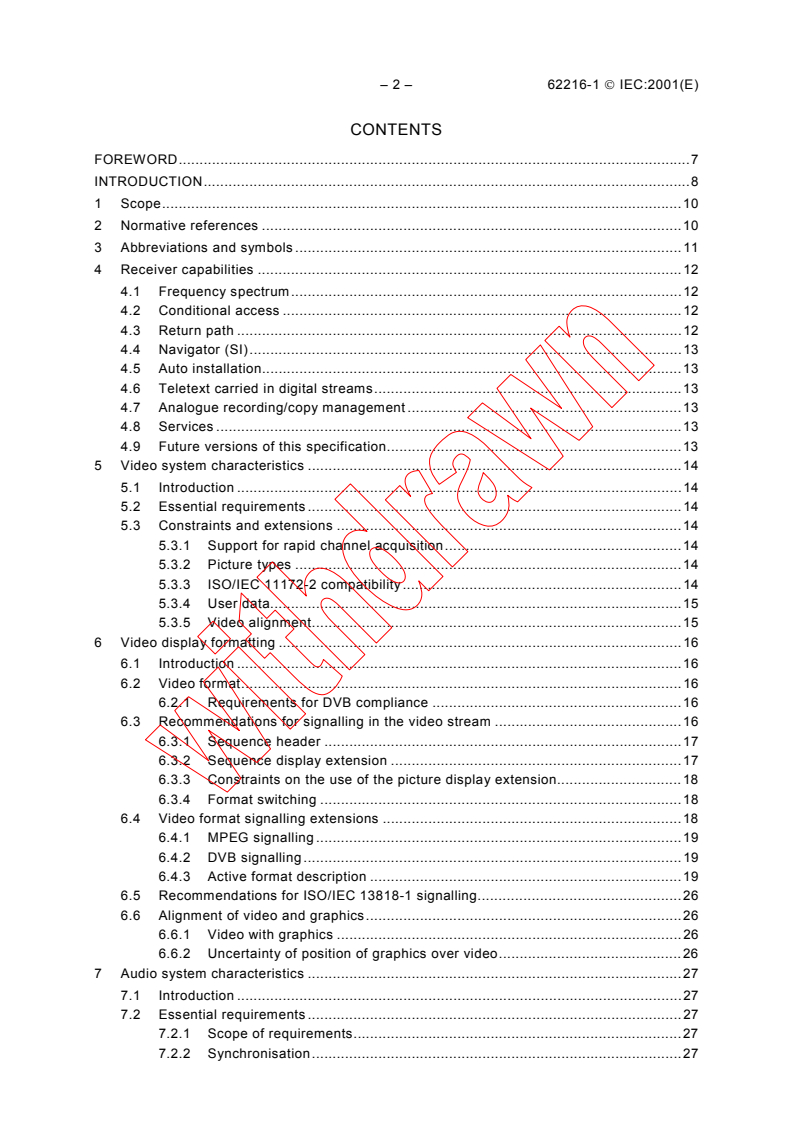
– 2 – 62216-1 IEC:2001(E)
CONTENTS
FOREWORD.7
INTRODUCTION.8
1 Scope.10
2 Normative references .10
3 Abbreviations and symbols .11
4 Receiver capabilities .12
4.1 Frequency spectrum.12
4.2 Conditional access .12
4.3 Return path .12
4.4 Navigator (SI).13
4.5 Auto installation.13
4.6 Teletext carried in digital streams.13
4.7 Analogue recording/copy management .13
4.8 Services .13
4.9 Future versions of this specification.13
5 Video system characteristics .14
5.1 Introduction .14
5.2 Essential requirements .14
5.3 Constraints and extensions .14
5.3.1 Support for rapid channel acquisition.14
5.3.2 Picture types .14
5.3.3 ISO/IEC 11172-2 compatibility.14
5.3.4 User data.15
5.3.5 Video alignment.15
6 Video display formatting .16
6.1 Introduction .16
6.2 Video format.16
6.2.1 Requirements for DVB compliance .16
6.3 Recommendations for signalling in the video stream .16
6.3.1 Sequence header .17
6.3.2 Sequence display extension .17
6.3.3 Constraints on the use of the picture display extension.18
6.3.4 Format switching .18
6.4 Video format signalling extensions .18
6.4.1 MPEG signalling .19
6.4.2 DVB signalling.19
6.4.3 Active format description .19
6.5 Recommendations for ISO/IEC 13818-1 signalling.26
6.6 Alignment of video and graphics.26
6.6.1 Video with graphics .26
6.6.2 Uncertainty of position of graphics over video.26
7 Audio system characteristics .27
7.1 Introduction .27
7.2 Essential requirements .27
7.2.1 Scope of requirements.27
7.2.2 Synchronisation.27
62216-1 IEC:2001(E) – 3 –
7.2.3 Decoding requirements.28
7.3 Constraints and extensions .28
7.3.1 Surround sound .28
7.4 Audio description.28
7.4.1 Background (informative).28
7.4.2 Receiver implementation minima .28
7.4.3 Signalling .28
7.4.4 Constraints on audio description stream coding.32
7.4.5 Implementation notes .32
7.5 Audio only services .34
7.6 PSI signalling .34
8 Multiplex and transport stream characteristics .34
8.1 Scope.34
8.2 Essential requirements .34
8.2.1 Multiplexing .34
8.2.2 Demultiplexing.35
8.3 Constraints and extensions .35
8.3.1 Multicomponent programs.35
9 Service and program specific information .36
9.1 Introduction .36
9.1.1 General requirements .36
9.1.2 General receiver requirements.36
9.1.3 General broadcaster requirements.37
9.1.4 Notation.38
9.2 SI & PSI Specification .38
9.2.1 Summary.38
9.2.2 Program association table .39
9.2.3 Program map table .39
9.2.4 Conditional access table.41
9.2.5 Network information table .41
9.2.6 Bouquet association table.43
9.2.7 Service description table .43
9.2.8 Event information table.45
9.2.9 Time and date table and time offset table .47
9.2.10 Running status table.48
9.2.11 Private data.48
9.3 Receiver functions.52
9.3.1 Information typically available to the user .52
9.3.2 Service change.52
9.3.3 Parental control .55
9.3.4 Receiver behaviour when a service stops .55
9.4 Establishing and maintaining the network connection .55
9.4.1 Use of SI identifiers .55
9.4.2 Auto installation.57
9.4.3 Network evolution.58
9.4.4 Logical channel numbers (LCN).61
9.4.5 Recommendation for robust SI acquisition.64
9.5 User interface.66
9.5.1 Presentation of text .66
– 4 – 62216-1 IEC:2001(E)
9.5.2 Information presentation.67
9.5.3 Service navigation .69
9.5.4 Display of time.70
9.6 Recording devices.70
9.6.1 Programming.70
9.6.2 Execution of recording.70
9.6.3 Control of analogue recorders .71
10 Subtitles .71
10.1 Introduction .71
10.2 Broadcast specifications.71
10.2.1 DVB subtitles.71
10.2.2 Signalling .72
10.2.3 Recommendation.72
10.3 Receiver functions.72
10.3.1 Background .72
10.3.2 User control of receiver behaviour .73
11 VBI based services.73
11.1 Introduction .73
11.2 Broadcast specifications.73
11.3 Receiver functions.74
11.3.1 Processing capabilities .74
11.3.2 Control .74
11.4 Extended VBI format support.74
11.4.1 VPS.75
11.4.2 WSS.75
11.4.3 Teletext and teletext subtitles .75
12 RF-part and channel decoder .75
12.1 General .75
12.2 Frequencies and channel bandwidth.75
12.3 DVB-T modes.75
12.4 Tuning procedure .76
12.5 Change of modulation parameters .76
12.6 Connector .76
12.7 Performance.76
12.7.1 C/N performance .76
12.7.2 Minimum receiver signal input levels .76
12.7.3 Maximum input level.77
12.7.4 Resistanceto analogue and/or digital signals in other channels.77
12.7.5 Resistance to co-channel interference from analogue TV signals.77
12.7.6 Guard interval utilisation in single frequency networks.78
13 Conditional access and the common interface .78
13.1 Introduction .78
13.2 Minimum Requirements .78
Annex A (normative) SI character set.79
A.1 Set of languages supported.79
A.2 Structure of character table .79
Annex B (normative) DVB-SI PDC descriptor .88
B.1 Introduction .88
62216-1 IEC:2001(E) – 5 –
B.2 PDC descriptor.88
Annex C (informative) Bootloader and software download.90
C.1 Overview .90
C.2 Signalling .90
C.3 User interface.91
Annex D (normative) Subtitling.92
D.1 Introduction .92
D.2 Essential requirements .92
D.3 Corrigenda to ETS 300 743 .92
D.4 Clarifications to ETS 300 743 .93
D.5 Revised decoder model .99
D.6 UK specific features .105
D.7 OSD Conflicts.106
D.8 System capabilities (informative) .106
D.9 Encoding Guidelines (informative) .106
D.10 Decoder treatment of errors.107
Annex E (informative) An example of frequencies and offsets .109
E.1 UHF .109
E.2 VHF.109
Annex F (informative) Noise model .110
Annex G (informative) An example of C/N-performance with a practical transmitter .111
Bibliography.112
Figure 1 – Relationship between digital video and analogue video .15
Figure 2 – Receiver and display format processing reference model .21
Figure 3 – Uncertainty of positioning graphics over video.27
Figure 4 – Illustration of control of audio level.29
Figure 5 – Mapping of pan byte onto sound presentation .32
Figure 6 – The “cold-cut” approach illustrated .33
Figure 7 – Generic single external decoder approach illustrated .33
Figure 8 – Possible single external decoder approaches illustrated.34
Figure 9 – Service regionalisation.62
Figure D.1 – High level bitstream organisation.94
Figure D.2 – Region depth selection .96
Figure D.3 – Mapping code strings to pixels in “requested” depth region.97
Figure D.4 – Mapping code strings to pixels.98
Figure D.5 – Subtitle reference decoder model .100
Figure D.6 – The two modelled decoding phases .101
Figure D.7 – Detail of data decoding phase.102
Figure D.8 – Disruption to display at start of new epoch.102
Figure F.1 – Tuner Noise Model.110
Table 1 – Horizontal scaling where format is signalled by the sequence header alone .17
Table 2 – Pan scan window .17
Table 3 – Non “full screen”.18
Table 4 – Formats described by the active_format description .19
– 6 – 62216-1 IEC:2001(E)
Table 5 – Processing by STB connected to 4:3 TV.22
Table 6 – User options for displaying 16:9 on 4:3.23
Table 7 – User options for displaying >16:9 on 4:3.23
Table 8 – Processing by STB connected to 16:9 TV.24
Table 9 – WSS codes for aspect ratio .25
Table 10 – Values for other WSS bits .25
Table 11 – Audio Description Descriptor .29
Table 12 – Illustration of PES packet header .31
Table 13 – Key to symbols.38
Table 14 – Summary of required tables.38
Table 15 – Program descriptors .39
Table 16 – Elementary streams descriptors .39
Table 17 – Network descriptors (first loop).41
Table 18 – Transport stream descriptors (second loop).42
Table 19 – Service descriptors.43
Table 20 – Event information descriptors .45
Table 21 – Time Offset Table descriptors.47
Table 22 – Private SI recognised by this specification.48
Table 23 – Syntax of the eacem stream identifier descriptor .48
Table 24 – Syntax of the logical channel descriptor .49
Table 25 – Logical Channel Number .50
Table 26 – Syntax of the preferred name list descriptor .50
Table 27 – Syntax of the preferred name identifier descriptor .51
Table 28 – Subtitle preference modes defined .53
Table 29 – Receiver Response to Missing SI Tables.65
Table 30 – Text Field Lengths.67
Table 31 – Subtitle preference modes defined .73
Table 32 – C/N (dB) for Reference BER.76
Table A.1 – Allowed character codes in SI text fields .80
Table B.1 – Syntax of the PDC descriptor .88
Table C.1 – Example download information structure.91
Table D.1 – Corrigenda to ETS 300 743.92
Table D.2 – Notes to Figure D-1.95
Table D.3 – Additional display update budget for page/region operations.103
Table D.4 – End of display set segment syntax .105
Table D.5 – Example subtitle system performance.106
Table G.1 – C/N (dB) for Reference BER .111
62216-1 IEC:2001(E) – 7 –
INTERNATIONAL ELECTROTECHNICAL COMMISSION
____________
DIGITAL TERRESTRIAL TELEVISION RECEIVERS
FOR THE DVB-T SYSTEM –
Part 1: Baseline receiver specification
FOREWORD
1) The IEC (International Electrotechnical Commission) is a worldwide organization for standardization comprising
all national electrotechnical committees (IEC National Committees). The object of the IEC is to promote
international co-operation on all questions concerning standardization in the electrical and electronic fields. To
this end and in addition to other activities, the IEC publishes International Standards. Their preparation is
entrusted to technical committees; any IEC National Committee interested in the subject dealt with may
participate in this preparatory work. International, governmental and non-governmental organizations liaising
with the IEC also participate in this preparation. The IEC collaborates closely with the International
Organization for Standardization (ISO) in accordance with conditions determined by agreement between the
two organizations.
2) The formal decisions or agreements of the IEC on technical matters express, as nearly as possible, an
international consensus of opinion on the relevant subjects since each technical committee has representation
from all interested National Committees.
3) The documents produced have the form of recommendations for international use and are published in the form
of standards, technical specifications, technical reports or guides and they are accepted by the National
Committees in that sense.
4) In order to promote international unification, IEC National Committees undertake to apply IEC International
Standards transparently to the maximum extent possible in their national and regional standards. Any
divergence between the IEC Standard and the corresponding national or regional standard shall be clearly
indicated in the latter.
5) The IEC provides no marking procedure to indicate its approval and cannot be rendered responsible for any
equipment declared to be in conformity with one of its standards.
6) Attention is drawn to the possibility that some of the elements of this International Standard may be the subject
of patent rights. The IEC shall not be held responsible for identifying any or all such patent rights.
International Standard IEC 62216-1 has been prepared by technical area 1, Digital receiving
equipment, of IEC technical committee 100: Audio, video and multimedia systems and
equipment
The text of this standard is based on the following documents:
CDV Report on voting
100/211/CDV 100/267/RVC
Full information on the voting for the approval of this standard can be found in the report on
voting indicated in the above table.
This publication has been drafted in accordance with the ISO/IEC Directives, Part 3.
Annexes A, B and D form an integral part of this standard. Annexes C, E, F and G are for
information only.
The committee has decided that this publication remains valid until 2003. At this date, in
accordance with the committee’s decision, the publication will be
• reconfirmed;
• withdrawn;
• replaced by a revised edition, or
• amended.
– 8 – 62216-1 IEC:2001(E)
INTRODUCTION
Television has evolved over the last half century from an up-market entertainment medium to
becoming the major information tool around the world.
Television is available to virtually all people around the globe, be it individually or in a
community setting.
The advent of the “personal computer”, enabling global reach and instant interaction has
escalated the demand for more and more information and the ability to respond to it instantly.
It is thus that the broadcasters and content providers set out to seek new means of delivering
higher levels of content, be it in volume or quality using existing or new transport mechanisms
available.
Digitalisation, taken from the world of information technology was the obvious choice.
It further brought the added benefits of efficient use of spectrum and energy, not to mention
interaction through a return path.
Terrestrial television has to migrate from analogue to digital in order to survive in the new
information society.
Without any doubt, all means of information and content dissemination technology will merge
over time, provided that sound business models find uptake by consumers at large.
Governments are keen to switch off the inefficient analogue broadcasts for a number of
obvious reasons, but only will be able to do so when consumers are confident that the new
proposition is attractive and affordable.
Business models are being developed to promote the uptake of digital receivers, however this
activity up to now is mainly led by private enterprises targeting the public sector willing to pay
for services in addition to those available from established public broadcasters.
This in itself is fine, but will not enable the migration from analogue to digital of all broadcasts,
however funded.
The more so as it has led to a variety of incompatible platforms tied to particular TV
operators, and this in turn does not allow for economy of scale for all parties concerned, be it
content providers, broadcasters, network providers or equipment manufacturers.
After over two years of requirement capture in DigiTAG (Digital Television Action Group) and
other fora, EACEM (European Association of Consumer Electronics Manufacturers) decided
to address this situation by developing a basic specification as a minimum platform, providing
secure reception of broadcast content and associated services. This includes both free to air
as well as pay TV services by means of the DVB common interface.
62216-1 IEC:2001(E) – 9 –
This is in order to provide a stable base from which new applications and services can be built
up, and ensuring backwards compatibility for products in the market based on this
specification, thus ensuring that the consumer will continue to receive the services they have
grown accustomed to.
EACEM has taken into consideration all other documents and specifications that were freely
available from various bodies (NorDig Group, ANIEL, etc.) in order to develop a pan European
specification.
– 10 – 62216-1 IEC:2001(E)
DIGITAL TERRESTRIAL TELEVISION RECEIVERS
FOR THE DVB-T SYSTEM –
Part 1: Baseline receiver specification
1 Scope
This part of IEC 62216 specifies the baseline receiver for the DVB-T system.
It concerns:
• broadcasters, and
• receiver manufacturers.
The objective is to define:
• how to provide broadcasts that are understood by all receivers and enable receivers to
provide good facilities to their users;
• the behaviour required from receivers to work well with these broadcasts and to be
attractive to consumers.
To avoid doubt, the words “shall”, “should” etc. are used in the traditional way to distinguish
issues that are important versus those that are optional. The term “shall” is also used to
identify mandatory requirements that are inherited from other specifications that have greater
force.
This specification does not consider interactive applications and the data broadcasting that
would support them. Subtitling and teletext are considered to be components of TV services.
Standalone teletext services are not part of this standard.
This specification primarily addresses terrestrial delivery of digital transmissions.
This specification primarily addresses deployment in countries that use European Latin script
based languages.
2 Normative references
The following normative documents contain provisions which, through reference in this text,
constitute provisions of this part of IEC 62216. For dated references, subsequent
amendments to, or revisions of, any of these publications do not apply. However, parties to
agreements based on this part of IEC 62216 are encouraged to investigate the possibility of
applying the most recent editions of the normative documents indicated below. For undated
references, the latest edition of the normative document referred to applies. Members of IEC
and ISO maintain registers of currently valid International Standards.
IEC 60169-2, Radio-frequency connectors - Part 2: Coaxial unmatched connector
ISO/IEC 6937, Information technology – Coded graphic character set for text communication –
Latin alphabet
ISO/IEC 8859-9, Information technology – 8-bit single-byte coded graphic character sets –
Part 9: Latin alphabet No. 5
ISO/IEC 11172-2, Information technology – Coding of moving pictures and associated audio
for digital storage media at up to about 1,5 Mbit/s – Part 2: Video
ISO/IEC 13818-1, Information technology – Generic coding of moving pictures and associated
audio information: systems
62216-1 IEC:2001(E) – 11 –
ISO/IEC 13818-2, Information technology – Generic coding of moving pictures and associated
audio information: Video
ISO/IEC 13818-3, Information technology – Generic coding of moving pictures and associated
audio information: Audio
ITU-R BT.470-6, Conventional television systems
ITU-R BS.775-1, Multichannel stereophonic sound system with and without accompanying
picture
ITU-R BT.1119-2, Wide-screen signalling for broadcasting (Signalling for wide-screen and
other enhanced television parameters)
ITU-R BT.1359-1, Relative timing of sound and vision for broadcasting
EN 50049-1, Domestic and Similar Electronic Equipment Interconnection Requirements:
Peritelevision Connector
EN 50221, Common Interface Specification for Conditional Access and Other Digital Video
Broadcasting Decoder Applications
EN 300 468, Digital Video Broadcasting (DVB) - Specification for Service Information (SI) in
DVB systems
EN 300 744, Digital Video Broadcasting (DVB) - Framing structure, channel coding and
modulation for digital terrestrial television (DVB-T)
EN 301 775, Digital Video Broadcasting (DVB) - Specification for the carriage of Vertical
Blanking Information (VBI) data in DVB bitstreams
ETR 289, Digital Video Broadcasting (DVB) - Support for Use of Scrambling and Conditional
Access (CA) within digital broadcasting systems
ETR 154, Digital Video Broadcasting (DVB) - Implementation guidelines for the use of MPEG-
2 Systems, Video and Audio in satellite, cable and terrestrial broadcasting applications
ETR 162, Digital Broadcasting Systems for Television Sound and Data services; Allocation of
Service Information (SI) codes for Digital Video Broadcasting (DVB) systems
ETR 211, Digital Video Broadcasting (DVB) - Guidelines on implementation and usage of
Service Information (SI)
ETS 300 231, Television Systems - Specification of the domestic video Programme Delivery
Control system (PDC)
ETS 300 294, Television Systems; 625 - Line television Wide Screen Signalling (WSS)
ETS 300 472, Digital Video Broadcasting (DVB) - Specification for conveying ITU-R System B
Teletext in DVB bitstreams
ETS 300 706, Enhanced Teletext specification
ETS 300 743, Digital Video Broadcasting (DVB) - Subtitling systems
R206-001, Guidelines for Implementation and Use of the Common Interface for DVB Decoder
Applications
TS 101 699, Digital Video Broadcasting (DVB) - Extensions to the Common Interface
Specification
3 Abbreviations and symbols
Bouquet Association Table
BAT
bslbf Bit string, left bit first
CA Conditional Access
Digital Terrestrial Television
DTTV
Digital Video Broadcast
DVB
Event Information Table
EIT
– 12 – 62216-1 IEC:2001(E)
EIT EIT present/following
pf
EPG Electronic Programme Guide
IDTV Integrated Digital Television
MFN Multi Frequency Network
MTBF Mean Time Between Failure
NIT Network Information Table
NVOD Near Video On Demand
PMT Program Map Table
PSI Program Specific Information
RST Running Status Table
SDT Service Description Table
SFN Single Frequency Network
SI Service Information
STB Set Top Box
TDT Time and Date Table
TOT Time Offset Table
TS Transport Stream
uimsbf Unsigned integer most significant bit first
UTC Universal Time, Co-ordinated
4 Receiver capabilities
The list below gives a general overview of receiver capabilities supported by this
specification.
4.1 Frequency spectrum
• UHF and/or VHF (band III);
• 8 MHz and/or 7 MHz Channel bandwidth;
• supports all DVB-T modulation methods;
• supports both 2K and 8K transmitting methods;
• supports all code rates;
• supports all guard intervals;
• supports hierarchical mode by the demodulator;
• supports portability.
4.2 Conditional access
The receiver is capable of receiving free-to-air as well as pay services. In order to have the
necessary flexibility to choose a conditional access (CA) system one common interface slot
(according to EN 50221) is foreseen. In future, other means to add new CA systems might be
used such as the IEEE 1394 digital interface.
4.3 Return path
If a modem is not embedded then suitable means should be provided for connection to one
(for example RS 232) for further interactive applications (for example IPPV, …).
62216-1 IEC:2001(E) – 13 –
4.4 Navigator (SI)
The navigator will use the mandatory service information broadcast in the service information
table and the event information table to present appropriate service and event information to
the user and to allow automatic selection of service features when the user selects a service.
Details can be found in clause 9, which is based on (mandatory) DVB-SI rules.
4.5 Auto installation
The receiver will allow access to all receivable services and will use the mandatory
information in the NIT and/or SDT to automate the initialisation of the service list and
subsequent updates thereof. See also 9.4.2.
4.6 Teletext carried in digital streams
Support of this feature is the responsibility of the manufacturer. Manufacturers are prepared
to support teletext for a transition period. This feature and its signalling is described in
clause 11.
4.7 Analogue recording/copy management
Analogue recording via the peritelevision connector (EN 50049-1) is supported.
4.8 Services
The receiver shall support the following services and service features:
• free to air broadcast;
• multi-lingual sound, multi-comments;
• multi-lingual subtitles (DVB subtitles, region based graphics);
• audio broadcast;
• screen formatting for ratios of 4:3 and 16:9.
In addition, the receiver may support:
• teletext linked with a program;
• mosaic services;
• Automatic Format Descriptor (AFD) for flexible screen formatting.
4.9 Future versions of this specification
It is the intention to extend this specification in a backward compatible way towards new types
of services and service options and consequent receiver behaviour.
This is the case, in particular for the choice of an API, where it is currently expected that
DVB-MHP is an appropriate choice as a generally accepted API for broadly marketable
receivers.
In clause 9, the following additions are foreseen:
• Service list and logical channel number handling through the SDT as an additional
alternative to the
...