


IEC 62320-2:2016
(Main)Maritime navigation and radiocommunication equipment and systems - Automatic identification system (AIS) - Part 2: AIS AtoN Stations - Operational and performance requirements, methods of testing and required test results
Maritime navigation and radiocommunication equipment and systems - Automatic identification system (AIS) - Part 2: AIS AtoN Stations - Operational and performance requirements, methods of testing and required test results
IEC 62320-2:2016 specifies the operational and performance requirements, methods of testing and required test results for AIS AtoN Stations compatible with the performance standards adopted by IMO Resolution MSC.74(69), Annex 3, Universal AIS. It incorporates the technical characteristics of non-shipborne AIS AtoN equipment, included in Recommendation ITU-R M.1371 and IALA Recommendation A-126. Where applicable, it also takes into account the ITU Radio Regulations. This standard takes into account other associated IEC International Standards and existing national standards, as applicable. This document is applicable for automatic identification system (AIS) installations on aids to navigation (AtoN). This edition includes the following significant technical changes with respect to the previous edition:
- additional cyber security measures;
- updated description of configuration via VDL;
- updated VDL access scheme requirements;
- new PI sentences and VDL message structures with added description for optional TAG blocks;
- added requirement for at least one standard method for configuration using Standard PI sentences;
- updated test methods and updated Annexes.
Matériels et systèmes de navigation et de radiocommunication maritimes - Système d'identification automatique (AIS) - Partie 2: Stations d'aides à la navigation AIS - Exigences opérationnelles et de fonctionnement, méthodes d'essai et résultats d'essai exigés
L'IEC 62320-2:2016 spécifie les exigences opérationnelles et de fonctionnement, les méthodes d'essai et les résultats d’essai exigés applicables aux stations d'aides à la navigation AIS compatibles avec les normes de fonctionnement adoptées par la Résolution MSC.74(69) de l'OMI (Annexe 3, AIS universel). Elle comprend les caractéristiques techniques des matériels AIS d'aides à la navigation non embarqués, figurant dans la Recommandation UIT-R M.1371 et la Recommandation A-126 de l'AISM. Le cas échéant, elle prend également en compte le Règlement des radiocommunications de l'UIT. La présente norme tient compte des autres normes internationales IEC associées et des normes nationales existantes, selon le cas.
Le présent document s'applique aux installations de systèmes d'identification automatique (AIS - automatic identification system) dédiées aux aides à la navigation (AtoN - aids to navigation).
Cette deuxième édition annule et remplace la première édition parue en 2008. Cette édition constitue une révision technique.
Cette édition inclut les modifications techniques majeures suivantes par rapport à l'édition précédente:
- des mesures de cybersécurité supplémentaires;
- mise à jour de la description de configuration via la VDL;
- mise à jour des exigences concernant les modes d'accès VDL;
- de nouvelles sentences PI et de nouvelles structures de messages VDL avec ajout d'une description des blocs TAG facultatifs;
- ajout d’une exigence concernant au moins une méthode de configuration type à l'aide de sentences PI types;
- mise à jour des méthodes d'essai et des annexes.
General Information
- Status
- Published
- Publication Date
- 30-Oct-2016
- Technical Committee
- TC 80 - Maritime navigation and radiocommunication equipment and systems
- Drafting Committee
- WG 15 - TC 80/WG 15
- Current Stage
- PPUB - Publication issued
- Start Date
- 31-Oct-2016
- Completion Date
- 30-Nov-2016
Relations
- Effective Date
- 05-Sep-2023
Overview
IEC 62320-2:2016 - "Maritime navigation and radiocommunication equipment and systems - Automatic identification system (AIS) - Part 2: AIS AtoN Stations" defines operational and performance requirements, required methods of testing, and required test results for Automatic Identification System Aids to Navigation (AIS AtoN) stations. The standard aligns AIS AtoN equipment with IMO Resolution MSC.74(69) (Universal AIS) and incorporates technical characteristics from ITU‑R M.1371 and IALA Recommendation A‑126, taking into account applicable ITU Radio Regulations and other IEC and national standards.
Key topics and technical requirements
The standard covers both equipment characteristics and verification procedures, including:
- Types of AIS AtoN stations (Type 1, Type 2, Type 3) and their capabilities and alternatives
- Physical layer requirements: transmitter/receiver behavior, power consumption, environmental specifications
- Link layer requirements: AIS message handling, synchronization, VDL access schemes, autonomous mode, and EPFS (electronic position fix system) integration
- Configuration methods: direct and chained configuration via VDL, Standard PI sentences, TAG block structures, and requirement to provide at least one standard configuration method
- Security and protocol updates: additional cyber security measures, updated VDL access requirements, new PI sentences and VDL message structures
- Test methods and required test results: RF tests (frequency error, carrier power, modulation spectrum), receiver tests (sensitivity, adjacent/co‑channel rejection, inter‑modulation, blocking), spurious emissions, functional tests (Message 6/8/12/14/21 scheduling and responses), synchronization accuracy, EPFS and off‑position monitoring, BIIT (Built‑In Integrity Test), and transmitter shutdown procedures
- Annexes with updated test procedures and examples
Practical applications and users
IEC 62320-2 is intended for organizations involved in the lifecycle of maritime AtoN AIS equipment:
- Manufacturers - design and verify AIS AtoN products to meet international performance and interoperability requirements
- Certification bodies and test laboratories - perform RF and functional conformity testing and produce compliance reports
- Port and coastal authorities, hydrographic offices, IALA/IMO stakeholders - specify procurement, installation, and operational requirements for AIS AtoN deployments
- System integrators and installers - implement VDL configuration, chaining, and ensure EPFS integration and cybersecurity provisions
- Classification societies and regulators - assess equipment conformity with IMO/ITU/IALA requirements
Related standards and references
- IMO Resolution MSC.74(69) Annex 3 (Universal AIS)
- ITU‑R M.1371 (AIS technical characteristics)
- IALA Recommendation A‑126
- ITU Radio Regulations and other applicable IEC International Standards
Keywords: IEC 62320-2, AIS AtoN, Automatic Identification System, maritime navigation, VDL configuration, AIS testing, IMO Universal AIS, ITU‑R M.1371, IALA A‑126, maritime radiocommunication.


IEC 62320-2:2016 - Maritime navigation and radiocommunication equipment and systems - Automatic identification system (AIS) - Part 2: AIS AtoN Stations - Operational and performance requirements, methods of testing and required test results Released:10/31/2016 Isbn:9782832237090

REDLINE IEC 62320-2:2016 - Maritime navigation and radiocommunication equipment and systems - Automatic identification system (AIS) - Part 2: AIS AtoN Stations - Operational and performance requirements, methods of testing and required test results Released:10/31/2016 Isbn:9782832237359


IEC 62320-2:2016 - Maritime navigation and radiocommunication equipment and systems - Automatic identification system (AIS) - Part 2: AIS AtoN Stations - Operational and performance requirements, methods of testing and required test results
Get Certified
Connect with accredited certification bodies for this standard

DNV
DNV is an independent assurance and risk management provider.

Lloyd's Register
Lloyd's Register is a global professional services organisation specialising in engineering and technology.

ABS Quality Evaluations Inc.
American Bureau of Shipping quality certification.
Sponsored listings
Frequently Asked Questions
IEC 62320-2:2016 is a standard published by the International Electrotechnical Commission (IEC). Its full title is "Maritime navigation and radiocommunication equipment and systems - Automatic identification system (AIS) - Part 2: AIS AtoN Stations - Operational and performance requirements, methods of testing and required test results". This standard covers: IEC 62320-2:2016 specifies the operational and performance requirements, methods of testing and required test results for AIS AtoN Stations compatible with the performance standards adopted by IMO Resolution MSC.74(69), Annex 3, Universal AIS. It incorporates the technical characteristics of non-shipborne AIS AtoN equipment, included in Recommendation ITU-R M.1371 and IALA Recommendation A-126. Where applicable, it also takes into account the ITU Radio Regulations. This standard takes into account other associated IEC International Standards and existing national standards, as applicable. This document is applicable for automatic identification system (AIS) installations on aids to navigation (AtoN). This edition includes the following significant technical changes with respect to the previous edition: - additional cyber security measures; - updated description of configuration via VDL; - updated VDL access scheme requirements; - new PI sentences and VDL message structures with added description for optional TAG blocks; - added requirement for at least one standard method for configuration using Standard PI sentences; - updated test methods and updated Annexes.
IEC 62320-2:2016 specifies the operational and performance requirements, methods of testing and required test results for AIS AtoN Stations compatible with the performance standards adopted by IMO Resolution MSC.74(69), Annex 3, Universal AIS. It incorporates the technical characteristics of non-shipborne AIS AtoN equipment, included in Recommendation ITU-R M.1371 and IALA Recommendation A-126. Where applicable, it also takes into account the ITU Radio Regulations. This standard takes into account other associated IEC International Standards and existing national standards, as applicable. This document is applicable for automatic identification system (AIS) installations on aids to navigation (AtoN). This edition includes the following significant technical changes with respect to the previous edition: - additional cyber security measures; - updated description of configuration via VDL; - updated VDL access scheme requirements; - new PI sentences and VDL message structures with added description for optional TAG blocks; - added requirement for at least one standard method for configuration using Standard PI sentences; - updated test methods and updated Annexes.
IEC 62320-2:2016 is classified under the following ICS (International Classification for Standards) categories: 47.020.70 - Navigation and control equipment. The ICS classification helps identify the subject area and facilitates finding related standards.
IEC 62320-2:2016 has the following relationships with other standards: It is inter standard links to IEC 62320-2:2008. Understanding these relationships helps ensure you are using the most current and applicable version of the standard.
IEC 62320-2:2016 is available in PDF format for immediate download after purchase. The document can be added to your cart and obtained through the secure checkout process. Digital delivery ensures instant access to the complete standard document.
Standards Content (Sample)
IEC 62320-2 ®
Edition 2.0 2016-10
INTERNATIONAL
STANDARD
colour
inside
Maritime navigation and radiocommunication equipment and systems –
Automatic identification system (AIS) –
Part 2: AIS AtoN Stations – Operational and performance requirements, methods
of testing and required test results
All rights reserved. Unless otherwise specified, no part of this publication may be reproduced or utilized in any form
or by any means, electronic or mechanical, including photocopying and microfilm, without permission in writing from
either IEC or IEC's member National Committee in the country of the requester. If you have any questions about IEC
copyright or have an enquiry about obtaining additional rights to this publication, please contact the address below or
your local IEC member National Committee for further information.
IEC Central Office Tel.: +41 22 919 02 11
3, rue de Varembé Fax: +41 22 919 03 00
CH-1211 Geneva 20 info@iec.ch
Switzerland www.iec.ch
About the IEC
The International Electrotechnical Commission (IEC) is the leading global organization that prepares and publishes
International Standards for all electrical, electronic and related technologies.
About IEC publications
The technical content of IEC publications is kept under constant review by the IEC. Please make sure that you have the
latest edition, a corrigenda or an amendment might have been published.
IEC Catalogue - webstore.iec.ch/catalogue Electropedia - www.electropedia.org
The stand-alone application for consulting the entire The world's leading online dictionary of electronic and
bibliographical information on IEC International Standards, electrical terms containing 20 000 terms and definitions in
Technical Specifications, Technical Reports and other English and French, with equivalent terms in 15 additional
documents. Available for PC, Mac OS, Android Tablets and languages. Also known as the International Electrotechnical
iPad. Vocabulary (IEV) online.
IEC publications search - www.iec.ch/searchpub IEC Glossary - std.iec.ch/glossary
The advanced search enables to find IEC publications by a 65 000 electrotechnical terminology entries in English and
variety of criteria (reference number, text, technical French extracted from the Terms and Definitions clause of
committee,…). It also gives information on projects, replaced IEC publications issued since 2002. Some entries have been
and withdrawn publications. collected from earlier publications of IEC TC 37, 77, 86 and
CISPR.
IEC Just Published - webstore.iec.ch/justpublished
Stay up to date on all new IEC publications. Just Published IEC Customer Service Centre - webstore.iec.ch/csc
details all new publications released. Available online and If you wish to give us your feedback on this publication or
also once a month by email. need further assistance, please contact the Customer Service
Centre: csc@iec.ch.
IEC 62320-2 ®
Edition 2.0 2016-10
INTERNATIONAL
STANDARD
colour
inside
Maritime navigation and radiocommunication equipment and systems –
Automatic identification system (AIS) –
Part 2: AIS AtoN Stations – Operational and performance requirements, methods
of testing and required test results
INTERNATIONAL
ELECTROTECHNICAL
COMMISSION
ICS 47.020.70 ISBN 978-2-8322-3709-0
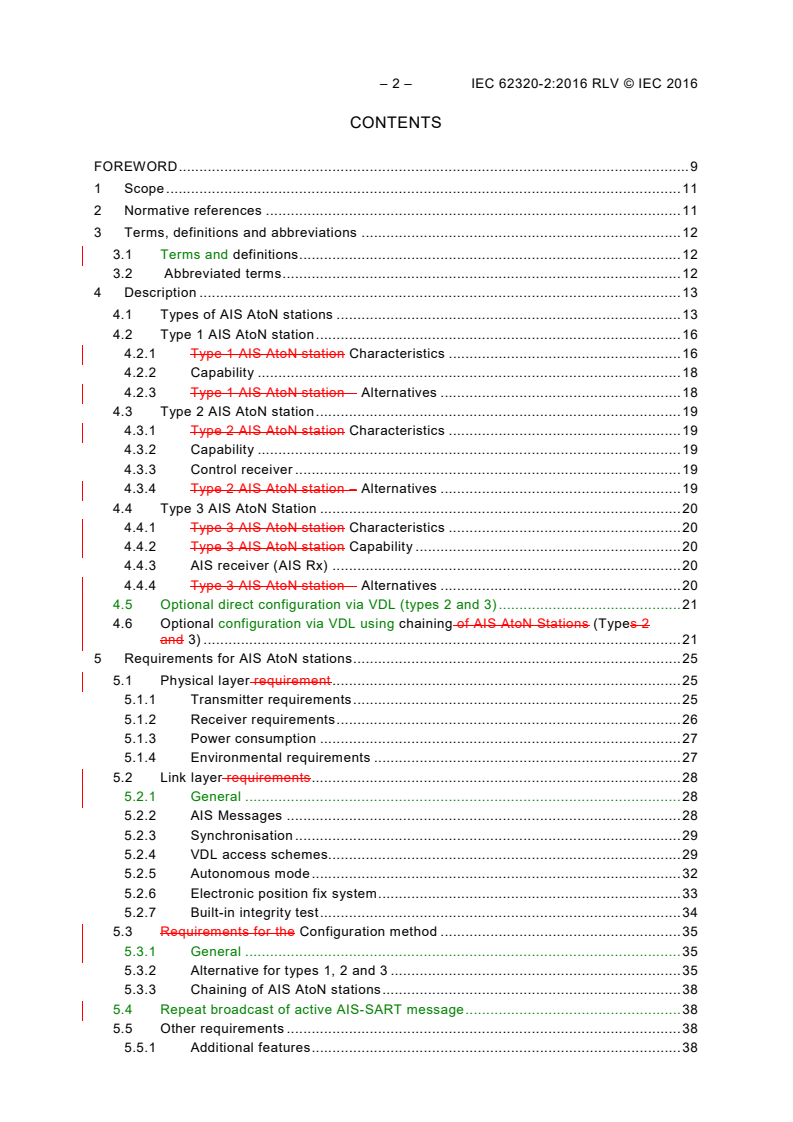
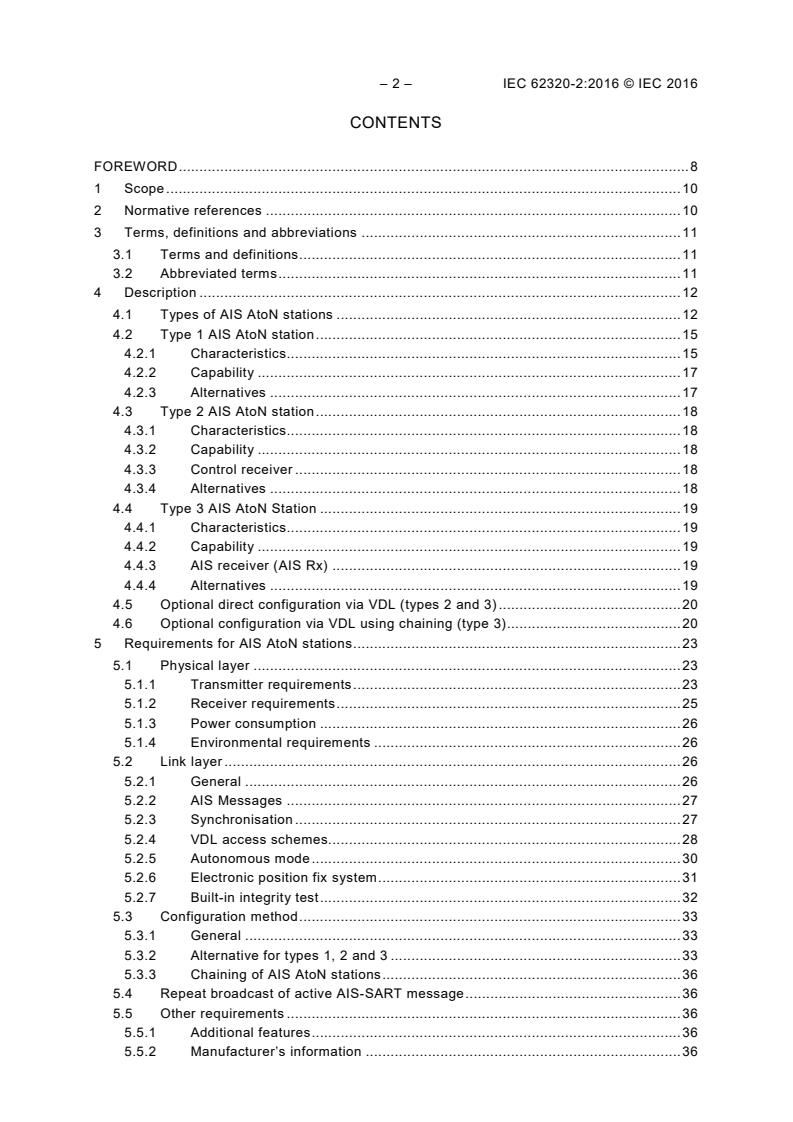
– 2 – IEC 62320-2:2016 © IEC 2016
CONTENTS
FOREWORD . 8
1 Scope . 10
2 Normative references . 10
3 Terms, definitions and abbreviations . 11
3.1 Terms and definitions . 11
3.2 Abbreviated terms . 11
4 Description . 12
4.1 Types of AIS AtoN stations . 12
4.2 Type 1 AIS AtoN station . 15
4.2.1 Characteristics. 15
4.2.2 Capability . 17
4.2.3 Alternatives . 17
4.3 Type 2 AIS AtoN station . 18
4.3.1 Characteristics. 18
4.3.2 Capability . 18
4.3.3 Control receiver . 18
4.3.4 Alternatives . 18
4.4 Type 3 AIS AtoN Station . 19
4.4.1 Characteristics. 19
4.4.2 Capability . 19
4.4.3 AIS receiver (AIS Rx) . 19
4.4.4 Alternatives . 19
4.5 Optional direct configuration via VDL (types 2 and 3) . 20
4.6 Optional configuration via VDL using chaining (type 3) . 20
5 Requirements for AIS AtoN stations . 23
5.1 Physical layer . 23
5.1.1 Transmitter requirements . 23
5.1.2 Receiver requirements . 25
5.1.3 Power consumption . 26
5.1.4 Environmental requirements . 26
5.2 Link layer . 27
5.2.1 General . 27
5.2.2 AIS Messages . 27
5.2.3 Synchronisation . 27
5.2.4 VDL access schemes. 28
5.2.5 Autonomous mode . 30
5.2.6 Electronic position fix system . 31
5.2.7 Built-in integrity test . 32
5.3 Configuration method . 33
5.3.1 General . 33
5.3.2 Alternative for types 1, 2 and 3 . 33
5.3.3 Chaining of AIS AtoN stations . 36
5.4 Repeat broadcast of active AIS-SART message . 36
5.5 Other requirements . 36
5.5.1 Additional features . 36
5.5.2 Manufacturer’s information . 36
5.5.3 Marking and identification . 37
5.5.4 Additional connection points . 37
6 Tests of AIS AtoN stations . 37
6.1 General . 37
6.2 Test conditions . 37
6.2.1 Normal test conditions . 37
6.2.2 Extreme test conditions . 37
6.2.3 Standard test environment . 38
6.2.4 Test signals . 38
6.2.5 Arrangements for test signals applied to the receiver input . 39
6.2.6 Encoder for receiver measurements . 40
6.2.7 Waiver for receivers . 40
6.2.8 Impedance . 40
6.2.9 Artificial antenna (dummy load) . 40
6.2.10 Facilities for access . 40
6.2.11 Modes of operation of the transmitter. 40
6.2.12 Measurement uncertainties . 40
7 RF tests . 41
7.1 TDMA transmitter . 41
7.1.1 General . 41
7.1.2 Frequency error . 41
7.1.3 Carrier power . 42
7.1.4 Modulation spectrum slotted transmission . 42
7.1.5 Transmitter test sequence and modulation accuracy . 43
7.1.6 Transmitter output power versus time function (FATDMA and RATDMA) . 45
7.2 TDMA receivers (types 2 and 3) . 46
7.2.1 Sensitivity . 46
7.2.2 Error behaviour at high input levels. 47
7.2.3 Co-channel rejection . 47
7.2.4 Adjacent channel selectivity . 48
7.2.5 Spurious response rejection . 49
7.2.6 Inter-modulation response rejection . 52
7.2.7 Blocking or desensitization . 53
7.3 Conducted spurious emissions at the antenna . 54
7.3.1 Spurious emissions from the receiver . 54
7.3.2 Spurious emissions from the transmitter . 54
8 Functional tests . 55
8.1 Configuration method . 55
8.1.1 General . 55
8.1.2 Configuration for Message 21 . 55
8.1.3 Schedule mode A FATDMA Message 21 (single report, alternating
channel operation) . 56
8.1.4 Schedule mode B FATDMA Message 21 (dual report, dual channel
operation) . 57
8.1.5 Schedule mode C FATDMA Message 21 (single report, single channel
operation) . 57
8.1.6 Schedule mode A RATDMA Message 21 (Type 3) (single report,
alternating channel operation) . 58
8.1.7 Schedule mode B RATDMA Message 21 (Type 3) (dual report, dual
channel operation) . 59
– 4 – IEC 62320-2:2016 © IEC 2016
8.1.8 Schedule mode C RATDMA Message 21 (type 3) (single channel
operation) . 59
8.1.9 Scheduled transmission of Message 6 . 60
8.1.10 Scheduled transmission of Message 8 . 61
8.1.11 Scheduled transmission of Message 12 . 61
8.1.12 Scheduled transmission of Message 14 . 61
8.1.13 Unscheduled transmission . 62
8.2 Synchronisation accuracy . 62
8.2.1 Implemented synchronisation modes and synchronisation error . 62
8.2.2 Synchronisation test without UTC (types 2 and 3) . 63
8.3 EPFS . 64
8.3.1 Position source . 64
8.3.2 Invalid position . 64
8.3.3 Off-position monitor . 64
8.4 Receive addressed message (types 2 and 3) . 65
8.4.1 Purpose . 65
8.4.2 Method of measurement . 65
8.4.3 Required results . 65
8.5 Interrogation response (Type 3) . 65
8.5.1 Purpose . 65
8.5.2 Method of measurement . 65
8.5.3 Required results . 66
8.6 Repeat AIS-SART messages . 66
8.6.1 Purpose . 66
8.6.2 Method of measurement . 66
8.6.3 Required results . 66
8.7 Additional functionality as implemented by the manufacturer. 66
8.7.1 Test for configuration of the receiver turn-on times (types 2 and 3) . 66
8.7.2 Test for configuration of payload transmission . 67
8.7.3 Test for forced broadcast . 68
8.7.4 Test for version information . 68
8.7.5 Test for DCR – AtoN function ID capability . 69
8.7.6 Test for assigning an encryption key for VDL configuration . 69
8.7.7 Test for VDL configuration using chaining (Type 3) . 70
8.8 BIIT. 75
8.8.1 Purpose . 75
8.8.2 Method of measurement . 75
8.8.3 Required results . 75
8.9 Transmitter shutdown procedure . 75
8.9.1 Purpose . 75
8.9.2 Method of measurement . 75
8.9.3 Required results . 75
8.10 Power supply . 75
8.10.1 Purpose . 75
8.10.2 Method of measurement . 76
8.10.3 Required results . 76
8.11 Environmental . 76
8.12 External removable media . 76
8.12.1 Purpose . 76
8.12.2 Method of measurement . 76
8.12.3 Required results . 76
8.13 Other tests . 76
8.13.1 Quality assurance . 76
8.13.2 Additional features . 76
8.13.3 Manual . 77
8.13.4 Marking and identification . 77
8.14 Optional TAG block encapsulation . 77
8.14.1 Application . 77
8.14.2 TAG block capabilities . 77
8.14.3 Activation of source-identification for output . 77
8.14.4 Activation of Destination-identification . 78
8.14.5 Activation of Source-identification for input . 79
8.14.6 Use of multiple source-identifications for input . 80
8.14.7 Test of grouping by TAG blocks for output . 81
8.14.8 Test of UNIX time output . 82
8.14.9 Test of line-count output . 82
Annex A (informative) AIS AtoN station configuration structures . 84
A.1 AIS AtoN station configuration structures . 84
A.2 MMSI Identification configuration command (AID) . 87
A.3 Extended/general AtoN station configuration command (ACF/ACG) . 89
A.4 Configure broadcast rates for AtoN Station message command (CBR) . 94
A.5 Configuration of encryption key (CEK) . 97
A.6 Configure the receiver turn-on times (ARW) . 98
A.7 Proprietary AtoN control command (MCR). 99
A.8 Configuration of message payload for broadcast (MEB) . 101
A.9 Forced broadcast command (AFB) . 101
A.10 Version information (VER) . 102
A.11 AtoN function ID capability . 104
A.12 Query via the VDL for Message 21 content . 105
A.13 General query request . 106
A.14 Configuration of receiver operational times command (COP) . 107
A.15 Configuration of message payload for broadcast (MEB) . 108
A.16 Query response via the VDL for Message 21 configuration . 110
Annex B (normative) Message 21 – AtoN status bits . 113
Bibliography . 114
Figure 1 – Functional block diagram of a Type 1 AIS AtoN Station . 16
Figure 2 – Functional block diagram of a type 2 AIS AtoN station . 18
Figure 3 – Functional block diagram of a type 3 AIS AtoN station . 19
Figure 4 – VDL configuration decision tree . 22
Figure 5 – Power versus time mask . 29
Figure 6 – Reporting modes for Message 21 . 31
Figure 7 – Block diagram of AIS AtoN test setup . 38
Figure 8 – Format for repeating four-packet cluster . 39
Figure 9 – Measurement arrangement for frequency error . 41
Figure 10 – Measurement arrangement for carrier power . 42
– 6 – IEC 62320-2:2016 © IEC 2016
Figure 11 – Emission mask . 43
Figure 12 – Measurement arrangement for modulation accuracy . 44
Figure 13 – Measurement arrangement for sensitivity . 46
Figure 14 – Measurement arrangement for error behaviour . 47
Figure 15 – Measurement arrangement for co-channel rejection . 48
Figure 16 – Measurement arrangement for adjacent channel selectivity . 49
Figure 17 – PER/BER or SINAD measuring equipment . 50
Figure 18 – Measurement arrangement for inter-modulation . 52
Figure 19 – Measurement arrangement for blocking or desensitisation . 53
Figure 20 – Test scenario for basic chaining test . 70
Figure 21 – Test scenario for linear chaining test . 72
Figure 22 – Test scenario for forked chaining test . 73
Figure B.1 – Use of AtoN status bits as IALA A-126 Page ID 7 . 113
Table 1 – Description of AIS AtoN stations . 13
Table 2 – Use of VDL messages . 14
Table 3 – Summary of optional Type 1 AIS AtoN Station messages . 17
Table 4 – Summary of optional Type 3 AIS AtoN Station messages . 20
Table 5 – Configuration of AIS AtoN stations via VDL . 23
Table 6 – Required parameter settings for an AIS AtoN Station . 24
Table 7 – Required settings of physical layer constants . 24
Table 8 – Modulation parameters of the physical layer of the AIS AtoN station . 24
Table 9 – Minimum required TDMA transmitter characteristics . 25
Table 10 – Required receiver characteristics . 26
Table 11 – Maximum allowed time error . 28
Table 12 – Definitions of timing for Figure 5 . 30
Table 13 – AIS AtoN Station reaction to BIIT conditions . 33
Table 14 – Standard sentences . 34
Table 15 – DCR Capabilities . 35
Table 16 – Optional TAG Block functions . 36
Table 17 – Content of first two packets . 39
Table 18 – Fixed PRS data derived from ITU-T O.153. 39
Table 19 – Maximum values of absolute measurement uncertainties . 41
Table 20 – Peak frequency deviation versus time. 45
Table 21 – Definition of timings . 45
Table 22 – Frequencies for inter-modulation test . 53
Table A.1 – Parameter setting in Message 25 for AIS AtoN Station applications . 84
Table A.2 – Parameter setting in Message 6 for AIS AtoN Station applications . 85
Table A.3 – Message 25 or 6 function identifier used for configuration and query via
the VDL . 86
Table A.4 – Configuration via the VDL for MMSI identification . 88
Table A.5 – Query via the VDL for MMSI identification . 88
Table A.6 – Query response via the VDL for MMSI identification . 89
Table A.7 – Configuration via the VDL, Part 1 . 90
Table A.8 – Configuration via the VDL, Part 2 . 90
Table A.9 – Configuration via the VDL, Part 3 . 91
Table A.10 – Configuration via the VDL, Part 4 (first 12 characters of AtoN name). 91
Table A.11 – Configuration via the VDL, Part 5 (second 12 characters of AtoN name) . 92
Table A.12 – Configuration via the VDL, Part 6 (third (last) 10 characters of AtoN
name) . 92
Table A.13 – Query request via the VDL . 92
Table A.14 – Query response via the VDL, Part 1 . 93
Table A.15 – Query response via the VDL, Part 2 . 94
Table A.16 – Configuration via the VDL for FATDMA . 95
Table A.17 – Configuration via the VDL for RATDMA/CSTDMA . 96
Table A.18 – Query request via the VDL for AtoN broadcast rates . 96
Table A.19 – Query response via the VDL with AtoN broadcast rates . 97
Table A.20 – Configuration via the VDL of encryption key . 98
Table A.21 – Configuration via the VDL for receiver turn-on times . 98
Table A.22 – Query request via the VDL for receiver turn-on times . 99
Table A.23 – Query response via the VDL for receiver turn-on times. 99
Table A.24 – Configuration via the VDL for proprietary information . 100
Table A.25 – Query request via the VDL for proprietary information . 100
Table A.26 – Query response via the VDL for proprietary information . 100
Table A.27 – Configuration or function via the VDL of message payload . 101
Table A.28 – Function via the VDL for forced broadcast . 102
Table A.29 – Query request via the VDL for VER . 103
Table A.30 – Query response via the VDL for VER . 104
Table A.31 – Query request via the VDL for function ID . 104
Table A.32 – Query response via the VDL for function ID . 105
Table A.33 – Query request via the VDL for Message 21 content . 106
Table A.34 – Query response via the VDL for Message 21 content . 106
Table A.35 – General query request via the VDL . 107
Table A.36 – Configuration via the VDL for COP . 108
Table A.37 – Payload control configuration via the VDL . 109
Table A.38 – Payload binary data via the VDL . 110
Table A.39 – Query response via the VDL, Message 21 configuration . 111
Table A.40 – Query response via the VDL, first 12 characters of AtoN name . 111
Table A.41 – Query response via the VDL, second 12 characters of AtoN name . 112
Table A.42 – Query response via the VDL, last 10 characters of AtoN name . 112
Table B.1 – AtoN status pages . 113
– 8 – IEC 62320-2:2016 © IEC 2016
INTERNATIONAL ELECTROTECHNICAL COMMISSION
____________
MARITIME NAVIGATION AND RADIOCOMMUNICATION EQUIPMENT
AND SYSTEMS – AUTOMATIC IDENTIFICATION SYSTEM (AIS) –
Part 2: AIS AtoN Stations – Operational and performance
requirements, methods of testing and required test results
FOREWORD
1) The International Electrotechnical Commission (IEC) is a worldwide organization for standardization comprising
all national electrotechnical committees (IEC National Committees). The object of IEC is to promote
international co-operation on all questions concerning standardization in the electrical and electronic fields. To
this end and in addition to other activities, IEC publishes International Standards, Technical Specifications,
Technical Reports, Publicly Available Specifications (PAS) and Guides (hereafter referred to as “IEC
Publication(s)”). Their preparation is entrusted to technical committees; any IEC National Committee interested
in the subject dealt with may participate in this preparatory work. International, governmental and non-
governmental organizations liaising with the IEC also participate in this preparation. IEC collaborates closely
with the International Organization for Standardization (ISO) in accordance with conditions determined by
agreement between the two organizations.
2) The formal decisions or agreements of IEC on technical matters express, as nearly as possible, an international
consensus of opinion on the relevant subjects since each technical committee has representation from all
interested IEC National Committees.
3) IEC Publications have the form of recommendations for international use and are accepted by IEC National
Committees in that sense. While all reasonable efforts are made to ensure that the technical content of IEC
Publications is accurate, IEC cannot be held responsible for the way in which they are used or for any
misinterpretation by any end user.
4) In order to promote international uniformity, IEC National Committees undertake to apply IEC Publications
transparently to the maximum extent possible in their national and regional publications. Any divergence
between any IEC Publication and the corresponding national or regional publication shall be clearly indicated in
the latter.
5) IEC itself does not provide any attestation of conformity. Independent certification bodies provide conformity
assessment services and, in some areas, access to IEC marks of conformity. IEC is not responsible for any
services carried out by independent certification bodies.
6) All users should ensure that they have the latest edition of this publication.
7) No liability shall attach to IEC or its directors, employees, servants or agents including individual experts and
members of its technical committees and IEC National Committees for any personal injury, property damage or
other damage of any nature whatsoever, whether direct or indirect, or for costs (including legal fees) and
expenses arising out of the publication, use of, or reliance upon, this IEC Publication or any other IEC
Publications.
8) Attention is drawn to the Normative references cited in this publication. Use of the referenced publications is
indispensable for the correct application of this publication.
9) Attention is drawn to the possibility that some of the elements of this IEC Publication may be the subject of
patent rights. IEC shall not be held responsible for identifying any or all such patent rights.
International Standard IEC 62320-2 has been prepared by IEC technical committee 80:
Maritime navigation and radiocommunication equipment and systems.
This second edition cancels and replaces the first edition, published in 2008, and constitutes
a technical revision.
This edition includes the following significant technical changes with respect to the previous
edition:
• additional cyber security measures;
• updated description of configuration via VDL;
• updated VDL access scheme requirements;
• new PI sentences and VDL message structures with added description for optional TAG
blocks;
• added requirement for at least one standard method for configuration using Standard PI
sentences;
• updated test methods and updated Annexes.
The text of this standard is based on the following documents:
FDIS Report on voting
80/817/FDIS 80/822/RVD
Full information on the voting for the approval of this standard can be found in the report on
voting indicated in the above table.
This publication has been drafted in accordance with the ISO/IEC Directives, Part 2.
A list of all parts in the IEC 62320 series, published under the general title Maritime
navigation and radiocommunication equipment and systems – Automatic identification system
(AIS), can be found on the IEC website.
The committee has decided that the contents of this publication will remain unchanged until
the stability date indicated on the IEC web site under "http://webstore.iec.ch" in the data
related to the specific publication. At this date, the publication will be
• reconfirmed,
• withdrawn,
• replaced by a revised edition, or
• amended.
A bilingual version of this publication may be issued at a later date.
IMPORTANT – The 'colour inside' logo on the cover page of this publication indicates
that it contains colours which are considered to be useful for the correct
understanding of its contents. Users should therefore print this document using a
colour printer.
– 10 – IEC 62320-2:2016 © IEC 2016
MARITIME NAVIGATION AND RADIOCOMMUNICATION EQUIPMENT
AND SYSTEMS – AUTOMATIC IDENTIFICATION SYSTEM (AIS) –
Part 2: AIS AtoN Stations – Operational and performance
requirements, methods of testing and required test results
1 Scope
This part of IEC 62320 specifies the operational and performance requirements, methods of
testing and required test results for AIS AtoN Stations compatible with the performance
standards adopted by IMO Resolution MSC.74(69), Annex 3, Universal AIS. It incorporates
the technical characteristics of non-shipborne AIS AtoN equipment, included in
Recommendation ITU-R M.1371 and IALA Recommendation A-126. Where applicable, it also
takes into account the ITU Radio Regulations. This standard takes into account other
associated IEC International Standards and existing national standards, as applicable.
This document is applicable for automatic identification system (AIS) installations on aids to
navigation (AtoN).
2 Normative references
The following referenced documents are indispensable for the application of this document.
For dated references, only the edition cited applies. For undated references, the latest edition
of the referenced document (including any amendments) applies.
IEC 60945, Maritime navigation and radiocommunication equipment and systems – General
requirements – Methods of testing and required test results
IEC 61108 (all parts), Maritime navigation and radiocommunication equipment and systems –
Global navigation satellite systems (GNSS)
IEC 62287-1, Maritime navigation and radiocommunication equipment and systems – Class B
shipborne equipment of the automatic identification system (AIS) – Part 1: Carrier-sense time
division multiple access (CSTDMA) techniques
IEC 62320-3:2015, Maritime navigation and radiocommunication equipment and systems –
Automatic identification systems (AIS) – Part 3: Repeater station – Minimum operational and
performance requirements – Methods of test and required test results
ITU Radio Regulations, Appendix 18, Table of transmitting frequencies in the VHF maritime
mobile band
ITU-R Recommendation M.1371-5:2014, Technical characteristics for an automatic
identification system using time division multiple access in the VHF maritime mobile band
IALA Recommendation A-126, The Use of Automatic Identification System (AIS) in Marine
Aids to Navigation
3 Terms, definitions and abbreviations
3.1 Terms and definitions
For the purposes of this document, the following terms and definitions apply.
3.1.1
aids to navigation
AtoN
device or system external to vessels that is designed and operated to enhance the safe and
efficient navigation of vessels and/or vessel traffic
3.1.2
Message 21
AtoN report transmitted on the VHF data link by an AIS station
3.1.3
real AIS AtoN
AIS AtoN station which is physically located on the aid to navigation
Note 1 to entry: IMO MSC.1/Circ.1473 states that physical AIS AtoN is an AIS Message 21 representing an aid to
navigation that physically exists.
3.1.4
synthetic AIS AtoN
Message 21 transmitted from an AIS station located remotely from the aid to navigation
Note 1 to entry: IMO MSC.1/Circ.1473 states that physical AIS AtoN is an AIS Message 21 representing an aid to
navigation that physically exists.
3.1.5
virtual AIS AtoN
Message 21 transmitted from an AIS station for an aid to navigation which does not physically
exist
3.2 Abbreviated terms
AES Advanced Encryption Standard
AIS automatic identification system
BIIT built-in integrity test
BT bandwidth-time product
CSTDMA carrier sense time division multiple access
DGNSS differ
...
IEC 62320-2 ®
Edition 2.0 2016-10
REDLINE VERSION
INTERNATIONAL
STANDARD
colour
inside
Maritime navigation and radiocommunication equipment and systems –
Automatic identification system (AIS) –
Part 2: AIS AtoN Stations – Operational and performance requirements, methods
of testing and required test results
All rights reserved. Unless otherwise specified, no part of this publication may be reproduced or utilized in any form
or by any means, electronic or mechanical, including photocopying and microfilm, without permission in writing from
either IEC or IEC's member National Committee in the country of the requester. If you have any questions about IEC
copyright or have an enquiry about obtaining additional rights to this publication, please contact the address below or
your local IEC member National Committee for further information.
IEC Central Office Tel.: +41 22 919 02 11
3, rue de Varembé Fax: +41 22 919 03 00
CH-1211 Geneva 20 info@iec.ch
Switzerland www.iec.ch
About the IEC
The International Electrotechnical Commission (IEC) is the leading global organization that prepares and publishes
International Standards for all electrical, electronic and related technologies.
About IEC publications
The technical content of IEC publications is kept under constant review by the IEC. Please make sure that you have the
latest edition, a corrigenda or an amendment might have been published.
IEC Catalogue - webstore.iec.ch/catalogue Electropedia - www.electropedia.org
The stand-alone application for consulting the entire The world's leading online dictionary of electronic and
bibliographical information on IEC International Standards, electrical terms containing 20 000 terms and definitions in
Technical Specifications, Technical Reports and other English and French, with equivalent terms in 15 additional
documents. Available for PC, Mac OS, Android Tablets and languages. Also known as the International Electrotechnical
iPad. Vocabulary (IEV) online.
IEC publications search - www.iec.ch/searchpub IEC Glossary - std.iec.ch/glossary
The advanced search enables to find IEC publications by a 65 000 electrotechnical terminology entries in English and
variety of criteria (reference number, text, technical French extracted from the Terms and Definitions clause of
committee,…). It also gives information on projects, replaced IEC publications issued since 2002. Some entries have been
and withdrawn publications. collected from earlier publications of IEC TC 37, 77, 86 and
CISPR.
IEC Just Published - webstore.iec.ch/justpublished
Stay up to date on all new IEC publications. Just Published IEC Customer Service Centre - webstore.iec.ch/csc
details all new publications released. Available online and If you wish to give us your feedback on this publication or
also once a month by email. need further assistance, please contact the Customer Service
Centre: csc@iec.ch.
IEC 62320-2 ®
Edition 2.0 2016-10
REDLINE VERSION
INTERNATIONAL
STANDARD
colour
inside
Maritime navigation and radiocommunication equipment and systems –
Automatic identification system (AIS) –
Part 2: AIS AtoN Stations – Operational and performance requirements, methods
of testing and required test results
INTERNATIONAL
ELECTROTECHNICAL
COMMISSION
ICS 47.020.70 ISBN 978-2-8322-3735-9
– 2 – IEC 62320-2:2016 RLV © IEC 2016
CONTENTS
FOREWORD . 9
1 Scope . 11
2 Normative references . 11
3 Terms, definitions and abbreviations . 12
3.1 Terms and definitions . 12
3.2 Abbreviated terms . 12
4 Description . 13
4.1 Types of AIS AtoN stations . 13
4.2 Type 1 AIS AtoN station . 16
4.2.1 Type 1 AIS AtoN station Characteristics . 16
4.2.2 Capability . 18
4.2.3 Type 1 AIS AtoN station – Alternatives . 18
4.3 Type 2 AIS AtoN station . 19
4.3.1 Type 2 AIS AtoN station Characteristics . 19
4.3.2 Capability . 19
4.3.3 Control receiver . 19
4.3.4 Type 2 AIS AtoN station – Alternatives . 19
4.4 Type 3 AIS AtoN Station . 20
4.4.1 Type 3 AIS AtoN station Characteristics . 20
4.4.2 Type 3 AIS AtoN station Capability . 20
4.4.3 AIS receiver (AIS Rx) . 20
4.4.4 Type 3 AIS AtoN station – Alternatives . 20
4.5 Optional direct configuration via VDL (types 2 and 3) . 21
4.6 Optional configuration via VDL using chaining of AIS AtoN Stations (Types 2
and 3) . 21
5 Requirements for AIS AtoN stations . 25
5.1 Physical layer requirement . 25
5.1.1 Transmitter requirements . 25
5.1.2 Receiver requirements . 26
5.1.3 Power consumption . 27
5.1.4 Environmental requirements . 27
5.2 Link layer requirements . 28
5.2.1 General . 28
5.2.2 AIS Messages . 28
5.2.3 Synchronisation . 29
5.2.4 VDL access schemes. 29
5.2.5 Autonomous mode . 32
5.2.6 Electronic position fix system . 33
5.2.7 Built-in integrity test . 34
5.3 Requirements for the Configuration method . 35
5.3.1 General . 35
5.3.2 Alternative for types 1, 2 and 3 . 35
5.3.3 Chaining of AIS AtoN stations . 38
5.4 Repeat broadcast of active AIS-SART message . 38
5.5 Other requirements . 38
5.5.1 Additional features . 38
5.5.2 Manufacturer’s information . 38
5.5.3 Marking and identification . 39
5.5.4 Additional connection points . 39
6 Tests of AIS AtoN stations – Method of measurement and required results. 39
6.1 General . 39
6.2 Test conditions . 39
6.2.1 Normal test conditions . 39
6.2.2 Extreme test conditions . 39
6.2.3 Standard test environment . 40
6.2.4 Test signals . 40
6.2.5 Arrangements for test signals applied to the receiver input . 42
6.2.6 Encoder for receiver measurements . 42
6.2.7 Waiver for receivers . 42
6.2.8 Impedance . 42
6.2.9 Artificial antenna (dummy load) . 42
6.2.10 Facilities for access . 42
6.2.11 Modes of operation of the transmitter. 42
6.2.12 Measurement uncertainties . 43
7 AIS AtoN Station RF tests . 43
7.1 RF tests (transmitter and receiver) TDMA transmitter . 43
7.1.1 General . 43
7.1.2 Frequency error . 43
7.1.3 Carrier power . 44
7.1.4 Modulation spectrum slotted transmission . 45
7.1.5 Transmitter test sequence and modulation accuracy . 46
7.1.6 Transmitter output power versus time function (FATDMA and RATDMA) . 47
7.2 TDMA receivers (types 2 and 3) . 48
7.2.1 Sensitivity . 48
7.2.2 Error behaviour at high input levels. 49
7.2.3 Co-channel rejection . 50
7.2.4 Adjacent channel selectivity . 51
7.2.5 Spurious response rejection . 52
7.2.6 Inter-modulation response rejection . 54
7.2.7 Blocking or desensitization . 56
7.3 Conducted spurious emissions at the antenna . 57
7.3.1 Spurious emissions from the receiver . 57
7.3.2 Spurious emissions from the transmitter . 57
8 Functional tests . 58
8.1 Tests for Configuration method . 58
8.1.1 General . 58
8.1.2 Configure test Configuration for Message 21 . 58
8.1.3 Schedule mode A FATDMA Message 21 (single report, alternating
channel operation) . 59
8.1.4 Schedule mode B FATDMA Message 21 (dual report, dual channel
operation) . 60
8.1.5 Schedule mode C FATDMA Message 21 (single report, single channel
operation) . 60
8.1.6 Schedule mode A RATDMA Message 21 (Type 3) (single report,
alternating channel operation) . 61
– 4 – IEC 62320-2:2016 RLV © IEC 2016
8.1.7 Schedule mode B RATDMA Message 21 (Type 3) (dual report, dual
channel operation) . 62
8.1.8 Schedule mode C RATDMA Message 21 (type 3) (single channel
operation) . 62
8.1.9 Addressed binary data Scheduled transmission of Message 6 . 63
8.1.10 Test Scheduled transmission of Message 8 . 64
8.1.11 AIS AtoN configuration Scheduled transmission of Messages 12 . 64
8.1.12 AIS AtoN configuration Scheduled transmission of Messages 14 . 64
8.1.13 Unscheduled transmission . 64
8.2 Synchronisation accuracy . 65
8.2.1 Implemented synchronisation modes and synchronisation error . 65
8.2.2 Synchronisation test without UTC (types 2 and 3) . 66
8.3 Tests for EPFS . 67
8.3.1 Position source . 67
8.3.2 Invalid position . 67
8.3.3 Off-position monitor . 67
8.4 Additional Receive addressed messages (types 2 and 3) . 68
8.4.1 Purpose . 68
8.4.2 Method of measurement . 68
8.4.3 Required results . 68
8.5 Interrogation response (Type 3) . 68
8.5.1 Purpose . 68
8.5.2 Method of measurement . 68
8.5.3 Required results . 69
8.6 Repeat AIS-SART messages . 69
8.6.1 Purpose . 69
8.6.2 Method of measurement . 69
8.6.3 Required results . 69
8.7 Additional functionality as implemented by the manufacturer. 69
8.7.1 Test for configuration of the receiver turn-on times (types 2 and 3) . 69
8.5.2 Test for configure proprietary AtoN control .
8.5.3 Test for configuration of payload re-broadcast .
8.7.2 Test for configuration of payload transmission . 72
8.7.3 Test for forced broadcast . 72
8.7.4 Test for version information . 73
8.7.5 Test for AFC DCR – AtoN function ID capability . 73
8.7.6 Test for assigning an encryption key for VDL configuration . 73
8.7.7 Test for VDL configuration using chaining (Types 2 and 3) . 74
8.8 Test for BIIT . 80
8.8.1 Purpose . 80
8.8.2 Method of measurement . 81
8.8.3 Required results . 81
8.9 Transmitter shutdown procedure . 81
8.9.1 Purpose . 81
8.9.2 Method of measurement . 81
8.9.3 Required results . 81
8.10 Test for Power supply . 81
8.8.1 Average power consumption .
8.10.1 Purpose . 81
8.10.2 Method of measurement . 82
8.10.3 Required results . 82
8.11 Environmental tests . 82
8.12 External removable media . 82
8.12.1 Purpose . 82
8.12.2 Method of measurement . 82
8.12.3 Required results . 82
8.13 Other tests . 82
8.13.1 Quality assurance . 82
8.13.2 Additional features . 82
8.13.3 Manual . 83
8.13.4 Marking and identification . 83
8.14 Optional TAG block encapsulation . 83
8.14.1 Application . 83
8.14.2 TAG block capabilities . 83
8.14.3 Activation of source-identification for output . 83
8.14.4 Activation of Destination-identification . 84
8.14.5 Activation of Source-identification for input . 85
8.14.6 Use of multiple source-identifications for input . 86
8.14.7 Test of grouping by TAG blocks for output . 87
8.14.8 Test of UNIX time output . 88
8.14.9 Test of line-count output . 88
Annex A (informative) Proposed additional IEC 61162 AIS AtoN Station sentences .
Annex A (informative) AIS AtoN station configuration structures . 100
A.1 AIS AtoN station configuration structures . 100
A.2 MMSI Identification configuration for command (AID) . 102
A.3 Extended/general AtoN station configuration command (ACE/ACF/ACG) . 104
A.4 Configure broadcast rates for AtoN Station message command (CBR) . 109
A.5 AKE – Configuration of encryption key (CEK) . 112
A.6 Configure the receiver turn-on times command (ARW) . 112
A.7 Configure Proprietary AtoN control command (MCR) . 114
A.8 MPR – Configuration of message payload rebroadcast command for
broadcast (MEB) . 115
A.9 Forced broadcast command (AFB) . 116
A.10 Version information (VER) . 117
A.11 AFC – AtoN function ID capability . 118
A.12 Query via the VDL for ACE and ACF Message 21 content . 119
A.13 General query request . 121
A.14 Configuration of receiver operational times command (COP) . 122
A.15 Configuration of message payload for broadcast (MEB) . 123
A.16 Query response via the VDL for Message 21 configuration . 124
Annex B (normative) Message 21 – AtoN status bits . 128
Bibliography . 130
Figure 1 – Functional block diagram of a Type 1 AIS AtoN Station . 17
Figure 2 – Functional block diagram of a type 2 AIS AtoN station . 19
Figure 3 – Functional block diagram of a type 3 AIS AtoN station . 20
Figure 4 – VDL configuration decision tree . 23
– 6 – IEC 62320-2:2016 RLV © IEC 2016
Figure 5 – Power versus time mask . 31
Figure 6 – Reporting modes for Message 21 . 33
Figure 7 – Block diagram of AIS AtoN test setup . 40
Figure 8 – Format for repeating four-packet cluster . 41
Figure 9 – Measurement arrangement for frequency error . 44
Figure 10 – Measurement arrangement for carrier power . 44
Figure 11 – Emission mask . 45
Figure 12 – Power versus time mask .
Figure 12 – Measurement arrangement for modulation accuracy . 46
Figure 13 – Measurement arrangement for sensitivity . 49
Figure 14 – Measurement arrangement for error behaviour . 50
Figure 15 – Measurement arrangement for co-channel rejection . 50
Figure 16 – Measurement arrangement with messages for adjacent channel selectivity . 51
Figure 17 – PER/BER or SINAD measuring equipment . 53
Figure 18 – Measurement arrangement for inter-modulation . 55
Figure 19 – Measurement arrangement for blocking or desensitisation . 56
Figure 20 – Test scenario for basic chaining test . 76
Figure 21 – Test scenario for linear chaining test . 78
Figure 22 – Test scenario for forked chaining test . 79
Figure B.1 – Use of AtoN status bits as IALA A-126 Page ID 7 . 128
Table 1 – Description of AIS AtoN Stations . 14
Table 2 – Use of VDL messages . 15
Table 3 – Summary of optional Type 1 AIS AtoN Station messages . 18
Table 4 – Chaining of AIS AtoN Stations .
Table 4 – Summary of optional Type 3 AIS AtoN Station messages . 21
Table 5 – Configuration of AIS AtoN stations via VDL . 24
Table 6 – Required parameter settings for an AIS AtoN Station . 25
Table 7 – Required settings of physical layer constants . 25
Table 8 – Modulation parameters of the physical layer of the AIS AtoN station . 26
Table 9 – Minimum required TDMA transmitter characteristics . 26
Table 10 – Required receiver characteristics . 27
Table 11 – Maximum allowed time error . 29
Table 12 – Definitions of timing for Figure 5 . 31
Table 13 – AIS AtoN Station reaction to BIIT conditions . 34
Table 14 – Standard sentences . 36
Table 15 – DCR Capabilities . 37
Table 16 – Optional TAG Block functions . 38
Table 17 – Content of first two packets . 41
Table 18 – Fixed PRS data derived from ITU-T O.153. 41
Table 19 – Maximum values of absolute measurement uncertainties . 43
Table 20 – Peak frequency deviation versus time. 47
Table 21 – Definition of timings for Figure 21 . 48
Table 22 – Frequencies for inter-modulation test . 55
Table A.1 – Parameter setting in Message 25 for AIS AtoN Station applications . 100
Table A.2 – Parameter setting in Message 6 for AIS AtoN Station applications . 100
Table A.3 – Message 25 or 6 function identifier used for configuration and query via
the VDL . 101
Table A.4 – Configuration via the VDL for AID MMSI identification . 103
Table A.5 – Query via the VDL for AID MMSI identification . 103
Table A.6 – Query response via the VDL for AID MMSI identification . 104
Table A.7 – Configuration via the VDL for ACE and ACF, Part 1 . 105
Table A.8 – Configuration via the VDL for ACE and ACF, Part 2 . 105
Table A.9 – Configuration via the VDL for ACE and ACF, Part 3 . 106
Table A.10 – Configuration via the VDL for ACE and ACF, Part 4 (first 12 characters of
AtoN name) . 106
Table A.11 – Configuration via the VDL for ACE and ACF, Part 5 (second 12
characters of AtoN name) . 107
Table A.12 – Configuration via the VDL for ACE and ACF, Part 6 (third (last) 10
characters of AtoN name) . 107
Table A.13 – Query request via the VDL for ACE/ACF content . 107
Table A.14 – Query response via the VDL for ACE and ACF, Part 1 . 108
Table A.15 – Query response via the VDL for ACE and ACF, Part 2 . 108
Table A.16 – Configuration via the VDL for FATDMA/CSTDMA . 109
Table A.17 – Configuration via the VDL for AAR for RATDMA/CSTDMA . 110
Table A.18 – Query request via the VDL for AAR for AtoN broadcast rates . 111
Table A.19 – Query response via the VDL for AAR with AtoN broadcast rates . 111
Table A.20 – Configuration via the VDL for AKE of encryption key . 112
Table A.21 – Configuration via the VDL for ARW receiver turn-on times . 113
Table A.22 – Query request via the VDL for ARW receiver turn-on times . 113
Table A.23 – Query response via the VDL for ARW receiver turn-on times . 114
Table A.24 – Configuration via the VDL for MCR proprietary information . 114
Table A.25 – Query request via the VDL for MCR proprietary information . 115
Table A.26 – Query response via the VDL for MCR proprietary information . 115
Table A.27 – Configuration or function via the VDL for MPR of message payload . 116
Table A.28 – Function via the VDL for PBR forced broadcast . 116
Table A.29 – Query request via the VDL for VER . 117
Table A.30 – Query response via the VDL for VER . 118
Table A.31 – Query request via the VDL for AFC function ID . 118
Table A.32 – Query response via the VDL for AFC function ID . 119
Table A.33 – Query request via the VDL for Message 21 content . 120
Table A.34 – Query response via the VDL for Message 21 content . 121
Table A.35 – General query request via the VDL . 121
Table A.36 – Configuration via the VDL for COP . 122
Table A.37 – Payload control configuration via the VDL . 123
Table A.38 – Payload binary data via the VDL . 123
Table A.39 – Query response via the VDL, Message 21 configuration . 124
– 8 – IEC 62320-2:2016 RLV © IEC 2016
Table A.40 – Query response via the VDL, first 12 characters of AtoN name . 125
Table A.41 – Query response via the VDL, second 12 characters of AtoN name . 125
Table A.42 – Query response via the VDL, last 10 characters of AtoN name . 125
Table B.1 – AtoN status pages . 128
INTERNATIONAL ELECTROTECHNICAL COMMISSION
____________
MARITIME NAVIGATION AND RADIOCOMMUNICATION EQUIPMENT
AND SYSTEMS – AUTOMATIC IDENTIFICATION SYSTEM (AIS) –
Part 2: AIS AtoN Stations – Operational and performance
requirements, methods of testing and required test results
FOREWORD
1) The International Electrotechnical Commission (IEC) is a worldwide organization for standardization comprising
all national electrotechnical committees (IEC National Committees). The object of IEC is to promote
international co-operation on all questions concerning standardization in the electrical and electronic fields. To
this end and in addition to other activities, IEC publishes International Standards, Technical Specifications,
Technical Reports, Publicly Available Specifications (PAS) and Guides (hereafter referred to as “IEC
Publication(s)”). Their preparation is entrusted to technical committees; any IEC National Committee interested
in the subject dealt with may participate in this preparatory work. International, governmental and non-
governmental organizations liaising with the IEC also participate in this preparation. IEC collaborates closely
with the International Organization for Standardization (ISO) in accordance with conditions determined by
agreement between the two organizations.
2) The formal decisions or agreements of IEC on technical matters express, as nearly as possible, an international
consensus of opinion on the relevant subjects since each technical committee has representation from all
interested IEC National Committees.
3) IEC Publications have the form of recommendations for international use and are accepted by IEC National
Committees in that sense. While all reasonable efforts are made to ensure that the technical content of IEC
Publications is accurate, IEC cannot be held responsible for the way in which they are used or for any
misinterpretation by any end user.
4) In order to promote international uniformity, IEC National Committees undertake to apply IEC Publications
transparently to the maximum extent possible in their national and regional publications. Any divergence
between any IEC Publication and the corresponding national or regional publication shall be clearly indicated in
the latter.
5) IEC itself does not provide any attestation of conformity. Independent certification bodies provide conformity
assessment services and, in some areas, access to IEC marks of conformity. IEC is not responsible for any
services carried out by independent certification bodies.
6) All users should ensure that they have the latest edition of this publication.
7) No liability shall attach to IEC or its directors, employees, servants or agents including individual experts and
members of its technical committees and IEC National Committees for any personal injury, property damage or
other damage of any nature whatsoever, whether direct or indirect, or for costs (including legal fees) and
expenses arising out of the publication, use of, or reliance upon, this IEC Publication or any other IEC
Publications.
8) Attention is drawn to the Normative references cited in this publication. Use of the referenced publications is
indispensable for the correct application of this publication.
9) Attention is drawn to the possibility that some of the elements of this IEC Publication may be the subject of
patent rights. IEC shall not be held responsible for identifying any or all such patent rights.
This redline version of the official IEC Standard allows the user to identify the changes
made to the previous edition. A vertical bar appears in the margin wherever a change
has been made. Additions are in green text, deletions are in strikethrough red text.
– 10 – IEC 62320-2:2016 RLV © IEC 2016
International Standard IEC 62320-2 has been prepared by IEC technical committee 80:
Maritime navigation and radiocommunication equipment and systems.
This second edition cancels and replaces the first edition, published in 2008, and constitutes
a technical revision.
This edition includes the following significant technical changes with respect to the previous
edition:
• additional cyber security measures;
• updated description of configuration via VDL;
• updated VDL access scheme requirements;
• new PI sentences and VDL message structures with added description for optional TAG
blocks;
• added requirement for at least one standard method for configuration using Standard PI
sentences;
• updated test methods and updated Annexes.
The text of this standard is based on the following documents:
FDIS Report on voting
80/817/FDIS 80/822/RVD
Full information on the voting for the approval of this standard can be found in the report on
voting indicated in the above table.
This publication has been drafted in accordance with the ISO/IEC Directives, Part 2.
A list of all parts in the IEC 62320 series, published under the general title Maritime
navigation and radiocommunication equipment and systems – Automatic identification system
(AIS), can be found on the IEC website.
The committee has decided that the contents of this publication will remain unchanged until
the stability date indicated on the IEC web site under "http://webstore.iec.ch" in the data
related to the specific publication. At this date, the publication will be
• reconfirmed,
• withdrawn,
• replaced by a revised edition, or
• amended.
A bilingual version of this publication may be issued at a later date.
IMPORTANT – The 'colour inside' logo on the cover page of this publication indicates
that it contains colours which are considered to be useful for the correct
understanding of its contents. Users should therefore print this document using a
colour printer.
MARITIME NAVIGATION AND RADIOCOMMUNICATION EQUIPMENT
AND SYSTEMS – AUTOMATIC IDENTIFICATION SYSTEM (AIS) –
Part 2: AIS AtoN Stations – Operational and performance
requirements, methods of testing and required test results
1 Scope
This part of IEC 62320 specifies the operational and performance requirements, methods of
testing and required test results for AIS AtoN Stations compatible with the performance
standards adopted by IMO Resolution MSC.74(69), Annex 3, Universal AIS. It incorporates
the technical characteristics of non-shipborne AIS AtoN equipment, included in
Recommendation ITU-R M.1371 and IALA Recommendation A-126. Where applicable, it also
takes into account the ITU Radio Regulations. This standard takes into account other
associated IEC International Standards and existing national standards, as applicable.
This document is applicable for automatic identification system (AIS) installations on aids to
navigation (AtoN).
2 Normative references
The following referenced documents are indispensable for the application of this document.
For dated references, only the edition cited applies. For undated references, the latest edition
of the referenced document (including any amendments) applies.
IEC 60945, Maritime navigation and radiocommunication equipment and systems – General
requirements – Methods of testing and required test results
IEC 61108 (all parts), Maritime navigation and radiocommunication equipment and systems –
Global navigation satellite systems (GNSS)
IEC 61108-1, Maritime navigation and radiocommunication equipment and systems – Global
navigation satellite systems (GNSS) – Part 1: Global positioning system (GPS) – Receiver
equipment – Performance standards, methods of testing and required test results
IEC 61108-2, Maritime navigation and radiocommunication equipment and systems – Global
navigation satellite systems (GNSS) – Part 2: Global navigation satellite system (GLONASS)
– Receiver equipment – Performance standards, methods of testing and required test results
IEC 61108-4, Maritime navigation and radiocommunication equipment and systems – Global
navigation satellite systems (GNSS) – Part 4: Shipborne DGPS and DGLONASS maritime
radio beacon receiver equipment – Performance requirements, methods of testing and
required results
IEC 61162-1, Maritime navigation and radiocommunication equipment and systems – Digital
interfaces – Part 1: Single talker and multiple listeners
IEC 62287-1, Maritime navigation and radiocommunication equipment and systems – Class B
shipborne equipment of the automatic identification system (AIS) – Part 1: Carrier-sense time
division multiple access (CSTDMA) techniques
-------------------
...
IEC 62320-2 ®
Edition 2.0 2016-10
INTERNATIONAL
STANDARD
NORME
INTERNATIONALE
colour
inside
Maritime navigation and radiocommunication equipment and systems –
Automatic identification system (AIS) –
Part 2: AIS AtoN Stations – Operational and performance requirements, methods
of testing and required test results
Matériels et systèmes de navigation et de radiocommunication maritimes –
Système d'identification automatique (AIS) –
Partie 2: Stations d'aides à la navigation AIS – Exigences opérationnelles et de
fonctionnement, méthodes d'essai et résultats d'essai exigés
All rights reserved. Unless otherwise specified, no part of this publication may be reproduced or utilized in any form
or by any means, electronic or mechanical, including photocopying and microfilm, without permission in writing from
either IEC or IEC's member National Committee in the country of the requester. If you have any questions about IEC
copyright or have an enquiry about obtaining additional rights to this publication, please contact the address below or
your local IEC member National Committee for further information.
Droits de reproduction réservés. Sauf indication contraire, aucune partie de cette publication ne peut être reproduite
ni utilisée sous quelque forme que ce soit et par aucun procédé, électronique ou mécanique, y compris la photocopie
et les microfilms, sans l'accord écrit de l'IEC ou du Comité national de l'IEC du pays du demandeur. Si vous avez des
questions sur le copyright de l'IEC ou si vous désirez obtenir des droits supplémentaires sur cette publication, utilisez
les coordonnées ci-après ou contactez le Comité national de l'IEC de votre pays de résidence.
IEC Central Office Tel.: +41 22 919 02 11
3, rue de Varembé info@iec.ch
CH-1211 Geneva 20 www.iec.ch
Switzerland
About the IEC
The International Electrotechnical Commission (IEC) is the leading global organization that prepares and publishes
International Standards for all electrical, electronic and related technologies.
About IEC publications
The technical content of IEC publications is kept under constant review by the IEC. Please make sure that you have the
latest edition, a corrigenda or an amendment might have been published.
IEC Catalogue - webstore.iec.ch/catalogue Electropedia - www.electropedia.org
The stand-alone application for consulting the entire The world's leading online dictionary of electronic and
bibliographical information on IEC International Standards, electrical terms containing 21 000 terms and definitions in
Technical Specifications, Technical Reports and other English and French, with equivalent terms in 16 additional
documents. Available for PC, Mac OS, Android Tablets and languages. Also known as the International Electrotechnical
iPad. Vocabulary (IEV) online.
IEC publications search - webstore.iec.ch/advsearchform IEC Glossary - std.iec.ch/glossary
The advanced search enables to find IEC publications by a 67 000 electrotechnical terminology entries in English and
variety of criteria (reference number, text, technical French extracted from the Terms and Definitions clause of
committee,…). It also gives information on projects, replaced IEC publications issued since 2002. Some entries have been
and withdrawn publications. collected from earlier publications of IEC TC 37, 77, 86 and
CISPR.
IEC Just Published - webstore.iec.ch/justpublished
Stay up to date on all new IEC publications. Just Published IEC Customer Service Centre - webstore.iec.ch/csc
details all new publications released. Available online and If you wish to give us your feedback on this publication or
also once a month by email. need further assistance, please contact the Customer Service
Centre: sales@iec.ch.
A propos de l'IEC
La Commission Electrotechnique Internationale (IEC) est la première organisation mondiale qui élabore et publie des
Normes internationales pour tout ce qui a trait à l'électricité, à l'électronique et aux technologies apparentées.
A propos des publications IEC
Le contenu technique des publications IEC est constamment revu. Veuillez vous assurer que vous possédez l’édition la
plus récente, un corrigendum ou amendement peut avoir été publié.
Catalogue IEC - webstore.iec.ch/catalogue Electropedia - www.electropedia.org
Application autonome pour consulter tous les renseignements
Le premier dictionnaire en ligne de termes électroniques et
bibliographiques sur les Normes internationales,
électriques. Il contient 21 000 termes et définitions en anglais
Spécifications techniques, Rapports techniques et autres
et en français, ainsi que les termes équivalents dans 16
documents de l'IEC. Disponible pour PC, Mac OS, tablettes
langues additionnelles. Egalement appelé Vocabulaire
Android et iPad.
Electrotechnique International (IEV) en ligne.
Recherche de publications IEC -
Glossaire IEC - std.iec.ch/glossary
webstore.iec.ch/advsearchform
67 000 entrées terminologiques électrotechniques, en anglais
La recherche avancée permet de trouver des publications IEC et en français, extraites des articles Termes et Définitions des
en utilisant différents critères (numéro de référence, texte, publications IEC parues depuis 2002. Plus certaines entrées
comité d’études,…). Elle donne aussi des informations sur les antérieures extraites des publications des CE 37, 77, 86 et
projets et les publications remplacées ou retirées. CISPR de l'IEC.
IEC Just Published - webstore.iec.ch/justpublished Service Clients - webstore.iec.ch/csc
Restez informé sur les nouvelles publications IEC. Just Si vous désirez nous donner des commentaires sur cette
Published détaille les nouvelles publications parues. publication ou si vous avez des questions contactez-nous:
Disponible en ligne et aussi une fois par mois par email. sales@iec.ch.
IEC 62320-2 ®
Edition 2.0 2016-10
INTERNATIONAL
STANDARD
NORME
INTERNATIONALE
colour
inside
Maritime navigation and radiocommunication equipment and systems –
Automatic identification system (AIS) –
Part 2: AIS AtoN Stations – Operational and performance requirements,
methods of testing and required test results
Matériels et systèmes de navigation et de radiocommunication maritimes –
Système d'identification automatique (AIS) –
Partie 2: Stations d'aides à la navigation AIS – Exigences opérationnelles et de
fonctionnement, méthodes d'essai et résultats d'essai exigés
INTERNATIONAL
ELECTROTECHNICAL
COMMISSION
COMMISSION
ELECTROTECHNIQUE
INTERNATIONALE
ICS 47.020.70 ISBN 978-2-8322-5229-1
– 2 – IEC 62320-2:2016 © IEC 2016
CONTENTS
FOREWORD . 8
1 Scope . 10
2 Normative references . 10
3 Terms, definitions and abbreviations . 11
3.1 Terms and definitions . 11
3.2 Abbreviated terms . 11
4 Description . 12
4.1 Types of AIS AtoN stations . 12
4.2 Type 1 AIS AtoN station . 15
4.2.1 Characteristics. 15
4.2.2 Capability . 17
4.2.3 Alternatives . 17
4.3 Type 2 AIS AtoN station . 18
4.3.1 Characteristics. 18
4.3.2 Capability . 18
4.3.3 Control receiver . 18
4.3.4 Alternatives . 18
4.4 Type 3 AIS AtoN Station . 19
4.4.1 Characteristics. 19
4.4.2 Capability . 19
4.4.3 AIS receiver (AIS Rx) . 19
4.4.4 Alternatives . 19
4.5 Optional direct configuration via VDL (types 2 and 3) . 20
4.6 Optional configuration via VDL using chaining (type 3) . 20
5 Requirements for AIS AtoN stations . 23
5.1 Physical layer . 23
5.1.1 Transmitter requirements . 23
5.1.2 Receiver requirements . 25
5.1.3 Power consumption . 26
5.1.4 Environmental requirements . 26
5.2 Link layer . 26
5.2.1 General . 26
5.2.2 AIS Messages . 27
5.2.3 Synchronisation . 27
5.2.4 VDL access schemes. 28
5.2.5 Autonomous mode . 30
5.2.6 Electronic position fix system . 31
5.2.7 Built-in integrity test . 32
5.3 Configuration method . 33
5.3.1 General . 33
5.3.2 Alternative for types 1, 2 and 3 . 33
5.3.3 Chaining of AIS AtoN stations . 36
5.4 Repeat broadcast of active AIS-SART message . 36
5.5 Other requirements . 36
5.5.1 Additional features . 36
5.5.2 Manufacturer’s information . 36
5.5.3 Marking and identification . 37
5.5.4 Additional connection points . 37
6 Tests of AIS AtoN stations . 37
6.1 General . 37
6.2 Test conditions . 37
6.2.1 Normal test conditions . 37
6.2.2 Extreme test conditions . 37
6.2.3 Standard test environment . 38
6.2.4 Test signals . 38
6.2.5 Arrangements for test signals applied to the receiver input . 39
6.2.6 Encoder for receiver measurements . 40
6.2.7 Waiver for receivers . 40
6.2.8 Impedance . 40
6.2.9 Artificial antenna (dummy load) . 40
6.2.10 Facilities for access . 40
6.2.11 Modes of operation of the transmitter. 40
6.2.12 Measurement uncertainties . 40
7 RF tests . 41
7.1 TDMA transmitter . 41
7.1.1 General . 41
7.1.2 Frequency error . 41
7.1.3 Carrier power . 42
7.1.4 Modulation spectrum slotted transmission . 42
7.1.5 Transmitter test sequence and modulation accuracy . 43
7.1.6 Transmitter output power versus time function (FATDMA and RATDMA) . 45
7.2 TDMA receivers (types 2 and 3) . 46
7.2.1 Sensitivity . 46
7.2.2 Error behaviour at high input levels. 47
7.2.3 Co-channel rejection . 47
7.2.4 Adjacent channel selectivity . 48
7.2.5 Spurious response rejection . 49
7.2.6 Inter-modulation response rejection . 52
7.2.7 Blocking or desensitization . 53
7.3 Conducted spurious emissions at the antenna . 54
7.3.1 Spurious emissions from the receiver . 54
7.3.2 Spurious emissions from the transmitter . 54
8 Functional tests . 55
8.1 Configuration method . 55
8.1.1 General . 55
8.1.2 Configuration for Message 21 . 55
8.1.3 Schedule mode A FATDMA Message 21 (single report, alternating
channel operation) . 56
8.1.4 Schedule mode B FATDMA Message 21 (dual report, dual channel
operation) . 57
8.1.5 Schedule mode C FATDMA Message 21 (single report, single channel
operation) . 57
8.1.6 Schedule mode A RATDMA Message 21 (Type 3) (single report,
alternating channel operation) . 58
8.1.7 Schedule mode B RATDMA Message 21 (Type 3) (dual report, dual
channel operation) . 59
– 4 – IEC 62320-2:2016 © IEC 2016
8.1.8 Schedule mode C RATDMA Message 21 (type 3) (single channel
operation) . 59
8.1.9 Scheduled transmission of Message 6 . 60
8.1.10 Scheduled transmission of Message 8 . 61
8.1.11 Scheduled transmission of Message 12 . 61
8.1.12 Scheduled transmission of Message 14 . 61
8.1.13 Unscheduled transmission . 62
8.2 Synchronisation accuracy . 62
8.2.1 Implemented synchronisation modes and synchronisation error . 62
8.2.2 Synchronisation test without UTC (types 2 and 3) . 63
8.3 EPFS . 64
8.3.1 Position source . 64
8.3.2 Invalid position . 64
8.3.3 Off-position monitor . 64
8.4 Receive addressed message (types 2 and 3) . 65
8.4.1 Purpose . 65
8.4.2 Method of measurement . 65
8.4.3 Required results . 65
8.5 Interrogation response (Type 3) . 65
8.5.1 Purpose . 65
8.5.2 Method of measurement . 65
8.5.3 Required results . 66
8.6 Repeat AIS-SART messages . 66
8.6.1 Purpose . 66
8.6.2 Method of measurement . 66
8.6.3 Required results . 66
8.7 Additional functionality as implemented by the manufacturer. 66
8.7.1 Test for configuration of the receiver turn-on times (types 2 and 3) . 66
8.7.2 Test for configuration of payload transmission . 67
8.7.3 Test for forced broadcast . 68
8.7.4 Test for version information . 68
8.7.5 Test for DCR – AtoN function ID capability . 69
8.7.6 Test for assigning an encryption key for VDL configuration . 69
8.7.7 Test for VDL configuration using chaining (Type 3) . 70
8.8 BIIT. 75
8.8.1 Purpose . 75
8.8.2 Method of measurement . 75
8.8.3 Required results . 75
8.9 Transmitter shutdown procedure . 75
8.9.1 Purpose . 75
8.9.2 Method of measurement . 75
8.9.3 Required results . 75
8.10 Power supply . 75
8.10.1 Purpose . 75
8.10.2 Method of measurement . 76
8.10.3 Required results . 76
8.11 Environmental . 76
8.12 External removable media . 76
8.12.1 Purpose . 76
8.12.2 Method of measurement . 76
8.12.3 Required results . 76
8.13 Other tests . 76
8.13.1 Quality assurance . 76
8.13.2 Additional features . 76
8.13.3 Manual . 77
8.13.4 Marking and identification . 77
8.14 Optional TAG block encapsulation . 77
8.14.1 Application . 77
8.14.2 TAG block capabilities . 77
8.14.3 Activation of source-identification for output . 77
8.14.4 Activation of Destination-identification . 78
8.14.5 Activation of Source-identification for input . 79
8.14.6 Use of multiple source-identifications for input . 80
8.14.7 Test of grouping by TAG blocks for output . 81
8.14.8 Test of UNIX time output . 82
8.14.9 Test of line-count output . 82
Annex A (informative) AIS AtoN station configuration structures . 84
A.1 AIS AtoN station configuration structures . 84
A.2 MMSI Identification configuration command (AID) . 87
A.3 Extended/general AtoN station configuration command (ACF/ACG) . 89
A.4 Configure broadcast rates for AtoN Station message command (CBR) . 94
A.5 Configuration of encryption key (CEK) . 97
A.6 Configure the receiver turn-on times (ARW) . 98
A.7 Proprietary AtoN control command (MCR). 99
A.8 Configuration of message payload for broadcast (MEB) . 101
A.9 Forced broadcast command (AFB) . 101
A.10 Version information (VER) . 102
A.11 AtoN function ID capability . 104
A.12 Query via the VDL for Message 21 content . 105
A.13 General query request . 106
A.14 Configuration of receiver operational times command (COP) . 107
A.15 Configuration of message payload for broadcast (MEB) . 108
A.16 Query response via the VDL for Message 21 configuration . 110
Annex B (normative) Message 21 – AtoN status bits . 113
Bibliography . 114
Figure 1 – Functional block diagram of a Type 1 AIS AtoN Station . 16
Figure 2 – Functional block diagram of a type 2 AIS AtoN station . 18
Figure 3 – Functional block diagram of a type 3 AIS AtoN station . 19
Figure 4 – VDL configuration decision tree . 22
Figure 5 – Power versus time mask . 29
Figure 6 – Reporting modes for Message 21 . 31
Figure 7 – Block diagram of AIS AtoN test setup . 38
Figure 8 – Format for repeating four-packet cluster . 39
Figure 9 – Measurement arrangement for frequency error . 41
Figure 10 – Measurement arrangement for carrier power . 42
– 6 – IEC 62320-2:2016 © IEC 2016
Figure 11 – Emission mask . 43
Figure 12 – Measurement arrangement for modulation accuracy . 44
Figure 13 – Measurement arrangement for sensitivity . 46
Figure 14 – Measurement arrangement for error behaviour . 47
Figure 15 – Measurement arrangement for co-channel rejection . 48
Figure 16 – Measurement arrangement for adjacent channel selectivity . 49
Figure 17 – PER/BER or SINAD measuring equipment . 50
Figure 18 – Measurement arrangement for inter-modulation . 52
Figure 19 – Measurement arrangement for blocking or desensitisation . 53
Figure 20 – Test scenario for basic chaining test . 70
Figure 21 – Test scenario for linear chaining test . 72
Figure 22 – Test scenario for forked chaining test . 73
Figure B.1 – Use of AtoN status bits as IALA A-126 Page ID 7 . 113
Table 1 – Description of AIS AtoN stations . 13
Table 2 – Use of VDL messages . 14
Table 3 – Summary of optional Type 1 AIS AtoN Station messages . 17
Table 4 – Summary of optional Type 3 AIS AtoN Station messages . 20
Table 5 – Configuration of AIS AtoN stations via VDL . 23
Table 6 – Required parameter settings for an AIS AtoN Station . 24
Table 7 – Required settings of physical layer constants . 24
Table 8 – Modulation parameters of the physical layer of the AIS AtoN station . 24
Table 9 – Minimum required TDMA transmitter characteristics . 25
Table 10 – Required receiver characteristics . 26
Table 11 – Maximum allowed time error . 27
Table 12 – Definitions of timing for Figure 5 . 30
Table 13 – AIS AtoN Station reaction to BIIT conditions . 33
Table 14 – Standard sentences . 34
Table 15 – DCR Capabilities . 35
Table 16 – Optional TAG Block functions . 36
Table 17 – Content of first two packets . 39
Table 18 – Fixed PRS data derived from ITU-T O.153. 39
Table 19 – Maximum values of absolute measurement uncertainties . 41
Table 20 – Peak frequency deviation versus time. 45
Table 21 – Definition of timings . 45
Table 22 – Frequencies for inter-modulation test . 53
Table A.1 – Parameter setting in Message 25 for AIS AtoN Station applications . 84
Table A.2 – Parameter setting in Message 6 for AIS AtoN Station applications . 85
Table A.3 – Message 25 or 6 function identifier used for configuration and query via
the VDL . 86
Table A.4 – Configuration via the VDL for MMSI identification . 88
Table A.5 – Query via the VDL for MMSI identification . 88
Table A.6 – Query response via the VDL for MMSI identification . 89
Table A.7 – Configuration via the VDL, Part 1 . 90
Table A.8 – Configuration via the VDL, Part 2 . 90
Table A.9 – Configuration via the VDL, Part 3 . 91
Table A.10 – Configuration via the VDL, Part 4 (first 12 characters of AtoN name). 91
Table A.11 – Configuration via the VDL, Part 5 (second 12 characters of AtoN name) . 92
Table A.12 – Configuration via the VDL, Part 6 (third (last) 10 characters of AtoN
name) . 92
Table A.13 – Query request via the VDL . 92
Table A.14 – Query response via the VDL, Part 1 . 93
Table A.15 – Query response via the VDL, Part 2 . 94
Table A.16 – Configuration via the VDL for FATDMA . 95
Table A.17 – Configuration via the VDL for RATDMA/CSTDMA . 96
Table A.18 – Query request via the VDL for AtoN broadcast rates . 96
Table A.19 – Query response via the VDL with AtoN broadcast rates . 97
Table A.20 – Configuration via the VDL of encryption key . 98
Table A.21 – Configuration via the VDL for receiver turn-on times . 98
Table A.22 – Query request via the VDL for receiver turn-on times . 99
Table A.23 – Query response via the VDL for receiver turn-on times. 99
Table A.24 – Configuration via the VDL for proprietary information . 100
Table A.25 – Query request via the VDL for proprietary information . 100
Table A.26 – Query response via the VDL for proprietary information . 100
Table A.27 – Configuration or function via the VDL of message payload . 101
Table A.28 – Function via the VDL for forced broadcast . 102
Table A.29 – Query request via the VDL for VER . 103
Table A.30 – Query response via the VDL for VER . 104
Table A.31 – Query request via the VDL for function ID . 104
Table A.32 – Query response via the VDL for function ID . 105
Table A.33 – Query request via the VDL for Message 21 content . 106
Table A.34 – Query response via the VDL for Message 21 content . 106
Table A.35 – General query request via the VDL . 107
Table A.36 – Configuration via the VDL for COP . 108
Table A.37 – Payload control configuration via the VDL . 109
Table A.38 – Payload binary data via the VDL . 110
Table A.39 – Query response via the VDL, Message 21 configuration . 111
Table A.40 – Query response via the VDL, first 12 characters of AtoN name . 111
Table A.41 – Query response via the VDL, second 12 characters of AtoN name . 112
Table A.42 – Query response via the VDL, last 10 characters of AtoN name . 112
Table B.1 – AtoN status pages . 113
– 8 – IEC 62320-2:2016 © IEC 2016
INTERNATIONAL ELECTROTECHNICAL COMMISSION
____________
MARITIME NAVIGATION AND RADIOCOMMUNICATION EQUIPMENT
AND SYSTEMS – AUTOMATIC IDENTIFICATION SYSTEM (AIS) –
Part 2: AIS AtoN Stations – Operational and performance
requirements, methods of testing and required test results
FOREWORD
1) The International Electrotechnical Commission (IEC) is a worldwide organization for standardization comprising
all national electrotechnical committees (IEC National Committees). The object of IEC is to promote
international co-operation on all questions concerning standardization in the electrical and electronic fields. To
this end and in addition to other activities, IEC publishes International Standards, Technical Specifications,
Technical Reports, Publicly Available Specifications (PAS) and Guides (hereafter referred to as “IEC
Publication(s)”). Their preparation is entrusted to technical committees; any IEC National Committee interested
in the subject dealt with may participate in this preparatory work. International, governmental and non-
governmental organizations liaising with the IEC also participate in this preparation. IEC collaborates closely
with the International Organization for Standardization (ISO) in accordance with conditions determined by
agreement between the two organizations.
2) The formal decisions or agreements of IEC on technical matters express, as nearly as possible, an international
consensus of opinion on the relevant subjects since each technical committee has representation from all
interested IEC National Committees.
3) IEC Publications have the form of recommendations for international use and are accepted by IEC National
Committees in that sense. While all reasonable efforts are made to ensure that the technical content of IEC
Publications is accurate, IEC cannot be held responsible for the way in which they are used or for any
misinterpretation by any end user.
4) In order to promote international uniformity, IEC National Committees undertake to apply IEC Publications
transparently to the maximum extent possible in their national and regional publications. Any divergence
between any IEC Publication and the corresponding national or regional publication shall be clearly indicated in
the latter.
5) IEC itself does not provide any attestation of conformity. Independent certification bodies provide conformity
assessment services and, in some areas, access to IEC marks of conformity. IEC is not responsible for any
services carried out by independent certification bodies.
6) All users should ensure that they have the latest edition of this publication.
7) No liability shall attach to IEC or its directors, employees, servants or agents including individual experts and
members of its technical committees and IEC National Committees for any personal injury, property damage or
other damage of any nature whatsoever, whether direct or indirect, or for costs (including legal fees) and
expenses arising out of the publication, use of, or reliance upon, this IEC Publication or any other IEC
Publications.
8) Attention is drawn to the Normative references cited in this publication. Use of the referenced publications is
indispensable for the correct application of this publication.
9) Attention is drawn to the possibility that some of the elements of this IEC Publication may be the subject of
patent rights. IEC shall not be held responsible for identifying any or all such patent rights.
International Standard IEC 62320-2 has been prepared by IEC technical committee 80:
Maritime navigation and radiocommunication equipment and systems.
This second edition cancels and replaces the first edition, published in 2008, and constitutes
a technical revision.
This edition includes the following significant technical changes with respect to the previous
edition:
• additional cyber security measures;
• updated description of configuration via VDL;
• updated VDL access scheme requirements;
• new PI sentences and VDL message structures with added description for optional TAG
blocks;
• added requirement for at least one standard method for configuration using Standard PI
sentences;
• updated test methods and updated Annexes.
This bilingual version (2018-01) corresponds to the monolingual English version, published in
2016-10.
The text of this standard is based on the following documents:
FDIS Report on voting
80/817/FDIS 80/822/RVD
Full information on the voting for the approval of this standard can be found in the report on
voting indicated in the above table.
The French version of this standard has not been voted upon.
This publication has been drafted in accordance with the ISO/IEC Directives, Part 2.
A list of all parts in the IEC 62320 series, published under the general title Maritime
navigation and radiocommunication equipment and systems – Automatic identification system
(AIS), can be found on the IEC website.
The committee has decided that the contents of this publication will remain unchanged until
the stability date indicated on the IEC web site under "http://webstore.iec.ch" in the data
related to the specific publication. At this date, the publication will be
• reconfirmed,
• withdrawn,
• replaced by a revised edition, or
• amended.
IMPORTANT – The 'colour inside' logo on the cover page of this publication indicates
that it contains colours which are considered to be useful for the correct
understanding of its contents. Users should therefore print this document using a
colour printer.
– 10 – IEC 62320-2:2016 © IEC 2016
MARITIME NAVIGATION AND RADIOCOMMUNICATION EQUIPMENT
AND SYSTEMS – AUTOMATIC IDENTIFICATION SYSTEM (AIS) –
Part 2: AIS AtoN Stations – Operational and performance
requirements, methods of testing and required tes
...
Questions, Comments and Discussion
Ask us and Technical Secretary will try to provide an answer. You can facilitate discussion about the standard in here.
Loading comments...