


IEC 62320-2:2008
(Main)Maritime navigation and radiocommunication equipment and systems - Automatic identification system (AIS) - Part 2: AIS AtoN Stations - Operational and performance requirements, methods of testing and required test results
Maritime navigation and radiocommunication equipment and systems - Automatic identification system (AIS) - Part 2: AIS AtoN Stations - Operational and performance requirements, methods of testing and required test results
IEC 62320-2:2008(E) specifies the operational and performance requirements, methods of testing and required test results for AIS AtoN Stations compatible with the performance standards adopted by IMO Res. MSC.74(69), annex 3, Universal AIS. Incorporates the technical characteristics of non-shipborne AIS AtoN equipment, included in the relevant ITU-R and IALA Recommendations. Also takes into account the ITU Radio Regulations, where applicable.
General Information
- Status
- Published
- Publication Date
- 25-Mar-2008
- Technical Committee
- TC 80 - Maritime navigation and radiocommunication equipment and systems
- Drafting Committee
- WG 14 - TC 80/WG 14
- Current Stage
- DELPUB - Deleted Publication
- Start Date
- 31-Oct-2016
- Completion Date
- 13-Feb-2026
Relations
- Effective Date
- 05-Sep-2023
Overview
IEC 62320-2:2008 - "Maritime navigation and radiocommunication equipment and systems - Automatic Identification System (AIS) - Part 2: AIS AtoN Stations" - defines the operational and performance requirements, test methods and required test results for AIS AtoN (Aids to Navigation) Stations. The standard aligns AIS AtoN technical characteristics with IMO Res. MSC.74(69) (Universal AIS), relevant ITU‑R and IALA recommendations, and where applicable the ITU Radio Regulations. It covers device types, physical and link layer requirements, synchronization, position integrity, and exhaustive RF, functional and environmental testing.
Key Topics and Technical Requirements
- Types of AIS AtoN Stations: Defines Type 1, Type 2 and Type 3 AtoN station architectures and capabilities, including optional chaining and message support (for example, Message 21 and other AtoN configuration messages).
- Physical layer requirements: Transmitter and receiver characteristics, modulation parameters, conducted spurious emissions and power/time masks for TDMA operation.
- Link layer and messaging: TDMA access schemes (FATDMA, RATDMA, autonomous modes), required AIS messages and reporting modes, and synchronization limits relative to UTC or internal timing.
- Position and integrity: Requirements for electronic position fix systems (EPFS), off‑position monitoring and invalid position handling.
- Built‑in Integrity Test (BIIT): Requirements for self‑test functionality and specified responses to fault conditions.
- Configuration and control: Methods for configuring AtoN parameters, receiver turn‑on scheduling, and payload rebroadcast or forced broadcast features.
- Testing and test results: Detailed test methods for RF performance, modulation accuracy, receiver sensitivity, inter‑modulation, blocking/desensitisation, functional tests (message scheduling, addressed messages), power consumption and environmental tests.
Applications and Who Uses It
- Manufacturers: Design and certify non‑shipborne AIS AtoN equipment to meet international performance standards.
- Maritime authorities, harbour masters and AtoN operators: Specify, deploy and verify AIS buoys, virtual AtoN and shore‑based transmitters for safe navigation and traffic management.
- Test laboratories and certification bodies: Execute the prescribed RF, functional and environmental tests and report required results for compliance and type approval.
- System integrators and maritime equipment suppliers: Ensure interoperability with shipborne AIS systems and compliance with IMO, ITU‑R and IALA requirements.
Related Standards
- IMO Res. MSC.74(69) - Universal AIS performance standards
- Relevant ITU‑R and IALA recommendations and the ITU Radio Regulations
- Annexes reference integration with IEC 61162 sentence structures for AIS AtoN data exchange
Keywords: IEC 62320-2:2008, AIS AtoN Stations, Automatic Identification System, maritime navigation, IMO Res. MSC.74(69), ITU‑R, IALA, TDMA testing, AIS performance requirements, AtoN certification.



IEC 62320-2:2008 - Maritime navigation and radiocommunication equipment and systems - Automatic identification system (AIS) - Part 2: AIS AtoN Stations - Operational and performance requirements, methods of testing and required test results Released:3/26/2008 Isbn:2831896207
Get Certified
Connect with accredited certification bodies for this standard

DNV
DNV is an independent assurance and risk management provider.

Lloyd's Register
Lloyd's Register is a global professional services organisation specialising in engineering and technology.

ABS Quality Evaluations Inc.
American Bureau of Shipping quality certification.
Sponsored listings
Frequently Asked Questions
IEC 62320-2:2008 is a standard published by the International Electrotechnical Commission (IEC). Its full title is "Maritime navigation and radiocommunication equipment and systems - Automatic identification system (AIS) - Part 2: AIS AtoN Stations - Operational and performance requirements, methods of testing and required test results". This standard covers: IEC 62320-2:2008(E) specifies the operational and performance requirements, methods of testing and required test results for AIS AtoN Stations compatible with the performance standards adopted by IMO Res. MSC.74(69), annex 3, Universal AIS. Incorporates the technical characteristics of non-shipborne AIS AtoN equipment, included in the relevant ITU-R and IALA Recommendations. Also takes into account the ITU Radio Regulations, where applicable.
IEC 62320-2:2008(E) specifies the operational and performance requirements, methods of testing and required test results for AIS AtoN Stations compatible with the performance standards adopted by IMO Res. MSC.74(69), annex 3, Universal AIS. Incorporates the technical characteristics of non-shipborne AIS AtoN equipment, included in the relevant ITU-R and IALA Recommendations. Also takes into account the ITU Radio Regulations, where applicable.
IEC 62320-2:2008 is classified under the following ICS (International Classification for Standards) categories: 47.020.70 - Navigation and control equipment. The ICS classification helps identify the subject area and facilitates finding related standards.
IEC 62320-2:2008 has the following relationships with other standards: It is inter standard links to IEC 62320-2:2016. Understanding these relationships helps ensure you are using the most current and applicable version of the standard.
IEC 62320-2:2008 is available in PDF format for immediate download after purchase. The document can be added to your cart and obtained through the secure checkout process. Digital delivery ensures instant access to the complete standard document.
Standards Content (Sample)
IEC 62320-2
Edition 1.0 2008-03
INTERNATIONAL
STANDARD
Maritime navigation and radiocommunication equipment and systems –
Automatic identification system (AIS) –
Part 2: AIS AtoN Stations – Operational and performance requirements,
methods of testing and required test results
All rights reserved. Unless otherwise specified, no part of this publication may be reproduced or utilized in any form
or by any means, electronic or mechanical, including photocopying and microfilm, without permission in writing from
either IEC or IEC's member National Committee in the country of the requester.
If you have any questions about IEC copyright or have an enquiry about obtaining additional rights to this publication,
please contact the address below or your local IEC member National Committee for further information.
IEC Central Office
3, rue de Varembé
CH-1211 Geneva 20
Switzerland
Email: inmail@iec.ch
Web: www.iec.ch
About the IEC
The International Electrotechnical Commission (IEC) is the leading global organization that prepares and publishes
International Standards for all electrical, electronic and related technologies.
About IEC publications
The technical content of IEC publications is kept under constant review by the IEC. Please make sure that you have the
latest edition, a corrigenda or an amendment might have been published.
ƒ Catalogue of IEC publications: www.iec.ch/searchpub
The IEC on-line Catalogue enables you to search by a variety of criteria (reference number, text, technical committee,…).
It also gives information on projects, withdrawn and replaced publications.
ƒ IEC Just Published: www.iec.ch/online_news/justpub
Stay up to date on all new IEC publications. Just Published details twice a month all new publications released. Available
on-line and also by email.
ƒ Electropedia: www.electropedia.org
The world's leading online dictionary of electronic and electrical terms containing more than 20 000 terms and definitions
in English and French, with equivalent terms in additional languages. Also known as the International Electrotechnical
Vocabulary online.
ƒ Customer Service Centre: www.iec.ch/webstore/custserv
If you wish to give us your feedback on this publication or need further assistance, please visit the Customer Service
Centre FAQ or contact us:
Email: csc@iec.ch
Tel.: +41 22 919 02 11
Fax: +41 22 919 03 00
IEC 62320-2
Edition 1.0 2008-03
INTERNATIONAL
STANDARD
Maritime navigation and radiocommunication equipment and systems –
Automatic identification system (AIS) –
Part 2: AIS AtoN Stations – Operational and performance requirements,
methods of testing and required test results
INTERNATIONAL
ELECTROTECHNICAL
COMMISSION
PRICE CODE
XD
ICS 47.020.70 ISBN 2-8318-9620-7
– 2 – 62320-2 © IEC:2008(E)
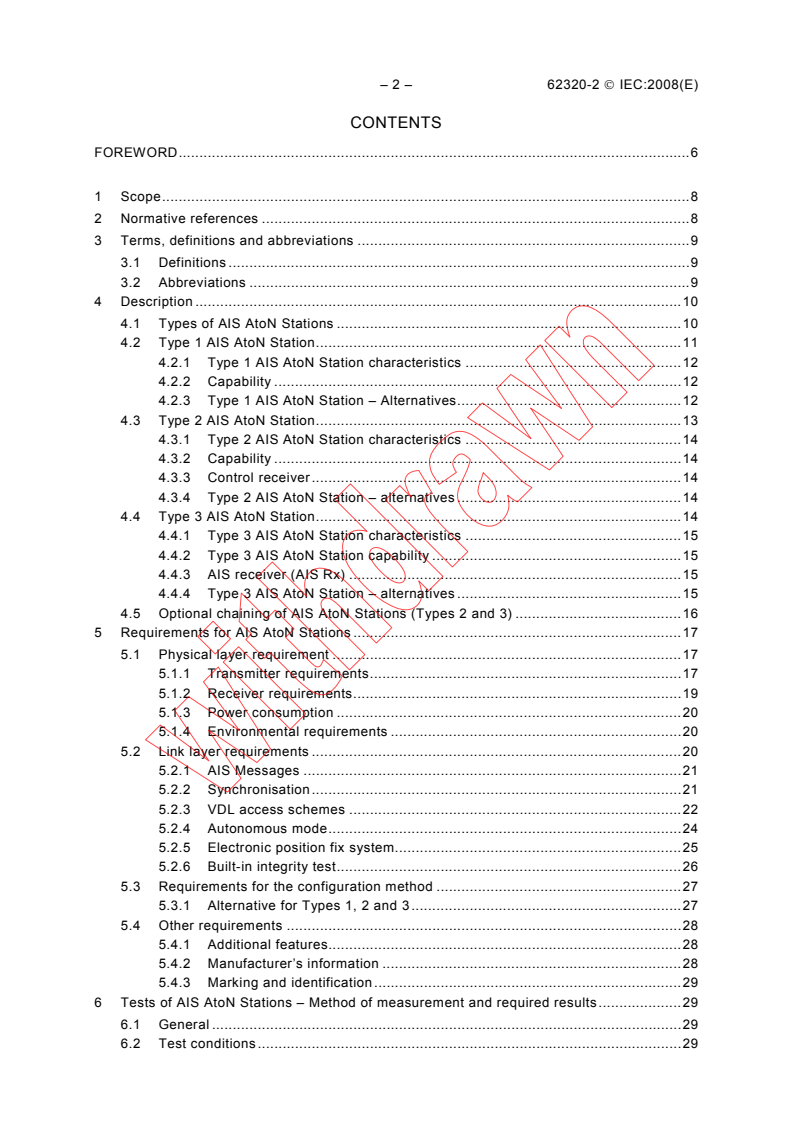
CONTENTS
FOREWORD.6
1 Scope.8
2 Normative references .8
3 Terms, definitions and abbreviations .9
3.1 Definitions .9
3.2 Abbreviations .9
4 Description .10
4.1 Types of AIS AtoN Stations .10
4.2 Type 1 AIS AtoN Station.11
4.2.1 Type 1 AIS AtoN Station characteristics .12
4.2.2 Capability .12
4.2.3 Type 1 AIS AtoN Station – Alternatives.12
4.3 Type 2 AIS AtoN Station.13
4.3.1 Type 2 AIS AtoN Station characteristics .14
4.3.2 Capability .14
4.3.3 Control receiver.14
4.3.4 Type 2 AIS AtoN Station – alternatives .14
4.4 Type 3 AIS AtoN Station.14
4.4.1 Type 3 AIS AtoN Station characteristics .15
4.4.2 Type 3 AIS AtoN Station capability .15
4.4.3 AIS receiver (AIS Rx) .15
4.4.4 Type 3 AIS AtoN Station – alternatives .15
4.5 Optional chaining of AIS AtoN Stations (Types 2 and 3) .16
5 Requirements for AIS AtoN Stations .17
5.1 Physical layer requirement .17
5.1.1 Transmitter requirements.17
5.1.2 Receiver requirements.19
5.1.3 Power consumption .20
5.1.4 Environmental requirements .20
5.2 Link layer requirements .20
5.2.1 AIS Messages .21
5.2.2 Synchronisation.21
5.2.3 VDL access schemes .22
5.2.4 Autonomous mode.24
5.2.5 Electronic position fix system.25
5.2.6 Built-in integrity test.26
5.3 Requirements for the configuration method .27
5.3.1 Alternative for Types 1, 2 and 3.27
5.4 Other requirements .28
5.4.1 Additional features.28
5.4.2 Manufacturer’s information .28
5.4.3 Marking and identification.29
6 Tests of AIS AtoN Stations – Method of measurement and required results.29
6.1 General .29
6.2 Test conditions.29
62320-2 © IEC:2008(E) – 3 –
6.2.1 Normal test conditions .29
6.2.2 Extreme test conditions .29
6.2.3 Standard test environment.29
6.2.4 Test signals .30
6.2.5 Arrangements for test signals applied to the receiver input .31
6.2.6 Encoder for receiver measurements .32
6.2.7 Waiver for receivers .32
6.2.8 Impedance.32
6.2.9 Artificial antenna (dummy load) .32
6.2.10 Facilities for access .32
6.2.11 Modes of operation of the transmitter .32
6.2.12 Measurement uncertainties.32
7 AIS AtoN Station tests .33
7.1 RF tests (transmitter and receiver) .33
7.1.1 TDMA transmitter .33
7.1.2 TDMA receivers (Types 2 and 3) .38
7.1.3 Conducted spurious emissions at the antenna .47
8 Functional tests .47
8.1 Tests for configuration method .47
8.1.1 Configure test Message 21 .48
8.1.2 Schedule mode A FATDMA Message 21 (single report, alternating
channel operation).48
8.1.3 Schedule mode B FATDMA Message 21 (dual report, dual channel
operation).49
8.1.4 Schedule mode C FATDMA Message 21 (Single report, single
channel operation).50
8.1.5 Schedule mode A RATDMA Message 21 (Type 3) (single report,
alternating channel operation) .50
8.1.6 Schedule mode B RATDMA Message 21 (Type 3) (dual report, dual
channel operation).51
8.1.7 Schedule mode C RATDMA Message 21 (Type 3) (single channel
operation).52
8.1.8 Addressed binary data Message 6 .52
8.1.9 Unscheduled transmission.53
8.1.10 Test Message 8 .53
8.1.11 AIS AtoN configuration Messages 12.54
8.1.12 AIS AtoN configuration Messages 14.54
8.2 Tests for synchronisation accuracy.54
8.2.1 Implemented synchronisation modes and synchronisation error.54
8.2.2 Synchronisation test without UTC (Types 2 and 3).55
8.3 Tests for EPFS.55
8.3.1 Position source.55
8.3.2 Invalid position .56
8.3.3 Off-position monitor .56
8.4 Additional messages .57
8.4.1 Receive addressed message (Types 2 and 3).57
8.5 Additional functionality .57
8.5.1 Test for configuration of the receiver turn-on times (Types 2 and 3).57
8.5.2 Test for configure proprietary AtoN control .58
8.5.3 Test for configuration of payload re-broadcast .59
– 4 – 62320-2 © IEC:2008(E)
8.5.4 Test for forced broadcast.59
8.5.5 Test for version information .60
8.5.6 Test for AFC – AtoN function ID capability.60
8.5.7 Test for VDL configuration using chaining (Types 2 and 3) .61
8.6 Test for BIIT .62
8.6.1 Purpose.62
8.6.2 Method of measurement .62
8.6.3 Required results .62
8.7 Transmitter shutdown procedure .62
8.7.1 Purpose.62
8.7.2 Method of measurement .62
8.7.3 Required results .62
8.8 Tests for power supply .63
8.8.1 Average power consumption.63
8.9 Environmental tests.63
8.10 Other tests .63
8.10.1 Quality assurance.63
8.10.2 Additional features.63
8.10.3 Manual .63
8.10.4 Marking and identification.64
Annex A (informative) Proposed additional IEC 61162 AIS AtoN Station sentences .65
Annex B (informative) AIS AtoN Station configuration structures.75
Annex C (normative) Message 21 – AtoN status bits.97
Bibliography.98
Figure 1 – Functional block diagram of a Type 1 AIS AtoN Station.11
Figure 2 – Functional block diagram of a Type 2 AIS AtoN Station.14
Figure 3 – Functional block diagram of a Type 3 AIS AtoN Station.15
Figure 4 – Power versus time mask .23
Figure 5 – Reporting modes for Message 21.25
Figure 6 – Block diagram of AIS AtoN test setup.30
Figure 7 – Format for repeating four-packet cluster.31
Figure 8 – Measurement arrangement .33
Figure 9 – Measurement arrangement .34
Figure 10 – Emission mask .35
Figure 11 – Measurement arrangement for modulation accuracy.36
Figure 12 – Power versus time mask .37
Figure 13 – Measurement arrangement.39
Figure 14 – Measurement arrangement.40
Figure 15 – Measurement arrangement.40
Figure 16 – Measurement arrangement with messages.41
Figure 17 – PER/BER or SINAD measuring equipment .43
Figure 18 – Measurement arrangement for inter-modulation .45
Figure 19 – Measurement arrangement for blocking or desensitisation .46
62320-2 © IEC:2008(E) – 5 –
Table 1 – Description of AIS AtoN Stations .10
Table 2 – Summary of optional Type 1 AIS AtoN Station messages .13
Table 3 – Summary of optional Type 3 AIS AtoN Station messages .16
Table 4 – Chaining of AIS AtoN Stations.17
Table 5 – Required parameter settings for an AIS AtoN Station .18
Table 6 – Required settings of physical layer constants .18
Table 7 – Modulation parameters of the physical layer of the AIS AtoN Station.18
Table 8 – Minimum required TDMA transmitter characteristics .19
Table 9 – Required receiver characteristics .19
Table 10 – Maximum allowed time error.22
Table 11 – Definitions of timing for Figure 4.23
Table 12 – AIS AtoN Station reaction to BIIT conditions.27
Table 13 – Standard sentences.28
Table 14 – Content of first two packets .31
Table 15 – Fixed PRS data derived from ITU-T O.153 .31
Table 16 – Maximum values of absolute measurement uncertainties.33
Table 17 – Peak frequency deviation versus time .37
Table 18 – Definition of timings for Figure 12.38
Table 19 – Frequencies for inter-modulation test .45
Table B.1 – Parameter setting in Message 25 for AIS AtoN Station applications .75
Table B.2 – Parameter setting in Message 6 for AIS AtoN Station applications .75
Table B.3 – Message 25 or 6 function identifier used for configuration and query via
the VDL .76
– 6 – 62320-2 © IEC:2008(E)
INTERNATIONAL ELECTROTECHNICAL COMMISSION
____________
MARITIME NAVIGATION AND RADIOCOMMUNICATION
EQUIPMENT AND SYSTEMS –
AUTOMATIC IDENTIFICATION SYSTEM (AIS) –
Part 2: AIS AtoN Stations –
Operational and performance requirements,
methods of testing and required test results
FOREWORD
1) The International Electrotechnical Commission (IEC) is a worldwide organization for standardization comprising
all national electrotechnical committees (IEC National Committees). The object of IEC is to promote
international co-operation on all questions concerning standardization in the electrical and electronic fields. To
this end and in addition to other activities, IEC publishes International Standards, Technical Specifications,
Technical Reports, Publicly Available Specifications (PAS) and Guides (hereafter referred to as “IEC
Publication(s)”). Their preparation is entrusted to technical committees; any IEC National Committee interested
in the subject dealt with may participate in this preparatory work. International, governmental and non-
governmental organizations liaising with the IEC also participate in this preparation. IEC collaborates closely
with the International Organization for Standardization (ISO) in accordance with conditions determined by
agreement between the two organizations.
2) The formal decisions or agreements of IEC on technical matters express, as nearly as possible, an international
consensus of opinion on the relevant subjects since each technical committee has representation from all
interested IEC National Committees.
3) IEC Publications have the form of recommendations for international use and are accepted by IEC National
Committees in that sense. While all reasonable efforts are made to ensure that the technical content of IEC
Publications is accurate, IEC cannot be held responsible for the way in which they are used or for any
misinterpretation by any end user.
4) In order to promote international uniformity, IEC National Committees undertake to apply IEC Publications
transparently to the maximum extent possible in their national and regional publications. Any divergence
between any IEC Publication and the corresponding national or regional publication shall be clearly indicated in
the latter.
5) IEC provides no marking procedure to indicate its approval and cannot be rendered responsible for any
equipment declared to be in conformity with an IEC Publication.
6) All users should ensure that they have the latest edition of this publication.
7) No liability shall attach to IEC or its directors, employees, servants or agents including individual experts and
members of its technical committees and IEC National Committees for any personal injury, property damage or
other damage of any nature whatsoever, whether direct or indirect, or for costs (including legal fees) and
expenses arising out of the publication, use of, or reliance upon, this IEC Publication or any other IEC
Publications.
8) Attention is drawn to the Normative references cited in this publication. Use of the referenced publications is
indispensable for the correct application of this publication.
9) Attention is drawn to the possibility that some of the elements of this IEC Publication may be the subject of
patent rights. IEC shall not be held responsible for identifying any or all such patent rights.
International Standard IEC 62320-2 has been prepared by IEC Technical Committee 80:
Maritime navigation and radiocommunication equipment and systems.
The text of this standard is based on the following documents:
FDIS Report on voting
80/507/FDIS 80/518/RVD
Full information on the voting for the approval of this standard can be found in the report on
voting indicated in the above table.
This publication has been drafted in accordance with the ISO/IEC Directives, Part 2.
62320-2 © IEC:2008(E) – 7 –
A list of all parts of IEC 62320 series, under the general title: Maritime navigation and
radiocommunication equipment and systems – Automatic Identification System (AIS) can be
found on the IEC website.
The committee has decided that the contents of this publication will remain unchanged until
the maintenance result date indicated on the IEC web site under "http://webstore.iec.ch" in
the data related to the specific publication. At this date, the publication will be
• reconfirmed,
• withdrawn,
• replaced by a revised edition, or
• amended.
A bilingual version of this publication may be issued at a later date.
– 8 – 62320-2 © IEC:2008(E)
MARITIME NAVIGATION AND RADIOCOMMUNICATION
EQUIPMENT AND SYSTEMS –
AUTOMATIC IDENTIFICATION SYSTEM (AIS) –
Part 2: AIS AtoN Stations –
Operational and performance requirements,
methods of testing and required test results
1 Scope
This part of IEC 62320 specifies the operational and performance requirements, methods of
testing and required test results for AIS AtoN Stations compatible with the performance
standards adopted by IMO Res. MSC.74(69), annex 3, Universal AIS. It incorporates the
technical characteristics of non-shipborne AIS AtoN equipment, included in Recommendation
ITU-R M.1371 and IALA Recommendation A-126. Where applicable, it also takes into account
the ITU Radio Regulations. This standard takes into account other associated IEC
International Standards and existing National Standards, as applicable.
This standard is applicable for Automatic Identification System (AIS) installations on Aids to
Navigation (AtoN).
2 Normative references
The following referenced documents are indispensable for the application of this document.
For dated references, only the edition cited applies. For undated references, the latest edition
of the referenced document (including any amendments) applies.
IEC 60945, Maritime navigation and radiocommunication equipment and systems – General
requirements – Methods of testing and required test results
IEC 61108-1, Maritime navigation and radiocommunication equipment and systems – Global
navigation satellite systems (GNSS) – Part 1: Global positioning system (GPS) – Receiver
equipment – Performance standards, methods of testing and required test results
IEC 61108-2, Maritime navigation and radiocommunication equipment and systems – Global
navigation satellite systems (GNSS) – Part 2: Global navigation satellite system (GLONASS)
– Receiver equipment – Performance standards, methods of testing and required test results
IEC 61108-4, Maritime navigation and radiocommunication equipment and systems – Global
navigation satellite systems (GNSS) – Part 4: Shipborne DGPS and DGLONASS maritime
radio beacon receiver equipment – Performance requirements, methods of testing and
required results
IEC 61162-1, Maritime navigation and radiocommunication equipment and systems – Digital
interfaces – Part 1: Single talker and multiple listeners
IEC 62287-1, Maritime navigation and radiocommunication equipment and systems – Class B
shipborne equipment of the automatic identification system (AIS) – Part 1: Carrier-sense time
division multiple access (CSTDMA) techniques
ITU Radio Regulations, Appendix 18, Table of transmitting frequencies in the VHF maritime
mobile band
62320-2 © IEC:2008(E) – 9 –
ITU-R Recommendation M.1371, Technical characteristics for an automatic identification
system using time division multiple access in the VHF maritime mobile band
ITU-T Recommendation O.153, Basic parameters for the measurement of error performance
at bit rates below the primary rate
IALA Recommendation A-126, The Use of Automatic Identification System (AIS) in Marine
Aids to Navigation
3 Terms, definitions and abbreviations
For the purposes of this document, the following terms, definitions and abbreviations apply.
3.1 Definitions
3.1.1
Aids to Navigation
(AtoN)
device or system external to vessels that is designed and operated to enhance the safe and
efficient navigation of vessels and/or vessel traffic
3.1.2
Message 21
AtoN report transmitted on the VHF data link by an AIS station
3.1.3
Real AIS AtoN
AIS AtoN station which is physically located on the AtoN
3.1.4
Synthetic AIS AtoN
Message 21 transmitted from an AIS station located remotely from the AtoN
3.1.5
Virtual AIS AtoN
Message 21 transmitted from an AIS station for an AtoN which does not physically exist
3.2 Abbreviations
AES Advanced Encryption Standard
AIS Automatic Identification System
BIIT Built-in Integrity Tests
BT Bandwidth Time Product
CSTDMA Carrier Sense Time Division Multiple Access
DGNSS Differential Global Navigation Satellite System
EPFS Electronic Position Fixing System
EUT Equipment Under Test
FATDMA Fixed Access Time Division Multiple Access
GNSS Global Navigation Satellite System
IMO International Maritime Organisation
MAC Medium Access Control
MMSI Maritime Mobile Service Identity
NRZI Non-Return to Zero Inverted
– 10 – 62320-2 © IEC:2008(E)
PER Packet Error Rate
PI Presentation Interface
RAIM Receiver Autonomous Integrity Monitoring
RATDMA Random Access Time Division Multiple Access
RF Radio Frequency
Rx Receive
SBAS Satellite-Based Augmentation System
SOTDMA Self Organizing Time Division Multiple Access
TDMA Time Division Multiple Access
Tx Transmit
UTC Universal Time Co-ordinated
VDL VHF Data Link
VSWR Voltage Standing Wave Ratio
NOTE Abbreviations related to IEC 61162 series are not included in the above list. For their meaning refer to that
International Standard.
4 Description
4.1 Types of AIS AtoN Stations
There are three types of AIS AtoN Stations as defined in Table 1. The AIS AtoN Stations may
optionally include additional capabilities as defined in the “Alternatives” column.
Table 1 – Description of AIS AtoN Stations
Type 1 AIS Type 2 AIS Type 3 AIS
Requirements Alternatives
AtoN Station AtoN Station AtoN Station
Two receiving
Receiver for
processes for
VDL receiver No receiver control
autonomous
functions only
mode
21 plus one or more of 6, 8,
12, 14, 25 and other
Transmitted
appropriate messages (Types
messages
1, 2 and 3)
plus 7, 13 (Type 3 only)
Access mode FATDMA and RATDMA (Type
FATDMA
for Message 21 3 only)
FATDMA (Types 1 and 2)
Access Mode
for messages
One or more of FATDMA,
other than 21,
RATDMA or CSTDMA (Type
if implemented
3)
Configuration /
Defined by the manufacturer
communication
with standard sentences
Defined by manufacturer
method
(Types 1, 2 and 3)
62320-2 © IEC:2008(E) – 11 –
Table 1 (continued)
Type 1 AIS Type 2 AIS Type 3 AIS
Requirements Alternatives
AtoN Station AtoN Station AtoN Station
The electrical and physical
characteristics shall be
Physical
defined by the manufacturer.
communication None
(Types 1, 2 and 3)
interface
As defined by the
Transmit power 12,5 W manufacturer (Types 1, 2 and
3)
Transmitter Single channel (Types 1, 2
Dual channel
capability and 3)
Synthetic and
No Yes (Types 1, 2 and 3)
Virtual AtoN
Positioning Surveyed position only (no
EPFS and surveyed position
device EPFS) (Types 1, 2 and 3)
UTC Direct, indirect or semaphore
Direct only
synchronisation (Type 3)
Shall not respond to assignment Messages 16
Assignment
and 23
Interrogation Shall not respond to interrogation Message 15
4.2 Type 1 AIS AtoN Station
Type 1 AIS AtoN Station has no receiver. It transmits on FATDMA slots given in its
configuration. Figure 1 shows the functional block diagram of a Type 1 AIS AtoN Station.
Type 1 AIS AtoN Station
EPFS
Controller
Configuration
AIS Tx
External interface
Timing and
sync device
Power
BIIT
supply
IEC 285/08
Figure 1 – Functional block diagram of a Type 1 AIS AtoN Station
– 12 – 62320-2 © IEC:2008(E)
4.2.1 Type 1 AIS AtoN Station characteristics
The characteristics of the Type 1 AIS AtoN Station are:
• transmits using FATDMA;
• no receive capability, therefore:
– cannot be configured via the VDL,
– cannot synchronise to other stations;
• configuration interface as defined by the manufacturer;
• 12,5 W transmitter power;
• dual channel transmission.
4.2.1.1 Controller
The controller composes Message 21 and ensures the correct operation of the AIS AtoN
Station on the VDL.
4.2.1.2 Timing and synchronisation device
This device provides the time and synchronisation for the controller.
4.2.1.3 Power supply
The power supply generates the internal voltages.
4.2.1.4 BIIT
The Built-in Integrity Tests (BIIT) shall provide integrity monitoring.
4.2.1.5 EPFS
Electronic Position Fixing System (EPFS) provides the current position of the AtoN.
4.2.1.6 Configuration
The interface used to configure the AIS AtoN Station.
4.2.2 Capability
Type 1 AIS AtoN Station is capable of transmitting Message 21 using FATDMA.
4.2.3 Type 1 AIS AtoN Station – Alternatives
4.2.3.1 Additional controller capability
In addition to Message 21, the controller shall compose optional output messages to the VDL
using FATDMA as described in Table 2.
62320-2 © IEC:2008(E) – 13 –
Table 2 – Summary of optional Type 1 AIS AtoN Station messages
Msg Message name Message description Application examples
ID
6 Binary addressed message Binary data for addressed Monitoring of AtoN lantern,
communication power supply, etc.
8 Binary broadcast message Binary data for broadcast Meteorological and
communication hydrological data
12 Addressed safety related Safety related data for Warn AtoN malfunctioning
message addressed communication
14 Broadcast safety related Safety related data for Warn AtoN malfunctioning
message broadcast communication
25 Single slot binary message Binary data for addressed or Status report
broadcast communication
NOTE The Type 1 AIS AtoN Station should not retransmit the addressed binary message (Messages 6 and 12).
The number of retries should be set to 0.
4.2.3.2 Configuration method
The Type 1 AIS AtoN Station may be configured using standard configuration sentences.
(IEC 61162-1 and as described in Annex A).
4.2.3.3 No EPFS
When a surveyed position is used, the EPFS may not be required.
4.2.3.4 TDMA transmitter (AIS Tx)
The TDMA transmitter may operate on a single channel.
4.2.3.5 External interface
The external interface(s) may be used for communication with external devices (for example
AtoN lantern, AtoN power supply, hydrological and meteorological instruments, etc.).
4.2.3.6 Synthetic and Virtual AtoN
The AIS AtoN Station may be capable of transmitting Message 21 for Synthetic and Virtual
AIS AtoN.
4.3 Type 2 AIS AtoN Station
Type 2 AIS AtoN Station transmits on FATDMA slots.
Type 2 AIS AtoN Station has a control receiver for messages containing configuration
sentences (see Annex B). Figure 2 shows the functional block diagram of a Type 2 AIS AtoN
Station.
– 14 – 62320-2 © IEC:2008(E)
Type 2 AIS AtoN Station
EPFS
AIS Tx
Controller Control Rx
Configuration
External interface
Timing and
sync device
Power
BIIT
supply
IEC 286/08
Figure 2 – Functional block diagram of a Type 2 AIS AtoN Station
4.3.1 Type 2 AIS AtoN Station characteristics
The characteristics of the Type 2 AIS AtoN Station are:
• transmits using FATDMA;
• limited receiver capability, therefore cannot maintain a slot map and cannot use RATDMA
access scheme;
• configuration interface as defined by the manufacturer;
• 12,5 W transmitter power;
• dual channel transmission.
4.3.2 Capability
A Type 2 AIS AtoN Station has the capabilities of a Type 1 AIS AtoN Station, with the addition
of a control receiver.
4.3.3 Control receiver
The Type 2 AIS AtoN Station shall have a receiver operating on an AIS channel for control
functions only.
4.3.4 Type 2 AIS AtoN Station – alternatives
The Type 2 AIS AtoN Station alternatives include all the Type 1 AIS AtoN Station alternatives.
4.4 Type 3 AIS AtoN Station
Type 3 AIS AtoN Station has AIS receive and transmit capabilities in accordance with
Recommendation ITU-R M.1371. Figure 3 shows the functional block diagram of a Type 3
AIS AtoN Station.
62320-2 © IEC:2008(E) – 15 –
Type 3 AIS AtoN Station
EPFS
AIS Tx
Controller
AIS Rx
Configuration
External interface
AIS Rx
Timing and
sync device
Power
supply
BIIT
IEC 287/08
Figure 3 – Functional block diagram of a Type 3 AIS AtoN Station
4.4.1 Type 3 AIS AtoN Station characteristics
The characteristics of the Type 3 AIS AtoN Station are:
• receiving capability on both AIS channels,
• transmits using FATDMA.
4.4.2 Type 3 AIS AtoN Station capability
A Type 3 AIS AtoN Station has the capability of a Type 1 AIS AtoN Station, with the addition
of AIS receivers.
4.4.3 AIS receiver (AIS Rx)
The Type 3 AIS AtoN Station shall have two AIS (TDMA) receiving processes to produce and
maintain a slot map for autonomous interaction with the VDL.
4.4.4 Type 3 AIS AtoN Station – alternatives
The Type 3 AIS AtoN Station alternatives include all the Type 1 and Type 2 AIS AtoN Station
alternatives, with the additions of 4.4.4.1, 4.4.4.2 and 4.4.4.3.
4.4.4.1 Additional controller capability
In addition to Message 21, the controller composes optional output messages to the VDL as
described in Table 3.
– 16 – 62320-2 © IEC:2008(E)
Table 3 – Summary of optional Type 3 AIS AtoN Station messages
Msg Message name Message description Application examples
ID
6 Binary addressed message Binary data for addressed Monitoring of AtoN
communication equipment
7 Binary acknowledge message Acknowledge of addressed
binary message
8 Binary broadcast message Binary data for broadcast Meteorological and
communication hydrological data
12 Addressed safety related Safety related data for Warn AtoN malfunctioning
message addressed communication
13 Safety related acknowledge Acknowledge of addressed
message safety related message
14 Broadcast safety related Safety related data for Warn AtoN malfunctioning
message broadcast communication
25 Single slot binary message Binary data for addressed or Status report
broadcast communication
4.4.4.2 Access mode
4.4.4.2.1 Message 21
Transmits using FATDMA or RATDMA.
4.4.4.2.2 Messages other than Message 21
For each message other than Message 21, the Type 3 AIS AtoN Station may use FATDMA,
CSTDMA or RATDMA.
4.4.4.3 Indirect and semaphore synchronisation
A Type 3 AIS AtoN Station may optionally synchronise to other AIS Stations using UTC
indirect synchronisation or other AIS Stations acting as semaphore.
4.5 Optional chaining of AIS AtoN Stations (Types 2 and 3)
A chain of AIS AtoN Stations allows for communication from an AIS Base Station to AIS AtoN
Stations that are remotely located and unable to communicate directly with the Base Station.
Messages are passed from station to station until the intended recipient is reached.
The concept requires an AIS AtoN Station to have knowledge of other AIS AtoN Stations in
the chain, namely its parent and all children below it in the chain. A “parent station” is a
station that is in the direction of the Base Station. A “child station” is a station that is directed
away from a Base Station. In order to prevent unnecessary retransmission of the messages,
each AIS AtoN Station in a chain may have only one parent, but may have multiple children
(this includes all Synthetic and Virtual AIS AtoN).
Messages 6 and 25 are used for the transfer of the encrypted binary field. It is assumed that
the whole chain has the same encryption key. The source ID and “MMSI of AtoN” fields of
Message 6 or 25 are used to determine whether the received message is from a parent or
child station. If not, then the received message is ignored.
The encrypted binary data field is decrypted to obtain the function ID and “MMSI of AtoN”. If
the source ID of the message is set to the parent station ID and the function ID is a
configuration, query request or function, and the MMSI of the AIS AtoN Station is in the chain,
then the message shall be retransmitted, with the source ID set to own MMSI. If the source ID
62320-2 © IEC:2008(E) – 17 –
of the message is set to the station’s MMSI and the function ID is a query response, then the
message shall be retransmitted, with the ”MMSI of AtoN” set to the parent MMSI. Any other
combination of known or unknown MMSI is ignored (see Table 4).
The chaining algorithm may be ignored by setting the source ID field to “@@@@@”. The AIS
AtoN Station shall attempt to decrypt the binary data field, and check that it is the intended
recipient of the message before processing the message any further.
Table 4 – Chaining of AIS AtoN Stations
Source ID Application MMSI of AtoN Action by Own Station
Identifier from Encrypted
Binary Field
Parent Function ID = Responding AIS In all cases, if function ID = query response, then ignore
query response AtoN Station
Parent Function ID = Intended If function ID = configuration or query request or functional,
configuration or recipient then verify intended recipient is in the chain and re-
query request or transmit message with source ID set to own station MMSI
functional
Parent Function ID = Own station If function ID = configuration or query request or functional,
configuration or then verify that the intended recipient is own station and
query request or then process
functional
Responding Function ID = Own station In all cases, if function ID = query response, then re-
child query response transmit the message with ”MMSI of AtoN” set to own
station’s parent MMSI
Child Function ID = Intended In all cases, if Function ID = configuration or query request
configuration or recipient or functional, then ignore
query request or
functional
“@@@@@” Own station Process
“@@@@@” Other Ignore
Other Ignore Ignore
5 Requirements for AIS AtoN Stations
5.1 Physical layer requirement
5.1.1 Transmitter requirements
5.1.1.1 Channel
The AIS AtoN Station shall operate on dual channels, Channel 1 and Channel 2, in the VHF
Maritime Mobile Service band, using 25 kHz bandwidth, according to the ITU Radio
Regulations, Appendix 18.
5.1.1.2 Channel alternatives
The Type 1, Type 2 and Type 3 AIS AtoN Stations may transmit on a single channel only,
either Channel 1 or Channel 2.
5.1.1.3 Parameter settings
Table 5 and Table 7 are derived from Recommendation ITU-R M.1371 and give the
parameters required for an AIS AtoN Station. For the meaning of the symbols and additional
information (footnotes) refer to the appropriate section of Recommendation ITU-R M.1371.
– 18 – 62320-2 © IEC:2008(E)
Table 5 – Required parameter settings for an AIS AtoN Station
Symbol Parameter name Setting (FATDMA, Setting (CSTDMA)
RATDMA)
PH.RFR Regional frequencies Two channels between 156,025 MHz and 162,025 MHz
PH.AIS1 Channel 1 (default Channel 1) 161,975 MHz
PH.AIS2 Channel 2 (default Channel 2) 162,025 MHz
PH.BR Bit ra
...
Questions, Comments and Discussion
Ask us and Technical Secretary will try to provide an answer. You can facilitate discussion about the standard in here.
Loading comments...