


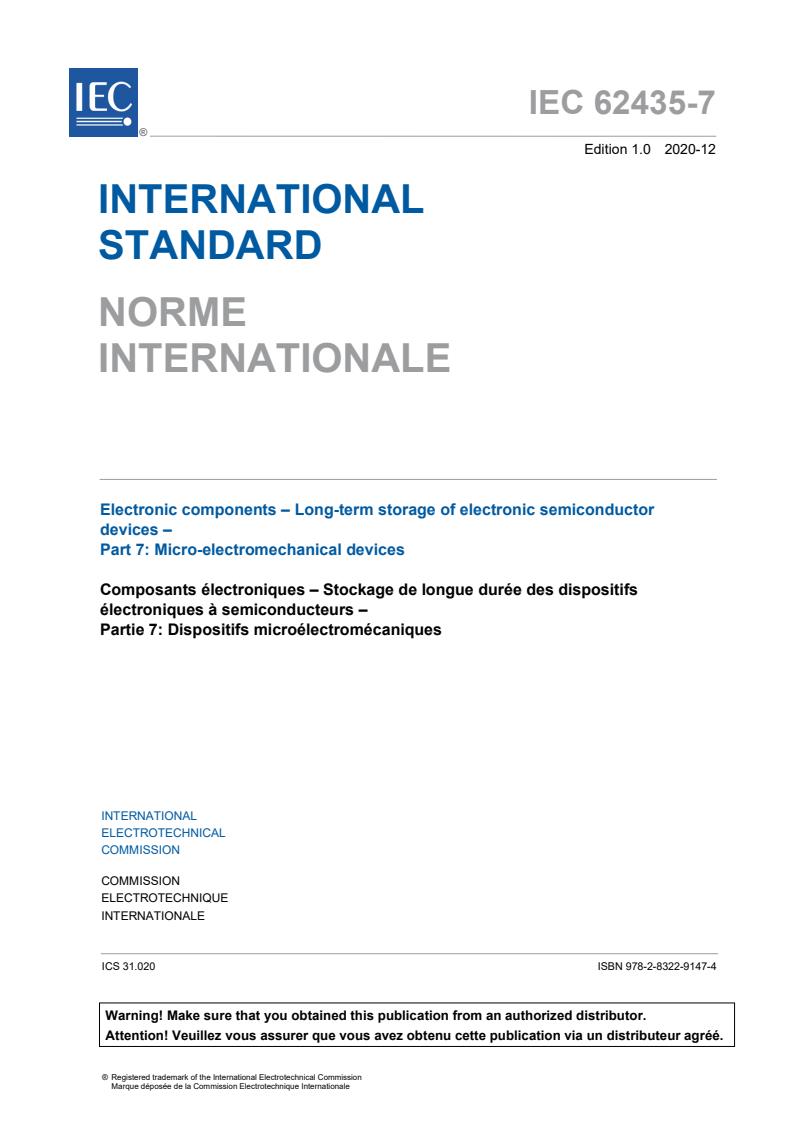
IEC 62435-7:2020
(Main)Electronic components - Long-term storage of electronic semiconductor devices - Part 7: Micro-electromechanical devices
Electronic components - Long-term storage of electronic semiconductor devices - Part 7: Micro-electromechanical devices
IEC 62435-7:2020 on long-term storage applies to micro-electromechanical devices (MEMS) in long-term storage that can be used as part of obsolescence mitigation strategy. Long-term storage refers to a duration that may be more than 12 months for products scheduled for storage. Philosophy, good working practice, and general means to facilitate the successful long-term storage of electronic components are also addressed.
Composants électroniques - Stockage de longue durée des dispositifs électroniques à semiconducteurs - Partie 7: Dispositifs microélectromécaniques
L'IEC 62435-7:2020 relative au stockage de longue durée s’applique aux dispositifs microélectromécaniques (MEMS - micro-electromechanical device) du stockage de longue durée qui peuvent être utilisés dans le cadre d’une stratégie de réduction de l’obsolescence. Le stockage de longue durée implique une durée qui peut être supérieure à 12 mois, pour les produits destinés à être stockés. Les concepts, les bonnes pratiques professionnelles et les moyens généraux de nature à faciliter un stockage optimum de longue durée de composants électroniques sont aussi traités.
General Information

Standards Content (Sample)
IEC 62435-7 ®
Edition 1.0 2020-12
INTERNATIONAL
STANDARD
NORME
INTERNATIONALE
Electronic components – Long-term storage of electronic semiconductor
devices –
Part 7: Micro-electromechanical devices
Composants électroniques – Stockage de longue durée des dispositifs
électroniques à semiconducteurs –
Partie 7: Dispositifs microélectromécaniques
All rights reserved. Unless otherwise specified, no part of this publication may be reproduced or utilized in any form
or by any means, electronic or mechanical, including photocopying and microfilm, without permission in writing from
either IEC or IEC's member National Committee in the country of the requester. If you have any questions about IEC
copyright or have an enquiry about obtaining additional rights to this publication, please contact the address below or
your local IEC member National Committee for further information.
Droits de reproduction réservés. Sauf indication contraire, aucune partie de cette publication ne peut être reproduite
ni utilisée sous quelque forme que ce soit et par aucun procédé, électronique ou mécanique, y compris la photocopie
et les microfilms, sans l'accord écrit de l'IEC ou du Comité national de l'IEC du pays du demandeur. Si vous avez des
questions sur le copyright de l'IEC ou si vous désirez obtenir des droits supplémentaires sur cette publication, utilisez
les coordonnées ci-après ou contactez le Comité national de l'IEC de votre pays de résidence.
IEC Central Office Tel.: +41 22 919 02 11
3, rue de Varembé info@iec.ch
CH-1211 Geneva 20 www.iec.ch
Switzerland
About the IEC
The International Electrotechnical Commission (IEC) is the leading global organization that prepares and publishes
International Standards for all electrical, electronic and related technologies.
About IEC publications
The technical content of IEC publications is kept under constant review by the IEC. Please make sure that you have the
latest edition, a corrigendum or an amendment might have been published.
IEC publications search - webstore.iec.ch/advsearchform Electropedia - www.electropedia.org
The advanced search enables to find IEC publications by a The world's leading online dictionary on electrotechnology,
variety of criteria (reference number, text, technical containing more than 22 000 terminological entries in English
committee,…). It also gives information on projects, replaced and French, with equivalent terms in 16 additional languages.
and withdrawn publications. Also known as the International Electrotechnical Vocabulary
(IEV) online.
IEC Just Published - webstore.iec.ch/justpublished
Stay up to date on all new IEC publications. Just Published IEC Glossary - std.iec.ch/glossary
details all new publications released. Available online and 67 000 electrotechnical terminology entries in English and
once a month by email. French extracted from the Terms and Definitions clause of
IEC publications issued since 2002. Some entries have been
IEC Customer Service Centre - webstore.iec.ch/csc collected from earlier publications of IEC TC 37, 77, 86 and
If you wish to give us your feedback on this publication or CISPR.
need further assistance, please contact the Customer Service
Centre: sales@iec.ch.
A propos de l'IEC
La Commission Electrotechnique Internationale (IEC) est la première organisation mondiale qui élabore et publie des
Normes internationales pour tout ce qui a trait à l'électricité, à l'électronique et aux technologies apparentées.
A propos des publications IEC
Le contenu technique des publications IEC est constamment revu. Veuillez vous assurer que vous possédez l’édition la
plus récente, un corrigendum ou amendement peut avoir été publié.
Recherche de publications IEC - Electropedia - www.electropedia.org
webstore.iec.ch/advsearchform Le premier dictionnaire d'électrotechnologie en ligne au
La recherche avancée permet de trouver des publications IEC monde, avec plus de 22 000 articles terminologiques en
en utilisant différents critères (numéro de référence, texte, anglais et en français, ainsi que les termes équivalents dans
comité d’études,…). Elle donne aussi des informations sur les 16 langues additionnelles. Egalement appelé Vocabulaire
projets et les publications remplacées ou retirées. Electrotechnique International (IEV) en ligne.
IEC Just Published - webstore.iec.ch/justpublished Glossaire IEC - std.iec.ch/glossary
Restez informé sur les nouvelles publications IEC. Just 67 000 entrées terminologiques électrotechniques, en anglais
Published détaille les nouvelles publications parues. et en français, extraites des articles Termes et Définitions des
Disponible en ligne et une fois par mois par email. publications IEC parues depuis 2002. Plus certaines entrées
antérieures extraites des publications des CE 37, 77, 86 et
Service Clients - webstore.iec.ch/csc CISPR de l'IEC.
Si vous désirez nous donner des commentaires sur cette
publication ou si vous avez des questions contactez-nous:
sales@iec.ch.
IEC 62435-7 ®
Edition 1.0 2020-12
INTERNATIONAL
STANDARD
NORME
INTERNATIONALE
Electronic components – Long-term storage of electronic semiconductor
devices –
Part 7: Micro-electromechanical devices
Composants électroniques – Stockage de longue durée des dispositifs
électroniques à semiconducteurs –
Partie 7: Dispositifs microélectromécaniques
INTERNATIONAL
ELECTROTECHNICAL
COMMISSION
COMMISSION
ELECTROTECHNIQUE
INTERNATIONALE
ICS 31.020 ISBN 978-2-8322-9147-4
– 2 – IEC 62435-7:2020 © IEC 2020
CONTENTS
FOREWORD . 3
INTRODUCTION . 5
1 Scope . 7
2 Normative references . 7
3 Terms and definitions . 7
4 Storage considerations . 9
4.1 Overview of MEMS applications . 9
4.2 Failure mechanisms . 9
4.2.1 Occurrence of failure and driving force . 9
4.2.2 Storage environment and mitigation for stimuli to prevent failure . 12
4.3 Materials management . 13
4.4 Storage media . 13
4.5 Documentation/paper lot identifiers . 14
4.6 Inventory check. 14
4.7 Inventory dry packing refreshing . 14
4.8 Inventory re-assessment . 14
5 Baseline long-term storage requirements . 14
5.1 General . 14
5.2 Moisture sensitivity designation . 15
5.3 Dry packing for storage . 15
5.4 Non-moisture sensitive device storage . 15
5.4.1 General . 15
5.4.2 Storage media . 15
5.4.3 Lot data and labelling . 15
5.5 Storage of MEMS devices before assembly – Wafer level and die level
storage . 15
5.6 Storage of moisture sensitive finished devices . 15
5.6.1 Moisture barrier bag . 15
5.6.2 Dunnage . 16
5.6.3 Humidity indicator card . 16
5.6.4 Desiccant . 16
5.6.5 Labelling . 16
5.6.6 Lot data and labelling . 16
5.6.7 Storage environment . 17
5.6.8 Process (temperature) sensitivity designation . 17
Annex A (informative) Packaged or finished device storage environment
considerations . 18
Bibliography . 19
Table 1 – Failure mechanisms in storage and stimuli to mitigate during storage . 10
Table 2 – Long-term environment – sustained condition requirements . 13
Table 3 – Considerations for management, control and documentation during storage . 13
Table A.1 – Long-term storage environment – sustained condition considerations . 18
INTERNATIONAL ELECTROTECHNICAL COMMISSION
____________
ELECTRONIC COMPONENTS – LONG-TERM STORAGE
OF ELECTRONIC SEMICONDUCTOR DEVICES –
Part 7: Micro-electromechanical devices
FOREWORD
1) The International Electrotechnical Commission (IEC) is a worldwide organization for standardization comprising
all national electrotechnical committees (IEC National Committees). The object of IEC is to promote international
co-operation on all questions concerning standardization in the electrical and electronic fields. To this end and
in addition to other activities, IEC publishes International Standards, Technical Specifications, Technical Reports,
Publicly Available Specifications (PAS) and Guides (hereafter referred to as “IEC Publication(s)”). Their prepa-
ration is entrusted to technical committees; any IEC National Committee interested in the subject dealt with may
participate in this preparatory work. International, governmental and non-governmental organizations liaising with
the IEC also participate in this preparation. IEC collaborates closely with the International Organization for Stand-
ardization (ISO) in accordance with conditions determined by agreement between the two organizations.
2) The formal decisions or agreements of IEC on technical matters express, as nearly as possible, an international
consensus of opinion on the relevant subjects since each technical committee has representation from all inter-
ested IEC National Committees.
3) IEC Publications have the form of recommendations for international use and are accepted by IEC National
Committees in that sense. While all reasonable efforts are made to ensure that the technical content of IEC
Publications is accurate, IEC cannot be held responsible for the way in which they are used or for any misinter-
pretation by any end user.
4) In order to promote international uniformity, IEC National Committees undertake to apply IEC Publications trans-
parently to the maximum extent possible in their national and regional publications. Any divergence between any
IEC Publication and the corresponding national or regional publication shall be clearly indicated in the latter.
5) IEC itself does not provide any attestation of conformity. Independent certification bodies provide conformity
assessment services and, in some areas, access to IEC marks of conformity. IEC is not responsible for any
services carried out by independent certification bodies.
6) All users should ensure that they have the latest edition of this publication.
7) No liability shall attach to IEC or its directors, employees, servants or agents including individual experts and
members of its technical committees and IEC National Committees for any personal injury, property damage or
other damage of any nature whatsoever, whether direct or indirect, or for costs (including legal fees) and ex-
penses arising out of the publication, use of, or reliance upon, this IEC Publication or any other IEC Publications.
8) Attention is drawn to the Normative references cited in this publication. Use of the referenced publications is
indispensable for the correct application of this publication.
9) Attention is drawn to the possibility that some of the elements of this IEC Publication may be the subject of patent
rights. IEC shall not be held responsible for identifying any or all such patent rights.
IEC 62435-7 has been prepared by IEC technical committee 47: Semiconductor devices. It is
an International Standard.
The text of this International Standard is based on the following documents:
Draft Report on voting
47/2664/FDIS 47/2669/RVD
Full information on the voting for its approval can be found in the report on voting indicated in
the above table.
The language used for the development of this International Standard is English.
This document was drafted in accordance with ISO/IEC Directives, Part 2, and developed in
accordance with ISO/IEC Directives, Part 1 and ISO/IEC Directives, IEC Supplement, available
at www.iec.ch/members_experts/refdocs. The main document types developed by IEC are
described in greater detail at www.iec.ch/standardsdev/publications.
– 4 – IEC 62435-7:2020 © IEC 2020
A list of all parts in the IEC 62435 series, published under the general title Electronic
components – Long-term storage of electronic semiconductor devices, can be found on the IEC
website.
The committee has decided that the contents of this document will remain unchanged until the
stability date indicated on the IEC website under "http://webstore.iec.ch" in the data related to
the specific document. At this date, the document will be
• reconfirmed,
• withdrawn,
• replaced by a revised edition, or
• amended.
INTRODUCTION
This document applies to the long-term storage of electronic components.
This is a standard for long-term storage (LTS) of electronic devices drawing on the best long-
term storage practices currently known. For the purposes of this document, LTS is defined as
any device storage whose duration may be more than 12 months for product scheduled for long
duration storage. While intended to address the storage of unpackaged semiconductors and
packaged electronic devices, nothing in this document precludes the storage of other items
under the storage levels defined herein.
Although it has always existed to some extent, obsolescence of electronic components and
particularly of integrated circuits, has become increasingly intense over the last few years.
Indeed, with the existing technological boom, the commercial life of a component has become
very short compared with the life of industrial equipment such as that encountered in the
aeronautical field, the railway industry or the energy sector.
The many solutions enabling obsolescence to be resolved are now identified. However,
selecting one of these solutions should be preceded by a case-by-case technical and economic
feasibility study, depending on whether storage is envisaged for field service or production, for
example:
• remedial storage as soon as components are no longer marketed;
• preventive storage anticipating declaration of obsolescence.
Taking into account the expected life of some installations, sometimes covering several
decades, the qualification times, and the unavailability costs, which can also be very high, the
solution to be adopted to resolve obsolescence should often be rapidly implemented. This is
why the solution retained in most cases consists in systematically storing components which
are in the process of becoming obsolescent.
The technical risks of this solution are, a priori, fairly low. However, it requires perfect mastery
of the implemented process and especially of the storage environment, although this mastery
becomes critical when it comes to long-term storage.
All handling, protection, storage and test operations are recommended to be performed
according to the state of the art.
The application of the approach proposed in this document in no way guarantees that the stored
components are in perfect operating condition at the end of this storage. It only comprises a
means of minimizing potential and probable degradation factors.
Some electronic device users have the need to store electronic devices for long periods of time.
Lifetime buys are commonly made to support production runs of assemblies that well exceed
the production timeframe of their individual parts. This puts the user in a situation requiring
careful and adequate storage of such parts to maintain the as-received solderability and
minimize any degradation effects to the part over time. Major degradation concerns are moisture,
electrostatic fields, ultraviolet light, large variations in temperature, air-borne contaminants, and
outgassing.
– 6 – IEC 62435-7:2020 © IEC 2020
Warranties and sparing also present a challenge for the user or repair agency as some systems
have been designated to be used for long periods of time, in some cases for up to 40 years or
more. Some of the devices needed for repair of these systems will not be available from the
original supplier for the lifetime of the system or the spare assembly may be built with the
original production run but then require long-term storage This document was developed to
provide a standard for storing electronic devices for long periods of time. For storage of devices
that are moisture sensitive but that do not need to be stored for long periods of time, refer to
IEC TR 62258-3.
Long-term storage assumes that the device is going to be placed in uninterrupted storage for a
number of years. It is essential that it is useable after storage. Particular attention should be
paid to storage media surrounding the devices together with the local environment.
These guidelines do not imply any warranty of product or guarantee of operation beyond the
storage time given by the manufacturer.
The IEC 62435 series is intended to ensure that adequate reliability is achieved for devices in
user applications after long-term storage. Users are encouraged to request data from suppliers
to applicable specifications to demonstrate a successful storage life as requested by the user.
These standards are not intended to address built-in failure mechanisms that would take place
regardless of storage conditions.
These standards are intended to give practical guide to methods of long-duration storage of
electronic components where this is intentional or planned storage of product for a number of
years. Storage regimes for work-in-progress production are managed according to company
internal process requirements and are not detailed in this series of standards.
The overall standard series is split into a number of parts. Parts 1 to 4 apply to any long-term
storage and contain general requirements and guidance, whereas Parts 5 to 9 are specific to
the type of product being stored. It is intended that the product specific part should be read
alongside the general requirements of Part 1 to 4.
Electronic components requiring different storage conditions are covered separately starting
with Part 5.
The structure of the IEC 62435 series as currently conceived is as follows:
Part 1 – General
Part 2 – Deterioration mechanisms
Part 3 – Data
Part 4 – Storage
Part 5 – Die and wafer devices
Part 6 – Packaged or finished devices
Part 7 – Micro-electromechanical devices – MEMS
Part 8 – Passive electronic devices
Part 9 – Special cases
ELECTRONIC COMPONENTS – LONG-TERM STORAGE
OF ELECTRONIC SEMICONDUCTOR DEVICES –
Part 7: Micro-electromechanical devices
1 Scope
This part of IEC 62435 on long-term storage applies to micro-electromechanical devices (MEMS)
in long-term storage that can be used as part of obsolescence mitigation strategy. Long-term
storage refers to a duration that may be more than 12 months for products scheduled for storage.
Philosophy, good working practice, and general means to facilitate the successful long-term
storage of electronic components are also addressed.
2 Normative references
The following documents are referred to in the text in such a way that some or all of their content
constitutes requirements of this document. For dated references, only the edition cited applies.
For undated references, the latest edition of the referenced document (including any
amendments) applies.
IEC 60721-3-1, Classification of environmental conditions – Part 3-1: Classification of groups
of environmental parameters and their severities – Storage
IEC 60749-20, Semiconductor devices – Mechanical and climatic test methods – Part 20:
Resistance of plastic encapsulated SMDs to the combined effect of moisture and soldering heat
IEC 60749-20-1, Semiconductor devices – Mechanical and climatic test methods – Part 20-1:
Handling, packing, labelling and shipping of surface-mount devices sensitive to the combined
effect of moisture and soldering heat
IEC 62435-2, Electronic components – Long-term storage of electronic semiconductor devices
– Part 2: Deterioration mechanisms
IEC 62435-3, Electronic components – Long-term storage of electronic semiconductor devices
– Part 3: Data
IEC 62435-4, Electronic components – Long-term storage of electronic semiconductor devices
– Part 4: Storage
IEC 62435-5, Electronic components – Long-term storage of electronic semiconductor devices
– Part 5: Die and wafer devices
3 Terms and definitions
For the purposes of this document, the following terms and definitions apply.
ISO and IEC maintain terminological databases for use in standardization at the following
addresses:
• IEC Electropedia: available at http://www.electropedia.org/
• ISO Online browsing platform: available at http://www.iso.org/obp
– 8 – IEC 62435-7:2020 © IEC 2020
3.1
storage environment
specially controlled storage area, with particular control of temperature, humidity, atmosphere
and any other conditions depending on the product requirements
3.2
critical moisture limit
maximum safe equilibrium moisture content for a specific encapsulated device at reflow assem-
bly or rework
3.3
long-term storage
LTS
planned storage of components to extend the life-cycle for a duration with the intention of sup-
porting future use
Note 1 to entry: Allowable storage durations will vary by product, form factor (e.g., packing materials, shape) and
storage conditions. In general, long-term storage is longer than 12 months.
3.4
LTS storeroom
area containing components that have additional packaging for storage to protect from moisture
or from mechanical impact or for ease of identification or handling
3.5
moisture-sensitive device
MSD
device that has moisture absorption or moisture retention and whose quality, process ability or
reliability is affected by moisture
3.6
electronic device
packaged electrical, electronic, electro-mechanical (EEE) item, or assemblies using such items
3.7
desiccant
hygroscopic substance used to remove moisture from an atmosphere
3.8
moisture barrier bag
MBB
storage bag manufactured with a flexible laminated vapour barrier film that restricts the trans-
mission of water vapour
Note 1 to entry: Refer to IEC 60749-20-1 for packaging of moisture sensitive products.
3.9
humidity indicator card
HIC
card printed with a moisture sensitive chemical that changes from blue to pink (colour) in the
presence of water vapour
3.10
water vapour transmission rate
WVTR
measure of permeability of MBBs to water vapour
3.11
dunnage
all the matter stored in a moisture barrier bag that is additional to the packaged electronic
component
3.12
electro-static discharge
ESD
transfer of electric charge between bodies of different electrostatic potentials in proximity or
through direct contact
[SOURCE: IEC 60050-561:2014, 561-03-06]
4 Storage considerations
4.1 Overview of MEMS applications
MEMS (Micro-electromechanical Systems) are miniaturized mechanical or electromechanical
elements that typically vary in size from 1 micron to 1 000 microns that are used to mechanically
measure or manipulate matter, light or create electric signals from environmental inputs.
Storage of MEMS devices should consider different sensitivities and risks compared to other
semiconductor devices due to the mechanical nature of the devices. MEMS may be subject to
additional mechanical related performance and failure mechanisms in addition traditional
semiconductor performance mechanisms. The storage program should consider the end use
and failure mechanisms related to the function of the MEMS device. Typical uses are listed for
initial consideration and risk assessment.
– Actuator mechanical movement related to electrostatics, thermal changes or piezoelectric
effects.
– Physical sensors related to acceleration, vibration, field/flux, force, magnetic field, electro-
static, optical stimulus or radiation effects, pressure, temperature.
– Chemisensors related to gas or liquid induced mechanical response changes (may also
have requirements for moisture or solvent which also have shelf life).
– Biosensors liquid, mechanical or fluidic induced mechanical response changes (may also
have requirements for moisture or solvent which also have shelf life).
4.2 Failure mechanisms
4.2.1 Occurrence of failure and driving force
Failures during long-term storage may be mitigated by control of the stimuli driving given failure
modes of interest as defined by risk assessment tools, for example, failure modes and effects
analysis (FMEA). Storage related failures are often detected as modes of non-operation, visual
quality, reduced life time or other non-conformance. The modes of failure during storage are
typically related to a failure mechanism that is driven by a physical stimuli or condition. Example
failure stimuli are given in Table 1. Additional examples of deterioration mechanisms are found
in IEC 62435-2. Successful long-term storage is accomplished by mitigating failures through
control of the stimuli or driving force.
– 10 – IEC 62435-7:2020 © IEC 2020
Table 1 – Failure mechanisms in storage and stimuli to mitigate during storage
Failure Failure mechanism Failure mode Mechanism stimuli
mechanism detail
Popcorn High rate vapour Open circuit, Temperature increase leading to moisture
effect expansion within a blistering, package vapour
package during cracks
surface mounting
Handling Cracking Open, short, visible Application of force
damage crack, sense signal
degradation
Visible Open, short, surface
Mechanical abrasion
scratch/smudge mark, sense signal
degradation
Physical crack in Open, short, sense
Excessive pressure change
sensing device signal degradation
Mechanical Sensitivity shift, non- Sources of mechanical overstress are shock,
overstress parametric sensitivity, fatigue, vibration, corrosion or the effects of
offset shift, stuck at electrical overstress (EOS) or electrostatic
discharge (ESD) that result in structural
damage to MEMS transducer parts.
Fractured spring Non-parametric MEMS motion transducers typically use a
sensitivity collection of springs to establish mechanical
positioning in linear sensitivity and travel
limits. When springs are compromised by
excessive handling the difference between
springs and proof mass is compromised
resulting in error by nonlinear sensitivity.
Fractured finger Sensitivity shift, offset Capacitive interdigitated fingers used to sense
shift, change of sensor the proof mass movement are damaged.
dynamics
When a finger fractures, the total capacitance
is reduced, resulting in a decrease of
sensitivity and offset shift.
Cavity seal breach Sensitivity shift, offset The gap between the fingers provides an
shift, change of sensor aerodynamic dampening due to the sealed gas
dynamics molecules inside the cavity structure that is
proportional to the pressure of the sealed gas.
The lower pressure results in an increase of
sensitivity and then a change of sensor
dynamics or cut-off frequency.
Fractured diaphragm Offset shift, stuck-at Pressure transducers are diaphragms that
exert a strain on piezo-resistive elements or
change a capacitive gap. When a diaphragm
fractures, an offset or a complete loss of
sensitivity occurs, resulting in a stuck-at
ground fault.
Fractured anchor Offset shift, stuck-at Motion transducers are typically have springs
with anchors used to limit travel distance. If
the anchor, or travel-limiter fractures, the
proof mass becomes misaligned or travels out
of range to contact the inner surfaces of the
cavity, resulting in a stuck-at fault
Device data Electro-magnetic Open, short, data Electro-magnetic field
loss/damage current field induced corruption
(currently not short/open/error
typical to
High ionizing Open, short, data High-energy radiation, x-ray
MEMs)
radiation induced corruption
open, short or error
Soft error resulting Open, short or data Neutron particle hit
from device damage corruption
Alpha particle emission hit
Failure Failure mechanism Failure mode Mechanism stimuli
mechanism detail
Staining Change in surface Visible defect, non- Exposure resulting in aging, oxidation or
residue appearance and conforming hardening of residue
specification appearance and
resulting from potential of
unplanned exposure misprocessing
to oxidizing contents
Polymer Polymer Visible cracking, open Temperature exposure, residual mechanical
material embrittlement or shorting sense stress and bright light
aging signal degradation
Storage Tape on reel, tube Misalignment during Temperature exposure, mechanical stressing
media Issues embrittlement/aging processing and bright light
Tray and tube aging Dropped parts from Temperature, handling and bright light
embrittlement broken tray media or
parts out of formed
pocket
Box aging Dropped parts Temperature and bright light
embrittlement
Opens or shorts from
ESD
Foreign material;
mechanical
malfunction due to
particles
ESD coating Opens or shorts from Triboelectric charging or charge potential
degradations ESD difference
Label aging Illegible mark Bright light, temperature
Missing label Temperature and bright light
Brittle flaking – partial Temperature and bright light
label
Indirect Moisture barrier bag Humidity indicator Handling abrasion, bending and shock events
material leak card trigger, visual
issues non-conformance
Humidity indicator Incorrect colour or no Temperature, humidity exposure before use
card inactivated moisture exposure
indicated
Label aging Illegible mark Bright light, temperature
Missing label Temperature and bright light
Brittle flaking – partial Temperature and bright light
label
Solderability Inability to form a Post surface mount Temperature, humidity exposure
good solder joint electrical open
Corrosion Electro-chemical Open, short, visual Temperature, galvanic cell, chemical residue
reaction leading non-conformance,
failure or reduced stiction related sense
mechanical signal degradation or
functionality failure
Stiction Reduction in Sense signal Temperature humidity, use cycling, dynamic
mechanical degradation, shift, stresses-vibration. Capillary or electrostatic
movement due to non-parametric forces cause suspended/cantilevered surfaces
effects of static sensitivity and stuck at to become stuck to other moving surfaces or
friction coating: may to fixed surfaces due to anomalies of coatings
result from
used to prevent such effects
corrosion, oxidation,
foreign material or
mechanical wear
Wear Degradation of Sense signal Mechanical cycling, dynamic stresses-
functionality related degradation vibration, and shock
to use of a
mechanical function
– 12 – IEC 62435-7:2020 © IEC 2020
Failure Failure mechanism Failure mode Mechanism stimuli
mechanism detail
Exposure to Degradation of Sense signal Exposure to Helium. Helium can penetrate Si
gas or functionality related degradation and change the pressure in a MEMs resulting
pressure to use of a in altered or degraded performance.
differential mechanical function.
Exposure to rapid pressure changes can result
in bubbles forming in gel (unless otherwise
specified by the manufacturer)
Foreign Unexpected particle Short adhesion sense Mechanical cycling, dynamic stresses-
material = or other material that signal degradation vibration. A particle is capable of introducing
Particles prevents mechanical multiple failure modes depending on the
functionality conductivity of the particle and the individual
parts of the transducer that it contacts. It may
also impede the movement of the parts.
Particles may account for transient faults and
general unpredictability.
Solvent Ineffective solvent Sense signal Solvent aging by temperature, humidity or
for chemical or
extinction degradation radiation
biosensor
Tin whiskers Whisker filament Visual whiskers, short Bright Sn surface finish (un-alloyed) crystal
formed by dislocation growth (in un-mitigated parts)
dislocations in metal
Sulphur gas catalysed reaction
films with a gradient
in surface
mechanical stress
Creep Migration of Changing material Temperature stress or external load
molecules under
performance,fracture
various stresses
Delamination Delamination Fracture, Shock or vibration
between depositional
deformation、
layers
adhesion
4.2.2 Storage environment and mitigation for stimuli to prevent failure
Mitigation of failures during and after long-term storage occurs by directly controlling or limiting
the stimulus for failure by a number of means. Common requirements for sustained long-term
storage are given in Table 2. Knowledge and control of the storage environment is of primary
importance to identify the risk of failure occurrence and to control or eliminate failure stimuli
during storage. Examples of the storage environment are contained in IEC 62435-4. Other
storage environment parameters related to long-term storage that could be important for
products or devices with certain sensitivities are presented in Annex A. It is the responsibility
of the end customer to maintain the storage environment, as well as to ensure that terms and
conditions are in place successful long-term storage at the time of product purchase.
The full component thermal and environmental chain should be considered in planning reliability
characterization evaluation and for estimation of reliability after storage, and added to the use
reliability estimates.
Table 2 – Long-term environment – sustained condition requirements
LTS storeroom Range (terrestrial storage) Failure mitigation
environment
a, b
low/high: + 5 °C / + 40 °C Temperature controls or geographical
Temperature
or specified by device manufacturer placement.
Relative Humidity (RH) Low / high: 10 % / 85 % RH Dry pack (if appropriate for the MEMS
c
or specified by device manufacturer device)
non-condensing
Shock and vibration Specified by device manufacturer Shock and vibration isolation
Handling – pressure Specified by device manufacturer Handling procedure specified by supplier
to exclude suction cup / pick up pressure
and possibly vacuum during the dry-pack
operation
a
IEC 60721-3-1 storage classification 1K21.
b
ASHRAE – climate control class A3 and class C for temperature.
c
RH greater control > 7 % is required for ESD control.
Other storage environments of interest might be: chemical activity, pressure, altitude and
magnetic fields. Considerations are provided in Table A.1.
4.3 Materials management
Long-term materials storage management includes storage of identification data either in
physical form and/or in electronic form as determined by supplier/distributor and customer
agreement. Table 3 outlines agreement considerations for long-term storage. The objective of
data retention schemes is to identify discrepant material.
Table 3 – Considerations for management, control and documentation during storage
Storage information Storage data Form or method
category
Data/aging Lot date code Box/bag date label, barcode/matrix code, physical
mark
Dry packing date
Environment deviations Alarms Box/bag date label and lot history, barcode/matrix
code, physical mark or database history
Qualifications Original qualification report Supplier/distributor report, report database
Inventory check report (if
agreed)
Inventory requalification report
Extended storage justification
4.4 Storage media
The storage media refers to trays, wafer boxes, tubes, tape-and-reel, bulk bag or other purpose
built packaging for storage of finished products. Care should be taken to ensure the media does
itself not contain absorbed or adsorbed moisture, chemical contaminants or oils that may make
their way to the units being stored. Media may include dunnage used to secure the trays
together during handling and tension bands and/or straps which are subject to the same
requirements as trays.
– 14 – IEC 62435-7:2020 © IEC 2020
4.5 Documentation/paper lot identifiers
Lot information and documentation can be stored with units in LTS as a method to ensure unit
level and lot level identification during storage and prior to use. Lot information recorded on
paper and electronic devices are subject to the same restrictions for absorbed or adsorbed
moisture, chemical contaminants or oils that may provide stimuli for failure of parts upon final
assembly.
4.6 Inventory check
Inventory checking may be accomplished by either passive or active means depending upon
business needs and terms of the obligation. Passive inventory checks are advantageous to
ensure proper accounting and minimal added handling.
Added handling, in the case of active checking, introduces additional risk to parts by un-
intended exposure or damage. Examples of unintended damage include: damage to moisture
barrier bags resulting in a leak detected at a later time as well as electrostatic discharge which
may be detected at system integration at a later time. A special case of inventory check may
be necessary when a new test program or manufacturing issue is detected and found to affect
stored inventory. The supplier may determine to manage the process proactively as an issue is
uncovered or passively, prior to shipment to the customer. It is the responsibility of the supplier
or distributor to manage the inventory to the performance specification sheet and the terms and
conditions of the business agreement.
Added handling during an active inventory check and re-assessment is a practice that should
be properly planned and executed to prevent handling damage, electrostatic discharge and
violation of ambient moisture exposures.
4.7 Inventory dry packing refreshing
A new dry packaging operation may be required after an active inspection of inventory.
Refreshing of the desiccant and moisture humidity indicator card should be controlled within a
small time interval taking care to limit moisture or other exposures. Modification of the dry pack
procedure should consider the special requirements and sensitivity of the MEMS devices to
pressure and particulate contamination. A refresh may be necessary if the desiccant used for
storage is insufficient in quantity or if moisture has leaked into a rated moisture barrier bag.
Similarly, it may be required to refresh with a new humidity indicator card when the storage
duration is beyond the demonstrated life or capability of the card to detect moisture exposure.
4.8 Inventory re-assessment
Inventory re-assessment testing should be performed as required. It is not recommended to
perform full inventory re-assessment testing, but rather targeted sampling of inventory to
determine remaining life or continued suitability for use.
5 Baseline long-term storage requirements
5.1 General
Storage of moisture sensitive components requires that all failure modes are mitigated and that
unit level traceability, supply chain of custody are in place and that critical aspects of the storage
environment are known and controlled. See IEC 62435-2, IEC 62435-4, and JEDEC JEP-160
for failure mechanisms of interest and typical failure mitigation methods. It is good practice to
establish the storage time and environment when the technology is developed, prior to
certification or qualification so that added requirements can be integrated if required. Storage
requirements beyond the basic storage requirements in this document are the responsibility of
the supplier or distributor as agreed in the terms and conditions of the purchasing contract.
5.2 Moisture sensitivity designation
Moisture sensitive devices shall be tested and rated according to IEC 60749-20 and JEDEC
JESD-020 prior to packing and storage. Packing shall be performed to ensure that the board or
system integration function is capable to utilize the declared floor life or recoverable floor life
after baking. Package labelling shall identify moisture sensitivity parts and the designated
moisture sensitivity rating per IEC 60749-20-1 and JEDEC JESD-020.
5.3 Dry packing for storage
If the device is rated as moisture sensitive then dry packing with desiccant and a humidity
indicator card are required. The process for moisture barrier bag selection and determination
of desiccant quantity is outlined in IEC 60749-20-1 or JEDEC JESD-033. For wafer or die level
packing a dry packing with desiccant and MBB is suggested although consideration should be
given to pressure sensitivities and particulate contamination sensitivities.
5.4 Non-moistur
...
Questions, Comments and Discussion
Ask us and Technical Secretary will try to provide an answer. You can facilitate discussion about the standard in here.
Loading comments...